
Alternating Current Class 12 Notes for IIT JEE | NEET

eSaral Academic and Editorial Team
Summary
Alternating Current Class 12 Notes cover alternating voltage and current, peak, RMS and mean values, the behaviour of a resistor, an inductor and a capacitor in an AC circuit, the series LCR circuit with impedance and phase angle, resonance and the quality factor, power and the power factor, the AC generator and the transformer.
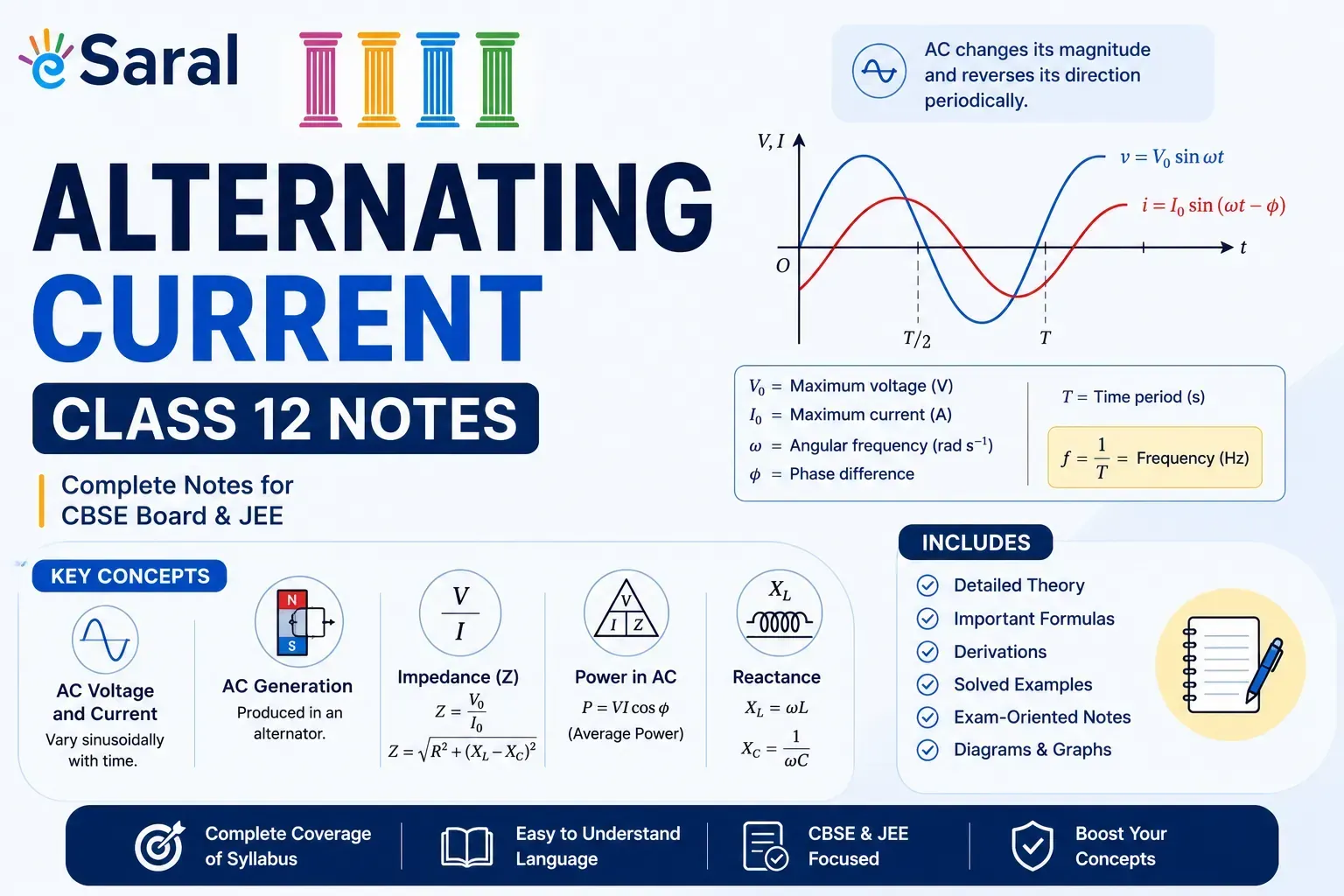
Alternating Current is Chapter 7 of NCERT Class 12 Physics. In the CBSE 2026-27 scheme, Chapters 4 to 7 (Moving Charges and Magnetism, Magnetism and Matter, Electromagnetic Induction and Alternating Current) carry 17 marks together. In the JEE Main 2026 syllabus, the chapter is part of Unit 14, together with Electromagnetic Induction. These Alternating Current Class 12 Notes follow the NCERT chapter, and they give the formula and the reason for each result.
Alternating Current Class 12 Notes: Chapter Overview and Syllabus
Topic | CBSE 2026-27 | JEE Main 2026 (Unit 14) |
|---|---|---|
Alternating voltage and current, peak and RMS values | Yes | Yes |
Reactance and impedance, AC through R, L and C | Yes | Yes |
Series LCR circuit and resonance | Yes | Yes |
LC oscillations | Check the latest syllabus (qualitative only in earlier years) | Not listed separately |
Power in AC circuits, power factor, wattless current | Yes | Yes (power and wattless current) |
AC generator | Yes | Yes |
Transformer | Yes | Yes |
Check the latest syllabi of CBSE and NTA, and the NMC syllabus for NEET, for the exact lists.
Tip from the eSaral Physics team: Always draw the phasor diagram before you write a formula for an AC circuit. If you know which of $X_L$ and $X_C$ is larger, you know the sign of the phase angle and whether the circuit is inductive or capacitive.
Alternating Current Class 12 Notes
India's Best Exam Preparation for Class 12th - Download Now
India's Best Exam Preparation for Class 12th - Download Now
India's Best Exam Preparation for Class 12th - Download Now
India's Best Exam Preparation for Class 12th - Download Now
India's Best Exam Preparation for Class 12th - Download Now
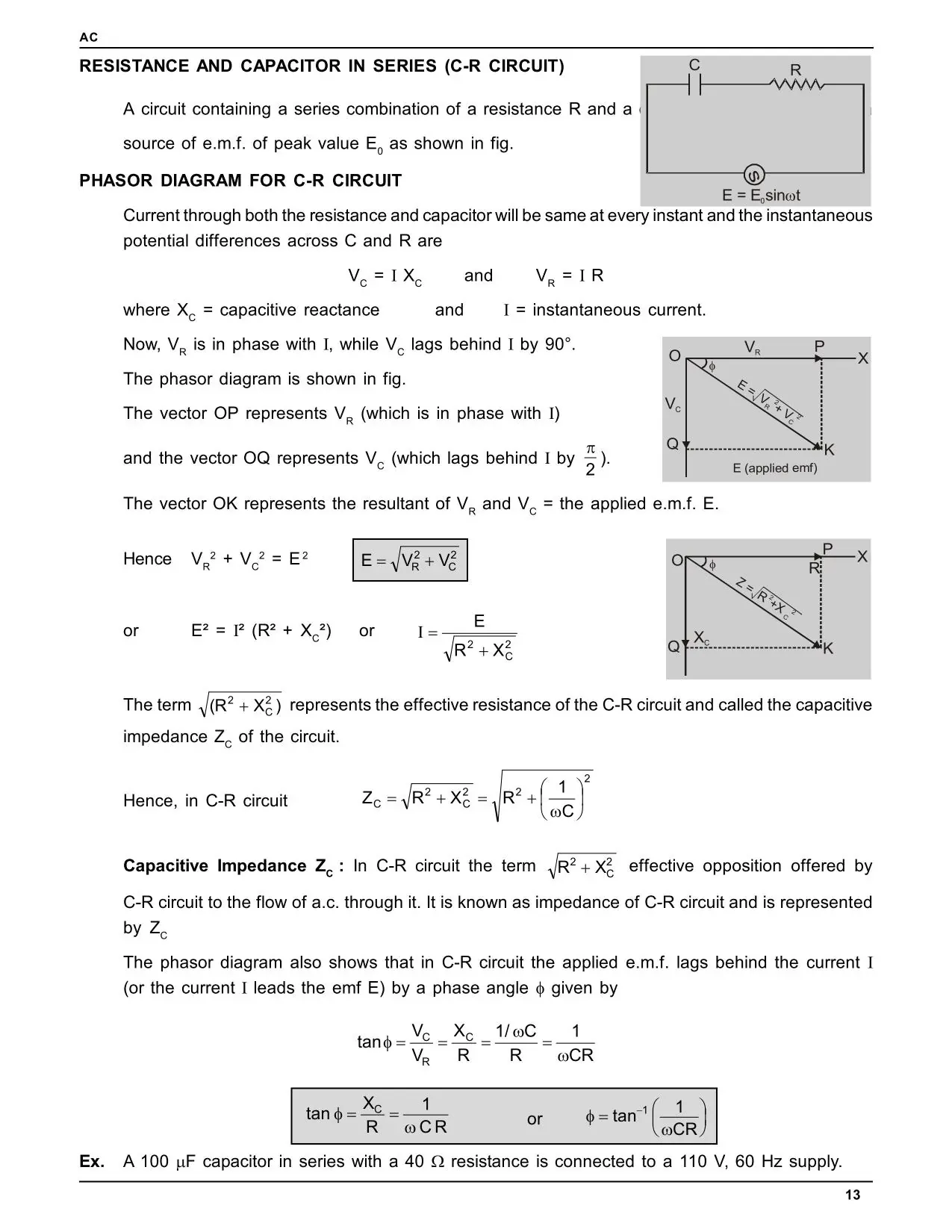
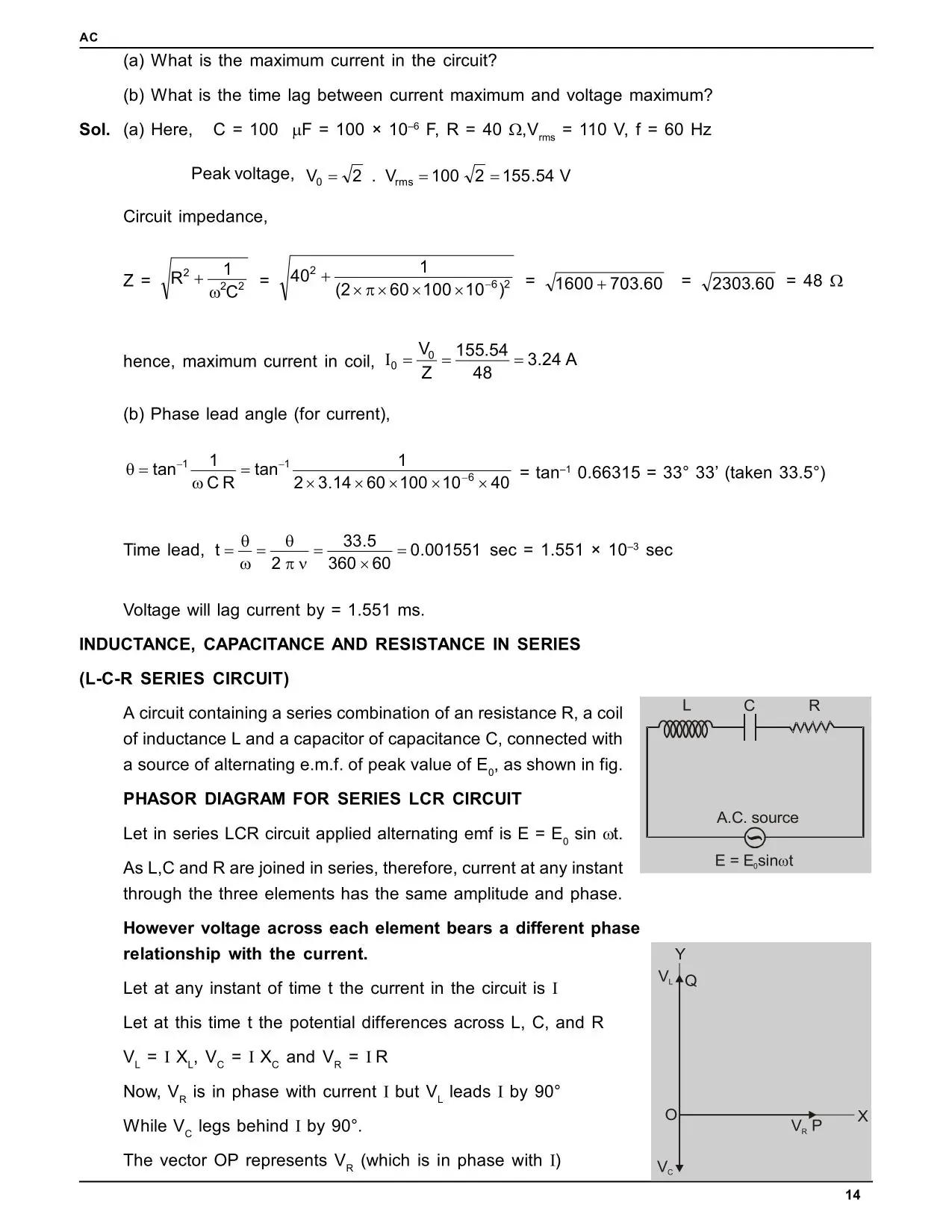
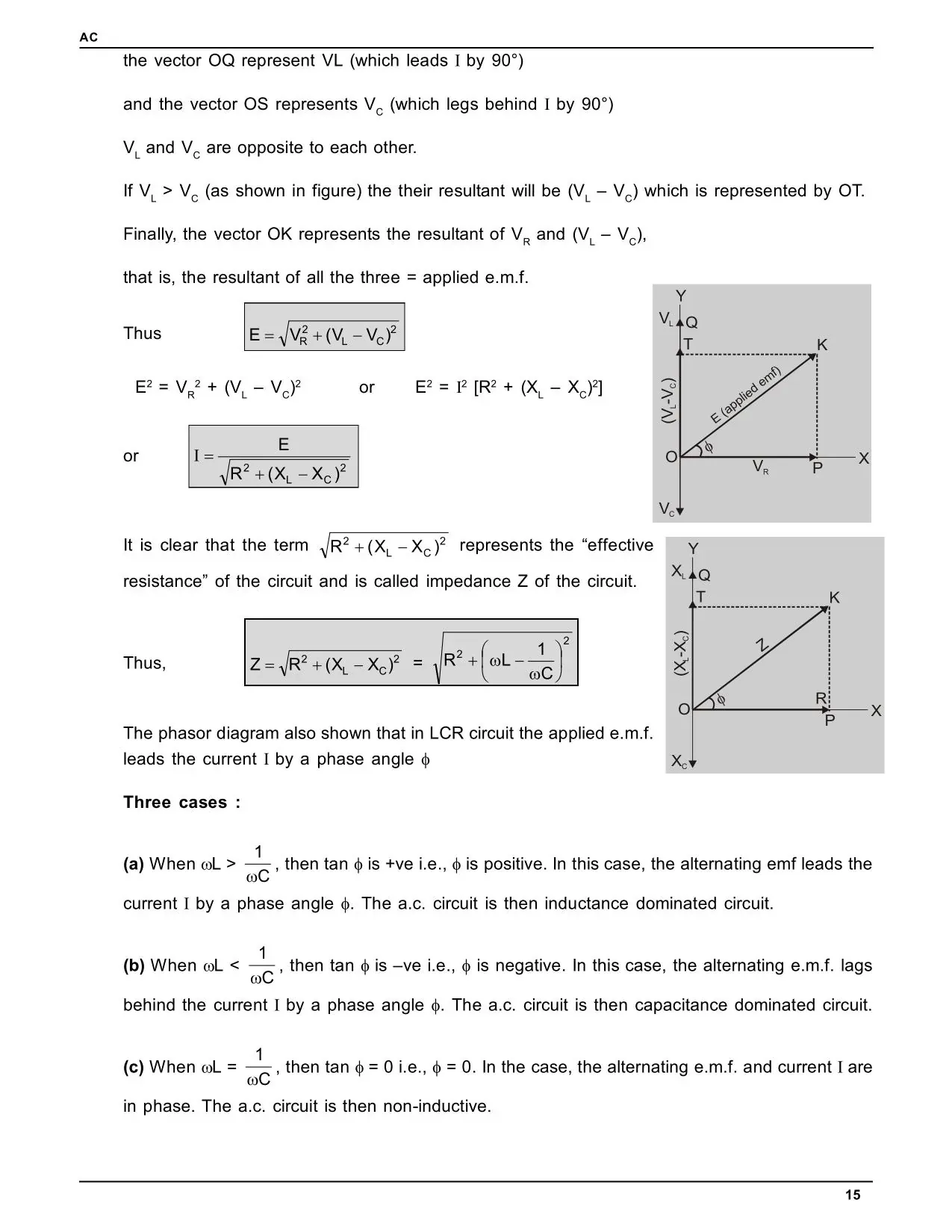
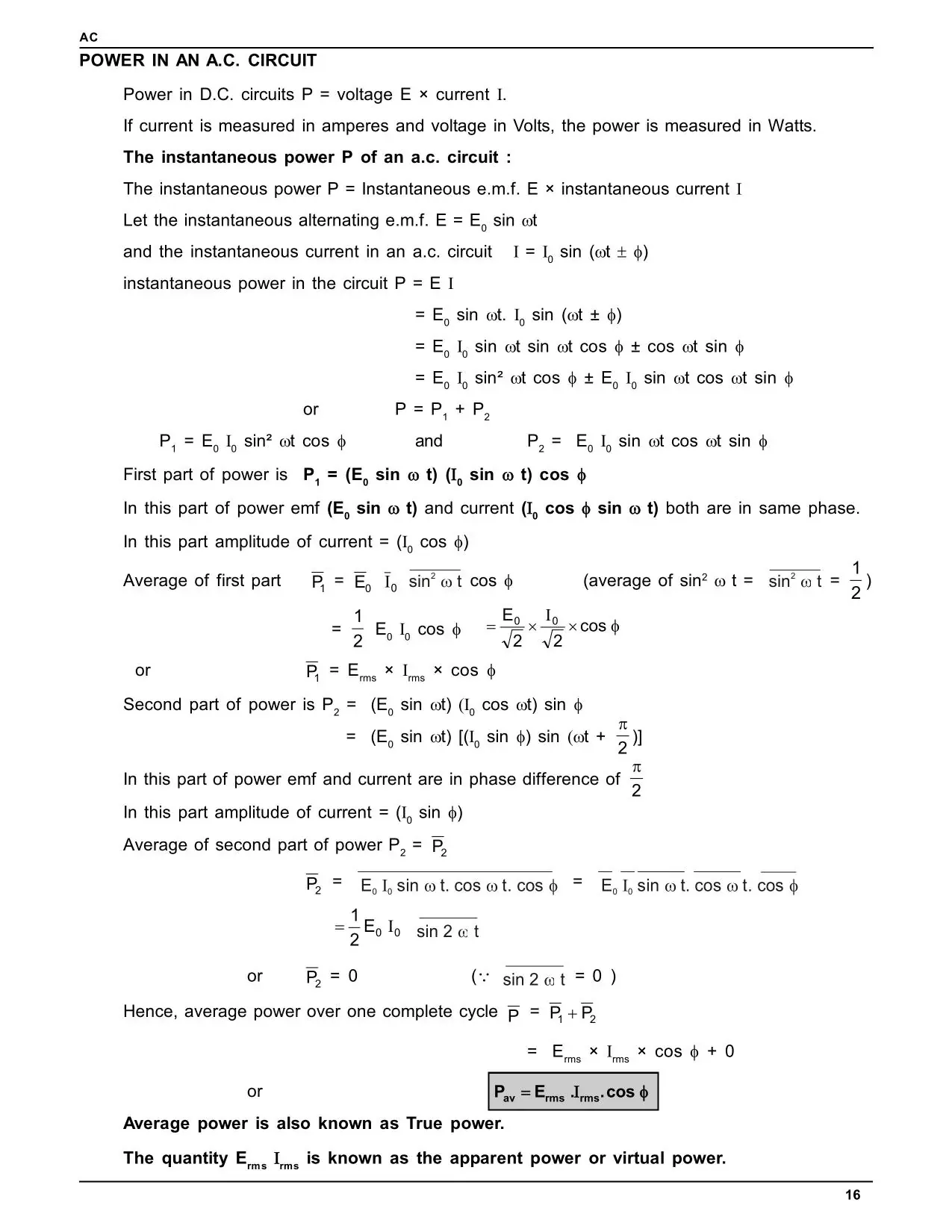
India's Best Exam Preparation for Class 12th - Download Now
India's Best Exam Preparation for Class 12th - Download Now
India's Best Exam Preparation for Class 12th - Download Now
What Is Alternating Current? in Alternating Current Class 12 Notes
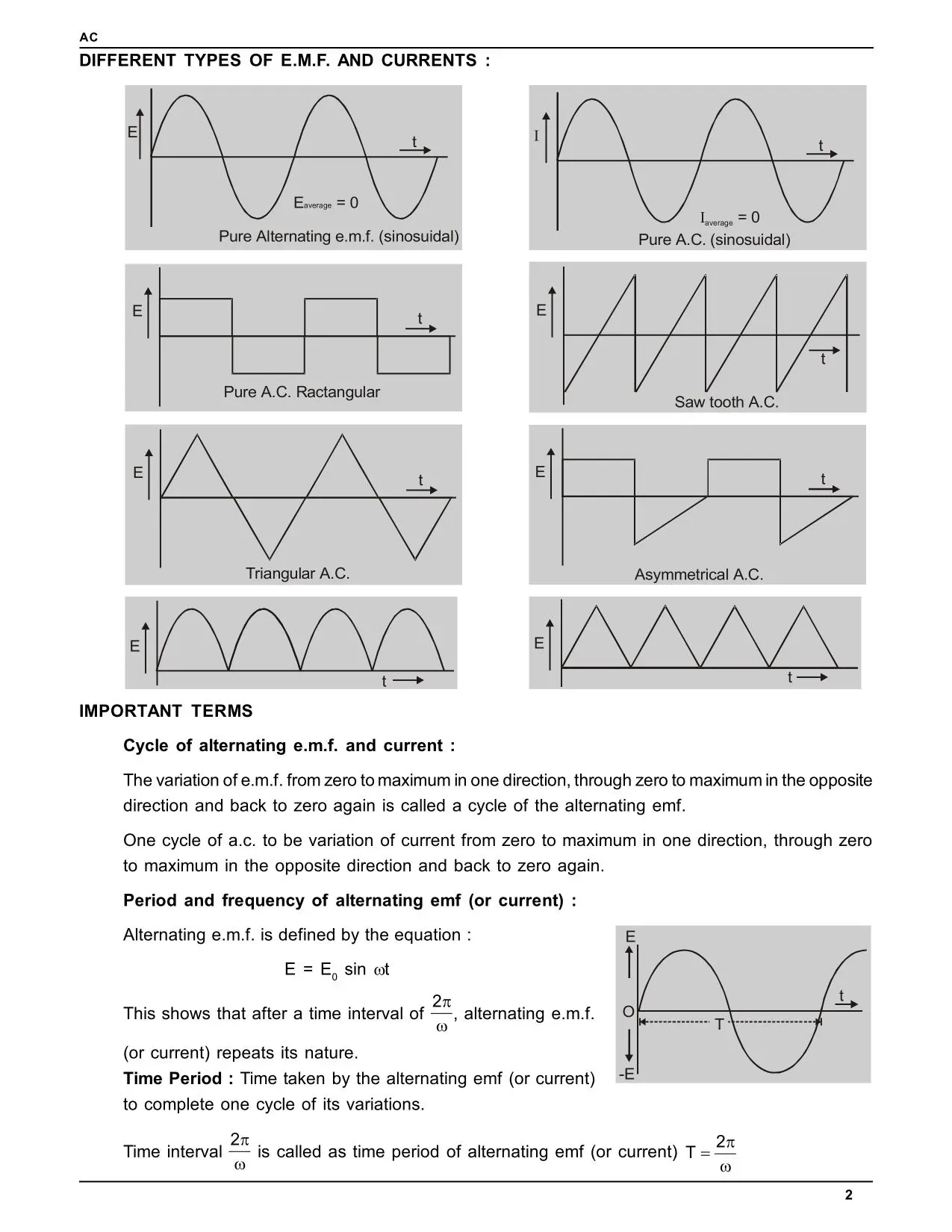
An alternating current changes its magnitude continuously with time, and it reverses its direction periodically. A sinusoidal alternating voltage and current are:
$$v = V_0\sin\omega t, \qquad i = I_0\sin(\omega t + \phi)$$
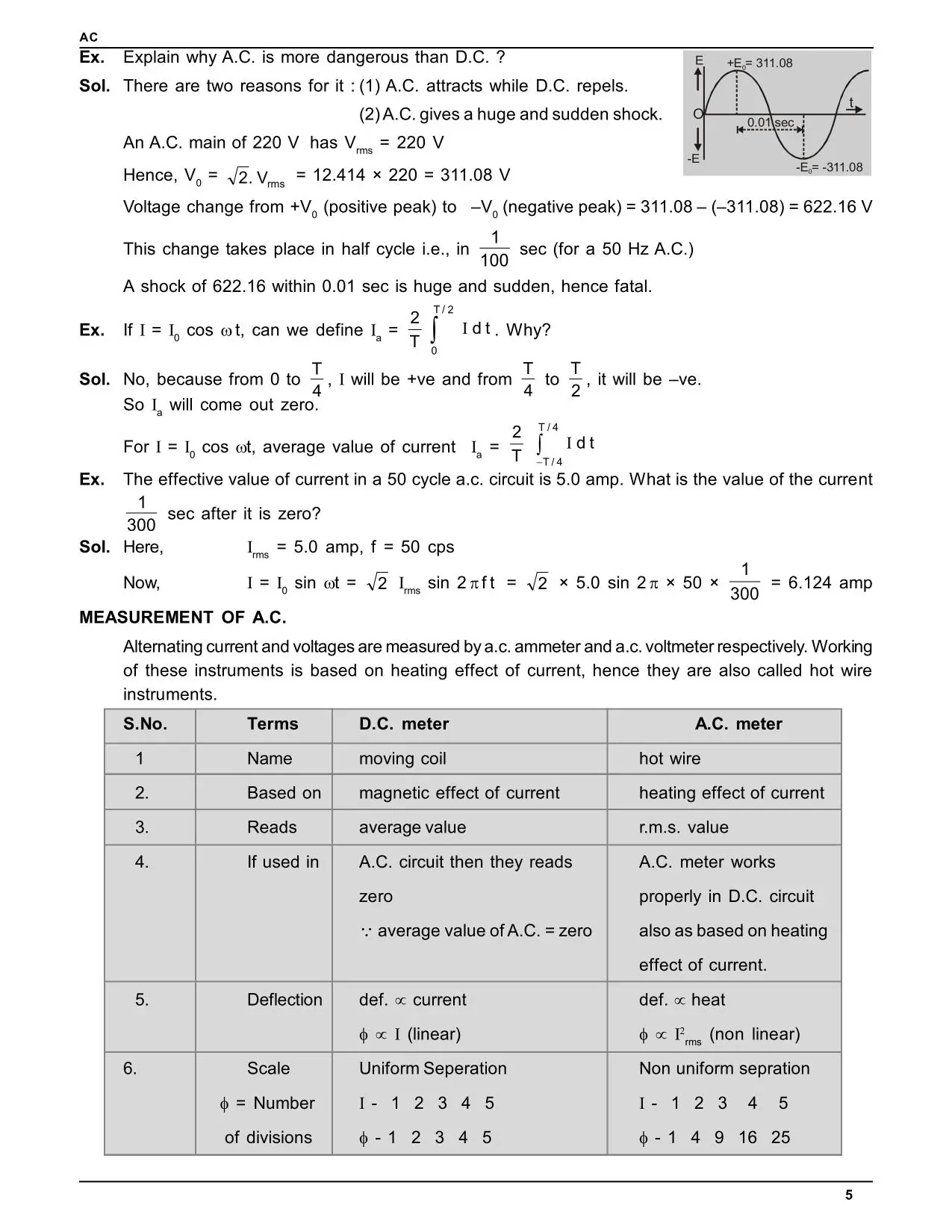
where $V_0$ and $I_0$ are the peak values, $\omega = 2\pi f$ is the angular frequency, $T = \dfrac{1}{f}$ is the time period, and $\phi$ is the phase difference between the current and the voltage. The household supply in India is 230 V (RMS) at 50 Hz. AC is used for power supply because its voltage can be changed easily with a transformer, and it can be sent over long distances with less loss.
Peak, RMS and Mean Values in Alternating Current Class 12 Notes
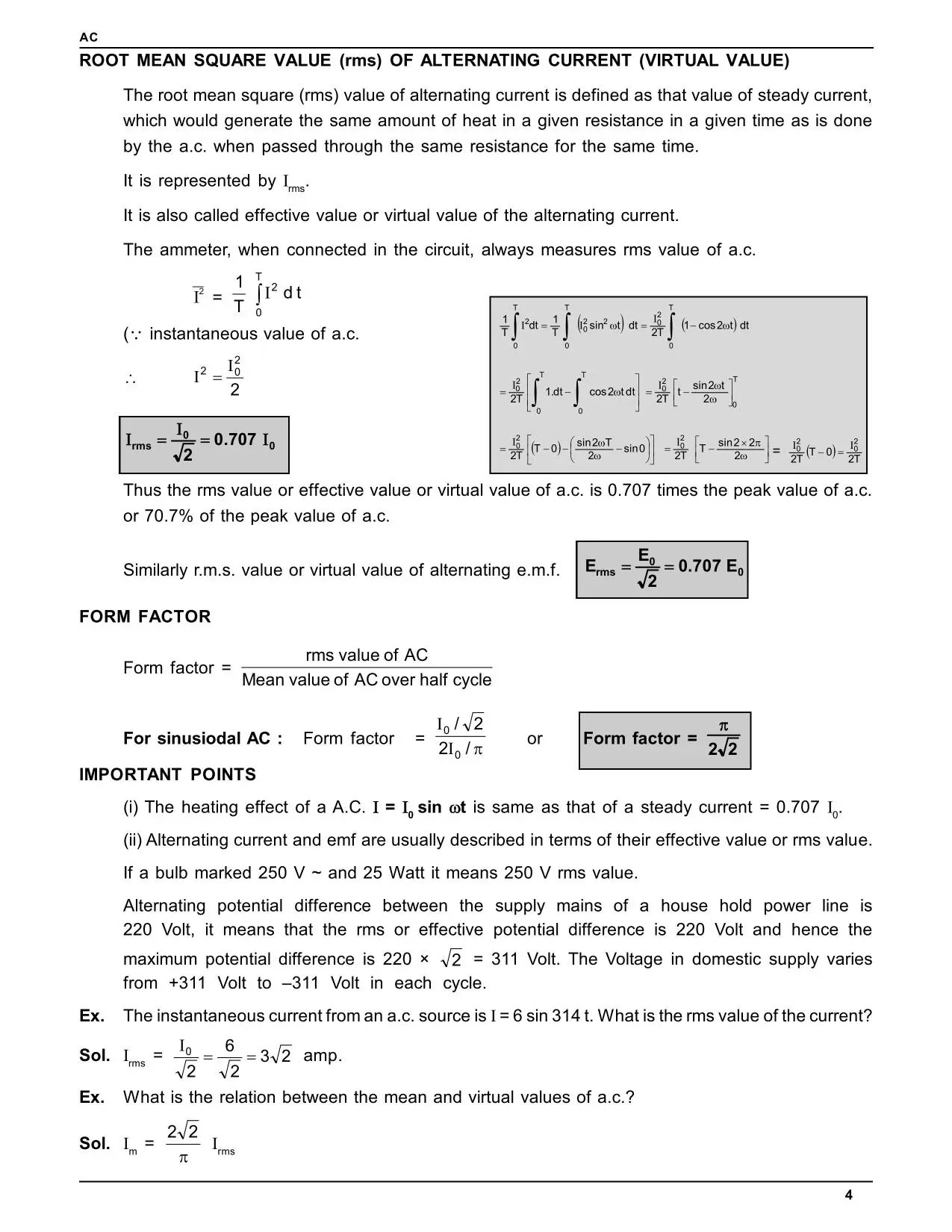
The average of a sinusoidal current over a full cycle is zero, so we use the RMS (root mean square) value, which is the DC value that gives the same heating in a resistor:
$$I_{rms} = \frac{I_0}{\sqrt{2}} \approx 0.707\,I_0, \qquad V_{rms} = \frac{V_0}{\sqrt{2}}$$
Value | Formula |
|---|---|
RMS value | $I_{rms} = \dfrac{I_0}{\sqrt{2}}$ |
Mean value over a half cycle | $\langle I\rangle = \dfrac{2I_0}{\pi} \approx 0.637\,I_0$ |
Mean value over a full cycle | $0$ |
Heat produced in a resistor | $H = I_{rms}^{2}\,R\,t$ |
AC ammeters and voltmeters read RMS values, and the rating of a household supply (230 V) is an RMS value.
AC Through a Resistor, an Inductor and a Capacitor in Alternating Current Class 12 Notes
Element | Reactance or resistance | Phase between current and voltage | Average power over a cycle |
|---|---|---|---|
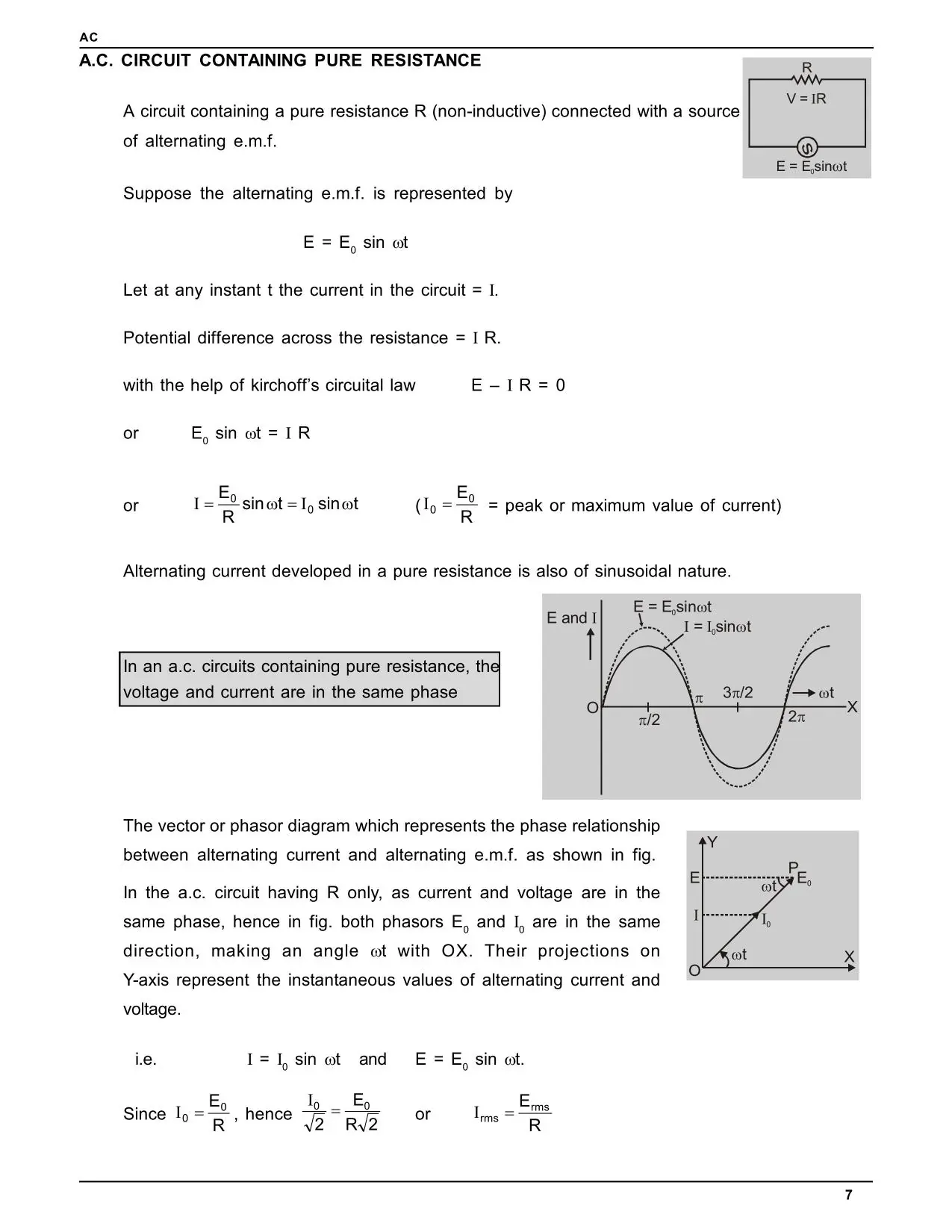
Resistor | $R$ | In phase | $V_{rms}I_{rms}$ |
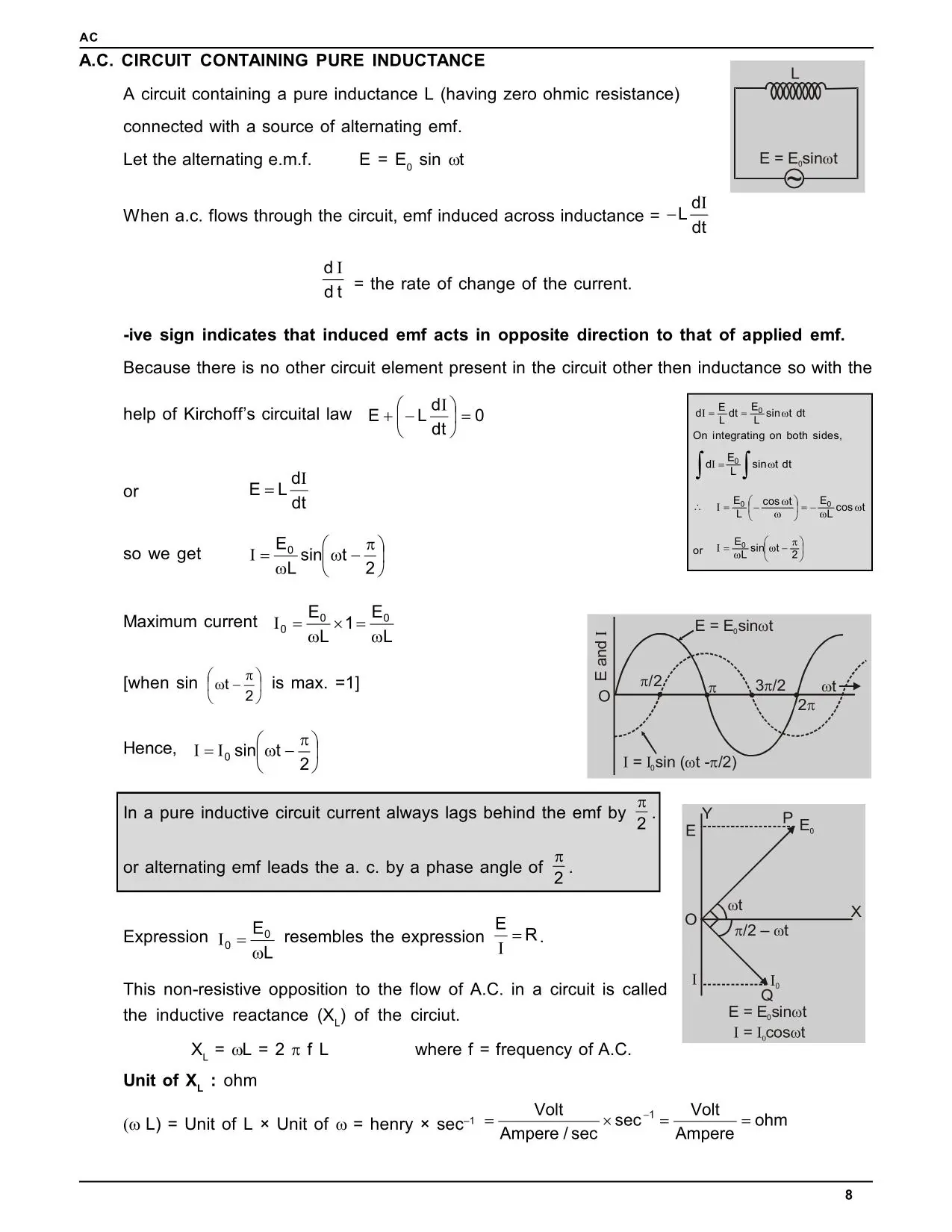
Inductor | $X_L = \omega L = 2\pi f L$ | Current lags the voltage by $\dfrac{\pi}{2}$ | $0$ |
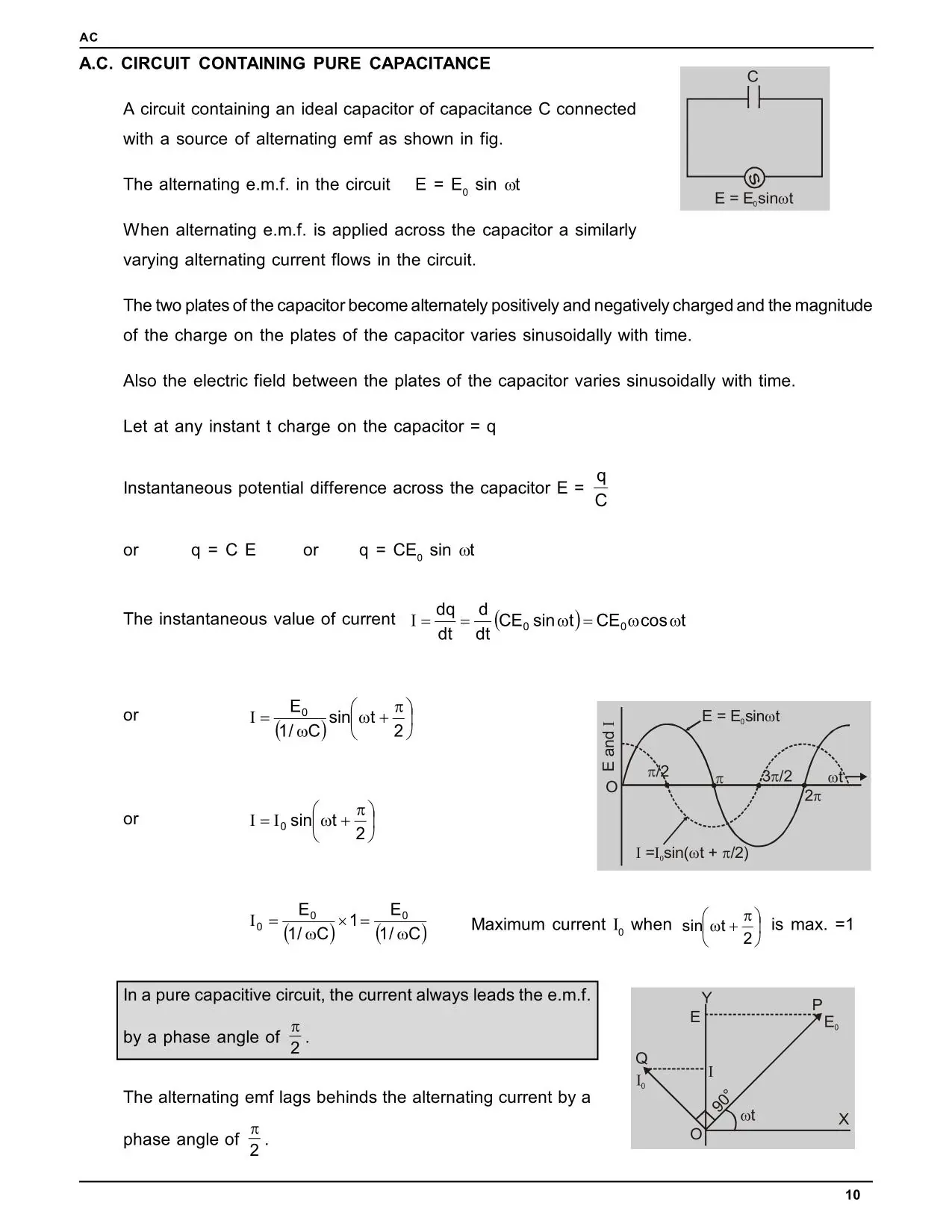
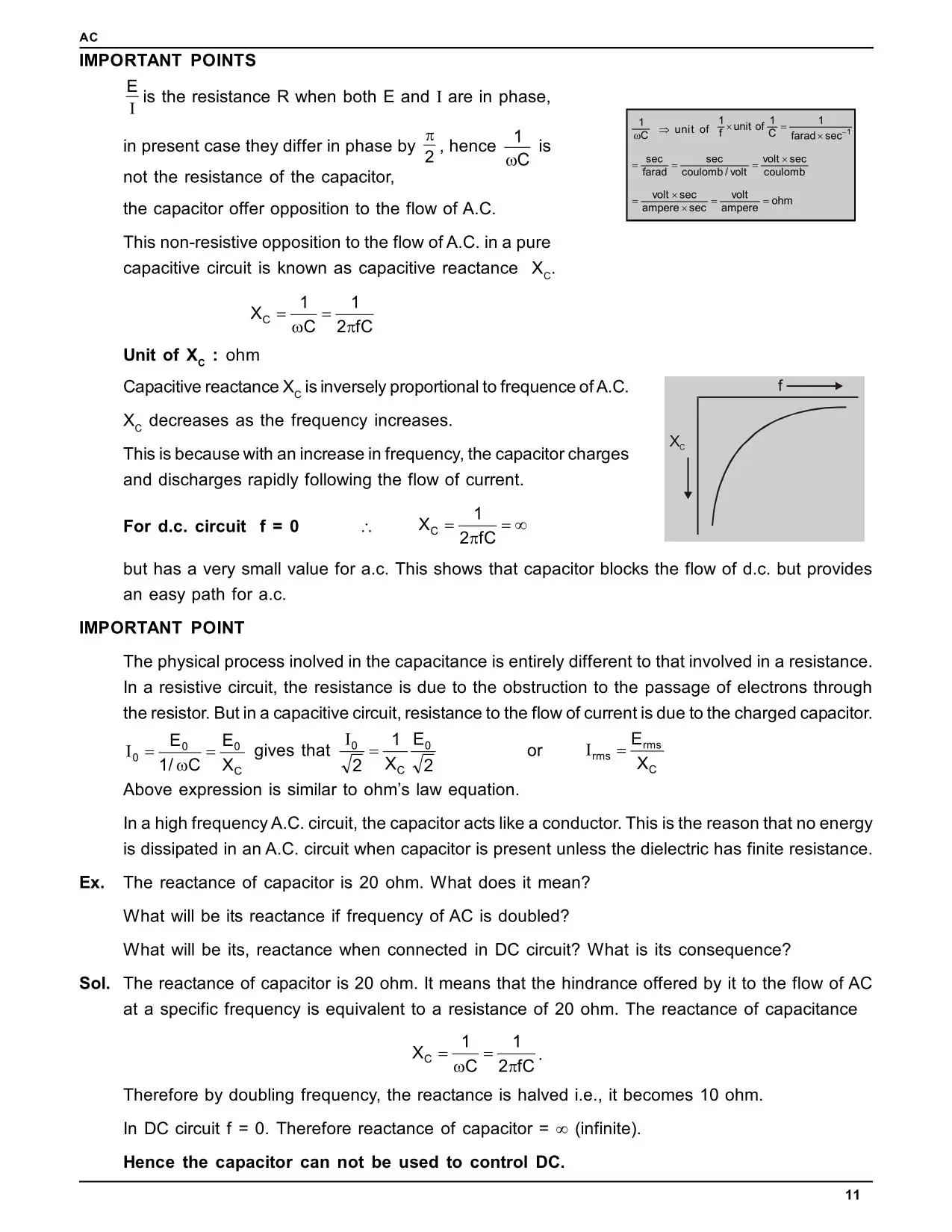
Capacitor | $X_C = \dfrac{1}{\omega C} = \dfrac{1}{2\pi f C}$ | Current leads the voltage by $\dfrac{\pi}{2}$ | $0$ |
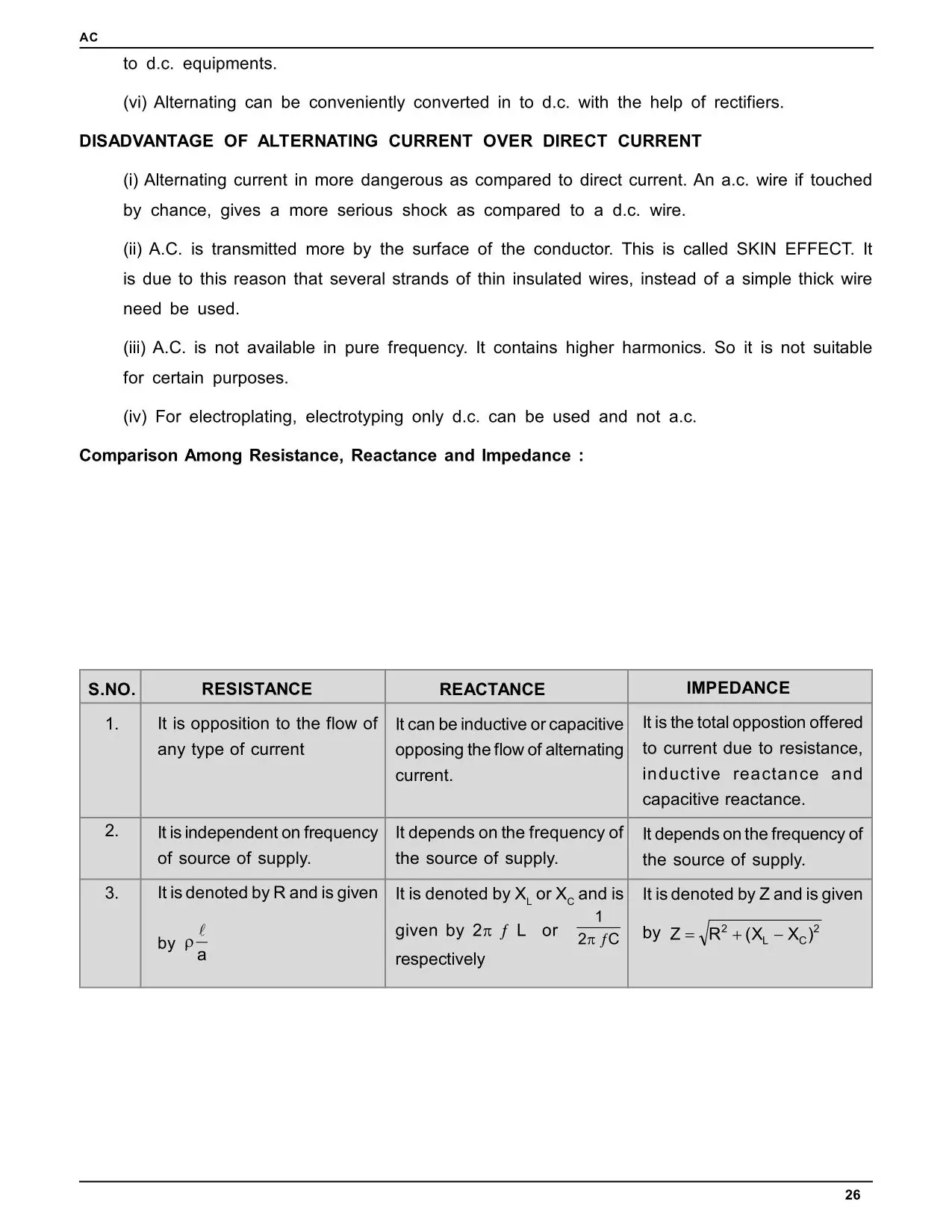
For each element, $I_0 = \dfrac{V_0}{R}$, $\dfrac{V_0}{X_L}$ or $\dfrac{V_0}{X_C}$, and the unit of reactance is the ohm. An inductor passes DC easily and opposes high frequencies, because $X_L$ rises with $f$. A capacitor blocks DC and passes high frequencies, because $X_C$ falls with $f$. A memory aid is “CIVIL”: in a capacitor (C), the current (I) leads the voltage (V), and in an inductor (L), the voltage leads the current.
Series LCR Circuit and Impedance in Alternating Current Class 12 Notes
In a series LCR circuit, the same current flows through R, L and C. The voltages $V_R$, $V_L$ and $V_C$ are added as phasors, with $V_L$ and $V_C$ opposite to each other:
$$V_0^{2} = V_R^{2} + (V_L - V_C)^{2}$$ $$Z = \sqrt{R^{2} + (X_L - X_C)^{2}}, \qquad I_0 = \frac{V_0}{Z}, \qquad \tan\phi = \frac{X_L - X_C}{R}$$
Condition | Nature of the circuit | Phase angle |
|---|---|---|
$X_L > X_C$ | Inductive: the voltage leads the current | $\phi > 0$ |
$X_L < X_C$ | Capacitive: the current leads the voltage | $\phi < 0$ |
$X_L = X_C$ | Resonance: purely resistive | $\phi = 0$ |
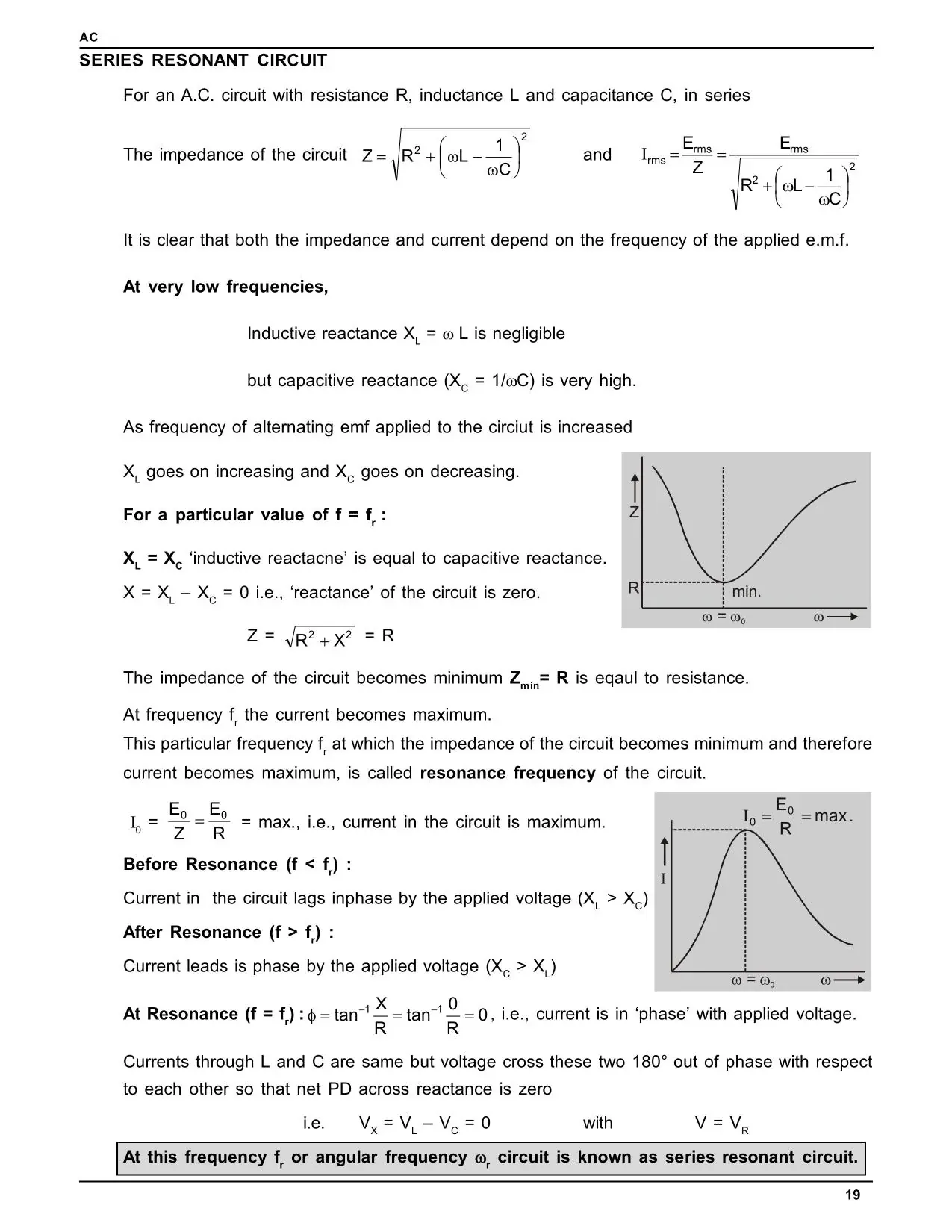
Resonance and Quality Factor in Alternating Current Class 12 Notes
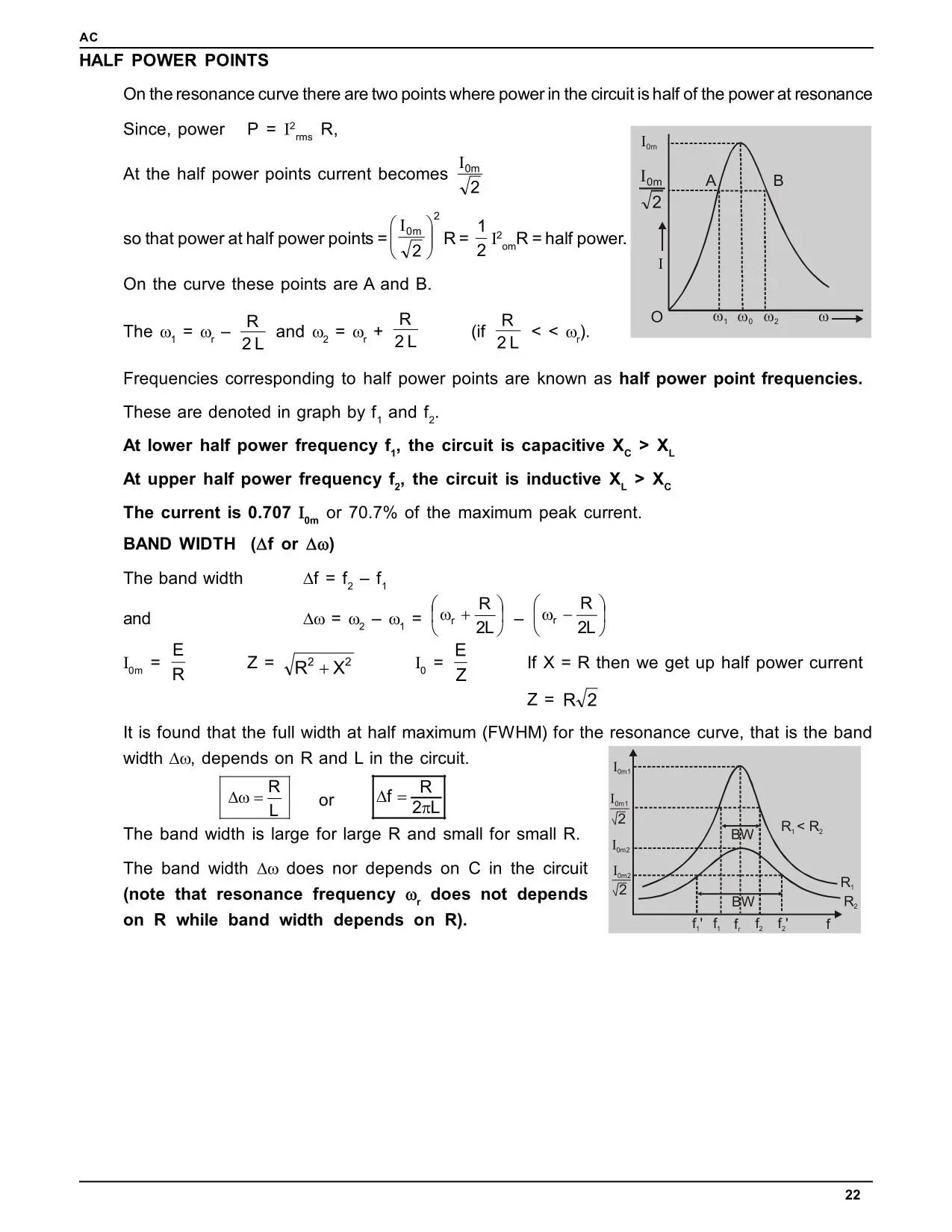
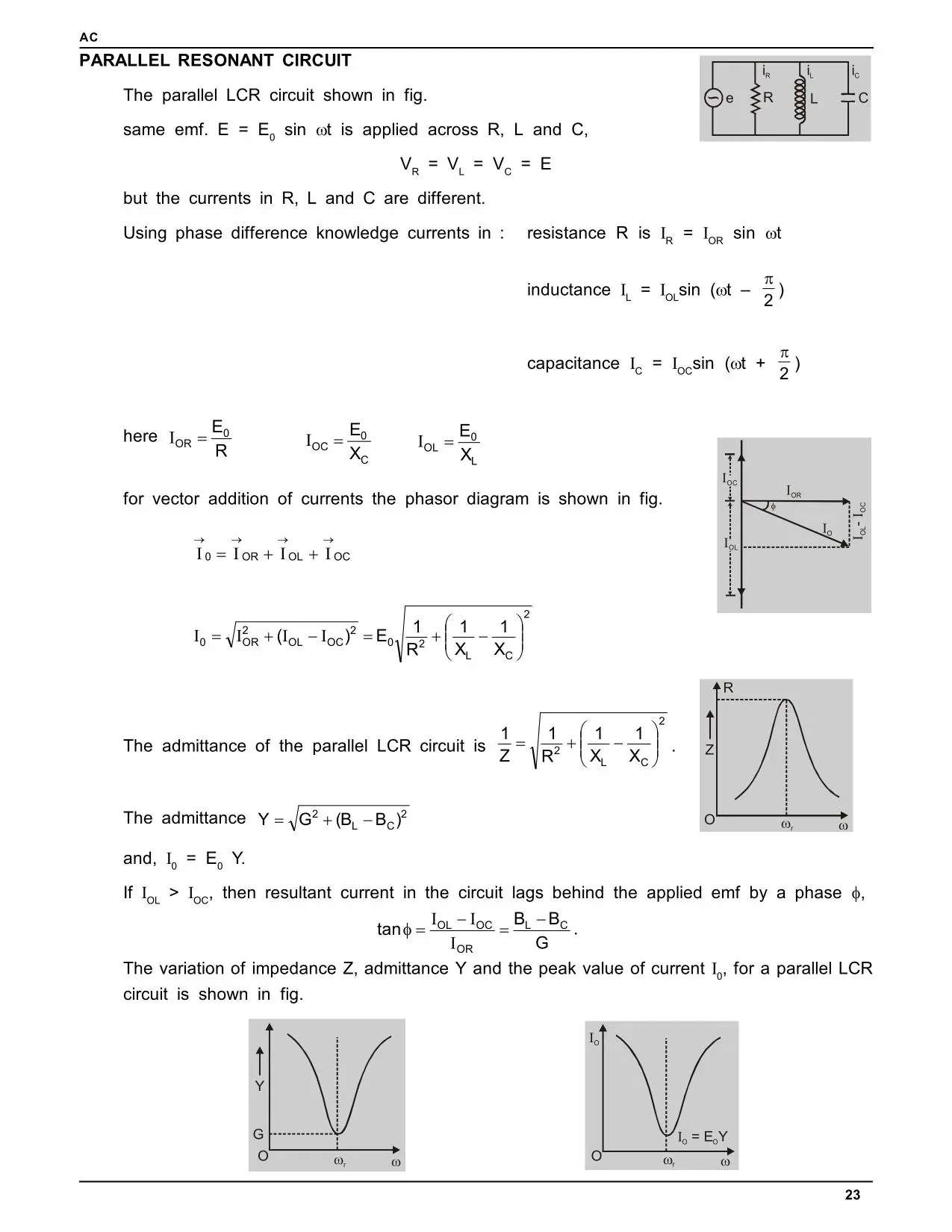
At resonance, $X_L = X_C$, so the impedance is minimum ($Z = R$), the current is maximum, and the phase angle is zero:
$$\omega_0 = \frac{1}{\sqrt{LC}}, \qquad f_0 = \frac{1}{2\pi\sqrt{LC}}, \qquad I_{max} = \frac{V}{R}$$
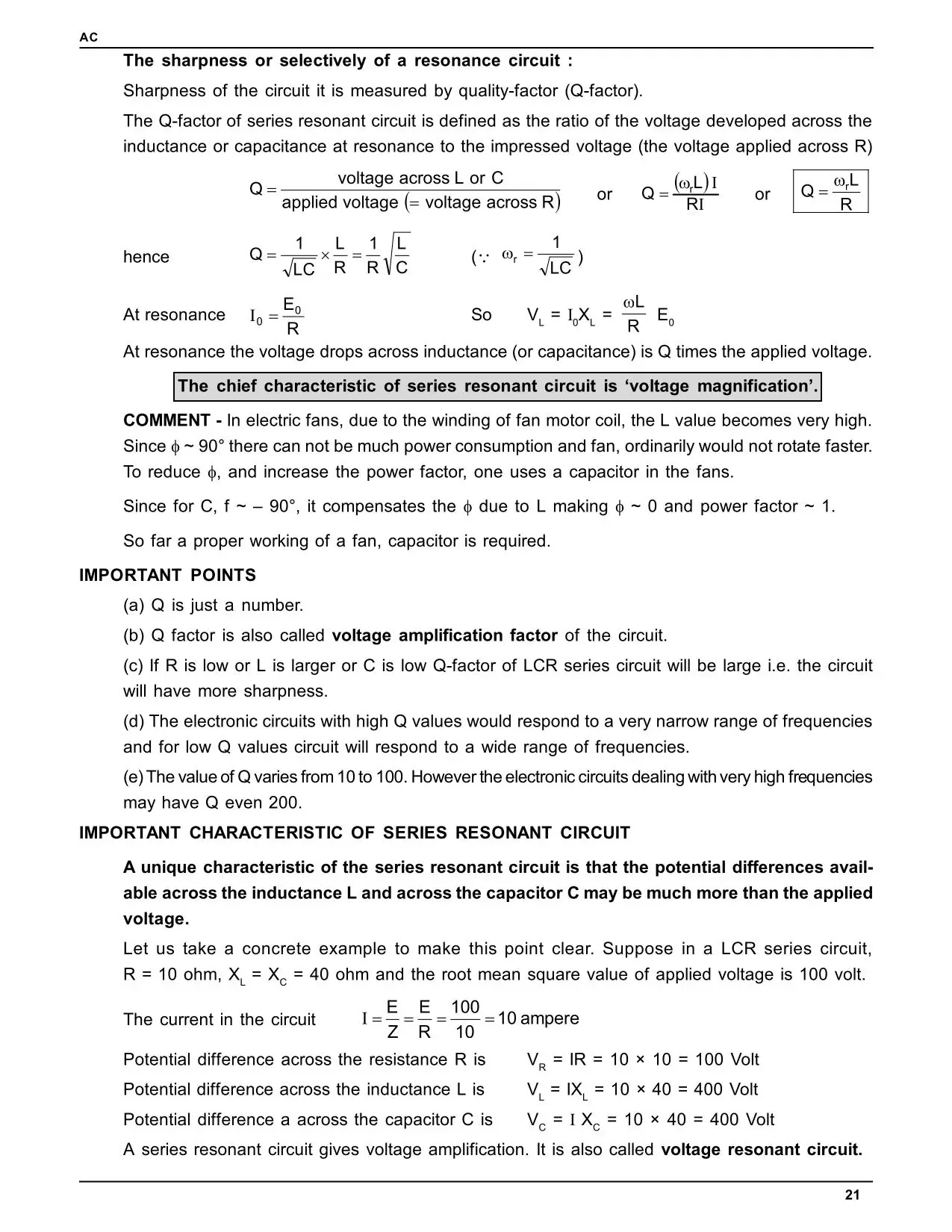
The quality factor measures how sharp the resonance is:
$$Q = \frac{\omega_0 L}{R} = \frac{1}{\omega_0 C R} = \frac{1}{R}\sqrt{\frac{L}{C}} = \frac{\omega_0}{2\Delta\omega}$$
where $2\Delta\omega = \dfrac{R}{L}$ is the bandwidth. A smaller resistance gives a larger $Q$, a sharper peak and a narrower bandwidth. A radio tuner uses resonance to pick one station.
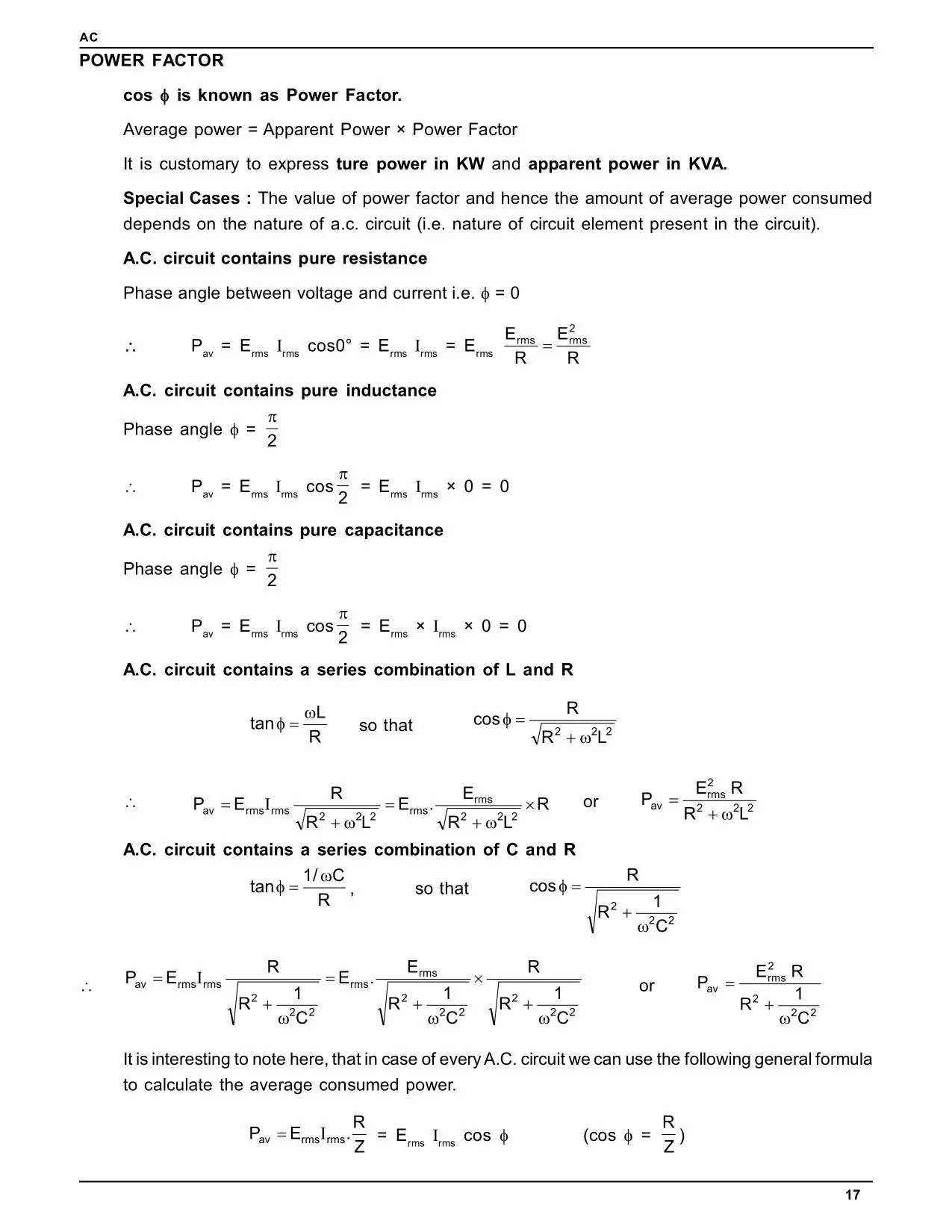
Power in an AC Circuit in Alternating Current Class 12 Notes
The average power over a cycle is:
$$P = V_{rms}\,I_{rms}\cos\phi, \qquad \cos\phi = \frac{R}{Z} \ \text{(power factor)}$$
- For a purely resistive circuit, $\phi = 0$ and $\cos\phi = 1$, so $P = V_{rms}I_{rms}$.
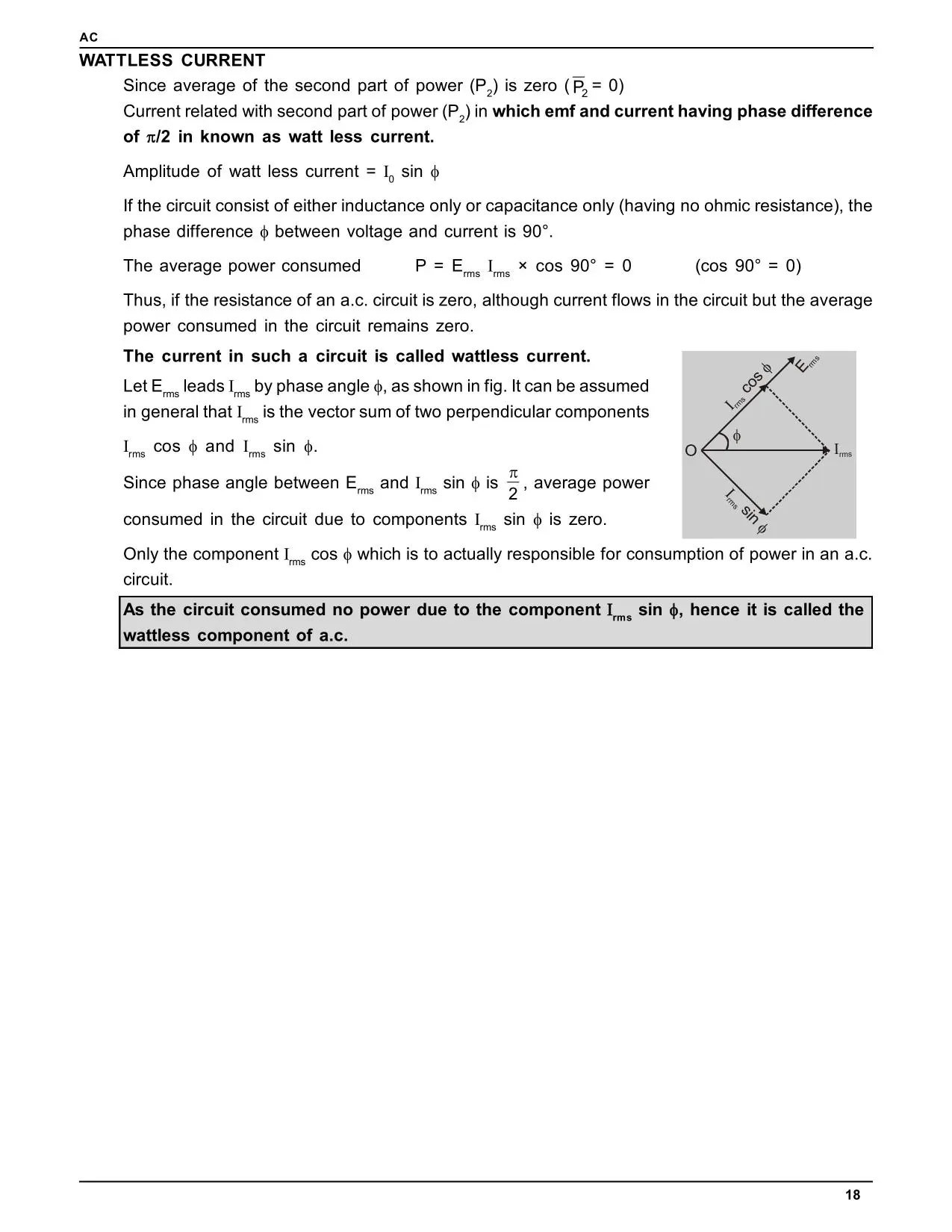
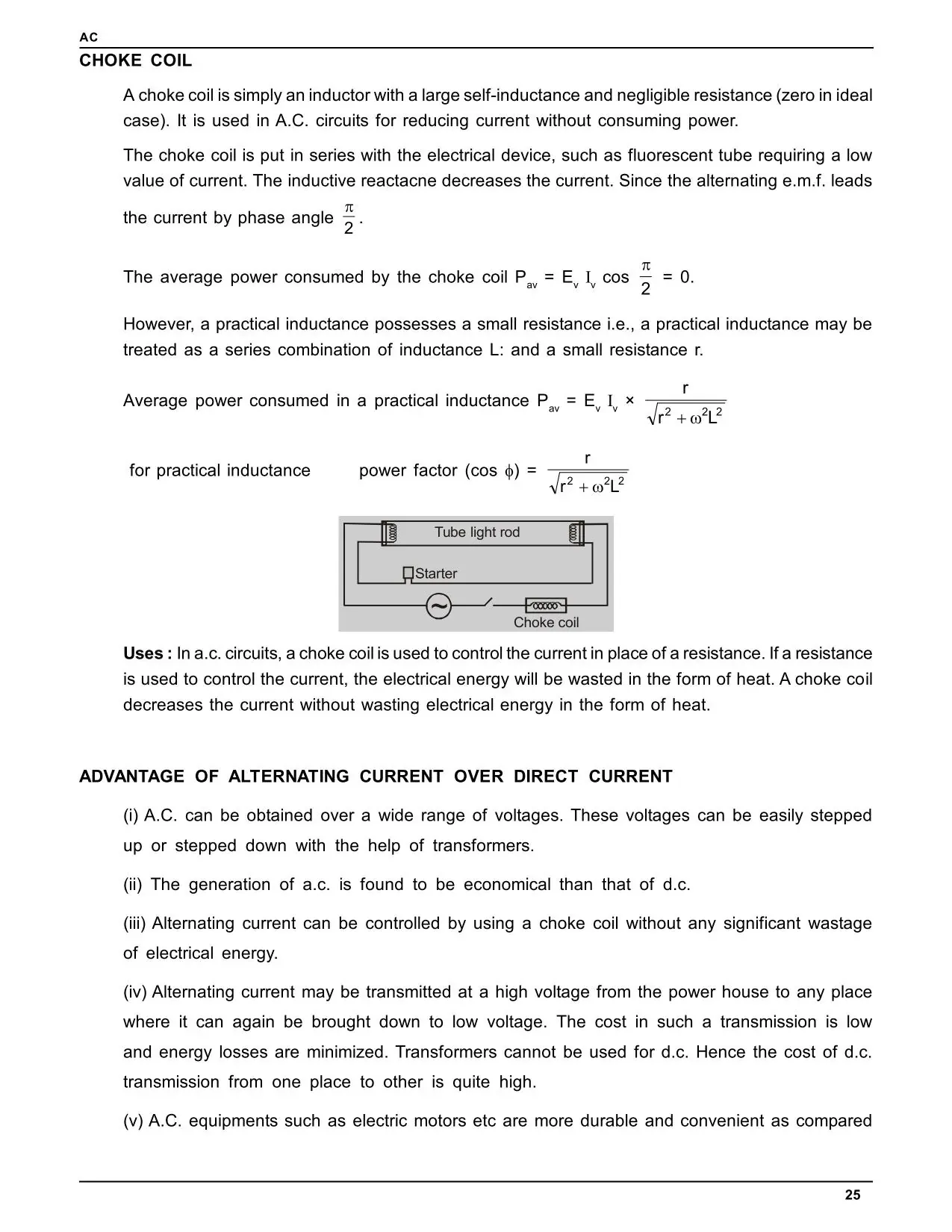
- For a pure inductor or a pure capacitor, $\phi = 90^\circ$ and $\cos\phi = 0$, so the average power is zero. The current in this case is called the wattless current, because it does not consume power.
- At resonance, $\cos\phi = 1$, so the power is maximum.
- A low power factor means that the circuit draws a larger current for the same useful power. A capacitor in parallel is used to improve it.
LC Oscillations in Alternating Current Class 12 Notes
When a charged capacitor is connected to an inductor, the energy moves between the electric field of the capacitor and the magnetic field of the inductor. The oscillation has the angular frequency $\omega_0 = \dfrac{1}{\sqrt{LC}}$, and the total energy stays constant (in the ideal case without resistance):
$$U = \frac{q^{2}}{2C} + \frac{1}{2}LI^{2} = \text{constant}$$
For CBSE, this topic was qualitative only in earlier syllabi, so check the latest CBSE syllabus.
AC Generator and Transformer in Alternating Current Class 12 Notes
AC Generator
A coil of $N$ turns and area $A$ rotating with the angular speed $\omega$ in a uniform field $B$ produces an emf by electromagnetic induction:
$$\varepsilon = NBA\omega\sin\omega t, \qquad \varepsilon_0 = NBA\omega$$
Transformer
A transformer works on mutual induction and changes the AC voltage. For an ideal transformer, with $N_p$ and $N_s$ turns in the primary and the secondary:
$$\frac{V_s}{V_p} = \frac{N_s}{N_p} = \frac{I_p}{I_s}$$
Type | Condition | Effect |
|---|---|---|
Step-up | $N_s > N_p$ | The voltage increases and the current decreases |
Step-down | $N_s < N_p$ | The voltage decreases and the current increases |
Efficiency: $\eta = \dfrac{P_{out}}{P_{in}}$, which is less than 1 for a real transformer. Losses and their remedies: copper loss ($I^2R$ in the windings, reduced by thick wire), eddy current loss (reduced by a laminated core), hysteresis loss (reduced by a soft iron core) and flux leakage (reduced by winding the coils over each other).
Key Formulas in Alternating Current Class 12 Notes
Concept | Formula |
|---|---|
RMS value | $I_{rms} = \dfrac{I_0}{\sqrt{2}}$ |
Inductive reactance | $X_L = \omega L$ |
Capacitive reactance | $X_C = \dfrac{1}{\omega C}$ |
Impedance of a series LCR circuit | $Z = \sqrt{R^2 + (X_L - X_C)^2}$ |
Phase angle | $\tan\phi = \dfrac{X_L - X_C}{R}$ |
Resonant frequency | $f_0 = \dfrac{1}{2\pi\sqrt{LC}}$ |
Quality factor | $Q = \dfrac{1}{R}\sqrt{\dfrac{L}{C}}$ |
Average power | $P = V_{rms}I_{rms}\cos\phi$ |
AC generator emf | $\varepsilon_0 = NBA\omega$ |
Ideal transformer | $\dfrac{V_s}{V_p} = \dfrac{N_s}{N_p} = \dfrac{I_p}{I_s}$ |
Solved Examples from Alternating Current Class 12 Notes
Example 1 (peak and RMS): The household supply is 230 V (RMS). Find the peak voltage.
$V_0 = \sqrt{2}\,V_{rms} = 1.414 \times 230 \approx 325$ V.
Example 2 (reactances): Find $X_L$ for $L = 0.1$ H and $X_C$ for $C = 100\ \mu$F, both at 50 Hz.
$X_L = 2\pi f L = 2\pi \times 50 \times 0.1 \approx 31.4\ \Omega$. $X_C = \dfrac{1}{2\pi f C} = \dfrac{1}{2\pi \times 50 \times 100 \times 10^{-6}} \approx 31.8\ \Omega$.
Example 3 (series LCR circuit): In a series LCR circuit, $R = 30\ \Omega$, $X_L = 80\ \Omega$ and $X_C = 40\ \Omega$, and the supply is 100 V (RMS). Find the impedance, the current, the phase angle and the average power.
$Z = \sqrt{30^2 + (80 - 40)^2} = 50\ \Omega$. $I_{rms} = \dfrac{100}{50} = 2$ A. $\tan\phi = \dfrac{40}{30}$, so $\phi \approx 53^\circ$ and $\cos\phi = 0.6$. $P = 100 \times 2 \times 0.6 = 120$ W, which equals $I_{rms}^2 R = 4 \times 30$.
Example 4 (resonance and Q): A series circuit has $L = 1$ mH, $C = 10\ \mu$F and $R = 2\ \Omega$, with a 10 V (RMS) source. Find the resonant frequency, the current at resonance and $Q$.
$f_0 = \dfrac{1}{2\pi\sqrt{10^{-3} \times 10^{-5}}} = \dfrac{1}{2\pi \times 10^{-4}} \approx 1592$ Hz. $I = \dfrac{V}{R} = 5$ A. $Q = \dfrac{1}{R}\sqrt{\dfrac{L}{C}} = \dfrac{1}{2}\sqrt{100} = 5$.
Example 5 (power factor): A circuit draws 5 A from a 220 V supply, and the current lags the voltage by $60^\circ$. Find the average power.
$P = V_{rms}I_{rms}\cos\phi = 220 \times 5 \times 0.5 = 550$ W.
Example 6 (transformer): A step-down transformer converts 2200 V to 220 V. The primary has 1000 turns, and the secondary current is 10 A. Find the number of secondary turns, and the primary current if the efficiency is 90%.
$N_s = N_p\dfrac{V_s}{V_p} = 1000 \times \dfrac{220}{2200} = 100$. $P_{out} = 220 \times 10 = 2200$ W, so $P_{in} = \dfrac{2200}{0.9} \approx 2444$ W, and $I_p = \dfrac{2444}{2200} \approx 1.11$ A.
Example 7 (RMS and mean values): The peak current of an AC is 10 A. Find the RMS value and the mean value over a half cycle.
$I_{rms} = \dfrac{10}{\sqrt{2}} \approx 7.07$ A. $\langle I\rangle = \dfrac{2 \times 10}{\pi} \approx 6.37$ A.
Example 8 (pure inductor): An inductor of 0.5 H is connected to a 220 V, 50 Hz supply. Find the RMS current, the phase relation and the average power.
$X_L = 2\pi \times 50 \times 0.5 \approx 157\ \Omega$, so $I_{rms} = \dfrac{220}{157} \approx 1.40$ A. The current lags the voltage by $90^\circ$, and the average power is zero.
Example 9 (AC generator): A coil has 100 turns and an area of 0.05 m². It rotates at 50 Hz in a field of 0.2 T. Find the peak and the RMS emf.
$\varepsilon_0 = NBA\omega = 100 \times 0.2 \times 0.05 \times 2\pi \times 50 \approx 314$ V. $\varepsilon_{rms} = \dfrac{314}{\sqrt{2}} \approx 222$ V.
Common Mistakes in Alternating Current Class 12 Notes Problems
Mistake | Correct approach |
|---|---|
Using the peak value in $P = VI\cos\phi$ | Use RMS values for the average power |
Adding $R$, $X_L$ and $X_C$ directly | Add them as phasors: $Z = \sqrt{R^2 + (X_L - X_C)^2}$ |
Saying that the current leads the voltage in an inductor | In an inductor, the current lags. In a capacitor, it leads. |
Thinking that the power is $VI$ at resonance for any circuit | At resonance, $\cos\phi = 1$, so $P = V_{rms}I_{rms}$, and it equals $V^2/R$ |
Thinking that the wattless current is zero | It is non-zero, but it consumes no average power |
Using $\dfrac{V_s}{V_p} = \dfrac{N_p}{N_s}$ | $\dfrac{V_s}{V_p} = \dfrac{N_s}{N_p}$, and $\dfrac{I_s}{I_p} = \dfrac{N_p}{N_s}$ |
Assuming that a step-up transformer increases the power | It increases the voltage, but the power cannot increase |
Taking the mean value over a full cycle as $\dfrac{2I_0}{\pi}$ | Over a full cycle it is zero, and $\dfrac{2I_0}{\pi}$ is for a half cycle |
How to Study Alternating Current Class 12 Notes
- Read the NCERT chapter first, and download the textbook from eSaral’s NCERT Class 12 Physics book page.
- Learn the table of R, L and C (reactance and phase), and then practise the phasor diagram of the series LCR circuit.
- Solve one problem each on RMS values, impedance, resonance and Q, power factor and the transformer.
- Use eSaral’s Complete Class 12 Physics notes for all the chapters, and the free Physics revision series on YouTube for quick formula revision.
- Revise the unit with eSaral’s JEE Main Physics revision notes (Unit 14), and test yourself with eSaral’s JEE Main chapter-wise PYQs and NEET chapter-wise PYQs.
Frequently Asked Questions
What is resonance in an LCR circuit?
Resonance occurs when the inductive reactance equals the capacitive reactance, $X_L = X_C$, at the resonant frequency $f_0 = \dfrac{1}{2\pi\sqrt{LC}}$. At resonance, the impedance is minimum ($Z = R$), the current is maximum, and the phase angle is zero. The quality factor $Q = \dfrac{1}{R}\sqrt{\dfrac{L}{C}}$ shows how sharp the resonance is. eSaral’s Alternating Current Class 12 Notes show this with a worked example.
What is the RMS value of AC, and why is it important?
The RMS value is $I_{rms} = \dfrac{I_0}{\sqrt{2}} \approx 0.707\,I_0$. It is the DC value that produces the same heating in a resistor. AC meters and the household rating (230 V) use RMS values, not peak values. In Alternating Current Class 12 Notes, it is the first thing to learn.
What is alternating current in Class 12 Physics?
An alternating current is a current that changes its magnitude continuously and reverses its direction periodically, usually as $i = I_0\sin\omega t$. The chapter covers RMS values, R, L and C in AC circuits, the series LCR circuit, resonance, power, the AC generator and the transformer. In Alternating Current Class 12 Notes, these topics are in the same order as in NCERT.
Which topics of Alternating Current are most important for JEE Main?
The series LCR circuit (impedance and phase angle), resonance and the quality factor, the power factor and wattless current, the RMS and mean values, and the transformer. The JEE Main 2026 syllabus lists reactance and impedance, the LCR series circuit, resonance, power in AC circuits, wattless current, the AC generator and the transformer. The number of questions changes every year, so check previous years’ papers.
How does a transformer work, and what are its losses?
A transformer works on mutual induction: a changing current in the primary coil induces a voltage in the secondary coil. For an ideal transformer, $\dfrac{V_s}{V_p} = \dfrac{N_s}{N_p}$. The losses are copper loss, eddy current loss (reduced by lamination), hysteresis loss and flux leakage. These Alternating Current Class 12 Notes list the remedy for each loss.
What is the power factor in an AC circuit?
The power factor is $\cos\phi = \dfrac{R}{Z}$, where $\phi$ is the phase angle between the voltage and the current. The average power is $P = V_{rms}I_{rms}\cos\phi$. It is 1 for a purely resistive circuit and 0 for a pure inductor or capacitor, where the current is wattless.
Why does the current lag the voltage in an inductor and lead it in a capacitor?
An inductor opposes a change in current, so the current reaches its peak a quarter of a cycle after the voltage. A capacitor needs charge to flow before its voltage builds up, so the current reaches its peak a quarter of a cycle before the voltage. A memory aid is CIVIL.
Which chapter number is Alternating Current in Class 12 Physics?
In the NCERT Class 12 Physics book, Alternating Current is Chapter 7. In the CBSE 2026-27 scheme, Chapters 4 to 7 carry 17 marks together. These Alternating Current Class 12 Notes follow the NCERT chapter.
Where can I find more Class 12 Physics notes on eSaral?
eSaral has chapter-wise Class 12 Physics notes, NCERT books, JEE Main and NEET chapter-wise PYQs, a free Physics revision series on YouTube and these Alternating Current Class 12 Notes, all linked on this page.
Team eSaral
eSaral Academic and Editorial Team
Team eSaral is the collective author profile for educational content created by eSaral’s teachers and academic contributors. The team draws on expertise from IIT graduates, doctors, experienced educators and subject specialists to develop resources for JEE, NEET and school students. Our articles aim to explain concepts clearly and help students study with confidence.
Related Posts

BITSAT 2027: Registration Date, Exam Date, Syllabus, Eligibility, Pattern & Fees
BITSAT 2027 exam dates, registration timeline, eligibility criteria, exam pattern, marking scheme, syllabus and fees in one page.

BITSAT Previous Year Question Paper PDF (2017-2026)
Download BITSAT previous year question papers PDF from 2017 to 2026,session-wise. Memory-based papers,exam pattern, paper analysis and how to practise

CBSE Class 10 Date Sheet 2027: Expected Exam Dates, Release Date, Admit Card & Result Timeline
CBSE Class 10 date sheet 2027 is awaited. See the expected exam dates, release window, how to download the PDF, admit card and result timelines.

NCERT Physics Class 10 Book PDF in Hindi 2026-27 – भौतिक विज्ञान के 4 अध्याय (Free Download)
NCERT Physics Class 10 book PDF in Hindi 2026-27: download all 4 chapters (अध्याय 9–12) free, with topics and important formulas.

NCERT Biology Class 9 Book Anveshan PDF in Hindi - जीव विज्ञान कक्षा 9 पुस्तक अन्वेषण PDF
Download NCERT Biology Class 9 book PDF in Hindi chapterwise for 2026-27: Cell, Tissues, Reproduction and Diversity. Free PDFs.

Essay On Artificial Intelligence in English (100,150, 200, 250, 300, 500 Words)
This is in contrast to the natural intelligence of humans. With Artificial Intelligence, machines can perform

Essay on 78th India Independence Day in English for Student (100, 150, 200, 250, 300, 500 Words)
Read the best essays on India's Independence Day in English. Short & long essays (100, 150, 200, 250, 300, 500 words) perfect for school exams
NCERT Class 11 English Snapshots book - Free PDF download- Esaral
Download NCERT Class 11 English Snapshots book PDF for free. Get all 8 chapters, chapter-wise. Start your prep today!
NCERT Class 10 biology book pdf - Free PDF Download - eSaral
NCERT Class 10 Biology book PDF 2026-27: all 5 chapters (Life Processes to Our Environment) in English & Hindi, with CBSE syllabus, marks & practical

Essay on Global Warming in English (100,150, 200, 250, 300, 500 Words)
Global warming means the Earth is getting hotter. This happens because of things like pollution from cars and factories.