
Applications of Colloids | Catalysis & its Types for Class 12, IIT-JEE, NEET

eSaral Academic and Editorial Team
Applications of Colloids
Colloids play an important role in our daily life and industry. Some of the important applications of colloids are listed below.

Adsorption Indicators
Indicators like fluoresce in function by adsorption of ions on to sol particles When silver nitrate solution is run into a solution of sodium chloride containing a fluoresce in a white precipitate of AgCl is first formed. At the end point the white precipitate turns sharply pink.
Tanning
Animal leather (skin) is soft due to the presence of very fine globules oils and fats in the' pores of skin. These globules are of colloidal in nature. When this soft leather (skin) is placed in salt water, these globules of oils and fats coagulate and settle down in water. Now when the animal hides tare dried, they become hand. This process of making soft leather to hard leather by dipping it in salt water is called tanning usually chromium salts are used for tanning.
Clearing action of soaps and detergents
Dust and dirt particles on clothes are colloidal in nature soaps being sodium salts of higher fatty acids coagulates them which become suspension particles called micelle and roll out due to greater volume and greater mass.
Industrial products
Paints, inks, synthetic plastics, rubber, graphite lubricants, cement, etc are all colloidal solutions. Colloidal solution of graphite in water is called “Aqua dag” while that in Oil is called oil dag.
Adsorption & Catalysis
Adsorption
The phenomenon of increase in concentration at the surface due to molecular surface force is known as adsorption.
Adsorbent
The solid substance on the surface of which adsorption takes place is called adsorbent. Examples of absorbents are activated charcoal, Pt, Pd, Ni etc.
Adsorbate
The substances, gases or-liquids which are adsorbed on the surface of adsorbent are called adsorbent.
Sorption
lt may be defined as the process in which both adsorption and absorption take place simultaneously.
Absorption
When a substance is uniformly distributed throughout the body of a solid of liquid, the phenomenon is called absorption.
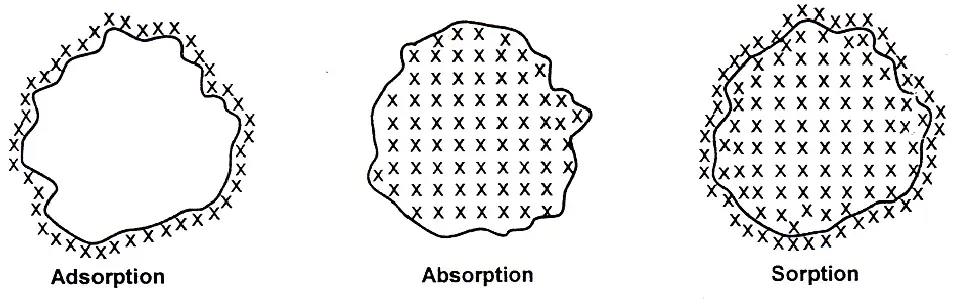
Mechanism of Adsorption
Adsorption is due to the fact that the surface particles of the adsorbent are in different state than the particles inside the bulk. Inside the adsorbent all the forces acting between the particles are mutually balanced but on the surface particles are not surrounded by atoms or molecules of their kind on all sides and hence they possess unbalanced or residual attractive forces.
Types of adsorption
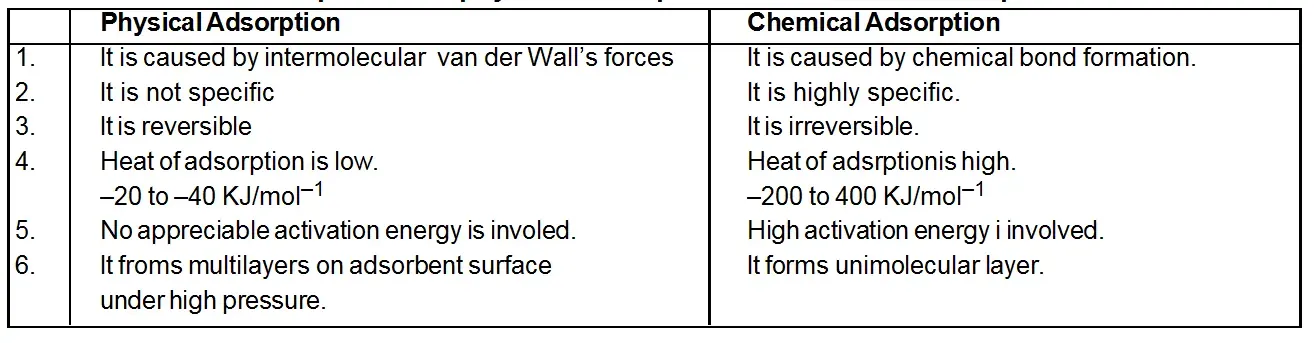
Depending upon the nature of forces between molecules of adsorbate and adsorbent, adsorption is of two types.
Comparison of physical adsorption and Chemical adsorption
- Nature of adsorbate: Readily liquefiable gases such as HCl, etc. are more. easily adsorbed by and adsorbent than the permanent gases etc.
- Nature of absorbent: - Activated charcoal is a better adsorbent than transitional metals.
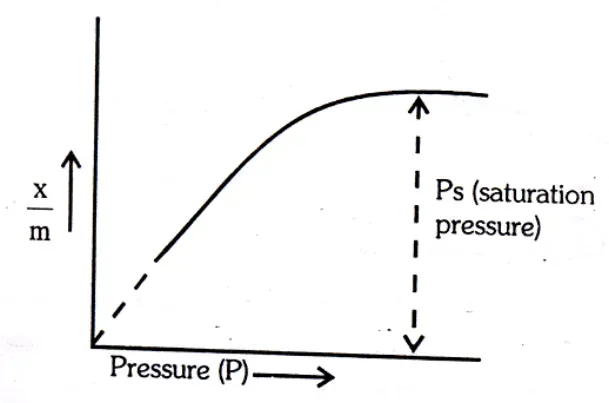
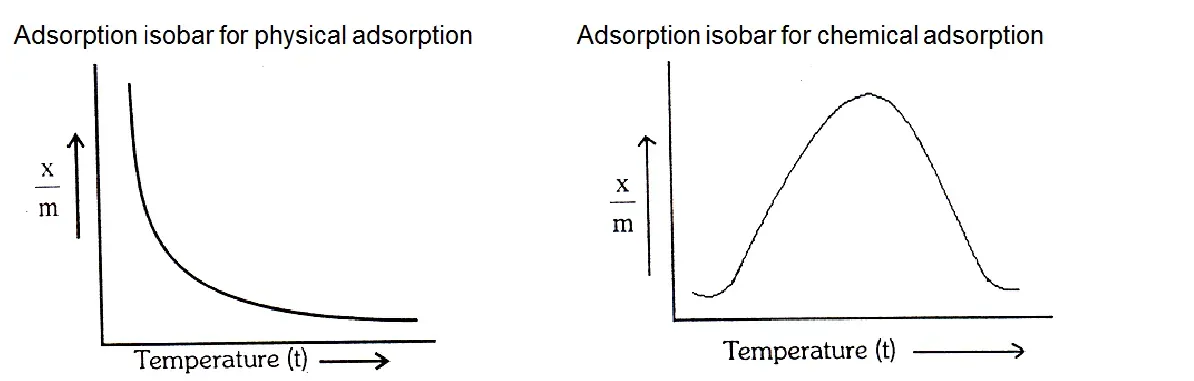
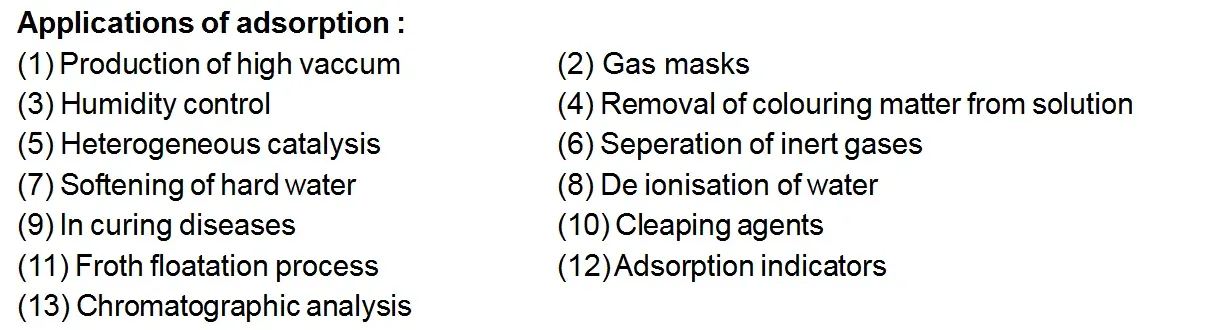
Specific area of adsorbent-The greater the specific area of adsorbent the greater will be the extent of adsorption. Extent of adsorption state of sub- division of adsorbent. Pressure: - Extent of physical adsorption increases as the pressure of the gas increases, till a saturation point is reached. Freundlich gave the following relationship between extent of adsorption Where: mass of adsorbate, of adsorbent and pressure : and are constants, depends upon the nature of adsorbate as well as adsorbent. (a) At low pressure: is directly proportional to the pressure (b) At high pressure: - The extent of adsorption, becomes independent of pressure i.e. a. PO (c) At intermediate pressure: - will depend upon the power of pressure which lies between 0 and 1 or (i) On taking logarithm on both sides of (i) We get (ii) Expression (i) and (ii) are called Freundlich adsorption isotherm. Expression (ii) represents a straight line. The slope of the line will be while its intercept on the log axis will be Temperature: Adsorption is accompanied by evolution of heat i.e. H is negative, so the rate of adsorption should decrease with rise in temperature. It is found to be so in case of physical adsorption. The effect of temperature is represented by an adsorption isobar. Activation of adsorbent-An adsorbent can be activated either by heating or by bringing it in finely divided state, or by making its surface rough by rubbing. For example, charcoal is activated by heating it in vacuum at Adsorption isobar - A graph between the amount of adsorbate adsorbed per gram of adsorbent and the temperature (t) at a constant pressure is called adsorption isobar.
Catalysis
The phenomena in which the rate of a reaction is altered (increased or decrease) by the presence of a substance (Catalyst) is known as catalysis. Catalytic reactions are divided into two types. (a) Homogeneous catalysis (b) Heterogeneous catalysis
Homogeneous catalysis:
When the reactants and the catalyst are in the same physical state, i.e. in the same phase, it is called homogeneous catalysis. For example. (i) Lead chamber process: - In this process for the manufacture of sulphuric acid NO (gas) is used as a catalyst. (ii) Inversion of cane sugar- In aqueous solution is catalysed by dilute acid (Hydrogen ions) (b) Heterogeneous catalysis: When the catalyst and the reactants are not in the same physical state i.e. not in the same phase, it is called heterogeneous catalysis. for example. (i) Decomposition of (ii) Haber process for




TYPES OF CATALYSIS
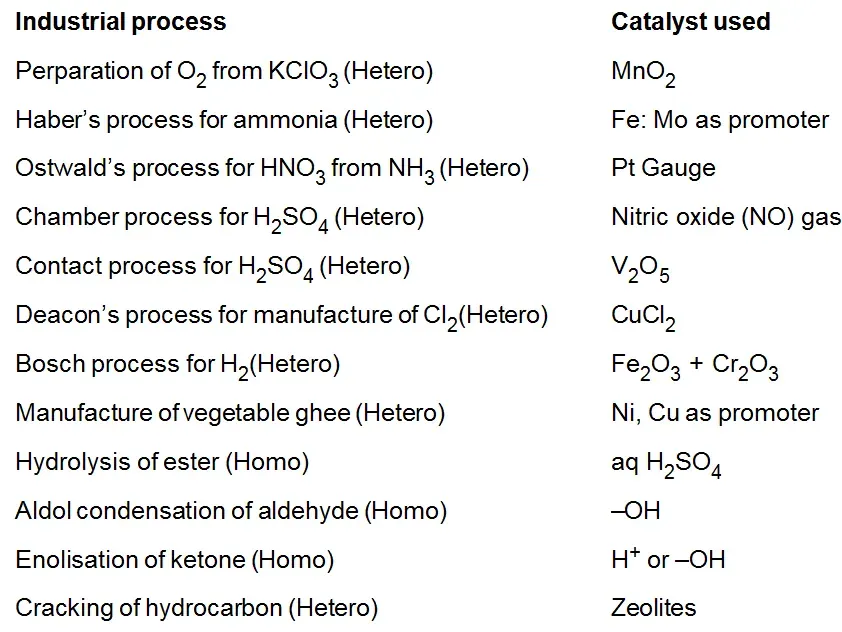
(i) Positive catalysts: -The substance which increases the rate of a reaction is known as a positive catalyst. It decreases the energy of activation for the reaction. For example: (ii) Negative catalysts: The substance which decreases the rate of chemical reaction is called negative catalyst or inhibitor. It increases the activation energy for the reaction. For example. (iii) Auto catalysts: -When one of the products of the reaction begins to act as a catalyst, it is called auto-catalyst for example. In the initial stages the reaction is slow but as soon as the products come into existence the the reaction rate increases (iv) Induced catalyst:- When a chemical reaction enhances the rate of another chemical reaction it is called induced catalysis. For example:- Soduim arsenite solution is not oxidised by air. If however, air is passed through a mixture of both of them undergo simultaneous oxidation. The oxidation of sodium sulphite, thus influences the oxidation of sodium arsenite. Promoters: Those substance which do not themselves act as catalysts but their presence increases the activity of a catalyst are called catalytic promoters or catalyst for a catalyst. Example: In the Haber process for the synthesis of ammonia, Fe is the catalyst while molybdenum (Mo) acts as promoter. Catalytic Poison: -The substance whose presence decreases or destroy the activity of a catalyst is called catalytic poison. For example:- Carbon monoxide or in hydrogen gas, acts as a poison for Fe catalyst in the Haber process for acts as poison for asbestos in contact process for Inhibitors: - Those substances which retard rate of a chemical reaction are known as inhibitor. For example: glycerol or acetamide decrease the rate of decomposition of hydrogen peroxide. General characteristics of catalysts: (i) A catalyst remains unchanged in mass and chemical composition but change their physical state. (ii) Only a very small amount of catalyst is sufficient to catalyse a reaction. (iii) A catalyst does not initiate a reaction & does not controlled on chemical Rxn. (iv) When a catalyst is a solid, it is usually more efficient where used in finely divided form. (v) Generally, catalyst does not change the nature of products. (vi) A catalyst does not change the equilibrium state of a reversible reaction but help to time achieve of equilibrium state. or position of equilibrium. (vii) The catalysts are generally specific in nature. (viii) Change rate constant of Rxn. (ix) does not change free energy of Rxn. THEORIES OF CATALYSIS Intermediate compound formation theory: -This theory is explaining homogeneous catalysis mainly. According to this theory, the catalyst combines with one of the reactants to give an intermediate compound. This compound intermediately reacts with the other reactants and gives the product and regenerates the catalyst in its original form. Thus, the reactants do not directly combine with each other, instead they react through the catalyst which provides an alternative pathway which involves lesser energy of activation. For example: -The function of nitric oxide (NO) as a catalyst in the formation of is explained as follows. Adsorption theory: - This theory is explaining the heterogeneous catalysis. The role of a solid catalyst in enhancing the reaction rate is explained on the basis of this theory in the following steps. (i) The reactant molecules are absorbed on the surface of the catalyst at adjacent points. Adsorption leads to higher concentration of the adsorbed reactant on the surface of a catalyst. (ii) As adsorption is an exothermic process, the heat of adsorption provides the necessary activation energy for the chemical reaction to proceed. (iii) The adsorbed reactant molecules are tied on the solid sold surface of the catalyst. The bonds between the atoms of chemisorption reactant molecules are weakened. The reactant molecules of sufficient energy combine together and with the surface of the catalyst to form surface activated complex. This adsorbed activated complex is decomposed to form 'products as a definite faster rate. Catalysts in Industry: - Some of the important processes and their catalyst are given in below.






Click Here to View or Download Complete Notes of Surface Chemistry for Class 12 JEE & NEET
Attempt Free Mock Test for JEE based on New NTA Pattern
Click Here to Practice JEE Main Previous Year questions of Surface Chemistry
Download eSaral App and ask your doubts for free at Discussion Forum.
Team eSaral
eSaral Academic and Editorial Team
Team eSaral is the collective author profile for educational content created by eSaral’s teachers and academic contributors. The team draws on expertise from IIT graduates, doctors, experienced educators and subject specialists to develop resources for JEE, NEET and school students. Our articles aim to explain concepts clearly and help students study with confidence.
Related Posts
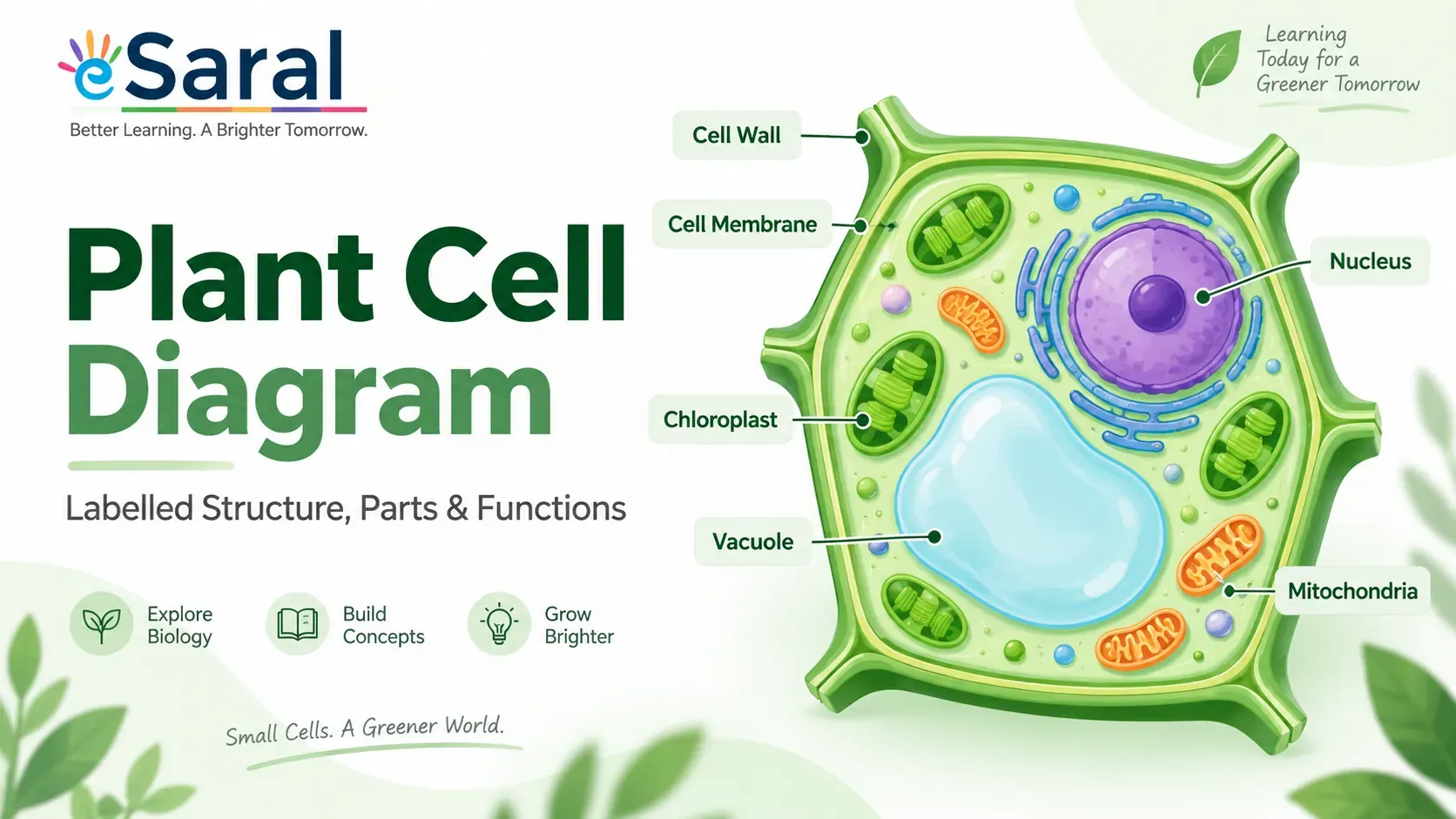
Plant Cell Diagram: Labelled Structure, Parts and Functions
Simple, labelled plant cell diagram with parts and functions. Covers plant cell structure for Class 6, 7, 8, 9, 10 and 11 students, CBSE-aligned.

Saransh Gupta Sir's Visit to IIT Patna: Hostel Life, Placements & Lessons for JEE Aspirants
Inside Saransh Gupta Sir's IIT Patna visit — hostel life, the library, placements, internships, and real advice for JEE aspirants from students living the IIT dream.
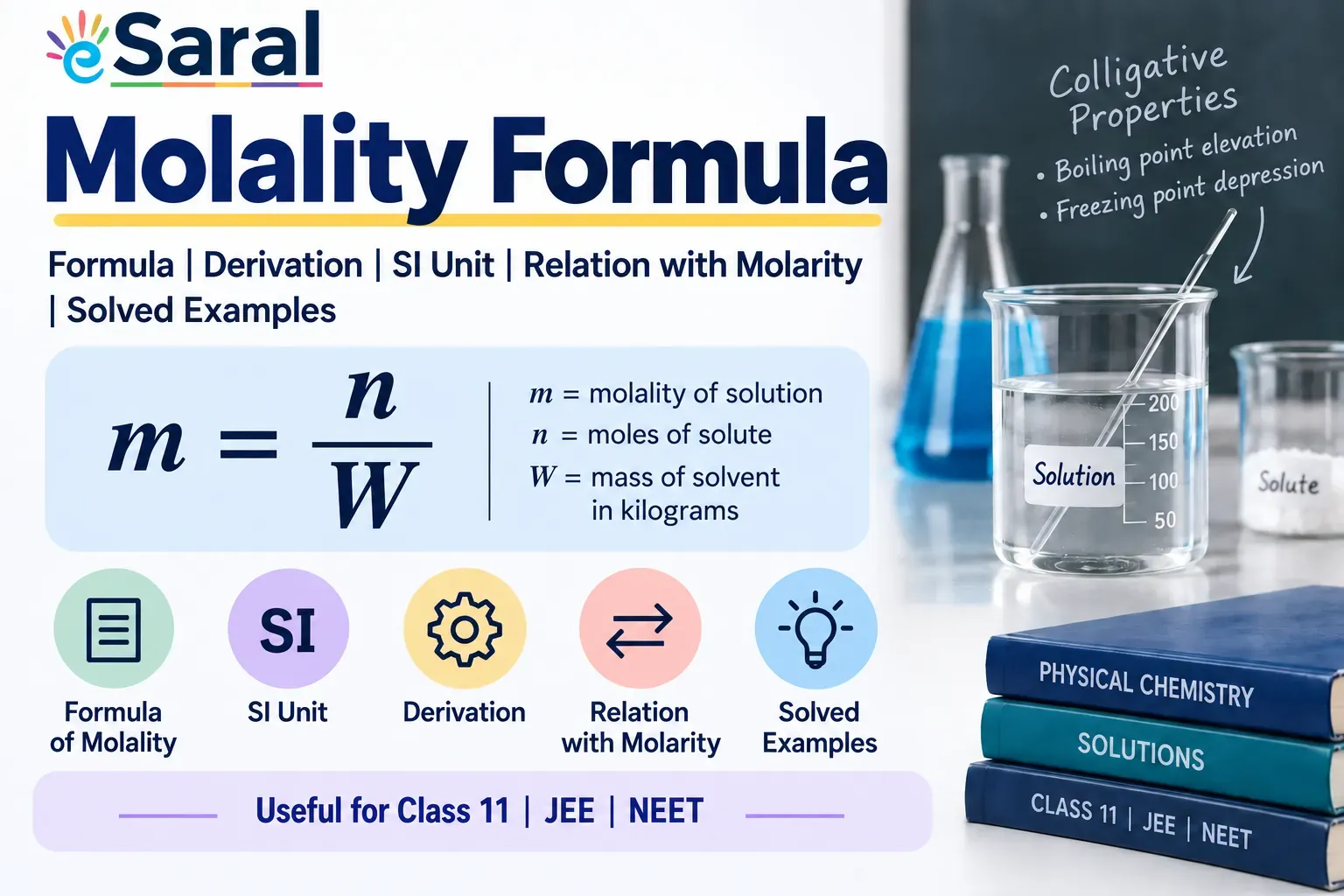
Molality Formula: Formula for Molality, Derivation & Solved Examples
Molality formula is $m = \dfrac{n}{W}$. Learn the formula of molality, its SI unit, derivation, relation with molarity, and solved examples for Class 11, JEE and NEET.

BITSAT Previous Year Question Paper PDF
Download BITSAT previous year question papers PDF. Get year-wise BITSAT PYQs, memory-based papers, exam pattern, and preparation tips to improve your BITSAT preparation.

Teachers’ Day 2026 at eSaral Gurukul: Celebrating the Bond Between Students, Teachers & Mentors
See how Teachers’ Day 2026 was celebrated at eSaral Gurukul, reflecting the bond among students, teachers, and mentors, and the role of guidance beyond academics.

JEE Advanced Attempts: Can You Give It a Third Time? Rules Explained
JEE Advanced attempts: current rule is 2 consecutive years only: full eligibility criteria, the 2025 third-attempt controversy, and the latest 2026 petition news.

Best JEE Preparation App
Best JEE preparation app for Main & Advanced: AI mock tests, live doubt-solving, thousands of practice questions. JEE preparation app for droppers & Class 11-12.
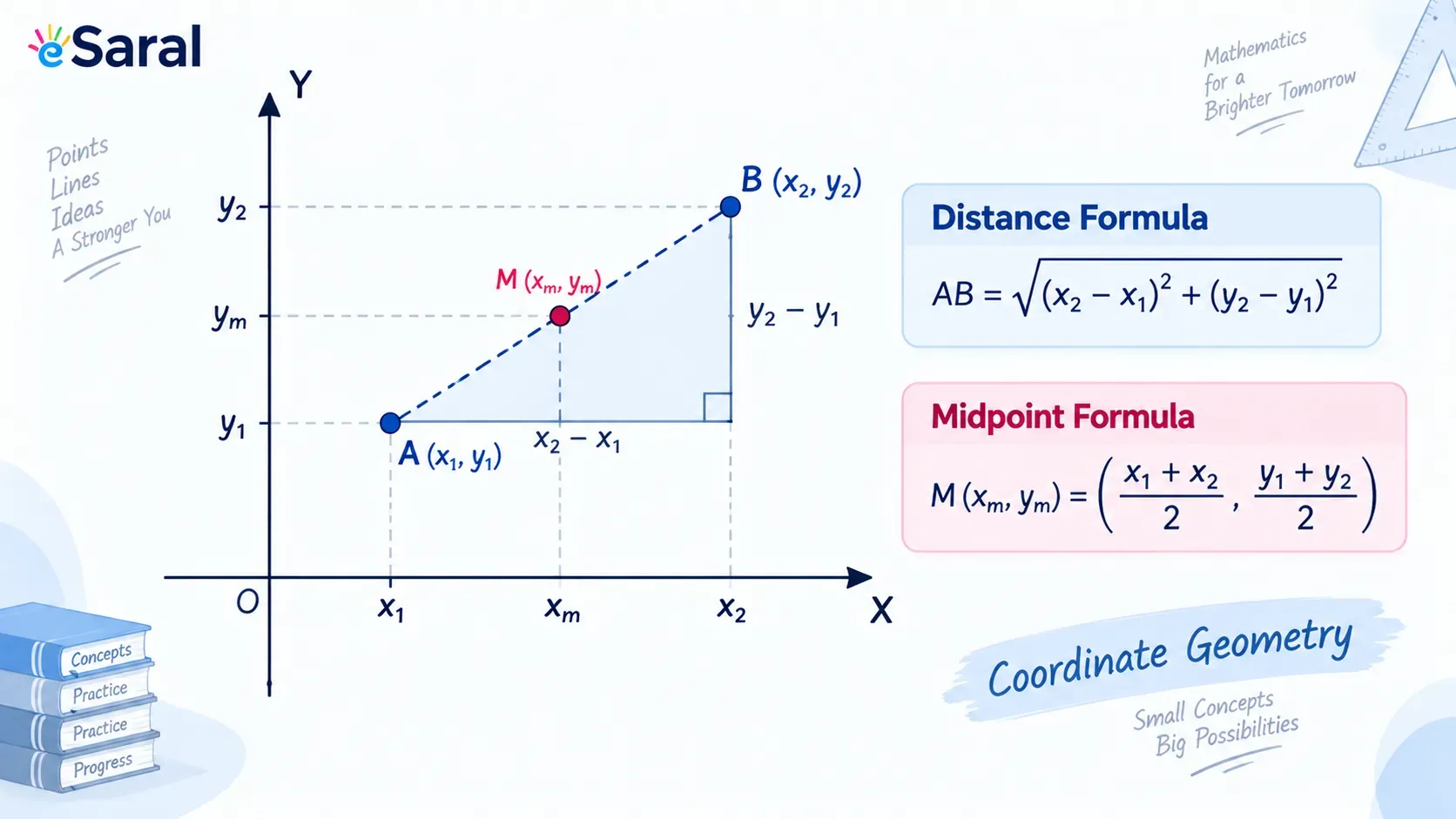
Coordinate Geometry Class 10: Formulas, Notes & Solved Examples
Coordinate geometry class 10: complete CBSE formulas — distance, section, midpoint and area of triangle — with derivation, notes and solved examples.

How to make Notes For JEE Smart Notes Strategy of an AIR 41
Learn how to make notes for JEE the way toppers do — indexing, shorthand, and smart short notes for JEE that cut revision time to just 5–7 days.
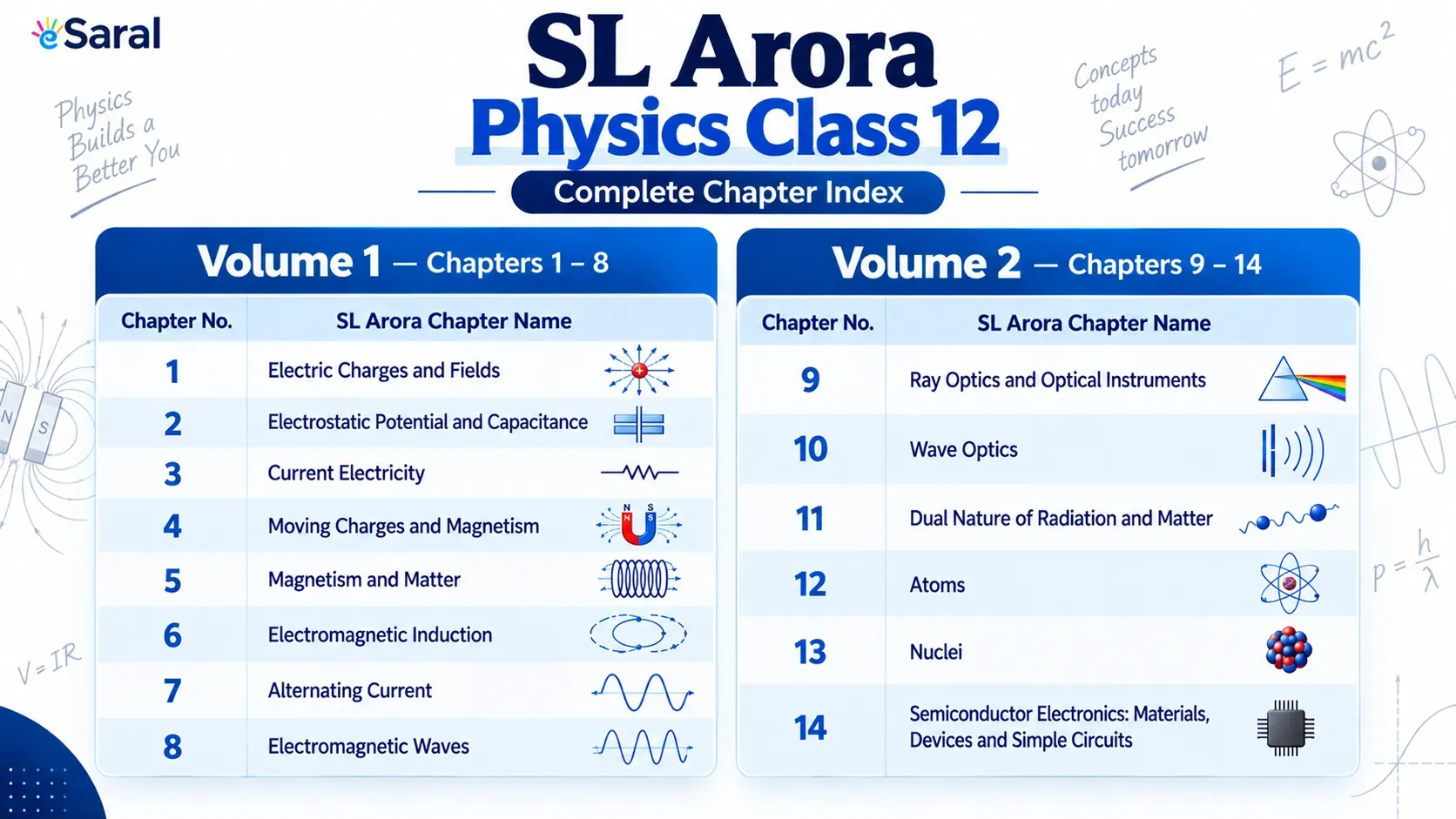
SL Arora Physics Class 12 Index – Chapter List for Volume 1 & 2
SL Arora Physics Class 12 index — complete chapter list for Volume 1 & 2, mapped to NCERT solutions for board, JEE Main, and NEET preparation.