
Atomic Structure - JEE Advanced Previous Year Questions with Solutions

eSaral Academic and Editorial Team
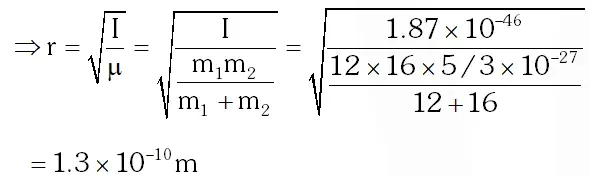
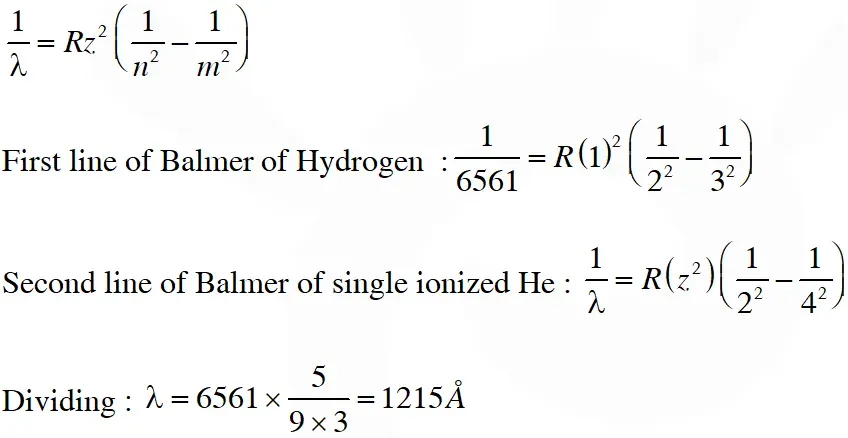
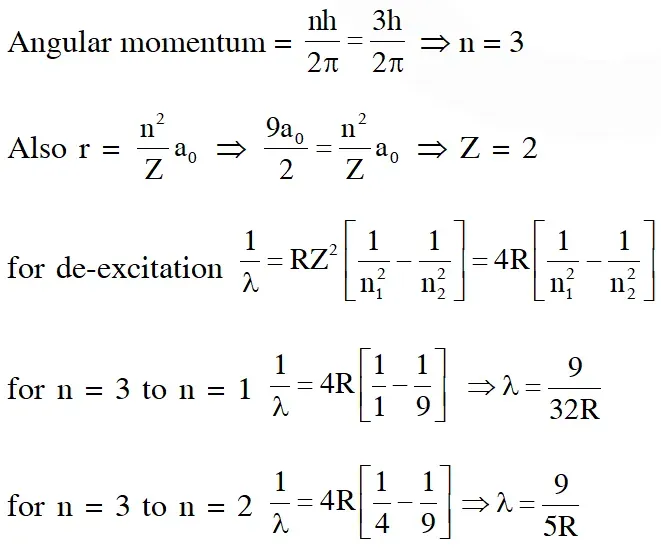
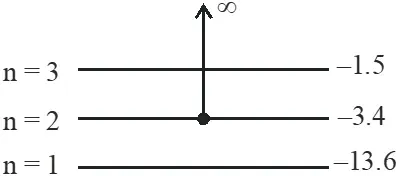
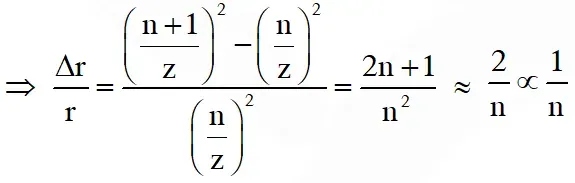
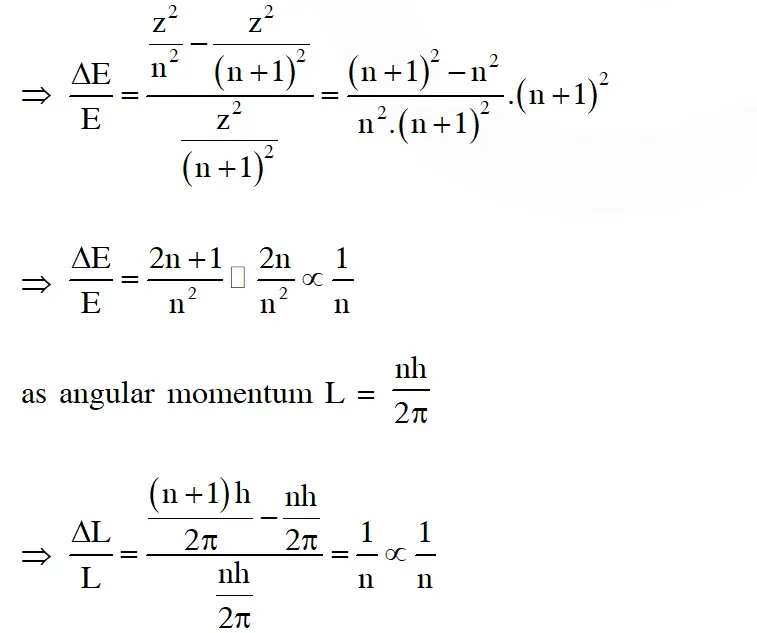
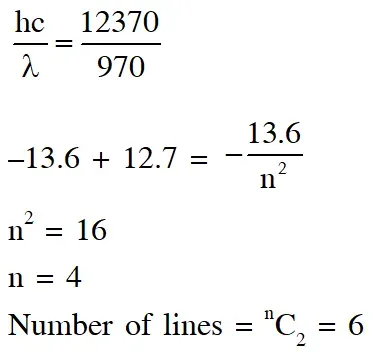
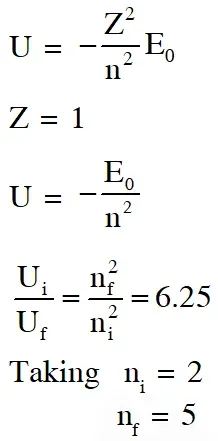
JEE Advanced Previous Year Questions of Physics with Solutions are available at eSaral. Practicing JEE Advanced Previous Year Papers Questions of Physics will help the JEE aspirants in realizing the question pattern as well as help in analyzing weak & strong areas. Get detailed Class 11th & 12th Physics Notes to prepare for Boards as well as competitive exams like IIT JEE, NEET etc. eSaral helps the students in clearing and understanding each topic in a better way. eSaral is providing complete chapter-wise notes of Class 11th and 12th both for all subjects. Click Here for JEE main Previous Year Topic Wise Questions of Physics with Solutions Download eSaral app for free study material and video tutorials. Simulator Previous Years JEE Advanced Questions Paragraph for Question Nos. 1 to 3 The key feature of Bohr’s theory of spectrum of hydrogen atom is the quantization of angular momentum when an electron is revolving around a proton. We will extend this to a general rotational motion to find quantized rotational energy of a diatomic molecule assuming it to be rigid. The rule to be applied is Bohr’s quantization condition. Simulator Previous Years JEE Advanced Questions Paragraph for Question Nos. 1 to 3 The key feature of Bohr’s theory of spectrum of hydrogen atom is the quantization of angular momentum when an electron is revolving around a proton. We will extend this to a general rotational motion to find quantized rotational energy of a diatomic molecule assuming it to be rigid. The rule to be applied is Bohr’s quantization condition. [esquestion] A diatomic molecule has moment of inertia I. By Bohr’s quantization condition its rotational energy in the nth level (n =0 is not allowed) is $(\mathrm{A}) \frac{1}{\mathrm{n}^{2}}\left(\frac{\mathrm{h}^{2}}{8 \pi^{2} \mathrm{I}}\right)$ $(\mathrm{B}) \frac{1}{\mathrm{n}}\left(\frac{\mathrm{h}^{2}}{8 \pi^{2} \mathrm{I}}\right)$ $(\mathrm{C}) \mathrm{n}\left(\frac{\mathrm{h}^{2}}{8 \pi^{2} \mathrm{I}}\right)$ $(\mathrm{D}) \mathrm{n}^{2}\left(\frac{\mathrm{h}^{2}}{8 \pi^{2} \mathrm{I}}\right)$ #tag# [JEE 2010] #sol# (D) $\mathrm{E}_{\mathrm{n}}=\frac{1}{2} \mathrm{I} \omega^{2}=\frac{(\mathrm{l} \omega)^{2}}{2 \mathrm{l}}=\frac{(\mathrm{nh} / 2 \pi)^{2}}{2 \mathrm{l}}=\frac{\mathrm{n}^{2} \mathrm{h}^{2}}{8 \pi^{2} \mathrm{I}}$ [/esquestion] [esquestion] It is found that the excitation frequency from ground to the first excited state of rotation for the CO molecule is close to $\frac{4}{\pi} \times 10^{11} \mathrm{Hz}$ Hz. Then the moment of inertia of CO molecule about its center of mass is close to $\left[\text { Take } \mathrm{h}=2 \pi \times 10^{-34} \mathrm{Js}\right)$ (A) $2.76 \times 10^{-46} \mathrm{kg} \mathrm{m}^{2}$ (B) $1.87 \times 10^{-46} \mathrm{kg} \mathrm{m}^{2}$ (C) $4.67 \times 10^{-47} \mathrm{kg} \mathrm{m}^{2}$ (D) $1.17 \times 10^{-47} \mathrm{kg} \mathrm{m}^{2}$ #tag# [JEE 2010] #sol# (B) [/esquestion] [esquestion] In a CO molecule, the distance between C (mass = 12 a.m.u.) and O (mass = 16 a.m.u.), where 1 a.m.u. $=\frac{5}{3} \times 10^{-27} \mathrm{kg},$ is close to (A) $2.4 \times 10^{-10} \mathrm{m}$ (B) $1.9 \times 10^{-10} \mathrm{m}$ (C) $1.3 \times 10^{-10} \mathrm{m}$ (D) $4.4 \times 10^{-11} \mathrm{m}$ #tag# [JEE 2010] #sol# (C) Moment of inertia of CO molecule about centre of mass : $\mathrm{I}=\mu \mathrm{r}^{2}$ where $\mu=\frac{\mathrm{m}_{1} \mathrm{m}_{2}}{\mathrm{m}_{1}+\mathrm{m}_{2}}$ [/esquestion] [esquestion] The wavelength of the first spectral line in the Balmer series of hydrogen atom is 6561 Å. The wavelength of the second spectral line in the Balmer series of singly-ionized helium atom is ? #tag# [JEE 2011] #sol# (A) [/esquestion] [esquestion] The radius of the orbit of an electron in a Hydrogen-like atom is 4.5 a0, where a0 is the Bohr radius. Its orbital angular momentum is $\frac{3 \mathrm{h}}{2 \pi}$. It is given that h is Planck constant and R is Rydberg constant. The possible wavelength (s), when the atom de-excites, is (are) :- (A) $\frac{9}{32 \mathrm{R}}$ (B) $\frac{9}{16 \mathrm{R}}$ (C) $\frac{9}{\text { sR }}$ (D) $\frac{4}{3 \mathrm{R}}$ #tag# [JEE Advanced-2013] #sol# (A,C) for $\mathrm{n}=2$ to $\mathrm{n}=1 \quad \frac{1}{\lambda}=4 \mathrm{R}\left[\frac{1}{1}-\frac{1}{4}\right] \Rightarrow \lambda=\frac{3}{\mathrm{R}}$ [/esquestion] [esquestion] Consider a hydrogen atom with its electron in the nth orbital. An electromagnetic radiation of wavelength 90 nm is used to ionize the atom. If the kinetic energy of the ejected electron is 10.4 eV, then the value of n is (hc = 1242 eV nm). #tag# [JEE Advanced-2015] #sol# 2 $\mathrm{E}_{\mathrm{Ph}}=\frac{\mathrm{hc}}{\lambda}=\frac{1242}{90}=13.8 \mathrm{eV}$ $\mathrm{E}_{\mathrm{Ph}}=\Delta \mathrm{E}+(\mathrm{K.E.})$ $13.8=\Delta \mathrm{E}+10.4$ $\Delta E=3.4 \mathrm{eV}$ so electron initially was in n = 2 [/esquestion] [esquestion] Highly excited states for hydrogen like atoms (also called Rydberg states) with nuclear charge Ze are defined by their principal quantum number n, where n >> 1. Which of the following statement(s) is (are) true? (A) Relative change in the radii of two consecutive orbitals does not depend on Z (B) Relative change in the radii of two consecutive oribitals varies as 1/n (C) Relative change in the energy of two consecutive orbitals varies as $1 / \mathrm{n}^{3}$ (D) Relative change in the angular momenta of two consecutive orbitals varies as 1/n #tag# [JEE Advanced-2016] #sol# (A,B,D) As radius $\mathrm{r} \propto \frac{\mathrm{n}^{2}}{\mathrm{z}}$ as energy $\mathrm{E} \propto \frac{\mathrm{z}^{2}}{\mathrm{n}^{2}}$ [/esquestion] [esquestion] A hydrogen atom in its ground state is irradiated by light of wavelength 970 $\hat{\mathbf{A}}$. Taking hc/e = $1.237 \times 10^{-6}$ eV m and the ground state energy of hydrogen atom as –13.6 eV, the number of lines present in the emission spectrum is ? #tag# [JEE Advanced-2016] #sol# 6 [/esquestion] [esquestion] An electron in a hydrogen atom undergoes a transition from an orbit with quantum number $\mathrm{n}_{\mathrm{i}}$ to another with quantum number $\mathrm{n}_{\mathrm{f}} \cdot \mathrm{V}_{\mathrm{i}}$ and $\mathrm{V}_{\mathrm{f}}$ are respectively the initial and final potential energies of the electron. If $\frac{\mathrm{V}_{\mathrm{i}}}{\mathrm{V}_{\mathrm{f}}}=6.25$, then the smallest possible $\mathbf{n}_{\mathrm{f}}$ is. #tag# [JEE Advanced-2017] #sol# 5 [/esquestion]


For additional practice after Atomic Structure - JEE Advanced PYQs (Physics), refer to the JEE Advanced PYQ archive.
Once you have mastered the core concepts of Atomic Structure and practiced JEE Advanced previous year questions, you can further challenge your problem-solving skills with Irodov Selected Questions for JEE Advanced. These selected problems are useful for developing a deeper understanding of Physics concepts and tackling higher-level numerical problems.
Team eSaral
eSaral Academic and Editorial Team
Team eSaral is the collective author profile for educational content created by eSaral’s teachers and academic contributors. The team draws on expertise from IIT graduates, doctors, experienced educators and subject specialists to develop resources for JEE, NEET and school students. Our articles aim to explain concepts clearly and help students study with confidence.
Related Posts

BITSAT 2027: Registration Date, Exam Date, Syllabus, Eligibility, Pattern & Fees
BITSAT 2027 exam dates, registration timeline, eligibility criteria, exam pattern, marking scheme, syllabus and fees in one page.

BITSAT Previous Year Question Paper PDF (2017-2026)
Download BITSAT previous year question papers PDF from 2017 to 2026,session-wise. Memory-based papers,exam pattern, paper analysis and how to practise

CBSE Class 10 Date Sheet 2027: Expected Exam Dates, Release Date, Admit Card & Result Timeline
CBSE Class 10 date sheet 2027 is awaited. See the expected exam dates, release window, how to download the PDF, admit card and result timelines.

NCERT Physics Class 10 Book PDF in Hindi 2026-27 – भौतिक विज्ञान के 4 अध्याय (Free Download)
NCERT Physics Class 10 book PDF in Hindi 2026-27: download all 4 chapters (अध्याय 9–12) free, with topics and important formulas.

NCERT Biology Class 9 Book Anveshan PDF in Hindi - जीव विज्ञान कक्षा 9 पुस्तक अन्वेषण PDF
Download NCERT Biology Class 9 book PDF in Hindi chapterwise for 2026-27: Cell, Tissues, Reproduction and Diversity. Free PDFs.

Essay On Artificial Intelligence in English (100,150, 200, 250, 300, 500 Words)
This is in contrast to the natural intelligence of humans. With Artificial Intelligence, machines can perform

Essay on 78th India Independence Day in English for Student (100, 150, 200, 250, 300, 500 Words)
Read the best essays on India's Independence Day in English. Short & long essays (100, 150, 200, 250, 300, 500 words) perfect for school exams
NCERT Class 11 English Snapshots book - Free PDF download- Esaral
Download NCERT Class 11 English Snapshots book PDF for free. Get all 8 chapters, chapter-wise. Start your prep today!
NCERT Class 10 biology book pdf - Free PDF Download - eSaral
NCERT Class 10 Biology book PDF 2026-27: all 5 chapters (Life Processes to Our Environment) in English & Hindi, with CBSE syllabus, marks & practical

Essay on Global Warming in English (100,150, 200, 250, 300, 500 Words)
Global warming means the Earth is getting hotter. This happens because of things like pollution from cars and factories.