
Atomic Structure NEET Previous Year Questions with Complete Solutions

eSaral Academic and Editorial Team
Summary
Atomic structure NEET previous year questions come from Class 11 Chemistry Chapter 2, Structure of Atom. They test the Bohr model, the hydrogen spectrum, quantum numbers, orbitals, the photoelectric effect, de Broglie wavelength and electronic configuration. This page gives the solved question pages, a priority topic list, key formulae, common mistakes and NEET-style practice questions.
Here you will find atomic structure NEET previous year questions with detailed solutions. For other chapters, see the complete NEET previous year questions for Physics, Chemistry and Biology.
What Is Covered in Atomic Structure NEET Previous Year Questions?
Atomic structure is Chapter 2 of NCERT Class 11 Chemistry. In NEET, questions from this chapter are usually formula-based and conceptual. The chapter covers:
- Subatomic particles, atomic number, isotopes and isobars
- Thomson, Rutherford and Bohr models
- Hydrogen spectrum and spectral series
- Photoelectric effect and photon energy
- de Broglie relation and Heisenberg’s uncertainty principle
- Quantum numbers, orbitals and their shapes
- Aufbau principle, Pauli’s exclusion principle and Hund’s rule
- Electronic configuration and stability of half-filled and completely filled orbitals
NEET questions follow the NCERT chapter closely, so revise the full chapter. For the exact list of NEET topics, check the latest official NEET syllabus.
How Many Questions Come from Atomic Structure in NEET?
NEET Chemistry has 45 questions of 4 marks each, so 180 marks in total. Published analyses of recent papers show that Structure of Atom usually carries about 2 to 3 questions a year, which is roughly 4–6% of the Chemistry section. The count changes from year to year, so check the official papers for each year when you plan your practice. Bohr’s model, quantum numbers and electronic configuration are the most frequently tested ideas.
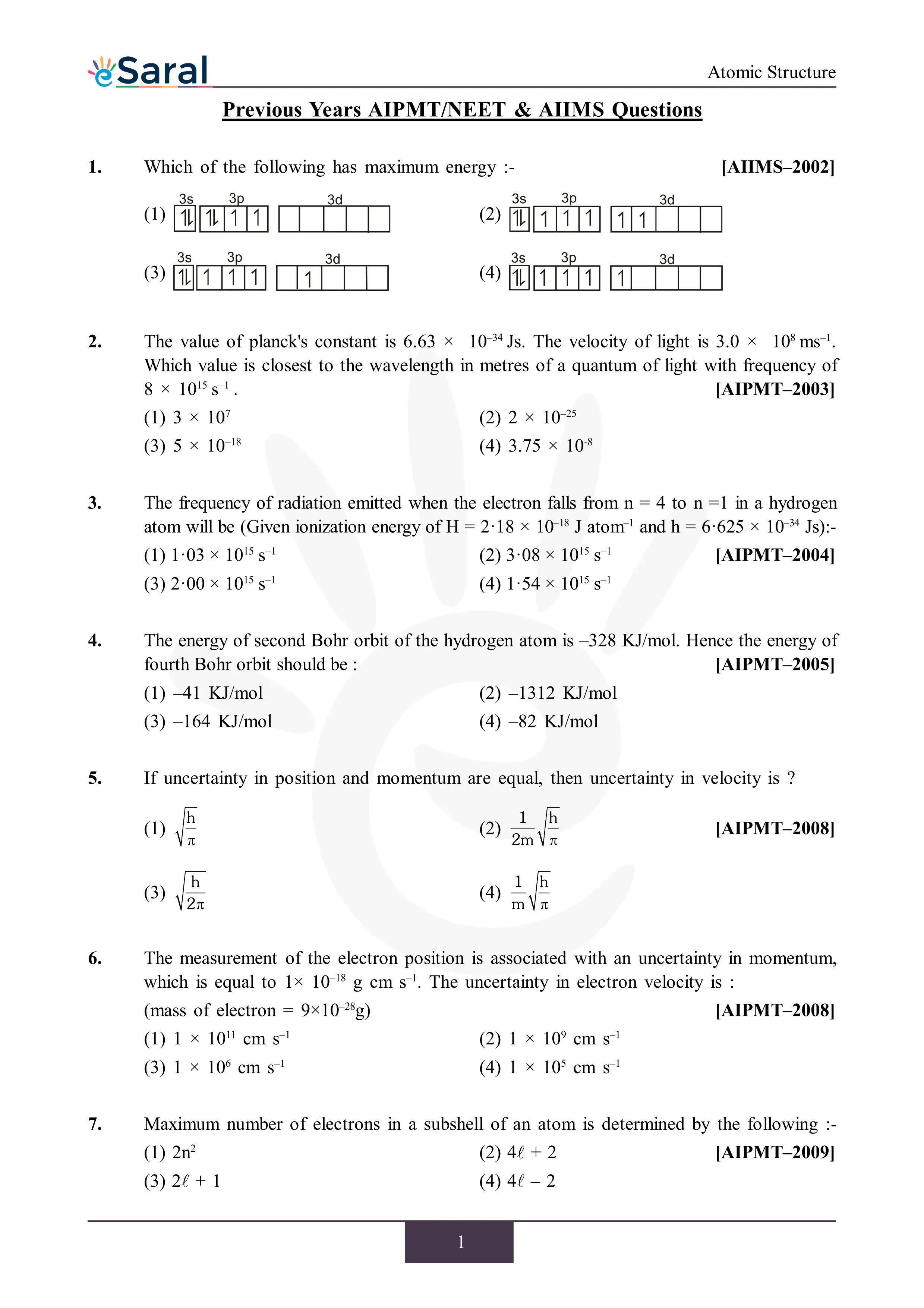
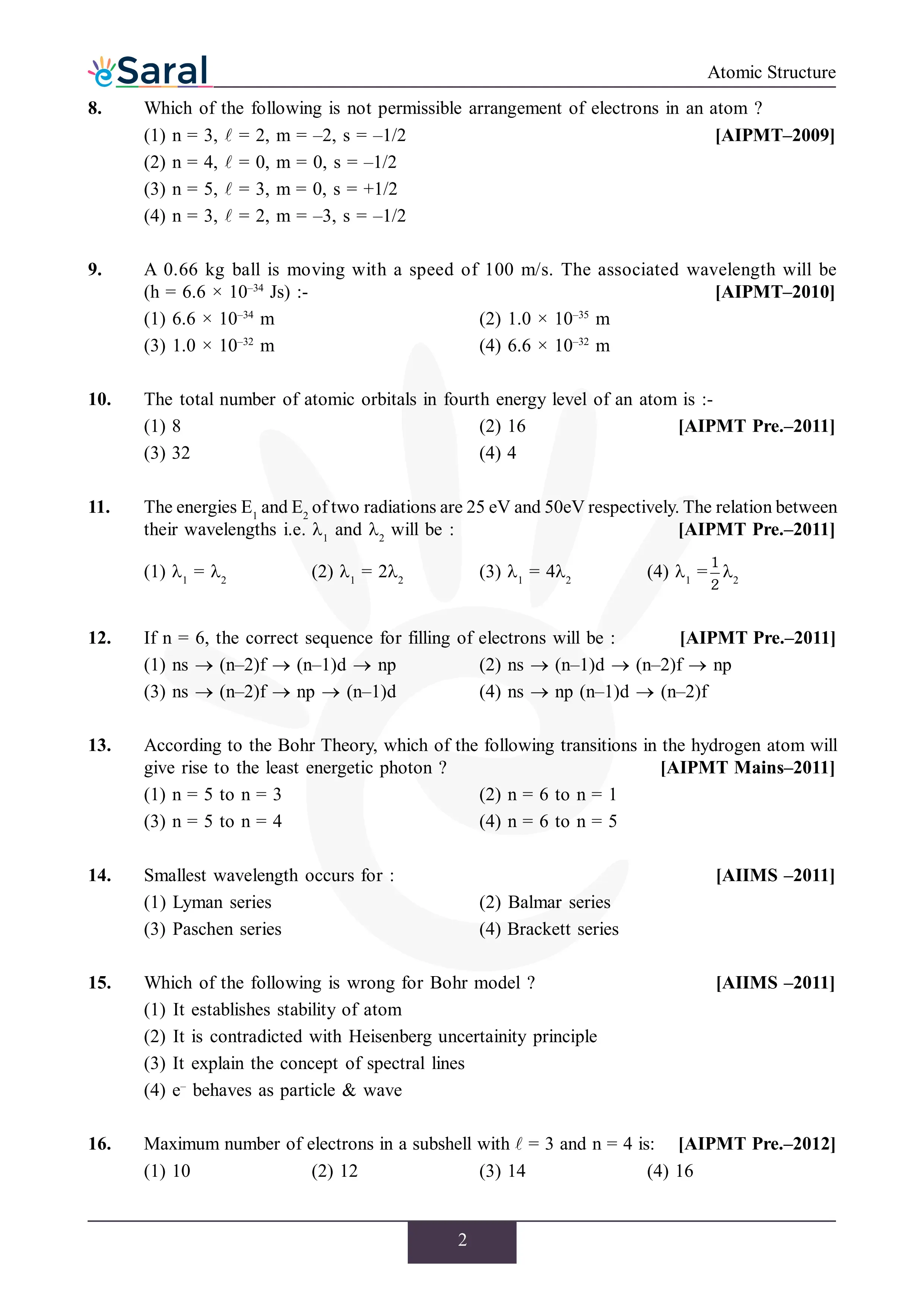
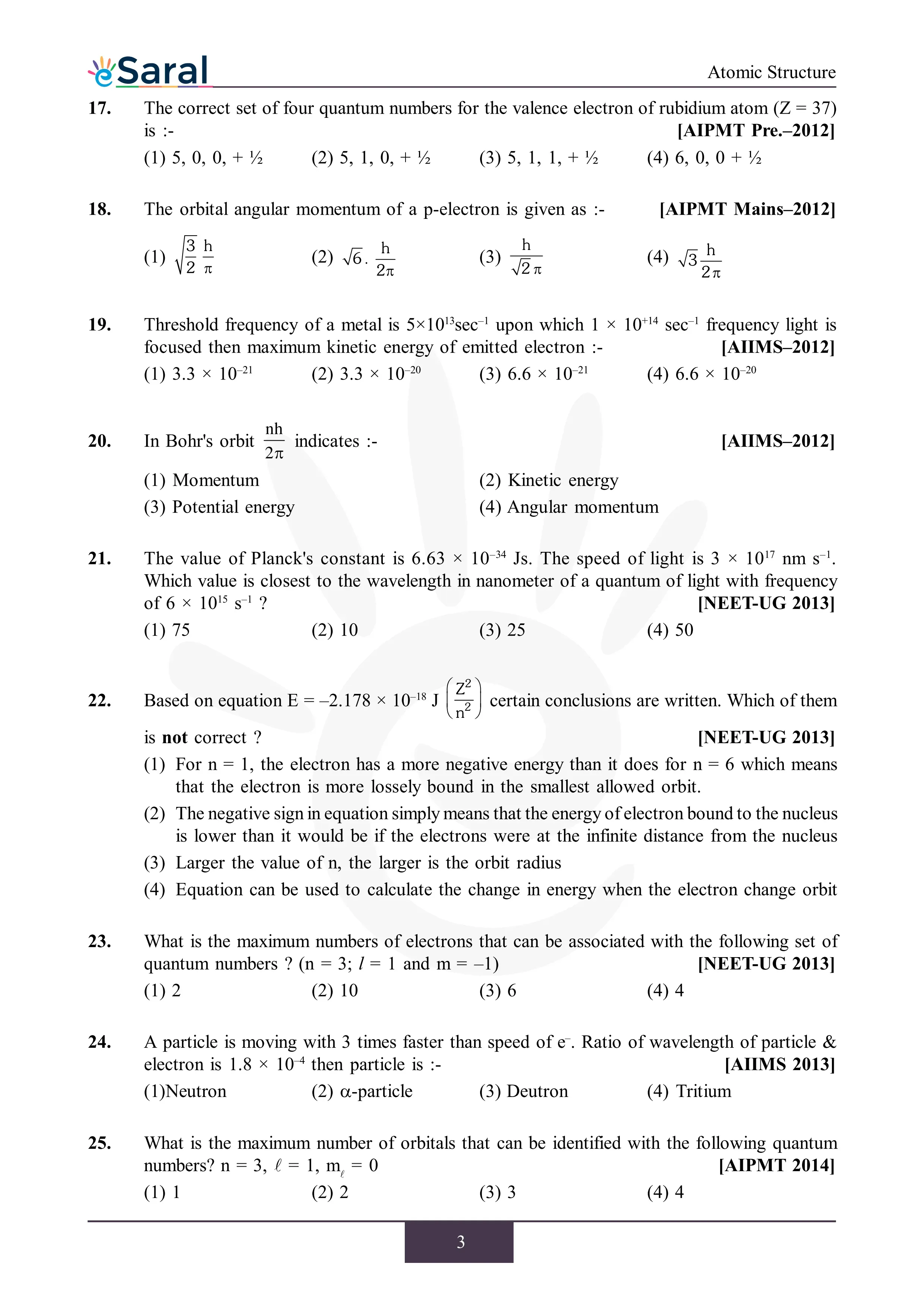
Atomic Structure NEET Previous Year Questions: Solved Pages
Solve each question yourself first, and then check the solution.
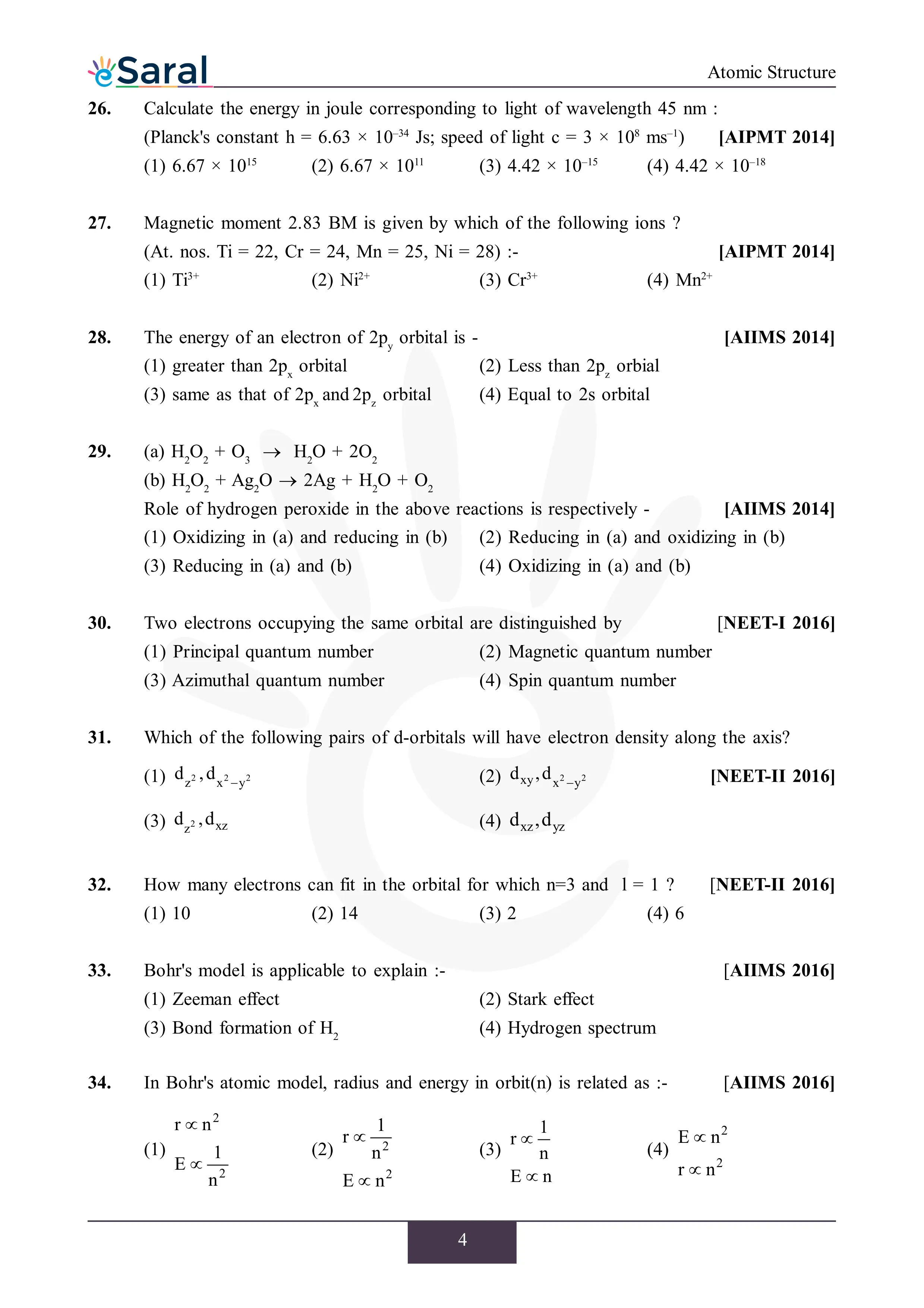
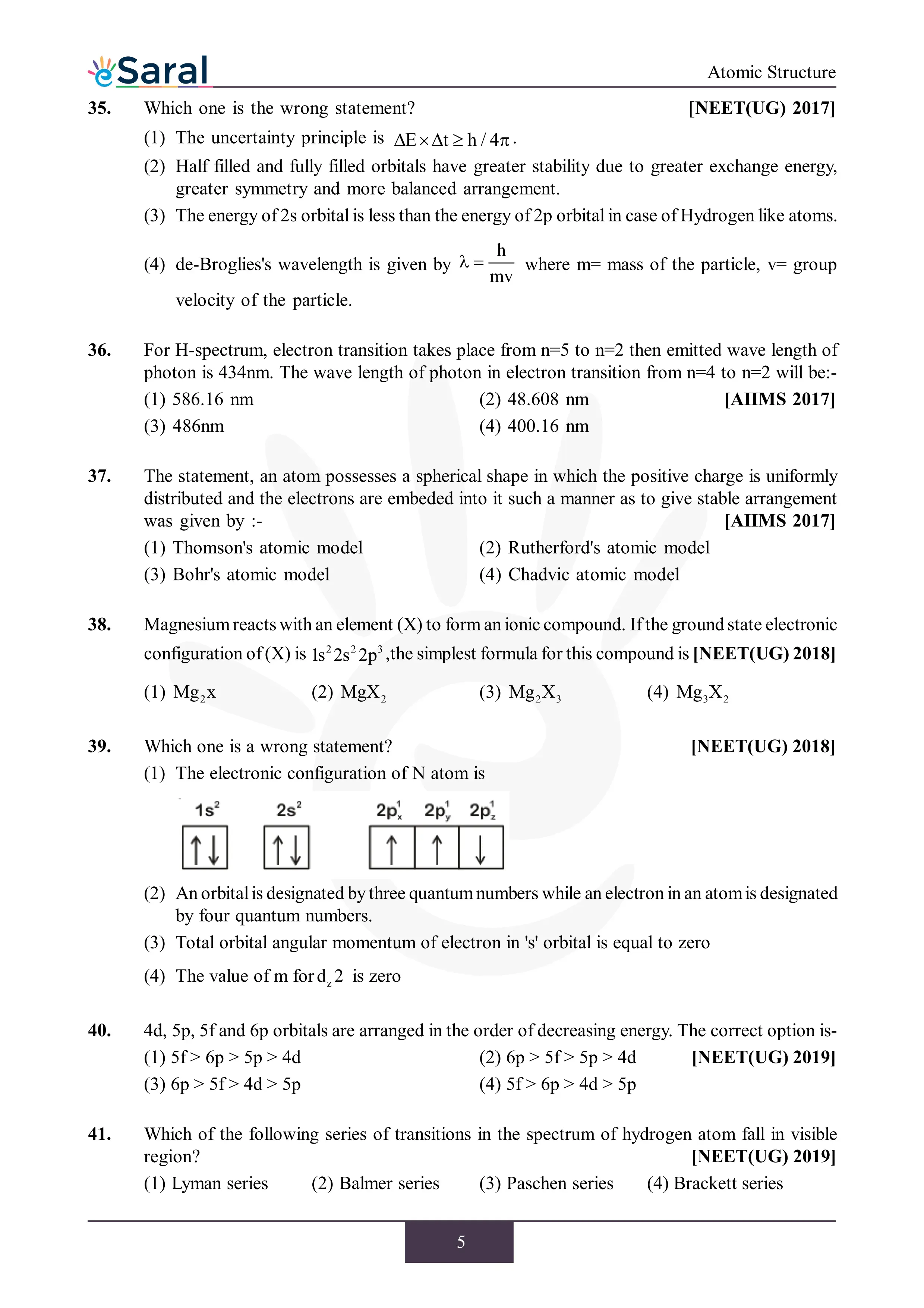

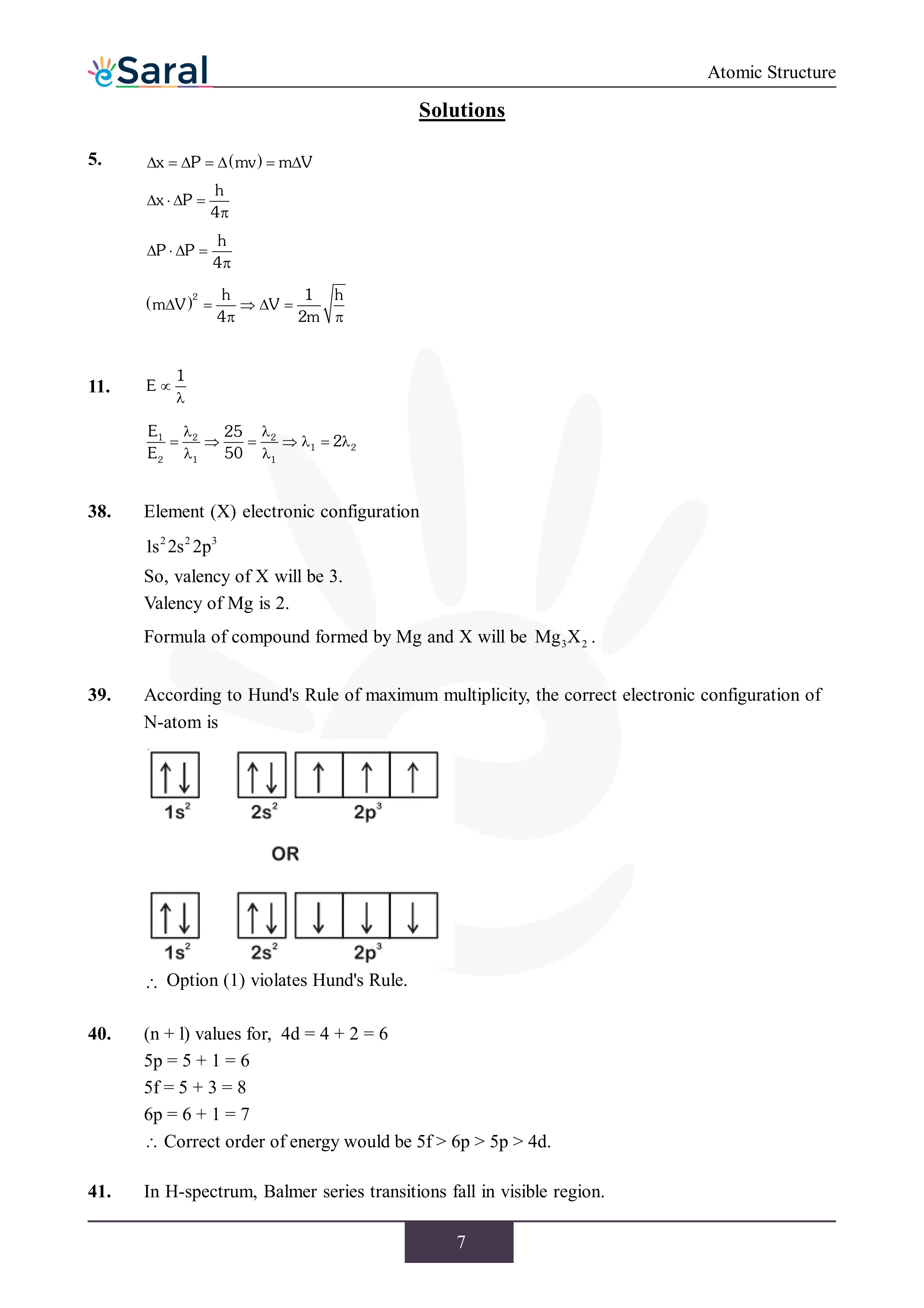
Important Topics in Atomic Structure NEET Previous Year Questions
High-Priority Topics
- Bohr model: radius, velocity and energy of an orbit
- Quantum numbers: allowed values, number of orbitals and electrons in a shell
- Electronic configuration: Aufbau, Pauli, Hund, and Cr and Cu exceptions
- Hydrogen spectrum: spectral series and wavelength calculations
Medium-Priority Topics
- de Broglie wavelength and Heisenberg’s uncertainty principle
- Photoelectric effect and threshold frequency
- Nodes (radial and angular) and shapes of orbitals
Lower-Priority Topics
- Thomson and Rutherford models
- Isotopes, isobars and isotones
- Electromagnetic radiation and Planck’s quantum theory
Key Formulae for Atomic Structure NEET Previous Year Questions
Concept | Formula |
|---|---|
Radius of nth Bohr orbit | r_n = 52.9 \times \frac{n^2}{Z}\ \mathrm{pm} |
Velocity of electron in nth orbit | v_n = 2.18 \times 10^6 \times \frac{Z}{n}\ \mathrm{m\,s^{-1}} |
Energy of nth orbit | E_n = -13.6 \times \frac{Z^2}{n^2}\ \mathrm{eV} = E_n = -2.18 \times 10^{-18} \times \frac{Z^2}{n^2}\ \mathrm{J} |
Spectral lines (Rydberg equation) | \frac{1}{\lambda} = R_H Z^2 \left(\frac{1}{n_1^2} - \frac{1}{n_2^2}\right), R_H = 1.097 \times 10^7\ \mathrm{m^{-1}} |
Energy of a photon | E = h\nu = \frac{hc}{\lambda} |
Photoelectric effect | h\nu = h\nu_0 + \frac{1}{2}mv^2 |
de Broglie wavelength | \lambda = \frac{h}{mv} |
Heisenberg’s uncertainty principle | \Delta x \cdot \Delta p \geq \frac{h}{4\pi} |
Orbitals and electrons in shell n | \text{Number of orbitals} = n^2, \text{Maximum number of electrons} = 2n^2 |
Nodes | \text{Radial nodes} = n-l-1, \text{Angular nodes} = l, \text{Total nodes} = n-1 |
Hydrogen Spectrum Series
Series | Transition ends at n₁ | Region |
|---|---|---|
Lyman | 1 | Ultraviolet |
Balmer | 2 | Visible |
Paschen | 3 | Infrared |
Brackett | 4 | Infrared |
Pfund | 5 | Infrared |
NEET-Style Practice Questions on Atomic Structure
These are practice questions written in the NEET style. They are not official previous year questions. Attempt them after solving the atomic structure NEET previous year questions above.
Q1. The number of radial nodes in a 3p orbital is
(1) 0 (2) 1 (3) 2 (4) 3
Answer: (2). Radial nodes = n − l − 1 = 3 − 1 − 1 = 1.
Q2. The maximum number of electrons that can be accommodated in the shell with n = 3 is
(1) 8 (2) 9 (3) 18 (4) 32
Answer: (3). Maximum electrons = 2n² = 2 × 9 = 18.
Q3. The energy of the electron in the second orbit of He⁺ is
(1) −3.4 eV (2) −13.6 eV (3) −27.2 eV (4) −54.4 eV
Answer: (2). Eₙ = −13.6 × Z²/n² = −13.6 × 4/4 = −13.6 eV.
Q4. The total number of orbitals in the fourth energy level of an atom is
(1) 4 (2) 8 (3) 16 (4) 32
Answer: (3). Number of orbitals = n² = 16.
Q5. Which set of quantum numbers (n, l, mₗ, mₛ) is not permitted?
(1) 3, 2, −2, +½ (2) 2, 1, 0, −½ (3) 2, 2, 1, +½ (4) 4, 3, 0, −½
Answer: (3). For n = 2, l can only be 0 or 1. So l = 2 is not allowed.
Q6. The number of unpaired electrons in a chromium atom (Z = 24) in the ground state is
(1) 4 (2) 5 (3) 6 (4) 7
Answer: (3). Chromium is [Ar] 3d⁵ 4s¹, with 5 + 1 = 6 unpaired electrons.
Q7. The de Broglie wavelength of an electron (mass 9.1 × 10⁻³¹ kg) moving at 1 × 10⁶ m s⁻¹ is about (h = 6.63 × 10⁻³⁴ J s)
(1) 7.3 × 10⁻¹⁰ m (2) 7.3 × 10⁻⁷ m (3) 6.6 × 10⁻³⁴ m (4) 9.1 × 10⁻¹⁰ m
Answer: (1). λ = h/mv = 6.63 × 10⁻³⁴ / (9.1 × 10⁻³¹ × 10⁶) ≈ 7.3 × 10⁻¹⁰ m.
Q8. Which series of the hydrogen spectrum lies in the visible region?
(1) Lyman (2) Balmer (3) Paschen (4) Brackett
Answer: (2). The Balmer series, where the electron falls to n = 2, is in the visible region.
Common Mistakes in Atomic Structure NEET Previous Year Questions
Mistake | Correct approach |
|---|---|
Using Bohr’s formulae for atoms with many electrons | Bohr’s model works for H and one-electron ions such as He⁺ and Li²⁺ only |
Forgetting Z in Eₙ and rₙ | Always put the atomic number Z in the formula, for example Z = 2 for He⁺ |
Mixing up n and l when counting nodes | Radial nodes = n − l − 1, angular nodes = l |
Writing wrong configurations for Cr and Cu | Cr is [Ar] 3d⁵ 4s¹ and Cu is [Ar] 3d¹⁰ 4s¹, because of extra stability of half-filled and filled d subshells |
Confusing orbit and orbital | An orbit is a fixed path in Bohr’s model, and an orbital is a region of high electron probability |
Using wrong units in de Broglie problems | Convert mass to kg and speed to m s⁻¹ before using λ = h/mv |
How to Practise Atomic Structure NEET Previous Year Questions
- Learn the NCERT chapter and the formulae first.
- Solve the questions yourself and time each set.
- Check the solutions and mark whether each mistake was a concept gap, a calculation slip or a misread question.
- Revisit the questions you got wrong after a few days.
- Write the Bohr formulae from memory for a few days, grouped by what they calculate: size (rₙ ∝ n²/Z), speed (vₙ ∝ Z/n) and energy (Eₙ ∝ −Z²/n²).
Conclusion
Atomic structure is a calculation-friendly chapter, and its concepts return in Chemical Bonding, Periodicity and Coordination Chemistry. Pair your practice of atomic structure NEET previous year questions with NCERT theory, and then solve the mixed practice sets in the full NEET PYQ collection.
Frequently Asked Questions
Which topics in atomic structure NEET previous year questions are most important?
The highest-priority topics are Bohr’s model formulae (radius, energy and velocity), quantum numbers and their allowed values, electronic configuration, and hydrogen spectrum series. Medium-priority topics are the photoelectric effect and de Broglie wavelength. Solving atomic structure NEET previous year questions on these topics gives the best return.
Is Atomic Structure important for NEET 2027?
Yes. Structure of Atom is part of the NEET Chemistry syllabus and has appeared in recent papers. Its concepts, such as electronic configuration, orbitals and energy levels, are also needed for Chemical Bonding, Periodicity and Coordination Chemistry. Check the latest official NEET syllabus for the final list of topics.
How many questions from Atomic Structure come in NEET every year?
Published analyses of recent NEET papers show about 2 to 3 questions a year from Structure of Atom, and some years have fewer. Bohr’s model, quantum numbers and electronic configuration appear most often. Check the official papers for the exact count for each year.
What is the best way to remember Bohr’s model formulae for NEET?
Write the formulae from memory for a few days in a row instead of only re-reading notes. Group them by what they calculate: size (rₙ ∝ n²/Z), speed (vₙ ∝ Z/n) and energy (Eₙ ∝ −Z²/n²). Seeing the pattern reduces the amount you have to memorise.
Are NCERT questions enough for Atomic Structure in NEET?
NCERT theory and solved examples give the base, and most NEET questions on this chapter follow NCERT concepts. NEET often presents familiar ideas in a new format, so practise previous year questions as well. eSaral’s atomic structure NEET previous year questions on this page can help you check your preparation.
Which formulae should I revise before solving atomic structure NEET previous year questions?
Revise the Bohr radius, velocity and energy formulae, the Rydberg equation, E = hν, the photoelectric equation, the de Broglie relation, Heisenberg’s uncertainty principle, and the formulae for orbitals, electrons and nodes. They are in the formula table above.
What is the difference between an orbit and an orbital?
An orbit is a fixed circular path around the nucleus in Bohr’s model. An orbital is a three-dimensional region around the nucleus where the probability of finding an electron is high, according to the quantum mechanical model. This difference is often tested in atomic structure NEET previous year questions.
Which hydrogen spectrum series is in the visible region?
The Balmer series, which ends at n = 2, is in the visible region. The Lyman series is in the ultraviolet, and the Paschen, Brackett and Pfund series are in the infrared. Spectral series questions often appear in atomic structure NEET previous year questions.
Team eSaral
eSaral Academic and Editorial Team
Team eSaral is the collective author profile for educational content created by eSaral’s teachers and academic contributors. The team draws on expertise from IIT graduates, doctors, experienced educators and subject specialists to develop resources for JEE, NEET and school students. Our articles aim to explain concepts clearly and help students study with confidence.
Related Posts

BITSAT 2027: Registration Date, Exam Date, Syllabus, Eligibility, Pattern & Fees
BITSAT 2027 exam dates, registration timeline, eligibility criteria, exam pattern, marking scheme, syllabus and fees in one page.

BITSAT Previous Year Question Paper PDF (2017-2026)
Download BITSAT previous year question papers PDF from 2017 to 2026,session-wise. Memory-based papers,exam pattern, paper analysis and how to practise

CBSE Class 10 Date Sheet 2027: Expected Exam Dates, Release Date, Admit Card & Result Timeline
CBSE Class 10 date sheet 2027 is awaited. See the expected exam dates, release window, how to download the PDF, admit card and result timelines.

NCERT Physics Class 10 Book PDF in Hindi 2026-27 – भौतिक विज्ञान के 4 अध्याय (Free Download)
NCERT Physics Class 10 book PDF in Hindi 2026-27: download all 4 chapters (अध्याय 9–12) free, with topics and important formulas.

NCERT Biology Class 9 Book Anveshan PDF in Hindi - जीव विज्ञान कक्षा 9 पुस्तक अन्वेषण PDF
Download NCERT Biology Class 9 book PDF in Hindi chapterwise for 2026-27: Cell, Tissues, Reproduction and Diversity. Free PDFs.

Essay On Artificial Intelligence in English (100,150, 200, 250, 300, 500 Words)
This is in contrast to the natural intelligence of humans. With Artificial Intelligence, machines can perform

Essay on 78th India Independence Day in English for Student (100, 150, 200, 250, 300, 500 Words)
Read the best essays on India's Independence Day in English. Short & long essays (100, 150, 200, 250, 300, 500 words) perfect for school exams
NCERT Class 11 English Snapshots book - Free PDF download- Esaral
Download NCERT Class 11 English Snapshots book PDF for free. Get all 8 chapters, chapter-wise. Start your prep today!
NCERT Class 10 biology book pdf - Free PDF Download - eSaral
NCERT Class 10 Biology book PDF 2026-27: all 5 chapters (Life Processes to Our Environment) in English & Hindi, with CBSE syllabus, marks & practical

Essay on Global Warming in English (100,150, 200, 250, 300, 500 Words)
Global warming means the Earth is getting hotter. This happens because of things like pollution from cars and factories.