
Bihar Board 12th Chemistry Syllabus | Download PDF

eSaral Academic and Editorial Team
Summary
<p>Bihar Board Class 12 Chemistry syllabus covers 16 units for a 70-mark theory paper, with highest weightage given to p-Block Elements, Aldehydes/Ketones/Carboxylic Acids, Solutions, Electrochemistry, Chemical Kinetics, and d/f-Block Elements, making NCERT-based preparation, numerical practice, organic reaction revision, and regular inorganic chemistry revision essential for strong board, NEET, and JEE Main performance.</p>
eSaral › Bihar Board 12th Chemistry Syllabus | Download PDF

🚀 Checkout eSaral Courses
Bihar Board 12th Chemistry: Unit-Wise Marks Distribution
The complete Bihar Board Class 12 Chemistry theory paper is 70 marks. Here is the official unit-wise marks distribution:
Unit No. | Unit Name | Marks |
|---|---|---|
Unit 1 | Solid State | 4 |
Unit 2 | Solutions | 5 |
Unit 3 | Electrochemistry | 5 |
Unit 4 | Chemical Kinetics | 5 |
Unit 5 | Surface Chemistry | 3 |
Unit 6 | General Principles & Processes of Isolation of Elements | 3 |
Unit 7 | p-Block Elements | 8 |
Unit 8 | d and f-Block Elements | 5 |
Unit 9 | Coordination Compounds | 3 |
Unit 10 | Haloalkanes and Haloarenes | 4 |
Unit 11 | Alcohols, Phenols and Ethers | 4 |
Unit 12 | Aldehydes, Ketones and Carboxylic Acids | 6 |
Unit 13 | Organic Compounds Containing Nitrogen | 4 |
Unit 14 | Biomolecules | 4 |
Unit 15 | Polymers | 3 |
Unit 16 | Chemistry in Everyday Life | 3 |
Total |
| 70 |
💡 Expert Tip by eSaral Academic Team: "Map this table to your study schedule. Units 7, 12, 2, 3, 4, and 8 together account for 34 marks out of 70 — nearly half the paper. Clearing these 6 units well before boards is your fastest path to a strong score."
Which Chapters Have the Highest Weightage?
Based on the marks distribution above, here are the top priority chapters for the Bihar Board Class 12 Chemistry:
Tier 1 — Highest Priority (5–8 marks each)
- p-Block Elements — 8 marks (highest in the paper)
- Aldehydes, Ketones and Carboxylic Acids — 6 marks
- Solutions — 5 marks
- Electrochemistry — 5 marks
- Chemical Kinetics — 5 marks
- d and f-Block Elements — 5 marks
These 6 units together carry 34 marks. Master these before moving to lower-weightage topics.
Tier 2 — Medium Priority (4 marks each)
- Solid State — 4 marks
- Haloalkanes and Haloarenes — 4 marks
- Alcohols, Phenols and Ethers — 4 marks
- Organic Compounds Containing Nitrogen — 4 marks
- Biomolecules — 4 marks
Tier 3 — Lower Weightage (3 marks each)
- Surface Chemistry — 3 marks
- General Principles of Isolation of Elements — 3 marks
- Coordination Compounds — 3 marks
- Polymers — 3 marks
- Chemistry in Everyday Life — 3 marks
Do not skip Tier 3 units entirely — 3-mark questions are often conceptual and quick to prepare. But invest your deep study time in Tier 1 first.
Download BIHAR BOARD 12 CHEMISTRY DETAILED SYLLABUS PDF
Detailed Chapter-Wise Syllabus: Physical Chemistry Units
Physical Chemistry units form the quantitative core of the Bihar Board 12th Chemistry paper. These require both conceptual clarity and numerical practice.
Unit 1 — Solid State (4 Marks)
- Classification of solids based on binding forces: ionic, covalent, metallic, molecular
- Crystalline vs Amorphous Solids
- Unit cell in 2D and 3D lattices; density of unit cell
- Packing in solids; voids; number of atoms per unit cell
- Point defects
- Band theory: metals, conductors, semiconductors, insulators
- n-type and p-type semiconductors
Unit 2 — Solutions (5 Marks)
- Types of solutions
- Methods of expressing concentration
- Vapour pressure of liquid solutions
- Colligative properties and determination of molar mass
- Osmosis and osmotic pressure
- Depression of freezing point
- Abnormal molecular mass
Unit 3 — Electrochemistry (5 Marks)
- Redox reactions
- Electrolytic cells and electrolysis
- Galvanic cells, dry cells: EMF of a cell
- Nernst equation and applications
- Kohlrausch's Law
- Corrosion
- Fuel cells
Unit 4 — Chemical Kinetics (5 Marks)
- Rate of reaction; factors affecting rate; temperature dependence
- Order and molecularity of reaction; rate law; specific rate constant
- Integrated rate equations; half-life
- Activation energy; Arrhenius equation
- Concept of collision theory
Unit 5 — Surface Chemistry (3 Marks)
- Adsorption: factors affecting the adsorption of gases on solids
- Catalysis: homogeneous and heterogeneous; enzyme catalysis
- Colloidal state; distinction between true solutions, colloids, and suspensions
- Preparation and properties of colloids: Tyndall effect, Brownian movement, electrophoresis, coagulation
- Emulsions and their types
💡 Expert Tip by eSaral Academic Team: "In Physical Chemistry, focus on writing balanced equations for Electrochemistry (Nernst equation) and practising order-of-reaction problems for Chemical Kinetics. Both chapters have high numerical question probability in Bihar Board exams."
Detailed Chapter-Wise Syllabus: Inorganic Chemistry Units
Inorganic Chemistry is largely factual but has the highest single-unit weightage in the paper. Consistent revision of reactions and properties pays off directly.
Unit 6 — General Principles and Processes of Isolation of Elements (3 Marks)
- Principles and methods of extraction
- Oxidation and reduction in metallurgy
- Electrolytic method and refining
- Occurrence and extraction of aluminium, copper, zinc, and iron
Unit 7 — p-Block Elements (8 Marks) ⭐ Highest Weightage
Group 15 Elements:
- Configuration, oxidation states, occurrence, physical and chemical properties
- Nitrogen: preparation, properties, uses; properties of ammonia and nitric acid; oxides of nitrogen
- Phosphorus: allotropic forms; phosphine, PCl₃, PCl₅, oxoacids
Group 16 Elements:
- Configuration, oxidation states, occurrence, physical and chemical properties
- Dioxygen: preparation, properties, uses
- Classification of oxides ozone
- Sulphur: allotropic forms; SO₂, sulphuric acid, oxoacids of sulphur
Group 17 Elements:
- Configuration, oxidation states, occurrence, physical and chemical properties
- Halogen compounds; uses of chlorine and HCl; interhalogen compounds; oxoacids of halogens
Group 18 Elements:
- Configuration, oxidation states, occurrence, physical and chemical properties
Unit 8 — d and f-Block Elements (5 Marks)
- Transition metals: characteristics and occurrence
- Configuration, oxidation states, physical and chemical properties
- Potassium dichromate and potassium permanganate: preparation and properties
- Lanthanoids: configuration, oxidation states, lanthanoid contraction
- Actinoids: configuration and oxidation states
Unit 9 — Coordination Compounds (3 Marks)
- Werner's theory of coordination compounds
- IUPAC nomenclature of mononuclear coordination compounds
- Valence bond theory and crystal field theory
- Structure and stereoisomerism
- Bonding in metal carbonyls
Detailed Chapter-Wise Syllabus: Organic Chemistry Units
Organic Chemistry units together carry 28 marks in the Bihar Board 12th Chemistry paper — the largest block. Strong organic chemistry is also directly relevant for NEET preparation. See the NEET Chemistry weightage page for how these chapters overlap with NEET.
Unit 10 — Haloalkanes and Haloarenes (4 Marks)
- Haloalkanes: classification, nomenclature, nature of C-X bond, applications
- Haloarenes: nature of C-X bond, substitution reactions
- Environmental effects of dichloromethane, trichloromethane, tetrachloromethane, iodoform, freons, DDT
Unit 11 — Alcohols, Phenols and Ethers (4 Marks)
- Alcohols: nomenclature, preparation, physical and chemical properties; mechanism of dehydration; identification of primary, secondary, tertiary alcohols; uses
- Phenols: nomenclature, preparation, properties, acidic nature, electrophilic substitution reactions, uses
- Ethers: nomenclature, preparation, properties, uses
Unit 12 — Aldehydes, Ketones and Carboxylic Acids (6 Marks) ⭐ Second Highest
- Aldehydes and Ketones: nomenclature, preparation methods, properties, nucleophilic addition reactions
- Carboxylic Acids: nomenclature, acidic nature, preparation methods, physical and chemical properties, uses
Unit 13 — Organic Compounds Containing Nitrogen (4 Marks)
- Amines: structure, classification, nomenclature, preparation, properties, uses; identification of primary, secondary, tertiary amines
- Cyanides and isocyanides: structure, classification, nomenclature, preparation, properties, uses
- Diazonium salts: structure, nomenclature, preparation, properties; importance in synthetic organic chemistry
Unit 14 — Biomolecules (4 Marks)
- Carbohydrates: classification and uses
- Proteins: structure; α-amino acids; peptide bond; polypeptides; denaturation of proteins and enzymes
- Vitamins: classification and functions
- Nucleic acids: DNA and RNA structures
Unit 15 — Polymers (3 Marks)
- Classification and polymerisation methods
- Copolymerisation
- Natural and synthetic polymers
- Biodegradable and non-biodegradable polymers
Unit 16 — Chemistry in Everyday Life (3 Marks)
- Chemicals in medicines: antiseptics, disinfectants, antibiotics, antacids, antihistamines, antifertility drugs
- Chemicals in food: preservatives, artificial sweetening agents
- Cleansing agents: soaps and detergents; cleansing action
How to Download the Bihar Board 12th Chemistry Syllabus PDF
Follow these steps to download the official Bihar Board Class 12 Chemistry syllabus PDF:
- Visit the official BSEB website: biharboardonline.bihar.gov.in
- Navigate to "Academics" → "Syllabus" → "Class 12"
- Select "Science" stream
- Download the Chemistry syllabus PDF
Alternatively, download the eSaral app for the complete chapter-wise syllabus for the Bihar Board, along with video lectures covering all 16 units for both board and competitive exam preparation.
Preparation Tips Based on Syllabus Weightage
Now that you know the marks distribution, here is a strategic approach to preparing the Bihar Board Class 12 Chemistry syllabus:
Start with the High-Weightage Units
Begin your preparation with p-Block Elements (8 marks), Aldehydes/Ketones/Carboxylic Acids (6 marks), and the 5-mark units (Solutions, Electrochemistry, Chemical Kinetics, d/f-Block Elements). These 6 units = 34 marks. Clear them first.
Use NCERT as the Primary Source
Bihar Board Class 12 Chemistry is almost entirely NCERT-based. Read every NCERT chapter thoroughly, including all in-text examples and chapter-end exercises. Questions often come directly from the NCERT.
Make Reaction Lists for Organic Chemistry
Organic units (10–13) have 16 marks combined. Make a dedicated reaction chart — named reactions, mechanisms, and reagents. Bihar Board frequently tests specific named reactions like Cannizzaro, Aldol condensation, and Sandmeyer reaction.
Revise Inorganic Reactions Regularly
p-Block Elements (8 marks) involves numerous properties and reactions across 4 groups. Use a short weekly revision session of 30 minutes to keep these reactions fresh. Don't study the p-block only once and move on.
Practice Numericals for Physical Chemistry
Units 2, 3, and 4 (Solutions, Electrochemistry, Chemical Kinetics) all involve calculations. Practise at least 5–7 numerical problems per unit from NCERT exercises and previous year Bihar Board papers.
Students preparing for NEET alongside the Bihar Board should note that the NEET syllabus has a significant overlap with the Bihar Board Chemistry, particularly in Organic and Physical Chemistry units. Similarly, JEE Main aspirants can reference the JEE Main syllabus for chapter overlap. Preparing for the Bihar Board Chemistry well simultaneously strengthens NEET and JEE Main Chemistry — dual benefit.
Download BIHAR BOARD 12 CHEMISTRY DETAILED SYLLABUS PDF
Frequently Asked Questions
What is the total marks for theory in Bihar Board Class 12 Chemistry?
Bihar Board Class 12 Chemistry theory paper is 70 marks. The remaining 30 marks come from practical examinations. The theory paper covers all 16 units of the syllabus, with marks ranging from 3 to 8 per unit.
Which unit has the highest marks in Bihar Board 12th Chemistry?
p-Block Elements (Unit 7) carries the highest marks in Bihar Board Class 12 Chemistry with 8 marks. It covers Groups 15, 16, 17, and 18 elements including nitrogen, phosphorus, sulphur, halogens, and noble gases. This unit requires consistent revision because of the volume of reactions and properties involved.
What is the syllabus of Chemistry Class 12 Bihar Board?
Bihar Board Class 12 Chemistry syllabus has 16 units covering Physical Chemistry (Solid State, Solutions, Electrochemistry, Chemical Kinetics, Surface Chemistry), Inorganic Chemistry (Metallurgy, p-Block, d/f-Block, Coordination Compounds), and Organic Chemistry (Haloalkanes, Alcohols, Aldehydes, Amines, Biomolecules, Polymers, Everyday Chemistry). The total theory marks are 70.
Is Bihar Board Class 12 Chemistry syllabus same as NCERT?
Bihar Board Class 12 Chemistry syllabus is largely aligned with NCERT Class 12 Chemistry. The BSEB syllabus follows the same 16-unit structure as NCERT. Students preparing from NCERT textbooks are well-covered for Bihar Board exams. For NEET and JEE Main, some additional practice beyond NCERT is recommended.
Does Bihar Board Class 12 Chemistry syllabus overlap with NEET syllabus?
Yes, Bihar Board Class 12 Chemistry has significant overlap with the NEET syllabus. Organic Chemistry units (Haloalkanes, Alcohols, Aldehydes, Amines, Biomolecules) and Physical Chemistry units (Electrochemistry, Chemical Kinetics, Solutions) appear in both. Students preparing for NEET alongside Bihar Board boards effectively prepare for both simultaneously in Chemistry.
Team eSaral
eSaral Academic and Editorial Team
Team eSaral is the collective author profile for educational content created by eSaral’s teachers and academic contributors. The team draws on expertise from IIT graduates, doctors, experienced educators and subject specialists to develop resources for JEE, NEET and school students. Our articles aim to explain concepts clearly and help students study with confidence.
Related Posts
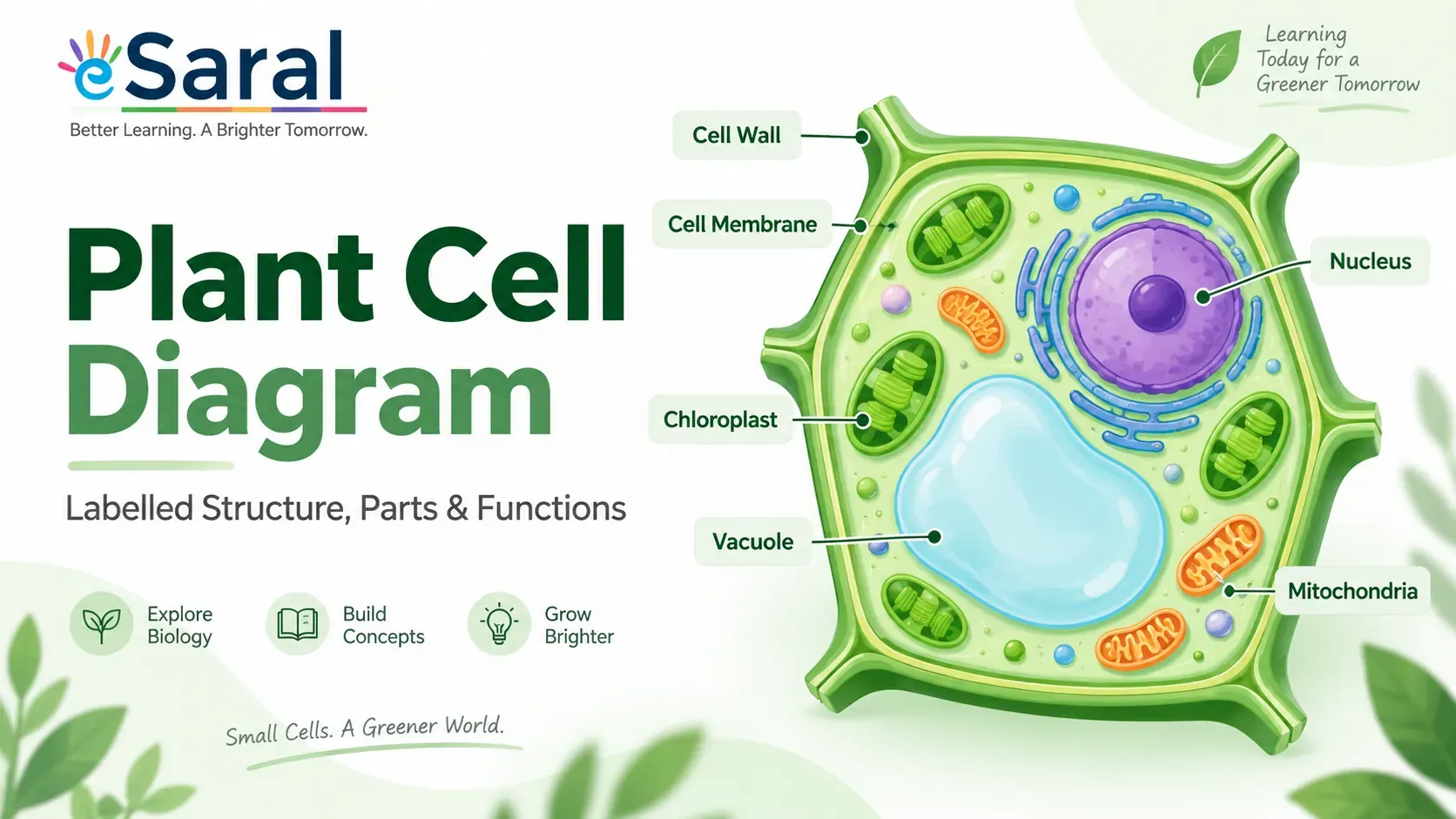
Plant Cell Diagram: Labelled Structure, Parts and Functions
Simple, labelled plant cell diagram with parts and functions. Covers plant cell structure for Class 6, 7, 8, 9, 10 and 11 students, CBSE-aligned.

Saransh Gupta Sir's Visit to IIT Patna: Hostel Life, Placements & Lessons for JEE Aspirants
Inside Saransh Gupta Sir's IIT Patna visit — hostel life, the library, placements, internships, and real advice for JEE aspirants from students living the IIT dream.
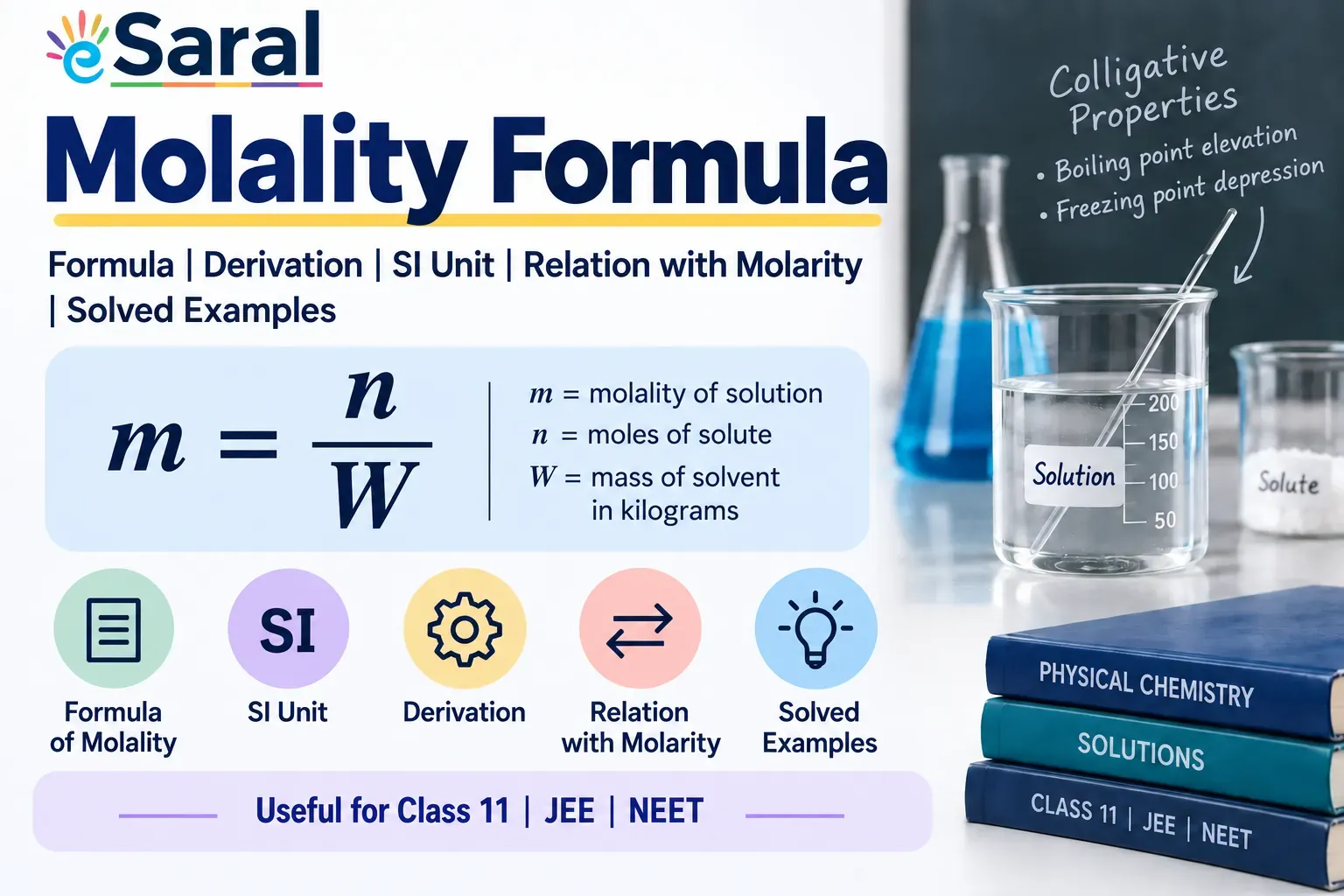
Molality Formula: Formula for Molality, Derivation & Solved Examples
Molality formula is $m = \dfrac{n}{W}$. Learn the formula of molality, its SI unit, derivation, relation with molarity, and solved examples for Class 11, JEE and NEET.
BITSAT Previous Year Question Paper PDF
Download BITSAT previous year question papers PDF. Get year-wise BITSAT PYQs, memory-based papers, exam pattern, and preparation tips to improve your BITSAT preparation.

Teachers’ Day 2026 at eSaral Gurukul: Celebrating the Bond Between Students, Teachers & Mentors
See how Teachers’ Day 2026 was celebrated at eSaral Gurukul, reflecting the bond among students, teachers, and mentors, and the role of guidance beyond academics.

JEE Advanced Attempts: Can You Give It a Third Time? Rules Explained
JEE Advanced attempts: current rule is 2 consecutive years only: full eligibility criteria, the 2025 third-attempt controversy, and the latest 2026 petition news.

Best JEE Preparation App
Best JEE preparation app for Main & Advanced: AI mock tests, live doubt-solving, thousands of practice questions. JEE preparation app for droppers & Class 11-12.
Coordinate Geometry Class 10: Formulas, Notes & Solved Examples
Coordinate geometry class 10: complete CBSE formulas — distance, section, midpoint and area of triangle — with derivation, notes and solved examples.
How to make Notes For JEE Smart Notes Strategy of an AIR 41
Learn how to make notes for JEE the way toppers do — indexing, shorthand, and smart short notes for JEE that cut revision time to just 5–7 days.
SL Arora Physics Class 12 Index – Chapter List for Volume 1 & 2
SL Arora Physics Class 12 index — complete chapter list for Volume 1 & 2, mapped to NCERT solutions for board, JEE Main, and NEET preparation.