
Chemical Equilibrium Class 11 Notes for IIT JEE & NEET

eSaral Academic and Editorial Team
Summary
Chemical Equilibrium Class 11 Notes cover dynamic equilibrium, the law of chemical equilibrium, the equilibrium constants $K_c$ and $K_p$ and the relation between them, the reaction quotient, the link between $\Delta G^\circ$ and $K$, Le Chatelier’s principle, the degree of dissociation and the industrial applications. This page gives all the formulas, solved examples and handwritten notes for CBSE boards, JEE Main and NEET.
Equilibrium is Chapter 6 of NCERT Class 11 Chemistry (it was Chapter 7 in older books). The NCERT chapter covers both chemical equilibrium and ionic equilibrium (acids, bases, buffers and solubility product). This page is about chemical equilibrium. The same ideas return in Chemical Kinetics, Electrochemistry and the p-Block. These Chemical Equilibrium Class 11 Notes follow the topics of the NCERT chapter and the JEE Main and NEET syllabi.
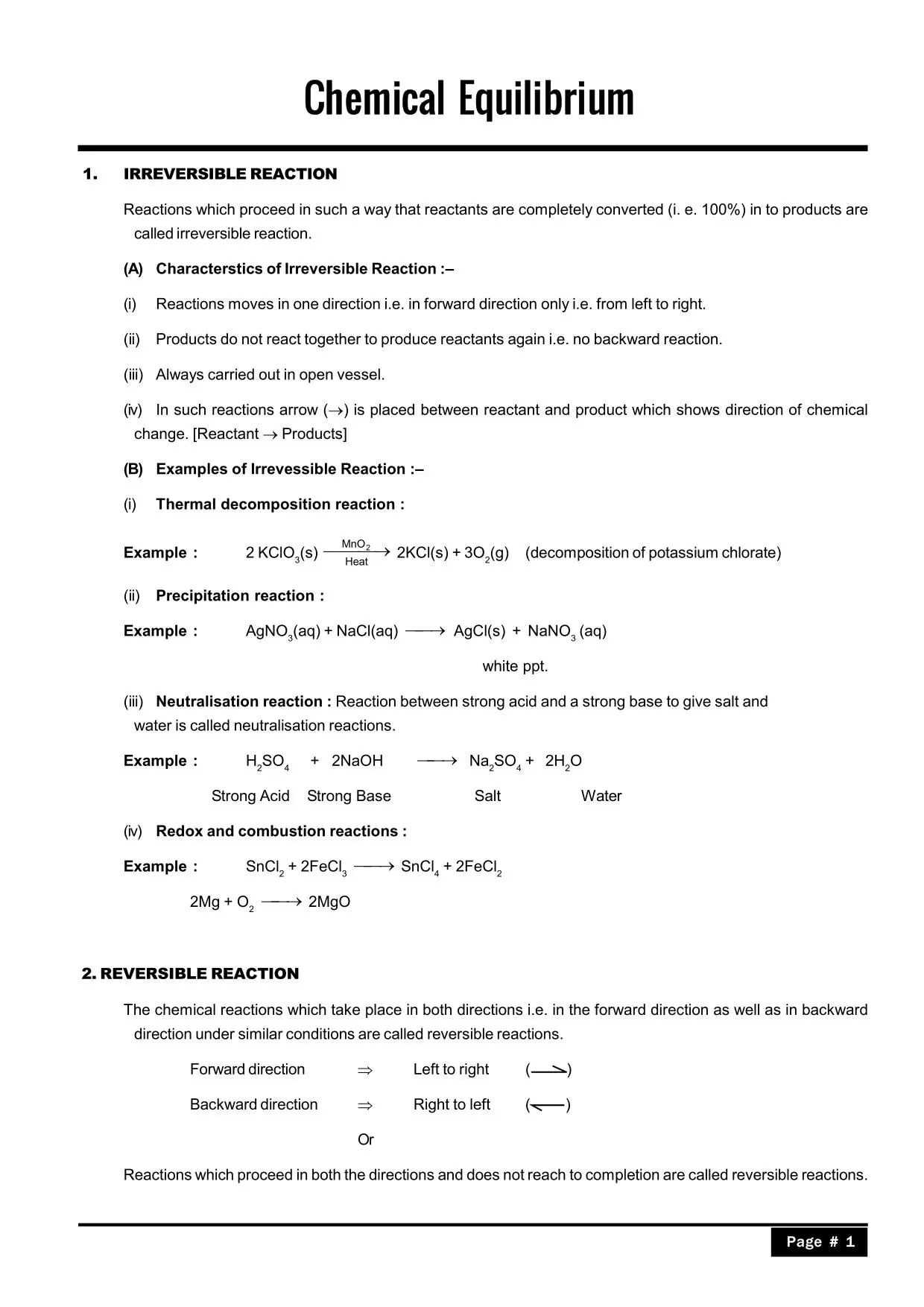
Chemical Equilibrium Class 11 Notes
India's Best Exam Preparation for Class 11th - Download Now
India's Best Exam Preparation for Class 11th - Download Now
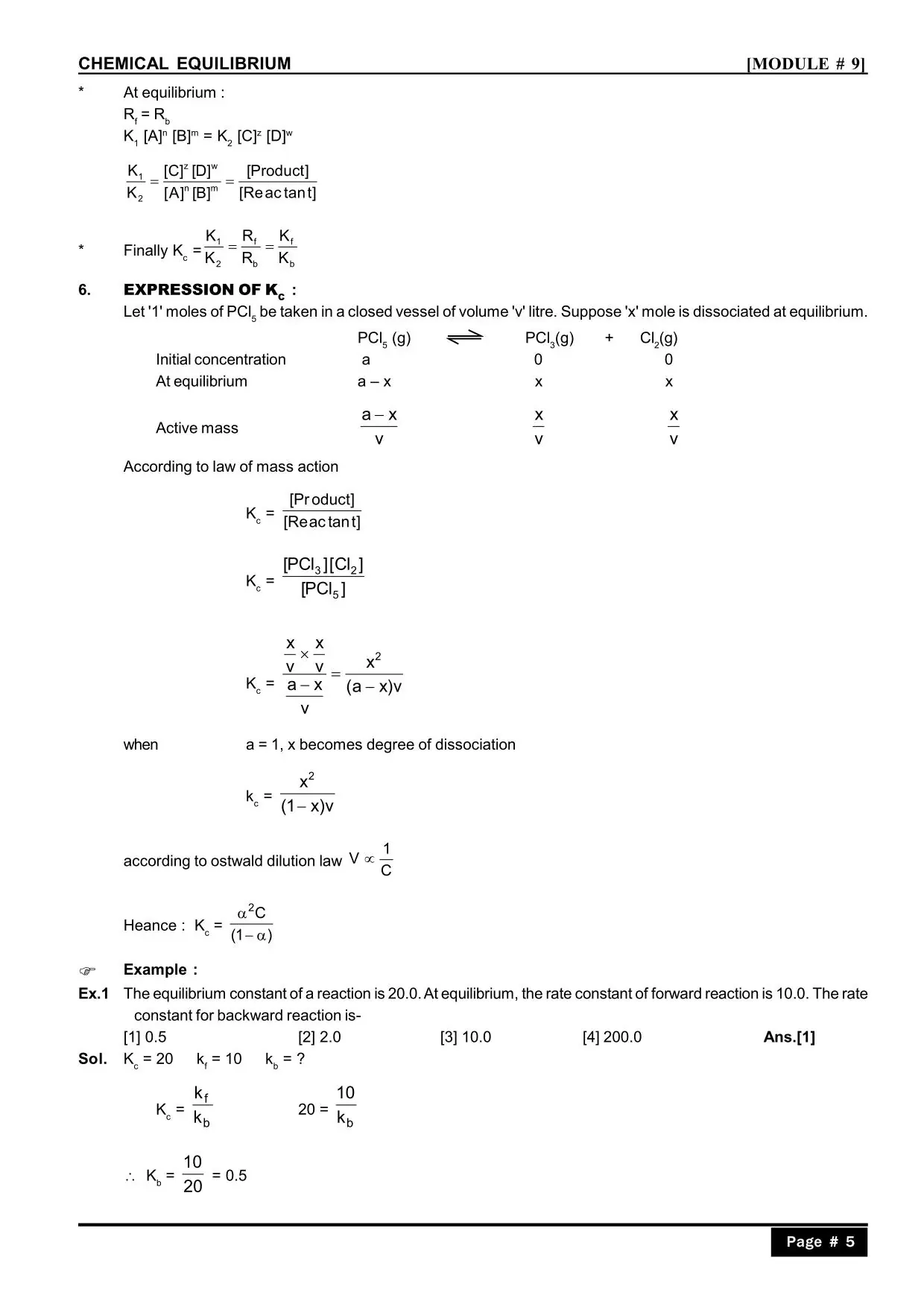
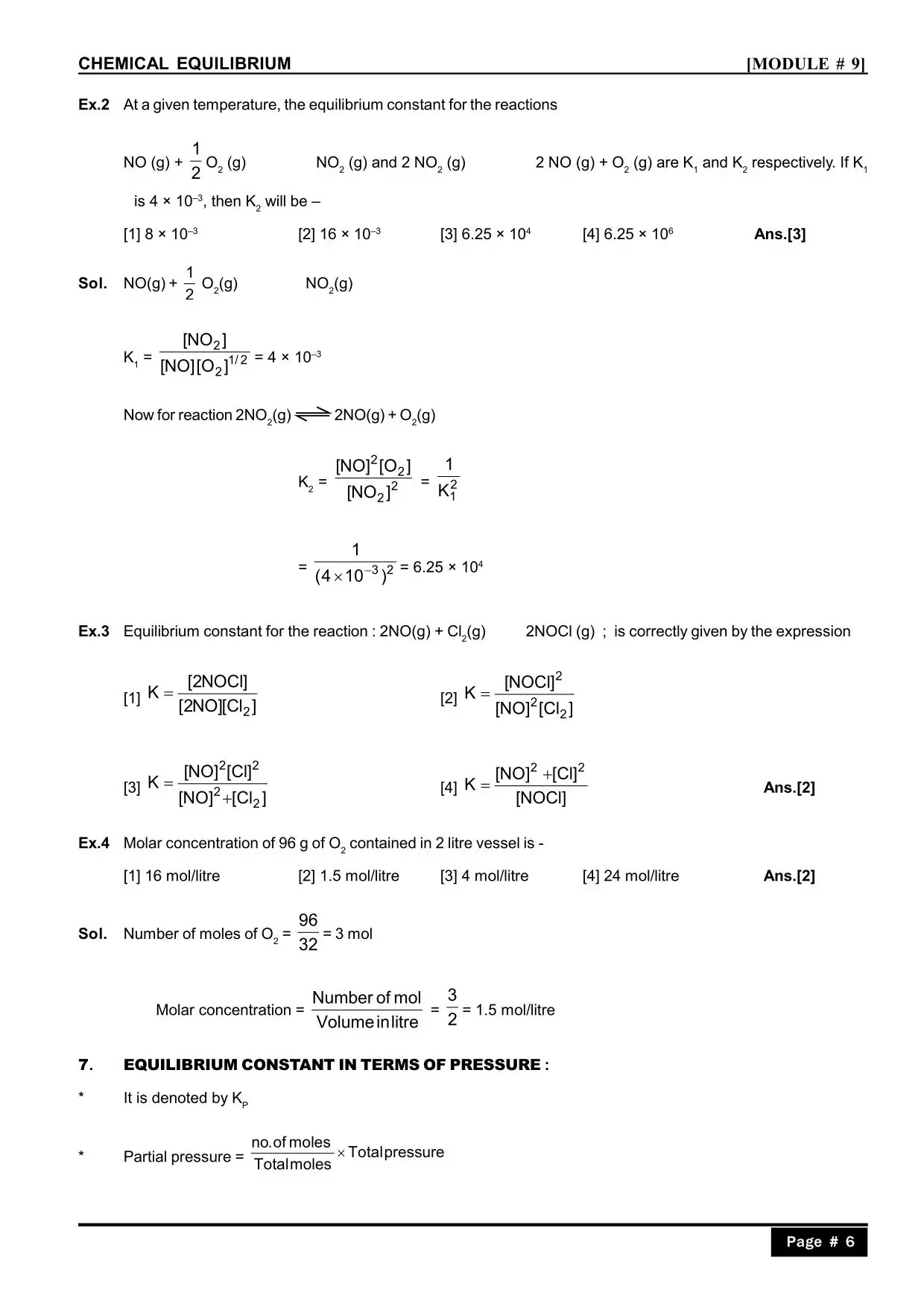
India's Best Exam Preparation for Class 11th - Download Now
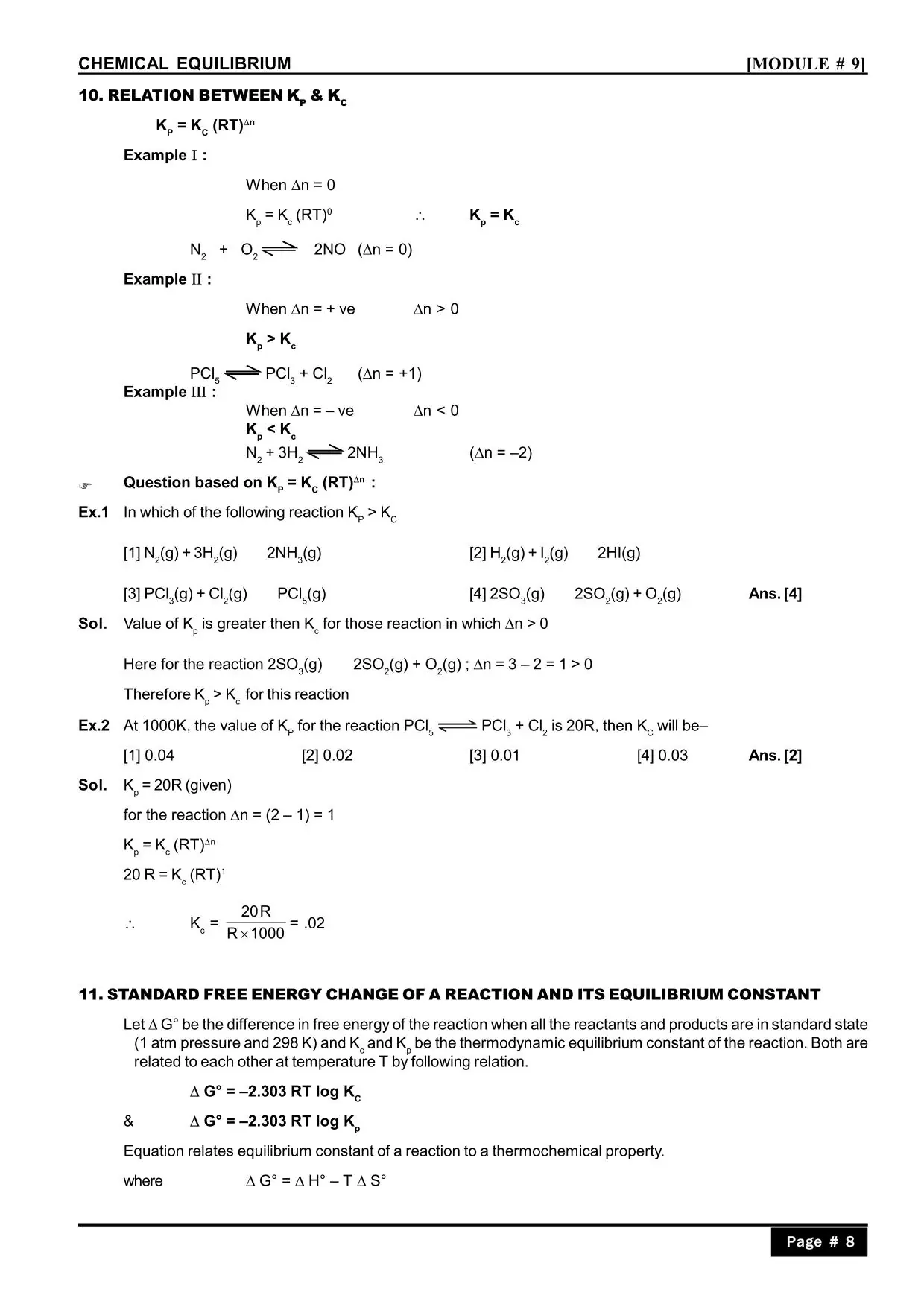
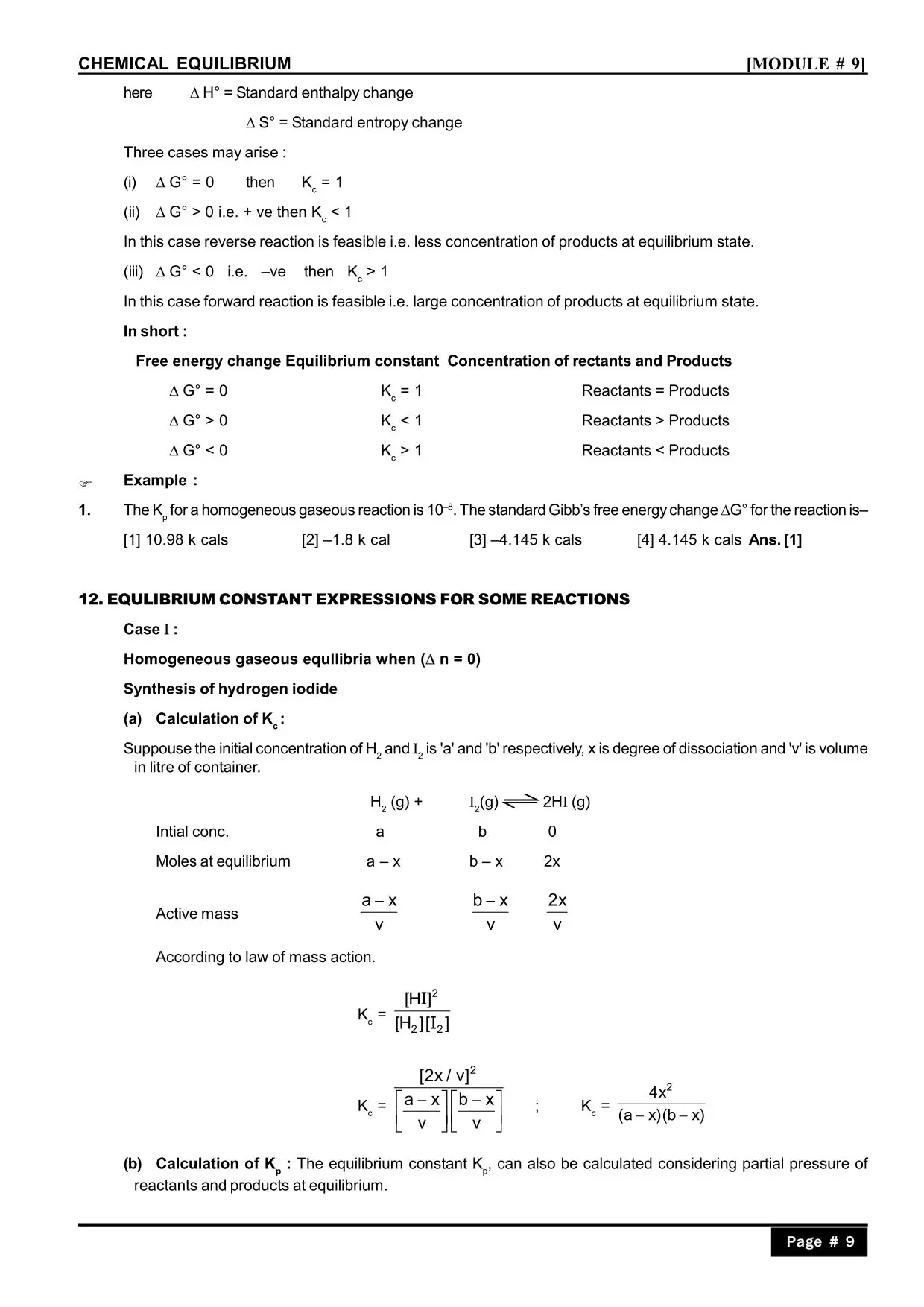
India's Best Exam Preparation for Class 11th - Download Now
India's Best Exam Preparation for Class 11th - Download Now
Chemical Equilibrium Class 11 Notes: Chapter Overview and Syllabus
The topics of chemical equilibrium are:
- Equilibrium in physical processes, and the idea of dynamic equilibrium
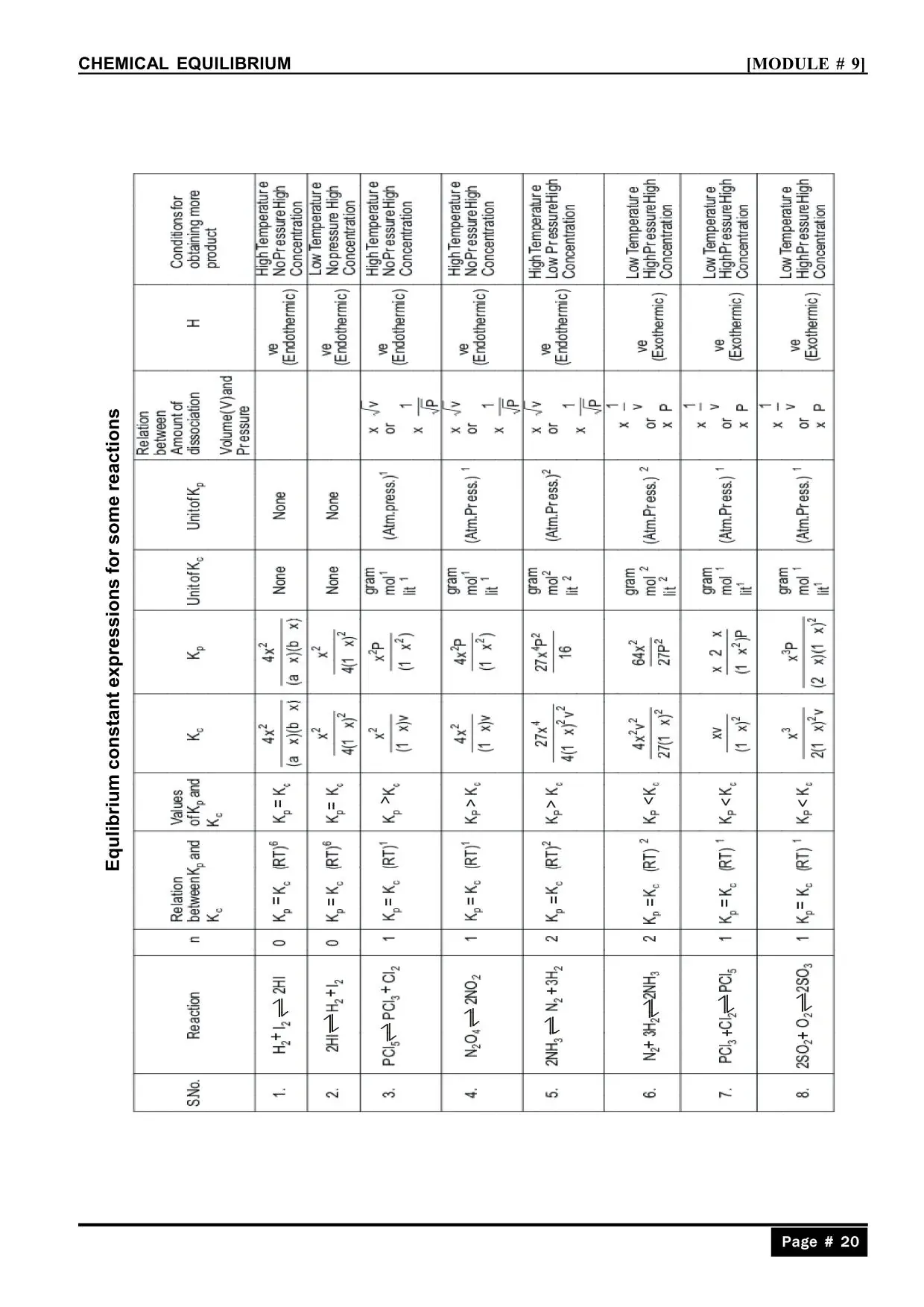
- The law of chemical equilibrium, and the equilibrium constants $K_c$ and $K_p$ with their significance
- The reaction quotient, and the direction of a reaction
- The significance of $\Delta G$ and $\Delta G^\circ$ in chemical equilibrium
- Factors that affect equilibrium: concentration, pressure, temperature and the effect of a catalyst, with Le Chatelier’s principle
Ionic equilibrium (pH, buffers, $K_a$, $K_b$ and $K_{sp}$) is the other half of the NCERT chapter and has its own notes. Check the latest syllabi of CBSE, NTA (JEE Main) and NMC (NEET) for the exact lists.
Tip from the eSaral Chemistry team: In every equilibrium numerical, write the balanced equation first, then the expression for $K$, and then an ICE table (Initial, Change, Equilibrium). Most errors come from a wrong power in the expression for $K$.
What Is Chemical Equilibrium? Dynamic Equilibrium in Chemical Equilibrium Class 11 Notes
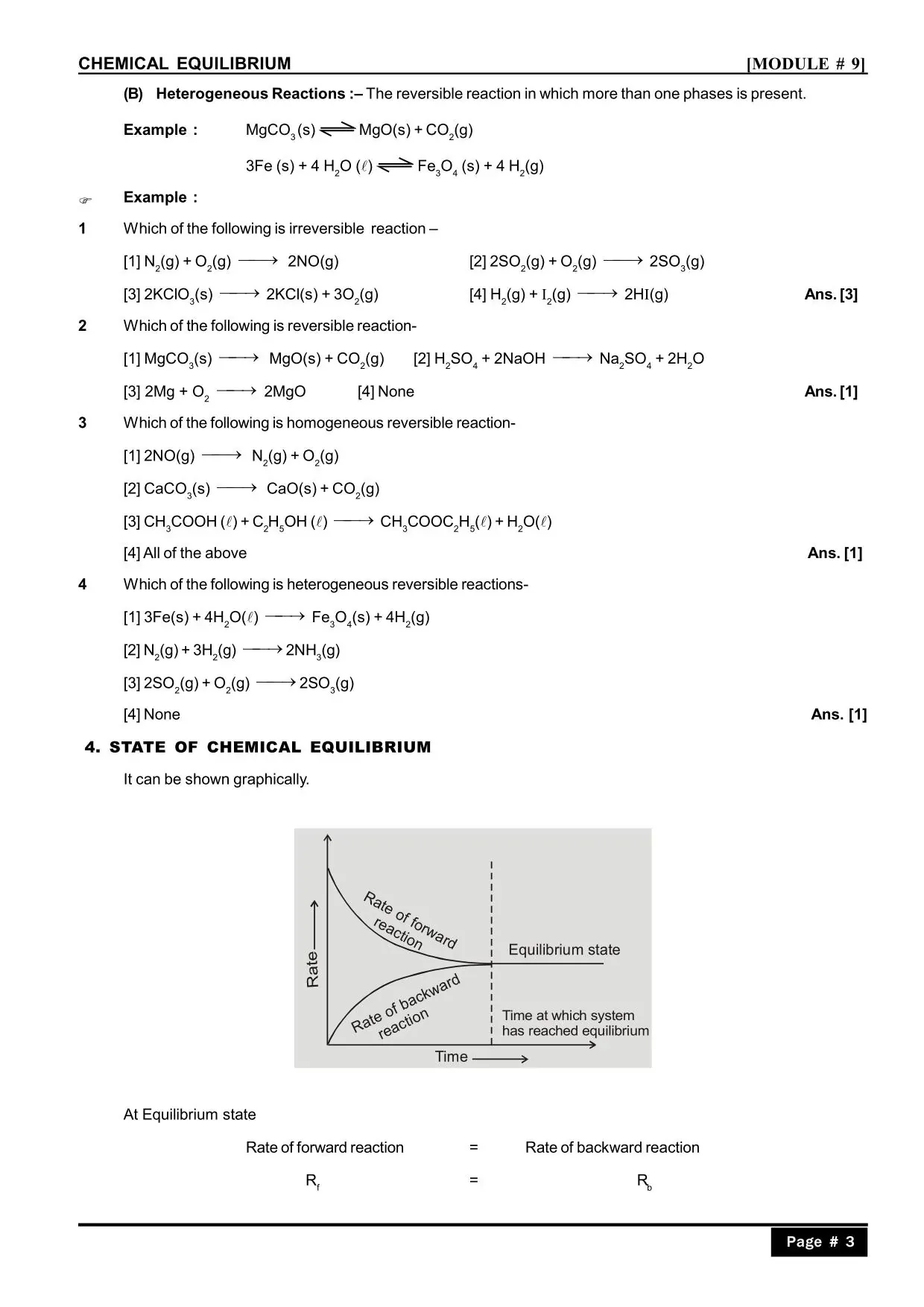
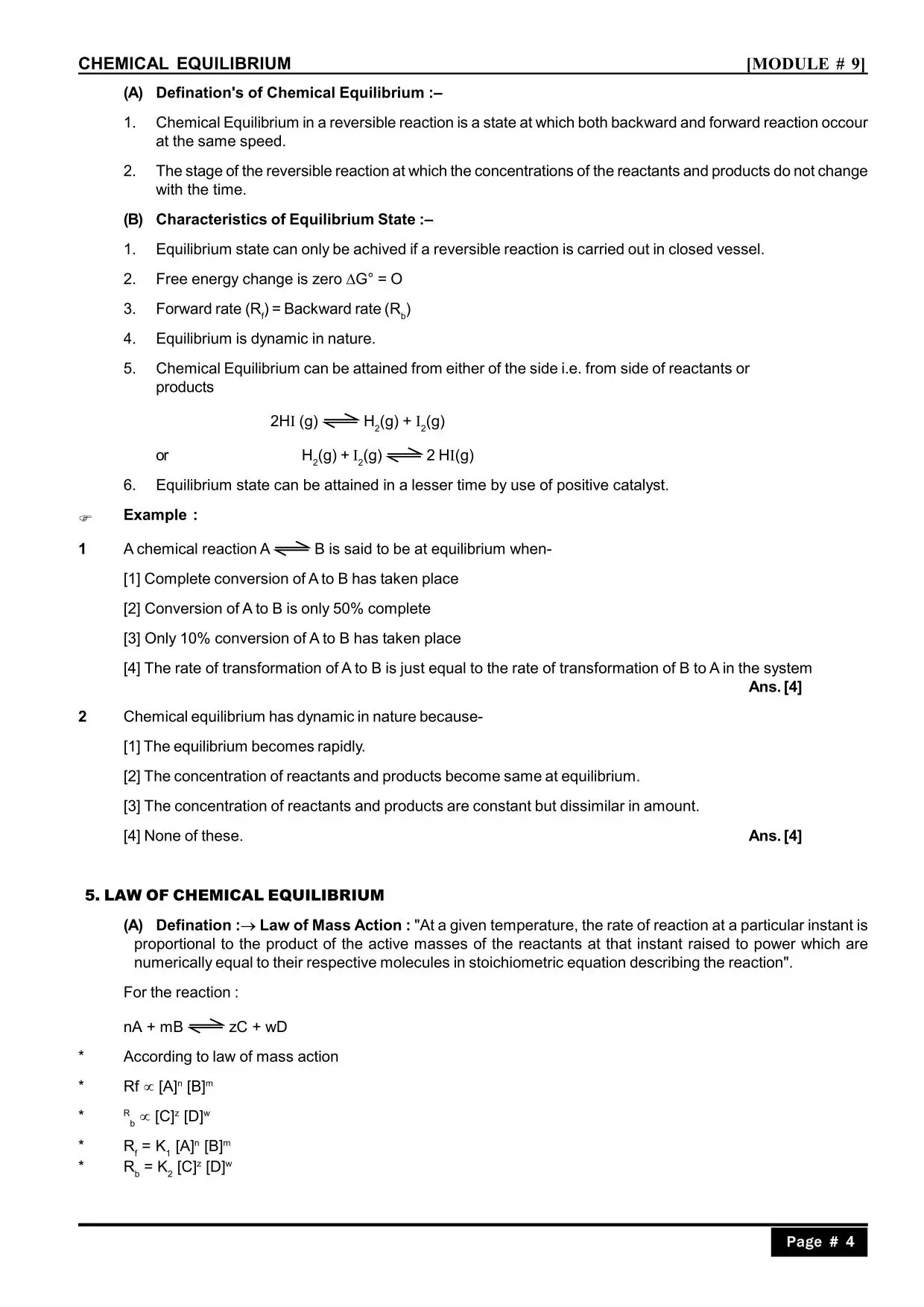
A reaction is reversible if the products can react to form the reactants again. In a closed system, a reversible reaction reaches chemical equilibrium when the rate of the forward reaction equals the rate of the reverse reaction. At this stage:
- The concentrations of all the species stay constant, but the reactions have not stopped. This is why it is called a dynamic equilibrium.
- The same equilibrium is reached from either side (from the reactants or from the products), at a given temperature.
- A catalyst does not change the position of equilibrium. It only helps the system to reach it faster.
Equilibrium Constants $K_c$ and $K_p$ in Chemical Equilibrium Class 11 Notes
For the reaction $a\mathrm{A} + b\mathrm{B} \rightleftharpoons c\mathrm{C} + d\mathrm{D}$ at equilibrium:
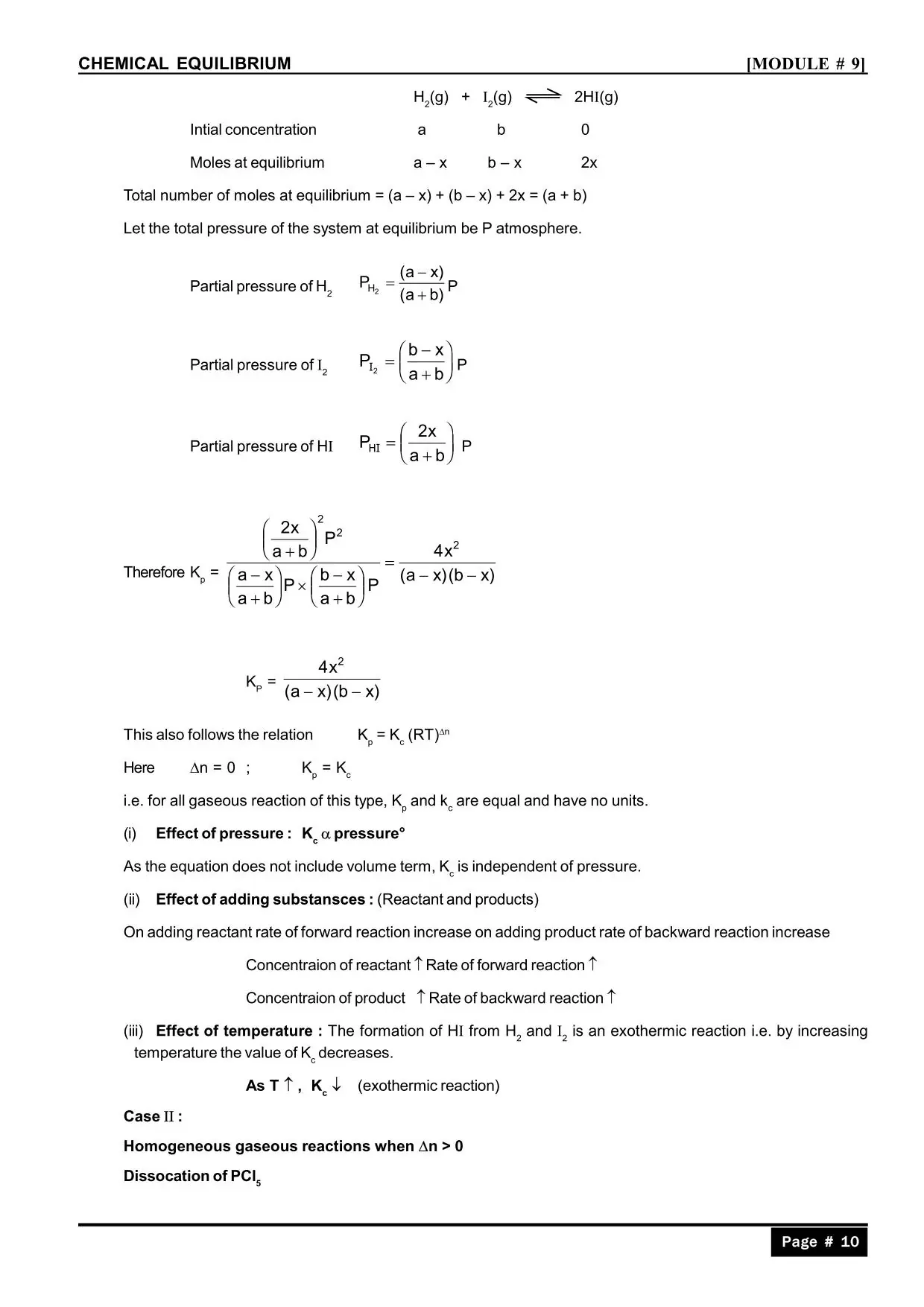
$$K_c = \frac{[\mathrm{C}]^c\,[\mathrm{D}]^d}{[\mathrm{A}]^a\,[\mathrm{B}]^b}, \qquad K_p = \frac{p_{\mathrm{C}}^{\,c}\,p_{\mathrm{D}}^{\,d}}{p_{\mathrm{A}}^{\,a}\,p_{\mathrm{B}}^{\,b}}$$
Relation between $K_p$ and $K_c$:
$$K_p = K_c\,(RT)^{\Delta n_g}, \qquad \Delta n_g = (c + d) - (a + b) \ \text{(gaseous species only)}$$
If $\Delta n_g = 0$, then $K_p = K_c$. Use $R = 0.0821$ L atm mol⁻¹ K⁻¹ when the pressures are in atm.
Rules for writing the expression of $K$:
Rule | Statement |
|---|---|
Pure solids and pure liquids | Their concentrations are taken as 1, so they do not appear in $K$ |
Reverse reaction | $K_{\text{reverse}} = \dfrac{1}{K}$ |
Multiplying the equation by $n$ | $K_{\text{new}} = K^n$ |
Adding two reactions | $K_{\text{net}} = K_1 \times K_2$ |
Dependence | $K$ depends only on temperature |
Significance of the magnitude of $K$: if $K \gg 1$, the products are favoured at equilibrium. If $K \ll 1$, the reactants are favoured. A very large or very small $K$ tells you the extent of the reaction, not its speed.
Reaction Quotient and the Direction of a Reaction in Chemical Equilibrium Class 11 Notes
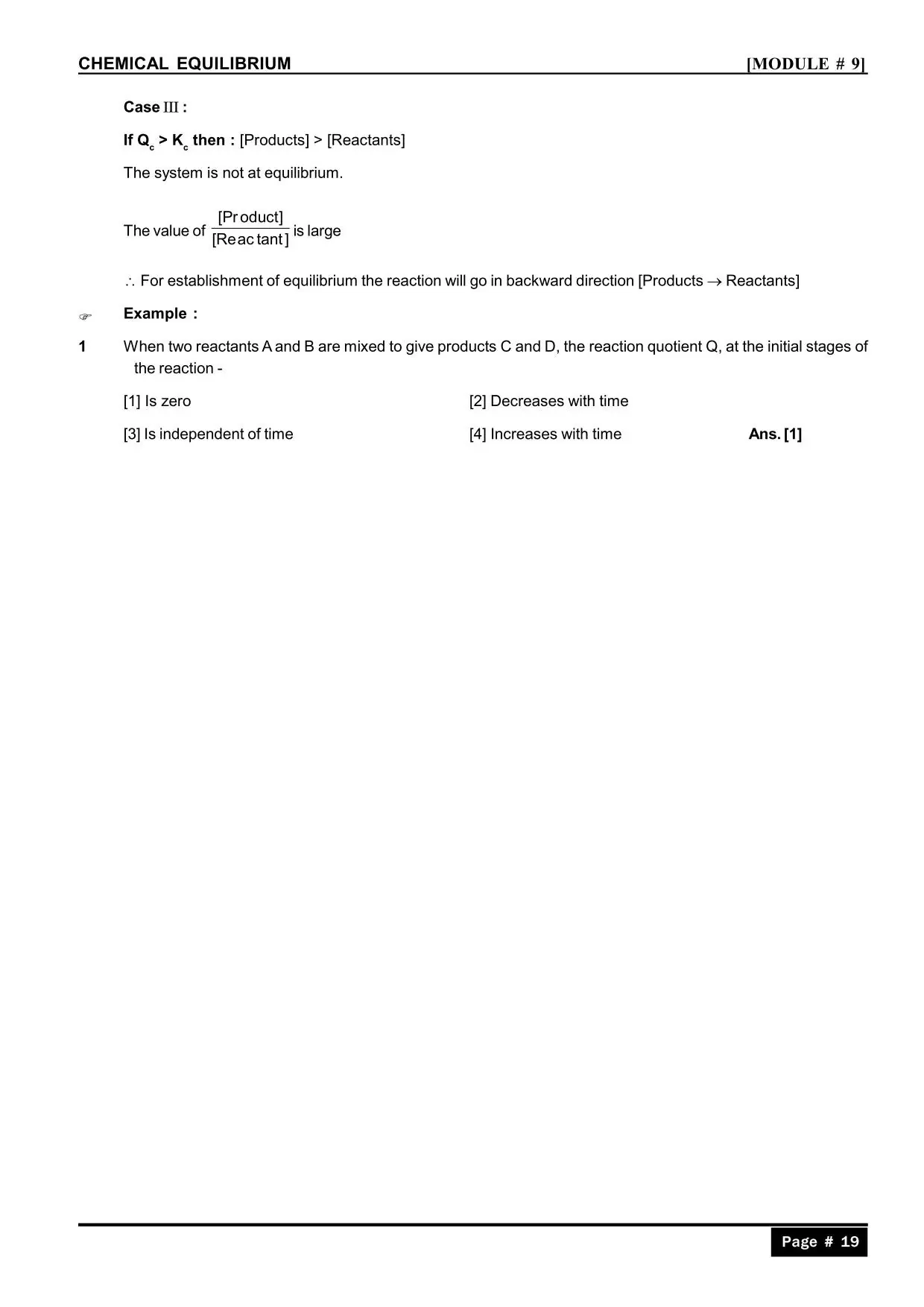
The reaction quotient $Q$ has the same form as $K$, but it uses the concentrations (or pressures) at any moment:
$$Q_c = \frac{[\mathrm{C}]^c\,[\mathrm{D}]^d}{[\mathrm{A}]^a\,[\mathrm{B}]^b} \quad \text{(at any time)}$$
Comparison | What happens |
|---|---|
$Q < K$ | The reaction proceeds in the forward direction |
$Q = K$ | The system is at equilibrium |
$Q > K$ | The reaction proceeds in the backward direction |
Gibbs Energy and the Equilibrium Constant in Chemical Equilibrium Class 11 Notes
$$\Delta G^\circ = -RT\ln K = -2.303\,RT\log K$$ $$\Delta G = \Delta G^\circ + RT\ln Q$$
At equilibrium, $\Delta G = 0$ and $Q = K$. If $K > 1$, then $\Delta G^\circ$ is negative. If $K < 1$, then $\Delta G^\circ$ is positive.
Le Chatelier’s Principle and the Factors That Affect Equilibrium in Chemical Equilibrium Class 11 Notes
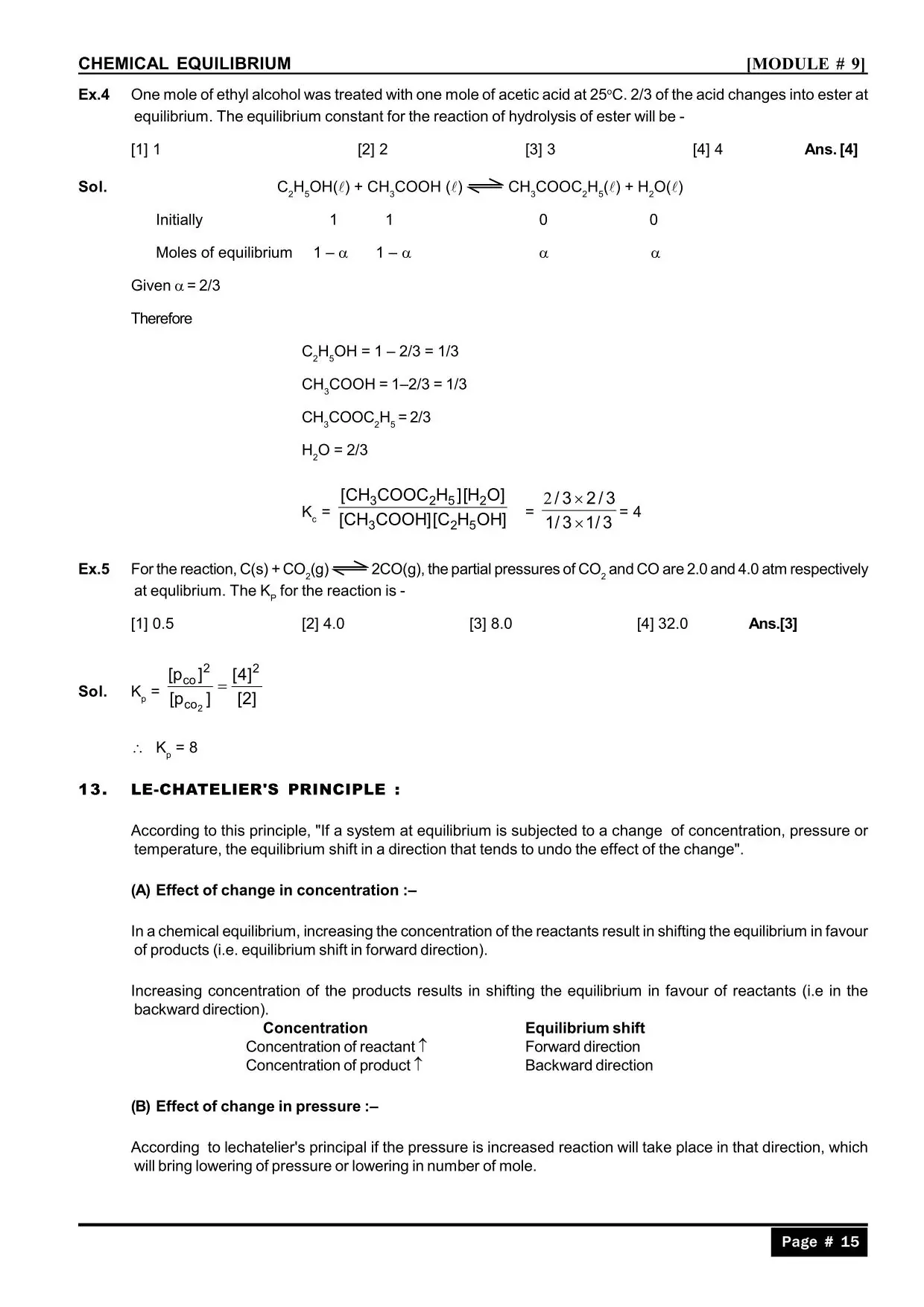
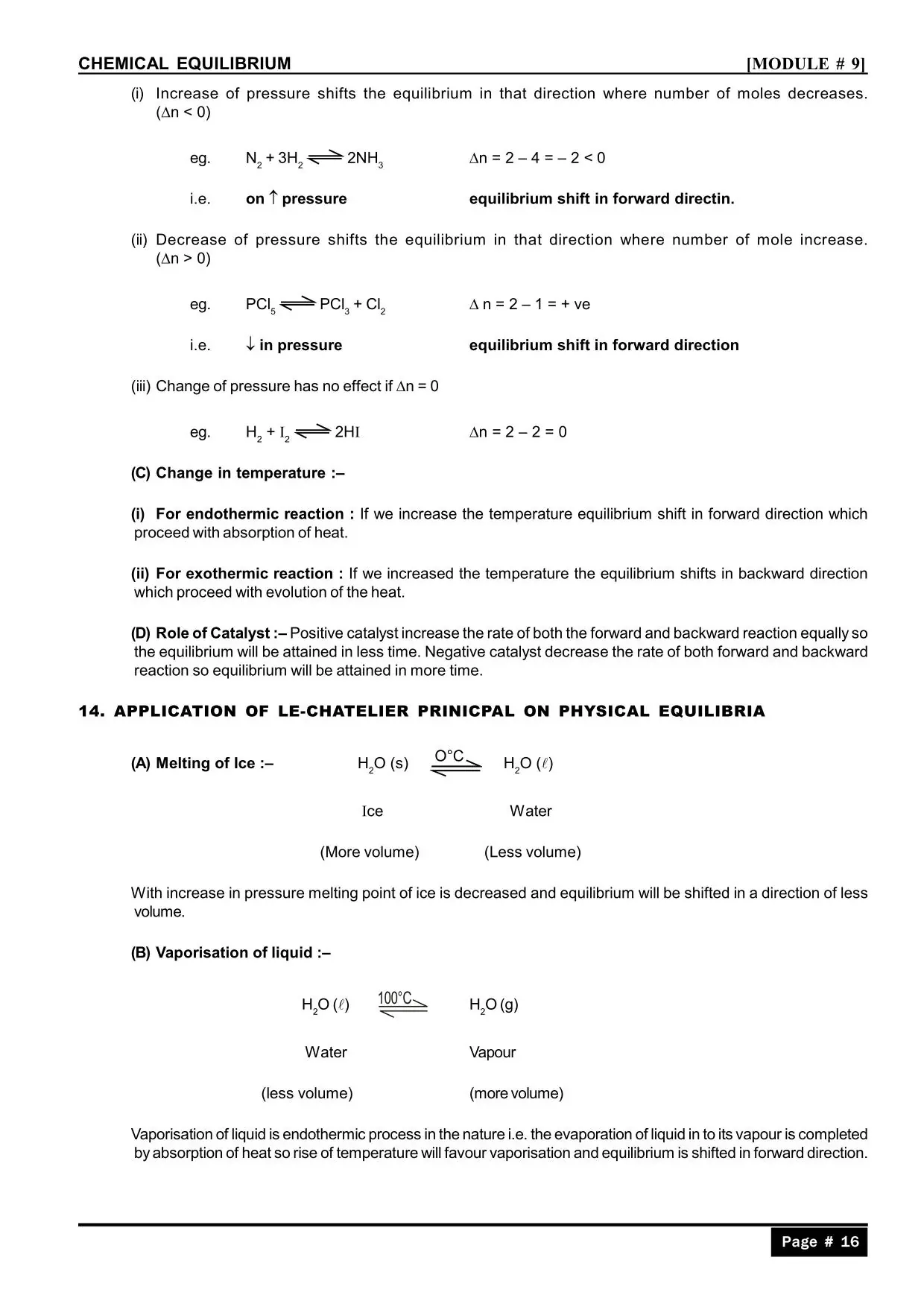
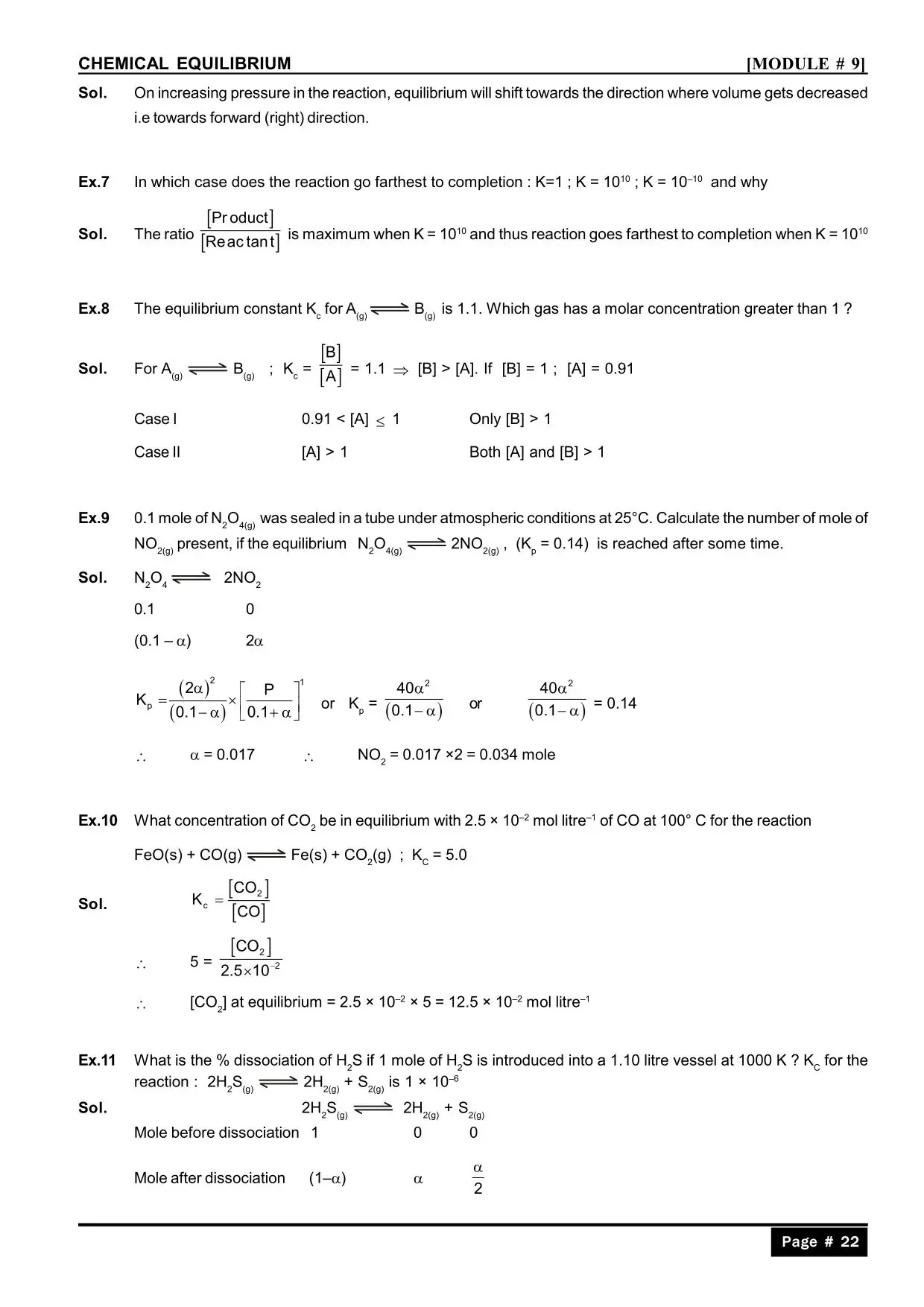
Le Chatelier’s principle: if a change is made in the conditions of a system at equilibrium, the system shifts in the direction that reduces the effect of the change.
Change | Direction of the shift | Effect on $K$ |
|---|---|---|
Increase the concentration of a reactant | Forward (the reactant is used up) | None |
Remove a product | Forward | None |
Increase the pressure (decrease the volume) | Towards fewer moles of gas | None |
Increase the temperature | Towards the endothermic direction | Changes |
Decrease the temperature | Towards the exothermic direction | Changes |
Add a catalyst | No shift (equilibrium is reached faster) | None |
Add an inert gas at constant volume | No shift | None |
Add an inert gas at constant pressure | Towards more moles of gas | None |
Only a change in temperature changes the value of $K$. The effect is given by the van’t Hoff equation:
$$\ln\frac{K_2}{K_1} = -\frac{\Delta H^\circ}{R}\left(\frac{1}{T_2} - \frac{1}{T_1}\right)$$
For an endothermic reaction, $K$ increases when the temperature rises. For an exothermic reaction, $K$ decreases when the temperature rises.
Degree of Dissociation and Equilibrium Calculations in Chemical Equilibrium Class 11 Notes
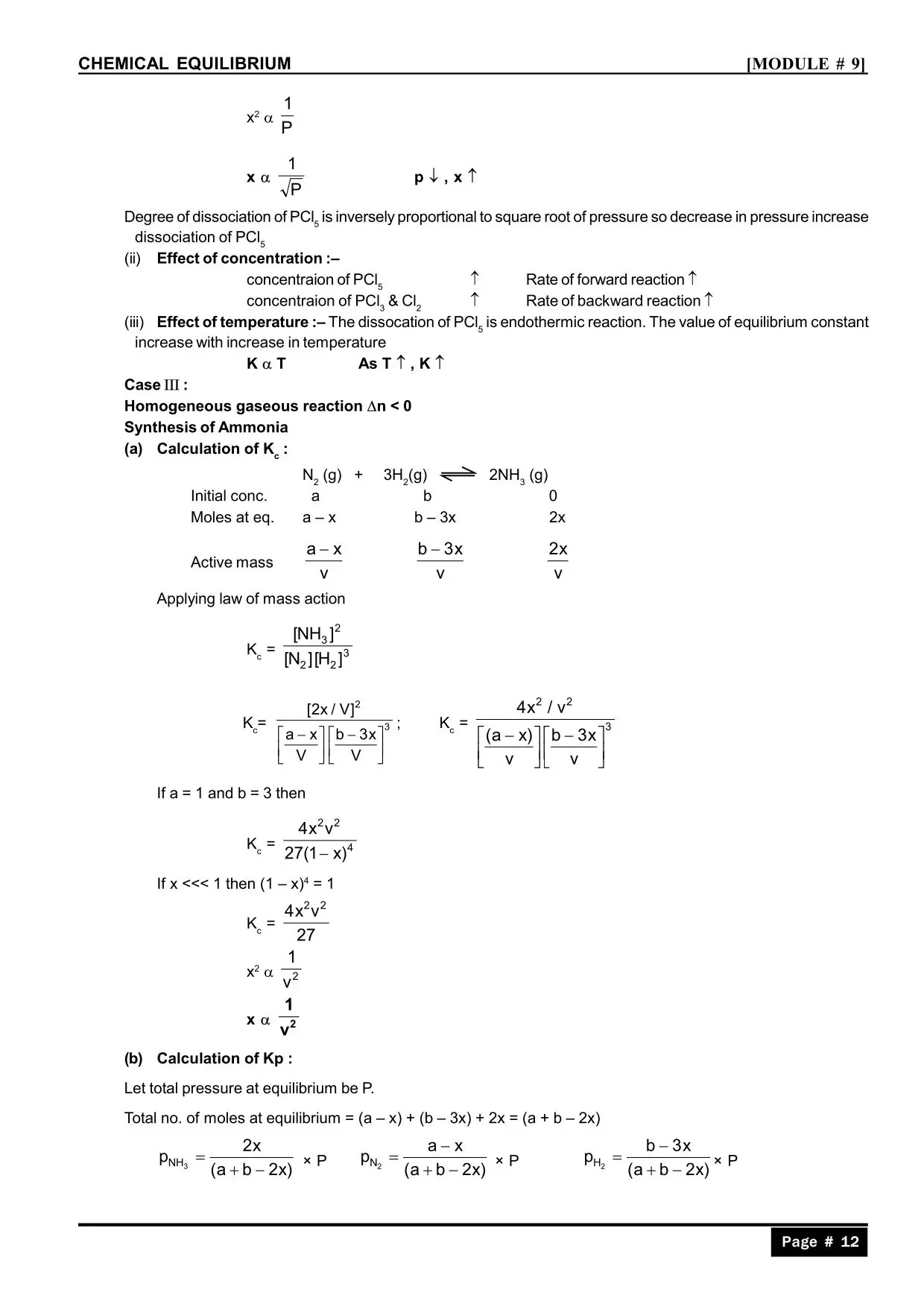
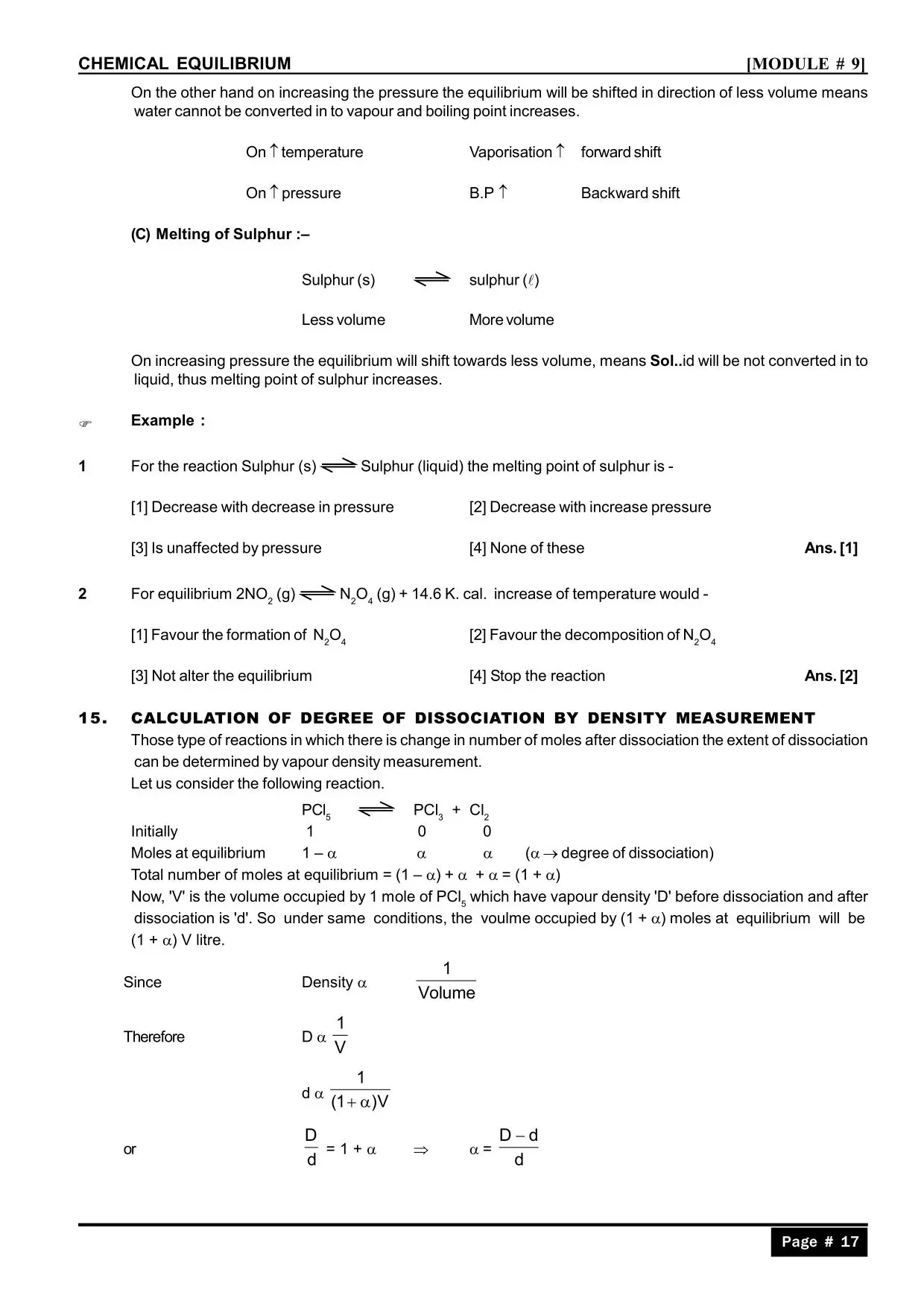
The degree of dissociation $\alpha$ is the fraction of the reactant that dissociates at equilibrium. For $\mathrm{PCl_5 \rightleftharpoons PCl_3 + Cl_2}$, starting with a concentration $C$ of $\mathrm{PCl_5}$ and no products:
$\mathrm{PCl_5}$ | $\mathrm{PCl_3}$ | $\mathrm{Cl_2}$ | |
|---|---|---|---|
Initial | $C$ | $0$ | $0$ |
Change | $-C\alpha$ | $+C\alpha$ | $+C\alpha$ |
Equilibrium | $C(1 - \alpha)$ | $C\alpha$ | $C\alpha$ |
$$K_c = \frac{C\alpha \cdot C\alpha}{C(1 - \alpha)} = \frac{C\alpha^2}{1 - \alpha}, \qquad K_p = \frac{\alpha^2}{1 - \alpha^2}\,P$$
where $P$ is the total pressure at equilibrium. When $\alpha \ll 1$, you can write $1 - \alpha \approx 1$ and $K_c \approx C\alpha^2$, which gives $\alpha \approx \sqrt{K_c/C}$.
For $\mathrm{N_2O_4 \rightleftharpoons 2NO_2}$, $K_p = \dfrac{4\alpha^2}{1 - \alpha^2}\,P$.
From vapour density: if $D$ is the theoretical (initial) vapour density and $d$ is the observed vapour density at equilibrium, and one mole of the reactant gives $n$ moles of products:
$$\alpha = \frac{D - d}{(n - 1)\,d}$$
Industrial Applications in Chemical Equilibrium Class 11 Notes
Process | Reaction | Conditions that favour the product |
|---|---|---|
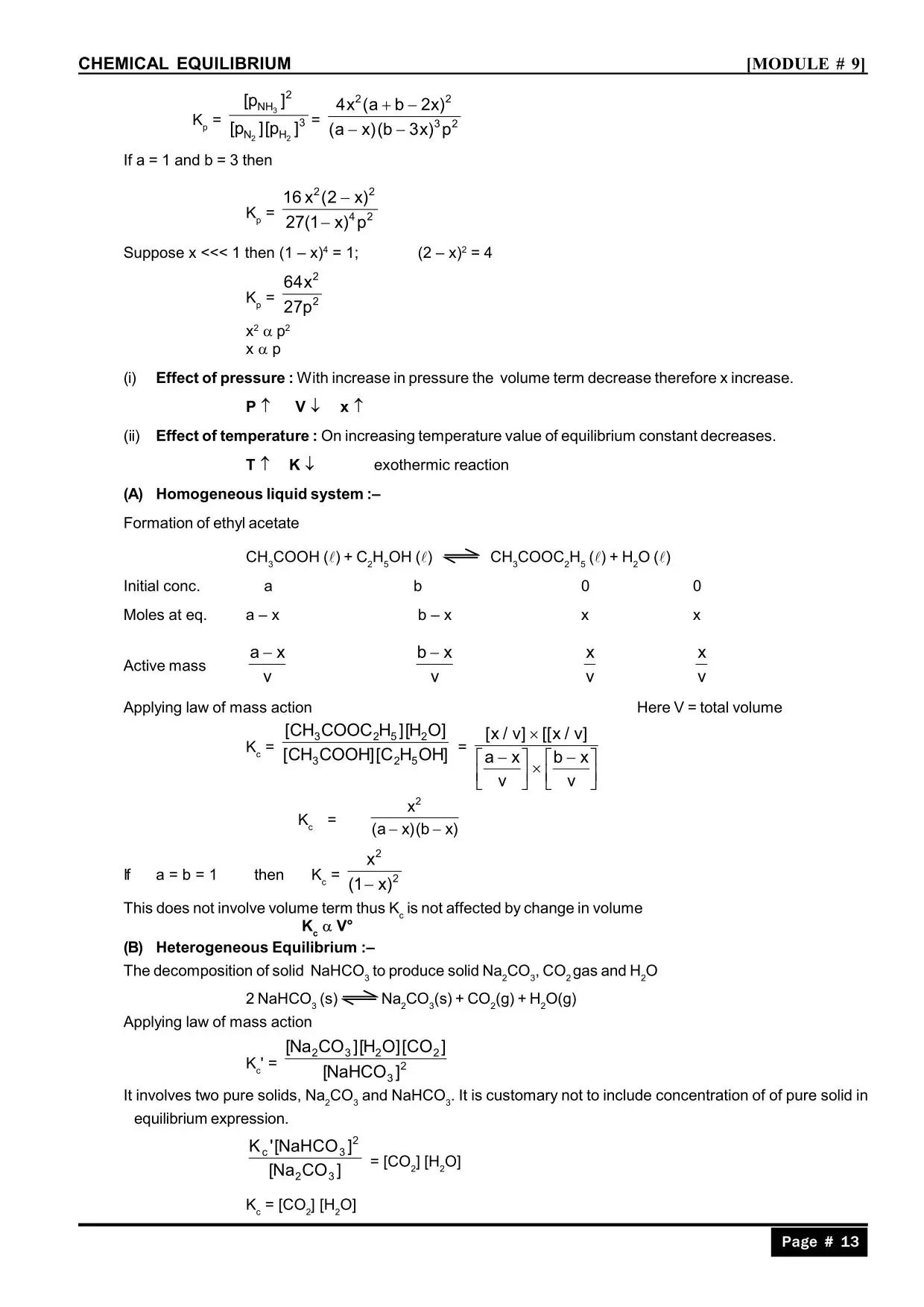
Haber process | $\mathrm{N_2 + 3H_2 \rightleftharpoons 2NH_3}$ ($\Delta H < 0$) | High pressure, a moderate temperature (about 700 K) and an iron catalyst |
Contact process | $\mathrm{2SO_2 + O_2 \rightleftharpoons 2SO_3}$ ($\Delta H < 0$) | High pressure, a moderate temperature and a $\mathrm{V_2O_5}$ catalyst |
Both reactions are exothermic and reduce the number of moles of gas. A high pressure favours the products, but a high temperature lowers the yield. A moderate temperature is chosen as a compromise, because a low temperature makes the reaction too slow.
Key Formulas in Chemical Equilibrium Class 11 Notes
Concept | Formula |
|---|---|
Equilibrium constant | $K_c = \dfrac{[\mathrm{C}]^c[\mathrm{D}]^d}{[\mathrm{A}]^a[\mathrm{B}]^b}$ |
$K_p$ and $K_c$ | $K_p = K_c(RT)^{\Delta n_g}$ |
Reaction quotient | $Q$ has the form of $K$ with non-equilibrium values |
Gibbs energy | $\Delta G^\circ = -2.303\,RT\log K$ |
van’t Hoff equation | $\ln\dfrac{K_2}{K_1} = -\dfrac{\Delta H^\circ}{R}\left(\dfrac{1}{T_2} - \dfrac{1}{T_1}\right)$ |
Dissociation, $\mathrm{PCl_5}$ | $K_c = \dfrac{C\alpha^2}{1 - \alpha}$ |
Vapour density | $\alpha = \dfrac{D - d}{(n - 1)d}$ |
Solved Examples from Chemical Equilibrium Class 11 Notes
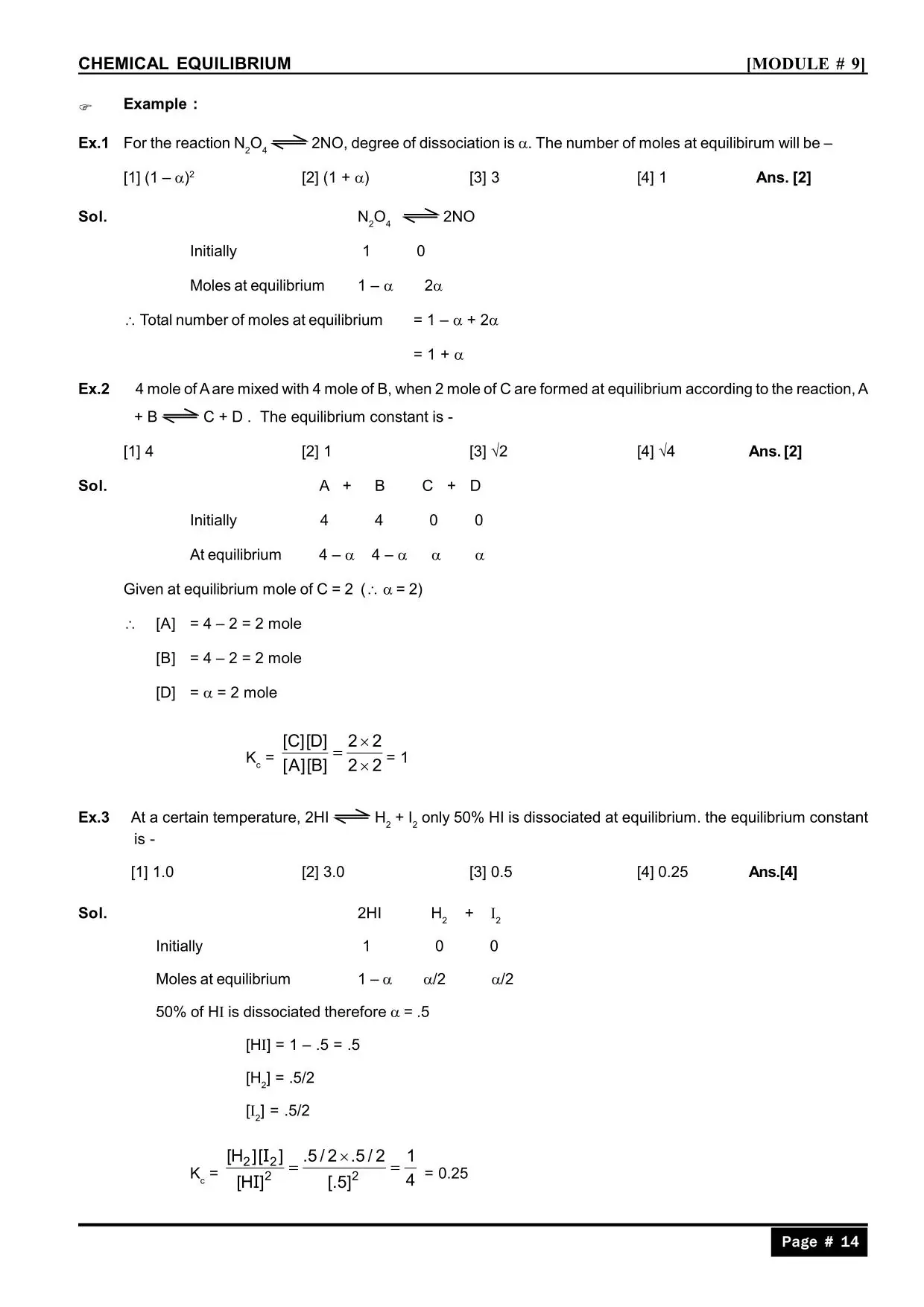
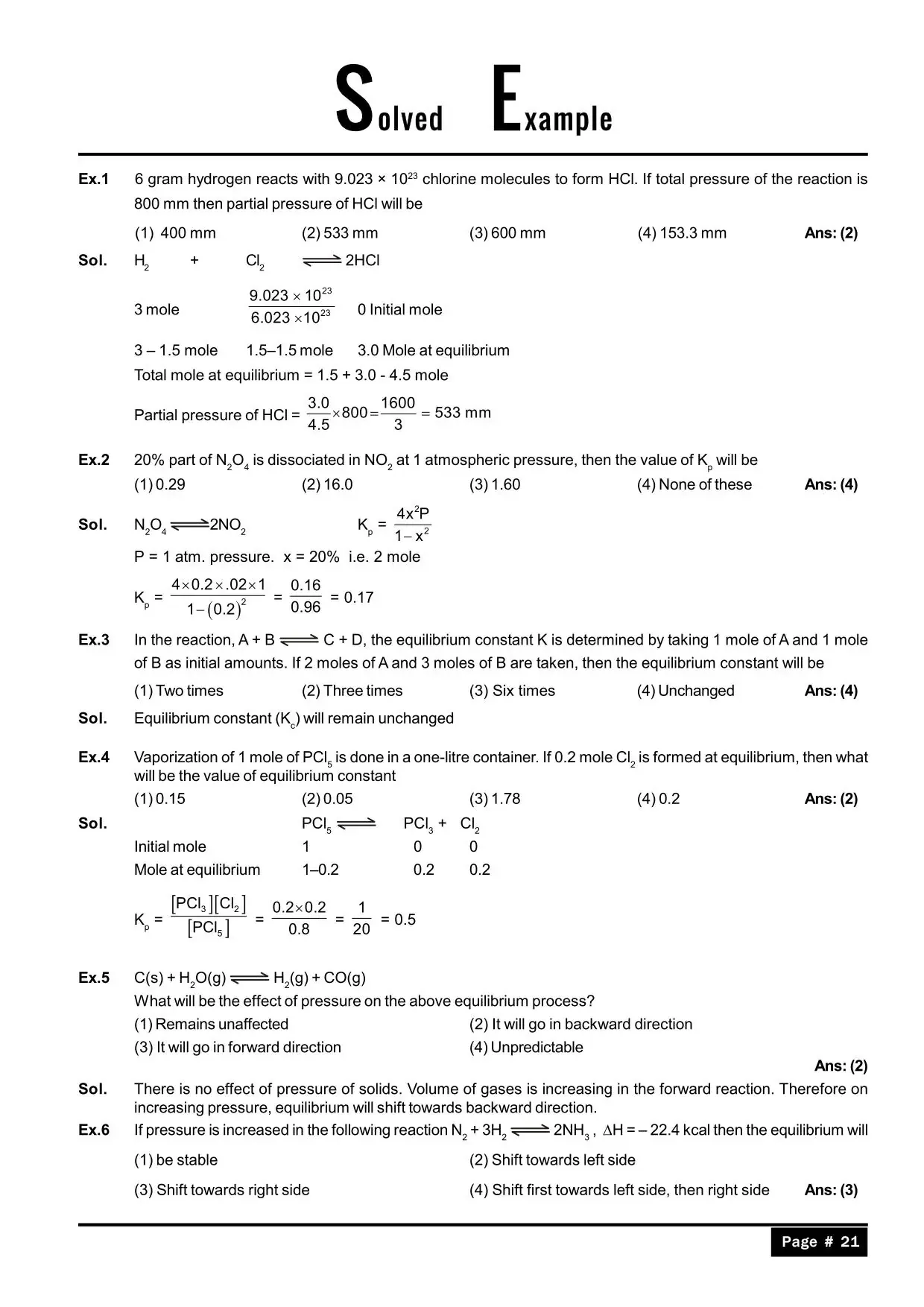
Example 1 (expression of $K_c$): Write $K_c$ for $\mathrm{N_2 + 3H_2 \rightleftharpoons 2NH_3}$.
$K_c = \dfrac{[\mathrm{NH_3}]^2}{[\mathrm{N_2}][\mathrm{H_2}]^3}$.
Example 2 ($K_p$ from $K_c$): For $\mathrm{N_2O_4 \rightleftharpoons 2NO_2}$, $K_c = 4.0 \times 10^{-3}$ mol L⁻¹ at 300 K. Find $K_p$.
$\Delta n_g = 2 - 1 = 1$, so $K_p = K_c RT = 4.0 \times 10^{-3} \times 0.0821 \times 300 \approx 0.098$ atm.
Example 3 (direction of the reaction): For $\mathrm{H_2 + I_2 \rightleftharpoons 2HI}$, $K_c = 50$ at 700 K. A mixture has $[\mathrm{H_2}] = 0.1$ M, $[\mathrm{I_2}] = 0.1$ M and $[\mathrm{HI}] = 1.0$ M. In which direction does the reaction proceed?
$Q_c = \dfrac{(1.0)^2}{(0.1)(0.1)} = 100$. Since $Q_c > K_c$, the reaction proceeds in the backward direction.
Example 4 (degree of dissociation): One mole of $\mathrm{PCl_5}$ in a 1 L vessel dissociates to the extent $\alpha = 0.4$ at equilibrium. Find $K_c$.
$K_c = \dfrac{C\alpha^2}{1 - \alpha} = \dfrac{1 \times (0.4)^2}{0.6} \approx 0.267$ mol L⁻¹.
Example 5 (changing the equation): For $\mathrm{N_2 + O_2 \rightleftharpoons 2NO}$, $K = 4 \times 10^{-4}$. Find $K$ for (a) $\mathrm{2NO \rightleftharpoons N_2 + O_2}$ and (b) $\mathrm{\tfrac{1}{2}N_2 + \tfrac{1}{2}O_2 \rightleftharpoons NO}$.
(a) $K' = \dfrac{1}{4 \times 10^{-4}} = 2500$. (b) $K'' = \sqrt{4 \times 10^{-4}} = 0.02$.
Example 6 (Gibbs energy): Find $\Delta G^\circ$ for a reaction with $K = 10$ at 300 K ($R = 8.314$ J K⁻¹ mol⁻¹).
$\Delta G^\circ = -2.303\,RT\log K = -2.303 \times 8.314 \times 300 \times 1 \approx -5744$ J mol⁻¹, or about $-5.74$ kJ mol⁻¹.
Example 7 (Le Chatelier’s principle): For $\mathrm{N_2 + 3H_2 \rightleftharpoons 2NH_3}$ ($\Delta H < 0$), what is the effect of (a) increasing the pressure, (b) increasing the temperature and (c) adding a catalyst?
(a) The equilibrium shifts forward, because there are fewer moles of gas on the right. (b) It shifts backward, because the forward reaction is exothermic, and $K$ decreases. (c) There is no shift, because a catalyst changes only the rate.
Common Mistakes in Chemical Equilibrium Class 11 Notes Problems
Mistake | Correct approach |
|---|---|
Including pure solids or liquids in $K$ | Leave them out, because their activity is 1 |
Using the wrong power for a coefficient | Raise each concentration to the power of its coefficient in the balanced equation |
Thinking that a catalyst changes $K$ or the shift | A catalyst changes only the rate, not the position or $K$ |
Using $K_p = K_c$ when $\Delta n_g \neq 0$ | Use $K_p = K_c(RT)^{\Delta n_g}$ |
Saying that pressure changes $K$ | Only temperature changes $K$. Pressure can change the position only. |
Forgetting that an inert gas at constant pressure acts like a volume increase | It shifts the equilibrium towards the side with more moles of gas |
Using $\alpha$ for the fraction that remains | $\alpha$ is the fraction that dissociates |
How to Study Chemical Equilibrium Class 11 Notes
- Read the NCERT chapter first, and solve the examples. Practise writing $K_c$ and $K_p$ for 10 reactions every day for a week.
- Learn the Le Chatelier table, and then solve the ICE-table numericals on $\alpha$.
- Revise with eSaral’s Class 11 Chemistry notes, and test yourself with eSaral’s NEET chapter-wise PYQs and JEE Main chapter-wise PYQs.
Frequently Asked Questions
How do you calculate the degree of dissociation from $K_c$?
Set up an ICE table with the degree of dissociation $\alpha$. Write the equilibrium concentrations in terms of $\alpha$ and the initial concentration, and put them in the $K_c$ expression. For $\mathrm{PCl_5 \rightleftharpoons PCl_3 + Cl_2}$, $K_c = \dfrac{C\alpha^2}{1 - \alpha}$. If $\alpha$ is very small, take $1 - \alpha \approx 1$, so $\alpha \approx \sqrt{K_c/C}$. eSaral’s Chemical Equilibrium Class 11 Notes give worked examples.
Does adding a catalyst shift the equilibrium position?
No. A catalyst does not change the position of equilibrium or the value of $K$. It speeds up the forward and the reverse reactions equally, so the system reaches equilibrium faster. This is a common trap in NEET questions.
What is the difference between $K_c$ and $K_p$ in Chemical Equilibrium Class 11 notes?
$K_c$ uses the molar concentrations of the species, and $K_p$ uses the partial pressures of the gaseous species. They are related by $K_p = K_c(RT)^{\Delta n_g}$, where $\Delta n_g$ is the change in the number of moles of gas. If $\Delta n_g = 0$, then $K_p = K_c$.
What is the reaction quotient, and how is it used?
The reaction quotient $Q$ has the same form as $K$, but it uses the concentrations at any moment. If $Q < K$, the reaction proceeds forward. If $Q > K$, it proceeds backward. If $Q = K$, the system is at equilibrium. In Chemical Equilibrium Class 11 Notes, this is the standard way to find the direction of a reaction.
Is chemical equilibrium important for NEET and JEE Main?
Equilibrium is part of the NEET and JEE Main Chemistry syllabus. The questions are mostly on Le Chatelier’s principle, $K_c$ and $K_p$, and numericals on the degree of dissociation, and the number of questions varies from year to year. Check the latest syllabi and previous years’ papers.
What happens to the equilibrium when the pressure is increased?
An increase in pressure at constant temperature shifts the equilibrium towards the side with fewer moles of gas. If $\Delta n_g = 0$, pressure has no effect on the position. Adding an inert gas at constant volume does not change the partial pressures, so it has no effect. Adding an inert gas at constant pressure increases the volume, so it shifts the equilibrium towards the side with more moles of gas.
Which factor changes the value of the equilibrium constant?
Only temperature changes the value of $K$. For an endothermic reaction, $K$ increases with temperature, and for an exothermic reaction, $K$ decreases, as the van’t Hoff equation shows. Concentration, pressure and a catalyst can change the position of equilibrium or the rate, but not $K$.
Which chapter number is Equilibrium in Class 11 Chemistry?
In the current NCERT Class 11 Chemistry book, Equilibrium is Chapter 6, and in older books it was Chapter 7. The chapter includes both chemical equilibrium and ionic equilibrium. These Chemical Equilibrium Class 11 Notes cover the chemical equilibrium part.
Where can I find more Class 11 Chemistry notes on eSaral?
eSaral has handwritten Chemical Equilibrium Class 11 Notes on this page, the Class 11 Chemistry notes hub and chapter-wise NEET and JEE previous year questions, all linked on this page.
Team eSaral
eSaral Academic and Editorial Team
Team eSaral is the collective author profile for educational content created by eSaral’s teachers and academic contributors. The team draws on expertise from IIT graduates, doctors, experienced educators and subject specialists to develop resources for JEE, NEET and school students. Our articles aim to explain concepts clearly and help students study with confidence.
Related Posts

BITSAT 2027: Registration Date, Exam Date, Syllabus, Eligibility, Pattern & Fees
BITSAT 2027 exam dates, registration timeline, eligibility criteria, exam pattern, marking scheme, syllabus and fees in one page.

BITSAT Previous Year Question Paper PDF (2017-2026)
Download BITSAT previous year question papers PDF from 2017 to 2026,session-wise. Memory-based papers,exam pattern, paper analysis and how to practise

CBSE Class 10 Date Sheet 2027: Expected Exam Dates, Release Date, Admit Card & Result Timeline
CBSE Class 10 date sheet 2027 is awaited. See the expected exam dates, release window, how to download the PDF, admit card and result timelines.

NCERT Physics Class 10 Book PDF in Hindi 2026-27 – भौतिक विज्ञान के 4 अध्याय (Free Download)
NCERT Physics Class 10 book PDF in Hindi 2026-27: download all 4 chapters (अध्याय 9–12) free, with topics and important formulas.

NCERT Biology Class 9 Book Anveshan PDF in Hindi - जीव विज्ञान कक्षा 9 पुस्तक अन्वेषण PDF
Download NCERT Biology Class 9 book PDF in Hindi chapterwise for 2026-27: Cell, Tissues, Reproduction and Diversity. Free PDFs.

Essay On Artificial Intelligence in English (100,150, 200, 250, 300, 500 Words)
This is in contrast to the natural intelligence of humans. With Artificial Intelligence, machines can perform

Essay on 78th India Independence Day in English for Student (100, 150, 200, 250, 300, 500 Words)
Read the best essays on India's Independence Day in English. Short & long essays (100, 150, 200, 250, 300, 500 words) perfect for school exams
NCERT Class 11 English Snapshots book - Free PDF download- Esaral
Download NCERT Class 11 English Snapshots book PDF for free. Get all 8 chapters, chapter-wise. Start your prep today!
NCERT Class 10 biology book pdf - Free PDF Download - eSaral
NCERT Class 10 Biology book PDF 2026-27: all 5 chapters (Life Processes to Our Environment) in English & Hindi, with CBSE syllabus, marks & practical

Essay on Global Warming in English (100,150, 200, 250, 300, 500 Words)
Global warming means the Earth is getting hotter. This happens because of things like pollution from cars and factories.