
Chemical Kinetics Class 12 Notes for CBSE, JEE and NEET

eSaral Academic and Editorial Team
Summary
These chemical kinetics class 12 notes from eSaral explain rate of reaction, rate law, order and molecularity, integrated rate equations, half-life and the Arrhenius equation, with key formulas and exam tips for CBSE boards, JEE and NEET. Most questions from this physical chemistry chapter are based on formulas and graphs.
Chemical kinetics tells us how fast a reaction happens and which factors change its speed. These chemical kinetics class 12 notes cover the NCERT chapter in a revision-friendly way for board exams, JEE and NEET. Read the key concepts and formulas below, then use the handwritten pages to practise. eSaral also offers NCERT Solutions, previous year questions, test series and important questions. For the other chapters, see the complete Class 12 Chemistry notes. Download the eSaral app for free study material and video tutorials.

India's Best Exam Preparation for Class 12th - Download Now
Chemical Kinetics Class 12 Notes
India's Best Exam Preparation for Class 12th - Download Now
India's Best Exam Preparation for Class 12th - Download Now
India's Best Exam Preparation for Class 12th - Download Now
India's Best Exam Preparation for Class 12th - Download Now
India's Best Exam Preparation for Class 12th - Download Now
India's Best Exam Preparation for Class 12th - Download Now
Chemical Kinetics Class 12 Notes: Chapter Overview
The chapter covers the rate of a reaction, rate law and rate constant, order and molecularity, integrated rate equations for zero and first order reactions, half-life, and the Arrhenius equation. Together these explain how concentration, temperature and a catalyst affect the speed of a reaction.
India's Best Exam Preparation for Class 12th - Download Now
Rate of Reaction and Rate Law
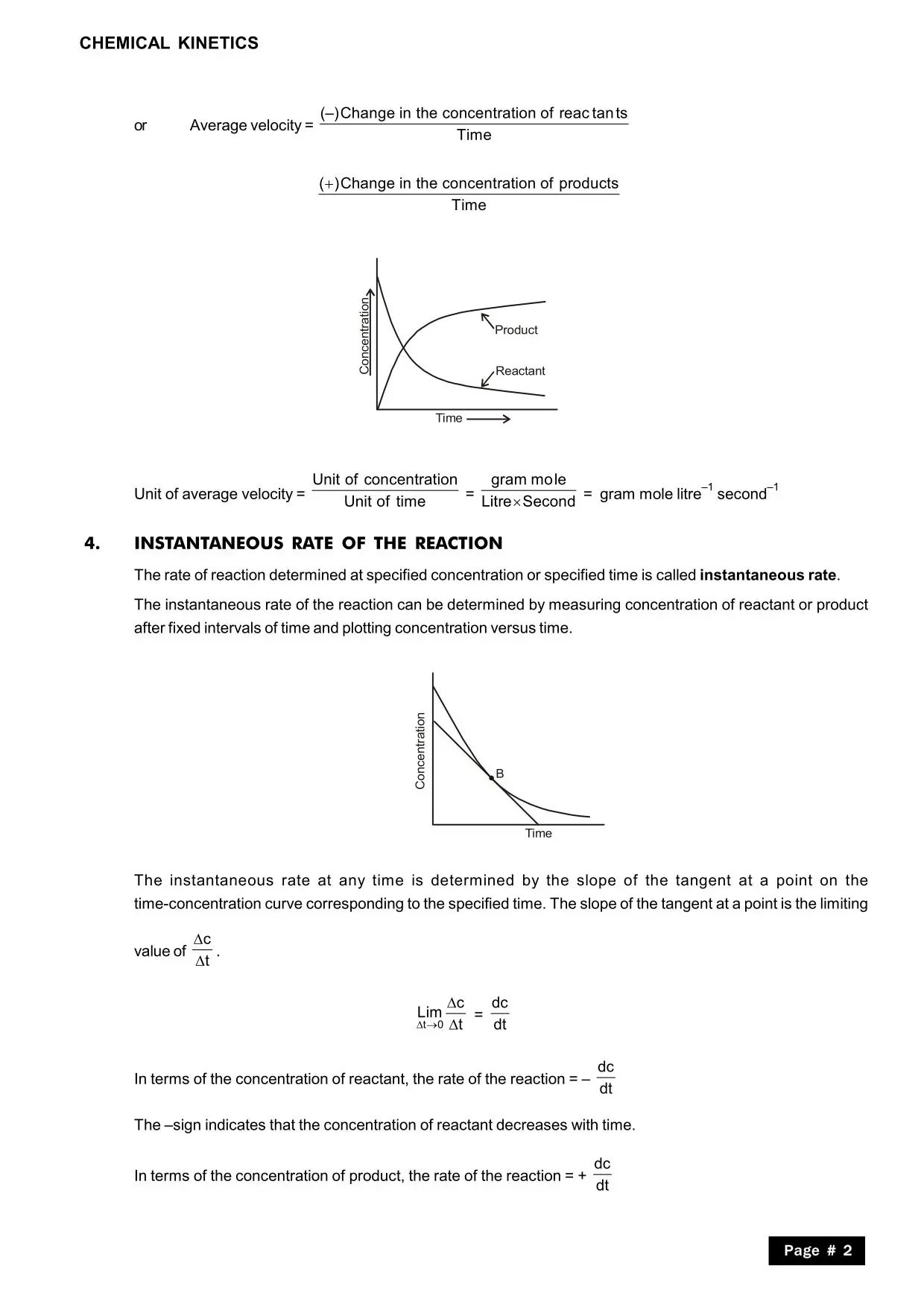
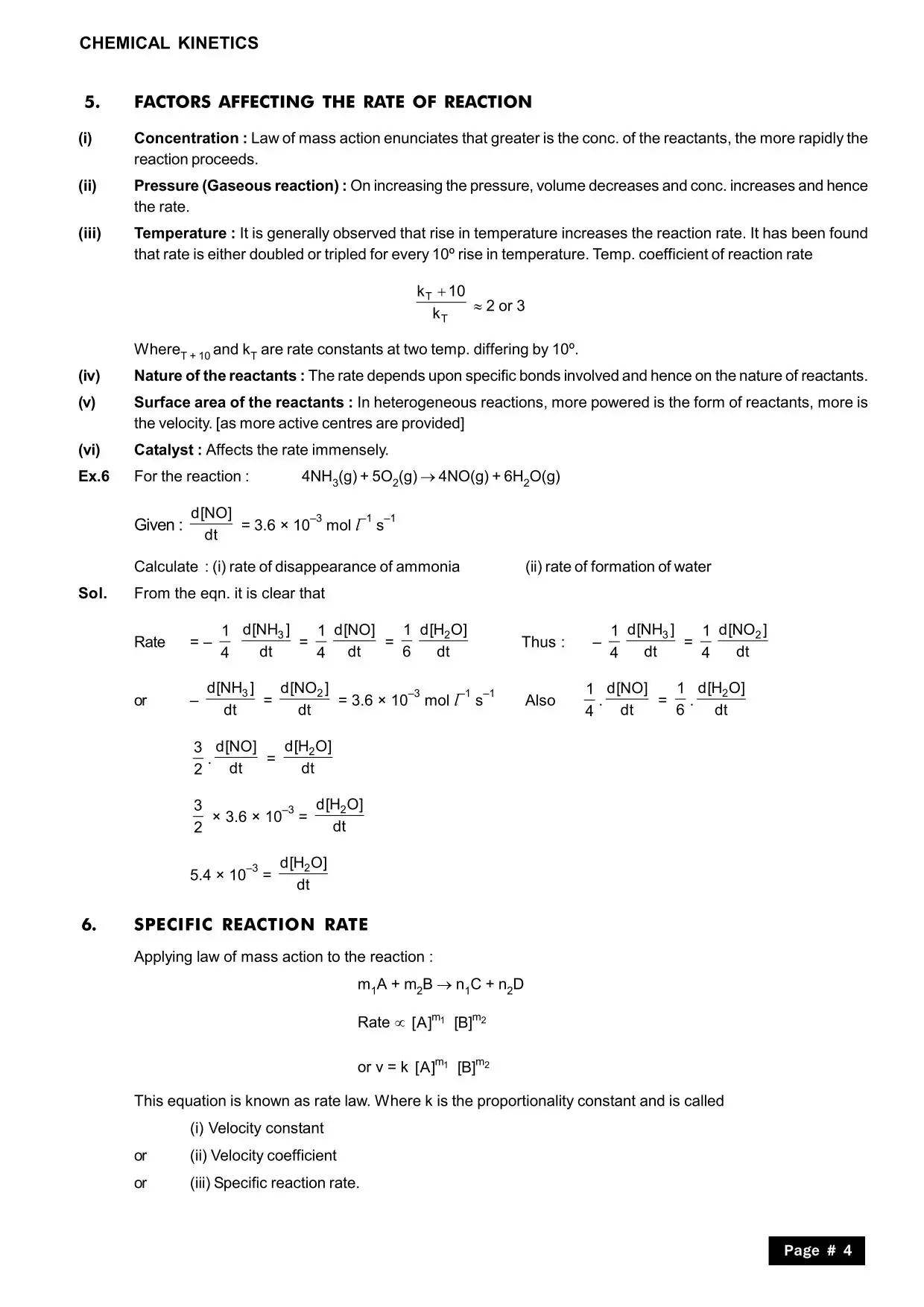
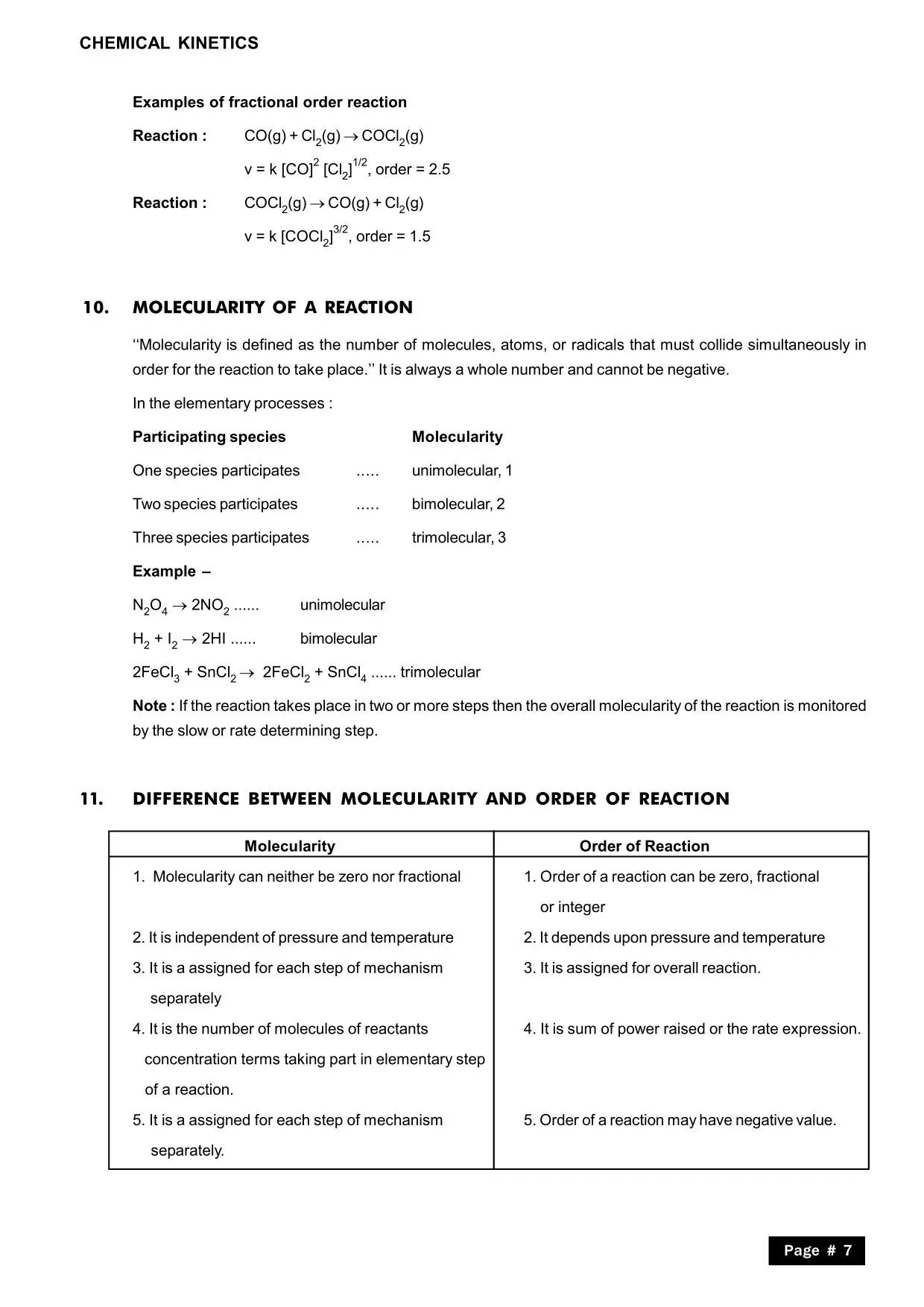
The rate of reaction is the change in concentration of a reactant or product per unit time. For a reaction aA + bB → cC + dD, rate = −(1/a) d[A]/dt = −(1/b) d[B]/dt = (1/c) d[C]/dt = (1/d) d[D]/dt. The rate law expresses the rate in terms of concentrations: rate = k[A]^x[B]^y, where k is the rate constant. The powers x and y are found by experiment, not from the balanced equation.
Order of Reaction and Molecularity: Key Differences
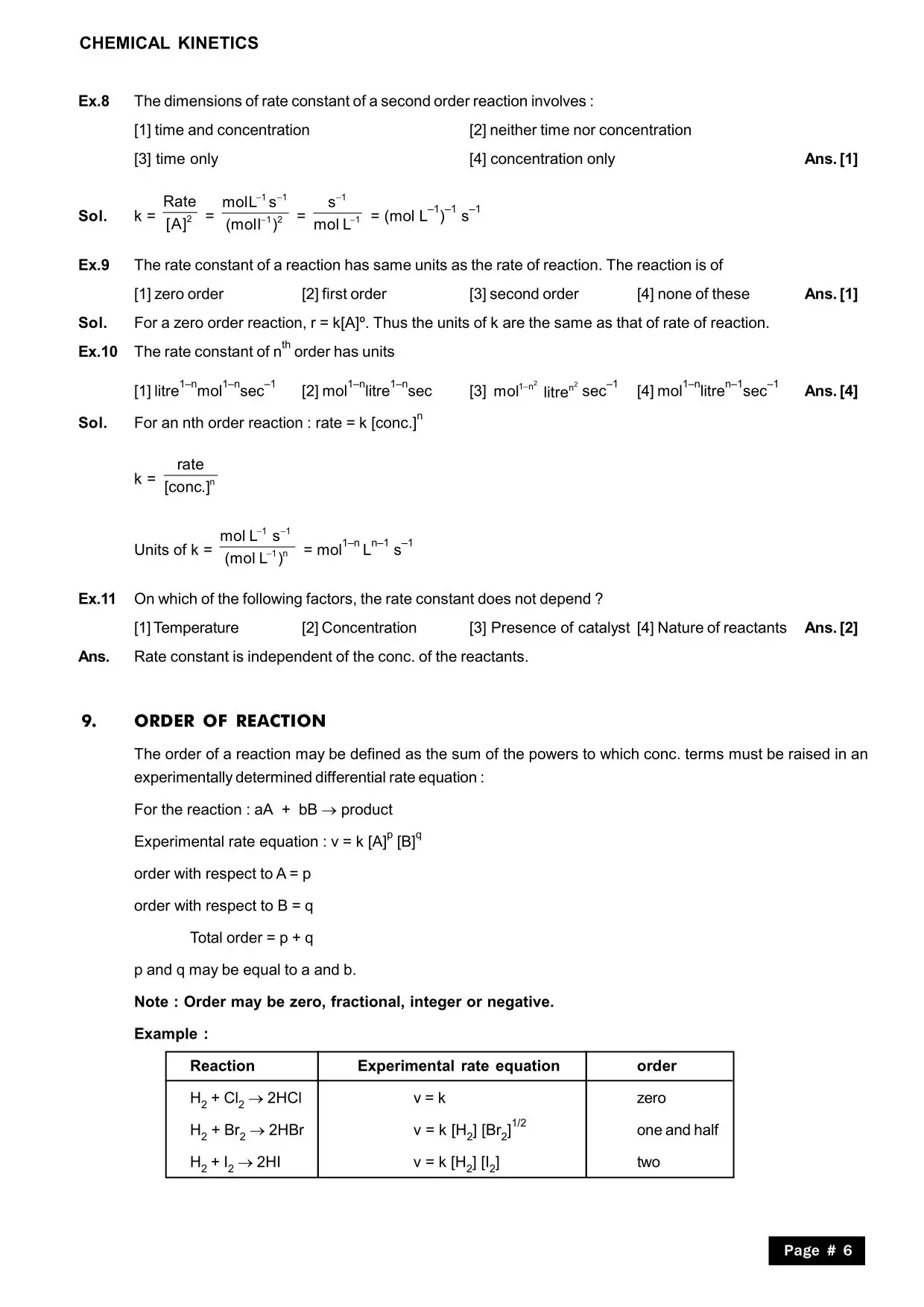
Order of reaction is the sum of the powers of concentration terms in the rate law (x + y). It is found experimentally and can be zero, a fraction or a whole number. Molecularity is the number of reacting species that collide in an elementary step. It is always a whole number, is never zero, and applies only to elementary reactions. For a complex reaction, the overall order is decided by the slowest step, called the rate-determining step.
Units of Rate Constant for Zero and First Order Reactions
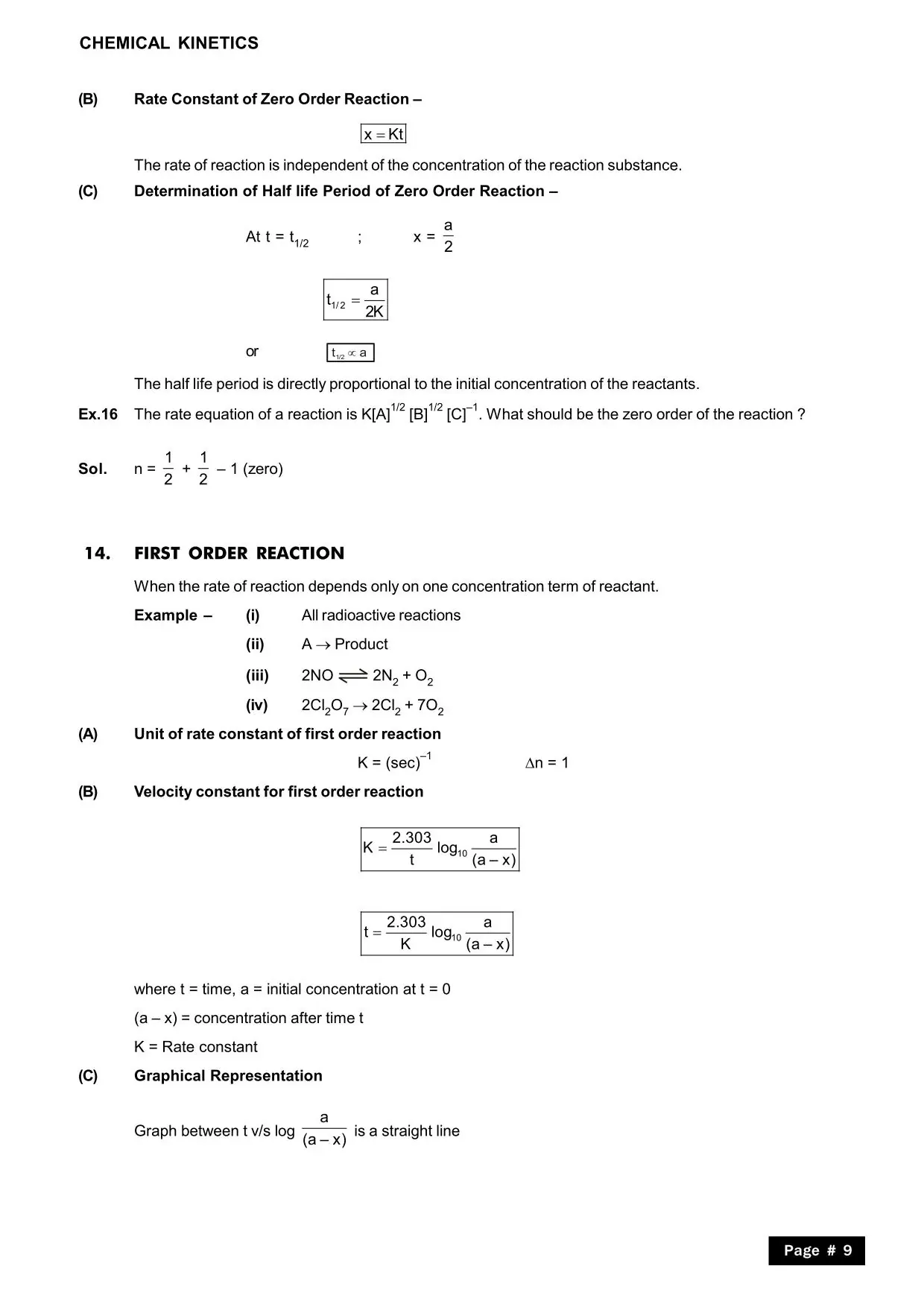
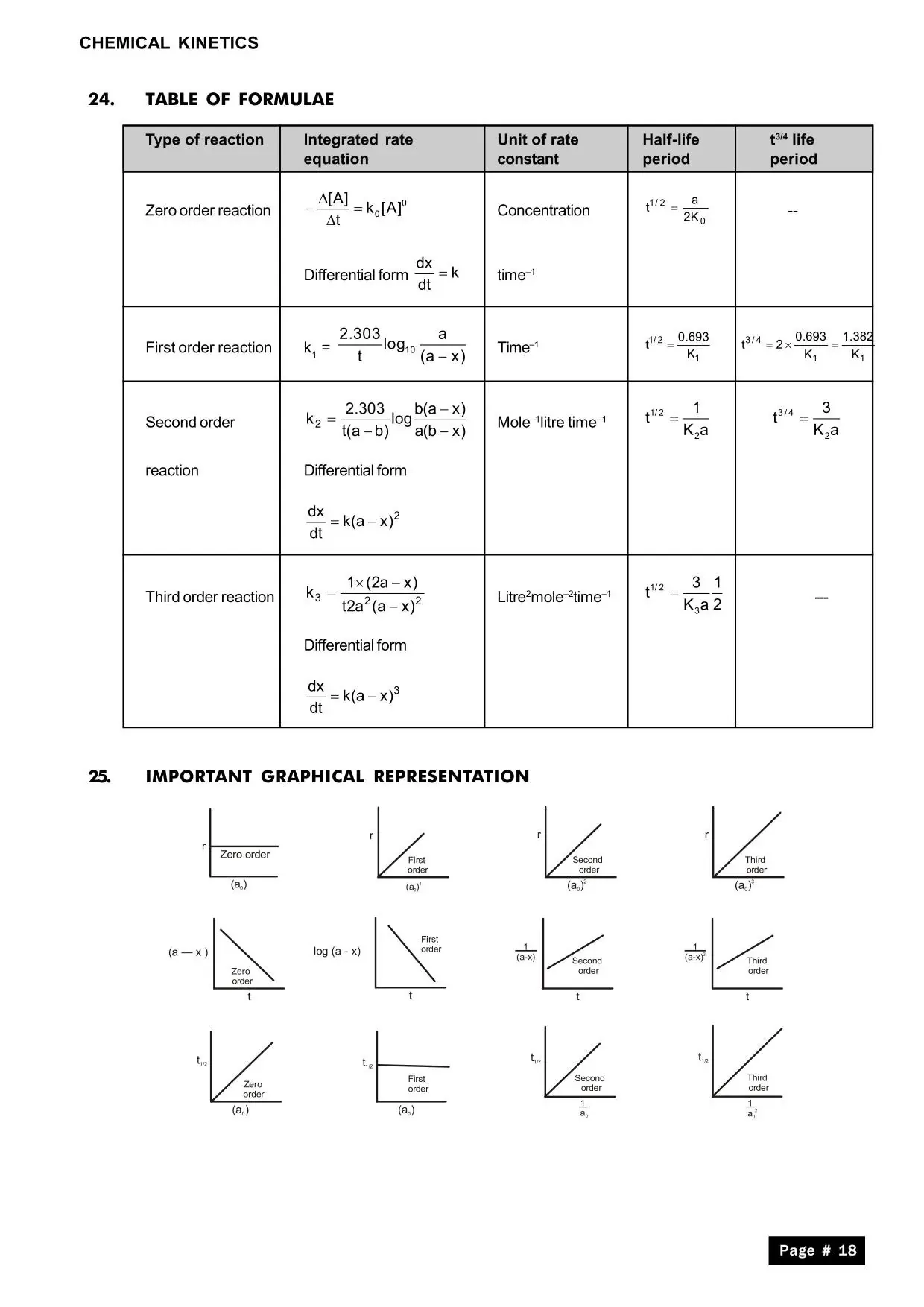
- Zero order: mol L⁻¹ s⁻¹
- First order: s⁻¹
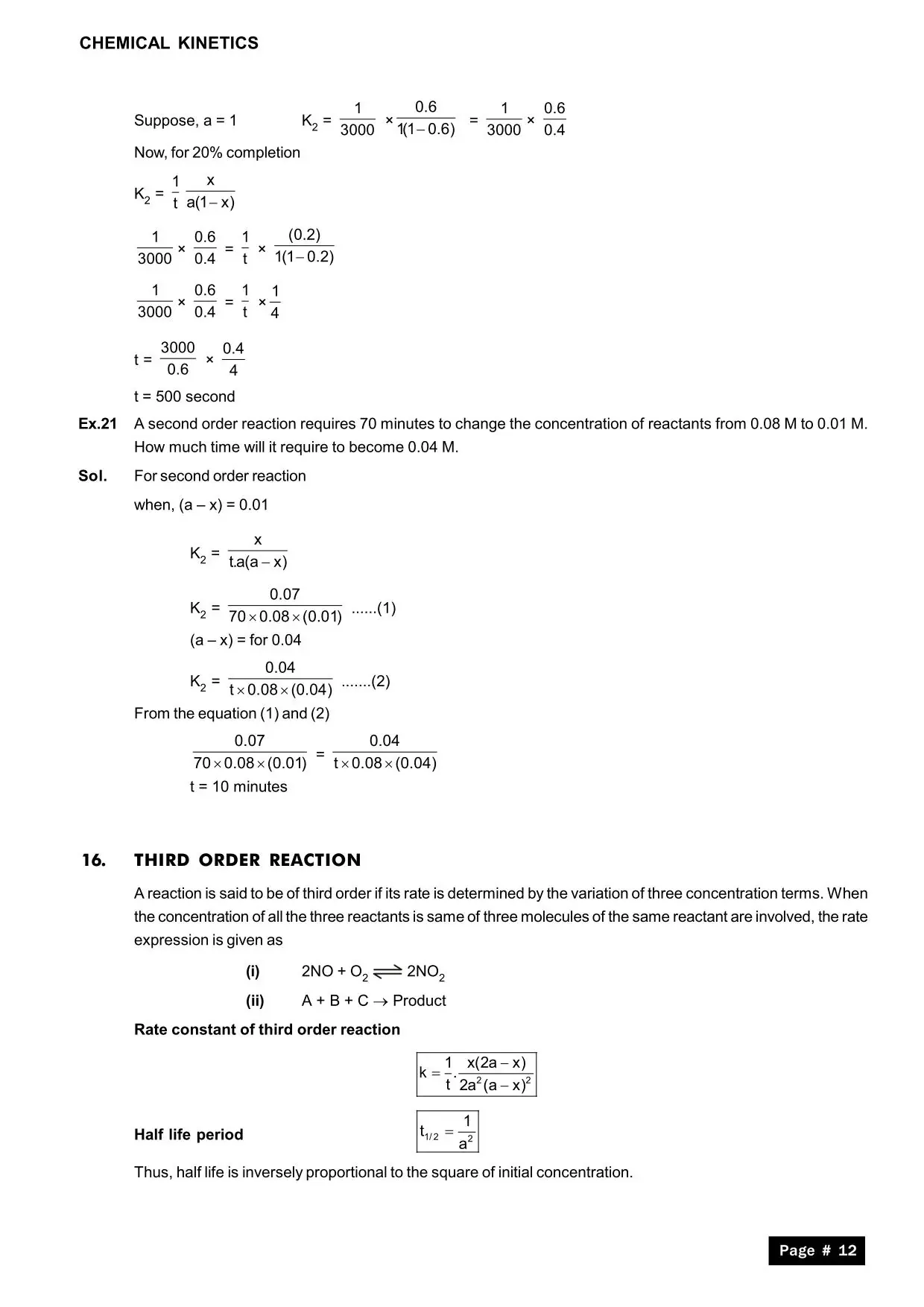
- Second order: L mol⁻¹ s⁻¹
For order n, the unit is (mol L⁻¹)^(1−n) s⁻¹.
Integrated Rate Equations and Half-Life of a First-Order Reaction
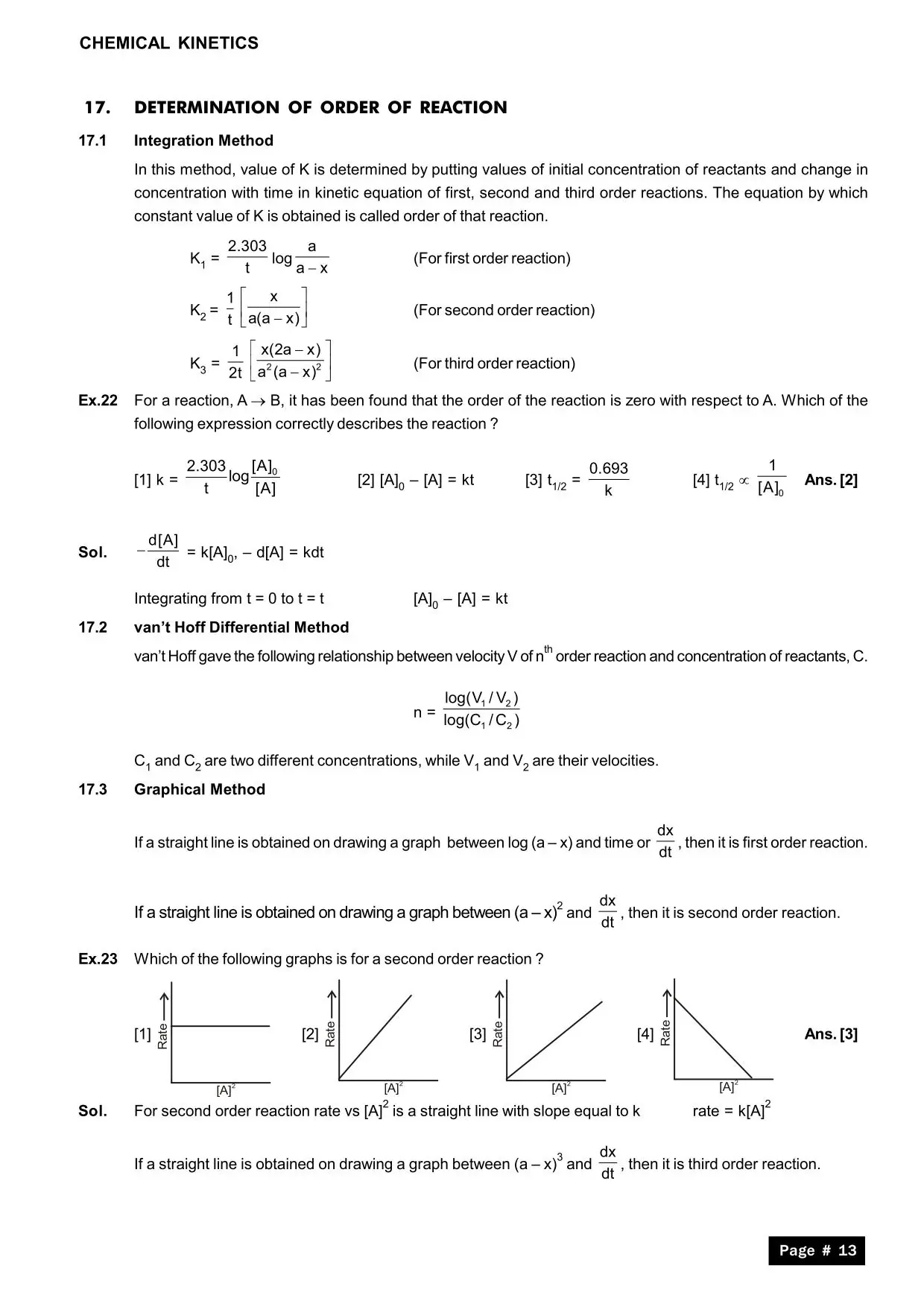
Zero order: [R] = [R]₀ − kt, and t₁/₂ = [R]₀/2k. A graph of [R] against t is a straight line with slope −k.
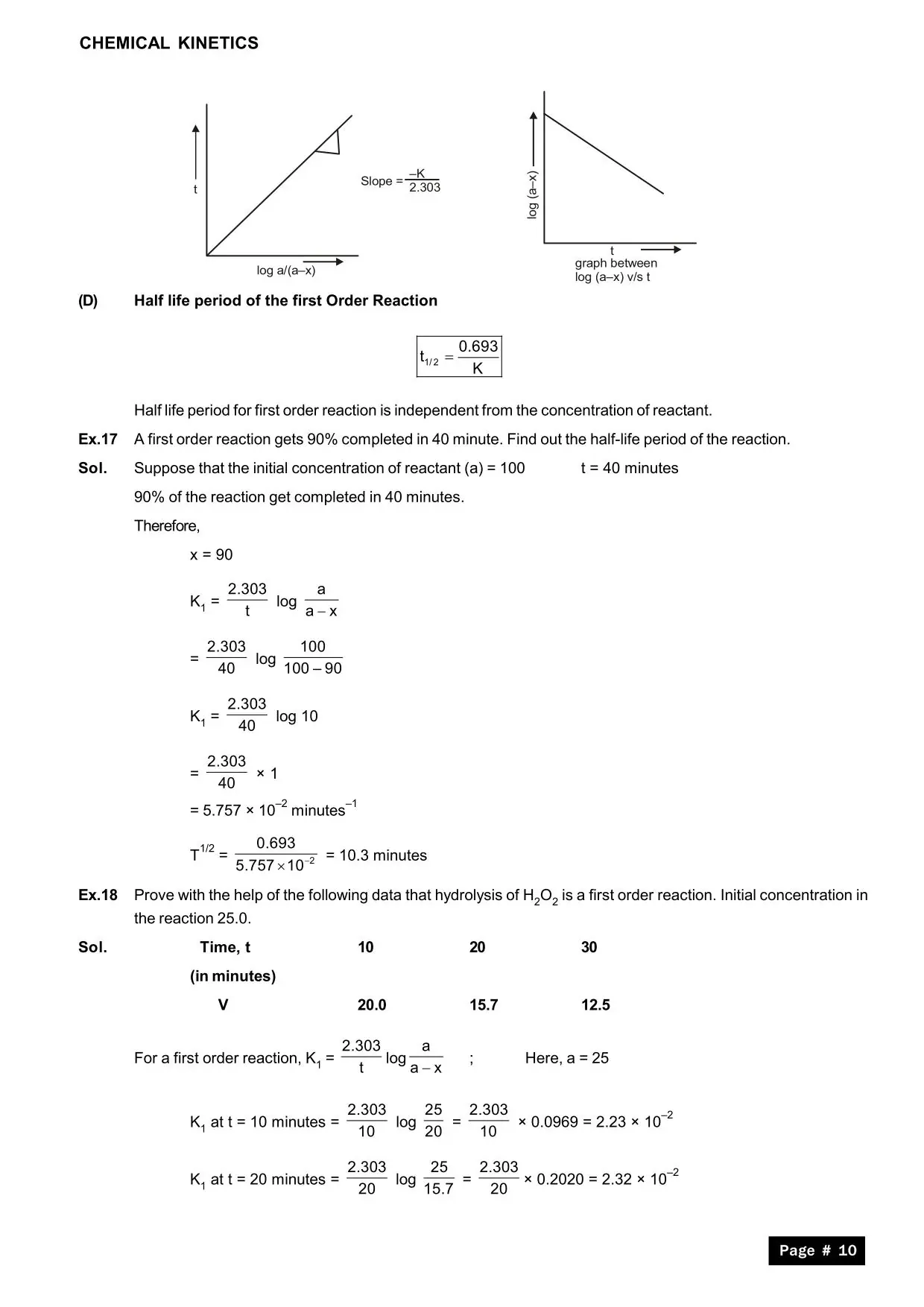
First order: k = (2.303/t) log([R]₀/[R]), and ln[R] = ln[R]₀ − kt. A graph of ln[R] against t is a straight line with slope −k.
Half-Life of First Order Reaction Formula
For a first order reaction, t₁/₂ = 0.693/k. The half-life does not depend on the initial concentration. For example, if k = 0.0693 min⁻¹, then t₁/₂ = 0.693/0.0693 = 10 minutes, whether you start with 1 M or 0.1 M.
Arrhenius Equation: Effect of Temperature and Catalyst
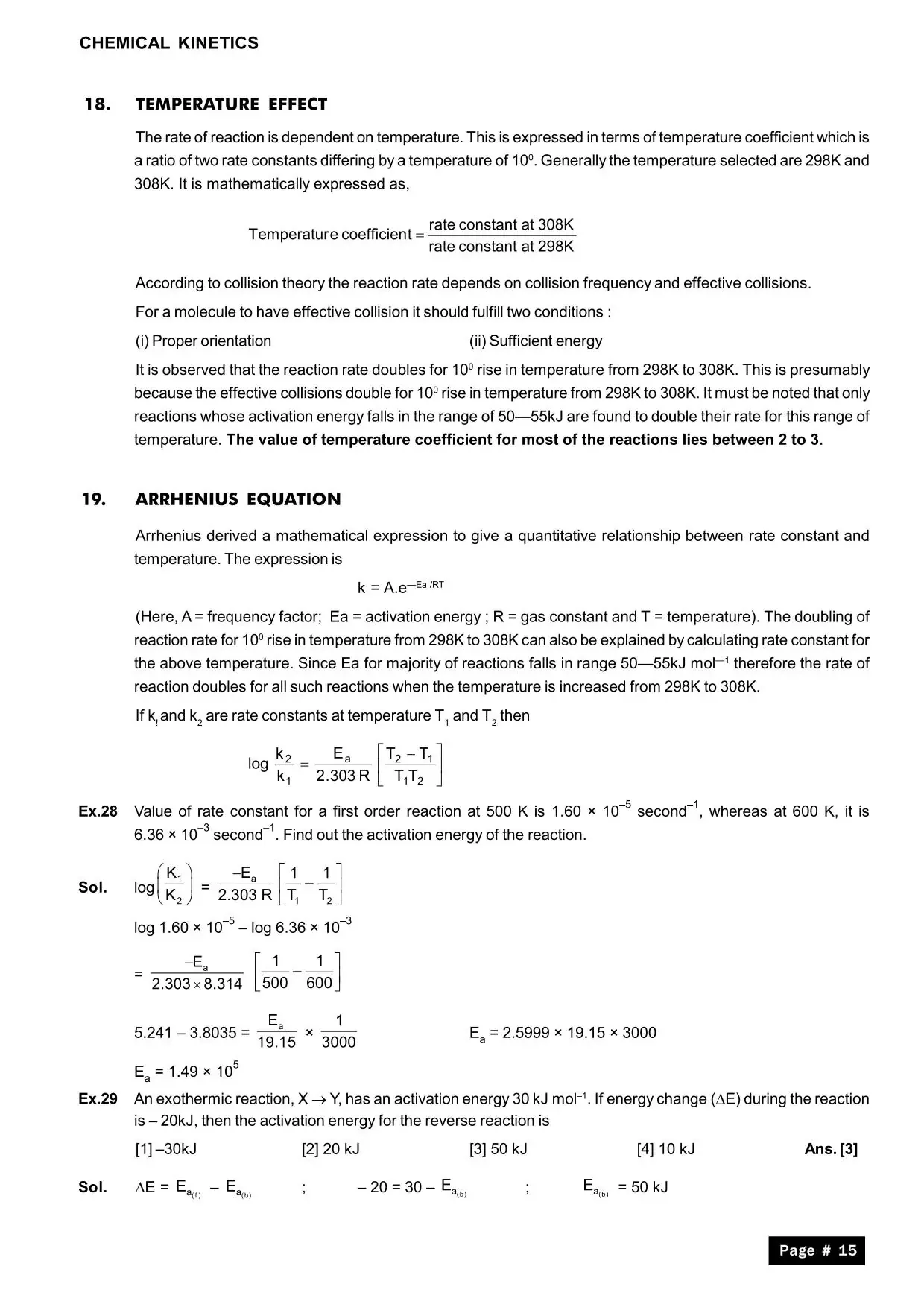
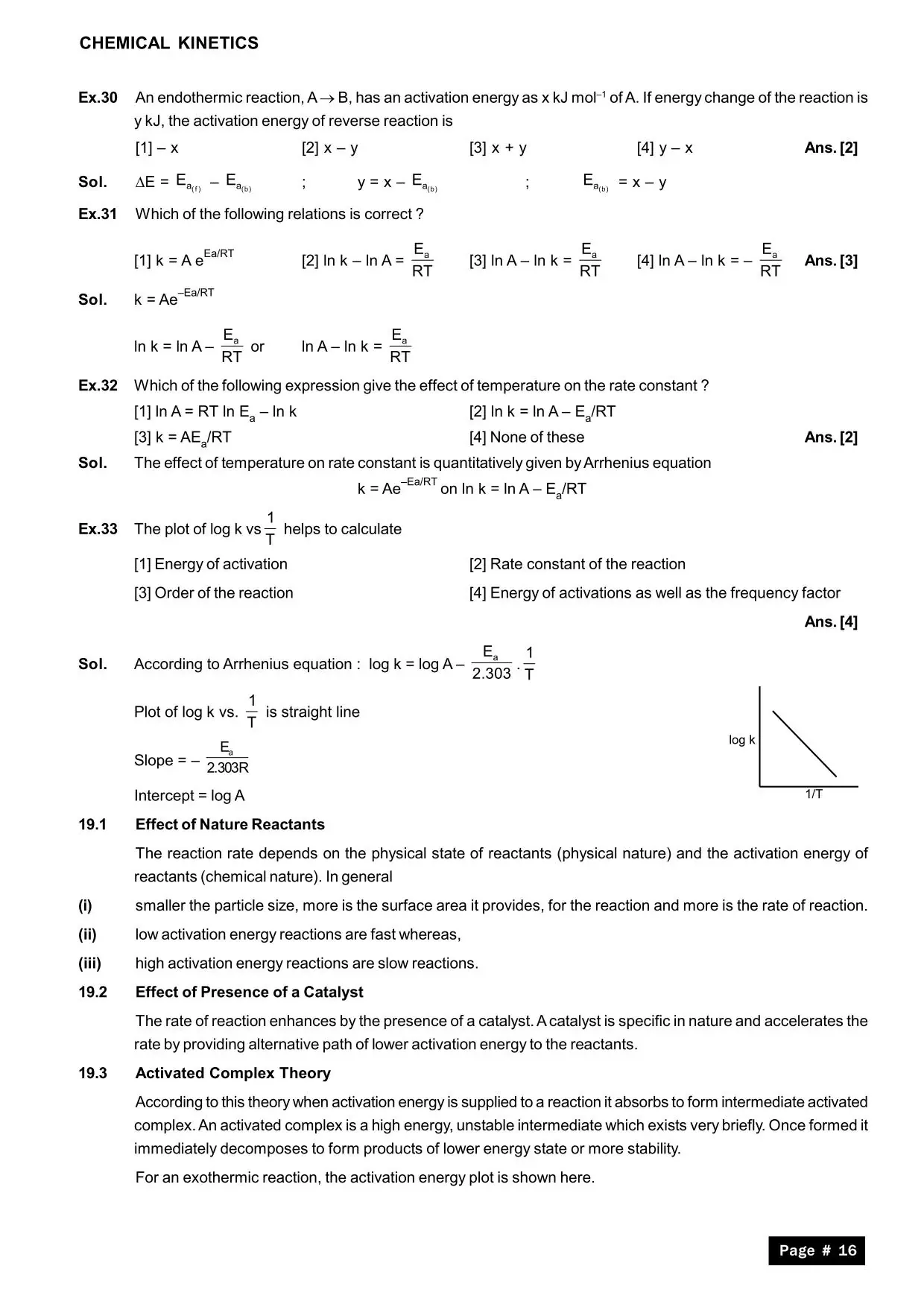
The Arrhenius equation is k = A e^(−Ea/RT), or log k = log A − Ea/(2.303RT). Here A is the frequency factor, Ea is the activation energy, R = 8.314 J mol⁻¹ K⁻¹ and T is in Kelvin. A plot of log k against 1/T is a straight line with slope −Ea/2.303R. For many reactions near room temperature, the rate constant roughly doubles for every 10 K rise. A catalyst lowers the activation energy, so k increases, but it does not change the enthalpy of the reaction or the equilibrium position.
Arrhenius Equation Numericals for JEE
Most numericals use the two-temperature form: log(k₂/k₁) = (Ea/2.303R)(1/T₁ − 1/T₂). You are given two rate constants at two temperatures and asked for Ea, or the other way round. Convert temperature to Kelvin and keep Ea and R in the same units, either J or kJ.
Important Topics in Chemical Kinetics Class 12 Notes for JEE and NEET
Chemical kinetics is a regular chapter in CBSE boards, JEE and NEET. In the current CBSE blueprint it carries about 7 marks, so check the latest blueprint for your year. These chemical kinetics class 12 notes focus on the topics asked most often:
- Units of rate constant and order from the rate law
- Half-life and time-based calculations for first order reactions
- Graphs of concentration against time for zero and first order reactions
- Effect of temperature and catalyst, and Arrhenius numericals
- Rate-determining step and mechanism-based questions, mainly in JEE Advanced
How to Revise Chemical Kinetics Class 12 Notes
- Write the units of k, the integrated equations and the half-life formulas on one page.
- Practise graphs, because many MCQs ask you to identify the order from a plot.
- Solve the exercises of this chapter and compare your steps with the NCERT Solutions for Class 12 Chemistry.
eSaral is a Kota-based platform for JEE, NEET and Class 8–10 preparation, with the mission of making quality education available to every student in India. We hope these chemical kinetics class 12 notes help you remember the key points and revise with confidence. To read notes for every chapter, get the complete Class 12 Chemistry notes, and for video lectures and practice, download the eSaral app.
Frequently Asked Questions
What is chemical kinetics in Class 12 Chemistry?
Chemical kinetics is the study of reaction rates and the factors that control them. These chemical kinetics class 12 notes cover rate laws, order and molecularity, integrated rate equations, half-life and the Arrhenius equation.
What is the difference between order of reaction and molecularity?
Order is found by experiment from the rate law and can be zero or a fraction. Molecularity is the number of species in an elementary step and is always a positive whole number.
What are the units of rate constant for zero and first order reactions?
For a zero order reaction the unit is mol L⁻¹ s⁻¹, and for a first order reaction it is s⁻¹. For order n, the unit is (mol L⁻¹)^(1−n) s⁻¹.
How is the Arrhenius equation used in JEE numericals?
JEE Main numericals usually use log(k₂/k₁) = (Ea/2.303R)(1/T₁ − 1/T₂) to find activation energy from two rate constants. Always convert temperature to Kelvin and use R = 8.314 J mol⁻¹ K⁻¹.
What is the half-life of a first-order reaction?
For a first order reaction, t₁/₂ = 0.693/k, and it is independent of the initial concentration. The time for 50% of the reaction to complete is the same however much reactant you start with.
Is chemical kinetics important for JEE Advanced and NEET?
Yes. JEE Advanced often tests mechanisms, the rate-determining step and graph interpretation, which need more depth than NCERT. NEET commonly asks about units of k, half-life, graphs and the effect of a catalyst. eSaral’s chemical kinetics class 12 notes cover these areas.
Where can I revise chemical kinetics class 12 notes quickly?
Use the formula sections and handwritten pages on this eSaral page, then practise numericals from NCERT. The eSaral app also offers video lectures and study material for Class 12 Chemistry.
Team eSaral
eSaral Academic and Editorial Team
Team eSaral is the collective author profile for educational content created by eSaral’s teachers and academic contributors. The team draws on expertise from IIT graduates, doctors, experienced educators and subject specialists to develop resources for JEE, NEET and school students. Our articles aim to explain concepts clearly and help students study with confidence.
Related Posts

BITSAT 2027: Registration Date, Exam Date, Syllabus, Eligibility, Pattern & Fees
BITSAT 2027 exam dates, registration timeline, eligibility criteria, exam pattern, marking scheme, syllabus and fees in one page.

BITSAT Previous Year Question Paper PDF (2017-2026)
Download BITSAT previous year question papers PDF from 2017 to 2026,session-wise. Memory-based papers,exam pattern, paper analysis and how to practise

CBSE Class 10 Date Sheet 2027: Expected Exam Dates, Release Date, Admit Card & Result Timeline
CBSE Class 10 date sheet 2027 is awaited. See the expected exam dates, release window, how to download the PDF, admit card and result timelines.

NCERT Physics Class 10 Book PDF in Hindi 2026-27 – भौतिक विज्ञान के 4 अध्याय (Free Download)
NCERT Physics Class 10 book PDF in Hindi 2026-27: download all 4 chapters (अध्याय 9–12) free, with topics and important formulas.

NCERT Biology Class 9 Book Anveshan PDF in Hindi - जीव विज्ञान कक्षा 9 पुस्तक अन्वेषण PDF
Download NCERT Biology Class 9 book PDF in Hindi chapterwise for 2026-27: Cell, Tissues, Reproduction and Diversity. Free PDFs.

Essay On Artificial Intelligence in English (100,150, 200, 250, 300, 500 Words)
This is in contrast to the natural intelligence of humans. With Artificial Intelligence, machines can perform

Essay on 78th India Independence Day in English for Student (100, 150, 200, 250, 300, 500 Words)
Read the best essays on India's Independence Day in English. Short & long essays (100, 150, 200, 250, 300, 500 words) perfect for school exams
NCERT Class 11 English Snapshots book - Free PDF download- Esaral
Download NCERT Class 11 English Snapshots book PDF for free. Get all 8 chapters, chapter-wise. Start your prep today!
NCERT Class 10 biology book pdf - Free PDF Download - eSaral
NCERT Class 10 Biology book PDF 2026-27: all 5 chapters (Life Processes to Our Environment) in English & Hindi, with CBSE syllabus, marks & practical

Essay on Global Warming in English (100,150, 200, 250, 300, 500 Words)
Global warming means the Earth is getting hotter. This happens because of things like pollution from cars and factories.