
Class 10 Maths NCERT Book PDF

eSaral Academic and Editorial Team
Summary
Class 10 Maths NCERT book PDF for 2026-27 covers 14 chapters, from Real Numbers to Probability, aligned with the latest CBSE syllabus. Download every chapter free, check the unit-wise marks for the 80-mark paper, and see what has changed this session, including the removal of Constructions.
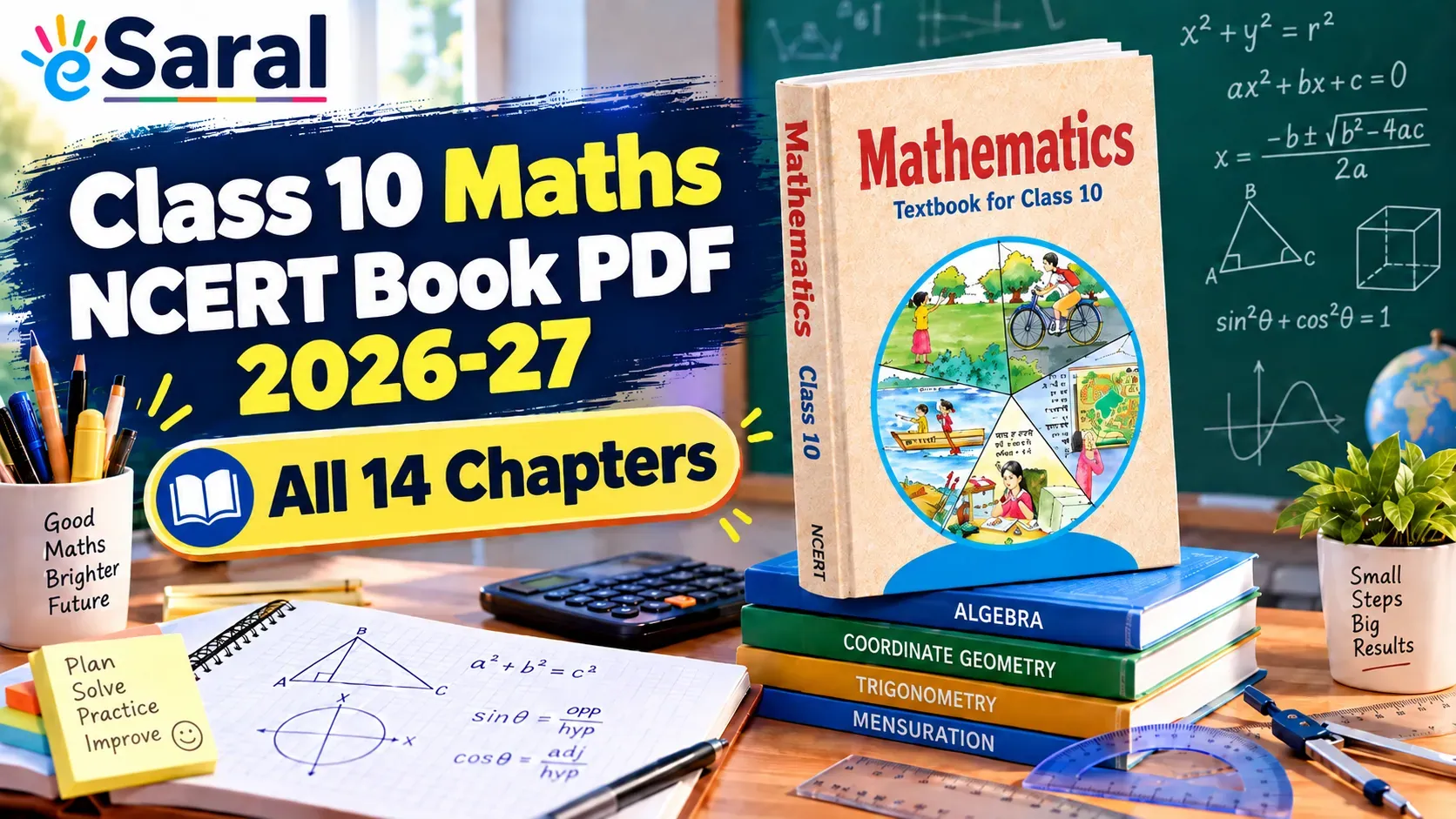
Class 10 Maths NCERT Book PDF: Chapter-Wise Download (2026-27)
Every chapter of the class 10 maths NCERT book PDF below opens as a separate PDF, so you can download only what you need. You can also get the book from the official NCERT website (ncert.nic.in).
Chapter | Download | Key Topics |
|---|---|---|
1 | Fundamental Theorem of Arithmetic, irrationality of √2, √3, √5 | |
2 | Zeroes of a polynomial, graphical meaning, zeroes–coefficients relationship for quadratics | |
3 | Graphical, substitution and elimination methods, consistency | |
4 | Factorisation, discriminant, nature of roots | |
5 | nth term, sum of first n terms, real-life applications | |
6 | Similar figures, Basic Proportionality Theorem, similarity criteria | |
7 | Distance formula, section formula | |
8 | Trigonometric ratios, values for 30°, 45°, 60°, identities | |
9 | Heights and distances, angles of elevation and depression | |
10 | Tangent to a circle, tangents from an external point | |
11 | Area of sector and segment | |
12 | Surface area and volume of combinations of solids | |
13 | Mean, median and mode of grouped data | |
14 | Classical definition, simple probability problems |
What's Changed in NCERT Class 10 Maths for 2026-27
The biggest change is that Constructions is no longer part of the book or the syllabus, so the textbook now has 14 chapters. Chapter numbers have shifted too: Areas Related to Circles is now Chapter 11, Surface Areas and Volumes is Chapter 12, Statistics is Chapter 13 and Probability is Chapter 14.
Some topics from older editions are also not listed in the current syllabus, such as the division algorithm for polynomials, cross-multiplication, completing the square, area of a triangle, frustum and conversion of solids. If you are using an older class 10 maths NCERT book PDF or old notes, check them against the latest syllabus before you study. The revised syllabus also puts more weight on real-life applications, reasoning and competency-based learning than on rote practice.
NCERT Class 10 Maths Syllabus 2026-27 and Marks Weightage
The theory paper is 80 marks, spread across seven units.
Unit | Chapters | Marks |
|---|---|---|
I. Number Systems | Ch 1: Real Numbers | 6 |
II. Algebra | Ch 2–5: Polynomials, Linear Equations, Quadratic Equations, APs | 20 |
III. Coordinate Geometry | Ch 7 | 6 |
IV. Geometry | Ch 6: Triangles, Ch 10: Circles | 15 |
V. Trigonometry | Ch 8, Ch 9 | 12 |
VI. Mensuration | Ch 11, Ch 12 | 10 |
VII. Statistics and Probability | Ch 13, Ch 14 | 11 |
Total | 80 |
Note: Weightage is approximate based on CBSE Class 10 Maths standard paper pattern. Official weightage may vary — always refer to the CBSE official website for the current year's blueprint.
Internal assessment carries another 20 marks: 10 for the pen-paper test and multiple assessment, 5 for the portfolio and 5 for the lab practical. For the full list of topics, see the Class 10 syllabus and the Class 10 exam pattern.
Class 10 Maths Standard (041) vs Basic (241)
Both papers are 3 hours long, carry 80 marks and use the same NCERT textbook. The difference is the type of questions.
Question Type | Standard | Basic |
|---|---|---|
Remembering and understanding | 43 marks (54%) | 60 marks (75%) |
Applying | 19 marks (24%) | 12 marks (15%) |
Analysing, evaluating, creating | 18 marks (22%) | 8 marks (10%) |
Standard students should practise more application-based questions. Basic students should focus on getting the core concepts and formulas exactly right.
Why the Class 10 Maths NCERT Book PDF Is Essential for Boards?
The syllabus prescribes the NCERT textbook, and the class 10 maths NCERT book PDF builds the concepts that board questions test. It also lays the groundwork for Class 11–12 maths and later for JEE and NEET preparation, especially in Coordinate Geometry, Quadratic Equations and Trigonometry. The proofs the syllabus lists are the irrationality of √2, √3 and √5, the Basic Proportionality Theorem, the two tangent theorems and sin²A + cos²A = 1. Practise these until you can write them without help.
How to Study NCERT Class 10 Maths Effectively
Is NCERT Enough for the Class 10 Maths Board Exam?
NCERT is the main resource, but a good share of the paper tests application and higher-order thinking, about 46% in Standard. So use the book as your base and add practice on top.
- Read each chapter's theory, including the solved examples. Each example shows a question type you may see in the exam.
- Solve every exercise question in order. The questions get harder as you go.
- Practise NCERT Exemplar problems once the exercises are done.
- Attempt previous year papers and time yourself.
- Revise formulas and proofs from short notes before the exam. Use the important questions for a final check.
Chapter-Wise Difficulty and Time Plan (eSaral's suggested plan)
Chapter | Difficulty | Suggested Time |
|---|---|---|
Real Numbers | Easy | 3–4 hours |
Polynomials | Easy–Medium | 4–5 hours |
Linear Equations | Medium | 5–6 hours |
Quadratic Equations | Medium | 5–6 hours |
Arithmetic Progressions | Medium | 4–5 hours |
Triangles | Medium–Hard | 7–8 hours |
Coordinate Geometry | Medium | 4–5 hours |
Introduction to Trigonometry | Medium | 5–6 hours |
Applications of Trigonometry | Easy–Medium | 3–4 hours |
Circles | Medium | 4–5 hours |
Areas Related to Circles | Medium | 4–5 hours |
Surface Areas and Volumes | Medium | 5–6 hours |
Statistics | Easy–Medium | 4–5 hours |
Probability | Easy | 2–3 hours |
Class 10 Maths Resources: Solutions, PYQs and Important Questions
Once you have the class 10 maths NCERT book PDF, put it to work with these eSaral resources:
- NCERT Solutions for Class 10 Maths: step-by-step answers in the board-exam format
- Class 10 previous year question papers
- Class 10 important questions
- All NCERT books
If you want live classes, tests and doubt support along with the book, explore eSaral's Class 8, 9, 10 foundation courses.
Frequently Asked Questions
How many chapters are in NCERT Class 10 Maths 2026-27?
There are 14 chapters, from Real Numbers to Probability. Constructions is not included. You can download all 14 chapters as free PDFs from eSaral's resource section.
Is Constructions in the Class 10 Maths syllabus 2026-27?
No. It is not in the current textbook or the CBSE syllabus.
How do I download the class 10 maths NCERT book PDF chapter-wise?
Use the chapter table on this page and click any chapter to download it as a free PDF from eSaral's resource section. You can also download the book from the official NCERT website.
Is NCERT enough for the Class 10 Maths board exam?
NCERT is the main resource. Add NCERT Exemplar and previous year papers to prepare for application-based questions. eSaral's NCERT Solutions for Class 10 can help you check your answers as you practise.
Which unit carries the most marks?
Algebra carries 20 of 80 marks (Chapters 2–5). Geometry carries 15 and Trigonometry 12.
What is the difference between Maths Standard and Basic?
Both are 80 marks and 3 hours. Standard has more application and analysis questions (46%) than Basic (25%).
Where can I get help with Class 10 Maths beyond the textbook?
eSaral offers Class 8, 9, 10 foundation courses with video lectures, live sessions, tests and revision support, along with free study material like this book PDF. You can also use eSaral's NCERT Solutions for Class 10 to check your answers while you practise.
Team eSaral
eSaral Academic and Editorial Team
Team eSaral is the collective author profile for educational content created by eSaral’s teachers and academic contributors. The team draws on expertise from IIT graduates, doctors, experienced educators and subject specialists to develop resources for JEE, NEET and school students. Our articles aim to explain concepts clearly and help students study with confidence.
Related Posts
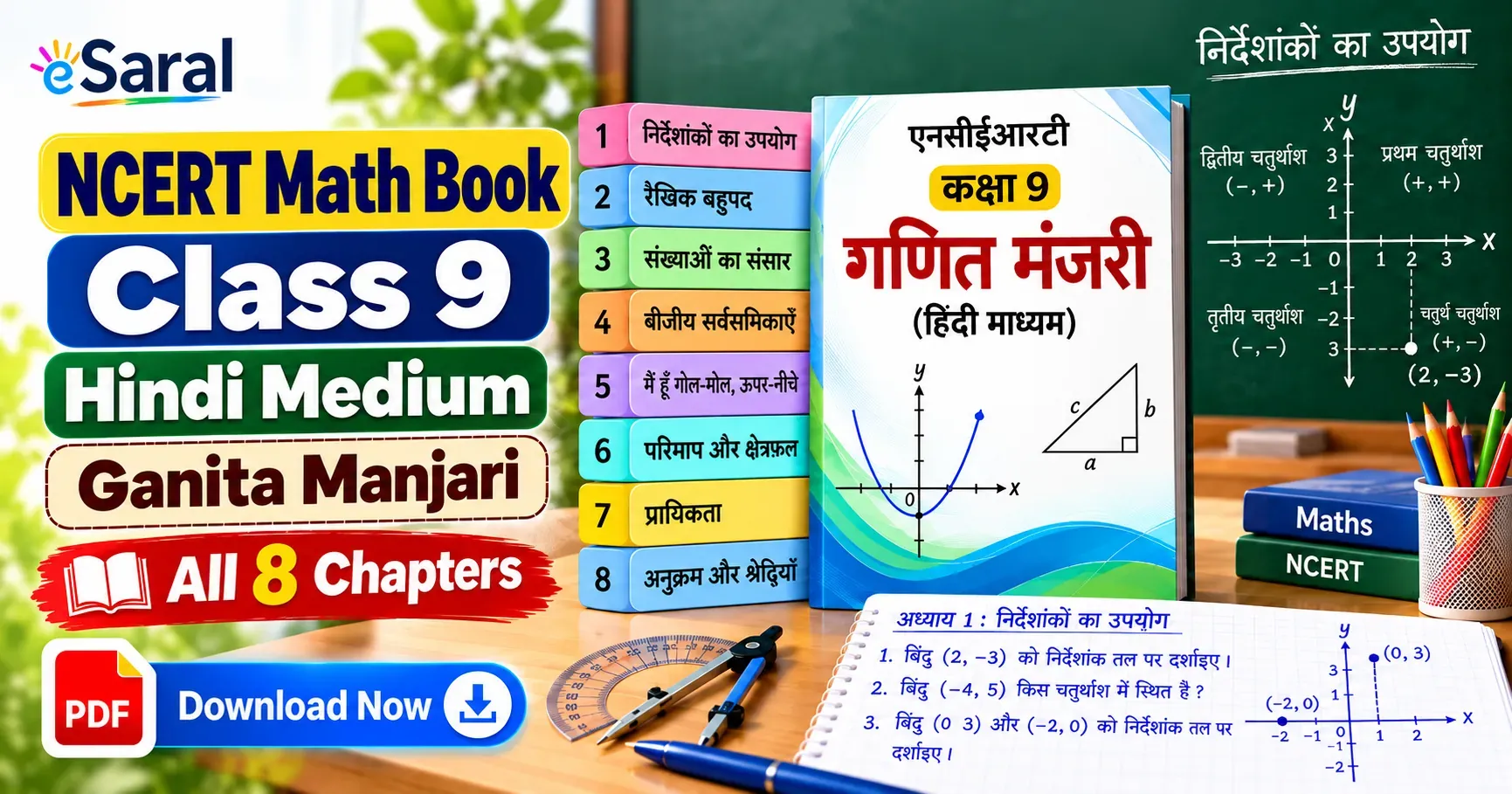
NCERT Math Book Class 9 in Hindi Medium 2026-27 (Ganita Manjari) – गणित मंजरी PDF Download
Download the NCERT Math Book Class 9 in Hindi Medium (Ganita Manjari) — all 8 chapters, free PDF, updated for the 2026-27 CBSE session.
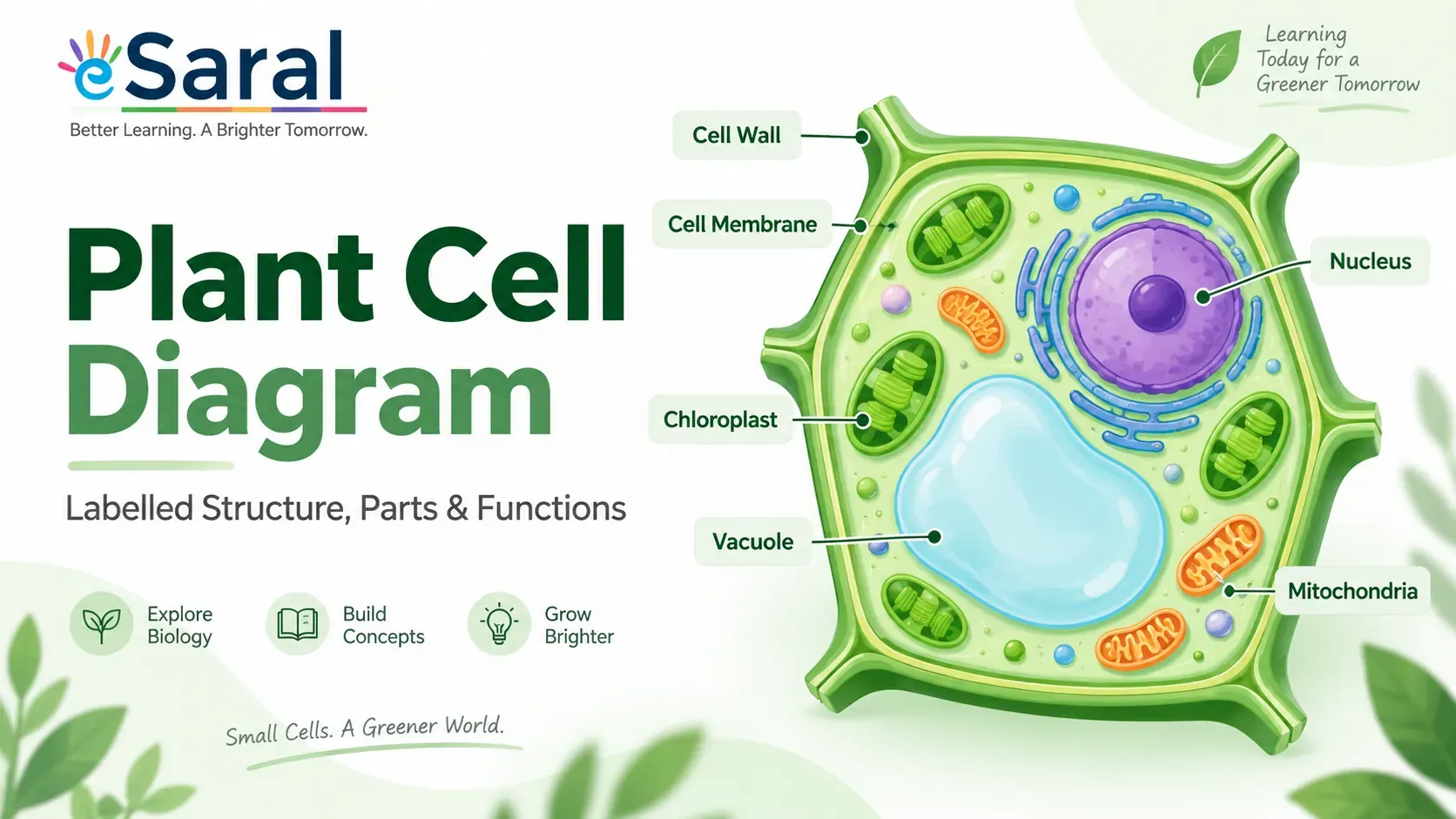
Plant Cell Diagram: Labelled Structure, Parts and Functions
Simple, labelled plant cell diagram with parts and functions. Covers plant cell structure for Class 6, 7, 8, 9, 10 and 11 students, CBSE-aligned.
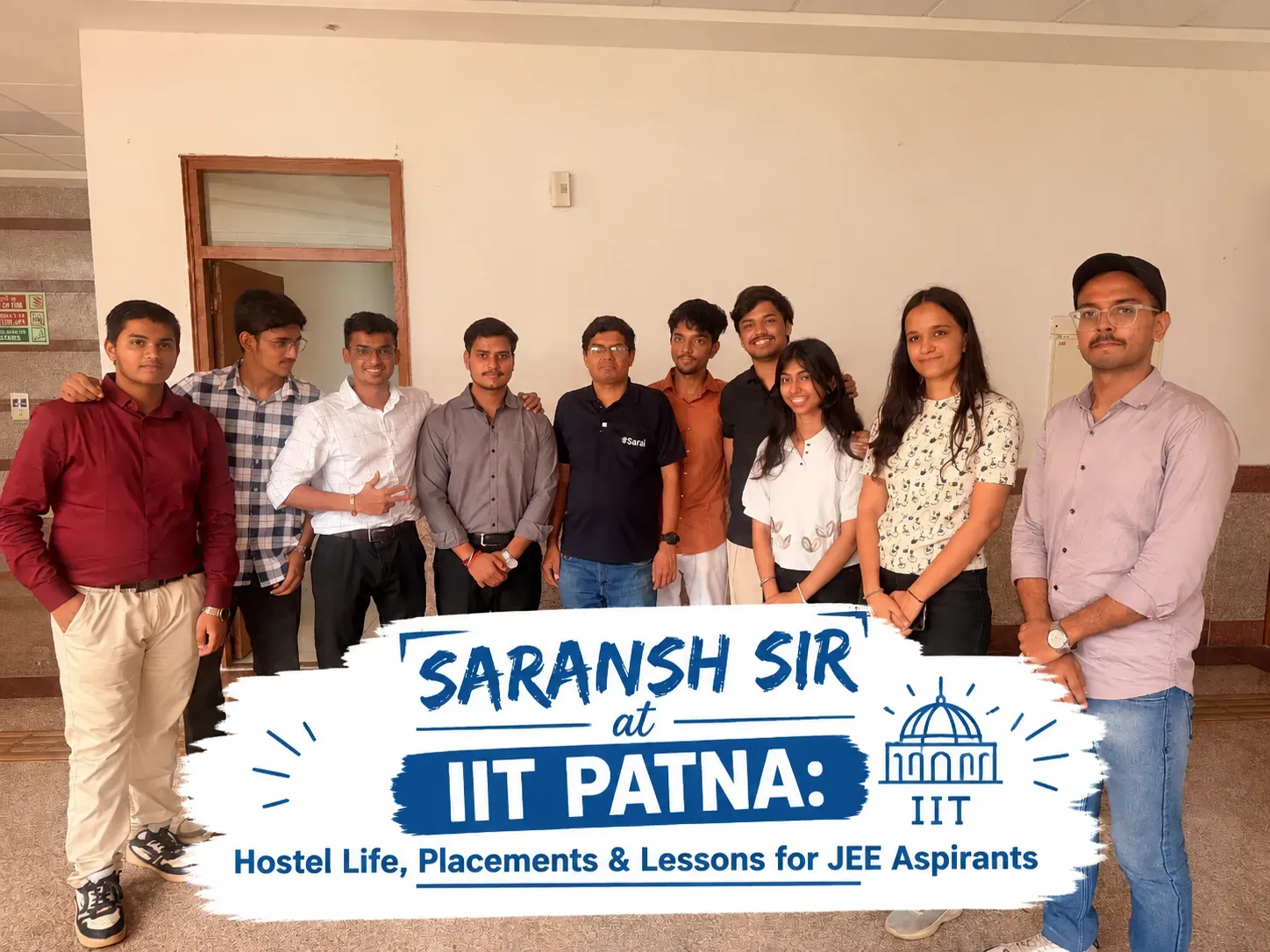
Saransh Gupta Sir's Visit to IIT Patna: Hostel Life, Placements & Lessons for JEE Aspirants
Inside Saransh Gupta Sir's IIT Patna visit — hostel life, the library, placements, internships, and real advice for JEE aspirants from students living the IIT dream.
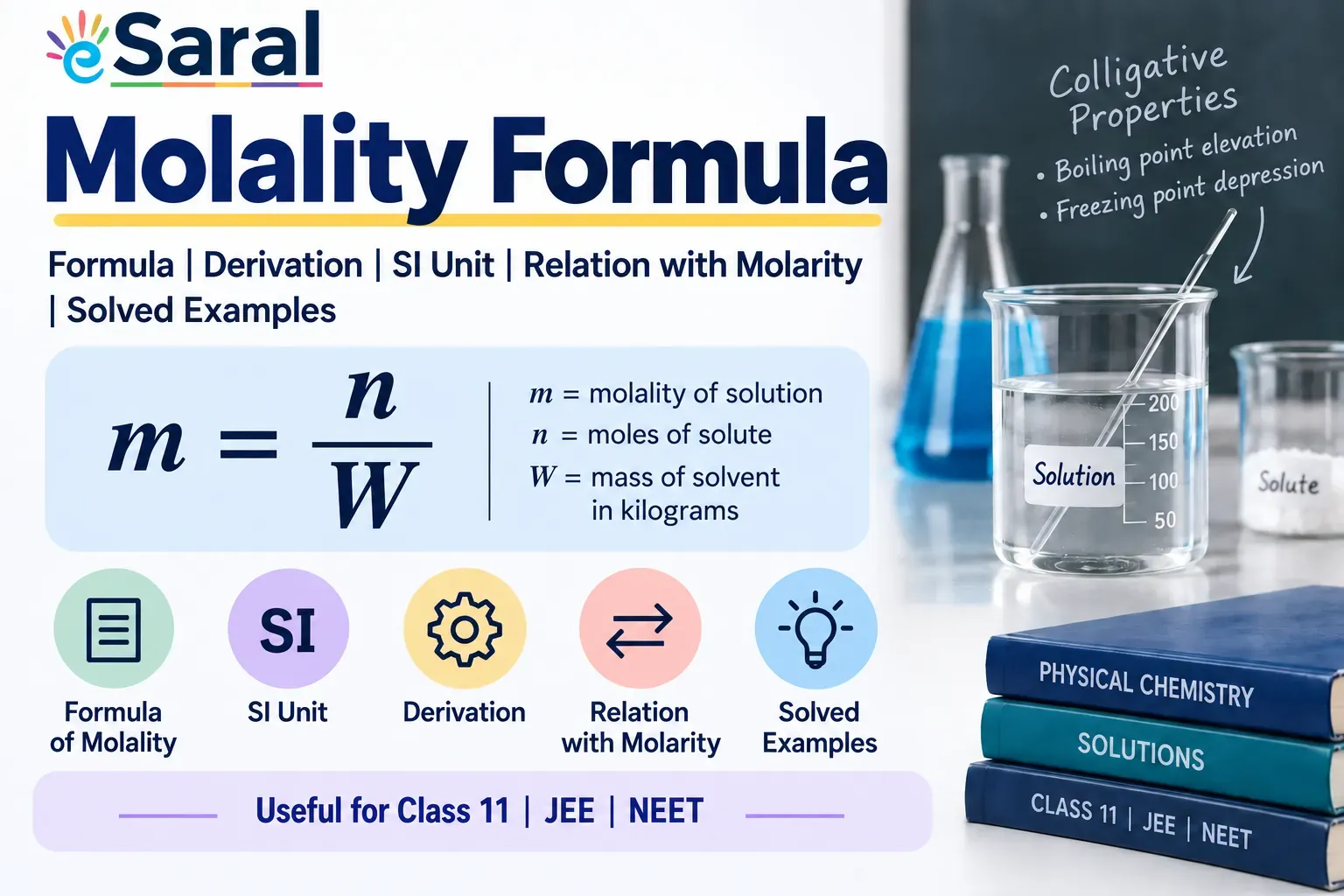
Molality Formula: Formula for Molality, Derivation & Solved Examples
Molality formula is $m = \dfrac{n}{W}$. Learn the formula of molality, its SI unit, derivation, relation with molarity, and solved examples for Class 11, JEE and NEET.
BITSAT Previous Year Question Paper PDF
Download BITSAT previous year question papers PDF. Get year-wise BITSAT PYQs, memory-based papers, exam pattern, and preparation tips to improve your BITSAT preparation.

Teachers’ Day 2026 at eSaral Gurukul: Celebrating the Bond Between Students, Teachers & Mentors
See how Teachers’ Day 2026 was celebrated at eSaral Gurukul, reflecting the bond among students, teachers, and mentors, and the role of guidance beyond academics.
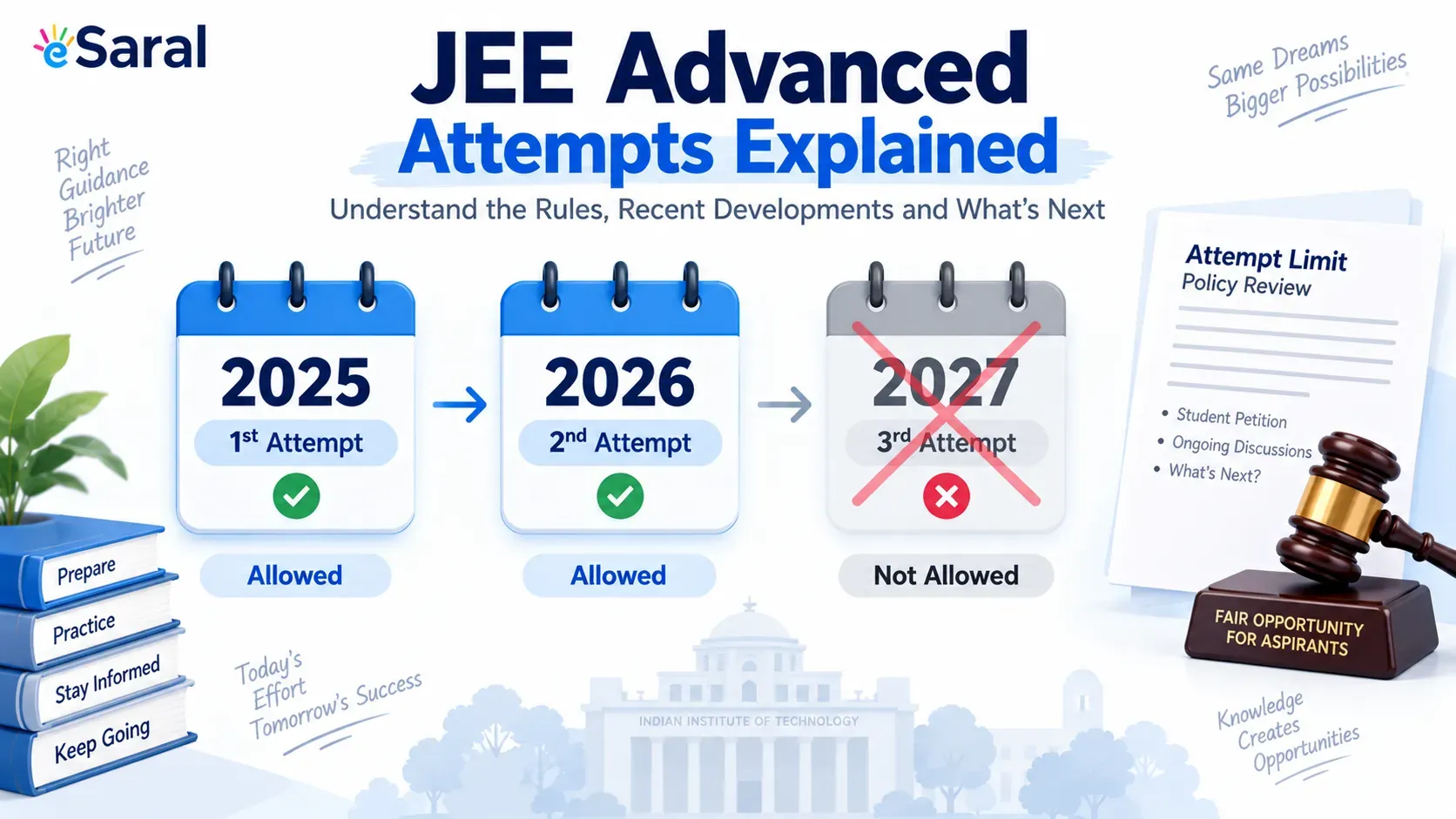
JEE Advanced Attempts: Can You Give It a Third Time? Rules Explained
JEE Advanced attempts: current rule is 2 consecutive years only: full eligibility criteria, the 2025 third-attempt controversy, and the latest 2026 petition news.

Best JEE Preparation App
Best JEE preparation app for Main & Advanced: AI mock tests, live doubt-solving, thousands of practice questions. JEE preparation app for droppers & Class 11-12.
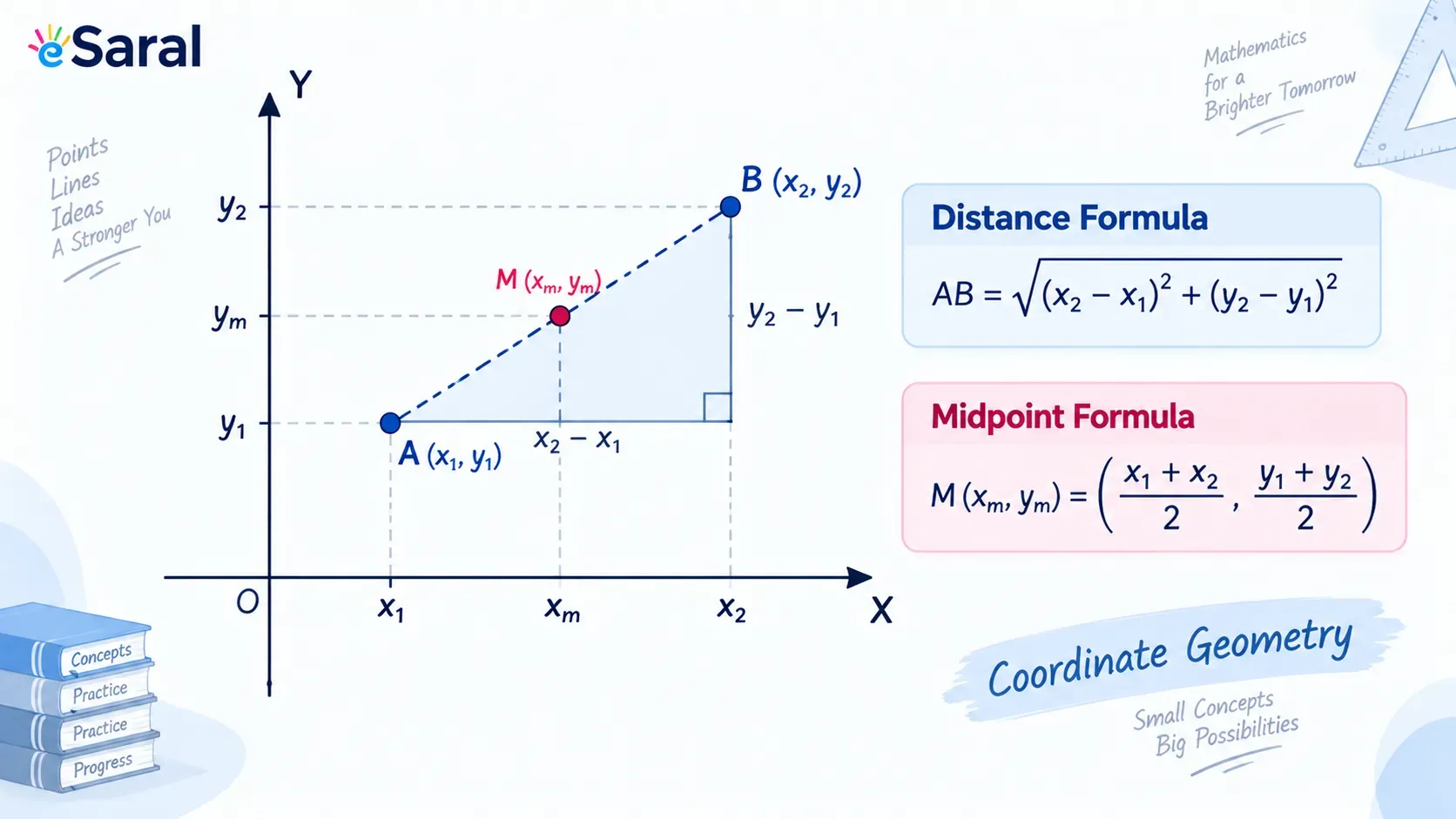
Coordinate Geometry Class 10: Formulas, Notes & Solved Examples
Coordinate geometry class 10: complete CBSE formulas — distance, section, midpoint and area of triangle — with derivation, notes and solved examples.
How to make Notes For JEE Smart Notes Strategy of an AIR 41
Learn how to make notes for JEE the way toppers do — indexing, shorthand, and smart short notes for JEE that cut revision time to just 5–7 days.