
CBSE Class 10 Exam Pattern 2027: Marking Scheme Explained

eSaral Academic and Editorial Team
Summary
The CBSE Class 10 exam pattern for 2026-27 gives each main subject 100 marks (80 theory + 20 internal assessment), with a 33% pass mark in each subject. Board exams run in two phases: a mandatory Phase 1 (February–March 2027) and an optional Phase 2 (May 2027) to improve up to three subjects. Question papers have about 50% competency-based, 20% objective and 30% constructed-response questions. This page also explains the section-wise paper design of Maths, Social Science, English and Hindi.
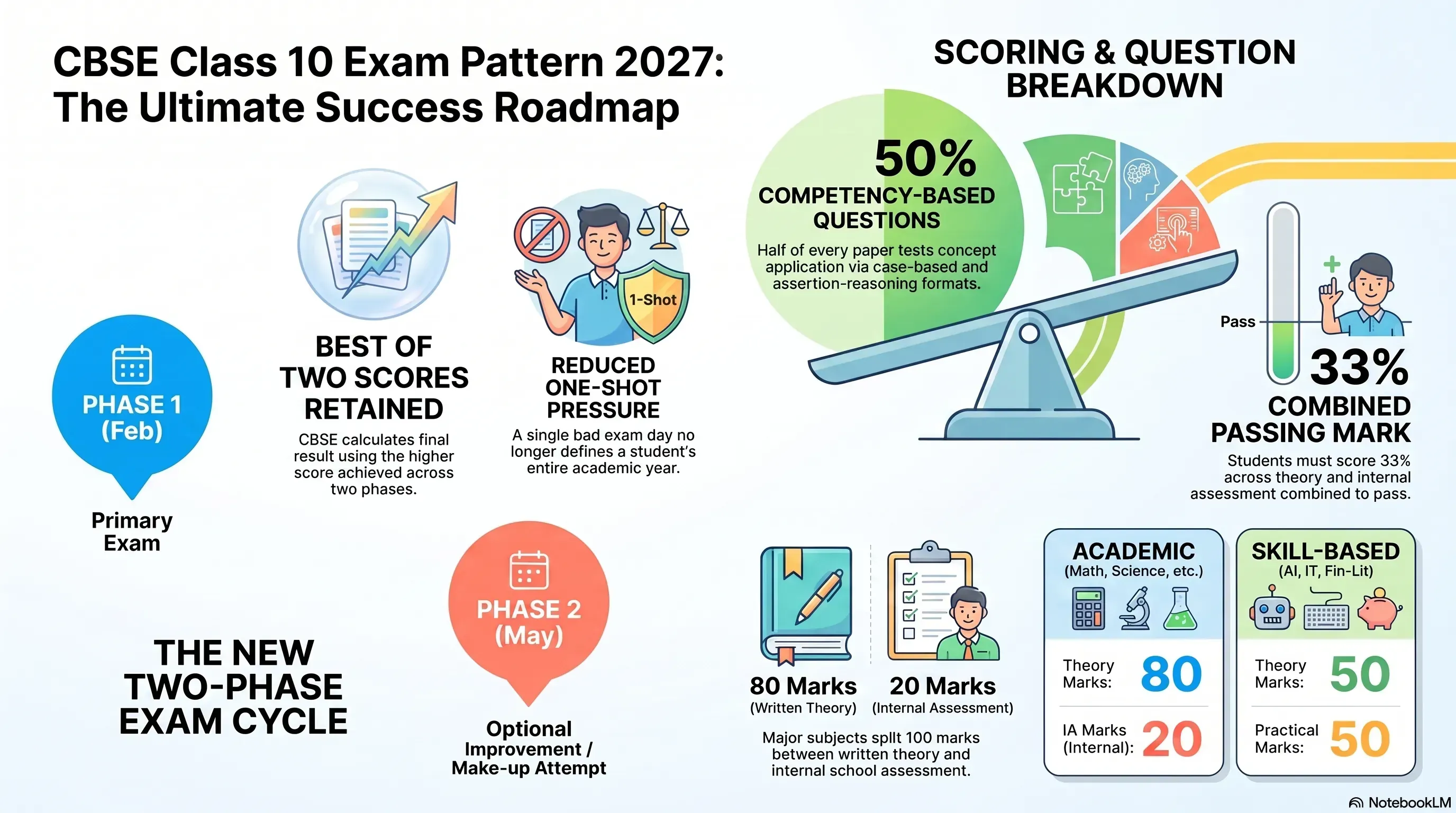
This guide explains the Class 10 exam pattern in simple steps. The Class 10 exam pattern for the 2026-27 session is different from earlier years mainly because of the two-exam system. More than 20 lakh students usually appear for the CBSE Class 10 board exam each year. The official date sheet for 2027 had not been published when this page was updated, so check cbse.gov.in for the final dates.
CBSE Class 10 Exam Pattern 2026-27 at a Glance
Feature | Details |
|---|---|
Marks per main subject | 100 (80 theory + 20 internal assessment) |
Theory paper duration | 3 hours for most subjects |
Board exams | Phase 1 (February–March 2027, mandatory) and Phase 2 (May 2027, optional) |
Question mix | About 50% competency-based, 20% objective (select response), 30% constructed response |
Negative marking | None |
Passing marks | 33% in each subject, theory and internal assessment combined |
Calculators in Maths | Not allowed |
How Are Theory and Internal Assessment Marks Divided in the Class 10 Exam Pattern?
Subject type | Theory | Internal assessment or practical | Total |
|---|---|---|---|
Main academic subjects (Maths, Science, Social Science, English, Hindi, Sanskrit) | 80 | 20 | 100 |
Skill subjects (for example, Artificial Intelligence and Information Technology) | 50 | 50 (practical) | 100 |
The 20 internal assessment marks are given by your school and sent to CBSE. The split differs by subject. In Science, it is periodic assessment 5, multiple assessment 5, portfolio 5 and subject enrichment (practical work) 5. In Maths, it is a pen-paper test and multiple assessment 10, portfolio 5 and lab practical 5. Internal assessment marks are not repeated in Phase 2, so they stay with you from the start of the year. For the full subject-wise details, see eSaral’s CBSE Class 10 syllabus 2026-27 page.
What Types of Questions Are Asked in the Class 10 Exam Pattern?
CBSE’s design for Classes 9 and 10 continues in 2026-27:
- About 50% competency-based questions: case-based, source-based and application questions, in MCQ and written formats.
- About 20% objective (select response) questions: MCQs, assertion-reason questions and similar.
- About 30% constructed response questions: short answers and long answers.
Half of the paper therefore tests how well you can apply a concept, not only recall it. Many questions have an internal choice, but the objective questions in Section A usually have none.
Is There Negative Marking in the CBSE Class 10 Exam?
No. There is no negative marking in the Class 10 board exam, so you should attempt every question you can.
How Do the Two Board Exams Work in the Class 10 Exam Pattern?
Rule | What it means |
|---|---|
Phase 1 | February–March 2027. It is the main exam and is mandatory for all students. |
Phase 2 | May 2027. It is optional and is meant to improve your score. |
Subjects in Phase 2 | You can reappear in up to three subjects (Science, Maths, Social Science or languages). |
Final marks | The better of the two scores in a subject is counted. |
Internal assessment | Not repeated. Your internal assessment marks carry over. |
If you do not pass 1–2 subjects | You can reappear in those subjects in May. |
If you do not pass 3 or more subjects | You are reported to be placed in the “Essential Repeat” category and take the exam next year. |
Skipping Phase 1 | You cannot skip Phase 1 and appear only in Phase 2. |
The details of Phase 2 are as reported from CBSE’s notifications, so read the latest CBSE circular and your school notice before you plan. Prepare for Phase 1 as if it were your only exam. If you need to improve a subject, Phase 2 gives you another chance.
Subject-Wise Paper Design in the Class 10 Exam Pattern (from CBSE Sample Papers 2026-27)
The tables below follow the structure of CBSE’s 2026-27 sample papers and their marking schemes. Use these tables to see how the Class 10 exam pattern works in each subject. The sections of the actual 2027 papers should be similar, but check the official sample papers on cbseacademic.nic.in.
Mathematics (Standard 041 and Basic 241)
Both Maths papers have the same five sections:
Section | Questions | Type | Marks |
|---|---|---|---|
A | 1–20 | MCQs and assertion-reason (1 mark each) | 20 |
B | 21–25 | Very short answer (2 marks each) | 10 |
C | 26–31 | Short answer (3 marks each) | 18 |
D | 32–35 | Long answer (5 marks each) | 20 |
E | 36–38 | Case-study based (4 marks each) | 12 |
Maths answers are marked step by step, so each correct step gets credit even if the final answer is wrong.
Social Science (087)
The paper has four sections, one for each subject, and every section carries 20 marks.
Section | Subject | Marks |
|---|---|---|
A | History | 20 |
B | Geography | 20 |
C | Political Science | 20 |
D | Economics | 20 |
Map-based questions are part of History (Section A) and Geography (Section B), so practise map work for both.
English
Paper | Section-wise marks |
|---|---|
English Language and Literature (184) | Reading 20, Writing and Grammar 20, Literature 40 |
English Communicative (101), from the sample paper | Reading 22, Writing 22, Grammar 10, Literature 26 |
Hindi (Course A and Course B)
Section | Hindi Course A (002) | Hindi Course B (085) |
|---|---|---|
A: Unseen passages (अपठित बोध) | 14 | 14 |
B: Applied grammar (व्यावहारिक व्याकरण) | 16 | 16 |
C: Textbooks (पाठ्य पुस्तक) | 30 (Kshitij and Kritika) | 28 (Sparsh and Sanchayan) |
D: Creative writing (रचनात्मक लेखन) | 20 | 22 |
Total | 80 | 80 |
Science (086)
The Science theory paper (80 marks) is based on five units, as given in the 2026-27 syllabus.
Unit | Marks |
|---|---|
Chemical Substances: Nature and Behaviour | 25 |
World of Living | 25 |
Natural Phenomena | 12 |
Effects of Current | 13 |
Natural Resources | 5 |
Check the official syllabus PDF for the exact scope of each unit.
Passing Marks in the CBSE Class 10 Exam Pattern
To pass, you need 33% marks in each subject, with theory and internal assessment marks combined. CBSE has reportedly clarified that for Class 10 you do not need to score 33% separately in theory and in internal assessment, and this is different from the Class 12 rule. Students who do not pass one or two subjects in Phase 1 can reappear in those subjects in Phase 2.
How to Prepare for the New Class 10 Exam Pattern
- Start with the NCERT textbooks, and solve the in-text and exercise questions.
- Practise competency-based and case-based questions, since they make up about half of the paper.
- Solve the CBSE sample papers and previous year question papers within the time limit.
- Take your internal assessment seriously from the first term, because it carries 20 marks and is not repeated in Phase 2.
- Prepare for Phase 1 as your main exam, and use Phase 2 only if you need to improve.
Building Your JEE/NEET Foundation Alongside Class 10 Boards
Class 10 is also the year many serious JEE and NEET aspirants start layering competitive-exam thinking on top of board preparation — and the two don't have to compete for the same hours.
Physics, Chemistry, and Mathematics concepts from Class 10 NCERT form the direct base for Class 11 topics that show up in both boards and entrance exams two years later. A student who builds genuine conceptual clarity now, rather than memorising for a 33% pass mark, walks into Class 11 with real momentum instead of starting from zero.
If you're mapping this transition, eSaral's Foundation courses are built around exactly this bridge — combining CBSE syllabus coverage with the conceptual depth JEE and NEET eventually demand, taught by the same IIT Bombay faculty who run eSaral's senior JEE and NEET batches.
Frequently Asked Questions
What is the CBSE Class 10 exam pattern for 2026-27?
Each main subject carries 100 marks: 80 marks for the theory paper and 20 marks for internal assessment. Papers have about 50% competency-based, 20% objective and 30% constructed-response questions. Skill subjects have 50 theory and 50 practical marks. eSaral’s Class 10 exam pattern page explains the section-wise design for each subject.
How many board exams will CBSE Class 10 have in 2027?
There are two board exams. Phase 1 (February–March 2027) is mandatory, and Phase 2 (May 2027) is optional for improving your score in up to three subjects. The better score in each subject is counted.
What are the passing marks in the CBSE Class 10 exam pattern?
You need at least 33% marks in each subject, with theory and internal assessment marks counted together. CBSE has reportedly confirmed that there is no change in this rule for 2026-27.
How is the 20-mark internal assessment calculated in Class 10?
It depends on the subject. In Science, it is periodic assessment 5, multiple assessment 5, portfolio 5 and subject enrichment 5. In Maths, it is a pen-paper test and multiple assessment 10, portfolio 5 and lab practical 5. Schools send the marks to CBSE.
Is there negative marking in CBSE Class 10 board exams?
No. Wrong answers do not reduce your marks, so you should attempt every question.
Can I use a calculator in the CBSE Class 10 Maths exam?
No. Calculators are not allowed in the Class 10 Maths board exam. Maths answers are marked step by step, so write each step clearly.
What is the difference between Maths Standard and Maths Basic?
In the Class 10 exam pattern, both have the same paper structure of five sections (A to E) and 80 marks. Maths Standard (041) is for students who want to study Maths further, and Maths Basic (241) is for students who do not plan to take Maths after Class 10. The difficulty of the questions is different.
What is the difference between Hindi Course A and Hindi Course B?
Hindi Course A (002) uses the textbooks Kshitij and Kritika. Hindi Course B (085) uses Sparsh and Sanchayan. Both have 80 marks in the Class 10 exam pattern, and their section-wise marks differ slightly.
Team eSaral
eSaral Academic and Editorial Team
Team eSaral is the collective author profile for educational content created by eSaral’s teachers and academic contributors. The team draws on expertise from IIT graduates, doctors, experienced educators and subject specialists to develop resources for JEE, NEET and school students. Our articles aim to explain concepts clearly and help students study with confidence.
Related Posts

BITSAT 2027: Registration Date, Exam Date, Syllabus, Eligibility, Pattern & Fees
BITSAT 2027 exam dates, registration timeline, eligibility criteria, exam pattern, marking scheme, syllabus and fees in one page.

BITSAT Previous Year Question Paper PDF (2017-2026)
Download BITSAT previous year question papers PDF from 2017 to 2026,session-wise. Memory-based papers,exam pattern, paper analysis and how to practise

CBSE Class 10 Date Sheet 2027: Expected Exam Dates, Release Date, Admit Card & Result Timeline
CBSE Class 10 date sheet 2027 is awaited. See the expected exam dates, release window, how to download the PDF, admit card and result timelines.

NCERT Physics Class 10 Book PDF in Hindi 2026-27 – भौतिक विज्ञान के 4 अध्याय (Free Download)
NCERT Physics Class 10 book PDF in Hindi 2026-27: download all 4 chapters (अध्याय 9–12) free, with topics and important formulas.

NCERT Biology Class 9 Book Anveshan PDF in Hindi - जीव विज्ञान कक्षा 9 पुस्तक अन्वेषण PDF
Download NCERT Biology Class 9 book PDF in Hindi chapterwise for 2026-27: Cell, Tissues, Reproduction and Diversity. Free PDFs.

Essay On Artificial Intelligence in English (100,150, 200, 250, 300, 500 Words)
This is in contrast to the natural intelligence of humans. With Artificial Intelligence, machines can perform

Essay on 78th India Independence Day in English for Student (100, 150, 200, 250, 300, 500 Words)
Read the best essays on India's Independence Day in English. Short & long essays (100, 150, 200, 250, 300, 500 words) perfect for school exams
NCERT Class 11 English Snapshots book - Free PDF download- Esaral
Download NCERT Class 11 English Snapshots book PDF for free. Get all 8 chapters, chapter-wise. Start your prep today!
NCERT Class 10 biology book pdf - Free PDF Download - eSaral
NCERT Class 10 Biology book PDF 2026-27: all 5 chapters (Life Processes to Our Environment) in English & Hindi, with CBSE syllabus, marks & practical

Essay on Global Warming in English (100,150, 200, 250, 300, 500 Words)
Global warming means the Earth is getting hotter. This happens because of things like pollution from cars and factories.