
Class 11 Physics Gravitation Notes – Key Formulas, Laws & Concepts for JEE & NEET

eSaral Academic and Editorial Team
Summary
Class 11 Physics gravitation notes cover Newton’s law of universal gravitation, acceleration due to gravity and its variation, gravitational field and potential, gravitational potential energy, escape velocity, the orbital motion of satellites and Kepler’s laws. This page gives each formula with its meaning, short derivations, solved examples, common mistakes and FAQs for boards, JEE and NEET.

Gravitation is the force of attraction between all objects that have mass. It is the reason why a ball thrown upward falls back, why the Moon goes around the Earth, and why satellites stay in orbit. These Class 11 Physics gravitation notes follow the NCERT chapter on Gravitation, and they add the points that JEE and NEET ask. Use the Class 11 Physics gravitation notes first, and then solve the questions. For the NCERT questions, use eSaral’s NCERT Solutions for Class 11 Physics Chapter 7. Orbital motion also needs vectors and centripetal acceleration, so revise vectors and two-dimensional motion before the satellite numericals. For a quick revision, you can download eSaral’s Gravitation revision notes (PDF).
Class 11 Physics Gravitation Notes: Formulas at a Glance
Use this table with the Class 11 Physics gravitation notes below.
Topic | Formula |
|---|---|
Newton’s law of gravitation | $F = \dfrac{Gm_1m_2}{r^2}$, with $G = 6.67\times 10^{-11}\ \text{N m}^2\text{kg}^{-2}$ |
Acceleration due to gravity | $g = \dfrac{GM}{R^2}$ |
$g$ at a height $h$ | $g_h = g\left(\dfrac{R}{R+h}\right)^2 \approx g\left(1 - \dfrac{2h}{R}\right)$ for $h \ll R$ |
$g$ at a depth $d$ | $g_d = g\left(1 - \dfrac{d}{R}\right)$ |
$g$ at latitude $\lambda$ | $g' = g - \omega^2R\cos^2\lambda$ |
Gravitational potential energy | $U = -\dfrac{GMm}{r}$ |
Escape velocity | $v_e = \sqrt{\dfrac{2GM}{R}} = \sqrt{2gR} \approx 11.2\ \text{km/s}$ |
Orbital velocity | $v_o = \sqrt{\dfrac{GM}{r}}$, and $\sqrt{gR} \approx 7.9\ \text{km/s}$ near the surface |
Time period of a satellite | $T = 2\pi\sqrt{\dfrac{r^3}{GM}}$ |
Energy of a satellite | $KE = \dfrac{GMm}{2r},\quad PE = -\dfrac{GMm}{r},\quad E = -\dfrac{GMm}{2r}$ |
Kepler’s third law | $T^2 \propto a^3$ |
Class 11 Physics Gravitation Notes: Newton’s Law of Universal Gravitation
Every particle in the universe attracts every other particle with a force
$$F = \frac{Gm_1m_2}{r^2}$$
along the line joining them. $G$ is the universal gravitational constant, and Henry Cavendish measured it first. Its dimensions are $[M^{-1}L^3T^{-2}]$.
Properties of the gravitational force:
- It is always attractive, and it acts along the line joining the two particles.
- It forms an action-reaction pair, so the two particles pull each other with equal and opposite forces.
- It is a conservative force, and it is central: it depends only on the distance $r$.
- It does not depend on the medium between the particles.
- It is the weakest of the fundamental forces, so it matters only when at least one body is very massive.
$G$ | $g$ | |
|---|---|---|
Name | Universal gravitational constant | Acceleration due to gravity |
Value | $6.67\times 10^{-11}\ \text{N m}^2\text{kg}^{-2}$, the same everywhere | About $9.8\ \text{m/s}^2$ on the Earth, and different on other places |
Depends on | Nothing | The mass and the radius of the planet, the height, the depth and the latitude |
Class 11 Physics Gravitation Notes: Acceleration Due to Gravity and Its Variation
At the surface of a planet of mass $M$ and radius $R$, the weight $mg$ equals the force of gravitation $\dfrac{GMm}{R^2}$, so
$$g = \frac{GM}{R^2}$$
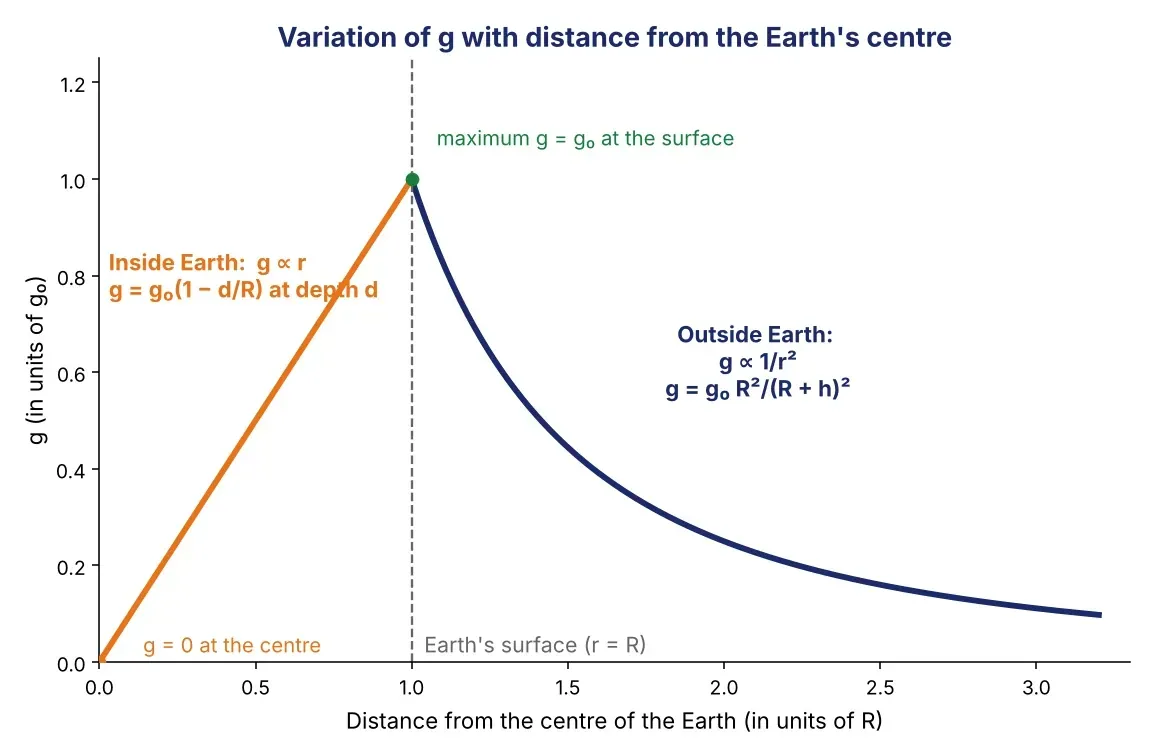
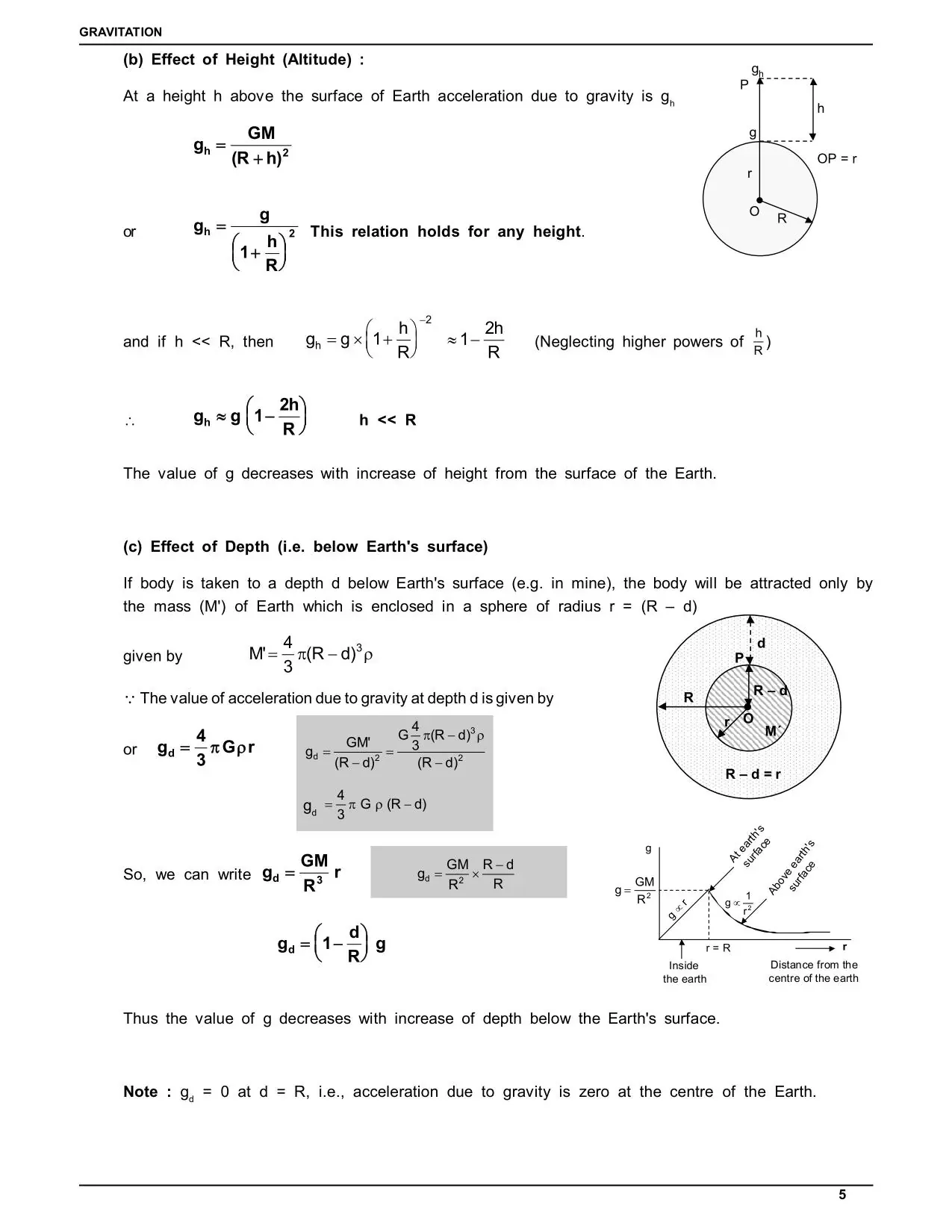
Variation with height. At a height $h$ above the surface,
$$g_h = \frac{GM}{(R+h)^2} = g\left(\frac{R}{R+h}\right)^2 \approx g\left(1 - \frac{2h}{R}\right) \quad (h \ll R)$$
Variation with depth. Inside a uniform Earth, only the mass of the sphere of radius $(R - d)$ attracts the body, so
$$g_d = g\left(1 - \frac{d}{R}\right)$$
and $g$ becomes zero at the centre.
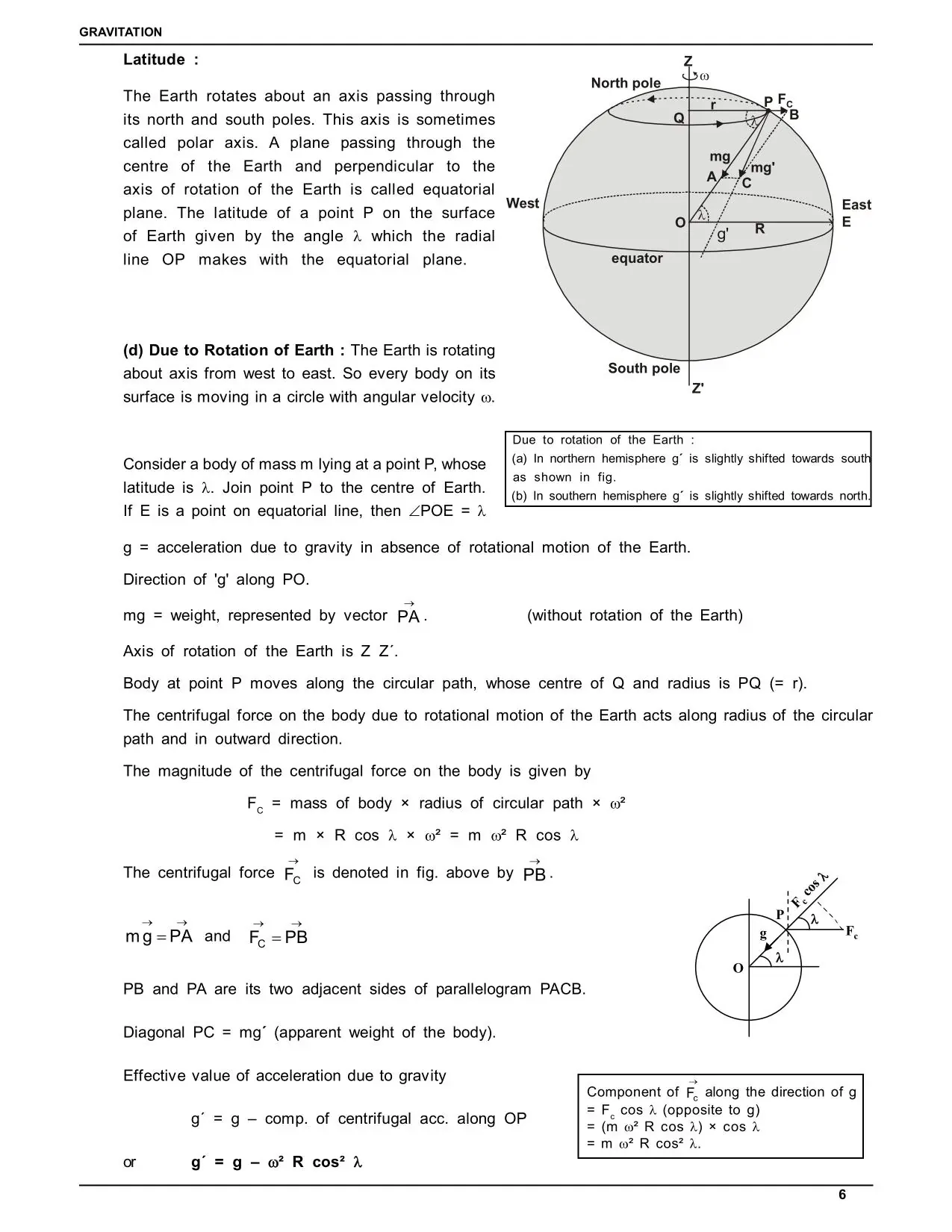
Variation with latitude. Because of the rotation of the Earth with angular velocity $\omega$, at a latitude $\lambda$,
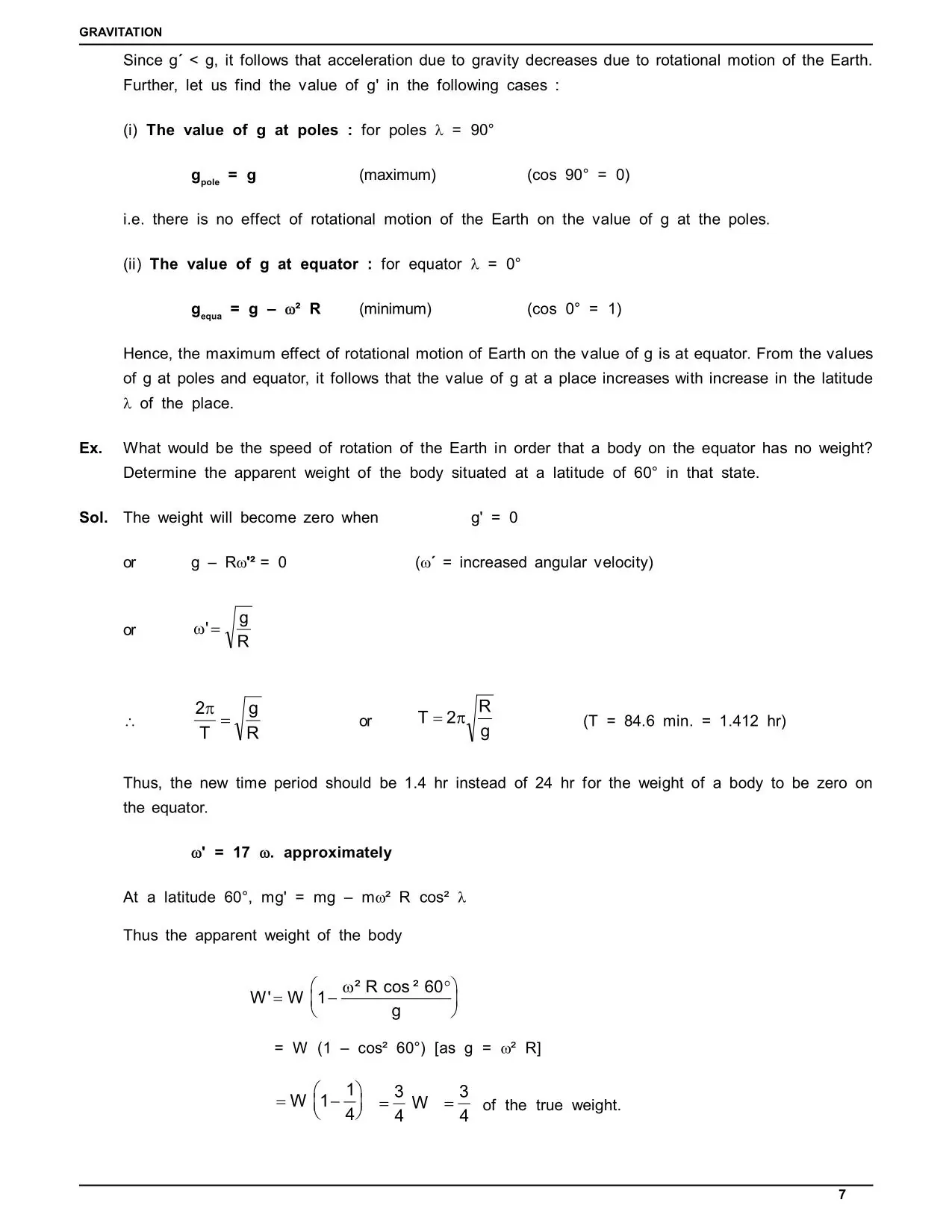
$$g' = g - \omega^2R\cos^2\lambda$$
So $g' = g - \omega^2R$ at the equator, and $g' = g$ at the poles. The shape of the Earth also makes $g$ slightly larger at the poles.
Class 11 Physics Gravitation Notes: Gravitational Field and Potential
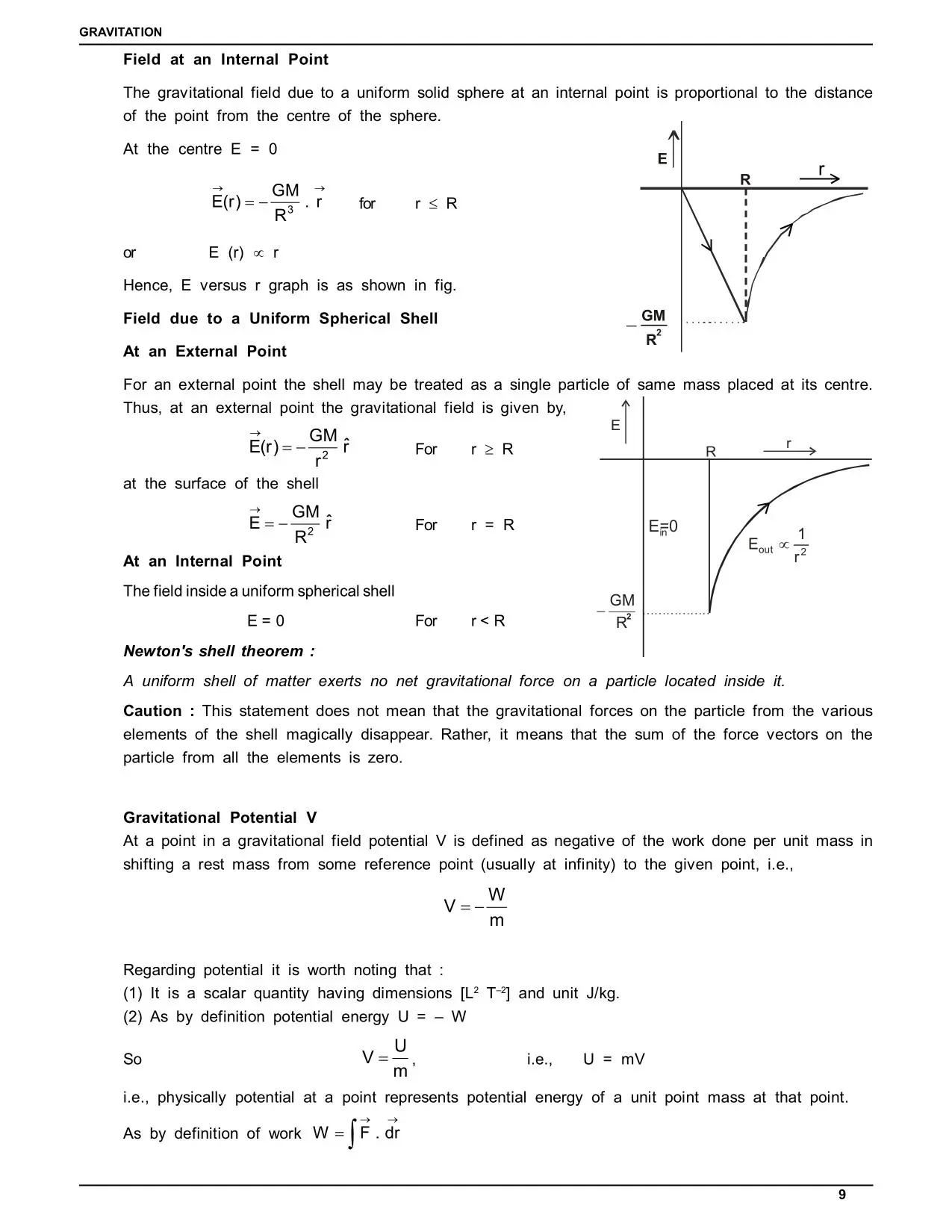
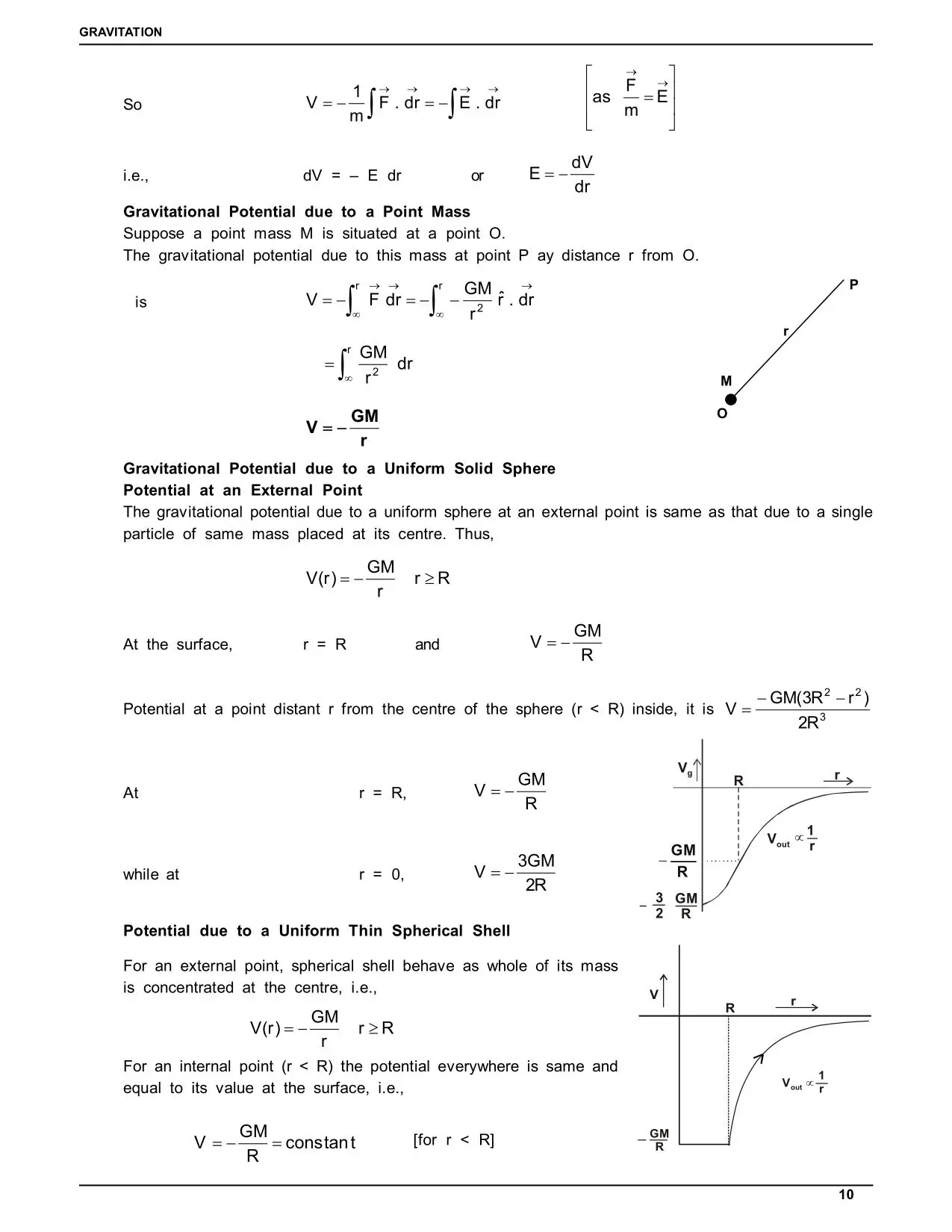
The gravitational field (intensity) at a point is the force per unit mass, and the gravitational potential is the work done per unit mass in bringing a small mass from infinity to the point.
Source | Field $I$ | Potential $V$ |
|---|---|---|
Point mass $M$ at distance $r$ | $\dfrac{GM}{r^2}$ | $-\dfrac{GM}{r}$ |
Thin spherical shell, outside ($r \geq R$) | $\dfrac{GM}{r^2}$ | $-\dfrac{GM}{r}$ |
Thin spherical shell, inside ($r < R$) | $0$ | $-\dfrac{GM}{R}$ (constant) |
Solid sphere, inside ($r < R$) | $\dfrac{GMr}{R^3}$ | $-\dfrac{GM(3R^2 - r^2)}{2R^3}$ |
The potential energy of a mass $m$ at a point where the potential is $V$ is $U = mV$.
Class 11 Physics Gravitation Notes: Gravitational Potential Energy and Escape Velocity
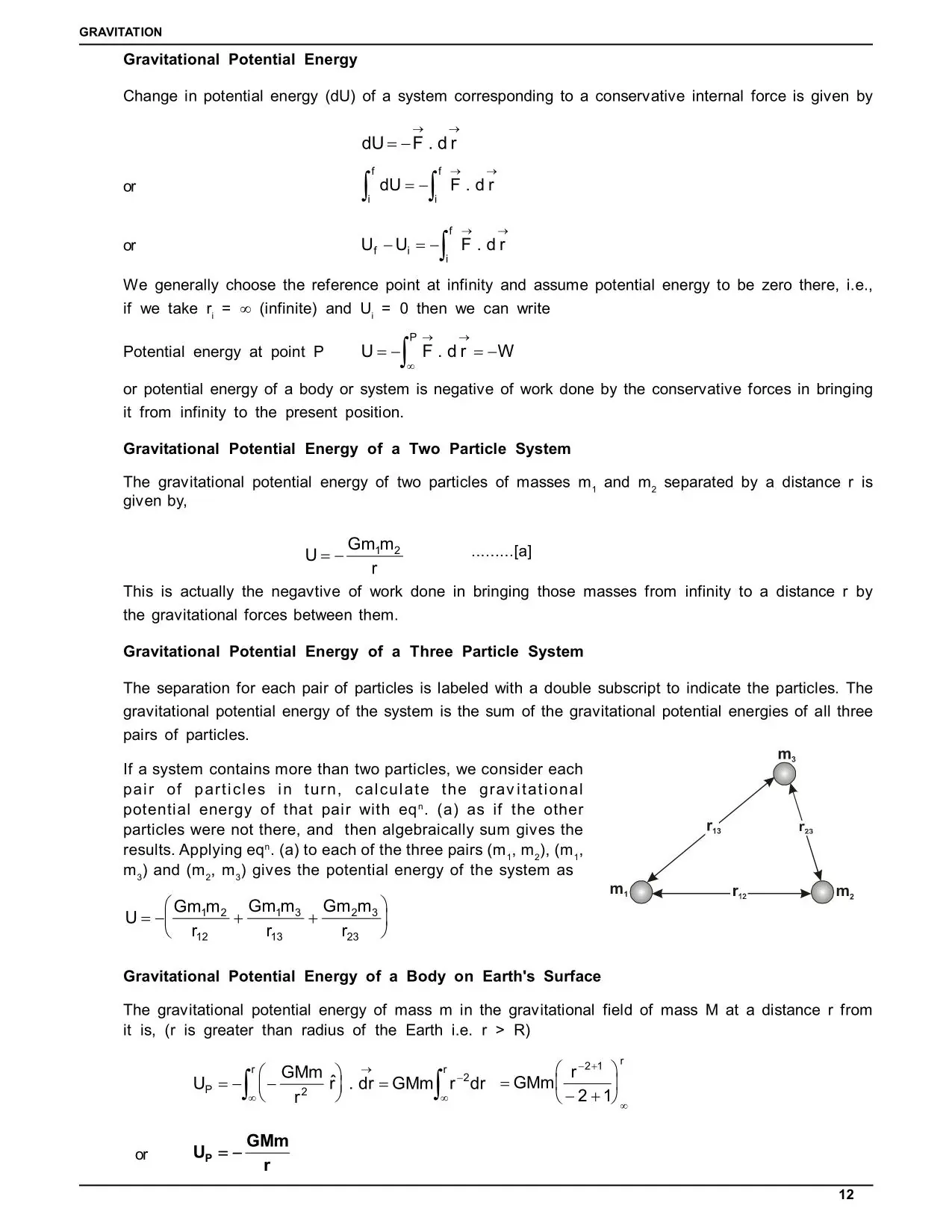
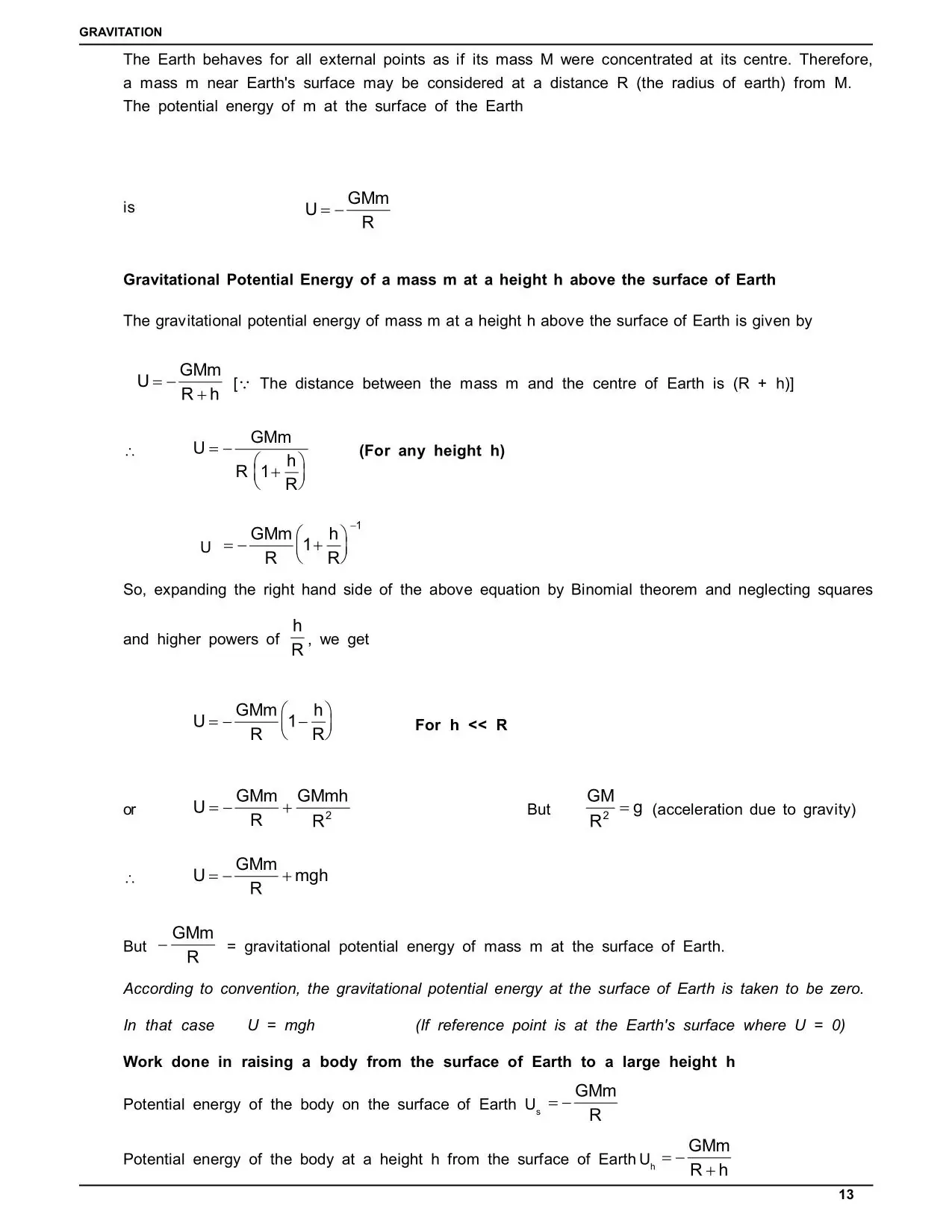
The gravitational potential energy of a mass $m$ at a distance $r$ from the centre of the Earth is
$$U = -\frac{GMm}{r}$$
It is zero at infinity and negative everywhere else. Near the surface, the change in potential energy for a small height $h$ is $\Delta U = mgh$.
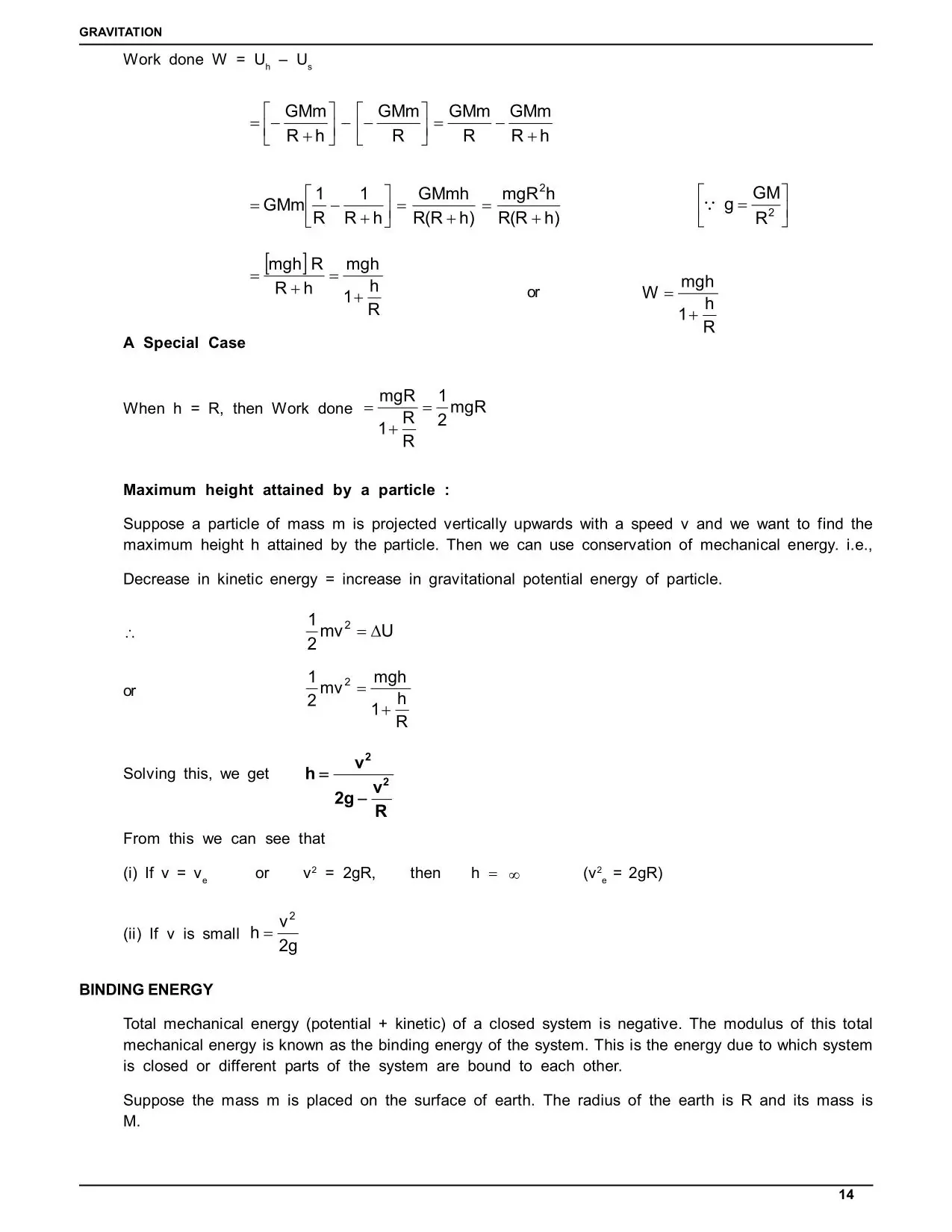
Escape velocity is the minimum speed that has to be given to a body at the surface so that it reaches infinity. At infinity, the total energy is zero, so
$$\frac{1}{2}mv_e^2 - \frac{GMm}{R} = 0 \;\Rightarrow\; v_e = \sqrt{\frac{2GM}{R}} = \sqrt{2gR} \approx 11.2\ \text{km/s}$$
The escape velocity does not depend on the mass of the body, or on the direction of projection. For the Moon it is about 2.4 km/s, which is one reason why the Moon has no atmosphere.
Class 11 Physics Gravitation Notes: Orbital Motion of Satellites
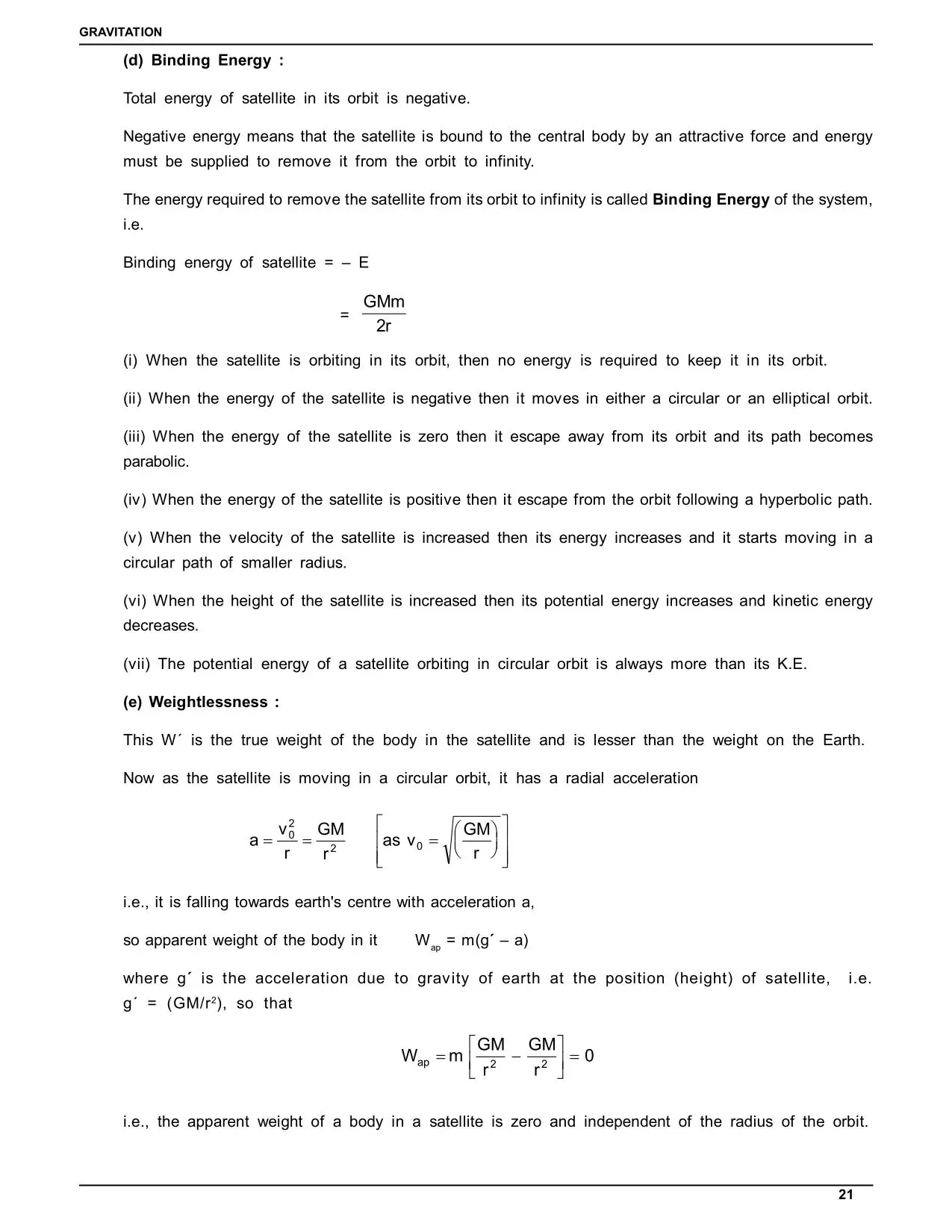
For a satellite in a circular orbit of radius $r$, the gravitational force provides the centripetal force:
$$\frac{GMm}{r^2} = \frac{mv_o^2}{r} \;\Rightarrow\; v_o = \sqrt{\frac{GM}{r}}$$
The time period is
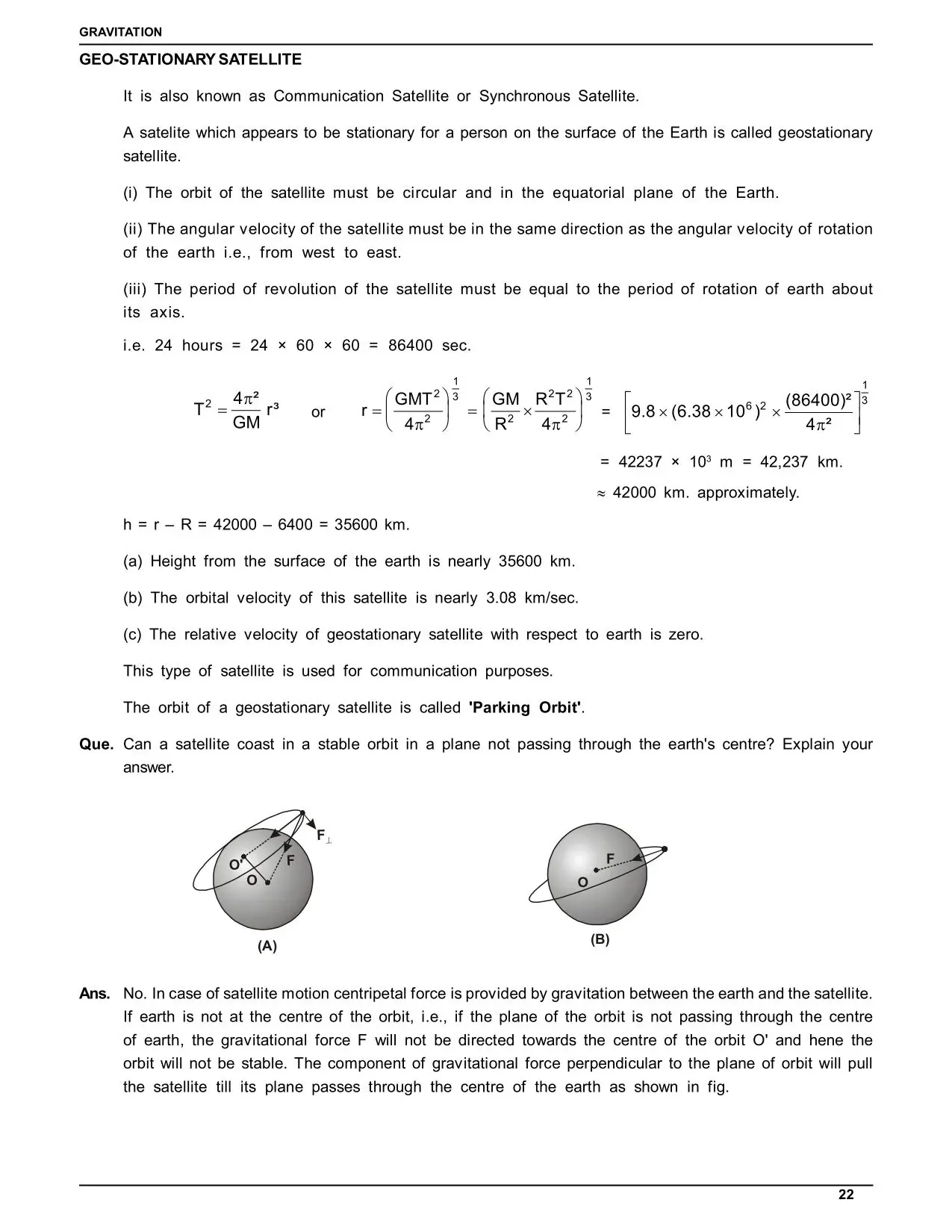
$$T = \frac{2\pi r}{v_o} = 2\pi\sqrt{\frac{r^3}{GM}}$$
Near the surface of the Earth, $v_o = \sqrt{gR} \approx 7.9$ km/s, and $v_e = \sqrt{2}\,v_o$.
Energy of a satellite:
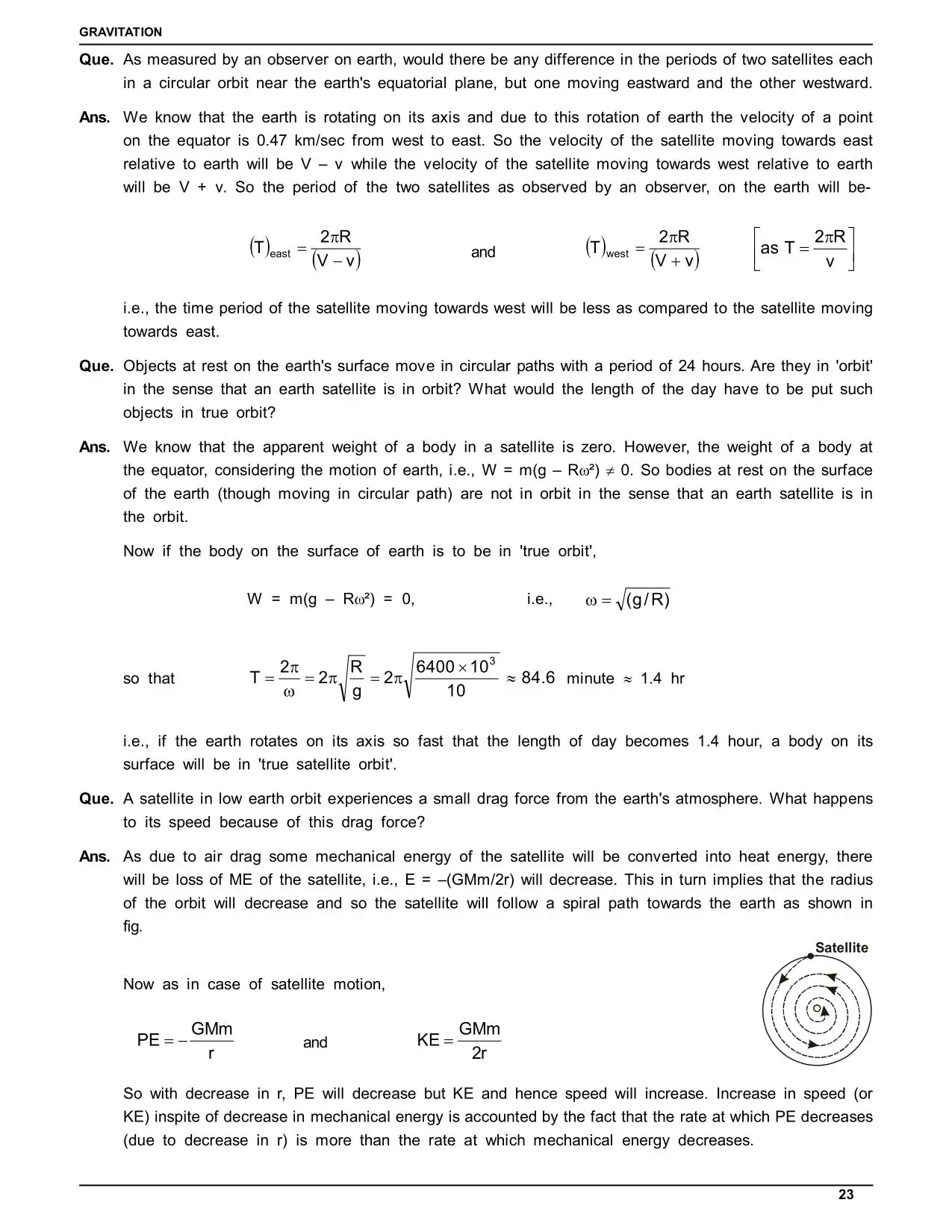
$$KE = \frac{GMm}{2r}, \qquad PE = -\frac{GMm}{r}, \qquad E = KE + PE = -\frac{GMm}{2r}$$
The total energy is negative, which means that the satellite is bound. The binding energy is $+\dfrac{GMm}{2r}$.
Geostationary satellite: It moves in the equatorial plane, from west to east, with a time period of 24 hours. Putting $T = 24$ h in the time period formula gives $r \approx 4.2\times 10^7$ m from the centre of the Earth, which is about 36,000 km above the surface, and the orbital speed is about 3.1 km/s.
Weightlessness: Inside a satellite, the apparent weight is zero because the satellite and everything in it are in free fall. Gravity is not zero there: at a height of 400 km, $g$ is still about 8.7 m/s².
Class 11 Physics Gravitation Notes: Kepler’s Laws of Planetary Motion
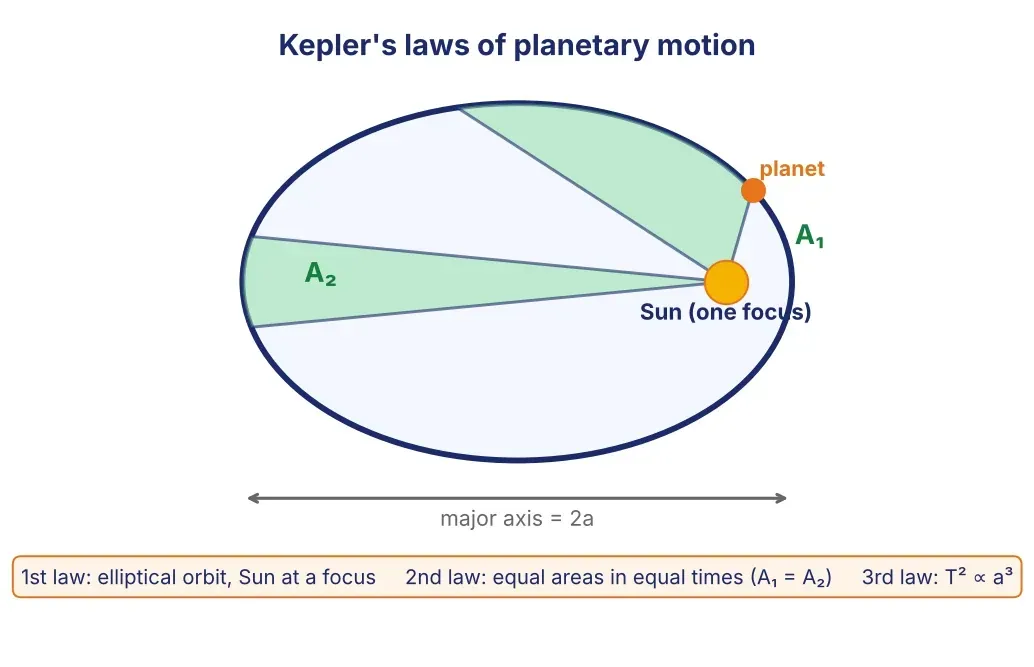
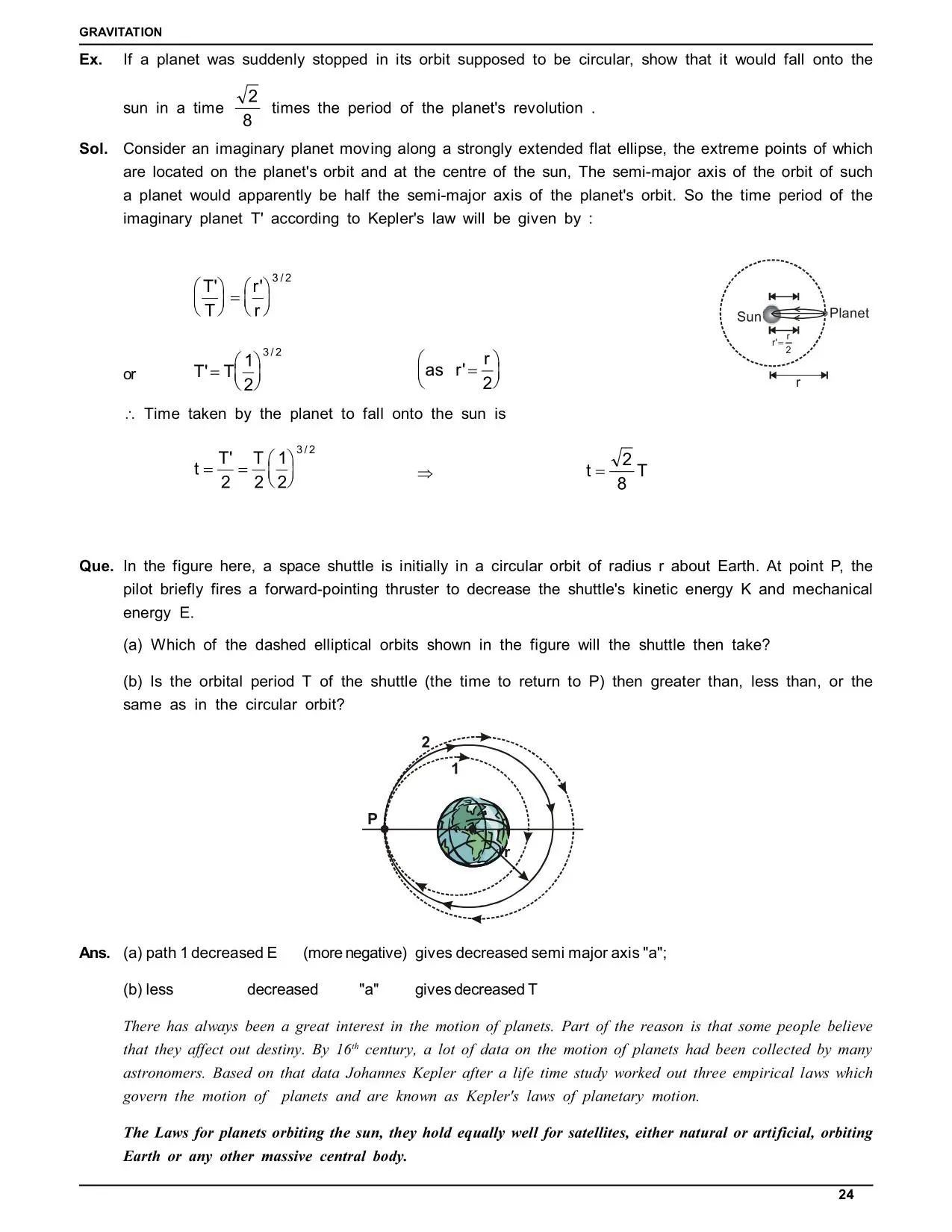
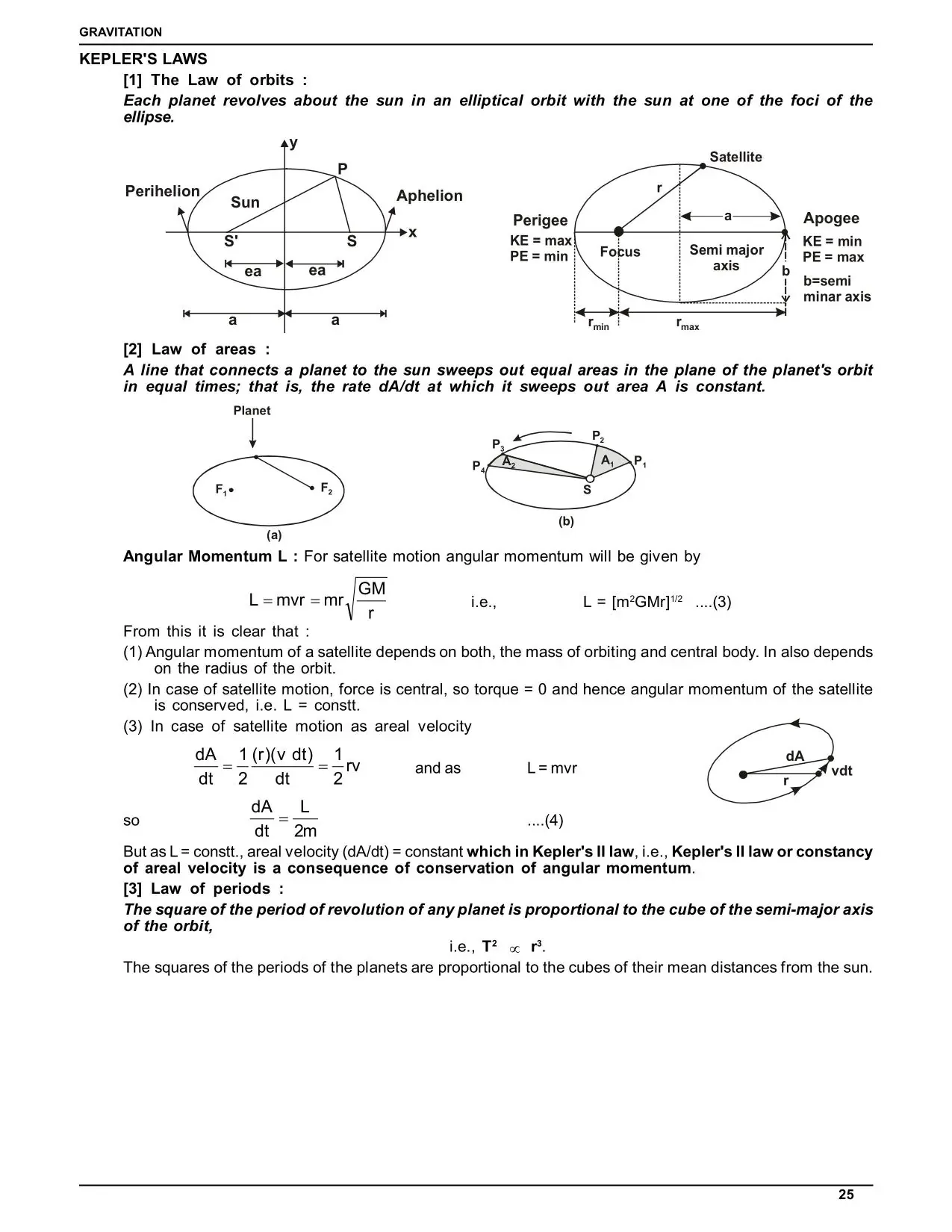
- Law of orbits: every planet moves in an elliptical orbit with the Sun at one focus.
- Law of areas: the line joining the Sun and a planet sweeps equal areas in equal times. The areal velocity $\dfrac{dA}{dt} = \dfrac{L}{2m}$ is constant, so this law is a result of the conservation of angular momentum. The planet moves faster when it is closer to the Sun.
- Law of periods: the square of the time period is proportional to the cube of the semi-major axis, $T^2 \propto a^3$.
For a circular orbit, the third law follows from $\dfrac{GMm}{r^2} = m\omega^2 r$ with $\omega = \dfrac{2\pi}{T}$:
$$T^2 = \frac{4\pi^2}{GM}\,r^3$$
Class 11 Physics Gravitation Notes: Solved Examples
These solved examples apply the formulas of the Class 11 Physics gravitation notes.
Example 1: $g$ at a height and at a depth
Find $g$ at (i) a height $h = R$ above the surface and (ii) a depth $d = \dfrac{R}{2}$. Take $g = 9.8\ \text{m/s}^2$ on the surface.
(i) $g_h = g\left(\dfrac{R}{R + R}\right)^2 = \dfrac{g}{4} = 2.45\ \text{m/s}^2$.
(ii) $g_d = g\left(1 - \dfrac{1}{2}\right) = \dfrac{g}{2} = 4.9\ \text{m/s}^2$.
Example 2: A planet with a different mass and radius
A planet has twice the mass and half the radius of the Earth. Find $g$ and the escape velocity, compared with the Earth.
$$g_p = \frac{G(2M)}{(R/2)^2} = 8\,\frac{GM}{R^2} = 8g, \qquad v_{e,p} = \sqrt{\frac{2G(2M)}{R/2}} = \sqrt{4}\,v_e = 2v_e \approx 22.4\ \text{km/s}$$
Example 3: Time periods of two satellites
Two satellites orbit the Earth at radii in the ratio $1 : 4$. Find the ratio of their time periods.
Since $T^2 \propto r^3$, $\dfrac{T_1}{T_2} = \left(\dfrac{1}{4}\right)^{3/2} = \dfrac{1}{8}$.
Example 4: Energy of a satellite
Find the total energy and the binding energy of a 500 kg satellite at a distance $r = 2R$ from the centre of the Earth. ($g = 9.8\ \text{m/s}^2$, $R = 6.4\times 10^6$ m)
Use $GM = gR^2$:
$$E = -\frac{GMm}{2r} = -\frac{gR^2m}{2\times 2R} = -\frac{gRm}{4} = -\frac{9.8\times 6.4\times 10^6\times 500}{4} = -7.84\times 10^9\ \text{J}$$
The binding energy is $+7.84\times 10^9$ J.
Class 11 Physics Gravitation Notes: Common Mistakes
These mistakes cost marks in questions on Class 11 Physics gravitation notes.
Mistake | Correct approach |
|---|---|
Using $g = 9.8\ \text{m/s}^2$ at any height | $g$ changes with the height and the depth. Use $g_h$ and $g_d$ |
Taking $d$ as the distance from the centre | In $g_d = g(1 - d/R)$, $d$ is the depth below the surface |
Using $U = mgh$ for large heights | $U = mgh$ is only for $h \ll R$. Otherwise use $U = -GMm/r$ |
Thinking that escape velocity depends on the mass of the body | It depends only on $M$ and $R$ of the planet |
Writing the total energy of a satellite as positive | $E = -GMm/2r$ is negative for a bound satellite |
Using $R$ instead of $R + h$ for a satellite at a height | The orbital radius $r = R + h$ is measured from the centre of the Earth |
Saying that there is no gravity in a satellite | Gravity is there, and the weightlessness is due to free fall |
Quick Revision of Class 11 Physics Gravitation Notes
- The gravitational force is attractive, central and conservative, and $G$ is a constant, while $g$ changes.
- $g$ is maximum at the surface (the Earth is treated as uniform), zero at the centre, and decreases above the surface as $1/r^2$.
- $v_e = \sqrt{2}\,v_o$ at the same distance, and neither depends on the mass of the body.
- For a satellite, $KE = -E$, $PE = 2E$, and $E = -\dfrac{GMm}{2r}$.
- A satellite’s speed decreases as its orbit gets bigger, but its total energy increases (it becomes less negative).
- $T^2 \propto r^3$ for all the planets around the same Sun, and for all the satellites around the same planet.
- A geostationary satellite has $T = 24$ h, orbits in the equatorial plane, and has the same angular velocity as the Earth.
Class 11 Physics Gravitation Notes
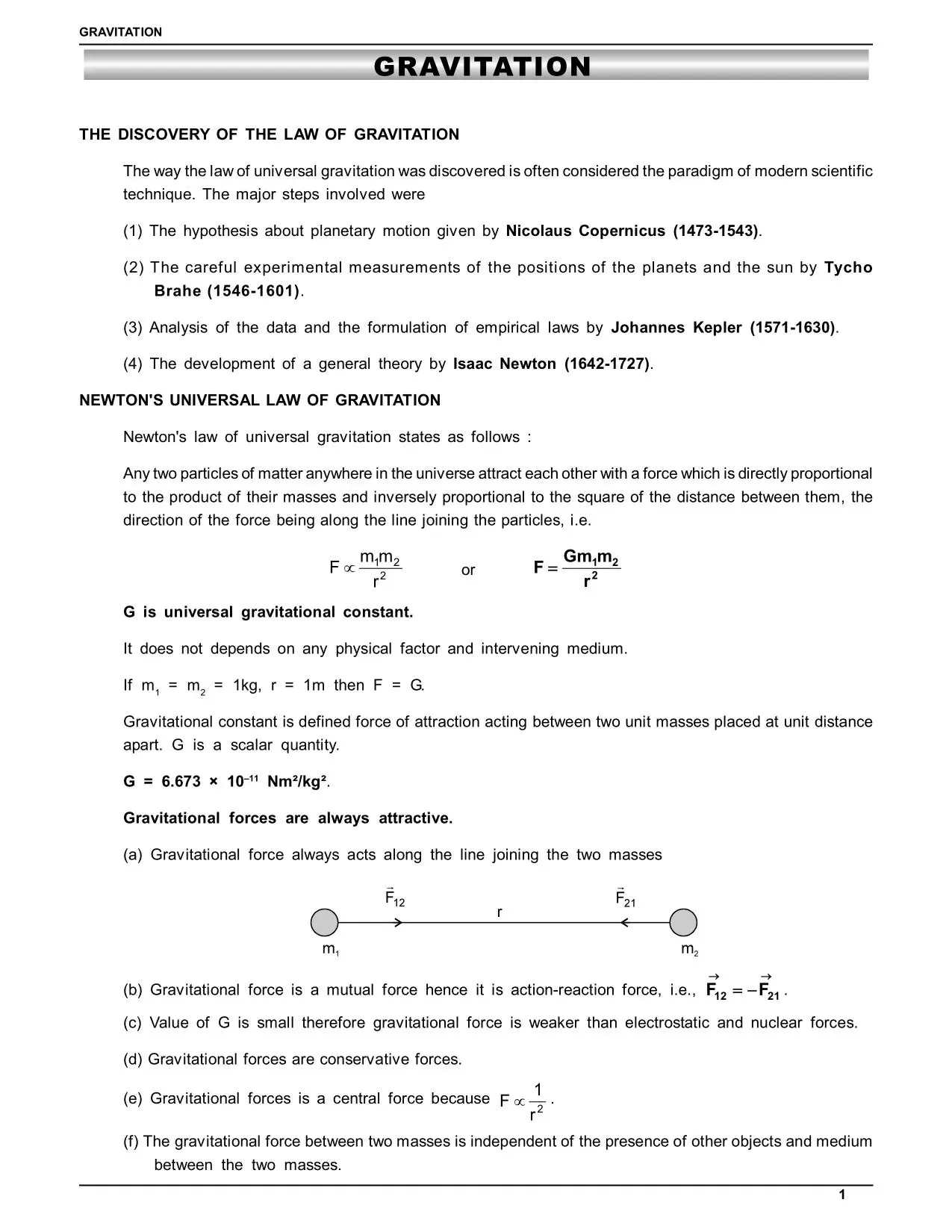
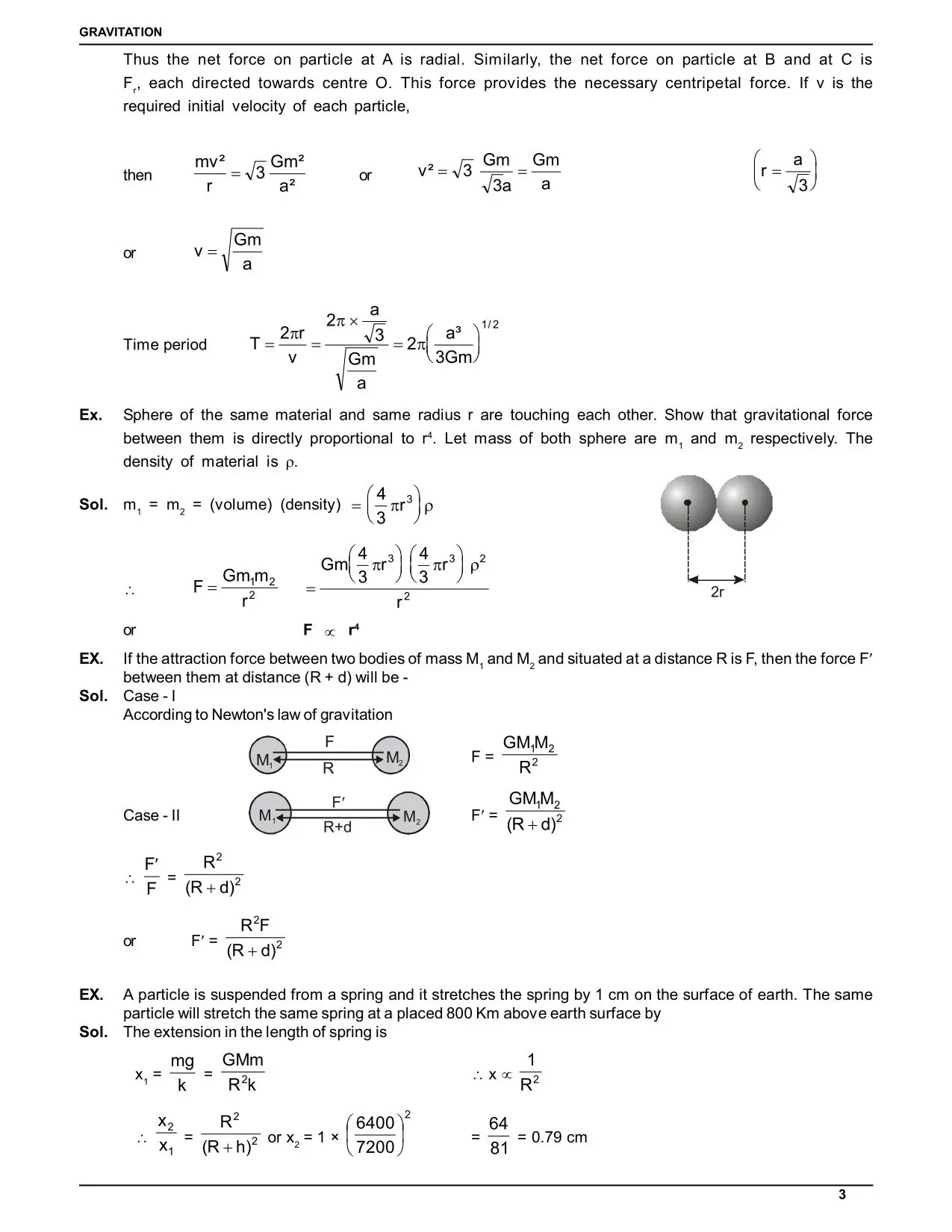
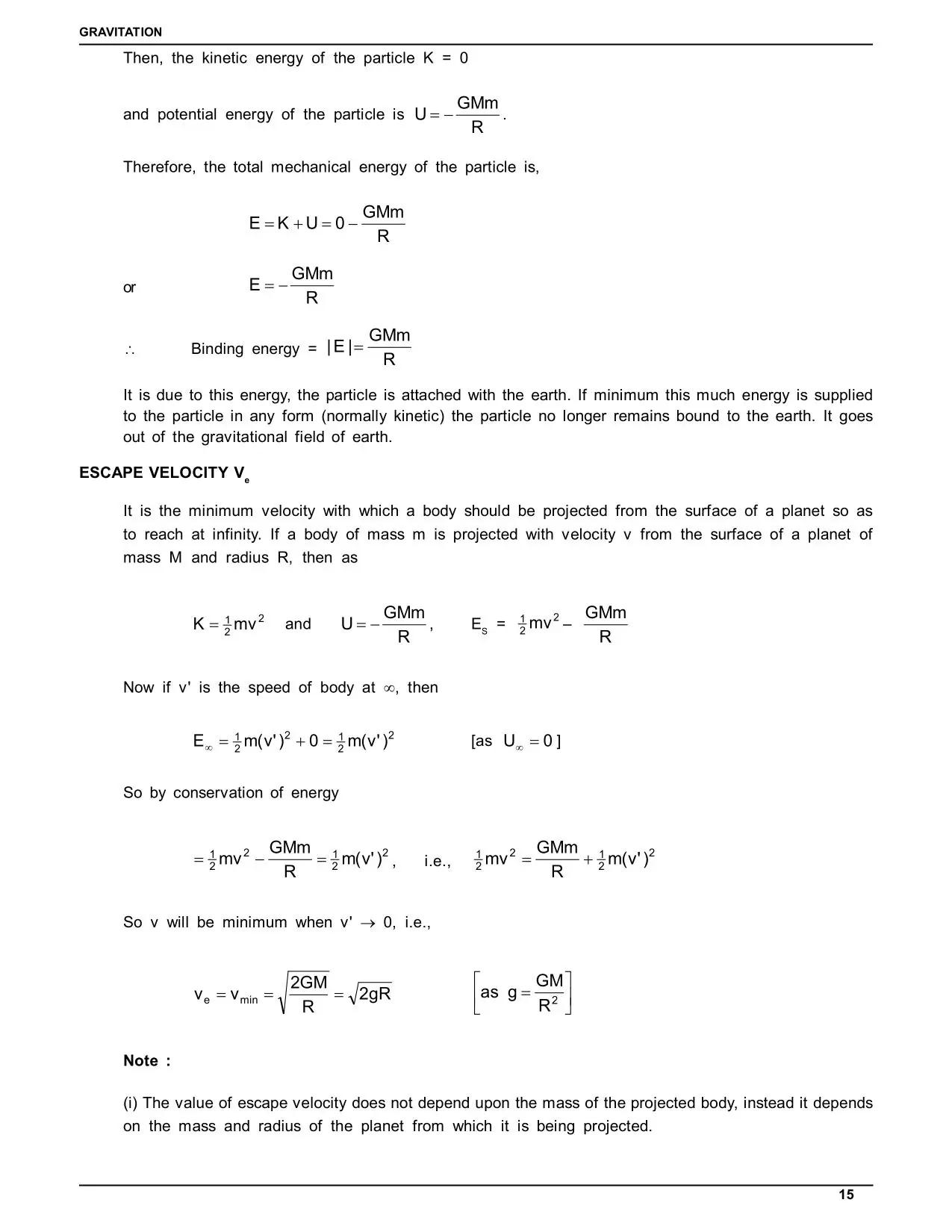
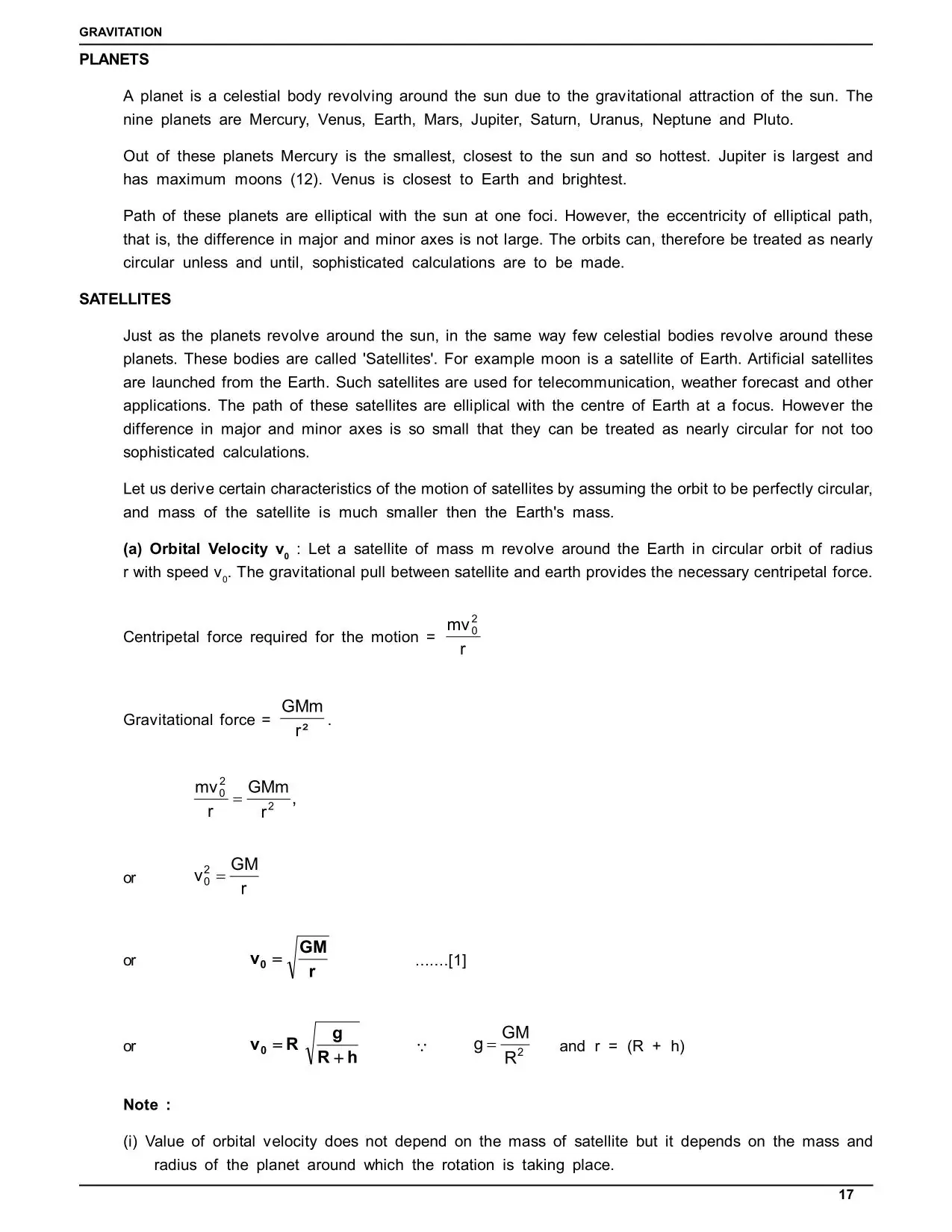
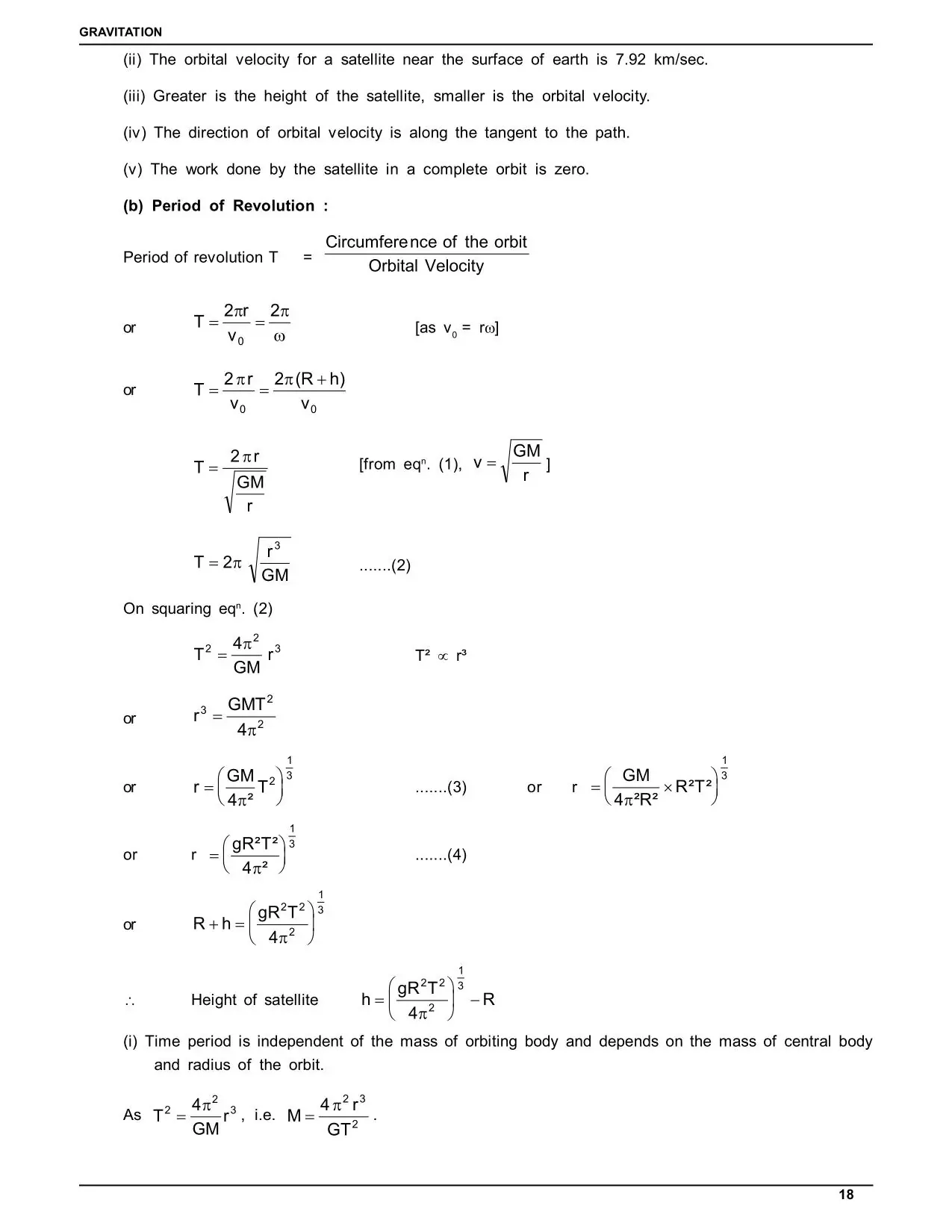
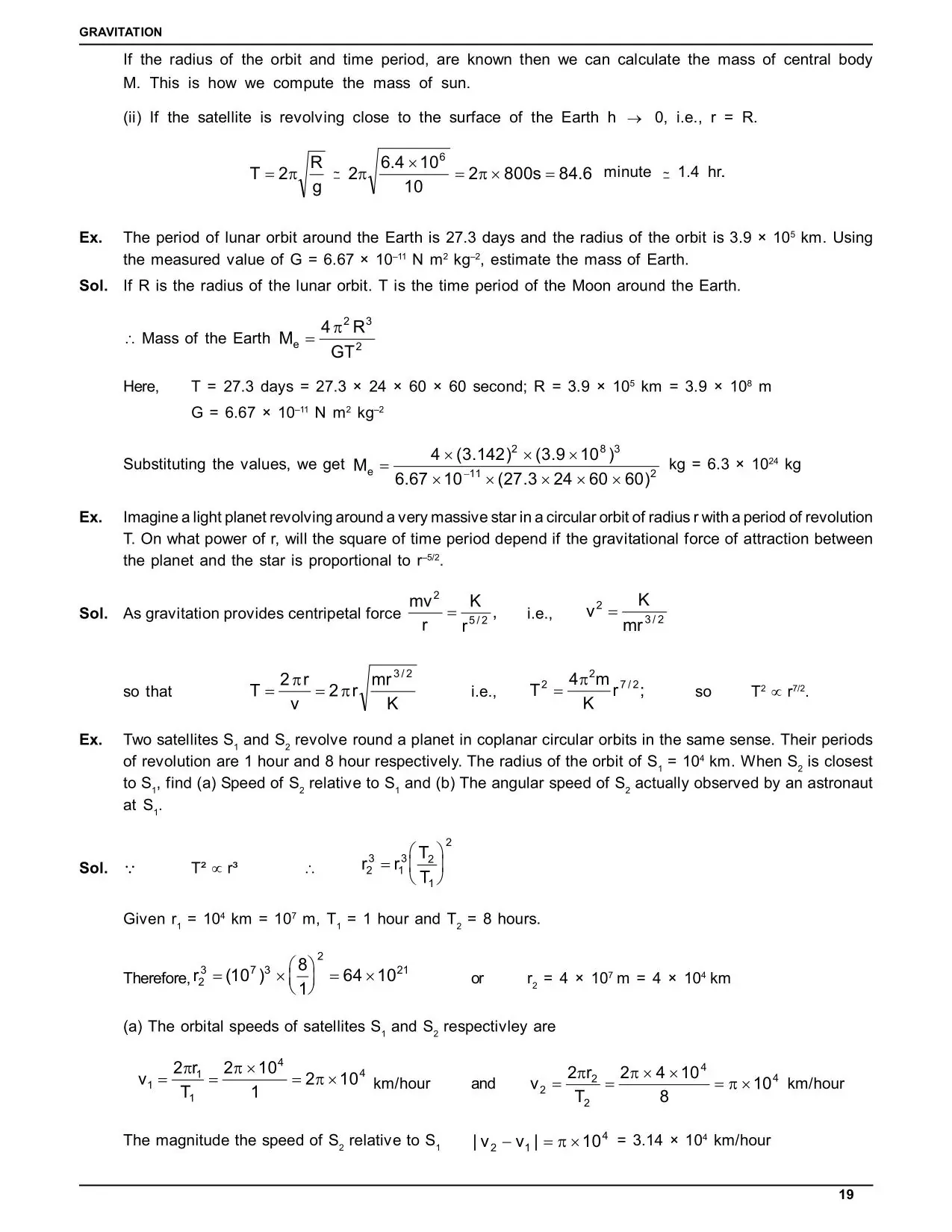
These are eSaral’s handwritten Class 11 Physics gravitation notes, as images.
India's Best Exam Preparation for Class 11th - Download Now
India's Best Exam Preparation for Class 11th - Download Now
India's Best Exam Preparation for Class 11th - Download Now
India's Best Exam Preparation for Class 11th - Download Now
India's Best Exam Preparation for Class 11th - Download Now
India's Best Exam Preparation for Class 11th - Download Now
Practise and Revise Gravitation
After the Class 11 Physics gravitation notes, revise and practise with these eSaral resources.
eSaral has a free Physics revision series on its YouTube channel, where you can revise a chapter within minutes with all the important formulae and key points. For all the chapters, get the Complete Physics Notes for Class 11. For video lectures and study material, download the eSaral app.
After the notes, solve the questions:
Frequently Asked Questions
What do Class 11 Physics gravitation notes cover?
Class 11 Physics gravitation notes cover Newton’s law of universal gravitation, acceleration due to gravity and its variation, gravitational field and potential, gravitational potential energy, escape velocity, orbital motion of satellites, and Kepler’s laws of planetary motion. eSaral’s notes also give solved examples and common mistakes for boards, JEE and NEET.
What is Newton’s law of universal gravitation?
Every particle attracts every other particle with a force that is directly proportional to the product of their masses and inversely proportional to the square of the distance between them: $F = \dfrac{Gm_1m_2}{r^2}$, where $G = 6.67\times 10^{-11}\ \text{N m}^2\text{kg}^{-2}$. The force acts along the line joining the two particles.
What is the difference between g and G?
$G$ is the universal gravitational constant. It has the same value everywhere in the universe, and it is $6.67\times 10^{-11}\ \text{N m}^2\text{kg}^{-2}$. $g$ is the acceleration due to gravity, $g = \dfrac{GM}{R^2}$, which changes with the height, the depth, the latitude and the planet, and is about $9.8\ \text{m/s}^2$ on the surface of the Earth.
How does the acceleration due to gravity change with height, depth and latitude?
The Class 11 Physics gravitation notes give three results. At a height $h$, $g_h = g\left(\dfrac{R}{R+h}\right)^2 \approx g\left(1 - \dfrac{2h}{R}\right)$ for $h \ll R$. At a depth $d$, $g_d = g\left(1 - \dfrac{d}{R}\right)$, and it is zero at the centre. Because of the rotation of the Earth, $g' = g - \omega^2R\cos^2\lambda$ at a latitude $\lambda$, so $g$ is smallest at the equator and largest at the poles.
What is the formula for escape velocity, and does it depend on the mass of the body?
The escape velocity is $v_e = \sqrt{\dfrac{2GM}{R}} = \sqrt{2gR}$, which is about 11.2 km/s for the Earth. It does not depend on the mass of the body that is projected, or on the direction of projection, when air resistance is ignored.
What is the difference between escape velocity and orbital velocity?
Orbital velocity, $v_o = \sqrt{\dfrac{GM}{r}}$, is the speed needed to stay in a circular orbit, and it is about 7.9 km/s near the surface of the Earth. Escape velocity is the speed needed to leave the gravitational field, and it is about 11.2 km/s. At the same distance from the centre, $v_e = \sqrt{2}\,v_o$.
Why is the total energy of a satellite negative?
The kinetic energy of a satellite is $\dfrac{GMm}{2r}$ and its potential energy is $-\dfrac{GMm}{r}$, so the total energy is $E = -\dfrac{GMm}{2r}$, which is negative. A negative total energy means that the satellite is bound to the Earth. The energy $\dfrac{GMm}{2r}$ is the binding energy that has to be supplied to free it.
What is a geostationary satellite, and why does it appear stationary?
In Class 11 Physics gravitation notes, a geostationary satellite is one that moves in the equatorial plane from west to east with a time period of 24 hours, at a height of about 36,000 km above the surface of the Earth. Since its period equals the rotation period of the Earth, it stays above the same point on the equator and appears fixed in the sky. These satellites are used for communication and broadcasting.
What are Kepler’s laws of planetary motion?
The law of orbits says that a planet moves in an ellipse with the Sun at one focus. The law of areas says that the line joining the Sun and the planet sweeps equal areas in equal times, which means that the angular momentum is conserved. The law of periods says that $T^2 \propto a^3$, where $a$ is the semi-major axis.
Are astronauts weightless because there is no gravity in space?
No. At the height of the International Space Station, about 400 km, $g$ is still about 8.7 m/s², nearly 90% of its value on the ground. The astronauts feel weightless because they and the station are in free fall, so the apparent weight is zero.
How many questions come from Gravitation in JEE and NEET?
Gravitation usually gives a small number of questions in JEE Main and NEET papers, mostly on escape velocity, orbital velocity, the variation of $g$, satellite energy and Kepler’s third law. The exact number changes every year, so practise the chapter-wise PYQs, for example eSaral’s Gravitation JEE Main previous year questions.
Where can I download Class 11 Physics gravitation notes in PDF?
eSaral has a free Gravitation revision notes PDF for JEE Main, and the eSaral app has the notes and the video lectures. The PDF link and the eSaral app link are on this page, along with the NCERT Solutions for Chapter 7.
Team eSaral
eSaral Academic and Editorial Team
Team eSaral is the collective author profile for educational content created by eSaral’s teachers and academic contributors. The team draws on expertise from IIT graduates, doctors, experienced educators and subject specialists to develop resources for JEE, NEET and school students. Our articles aim to explain concepts clearly and help students study with confidence.
Related Posts

BITSAT 2027: Registration Date, Exam Date, Syllabus, Eligibility, Pattern & Fees
BITSAT 2027 exam dates, registration timeline, eligibility criteria, exam pattern, marking scheme, syllabus and fees in one page.

BITSAT Previous Year Question Paper PDF (2017-2026)
Download BITSAT previous year question papers PDF from 2017 to 2026,session-wise. Memory-based papers,exam pattern, paper analysis and how to practise

CBSE Class 10 Date Sheet 2027: Expected Exam Dates, Release Date, Admit Card & Result Timeline
CBSE Class 10 date sheet 2027 is awaited. See the expected exam dates, release window, how to download the PDF, admit card and result timelines.

NCERT Physics Class 10 Book PDF in Hindi 2026-27 – भौतिक विज्ञान के 4 अध्याय (Free Download)
NCERT Physics Class 10 book PDF in Hindi 2026-27: download all 4 chapters (अध्याय 9–12) free, with topics and important formulas.

NCERT Biology Class 9 Book Anveshan PDF in Hindi - जीव विज्ञान कक्षा 9 पुस्तक अन्वेषण PDF
Download NCERT Biology Class 9 book PDF in Hindi chapterwise for 2026-27: Cell, Tissues, Reproduction and Diversity. Free PDFs.

Essay On Artificial Intelligence in English (100,150, 200, 250, 300, 500 Words)
This is in contrast to the natural intelligence of humans. With Artificial Intelligence, machines can perform

Essay on 78th India Independence Day in English for Student (100, 150, 200, 250, 300, 500 Words)
Read the best essays on India's Independence Day in English. Short & long essays (100, 150, 200, 250, 300, 500 words) perfect for school exams
NCERT Class 11 English Snapshots book - Free PDF download- Esaral
Download NCERT Class 11 English Snapshots book PDF for free. Get all 8 chapters, chapter-wise. Start your prep today!
NCERT Class 10 biology book pdf - Free PDF Download - eSaral
NCERT Class 10 Biology book PDF 2026-27: all 5 chapters (Life Processes to Our Environment) in English & Hindi, with CBSE syllabus, marks & practical

Essay on Global Warming in English (100,150, 200, 250, 300, 500 Words)
Global warming means the Earth is getting hotter. This happens because of things like pollution from cars and factories.