
CBSE Class 9 Exam Pattern 2026-27: Marks, Question Paper Design, Internal Assessment and Grading

eSaral Academic and Editorial Team
Summary
The CBSE Class 9 exam pattern for 2026-27 has an 80-mark annual examination conducted by the school and a 20-mark internal assessment for each major subject. About 50% of the questions are competency-focused, and the rest are MCQs and short and long answers. Class 9 is graded on an absolute scale from A1 (91–100) to D (33–40). Mathematics and Science also have an optional Advanced paper of 25 marks.
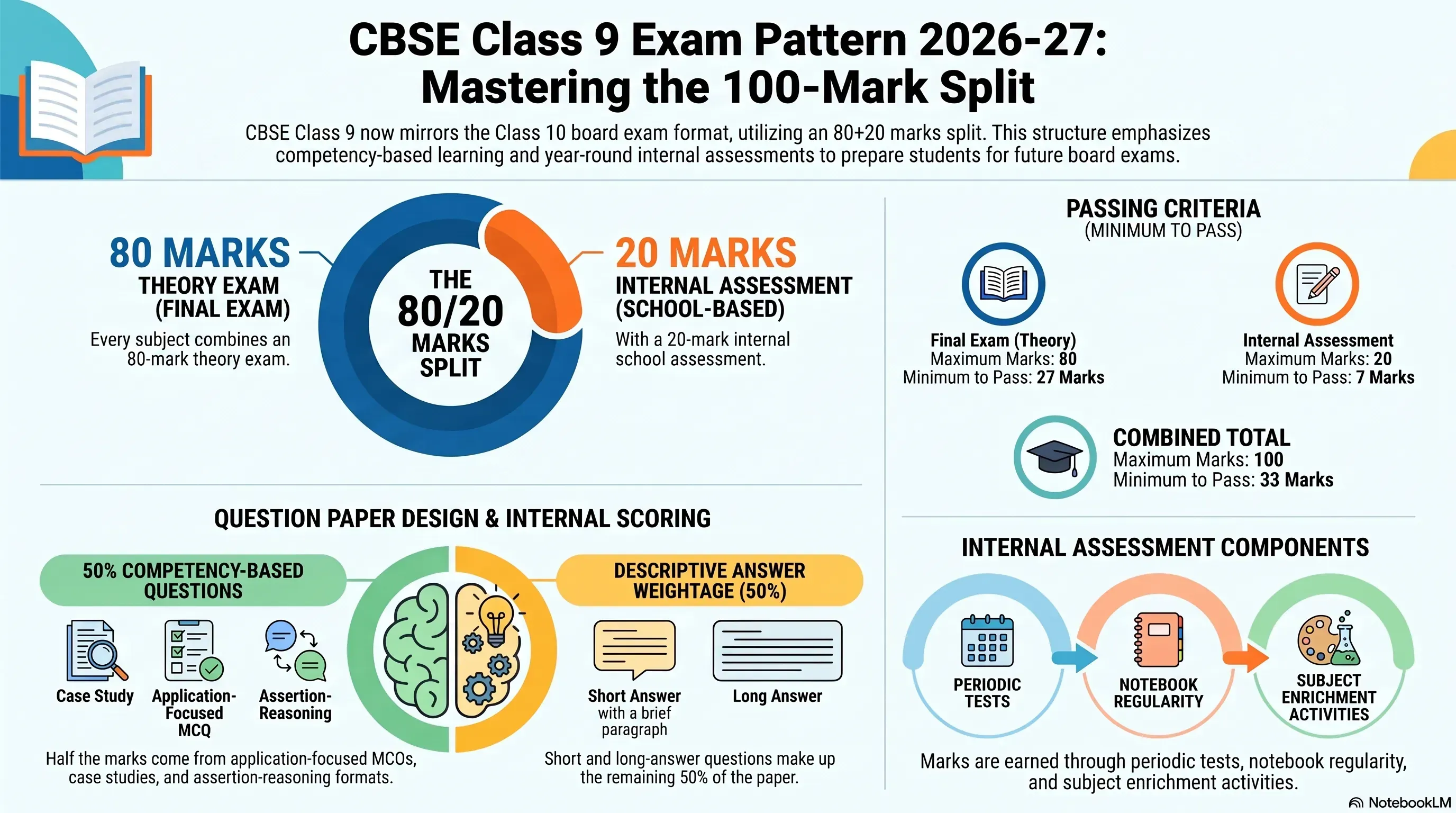
This guide explains the Class 9 exam pattern for the 2026-27 session in simple terms. Class 9 and Class 10 form one composite course, and CBSE’s secondary-stage curriculum for 2026-27 says that the Class 9 assessment scheme is similar to the Class 10 board exam. The difference is that the Class 9 exam is set and checked by your school. Always confirm the final details with your school, because it conducts the exam.
CBSE Class 9 Exam Pattern 2026-27 at a Glance
Feature | Details |
|---|---|
Final exam | Annual examination conducted by the school, 80 marks for major subjects (3 hours) |
Internal assessment | 20 marks, conducted by the school |
Total per major subject | 100 marks |
Question mix | About 50% competency-focused questions. The rest are MCQs and short and long answers. |
Optional Advanced papers | Mathematics Advanced and Science Advanced, 25 marks each, 1 hour |
Grading | Absolute grades A1 to D, awarded by the school |
Board exam | None. The first CBSE board exam is in Class 10. |
Subjects and Assessment in the Class 9 Exam Pattern
In the Class 9 exam pattern for 2026-27, the main subjects with an annual examination plus a 20-mark internal assessment are Language 1, Language 2, Mathematics, Science and Social Science. Other areas, such as the third language, Art Education, Physical Education and Well-being and Vocational Education, are assessed mainly through school-based assessment. Check your school’s scheme for the exact list. Both components are required, and a student must appear in and complete the internal assessment and the annual examination to be declared successful.
CBSE Class 9 Question Paper Design
CBSE’s curriculum says that about 50% of the questions in Class 9 and Class 10 papers are competency-focused, such as case-based, source-based, data-interpretation and application questions. The remaining questions are select-response (MCQs) and constructed-response (short and long answer) questions. For Class 10, CBSE has described the split as about 20% objective and 30% constructed response, and Class 9 papers follow the same design.
Section | Usual content |
|---|---|
A | Objective questions and MCQs |
B and C | Short-answer questions |
D | Long-answer questions |
E | Case-study questions, in certain subjects |
Internal choices are given where appropriate. Your school may arrange the sections differently, so use CBSE’s sample papers on cbseacademic.nic.in as a guide.
💡 Expert Tip by eSaral Academic Team: Don't split your prep time evenly across question types. Since competency-based questions carry 50% of the paper, spend proportionally more practice time on case-based and assertion-reasoning formats — they're the section most students underprepare for.
How Are Competency-Based Questions Different from MCQs?
A standard MCQ tests whether you remember a fact. A competency-based question puts the same idea in a case, a data set or a real-life situation, and asks you to apply it. For example, instead of asking for the definition of photosynthesis, a question may describe an experiment with different light conditions and ask you to interpret the results and predict the outcome in a new condition.
CBSE Class 9 Internal Assessment: 20 Marks Explained
In the Class 9 exam pattern, the 20 marks of internal assessment have four components, and each carries 25% of the weightage (5 marks each):
- Periodic assessment: three periodic assessments are held in the year, and the average of the best two is taken. At least one must be competency-based and application-oriented.
- Multiple assessment: varied tasks such as observation, oral presentations, quizzes, experiments, projects and group work, assessed with rubrics.
- Portfolio: a selected collection of your work (projects, reflections, experiment records and presentations) that shows your progress over time.
- Subject enrichment activities: activities that deepen understanding, such as listening and speaking in languages, experiments in Science and Mathematics, and civic inquiry in Social Science.
The best performance of the student across the components is considered while awarding the final internal assessment credit.
Optional Advanced Papers in Class 9 Mathematics and Science
In the Class 9 exam pattern for 2026-27, Mathematics and Science are offered at two levels. All students take the common standard paper of 80 marks (3 hours). Students who want to study additional topics can also take Mathematics Advanced and/or Science Advanced:
- Each Advanced paper is 25 marks and lasts 1 hour.
- The questions are all higher-order thinking (HOTS) questions based on additional content.
- The marks are not added to the total. A score of 50% or more is recorded in the marksheet as having cleared the Advanced Level (this wording is tentative).
- The two-level structure does not apply to the 20-mark internal assessment.
The earlier Mathematics Basic and Standard scheme is discontinued from 2026-27. Class 10 students in 2026-27 continue under the existing scheme.
Class 9 Grading System
The Class 9 exam pattern uses absolute grading, and the school awards the grades:
Marks | Grade |
|---|---|
91–100 | A1 |
81–90 | A2 |
71–80 | B1 |
61–70 | B2 |
51–60 | C1 |
41–50 | C2 |
33–40 | D |
In Class 10, CBSE uses a positional 9-point scale (A1 to D2), where the passed candidates are ranked and divided into eight equal groups, and E means essential repeat.
Passing Marks in the CBSE Class 9 Exam Pattern
The minimum for a pass is 33% in each subject. CBSE’s curriculum describes this as 33% of the combined total of internal assessment and annual examination marks, and it says that students must appear in both components. Because the Class 9 exam is conducted by the school, check your school’s promotion policy for how it applies the rule, for example whether a minimum is required in each component.
Why the Class 9 Exam Pattern Matters Before Class 10
The Class 9 assessment follows the same design as the Class 10 board exam: 80 + 20 marks, competency-based questions and a similar internal assessment. A student who learns to handle case-based questions and keeps up with the internal assessment in Class 9 is better prepared for the Class 10 board exam.
How to Prepare for the Class 9 Exam Pattern
- Study from the new NCERT books. Download the NCERT Books for Class 9 and check the CBSE Class 9 syllabus 2026-27 so that you use the right textbook for each subject.
- Practise competency-based questions. Case-based and assertion-reasoning questions need practice that is separate from textbook exercises.
- Take internal assessment seriously. It carries 20 marks and is built through the year with periodic assessments, multiple assessment, portfolio and subject enrichment.
- Ask your school about the Advanced papers. Find out whether Mathematics Advanced or Science Advanced is offered and how it is assessed.
- Look ahead to Class 10. Browse the NCERT Solutions for Class 10 Maths and Class 10 Science to see where your habits are heading.
Frequently Asked Questions
What is the CBSE Class 9 exam pattern for 2026-27?
Each major subject has an 80-mark annual examination conducted by the school and a 20-mark internal assessment, which makes 100 marks. About 50% of the questions are competency-focused, and the rest are MCQs and short and long answers. eSaral’s Class 9 exam pattern guide explains each part.
Does CBSE conduct the Class 9 exam?
No. The Class 9 annual examination is conducted and evaluated by the school. The first CBSE board exam is in Class 10, although Class 9 follows a similar assessment scheme.
What are the passing marks in the Class 9 exam pattern?
A student needs at least 33% in each subject. CBSE’s curriculum describes the 33% on the combined total of internal assessment and annual examination marks, and it requires the student to appear in both components. Check your school’s promotion policy for the details.
How is the 20-mark internal assessment divided in Class 9?
It has four components with equal weightage, 5 marks each: periodic assessment (the average of the best two of three), multiple assessment, portfolio and subject enrichment activities.
What are competency-based questions in Class 9?
They are questions such as case-based, source-based, data-interpretation and application questions that test whether you can apply a concept. About 50% of the questions in CBSE papers are competency-focused.
What is the grading system in Class 9?
The Class 9 exam pattern uses absolute grading by the school: A1 for 91–100, A2 for 81–90, B1 for 71–80, B2 for 61–70, C1 for 51–60, C2 for 41–50 and D for 33–40.
What are Mathematics Advanced and Science Advanced in Class 9?
They are optional papers of 25 marks and 1 hour each, with higher-order questions on additional content, offered from 2026-27. Their marks are not added to the total score, and a score of 50% or more is recorded in the marksheet.
Is Maths Basic or Standard offered in Class 9?
No. In the Class 9 exam pattern, the Mathematics Basic and Standard scheme is discontinued from 2026-27. All Class 9 students take the common Mathematics paper, and they can also take the optional Mathematics Advanced paper. Class 10 students in 2026-27 continue under the existing scheme.
Is the Class 9 exam pattern the same as Class 10?
It is similar. Both use 80 + 20 marks and about 50% competency-focused questions. The main differences are that the Class 9 exam is conducted by the school, the grading is absolute, and there is no second exam.
Team eSaral
eSaral Academic and Editorial Team
Team eSaral is the collective author profile for educational content created by eSaral’s teachers and academic contributors. The team draws on expertise from IIT graduates, doctors, experienced educators and subject specialists to develop resources for JEE, NEET and school students. Our articles aim to explain concepts clearly and help students study with confidence.
Related Posts

BITSAT 2027: Registration Date, Exam Date, Syllabus, Eligibility, Pattern & Fees
BITSAT 2027 exam dates, registration timeline, eligibility criteria, exam pattern, marking scheme, syllabus and fees in one page.

BITSAT Previous Year Question Paper PDF (2017-2026)
Download BITSAT previous year question papers PDF from 2017 to 2026,session-wise. Memory-based papers,exam pattern, paper analysis and how to practise

CBSE Class 10 Date Sheet 2027: Expected Exam Dates, Release Date, Admit Card & Result Timeline
CBSE Class 10 date sheet 2027 is awaited. See the expected exam dates, release window, how to download the PDF, admit card and result timelines.

NCERT Physics Class 10 Book PDF in Hindi 2026-27 – भौतिक विज्ञान के 4 अध्याय (Free Download)
NCERT Physics Class 10 book PDF in Hindi 2026-27: download all 4 chapters (अध्याय 9–12) free, with topics and important formulas.

NCERT Biology Class 9 Book Anveshan PDF in Hindi - जीव विज्ञान कक्षा 9 पुस्तक अन्वेषण PDF
Download NCERT Biology Class 9 book PDF in Hindi chapterwise for 2026-27: Cell, Tissues, Reproduction and Diversity. Free PDFs.

Essay On Artificial Intelligence in English (100,150, 200, 250, 300, 500 Words)
This is in contrast to the natural intelligence of humans. With Artificial Intelligence, machines can perform

Essay on 78th India Independence Day in English for Student (100, 150, 200, 250, 300, 500 Words)
Read the best essays on India's Independence Day in English. Short & long essays (100, 150, 200, 250, 300, 500 words) perfect for school exams
NCERT Class 11 English Snapshots book - Free PDF download- Esaral
Download NCERT Class 11 English Snapshots book PDF for free. Get all 8 chapters, chapter-wise. Start your prep today!
NCERT Class 10 biology book pdf - Free PDF Download - eSaral
NCERT Class 10 Biology book PDF 2026-27: all 5 chapters (Life Processes to Our Environment) in English & Hindi, with CBSE syllabus, marks & practical

Essay on Global Warming in English (100,150, 200, 250, 300, 500 Words)
Global warming means the Earth is getting hotter. This happens because of things like pollution from cars and factories.