
Classification of solids in terms of the forbidden energy gap - eSaral

eSaral Academic and Editorial Team
hey, do you want to learn about the Classification of solids in terms of the forbidden energy gap? If yes. Then you are at the right place.
Classification of solids in terms of the forbidden energy gap
The width of the forbidden energy gap between the valence band and the conduction band distinguishes conductors, semiconductors, and insulators from each other.
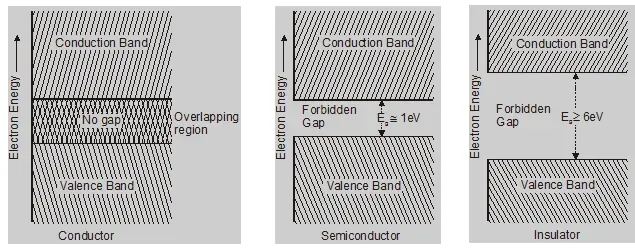
Comparison between conductor, semiconductor, and insulator:
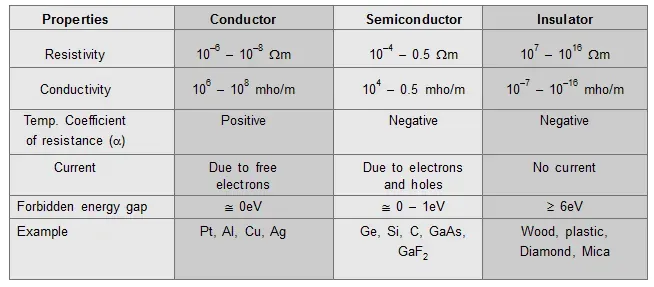
Difference between Valence, Conduction, and Forbidden Band
Valence band:
This band is never empty. VB may be partially or completely filled with electrons. VB electrons are not capable of gaining energy from the external electric fields. Therefore, the electrons of VB also not contribute to the electric current.
Conduction band:
Electrons are rarely present. CB either empty or partially filled with electrons. CB electrons can gain energy from the external electric field. Electrons in this band contribute to the electric current.
Forbidden energy gap:
Electrons are not found in this band. FEB is completely empty. The minimum energy required for shifting electrons from the valence band to the conduction band is called band gap ($\left(E_{g}\right)$).
So, that's all from this article. I hope you get the idea about the Classification of the solids according to the Forbidden energy gaps. If you found this article informative then please share it with your friends. If you have any confusion related to this topic, then you can ask in the comments section down below.
For a better understanding of this chapter, please check the detailed notes of Electronics. To watch Free Learning Videos on physics by Saransh Gupta sir Install the eSaral App.
Team eSaral
eSaral Academic and Editorial Team
Team eSaral is the collective author profile for educational content created by eSaral’s teachers and academic contributors. The team draws on expertise from IIT graduates, doctors, experienced educators and subject specialists to develop resources for JEE, NEET and school students. Our articles aim to explain concepts clearly and help students study with confidence.
Related Posts

Plant Cell Diagram: Labelled Structure, Parts and Functions
Simple, labelled plant cell diagram with parts and functions. Covers plant cell structure for Class 6, 7, 8, 9, 10 and 11 students, CBSE-aligned.

Saransh Gupta Sir's Visit to IIT Patna: Hostel Life, Placements & Lessons for JEE Aspirants
Inside Saransh Gupta Sir's IIT Patna visit — hostel life, the library, placements, internships, and real advice for JEE aspirants from students living the IIT dream.
Molality Formula: Formula for Molality, Derivation & Solved Examples
Molality formula is $m = \dfrac{n}{W}$. Learn the formula of molality, its SI unit, derivation, relation with molarity, and solved examples for Class 11, JEE and NEET.
BITSAT Previous Year Question Paper PDF
Download BITSAT previous year question papers PDF. Get year-wise BITSAT PYQs, memory-based papers, exam pattern, and preparation tips to improve your BITSAT preparation.

Teachers’ Day 2026 at eSaral Gurukul: Celebrating the Bond Between Students, Teachers & Mentors
See how Teachers’ Day 2026 was celebrated at eSaral Gurukul, reflecting the bond among students, teachers, and mentors, and the role of guidance beyond academics.
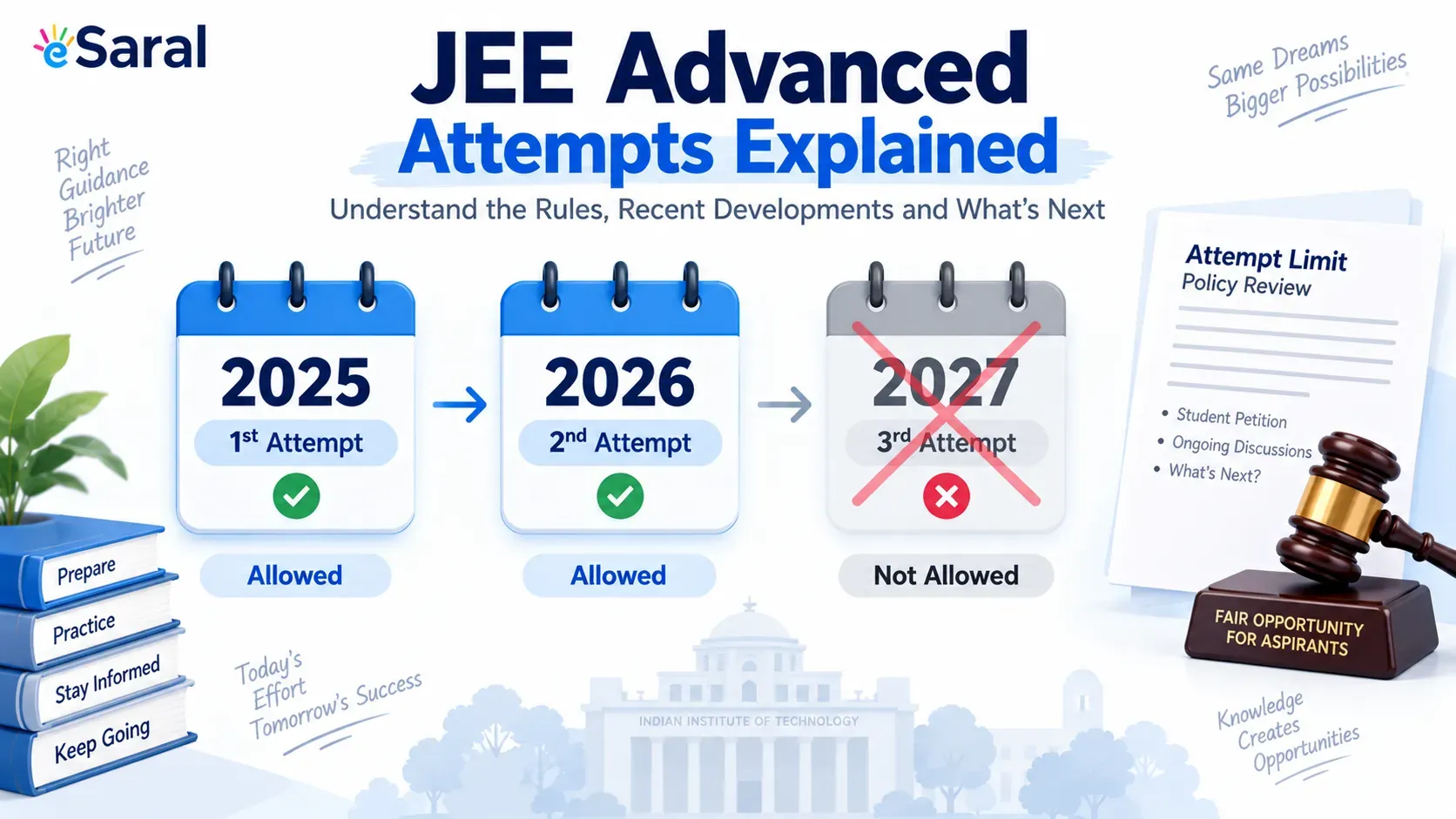
JEE Advanced Attempts: Can You Give It a Third Time? Rules Explained
JEE Advanced attempts: current rule is 2 consecutive years only: full eligibility criteria, the 2025 third-attempt controversy, and the latest 2026 petition news.

Best JEE Preparation App
Best JEE preparation app for Main & Advanced: AI mock tests, live doubt-solving, thousands of practice questions. JEE preparation app for droppers & Class 11-12.
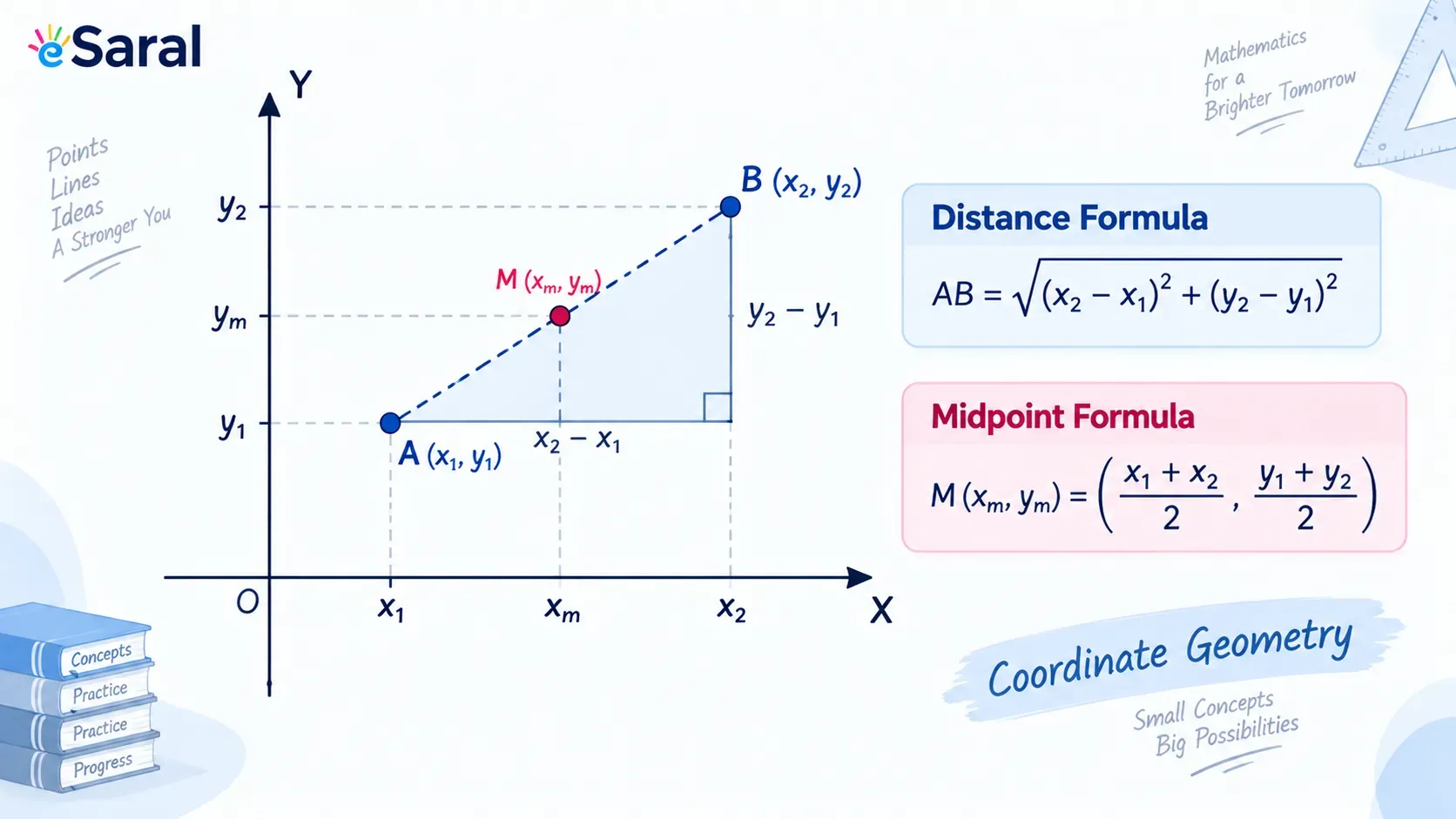
Coordinate Geometry Class 10: Formulas, Notes & Solved Examples
Coordinate geometry class 10: complete CBSE formulas — distance, section, midpoint and area of triangle — with derivation, notes and solved examples.
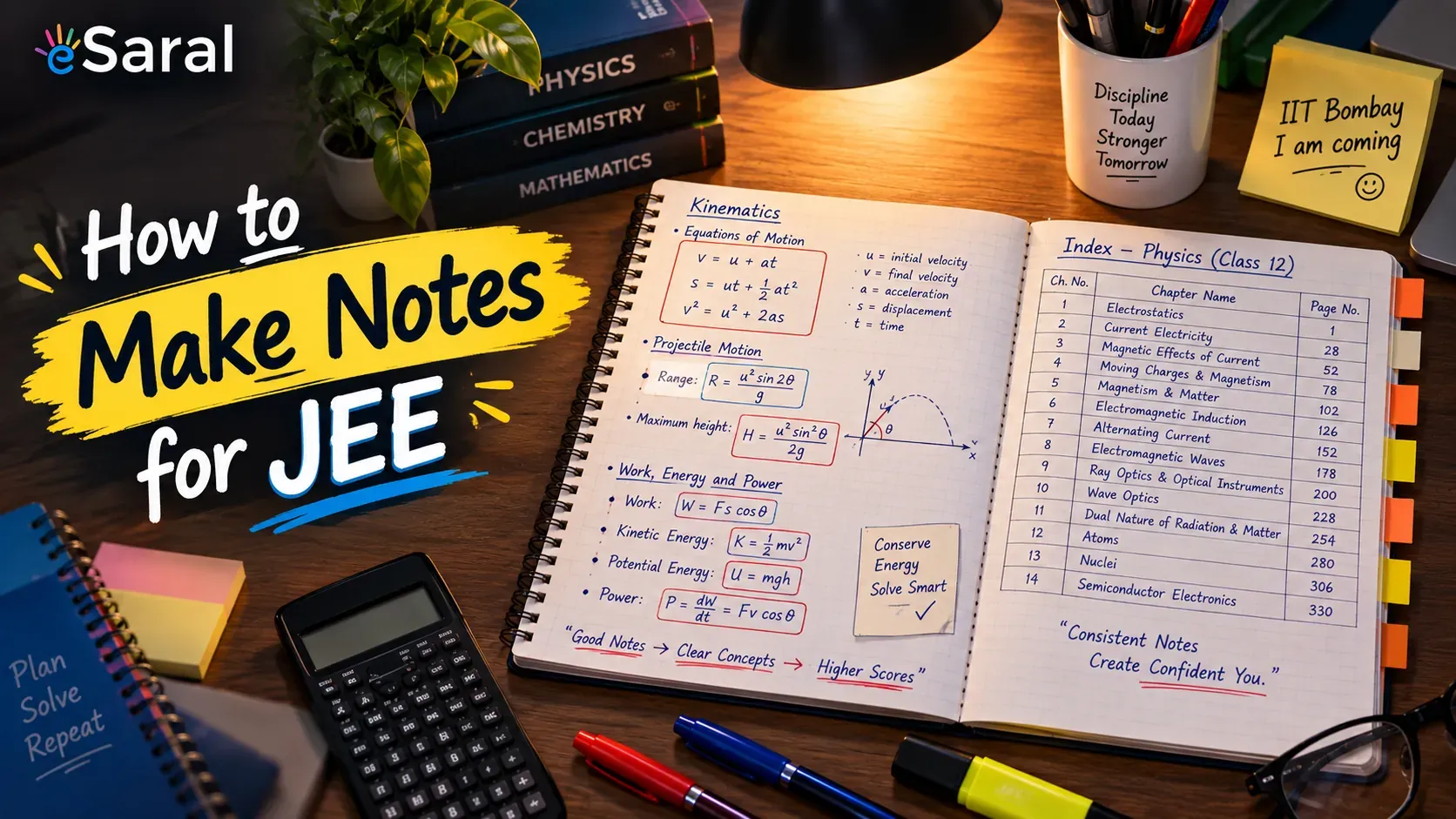
How to make Notes For JEE Smart Notes Strategy of an AIR 41
Learn how to make notes for JEE the way toppers do — indexing, shorthand, and smart short notes for JEE that cut revision time to just 5–7 days.
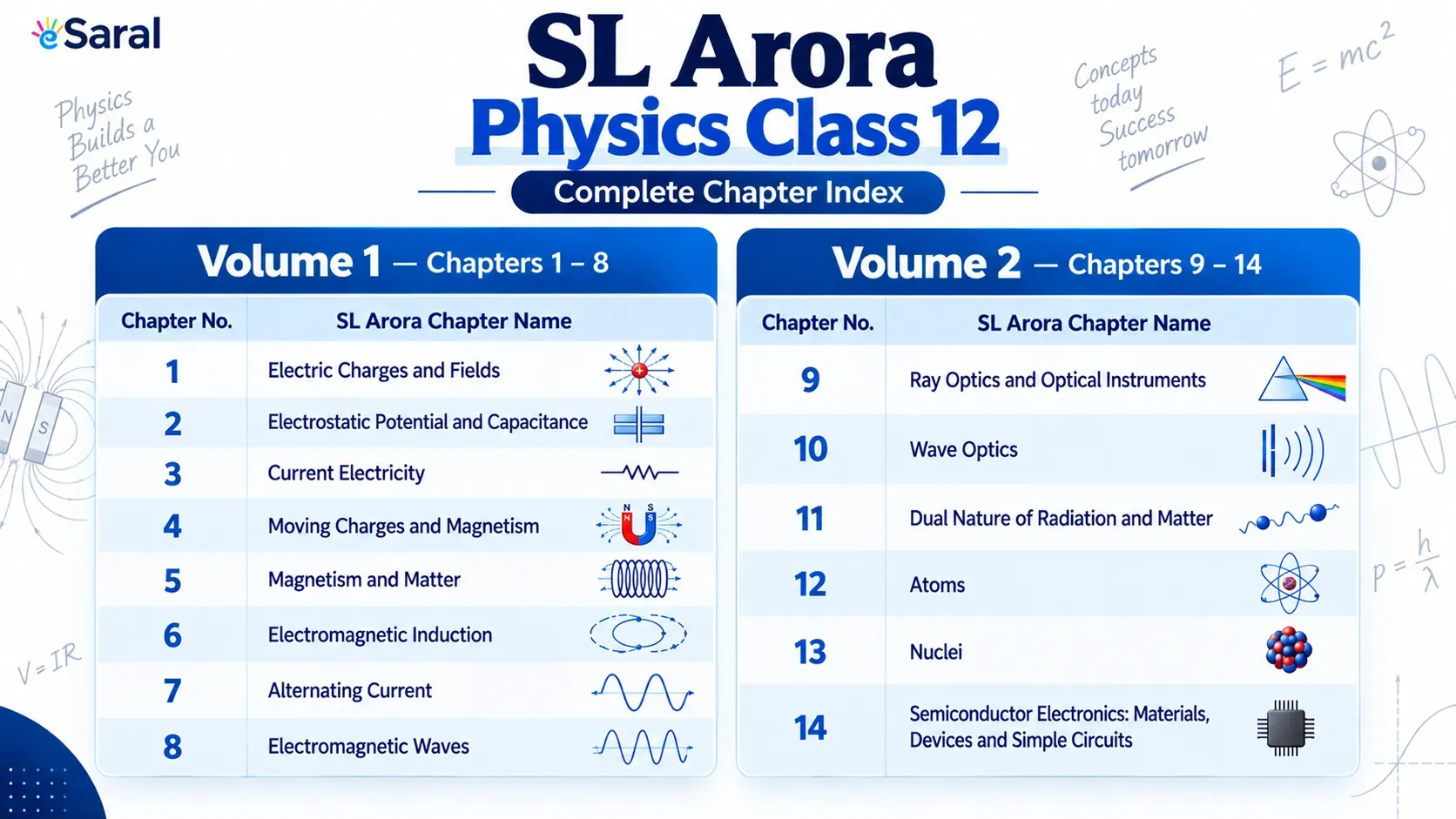
SL Arora Physics Class 12 Index – Chapter List for Volume 1 & 2
SL Arora Physics Class 12 index — complete chapter list for Volume 1 & 2, mapped to NCERT solutions for board, JEE Main, and NEET preparation.