
Determinants Notes for Class 12 & IIT JEE

eSaral Academic and Editorial Team
Summary
These determinants notes for Class 12 from eSaral cover the definition, minors and cofactors, properties, area of a triangle, adjoint and inverse, and Cramer’s rule, with formulas and worked examples for CBSE boards and JEE Main.

A determinant is a number linked to a square matrix, and it decides whether the matrix has an inverse and whether a system of equations has a unique solution. These determinants notes for Class 12 explain each rule with its formula and a short example, so you can revise the chapter quickly. For solved exercises, use the NCERT Solutions for Class 12 Maths Chapter 4 Determinants.
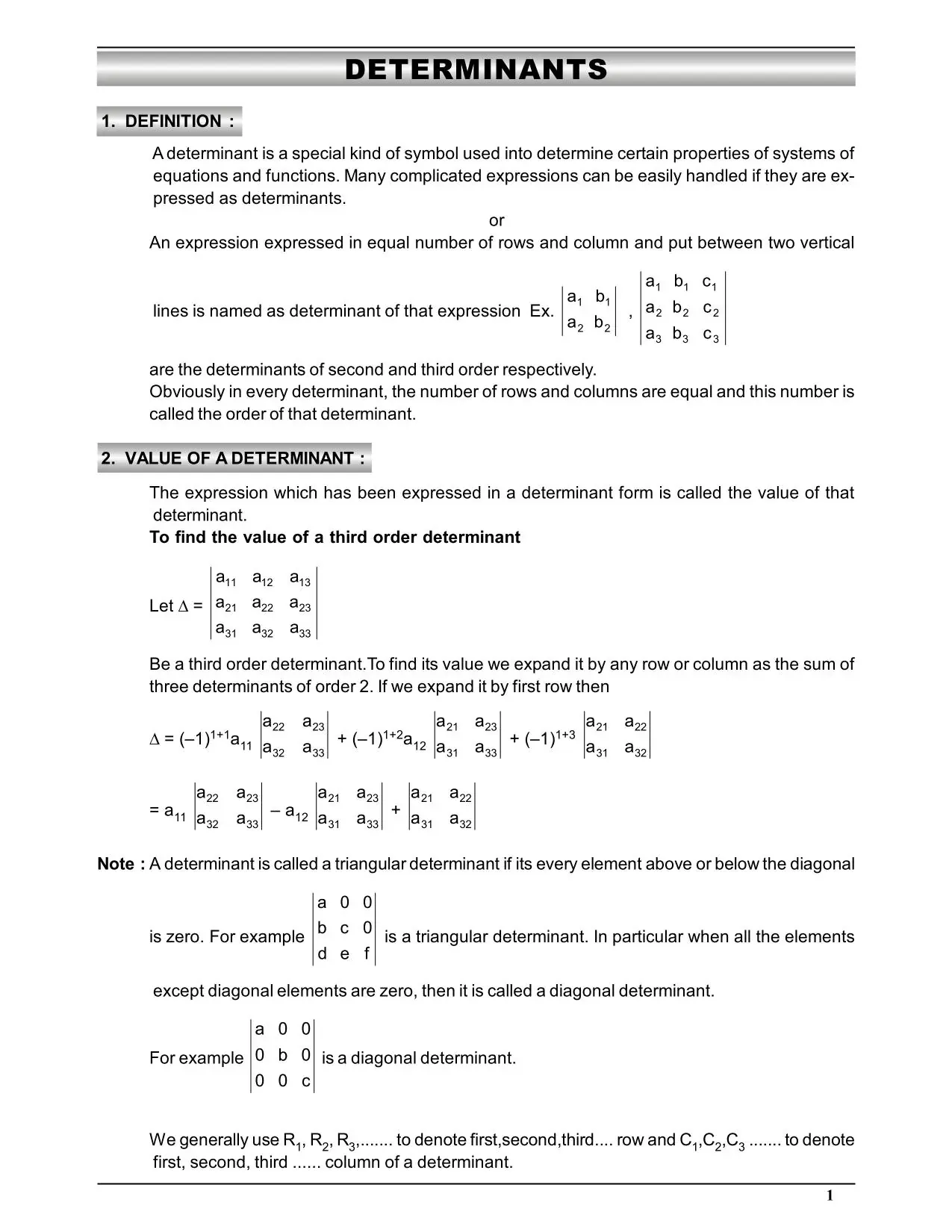
What Is a Determinant? Definition and Notation
A determinant is a unique scalar (real number) associated with every square matrix, that is, a matrix with equal numbers of rows and columns. For a square matrix $A$ it is written as $\det(A)$, $|A|$ or $\Delta$.
In determinants notes for Class 12, the first thing to remember is that a matrix is an array of numbers in brackets, while a determinant is the single value computed from it and is written with straight lines. Students lose marks by treating the two as interchangeable.
- Matrix: an array of numbers, not a number itself
- Determinant: a single scalar value
- Singular matrix: $|A| = 0$, no inverse exists
- Non-singular matrix: $|A| \neq 0$, inverse exists
Key distinction for Class 12 and JEE: A matrix is an array of numbers enclosed in brackets [ ] or ( ). A determinant is the scalar value computed from that matrix and is written with straight lines | |. Students frequently lose marks by treating the two as interchangeable — they are not. A matrix is an object; a determinant is a number.
Determinants Notes for Class 12 & IIT JEE
India's Best Exam Preparation for Class 12th - Download Now
India's Best Exam Preparation for Class 12th - Download Now
India's Best Exam Preparation for Class 12th - Download Now
India's Best Exam Preparation for Class 12th - Download Now
How to Evaluate a Determinant
Evaluation is the first skill in determinants notes for Class 12, so learn the 2×2 and 3×3 methods before the properties.
Determinant of a 2×2 Matrix
$$\begin{vmatrix} a & b \\ c & d \end{vmatrix} = ad - bc$$
Determinant of a 3×3 Matrix by Expansion
Expanding along the first row:
$$\Delta = a_{11}(a_{22}a_{33} - a_{23}a_{32}) - a_{12}(a_{21}a_{33} - a_{23}a_{31}) + a_{13}(a_{21}a_{32} - a_{22}a_{31})$$
You can expand along any row or column. Choose the one with the most zeros to save time.
Example:
$$\begin{vmatrix} 1 & 2 & 3 \\ 0 & 4 & 5 \\ 1 & 0 & 6 \end{vmatrix} = 1(24 - 0) - 2(0 - 5) + 3(0 - 4) = 22$$
Minors and Cofactors
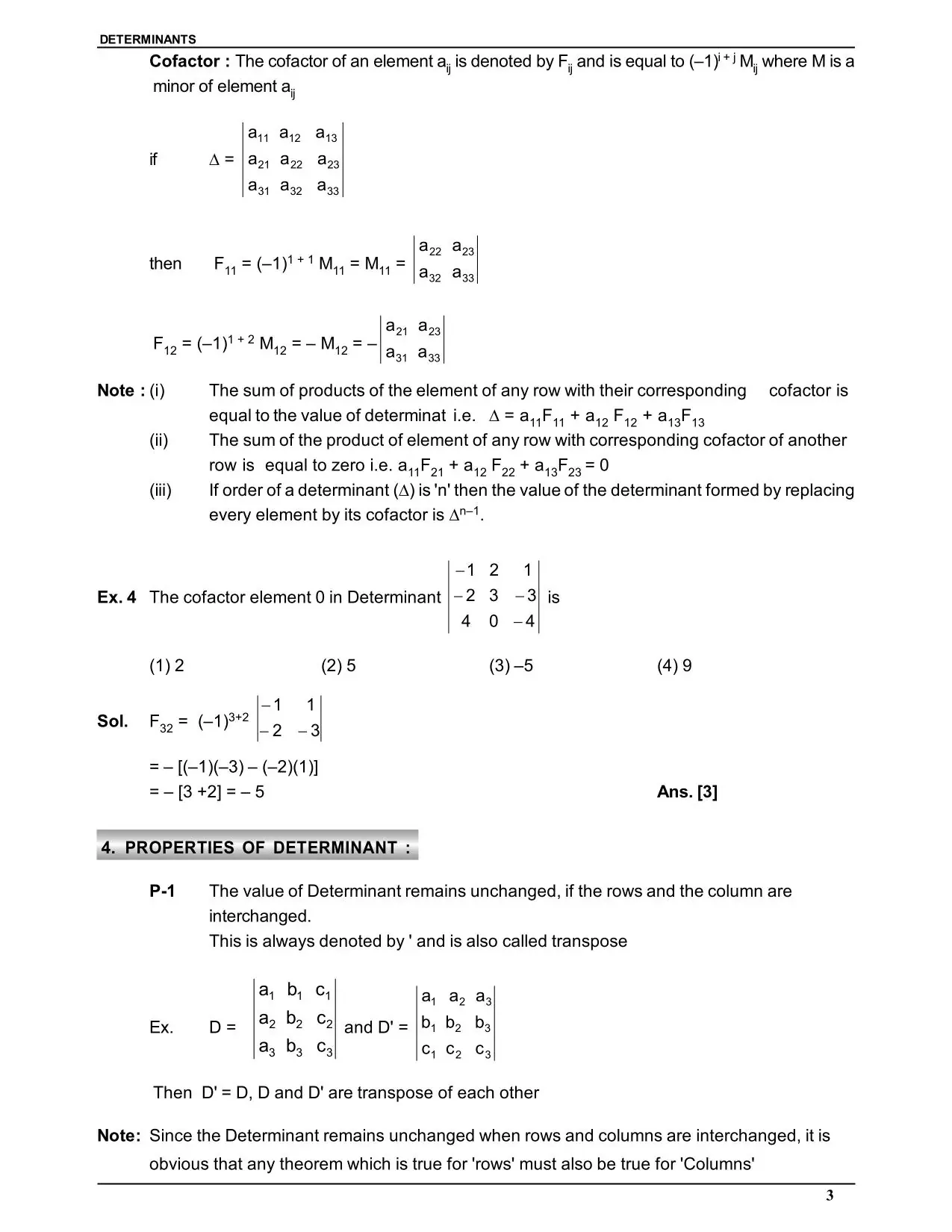
The minor $M_{ij}$ of the element $a_{ij}$ is the determinant left after deleting row $i$ and column $j$. The cofactor is the signed minor:
$$A_{ij} = (-1)^{i+j}M_{ij}$$
The determinant equals the sum of each element of any row (or column) times its cofactor, so $\Delta = a_{i1}A_{i1} + a_{i2}A_{i2} + a_{i3}A_{i3}$. If you multiply the elements of one row by the cofactors of a different row, the sum is zero.
Properties of Determinants for Class 12 and JEE
These properties are the core of determinants notes for Class 12 and save time in long expansions.
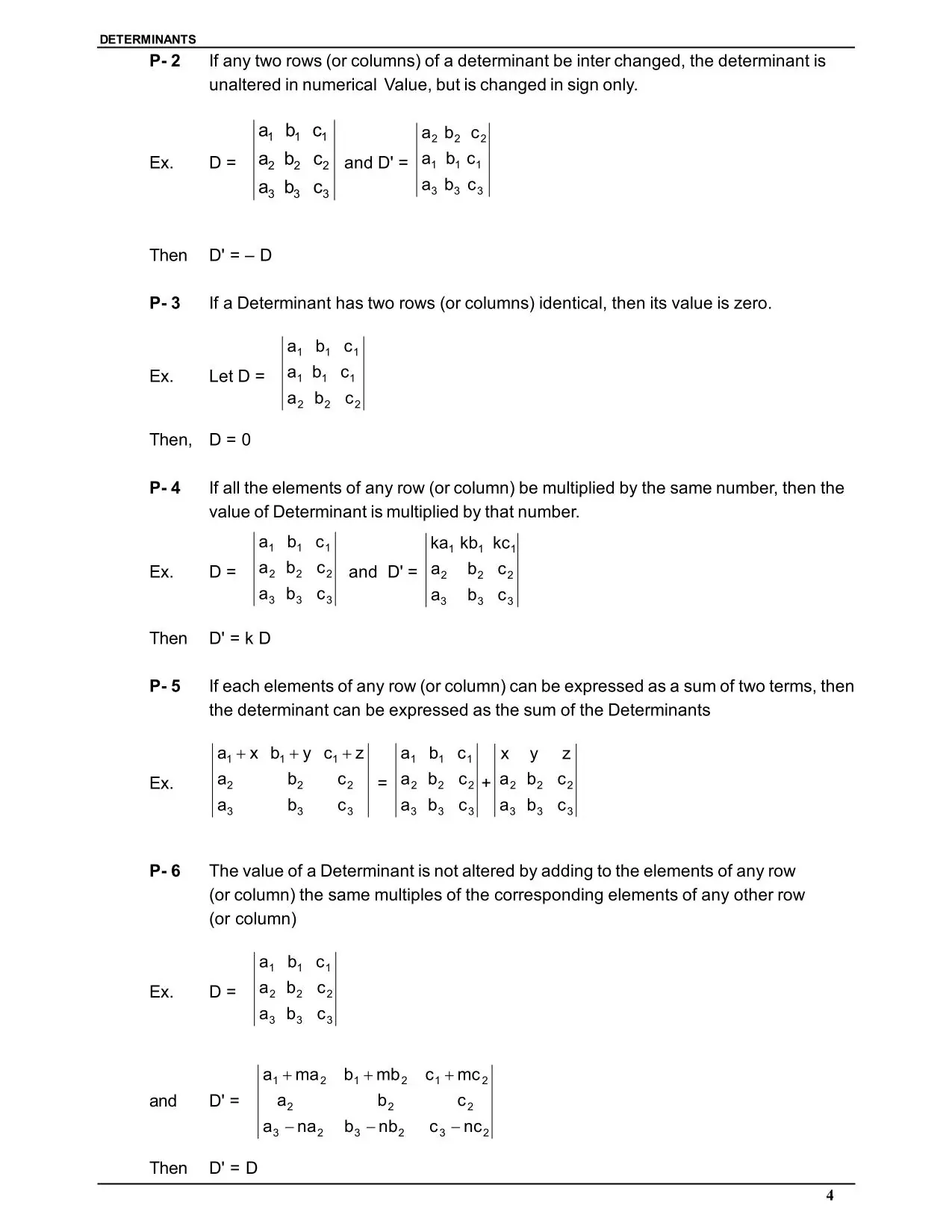
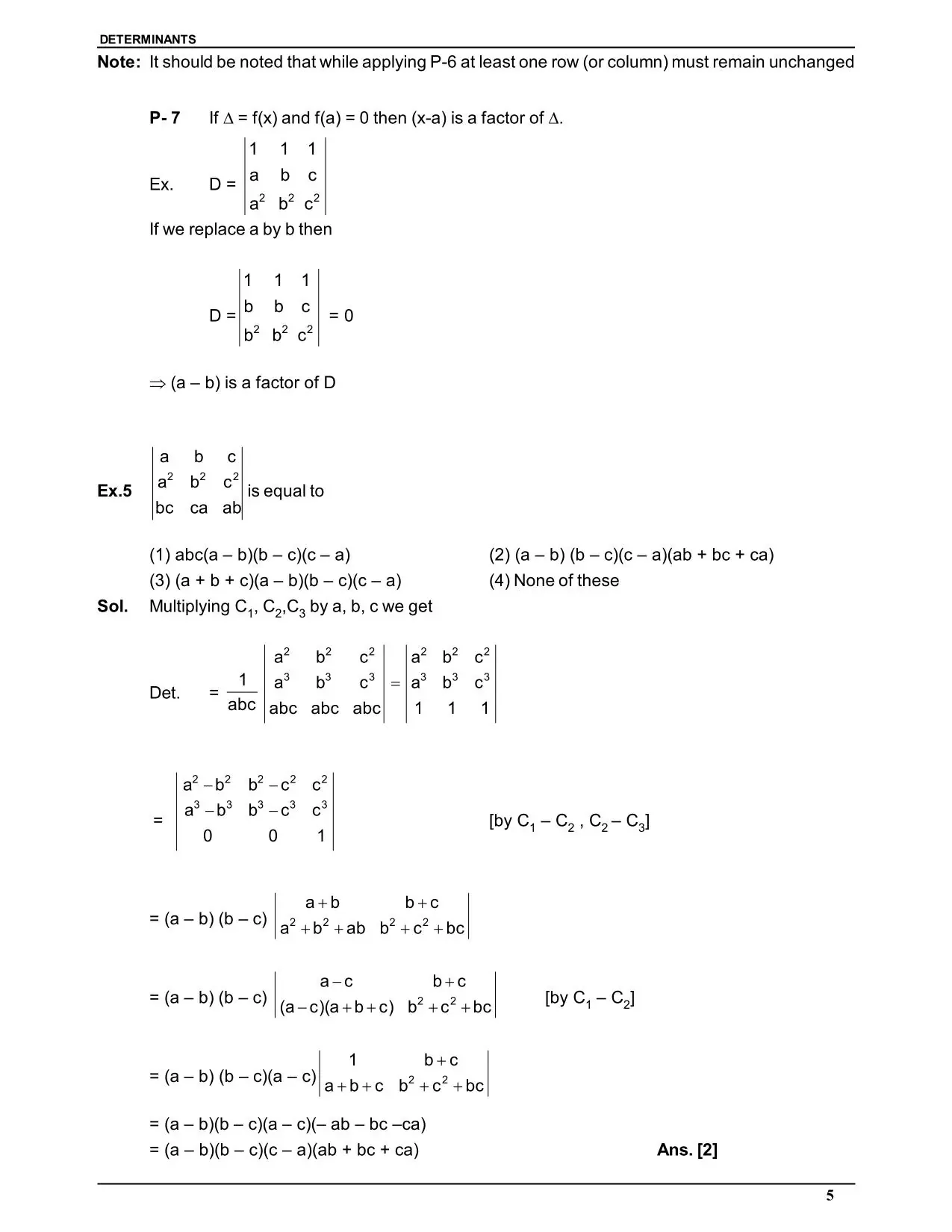
- Transposing does not change the value: $|A^T| = |A|$.
- Swapping two rows or two columns changes the sign.
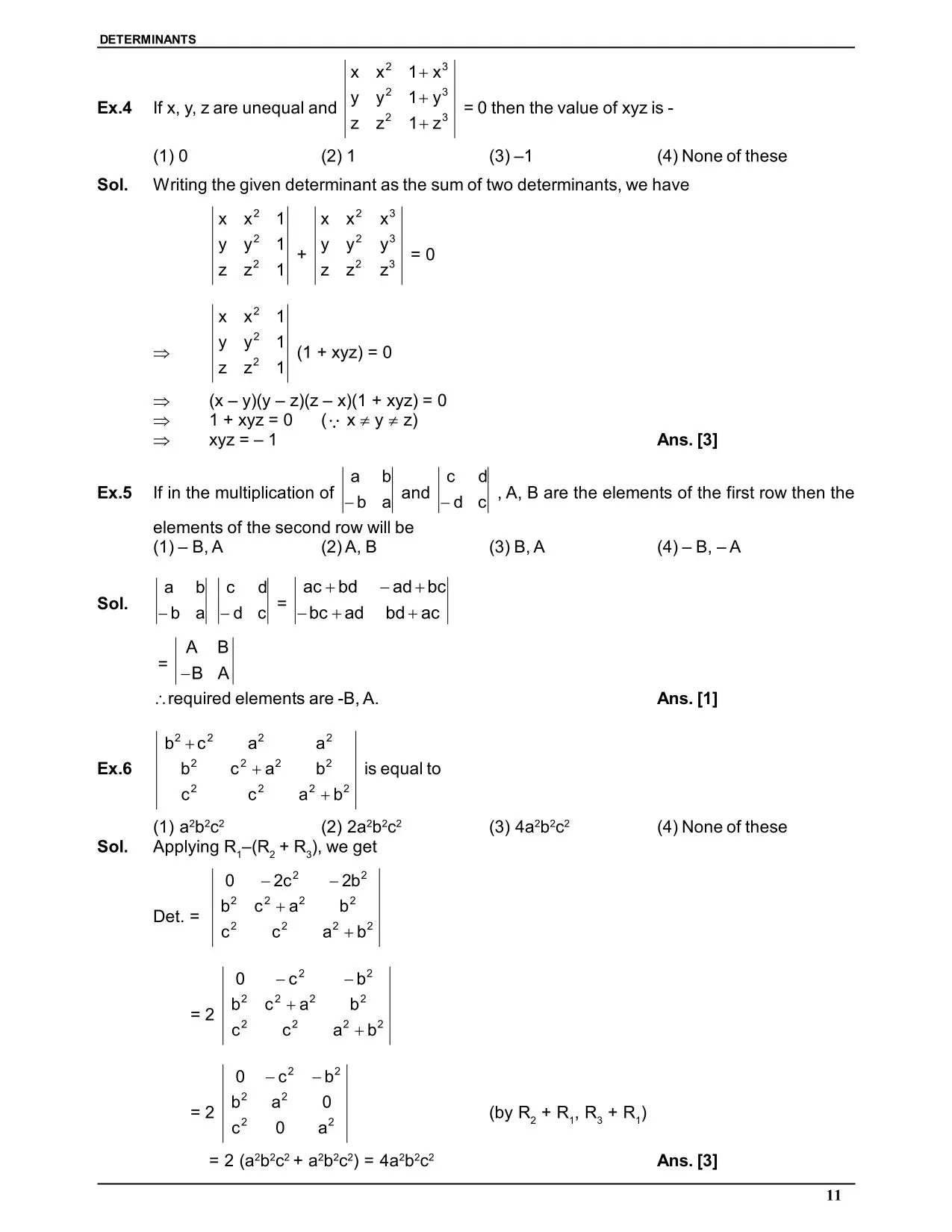
- Two identical rows or columns give zero. A zero row or column, or two proportional rows or columns, also give zero.
- Multiplying one row by $k$ multiplies the determinant by $k$.
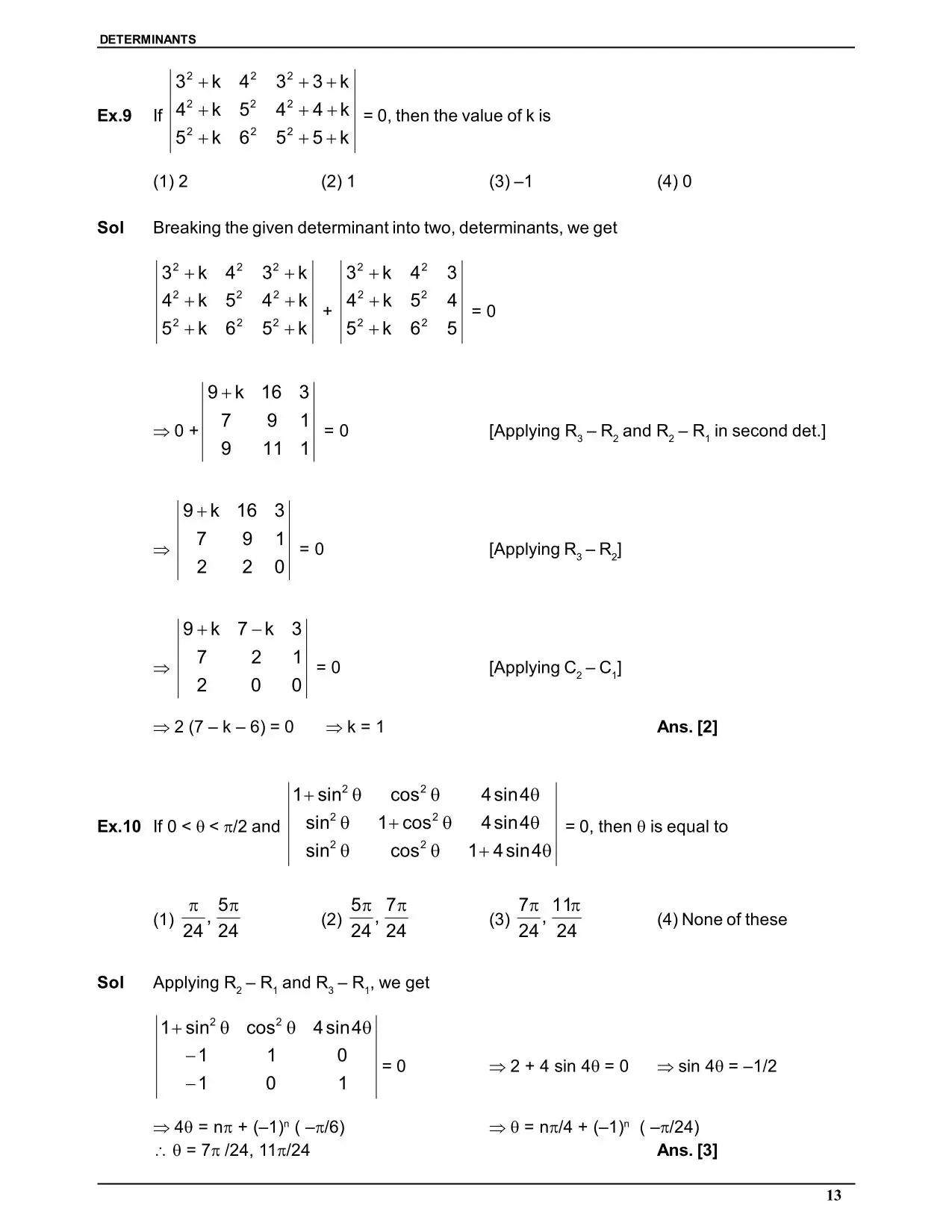
- If every element of a row is a sum of two terms, the determinant splits into a sum of two determinants.
- Adding a multiple of one row to another row does not change the value: $R_i \to R_i + kR_j$.
- For a triangular matrix, the determinant is the product of the diagonal elements.
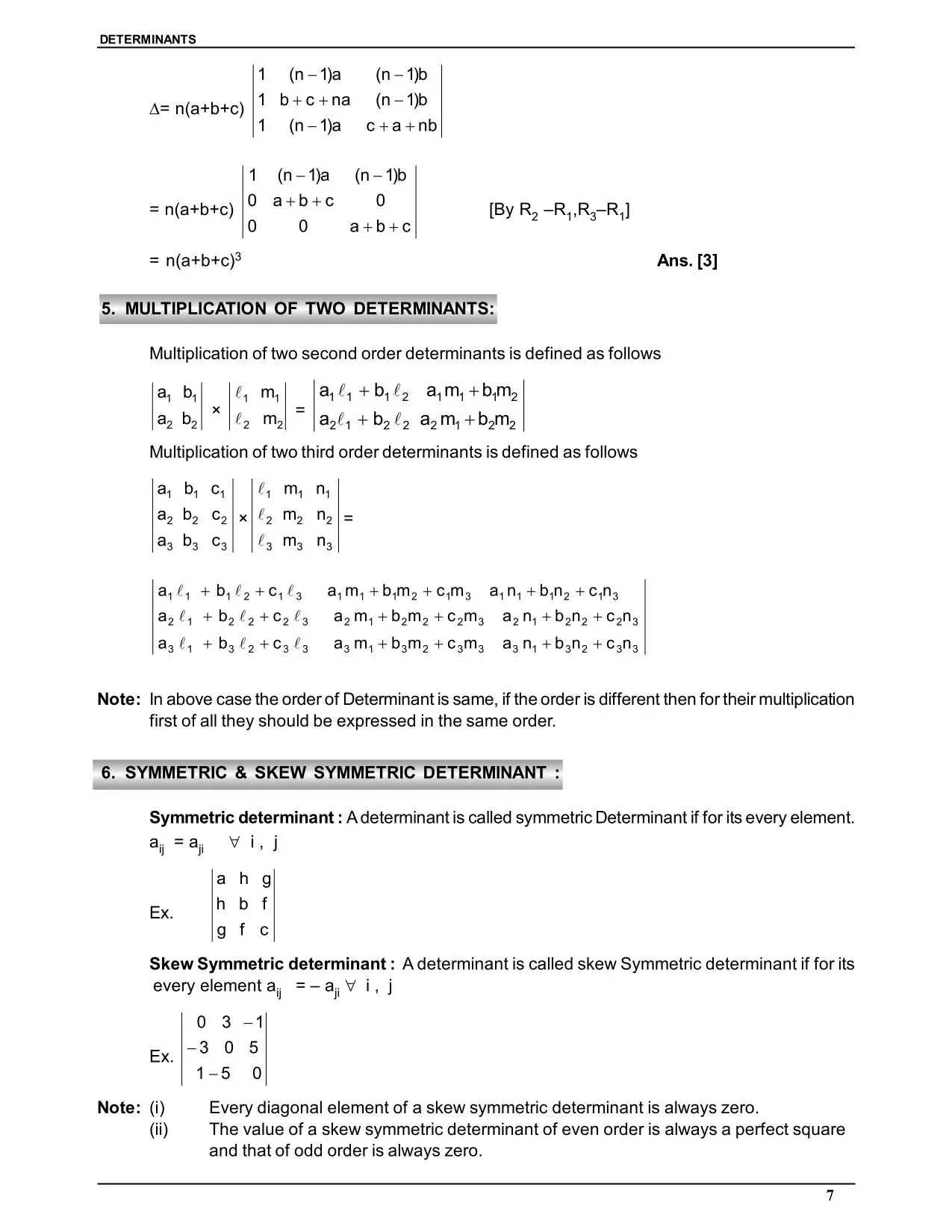
- $|AB| = |A||B|$.
- For an $n \times n$ matrix, $|kA| = k^n|A|$. For example, if $|A| = 4$ for a 3×3 matrix, then $|2A| = 2^3 \times 4 = 32$.
In JEE problems, use row and column operations to create zeros and take out common factors before expanding.
Area of a Triangle Using Determinants
For vertices $(x_1, y_1)$, $(x_2, y_2)$ and $(x_3, y_3)$:
$$\text{Area} = \dfrac{1}{2}\left|\begin{vmatrix} x_1 & y_1 & 1 \\ x_2 & y_2 & 1 \\ x_3 & y_3 & 1 \end{vmatrix}\right|$$
If this determinant is zero, the three points are collinear. Example: for $(0,0)$, $(4,0)$ and $(0,3)$ the determinant is 12, so the area is 6 square units.
Adjoint and Inverse of a Matrix
The adjoint of $A$ is the transpose of the matrix of cofactors. Then:
$$A(\text{adj}\,A) = (\text{adj}\,A)A = |A|\,I$$ $$A^{-1} = \dfrac{\text{adj}\,A}{|A|}, \qquad |A| \neq 0$$
Useful results for an $n \times n$ matrix:
$$|\text{adj}\,A| = |A|^{n-1}, \qquad |A^{-1}| = \dfrac{1}{|A|}$$ $$(AB)^{-1} = B^{-1}A^{-1}, \qquad \text{adj}(AB) = (\text{adj}\,B)(\text{adj}\,A)$$
Solving Linear Equations: Cramer’s Rule and Consistency
Cramer’s Rule for Three Equations
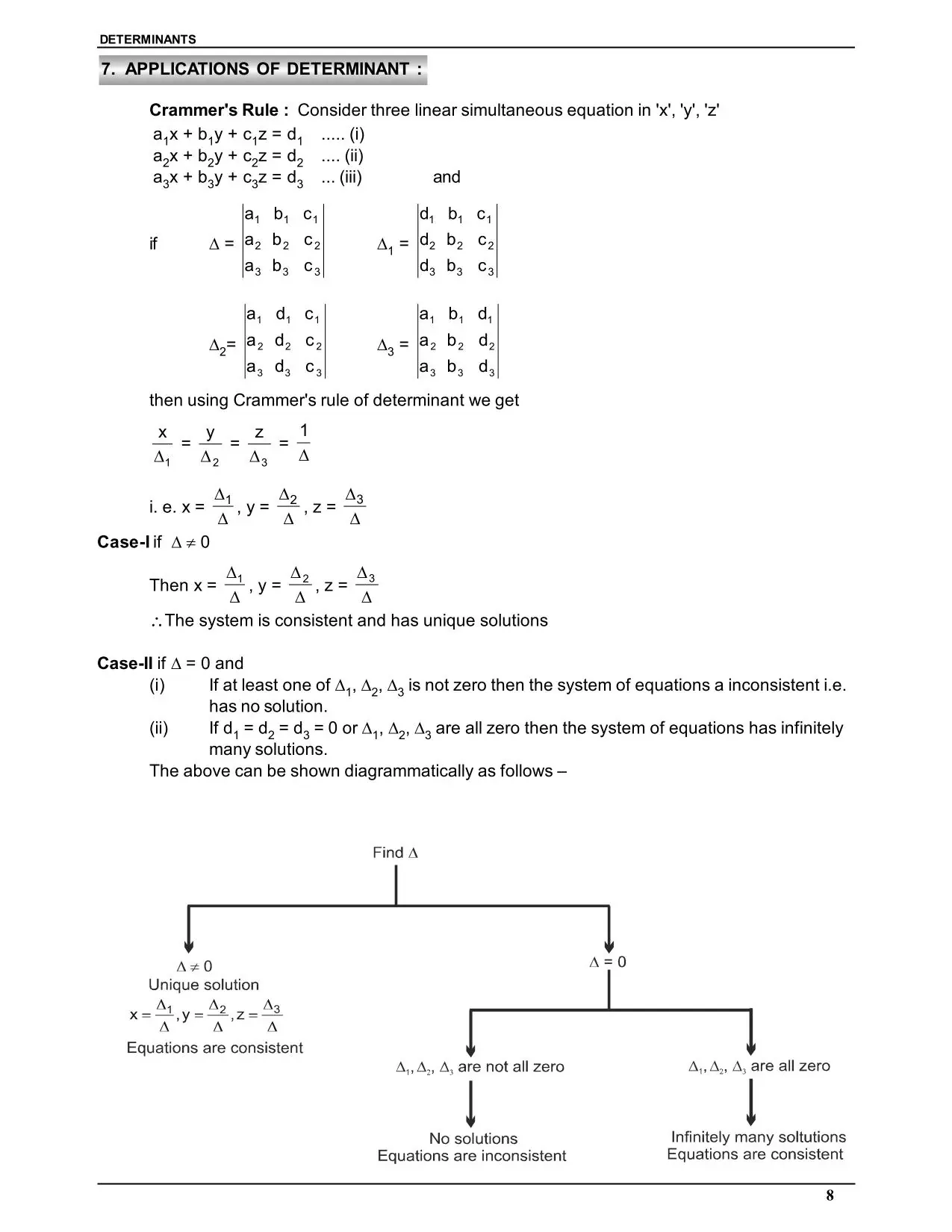
For $AX = B$ in three unknowns, let $D = |A|$, and let $D_1$, $D_2$, $D_3$ be $D$ with the first, second and third column replaced by $B$. If $D \neq 0$:
$$x = \dfrac{D_1}{D}, \qquad y = \dfrac{D_2}{D}, \qquad z = \dfrac{D_3}{D}$$
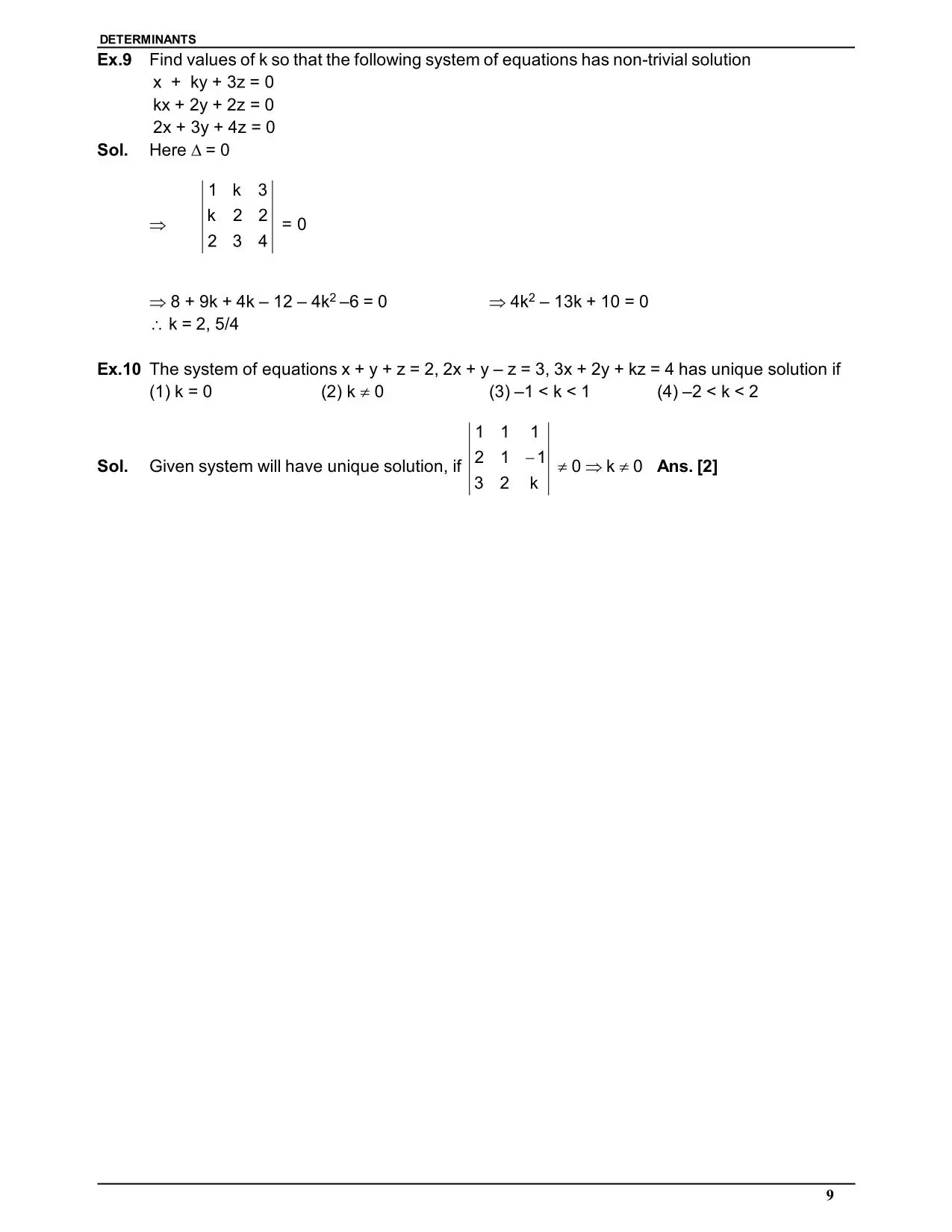
If $D = 0$ and at least one of $D_1$, $D_2$, $D_3$ is non-zero, the system has no solution. If $D = 0$ and all of them are zero, check further, because the system may have infinitely many solutions or none.
Example: for $x + y = 5$ and $x - y = 1$, $D = -2$, $D_1 = -6$, $D_2 = -4$, so $x = 3$ and $y = 2$.
Matrix Method for $AX = B$
If $|A| \neq 0$, the unique solution is $X = A^{-1}B$. If $|A| = 0$ and $(\text{adj}\,A)B \neq O$, there is no solution. If $|A| = 0$ and $(\text{adj}\,A)B = O$, the system is either consistent with infinitely many solutions or inconsistent.
Common Mistakes in Determinants Notes for Class 12
- Treating a matrix and its determinant as the same thing.
- Forgetting the sign pattern $(-1)^{i+j}$ while expanding.
- Using $|kA| = k|A|$ instead of $k^n|A|$.
- Using Cramer’s rule when $D = 0$.
How to Revise Determinants Notes for Class 12
- Practise evaluating 3×3 determinants with row operations until the steps are routine.
- Write the properties and the adjoint and inverse results on one page.
- Solve the exercises and compare your steps with the NCERT Solutions for Class 12 Maths Chapter 4.
Frequently Asked Questions
What do determinants notes for Class 12 cover?
Determinants notes for Class 12 cover the definition, evaluation of 2×2 and 3×3 determinants, minors and cofactors, properties, area of a triangle, adjoint and inverse, and Cramer’s rule. eSaral’s notes give the formulas and worked examples for each topic.
What is a determinant and how is it different from a matrix?
A determinant is a single scalar value associated with a square matrix. A matrix is an array of numbers. For a 2×2 matrix, the determinant is $ad - bc$.
What are the properties of determinants for Class 12 and JEE?
The main properties are $|A^T| = |A|$, sign change on swapping rows, zero for identical or proportional rows, scaling a row scales the determinant, no change under $R_i \to R_i + kR_j$, product of diagonal entries for triangular matrices, $|AB| = |A||B|$ and $|kA| = k^n|A|$.
What is Cramer’s rule and when does it apply?
Cramer’s rule solves $n$ linear equations in $n$ unknowns using $x_i = \dfrac{D_i}{D}$. It applies only when $D \neq 0$.
What is the difference between a minor and a cofactor?
The minor $M_{ij}$ is the determinant after deleting row $i$ and column $j$. The cofactor is $A_{ij} = (-1)^{i+j}M_{ij}$. Cofactors are used to expand determinants and to find the adjoint.
How do you find the inverse of a matrix using determinants?
Find $|A|$. If it is non-zero, find the adjoint and use $A^{-1} = \dfrac{\text{adj}\,A}{|A|}$. If $|A| = 0$, the inverse does not exist.
Is the determinants chapter important for JEE Main?
Yes. It is a core Algebra chapter, and its properties and the solution of linear systems are regularly tested. Check recent previous year papers for the current pattern. eSaral’s determinants notes for Class 12 cover these topics.
Where can I revise determinants notes for Class 12 quickly?
Use the formula sections and handwritten pages on this eSaral page, then practise the NCERT exercises. The eSaral app also offers video lectures and study material for Class 12 Maths.
Team eSaral
eSaral Academic and Editorial Team
Team eSaral is the collective author profile for educational content created by eSaral’s teachers and academic contributors. The team draws on expertise from IIT graduates, doctors, experienced educators and subject specialists to develop resources for JEE, NEET and school students. Our articles aim to explain concepts clearly and help students study with confidence.
Related Posts

BITSAT 2027: Registration Date, Exam Date, Syllabus, Eligibility, Pattern & Fees
BITSAT 2027 exam dates, registration timeline, eligibility criteria, exam pattern, marking scheme, syllabus and fees in one page.

BITSAT Previous Year Question Paper PDF (2017-2026)
Download BITSAT previous year question papers PDF from 2017 to 2026,session-wise. Memory-based papers,exam pattern, paper analysis and how to practise

CBSE Class 10 Date Sheet 2027: Expected Exam Dates, Release Date, Admit Card & Result Timeline
CBSE Class 10 date sheet 2027 is awaited. See the expected exam dates, release window, how to download the PDF, admit card and result timelines.

NCERT Physics Class 10 Book PDF in Hindi 2026-27 – भौतिक विज्ञान के 4 अध्याय (Free Download)
NCERT Physics Class 10 book PDF in Hindi 2026-27: download all 4 chapters (अध्याय 9–12) free, with topics and important formulas.

NCERT Biology Class 9 Book Anveshan PDF in Hindi - जीव विज्ञान कक्षा 9 पुस्तक अन्वेषण PDF
Download NCERT Biology Class 9 book PDF in Hindi chapterwise for 2026-27: Cell, Tissues, Reproduction and Diversity. Free PDFs.

Essay On Artificial Intelligence in English (100,150, 200, 250, 300, 500 Words)
This is in contrast to the natural intelligence of humans. With Artificial Intelligence, machines can perform

Essay on 78th India Independence Day in English for Student (100, 150, 200, 250, 300, 500 Words)
Read the best essays on India's Independence Day in English. Short & long essays (100, 150, 200, 250, 300, 500 words) perfect for school exams
NCERT Class 11 English Snapshots book - Free PDF download- Esaral
Download NCERT Class 11 English Snapshots book PDF for free. Get all 8 chapters, chapter-wise. Start your prep today!
NCERT Class 10 biology book pdf - Free PDF Download - eSaral
NCERT Class 10 Biology book PDF 2026-27: all 5 chapters (Life Processes to Our Environment) in English & Hindi, with CBSE syllabus, marks & practical

Essay on Global Warming in English (100,150, 200, 250, 300, 500 Words)
Global warming means the Earth is getting hotter. This happens because of things like pollution from cars and factories.