
Differential Equation - JEE Main Previous Year Question with Solutions

eSaral Academic and Editorial Team
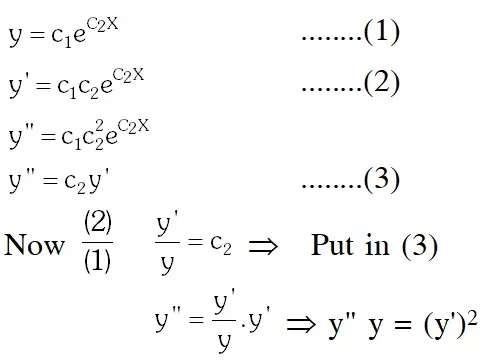
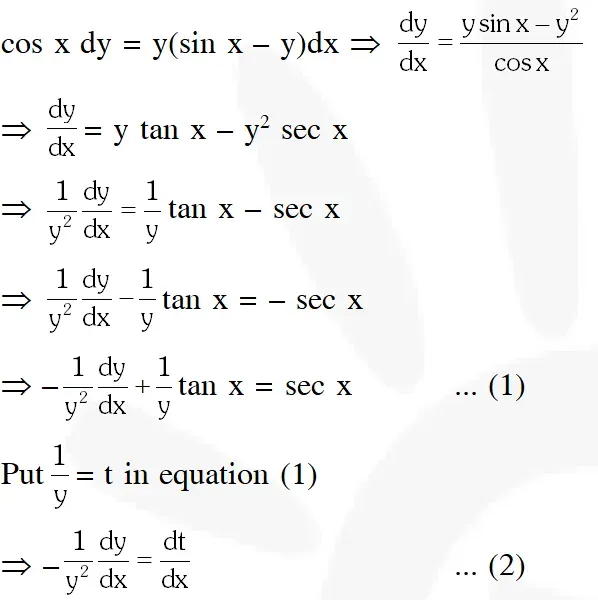
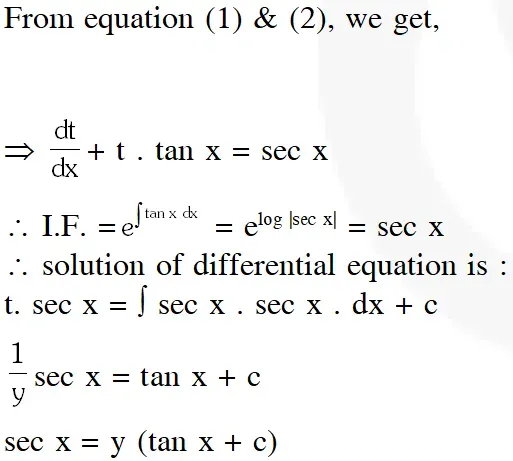
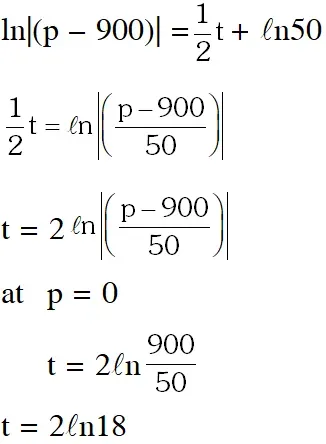
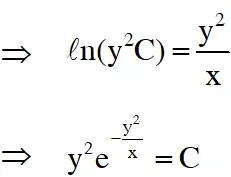
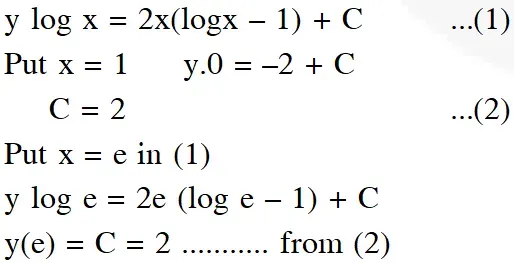
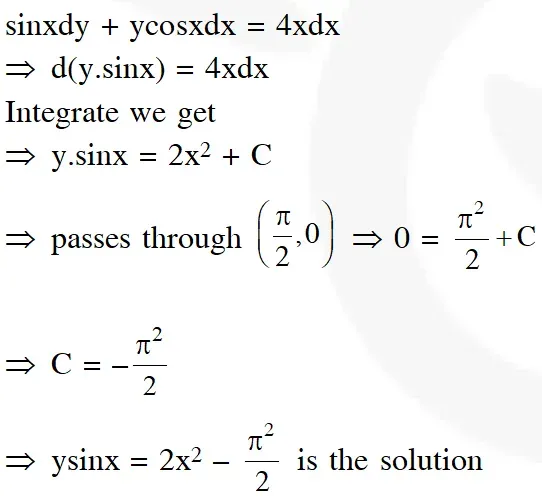
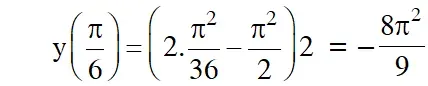
JEE Main Previous Year Question of Math with Solutions are available at eSaral. Practicing JEE Main Previous Year Papers Questions of mathematics will help the JEE aspirants in realizing the question pattern as well as help in analyzing weak & strong areas. eSaral helps the students in clearing and understanding each topic in a better way. eSaral is providing complete chapter-wise notes of Class 11th and 12th both for all subjects. Besides this, eSaral also offers NCERT Solutions, Previous year questions for JEE Main and Advance, Practice questions, Test Series for JEE Main, JEE Advanced and NEET, Important questions of Physics, Chemistry, Math, and Biology and many more. Download eSaral app for free study material and video tutorials. [esquestion] The differential equation which represents the family of curves $y=c_{1} e^{c_{2} x},$ where $c_{1}$ and $c_{2}$ are arbitrary constants, is :- (1) yy" = y' (2) $\mathrm{yy}^{\prime \prime}=\left(\mathrm{y}^{\prime}\right)^{2}$ (3) $y^{\prime}=y^{2}$ (4) $y^{\prime \prime}=y^{\prime} y$ #tag# [AIEEE-2009] #sol# (2) [/esquestion] [esquestion] Solution of the differential equation $\cos x$ dy $=y(\sin x-y) d x, 0<x<\frac{\pi}{2}$ is : (1) sec x = (tan x + c) y (2) y sec x = tan x + c (3) y tan x = sec x + c (4) tan x = (sec x + c) y #tag# [AIEEE-2010] #sol# (1) [/esquestion] [esquestion] If $\frac{d y}{d x}=y+3>0$ and $y(0)=2,$ then $y(\ln 2)$ is equal to $:-$ (1) 13 (2) –2 (3) 7 (4) 5 #tag# [AIEEE-2011] #sol# (3) $\frac{d y}{d x}=y+3>0 \quad y(0)=2, y(\log 2)=?$ $\int \frac{d y}{y+3}=\int d x$ $\log |y+3|=x+c$ $\mathrm{y}(0)=2$ $\log |2+3|=0+\mathrm{c} \Rightarrow \mathrm{c}=\log 5$ y. $(\log 2)=?$ $\log |y+3|=\log 2+\log 5$ $\log |y+3|=\log 10$ $y+3=10$ $y=7$ [/esquestion] [esquestion] Let I be the purchase value of an equipment and $V(t)$ be the value after it has been used for t years. The value $\mathrm{V}(\mathrm{t})$ depreciates at a rate given by differential equation $\frac{\mathrm{dV}(\mathrm{t})}{\mathrm{dt}}=-\mathrm{k}(\mathrm{T}-\mathrm{t})$ where $\mathrm{k}>0$ is a constant and $\mathrm{T}$ is the total life in years of the equipment. Then the scrap value $\mathrm{V}(\mathrm{T})$ of the equipment is :-. (1) $\mathrm{I}-\frac{\mathrm{k}(\mathrm{T}-\mathrm{t})^{2}}{2}$ (2) $\mathrm{e}^{-\mathrm{kT}}$ (3) $\mathrm{T}^{2}-\frac{\mathrm{I}}{\mathrm{k}}$ (4) $\mathrm{I}-\frac{\mathrm{k} \mathrm{T}^{2}}{2}$ #tag# [AIEEE-2011] #sol# (4) $\frac{\mathrm{d} \mathrm{V}}{\mathrm{dt}}=-\mathrm{k}(\mathrm{T}-\mathrm{t})$ $\int \mathrm{d} \mathrm{V}=\int-\mathrm{k}(\mathrm{T}-\mathrm{t}) \mathrm{dt}$ $V=-k\left[T t-\frac{t^{2}}{2}\right]+C$ At $\mathrm{t}=0 \quad \mathrm{V}=\mathrm{I} \Rightarrow \mathrm{C}=\mathrm{I}$ $\mathrm{V}=-\mathrm{kt}\left(\mathrm{T}-\frac{\mathrm{t}}{2}\right)+\mathrm{I}$ $V(T)=-k T\left(T-\frac{T}{2}\right)+I=\frac{-k T^{2}}{2}+I$ [/esquestion] [esquestion] The curve that passes through the point (2, 3), and has the property that the segment of any tangent to it lying between the coordinate axes is bisected by the point of contact, is given by : (1) $\left(\frac{x}{2}\right)^{2}+\left(\frac{y}{3}\right)^{2}=2$ (2) 2y – 3x = 0 (3) $y=\frac{6}{x}$ (4) $x^{2}+y^{2}=13$ #tag# [AIEEE-2011] #sol# (3) Equation of tangent at $\left(\mathrm{x}_{1}, \mathrm{y}_{1}\right)$ is $y-y_{1}=\frac{d y_{1}}{d x_{1}}\left(x-x_{1}\right)$ $\mathrm{x}-$ intercept $=\mathrm{x}_{1}-\mathrm{y}_{1} \frac{\mathrm{d} \mathrm{x}_{1}}{\mathrm{d} y_{1}}$ According to question $x_{1}=\frac{x_{1}-y_{1} \frac{d x_{1}}{d y_{1}}}{2}$ $\Rightarrow \mathrm{x}_{1}=-\mathrm{y}_{1} \frac{\mathrm{d} \mathrm{x}_{1}}{\mathrm{d} y_{1}}$ $\int \frac{d y}{y}=\int-\frac{d x}{x}$ $\Rightarrow \quad \ell n y=-\ell n x+\ell n c$ $\Rightarrow \quad \mathrm{y}=\frac{\mathrm{c}}{\mathrm{x}} \quad \Rightarrow \quad \mathrm{xy}=\mathrm{c}$ Now at $x=2, y=3$ $\Rightarrow \quad c=6$ $\therefore \quad x y=6 \quad \Rightarrow \quad y=\frac{6}{x}$ [/esquestion] [esquestion] Consider the differential equation $\mathrm{y}^{2} \mathrm{d} \mathrm{x}+\left(\mathrm{x}-\frac{1}{\mathrm{y}}\right) \mathrm{d} \mathrm{y}=0 .$ It $\mathrm{y}(1)=1,$ then $\mathrm{x}$ is given by : (1) $1-\frac{1}{y}+\frac{\frac{1}{e^{y}}}{e}$ (2) $4-\frac{2}{y}-\frac{\frac{1}{e^{y}}}{e}$ (3) $3-\frac{1}{y}+\frac{\frac{1}{e^{y}}}{e}$ (4) $1+\frac{1}{y}-\frac{\frac{1}{e^{y}}}{e}$ #tag# [AIEEE-2011] #sol# (4) $\mathrm{y}^{2} \mathrm{d} \mathrm{x}+\left(\mathrm{x}-\frac{1}{\mathrm{y}}\right) \mathrm{d} \mathrm{y}=0$ $\Rightarrow \quad \mathrm{y}^{2} \frac{\mathrm{d} \mathrm{x}}{\mathrm{d} y}+\mathrm{x}=\frac{1}{\mathrm{y}} \quad \Rightarrow \quad \frac{\mathrm{d} \mathrm{x}}{\mathrm{d} y}+\frac{\mathrm{x}}{\mathrm{y}^{2}}=\frac{1}{\mathrm{y}^{3}}$ Integrating factor (I.F.) $=\mathrm{e}^{\int \frac{1}{\mathrm{y}^{2}} \mathrm{d} \mathrm{y}}=\mathrm{e}^{-1 / \mathrm{y}}$ General solution is - \[ \mathbf{x} \cdot \mathrm{e}^{-1 / \mathrm{y}}=\int \frac{1}{y^{3}} e^{-1 / y} \mathrm{d} y+c \] Let $\mathrm{I}_{1}=\int \frac{1}{y^{3}} e^{-1 / y} \mathrm{d} y$ put $\quad \frac{-1}{y}=t$ $y^{-2} d y=d t$ $\therefore \quad \mathrm{I}_{1}=-\int \mathrm{te}^{\mathrm{t}} \mathrm{dt}$ $=-e^{t}(t-1)$ $=e^{t}(1-t)$ General solution is $\mathrm{xe}^{-1 / \mathrm{y}}=\mathrm{e}^{-1 / \mathrm{y}}\left(1+\frac{1}{\mathrm{y}}\right)+\mathrm{C}$ $\Rightarrow \quad \mathrm{x}=1+\frac{1}{y}+\mathrm{Ce}^{1 / \mathrm{y}}$ Put x = 1, y = 1 $\therefore \quad 1=1+\frac{1}{1}+\mathrm{Ce}^{1 / 1}$ $\Rightarrow \quad C=-1 / \mathrm{e}$ $\therefore \quad x=1+\frac{1}{y}-\frac{e^{1 / y}}{e}$ [/esquestion] [esquestion] The population p(t) at time t of a certain mouse species satisfies the differential equation $\mathrm{dp}(\mathrm{t})$ $\mathrm{dt}$ = 0.5 p(t) – 450. If p(0) = 850, then the time at which the population becomes zero is : (1) ln18 (2) 2 ln18 (3) ln9 (4) $\frac{1}{2} \ln 18$ #tag# [AIEEE-2012] #sol# (2) $\frac{\mathrm{dp}(\mathrm{t})}{\mathrm{dt}}=\frac{1}{2} \mathrm{p}(\mathrm{t})-450$ integrate $\int \frac{\mathrm{d} \mathrm{p}}{\mathrm{p}-900}=\int \frac{1}{2} \mathrm{d} \mathrm{t}$ $\ell \mathrm{n}|(\mathrm{p}-900)|=\frac{1}{2} \mathrm{t}+\mathrm{C} \quad \ldots .(1)$ given $\mathrm{t}=0 \rightarrow \mathrm{p}=850 \quad \therefore \mathrm{C}=\ell \mathrm{n} 50$ from ( 1) [/esquestion] [esquestion] At present a firm is manufacturing 2000 items. It is estimated that the rate of change of production P w.r.t. additional number of workers x is given by $\frac{d P}{d x}=100-12 \sqrt{x}$. If the firm employs 25 more workers, then the new level of production of items is : (1) 2500 (2) 3000 (3) 3500 (4) 4500 #tag# [JEE (Main)-2013] #sol# (3) $\mathrm{P}=100 \mathrm{x}-12 \mathrm{x}^{3 / 2} \cdot \frac{2}{3}+\mathrm{C}$ x = 0, P = 2000 C = 2000 $\mathrm{P}_{(\mathrm{x}=25)}=2500-1000+2000=3500$ [/esquestion] [esquestion] If the surface area of a sphere of radius r is increasing uniformly at the rate $8 \mathrm{cm}^{2} / \mathrm{s}$, then the rate of change of its volume is : (1) proportional to $r^{2}$ (2) constant (3) proportional to r (4) proportional to $\sqrt{\mathrm{r}}$ #tag# [JEE-Main (On line)-2013] #sol# (3) $\mathrm{S}=4 \pi \mathrm{r}^{2}$ $\frac{\mathrm{ds}}{\mathrm{dt}}=8=8 \pi \mathrm{r} \frac{\mathrm{dr}}{\mathrm{dt}} \& \quad \mathrm{v}=\frac{4}{3} \pi \mathrm{r}^{3}$ $\Rightarrow \frac{\mathrm{dv}}{\mathrm{dt}}=4 \pi \mathrm{r}^{2} \frac{\mathrm{dr}}{\mathrm{dt}}$ $\Rightarrow \frac{\mathrm{d} \mathrm{v}}{\mathrm{dt}}=4 \mathrm{r}$ [/esquestion] [esquestion] Consider the differential equation $\frac{\mathrm{d} y}{\mathrm{dx}}=\frac{\mathrm{y}^{3}}{2\left(\mathrm{xy}^{2}-\mathrm{x}^{2}\right)}$ Statement 1 : The substitution z $=y^{2}$ transforms the above equation into a first order homogenous differential equation. Statement 2 : The solution of this differential equation is $y^{2} e^{-\frac{y^{2}}{x}}=C$. (1) Statement 1 is false and statement 2 is true. (2) Both statements are true. (3) Statement 1 is true and statement 2 is false. (4) Both statements are false. #tag# [JEE-Main (On line)-2013] #sol# (2) put $z=y^{2}$ $\Rightarrow \quad \frac{\mathrm{d} z}{\mathrm{dx}}=2 \mathrm{y} \frac{\mathrm{d} \mathrm{y}}{\mathrm{d} \mathrm{x}}$ $\Rightarrow \quad$ D.E. is $\frac{\mathrm{d} z}{\mathrm{dx}}=\frac{2 \mathrm{z}^{2}}{2\left(\mathrm{xz}-\mathrm{x}^{2}\right)}$ $\Rightarrow \quad z(x d z-z d x)=x^{2} d z$ $\Rightarrow \quad \int d\left(\frac{z}{x}\right)=\int \frac{d z}{z}$ $\Rightarrow \quad \frac{\mathrm{z}}{\mathrm{x}}=\ell \mathrm{nz}+\ell \mathrm{nC}$ [/esquestion] [esquestion] If a curve passes through the point $\left(2, \frac{7}{2}\right)$ and has slope $\left(1-\frac{1}{\mathrm{x}^{2}}\right)$ at any point $(\mathrm{x}, \mathrm{y})$ on it, then the ordinate of the point on the curve whose abscissa is $-2$ is : $(1)-\frac{5}{2}$ ( 2)$\frac{5}{2}$ $(3)-\frac{3}{2}$ ( 4)$\frac{3}{2}$ #tag# [JEE-Main (On line)-2013] #sol# (3) $\frac{\mathrm{d} y}{\mathrm{dx}}=1-\frac{1}{\mathrm{x}^{2}}$ $\Rightarrow \quad \mathrm{y}=\mathrm{x}+\frac{1}{\mathrm{x}}+1$ $\Rightarrow \quad \mathrm{y}=-2-\frac{1}{2}+1=-\frac{3}{2}$ [/esquestion] [esquestion] The equation of the curve passing through the origin and satisfying the differential equation $\left(1+x^{2}\right) \frac{d y}{d x}+2 x y=4 x^{2}$ is : $(1)\left(1+x^{2}\right) y=x^{3}$ (2) $3\left(1+x^{2}\right) y=4 x^{3}$ (3) $3\left(1+x^{2}\right) y=2 x^{3}$ (4) $\left(1+x^{2}\right) y=3 x^{3}$ #tag# [JEE-Main (On line)-2013] #sol# (2) $\int \mathrm{d}\left(\left(1+\mathrm{x}^{2}\right) \mathrm{y}\right)=\int 4 \mathrm{x}^{2} \mathrm{d} \mathrm{x}$ $\Rightarrow \quad \mathrm{y}\left(1+\mathrm{x}^{2}\right)=\frac{4 \mathrm{x}^{3}}{3}+\mathrm{C}$ passes through $(0,0)$ $\Rightarrow \quad 3 \mathrm{y}\left(1+\mathrm{x}^{2}\right)=4 \mathrm{x}^{3}$ [/esquestion] [esquestion] Let the population of rabbits surviving at a time t be governed by the differential equation $\frac{\mathrm{dp}(\mathrm{t})}{\mathrm{dt}}=\frac{1}{2} \mathrm{p}(\mathrm{t})-200 .$ If $\mathrm{p}(0)=100,$ then $\mathrm{p}(\mathrm{t})$ equals : (1) $400-300 \mathrm{e}^{\mathrm{t} / 2}$ (2) $300-200 \mathrm{e}^{-t / 2}$ (3) $600-500 \mathrm{e}^{t / 2}$ (4) $400-300 \mathrm{e}^{-1 / 2}$ #tag# [JEE(Main)-2014] #sol# (1) $\frac{\mathrm{dp}(\mathrm{t})}{\mathrm{dt}}=\frac{1}{2} \mathrm{p}(\mathrm{t})-200$ $\int_{10}^{p(t)} \frac{d p(t)}{p(t)-400}=\int_{0}^{t} \frac{d t}{2} \Rightarrow \log \left|\frac{p(t)-400}{-300}\right|=\frac{t}{2}$ $|p(t)-400|=300 e^{t / 2}$ $400-p(t)=300 e^{t / 2}$ $\therefore \mathrm{p}(\mathrm{t})=400-300 \mathrm{e}^{\mathrm{t} / 2}$ [/esquestion] [esquestion] Let $\mathrm{y}(\mathrm{x})$ be the solution of the differential equation $(\mathrm{x} \log \mathrm{x}) \frac{\mathrm{d} \mathrm{y}}{\mathrm{dx}}+\mathrm{y}=2 \mathrm{x} \log \mathrm{x},(\mathrm{x} \geq 1)$ Then $\mathrm{y}(\mathrm{e})$ is equal to : (1) 2 (2) 2e (3) e (4) 0 #tag# [JEE(Main)-2015] #sol# (1) $(x \log x) \frac{d y}{d x}+y=2 x \log x,(x \geq 1)$ $\Rightarrow \frac{d y}{d x}+\frac{y}{x \log x}=2$ I.F. $=e^{\int \frac{d x}{x \log x}}=e^{\log (\log x)}=\log x$ Solution is $y \log x=\int 2 \log x d x$ [/esquestion] [esquestion] If a curve $\mathrm{y}=\mathrm{f}(\mathrm{x})$ passes through the point $(1,-1)$ and satisfies the differential equation, $\mathrm{y}(1+\mathrm{xy}) \mathrm{dx}=\mathrm{x}$ dy, then $\mathrm{f}\left(-\frac{1}{2}\right)$ is equal to : ( 1)$\frac{4}{5}$ (2) $-\frac{2}{5}$ (3) $-\frac{4}{5}$ ( 4)$\frac{2}{5}$ #tag# [JEE(Main)-2016] #sol# (1) Given differential equation $\mathrm{ydx}+\mathrm{xy}^{2} \mathrm{dx}=\mathrm{xdy}$ $\Rightarrow \frac{\mathrm{xdy}-\mathrm{ydx}}{\mathrm{y}^{2}}=\mathrm{xdx}$ $\Rightarrow-\mathrm{d}\left(\frac{\mathrm{x}}{\mathrm{y}}\right)=\mathrm{d}\left(\frac{\mathrm{x}^{2}}{2}\right)$ Integrating we get $-\frac{x}{y}=\frac{x^{2}}{2}+C$ $\because$ It passes through $(1,-1)$ $\therefore \quad 1=\frac{1}{2}+\mathrm{C} \Rightarrow \mathrm{C}=\frac{1}{2}$ $\therefore \quad x^{2}+1+\frac{2 x}{y}=0 \Rightarrow y=\frac{-2 x}{x^{2}+1}$ $\therefore \mathrm{f}\left(-\frac{1}{2}\right)=\frac{4}{5}$ [/esquestion] [esquestion] If $(2+\sin x) \frac{d y}{d x}+(y+1) \cos x=0$ and $y(0)=1,$ then $y\left(\frac{\pi}{2}\right)$ is equal to :- (1) $\frac{4}{3}$ ( 2)$\frac{1}{3}$ (3) $-\frac{2}{3}$ $(4)-\frac{1}{3}$ #tag# [JEE(Main)-2017] #sol# (2) $(2+\sin x) \frac{d y}{d x}+(y+1) \cos x=0$ $\frac{d}{d x}(2+\sin x)(y+1)=0$ $(2+\sin x)(y+1)=c$ $x=0, y=1 \Rightarrow c=4$ $\mathrm{y}+1=\frac{4}{2+\sin \mathrm{x}}$ $y\left(\frac{\pi}{2}\right)=\frac{4}{3}-1=\frac{1}{3}$ [/esquestion] [esquestion] Let $\mathrm{y}=\mathrm{y}(\mathrm{x})$ be the solution of the differential equation $\sin \mathrm{x} \frac{\mathrm{dy}}{\mathrm{dx}}+\mathrm{y} \cos \mathrm{x}=4 \mathrm{x}, \mathrm{x} \in(0$ \pi). If $\mathrm{y}\left(\frac{\pi}{2}\right)=0,$ then $\mathrm{y}\left(\frac{\pi}{6}\right)$ is equal to : (1) $\frac{-8}{9 \sqrt{3}} \pi^{2}$ (2) $-\frac{8}{9} \pi^{2}$ (3) $-\frac{4}{9} \pi^{2}$ (4) $\frac{4}{9 \sqrt{3}} \pi^{2}$ #tag# [JEE(Main)-2018] #sol# (2) [/esquestion]
Differential Equations connects with several Maths topics, and the JEE PYQ chapter wise page provides a convenient way to revise them together.
This Differential Equations set covers one chapter only — for entire papers exactly as they appeared on exam day, check our previous years JEE Main question papers.
Team eSaral
eSaral Academic and Editorial Team
Team eSaral is the collective author profile for educational content created by eSaral’s teachers and academic contributors. The team draws on expertise from IIT graduates, doctors, experienced educators and subject specialists to develop resources for JEE, NEET and school students. Our articles aim to explain concepts clearly and help students study with confidence.
Related Posts

BITSAT 2027: Registration Date, Exam Date, Syllabus, Eligibility, Pattern & Fees
BITSAT 2027 exam dates, registration timeline, eligibility criteria, exam pattern, marking scheme, syllabus and fees in one page.

BITSAT Previous Year Question Paper PDF (2017-2026)
Download BITSAT previous year question papers PDF from 2017 to 2026,session-wise. Memory-based papers,exam pattern, paper analysis and how to practise

CBSE Class 10 Date Sheet 2027: Expected Exam Dates, Release Date, Admit Card & Result Timeline
CBSE Class 10 date sheet 2027 is awaited. See the expected exam dates, release window, how to download the PDF, admit card and result timelines.

NCERT Physics Class 10 Book PDF in Hindi 2026-27 – भौतिक विज्ञान के 4 अध्याय (Free Download)
NCERT Physics Class 10 book PDF in Hindi 2026-27: download all 4 chapters (अध्याय 9–12) free, with topics and important formulas.

NCERT Biology Class 9 Book Anveshan PDF in Hindi - जीव विज्ञान कक्षा 9 पुस्तक अन्वेषण PDF
Download NCERT Biology Class 9 book PDF in Hindi chapterwise for 2026-27: Cell, Tissues, Reproduction and Diversity. Free PDFs.

Essay On Artificial Intelligence in English (100,150, 200, 250, 300, 500 Words)
This is in contrast to the natural intelligence of humans. With Artificial Intelligence, machines can perform

Essay on 78th India Independence Day in English for Student (100, 150, 200, 250, 300, 500 Words)
Read the best essays on India's Independence Day in English. Short & long essays (100, 150, 200, 250, 300, 500 words) perfect for school exams
NCERT Class 11 English Snapshots book - Free PDF download- Esaral
Download NCERT Class 11 English Snapshots book PDF for free. Get all 8 chapters, chapter-wise. Start your prep today!
NCERT Class 10 biology book pdf - Free PDF Download - eSaral
NCERT Class 10 Biology book PDF 2026-27: all 5 chapters (Life Processes to Our Environment) in English & Hindi, with CBSE syllabus, marks & practical

Essay on Global Warming in English (100,150, 200, 250, 300, 500 Words)
Global warming means the Earth is getting hotter. This happens because of things like pollution from cars and factories.