
Electrostatics: Electric Charges and Fields Class 12 Physics Chapter 1 Notes

eSaral Academic and Editorial Team
Summary
Electric Charges and Fields is Chapter 1 of NCERT Class 12 Physics (the start of Electrostatics). This page covers electric charge and its three properties (additivity, conservation and quantisation), Coulomb’s law and the superposition principle, the electric field and field lines, electric flux, the electric dipole and its torque in a field, continuous charge distributions, and Gauss’s law with its applications.
Electric Charges and Fields is the base of the whole electricity and magnetism part of Class 12. In the CBSE 2026-27 scheme, Chapters 1 to 3 (Electric Charges and Fields, Electrostatic Potential and Capacitance, and Current Electricity) carry 16 marks together. In the JEE Main 2026 syllabus, the chapter is the first part of Unit 11, Electrostatics. These notes follow the order of the NCERT chapter, so that you can read them next to the textbook.
Electrostatics: Electric Charges and Fields class 12 physics chapter 1 notes
Also read:
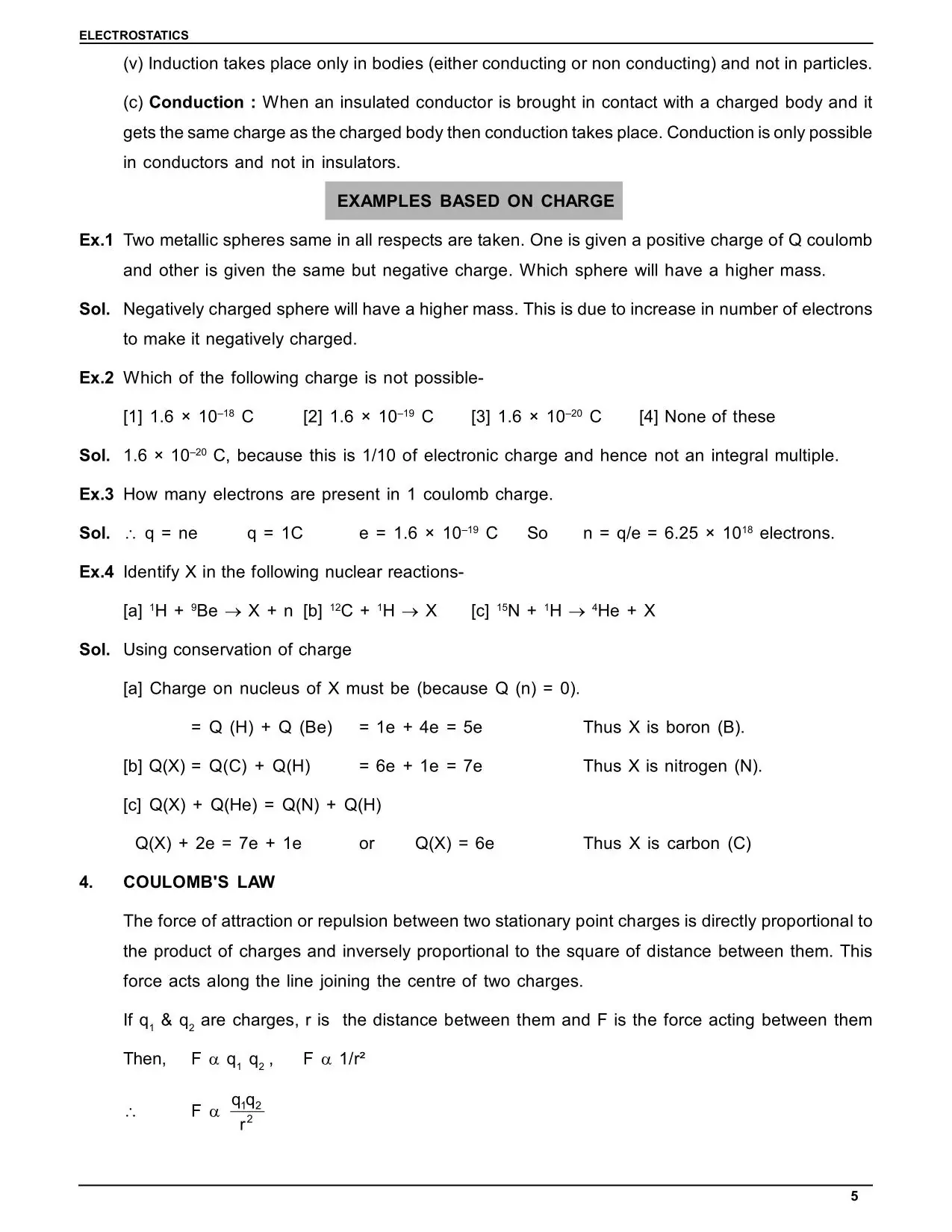
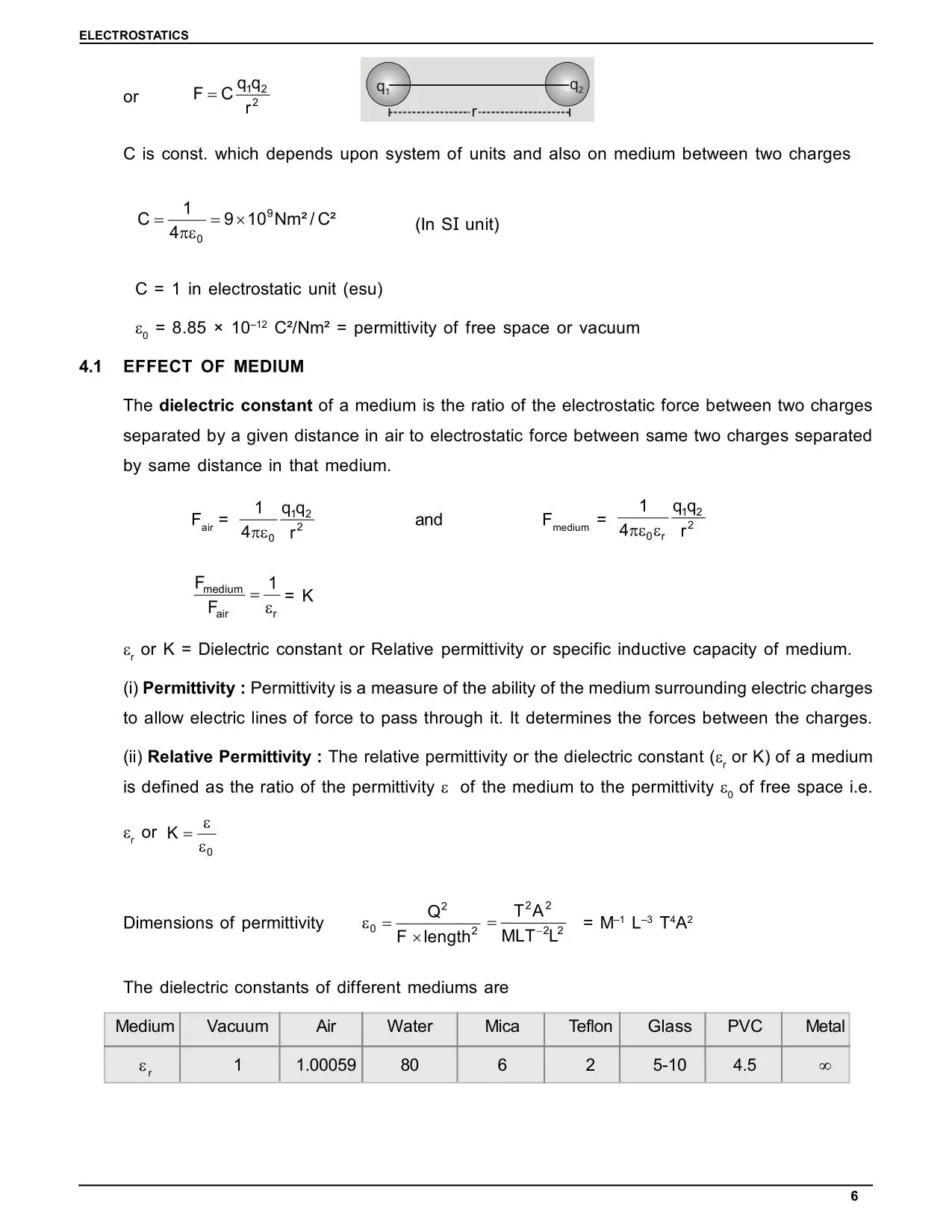
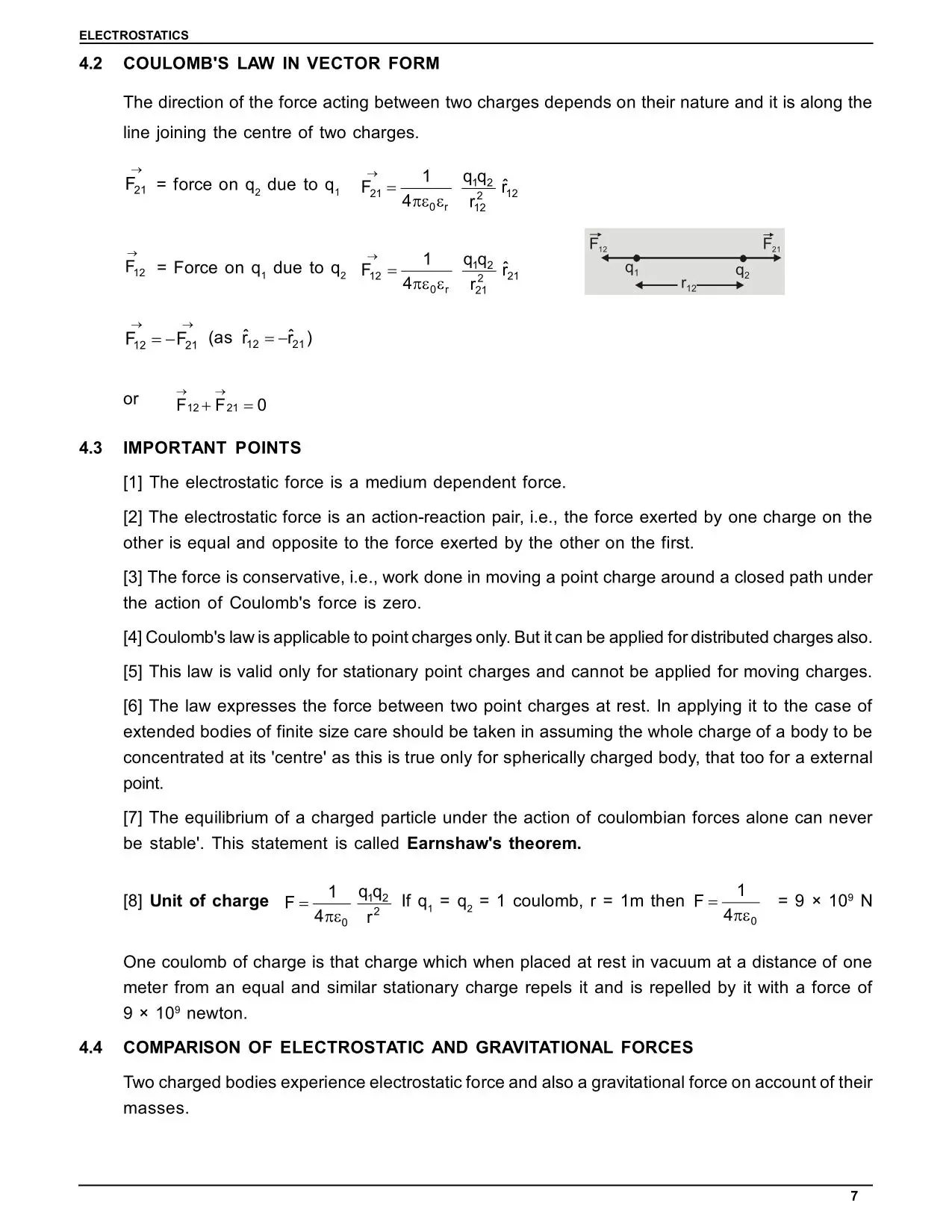
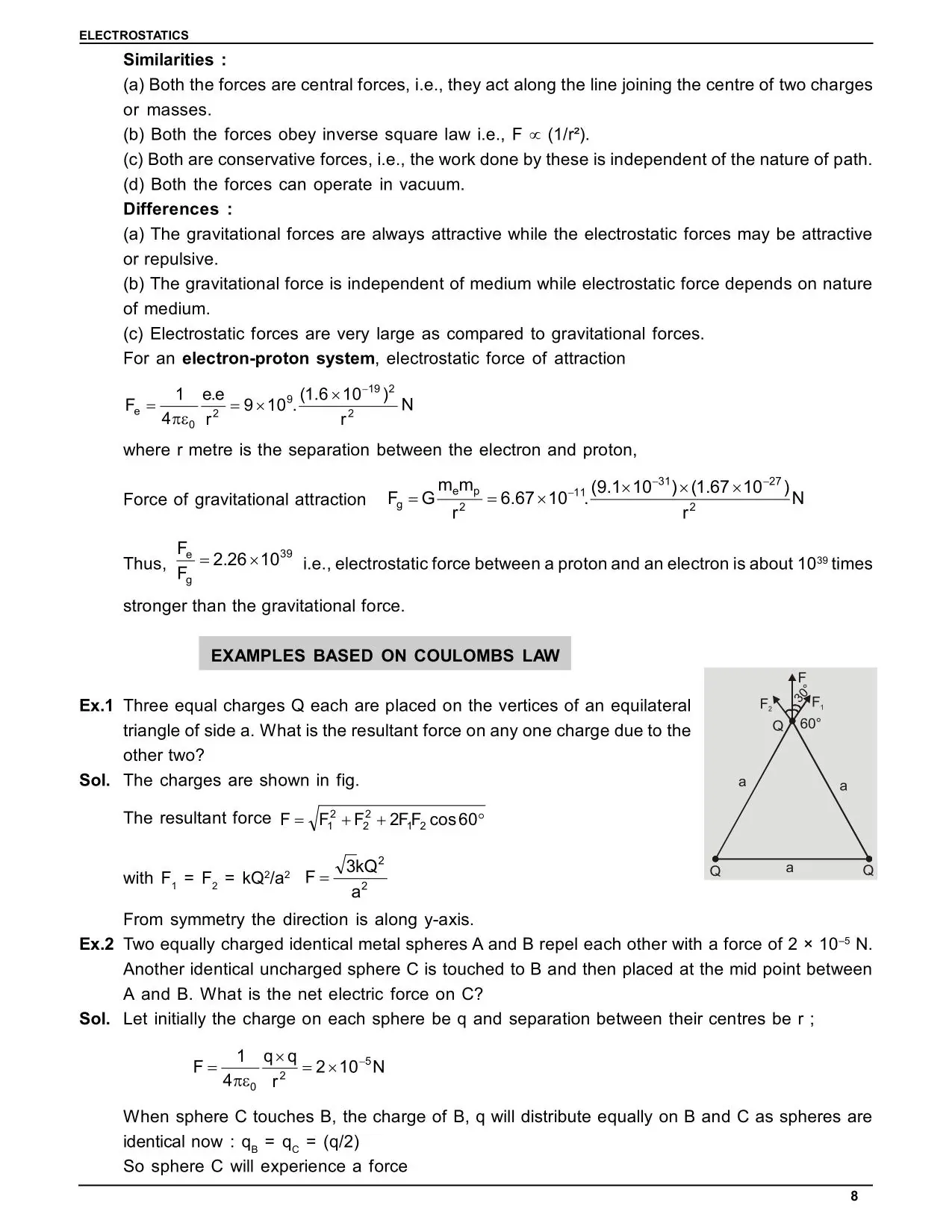
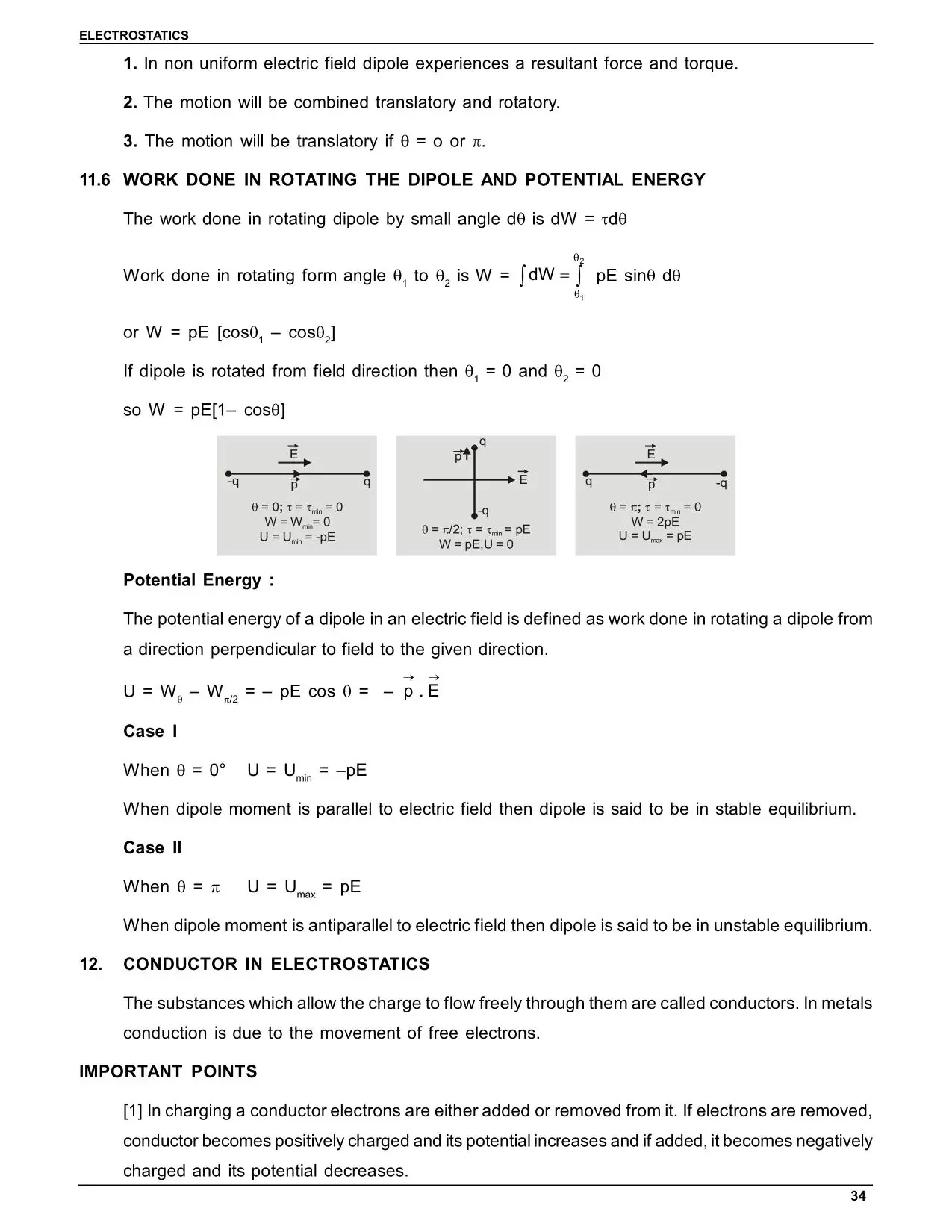
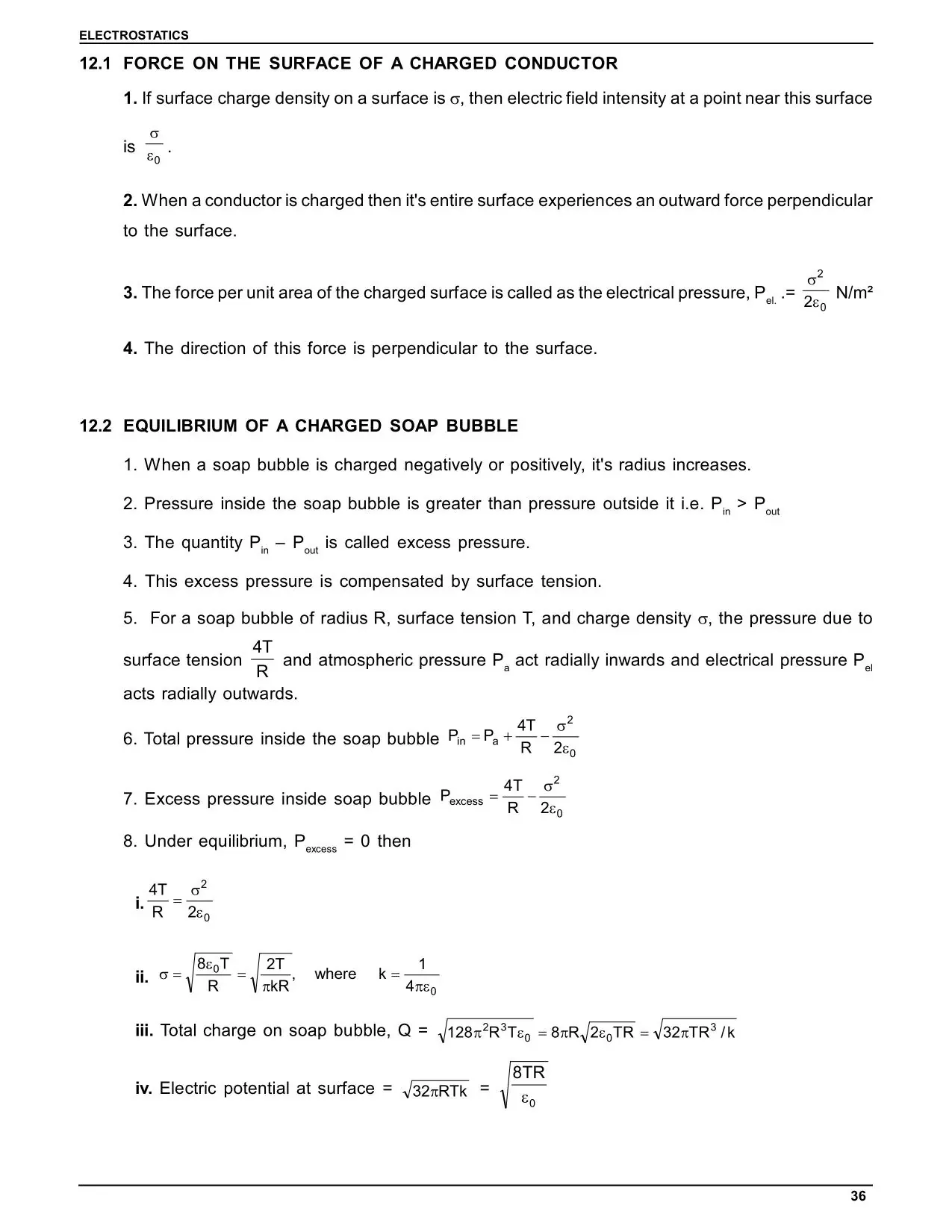
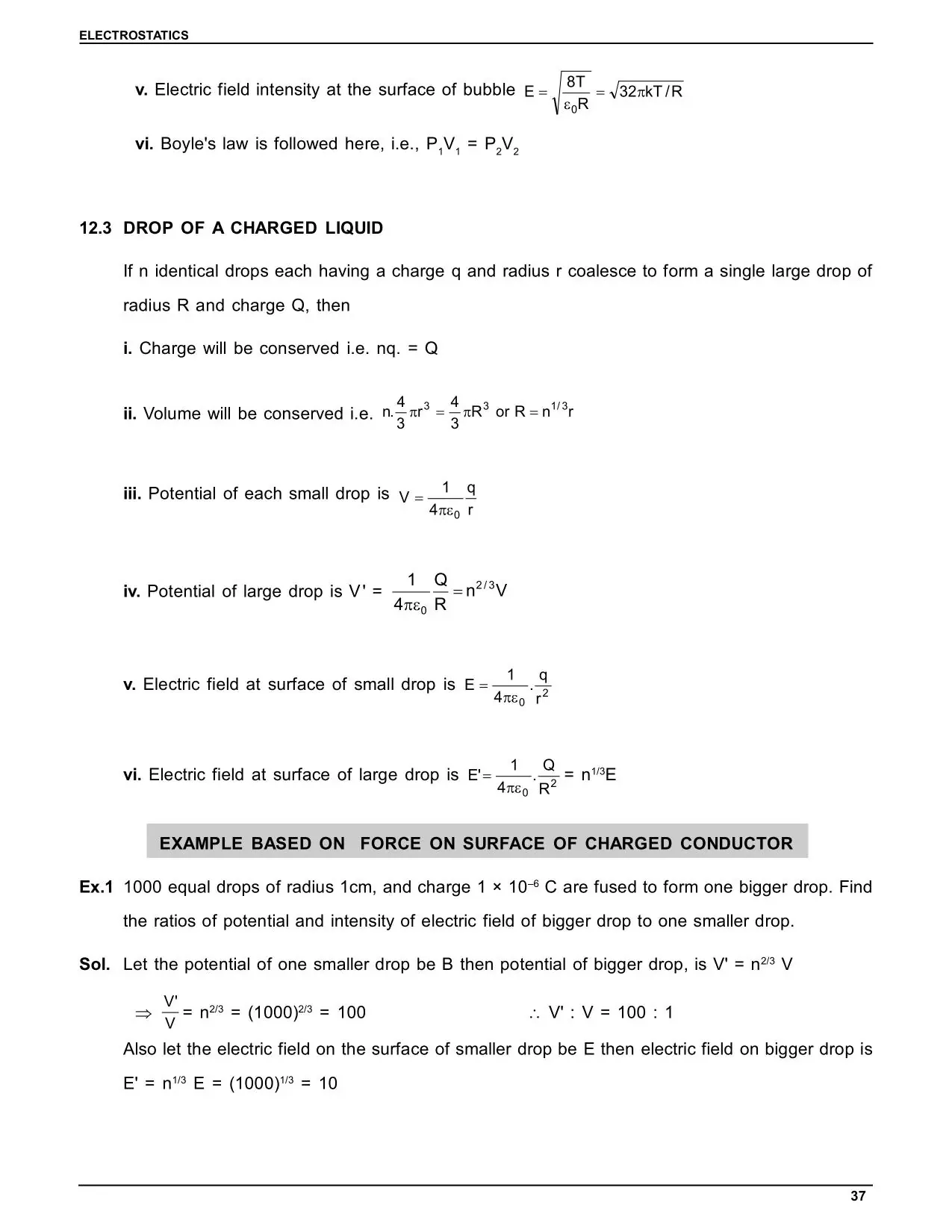
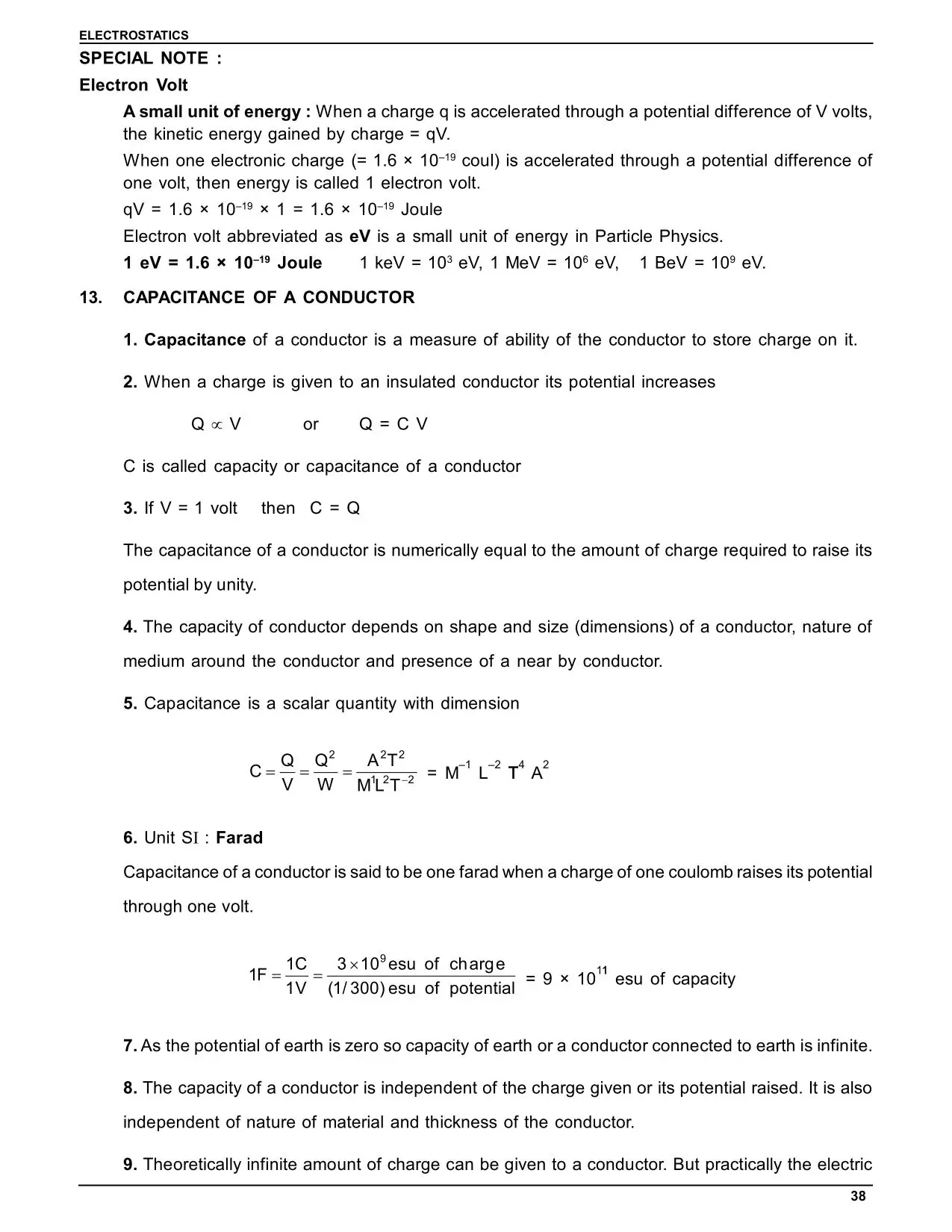
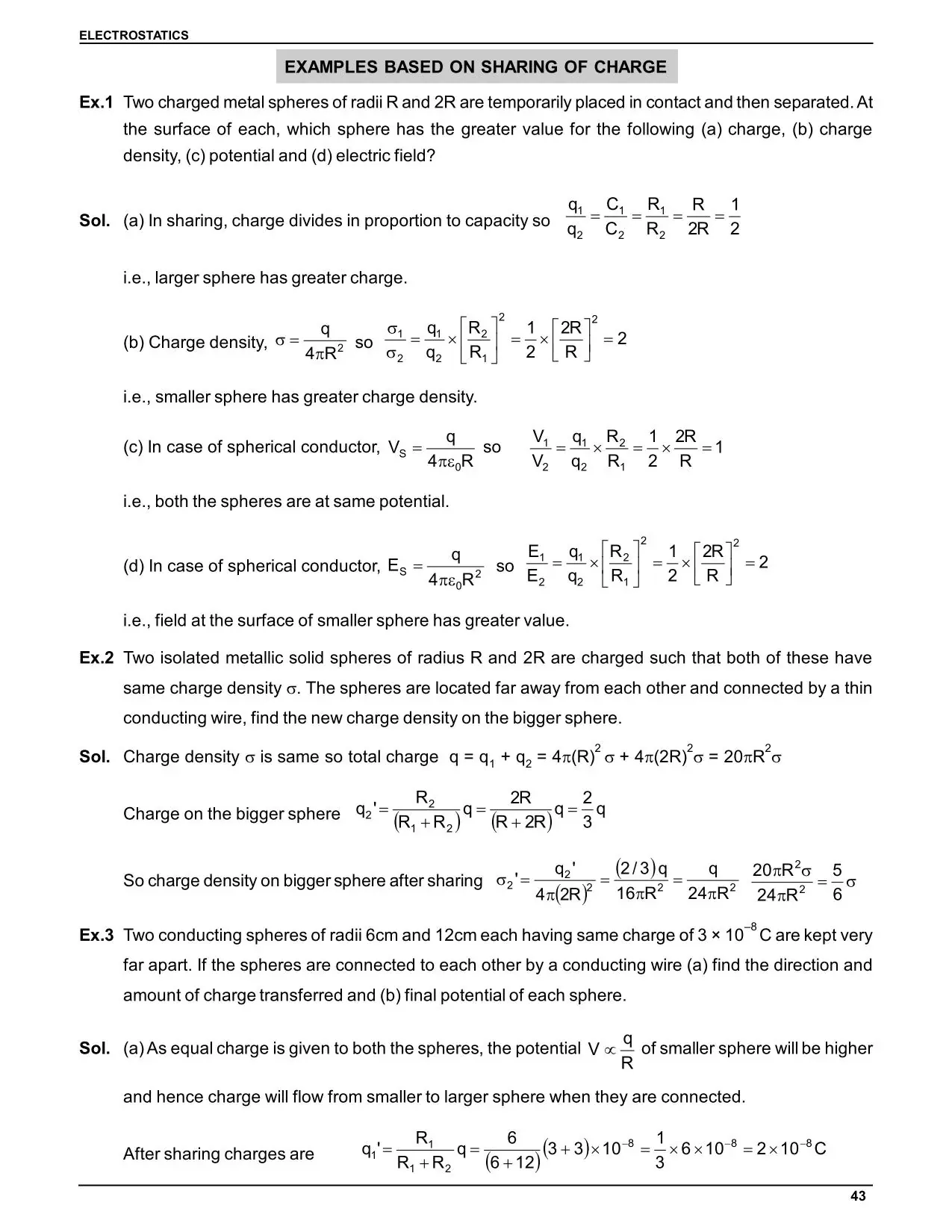
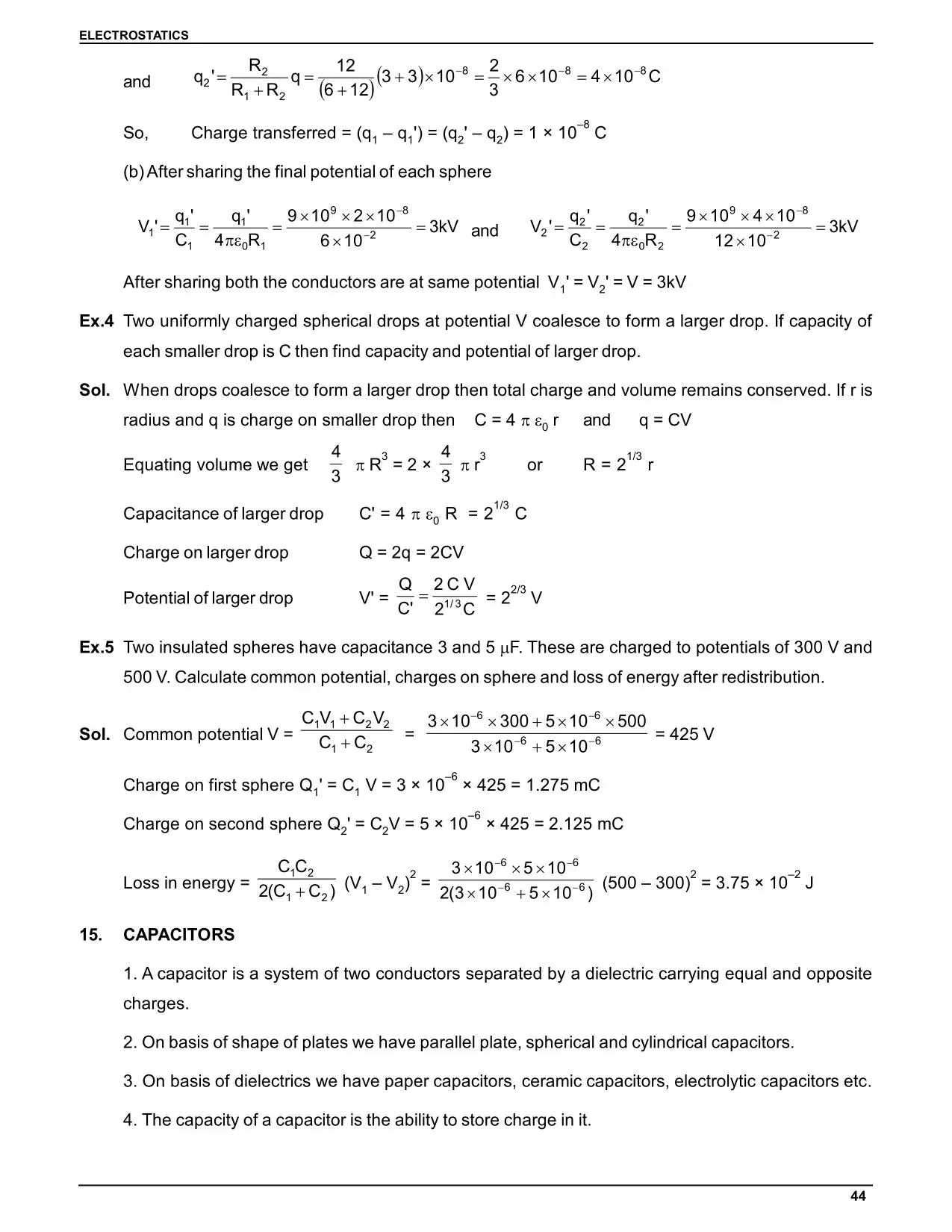
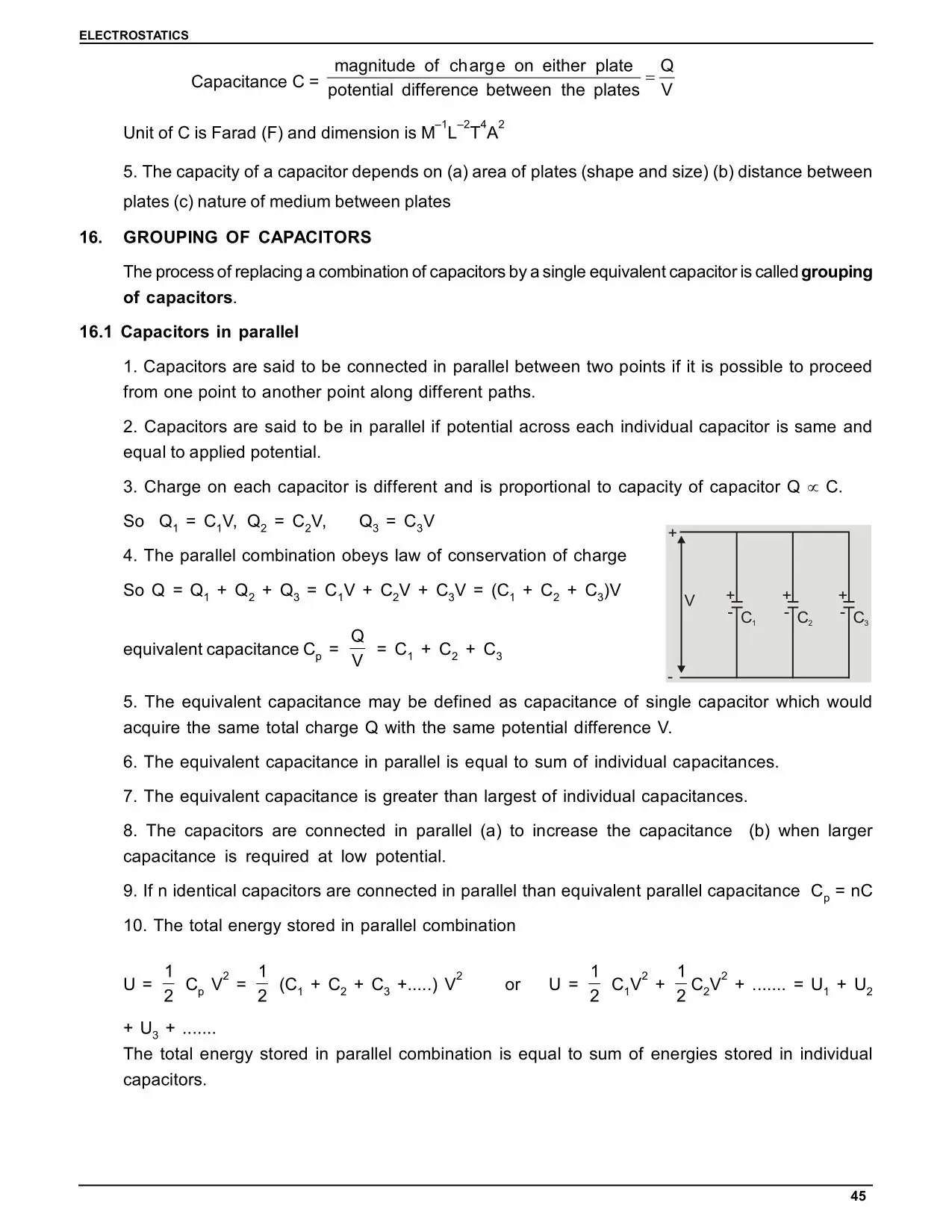
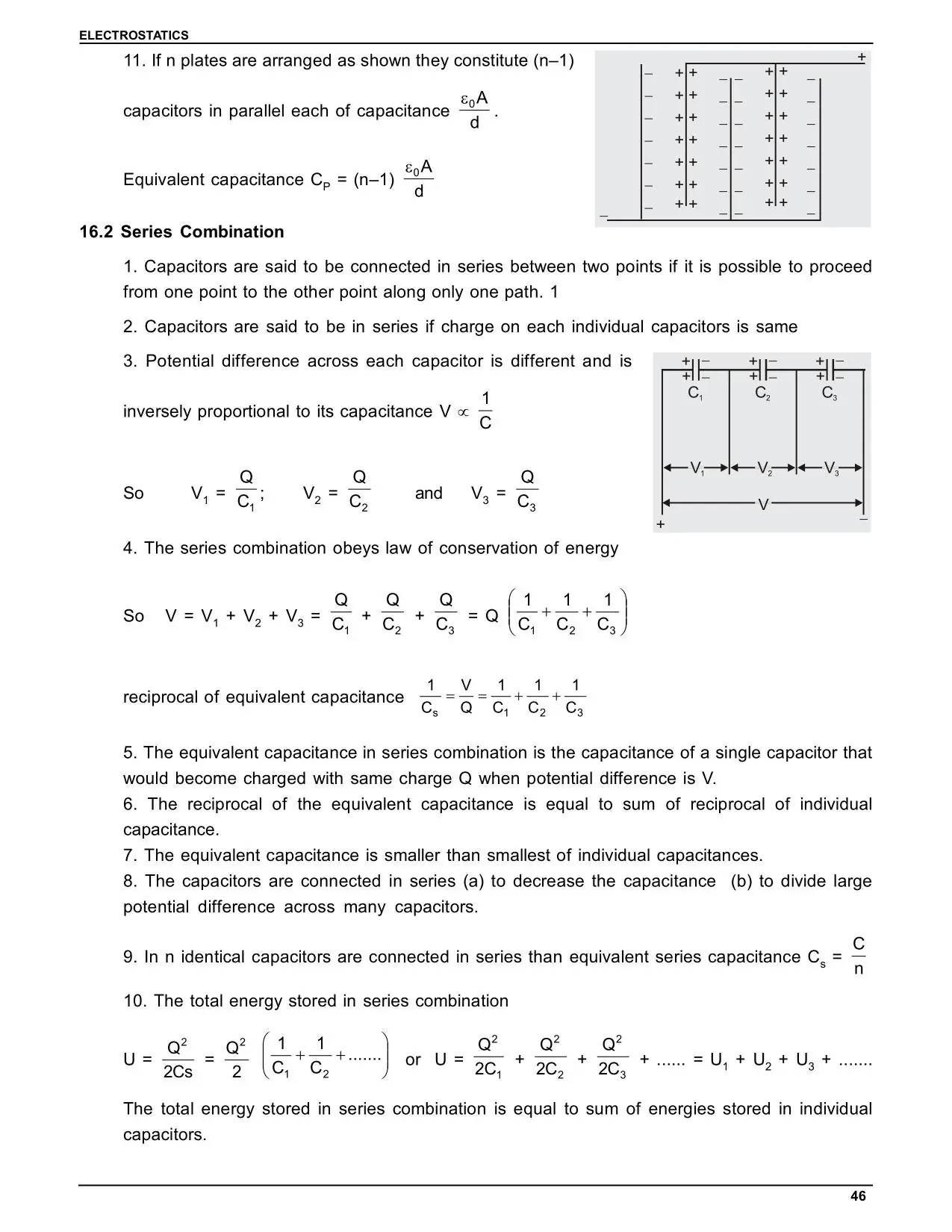
Electric Charges and Fields Class 12 Notes: Chapter Overview and Syllabus
NCERT section | Topic | CBSE and JEE Main |
|---|---|---|
1.2 – 1.3 | Electric charge, conductors and insulators | Yes |
1.4 | Additivity, conservation and quantisation of charge | Yes (conservation of charge is listed) |
1.5 – 1.6 | Coulomb’s law, forces between multiple charges, superposition | Yes |
1.7 – 1.8 | Electric field, electric field lines | Yes |
1.9 | Electric flux | Yes |
1.10 – 1.11 | Electric dipole, field of a dipole, torque on a dipole in a uniform field | Yes |
1.12 | Continuous charge distribution | Yes |
1.13 – 1.14 | Gauss’s law and its applications (infinite wire, infinite plane sheet, thin spherical shell) | Yes |
The potential energy of a dipole, electric potential and capacitors belong to Chapter 2, which is also part of the same JEE Main unit. Check the latest syllabi of CBSE, NTA and NMC (for NEET) for the exact lists.
Tip from the eSaral Physics team: Treat every problem in this chapter as a vector problem. Draw the charges, draw each force or field as an arrow, and add the arrows with their directions. Most wrong answers come from adding magnitudes without the directions.
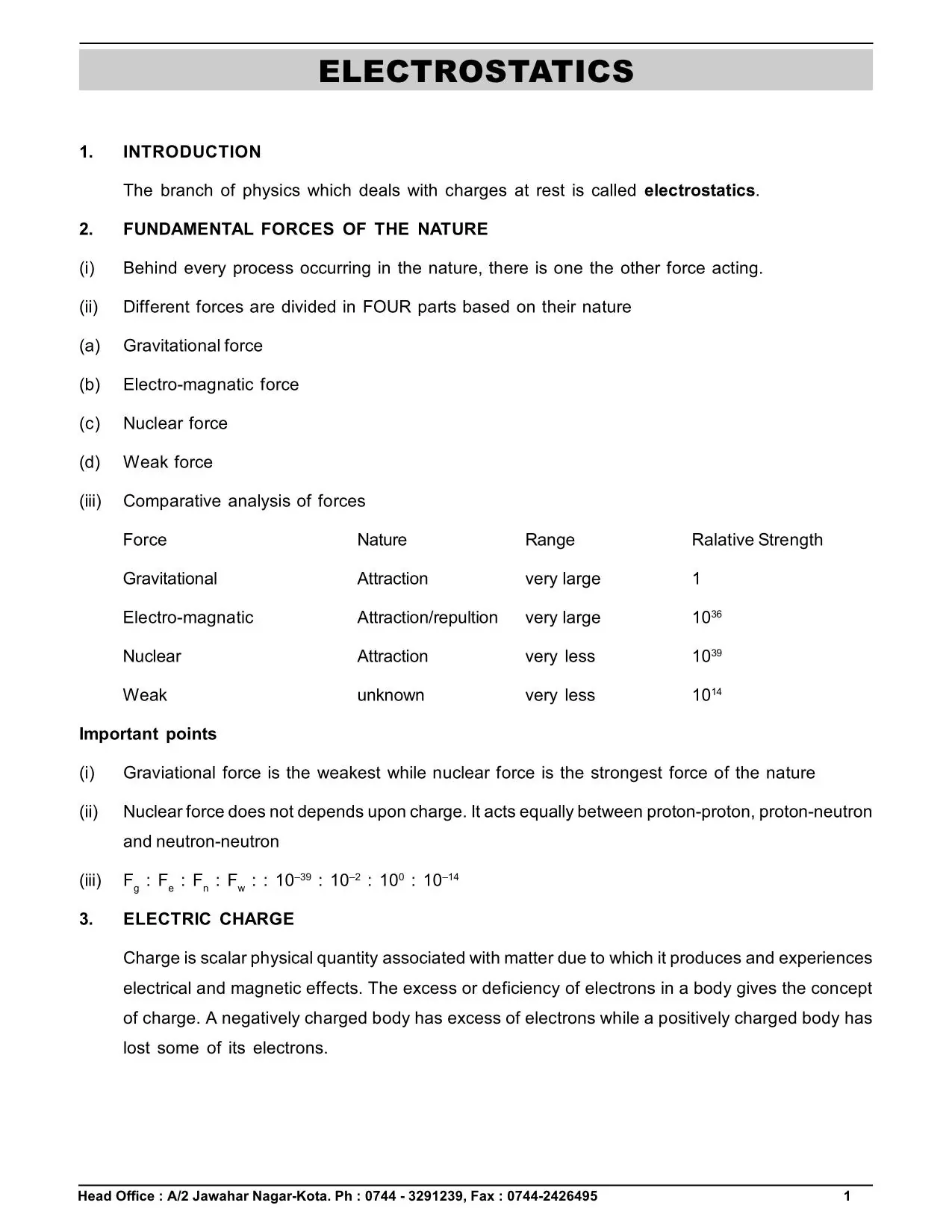
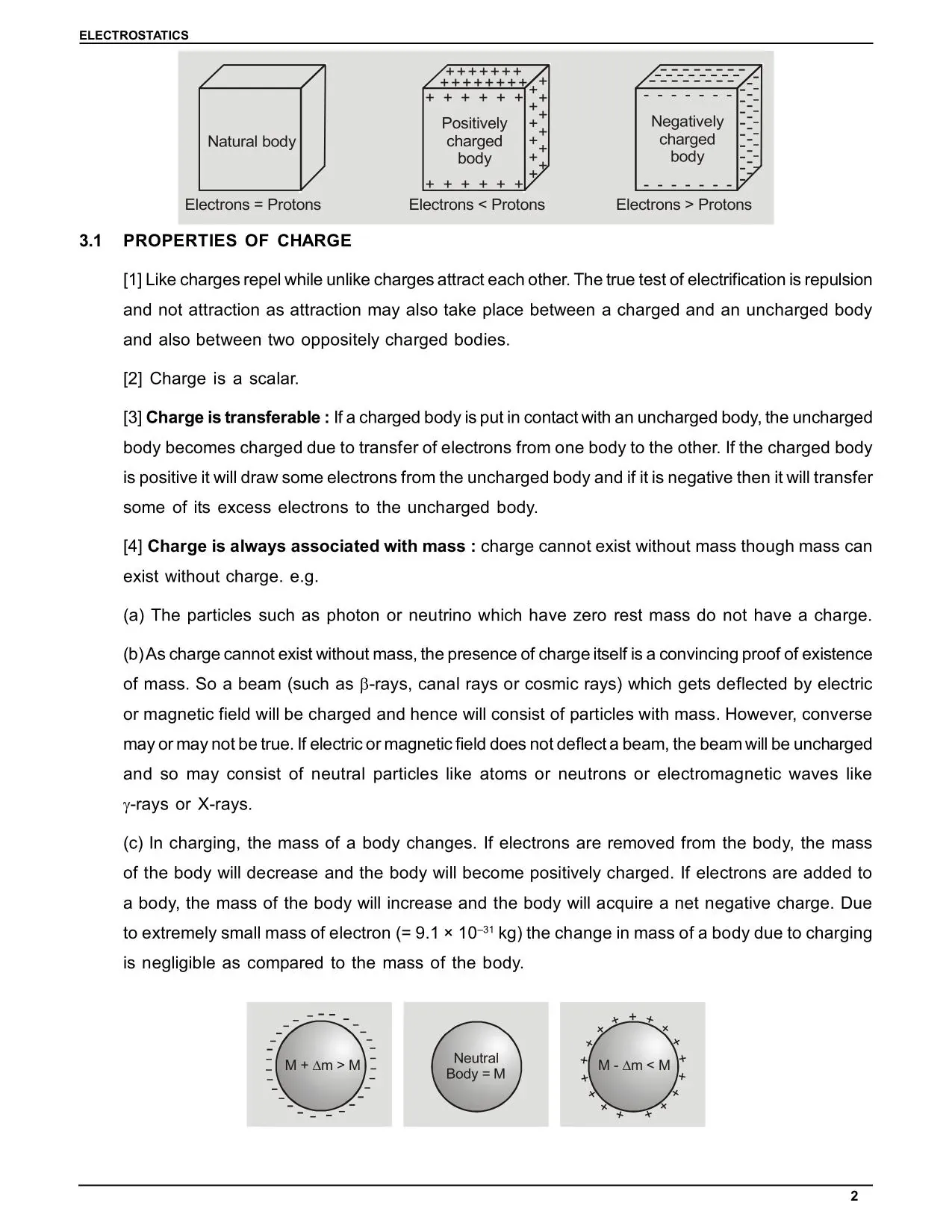
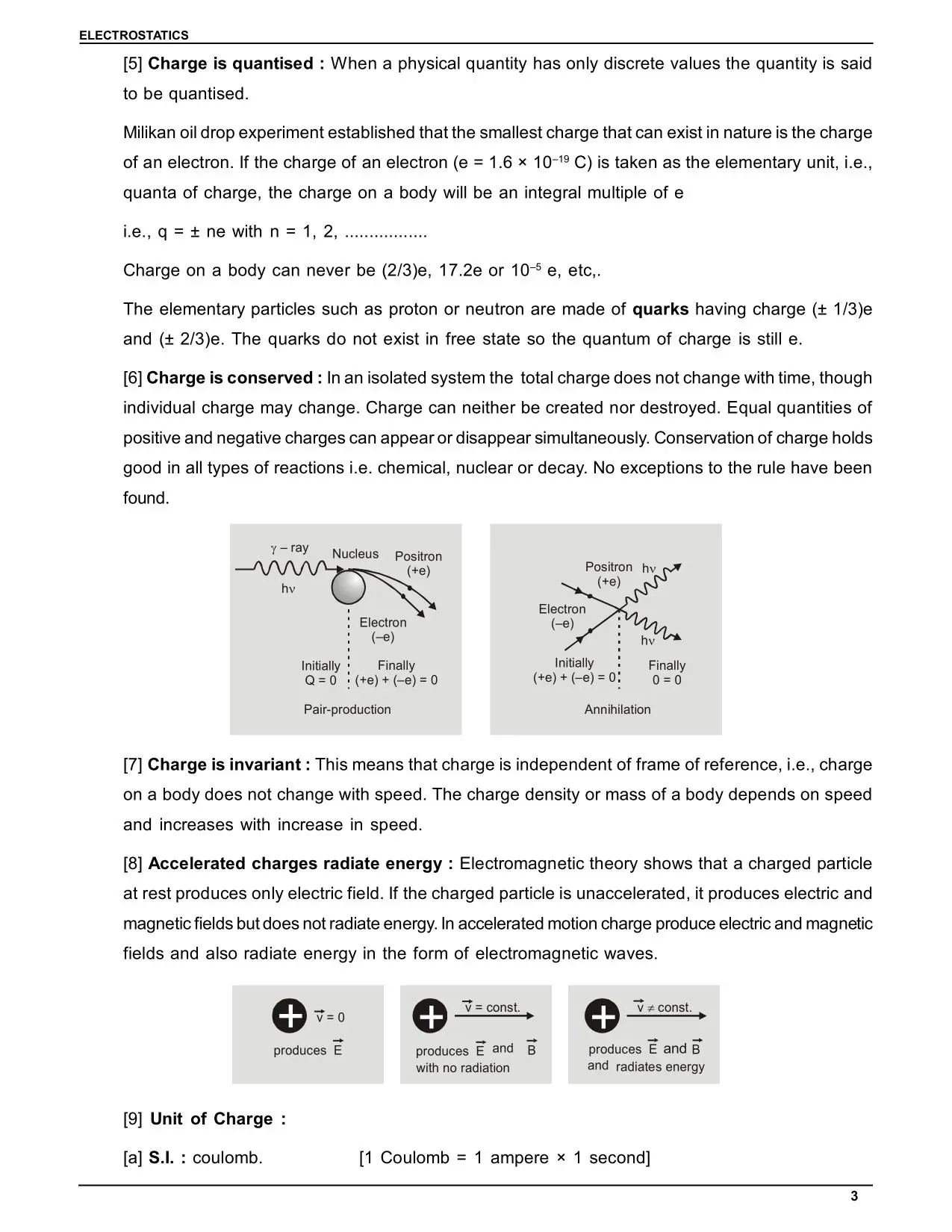
Electric Charge and Its Properties in Electric Charges and Fields Class 12 Notes
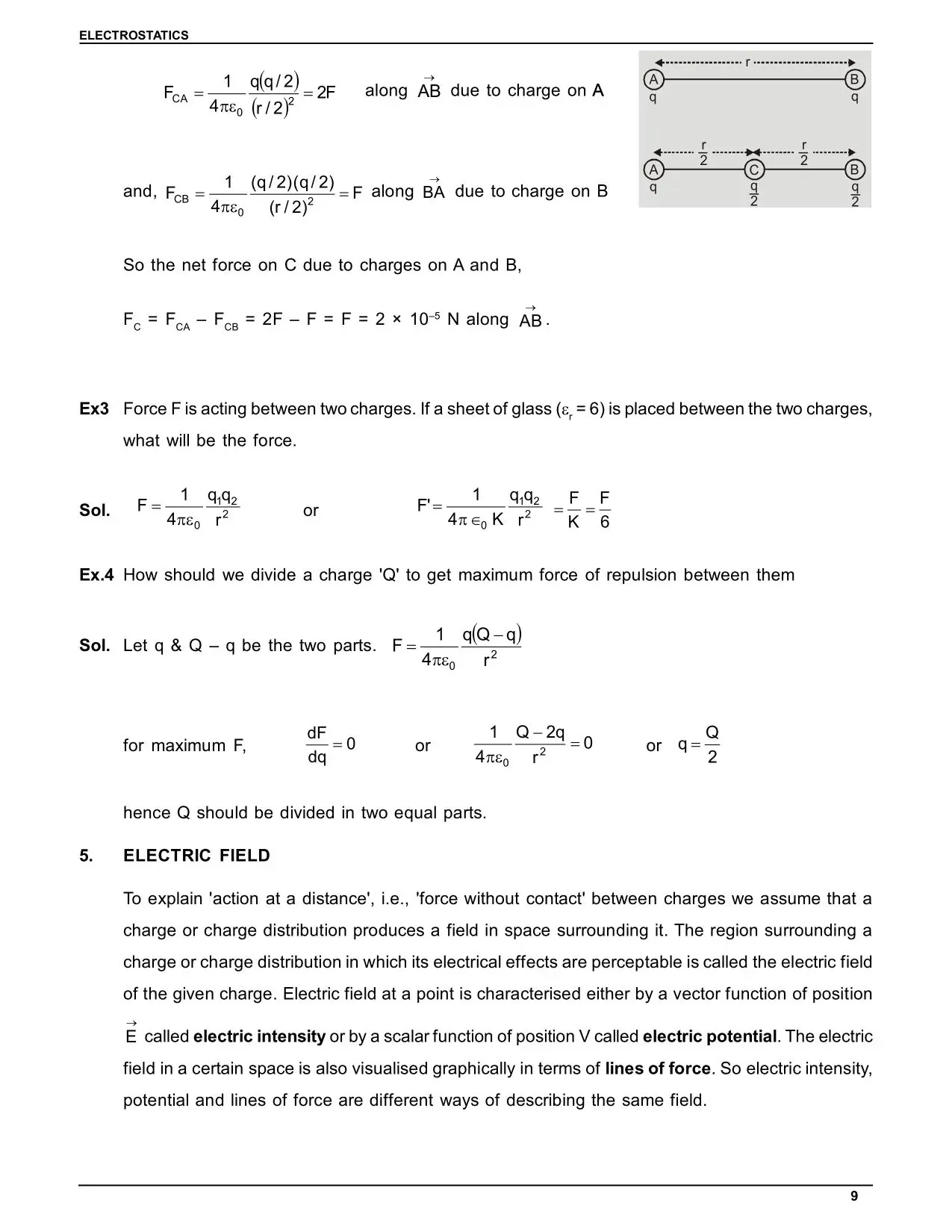
Rubbing two bodies, such as glass with silk, transfers electrons from one to the other. The body that loses electrons becomes positively charged, and the body that gains them becomes negatively charged. Like charges repel, and unlike charges attract. A gold-leaf electroscope detects the charge on a body, because the leaves diverge when they carry charge.
Conductors and insulators: conductors allow charge to move through them (in metals, the mobile charges are electrons), and insulators do not.
Property | Statement | Formula or example |
|---|---|---|
Additivity | The total charge of a system is the algebraic sum of the individual charges. Charge is a scalar. | $q_{total} = q_1 + q_2 + q_3 + \cdots$ |
Conservation | The total charge of an isolated system does not change with time. Charge is transferred, not created or destroyed. | A neutron turns into a proton and an electron, and the total charge stays zero |
Quantisation | Every free charge is an integral multiple of the basic charge $e$. | $q = ne$, with $n = 0, \pm 1, \pm 2, \ldots$ and $e = 1.602 \times 10^{-19}\ \text{C}$ |
The SI unit of charge is the coulomb (C), where $1\ \text{C} = 1\ \text{A s}$. A charge of $-1$ C needs about $6 \times 10^{18}$ electrons. For macroscopic charges, $n$ is very large, so quantisation can be ignored.
Coulomb’s Law in Electric Charges and Fields Class 12 Notes
The force between two point charges $q_1$ and $q_2$ at a distance $r$ is proportional to $q_1 q_2$ and inversely proportional to $r^2$. It acts along the line joining the charges. In vector form, the force on $q_2$ due to $q_1$ is:
$$\vec{F}_{21} = \frac{1}{4\pi\varepsilon_0}\,\frac{q_1 q_2}{r_{21}^{2}}\,\hat{r}_{21}$$
where $\hat{r}_{21}$ is the unit vector from $q_1$ to $q_2$. The force is repulsive for like charges and attractive for unlike charges. In SI units:
$$k = \frac{1}{4\pi\varepsilon_0} \approx 9 \times 10^{9}\ \text{N m}^2\text{C}^{-2}, \qquad \varepsilon_0 = 8.854 \times 10^{-12}\ \text{C}^2\text{N}^{-1}\text{m}^{-2}$$
Electric force vs gravitational force: both follow an inverse-square law, but the gravitational force is always attractive, while the electric force can attract or repel. For a proton and an electron:
$$\frac{k e^{2}}{G\,m_e m_p} \approx 2.4 \times 10^{39}$$
Forces Between Multiple Charges (Superposition Principle)
The force between two charges is not changed by the presence of other charges. So the force on a charge $q_1$ due to $q_2, q_3, \ldots$ is the vector sum of the individual forces:
$$\vec{F}_1 = \vec{F}_{12} + \vec{F}_{13} + \cdots + \vec{F}_{1n}$$
Electric Field and Field Lines in Electric Charges and Fields Class 12 Notes
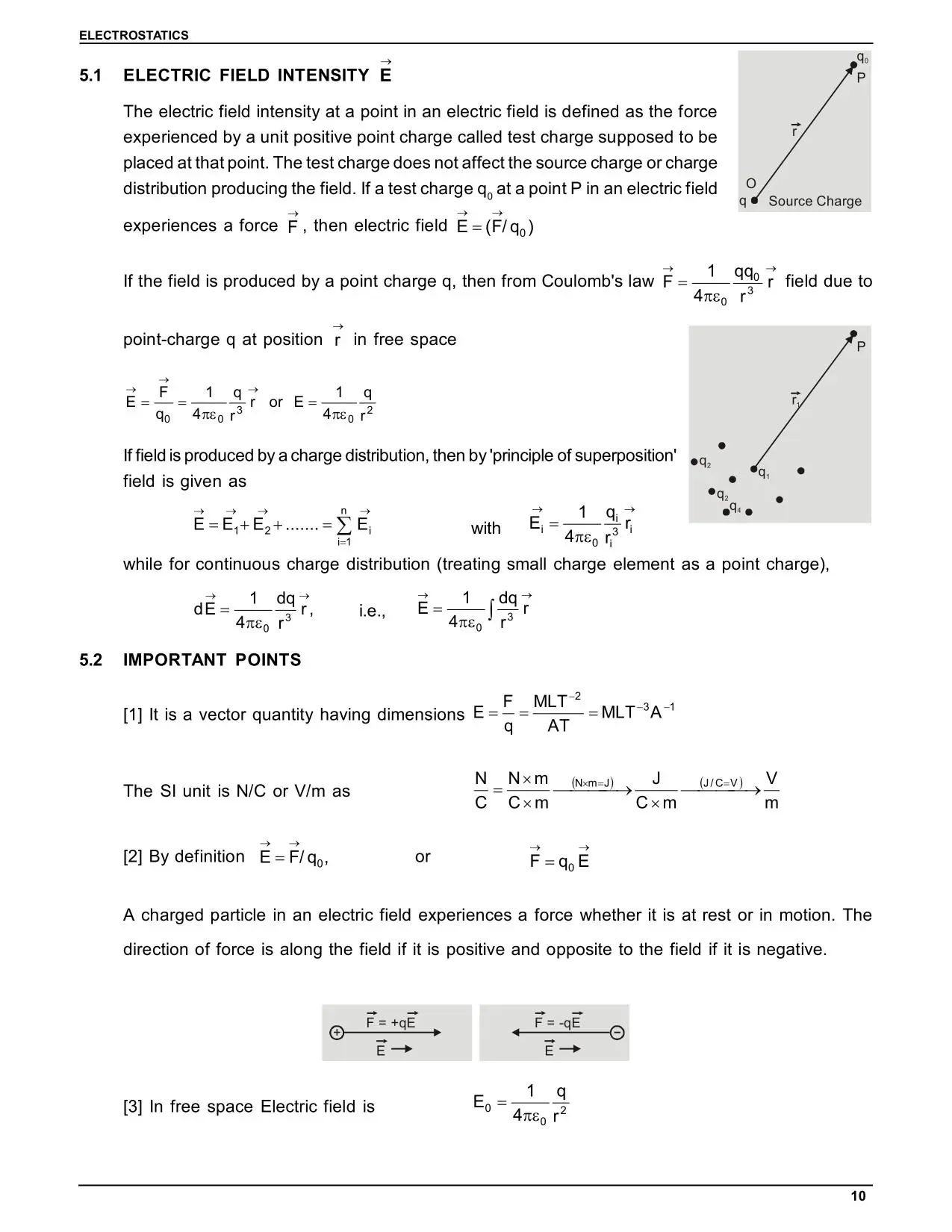
The electric field at a point is the force per unit positive test charge placed there, with the test charge made very small so that it does not disturb the source:
$$\vec{E} = \lim_{q \to 0}\frac{\vec{F}}{q}, \qquad \text{unit: N C}^{-1} \ (= \text{V m}^{-1})$$
For a point charge $q$ at a distance $r$:
$$\vec{E} = \frac{1}{4\pi\varepsilon_0}\,\frac{q}{r^{2}}\,\hat{r}$$
The field points away from a positive charge and towards a negative charge. For a system of charges, the field also obeys the superposition principle:
$$\vec{E} = \sum_i \frac{1}{4\pi\varepsilon_0}\,\frac{q_i}{r_i^{2}}\,\hat{r}_i$$
Physical significance: the field exists at a point whether or not a test charge is there. It is a vector quantity that depends on the position. A force $\vec{F} = q\vec{E}$ acts on any charge $q$ placed in the field.
Electric Field Lines
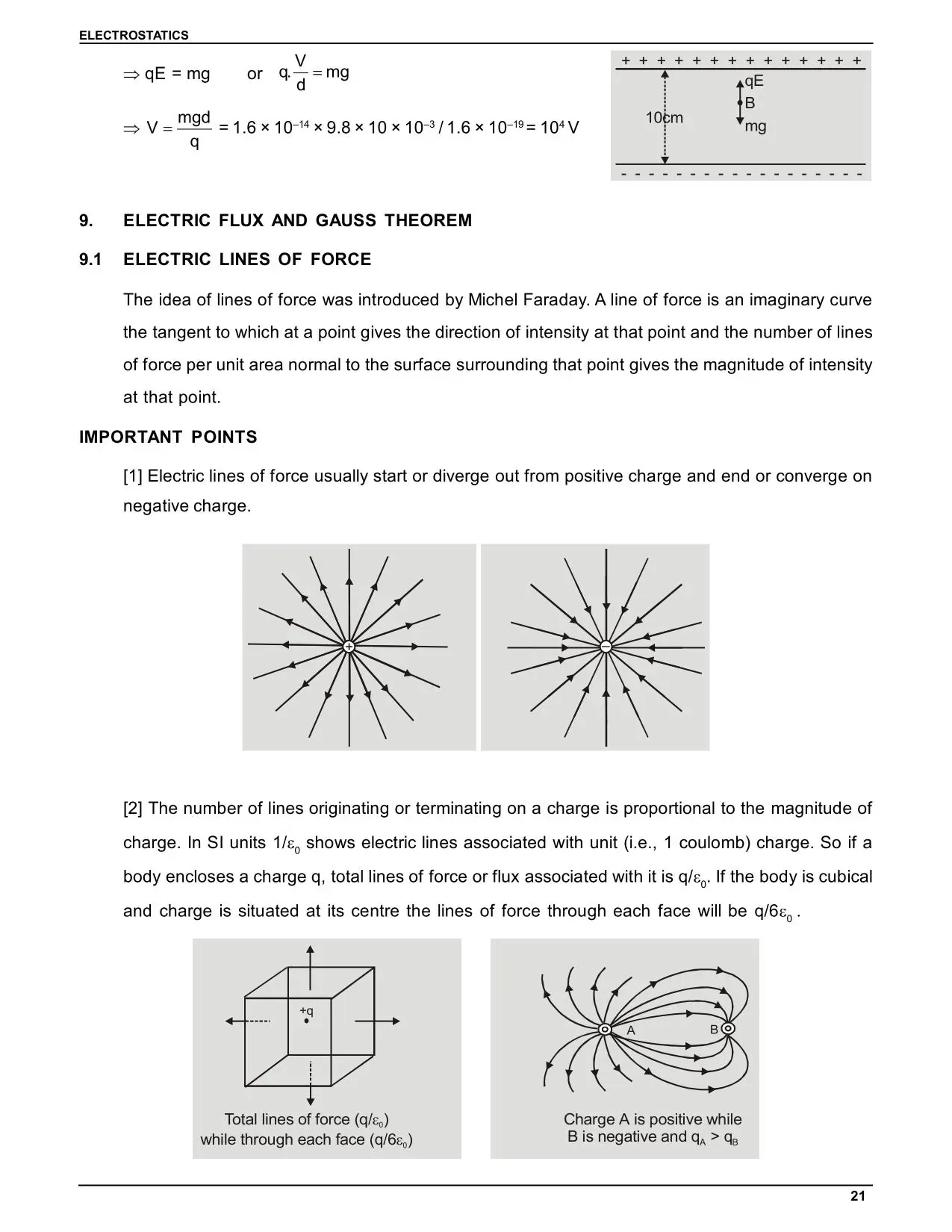
A field line is a curve whose tangent at each point gives the direction of the field there.
- Field lines are continuous curves without any break.
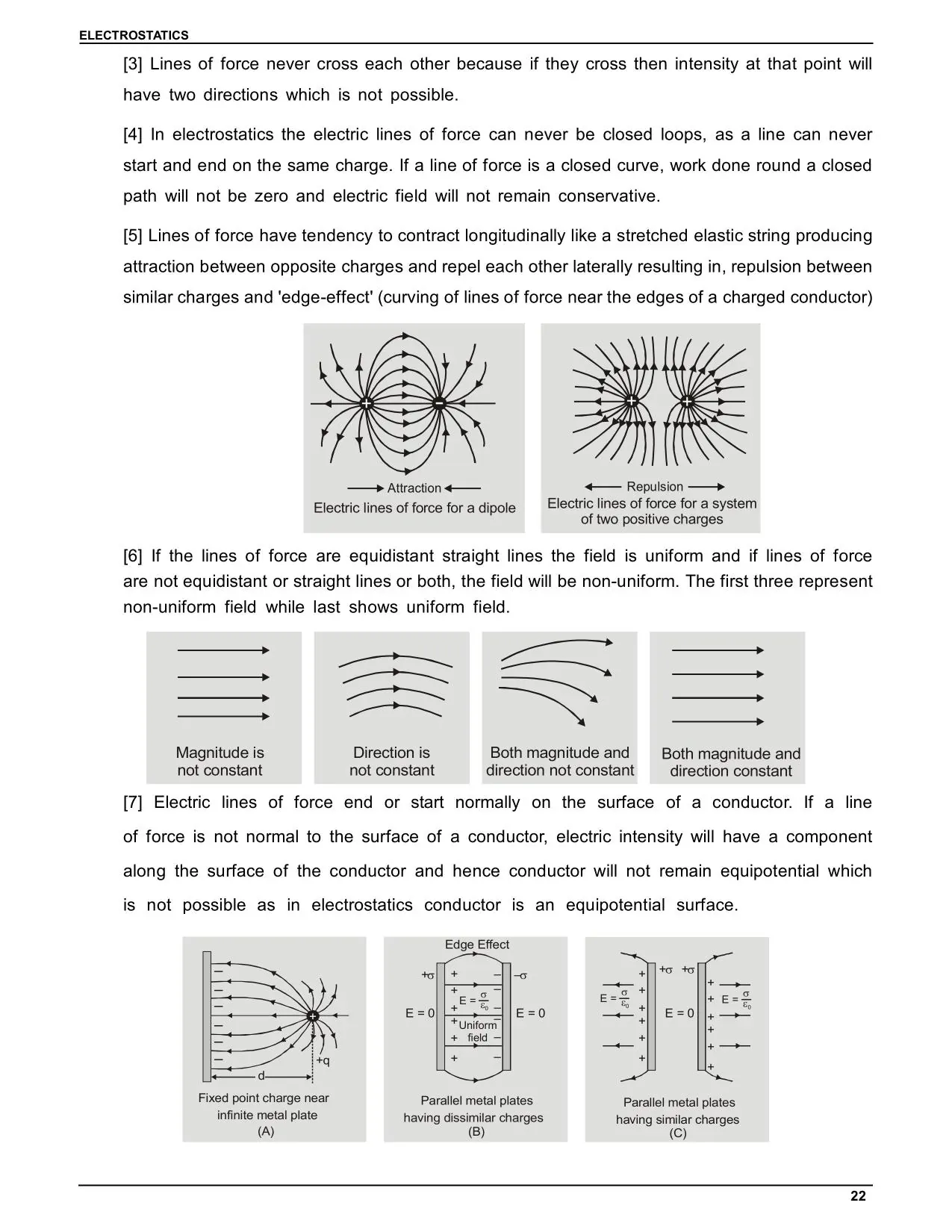
- Two field lines never cross, because the field would have two directions at the crossing point.
- Field lines start at positive charges and end at negative charges. They do not form closed loops.
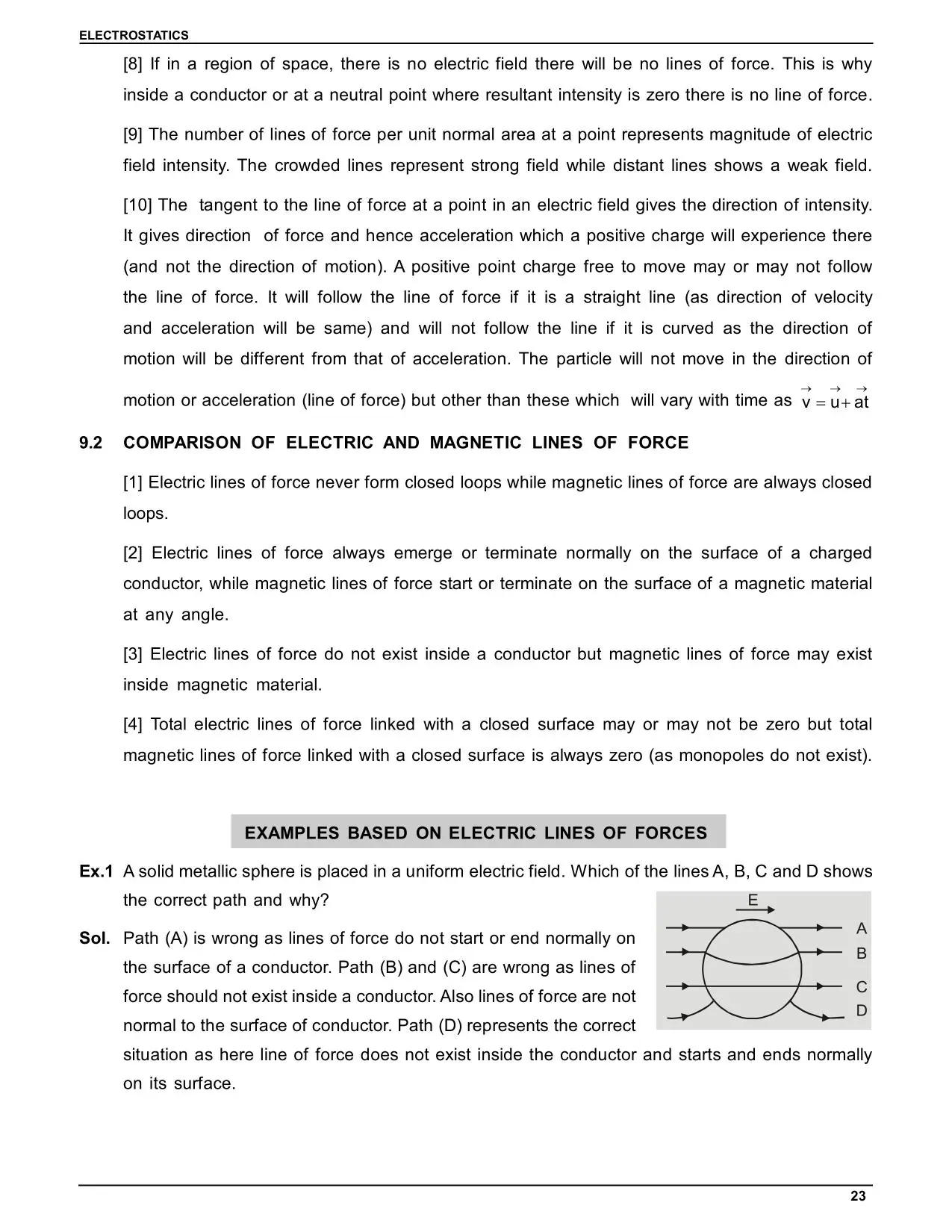
- Lines that are close together show a strong field, and lines that are far apart show a weak field. In a uniform field, the lines are equally spaced parallel straight lines.
Electric Flux in Electric Charges and Fields Class 12 Notes
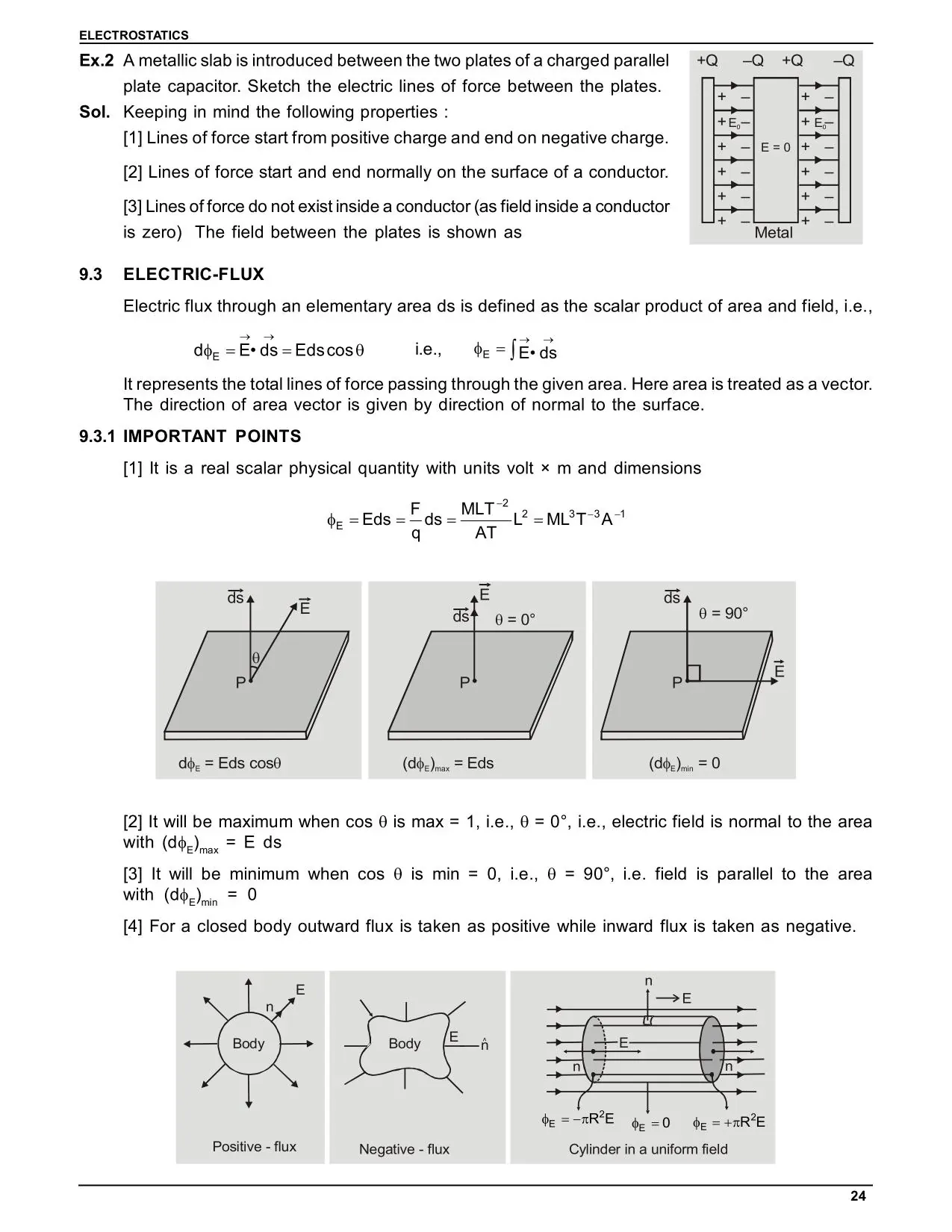
The flux through a small area element $\Delta\vec{S} = \Delta S\,\hat{n}$ is:
$$\Delta\phi = \vec{E}\cdot\Delta\vec{S} = E\,\Delta S\cos\theta$$
where $\theta$ is the angle between $\vec{E}$ and the normal $\hat{n}$. For a closed surface, $\hat{n}$ is the outward normal. Flux is a scalar. Its SI unit is $\text{N m}^2\text{C}^{-1}$ (or V m), and its dimensions are $[\text{ML}^3\text{T}^{-3}\text{A}^{-1}]$.
Electric Dipole in Electric Charges and Fields Class 12 Notes
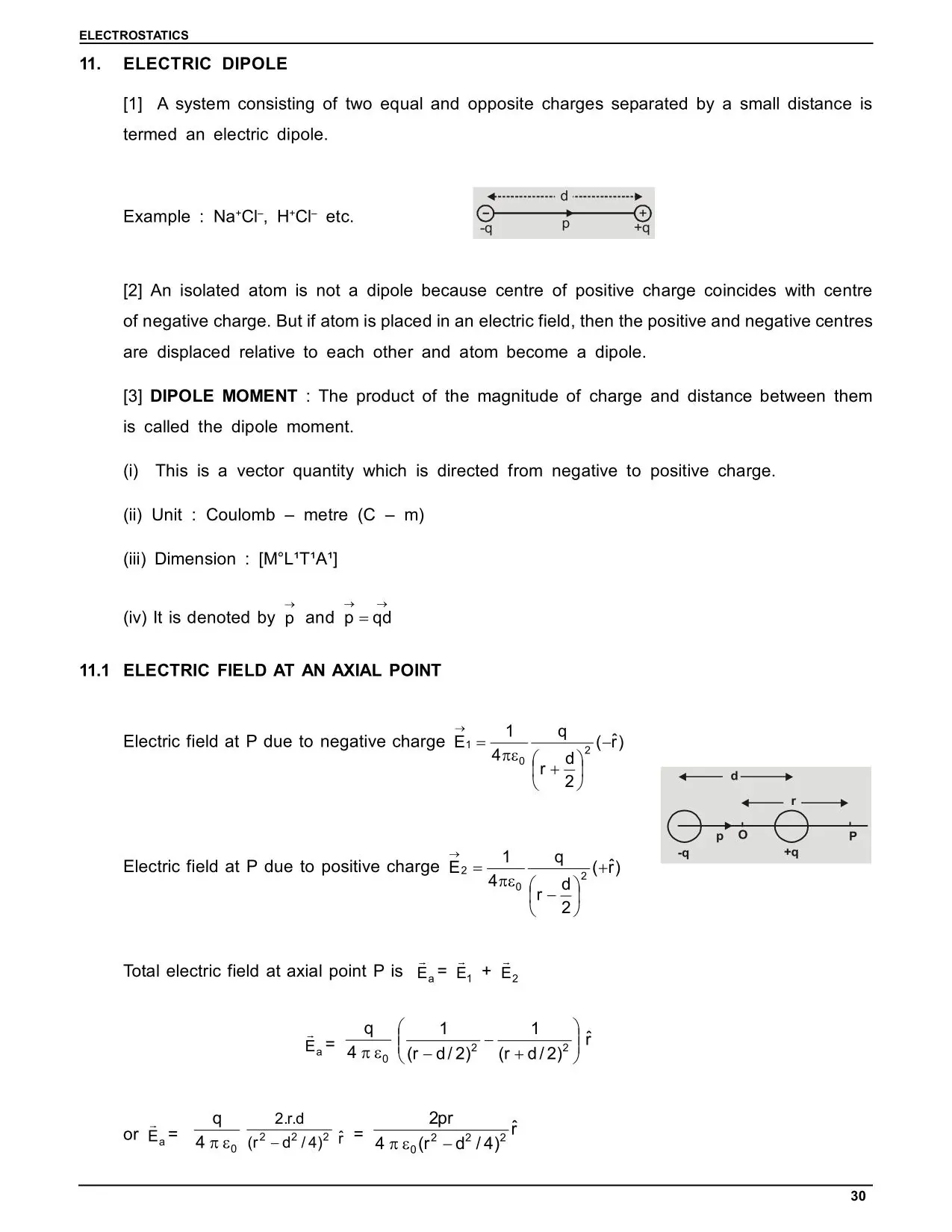
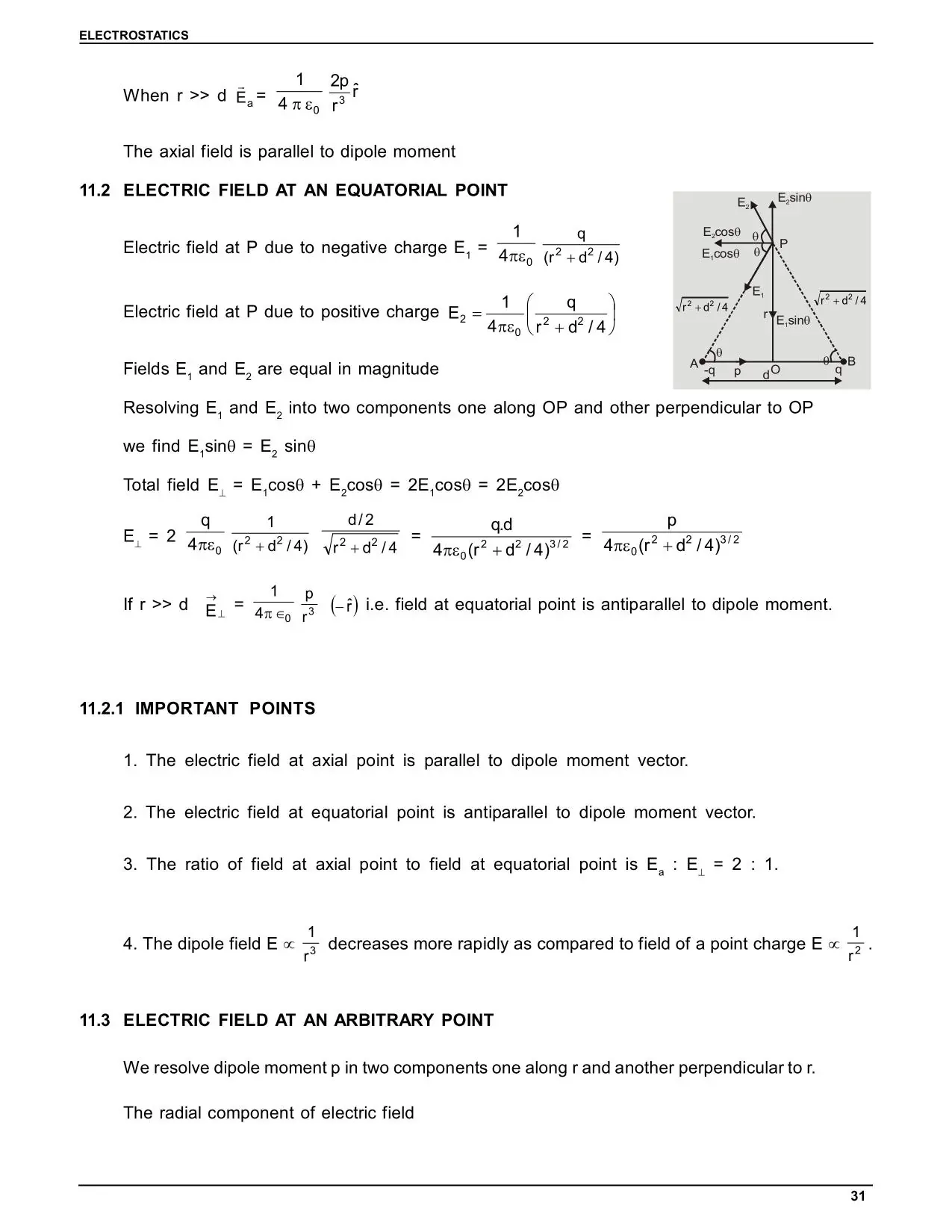
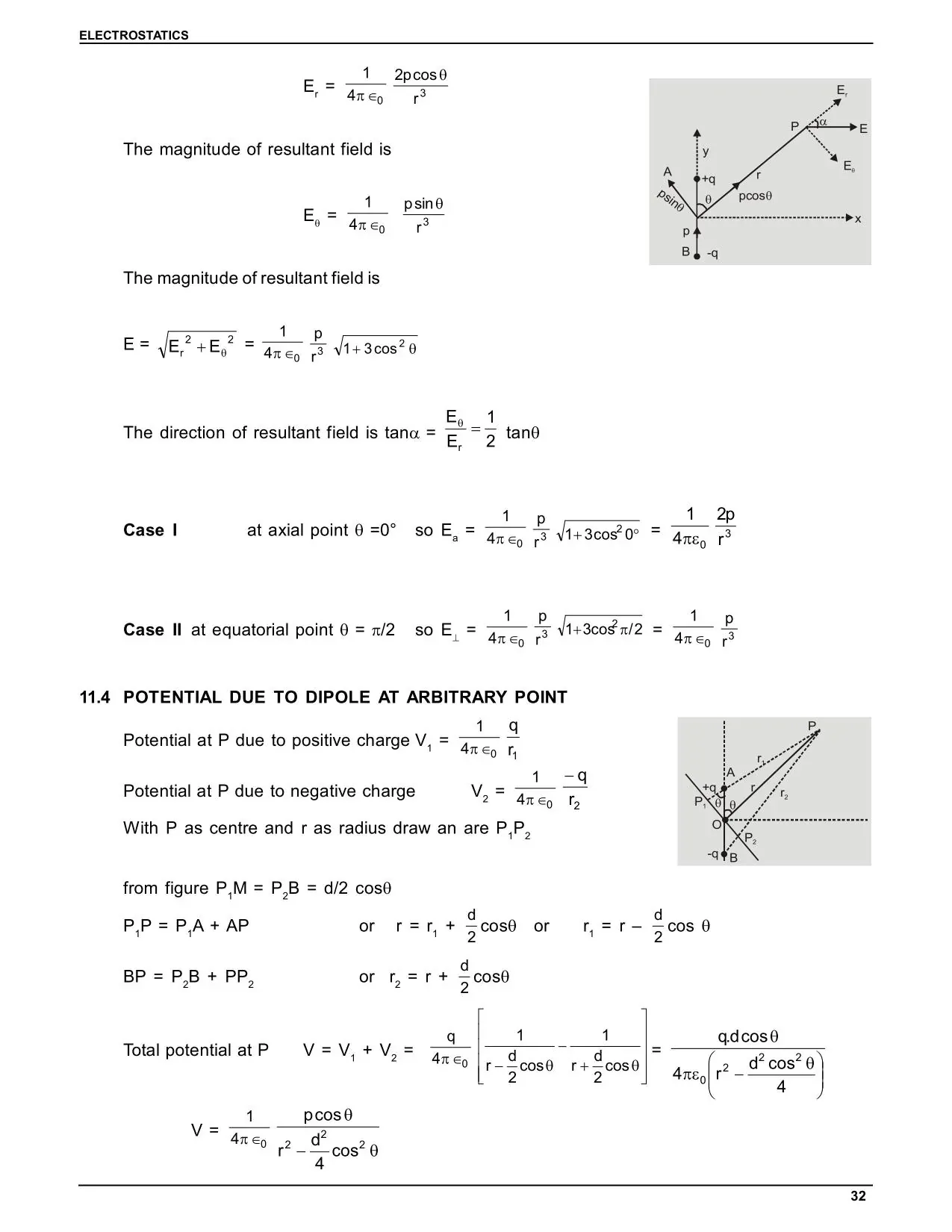
An electric dipole is a pair of equal and opposite charges $+q$ and $-q$ separated by a distance $2a$. Its dipole moment is a vector from $-q$ to $+q$:
$$\vec{p} = 2q a\,\hat{p}, \qquad p = 2qa \quad \text{(unit: C m)}$$
Point | Field of the dipole | For $r \gg a$ |
|---|---|---|
On the axis, at a distance $r$ from the centre | $E = \dfrac{1}{4\pi\varepsilon_0}\dfrac{2pr}{(r^{2} - a^{2})^{2}}$, along $\vec{p}$ | $E \approx \dfrac{1}{4\pi\varepsilon_0}\dfrac{2p}{r^{3}}$ |
On the equatorial plane, at a distance $r$ from the centre | $\vec{E} = -\dfrac{1}{4\pi\varepsilon_0}\dfrac{\vec{p}}{(a^{2} + r^{2})^{3/2}}$, opposite to $\vec{p}$ | $E \approx \dfrac{1}{4\pi\varepsilon_0}\dfrac{p}{r^{3}}$ |
The field of a dipole falls as $1/r^3$, faster than the $1/r^2$ field of a point charge. For $r \gg a$, the axial field is twice the equatorial field.
Dipole in a Uniform Electric Field
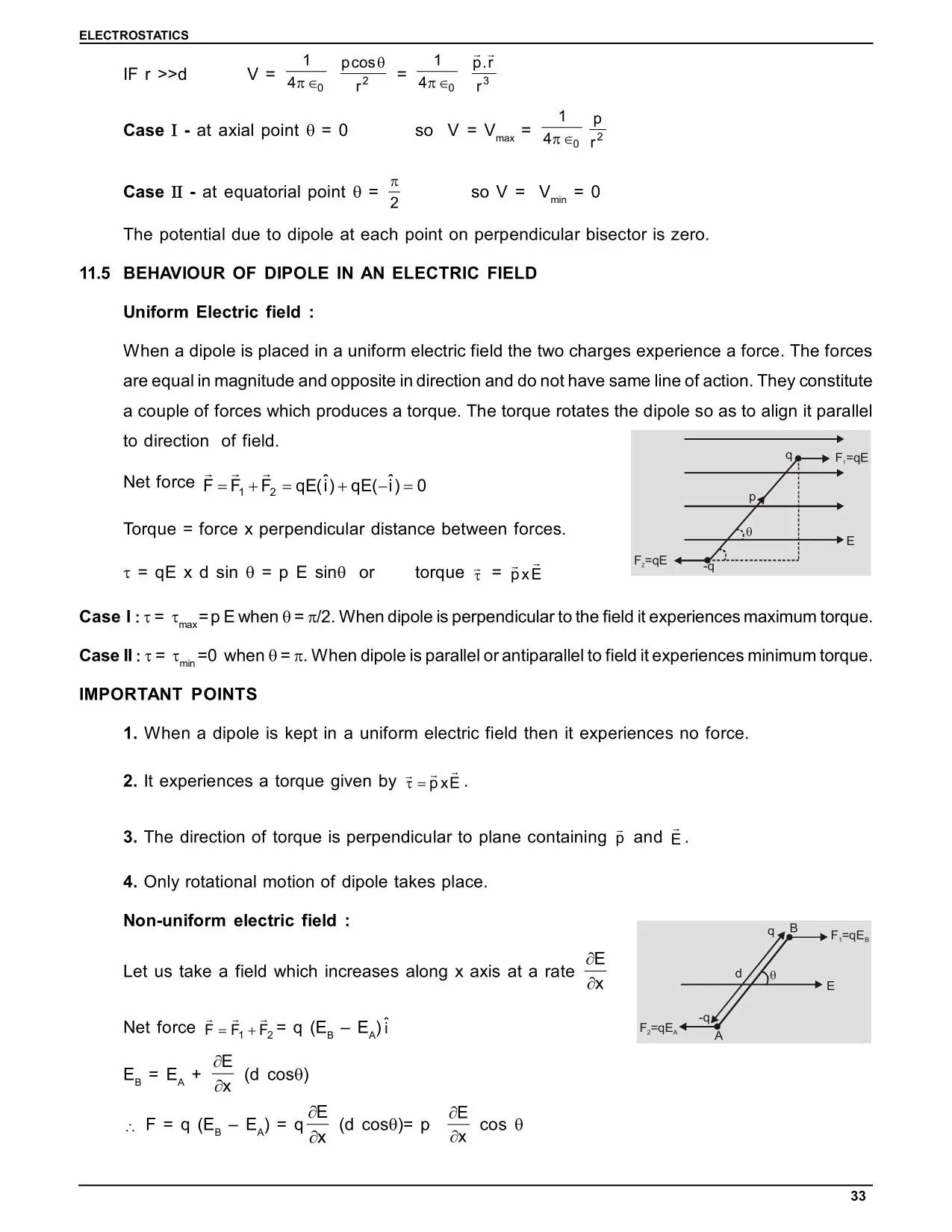
In a uniform field, the forces $q\vec{E}$ and $-q\vec{E}$ on the two charges cancel, so the net force is zero. They act at different points, so they form a torque:
$$\vec{\tau} = \vec{p} \times \vec{E}, \qquad \tau = pE\sin\theta$$
The torque tries to align the dipole with the field. It is zero when $\vec{p}$ is parallel or antiparallel to $\vec{E}$, and it is maximum when $\vec{p}$ is perpendicular to $\vec{E}$. In a non-uniform field, there is also a net force. This is why a charged comb attracts small pieces of paper: it polarises the paper, and the field is not uniform. The potential energy of a dipole in a field is studied in Chapter 2.
Continuous Charge Distribution in Electric Charges and Fields Class 12 Notes
When charge is spread over a line, a surface or a volume, use a charge density:
Distribution | Density | Unit |
|---|---|---|
Linear | $\lambda = \dfrac{\Delta q}{\Delta l}$ | C m⁻¹ |
Surface | $\sigma = \dfrac{\Delta q}{\Delta S}$ | C m⁻² |
Volume | $\rho = \dfrac{\Delta q}{\Delta V}$ | C m⁻³ |
The field is found by dividing the body into small elements $dq$ and adding their fields:
$$\vec{E} = \int \frac{1}{4\pi\varepsilon_0}\,\frac{dq}{r^{2}}\,\hat{r}$$
A common JEE result (beyond the NCERT text): for a uniformly charged ring of radius $R$ and total charge $Q$, the field on its axis at a distance $x$ from the centre is $E = \dfrac{1}{4\pi\varepsilon_0}\dfrac{Qx}{(R^2 + x^2)^{3/2}}$.
Gauss’s Law and Its Applications in Electric Charges and Fields Class 12 Notes
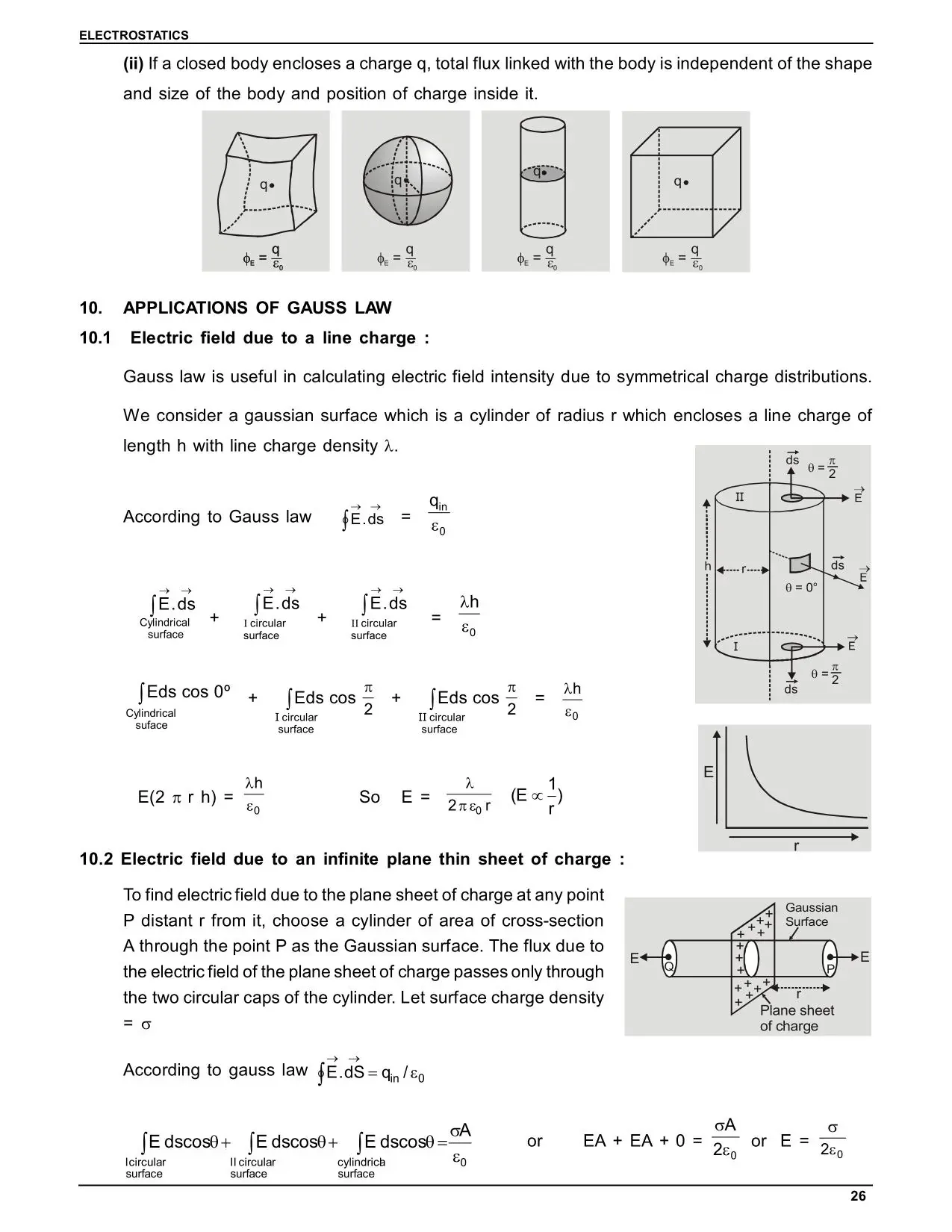
Gauss’s law: the flux of the electric field through any closed surface is $\dfrac{1}{\varepsilon_0}$ times the charge enclosed by the surface:
$$\phi = \oint \vec{E}\cdot d\vec{S} = \frac{q_{enc}}{\varepsilon_0}$$
Choose a Gaussian surface that matches the symmetry of the charge, so that $E$ is constant on it. Only the enclosed charge counts in $q_{enc}$, but $\vec{E}$ on the surface is due to all the charges.
Charge distribution | Electric field |
|---|---|
Infinitely long straight wire, uniform $\lambda$, at a distance $r$ | $E = \dfrac{\lambda}{2\pi\varepsilon_0 r}$, radially outward |
Infinite plane sheet, uniform $\sigma$ | $E = \dfrac{\sigma}{2\varepsilon_0}$, perpendicular to the sheet, on both sides, and independent of the distance |
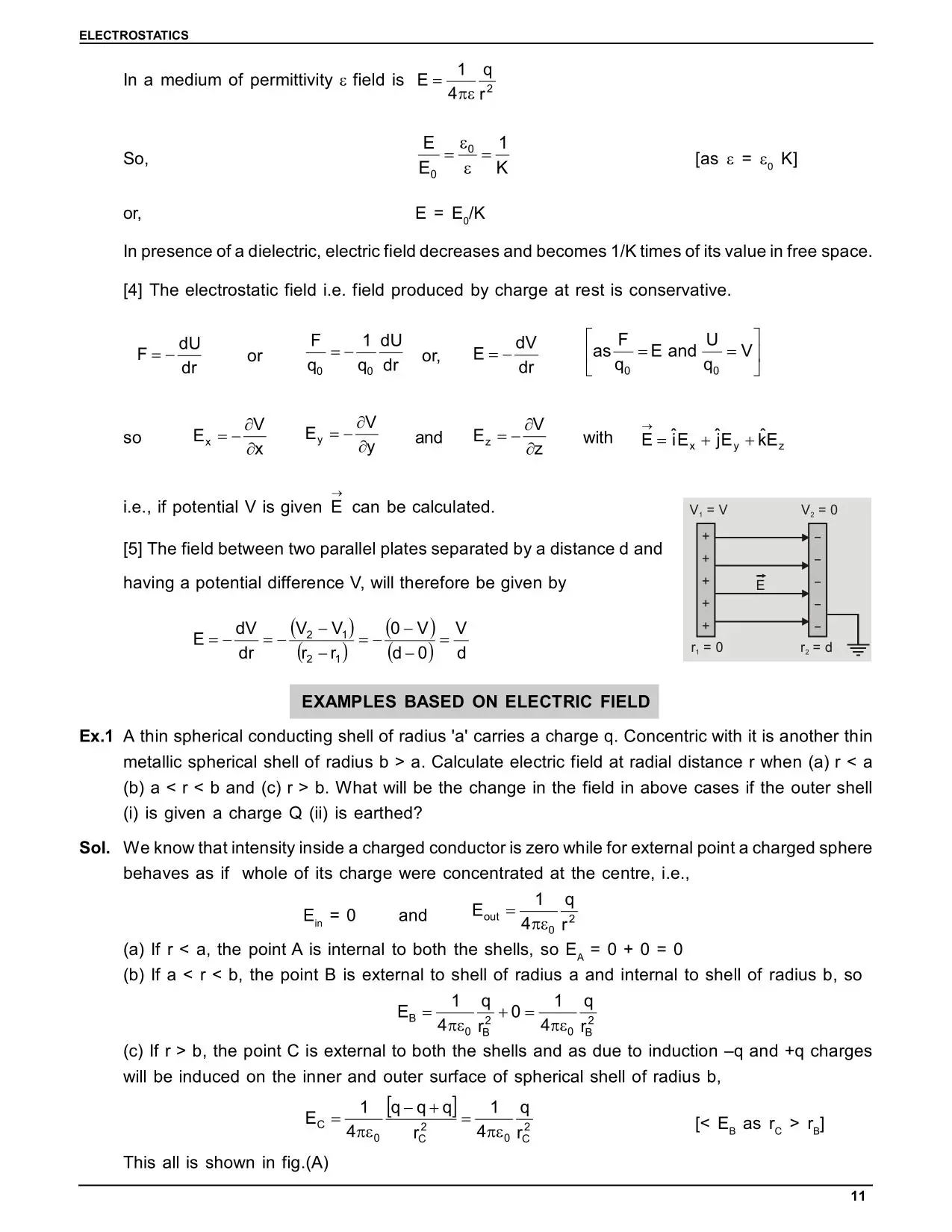
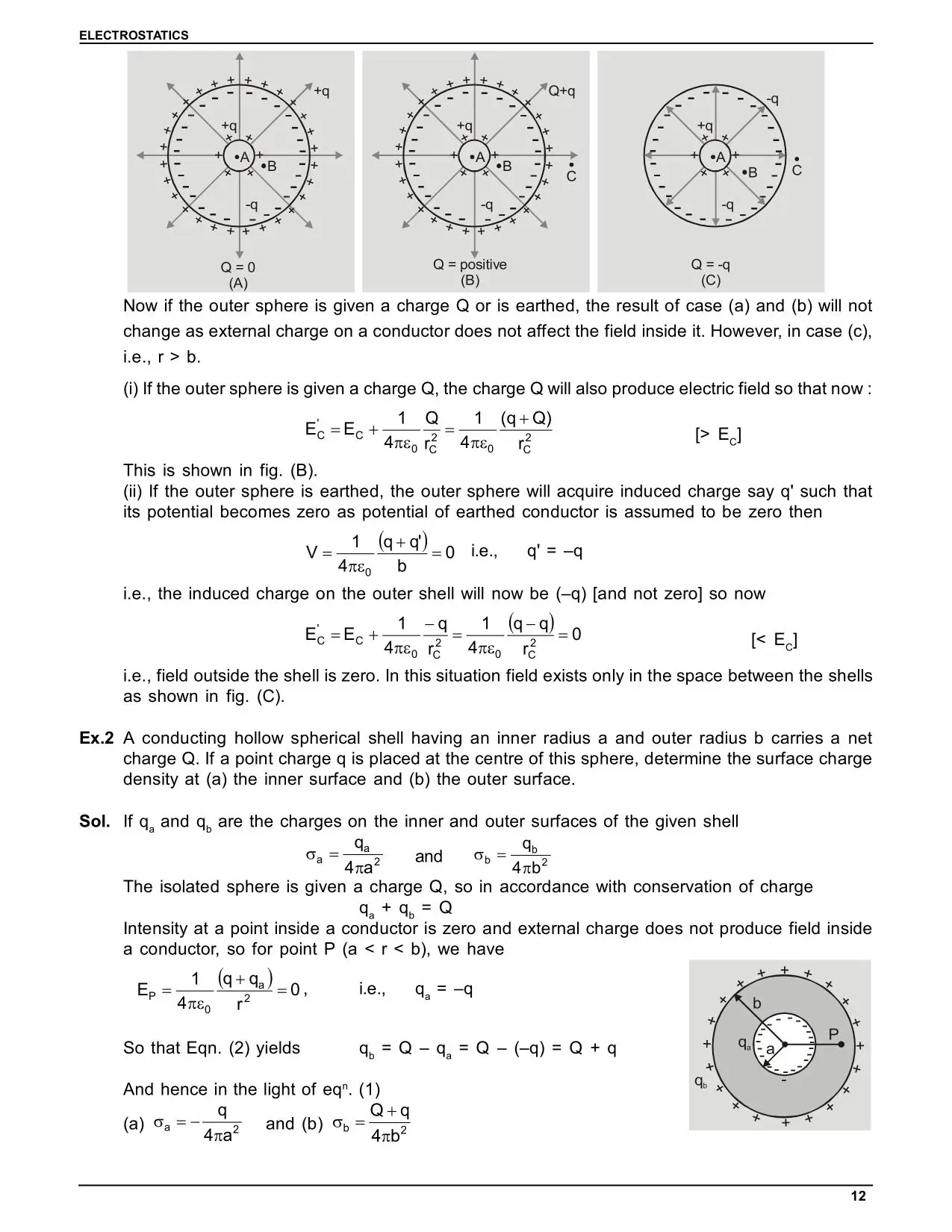
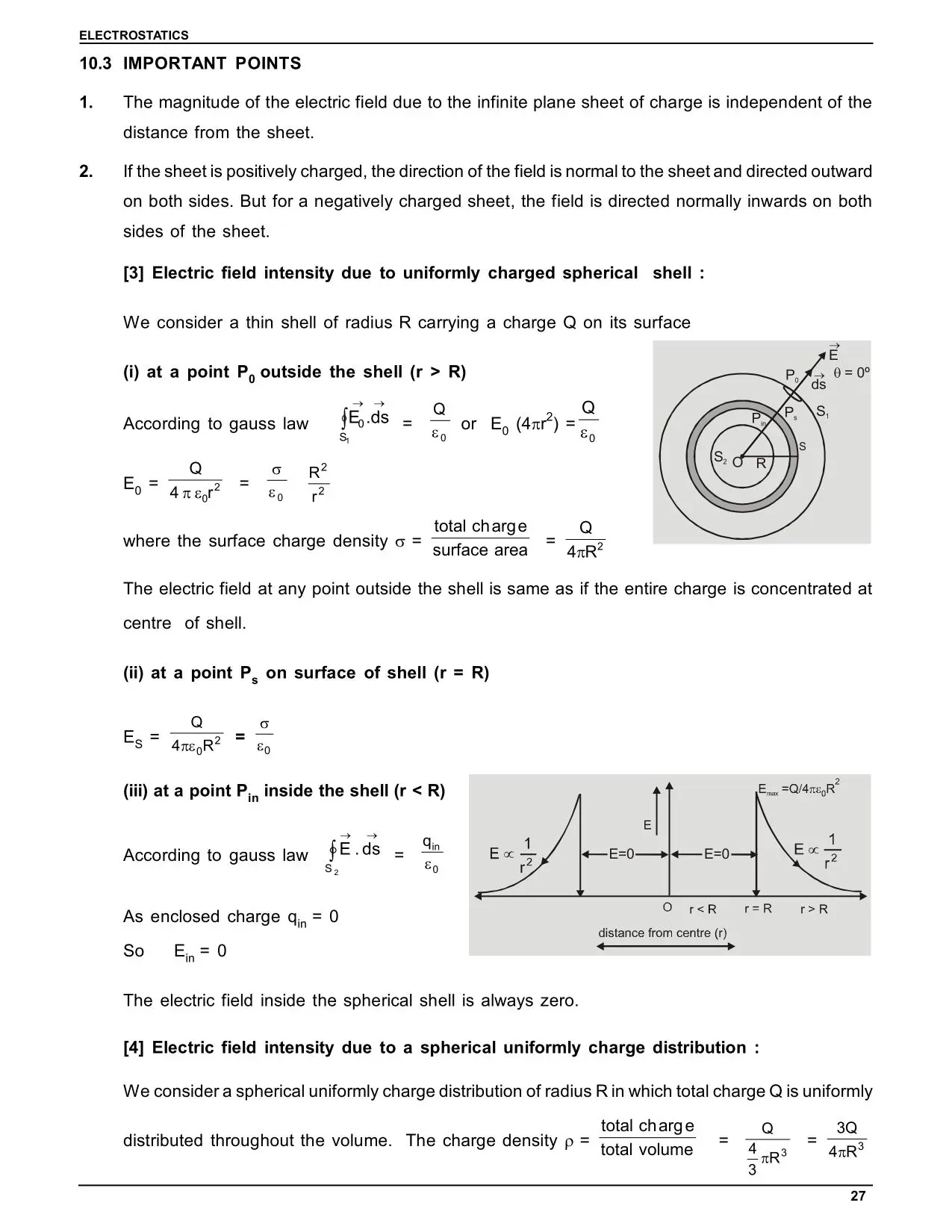
Thin spherical shell, radius $R$, total charge $q$: outside ($r \geq R$) | $E = \dfrac{1}{4\pi\varepsilon_0}\dfrac{q}{r^{2}}$, as if all the charge were at the centre |
Thin spherical shell: inside ($r < R$) | $E = 0$ |
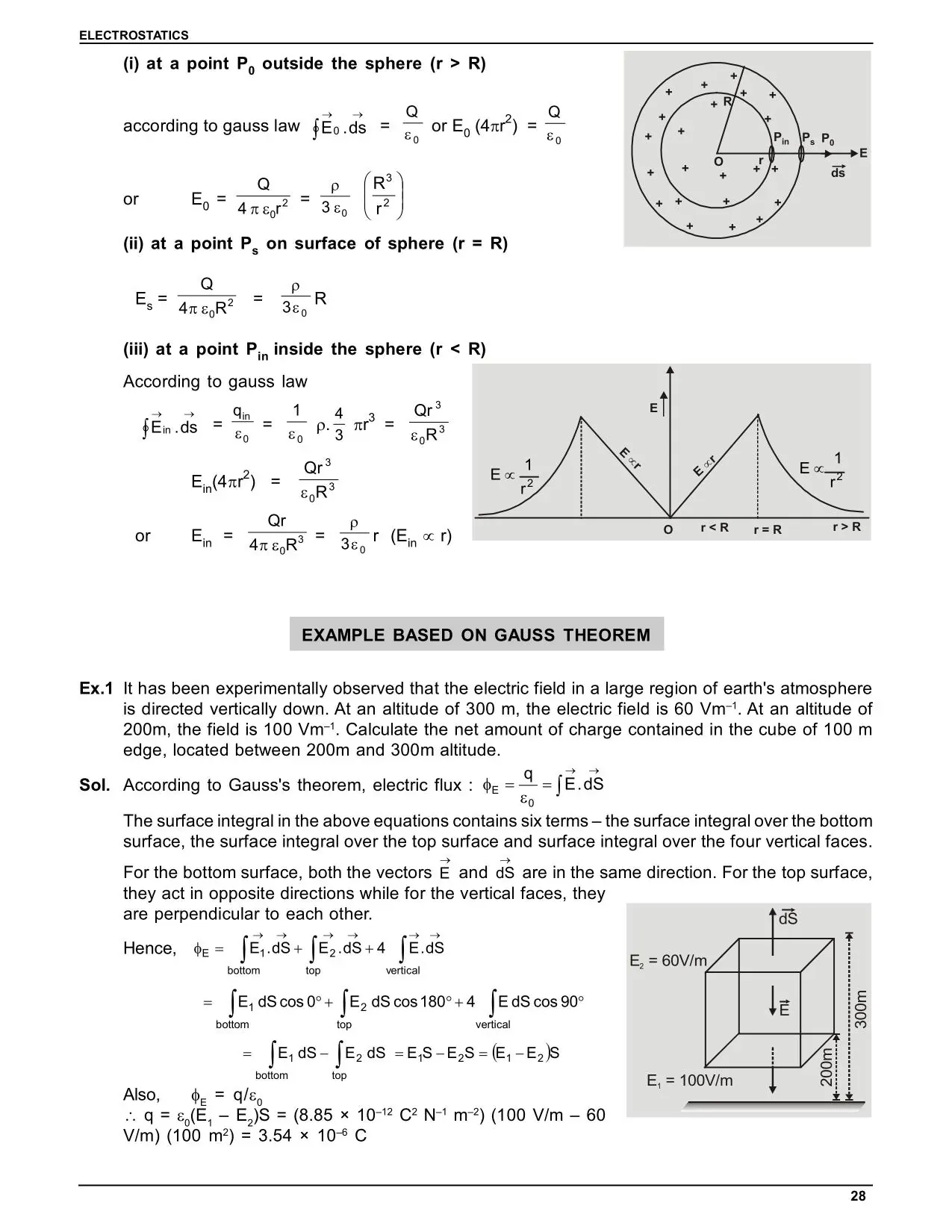
Uniformly charged solid sphere, inside ($r < R$), beyond NCERT | $E = \dfrac{\rho r}{3\varepsilon_0}$ |
For the shell, $q = 4\pi R^{2}\sigma$, and the field just outside the surface is $E = \dfrac{\sigma}{\varepsilon_0}$. The result for the outside of a shell is also true for a solid sphere of uniform volume charge density.
Key Formulas in Electric Charges and Fields Class 12 Notes
Concept | Formula |
|---|---|
Quantisation | $q = ne$, $e = 1.602 \times 10^{-19}$ C |
Coulomb’s law | $F = \dfrac{1}{4\pi\varepsilon_0}\dfrac{q_1 q_2}{r^2}$ |
Superposition | $\vec{F}_1 = \sum \vec{F}_{1j}$ |
Field of a point charge | $E = \dfrac{1}{4\pi\varepsilon_0}\dfrac{q}{r^2}$ |
Electric flux | $\Delta\phi = \vec{E}\cdot\Delta\vec{S}$ |
Dipole moment | $p = 2qa$ |
Axial field of a dipole ($r \gg a$) | $\dfrac{1}{4\pi\varepsilon_0}\dfrac{2p}{r^3}$ |
Equatorial field of a dipole ($r \gg a$) | $\dfrac{1}{4\pi\varepsilon_0}\dfrac{p}{r^3}$ |
Torque on a dipole | $\vec{\tau} = \vec{p}\times\vec{E}$ |
Gauss’s law | $\oint \vec{E}\cdot d\vec{S} = \dfrac{q_{enc}}{\varepsilon_0}$ |
Infinite wire | $E = \dfrac{\lambda}{2\pi\varepsilon_0 r}$ |
Infinite sheet | $E = \dfrac{\sigma}{2\varepsilon_0}$ |
Solved Examples from Electric Charges and Fields Class 12 Notes
Example 1 (quantisation): How many electrons make up a charge of $-2\ \mu$C?
$n = \dfrac{2 \times 10^{-6}}{1.6 \times 10^{-19}} = 1.25 \times 10^{13}$ electrons.
Example 2 (Coulomb’s law): Find the force between charges of $2\ \mu$C and $3\ \mu$C placed 30 cm apart in vacuum.
$F = \dfrac{9 \times 10^{9} \times 2 \times 10^{-6} \times 3 \times 10^{-6}}{(0.3)^2} = \dfrac{0.054}{0.09} = 0.6$ N, and it is repulsive.
Example 3 (superposition): Charges of $+3\ \mu$C at $x = 0$ and $-2\ \mu$C at $x = 0.1$ m lie on a line. Find the net force on a $+1\ \mu$C charge at $x = 0.2$ m.
Force due to the $+3\ \mu$C charge: $\dfrac{9 \times 10^{9} \times 3 \times 10^{-6} \times 1 \times 10^{-6}}{(0.2)^2} = 0.675$ N, along $+x$ (repulsion). Force due to the $-2\ \mu$C charge: $\dfrac{9 \times 10^{9} \times 2 \times 10^{-6} \times 1 \times 10^{-6}}{(0.1)^2} = 1.8$ N, along $-x$ (attraction). The net force is $0.675 - 1.8 = -1.125$ N, so it is 1.125 N towards $-x$.
Example 4 (field of a point charge): Find the electric field at 0.3 m from a charge of 5 nC.
$E = \dfrac{9 \times 10^{9} \times 5 \times 10^{-9}}{(0.3)^2} = 500$ N/C.
Example 5 (field of a dipole): A dipole has charges $\pm 2$ nC separated by 1 cm. Find the axial and equatorial fields at 0.5 m from its centre.
$p = 2 \times 10^{-9} \times 0.01 = 2 \times 10^{-11}$ C m. Since $r \gg a$, $E_{axial} = \dfrac{2 \times 9 \times 10^{9} \times 2 \times 10^{-11}}{(0.5)^3} = 2.88$ N/C, and $E_{equatorial} = 1.44$ N/C.
Example 6 (torque on a dipole): A dipole with $p = 4 \times 10^{-9}$ C m is placed at 30° to a uniform field of $5 \times 10^{4}$ N/C. Find the torque.
$\tau = pE\sin\theta = 4 \times 10^{-9} \times 5 \times 10^{4} \times 0.5 = 1 \times 10^{-4}$ N m.
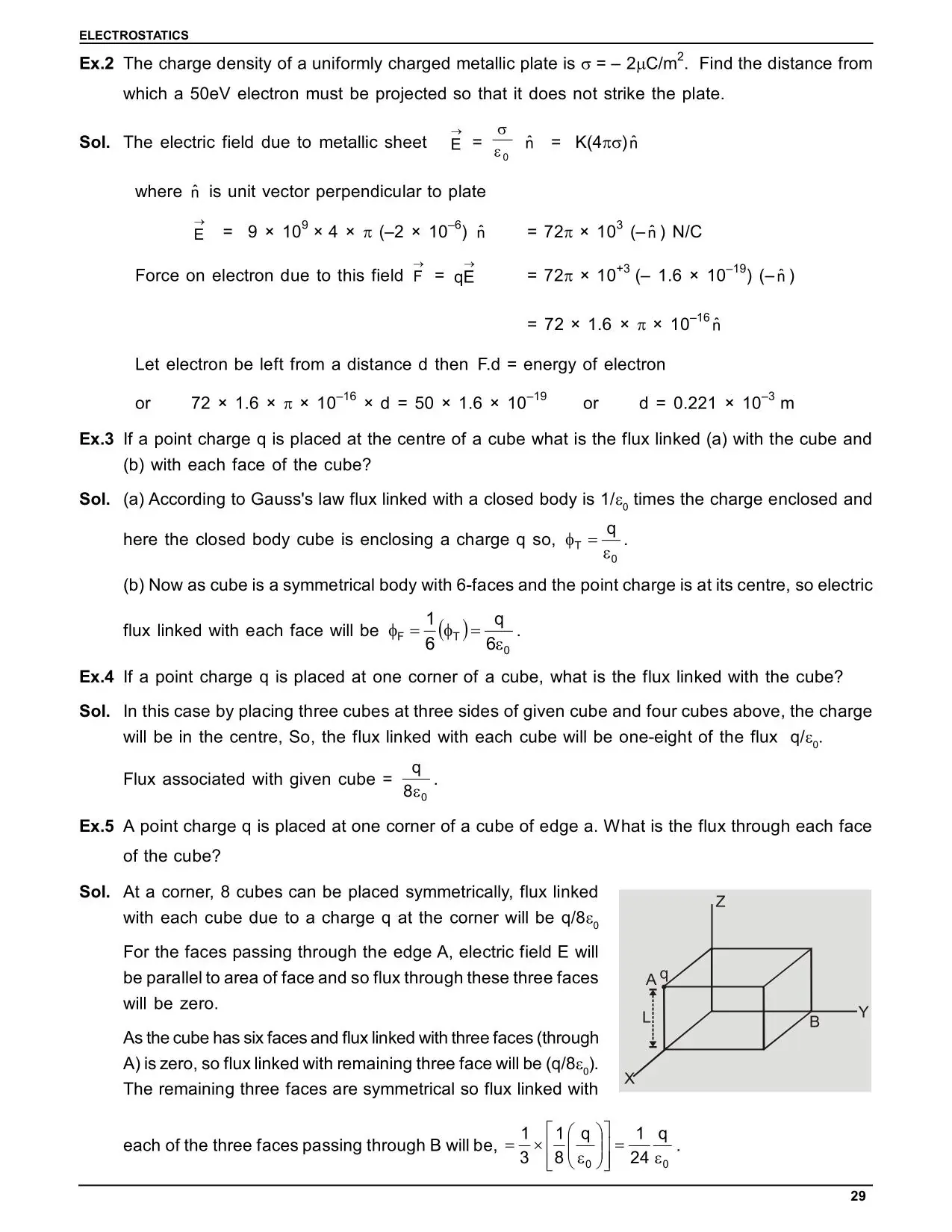
Example 7 (Gauss’s law and flux): A charge of $2\ \mu$C is at the centre of a cube. Find the flux through the cube and through one face.
$\phi = \dfrac{q}{\varepsilon_0} = \dfrac{2 \times 10^{-6}}{8.854 \times 10^{-12}} \approx 2.26 \times 10^{5}$ N m²/C. Each face gets one sixth, which is about $3.77 \times 10^{4}$ N m²/C.
Example 8 (infinite sheet): An infinite sheet has $\sigma = 4\ \mu$C m⁻². Find the field near it.
$E = \dfrac{\sigma}{2\varepsilon_0} = \dfrac{4 \times 10^{-6}}{2 \times 8.854 \times 10^{-12}} \approx 2.26 \times 10^{5}$ N/C.
Example 9 (thin spherical shell): A thin shell of radius 10 cm carries a charge of $6\ \mu$C. Find the field at 5 cm, 10 cm and 20 cm from the centre.
At 5 cm (inside), $E = 0$. At 10 cm (on the surface), $E = \dfrac{9 \times 10^{9} \times 6 \times 10^{-6}}{(0.1)^2} = 5.4 \times 10^{6}$ N/C. At 20 cm, $E = \dfrac{9 \times 10^{9} \times 6 \times 10^{-6}}{(0.2)^2} = 1.35 \times 10^{6}$ N/C.
Example 10 (infinite wire): A long wire has a charge of $2\ \mu$C per metre. Find the field at 0.5 m from it.
$E = \dfrac{\lambda}{2\pi\varepsilon_0 r} = \dfrac{2 \times 9 \times 10^{9} \times 2 \times 10^{-6}}{0.5} = 7.2 \times 10^{4}$ N/C.
Common Mistakes in Electric Charges and Fields Class 12 Problems
Mistake | Correct approach |
|---|---|
Adding forces or fields as plain numbers | Add them as vectors, with the directions |
Using $F = kq_1q_2/r$ | The force falls as $1/r^2$ |
Thinking that field lines can cross or form closed loops | They never cross, and electrostatic field lines do not form loops |
Counting only the enclosed charge for $\vec{E}$ in Gauss’s law | $q_{enc}$ is only the enclosed charge, but $\vec{E}$ is due to all the charges |
Saying that a dipole feels a net force in a uniform field | The net force is zero, and only a torque acts |
Using $E = \dfrac{\sigma}{2\varepsilon_0}$ for a conductor surface | For the surface of a charged conductor, $E = \dfrac{\sigma}{\varepsilon_0}$ |
Thinking that the field of an infinite sheet falls with distance | It is constant and independent of the distance |
Using the field outside a shell for a point inside it | Inside a thin shell, $E = 0$ |
How to Study Electric Charges and Fields Class 12 Notes
- Read the NCERT chapter first, and download the textbook from eSaral’s NCERT Class 12 Physics book page.
- Learn the formula tables in this page, and write the field results of the wire, the sheet and the shell from memory.
- Practise vector problems: draw the charges, and add the forces. Then practise one Gauss’s law problem a day, choosing the Gaussian surface first.
- Use eSaral’s Complete Class 12 Physics notes for all the chapters, and the free Physics revision series on YouTube for quick formula revision.
- When you finish this chapter, move on to eSaral’s Current Electricity Class 12 notes, and test yourself with eSaral’s JEE Main chapter-wise PYQs and NEET chapter-wise PYQs.
Click Here for Complete Physics Revision Series by Saransh Gupta Sir (AIR-41). About Saransh Gupta Sir: Computer Science Graduate from IIT Bombay. Cracked IIT-JEE with AIR-41 and AIEEE (JM) with AIR-71 in 2006. He is the author of the JEE Mentorship Book “StrateJEE”. He taught Physics for 5 years at Allen and was loved immensely by all the students. Many of his students bagged success with flying colours in JEE & NEET Exams. eSaral brings you detailed Class 11th Physics study material. eSaral provides a series of detailed chapter-wise notes for all the Subjects of class 11th and 12th. These notes will also help you in your IIT JEE & NEET preparations. Also read NCERT Class 12 Chapterwise Physics Book PDF, NCERT Class 12 Chapterwise Physics Book Hindi PDF, and NCERT Class 12 Chapterwise Physics Exemplar PDF. We hope these Physics Notes for Class 12 will help you understand the important topics and remember the key points from an exam point of view. For free video lectures and complete study material, download the eSaral APP. About eSaral: At eSaral, we are offering a complete platform for IIT-JEE & NEET preparation. The main mission behind eSaral is to provide education to each and every student in India by eliminating the Geographic and Economic factors, as a nation’s progress and development depend on the availability of quality education to everyone. With the blend of education & technology, the eSaral team made the learning personalized & adaptive for everyone.
Frequently Asked Questions
What does Coulomb's Law state?
Coulomb’s law states that the electrostatic force between two point charges is directly proportional to the product of the charges and inversely proportional to the square of the distance between them, $F = \dfrac{1}{4\pi\varepsilon_0}\dfrac{q_1 q_2}{r^2}$, where $\dfrac{1}{4\pi\varepsilon_0} \approx 9 \times 10^9$ N m² C⁻². The force acts along the line joining the charges. eSaral’s Electric Charges and Fields notes show it in vector form.
What are the three basic properties of electric charge?
In Electric Charges and Fields, the three basic properties of charge are additivity (the total charge is the algebraic sum), conservation (the total charge of an isolated system does not change) and quantisation ($q = ne$, with $e = 1.602 \times 10^{-19}$ C). Charge is a scalar, and for macroscopic charges, quantisation can be ignored.
What is an electric dipole, and how does it behave in a uniform field?
An electric dipole is a pair of equal and opposite charges $\pm q$ separated by $2a$, with the dipole moment $p = 2qa$ directed from $-q$ to $+q$. In a uniform field, the net force is zero, and the torque is $\vec{\tau} = \vec{p}\times\vec{E}$. In Electric Charges and Fields Class 12 Notes, this torque tries to align the dipole with the field.
What are the properties of electric field lines?
Field lines are continuous, they never cross, they start at positive charges and end at negative charges, and they do not form closed loops. Their closeness shows the strength of the field. In a uniform field, they are parallel and equally spaced.
What is Gauss’s law, and when should you use it?
Gauss’s law says that the flux of the electric field through a closed surface is $q_{enc}/\varepsilon_0$. Use it when the charge distribution has spherical, cylindrical or planar symmetry, such as an infinite wire, an infinite sheet or a thin spherical shell. In these cases, Gauss’s law gives the field with much less work than Coulomb’s law, as the Electric Charges and Fields Class 12 Notes on eSaral show.
What is electric flux, and what is its unit?
In Electric Charges and Fields Class 12 Notes, the electric flux through a small area is $\Delta\phi = \vec{E}\cdot\Delta\vec{S} = E\,\Delta S\cos\theta$. It is a scalar, and its SI unit is N m² C⁻¹ (equivalently V m). For a closed surface, the outward normal is used.
What is the electric field inside and outside a charged spherical shell?
Inside a thin uniformly charged spherical shell, the field is zero. Outside it (for $r \geq R$), the field is $\dfrac{1}{4\pi\varepsilon_0}\dfrac{q}{r^2}$, as if all the charge were at the centre. On the surface, the field is $\sigma/\varepsilon_0$.
Which chapter number is Electric Charges and Fields in Class 12 Physics?
In the NCERT Class 12 Physics book (Part I), Electric Charges and Fields is Chapter 1. In the JEE Main 2026 syllabus, it is part of Unit 11, Electrostatics. These Electric Charges and Fields Class 12 Notes follow the NCERT chapter. The number of questions in JEE Main and NEET changes every year, so check previous years’ papers.
Where can I find more Class 12 Physics notes on eSaral?
eSaral has chapter-wise Class 12 Physics notes, NCERT books, JEE Main and NEET chapter-wise PYQs, a free Physics revision series on YouTube and these Electric Charges and Fields Class 12 Notes, all linked on this page.
Team eSaral
eSaral Academic and Editorial Team
Team eSaral is the collective author profile for educational content created by eSaral’s teachers and academic contributors. The team draws on expertise from IIT graduates, doctors, experienced educators and subject specialists to develop resources for JEE, NEET and school students. Our articles aim to explain concepts clearly and help students study with confidence.
Related Posts

BITSAT 2027: Registration Date, Exam Date, Syllabus, Eligibility, Pattern & Fees
BITSAT 2027 exam dates, registration timeline, eligibility criteria, exam pattern, marking scheme, syllabus and fees in one page.

BITSAT Previous Year Question Paper PDF (2017-2026)
Download BITSAT previous year question papers PDF from 2017 to 2026,session-wise. Memory-based papers,exam pattern, paper analysis and how to practise

CBSE Class 10 Date Sheet 2027: Expected Exam Dates, Release Date, Admit Card & Result Timeline
CBSE Class 10 date sheet 2027 is awaited. See the expected exam dates, release window, how to download the PDF, admit card and result timelines.

NCERT Physics Class 10 Book PDF in Hindi 2026-27 – भौतिक विज्ञान के 4 अध्याय (Free Download)
NCERT Physics Class 10 book PDF in Hindi 2026-27: download all 4 chapters (अध्याय 9–12) free, with topics and important formulas.

NCERT Biology Class 9 Book Anveshan PDF in Hindi - जीव विज्ञान कक्षा 9 पुस्तक अन्वेषण PDF
Download NCERT Biology Class 9 book PDF in Hindi chapterwise for 2026-27: Cell, Tissues, Reproduction and Diversity. Free PDFs.

Essay On Artificial Intelligence in English (100,150, 200, 250, 300, 500 Words)
This is in contrast to the natural intelligence of humans. With Artificial Intelligence, machines can perform

Essay on 78th India Independence Day in English for Student (100, 150, 200, 250, 300, 500 Words)
Read the best essays on India's Independence Day in English. Short & long essays (100, 150, 200, 250, 300, 500 words) perfect for school exams
NCERT Class 11 English Snapshots book - Free PDF download- Esaral
Download NCERT Class 11 English Snapshots book PDF for free. Get all 8 chapters, chapter-wise. Start your prep today!
NCERT Class 10 biology book pdf - Free PDF Download - eSaral
NCERT Class 10 Biology book PDF 2026-27: all 5 chapters (Life Processes to Our Environment) in English & Hindi, with CBSE syllabus, marks & practical

Essay on Global Warming in English (100,150, 200, 250, 300, 500 Words)
Global warming means the Earth is getting hotter. This happens because of things like pollution from cars and factories.