
Essay on Importance of Education: 10 Lines and 100–500 Words

eSaral Academic and Editorial Team
Summary
Education is the process of gaining knowledge, skills, values and critical thinking that help people earn better, live healthier, take part in democracy and move a nation forward. This eSaral essay on importance of education gives 10 lines and sample essays from 100 to 500 words for Class 3 to Class 12, with key India facts, types of education and FAQs.
Looking for an essay on importance of education? Education shapes how we think, work and live. Here you will find ready-to-use samples for every class, along with key points and facts that help you write a better answer in exams. Use them as models and always write in your own words.
Key Points: Importance of Education Quick Reference
Use these points on the importance of education as the backbone of any essay, whatever the word limit.
Point | Detail |
|---|---|
Definition | Process of gaining knowledge, skills, values and attitudes |
Famous quote | “Education is the most powerful weapon which you can use to change the world.” (Nelson Mandela) |
India literacy rate | 80.9% (PLFS 2023-24); male 87.2%, female 74.6% |
RTE Act | Passed in 2009: free and compulsory education for ages 6 to 14 |
Article 21A | Makes education a fundamental right (added in 2002) |
NEP 2020 | Replaced the 10+2 structure with 5+3+3+4 |
Girls’ education | Beti Bachao Beti Padhao (2015) |
School meals | Mid-Day Meal Scheme, now PM POSHAN |
Class 10 to 11 transition | About 75.1% (UDISE+ 2024-25) |
Types of education | Formal, informal and non-formal |
Importance of education in economy | Education builds human capital, productivity and national income |
Impact on gender equality | One of the strongest ways to reduce the gender gap |
10 Lines on Importance of Education
- Education is the process of learning knowledge, skills and values that shape our personality and future.
- Nelson Mandela said, “Education is the most powerful weapon which you can use to change the world.”
- Education helps us get good jobs and lead a financially secure life.
- It develops our ability to think critically, solve problems and make better decisions.
- Educated citizens are essential for the progress of any nation.
- In India, the Right to Education Act (2009) guarantees free and compulsory education to children between 6 and 14 years.
- Education reduces poverty by opening doors to better employment.
- It promotes gender equality by helping girls and women take part equally in society.
- Education makes us aware of our rights, responsibilities and the world around us.
- No matter who we are or where we come from, education gives everyone a chance to improve their life.
Short Essay on Importance of Education in 100 Words (Class 3 & 4)
The importance of education in a person’s life is very big. It teaches us to read, write and think. With education, we can get good jobs and live a better life. It also teaches us honesty, kindness and respect for others.
Nelson Mandela said, “Education is the most powerful weapon which you can use to change the world.” In India, every child between 6 and 14 years has the right to free education under the Right to Education Act. When every child goes to school, the whole country becomes stronger. Education is truly the key to a bright future.
Essay on Importance of Education in 150 Words (Class 5)
The importance of education begins with a simple fact: it is the foundation of a successful and meaningful life. It gives us the knowledge and skills we need to understand the world, earn a living and help others. Without education, it is very difficult to achieve our goals.
In India, the government has taken many steps to make education available to everyone. The Right to Education Act (2009) ensures that children between 6 and 14 years of age receive free and compulsory education. The Mid-Day Meal Scheme, now called PM POSHAN, has helped more children attend school, especially in rural areas.
Education is not only about getting a degree. It also teaches us discipline, responsibility and the ability to tell right from wrong. It helps girls and women stand on their own feet and take part equally in society.
Every child deserves a good education. When we educate one child, we change the future of a whole family and community.
Essay on Importance of Education in 200 Words (Class 6)
The importance of education lies in its power to build a better future. It is not just going to school. It is a lifelong process of gaining knowledge, building skills, forming values and learning to think clearly.
Why Education Matters
- Employment: Education opens the door to better jobs, because most skilled jobs need formal learning.
- Personal growth: It builds confidence, improves communication and teaches us to solve problems.
- Social progress: Educated people know their rights and duties, which makes society fairer.
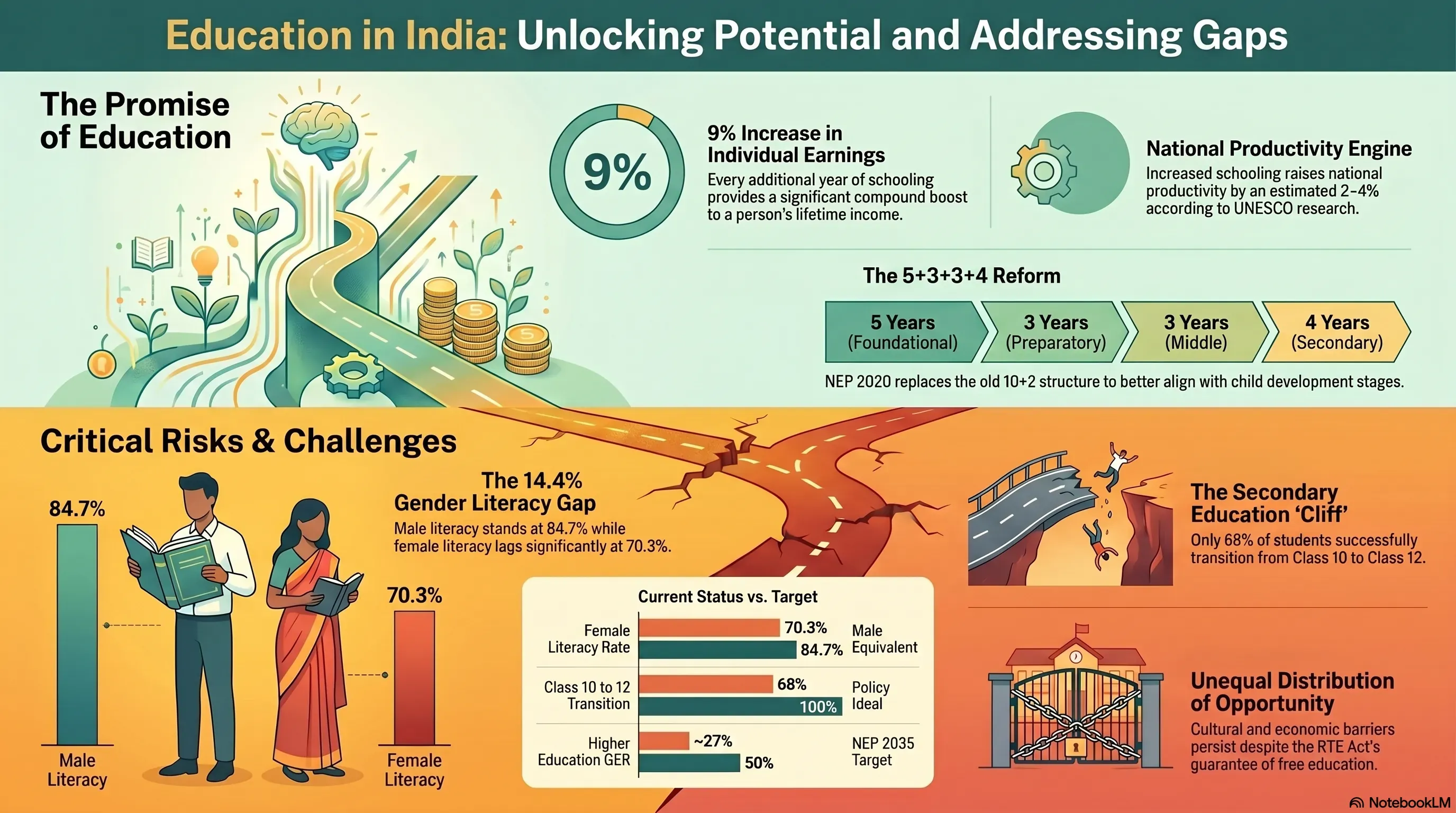
- Economic growth: World Bank estimates suggest that each extra year of schooling raises a person’s earnings by about 9%.
- Gender equality: Educated girls tend to marry later, earn more and support their own children’s education.
Education also helps a country as a whole. When more people are educated, there is less poverty, better health and a stronger sense of responsibility towards others. A well-educated community can solve its problems with knowledge instead of fear.
India has made good progress in bringing children to school, but many students still leave before completing Class 12. Real progress means that every child not only enrols but also stays in school and learns well.
Essay on Importance of Education in 300 Words (Class 7 & 8)
The importance of education is described in many ways: as a right, a privilege, a weapon and a light. At its core, it is the process through which people gain the knowledge, values and skills needed to take part fully in society. Its importance cannot be measured only in individual terms, because education shapes communities, economies and nations.
Importance of Education in Individual Development
At the personal level, education expands career options, improves earning potential and builds self-confidence. An educated person can make better decisions about health, money and civic life. World Bank estimates suggest that each extra year of schooling raises income by around 9%, and the benefit adds up over a lifetime. Education also teaches values such as telling right from wrong, respecting different views and caring for others.
Importance of Education in National Development
A nation’s human capital, meaning the knowledge and skills of its people, is its most valuable resource. Countries that invest in education usually enjoy higher productivity, lower poverty and stronger democratic institutions. India’s Right to Education Act (2009) guarantees free and compulsory education for children aged 6 to 14. The National Education Policy (NEP) 2020 goes further with a 5+3+3+4 school structure, more focus on critical thinking, learning in the mother tongue in the early years and vocational skills from Class 6.
The Unfinished Agenda
Challenges remain. India’s literacy rate is 80.9% according to PLFS 2023-24, but female literacy (74.6%) is still lower than male literacy (87.2%). UDISE+ 2024-25 data shows that only about 75% of students move from Class 10 to Class 11, so dropout at the secondary stage is a serious concern. Closing these gaps needs good policy, better schools and trained teachers, and also a belief that every child’s education is everyone’s responsibility.
Essay on Importance of Education for Class 9 in 400 Words
The importance of education is clear in every part of society, because it is one of the most transformative forces for individuals, communities and nations. From ancient gurukuls to modern digital classrooms, its forms have changed, but its purpose has stayed the same: to develop human potential, pass on values and prepare people to contribute to society.
Education as a Fundamental Right
India recognised education as a fundamental right through Article 21A, added to the Constitution in 2002. The Right to Education (RTE) Act, passed in 2009, gives every child between 6 and 14 years the right to free and compulsory education. Enrolment has improved a great deal over the years, but enrolment is not the same as learning. The real challenge is to make sure that children stay in school and learn well through the secondary stage.
Importance of Education in Reducing Inequality
India’s biggest challenge is not a lack of talent but an unequal spread of opportunity. Quality schooling helps break the cycle of poverty across generations. A child from a low-income rural family who gets a good education can reach opportunities that would otherwise stay out of reach. The gender gap is especially visible. PLFS 2023-24 shows female literacy at 74.6% against 87.2% for males. Programmes such as Beti Bachao Beti Padhao and Kasturba Gandhi Balika Vidyalayas aim to narrow this gap, but social and economic barriers still exist in many places.
Importance of Education in Economic Growth
The importance of education in economic growth is well established, as education and prosperity go hand in hand. Countries such as Finland, Japan and South Korea have placed education at the centre of their growth and are known for innovation and high incomes. World Bank estimates suggest that each additional year of schooling raises a person’s earnings by about 9%. India’s NEP 2020 reflects this thinking by moving from rote learning to critical thinking, introducing vocational education from Class 6 and accepting regional languages as mediums of instruction.
Importance of Education for Citizenship
The deepest purpose of education is civic. An educated citizen knows their rights, performs their duties, takes part in democracy and questions those in power. A country of aware citizens is harder to mislead and easier to govern fairly.
This is why education is not just an investment in individual futures. It is the base on which a fair, democratic and prosperous society is built. When a student learns to ask questions, check facts and respect other views, that student is already preparing to be a responsible citizen of tomorrow.
Essay on Importance of Education for Class 10 in 500 Words (Also for Class 11 & 12)
Introduction
“Education is the most powerful weapon which you can use to change the world.” Nelson Mandela’s words apply strongly to India today, a country with huge human potential and deep inequalities. The importance of education goes beyond collecting information or earning a degree. It shapes how people think, what they value and how they deal with the world around them.
Importance of Education in Human Development
At its core, education develops human capability. Economist Amartya Sen argues that development should be measured not by income alone but by the real freedoms people enjoy, including the freedom to live a healthy and educated life. Education widens these freedoms. It helps people make informed choices, resist exploitation and use economic opportunities. World Bank estimates suggest that each extra year of schooling raises earnings by about 9%.
India’s Progress and Remaining Gaps
Since Independence, India has greatly expanded access to schooling. The RTE Act (2009) guarantees free education for children aged 6 to 14. The Mid-Day Meal Scheme, now PM POSHAN, has improved attendance by tackling hunger. Samagra Shiksha, which brought earlier schemes such as Sarva Shiksha Abhiyan under one umbrella, supports schools from pre-primary to Class 12.
Yet the picture is uneven. India’s literacy rate is 80.9% (PLFS 2023-24), with women at 74.6% and men at 87.2%. Dropout at the secondary stage is still high. UDISE+ 2024-25 reports a secondary dropout rate of 11.5% and a 75.1% transition from Class 10 to Class 11.
National Education Policy 2020: A Major Shift
NEP 2020 is the most ambitious reform since 1986. It replaces the 10+2 structure with a 5+3+3+4 framework matched to children’s stages of development. It recommends teaching in the mother tongue or home language at least until Grade 5, stresses critical thinking over rote learning, brings vocational education from Class 6 and sets a target of 50% Gross Enrolment Ratio in higher education by 2035. If implemented well, it can produce graduates who are not just qualified but capable: creative thinkers, adaptable problem-solvers and responsible citizens. Success will depend on trained teachers, good school infrastructure and steady funding.
Importance of Education for Gender Equality
Educated women tend to marry later, have fewer children, earn more and invest more in their children’s health and education. Educating girls therefore benefits generations, not just one person. Beti Bachao Beti Padhao, launched in 2015, recognises this link, but policy alone is not enough. Attitudes must change through community effort, role models and support for families who keep their daughters in school.
Conclusion
The importance of education can be seen at two levels: it is both a personal journey and a public good. For individuals, it opens doors that would otherwise stay closed. For society, it is the base of democracy, growth and justice. The real question is not whether education is important but whether we will do what is needed so that every child, regardless of gender, caste, class or place, gets a quality education. The answer will decide what kind of country India becomes.
Types of Education: Formal, Informal and Non-Formal
Understanding the types of education helps you explain the importance of education better in Class 9–12 essays and in exams.
Type | Definition | Examples | Key feature |
|---|---|---|---|
Formal Education | Structured learning in institutions with a fixed curriculum | School, college, university | Leads to recognised degrees and certificates |
Informal Education | Learning from life experiences and daily interactions | Family values, community and cultural practices | No fixed structure or certificate |
Non-formal Education | Organised learning outside formal institutions | Adult literacy programmes, skill training, online courses | Flexible; may or may not give a certificate |
Importance of Education in India: Key Facts for Essays
Add these data points on the importance of education to your essay to show depth and earn better marks.
Fact | Source | Year |
|---|---|---|
India literacy rate: 80.9% | PLFS (NSO) | 2023-24 |
Male literacy: 87.2% | PLFS (NSO) | 2023-24 |
Female literacy: 74.6% | PLFS (NSO) | 2023-24 |
Elementary GER: about 90.6% | UDISE+ | 2024-25 |
Secondary dropout rate: 11.5% | UDISE+ | 2024-25 |
Class 10 to 11 transition rate: 75.1% | UDISE+ | 2024-25 |
RTE Act age group: 6 to 14 years | Government of India | 2009 |
Higher education GER target: 50% by 2035 | NEP 2020 | 2020 |
Return on each extra year of schooling: about 9% | World Bank estimates | Global average |
How to Write an Essay on Importance of Education
Structure Guide by Class
Class | Word count | Focus areas |
|---|---|---|
Class 3–4 | 100 words | Definition, 2 benefits, one positive closing line |
Class 5 | 150 words | Benefits, one India fact, importance for self and society |
Class 6 | 200 words | Several benefits with sub-headings and one data point |
Class 7–8 | 300 words | Individual and national importance, India context, one challenge |
Class 9 | 400 words | Rights, inequality, economy and citizenship |
Class 10–12 | 500+ words | Full essay with data, policy (NEP, RTE), gender, vision-based conclusion |
Strong Opening Lines for Your Essay
Avoid starting with “In this essay, I will...”. Try one of these instead:
- Nelson Mandela once said, “Education is the most powerful weapon which you can use to change the world”, and India’s journey since Independence proves him right.
- Every time a child learns to read, the world becomes slightly fairer.
- Education is not preparation for life; education is life itself. (John Dewey)
- India’s greatest resource is not coal, steel or software. It is the students sitting in its classrooms.
Common Mistakes to Avoid
Mistake | Correct approach |
|---|---|
Writing only about school and college | Include informal and non-formal education too |
No India-specific content | Add the RTE Act, NEP 2020 or literacy data |
Vague lines like “Education is very good” | Support every claim with a reason or fact |
Repeating the same point | Give each paragraph a new, distinct idea |
No conclusion | Summarise and end with a forward-looking thought |
Also read: Essay on Global Warming in English: https://new.esaral.com/english/essay-on-global-warming
Frequently Asked Questions
What is the importance of education in our life?
Education improves employment opportunities, develops critical thinking, builds self-confidence, and shapes moral values. It enables individuals to make informed decisions about health, finance, and civic life. For societies, education reduces poverty, narrows inequality, strengthens democracy, and drives economic growth. UNESCO research shows each year of schooling increases earnings by approximately 9%, making education the highest-return investment most individuals can make.
How do you write an essay on the importance of education for Class 10?
For Class 10, write 400–500 words in 5–6 paragraphs. Begin with a powerful quote or fact (Nelson Mandela's quote or India's literacy rate). Cover education's role in individual development, national progress, gender equality, and economic growth. Include India-specific data — RTE Act, NEP 2020, dropout rates. End with a forward-looking conclusion about what education can achieve for India. Use formal language and varied sentence structure throughout.
What is a short essay on importance of education in 100 words?
A short essay on importance of education for 100 words should have a one-line definition, two or three benefits such as jobs, good values and a better life, one India fact like the Right to Education Act, and a positive closing line. eSaral’s 100-word sample above for Class 3 and 4 follows exactly this pattern.
What are 10 lines on importance of education?
Education is the process of learning knowledge, skills, and values. Nelson Mandela called it the most powerful weapon to change the world. It improves employment opportunities and earning potential. Education develops critical thinking and problem-solving abilities. It promotes gender equality and social justice. In India, the Right to Education Act (2009) guarantees free schooling for ages 6–14. India's literacy rate is 77.7% as of 2023 (UNESCO). Educated citizens strengthen democracy. Education reduces poverty across generations. Every child deserves access to quality education regardless of background.
What is the role of education in national development?
Education builds a nation's human capital — the collective skills, knowledge, and capabilities of its people. Countries with high literacy and educational attainment consistently show stronger GDP growth, lower poverty rates, better public health outcomes, and more stable democratic governance. In India, the New Education Policy 2020 targets a 50% Gross Enrolment Ratio in higher education by 2035, recognising education as central to India's ambition to become a developed nation.
How many words should an essay on importance of education be?
It depends on the class and the question. Class 3 to 5 usually need 100 to 150 words, Class 6 to 8 need 200 to 300 words, and Class 9 to 12 need 400 to 500 words or more. Check the word limit in the question, and use eSaral’s samples as models for structure and facts.
Team eSaral
eSaral Academic and Editorial Team
Team eSaral is the collective author profile for educational content created by eSaral’s teachers and academic contributors. The team draws on expertise from IIT graduates, doctors, experienced educators and subject specialists to develop resources for JEE, NEET and school students. Our articles aim to explain concepts clearly and help students study with confidence.
Related Posts

BITSAT 2027: Registration Date, Exam Date, Syllabus, Eligibility, Pattern & Fees
BITSAT 2027 exam dates, registration timeline, eligibility criteria, exam pattern, marking scheme, syllabus and fees in one page.

BITSAT Previous Year Question Paper PDF (2017-2026)
Download BITSAT previous year question papers PDF from 2017 to 2026,session-wise. Memory-based papers,exam pattern, paper analysis and how to practise

CBSE Class 10 Date Sheet 2027: Expected Exam Dates, Release Date, Admit Card & Result Timeline
CBSE Class 10 date sheet 2027 is awaited. See the expected exam dates, release window, how to download the PDF, admit card and result timelines.

NCERT Physics Class 10 Book PDF in Hindi 2026-27 – भौतिक विज्ञान के 4 अध्याय (Free Download)
NCERT Physics Class 10 book PDF in Hindi 2026-27: download all 4 chapters (अध्याय 9–12) free, with topics and important formulas.

NCERT Biology Class 9 Book Anveshan PDF in Hindi - जीव विज्ञान कक्षा 9 पुस्तक अन्वेषण PDF
Download NCERT Biology Class 9 book PDF in Hindi chapterwise for 2026-27: Cell, Tissues, Reproduction and Diversity. Free PDFs.

Essay On Artificial Intelligence in English (100,150, 200, 250, 300, 500 Words)
This is in contrast to the natural intelligence of humans. With Artificial Intelligence, machines can perform

Essay on 78th India Independence Day in English for Student (100, 150, 200, 250, 300, 500 Words)
Read the best essays on India's Independence Day in English. Short & long essays (100, 150, 200, 250, 300, 500 words) perfect for school exams
NCERT Class 11 English Snapshots book - Free PDF download- Esaral
Download NCERT Class 11 English Snapshots book PDF for free. Get all 8 chapters, chapter-wise. Start your prep today!
NCERT Class 10 biology book pdf - Free PDF Download - eSaral
NCERT Class 10 Biology book PDF 2026-27: all 5 chapters (Life Processes to Our Environment) in English & Hindi, with CBSE syllabus, marks & practical

Essay on Global Warming in English (100,150, 200, 250, 300, 500 Words)
Global warming means the Earth is getting hotter. This happens because of things like pollution from cars and factories.