
Essay on Indian Culture and Tradition – 10 Lines, 100 to 500 Words

eSaral Academic and Editorial Team
Summary
An essay on Indian culture and tradition describes the way of life of the people of India: their languages, religions, festivals, food, clothing, music, dance, family system and values such as respect for elders and "Atithi Devo Bhava" (the guest is like God). India's culture is one of the oldest in the world, and its biggest strength is unity in diversity. This page gives an essay on Indian culture and tradition in 10 lines and in 100, 150, 200, 250, 300, 400 and 500 words, along with a paragraph, a speech and a sample conclusion for students.
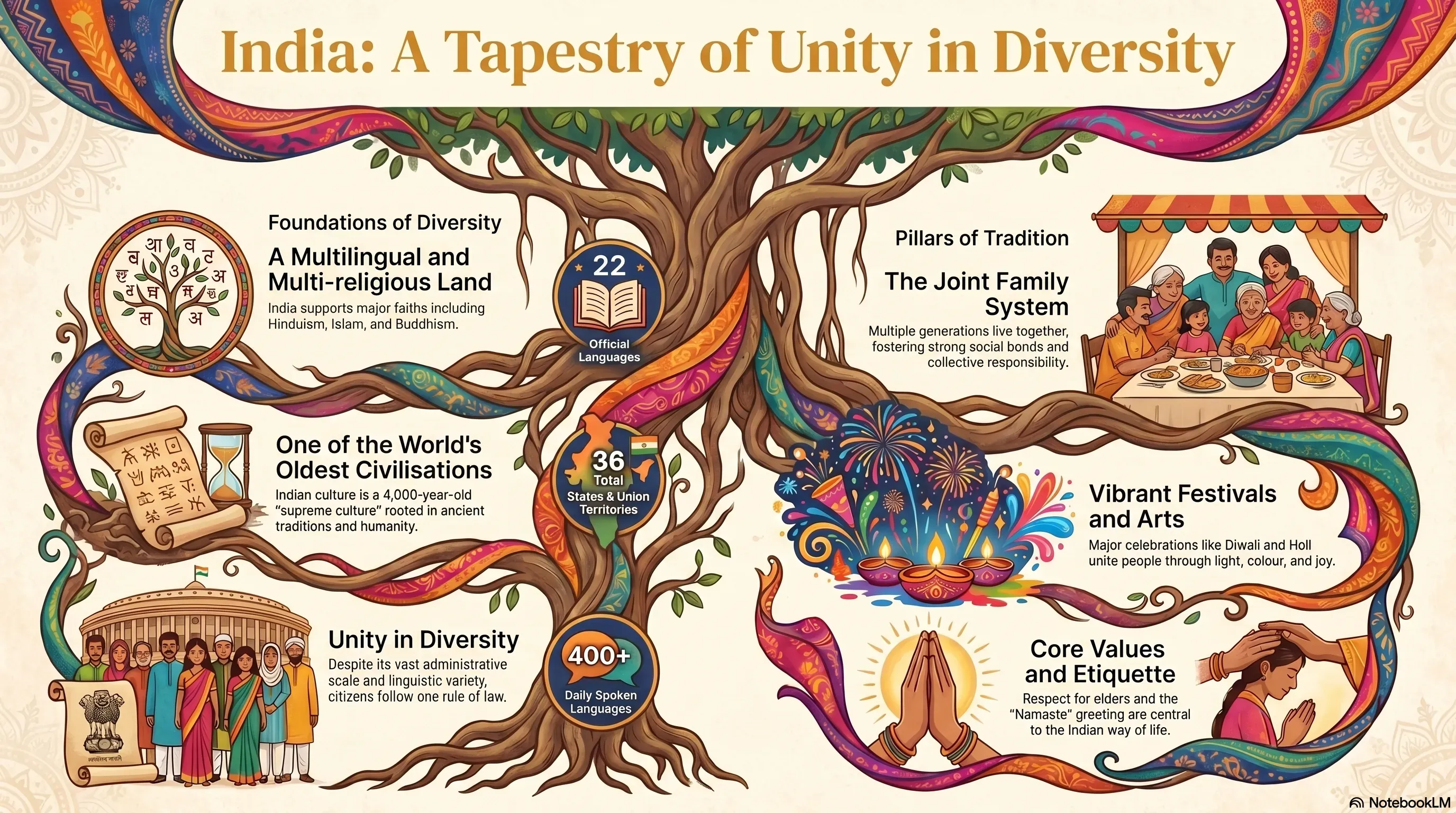
The culture and tradition of India are known all over the world. India is a land of many languages, religions, customs and festivals. People in Kerala, Punjab, Assam and Gujarat dress, eat and celebrate differently, yet they share common values and a common national identity. This rich mix of beliefs and practices, passed down from one generation to the next, is what we call Indian culture and tradition, and it is the theme of every essay on Indian culture and tradition.
An essay on Indian culture and tradition is a popular topic in school exams, essay competitions and speeches. The samples below are written in simple English for Classes 1 to 12, and each one is counted to stay close to its word limit.
How to Write an Essay on Indian Culture and Tradition
Follow this simple format for any essay on Indian culture and tradition, whatever the word limit.
Part | What to Write |
|---|---|
Introduction | Explain what culture means and why India's culture is special |
Body | Write about languages and religions, festivals, food and clothing, music and dance, the family system, values and unity in diversity |
Conclusion | End the essay on Indian culture and tradition by saying why we should respect and preserve it |
10 Lines on Indian Culture
Younger students can write these 10 lines instead of a full essay on Indian culture and tradition.
- Indian culture is one of the oldest cultures in the world.
- India is known for its unity in diversity.
- People in India speak many languages and follow many religions.
- Diwali, Holi, Eid, Christmas, Guru Nanak Jayanti and Pongal are some of our festivals.
- Each region has its own food, clothes, music and dance.
- Bharatanatyam, Kathak, Odissi and Kuchipudi are famous classical dances of India.
- We greet others with "Namaste" by joining our hands.
- Indian culture teaches us to respect elders and treat guests like God.
- Yoga and Ayurveda are gifts of Indian culture to the world.
- We should be proud of our culture and help preserve it.
Long and Short Essay on Indian Culture and Tradition
Pick the essay on Indian culture and tradition that matches your word limit. Each essay is written in simple English and can also be used to describe the culture and tradition of India in a project.
Short Essay on Indian Culture and Tradition in 100 Words
This short essay on Indian culture and tradition suits Classes 1 to 4.
India has a rich and colourful culture. Indian culture is one of the oldest in the world. People of many religions, languages and traditions live here together in peace. This is called unity in diversity.
We celebrate many festivals like Diwali, Holi, Eid, Christmas and Pongal with great joy. Every state has its own food, dress, songs and dances.
Indian culture teaches us good values. We respect our elders, greet people with "Namaste" and treat guests like God. Yoga is also a part of our culture.
I am proud of my country's culture and traditions.
Essay on Indian Culture and Tradition in 150 Words
This 150-word essay on Indian culture and tradition suits Classes 3 to 5.
Indian culture is the way of life of the people of India. It includes our languages, religions, festivals, food, clothes, arts and values. It is one of the oldest cultures in the world, and its roots go back thousands of years to the Indus Valley Civilisation.
India is famous for unity in diversity. People here follow religions like Hinduism, Islam, Christianity, Sikhism, Buddhism and Jainism. Hundreds of languages are spoken across the country, and 22 of them are listed in our Constitution.
Festivals are the heart of Indian culture. Diwali, Holi, Eid, Christmas, Onam, Pongal and Baisakhi bring families and friends together. Each region has its own food, such as dosa in the south and makki ki roti in Punjab, and its own dress, music and dance.
Indian culture also teaches us values like respect for elders, honesty and hospitality. We must be proud of our culture and preserve it.
Essay on Indian Culture and Tradition in 200 Words
This essay on Indian culture and tradition suits Classes 4 to 6.
India is a country with a rich and ancient culture. Indian culture includes the beliefs, customs, languages, festivals, arts and values of its people. It has been shaped over thousands of years by many communities and religions.
Unity in diversity
India is home to people of different religions, castes, languages and regions. Yet they live together peacefully and celebrate each other's festivals. This spirit of unity in diversity is the greatest strength of Indian culture.
Festivals, food and clothing
Indians celebrate many festivals, such as Diwali, Holi, Eid, Christmas, Guru Nanak Jayanti, Onam and Durga Puja. Each region has its own special food, like idli and dosa in the south, dhokla in Gujarat and litti chokha in Bihar. Traditional clothes include the saree, salwar-kameez, dhoti-kurta and turban, and each region has its own style of wearing them.
Values and traditions
Indian culture teaches respect for elders, love for family and kindness towards guests. The saying "Atithi Devo Bhava" means that a guest is like God. Stories from the Ramayana, the Mahabharata and the Panchatantra teach children moral values.
Conclusion
Indian culture is our identity and pride. It connects us with our past and guides our future. We should respect all cultures and help preserve our rich traditions.
Essay on Indian Culture and Tradition in 250 Words
This essay on Indian culture and tradition suits Classes 5 to 7.
Introduction
Indian culture is one of the oldest and richest cultures in the world. It is a beautiful blend of customs, rituals, languages, arts and values that have been passed down from one generation to the next. Its biggest feature is unity in diversity.
Languages and religions
India is a land of many languages and faiths. Hundreds of languages are spoken across the country, and 22 of them are included in the Eighth Schedule of the Constitution. India is the birthplace of Hinduism, Buddhism, Jainism and Sikhism, and Islam, Christianity and other faiths are also followed here.
Festivals and celebrations
Festivals bring colour and joy to Indian life. Diwali, the festival of lights, celebrates the victory of good over evil. Homes are decorated with diyas and rangoli, and families share sweets. Holi, the festival of colours, spreads love and friendship. Eid, Christmas, Guru Nanak Jayanti, Pongal and Bihu are celebrated with equal enthusiasm.
Art, music and dance
India has a rich tradition of classical music, both Hindustani and Carnatic, and classical dances like Bharatanatyam, Kathak, Kathakali and Odissi. Folk dances such as Garba, Bhangra and Bihu show the spirit of different regions.
Family and values
The joint family system, respect for elders and hospitality are important parts of Indian tradition. Greeting with "Namaste" and touching elders' feet show respect. Children learn moral values from the Ramayana, the Mahabharata and the Panchatantra stories told by grandparents.
Conclusion
Indian culture is our pride and identity. In today's modern world, we must keep our traditions alive while learning good things from others.
Essay on Indian Culture and Tradition in 300 Words
This essay on Indian culture and tradition suits Classes 6 to 8.
Introduction
Culture is the way of life of a group of people. It includes their beliefs, language, food, clothes, festivals, arts and values. India has one of the oldest cultures in the world, with roots going back to the Indus Valley Civilisation and the Vedic period. Over thousands of years, many communities have added to it, making it rich and diverse.
Unity in diversity
India has 28 states and 8 union territories, each with its own language, food, dress and customs. Hindus, Muslims, Sikhs, Christians, Buddhists, Jains and people of many other faiths live together. Despite these differences, Indians are united by shared values and a common Constitution. This is why India is called a land of unity in diversity.
Festivals and food
Indian festivals are colourful and full of joy. Diwali, Holi, Eid, Christmas, Durga Puja, Onam, Pongal and Baisakhi are celebrated with family and friends. Indian food is as diverse as its people, from biryani and kebabs to dosa, dhokla, rasgulla and sarson ka saag.
Arts, music and dance
India's classical music has two main traditions, Hindustani and Carnatic. Classical dances like Bharatanatyam, Kathak, Odissi, Kuchipudi and Manipuri tell stories from mythology. Folk arts like Madhubani painting and Warli art are famous worldwide. Folk dances such as Garba, Bhangra, Bihu and Lavani are performed at festivals and weddings.
Values and traditions
Indian tradition teaches respect for elders, care for family and kindness to guests. The joint family system has kept families close for generations. Guests are treated with great warmth, following the saying "Atithi Devo Bhava". Yoga, meditation and Ayurveda, which began in India, are now practised across the world.
Conclusion
Indian culture and tradition are our identity and heritage. They teach us tolerance, respect and togetherness. As young citizens, we should be proud of our culture, respect all communities and help preserve our traditions for future generations.
Essay on Indian Culture and Tradition in 400 Words
This detailed essay on Indian culture and tradition suits Classes 8 to 10.
Introduction
India is known all over the world for its rich culture and traditions. Indian culture is the sum of the beliefs, customs, languages, arts, festivals and values of the people of India. It is one of the oldest living cultures in the world, with roots in the Indus Valley Civilisation, which flourished more than 4,500 years ago, and in the Vedic period that followed.
Unity in diversity
India's culture is unique because of its diversity. The country has 28 states and 8 union territories, hundreds of languages and many religions. India is the birthplace of four major religions: Hinduism, Buddhism, Jainism and Sikhism. Islam, Christianity, Zoroastrianism and Judaism also have a long history here. Despite these differences, people live together with mutual respect. This unity in diversity is the soul of Indian culture.
Festivals
Festivals play an important role in Indian life. Diwali celebrates the victory of light over darkness, Holi spreads colours and friendship, and Eid and Christmas teach love and sharing. Regional festivals like Onam in Kerala, Pongal in Tamil Nadu, Bihu in Assam and Durga Puja in West Bengal show the variety of Indian traditions. People of all faiths join in each other's celebrations.
Food and clothing
Every region of India has its own food and dress. Rice is the main food in the south and east, while wheat is more common in the north. Traditional clothes like the saree, salwar-kameez, dhoti, kurta, lehenga and turban show regional styles and skills like handloom weaving.
Art, music and dance
India has a rich tradition of classical and folk arts. Hindustani and Carnatic music, classical dances such as Bharatanatyam, Kathak, Odissi and Kathakali, and folk arts like Madhubani, Warli and Pattachitra are admired worldwide. Ancient temples, forts and monuments reflect India's architectural skill.
Values and traditions
Indian tradition places great importance on family, respect for elders and hospitality. The joint family system, the greeting "Namaste" and the belief in "Atithi Devo Bhava" reflect these values. Epics like the Ramayana and Mahabharata teach truth, duty and courage. Yoga and Ayurveda are India's gifts to the world, and 21 June is celebrated as International Day of Yoga.
Conclusion
Indian culture and tradition are a treasure that connects our past with our present. In a fast-changing world, we must keep our values alive while accepting useful new ideas. By respecting all communities and preserving our heritage, we can keep India's culture strong for generations to come.
Essay on Indian Culture and Tradition in 500 Words
This long essay on Indian culture and tradition suits Classes 9 to 12, essay competitions and speeches.
Introduction
Culture is the identity of a nation. It reflects how people think, live, celebrate and treat one another. India's culture is one of the oldest and most diverse in the world. Shaped by thousands of years of history, many religions and countless communities, Indian culture and tradition have become a beautiful mosaic admired across the globe.
Ancient roots
The roots of Indian culture go back to the Indus Valley Civilisation, one of the world's earliest urban civilisations. The Vedic period gave India its early scriptures, philosophy and the Sanskrit language. Later, empires like the Mauryas, Guptas, Cholas and Mughals added to India's art, architecture, literature and science. Each period left its mark, making Indian culture rich and layered. Great monuments like the Ajanta and Ellora caves, the Konark Sun Temple and the Taj Mahal reflect this long history.
Unity in diversity
India is home to people of many religions, languages and customs. Hundreds of languages and dialects are spoken, and 22 languages are listed in the Eighth Schedule of the Constitution. India is the birthplace of Hinduism, Buddhism, Jainism and Sikhism, and Islam, Christianity and other faiths are also an important part of its society. Despite these differences, Indians live together with tolerance and respect. This unity in diversity is the greatest strength of Indian culture.
Festivals and celebrations
Festivals are the heartbeat of Indian life. Diwali, Holi, Eid, Christmas, Guru Nanak Jayanti, Buddha Purnima and Mahavir Jayanti are celebrated across the country. Regional festivals like Onam, Pongal, Bihu, Baisakhi, Durga Puja and Navratri show the variety of traditions. People of different faiths often celebrate together, strengthening social bonds. Weddings, fairs and pilgrimages such as the Kumbh Mela also show the colourful traditions of India.
Arts, music and literature
India has a rich heritage of classical music, both Hindustani and Carnatic, and classical dances like Bharatanatyam, Kathak, Kathakali, Kuchipudi, Odissi and Manipuri. Folk arts such as Madhubani, Warli and Pattachitra are famous worldwide. Great works like the Ramayana, the Mahabharata, the Panchatantra and the poems of Kalidasa, Kabir and Rabindranath Tagore are part of India's literary treasure.
Values and way of life
Indian culture places great value on family, respect for elders, hospitality and harmony with nature. The joint family system, the greeting "Namaste", the belief in "Atithi Devo Bhava" and the principle of non-violence (ahimsa) reflect these values. Yoga, meditation and Ayurveda, developed in ancient India, are now practised around the world.
Indian culture in the modern world
Today, modern lifestyles, technology and globalisation are changing the way people live. Nuclear families are becoming more common, and western clothes and food are popular among young people. Yet Indian traditions continue to adapt and survive. Indian films, music, cuisine and yoga have spread Indian culture across the globe. Many young Indians are also using social media to promote folk arts, regional food and classical music.
Conclusion
Indian culture and tradition are a priceless heritage that gives us our identity. They teach us tolerance, respect, compassion and togetherness. As young citizens, we must take pride in our culture, respect all communities and preserve our traditions, while welcoming positive change.
Unity in Diversity in Indian Culture
Unity in diversity means that people of different religions, languages, castes and regions live together as one nation. In India, a Tamil-speaking family in Chennai, a Punjabi family in Amritsar and a Bengali family in Kolkata may speak different languages and follow different customs, but they share the same national flag, the same Constitution and the same love for the country. Festivals are often celebrated together by people of all communities. This spirit of togetherness is the most important feature of any essay on Indian culture and tradition.
Paragraph on Indian Culture
A paragraph is a shorter, single-block version of the essay on Indian culture and tradition, usually 100 to 120 words.
Indian culture is one of the oldest and richest cultures in the world. It includes the languages, religions, festivals, food, clothes, music, dance and values of the people of India. India is known for unity in diversity, as people of many faiths and languages live together peacefully. Festivals like Diwali, Holi, Eid and Christmas are celebrated with joy, and every region has its own food, dress and dance. Indian culture teaches respect for elders, hospitality and harmony with nature, and yoga and Ayurveda are its gifts to the world. We should be proud of our culture and work to preserve it.
Speech on Indian Culture
You can turn any essay on Indian culture and tradition into a speech by adding a greeting at the start and a thank-you at the end.
Good morning to our respected Principal, teachers and my dear friends. Today, I would like to speak on Indian culture.
Our country is a beautiful garden of many flowers. We speak different languages, follow different religions and celebrate different festivals, yet we are all Indians. This unity in diversity is the greatest strength of our culture.
Indian culture is one of the oldest in the world. It has given the world yoga, Ayurveda, classical music and dance, and great epics like the Ramayana and the Mahabharata. It teaches us to respect our elders, treat guests like God and live in harmony with nature.
Friends, in today's fast-changing world, let us not forget our roots. Let us respect every community, celebrate every festival with love and keep our traditions alive. Thank you. Jai Hind!
Conclusion on Indian Culture
You can end any essay on Indian culture and tradition with a conclusion like this:
"Indian culture and tradition are our identity and pride. They connect us with our glorious past and teach us values like tolerance, respect and togetherness. In a changing world, we must preserve our rich traditions while accepting positive new ideas, so that the spirit of unity in diversity continues for generations."
This essay on Indian culture and tradition covers our way of life. To learn about India's monuments and historical sites, read the Essay on Indian Heritage, and for more on celebrations, see the Essay on Festivals of India.
Frequently Asked Questions
How do I write an essay on Indian culture and tradition?
Start with what culture means and why India's culture is special. In the body, write about languages and religions, festivals, food and clothing, arts, the family system and values. End your essay on Indian culture and tradition with why we should respect and preserve it.
What are 10 lines on Indian culture?
Ten lines should cover India's ancient culture, unity in diversity, languages and religions, festivals, food and clothing, classical dances, the greeting "Namaste", respect for elders, yoga and pride in our traditions. A ready set of 10 lines is given on this eSaral page.
What are the values of Indian culture?
Important values of Indian culture include respect for elders, love for family, hospitality ("Atithi Devo Bhava"), tolerance, non-violence (ahimsa), honesty and harmony with nature. Mention these values in any essay on Indian culture and tradition.
What is the difference between Indian culture and Indian heritage?
Indian culture is our living way of life, including festivals, food, clothes, languages and values. Indian heritage is what we have inherited from the past, such as monuments, forts, temples, art and ancient texts. An essay on Indian culture and tradition focuses on the way people live today, while a heritage essay focuses on historical treasures.
Why is Indian culture called unity in diversity?
Because people of many religions, languages, castes and regions live together peacefully in India, share a common Constitution and national identity, and celebrate each other's festivals.
How old is Indian culture?
Indian culture is one of the oldest living cultures in the world. Its roots go back to the Indus Valley Civilisation, which flourished more than 4,500 years ago, followed by the Vedic period. eSaral's English essays on related topics like Indian heritage and festivals use the same simple format for students.
Team eSaral
eSaral Academic and Editorial Team
Team eSaral is the collective author profile for educational content created by eSaral’s teachers and academic contributors. The team draws on expertise from IIT graduates, doctors, experienced educators and subject specialists to develop resources for JEE, NEET and school students. Our articles aim to explain concepts clearly and help students study with confidence.
Related Posts

BITSAT 2027: Registration Date, Exam Date, Syllabus, Eligibility, Pattern & Fees
BITSAT 2027 exam dates, registration timeline, eligibility criteria, exam pattern, marking scheme, syllabus and fees in one page.

BITSAT Previous Year Question Paper PDF (2017-2026)
Download BITSAT previous year question papers PDF from 2017 to 2026,session-wise. Memory-based papers,exam pattern, paper analysis and how to practise

CBSE Class 10 Date Sheet 2027: Expected Exam Dates, Release Date, Admit Card & Result Timeline
CBSE Class 10 date sheet 2027 is awaited. See the expected exam dates, release window, how to download the PDF, admit card and result timelines.

NCERT Physics Class 10 Book PDF in Hindi 2026-27 – भौतिक विज्ञान के 4 अध्याय (Free Download)
NCERT Physics Class 10 book PDF in Hindi 2026-27: download all 4 chapters (अध्याय 9–12) free, with topics and important formulas.

NCERT Biology Class 9 Book Anveshan PDF in Hindi - जीव विज्ञान कक्षा 9 पुस्तक अन्वेषण PDF
Download NCERT Biology Class 9 book PDF in Hindi chapterwise for 2026-27: Cell, Tissues, Reproduction and Diversity. Free PDFs.

Essay On Artificial Intelligence in English (100,150, 200, 250, 300, 500 Words)
This is in contrast to the natural intelligence of humans. With Artificial Intelligence, machines can perform

Essay on 78th India Independence Day in English for Student (100, 150, 200, 250, 300, 500 Words)
Read the best essays on India's Independence Day in English. Short & long essays (100, 150, 200, 250, 300, 500 words) perfect for school exams
NCERT Class 11 English Snapshots book - Free PDF download- Esaral
Download NCERT Class 11 English Snapshots book PDF for free. Get all 8 chapters, chapter-wise. Start your prep today!
NCERT Class 10 biology book pdf - Free PDF Download - eSaral
NCERT Class 10 Biology book PDF 2026-27: all 5 chapters (Life Processes to Our Environment) in English & Hindi, with CBSE syllabus, marks & practical

Essay on Global Warming in English (100,150, 200, 250, 300, 500 Words)
Global warming means the Earth is getting hotter. This happens because of things like pollution from cars and factories.