
Functions Class 11 Notes & Solved Numericals for IIT JEE

eSaral Academic and Editorial Team
Summary
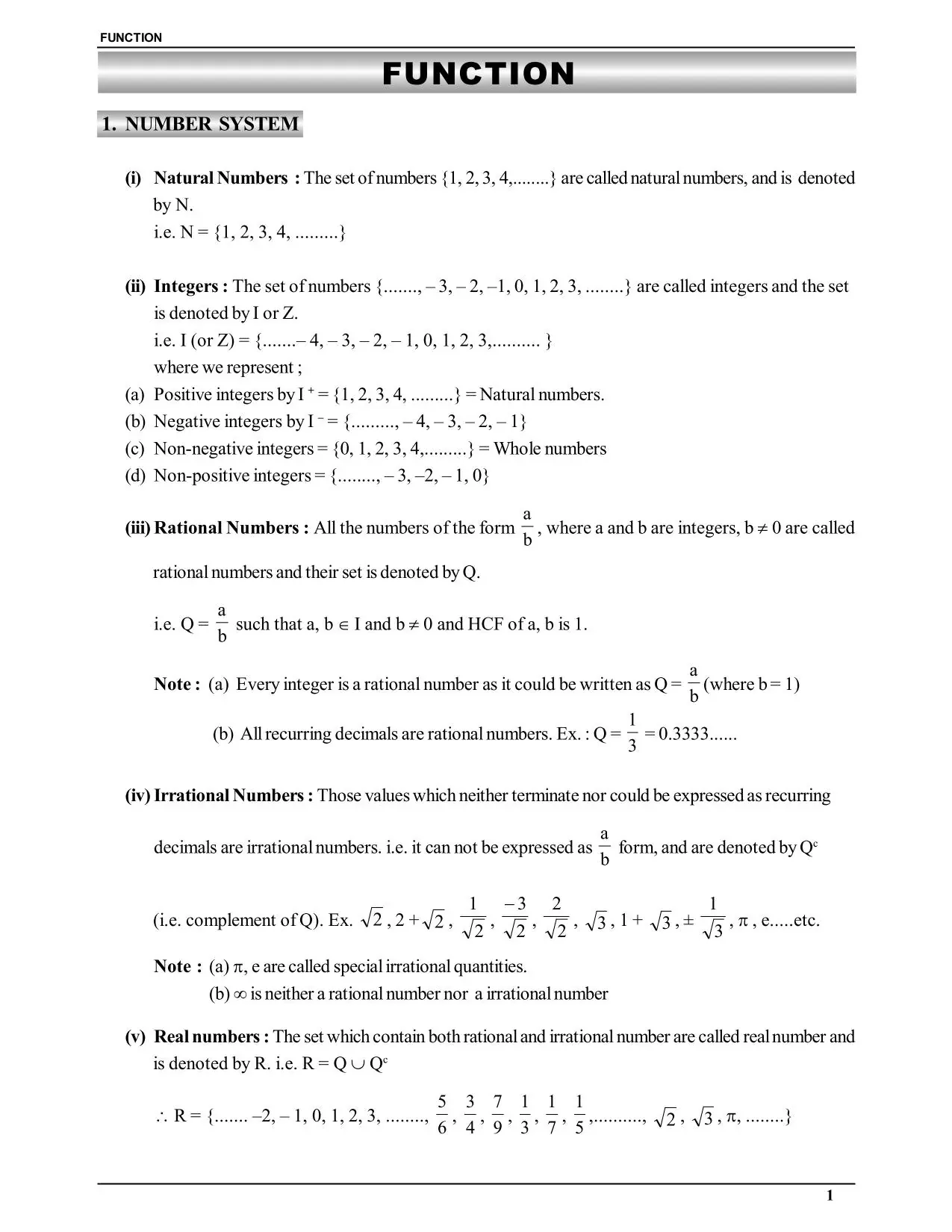
Functions Class 11 Notes cover relations and functions: ordered pairs and the Cartesian product, relations, the definition of a function, domain, co-domain and range, real functions, standard functions and their graphs, the algebra and composition of functions, and for JEE, one-one and onto functions, even, odd and periodic functions, and counting of functions.
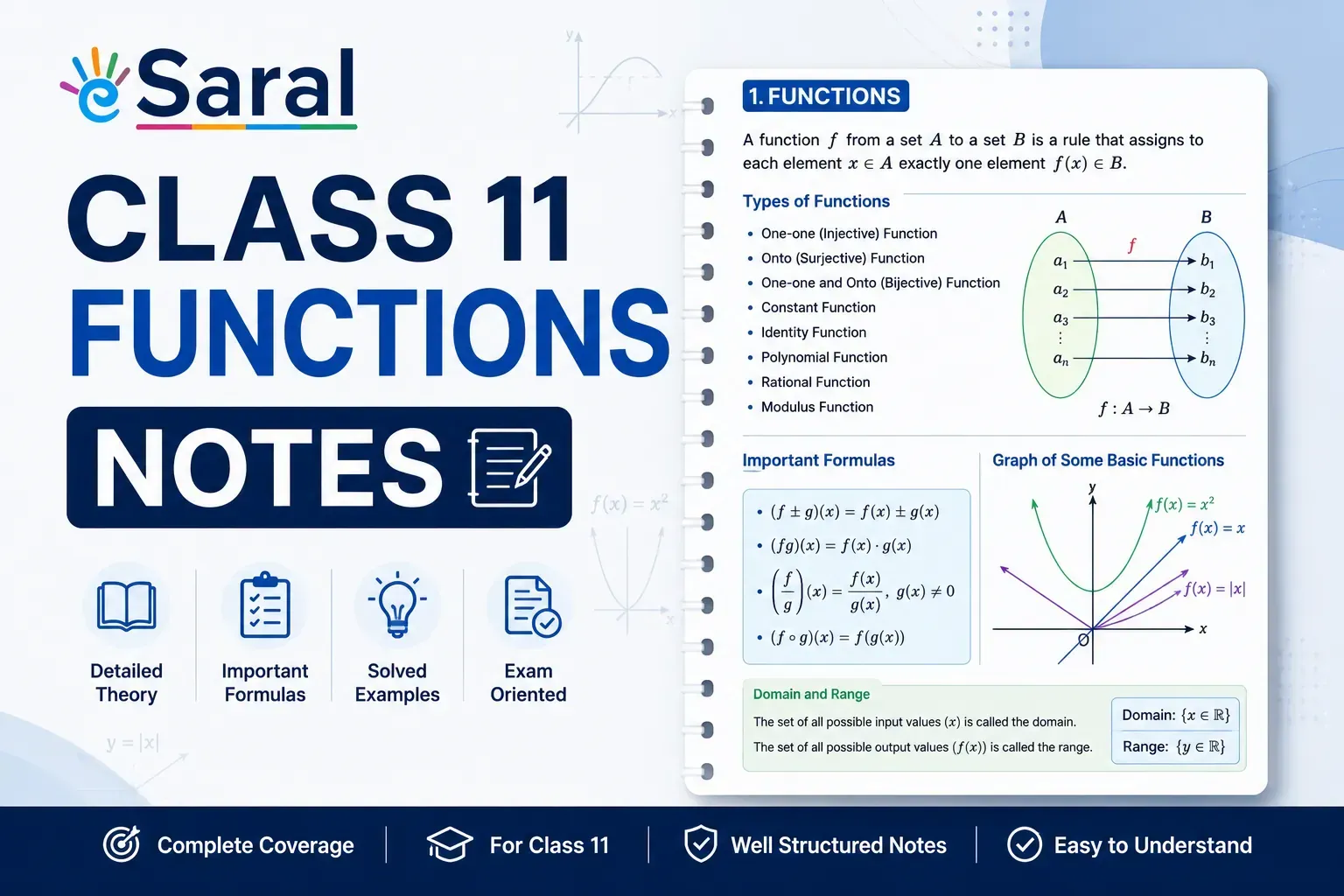
Relations and Functions is Chapter 2 of NCERT Class 11 Mathematics. The textbook defines relations and functions, and shows the standard functions with their graphs. One-one, onto and bijective functions are taught formally in Class 12 (Chapter 1), and the composition and inverse of functions appear in JEE problems, which use them from the start. These Functions Class 11 Notes cover both parts in one place.
Functions Class 11 Notes: Chapter Overview and Syllabus
Topic | NCERT Class 11 (Chapter 2) | Class 12 and JEE |
|---|---|---|
Ordered pairs, Cartesian product | Yes | Used throughout |
Relations, domain, co-domain, range | Yes | Types of relations (reflexive, symmetric, transitive) |
Functions, domain and range | Yes | Yes |
Standard functions and graphs (identity, constant, polynomial, rational, modulus, signum, greatest integer) | Yes | Yes |
Algebra of real functions | Yes | Yes |
One-one, onto, bijective functions | Not in the chapter | Yes (Class 12 Chapter 1 and JEE) |
Composition and inverse of functions | Not in the chapter | Yes in JEE (for CBSE Class 12, check the latest syllabus) |
Even, odd and periodic functions | Not in the chapter | Yes (JEE) |
JEE Main lists sets, relations and functions, including one-one, into and onto functions and the composition of functions. Check the latest syllabi of CBSE and NTA for the exact lists.
Tip from the eSaral Maths team: For any function question, first find the domain, because most mistakes come from a value of $x$ that the function cannot take. Then draw a rough graph before you decide the range or the type of the function.
Relations and the Cartesian Product in Functions Class 11 Notes
The Cartesian product of two sets $A$ and $B$ is the set of all ordered pairs:
$$A \times B = \{(a, b) : a \in A,\ b \in B\}, \qquad n(A \times B) = n(A)\cdot n(B)$$
Two ordered pairs are equal only when both elements match: $(x, y) = (u, v)$ if and only if $x = u$ and $y = v$. In general $A \times B \neq B \times A$, although $n(A \times B) = n(B \times A)$. For three sets, $A \times A \times A = \{(a, b, c) : a, b, c \in A\}$, and $(a, b, c)$ is an ordered triplet.
A relation $R$ from $A$ to $B$ is any subset of $A \times B$. If $n(A) = m$ and $n(B) = n$, the number of relations from $A$ to $B$ is $2^{mn}$, and the number of non-empty relations is $2^{mn} - 1$. A relation can be written in roster form, in set-builder form, or as an arrow diagram.
Term | Meaning |
|---|---|
Domain of $R$ | The set of all first elements of the pairs in $R$ |
Co-domain | The set $B$ |
Range of $R$ | The set of all second elements of the pairs in $R$ |
What Is a Function? Domain, Co-domain and Range in Functions Class 11 Notes
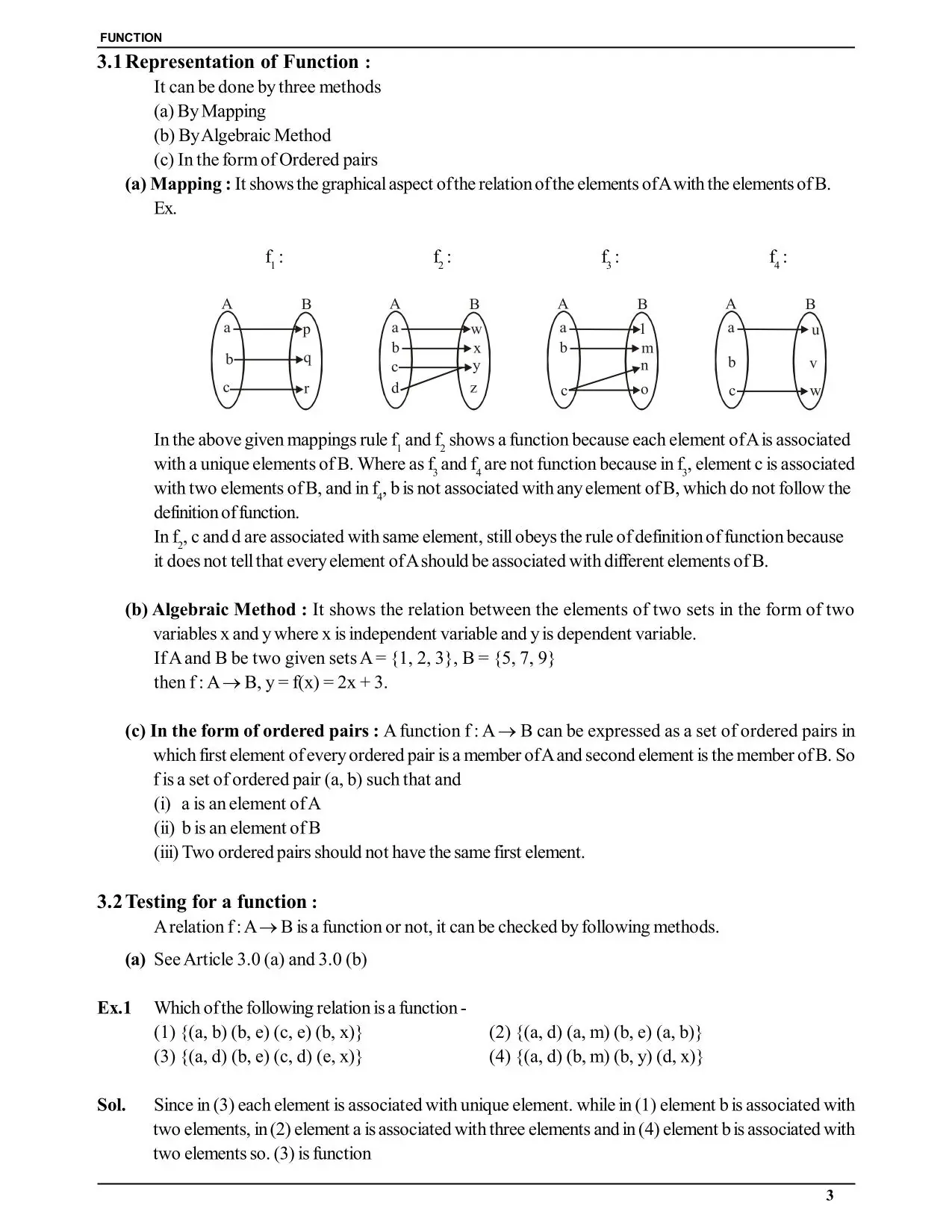
A function $f : A \to B$ is a relation in which every element of $A$ has exactly one image in $B$.
Term | Meaning |
|---|---|
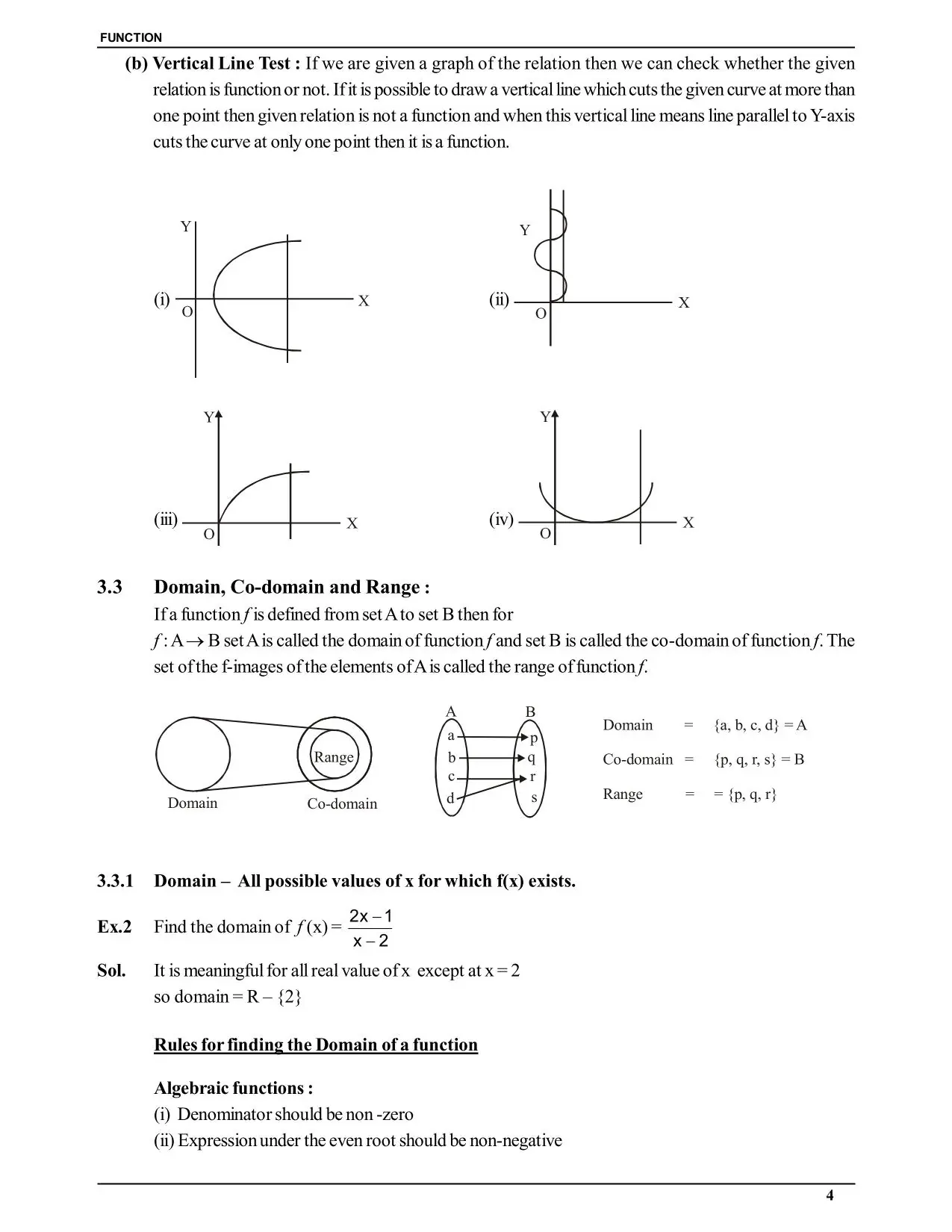
Domain | The set $A$ of all allowed inputs |
Co-domain | The set $B$ in which the outputs lie |
Range | The set of outputs that actually occur, $\{f(x) : x \in A\} \subseteq B$ |
Relation vs function: every function is a relation, but not every relation is a function. If one element of $A$ is related to two different elements of $B$, the relation is not a function. A graph is the graph of a function only if every vertical line meets it at most once (the vertical line test).
A function whose range is $\mathbb{R}$ or a subset of $\mathbb{R}$ is a real valued function. If its domain is also $\mathbb{R}$ or a subset of $\mathbb{R}$, it is a real function.
Counting: if $n(A) = m$ and $n(B) = n$, the number of functions from $A$ to $B$ is $n^{m}$.
How to Find the Domain of a Function in Functions Class 11 Notes
Form of the function | Condition on $x$ |
|---|---|
$\dfrac{1}{g(x)}$ | $g(x) \neq 0$ |
$\sqrt{g(x)}$ (or any even root) | $g(x) \geq 0$ |
$\log g(x)$ | $g(x) > 0$ |
$\dfrac{1}{\sqrt{g(x)}}$ | $g(x) > 0$ |
$\log_{h(x)} g(x)$ | $g(x) > 0$, $h(x) > 0$ and $h(x) \neq 1$ |
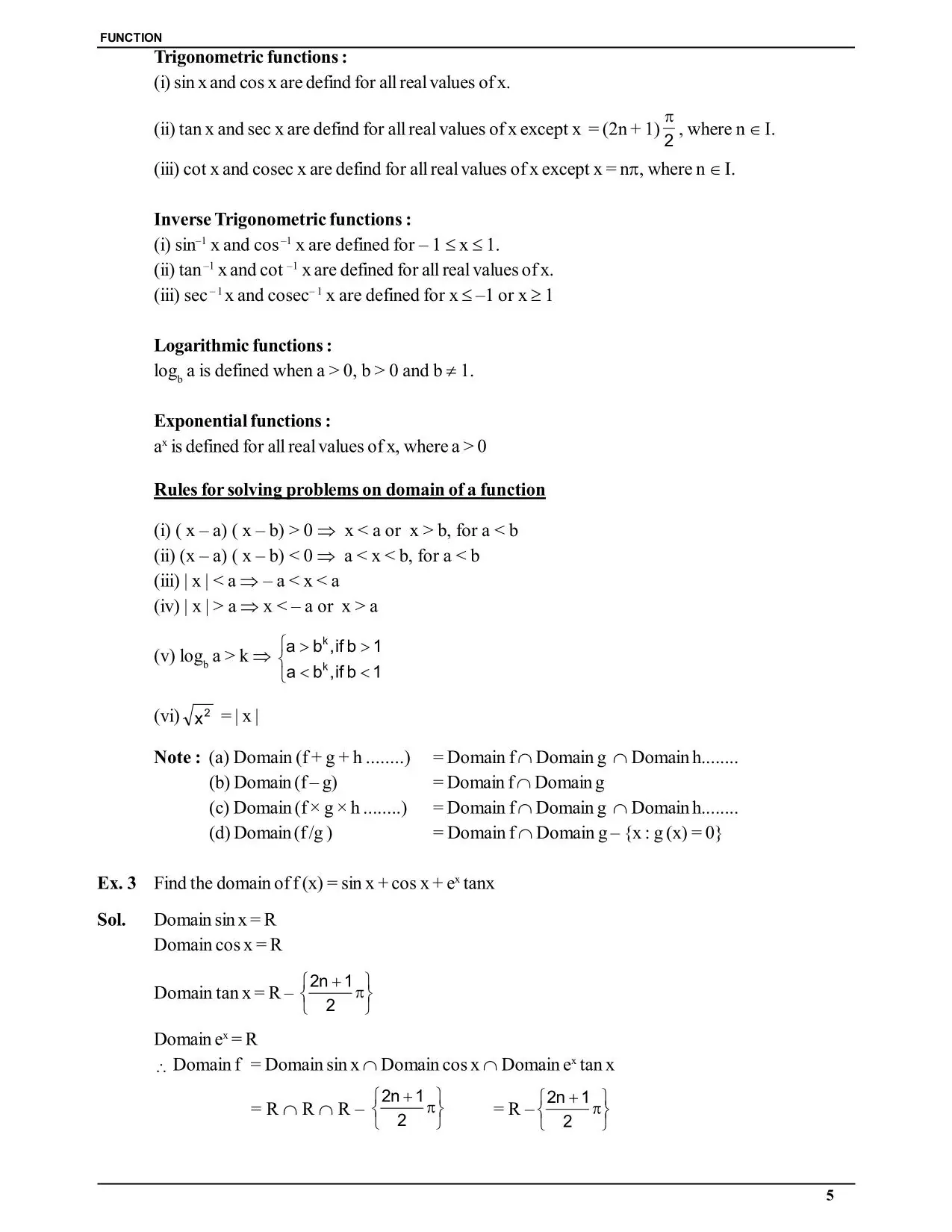
$\tan x$ | $x \neq (2n + 1)\dfrac{\pi}{2}$ |
$\sin^{-1} g(x)$ or $\cos^{-1} g(x)$ | $-1 \leq g(x) \leq 1$ |
For a sum, a difference or a product of functions, the domain is the intersection of the domains. For a quotient $\dfrac{f}{g}$, remove the points where $g(x) = 0$ as well.
How to Find the Range of a Function in Functions Class 11 Notes
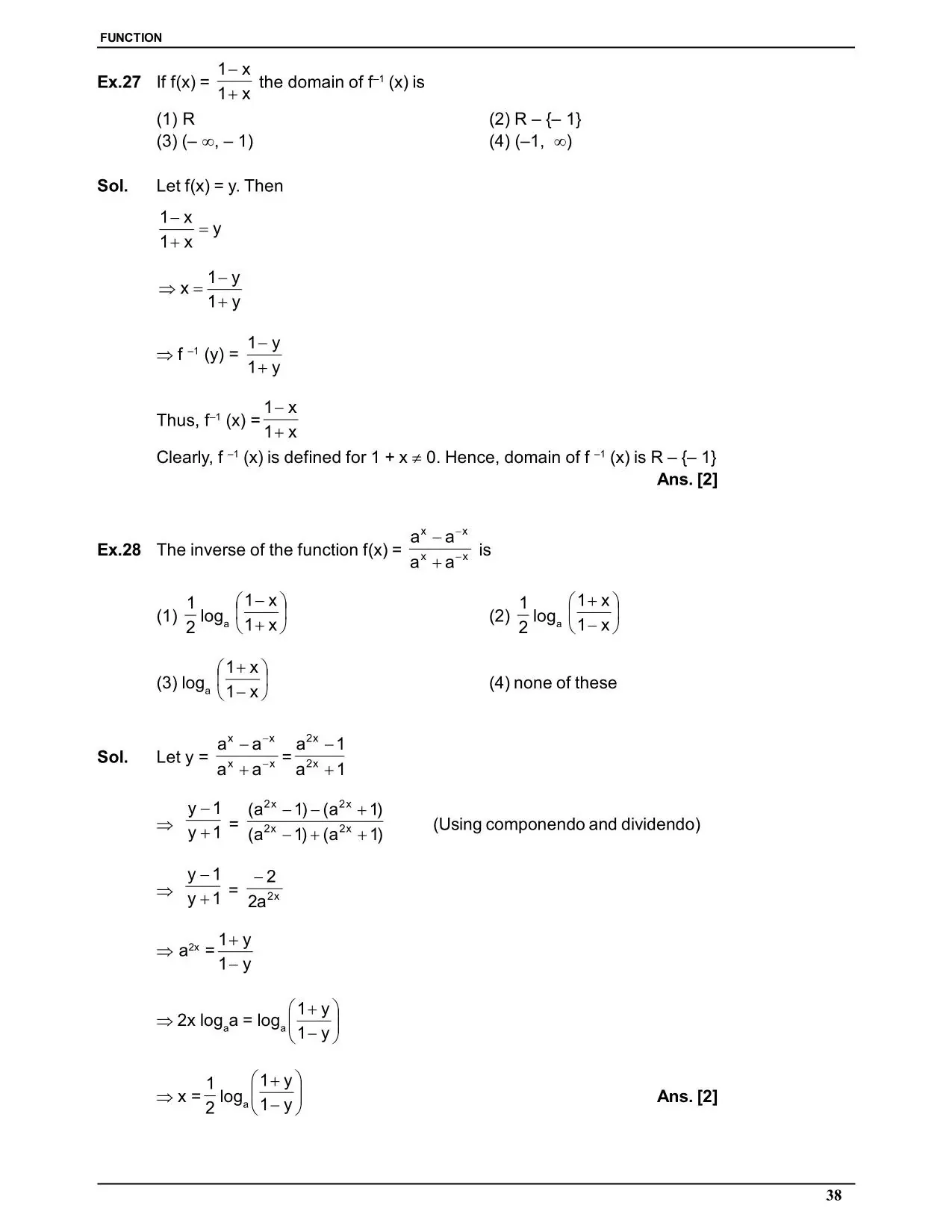
- Write $y = f(x)$, and solve for $x$ in terms of $y$. The values of $y$ for which a real $x$ exists in the domain form the range.
- Use the discriminant when $y = f(x)$ gives a quadratic in $x$: for a real $x$, the discriminant must be $\geq 0$.
- Use the minimum or maximum. For $ax^2 + bx + c$ with $a > 0$, the range is $\left[\dfrac{4ac - b^2}{4a},\ \infty\right)$.
- Use a graph, or the known bounds of standard functions (for example, $-1 \leq \sin x \leq 1$).
Standard Functions and Their Graphs in Functions Class 11 Notes
Function | Rule | Domain | Range |
|---|---|---|---|
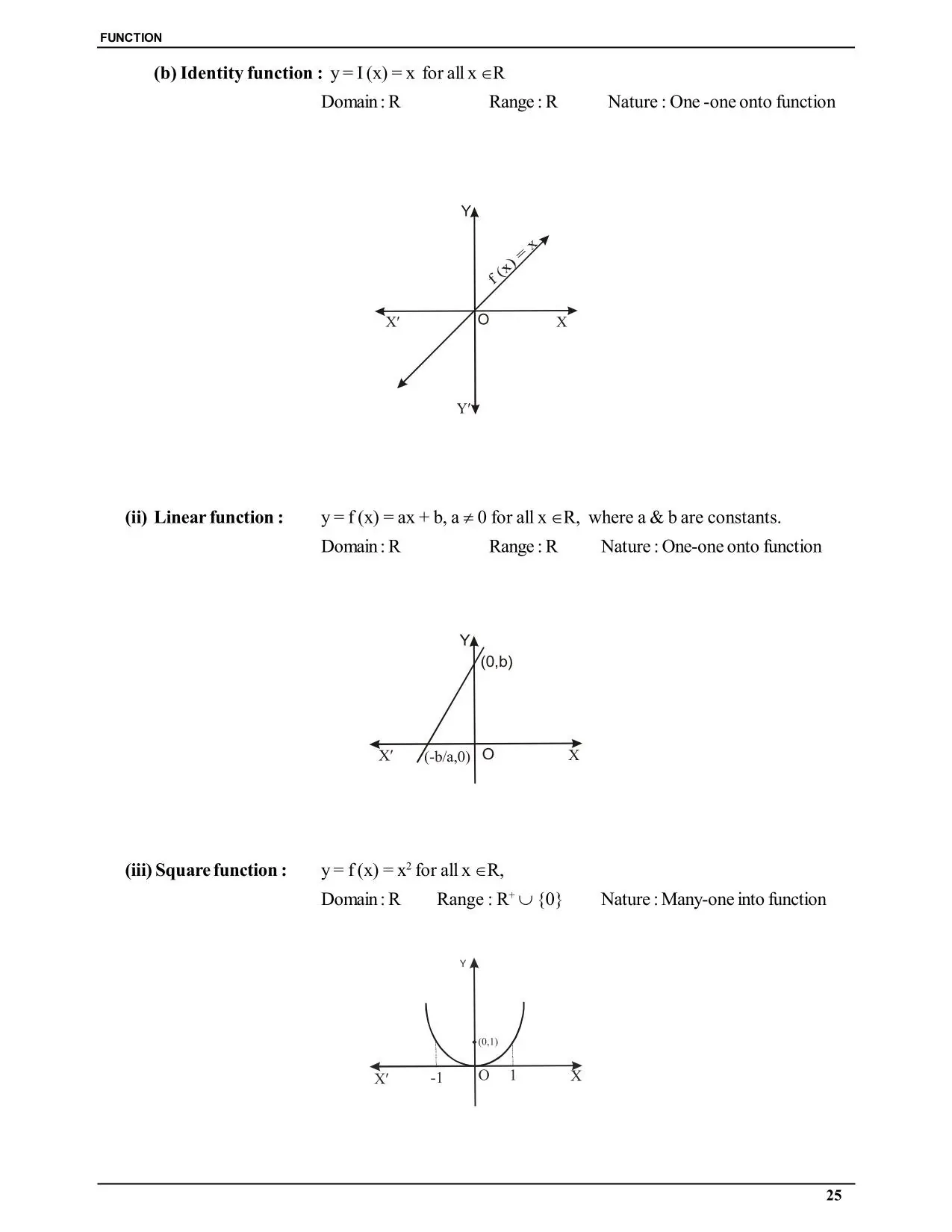
Identity | $f(x) = x$ | $\mathbb{R}$ | $\mathbb{R}$ |
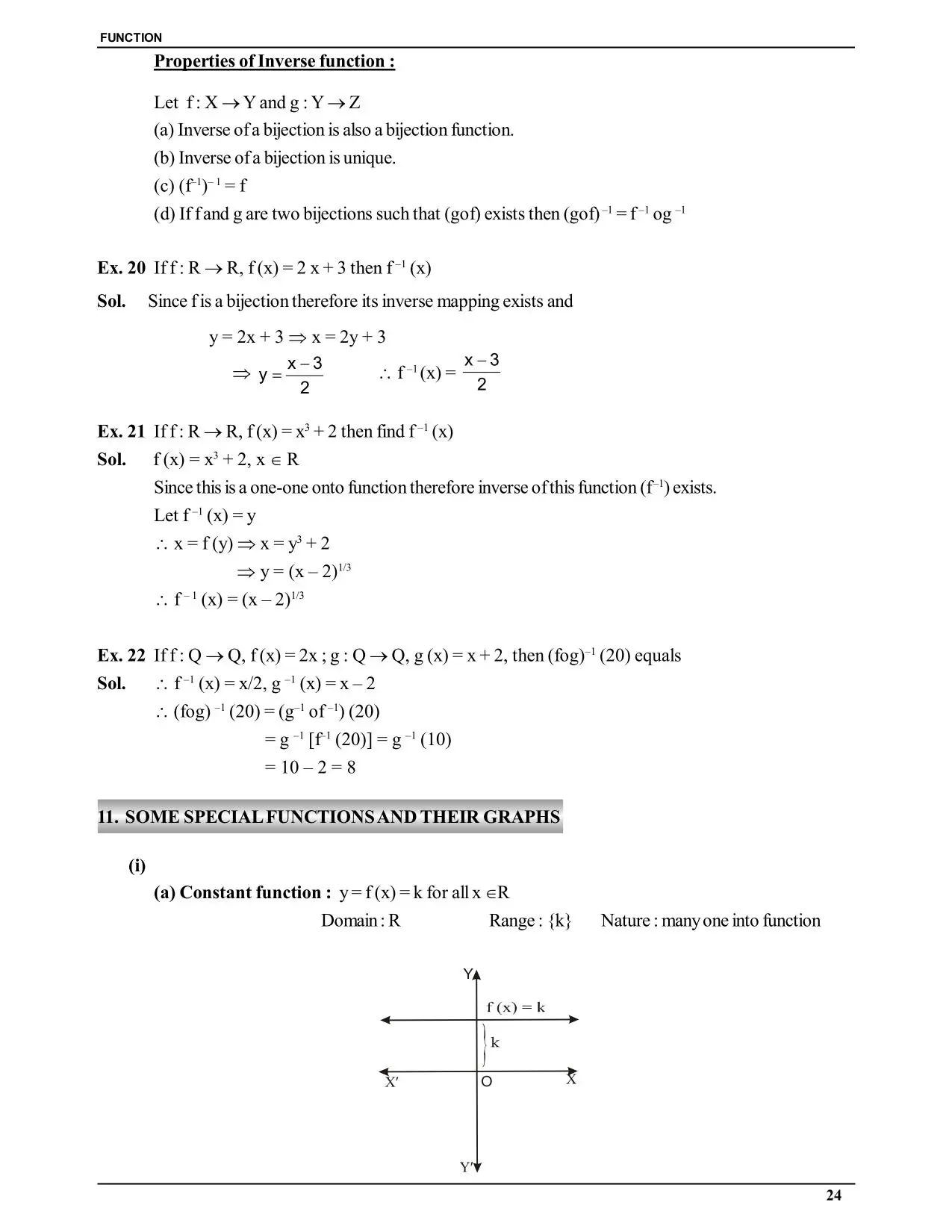
Constant | $f(x) = c$ | $\mathbb{R}$ | $\{c\}$ |
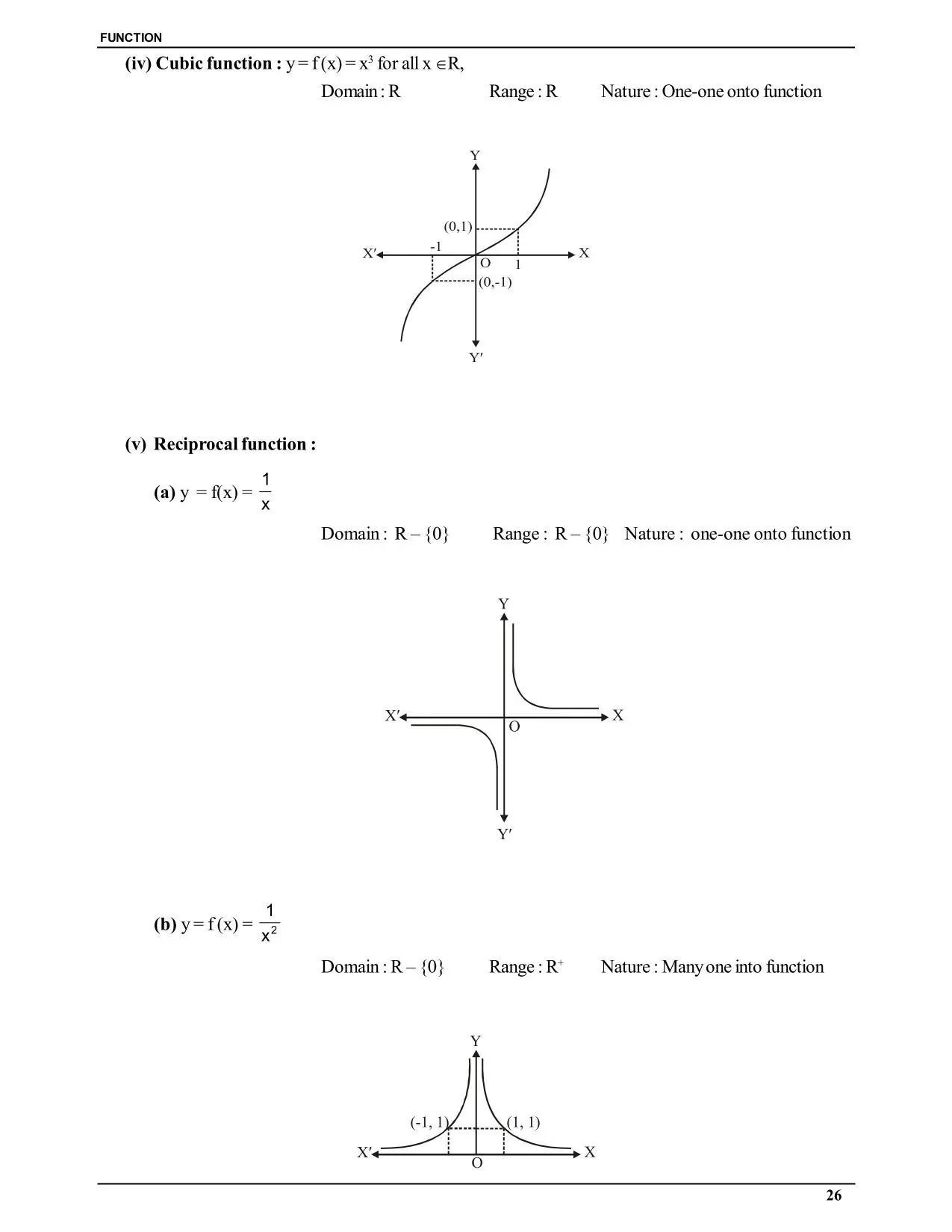
Reciprocal | $f(x) = \dfrac{1}{x}$ | $\mathbb{R} \setminus \{0\}$ | $\mathbb{R} \setminus \{0\}$ |
Modulus | $f(x) = \lvert x \rvert$ | $\mathbb{R}$ | $[0, \infty)$ |
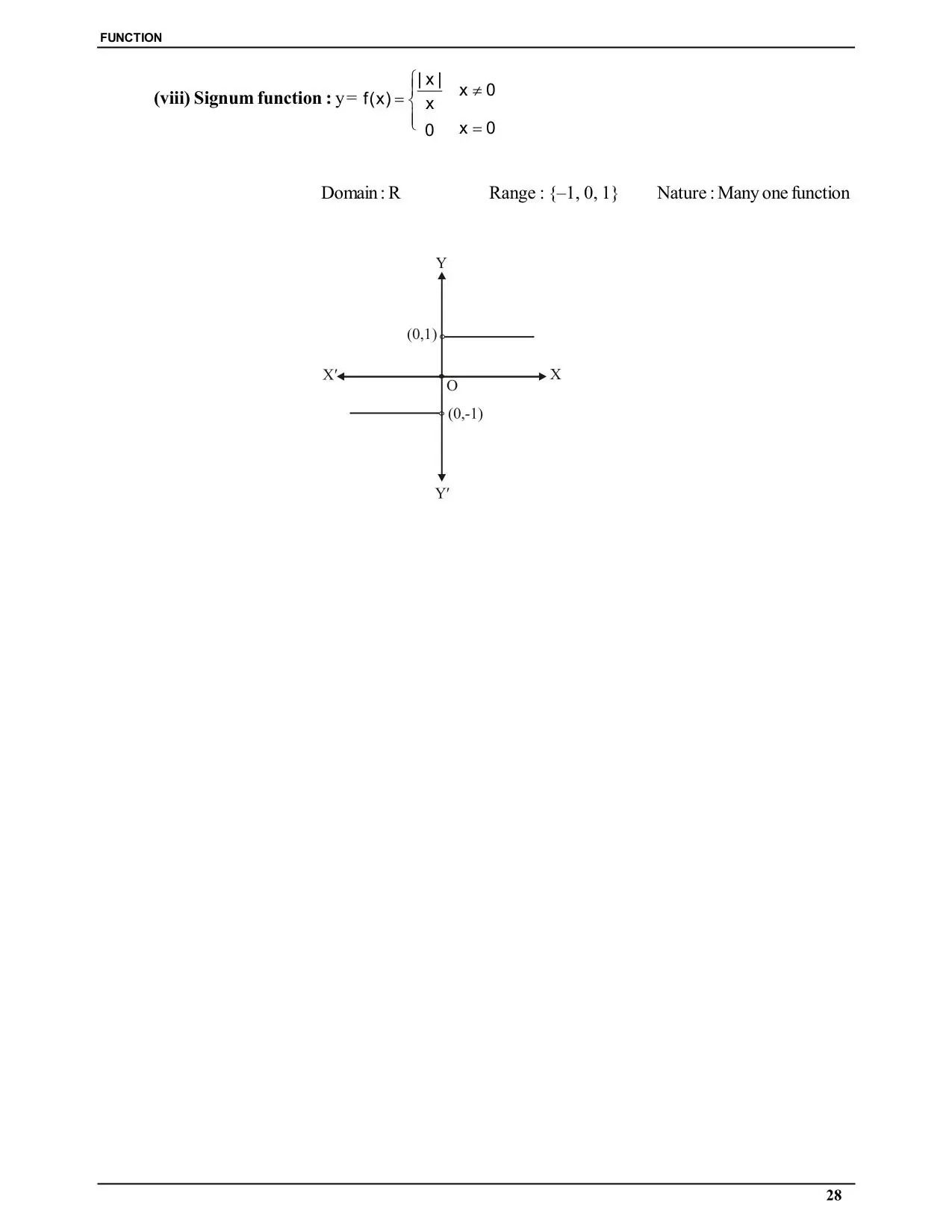
Signum | $f(x) = \dfrac{\lvert x \rvert}{x}$ for $x \neq 0$, and $0$ for $x = 0$ | $\mathbb{R}$ | $\{-1, 0, 1\}$ |
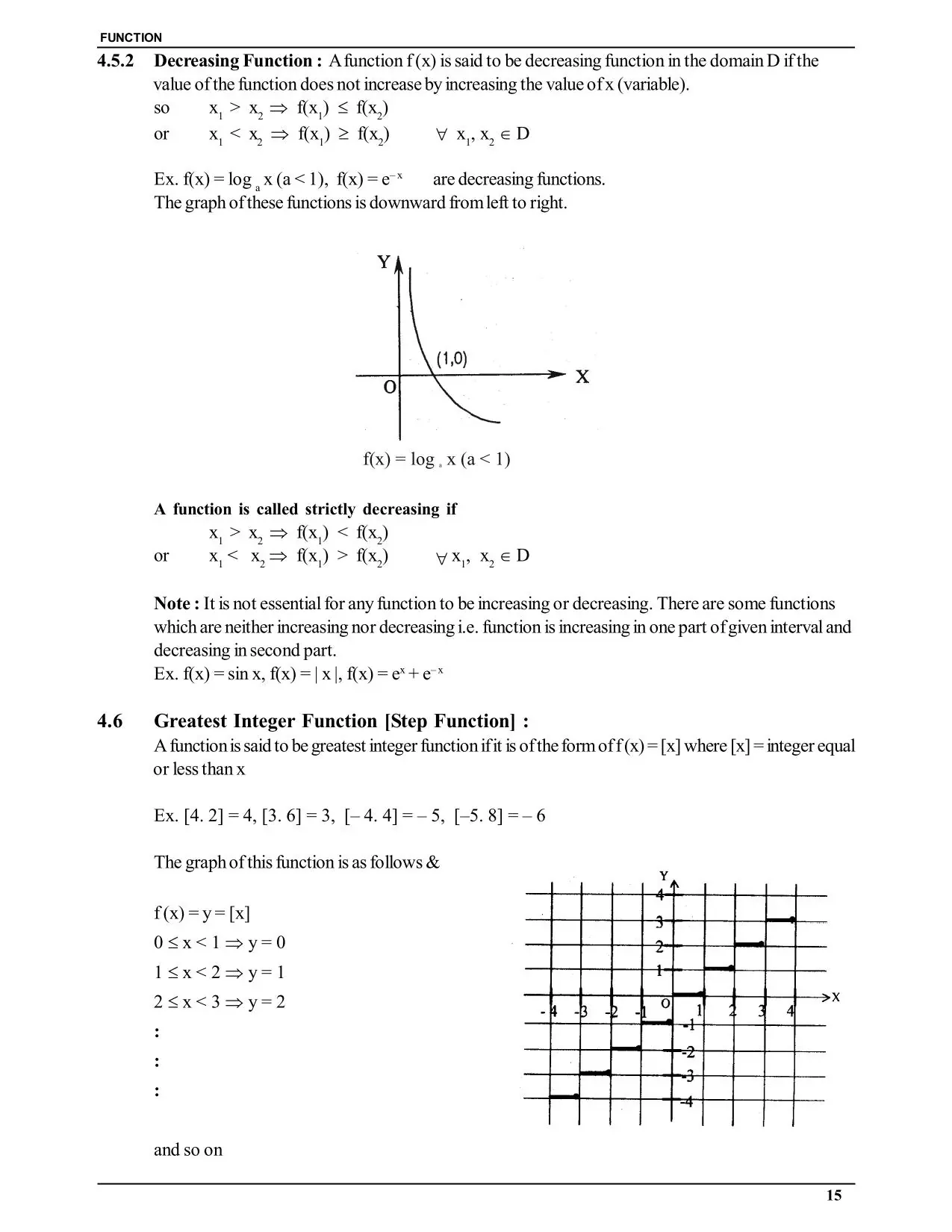
Greatest integer | $f(x) = [x]$ | $\mathbb{R}$ | $\mathbb{Z}$ |
Fractional part | $f(x) = \{x\} = x - [x]$ | $\mathbb{R}$ | $[0, 1)$ |
Exponential | $f(x) = a^{x}$ ($a > 0$, $a \neq 1$) | $\mathbb{R}$ | $(0, \infty)$ |
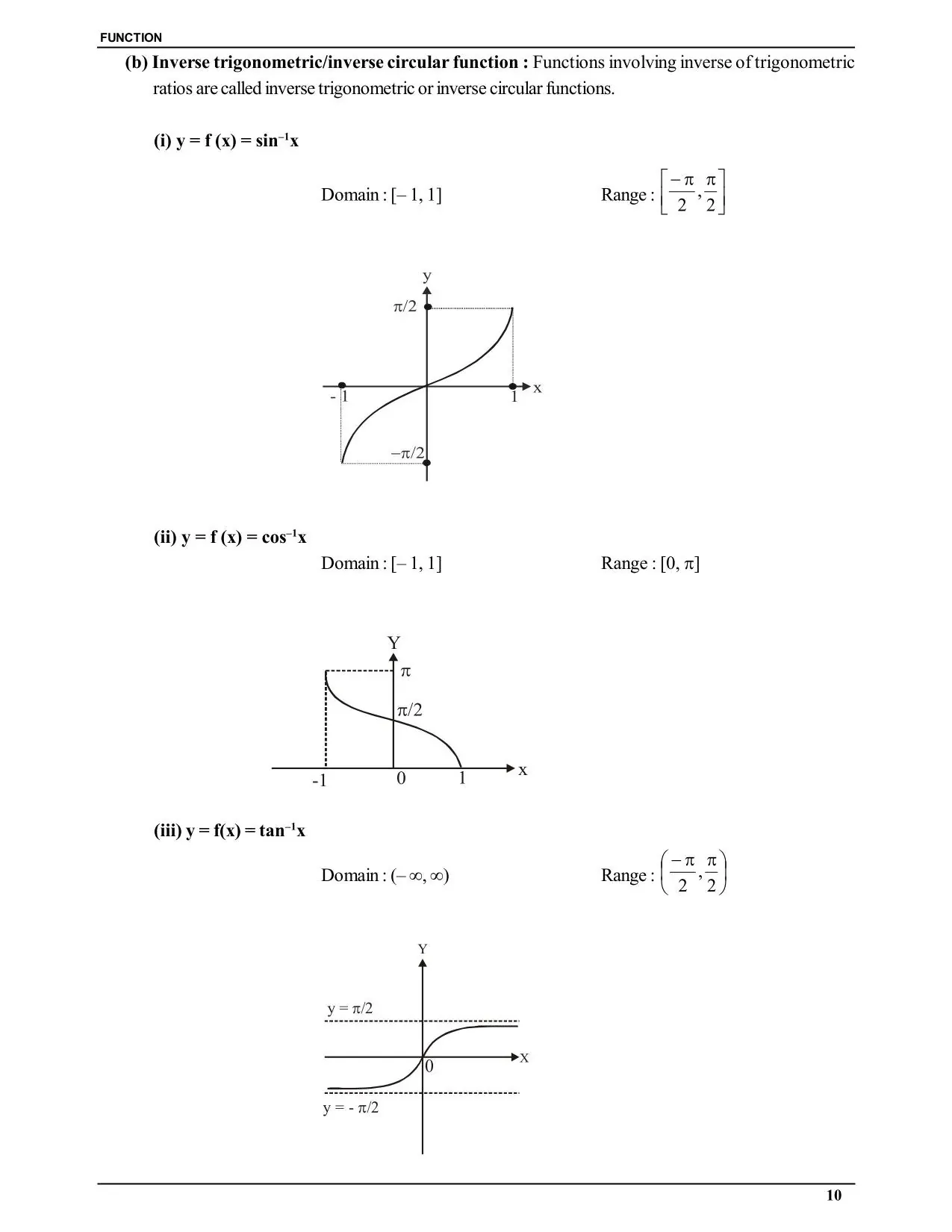
Logarithmic | $f(x) = \log_a x$ | $(0, \infty)$ | $\mathbb{R}$ |
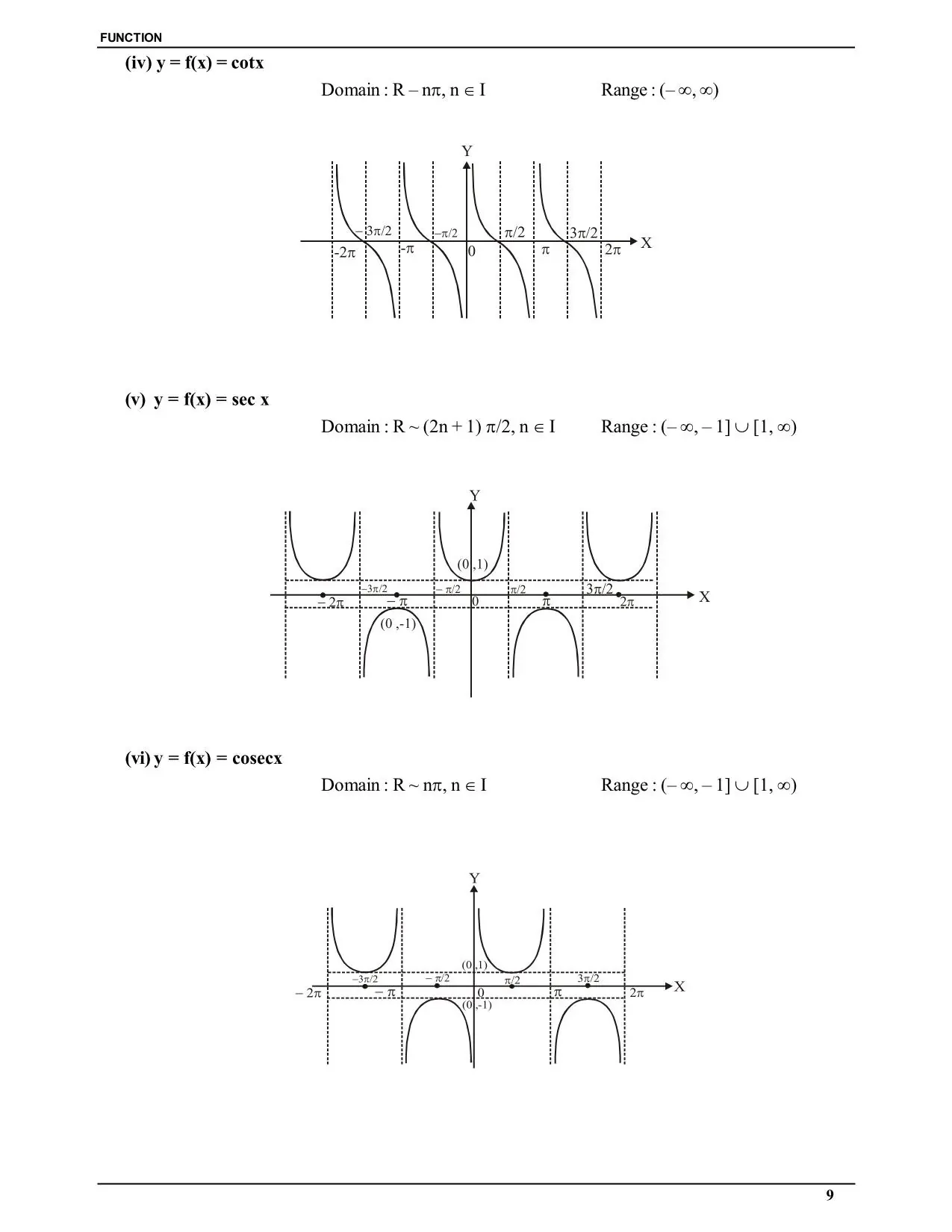
The greatest integer function $[x]$ gives the largest integer that is less than or equal to $x$, so $[2.7] = 2$ and $[-2.3] = -3$. The polynomial function $f(x) = a_0 + a_1x + \cdots + a_nx^n$ has the domain $\mathbb{R}$, and a rational function $\dfrac{p(x)}{q(x)}$ has the domain $\{x : q(x) \neq 0\}$. For the trigonometric functions, see eSaral’s trigonometry formulas for Class 11.
Algebra and Composition of Functions in Functions Class 11 Notes
For functions $f$ and $g$ with domains $D_f$ and $D_g$:
$$(f \pm g)(x) = f(x) \pm g(x), \qquad (\alpha f)(x) = \alpha f(x), \qquad (fg)(x) = f(x)\,g(x), \qquad \left(\frac{f}{g}\right)(x) = \frac{f(x)}{g(x)}$$
The domain of $f \pm g$ and of $fg$ is $D_f \cap D_g$, and the domain of $\dfrac{f}{g}$ is $D_f \cap D_g$ with the points where $g(x) = 0$ removed.
Composition:
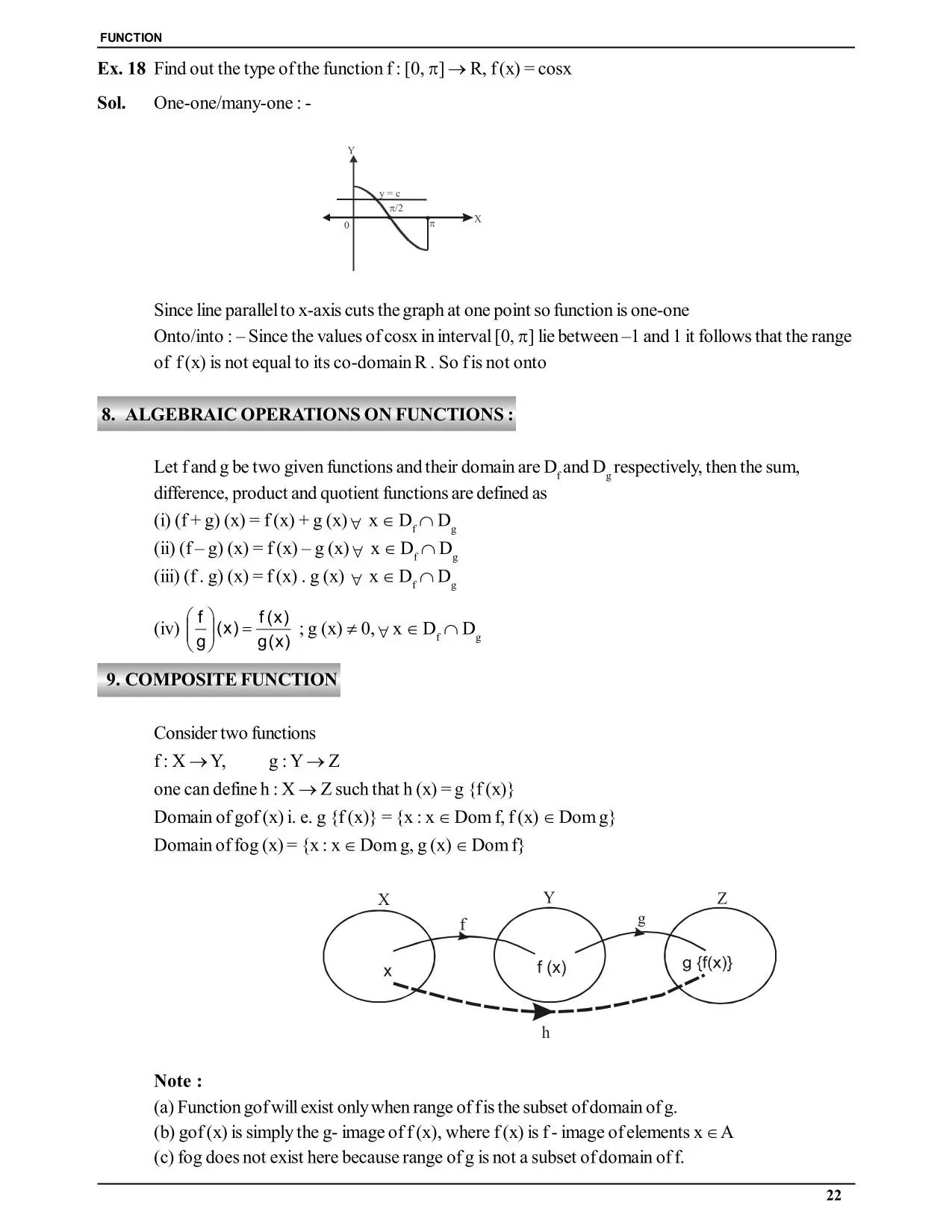
$$(f \circ g)(x) = f\big(g(x)\big)$$
It exists when the range of $g$ lies in the domain of $f$. In general, $f \circ g \neq g \circ f$.
Types of Functions for JEE in Functions Class 11 Notes
Type | Meaning | Test |
|---|---|---|
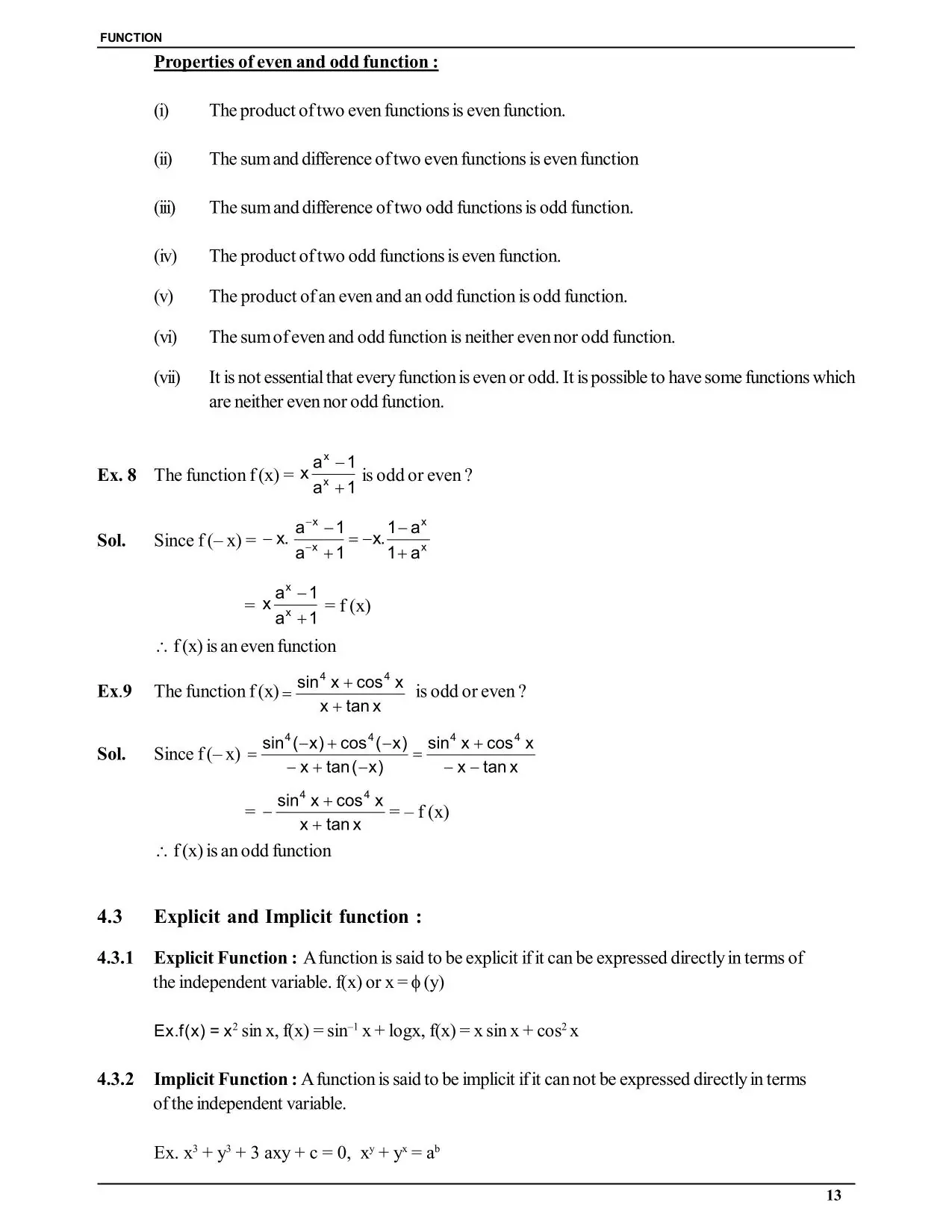
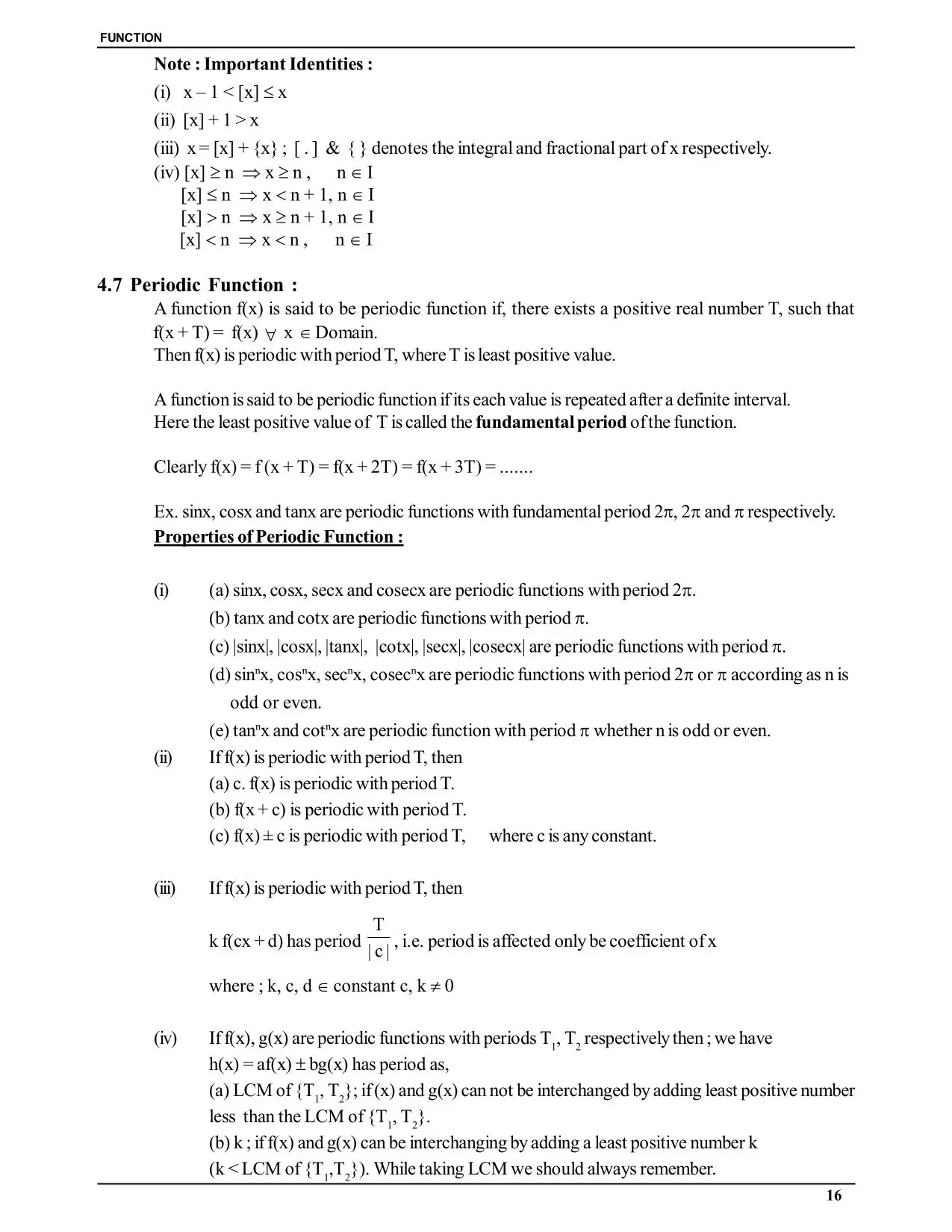
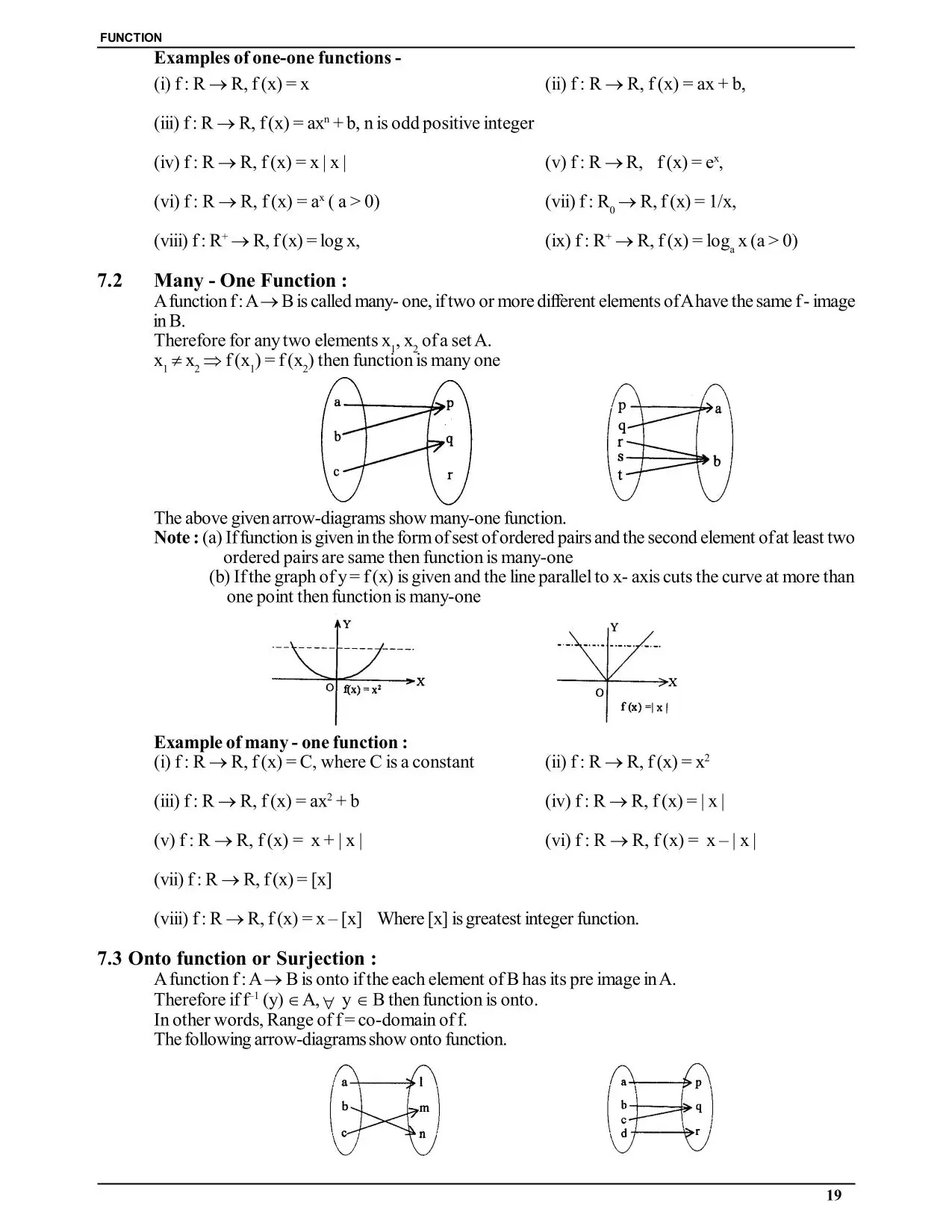
One-one (injective) | Different inputs give different outputs | Horizontal line test: no horizontal line meets the graph twice |
Many-one | Two or more inputs give the same output | A horizontal line meets the graph more than once |
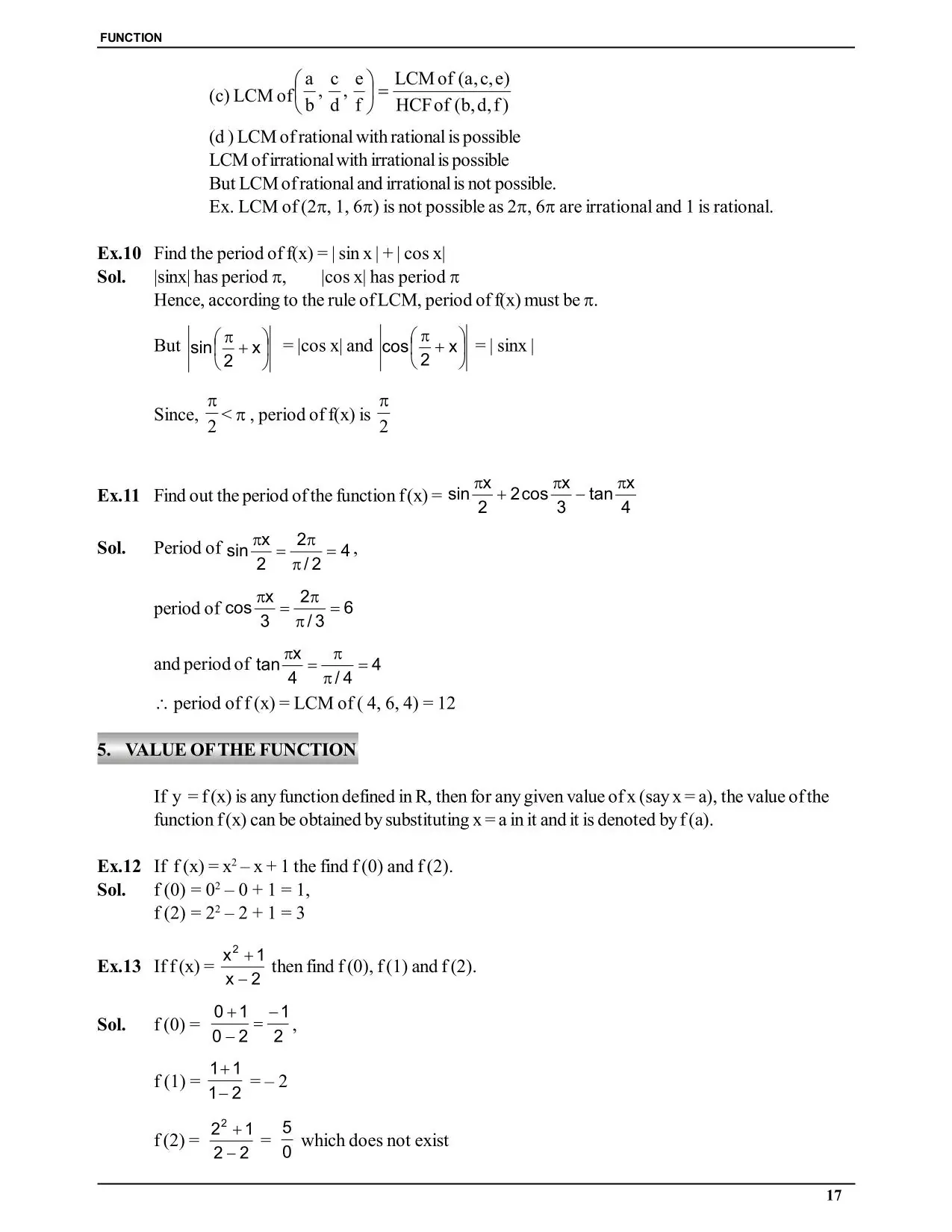
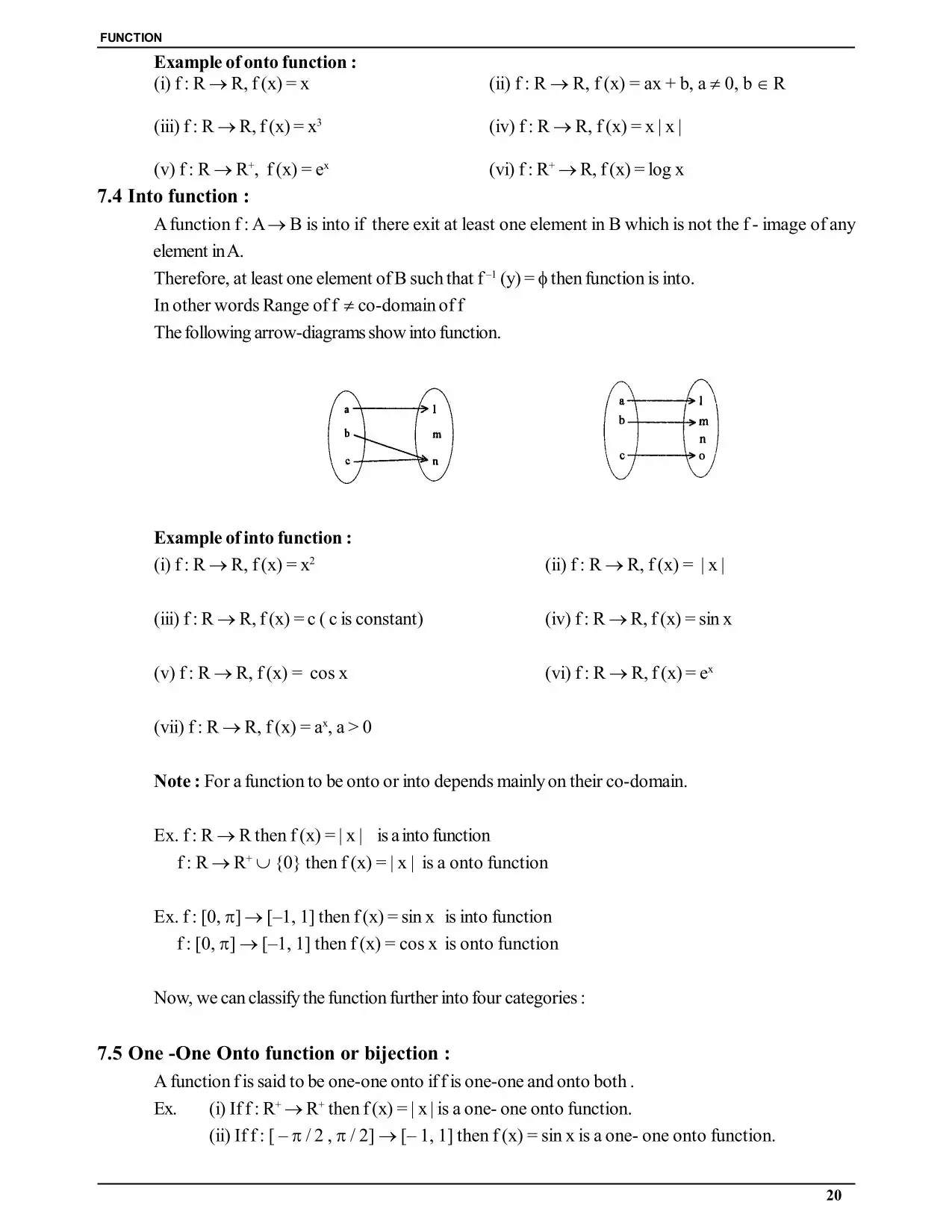
Onto (surjective) | Range = co-domain | Every $y$ in the co-domain has a pre-image |
Into | Range is a proper subset of the co-domain | Some $y$ has no pre-image |
Bijective | Both one-one and onto | Both tests hold |
If $f$ is differentiable, and $f'(x) > 0$ (or $< 0$) throughout an interval, then $f$ is one-one on that interval.
Counting functions between finite sets ($n(A) = m$, $n(B) = n$):
Type of function | Number |
|---|---|
All functions | $n^{m}$ |
One-one functions ($m \leq n$) | ${}^{n}P_{m} = \dfrac{n!}{(n-m)!}$ |
Bijective functions ($m = n$) | $n!$ |
Onto functions ($m \geq n$) | $\displaystyle\sum_{r=0}^{n} (-1)^{n-r}\binom{n}{r}\,r^{m}$ |
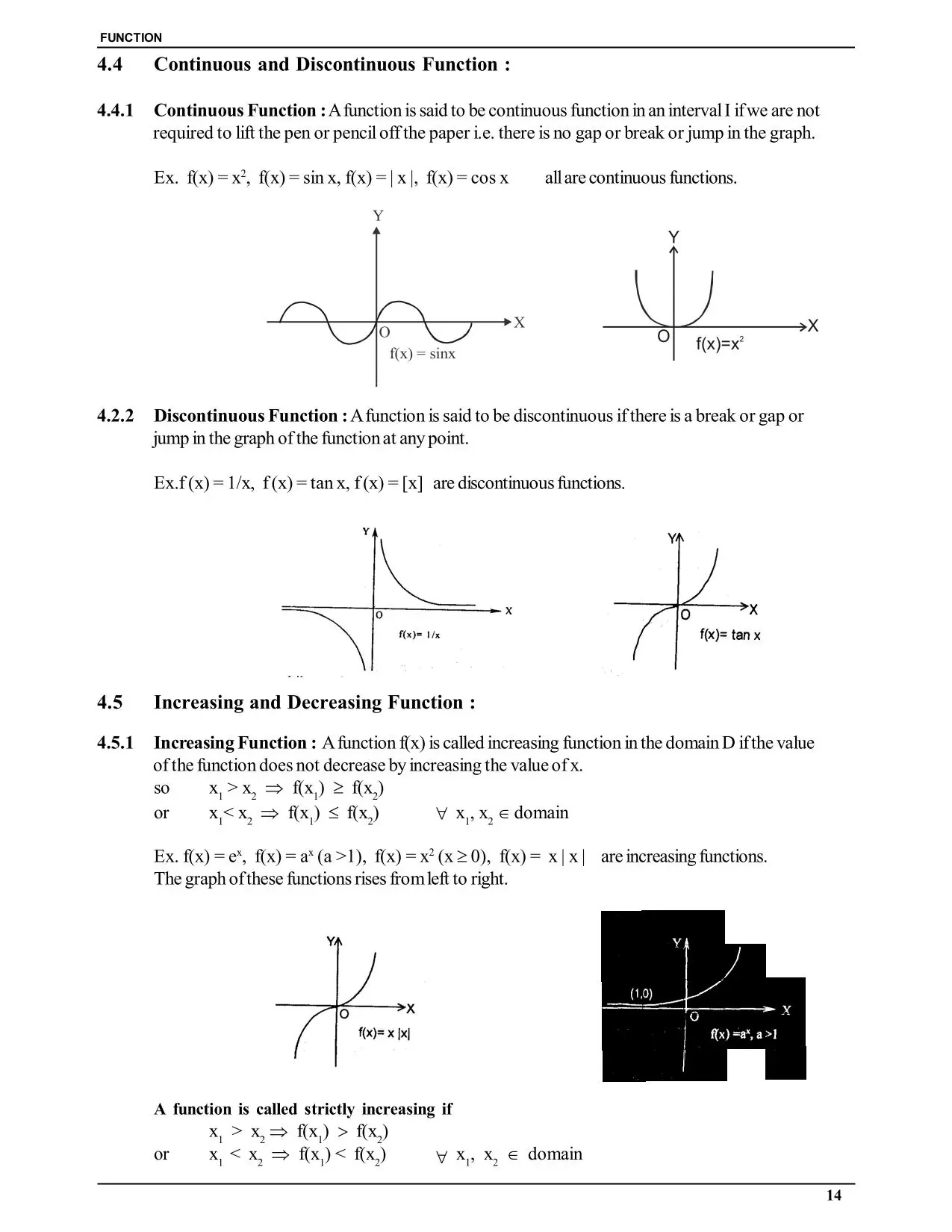
Inverse function: $f^{-1}$ exists only if $f$ is bijective. Then $f^{-1}\big(f(x)\big) = x$, and the graph of $f^{-1}$ is the mirror image of the graph of $f$ in the line $y = x$.
Even, Odd and Periodic Functions
Property | Condition | Example |
|---|---|---|
Even | $f(-x) = f(x)$ (graph is symmetric about the $y$-axis) | $x^2$, $\cos x$, $\lvert x \rvert$ |
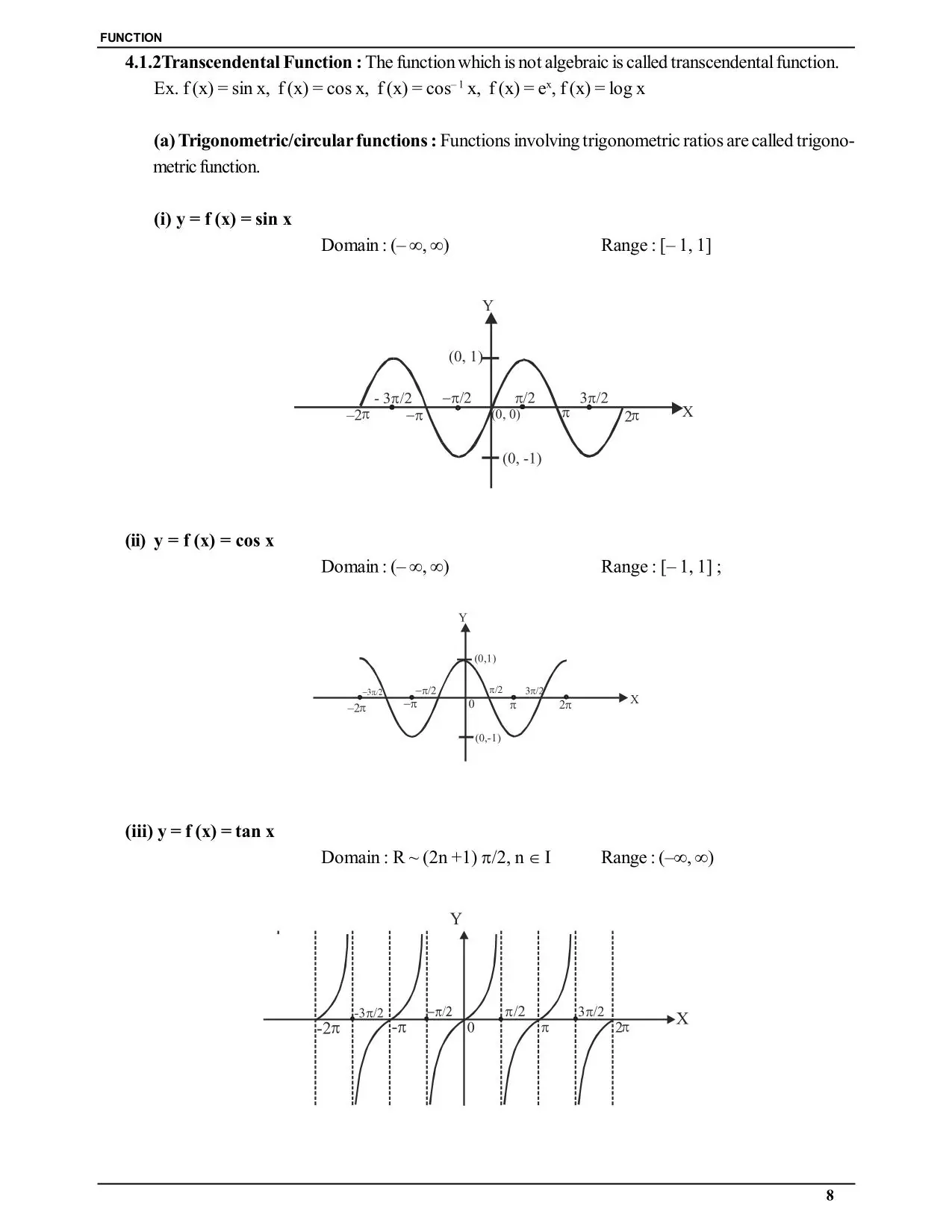
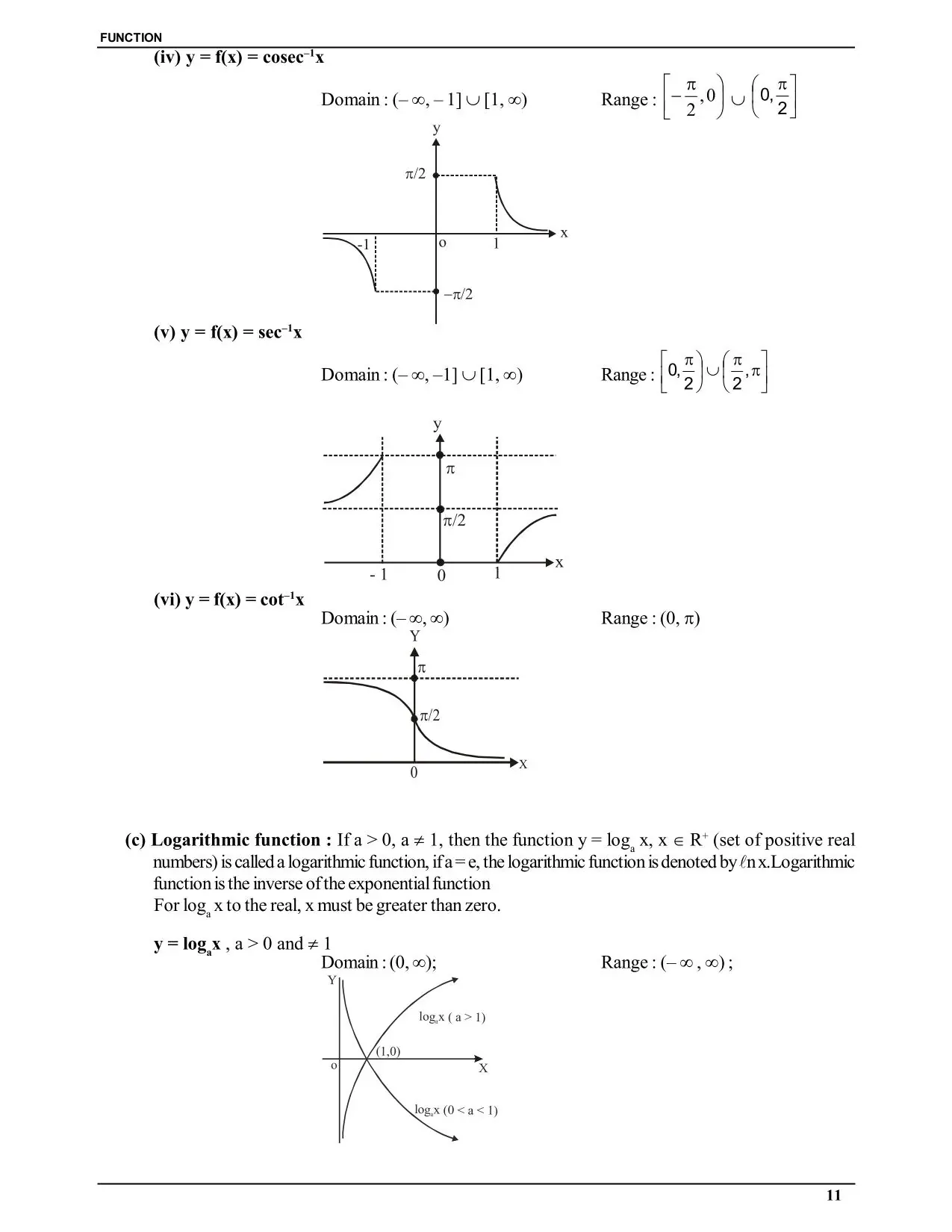
Odd | $f(-x) = -f(x)$ (graph is symmetric about the origin) | $x^3$, $\sin x$, $\tan x$ |
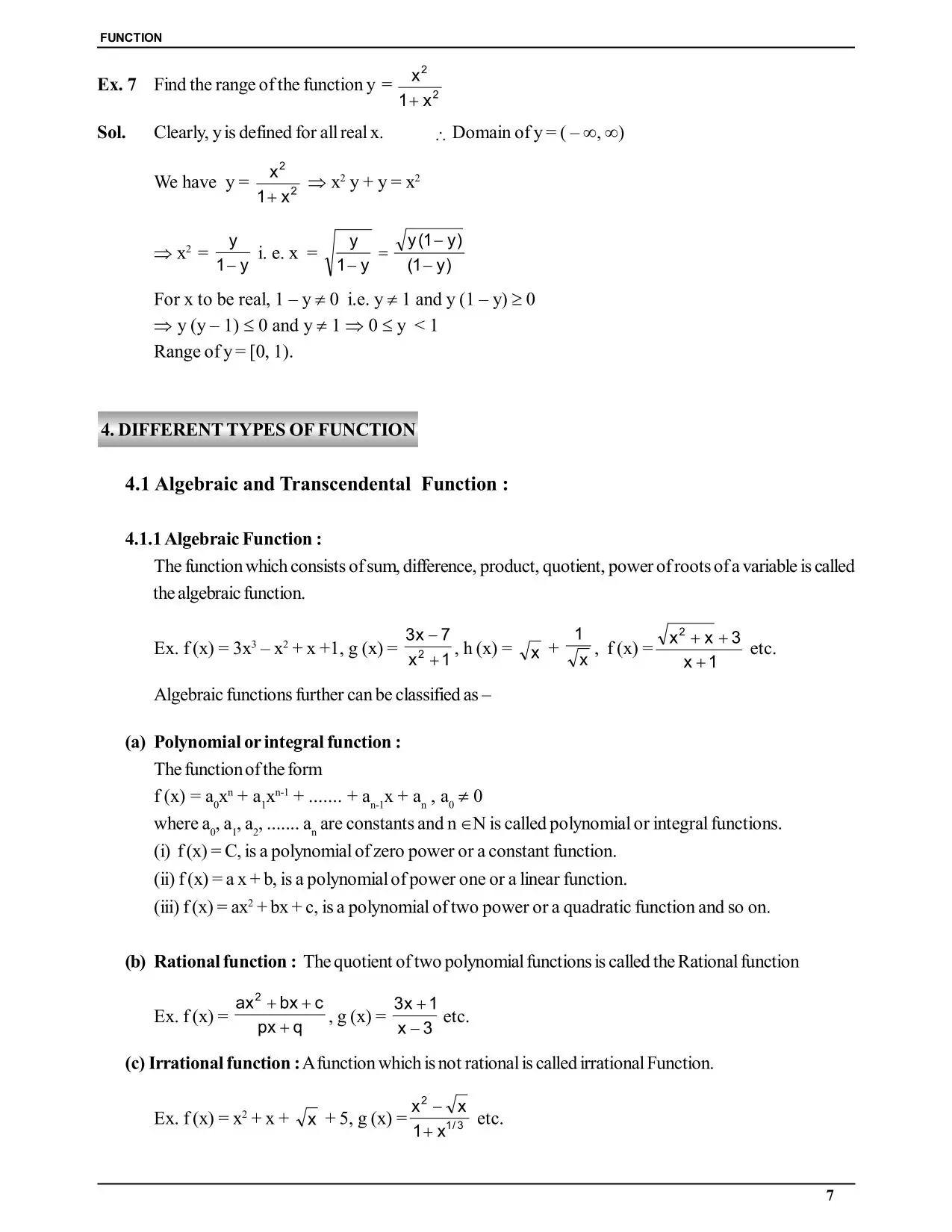
Periodic | $f(x + T) = f(x)$ for the smallest positive $T$ | $\sin x$ has period $2\pi$, and $\tan x$ has period $\pi$ |
The period of $\sin(ax + b)$ and $\cos(ax + b)$ is $\dfrac{2\pi}{\lvert a \rvert}$. If $f$ and $g$ have periods $T_1$ and $T_2$, the period of $f + g$ is the LCM of $T_1$ and $T_2$ (when it exists).
Key Formulas in Functions Class 11 Notes
Concept | Formula |
|---|---|
Cartesian product | $n(A \times B) = n(A)\,n(B)$ |
Number of relations (non-empty) | $2^{mn}$ ($2^{mn} - 1$) |
Number of functions | $n^{m}$ |
One-one functions | ${}^{n}P_{m}$ |
Onto functions | $\sum_{r=0}^{n}(-1)^{n-r}\binom{n}{r}r^{m}$ |
Scalar multiple | $(\alpha f)(x) = \alpha f(x)$ |
Composition | $(f\circ g)(x) = f(g(x))$ |
Fractional part | $\{x\} = x - [x]$ |
Even and odd | $f(-x) = \pm f(x)$ |
Period of $\sin(ax+b)$ | $\dfrac{2\pi}{\lvert a\rvert}$ |
Solved Examples from Functions Class 11 Notes
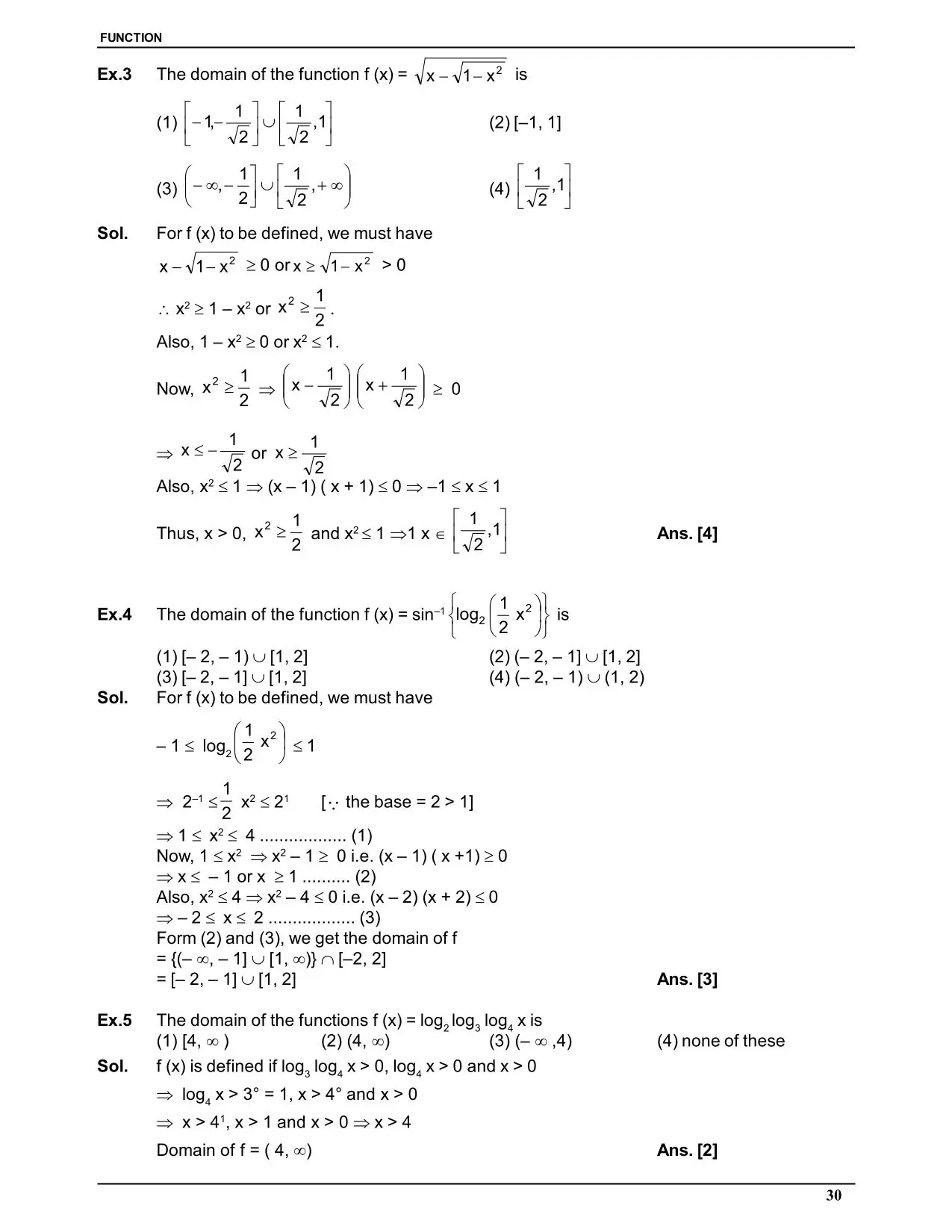
Example 1 (domain): Find the domain of $f(x) = \dfrac{\sqrt{x - 2}}{x - 5}$.
We need $x - 2 \geq 0$, so $x \geq 2$, and $x \neq 5$. The domain is $[2, 5) \cup (5, \infty)$.
Example 2 (domain with a logarithm): Find the domain of $f(x) = \log(x^2 - 3x + 2)$.
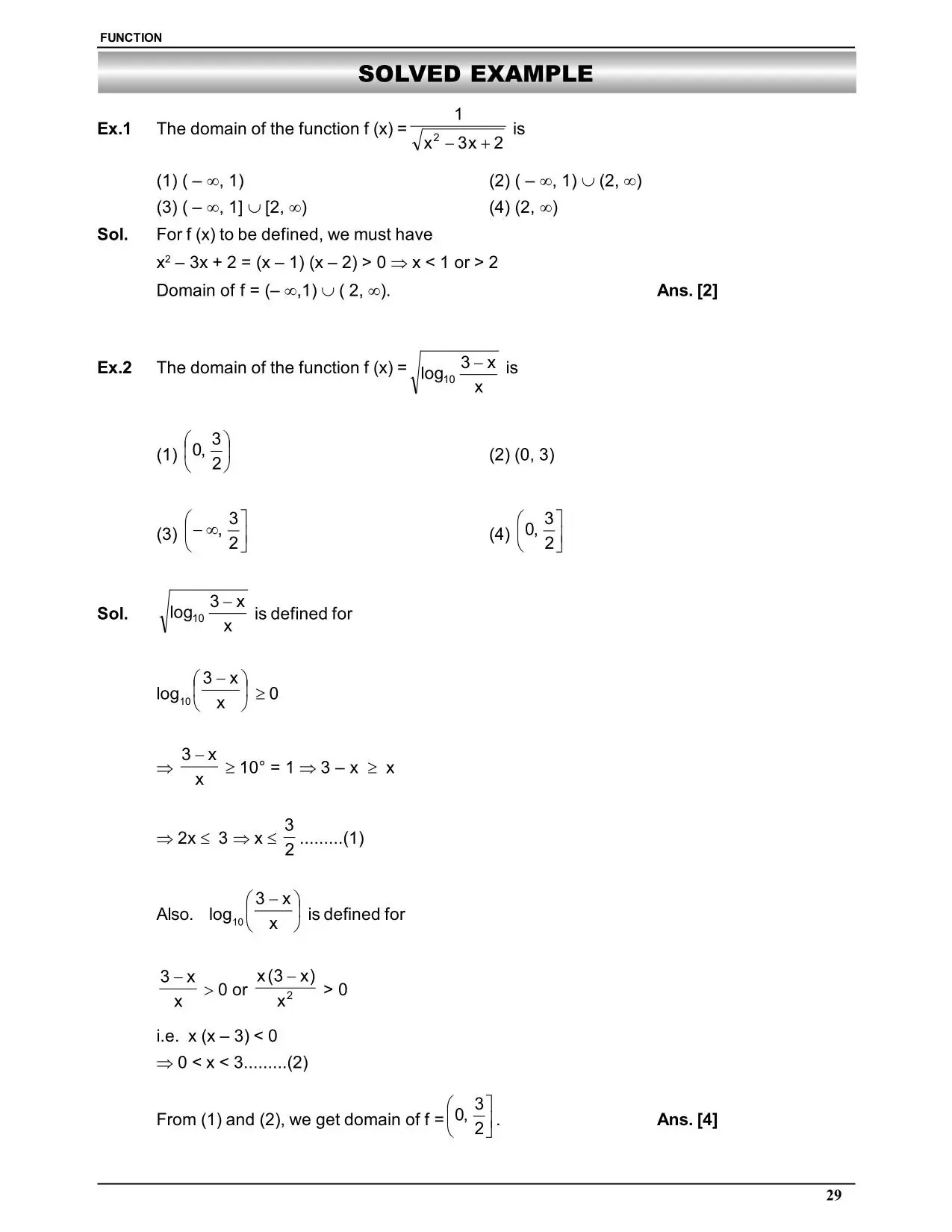
We need $x^2 - 3x + 2 = (x-1)(x-2) > 0$, so $x < 1$ or $x > 2$. The domain is $(-\infty, 1) \cup (2, \infty)$.
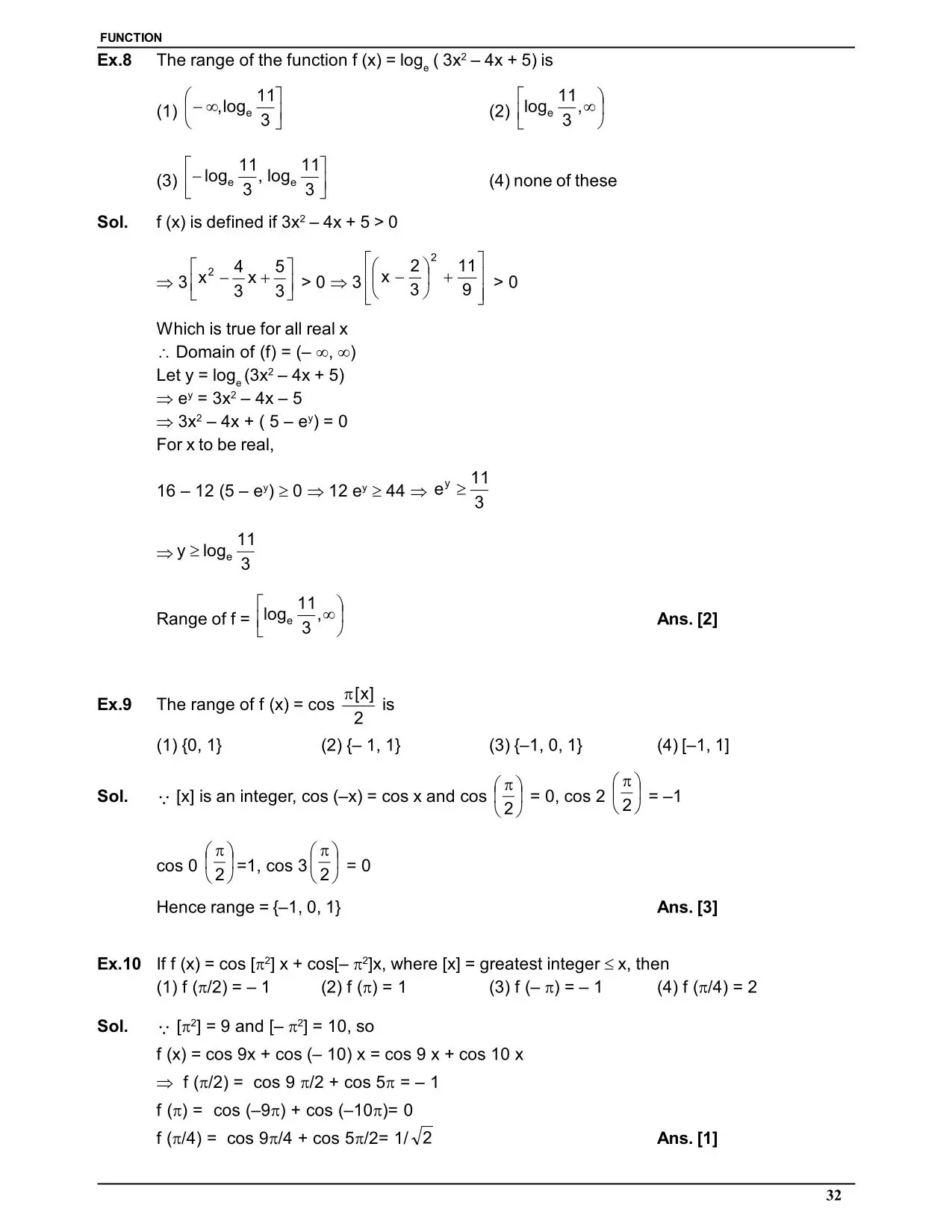
Example 3 (range, quadratic): Find the range of $f(x) = x^2 - 4x + 7$.
$f(x) = (x - 2)^2 + 3 \geq 3$, and it takes the value 3 at $x = 2$. The range is $[3, \infty)$.
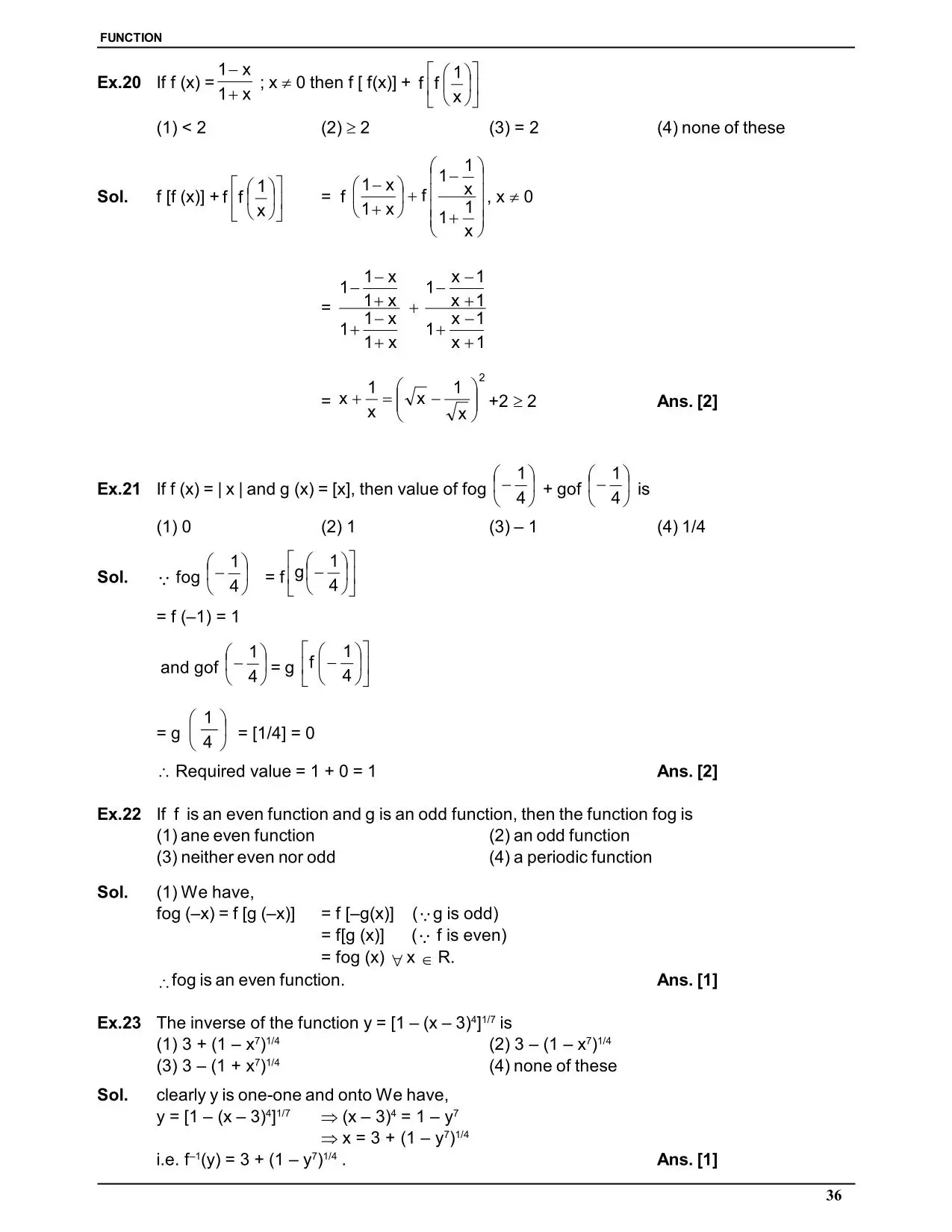
Example 4 (range, discriminant method): Find the range of $f(x) = \dfrac{x}{1 + x^2}$.
Put $y = \dfrac{x}{1 + x^2}$, so $yx^2 - x + y = 0$. For a real $x$, $1 - 4y^2 \geq 0$, so $-\dfrac{1}{2} \leq y \leq \dfrac{1}{2}$. The range is $\left[-\dfrac{1}{2}, \dfrac{1}{2}\right]$.
Example 5 (composition): If $f(x) = 2x + 1$ and $g(x) = x^2$, find $f \circ g$ and $g \circ f$.
$(f \circ g)(x) = 2x^2 + 1$, and $(g \circ f)(x) = (2x + 1)^2$. They are not equal.
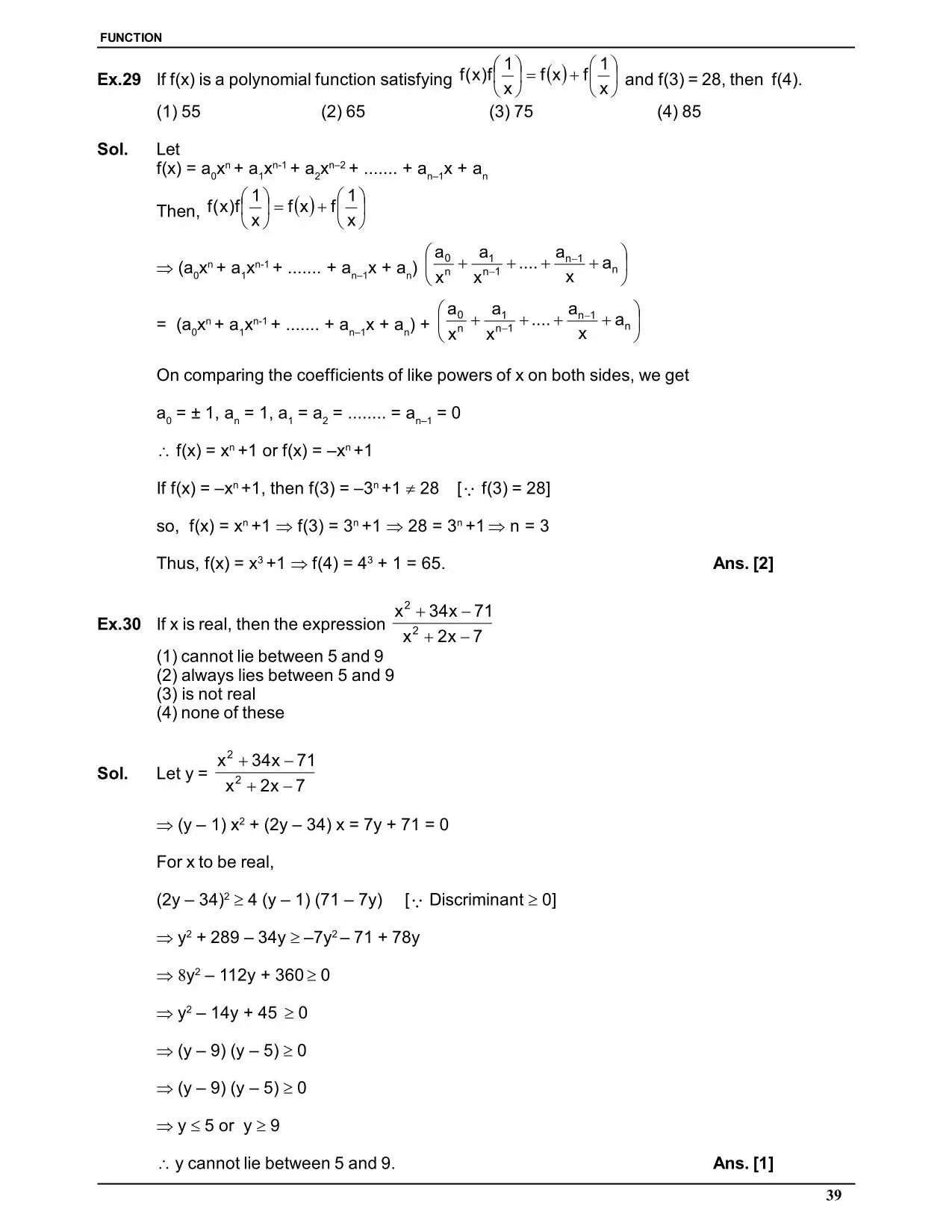
Example 6 (counting functions): Let $n(A) = 3$ and $n(B) = 2$. Find the number of functions, one-one functions and onto functions from $A$ to $B$.
All functions: $2^3 = 8$. One-one functions: 0, because $m > n$. Onto functions: $2^3 - 2 = 6$.
Example 7 (greatest integer and fractional part): Find $[-2.3] + [3.7] + \{2.5\}$.
$[-2.3] = -3$, $[3.7] = 3$ and $\{2.5\} = 0.5$, so the value is $-3 + 3 + 0.5 = 0.5$.
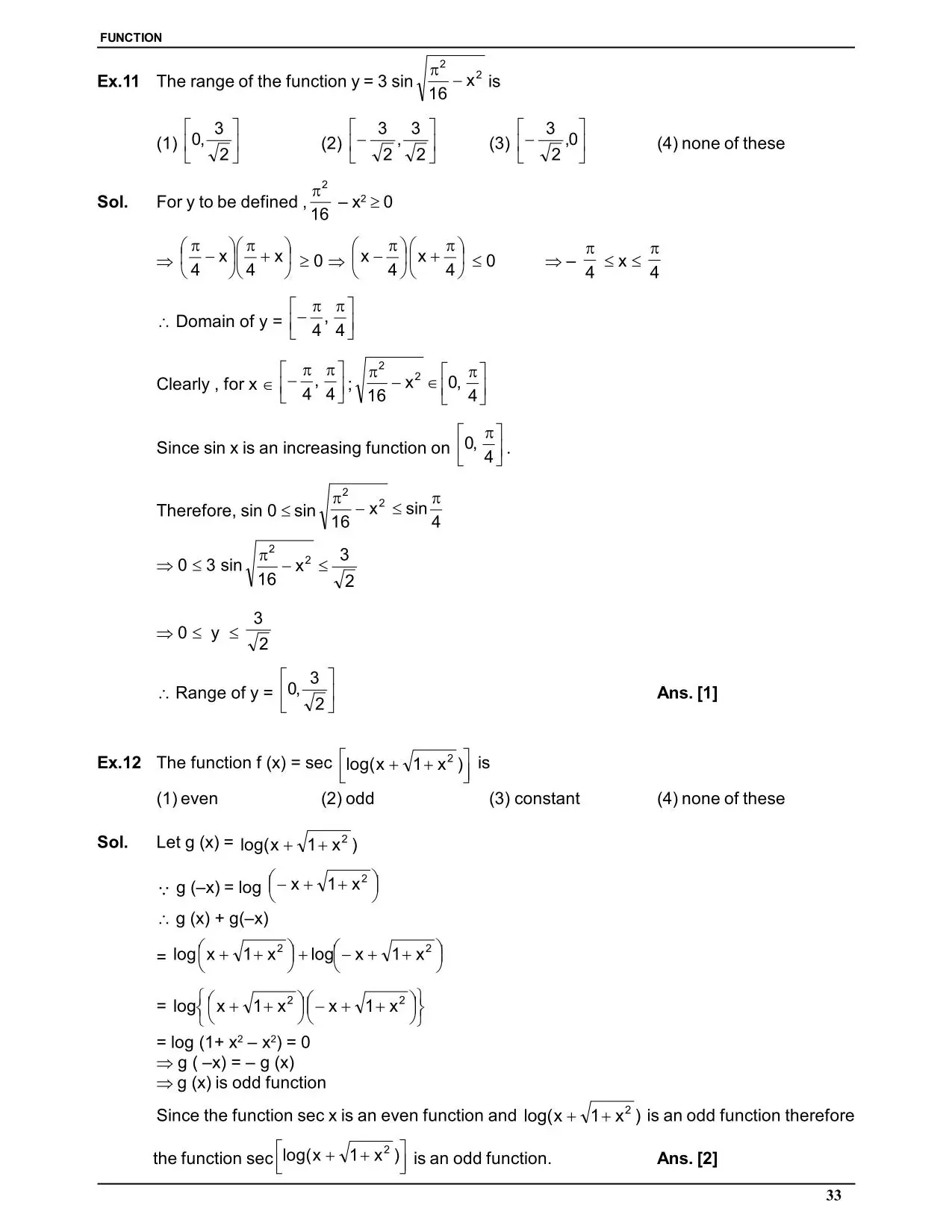
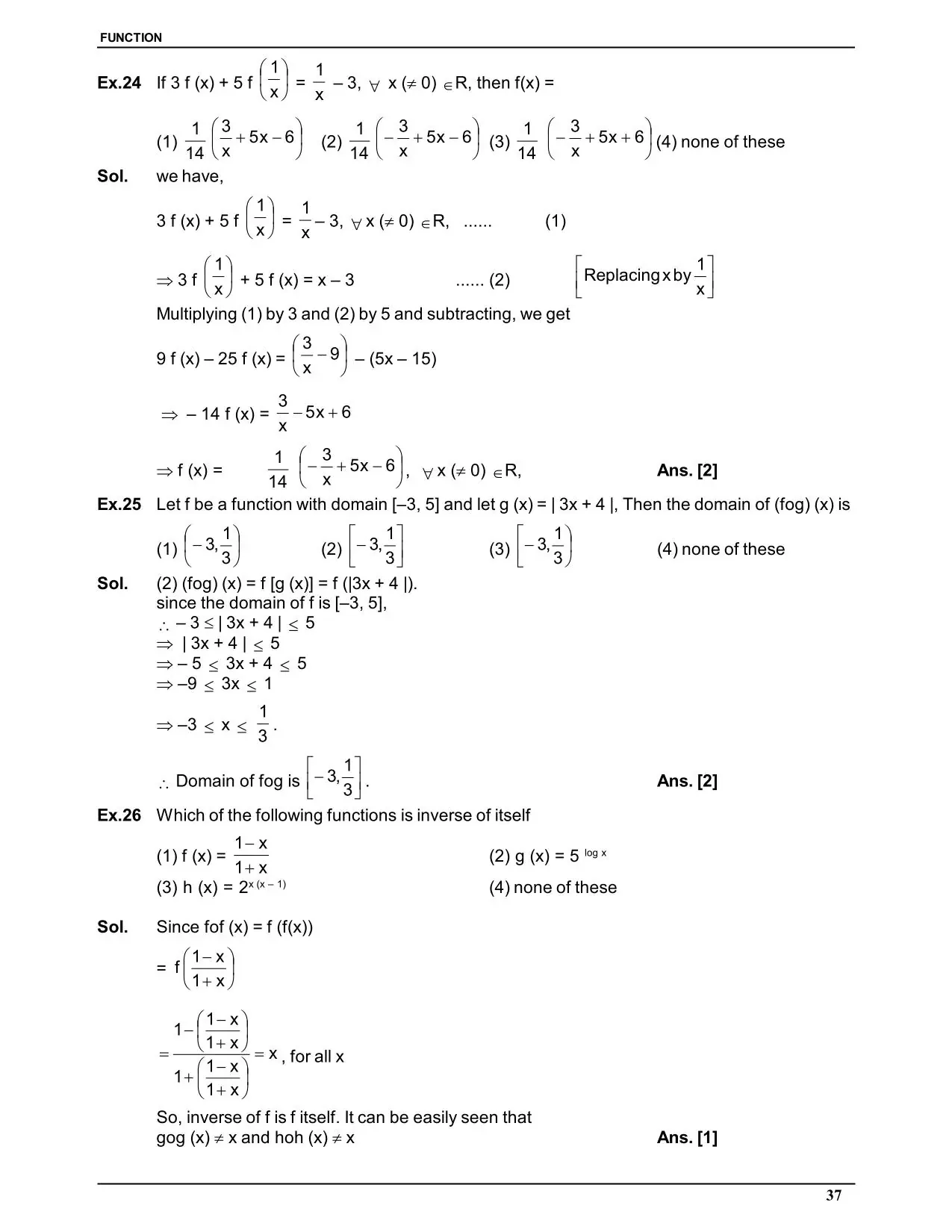
Example 8 (even and odd): Classify $f(x) = x^3 + \sin x$, $g(x) = x^2 + \cos x$ and $h(x) = e^{x}$.
$f(-x) = -x^3 - \sin x = -f(x)$, so $f$ is odd. $g(-x) = x^2 + \cos x = g(x)$, so $g$ is even. $h(-x) = e^{-x}$ is neither $h(x)$ nor $-h(x)$, so $h$ is neither.
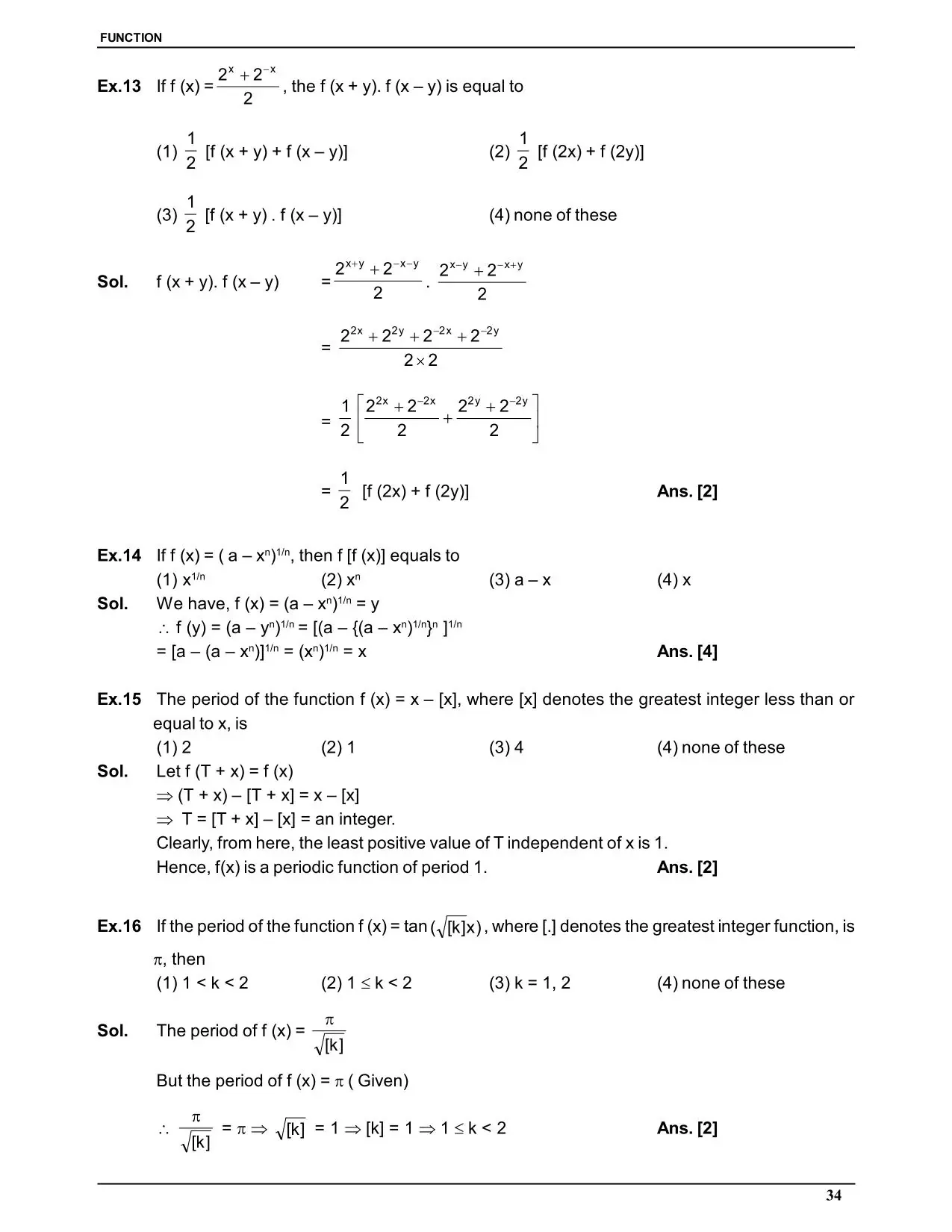
Example 9 (period): Find the period of $f(x) = \sin 3x + \cos 2x$.
The periods are $\dfrac{2\pi}{3}$ and $\pi$. The LCM is $2\pi$, so the period of $f$ is $2\pi$.
Example 10 (equal ordered pairs): Find $x$ and $y$ if (a) $(4x + 3,\ y) = (3x + 5,\ -2)$ and (b) $(x - y,\ x + y) = (6,\ 10)$.
(a) $4x + 3 = 3x + 5$ gives $x = 2$, and $y = -2$. (b) $x - y = 6$ and $x + y = 10$ give $x = 8$ and $y = 2$.
Example 11 (domain and range of a relation): Find the domain and range of $R = \left\{(x, y) : y = x + \dfrac{6}{x},\ x, y \in \mathbb{N},\ x < 6\right\}$.
$x = 1$ gives $y = 7$, $x = 2$ gives $y = 5$ and $x = 3$ gives $y = 5$. For $x = 4$ and $x = 5$, $y$ is not a natural number. So $R = \{(1, 7), (2, 5), (3, 5)\}$, the domain is $\{1, 2, 3\}$ and the range is $\{5, 7\}$.
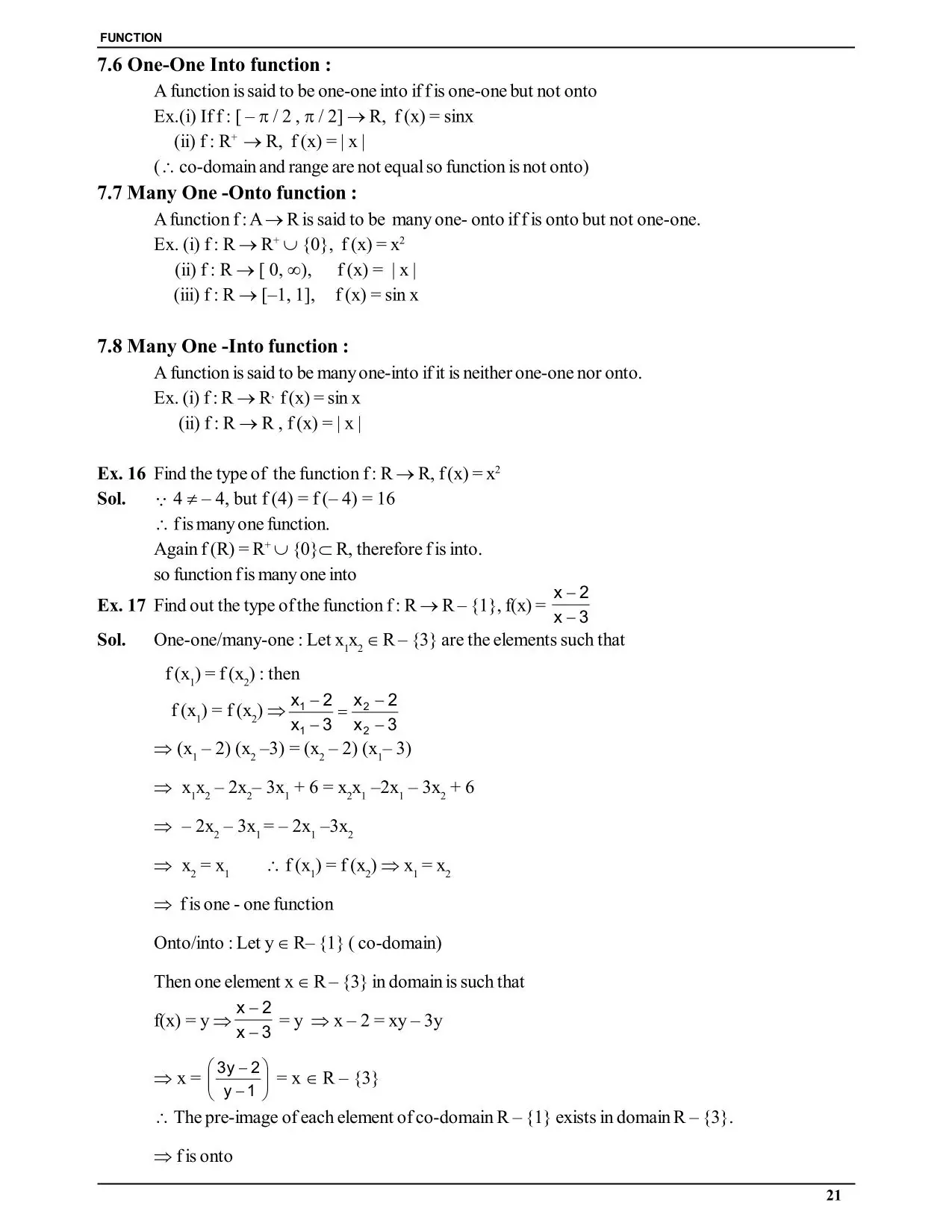
Example 12 (equal functions): Find the values of $x$ for which $f(x) = 2x^2 - 1$ and $g(x) = 1 - 3x$ are equal.
$2x^2 + 3x - 2 = 0$ gives $(2x - 1)(x + 2) = 0$, so $x = \dfrac{1}{2}$ or $x = -2$.
Example 13 (domain with the greatest integer function): Find the domain of $f(x) = \dfrac{1}{\sqrt{[x]^2 - [x] - 6}}$.
We need $[x]^2 - [x] - 6 = ([x] - 3)([x] + 2) > 0$, so $[x] < -2$ or $[x] > 3$. That means $x < -2$ or $x \geq 4$, so the domain is $(-\infty, -2) \cup [4, \infty)$.
Example 14 (redefining a modulus function): Redefine $f(x) = \lvert x - 1 \rvert + \lvert 1 + x \rvert$ for $-2 \leq x \leq 2$.
$$f(x) = \begin{cases} -2x, & -2 \leq x < -1 \\ 2, & -1 \leq x < 1 \\ 2x, & 1 \leq x \leq 2 \end{cases}$$
Example 15 (a domain that is empty): Find the domain of $f(x) = \dfrac{1}{\sqrt{x - \lvert x \rvert}}$.
For $x \geq 0$, $x - \lvert x \rvert = 0$, so the denominator is zero. For $x < 0$, $x - \lvert x \rvert = 2x < 0$, so the square root is not real. The function is not defined for any real $x$, and the domain is empty.
Functions Class 11 Notes
India's Best Exam Preparation for Class 11th - Download Now
India's Best Exam Preparation for Class 11th - Download Now
India's Best Exam Preparation for Class 11th - Download Now
India's Best Exam Preparation for Class 11th - Download Now
India's Best Exam Preparation for Class 11th - Download Now
India's Best Exam Preparation for Class 11th - Download Now
India's Best Exam Preparation for Class 11th - Download Now
India's Best Exam Preparation for Class 11th - Download Now
India's Best Exam Preparation for Class 11th - Download Now
Common Mistakes in Functions Class 11 Notes Problems
Mistake | Correct approach |
|---|---|
Forgetting the domain before finding the range | Always find the domain first |
Treating a relation as a function when one input has two outputs | Apply the vertical line test |
Mixing up the range and the co-domain | The range is the set of outputs that actually occur |
Cancelling a factor before finding the domain | Find the domain of the original expression, and then simplify |
Writing $[x]$ as “round off” | $[x]$ is the greatest integer less than or equal to $x$, so $[-2.3] = -3$ |
Assuming that $f \circ g = g \circ f$ | Composition is generally not commutative |
Finding the period of a sum as the sum of the periods | Use the LCM of the periods |
Assuming that a domain always exists | In $\dfrac{1}{\sqrt{x - \lvert x \rvert}}$, the denominator is zero or not real for every $x$, so the domain is empty |
Treating $(x, y)$ and $(y, x)$ as the same ordered pair | They are equal only if $x = y$, so $A \times B \neq B \times A$ in general |
How to Study Functions Class 11 Notes
- Read the NCERT chapter first, and solve its exercises with eSaral’s NCERT Solutions for Class 11 Maths Chapter 2.
- Practise domain and range questions daily: first with the table of conditions, and then with the discriminant method.
- Draw the graphs of the standard functions from memory, because many JEE questions are answered from a graph.
- After the types of functions, move on to the trigonometric functions with eSaral’s trigonometry formulas for Class 11, and revise all the chapters with the Class 11 Maths notes. Then solve eSaral’s JEE Main chapter-wise PYQs.
With the blend of education & technology, the eSaral team made the learning personalized & adaptive for everyone. eSaral Making Learning affordable, Accessible, and thoughtful for all.
Frequently Asked Questions
What is the difference between range and co-domain?
The co-domain is the entire set $B$ in $f : A \to B$. The range is the subset of $B$ that actually occurs as output. The range is always a subset of the co-domain, and it equals the co-domain only when the function is onto. eSaral’s Functions Class 11 Notes show this with examples.
How do you find the domain of a function?
List the conditions that the function needs: denominators must not be zero, expressions under an even root must be non-negative, and arguments of a logarithm must be positive. Solve the resulting inequalities, and write the domain in interval notation. For a sum, difference or product, take the intersection of the domains.
What is a function in Class 11 Maths?
A function $f : A \to B$ is a relation in which every element of $A$ has exactly one image in $B$. If any element of $A$ is related to more than one element of $B$, the relation is not a function. In Functions Class 11 Notes, this definition is the base for domain, range and all the types of functions.
Are one-one and onto functions part of the Class 11 syllabus?
In NCERT, the Class 11 chapter covers relations, functions, domain, range, standard functions and the algebra of functions. The formal treatment of one-one, onto and bijective functions is in Class 12 (Chapter 1). Composition and inverse functions are used in JEE problems, and for CBSE Class 12 you should check the latest syllabus. JEE problems use all of them, so these Functions Class 11 Notes explain them too.
What is a bijective function?
A bijective function is both one-one (injective) and onto (surjective). Each element of $A$ maps to a unique element of $B$, and every element of $B$ has a pre-image in $A$. Only a bijective function has an inverse. This idea is used again for inverse trigonometric functions in Class 12.
How many functions can be defined between two finite sets?
If $n(A) = m$ and $n(B) = n$, there are $n^m$ functions from $A$ to $B$. Among them, ${}^{n}P_{m}$ are one-one (for $m \leq n$), $n!$ are bijective (for $m = n$), and the number of onto functions (for $m \geq n$) is $\sum_{r=0}^{n}(-1)^{n-r}\binom{n}{r}r^m$.
Which functions are most important for JEE Main?
The greatest integer function, the fractional part function, the modulus function and the composition of functions are common in problems, along with the domain and range of composite and rational functions. The number of questions changes every year, so check previous years’ papers. The Functions Class 11 Notes list the properties of each of these.
Which chapter number is Relations and Functions in Class 11 Maths?
In the NCERT Class 11 Mathematics book, Relations and Functions is Chapter 2, after Sets. These Functions Class 11 Notes follow the chapter, and they add the JEE topics.
Where can I find more Class 11 Maths notes on eSaral?
eSaral has chapter-wise Class 11 Maths notes, NCERT solutions, a trigonometry formula sheet and JEE Main chapter-wise PYQs, linked with these Functions Class 11 Notes on this page, so you can study the chapter and practise it in one place.
Team eSaral
eSaral Academic and Editorial Team
Team eSaral is the collective author profile for educational content created by eSaral’s teachers and academic contributors. The team draws on expertise from IIT graduates, doctors, experienced educators and subject specialists to develop resources for JEE, NEET and school students. Our articles aim to explain concepts clearly and help students study with confidence.
Related Posts

BITSAT 2027: Registration Date, Exam Date, Syllabus, Eligibility, Pattern & Fees
BITSAT 2027 exam dates, registration timeline, eligibility criteria, exam pattern, marking scheme, syllabus and fees in one page.

BITSAT Previous Year Question Paper PDF (2017-2026)
Download BITSAT previous year question papers PDF from 2017 to 2026,session-wise. Memory-based papers,exam pattern, paper analysis and how to practise

CBSE Class 10 Date Sheet 2027: Expected Exam Dates, Release Date, Admit Card & Result Timeline
CBSE Class 10 date sheet 2027 is awaited. See the expected exam dates, release window, how to download the PDF, admit card and result timelines.

NCERT Physics Class 10 Book PDF in Hindi 2026-27 – भौतिक विज्ञान के 4 अध्याय (Free Download)
NCERT Physics Class 10 book PDF in Hindi 2026-27: download all 4 chapters (अध्याय 9–12) free, with topics and important formulas.

NCERT Biology Class 9 Book Anveshan PDF in Hindi - जीव विज्ञान कक्षा 9 पुस्तक अन्वेषण PDF
Download NCERT Biology Class 9 book PDF in Hindi chapterwise for 2026-27: Cell, Tissues, Reproduction and Diversity. Free PDFs.

Essay On Artificial Intelligence in English (100,150, 200, 250, 300, 500 Words)
This is in contrast to the natural intelligence of humans. With Artificial Intelligence, machines can perform

Essay on 78th India Independence Day in English for Student (100, 150, 200, 250, 300, 500 Words)
Read the best essays on India's Independence Day in English. Short & long essays (100, 150, 200, 250, 300, 500 words) perfect for school exams
NCERT Class 11 English Snapshots book - Free PDF download- Esaral
Download NCERT Class 11 English Snapshots book PDF for free. Get all 8 chapters, chapter-wise. Start your prep today!
NCERT Class 10 biology book pdf - Free PDF Download - eSaral
NCERT Class 10 Biology book PDF 2026-27: all 5 chapters (Life Processes to Our Environment) in English & Hindi, with CBSE syllabus, marks & practical

Essay on Global Warming in English (100,150, 200, 250, 300, 500 Words)
Global warming means the Earth is getting hotter. This happens because of things like pollution from cars and factories.