
Halogen Derivatives Notes for Class 12, IIT JEE & NEET

eSaral Academic and Editorial Team
Summary
Halogen Derivatives Notes cover haloalkanes and haloarenes: classification and nomenclature, the nature of the C–X bond, methods of preparation, physical properties, nucleophilic substitution (SN1 and SN2), elimination, reactions with metals, the low reactivity of haloarenes, and the polyhalogen compounds.
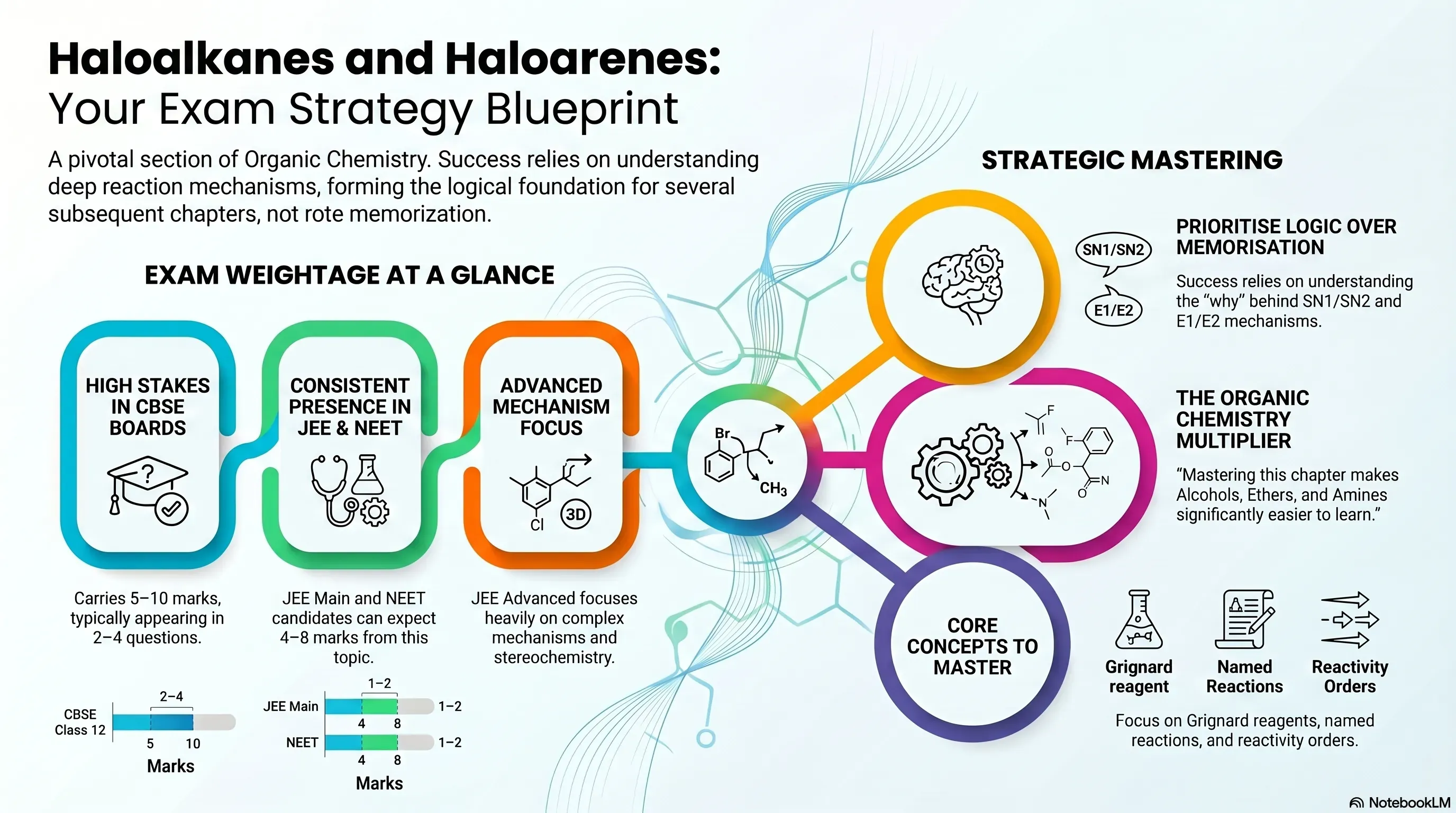
“Halogen derivatives” is the common name for the NCERT chapter Haloalkanes and Haloarenes, which is Chapter 6 of the current NCERT Class 12 Chemistry book (it was Chapter 10 in older books). In the CBSE 2026-27 scheme, it carries 6 marks. The chapter is also the base for the Alcohols, Phenols and Ethers and the Amines chapters, because they use the same ideas of nucleophilic substitution. These Halogen Derivatives Notes explain why each reaction happens, since this chapter rewards reasoning more than memory.
Halogen Derivatives Notes: Chapter Overview and Syllabus
Topic | CBSE 2026-27 | JEE Main and NEET |
|---|---|---|
Classification and nomenclature, nature of the C–X bond | Yes | Yes |
Methods of preparation of haloalkanes and haloarenes | In the NCERT chapter | Yes |
Physical and chemical properties of haloalkanes | Yes | Yes |
Optical rotation, and the mechanisms of substitution (SN1 and SN2) | Yes | Yes |
Haloarenes: nature of the C–X bond, substitution reactions (the directive influence of halogen in monosubstituted compounds only) | Yes | Yes |
Uses and environmental effects of dichloromethane, trichloromethane, tetrachloromethane, iodoform, freons and DDT | Yes | Yes |
Check the latest syllabi of CBSE and NTA (JEE Main) and the NMC syllabus for NEET for the exact lists.
Tip from the eSaral Chemistry team: For every substitution question, ask three things in order: is the carbon attached to the halogen primary, secondary or tertiary, how strong is the nucleophile, and is the solvent protic or aprotic? These three answers decide SN1 or SN2 almost every time.
Halogen Derivatives Notes
India's Best Exam Preparation for Class 12th - Download Now
India's Best Exam Preparation for Class 12th - Download Now
India's Best Exam Preparation for Class 12th - Download Now
India's Best Exam Preparation for Class 12th - Download Now
India's Best Exam Preparation for Class 12th - Download Now
India's Best Exam Preparation for Class 12th - Download Now
Classification and Nomenclature in Halogen Derivatives Notes
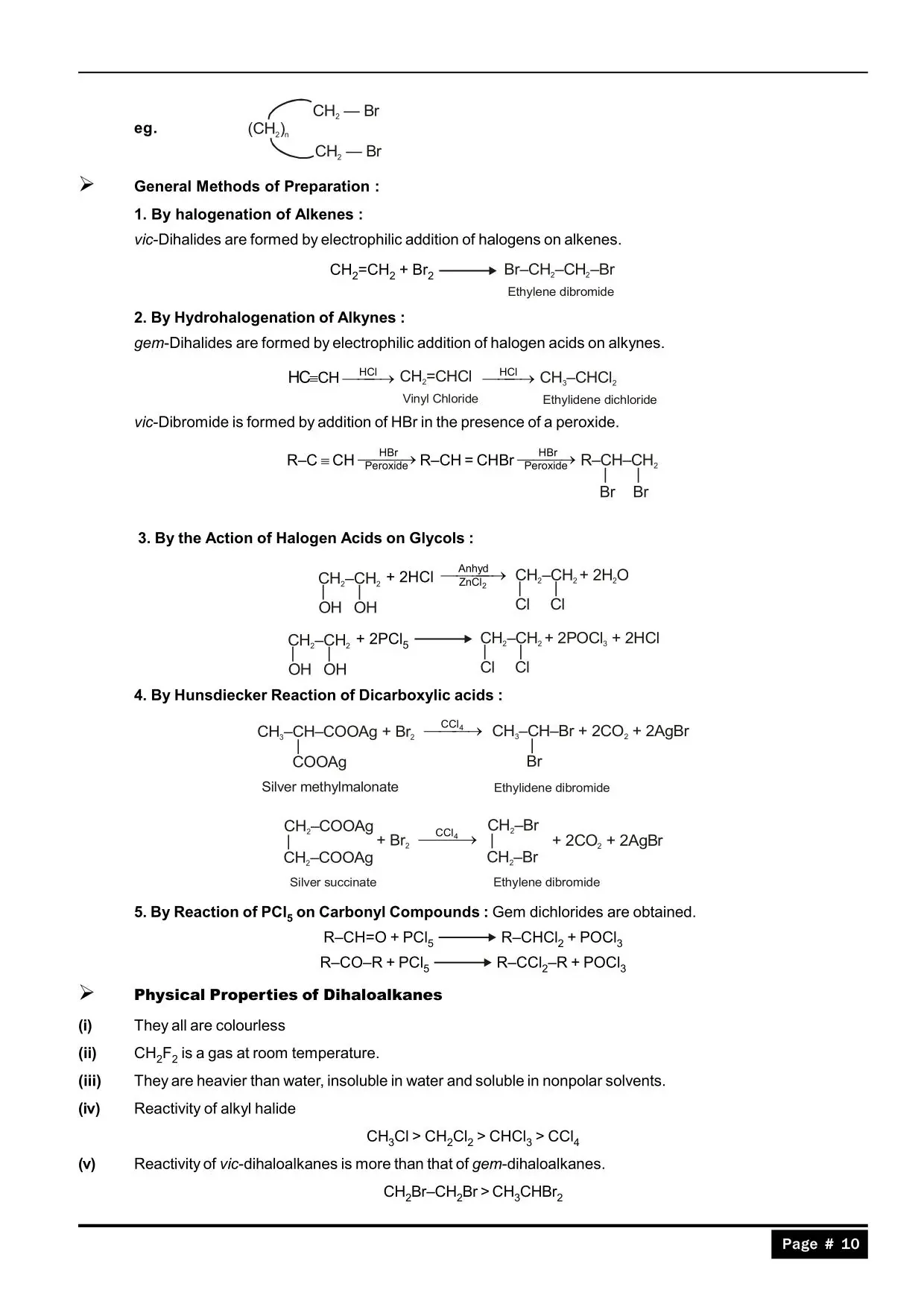
Haloalkanes (alkyl halides) have a halogen on an $sp^3$ carbon, and haloarenes (aryl halides) have a halogen on an $sp^2$ carbon of an aromatic ring. Compounds are also classed by the number of halogens (mono-, di-, tri- and polyhalogen) and by the type of carbon.
Type | Halogen is attached to | Example |
|---|---|---|
Primary, secondary and tertiary alkyl halide | A $1^\circ$, $2^\circ$ or $3^\circ$ $sp^3$ carbon | $\mathrm{CH_3CH_2Cl}$, $\mathrm{(CH_3)_2CHCl}$, $\mathrm{(CH_3)_3CCl}$ |
Allylic halide | An $sp^3$ carbon next to a $\mathrm{C{=}C}$ | $\mathrm{CH_2{=}CH{-}CH_2Cl}$ |
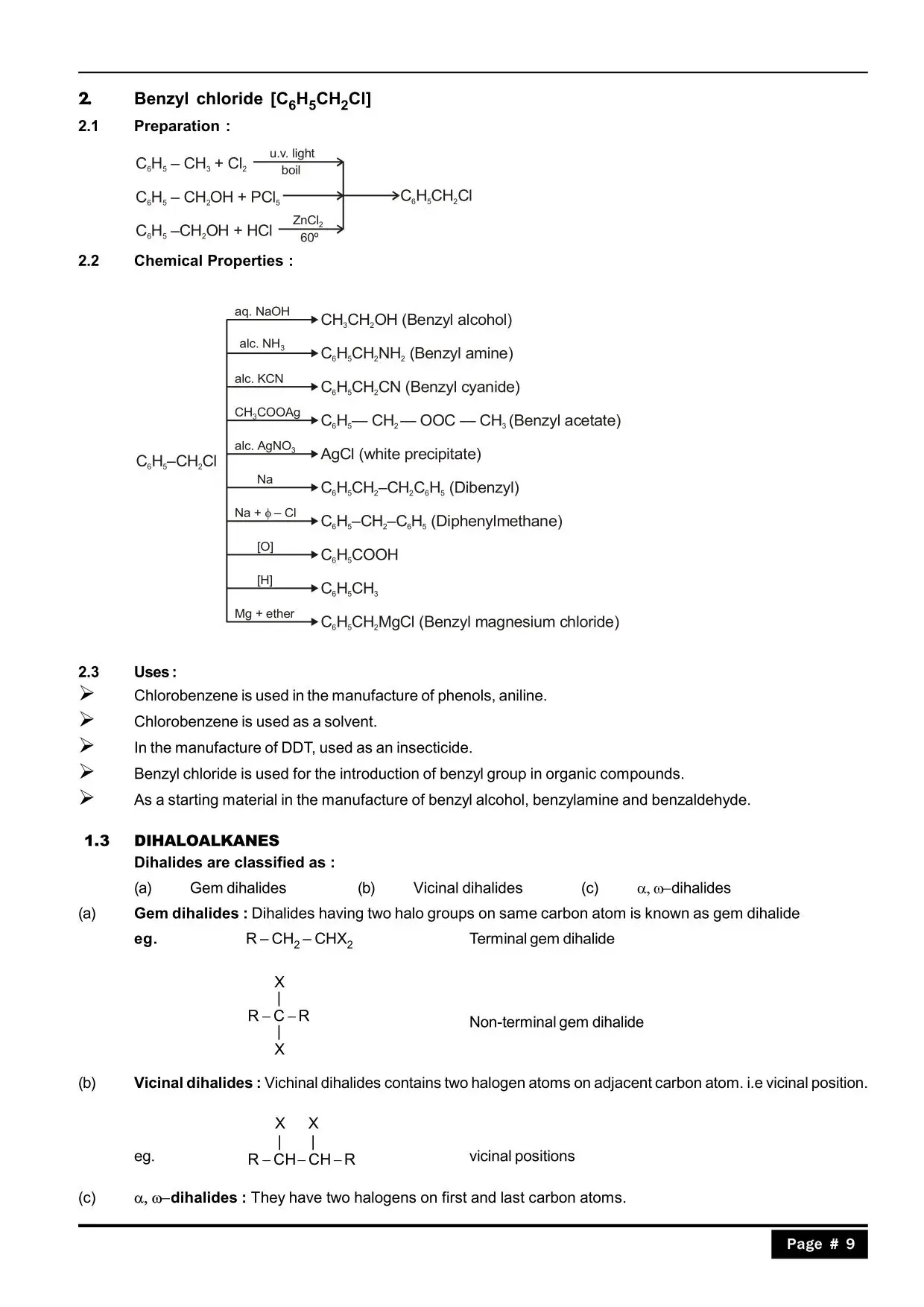
Benzylic halide | An $sp^3$ carbon next to a benzene ring | $\mathrm{C_6H_5CH_2Cl}$ |
Vinylic halide | An $sp^2$ carbon of a $\mathrm{C{=}C}$ | $\mathrm{CH_2{=}CHCl}$ |
Aryl halide | An $sp^2$ carbon of a benzene ring | $\mathrm{C_6H_5Cl}$ |
IUPAC names: for haloalkanes, add the prefix chloro-, bromo-, fluoro- or iodo- to the alkane name, and number the chain from the end that gives the lowest locants (for example 2-chloropropane). For haloarenes, use chlorobenzene, and the prefixes o-, m- and p- (or numbers) for the positions in a disubstituted ring. Isomerism: haloalkanes show chain and position isomerism, and a compound like 2-bromobutane is chiral and shows optical isomerism.
Nature of the C–X Bond in Halogen Derivatives Notes
The C–X bond is polar, because the halogen is more electronegative than carbon. The carbon has a partial positive charge and the halogen has a partial negative charge, so the carbon is attacked by nucleophiles. The bond length increases and the bond enthalpy decreases from F to I:
Bond (in $\mathrm{CH_3{-}X}$) | Bond length (pm) | Bond enthalpy (kJ mol⁻¹) |
|---|---|---|
C–F | 139 | 452 |
C–Cl | 178 | 351 |
C–Br | 193 | 293 |
C–I | 214 | 234 |
The weaker the bond, the better the halogen leaves in a substitution reaction, so the reactivity order is $\mathrm{R{-}I} > \mathrm{R{-}Br} > \mathrm{R{-}Cl} > \mathrm{R{-}F}$.
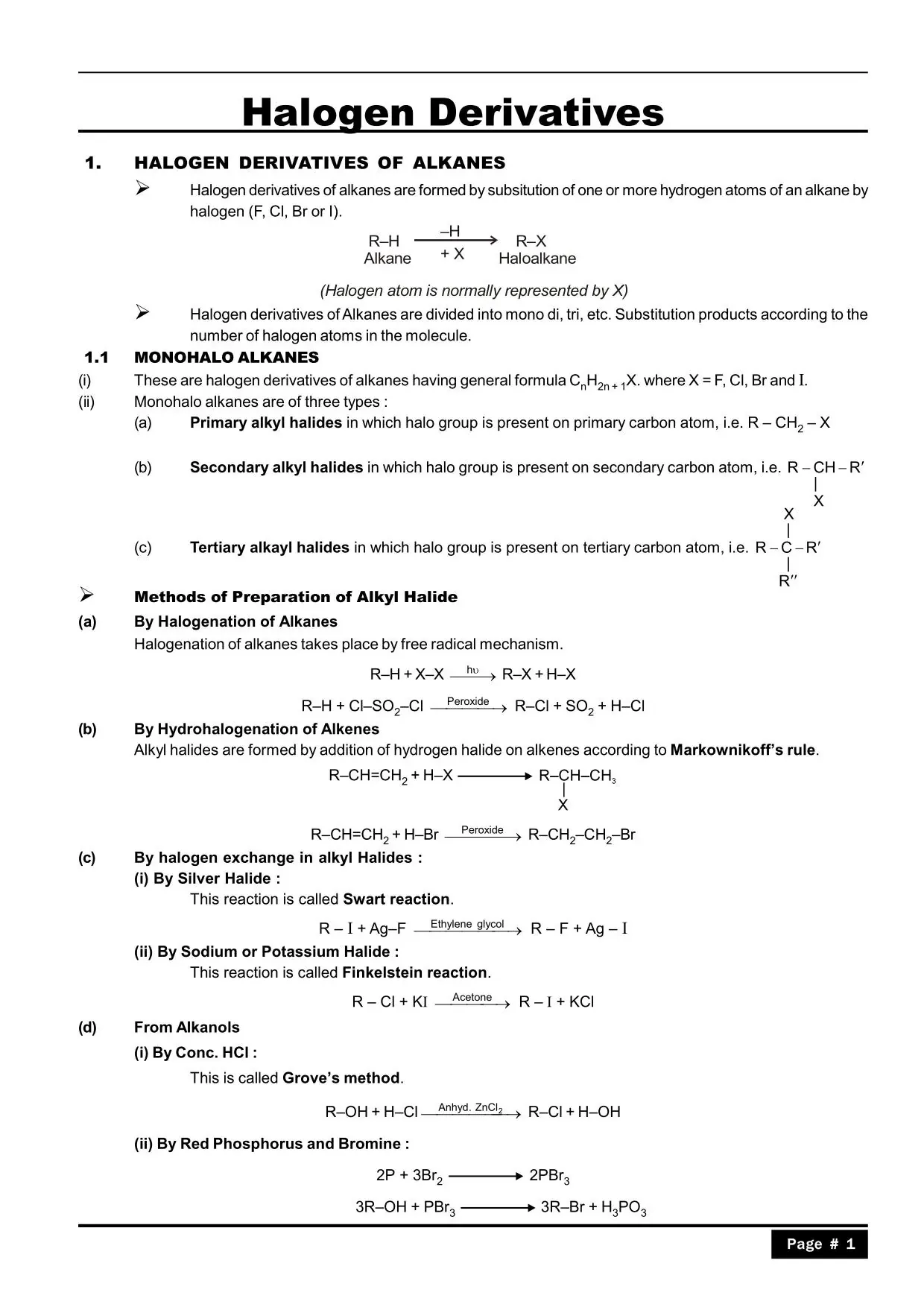
Methods of Preparation of Haloalkanes in Halogen Derivatives Notes
Method | Reaction | Note |
|---|---|---|
From alcohols with HX | $\mathrm{R{-}OH + HCl \xrightarrow{ZnCl_2} R{-}Cl + H_2O}$ | The reactivity of the alcohol is $3^\circ > 2^\circ > 1^\circ$ |
From alcohols with $\mathrm{SOCl_2}$ | $\mathrm{R{-}OH + SOCl_2 \rightarrow R{-}Cl + SO_2 + HCl}$ | The best method, because both by-products are gases |
From alcohols with $\mathrm{PCl_5}$ or $\mathrm{PCl_3}$ | $\mathrm{R{-}OH + PCl_5 \rightarrow R{-}Cl + POCl_3 + HCl}$ | $\mathrm{3R{-}OH + PCl_3 \rightarrow 3R{-}Cl + H_3PO_3}$ |
Addition of HX to alkenes | $\mathrm{CH_3CH{=}CH_2 + HBr \rightarrow CH_3CHBrCH_3}$ | Markovnikov addition. With peroxide, HBr gives the anti-Markovnikov product 1-bromopropane. |
Free radical halogenation | $\mathrm{CH_4 + Cl_2 \xrightarrow{h\nu} CH_3Cl + HCl}$ | Gives a mixture, so it is not a good laboratory method |
Finkelstein reaction | $\mathrm{R{-}X + NaI \xrightarrow{\text{dry acetone}} R{-}I + NaX}$ ($\mathrm{X = Cl, Br}$) | Used to make iodides |
Swarts reaction | $\mathrm{H_3C{-}Br + AgF \rightarrow H_3C{-}F + AgBr}$ | Used to make fluorides |
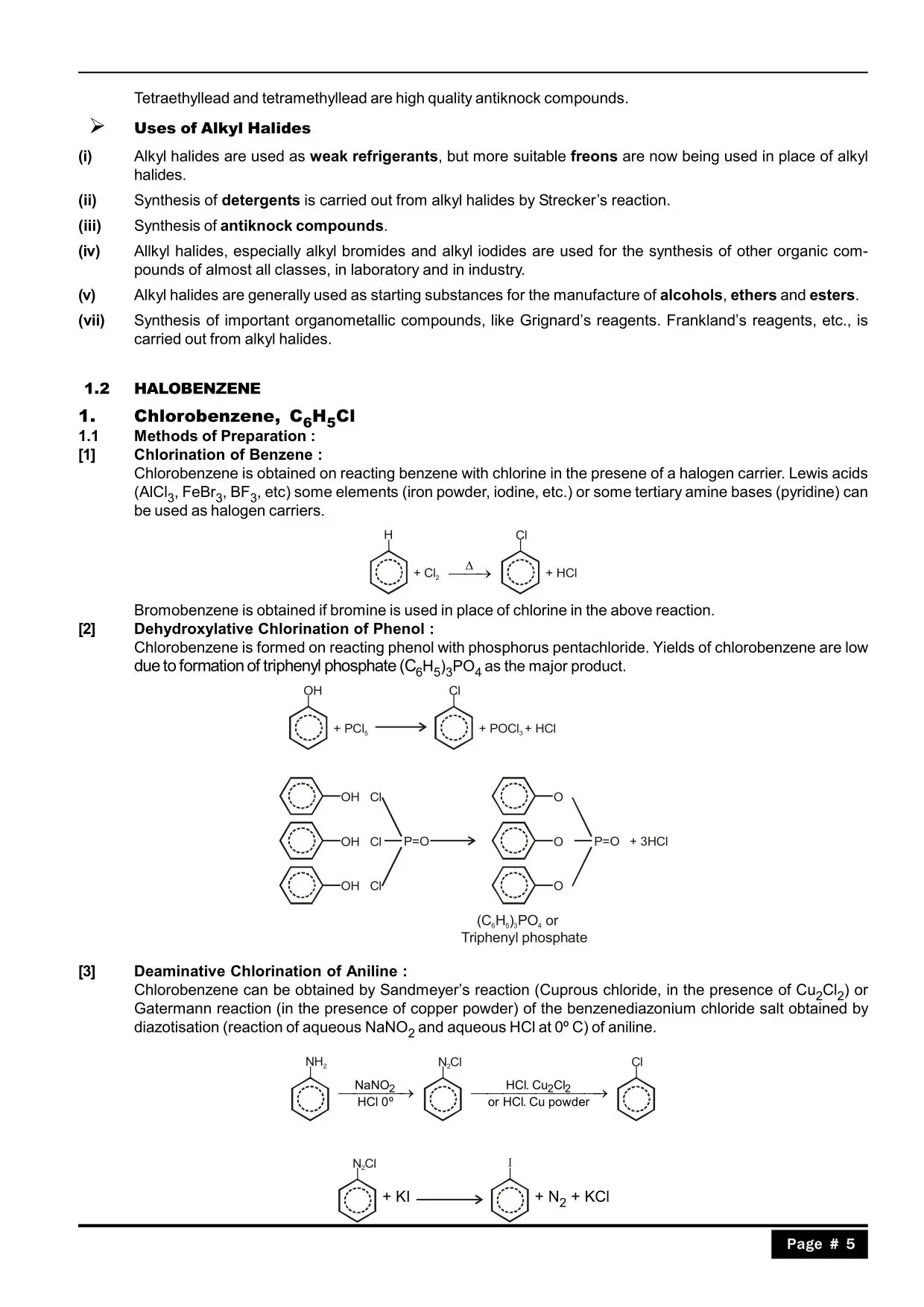
Methods of Preparation of Haloarenes in Halogen Derivatives Notes
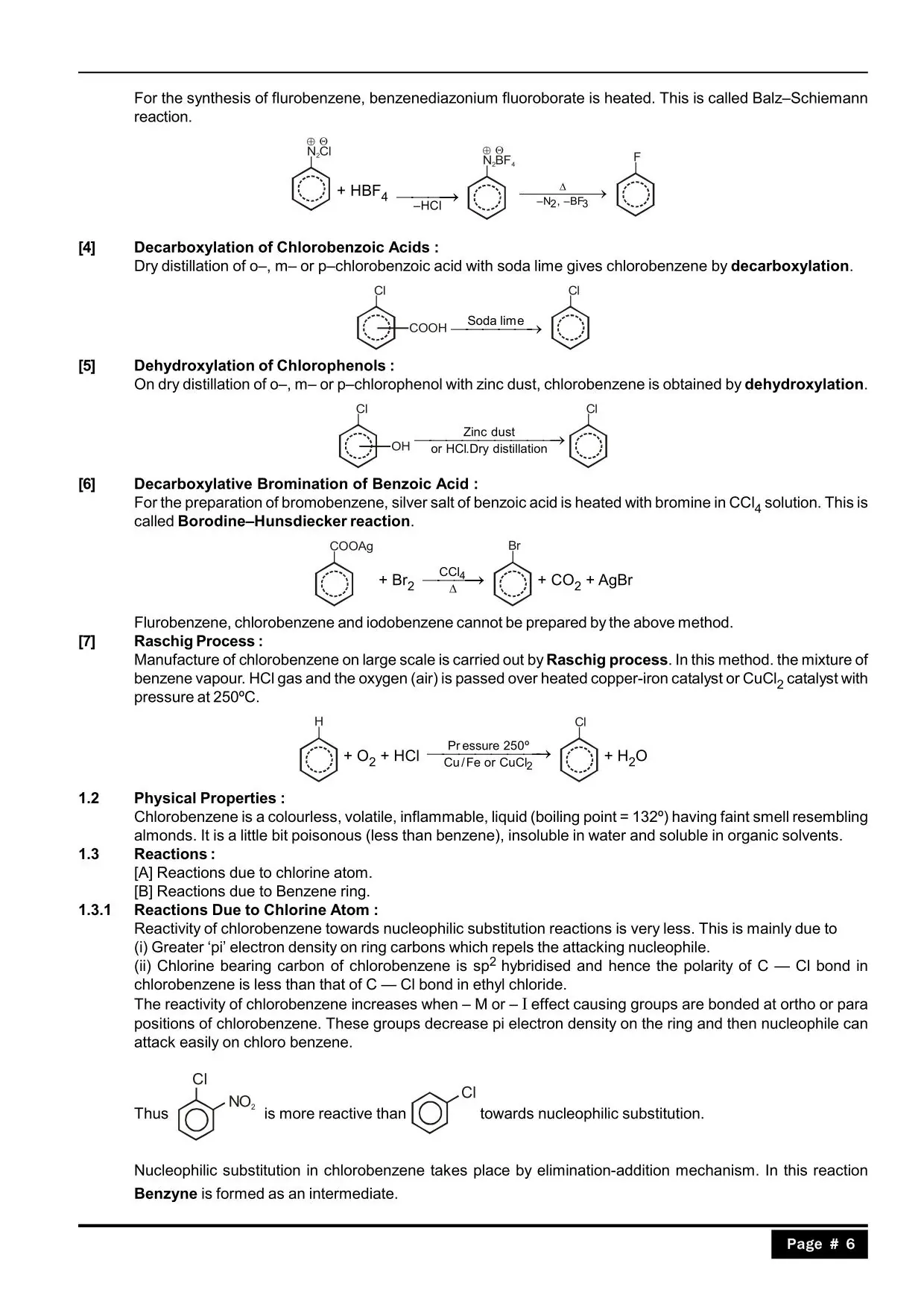
- Electrophilic substitution: $\mathrm{C_6H_6 + Cl_2 \xrightarrow{Fe\ \text{or}\ FeCl_3} C_6H_5Cl + HCl}$. Iodination needs an oxidising agent, and direct fluorination is not practical.
- Sandmeyer reaction: $\mathrm{ArN_2^{+}Cl^{-} \xrightarrow{CuCl/HCl} ArCl + N_2}$ (and $\mathrm{CuBr/HBr}$ for the bromide). With copper powder and HX instead, it is the Gattermann reaction.
- Iodides: $\mathrm{ArN_2^{+}X^{-} + KI \rightarrow ArI + N_2 + KX}$.
- Fluorides (Balz–Schiemann reaction): the diazonium fluoroborate is heated: $\mathrm{ArN_2^{+}BF_4^{-} \xrightarrow{\Delta} ArF + BF_3 + N_2}$.
Physical Properties in Halogen Derivatives Notes
- Boiling points rise with the size of the halogen: $\mathrm{R{-}F} < \mathrm{R{-}Cl} < \mathrm{R{-}Br} < \mathrm{R{-}I}$. For isomeric alkyl halides, the boiling point falls with branching, so $1^\circ > 2^\circ > 3^\circ$.
- Haloalkanes are only sparingly soluble in water, because they cannot form hydrogen bonds with water to replace the strong hydrogen bonds between water molecules.
- Among disubstituted haloarenes, the para isomer has the highest melting point, because it packs best in the crystal.
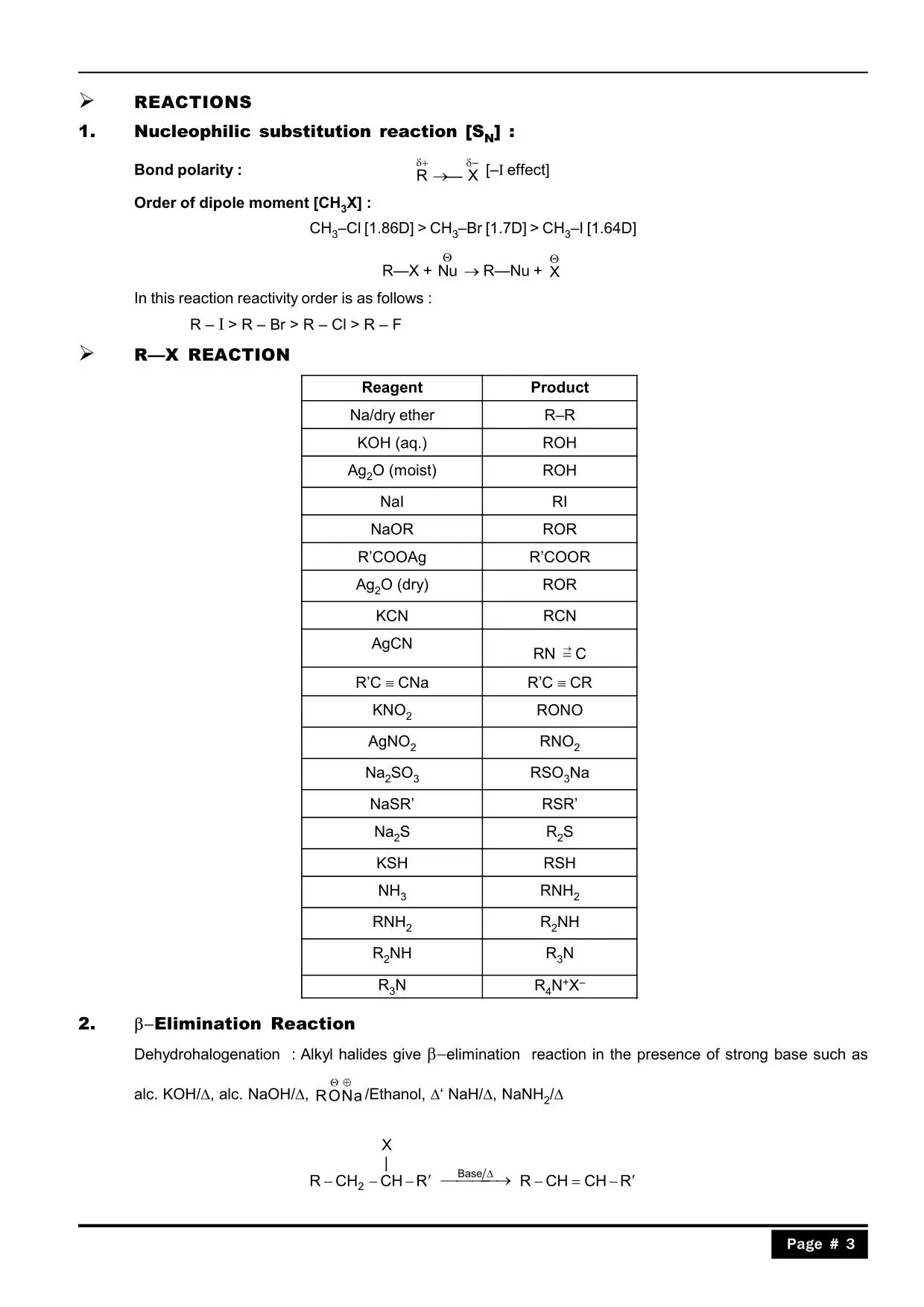
Nucleophilic Substitution in Haloalkanes: SN1 and SN2 in Halogen Derivatives Notes
The general reaction is $\mathrm{Nu^{-} + R{-}X \rightarrow R{-}Nu + X^{-}}$.
Reagent | Product |
|---|---|
aq. KOH (or moist $\mathrm{Ag_2O}$) | Alcohol, $\mathrm{R{-}OH}$ |
NaOR′ (Williamson synthesis) | Ether, $\mathrm{R{-}O{-}R'}$ |
KCN | Alkyl cyanide (nitrile), $\mathrm{R{-}CN}$ |
AgCN | Isocyanide, $\mathrm{R{-}NC}$ |
KNO₂ | Alkyl nitrite, $\mathrm{R{-}O{-}N{=}O}$ |
AgNO₂ | Nitroalkane, $\mathrm{R{-}NO_2}$ |
$\mathrm{NH_3}$ | Amine |
$\mathrm{R'COOAg}$ | Ester |
Cyanide and nitrite are ambident nucleophiles: KCN is ionic and attacks through carbon, while AgCN is covalent and attacks through nitrogen.
SN2 and SN1: Comparison
Feature | SN2 | SN1 |
|---|---|---|
Steps | One step (concerted) | Two steps, with a carbocation intermediate |
Rate law | $\text{rate} = k\,[\mathrm{R{-}X}][\mathrm{Nu^-}]$ (second order) | $\text{rate} = k\,[\mathrm{R{-}X}]$ (first order) |
Substrate order | $\mathrm{CH_3{-}X} > 1^\circ > 2^\circ > 3^\circ$ (steric hindrance) | $3^\circ > 2^\circ > 1^\circ > \mathrm{CH_3{-}X}$ (carbocation stability) |
Nucleophile | Strong nucleophile | Weak nucleophile is enough |
Solvent | Polar aprotic (DMSO, acetone) | Polar protic (water, alcohols) |
Stereochemistry | Inversion of configuration (Walden inversion) | Racemisation (a mixture of inversion and retention) |
Leaving group | $\mathrm{I^-} > \mathrm{Br^-} > \mathrm{Cl^-} > \mathrm{F^-}$ | The same order |
Allylic and benzylic halides react quickly by SN1, because their carbocations are stabilised by resonance.
Stereochemistry in Substitution
In an SN2 reaction, the nucleophile attacks from the side opposite to the leaving group, so the configuration is inverted. In an SN1 reaction, the planar carbocation is attacked from both sides, so an optically active reactant gives a (nearly) racemic product.
Elimination and Reactions with Metals in Halogen Derivatives Notes
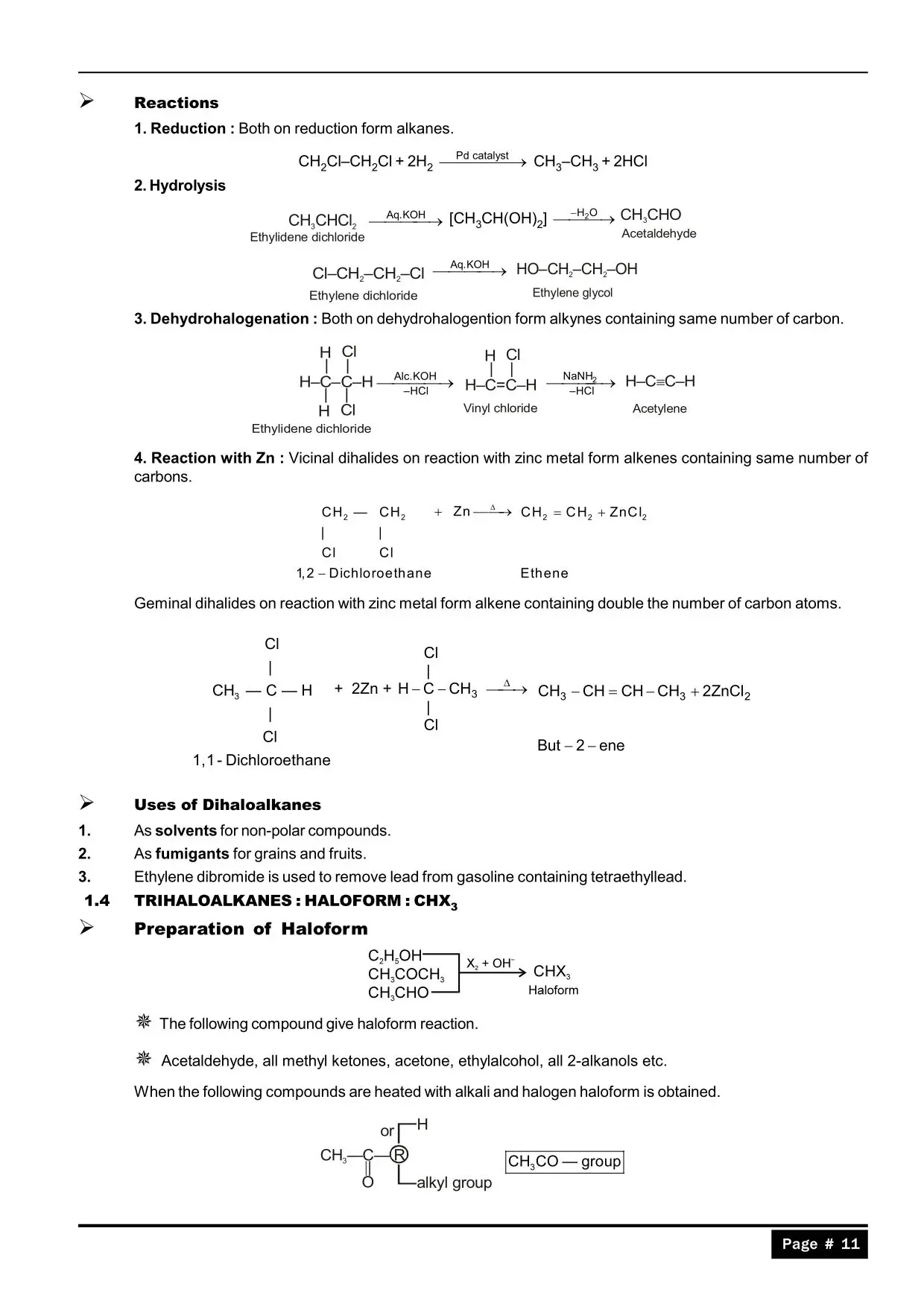
Dehydrohalogenation: a haloalkane with a β-hydrogen, heated with alcoholic KOH, loses HX and gives an alkene. Saytzeff’s rule: the more substituted alkene is the major product.
$$\mathrm{CH_3CH_2CHBrCH_3 \xrightarrow{\text{alc. KOH}, \Delta} CH_3CH{=}CHCH_3\ (\text{major}) + CH_3CH_2CH{=}CH_2\ (\text{minor})}$$
Aqueous KOH gives substitution (alcohol), and alcoholic KOH gives elimination (alkene).
Grignard reagent: $\mathrm{R{-}X + Mg \xrightarrow{\text{dry ether}} R{-}MgX}$.
Wurtz reaction: $\mathrm{2R{-}X + 2Na \xrightarrow{\text{dry ether}} R{-}R + 2NaX}$. It works well only with two identical alkyl halides. Two different halides give a mixture of three alkanes.
Reactions of Haloarenes in Halogen Derivatives Notes
Why Haloarenes Are Less Reactive in Nucleophilic Substitution
- Resonance: the lone pair of the halogen is delocalised into the ring, so the C–Cl bond has a partial double bond character and is shorter and stronger.
- Hybridisation: the carbon is $sp^2$ (more s-character), so it holds the halogen more tightly than an $sp^3$ carbon.
- Instability of the phenyl cation: a phenyl cation is not stabilised by resonance, so SN1 does not occur.
- Repulsion: the electron-rich ring repels the incoming nucleophile.
Dow process: under drastic conditions, chlorobenzene gives phenol: $\mathrm{C_6H_5Cl + NaOH \xrightarrow{623\ K,\ 300\ atm} C_6H_5ONa \xrightarrow{H^+} C_6H_5OH}$.
Effect of nitro groups: electron-withdrawing groups at the ortho and para positions make substitution easier. 4-Nitrochlorobenzene reacts under milder conditions than chlorobenzene, 2,4-dinitrochlorobenzene reacts more easily still, and 2,4,6-trinitrochlorobenzene reacts even at room temperature. A nitro group at the meta position has little effect.
Electrophilic Substitution
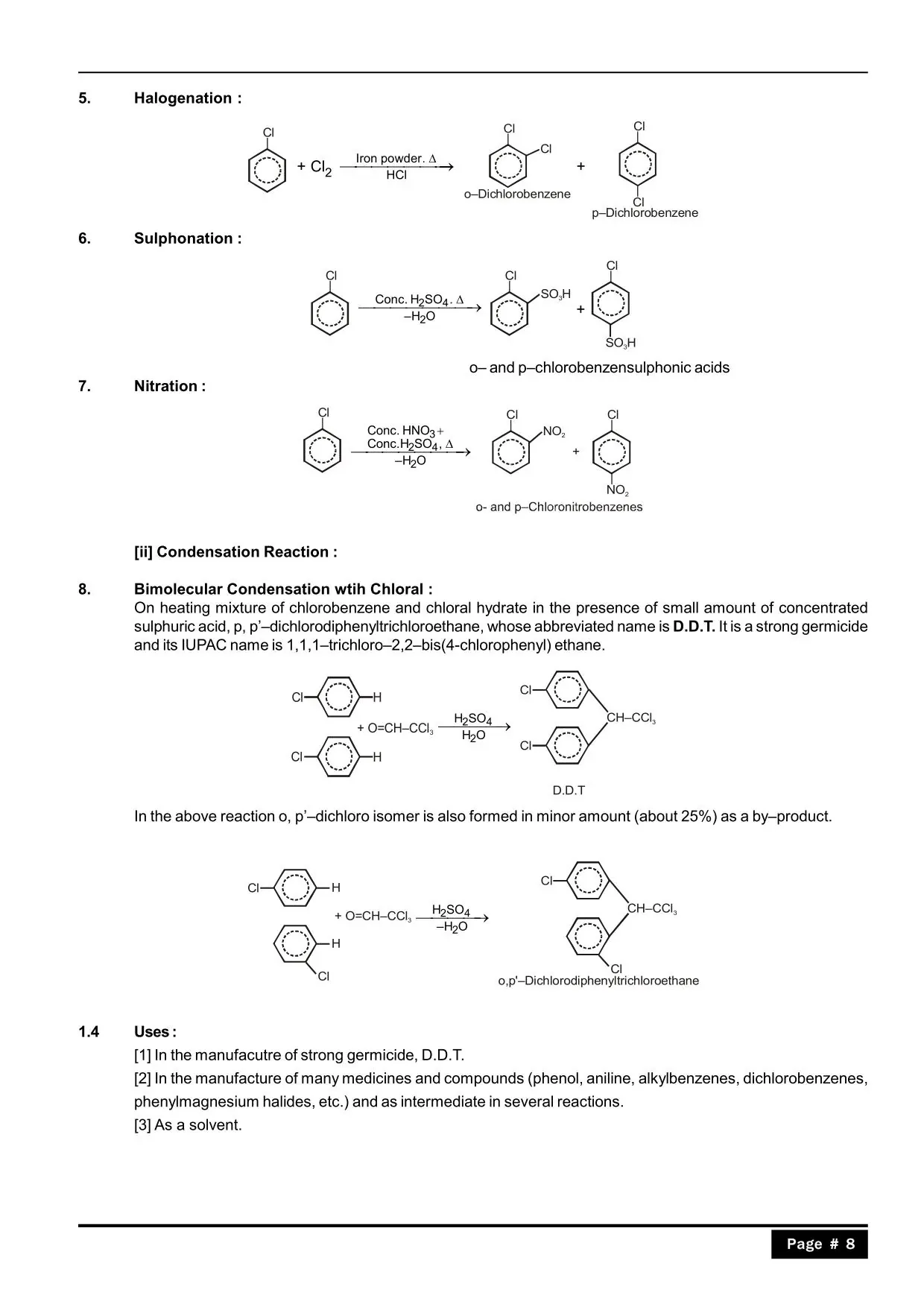
The halogen deactivates the ring, but it is ortho- and para-directing, so nitration, sulphonation and Friedel–Crafts reactions give mainly the ortho and para products, with the para product usually as the major one.
Fittig and Wurtz–Fittig Reactions
$$\mathrm{2C_6H_5Br + 2Na \xrightarrow{\text{dry ether}} C_6H_5{-}C_6H_5 + 2NaBr} \quad \text{(Fittig)}$$ $$\mathrm{C_6H_5Br + CH_3Br + 2Na \xrightarrow{\text{dry ether}} C_6H_5CH_3 + 2NaBr} \quad \text{(Wurtz–Fittig)}$$
Polyhalogen Compounds in Halogen Derivatives Notes
Compound | Use | Harmful effect |
|---|---|---|
Dichloromethane, $\mathrm{CH_2Cl_2}$ | Solvent, paint remover | Affects the central nervous system |
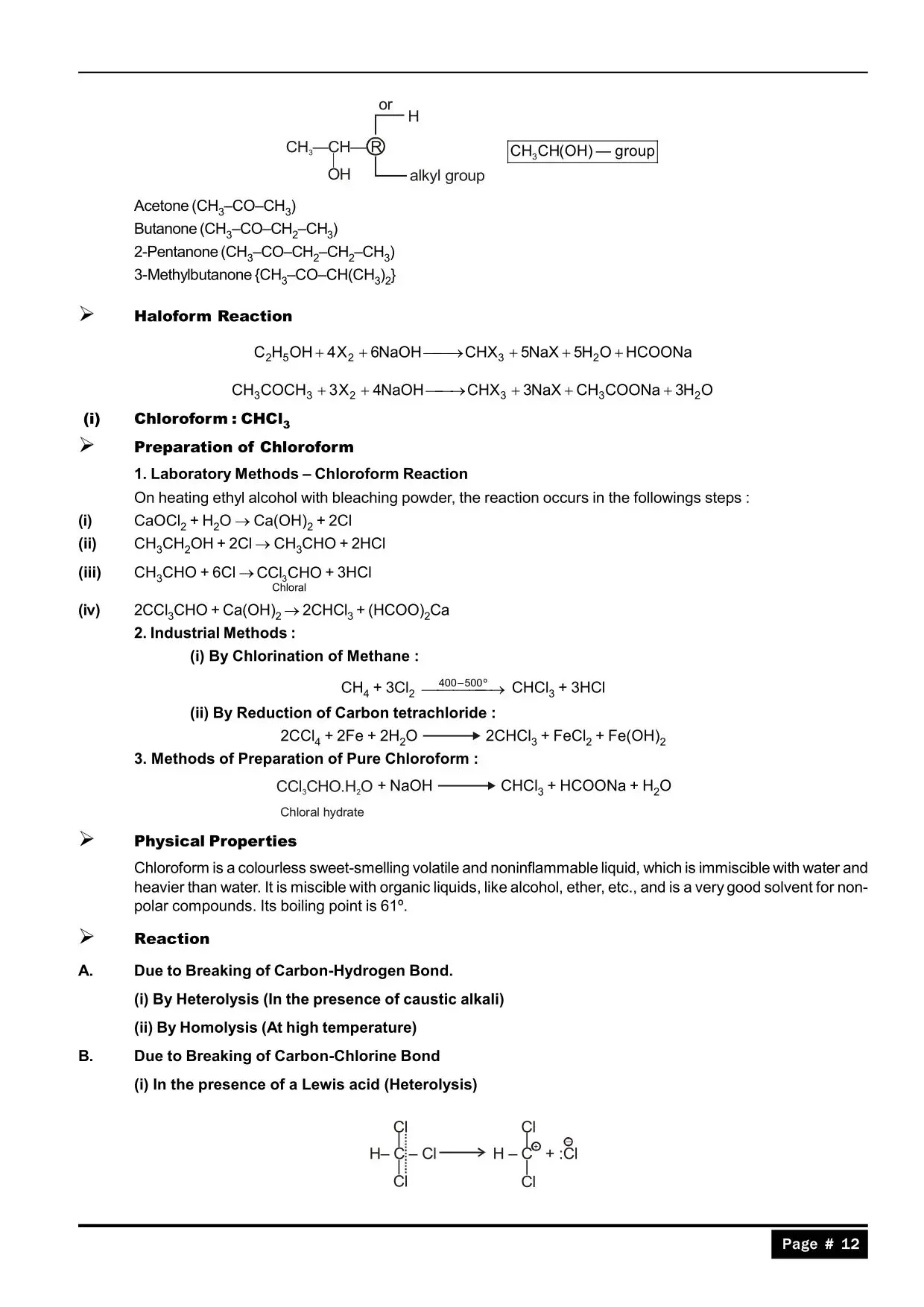
Chloroform, $\mathrm{CHCl_3}$ | Solvent, once used as an anaesthetic | Damages the liver. In light and air, it forms poisonous phosgene. |
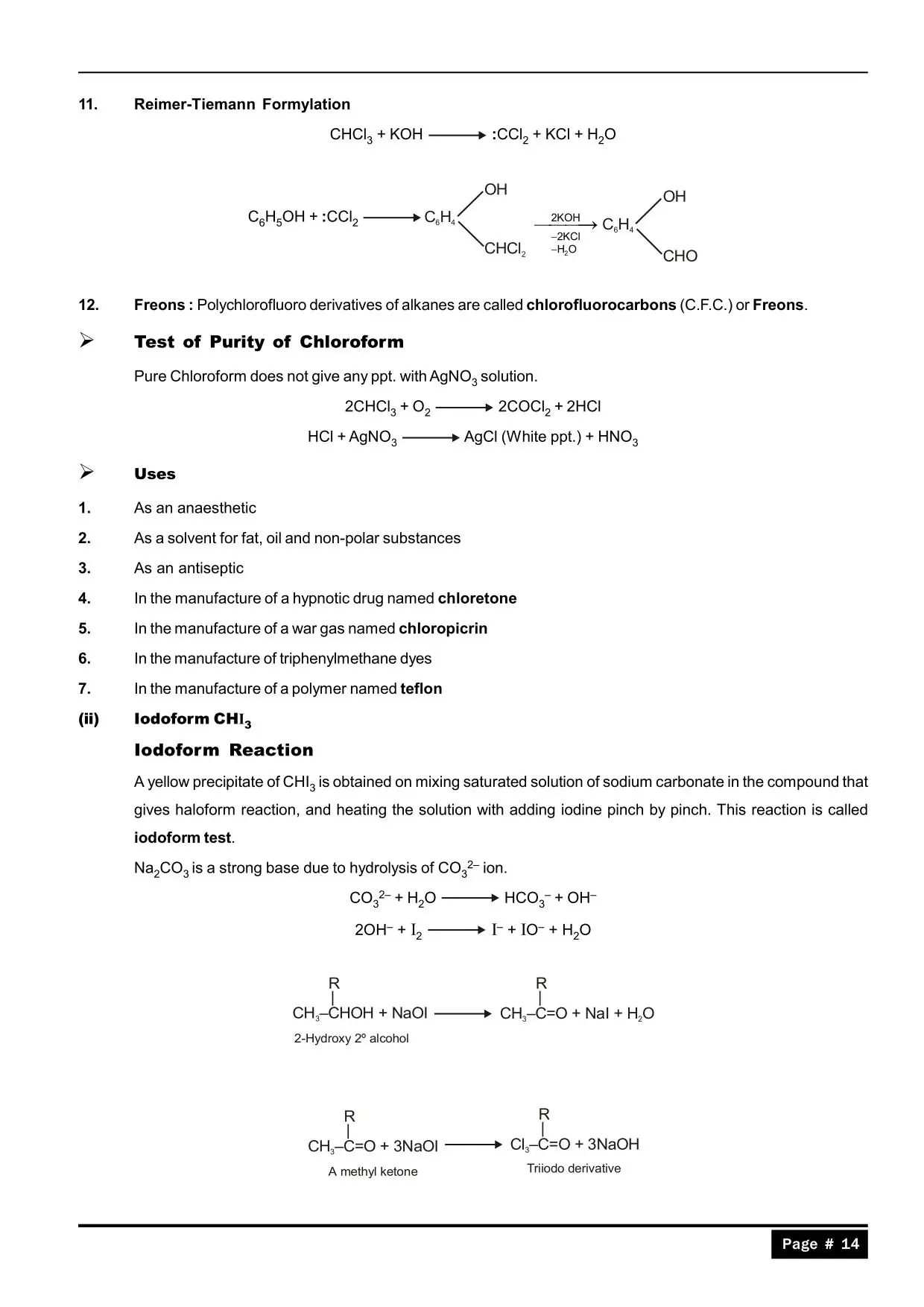
Iodoform, $\mathrm{CHI_3}$ | Antiseptic (because of the iodine that it releases) | Has a strong smell |
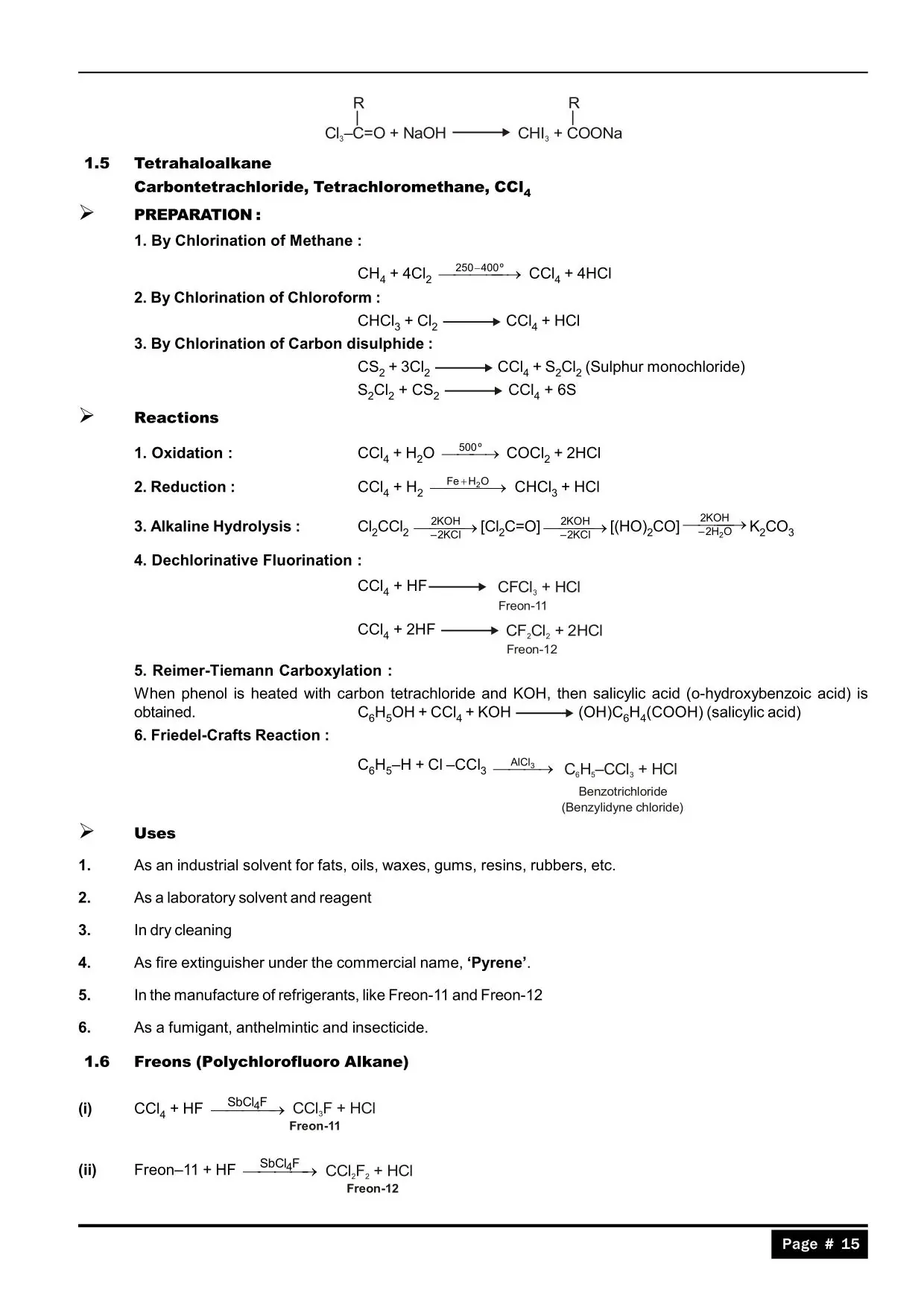
Tetrachloromethane, $\mathrm{CCl_4}$ | Solvent, once used in fire extinguishers | Damages the liver, and contributes to ozone depletion |
Freons ($\mathrm{CFCs}$) | Refrigerants, aerosol propellants | Deplete the ozone layer |
DDT | Insecticide | Persistent, and builds up in food chains |
Chloroform oxidises slowly in light and air: $\mathrm{2CHCl_3 + O_2 \xrightarrow{\text{light}} 2COCl_2 + 2HCl}$. It is therefore stored in dark, tightly closed bottles filled to the brim, with about 1% ethanol, which converts phosgene into harmless diethyl carbonate.
Key Facts in Halogen Derivatives Notes
Concept | Fact |
|---|---|
Reactivity in substitution (leaving group) | $\mathrm{R{-}I} > \mathrm{R{-}Br} > \mathrm{R{-}Cl} > \mathrm{R{-}F}$ |
SN2 rate and SN1 rate | $k[\mathrm{R{-}X}][\mathrm{Nu^-}]$ and $k[\mathrm{R{-}X}]$ |
SN2 substrate order | $\mathrm{CH_3{-}X} > 1^\circ > 2^\circ > 3^\circ$ |
SN1 substrate order | $3^\circ > 2^\circ > 1^\circ$ |
SN2 stereochemistry | Inversion (Walden inversion) |
SN1 stereochemistry | Racemisation |
Elimination | Alcoholic KOH, Saytzeff’s rule |
Haloarene reactivity | Low, because of resonance and $sp^2$ carbon |
Boiling point trend | $\mathrm{R{-}I} > \mathrm{R{-}Br} > \mathrm{R{-}Cl} > \mathrm{R{-}F}$, and $1^\circ > 2^\circ > 3^\circ$ for isomers |
Solved Examples from Halogen Derivatives Notes
Example 1 (rate laws): The concentrations of both the substrate and the nucleophile are doubled. How does the rate change for (a) $\mathrm{CH_3Br + OH^-}$ (SN2) and (b) $\mathrm{(CH_3)_3CBr + H_2O}$ (SN1)?
(a) For SN2, rate $= k[\mathrm{R{-}X}][\mathrm{Nu^-}]$, so the rate becomes $2 \times 2 = 4$ times. (b) For SN1, rate $= k[\mathrm{R{-}X}]$, so the rate becomes 2 times.
Example 2 (SN1 and SN2 order): Which reacts faster, $\mathrm{CH_3CH_2Br}$ or $\mathrm{(CH_3)_3CBr}$, by (a) SN2 and (b) SN1?
(a) SN2: $\mathrm{CH_3CH_2Br}$, because it is less hindered. (b) SN1: $\mathrm{(CH_3)_3CBr}$, because it gives a more stable tertiary carbocation.
Example 3 (elimination): Give the major product of 2-bromobutane with alcoholic KOH.
But-2-ene is the major product (Saytzeff’s rule), and but-1-ene is the minor product.
Example 4 (classification and names): Name and classify $\mathrm{CH_3CHClCH_3}$, $\mathrm{CH_2{=}CHCl}$ and $\mathrm{C_6H_5CH_2Cl}$.
$\mathrm{CH_3CHClCH_3}$ is 2-chloropropane (a secondary alkyl halide). $\mathrm{CH_2{=}CHCl}$ is chloroethene (a vinylic halide). $\mathrm{C_6H_5CH_2Cl}$ is (chloromethyl)benzene, or benzyl chloride (a benzylic halide).
Example 5 (ambident nucleophile): What is formed when ethyl bromide reacts with (a) KCN and (b) AgCN?
(a) $\mathrm{CH_3CH_2CN}$ (propanenitrile, an alkyl cyanide). (b) $\mathrm{CH_3CH_2NC}$ (ethyl isocyanide).
Example 6 (haloarene reactivity): Arrange chlorobenzene, 4-nitrochlorobenzene and 2,4-dinitrochlorobenzene in the increasing order of reactivity towards nucleophilic substitution.
Chlorobenzene < 4-nitrochlorobenzene < 2,4-dinitrochlorobenzene, because each nitro group at the ortho or para position makes the ring more electron-poor.
Example 7 (Fittig and Wurtz–Fittig): Give the products when (a) bromobenzene is treated with sodium in dry ether, and (b) bromobenzene and methyl bromide are treated together with sodium in dry ether.
(a) Biphenyl, $\mathrm{C_6H_5{-}C_6H_5}$. (b) Toluene, $\mathrm{C_6H_5CH_3}$, with some biphenyl and ethane as by-products.
Example 8 (boiling points): Arrange n-butyl chloride, isobutyl chloride and tert-butyl chloride in the decreasing order of their boiling points. Also arrange $\mathrm{CH_3CH_2CH_2Cl}$, $\mathrm{CH_3CH_2CH_2Br}$ and $\mathrm{CH_3CH_2CH_2I}$ in the increasing order.
For the isomers, the boiling point falls with branching: n-butyl chloride > isobutyl chloride > tert-butyl chloride. For the halides, the boiling point rises with the size of the halogen: $\mathrm{CH_3CH_2CH_2Cl} < \mathrm{CH_3CH_2CH_2Br} < \mathrm{CH_3CH_2CH_2I}$.
Common Mistakes in Halogen Derivatives Notes Problems
Mistake | Correct approach |
|---|---|
Choosing SN1 for a primary halide in a polar protic solvent | A primary halide with a strong nucleophile follows SN2. SN1 needs a stable carbocation. |
Saying that SN2 gives racemisation | SN2 gives inversion, and SN1 gives racemisation |
Thinking that the C–F bond is the best leaving group because it is the most polar | The C–F bond is the strongest, so fluoride is the worst leaving group |
Using aq. KOH for elimination | Elimination needs alcoholic KOH. Aqueous KOH gives substitution. |
Expecting haloarenes to undergo SN1 or easy SN2 | The $sp^2$ C–X bond is strong, and the phenyl cation is unstable |
Writing the product of AgCN as a nitrile | AgCN gives the isocyanide, and KCN gives the nitrile |
Using Wurtz reaction with two different halides for a pure product | It gives a mixture of three alkanes |
Saying that the halogen in haloarenes is meta-directing | It deactivates the ring, but it is ortho- and para-directing |
How to Study Halogen Derivatives Notes
- Read the NCERT chapter first, and download the textbook from eSaral’s NCERT books for Class 12 page.
- Make a two-column SN1 and SN2 table from memory, and add the leaving group, the solvent and the stereochemistry.
- Write each named reaction (Finkelstein, Swarts, Sandmeyer, Gattermann, Wurtz, Fittig, Wurtz–Fittig and Dow) with the reagent and the product.
- Revise with eSaral’s Class 12 Chemistry notes and JEE Main Chemistry revision notes, and test yourself with eSaral’s NEET chapter-wise PYQs and JEE Main chapter-wise PYQs.
Frequently Asked Questions
What is the difference between haloalkanes and haloarenes?
Haloalkanes have a halogen attached to an $sp^3$ carbon of an aliphatic chain, such as $\mathrm{CH_3Cl}$ or $\mathrm{C_2H_5Br}$. Haloarenes have a halogen attached to an $sp^2$ carbon of an aromatic ring, such as chlorobenzene. The C–X bond in haloarenes is shorter and stronger, because of resonance and the $sp^2$ carbon, so haloarenes are much less reactive in nucleophilic substitution. eSaral’s Halogen Derivatives Notes explain this with the four reasons.
When does SN1 occur and when does SN2 occur?
SN1 occurs with tertiary (and allylic or benzylic) halides, weak nucleophiles and polar protic solvents, through a carbocation, and it gives racemisation. SN2 occurs with methyl and primary halides, strong nucleophiles and polar aprotic solvents, in one concerted step, and it gives inversion of configuration. In Halogen Derivatives Notes, this is the most tested comparison.
What is the reactivity order of alkyl halides in substitution reactions?
In Halogen Derivatives Notes, the order of the leaving group is $\mathrm{R{-}I} > \mathrm{R{-}Br} > \mathrm{R{-}Cl} > \mathrm{R{-}F}$. The C–I bond is the weakest, so iodide leaves most easily, and the C–F bond is the strongest, so fluoride leaves with the most difficulty.
What is Saytzeff’s rule?
In Halogen Derivatives Notes, when a haloalkane loses HX on heating with alcoholic KOH, the more substituted (more stable) alkene is the major product. For 2-bromobutane, but-2-ene is the major product, and but-1-ene is the minor product.
What are the Wurtz, Fittig and Wurtz–Fittig reactions?
The Wurtz reaction joins two alkyl halides with sodium in dry ether to give a higher alkane, $\mathrm{2R{-}X + 2Na \rightarrow R{-}R + 2NaX}$. The Fittig reaction joins two aryl halides to give a biaryl. The Wurtz–Fittig reaction joins an aryl halide and an alkyl halide to give an alkylbenzene. Wurtz reaction with two different alkyl halides gives a mixture.
Why is chloroform stored in dark bottles?
In light and air, chloroform is slowly oxidised to poisonous phosgene, $\mathrm{COCl_2}$. It is stored in dark, tightly closed bottles that are filled to the brim, with about 1% ethanol, which converts phosgene into harmless diethyl carbonate. This is part of the polyhalogen compounds section of the Halogen Derivatives Notes.
How many marks does Haloalkanes and Haloarenes carry in CBSE Class 12?
In the CBSE 2026-27 scheme, Unit VI, Haloalkanes and Haloarenes, carries 6 marks out of 70 in Chemistry. The number of questions in JEE Main and NEET changes every year, so check previous years’ papers for the trend.
Which chapter number is Haloalkanes and Haloarenes in Class 12 Chemistry?
In the current NCERT Class 12 Chemistry book, it is Chapter 6, and in older books it was Chapter 10. These Halogen Derivatives Notes follow the NCERT chapter.
Where can I find more Class 12 Chemistry notes on eSaral?
eSaral has chapter-wise Class 12 Chemistry notes, NCERT books, JEE Main and NEET chapter-wise PYQs, and these Halogen Derivatives Notes, all linked on this page.
Team eSaral
eSaral Academic and Editorial Team
Team eSaral is the collective author profile for educational content created by eSaral’s teachers and academic contributors. The team draws on expertise from IIT graduates, doctors, experienced educators and subject specialists to develop resources for JEE, NEET and school students. Our articles aim to explain concepts clearly and help students study with confidence.
Related Posts

BITSAT 2027: Registration Date, Exam Date, Syllabus, Eligibility, Pattern & Fees
BITSAT 2027 exam dates, registration timeline, eligibility criteria, exam pattern, marking scheme, syllabus and fees in one page.

BITSAT Previous Year Question Paper PDF (2017-2026)
Download BITSAT previous year question papers PDF from 2017 to 2026,session-wise. Memory-based papers,exam pattern, paper analysis and how to practise

CBSE Class 10 Date Sheet 2027: Expected Exam Dates, Release Date, Admit Card & Result Timeline
CBSE Class 10 date sheet 2027 is awaited. See the expected exam dates, release window, how to download the PDF, admit card and result timelines.

NCERT Physics Class 10 Book PDF in Hindi 2026-27 – भौतिक विज्ञान के 4 अध्याय (Free Download)
NCERT Physics Class 10 book PDF in Hindi 2026-27: download all 4 chapters (अध्याय 9–12) free, with topics and important formulas.

NCERT Biology Class 9 Book Anveshan PDF in Hindi - जीव विज्ञान कक्षा 9 पुस्तक अन्वेषण PDF
Download NCERT Biology Class 9 book PDF in Hindi chapterwise for 2026-27: Cell, Tissues, Reproduction and Diversity. Free PDFs.

Essay On Artificial Intelligence in English (100,150, 200, 250, 300, 500 Words)
This is in contrast to the natural intelligence of humans. With Artificial Intelligence, machines can perform

Essay on 78th India Independence Day in English for Student (100, 150, 200, 250, 300, 500 Words)
Read the best essays on India's Independence Day in English. Short & long essays (100, 150, 200, 250, 300, 500 words) perfect for school exams
NCERT Class 11 English Snapshots book - Free PDF download- Esaral
Download NCERT Class 11 English Snapshots book PDF for free. Get all 8 chapters, chapter-wise. Start your prep today!
NCERT Class 10 biology book pdf - Free PDF Download - eSaral
NCERT Class 10 Biology book PDF 2026-27: all 5 chapters (Life Processes to Our Environment) in English & Hindi, with CBSE syllabus, marks & practical

Essay on Global Warming in English (100,150, 200, 250, 300, 500 Words)
Global warming means the Earth is getting hotter. This happens because of things like pollution from cars and factories.