
How I Taught My Grandmother to Read Summary – Class 9 English Kaveri, Question Answers

eSaral Academic and Editorial Team
Summary
"How I Taught My Grandmother to Read" by Sudha Murty is Unit 1 of the NCERT Class 9 English textbook Kaveri (2026-27). It is an autobiographical story about a twelve-year-old girl in a village in north Karnataka who teaches her sixty-two-year-old grandmother, Krishtakka, to read Kannada. The grandmother wants to read the serialised novel Kashi Yatre on her own, sets Saraswati Puja during Dassara as her deadline, and succeeds. The story shows that education brings independence and that there is no age bar for learning.
This page gives a complete how I taught my grandmother to read summary, part by part, followed by the main characters, themes and NCERT question answers from Kaveri.
How I Taught My Grandmother to Read Summary in 100 Words
The narrator, a twelve-year-old girl living with her grandparents in north Karnataka, reads the Kannada serial Kashi Yatre aloud to her grandmother, Avva, every week. When the narrator stays away at a wedding for a week, Avva cannot read the new episode and feels helpless. She decides to learn the Kannada alphabet, with Saraswati Puja during Dassara as her deadline. The narrator teaches her every day, and Avva works very hard. On Dassara, Avva touches her granddaughter's feet to honour her as a teacher and proudly reads the title of the novel Kashi Yatre on her own.
About the Chapter and the Author
Detail | Information |
|---|---|
Chapter | How I Taught My Grandmother to Read |
Book | Kaveri – NCERT English Textbook for Class 9 (2026-27) |
Unit | Unit 1 |
Author | Sudha Murty |
Genre | Autobiographical short story (first person) |
Setting | A village in north Karnataka |
Main characters | The narrator (about 12 years old) and her grandmother, Krishtakka ("Avva") |
About the author: The author of How I Taught My Grandmother to Read, Sudha Murty, is a well-known Indian author and social worker who writes in English and Kannada. She is the former chairperson of the Infosys Foundation and was also a teacher of Computer Science, which she mentions at the end of this story. This story is autobiographical: she describes a real experience from her own childhood, told in the first person ("I").
💡 Expert Tip by the eSaral Academic Team: Exams often ask whether a text is autobiographical, biographical or fictional. "How I Taught My Grandmother to Read" is autobiographical, because the author writes about her own life in the first person.
How I Taught My Grandmother to Read Summary – Part I
Part I of the how I taught my grandmother to read summary covers the narrator's village life, the novel Kashi Yatre and the grandmother's tears.
Life in a village in north Karnataka
When the narrator was about twelve, she lived with her grandparents in a village in north Karnataka. The transport system was poor, so the morning newspaper arrived only in the afternoon and the weekly magazine came a day late. Everyone waited eagerly for the bus that brought the papers, magazines and post.
Triveni and the novel Kashi Yatre
Triveni was a very popular Kannada writer. Her style was easy to read and convincing, and her stories dealt with complex psychological problems in the lives of ordinary people. She died very young, but even forty years later people still appreciate her novels.
Her novel Kashi Yatre was appearing as a serial in the Kannada weekly Karmaveera. It is about an old lady who longs to go to Kashi (Varanasi) and worship Lord Vishweshwara, which most Hindus consider the ultimate punya. In the story there is also a young orphan girl who falls in love but has no money for her wedding. In the end, the old lady gives away all her savings to the girl without going to Kashi, saying that the girl's happiness is more important than worshipping at Kashi.
Grandmother Krishtakka and the weekly reading
The narrator's grandmother, Krishtakka, never went to school and could not read. Every Wednesday, when the magazine came, the narrator read the next episode aloud to her. The grandmother listened with great concentration and could later repeat the whole text by heart. She identified with the novel's old lady, because she too had never been to Kashi. After each episode she discussed the story with her friends in the temple courtyard.
The grandmother in tears
Once, the narrator went with her cousins to a wedding in a neighbouring village. She went for a couple of days but stayed for a week. When she returned, she found her grandmother in tears, which surprised her, because she had never seen her cry, even in the most difficult situations. The narrator called her Avva, which means mother in the Kannada spoken in north Karnataka.
That night, on the open terrace under a full moon, Avva told the narrator about her life. She had lost her mother as a young girl and had no one to guide her. Her father was busy and remarried. In those days, education was not considered essential for girls, so she never went to school. She married young, had children and grandchildren, and was happy cooking and caring for everyone, but at times she regretted not going to school. So she made sure her children and grandchildren studied well.
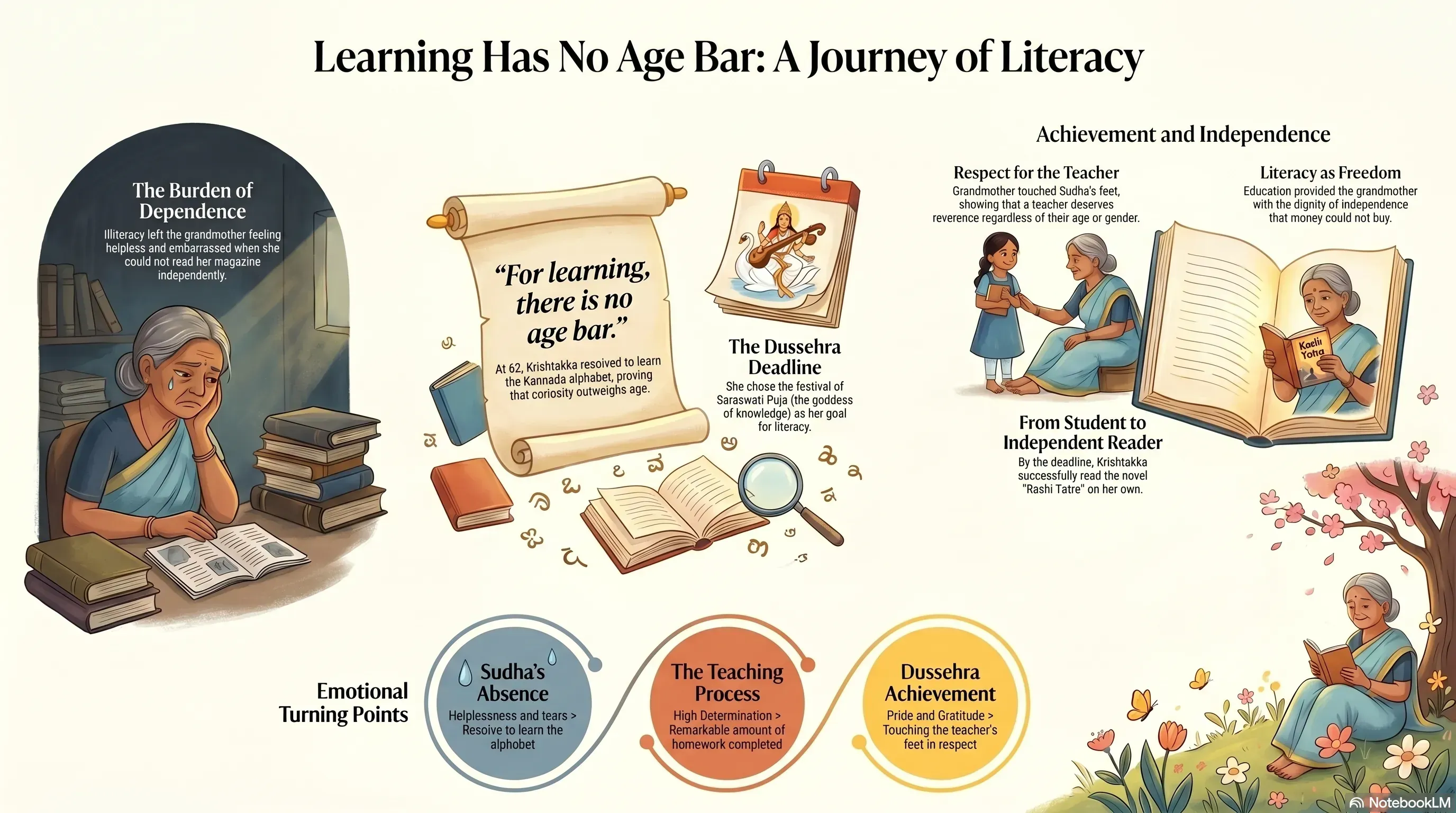
How I Taught My Grandmother to Read Summary – Part II
Part II of the how I taught my grandmother to read summary covers Avva's decision, her daily lessons and her success at Dassara.
Avva's helplessness
Avva explained that while the narrator was away, Karmaveera arrived as usual. She opened it and saw the picture with Kashi Yatre, but could not read a word. She rubbed her hands over the pages, wishing they could understand what was written. She even thought of going to the other village to ask the narrator to read it. She could have asked someone in her own village, but she was too embarrassed. She felt dependent and helpless, and said, "We are well-off, but what use is money when I cannot be independent?"
The decision to learn
Avva decided to learn the Kannada alphabet from the very next day. She set Saraswati Puja day during Dassara as her deadline, when she wanted to be able to read a novel on her own. The narrator laughed at her: at sixty-two, with grey hair, wrinkled hands and spectacles, and so much work in the kitchen, how could she learn? Avva just smiled and replied, "For a good cause if you are determined, you can overcome any obstacle… For learning there is no age bar."
The teacher and her first student
The tuition began the next day. Avva was a wonderful student; she would read, repeat, write and recite, and the amount of homework she did was amazing. The narrator was her only teacher, and Avva was the narrator's first student. The narrator adds that she did not know then that one day she would become a teacher of Computer Science and teach hundreds of students.
Dassara: the student passes
At Dassara, the narrator secretly bought Kashi Yatre, which had by then been published as a novel. Avva called her to the puja place, made her sit on a stool and gave her a gift of frock material. Then she bent down and touched the narrator's feet. The narrator was taken aback, because elders never touch the feet of youngsters. Avva explained that she was touching the feet of a teacher, not of her granddaughter, because the scriptures say a teacher should be respected irrespective of gender and age.
The narrator returned her namaskara by touching her feet and gave her the gift. Avva opened it and immediately read the title, "Kashi Yatre by Triveni", and the publisher's name. The narrator knew then that her student had passed with flying colours.
[Image: How I Taught My Grandmother to Read mind map]
Characters in How I Taught My Grandmother to Read
How I Taught My Grandmother to Read has only a few characters, and the story centres on the bond between the narrator and her grandmother.
Character | Role and qualities |
|---|---|
The narrator (Sudha Murty as a 12-year-old girl) | Loving, caring and patient. At first she childishly laughs at Avva's plan, but she becomes a devoted teacher |
Avva / Krishtakka (the grandmother) | Strong-willed, hardworking, self-respecting and humble. She wants independence, sets a goal, works hard and respects her teacher |
Triveni | A popular Kannada writer whose novel Kashi Yatre inspires Avva |
The old lady in Kashi Yatre | Wants to go to Kashi but gives her savings to an orphan girl; reflects Avva's own generous values |
Why Is Kashi Yatre Important in How I Taught My Grandmother to Read?
Kashi Yatre is the reason the grandmother wants to learn to read. She identifies with its old lady, who has never been to Kashi, so she cannot wait to know what happens next. The novel also mirrors the story's message: just as the old lady gives up her pilgrimage to help an orphan, the grandmother values something deeper than money, which is the independence that education brings. The narrator's Dassara gift of the published novel becomes the proof that Avva can now read.
How I Taught My Grandmother to Read Summary: Key Events at a Glance
Event | Significance |
|---|---|
The narrator reads Kashi Yatre to Avva every Wednesday | Shows Avva's dependence on others because she cannot read |
The narrator stays a week at a wedding | Avva cannot read the new episode on her own |
Avva is found in tears | Turning point: helplessness leads to her decision |
Avva sets Saraswati Puja during Dassara as her deadline | Shows determination and respect for learning |
Daily lessons begin | Shows hard work and the bond between teacher and student |
Avva touches the narrator's feet | A teacher deserves respect regardless of age or gender |
Avva reads the title of Kashi Yatre | Proof of her success and independence |
Themes and Moral of How I Taught My Grandmother to Read
How I Taught My Grandmother to Read carries several simple but powerful messages:
- Education gives independence and dignity. Avva had money but felt helpless because she could not read.
- There is no age bar for learning. At sixty-two, Avva learns to read in a few months through determination.
- Respect for teachers. Avva shows that a teacher must be respected irrespective of age or gender.
- Determination overcomes obstacles. "For a good cause if you are determined, you can overcome any obstacle."
- The power of stories. A serialised novel inspires a life-changing decision.
Moral: It is never too late to learn, and education is the key to independence. That is the message every how I taught my grandmother to read summary should end with.
How I Taught My Grandmother to Read Question Answers (NCERT Kaveri)
These question answers for How I Taught My Grandmother to Read follow the exercises in the NCERT Kaveri textbook.
Check Your Understanding: True or False
- The grandmother wanted to learn the Kannada alphabet to gain independence. True
- The grandmother asked someone in the village to read Kashi Yatre to her while the narrator was away. False (she was too embarrassed to ask anyone)
- The narrator was the grandmother's first teacher and taught her how to read Kannada. True
- The grandmother believed that there was no age limit for learning. True
- The grandmother touched the narrator's feet as a mark of respect for her as a teacher. True
- The narrator was disappointed with the progress her grandmother made in learning to read. False (Avva was a wonderful student and "passed with flying colours")
Extract-based questions
Extract 1 ("When I came back to my village, I saw my grandmother in tears…")
- (i) The phrase "never seen her cry in the most difficult situations" tells us the grandmother was A. strong-willed.
- (ii) The grandmother did not reply because she might have been too emotional to respond.
- (iii) Clue to a rural setting with traditional customs: sleeping on the open terrace of the house on a summer night, and calling the grandmother "Avva".
- (iv) Lines that establish a tender atmosphere: "Avva came and sat next to me. Her affectionate hands touched my forehead."
- (v) The aspect NOT emphasised in the extract is C. the grandmother's regret over her lack of education (she reveals this only later).
Extract 2 ("I have decided I want to learn the Kannada alphabet…")
- (i) "I want to be independent" shows that B. she desires self-sufficiency.
- (ii) The grandmother's determination shows that learning has no age limit.
- (iii) The narrator laughs because she thinks her grandmother is too old (sixty-two, grey-haired, wrinkled hands, spectacles) and too busy in the kitchen to learn the alphabet.
- (iv) Two qualities of the grandmother: determination and a positive attitude (she just smiles and says she will work harder than anybody).
- (v) The narrator assumes that old age, wrinkles, spectacles and housework make learning impossible, but the grandmother proves these assumptions wrong.
Answer the following questions
1. Why do you think the grandmother felt embarrassed to ask someone else to read to her while the narrator was away? She was a respected elder from a well-off family, and admitting in front of others that she could not read hurt her self-respect. She also did not want to depend on outsiders for something so personal.
2. Why does the narrator initially laugh at her grandmother's determination to learn at the age of sixty-two? As a child, the narrator thought learning was only for the young. She childishly assumed that her grandmother's age, grey hair, wrinkled hands, spectacles and busy kitchen work made it impossible for her to learn.
3. What significance does the story of Kashi Yatre have in both the grandmother's life and the story? Avva identifies with the novel's old lady, and her desire to read it independently leads her to learn the alphabet. In the story, Kashi Yatre links the beginning and the end: reading its title at Dassara proves Avva's success.
4. What does the grandmother's desire to learn the Kannada alphabet reflect about her? It reflects her self-respect, determination, love of learning and wish to be independent, as well as the courage to start something new late in life.
5. What lessons can we infer from the grandmother's action of touching the narrator's feet? A teacher deserves respect irrespective of age or gender, knowledge is to be honoured, and true humility means respecting whoever teaches us.
6. What does the line "For a good cause if you are determined, you can overcome any obstacle" tell us about the broader theme of the story? It expresses the main theme: determination and hard work can overcome obstacles like age, and learning has no age bar.
7. How effectively does the story highlight the value of education in supporting personal independence? Very effectively. Avva had money and a loving family, yet she felt helpless because she could not read. Once she learned, she could read any novel confidently on her own and said, "Now I am independent." The contrast shows that education, not wealth, gives true independence.
Frequently Asked Questions
What is the summary of "How I Taught My Grandmother to Read"?
In short, the how I taught my grandmother to read summary is this: the twelve-year-old narrator reads the serialised Kannada novel Kashi Yatre to her grandmother every week. When she is away for a week, her grandmother cannot read it and feels helpless. She decides to learn Kannada, sets Saraswati Puja during Dassara as her deadline, studies hard with her granddaughter as teacher, and finally reads Kashi Yatre on her own.
Who is the author of "How I Taught My Grandmother to Read"?
The author is Sudha Murthy, a celebrated Indian writer, philanthropist, and Chairperson of the Infosys Foundation. This is an autobiographical story based on her real childhood experience of teaching her grandmother to read Kannada.
What is the moral of How I Taught My Grandmother to Read?
The moral of How I Taught My Grandmother to Read is that there is no age bar for learning, and education gives a person independence and dignity. A teacher deserves respect regardless of age.
Why did the grandmother touch the narrator's feet?
She touched her feet to respect her as a teacher, not as a granddaughter. She said the scriptures teach that a teacher should be respected irrespective of gender and age.
Where can I find How I Taught My Grandmother to Read question answers?
The NCERT question answers from Kaveri, including true or false, extract-based and long questions, are given above with this how I taught my grandmother to read summary. eSaral's Class 9 English video lessons also explain the chapter in detail.
Team eSaral
eSaral Academic and Editorial Team
Team eSaral is the collective author profile for educational content created by eSaral’s teachers and academic contributors. The team draws on expertise from IIT graduates, doctors, experienced educators and subject specialists to develop resources for JEE, NEET and school students. Our articles aim to explain concepts clearly and help students study with confidence.
Related Posts

BITSAT 2027: Registration Date, Exam Date, Syllabus, Eligibility, Pattern & Fees
BITSAT 2027 exam dates, registration timeline, eligibility criteria, exam pattern, marking scheme, syllabus and fees in one page.

BITSAT Previous Year Question Paper PDF (2017-2026)
Download BITSAT previous year question papers PDF from 2017 to 2026,session-wise. Memory-based papers,exam pattern, paper analysis and how to practise

CBSE Class 10 Date Sheet 2027: Expected Exam Dates, Release Date, Admit Card & Result Timeline
CBSE Class 10 date sheet 2027 is awaited. See the expected exam dates, release window, how to download the PDF, admit card and result timelines.

NCERT Physics Class 10 Book PDF in Hindi 2026-27 – भौतिक विज्ञान के 4 अध्याय (Free Download)
NCERT Physics Class 10 book PDF in Hindi 2026-27: download all 4 chapters (अध्याय 9–12) free, with topics and important formulas.

NCERT Biology Class 9 Book Anveshan PDF in Hindi - जीव विज्ञान कक्षा 9 पुस्तक अन्वेषण PDF
Download NCERT Biology Class 9 book PDF in Hindi chapterwise for 2026-27: Cell, Tissues, Reproduction and Diversity. Free PDFs.

Essay On Artificial Intelligence in English (100,150, 200, 250, 300, 500 Words)
This is in contrast to the natural intelligence of humans. With Artificial Intelligence, machines can perform

Essay on 78th India Independence Day in English for Student (100, 150, 200, 250, 300, 500 Words)
Read the best essays on India's Independence Day in English. Short & long essays (100, 150, 200, 250, 300, 500 words) perfect for school exams
NCERT Class 11 English Snapshots book - Free PDF download- Esaral
Download NCERT Class 11 English Snapshots book PDF for free. Get all 8 chapters, chapter-wise. Start your prep today!
NCERT Class 10 biology book pdf - Free PDF Download - eSaral
NCERT Class 10 Biology book PDF 2026-27: all 5 chapters (Life Processes to Our Environment) in English & Hindi, with CBSE syllabus, marks & practical

Essay on Global Warming in English (100,150, 200, 250, 300, 500 Words)
Global warming means the Earth is getting hotter. This happens because of things like pollution from cars and factories.