
How to read a resistance color code?

eSaral Academic and Editorial Team
Resistors are the most common and important component of any electronic circuit. In daily life we see a lot of circuits having resistances but how do we recognize them? To know the value of a resistance they are color coded with rings which have specific meanings according to the color and the place they are at. Let's figure out now what Resistance Color Code is and what it all means!! Contents:
Resistance Color Code
Resistors are produced for laboratory and domestic uses. Generally they are available in two types:
- Wire bound Resistors
- Carbon Resistors
Wire bound resistors are made up by winding the alloy such as Nichrome, Manganin, Constantan etc as their resistivities are relatively insensitive to the temperature. they can be in the range of a fraction of an ohm to few hundred ohms. The second one, Carbon Resistors are used to make higher range of resistors. These are made up of Carbon. These are in general compact, inexpensive hence used extensively in electronic circuits. These are very small so their values are given by color coding them. Next we are going to see what is this color coding.
Color coding of Carbon Resistors
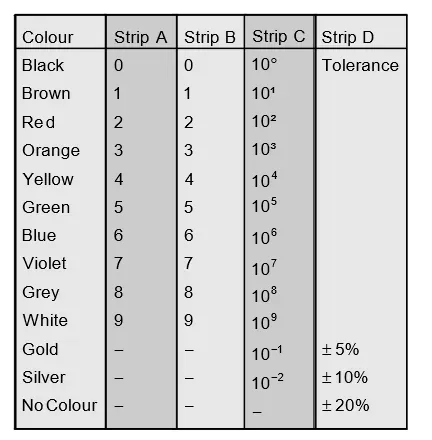
Check out the following table where each color is followed by 4 Strips. Here we will see what those 4 colored rings mean wound around a resistor. [caption id="attachment_4578" align="aligncenter" width="483"] Carbon Resistance Color Code Table[/caption]
Mnemonics
A useful mnemonic matches the first letter of the color code, in numeric order. Here are two that includes tolerance codes gold, silver, and none:
- Bad beer rots our young guts but vodka goes well – get some now.
- B B ROY of Great Britain had a Very Good Wife who wore Gold and Silver Necklace.
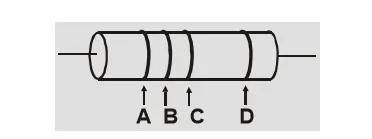
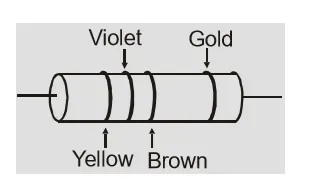
[source] A Carbon resistor looks like the one shown above. It has 4 rings around it. [caption id="attachment_4579" align="aligncenter" width="308"] Carbon Resistance Color Code[/caption] The first two rings give first two significant figures of resistance. The third ring indicates the decimal multiplier i.e. the number of zeroes that will follow the two significant figures. The fourth ring shows tolerance or percentage accuracy. [esquestion]What will be the color code for $42{\rm{k}}\Omega \pm 10\% $ carbon resistance. #sol#According to color code color for digit 4 is yellow, for digit 2 it is red, for 3 colors is orange and 10$\% $ tolerance is represented by silver color. So color code should be yellow, red, orange and silver. [/esquestion] [esquestion]What is resistance of following resistor? #sol#Brown color gives multiplier ${10^\prime },$ Gold gives a tolerance of $ \pm 5\% $ So resistance of resistor is $47 \times {10^1}\Omega \pm 5\% \quad $ or $\quad 470 \pm 5\% \Omega $ [/esquestion]
Body End Dot Color Code
Earlier, resistors were manufactured with this color code. [caption id="attachment_4581" align="aligncenter" width="217"] Body End Dot Color Code[/caption]
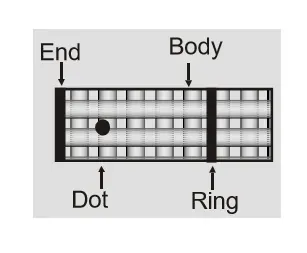
- The color of body gives first significant figure.
- The color of end gives second significant figure.
- The color of dot gives the decimal multiplier.
- The color of ring gives the tolerance.
Team eSaral
eSaral Academic and Editorial Team
Team eSaral is the collective author profile for educational content created by eSaral’s teachers and academic contributors. The team draws on expertise from IIT graduates, doctors, experienced educators and subject specialists to develop resources for JEE, NEET and school students. Our articles aim to explain concepts clearly and help students study with confidence.
Related Posts

Plant Cell Diagram: Labelled Structure, Parts and Functions
Simple, labelled plant cell diagram with parts and functions. Covers plant cell structure for Class 6, 7, 8, 9, 10 and 11 students, CBSE-aligned.

Saransh Gupta Sir's Visit to IIT Patna: Hostel Life, Placements & Lessons for JEE Aspirants
Inside Saransh Gupta Sir's IIT Patna visit — hostel life, the library, placements, internships, and real advice for JEE aspirants from students living the IIT dream.

Molality Formula: Formula for Molality, Derivation & Solved Examples
Molality formula is $m = \dfrac{n}{W}$. Learn the formula of molality, its SI unit, derivation, relation with molarity, and solved examples for Class 11, JEE and NEET.

BITSAT Previous Year Question Paper PDF
Download BITSAT previous year question papers PDF. Get year-wise BITSAT PYQs, memory-based papers, exam pattern, and preparation tips to improve your BITSAT preparation.

Teachers’ Day 2026 at eSaral Gurukul: Celebrating the Bond Between Students, Teachers & Mentors
See how Teachers’ Day 2026 was celebrated at eSaral Gurukul, reflecting the bond among students, teachers, and mentors, and the role of guidance beyond academics.

JEE Advanced Attempts: Can You Give It a Third Time? Rules Explained
JEE Advanced attempts: current rule is 2 consecutive years only: full eligibility criteria, the 2025 third-attempt controversy, and the latest 2026 petition news.

Best JEE Preparation App
Best JEE preparation app for Main & Advanced: AI mock tests, live doubt-solving, thousands of practice questions. JEE preparation app for droppers & Class 11-12.
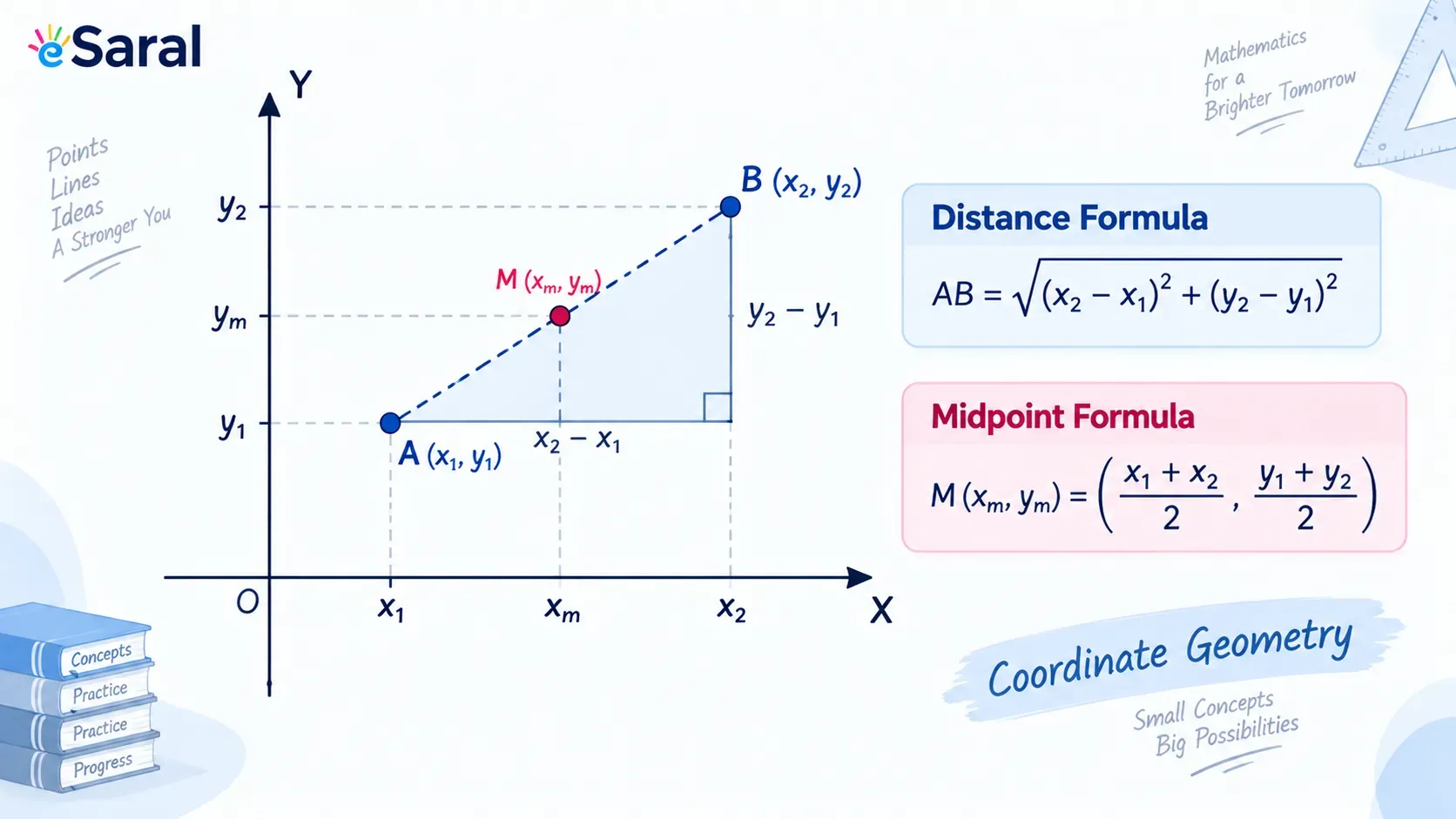
Coordinate Geometry Class 10: Formulas, Notes & Solved Examples
Coordinate geometry class 10: complete CBSE formulas — distance, section, midpoint and area of triangle — with derivation, notes and solved examples.

How to make Notes For JEE Smart Notes Strategy of an AIR 41
Learn how to make notes for JEE the way toppers do — indexing, shorthand, and smart short notes for JEE that cut revision time to just 5–7 days.
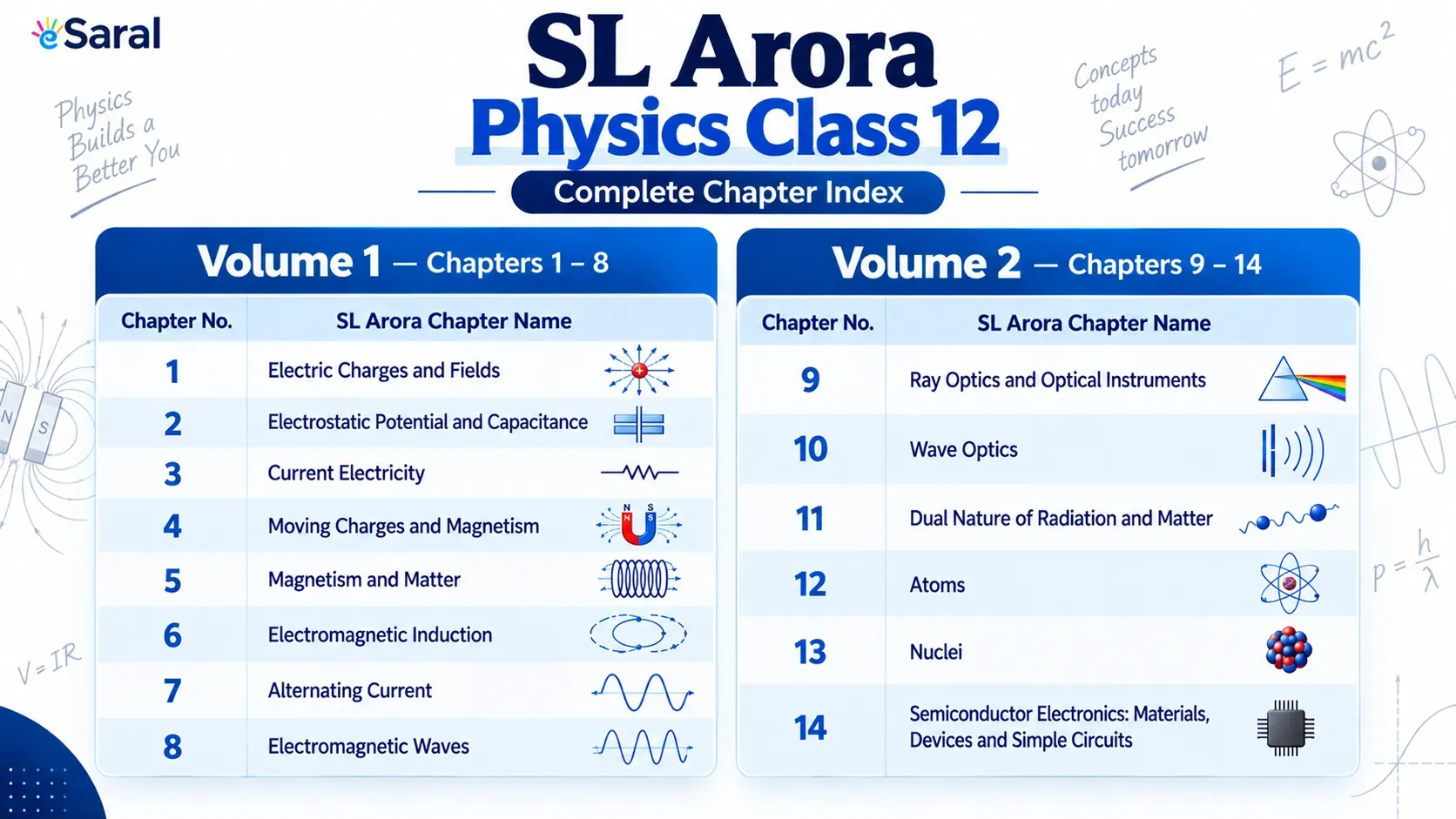
SL Arora Physics Class 12 Index – Chapter List for Volume 1 & 2
SL Arora Physics Class 12 index — complete chapter list for Volume 1 & 2, mapped to NCERT solutions for board, JEE Main, and NEET preparation.