
Invisible Living World Class 8 Notes: Cells & Microorganisms Explained
eSaral ›Foundation courses › Invisible Living World Class 8 Notes: Cells & Microorganisms Explained

What Is the Invisible Living World?
The chapter opens with a simple question: have you ever wondered what you might see if the invisible world around you became visible? Small, everyday objects around us — our hands, our food, the water we drink, and the air we breathe — contain tiny living things that our eyes are simply not powerful enough to see.
Because the human eye can only see objects above a certain size, this hidden world stayed unknown to people for a long time. As the chapter puts it, tiny organisms were unknown, and people did not know that they existed at all — until better tools were invented to look for them.
One important idea introduced early is that small does not mean simple. Tiny living things can be very complex, and even very simple-looking things can be alive. An ant, for example, is tiny but still a living being — just like the microorganisms discussed later in the chapter, which are even smaller than an ant or a mosquito.
How Did Humans Discover This Hidden World?
Long before microscopes existed, people discovered that a curved piece of glass could enhance the appearance of very small objects. This curved piece of glass was thick in the middle and thin at the edges — a shape that resembled a lentil seed (dal ka dana). That resemblance is exactly why this tool was named a lens — from "lentil."
Over time, this basic lens was improved, leading to more powerful tools such as the magnifying glass and eventually the microscope. Each new tool helped humans see a little further into the invisible world that had always existed around them.
💡 Expert Tip by Vanshika Ma'am: You can recreate the discovery of the lens at home. Fill a round-bottom glass flask with water, seal it with a cork, and place it over an open book. Look at the letters through the flask — they will appear magnified because the water bends light, just like a real magnifying glass.
Who Discovered the Cell? Robert Hooke and the Cork Slice
In 1665, scientist Robert Hooke published his book called Micrographia. Hooke used his own hand-made microscope — he was known to be a careful observer and also a skilled artist.
One day, Hooke took a thin slice of cork (the dead part of a plant) from his garden and examined it under his microscope. What he saw were small, empty, polygon-shaped structures that looked like a honeycomb. He named each of these empty spaces a cell — marking the very first time the word "cell" was used in science.
Because Hooke observed cork, which is dead plant tissue, he did not realise at the time whether these structures were living or non-living.
Who Is the Father of Microbiology?
Around 1660, a scientist named Antonie van Leeuwenhoek built a more powerful compound microscope. Using this tool, he became the first person to observe bacteria and blood cells — and, importantly, both of these were living.
Because Leeuwenhoek was the first to observe living cells, he is known as the Father of Microbiology.
Scientist | Key Contribution | Known As |
|---|---|---|
Robert Hooke | Discovered the cell (in a cork slice, 1665) | First to use the word "cell" |
Antonie van Leeuwenhoek | First to observe bacteria and living blood cells (around 1660) | Father of Microbiology |
What Is a Cell? The Basic Unit of Life
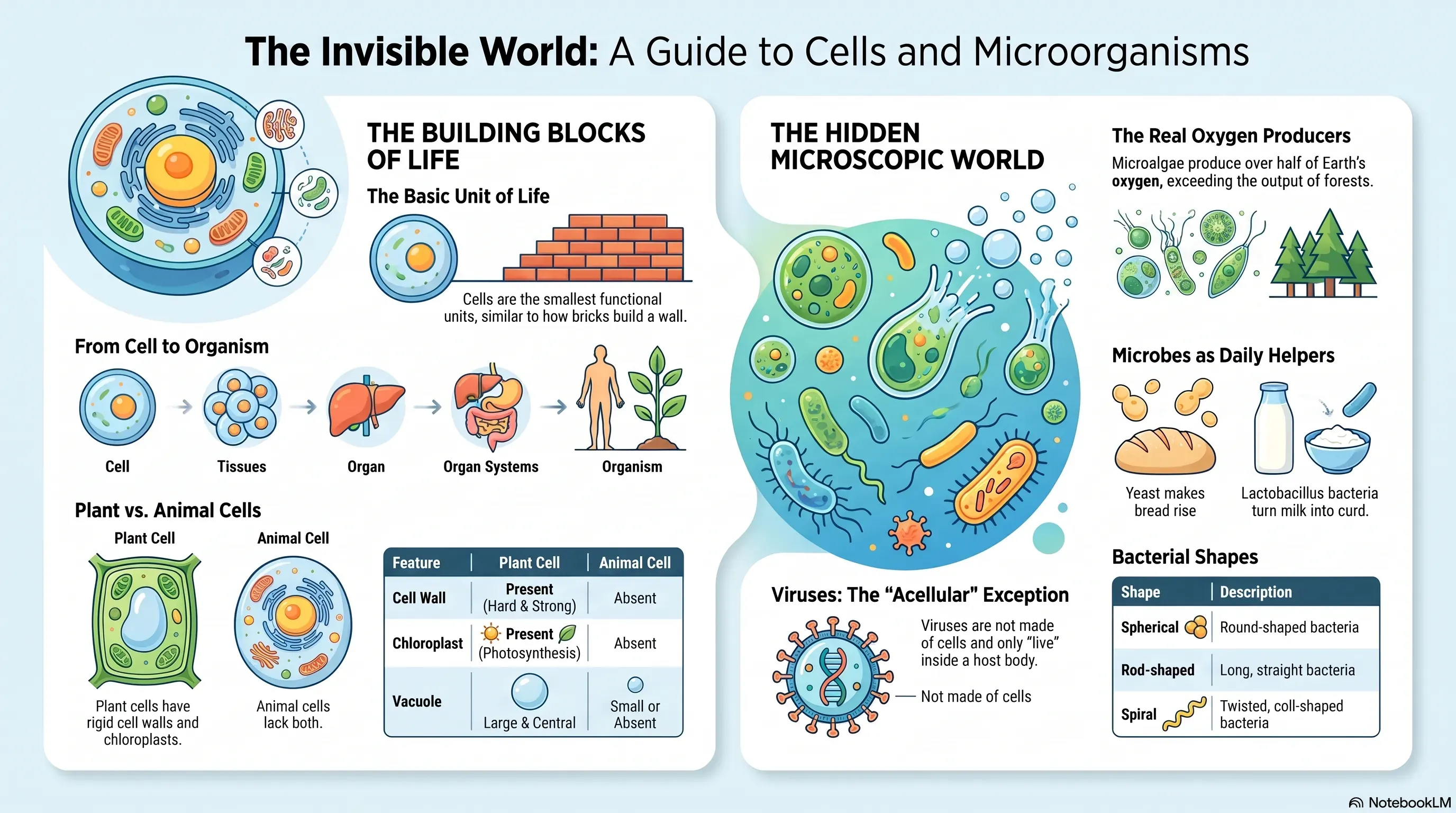
Following these two discoveries, one universal line emerges: all living beings are made up of cells — this includes plants, animals, and humans. This also means the cell is the smallest and basic unit of life, just as a brick is the basic unit of a wall.
Since the cell is so small, we cannot see it with our naked eyes. To understand the structure of a cell properly, we need to look at it using a microscope.
How to Observe Plant and Animal Cells Under a Microscope
The chapter describes two hands-on activities that prove all plants and animals are made of cells.
Activity 1: Observing an Onion Peel (Plant Cell)
- Take an onion bulb and wash it with water.
- Cut the onion vertically and take out one piece.
- Pull out the thin, transparent layer from inside — this is the onion peel.
- Place the peel in a petri dish and add a few drops of safranin (a red dye) as a stain.
- Wait 30 seconds so the stain is absorbed, then wash the peel with water.
- Place the peel carefully on a glass slide and add a few drops of glycerine to prevent the cells from drying out.
- Place a cover slip gently and remove excess glycerine with blotting paper.
- Observe the slide under a microscope.
Under the microscope, the onion peel shows many rectangular structures — these are the onion cells, and they contain a visible cell wall, cell membrane, nucleus, and cytoplasm. This proves that all plants are made up of cells.
Activity 2: Observing a Human Cheek Cell (Animal Cell)
- Rinse your mouth with clean water.
- Use a clean toothpick to gently scrape the inside of your cheek.
- Place the scraped material on a glass slide, add a drop of water, and spread it.
- Add methylene blue dye and wait for 1 minute (60 seconds) for staining.
- Add a drop of glycerine, place a cover slip, and remove the extra glycerine.
- Observe the slide under a microscope.
This time, the cells appear polygonal or irregular in shape, and you can see the cell membrane, cytoplasm, and nucleus — but notably, there is no cell wall. This confirms that animal bodies are also made up of cells.
Plant Cell vs Animal Cell: Key Differences
Comparing the two activities gives a clear structural comparison between plant and animal cells.
Feature | Plant Cell (Onion Peel) | Animal Cell (Cheek Cell) |
|---|---|---|
Shape | Rectangular, fixed shape | Polygonal/irregular, variable shape |
Cell Wall | Present | Absent |
Cell Membrane | Present | Present |
Nucleus | Present | Present |
Cytoplasm | Present | Present |
Arrangement | Compact, closely packed | Loosely arranged |
The Three Basic Parts of a Cell
Every cell is built from three main structures, whether it belongs to a plant or an animal.
- Cell Membrane — a thin outer covering that separates one cell from another. It is porous (has small holes) and functions to allow useful material to enter the cell while letting waste material go out.
- Cytoplasm — a jelly-like substance present inside the cell, where all life activities take place. It contains proteins, fats, and minerals.
- Nucleus — a small, round structure usually present in the centre of the cell. It controls all activities of the cell, functioning essentially as the cell's "brain."
Extra Cell Parts: Cell Wall, Plastids and Vacuole
Beyond the three basic parts, some cells have additional structures that are not present in every cell type.
- Cell Wall — present only in plant cells. It is hard and strong, giving the cell its shape, strength, and firmness. Plants need this rigid structure because they stand in one place and must withstand wind and storms.
- Plastids — present only in plant cells. An example is the chloroplast, which is green because it contains the pigment chlorophyll and helps in photosynthesis. Animal cells do not have plastids because animals do not make their own food.
- Vacuole — a large empty space found in plant cells; it is small or absent in animal cells. Its functions include storing food, storing waste, maintaining the cell's shape, and providing support.
Feature | Plant Cell | Animal Cell |
|---|---|---|
Cell Wall | Present | Absent |
Chloroplast | Present | Absent |
Vacuole | Large | Small or absent |
Shape | Fixed (due to cell wall) | Variable |
Why Do Cells Look Different from Each Other?
Not all cells are the same — different cells have different shapes, sizes, and structures because they each perform a specific function, and their shape depends on that function.
For example, a muscle cell is spindle-shaped, long, and thin because its job is to contract and relax to enable body movement. A nerve cell (also called a neuron), by contrast, is long and branched because its function is to carry messages from different body parts to the brain, connecting body parts to it.
Cells also work together to perform a specific task and keep our body alive. In digestion, for instance, the food pipe's muscle cells push food toward the stomach through movement, while the stomach has both muscle cells (which churn food) and gland cells (which release digestive juices to break down food).
Levels of Organisation: From Cell to Organism
A living organism's body is not built all at once — it develops step by step, similar to how bricks form a wall, walls form a room, and rooms form a house.
- Cell — the basic unit of life
- Tissue — a group of similar cells doing the same work (e.g., many muscle cells form muscle tissue; many nerve cells form nervous tissue)
- Organ — different tissues come together to perform one main job (e.g., the heart pumps blood; the stomach digests food; a leaf makes food in plants)
- Organ System — many organs work together for a bigger function (e.g., the digestive system includes the mouth, food pipe, stomach, small intestine, and large intestine)
- Organism — all organ systems work together to form a complete living body (e.g., a plant, a dog, or a human)
Every complex living organism starts life as a single cell. This single cell — for humans, called an egg — divides again and again to eventually form a complete organism.
Two record-holding cells are worth remembering: the largest cell is the yolk of an ostrich egg (about 130 mm to 170 mm in size), and the longest cell in the human body is the nerve cell (neuron).
What Are Microorganisms and Where Are They Found?
Microorganisms, also called microbes, are tiny living beings that cannot be seen with the naked eye and can only be observed using a microscope. As living beings, they are still classified as organisms — just extremely small ones.
Microorganisms are found everywhere: in water, in soil, in the air, and even inside our own bodies. They are present all the time, even though we cannot see them — much like a hidden, invisible presence around us at all times.
An activity using pond or stagnant water confirms this: taking just one drop of pond water and observing it under a microscope reveals many tiny, moving organisms of different shapes and sizes — some moving fast, some slow. A similar activity using soil suspension (soil mixed with water, left to settle) also reveals tiny moving organisms under the microscope, proving that soil also contains tiny living creatures.
Types of Microorganisms
Microorganisms fall into two broad categories based on the number of cells they contain.
- Unicellular microorganisms — made up of a single cell that performs all functions on its own. Examples: bacteria and amoeba.
- Multicellular microorganisms — made up of more than one cell working together. Examples: some fungi and algae.
The main categories of microorganisms are: bacteria, fungi, algae, protozoa, and viruses.
Specific examples observed in the pond water and soil activities include:
- Amoeba — a protozoan; unicellular, moving, irregular in shape, and moves using structures called pseudopodia.
- Paramecium — a protozoan; unicellular, and moves using small hair-like specialised structures on its surface.
- Algae — some are unicellular, some multicellular; green in colour due to chlorophyll, and move using specialised structures.
- Bread mould — a type of fungus; branched, without chlorophyll, and has a sac-like structure. It is commonly seen as green or black growth on bread left out during humid weather.
- Mould (fungus) — branched, without chlorophyll, with brush-like structures.
Bacteria: Shapes and Special Features
Bacteria come in different shapes, just as animals around us come in different shapes and sizes.
Bacteria Shape | Description |
|---|---|
Spherical | Round-shaped bacteria |
Rod-shaped | Long, straight bacteria |
Spiral | Twisted, coil-shaped bacteria |
Comma-shaped | Curved, comma-like bacteria |
Some bacteria have one long hair-like structure, while others have many small hair-like structures. Bacteria are also structurally unique because they do not have a well-defined nucleus like plant and animal cells do. Instead of a proper nucleus, bacteria have a nucleoid region, and they also lack a nuclear membrane — a feature that makes them different from plant and animal cells.
Feature | Bacteria | Plant/Animal Cell |
|---|---|---|
Nucleus | Not well defined (nucleoid region instead) | Well defined |
Nuclear Membrane | Absent | Present |
Nucleoid | Present | Not applicable |
To study these very minute parts of a cell in detail, a normal microscope is not enough — scientists need a more powerful electron microscope, which has a much stronger magnifying power.
Are Viruses Living or Non-Living?
Viruses are a special category of microorganisms because they are acellular — meaning they are not made up of cells at all, unlike every other living being discussed in this chapter.
Viruses multiply only inside a living cell. Once inside a host's body, they take over the body's machinery and begin to multiply, which is how they cause disease. Outside a living host, a virus remains non-living. Viruses can infect plants, amoebas, bacteria, animals, and humans alike.
How Are Microorganisms Connected to Our Daily Life?
Microorganisms connect to daily life in two ways: they cause food to spoil, but they also help us in many ways.
Food spoilage: Lemons, tomatoes, oranges, or bread left outside — especially during humid or rainy weather — can develop white powder, green patches, or cotton-like growth. This happens because microorganisms from the air, water, or soil land on the food and grow when conditions are favourable, spoiling it.
Why pickles and preserves don't spoil: Pickles and preserves (murabba) contain high concentrations of salt, sugar, and spices, which act as preservatives. This high concentration slows down the growth of microorganisms, preventing spoilage.
Helpful Role of Microorganisms
The chapter lists several specific, verified ways microorganisms help us:
- In the kitchen — dough (yeast): In an activity comparing two dough balls (one with yeast, flour, and sugar; one with just flour and sugar), only the yeast-containing dough rises, becomes fluffy, and develops a different smell after warm water is added. Yeast, a type of fungus, grows in warm conditions, uses sugar as food, and releases carbon dioxide, which forms bubbles that make the dough rise. This dough is used in making bread, cakes, and bakery items.
- In the kitchen — curd formation: Warm milk mixed with curd forms curd after some hours, while cold milk mixed with curd curdles the milk instead. Curd contains the bacterium Lactobacillus, which feeds on milk sugar and produces lactic acid, turning milk sour and forming curd.
- Helping plants — Rhizobium: Rhizobium bacteria live in the root nodules of leguminous plants and trap nitrogen from the air, making it usable for the plant.
- Microalgae and oxygen production: Microalgae are microscopic plant-like organisms found in water, soil, and air. Being green and containing chlorophyll, they make their own food and release oxygen — producing more than half of the Earth's oxygen. Uses of microalgae include food for aquatic animals, health supplements, medicines, water cleaning, and biofuel production.
- Spirulina: Called a "super food" because it is rich in protein and Vitamin B12, spirulina is used as a food supplement, including by astronauts during space travel.
- Cleaning the environment (decomposition): In an activity, vegetable and fruit peels buried in garden soil for two to three weeks turn dark and soft, forming manure. This happens because bacteria and fungi in the soil break down the complex peels into simpler substances — a process called decomposition — returning nutrients to the soil and making it more fertile.
- Biogas production: Some microbes survive without oxygen and break down plant and animal waste. During this decomposition, gases such as methane (CH₄) are released, which is used for cooking, generating electricity, and as fuel.
- Cleaning pollution: Scientist Ananda Mohan Chakrabarty developed a bacterium in 1971 that could break down oil spills, helping clean up pollution. He received a patent for this discovery in 1980 — a patent being a legal right that prevents others from copying an invention.
- Ancient references: Ancient Indian texts, particularly the Vedas, used the word "krimi" to refer to different tiny entities — some visible and some invisible — and mentioned both their beneficial and harmful effects.
Common Myths About Microorganisms
Myth | Fact |
|---|---|
All microorganisms are harmful | Most microorganisms are useful, not harmful. They help in digestion, food preparation (like bread and curd), cleaning the environment, and improving soil fertility through decomposition. Only some microbes cause disease. |
Bacteria are the simplest and weakest form of life | Bacteria are extremely strong survivors. Some can live in hot springs, extremely cold temperatures, and inside the human body — conditions where humans and animals cannot survive. |
Oxygen comes mainly from trees | More than half of the Earth's oxygen is produced by microalgae, not trees. These tiny organisms produce more oxygen than forests do. |
Frequently Asked Questions
What is the invisible living world in Class 8 Science?
The invisible living world refers to tiny living structures and organisms — such as cells and microorganisms — that exist all around us but cannot be seen with the naked eye. They were unknown to people until tools like the lens and microscope were invented to observe them.
Who discovered the cell and what did they observe?
Robert Hooke discovered the cell in 1665 while observing a thin slice of cork under his hand-made microscope. He saw small, empty, honeycomb-like structures and named them "cells," marking the first scientific use of the word.
Who is called the Father of Microbiology?
Antonie van Leeuwenhoek is called the Father of Microbiology. Using a compound microscope around 1660, he became the first person to observe living bacteria and blood cells, unlike Hooke, who had only observed dead cork cells.
What is the difference between a plant cell and an animal cell?
A plant cell has a rectangular, fixed shape with a cell wall, while an animal cell has a polygonal, variable shape without a cell wall. Both contain a cell membrane, cytoplasm, and nucleus, but plant cells additionally have chloroplasts and a large vacuole.
What are microorganisms and where are they found?
Microorganisms, or microbes, are tiny living beings invisible to the naked eye, observable only through a microscope. They are found everywhere — in water, soil, air, and even inside the human body.
Are all microorganisms harmful to humans?
No, most microorganisms are useful rather than harmful. They help with digestion, food preparation like bread and curd, environmental cleaning through decomposition, and improving soil fertility, while only some specific microbes cause disease.