
Isomerism - NEET Previous Year Questions with Complete Solutions
eSaral › NEET ›Isomerism - NEET Previous Year Questions with Complete Solutions

What Is Isomerism? — Quick Concept Overview
Isomerism is the phenomenon where two or more compounds have the same molecular formula but different structural arrangements or spatial arrangements of atoms, resulting in different physical and/or chemical properties.
Term | Definition | Example |
|---|---|---|
Isomers | Compounds with the same molecular formula but different structures | n-butane and isobutane (both C₄H₁₀) |
Isomerism | The phenomenon that gives rise to isomers | Chain isomerism in C₄H₁₀ |
Structural Isomers | Same molecular formula, different connectivity of atoms | n-pentane, isopentane, neopentane |
Stereoisomers | Same molecular formula and connectivity, different spatial arrangement | cis-2-butene and trans-2-butene |
💡 Expert Tip by eSaral Academic Team: Before attempting Isomerism NEET PYQs, make sure you can write all structural isomers for a given molecular formula systematically — start with the longest chain, then reduce by one carbon at a time. This skill is tested directly in 1–2 NEET questions every year and takes only 10 minutes of daily practice to master.
Types of Isomerism — Complete Classification Table
Isomerism is broadly divided into two main categories: Structural Isomerism and Stereoisomerism. Each has several sub-types that appear in NEET questions.
Category | Type of Isomerism | Basis of Difference | NEET Frequency |
|---|---|---|---|
Structural Isomerism | Chain Isomerism | Different carbon chain structures (branching) | High |
Position Isomerism | Different positions of the same functional group on the chain | High | |
Functional Group Isomerism | Different functional groups in the same molecular formula | Very High | |
Metamerism | Different alkyl groups on either side of same functional group | Medium | |
Tautomerism | Interconvertible structural isomers in equilibrium (keto-enol) | High | |
Stereoisomerism | Geometric (cis-trans / E-Z) Isomerism | Different spatial arrangement around a double bond or ring | Very High |
Optical Isomerism | Non-superimposable mirror images (enantiomers); presence of chiral centre | Very High |
Type of Isomerism | Key Condition / Rule | Common Example in NEET |
|---|---|---|
Chain Isomerism | Same molecular formula, different carbon skeleton | n-butane vs isobutane (C₄H₁₀) |
Position Isomerism | Same functional group at different positions | 1-propanol vs 2-propanol (C₃H₈O) |
Functional Group Isomerism | Different functional groups with same molecular formula | Ethanol (C₂H₅OH) vs dimethyl ether (CH₃OCH₃) — both C₂H₆O |
Tautomerism | Keto-enol interconversion; requires α-hydrogen | Acetaldehyde (keto) ⇌ vinyl alcohol (enol) |
Geometric Isomerism | Restricted rotation (C=C or ring); each C must have 2 different groups | cis-2-butene vs trans-2-butene |
Optical Isomerism | Chiral centre (carbon with 4 different groups); non-superimposable mirror images | Lactic acid (2-hydroxypropanoic acid) |
Isomerism NEET Weightage and Question Pattern
Understanding how Isomerism appears in NEET helps you prepare more efficiently. Here is the data from the last 6 years of NEET papers:
NEET Year | No. of Questions from Isomerism | Marks | Type of Isomerism Tested |
|---|---|---|---|
NEET 2024 | 2 | 8 | Optical isomerism (chiral centres), Geometric isomerism (E/Z) |
NEET 2023 | 2 | 8 | Functional group isomerism, Tautomerism |
NEET 2022 | 3 | 12 | Geometric isomerism, Optical isomerism, Chain isomerism |
NEET 2021 | 2 | 8 | Optical isomerism, Position isomerism |
NEET 2020 | 2 | 8 | Tautomerism, Geometric isomerism |
NEET 2019 | 2 | 8 | Functional group isomerism, Optical isomerism |
Key insight: Geometric isomerism and Optical isomerism are the two most frequently tested types — appearing in NEET almost every year. Together with Functional Group Isomerism and Tautomerism, these four types account for 90%+ of all Isomerism questions in NEET history.
💡 Expert Tip by eSaral Academic Team: NEET Isomerism questions almost never ask you to simply define a type of isomerism. They give you a compound or molecular formula and ask you to identify the type, count the isomers, or determine if a specific condition (like chirality or geometric isomerism) is satisfied. Practice identifying isomerism type from structure — not from definition alone. Isomerism samajhna hai, sirf yaad nahi karna.
Isomerism NEET Previous Year Questions with Solutions
Below are representative Isomerism questions from NEET previous year papers, organised by topic. Complete year-wise solutions are available at the end of this page and through the full PYQ library link.
Geometric Isomerism — NEET PYQ
Q No. | Question | Correct Answer | Concept Tested |
|---|---|---|---|
1 | Which of the following compounds can show geometric isomerism? | (a) CH₃CH=CHCH₃ (but-2-ene) | Condition for geometric isomerism — each doubly bonded carbon must carry two different groups |
2 | The cis isomer of but-2-enedioic acid is: | (b) Maleic acid | Named geometric isomers — cis (maleic) vs trans (fumaric) but-2-enedioic acid |
3 | Among the following, the compound that exhibits cis-trans isomerism is: | (b) 2-butene | Identifying which structure satisfies the geometric isomerism condition |
Optical Isomerism — NEET PYQ
Q No. | Question | Correct Answer | Concept Tested |
|---|---|---|---|
4 | The number of chiral carbons in chloramphenicol is: | (c) 2 | Identifying chiral centres in a given organic compound structure |
5 | Which of the following is optically active? | (c) d-Tartaric acid | Understanding meso compounds vs enantiomers; optical activity conditions |
6 | The compound that does NOT show optical isomerism is: | (c) 2-methylbutane | Identifying compounds without a chiral centre |
Functional Group and Structural Isomerism — NEET PYQ
Q No. | Question | Correct Answer | Concept Tested |
|---|---|---|---|
7 | Which pair of compounds are functional group isomers? | (a) Ethanol and dimethyl ether | Functional group isomerism — same molecular formula (C₂H₆O), different functional groups |
8 | Tautomerism is exhibited by: | (c) Acetaldehyde | Keto-enol tautomerism — requires α-hydrogen adjacent to carbonyl group |
9 | How many structural isomers are possible for C₄H₁₀? | (a) 2 (n-butane and isobutane) | Counting structural isomers — chain isomerism for alkanes |
📥 For complete year-wise Isomerism NEET PYQs with detailed step-by-step solutions, access the full chapter-wise PYQ library: NEET Previous Year Questions — Chapterwise with Solutions
Most Important Isomerism Topics for NEET
Based on analysis of NEET PYQs from 2015–2024, here are the specific Isomerism concepts tested most frequently:
Rank | Topic | What NEET Tests | Frequency |
|---|---|---|---|
1 | Optical Isomerism — Chiral Centres | Count chiral carbons, identify optically active compounds, distinguish enantiomers from meso compounds | Every year |
2 | Geometric Isomerism — E/Z and cis/trans | Identify which compounds show geometric isomerism, assign cis/trans or E/Z configuration | Every year |
3 | Functional Group Isomerism | Identify pairs with same molecular formula but different functional groups (alcohol vs ether, aldehyde vs ketone) | Most years |
4 | Tautomerism (Keto-Enol) | Identify which compounds show tautomerism (requires α-H next to C=O), draw keto and enol forms | Most years |
5 | Chain Isomerism | Count total structural isomers for a given molecular formula (especially C₄–C₆ alkanes, alcohols) | Frequent |
6 | Position Isomerism | Identify positional isomers — different positions of OH, Cl, double bond on same carbon chain | Frequent |
How to Prepare Isomerism for NEET — Step-by-Step
Isomerism is a topic where concept clarity beats memorisation. Follow this structured approach:
- Read NCERT Class 11 Chapter 12 completely. All NEET Isomerism questions trace back to NCERT. Read the definitions, conditions, and examples for each type — especially geometric and optical isomerism.
- Make a one-page summary of all types and their conditions. For each type, write: definition, condition for it to occur, and one example. This becomes your revision cheat sheet.
- Practice identifying isomerism type from structure. Given a molecular formula or structure, practise classifying: Is it structural or stereo? Which sub-type? NEET questions always start from a structure — not a definition.
- Master chiral centre identification. For optical isomerism, the key skill is quickly identifying all chiral carbons (sp³ carbons with 4 different groups) in a compound. Practise with 5–10 compounds daily until this becomes automatic.
- Learn the conditions for geometric isomerism. A double bond shows geometric isomerism only when each doubly bonded carbon carries two different substituents. Practice confirming or ruling out this condition quickly.
- Solve all NCERT examples and in-text questions. NCERT Chapter 12 has worked examples that are almost identical to NEET questions. Every example in NCERT has appeared in NEET in some form.
- Solve 5 years of NEET Isomerism PYQs. After completing NCERT, solve all Isomerism questions from NEET 2019–2024. Time yourself — each question should take 60–90 seconds maximum.
- Review mistakes by concept, not by question. If you get an optical isomerism question wrong, revise the full optical isomerism concept — not just the one question. NEET repeats concept patterns, not identical questions.
Preparation Stage | What to Do | Time Required |
|---|---|---|
Concept Learning | Read NCERT Ch 12, make type-wise summary notes | 2–3 days |
Practice | Solve NCERT examples + exercises, identify isomers from structures | 3–4 days |
PYQ Solving | Solve all NEET Isomerism PYQs from 2015–2024 under timed conditions | 2 days |
Revision | Revise one-page summary + reattempt 3–4 PYQs you got wrong | 30 mins per week |
More NEET Previous Year Questions — Chapter-wise
Isomerism is part of the broader NEET Organic Chemistry syllabus. After mastering Isomerism PYQs, explore these related chapters for maximum Chemistry marks:
Chapter | Connection to Isomerism | PYQ Link |
|---|---|---|
Some Basic Principles of Organic Chemistry (Ch 12, Class 11) | Isomerism is a core topic in this chapter — same chapter in NCERT | |
Hydrocarbons (Ch 13, Class 11) | Geometric isomerism in alkenes, chain/position isomers of alkanes and alkynes | |
Alcohols, Phenols and Ethers (Ch 11, Class 12) | Functional group isomerism between alcohols and ethers (same molecular formula) | |
Aldehydes, Ketones and Carboxylic Acids (Ch 12, Class 12) | Tautomerism (keto-enol), functional group isomers of aldehydes and ketones | |
Biomolecules (Ch 14, Class 12) | Optical isomerism in amino acids and sugars (D and L forms, Fischer projections) |
Access the complete chapter-wise NEET PYQ library for Physics, Chemistry, and Biology here: NEET Previous Year Questions — All Chapters with Solutions
Isomerism is a guaranteed 8–12 marks topic in NEET Chemistry every year. The three key takeaways: Geometric and Optical Isomerism appear in almost every NEET paper so they must be mastered first; all Isomerism questions in NEET are based on NCERT Class 11 Chapter 12 so NCERT is sufficient as your primary source; and solving the last 6 years of Isomerism PYQs under timed conditions is the fastest way to convert conceptual understanding into exam marks.
For structured NEET Chemistry preparation with expert faculty who explain every Organic Chemistry concept from first principles, explore eSaral's NEET courses — designed to take you from NCERT basics to 160+ in Chemistry. Access the complete NEET PYQ library and download chapter-wise solutions from the link above.
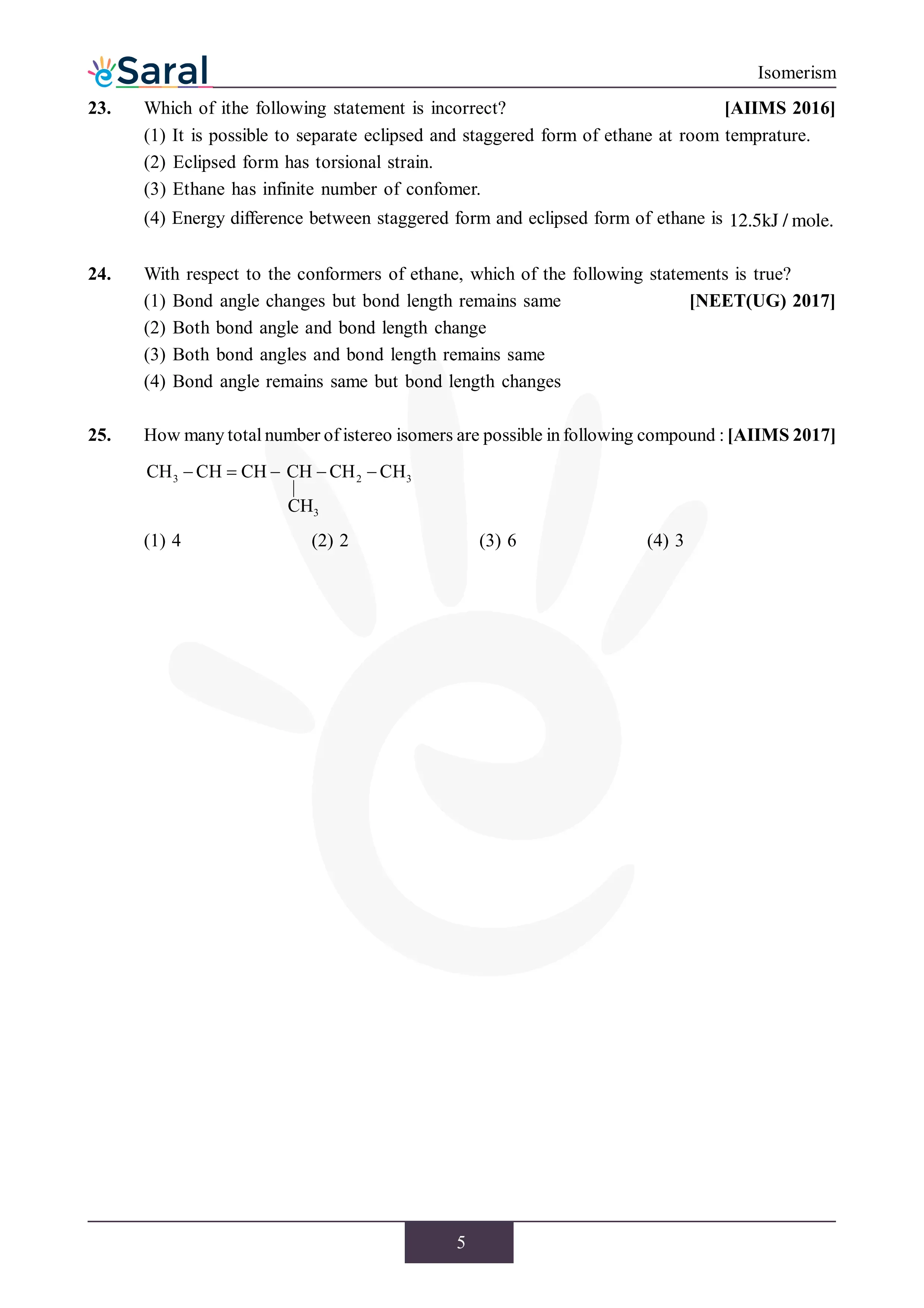
📋 Complete Solutions: Detailed step-by-step solutions for all Isomerism NEET Previous Year Questions are available below this section and through the full PYQ library at eSaral NEET Chapterwise PYQ — with Solutions.
You will find all the solutions at the end of this page:
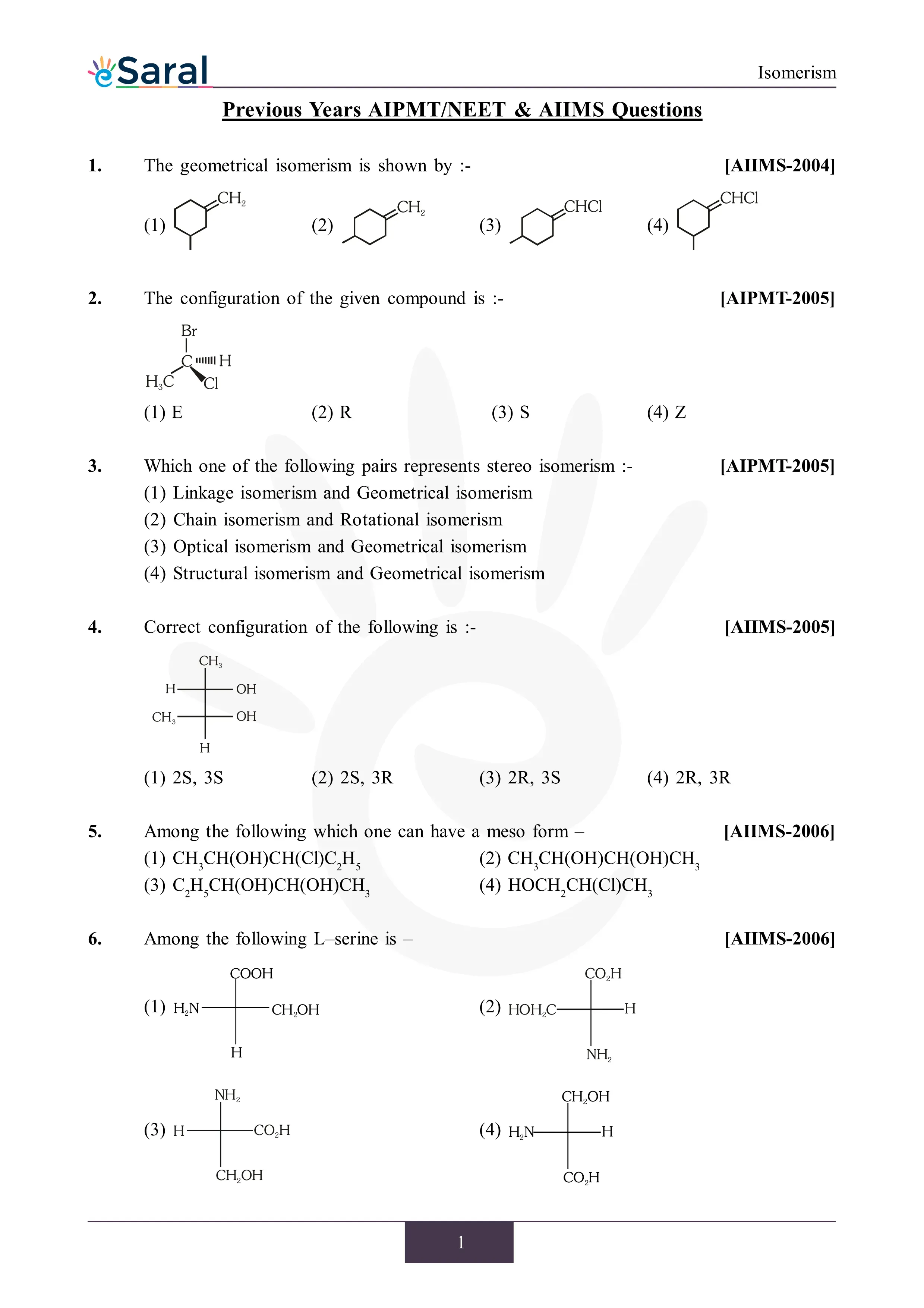
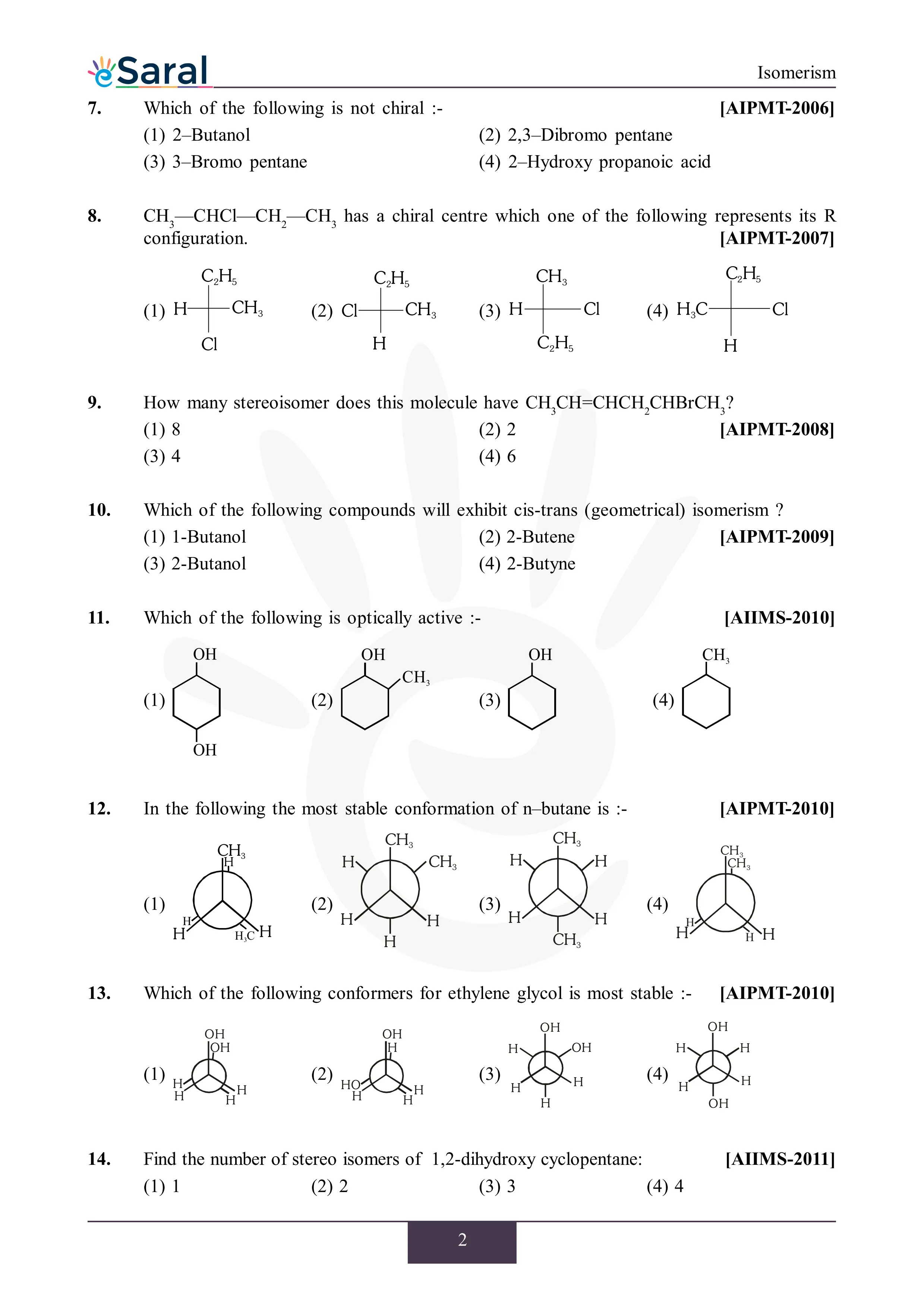
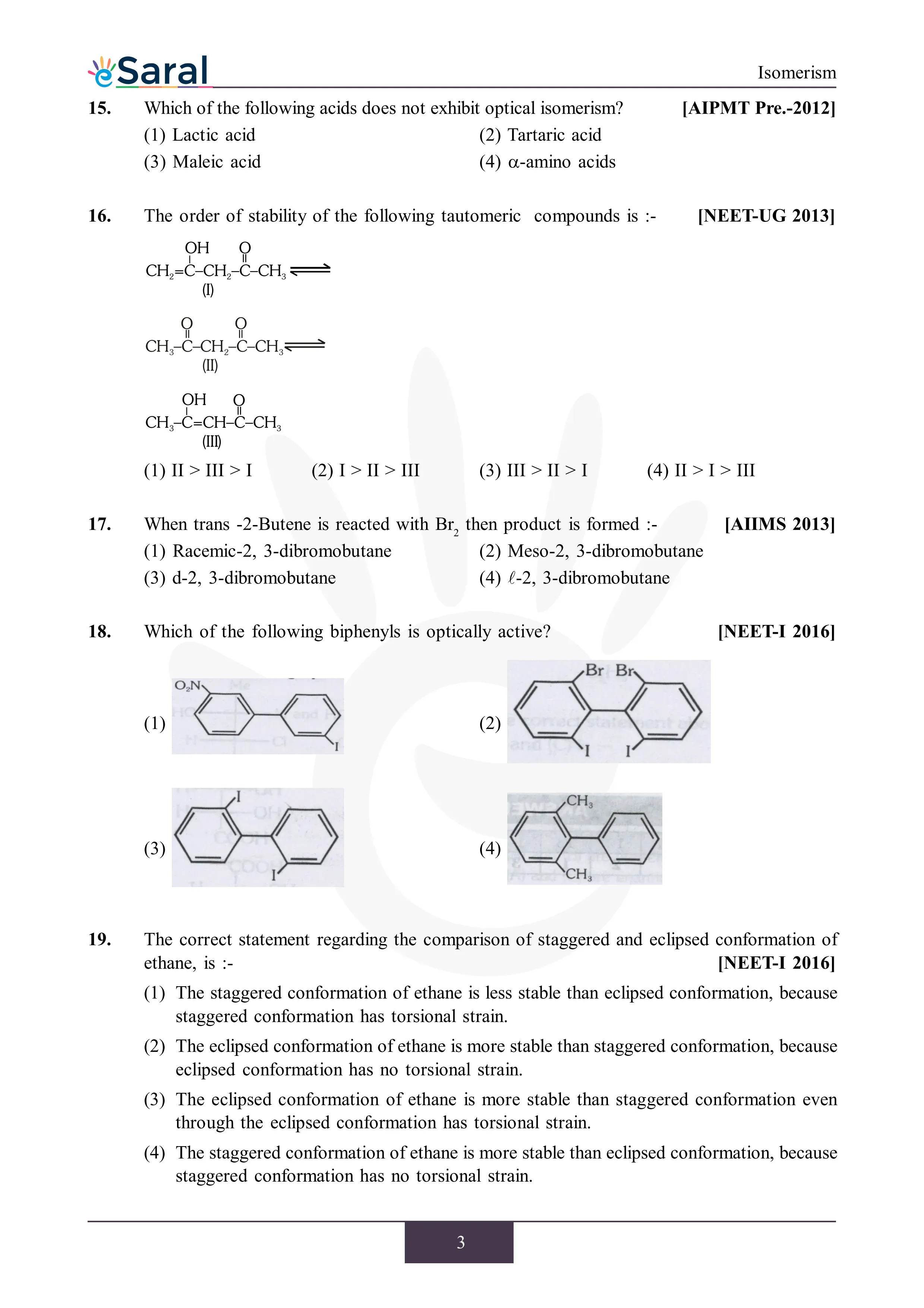
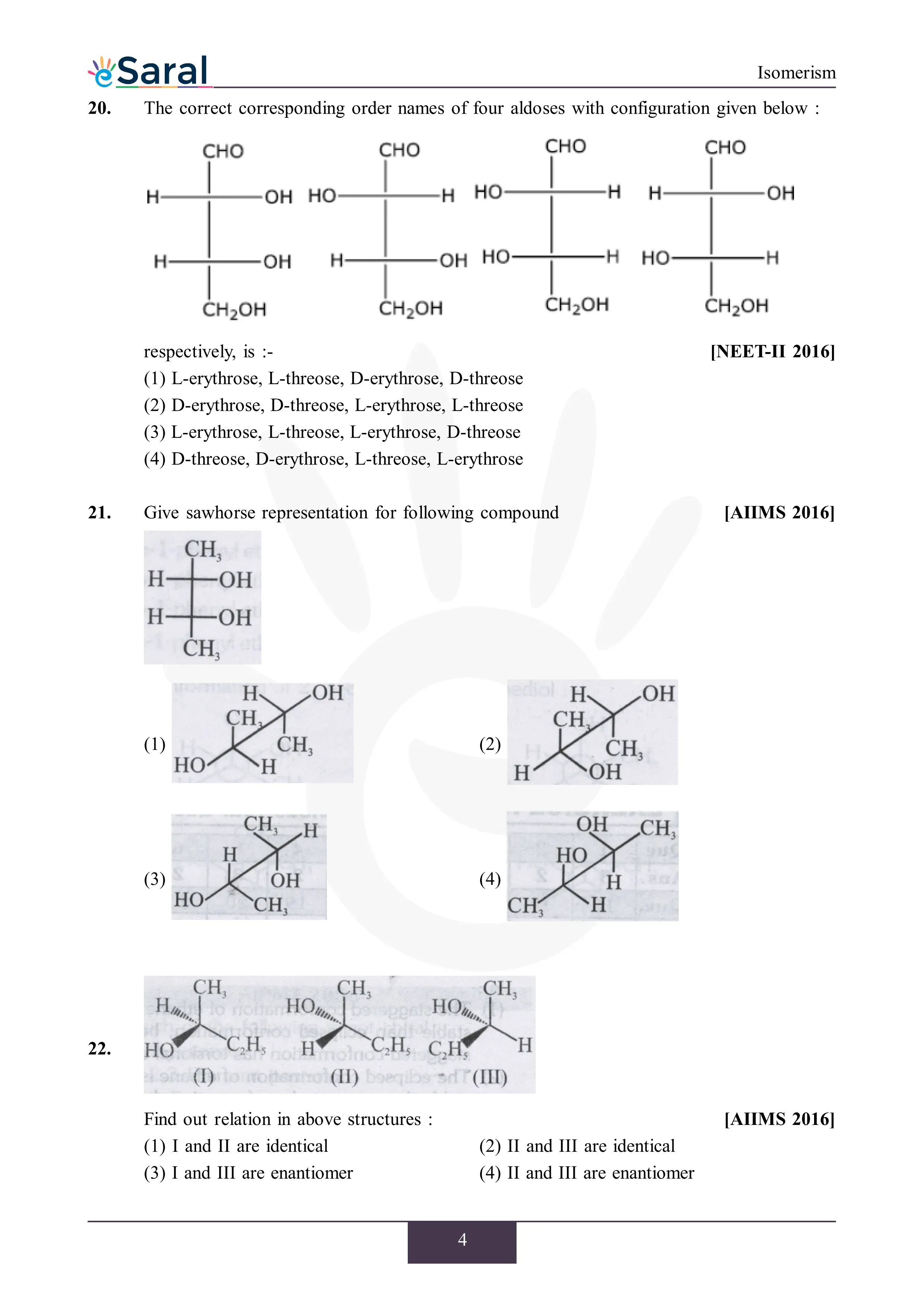

Frequently Asked Questions
How many questions come from Isomerism in NEET every year?
Isomerism typically contributes 2–3 questions in NEET every year, carrying 8–12 marks. Geometric isomerism and Optical isomerism appear most consistently — at least one question from these two types appears in every NEET paper. Functional group isomerism and Tautomerism also appear in most years. Combined, Isomerism is one of the most reliably tested Organic Chemistry topics in NEET.
Is NCERT enough for Isomerism in NEET?
Yes. NCERT Class 11 Chapter 12 (Some Basic Principles and Techniques of Organic Chemistry) covers all the Isomerism concepts tested in NEET — including all types of structural and stereoisomerism, conditions for each, and worked examples. Reading NCERT thoroughly, solving all in-text examples, and practising NEET PYQs from this chapter is sufficient to score full marks on Isomerism questions.
What is the difference between geometric and optical isomerism?
Geometric isomerism arises due to restricted rotation around a C=C double bond or ring — each doubly bonded carbon must have two different substituents (cis/trans or E/Z). Optical isomerism arises due to the presence of a chiral centre — a carbon with four different groups — giving non-superimposable mirror images (enantiomers). Both are types of Stereoisomerism tested in NEET every year.
What is tautomerism and which compounds show it in NEET?
Tautomerism is a special type of functional group isomerism where two interconvertible structural isomers exist in dynamic equilibrium. The most common form in NEET is keto-enol tautomerism, where a compound with an α-hydrogen adjacent to a C=O group interconverts between keto (carbonyl) and enol (hydroxyl on C=C) forms. Acetaldehyde, acetone, and glucose are common examples tested in NEET.
Where can I find complete Isomerism NEET PYQs with solutions?
Complete chapter-wise Isomerism NEET Previous Year Questions with detailed solutions are available on this page and through eSaral's full NEET PYQ library at esaral.com. The library includes year-wise and chapter-wise questions for all Physics, Chemistry, and Biology NEET chapters — with step-by-step solutions for every question, free of charge.