
Kelvin Bridge - Definition and Diagram || Current Electricity Class 12, JEE & NEET

eSaral Academic and Editorial Team
The Kelvin bridge or Thompson bridge is used for measuring the unknown resistances having a value less than 1Ω. It is the modified form of the Wheatstone Bridge. Here we will study about Kelvin Bridge, its Diagram and the equation of Kelvin Bridge.
Why there is a requirement of Kelvin Bridge?
Wheatstone bridge use for measuring the resistance from a few ohms to several kilo-ohms. But error occurs in the result when it is used for measuring the low resistance. This is the reason because of which the Wheatstone Bridge is modified, and the Kelvin bridge obtains. The Kelvin bridge is suitable for measuring the low resistance.
Modification of Wheatstone Bridge
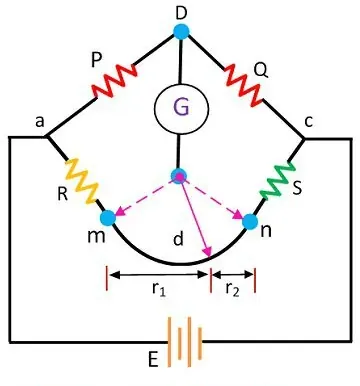
In Wheatstone Bridge, while measuring the low-value resistance, the resistance of their lead and contacts increases the resistance of their total measured value. This can easily be understood with the help of the circuit diagram. The r is the resistance of the contacts that connect the unknown resistance R to the standard resistance S. The ‘m’ and ‘n’ show the range between which the galvanometer is connected for obtaining a point. When the galvanometer is connected to point ‘m’, the lead resistance r is added to the standard resistance S. Thereby the very low indication obtains for unknown resistance R. And if the galvanometer is connected to point n then the r adds to the R, and hence the high value of unknown resistance is obtained. Thus, at point n and m either very high or very low value of unknown resistance is obtained. So, instead of connecting the galvanometer from point, m and n we chose any intermediate point say d where the resistance of lead r is divided into two equal parts, i.e., r1 and r2 $\frac{r_{1}}{r_{2}}=\frac{P}{Q} \ldots \ldots$ equ ( 1) The presence of $\mathrm{r}_{1}$ causes no error in the measurement of unknown resistance. $$ R+r_{1}=\frac{P}{Q} \cdot\left(S+r_{2}\right) $$ From equation $(1),$ we get $$ \begin{aligned} \frac{r_{1}}{r_{1}+r_{2}} &=\frac{P}{P+Q} \\ r_{1}=& \frac{P}{P+Q} \cdot r \end{aligned} $$ $a S$ $$ \begin{aligned} r_{1}+r_{2} &=r \\ r_{2}=& \frac{Q}{P+Q} \cdot r \\ R+\frac{P}{P+Q} \cdot r &=\frac{P}{Q}\left(S+\frac{Q}{P+Q} r\right) \\ R &=\frac{P}{Q} \cdot S \end{aligned} $$ The above equation shows that if the galvanometer connects at point d then the resistance of lead will not affect their results. The above mention process is practically not possible to implement. For obtaining the desired result, the actual resistance of exact ratio connects between the point m and n and the galvanometer connects at the junction of the resistor.
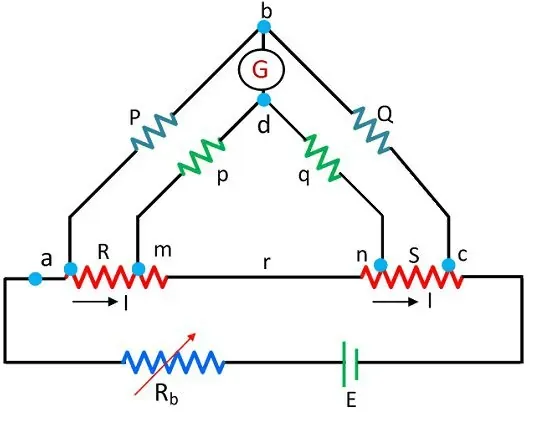
Kelvin Double Circuit Bridge
The ratio of the arms p and q are used to connect the galvanometer at the right place between the point j and k. The j and k reduce the effect of connecting lead. The P and Q is the first ratio of the arm and p and q is the second arm ratio. The galvanometer is connected between the arms p and q at a point d. The point d places at the centre of the resistance r between the point m and n for removing the effect of the connecting lead resistance which is placed between the unknown resistance R and standard resistance S. The ratio of p/q is made equal to the P/Q. Under balance condition zero current flows through the galvanometer. The potential difference between Point $a$ and $b$ is equivalent to the voltage drop between the points $E_{\mathrm{amd}}$. Now, $$ \begin{array}{c} {E_{a b}=\frac{P}{P+Q} E_{a c}} \\ {E_{a c}=I\left[R+S+\frac{(p+q) r}{p+q+r}\right] \ldots \ldots \text { equ }(1)} \\ {E_{a m d}=I\left[R+\frac{p}{(p+q)}\left\{\frac{(p+q) r}{p+q+r}\right\}\right]} \\ {E_{a c}=I\left[\frac{p r}{p+q+r}\right] \ldots \ldots \ldots e q u(2)} \end{array} $$ For zero galvanometer deflection, $$ \begin{array}{c} {E_{a c}=E_{a m d}} \\ {\frac{P}{P+Q} \cdot I\left[R+\frac{p}{(p+q)}\left\{\frac{(p+q) r}{p+q+r}\right\}\right]=I\left[\frac{p r}{p+q+r}\right]} \\ {R=\frac{P}{Q} \cdot S+\frac{p r}{p+q+r}\left[\frac{P}{Q}-\frac{p}{q}\right]} \end{array} $$ As we known, $\mathbf{P} / \mathbf{Q}=\mathbf{p} / \mathbf{q}$ then above equation becomes $$ R=\frac{P}{Q} \cdot S $$ The above equation is the working equations of the Kelvins bridge. The equation shows that the result obtains from the Kelvin double bridge is free from the impact of the connecting lead resistance. For obtaining the appropriate result, it is very essentials that the ratio of their arms is equal. The unequal arm ratio causes the error in the result. Also, the value of resistance r should be kept minimum for obtaining the exact result. The thermo-electric EMF induces in the bridge during the reading. This effect can be reduced by measuring the resistance with the reverse battery connection. The real value of the resistance obtains by takings the means of the two. Also Read: Combination of Resistances Download eSaral APP
Team eSaral
eSaral Academic and Editorial Team
Team eSaral is the collective author profile for educational content created by eSaral’s teachers and academic contributors. The team draws on expertise from IIT graduates, doctors, experienced educators and subject specialists to develop resources for JEE, NEET and school students. Our articles aim to explain concepts clearly and help students study with confidence.
Related Posts

BITSAT 2027: Registration Date, Exam Date, Syllabus, Eligibility, Pattern & Fees
BITSAT 2027 exam dates, registration timeline, eligibility criteria, exam pattern, marking scheme, syllabus and fees in one page.

BITSAT Previous Year Question Paper PDF (2017-2026)
Download BITSAT previous year question papers PDF from 2017 to 2026,session-wise. Memory-based papers,exam pattern, paper analysis and how to practise

CBSE Class 10 Date Sheet 2027: Expected Exam Dates, Release Date, Admit Card & Result Timeline
CBSE Class 10 date sheet 2027 is awaited. See the expected exam dates, release window, how to download the PDF, admit card and result timelines.

NCERT Physics Class 10 Book PDF in Hindi 2026-27 – भौतिक विज्ञान के 4 अध्याय (Free Download)
NCERT Physics Class 10 book PDF in Hindi 2026-27: download all 4 chapters (अध्याय 9–12) free, with topics and important formulas.

NCERT Biology Class 9 Book Anveshan PDF in Hindi - जीव विज्ञान कक्षा 9 पुस्तक अन्वेषण PDF
Download NCERT Biology Class 9 book PDF in Hindi chapterwise for 2026-27: Cell, Tissues, Reproduction and Diversity. Free PDFs.

Essay On Artificial Intelligence in English (100,150, 200, 250, 300, 500 Words)
This is in contrast to the natural intelligence of humans. With Artificial Intelligence, machines can perform

Essay on 78th India Independence Day in English for Student (100, 150, 200, 250, 300, 500 Words)
Read the best essays on India's Independence Day in English. Short & long essays (100, 150, 200, 250, 300, 500 words) perfect for school exams
NCERT Class 11 English Snapshots book - Free PDF download- Esaral
Download NCERT Class 11 English Snapshots book PDF for free. Get all 8 chapters, chapter-wise. Start your prep today!
NCERT Class 10 biology book pdf - Free PDF Download - eSaral
NCERT Class 10 Biology book PDF 2026-27: all 5 chapters (Life Processes to Our Environment) in English & Hindi, with CBSE syllabus, marks & practical

Essay on Global Warming in English (100,150, 200, 250, 300, 500 Words)
Global warming means the Earth is getting hotter. This happens because of things like pollution from cars and factories.