
Mechanical Properties of Solids Class 11 Notes - IIT JEE | NEET

eSaral Academic and Editorial Team
Summary
Mechanical Properties of Solids Class 11 Notes for IIT JEE and NEET cover elasticity and plasticity, stress and strain, Hooke’s law, Young’s modulus, bulk modulus and shear modulus (modulus of rigidity), the stress–strain curve, Poisson’s ratio, elastic potential energy, thermal stress and the applications of elasticity.
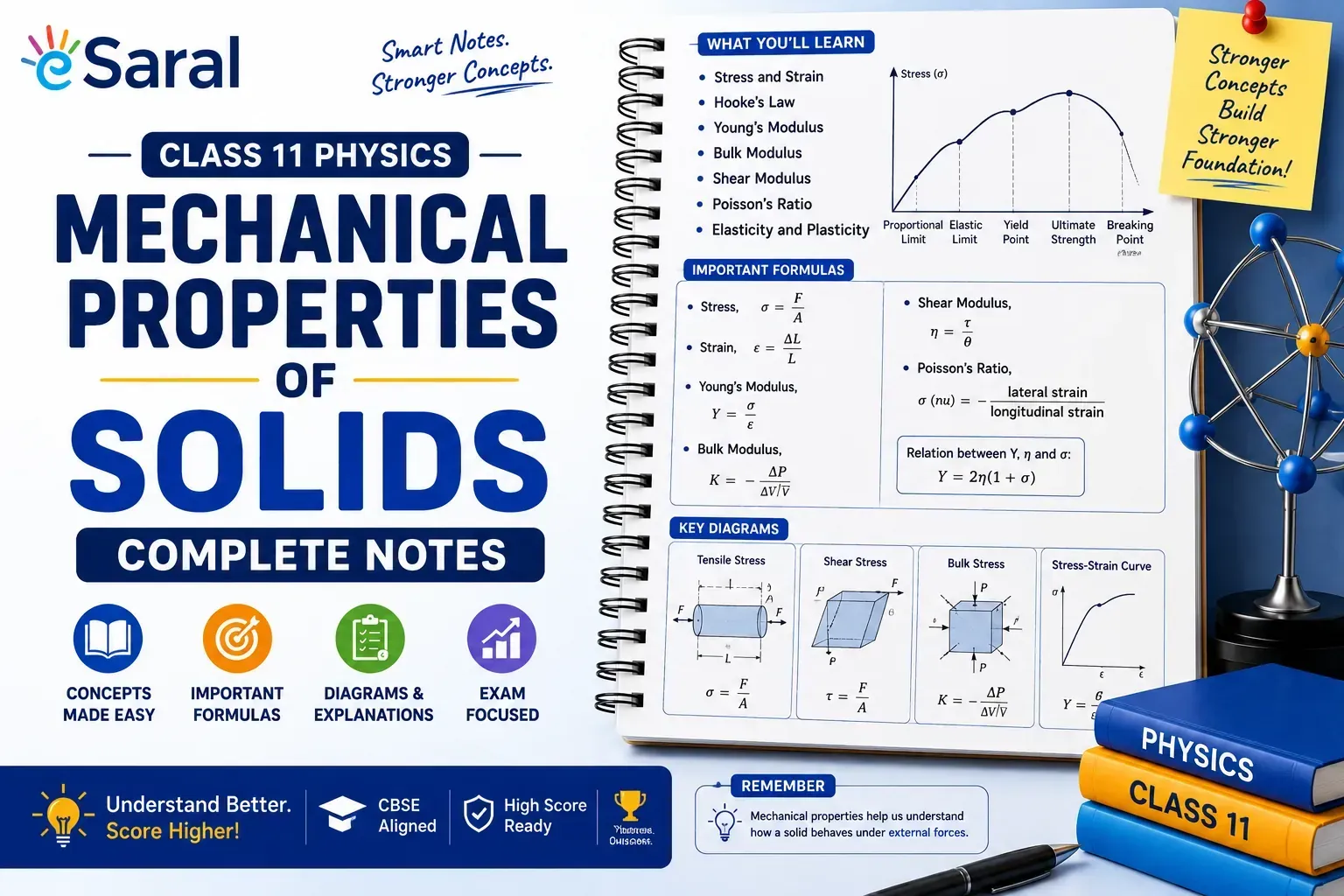
Mechanical Properties of Solids is Chapter 8 of the current NCERT Class 11 Physics book (Chapter 9 in older books), between Gravitation and Mechanical Properties of Fluids. In the JEE Main 2026 syllabus, it is the solids part of the unit Properties of Solids and Liquids. These Mechanical Properties of Solids Class 11 Notes follow the NCERT chapter and add the IIT JEE and NEET problem types.
Mechanical Properties of Solids Class 11 Notes: Chapter Overview and Syllabus
Topic | NCERT and CBSE (Class 11) | IIT JEE and NEET |
|---|---|---|
Elastic behaviour, elasticity and plasticity | Yes | Yes |
Stress and strain, Hooke’s law | Yes | Yes |
Young’s modulus, bulk modulus, shear modulus (modulus of rigidity) | Yes | Yes |
Stress–strain curve | Yes | Yes |
Poisson’s ratio and the relations between the moduli | Yes (Poisson’s ratio) | Common in problems |
Elastic potential energy, energy density | Yes | Common in problems |
Thermal stress, wire hanging under its own weight, springs and wires in series and parallel | Partly | Common in problems |
Check the latest CBSE, NTA (JEE Main), JEE Advanced and NMC (NEET) syllabi for the exact lists. The number of questions changes every year, so use previous years’ papers to see the trend.
Tip from the eSaral Physics team: Treat a wire as a spring with the force constant $k = \dfrac{YA}{L}$. Then every problem on a stretched wire, on wires in series and parallel and on elastic energy is a spring problem that you already know.
Mechanical Properties of Solids Class 11 Notes for IIT JEE and NEET
India's Best Exam Preparation for Class 11th - Download Now
India's Best Exam Preparation for Class 11th - Download Now
India's Best Exam Preparation for Class 11th - Download Now
India's Best Exam Preparation for Class 11th - Download Now
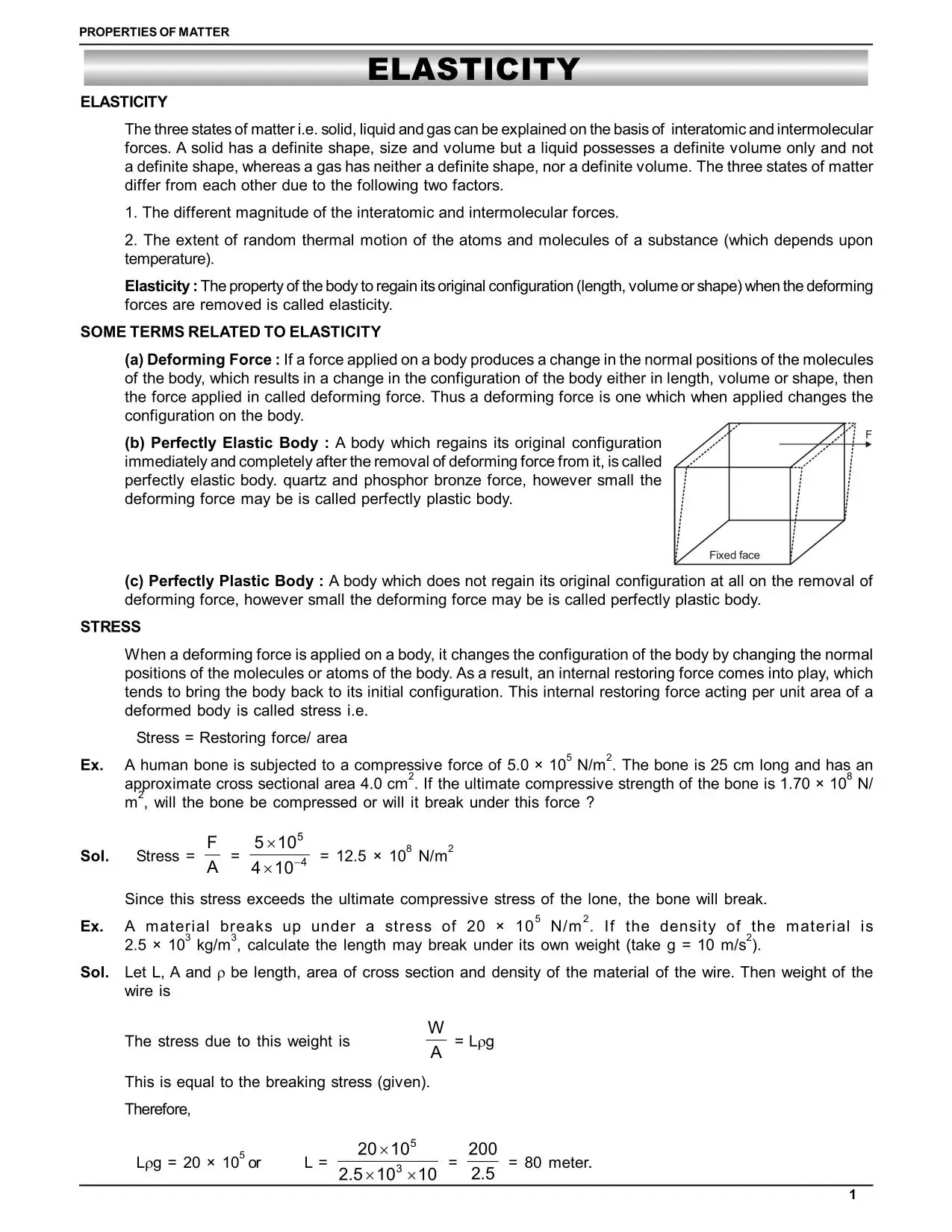
Elasticity, Plasticity and Deformation in Mechanical Properties of Solids Class 11 Notes
- A body is elastic if it regains its original shape and size when the deforming force is removed. A body is plastic if it keeps the deformation. A perfectly rigid body does not deform at all (an ideal case).
- When a body is deformed, a restoring force develops inside it, which is equal and opposite to the deforming force at equilibrium.
- The elastic limit is the largest stress up to which the body regains its original shape. Steel is more elastic than rubber, because for the same deforming force, it deforms less and returns to its original shape.
Stress and Strain in Mechanical Properties of Solids Class 11 Notes
Stress is the restoring force per unit area (the unit is the pascal, $1\ \text{Pa} = 1\ \text{N m}^{-2}$, and the dimensions are $[\text{ML}^{-1}\text{T}^{-2}]$). Strain is the fractional change in the shape or the size (it has no unit and no dimensions).
Type | Stress | Strain |
|---|---|---|
Longitudinal (tensile or compressive) | $\sigma = \dfrac{F}{A}$ (force normal to the area) | $\varepsilon = \dfrac{\Delta L}{L}$ |
Shear | $\dfrac{F_t}{A}$ (force tangential to the area) | $\theta \approx \tan\theta = \dfrac{\Delta x}{L}$ |
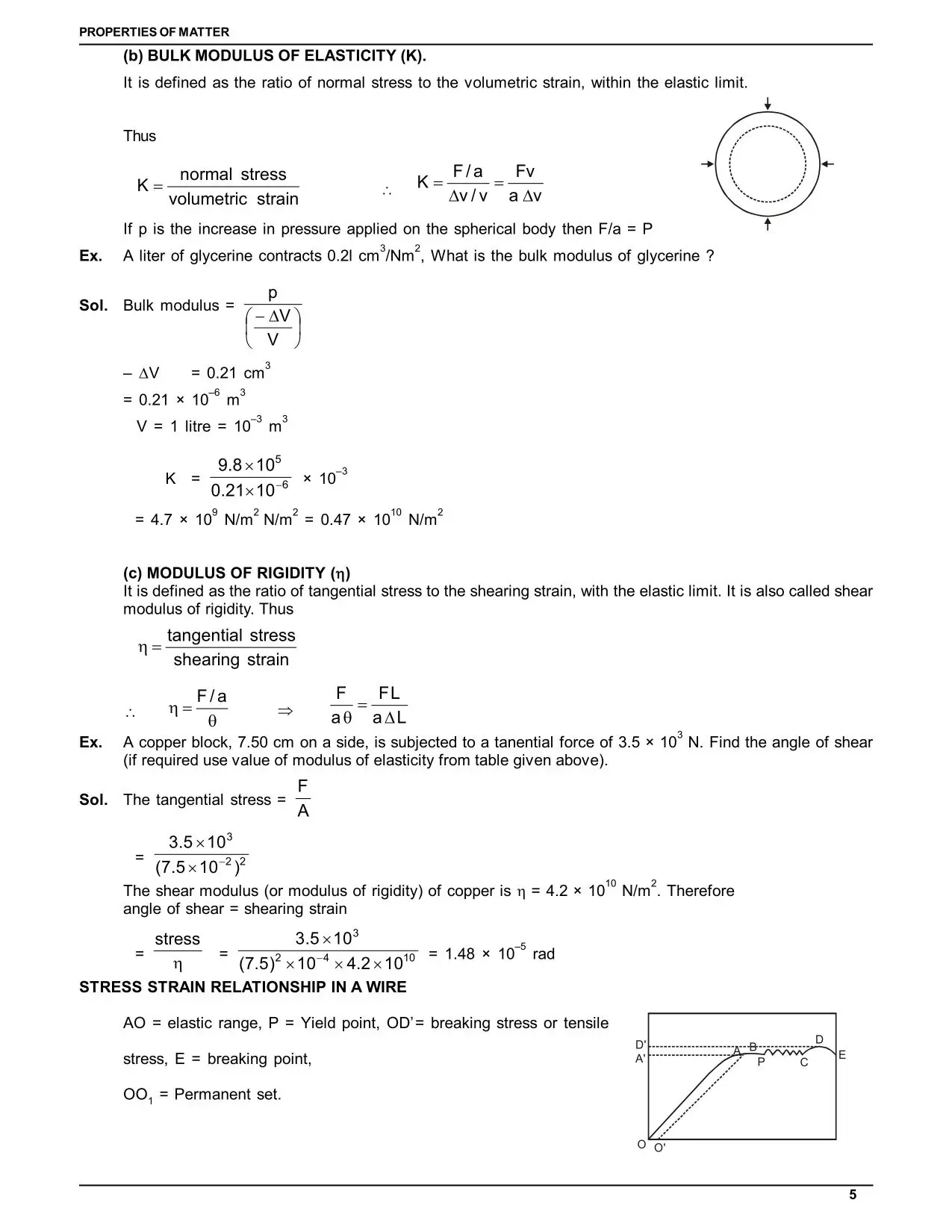
Volumetric (hydraulic) | $-\Delta P$ (a change in the pressure) | $\dfrac{\Delta V}{V}$ |
Hooke’s Law and the Elastic Moduli in Mechanical Properties of Solids Class 11 Notes
Hooke’s law: within the elastic limit (more exactly, within the proportional limit), the stress is proportional to the strain. The constant of proportionality is the modulus of elasticity.
Modulus | Definition | Formula |
|---|---|---|
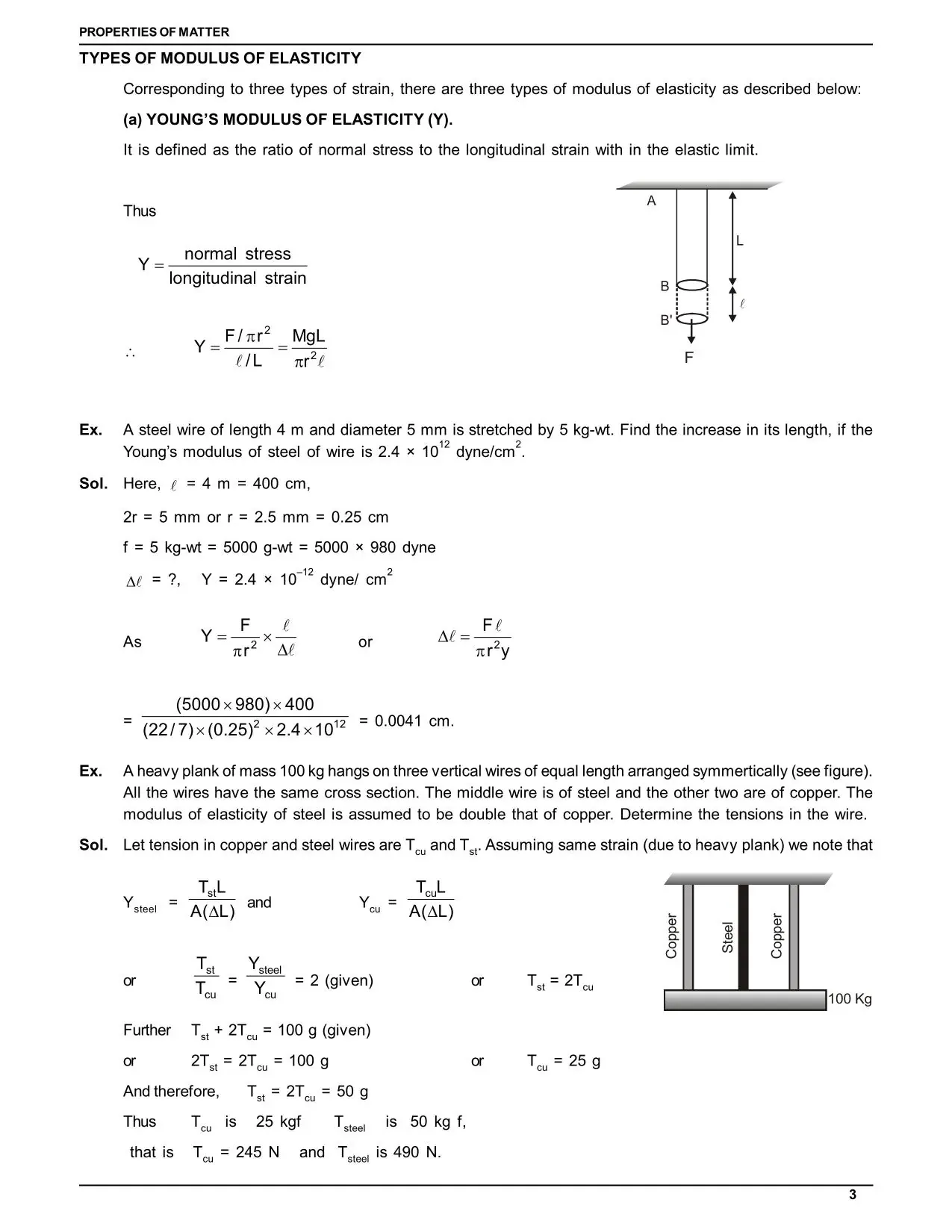
Young’s modulus $Y$ | Longitudinal stress over longitudinal strain | $Y = \dfrac{F/A}{\Delta L/L} = \dfrac{FL}{A\,\Delta L}$ |
Bulk modulus $B$ | Hydraulic stress over volumetric strain | $B = -\dfrac{\Delta P}{\Delta V/V} = -\dfrac{V\,\Delta P}{\Delta V}$ |
Shear modulus $G$ (or $\eta$) | Shearing stress over shear strain | $G = \dfrac{F_t/A}{\theta}$ |
All three have the unit Pa. The reciprocal of the bulk modulus is the compressibility, $k = \dfrac{1}{B}$. Solids have all three moduli. Liquids and gases have only the bulk modulus, because they cannot resist a shear, so $G = 0$ for them. For a gas, $B = P$ for an isothermal change, and $B = \gamma P$ for an adiabatic change.
Typical values of $Y$: steel about $2.0\times10^{11}$ Pa, iron about $1.9\times10^{11}$ Pa, copper about $1.1\times10^{11}$ Pa and aluminium about $0.7\times10^{11}$ Pa. Rubber has a much smaller value. A large $Y$ means that the material is stiffer.
Stretching of a wire: for a wire of length $L$, radius $r$ and Young’s modulus $Y$ under a load $F$:
$$\Delta L = \frac{FL}{AY} = \frac{FL}{\pi r^{2}Y}, \qquad \text{force constant } k = \frac{F}{\Delta L} = \frac{YA}{L}$$
For wires of the same material and the same load, $\Delta L \propto \dfrac{L}{r^{2}}$. For wires (or springs) in series, $\dfrac{1}{k_{eq}} = \sum\dfrac{1}{k_i}$, and in parallel, $k_{eq} = \sum k_i$.
A wire that hangs under its own weight (length $L$, density $\rho$, mass $M$):
$$\Delta L = \frac{MgL}{2AY} = \frac{\rho g L^{2}}{2Y}$$
Stress–Strain Curve in Mechanical Properties of Solids Class 11 Notes
For a metal wire that is stretched until it breaks, the stress–strain curve has these regions:
Region | Meaning |
|---|---|
Up to the proportional limit | Stress is proportional to strain (Hooke’s law), and the slope is $Y$ |
Up to the elastic limit | The wire still regains its shape, but stress is no longer proportional to strain |
Beyond the yield point | Plastic deformation begins, and the strain increases for a small change in the stress |
Ultimate tensile strength | The maximum stress that the material can bear |
Fracture (breaking) point | The wire breaks |
- A ductile material (copper, steel) has a long plastic region and can be drawn into wires. A brittle material (glass, cast iron) breaks soon after the elastic limit.
- An elastomer (rubber) can be stretched to a very large strain, and it does not obey Hooke’s law. Its loading and unloading curves are different, which is called elastic hysteresis, and the area of the loop is the energy that is lost as heat.
- The breaking stress is the stress at which a wire breaks. A safety factor is used in design, so that the working stress is much lower than the breaking stress.
Poisson’s Ratio and the Relations Between the Moduli in Mechanical Properties of Solids Class 11 Notes
When a wire is stretched, it becomes thinner. Poisson’s ratio is the ratio of the lateral strain to the longitudinal strain:
$$\sigma = \frac{\text{lateral strain}}{\text{longitudinal strain}}, \qquad -1 < \sigma < 0.5$$
For most metals, $\sigma$ is between about $0.2$ and $0.4$. For an isotropic material:
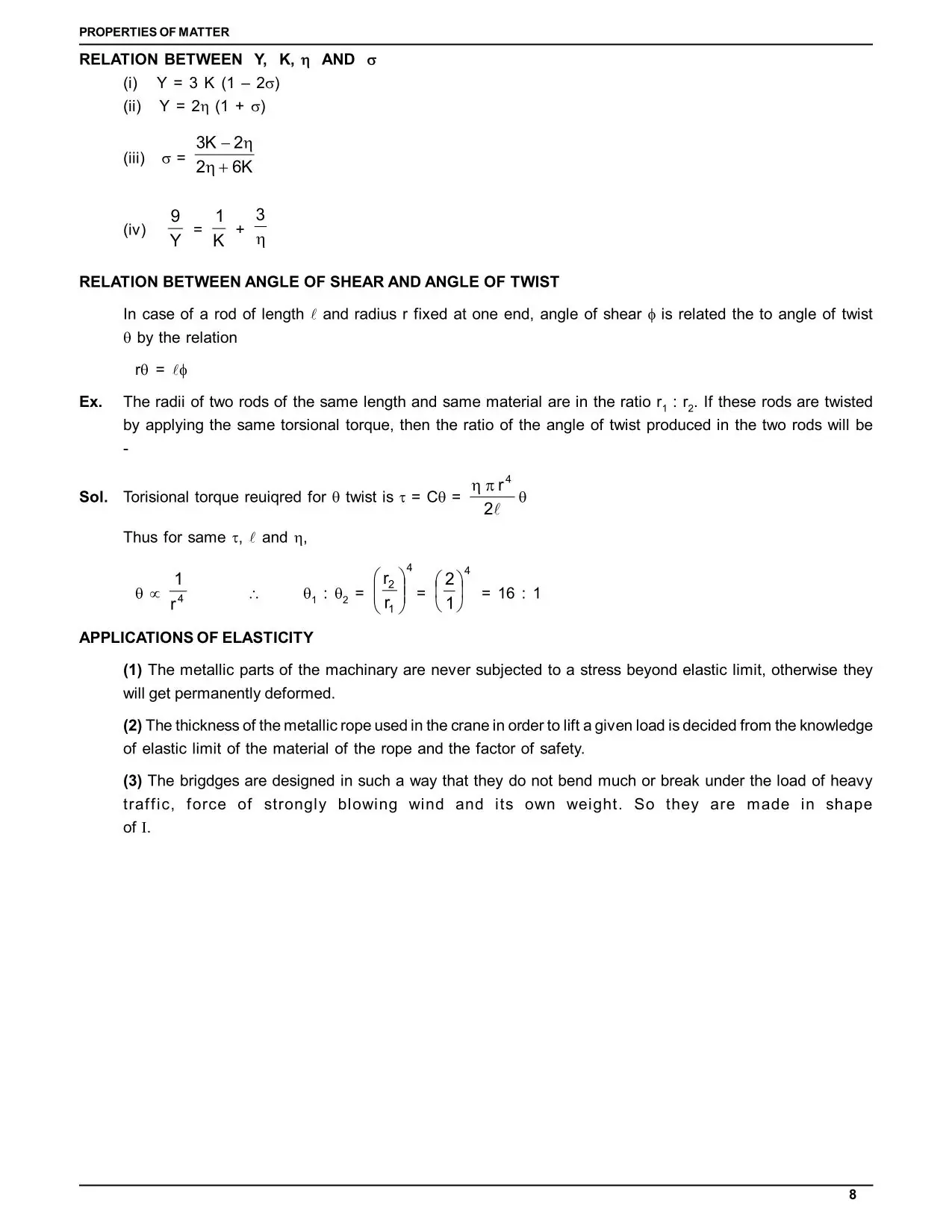
$$Y = 3B(1 - 2\sigma) = 2G(1 + \sigma), \qquad \sigma = \frac{3B - 2G}{2(3B + G)}$$
Elastic Potential Energy in Mechanical Properties of Solids Class 11 Notes
The work that is done to stretch a wire is stored in it as elastic potential energy:
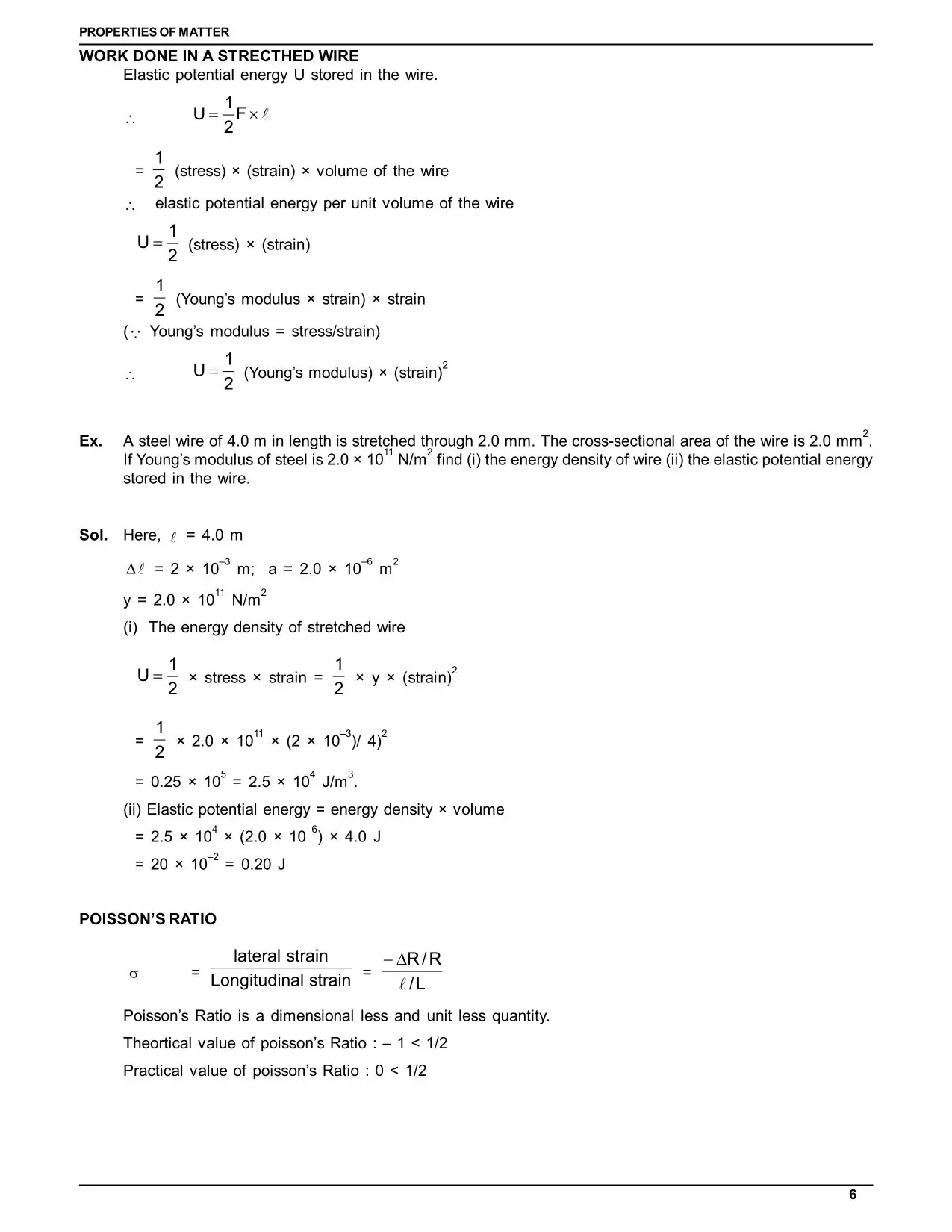
$$U = \tfrac{1}{2}F\,\Delta L = \tfrac{1}{2}\frac{YA}{L}(\Delta L)^{2}, \qquad u = \frac{U}{AL} = \tfrac{1}{2}\times\text{stress}\times\text{strain} = \tfrac{1}{2}Y\varepsilon^{2} = \frac{\sigma^{2}}{2Y}$$
Here $u$ is the energy density (energy per unit volume). The energy is the area under the force–extension graph.
Thermal Stress and Applications of Elasticity in Mechanical Properties of Solids Class 11 Notes
Thermal stress: if a rod of length $L$, cross-section $A$ and coefficient of linear expansion $\alpha$ is held between rigid walls and heated by $\Delta T$, it cannot expand, so a stress develops in it:
$$\text{stress} = Y\alpha\,\Delta T, \qquad F = YA\alpha\,\Delta T$$
Applications:
- Cranes and ropes: a rope is made of many thin strands, because a thin wire is easier to bend, and the breaking load depends on the total area. The safety factor is chosen from the breaking stress.
- Bridges and buildings: the beams and the columns are designed so that the stress is below the elastic limit. For a beam of length $l$, breadth $b$ and depth $d$ that is loaded at the middle with $W$, the depression is $\delta = \dfrac{Wl^{3}}{4bd^{3}Y}$, so a deeper beam bends much less, which is why girders have an I-shape.
- Springs in a vehicle and rubber in tyres use the elastic properties.
IIT JEE and NEET Problem Tips in Mechanical Properties of Solids Class 11 Notes
- Use $k = YA/L$. A wire is a spring, and a wire cut into two halves has a stiffness that is double for each half.
- For the same material and load, compare using $\Delta L \propto \dfrac{L}{r^{2}}$, and remember that a doubled radius gives four times the area.
- Energy problems: $U = \tfrac{1}{2}F\,\Delta L$ and $u = \tfrac{1}{2}\sigma\varepsilon$. When a wire is stretched by a hanging mass, only the stored energy is $\tfrac{1}{2}F\Delta L$, and the rest of the work of gravity is lost as kinetic energy and heat.
- Hydraulic and bulk problems: use $\dfrac{\Delta V}{V} = -\dfrac{\Delta P}{B}$, and remember the negative sign for a compression.
- Check the units: $Y$, $B$ and $G$ are in Pa, and the radius or the area must be in SI units.
Key Formulas in Mechanical Properties of Solids Class 11 Notes
Concept | Formula |
|---|---|
Stress and strain | $\sigma = F/A$, $\varepsilon = \Delta L/L$ |
Young’s modulus | $Y = \dfrac{FL}{A\,\Delta L}$ |
Bulk modulus | $B = -V\dfrac{\Delta P}{\Delta V}$ |
Shear modulus | $G = \dfrac{F_t/A}{\theta}$ |
Force constant of a wire | $k = YA/L$ |
Wire under its own weight | $\Delta L = \rho gL^2/2Y$ |
Poisson’s ratio relations | $Y = 3B(1 - 2\sigma) = 2G(1 + \sigma)$ |
Elastic energy | $U = \tfrac{1}{2}F\Delta L$, $u = \tfrac{1}{2}Y\varepsilon^2$ |
Thermal stress | $Y\alpha\,\Delta T$ |
Solved Examples from Mechanical Properties of Solids Class 11 Notes
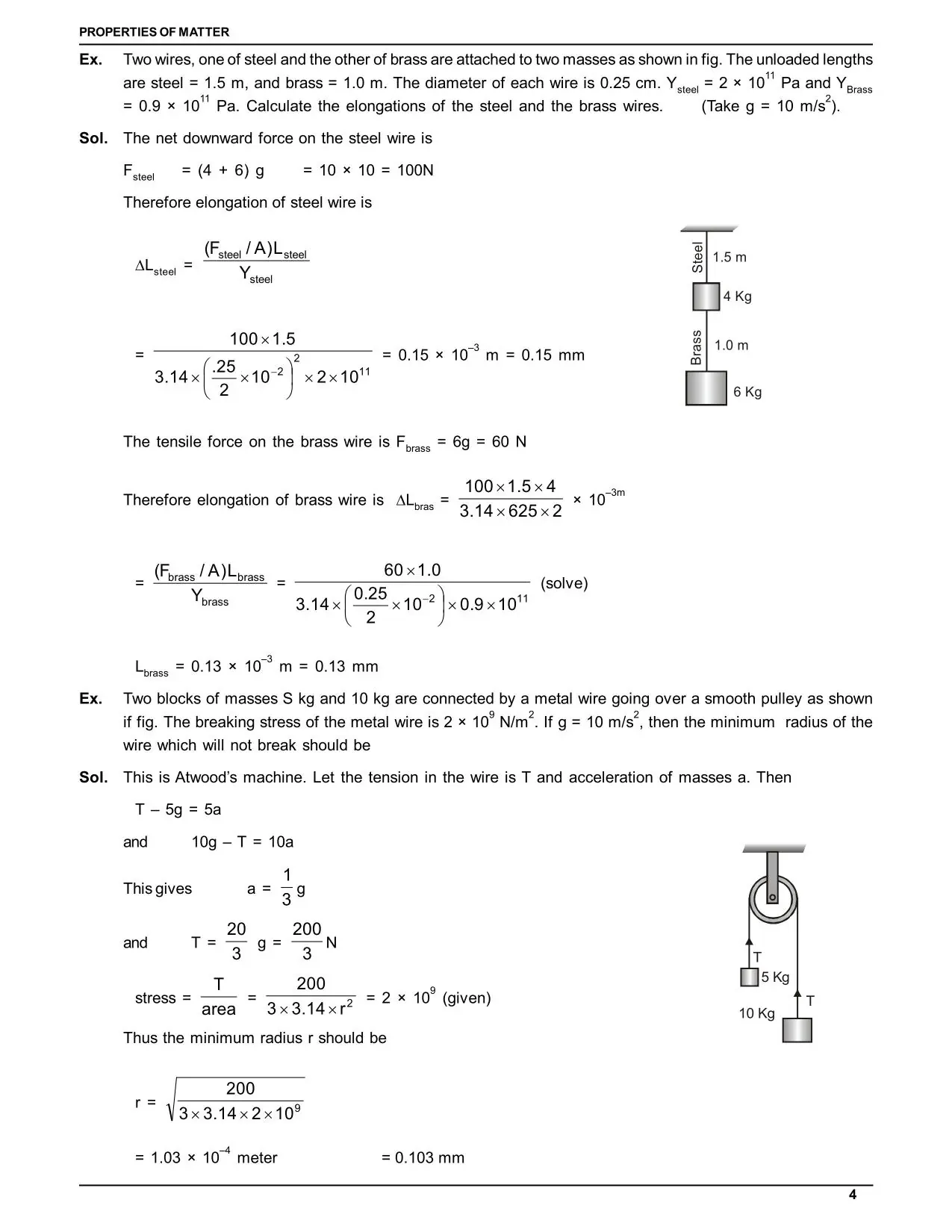
Example 1 (stretching of a wire): A steel wire of length 2 m and cross-section 1 mm$^2$ carries a load of 100 N ($Y = 2\times10^{11}$ Pa). Find the extension.
$\Delta L = \dfrac{FL}{AY} = \dfrac{100\times 2}{10^{-6}\times 2\times10^{11}} = 10^{-3}$ m $= 1$ mm.
Example 2 (a wire of a given radius): A wire of radius 0.5 mm and length 1 m carries a mass of 10 kg ($g = 10$ m/s$^2$, $Y = 2\times10^{11}$ Pa). Find the extension.
$A = \pi(0.5\times10^{-3})^{2} \approx 7.85\times10^{-7}$ m$^{2}$, and $F = 100$ N. $\Delta L = \dfrac{100\times 1}{7.85\times10^{-7}\times 2\times10^{11}} \approx 6.4\times10^{-4}$ m, which is about 0.64 mm.
Example 3 (breaking load): A wire of cross-section 2 mm$^2$ has a breaking stress of $5\times10^{8}$ Pa. Find the largest load that it can carry.
$F = \text{stress}\times A = 5\times10^{8}\times 2\times10^{-6} = 1000$ N.
Example 4 (bulk modulus): The bulk modulus of water is $2.2\times10^{9}$ Pa. Find the fractional change in the volume when the pressure increases by $2\times10^{7}$ Pa.
$\dfrac{\Delta V}{V} = \dfrac{\Delta P}{B} = \dfrac{2\times10^{7}}{2.2\times10^{9}} \approx 9.1\times10^{-3}$, so the volume decreases by about 0.91%.
Example 5 (shear modulus): A tangential force of 1000 N acts on the top face of a cube of side 10 cm ($G = 2.5\times10^{10}$ Pa). Find the displacement of the top face.
$\theta = \dfrac{F_t}{AG} = \dfrac{1000}{0.01\times 2.5\times10^{10}} = 4\times10^{-6}$ rad, so the displacement is $\theta L = 4\times10^{-6}\times 0.1 = 4\times10^{-7}$ m.
Example 6 (elastic energy): Find the energy stored in the wire of Example 1.
$U = \tfrac{1}{2}F\,\Delta L = \tfrac{1}{2}\times 100\times 10^{-3} = 0.05$ J.
Example 7 (energy density): A material with $Y = 2\times10^{11}$ Pa is under a stress of $10^{8}$ Pa. Find the energy per unit volume.
$u = \dfrac{\sigma^{2}}{2Y} = \dfrac{10^{16}}{4\times10^{11}} = 2.5\times10^{4}$ J/m$^{3}$.
Example 8 (a wire that hangs under its own weight): A steel wire of length 10 m hangs from a roof ($\rho = 7800$ kg/m$^3$, $Y = 2\times10^{11}$ Pa). Find the elongation.
$\Delta L = \dfrac{\rho gL^{2}}{2Y} = \dfrac{7800\times10\times100}{4\times10^{11}} \approx 1.95\times10^{-5}$ m, which is about 0.02 mm.
Example 9 (thermal stress): A steel rod is held between rigid walls and heated by 50 K ($\alpha = 1.2\times10^{-5}\ \text{K}^{-1}$, $Y = 2\times10^{11}$ Pa). Find the stress.
$\text{stress} = Y\alpha\,\Delta T = 2\times10^{11}\times1.2\times10^{-5}\times 50 = 1.2\times10^{8}$ Pa.
Example 10 (Poisson’s ratio): For a material, $Y = 2\times10^{11}$ Pa and $G = 0.8\times10^{11}$ Pa. Find Poisson’s ratio.
$Y = 2G(1 + \sigma)$, so $1 + \sigma = \dfrac{2\times10^{11}}{1.6\times10^{11}} = 1.25$, and $\sigma = 0.25$.
Example 11 (a comparison of two wires): Two wires of the same material and length have radii in the ratio $1 : 2$. They carry the same load. Find the ratio of their extensions.
$\Delta L \propto \dfrac{1}{r^{2}}$, so the ratio is $\dfrac{4}{1}$, which is $4 : 1$.
Example 12 (the wire as a spring): Find the force constant of the wire of Example 1, and use it to find the extension for a load of 100 N.
$k = \dfrac{YA}{L} = \dfrac{2\times10^{11}\times10^{-6}}{2} = 10^{5}$ N/m, so $\Delta L = \dfrac{F}{k} = \dfrac{100}{10^{5}} = 10^{-3}$ m, which matches Example 1.
Common Mistakes in Mechanical Properties of Solids Class 11 Problems
Mistake | Correct approach |
|---|---|
Saying that Young’s modulus depends on the size or the shape of the wire | It is a property of the material. The force constant $k = YA/L$ depends on the size. |
Using the diameter in place of the radius in $A = \pi r^{2}$ | Use the radius, and convert it to metres |
Saying that rubber is more elastic than steel | Steel has a larger $Y$ and returns to its shape better, so it is more elastic |
Writing the stress as the force, and not the force per unit area | Stress is $F/A$ |
Saying that liquids have a shear modulus | Liquids and gases have only the bulk modulus |
Using $U = F\,\Delta L$ for the stored energy | $U = \tfrac{1}{2}F\,\Delta L$ |
Forgetting the factor $\tfrac{1}{2}$ for a wire under its own weight | $\Delta L = \dfrac{\rho gL^{2}}{2Y}$ |
Saying that stress is always proportional to strain up to the breaking point | It is proportional only up to the proportional limit |
How to Study Mechanical Properties of Solids Class 11 Notes
- Read the NCERT chapter first, and download the textbook from eSaral’s NCERT books for Class 11 page.
- Learn the definitions of stress, strain and the three moduli, then the stress–strain curve, and then Poisson’s ratio and the energy formulas.
- Practise one problem each on a stretched wire, the breaking load, the bulk modulus, the shear modulus, the elastic energy, thermal stress and a wire under its own weight.
- Revise with eSaral’s Class 11 Physics notes, and use the free Physics revision series on YouTube for quick formula revision.
- Test yourself with eSaral’s JEE Main chapter-wise PYQs and NEET chapter-wise PYQs.
Frequently Asked Questions
What is Hooke's Law in simple words?
Hooke’s law says that, within the elastic limit (the proportional limit), the stress in a body is directly proportional to the strain. For a spring or a wire, the force is proportional to the extension, $F = k\,\Delta L$. The constant is the modulus of elasticity. eSaral’s Mechanical Properties of Solids Class 11 Notes show how it gives Young’s modulus.
What is Young’s modulus, and what are its units?
Young’s modulus $Y$ is the ratio of the longitudinal stress to the longitudinal strain, $Y = \dfrac{FL}{A\,\Delta L}$. Its SI unit is the pascal (Pa or N/m$^2$). For steel, $Y \approx 2\times10^{11}$ Pa. A larger $Y$ means a stiffer material. It is a property of the material, and it does not depend on the size of the wire.
What is the difference between stress and strain?
Stress is the restoring force per unit area, with the unit pascal. Strain is the fractional change in the dimension, and it has no unit. Stress is related to the deforming force, and strain is the resulting deformation. Within the elastic limit, they are related by a modulus of elasticity. In Mechanical Properties of Solids Class 11 Notes, there are three types of each (longitudinal, shear and volumetric).
What is the difference between Young’s modulus, shear modulus and bulk modulus?
Young’s modulus applies to a longitudinal stress and strain (stretching or compression along one direction). The shear modulus applies when a tangential force changes the shape without changing the volume. The bulk modulus applies when a uniform pressure changes the volume. All three are in Pa. Solids have all three, and liquids and gases have only the bulk modulus.
What does the stress–strain curve show?
It shows the proportional limit (Hooke’s law and the slope $Y$), the elastic limit, the yield point (where plastic deformation begins), the ultimate tensile strength and the breaking point. A ductile material has a long plastic region, and a brittle material breaks soon after the elastic limit. These Mechanical Properties of Solids Class 11 Notes explain each region.
What is Poisson’s ratio?
It is the ratio of the lateral strain to the longitudinal strain of a stretched wire. It lies between $-1$ and $0.5$, and for most metals, it is about $0.2$ to $0.4$. It links the moduli: $Y = 3B(1 - 2\sigma) = 2G(1 + \sigma)$.
How do you calculate the elastic potential energy stored in a stretched wire?
$U = \tfrac{1}{2}F\,\Delta L = \tfrac{1}{2}\dfrac{YA}{L}(\Delta L)^{2}$, and the energy per unit volume is $u = \tfrac{1}{2}\times\text{stress}\times\text{strain} = \dfrac{\sigma^{2}}{2Y}$. In Mechanical Properties of Solids Class 11 Notes, this is the area under the force–extension graph.
Is Mechanical Properties of Solids important for IIT JEE and NEET?
It is part of the Properties of Solids and Liquids unit of the JEE Main syllabus and of the NEET syllabus, and the questions are mostly short numericals on Young’s modulus, elastic energy and the stress–strain curve. The number of questions changes every year, so check previous years’ papers.
Which chapter number is Mechanical Properties of Solids in Class 11 Physics?
In the current NCERT Class 11 Physics book, Mechanical Properties of Solids is Chapter 8 (Chapter 9 in older books), and it follows Gravitation. These Mechanical Properties of Solids Class 11 Notes follow the NCERT chapter and add the IIT JEE and NEET topics.
Where can I find more Class 11 Physics notes on eSaral?
eSaral has chapter-wise Class 11 Physics notes, NCERT books, a free Physics revision series on YouTube, JEE Main and NEET chapter-wise PYQs and these Mechanical Properties of Solids Class 11 Notes, all linked on this page.
Team eSaral
eSaral Academic and Editorial Team
Team eSaral is the collective author profile for educational content created by eSaral’s teachers and academic contributors. The team draws on expertise from IIT graduates, doctors, experienced educators and subject specialists to develop resources for JEE, NEET and school students. Our articles aim to explain concepts clearly and help students study with confidence.
Related Posts

BITSAT 2027: Registration Date, Exam Date, Syllabus, Eligibility, Pattern & Fees
BITSAT 2027 exam dates, registration timeline, eligibility criteria, exam pattern, marking scheme, syllabus and fees in one page.

BITSAT Previous Year Question Paper PDF (2017-2026)
Download BITSAT previous year question papers PDF from 2017 to 2026,session-wise. Memory-based papers,exam pattern, paper analysis and how to practise

CBSE Class 10 Date Sheet 2027: Expected Exam Dates, Release Date, Admit Card & Result Timeline
CBSE Class 10 date sheet 2027 is awaited. See the expected exam dates, release window, how to download the PDF, admit card and result timelines.

NCERT Physics Class 10 Book PDF in Hindi 2026-27 – भौतिक विज्ञान के 4 अध्याय (Free Download)
NCERT Physics Class 10 book PDF in Hindi 2026-27: download all 4 chapters (अध्याय 9–12) free, with topics and important formulas.

NCERT Biology Class 9 Book Anveshan PDF in Hindi - जीव विज्ञान कक्षा 9 पुस्तक अन्वेषण PDF
Download NCERT Biology Class 9 book PDF in Hindi chapterwise for 2026-27: Cell, Tissues, Reproduction and Diversity. Free PDFs.

Essay On Artificial Intelligence in English (100,150, 200, 250, 300, 500 Words)
This is in contrast to the natural intelligence of humans. With Artificial Intelligence, machines can perform

Essay on 78th India Independence Day in English for Student (100, 150, 200, 250, 300, 500 Words)
Read the best essays on India's Independence Day in English. Short & long essays (100, 150, 200, 250, 300, 500 words) perfect for school exams
NCERT Class 11 English Snapshots book - Free PDF download- Esaral
Download NCERT Class 11 English Snapshots book PDF for free. Get all 8 chapters, chapter-wise. Start your prep today!
NCERT Class 10 biology book pdf - Free PDF Download - eSaral
NCERT Class 10 Biology book PDF 2026-27: all 5 chapters (Life Processes to Our Environment) in English & Hindi, with CBSE syllabus, marks & practical

Essay on Global Warming in English (100,150, 200, 250, 300, 500 Words)
Global warming means the Earth is getting hotter. This happens because of things like pollution from cars and factories.