
Mensuration Formulas Class 8 Maths: Area, Perimeter, Surface Area and Volume with Solved Examples

eSaral Academic and Editorial Team
Summary
Mensuration Formulas Class 8 Maths give the area and perimeter of 2D shapes (rectangle, square, parallelogram, rhombus, triangle, trapezium, quadrilateral and circle) and the surface area and volume of the cube, cuboid and cylinder.
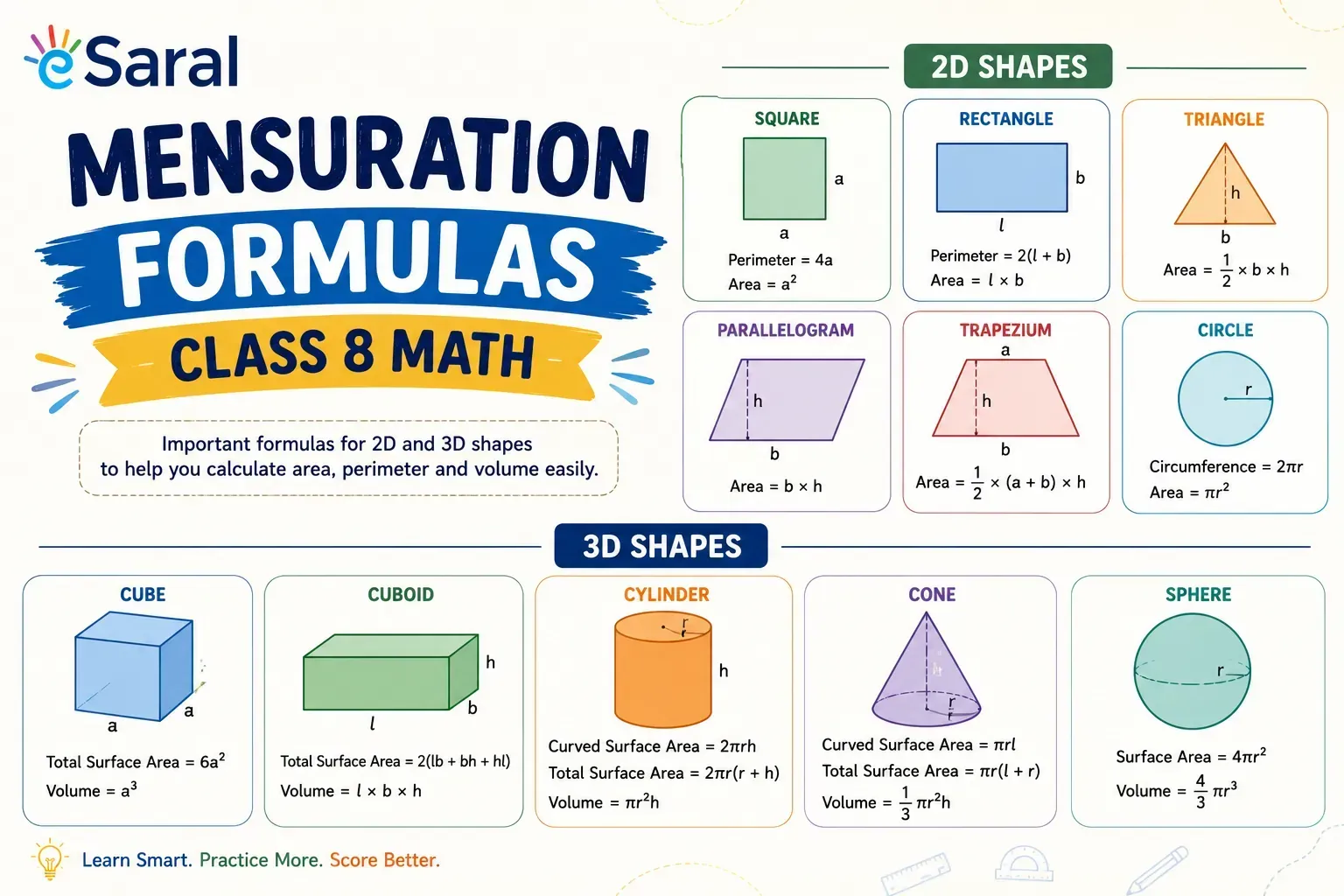
These Mensuration Formulas Class 8 Maths start from the idea of mensuration, the part of maths that measures shapes: the perimeter (the length of the boundary), the area (the surface that a flat shape covers) and the volume (the space that a solid takes). In the current NCERT Class 8 Maths book, Ganita Prakash, the area formulas are in Part 2, Chapter 7 (Area), and the solids are introduced in Part 2, Chapter 4 (Exploring Some Geometric Themes). The surface area and the volume of the cube, the cuboid and the cylinder are standard mensuration formulas that many schools and boards also teach in Class 8, and that you need again in Class 9 and Class 10. Check your school’s syllabus for the exact list. You can download the textbook from eSaral’s NCERT Maths Book for Class 8 page.
Units and Conversions for Mensuration Formulas Class 8 Maths
Quantity | Unit | Conversions |
|---|---|---|
Length, perimeter | m, cm, mm | $1\ \text{m} = 100\ \text{cm}$, $\ 1\ \text{cm} = 10\ \text{mm}$ |
Area | $\text{m}^2$, $\text{cm}^2$ | $1\ \text{m}^2 = 10\,000\ \text{cm}^2$, $\ 1\ \text{cm}^2 = 100\ \text{mm}^2$, $\ 1\ \text{hectare} = 10\,000\ \text{m}^2$ |
Volume | $\text{m}^3$, $\text{cm}^3$ | $1\ \text{m}^3 = 10^6\ \text{cm}^3$ |
Capacity | litre | $1\ \text{L} = 1000\ \text{cm}^3$, $\ 1\ \text{m}^3 = 1000\ \text{L}$ |
Perimeter is in units, area is in square units, and volume is in cubic units. Change all the lengths to one unit before you use a formula.
Area and Perimeter of 2D Shapes in Mensuration Formulas Class 8 Maths
Shape | Area | Perimeter |
|---|---|---|
Rectangle (length $l$, breadth $b$) | $l \times b$ | $2(l + b)$ |
Square (side $a$) | $a^2$ | $4a$ |
Parallelogram (base $b$, height $h$) | $b \times h$ | $2(\text{sum of two adjacent sides})$ |
Rhombus (diagonals $d_1$, $d_2$, side $a$) | $\dfrac{1}{2}d_1d_2$ | $4a$ |
Triangle (base $b$, height $h$) | $\dfrac{1}{2}bh$ | Sum of the three sides |
Equilateral triangle (side $a$) | $\dfrac{\sqrt{3}}{4}a^2$ | $3a$ |
Trapezium (parallel sides $a$, $b$, height $h$) | $\dfrac{1}{2}(a + b)\,h$ | Sum of the four sides |
Quadrilateral (diagonal $d$, offsets $h_1$, $h_2$; see the figure below) | $\dfrac{1}{2}\,d\,(h_1 + h_2)$ | Sum of the four sides |
Circle (radius $r$) | $\pi r^2$ | Circumference $2\pi r$ |
Semicircle (radius $r$) | $\dfrac{1}{2}\pi r^2$ | $\pi r + 2r$ |
- $\pi = \dfrac{22}{7}$ or $3.14$ (use $\dfrac{22}{7}$ when the radius is a multiple of 7, unless the question gives a value). The ratio $\dfrac{\text{circumference}}{\text{diameter}} = \pi$ is the same for every circle, and $\pi$ is irrational.
- The area of a path around a rectangle is the area of the outer rectangle minus the area of the inner rectangle.
- To find the area of any polygon, divide it into triangles and trapezia, and add their areas.
- If a height or a diagonal is missing, use the Pythagoras theorem: $\text{hypotenuse}^2 = \text{base}^2 + \text{height}^2$.
Area of a Quadrilateral from a Diagonal and Two Perpendiculars in Mensuration Formulas Class 8 Maths
A quadrilateral has no single formula like a rectangle does, so we split it into two triangles with one diagonal. The figure shows the quadrilateral $ABCD$ with the diagonal $AC$ (of length $d$). The perpendicular from $B$ to $AC$ is $h_1$, and the perpendicular from $D$ to $AC$ is $h_2$.
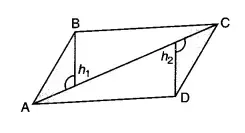
*Figure: the diagonal $AC$ splits the quadrilateral $ABCD$ into the triangles $ABC$ and $ADC$. Both triangles have the base $AC = d$, and their heights are $h_1$ and $h_2$.*
Why the formula works:
$$\text{Area}(ABCD) = \text{Area}(\triangle ABC) + \text{Area}(\triangle ADC) = \frac{1}{2}\,d\,h_1 + \frac{1}{2}\,d\,h_2 = \frac{1}{2}\,d\,(h_1 + h_2)$$
How to use it:
- Choose a diagonal, and measure its length $d$.
- Measure the perpendicular distance from each of the other two corners to that diagonal ($h_1$ and $h_2$).
- Put the three numbers in $\dfrac{1}{2}d(h_1 + h_2)$, and write the answer in square units.
This is the method that is used to find the area of an irregular field: a surveyor walks along one diagonal, and notes the “offsets” (the perpendicular distances) to the two other corners. The same idea works for any polygon: divide it into triangles, and add their areas. See Example 7 for a worked case.
Surface Area and Volume of Solids in Mensuration Formulas Class 8 Maths
Solid | Lateral (curved) surface area | Total surface area | Volume | Other |
|---|---|---|---|---|
Cube (side $a$) | $4a^2$ | $6a^2$ | $a^3$ | Diagonal $= \sqrt{3}\,a$ |
Cuboid ($l$, $b$, $h$) | $2h(l + b)$ | $2(lb + bh + hl)$ | $l \times b \times h$ | Diagonal $= \sqrt{l^2 + b^2 + h^2}$ |
Cylinder (radius $r$, height $h$) | $2\pi rh$ (curved) | $2\pi r(r + h)$ | $\pi r^2 h$ | Two circular ends, each of area $\pi r^2$ |
- Lateral surface area leaves out the top and the bottom. Total surface area includes them. For a closed box or can, use the total surface area.
- An open cylinder (for example a tank with no lid) has the area $2\pi rh + \pi r^2$ (the curved surface and one base). A pipe that is open at both ends has only the curved surface $2\pi rh$.
- Volume = area of the base × height for a cuboid, a cube and a cylinder.
- Capacity is the volume of liquid that a container holds. Find the volume in $\text{cm}^3$ or $\text{m}^3$, and then change it to litres.
How to Choose the Right Formula in Mensuration Formulas Class 8 Maths
If the question asks for... | Use... |
|---|---|
The fencing, the border, the length of a wire | Perimeter |
The paint, the tiles, the carpet, the cloth | Area (or surface area for a solid) |
The water that a tank holds, the sand in a box | Volume (and capacity in litres) |
The cost of painting the four walls of a room | Lateral surface area of the cuboid |
The cost of painting the whole box | Total surface area |
The longest rod that fits in a room | The diagonal $\sqrt{l^2 + b^2 + h^2}$ |
Common Mistakes in Mensuration Formulas Class 8 Maths Problems
Mistake | Correct approach |
|---|---|
Writing the area in the units of length | The area is in square units, and the volume in cubic units |
Mixing the units (m and cm) | Change all the lengths to one unit first |
Using the slant side, and not the height, in the area of a parallelogram or a triangle | Use the perpendicular height |
Using the total surface area for an open tank | Use the curved surface plus one base |
Writing the diagonal of a cuboid or a cube as an area or a volume | It is a length: $\sqrt{l^2 + b^2 + h^2}$ or $\sqrt{3}a$ |
Forgetting the factor $\frac{1}{2}$ in a triangle, a trapezium or a rhombus | The area of each has $\frac{1}{2}$ |
Using the diameter as the radius | $r = \dfrac{d}{2}$ |
Using $\pi = 3.14$ when the question asks for $\frac{22}{7}$ | Follow the value that is given |
Solved Examples from Mensuration Formulas Class 8 Maths
Example 1 (a rectangle): A rectangular field is 12 m long and 8 m wide. Find its area and perimeter.
Area $= 12\times 8 = 96\ \text{m}^2$. Perimeter $= 2(12 + 8) = 40$ m.
Example 2 (a square): The perimeter of a square is 36 cm. Find its area.
Side $= \dfrac{36}{4} = 9$ cm, so the area is $9^2 = 81\ \text{cm}^2$.
Example 3 (triangles): Find the area of a triangle of base 10 cm and height 7 cm, and of an equilateral triangle of side 8 cm.
$\dfrac{1}{2}\times10\times7 = 35\ \text{cm}^2$. For the equilateral triangle, $\dfrac{\sqrt{3}}{4}\times 8^2 = 16\sqrt{3} \approx 27.7\ \text{cm}^2$.
Example 4 (a trapezium): The parallel sides of a trapezium are 12 cm and 8 cm, and the distance between them is 5 cm. Find the area.
Area $= \dfrac{1}{2}(12 + 8)\times 5 = 50\ \text{cm}^2$.
Example 5 (a rhombus): The diagonals of a rhombus are 16 cm and 12 cm. Find its area and perimeter.
Area $= \dfrac{1}{2}\times16\times12 = 96\ \text{cm}^2$. The diagonals bisect each other at right angles, so the side is $\sqrt{8^2 + 6^2} = 10$ cm, and the perimeter is $4\times10 = 40$ cm.
Example 6 (a circle): Find the area and the circumference of a circle of radius 7 cm.
Area $= \dfrac{22}{7}\times 7^2 = 154\ \text{cm}^2$. Circumference $= 2\times\dfrac{22}{7}\times7 = 44$ cm.
Example 7 (a quadrilateral, using the figure above): In the quadrilateral $ABCD$, the diagonal $AC = d = 20$ cm. The perpendicular from $B$ to $AC$ is $h_1 = 6$ cm, and the perpendicular from $D$ to $AC$ is $h_2 = 9$ cm. Find the area.
Area $= \dfrac{1}{2}\times d\times(h_1 + h_2) = \dfrac{1}{2}\times 20\times(6 + 9) = 150\ \text{cm}^2$. Check by triangles: $\triangle ABC = \dfrac{1}{2}\times20\times6 = 60\ \text{cm}^2$, $\triangle ADC = \dfrac{1}{2}\times20\times9 = 90\ \text{cm}^2$, and $60 + 90 = 150\ \text{cm}^2$.
Example 8 (a path): A path 2 m wide runs around a rectangular lawn of 20 m by 15 m, outside it. Find the area of the path.
The outer rectangle is $(20 + 4)\times(15 + 4) = 24\times19 = 456\ \text{m}^2$. The lawn is $20\times15 = 300\ \text{m}^2$. The path is $456 - 300 = 156\ \text{m}^2$.
Example 9 (a cuboid): A cuboid is 5 m long, 4 m wide and 3 m high. Find its total surface area, lateral surface area, volume and diagonal.
TSA $= 2(5\times4 + 4\times3 + 3\times5) = 2(20 + 12 + 15) = 94\ \text{m}^2$. LSA $= 2\times3\times(5 + 4) = 54\ \text{m}^2$. Volume $= 5\times4\times3 = 60\ \text{m}^3$. Diagonal $= \sqrt{25 + 16 + 9} = \sqrt{50} \approx 7.07$ m.
Example 10 (a cube): Find the total surface area, the volume and the diagonal of a cube of side 6 cm.
TSA $= 6\times36 = 216\ \text{cm}^2$. Volume $= 6^3 = 216\ \text{cm}^3$. Diagonal $= 6\sqrt{3} \approx 10.39$ cm.
Example 11 (a cylinder): A cylinder has the radius 7 cm and the height 10 cm. Find (a) its curved surface area, total surface area and volume, and (b) the area of the same cylinder if it is open at the top.
(a) CSA $= 2\times\dfrac{22}{7}\times7\times10 = 440\ \text{cm}^2$. TSA $= 2\pi r(r + h) = 44\times17 = 748\ \text{cm}^2$. Volume $= \dfrac{22}{7}\times49\times10 = 1540\ \text{cm}^3$. (b) $2\pi rh + \pi r^2 = 440 + 154 = 594\ \text{cm}^2$.
Example 12 (capacity): A cylindrical tank has the radius 1.4 m and the height 2.5 m. How many litres of water does it hold?
Volume $= \dfrac{22}{7}\times(1.4)^2\times2.5 = 15.4\ \text{m}^3$. Since $1\ \text{m}^3 = 1000$ L, the tank holds $15\,400$ L.
How to Study Mensuration Formulas Class 8 Maths
- Read the chapter in your textbook first. You can download the NCERT book from eSaral’s NCERT Maths Book for Class 8 page.
- Learn the formulas in groups: 2D area and perimeter, then the cube and cuboid, and then the cylinder. Write the unit next to each formula.
- Practise one problem each on a path, a quadrilateral, a trapezium, a cuboid room, an open tank and a capacity in litres.
- Check your answers to the textbook exercises with eSaral’s NCERT Solutions for Class 8 page. For more practice on the earlier edition of the chapter (Mensuration), see eSaral’s NCERT Exemplar for Class 8 Maths.
- Download the eSaral App for Class 8 Maths videos and practice.
Frequently Asked Questions
What are the mensuration formulas for Class 8 Maths?
For 2D shapes: the rectangle $l\times b$, the square $a^2$, the parallelogram $b\times h$, the triangle $\frac{1}{2}bh$, the trapezium $\frac{1}{2}(a+b)h$, the rhombus $\frac{1}{2}d_1d_2$, the quadrilateral $\frac{1}{2}d(h_1+h_2)$ and the circle $\pi r^2$ (circumference $2\pi r$). For solids: the cube $6a^2$ and $a^3$, the cuboid $2(lb+bh+hl)$ and $lbh$, and the cylinder $2\pi r(r+h)$ and $\pi r^2h$. eSaral’s Mensuration Formulas Class 8 Maths list them all in tables.
How do you find the volume of a cuboid?
In Mensuration Formulas Class 8 Maths, the volume of a cuboid is $l\times b\times h$, which is the area of the base times the height. The answer is in cubic units. For example, if $l = 5$ cm, $b = 3$ cm and $h = 4$ cm, then $V = 5\times3\times4 = 60\ \text{cm}^3$.
What is the difference between the total surface area and the lateral surface area of a cylinder?
In Mensuration Formulas Class 8 Maths, the curved (lateral) surface area is $2\pi rh$, and it covers only the side. The total surface area is $2\pi r(r+h)$, and it also includes the two circular ends. Use the total surface area for a closed cylinder, the curved surface for a pipe that is open at both ends, and the curved surface plus one base ($2\pi rh + \pi r^2$) for a tank that is open at the top.
What is the formula for the area of a trapezium?
In Mensuration Formulas Class 8 Maths, the area of a trapezium is $\dfrac{1}{2}\times(\text{sum of the parallel sides})\times\text{height} = \dfrac{1}{2}(a+b)h$. Two identical trapezia placed side by side make a parallelogram of base $(a+b)$ and height $h$, so one trapezium is half of it. You can also divide the trapezium into two triangles with the same height $h$.
How do you find the area of a rhombus using its diagonals?
In Mensuration Formulas Class 8 Maths, the area of a rhombus is $\dfrac{1}{2}d_1d_2$. The diagonals bisect each other at right angles, so they divide the rhombus into four congruent right triangles. If the diagonals are 16 cm and 12 cm, the area is 96 $\text{cm}^2$, and the side is 10 cm.
How do you find the area of a quadrilateral?
Split it into two triangles with a diagonal. If the diagonal is $d$ and the perpendiculars from the other two corners to it are $h_1$ and $h_2$, the area is $\dfrac{1}{2}d(h_1 + h_2)$. The figure in the section on the quadrilateral shows $ABCD$ with the diagonal $AC$.
Which value of π should I use in mensuration?
Use the value that the question gives. If it does not give one, use $\dfrac{22}{7}$ when the radius or the diameter is a multiple of 7, and $3.14$ in other cases. $\pi$ is irrational ($3.14159\ldots$), and $\dfrac{22}{7}$ is only an approximation. In Mensuration Formulas Class 8 Maths, the answer changes slightly with the value that you use.
Which chapter has mensuration in NCERT Class 8 Maths?
In the current NCERT Class 8 Maths book (Ganita Prakash), the area formulas are in Part 2, Chapter 7 (Area), and in the earlier edition of the book, the topic was in Chapter 11 (Mensuration). These Mensuration Formulas Class 8 Maths cover the area, the surface area and the volume together, so they suit both.
How do you convert units of area and volume?
In Mensuration Formulas Class 8 Maths, square the length conversion for the area, and cube it for the volume. Since $1\ \text{m} = 100\ \text{cm}$, $1\ \text{m}^2 = 10\,000\ \text{cm}^2$ and $1\ \text{m}^3 = 10^6\ \text{cm}^3$. For capacity, $1\ \text{L} = 1000\ \text{cm}^3$.
Is Class 8 mensuration important for competitive exams like JEE?
JEE does not ask Class 8 questions directly, but the formulas for the area, the surface area and the volume are the base for the geometry and the solids of Class 9 and Class 10, and they are used in many problems of the later classes. A strong base in Mensuration Formulas Class 8 Maths makes these chapters easier, and it helps with the Olympiad and foundation tests.
Where can I find more Class 8 Maths help on eSaral?
eSaral has the NCERT Class 8 Maths book, NCERT solutions for Class 8, the NCERT Exemplar and the eSaral app with Class 8 videos. These Mensuration Formulas Class 8 Maths are one page in that set, and all the links are above.
Team eSaral
eSaral Academic and Editorial Team
Team eSaral is the collective author profile for educational content created by eSaral’s teachers and academic contributors. The team draws on expertise from IIT graduates, doctors, experienced educators and subject specialists to develop resources for JEE, NEET and school students. Our articles aim to explain concepts clearly and help students study with confidence.
Related Posts

BITSAT 2027: Registration Date, Exam Date, Syllabus, Eligibility, Pattern & Fees
BITSAT 2027 exam dates, registration timeline, eligibility criteria, exam pattern, marking scheme, syllabus and fees in one page.

BITSAT Previous Year Question Paper PDF (2017-2026)
Download BITSAT previous year question papers PDF from 2017 to 2026,session-wise. Memory-based papers,exam pattern, paper analysis and how to practise

CBSE Class 10 Date Sheet 2027: Expected Exam Dates, Release Date, Admit Card & Result Timeline
CBSE Class 10 date sheet 2027 is awaited. See the expected exam dates, release window, how to download the PDF, admit card and result timelines.

NCERT Physics Class 10 Book PDF in Hindi 2026-27 – भौतिक विज्ञान के 4 अध्याय (Free Download)
NCERT Physics Class 10 book PDF in Hindi 2026-27: download all 4 chapters (अध्याय 9–12) free, with topics and important formulas.

NCERT Biology Class 9 Book Anveshan PDF in Hindi - जीव विज्ञान कक्षा 9 पुस्तक अन्वेषण PDF
Download NCERT Biology Class 9 book PDF in Hindi chapterwise for 2026-27: Cell, Tissues, Reproduction and Diversity. Free PDFs.

Essay On Artificial Intelligence in English (100,150, 200, 250, 300, 500 Words)
This is in contrast to the natural intelligence of humans. With Artificial Intelligence, machines can perform

Essay on 78th India Independence Day in English for Student (100, 150, 200, 250, 300, 500 Words)
Read the best essays on India's Independence Day in English. Short & long essays (100, 150, 200, 250, 300, 500 words) perfect for school exams
NCERT Class 11 English Snapshots book - Free PDF download- Esaral
Download NCERT Class 11 English Snapshots book PDF for free. Get all 8 chapters, chapter-wise. Start your prep today!
NCERT Class 10 biology book pdf - Free PDF Download - eSaral
NCERT Class 10 Biology book PDF 2026-27: all 5 chapters (Life Processes to Our Environment) in English & Hindi, with CBSE syllabus, marks & practical

Essay on Global Warming in English (100,150, 200, 250, 300, 500 Words)
Global warming means the Earth is getting hotter. This happens because of things like pollution from cars and factories.