
Mole Concept NEET Previous Year Questions with Solutions

eSaral Academic and Editorial Team
Summary
Mole Concept NEET previous year questions come from Chapter 1 of Class 11 Chemistry, Some Basic Concepts of Chemistry. They test mole calculations, Avogadro’s number, molar mass, empirical and molecular formulae, stoichiometry, limiting reagent and concentration terms. This page gives the solved question pages, a weightage trend, key formulae, common mistakes and NEET-style practice questions.
Here you will find Mole Concept NEET previous year questions with detailed solutions. For the full set of chapters, see the complete NEET previous year questions for Physics, Chemistry and Biology.
What Is the Mole Concept and Why Does It Matter for NEET?
The mole concept connects the atomic world (atoms and molecules) with quantities you can measure in the lab (grams and litres). For NEET UG, it is part of Some Basic Concepts of Chemistry in the Class 11 Chemistry syllabus.
The chapter looks simple, so students often rush through it and lose easy marks. It also matters beyond its own questions, because mole-based calculations return in Solutions, Equilibrium, Redox and Electrochemistry. Chemistry has 45 questions of 4 marks each in NEET, so every question you secure here counts.
To build the base along with PYQ practice, also use the NCERT Solutions for Class 11 Chemistry, where every textbook problem is solved.
How Many Questions Come from Mole Concept in NEET?
Published analyses of NEET papers show that Some Basic Concepts of Chemistry usually carries a small number of questions each year. Different analyses count slightly differently, so treat the table as a range.
NEET year | Reported number of questions | Marks (4 per question) |
|---|---|---|
2021 | 1–2 | 4–8 |
2022 | 1–2 | 4–8 |
2023 | 1–3 | 4–12 |
2024 | 3 | 12 |
2025 | 2 | 8 |
On average, that is about 2 questions, or about 8 marks, per year. Count the 2026 paper yourself from the official question paper, since analyses of the latest paper are still being updated.
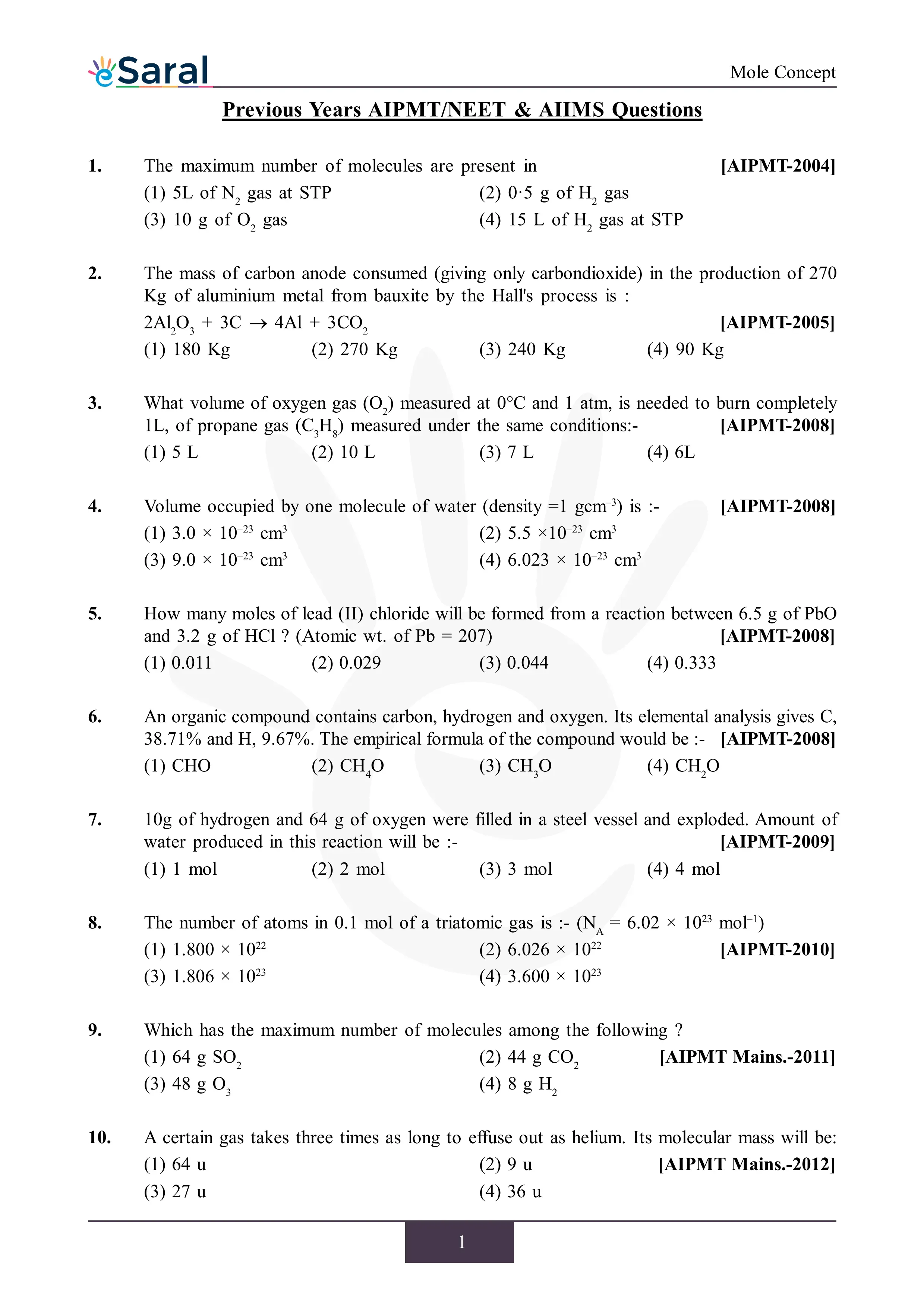
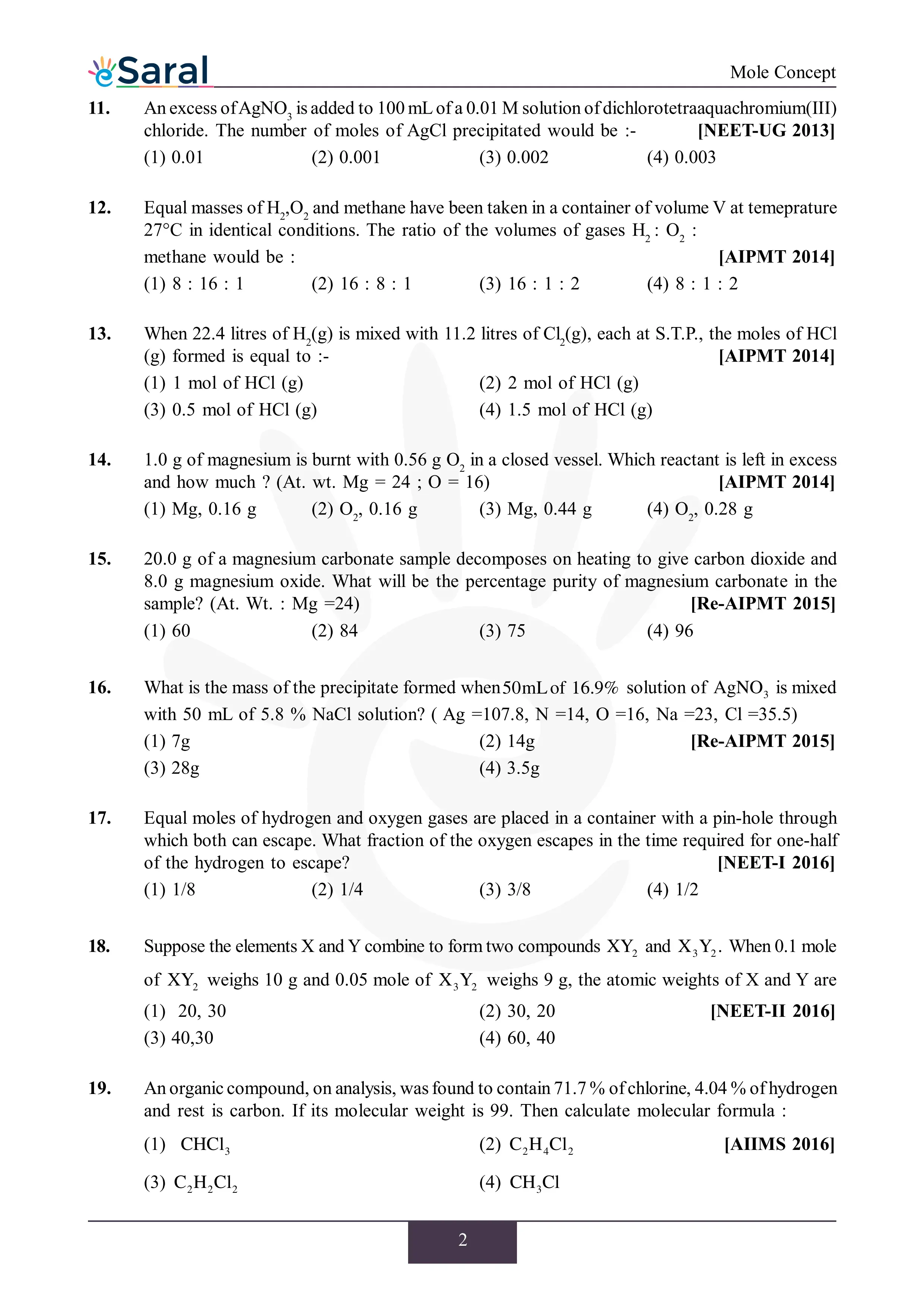
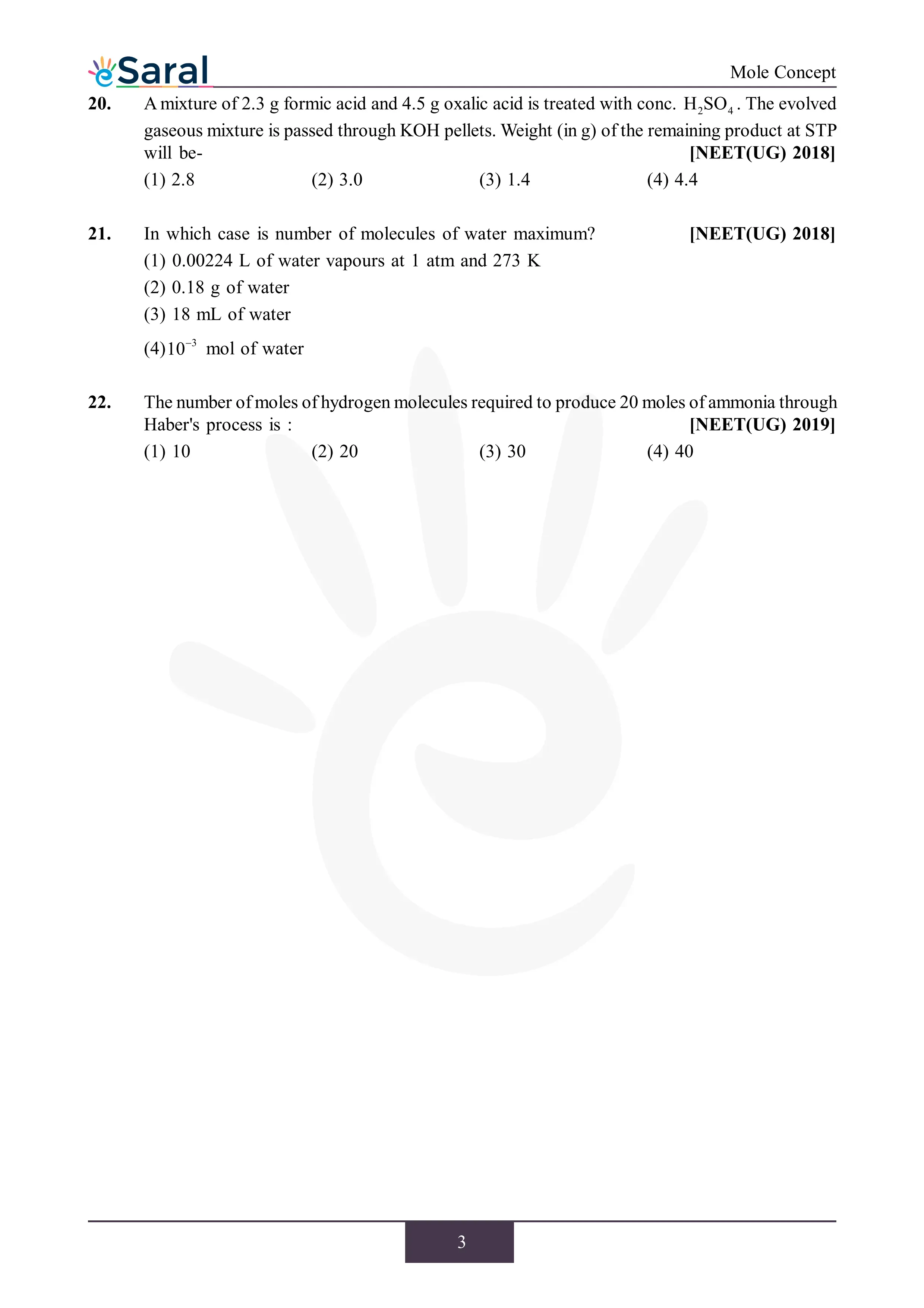
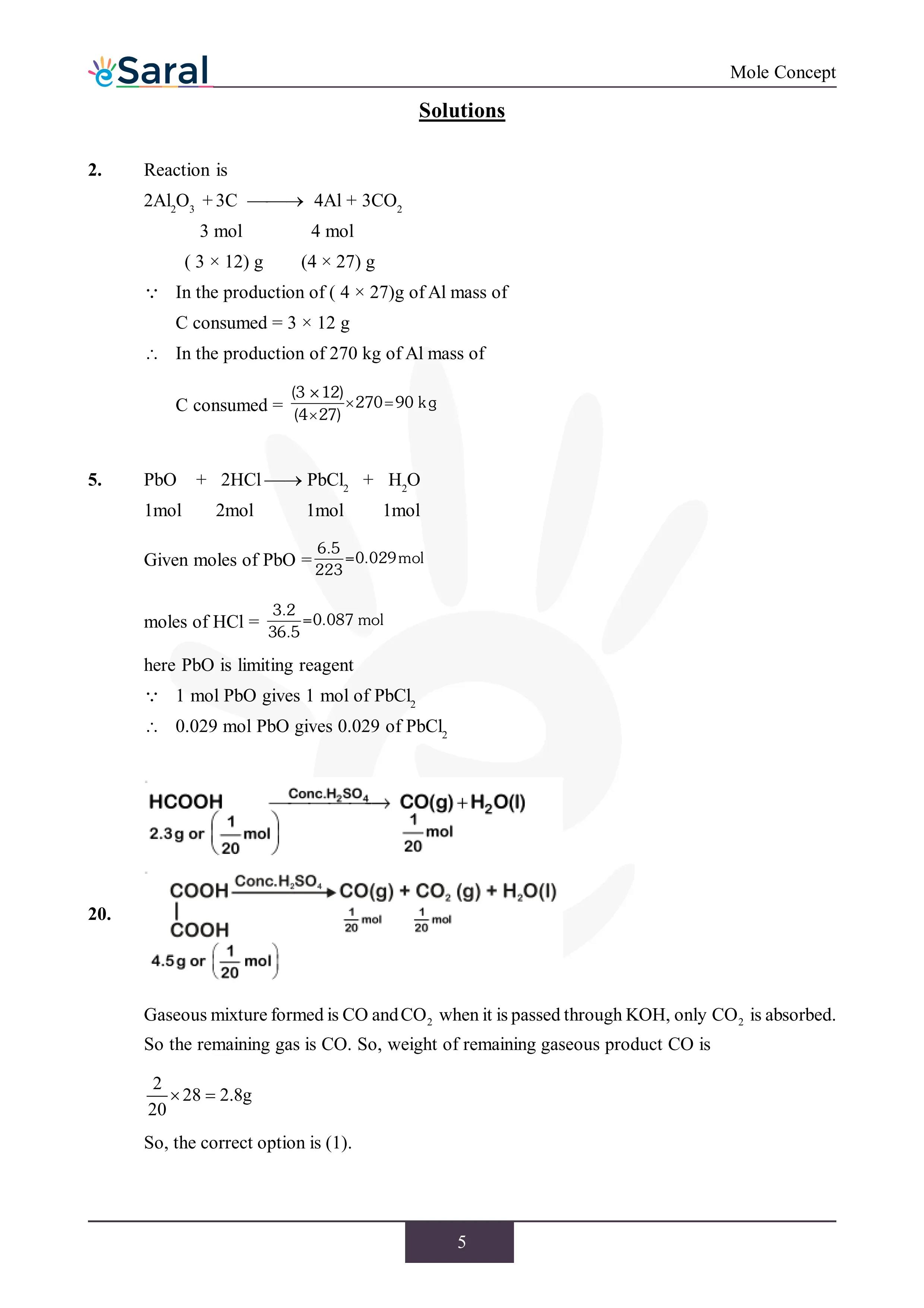
Mole Concept NEET Previous Year Questions: Solved Pages
Solve each question yourself first and then check the solution.

Which Subtopics Are Asked in Mole Concept NEET Previous Year Questions?
The NEET syllabus for this chapter includes laws of chemical combination, atomic and molecular masses, the mole concept, molar mass, percentage composition, empirical and molecular formula, and stoichiometry. Practise in this order.
High-Priority Subtopics
- Mole calculations: converting between grams, moles and number of particles
- Stoichiometry: mole ratios from balanced chemical equations
- Limiting reagent: finding which reactant is consumed first
- Empirical and molecular formula from percentage composition
Medium-Priority Subtopics
- Concentration terms: molarity, molality and mole fraction
- Molar volume of gases at STP
- Percentage yield and theoretical yield
Lower-Priority Subtopics
- Laws of chemical combination
- Average atomic mass of isotopes
- Vapour density and molecular mass
Key Formulae for Mole Concept NEET Previous Year Questions
Formula | Expression | Units |
|---|---|---|
Number of moles | $n = \frac{\text{mass (g)}}{\text{molar mass (g/mol)}}$ | mol |
Number of particles | $N = n \times 6.022 \times 10^{23}$ | — |
Molar volume at STP | $1\ \text{mol gas} = 22.4\ \text{L}$ | L/mol |
Molarity | $M = \frac{\text{moles of solute}}{\text{volume of solution (L)}}$ | mol/L |
Empirical formula mass | $\sum (\text{atomic mass} \times \text{subscript})$ | g/mol |
Molecular formula | $\text{Molecular formula} = n \times \text{Empirical formula}$ | — |
Percentage composition | $\text{Percentage} = \left(\frac{\text{mass of element}}{\text{molar mass of compound}}\right) \times 100$ | % |
Limiting reagent check | $\frac{\text{given moles}}{\text{stoichiometric coefficient}}$ → smallest = limiting | — |
NEET-Style Practice Questions on Mole Concept
These are practice questions written in the NEET style. They are not official previous year questions. Attempt them after solving the Mole Concept NEET previous year questions above.
Q1. The number of moles in 5.6 L of CO₂ at STP is
(1) 0.1 (2) 0.25 (3) 0.5 (4) 1.0
Answer: (2). n = 5.6 ÷ 22.4 = 0.25 mol.
Q2. The mass of 3.011 × 10²³ molecules of NH₃ is
(1) 4.25 g (2) 8.5 g (3) 17 g (4) 34 g
Answer: (2). Moles = 3.011 × 10²³ ÷ 6.022 × 10²³ = 0.5 mol. Mass = 0.5 × 17 = 8.5 g.
Q3. A hydrocarbon contains 80% carbon and 20% hydrogen, and its molecular mass is 30. Its molecular formula is
(1) CH₃ (2) C₂H₄ (3) C₂H₆ (4) C₃H₈
Answer: (3). C : H = 80/12 : 20/1 = 6.67 : 20 = 1 : 3, so the empirical formula is CH₃ (mass 15). n = 30 ÷ 15 = 2, so the formula is C₂H₆.
Q4. 2 mol of N₂ reacts with 3 mol of H₂ in N₂ + 3H₂ → 2NH₃. The amount of NH₃ formed is
(1) 1 mol (2) 2 mol (3) 3 mol (4) 4 mol
Answer: (2). N₂: 2 ÷ 1 = 2. H₂: 3 ÷ 3 = 1. H₂ is the limiting reagent, and 3 mol of H₂ gives 2 mol of NH₃.
Q5. The molarity of a solution containing 4 g of NaOH (molar mass 40 g/mol) in 500 mL is
(1) 0.1 M (2) 0.2 M (3) 0.4 M (4) 0.8 M
Answer: (2). Moles = 4 ÷ 40 = 0.1 mol. Volume = 0.5 L. M = 0.1 ÷ 0.5 = 0.2 M.
Q6. The total number of atoms in 0.5 mol of H₂SO₄ is approximately
(1) 3.0 × 10²³ (2) 2.1 × 10²⁴ (3) 4.2 × 10²⁴ (4) 6.0 × 10²³
Answer: (2). Each molecule has 7 atoms. Atoms = 0.5 × 7 × 6.022 × 10²³ ≈ 2.1 × 10²⁴.
Q7. The theoretical yield of a product is 20 g and the actual yield is 15 g. The percentage yield is
(1) 25% (2) 50% (3) 75% (4) 80%
Answer: (3). (15 ÷ 20) × 100 = 75%.
Common Mistakes in Mole Concept NEET Previous Year Questions
Mistake | Correct approach |
|---|---|
Using atomic mass instead of molecular mass | Check whether the question is about atoms or molecules, for example O₂ is 32 g/mol |
Forgetting that Avogadro’s number is 6.022 × 10²³ | Write it in full during calculations |
Using 22.4 L for gases that are not at STP | Use 22.4 L only at STP, unless the question gives different conditions |
Mixing molarity with molality | Molarity uses volume of solution in L, and molality uses mass of solvent in kg |
Not identifying the limiting reagent | Divide moles by the coefficient first, and then compare |
How to Practise Mole Concept NEET Previous Year Questions
- Revise the theory and formulae from the NCERT chapter first.
- Solve the questions on your own and time yourself.
- Check the solutions and note whether each mistake was a concept gap, a calculation slip or a misread question.
- Repeat the questions you got wrong after a few days.
Conclusion
For deeper concept clarity, pair your practice of Mole Concept NEET previous year questions with the NCERT Solutions for Class 11 Chemistry and download the NCERT Class 11 Books for reference. NEET stays closely within NCERT boundaries for this chapter.
If you want structured guidance through the entire NEET Chemistry syllabus, explore eSaral’s NEET courses, designed for both first-attempt and dropper students.
Frequently Asked Questions
Where can I find Mole Concept NEET previous year questions with solutions?
You can find Mole Concept NEET previous year questions with step-by-step solutions on this eSaral page, along with key formulae and practice questions. For the other chapters, use eSaral’s NEET chapter-wise previous year questions page.
Is Mole Concept important for NEET 2025?
Yes, Mole Concept is important for NEET 2025. It is part of the NTA-prescribed Class 11 Chemistry syllabus and appears every year without exception. It also forms the foundation for Physical Chemistry topics like Equilibrium, Electrochemistry, and Solutions — so mastering it pays dividends across multiple chapters.
How many questions come from Mole Concept in NEET?
NTA asks 2–4 questions from the Mole Concept (Some Basic Concepts of Chemistry) in NEET each year. Based on papers from 2018 to 2024, the average is approximately 3 questions worth 12 marks. This makes it one of the most marks-efficient chapters in NEET Chemistry for focused preparation.
What is the difference between empirical formula and molecular formula in NEET questions?
The empirical formula shows the simplest whole-number ratio of atoms in a compound. The molecular formula shows the actual number of atoms. For example, glucose has empirical formula CH₂O and molecular formula C₆H₁₂O₆. NEET frequently asks students to derive one from the other using percentage composition data and molar mass — a standard 2-step calculation.
What is the difficulty level of Mole Concept questions in NEET?
Mole Concept questions in NEET are generally easy to moderate in difficulty. Most questions test direct formula application — mole calculations, stoichiometry ratios, and empirical formula derivation. Rarely does NTA ask multi-step problems from this chapter. Students who practice 15–20 PYQs typically find this chapter fully predictable.
How should I use NCERT along with Mole Concept NEET previous year questions?
Read the NCERT chapter first, solve its exercise using eSaral’s NCERT Solutions for Class 11 Chemistry, and then attempt the PYQs. This way, the PYQs test understanding instead of memory.
Which STP value should I use in NEET numericals?
Most NEET questions use 22.4 L per mole at STP (273.15 K, 1 atm) unless the question states other conditions. The current IUPAC standard (1 bar) gives about 22.7 L, so always follow the data given in the question.
Team eSaral
eSaral Academic and Editorial Team
Team eSaral is the collective author profile for educational content created by eSaral’s teachers and academic contributors. The team draws on expertise from IIT graduates, doctors, experienced educators and subject specialists to develop resources for JEE, NEET and school students. Our articles aim to explain concepts clearly and help students study with confidence.
Related Posts

BITSAT 2027: Registration Date, Exam Date, Syllabus, Eligibility, Pattern & Fees
BITSAT 2027 exam dates, registration timeline, eligibility criteria, exam pattern, marking scheme, syllabus and fees in one page.

BITSAT Previous Year Question Paper PDF (2017-2026)
Download BITSAT previous year question papers PDF from 2017 to 2026,session-wise. Memory-based papers,exam pattern, paper analysis and how to practise

CBSE Class 10 Date Sheet 2027: Expected Exam Dates, Release Date, Admit Card & Result Timeline
CBSE Class 10 date sheet 2027 is awaited. See the expected exam dates, release window, how to download the PDF, admit card and result timelines.

NCERT Physics Class 10 Book PDF in Hindi 2026-27 – भौतिक विज्ञान के 4 अध्याय (Free Download)
NCERT Physics Class 10 book PDF in Hindi 2026-27: download all 4 chapters (अध्याय 9–12) free, with topics and important formulas.

NCERT Biology Class 9 Book Anveshan PDF in Hindi - जीव विज्ञान कक्षा 9 पुस्तक अन्वेषण PDF
Download NCERT Biology Class 9 book PDF in Hindi chapterwise for 2026-27: Cell, Tissues, Reproduction and Diversity. Free PDFs.

Essay On Artificial Intelligence in English (100,150, 200, 250, 300, 500 Words)
This is in contrast to the natural intelligence of humans. With Artificial Intelligence, machines can perform

Essay on 78th India Independence Day in English for Student (100, 150, 200, 250, 300, 500 Words)
Read the best essays on India's Independence Day in English. Short & long essays (100, 150, 200, 250, 300, 500 words) perfect for school exams
NCERT Class 11 English Snapshots book - Free PDF download- Esaral
Download NCERT Class 11 English Snapshots book PDF for free. Get all 8 chapters, chapter-wise. Start your prep today!
NCERT Class 10 biology book pdf - Free PDF Download - eSaral
NCERT Class 10 Biology book PDF 2026-27: all 5 chapters (Life Processes to Our Environment) in English & Hindi, with CBSE syllabus, marks & practical

Essay on Global Warming in English (100,150, 200, 250, 300, 500 Words)
Global warming means the Earth is getting hotter. This happens because of things like pollution from cars and factories.