
Motion in a lift - Laws of Motion, Physics, Class 11 - eSaral

eSaral Academic and Editorial Team
Summary
Motion in a lift refers to how a person's apparent weight changes when a lift (elevator) accelerates or decelerates. When a lift accelerates upward, apparent weight increases: W′ = M(g + a). When it accelerates downward, W′ = M(g − a). In free fall (a = g), apparent weight becomes zero — the condition of weightlessness.
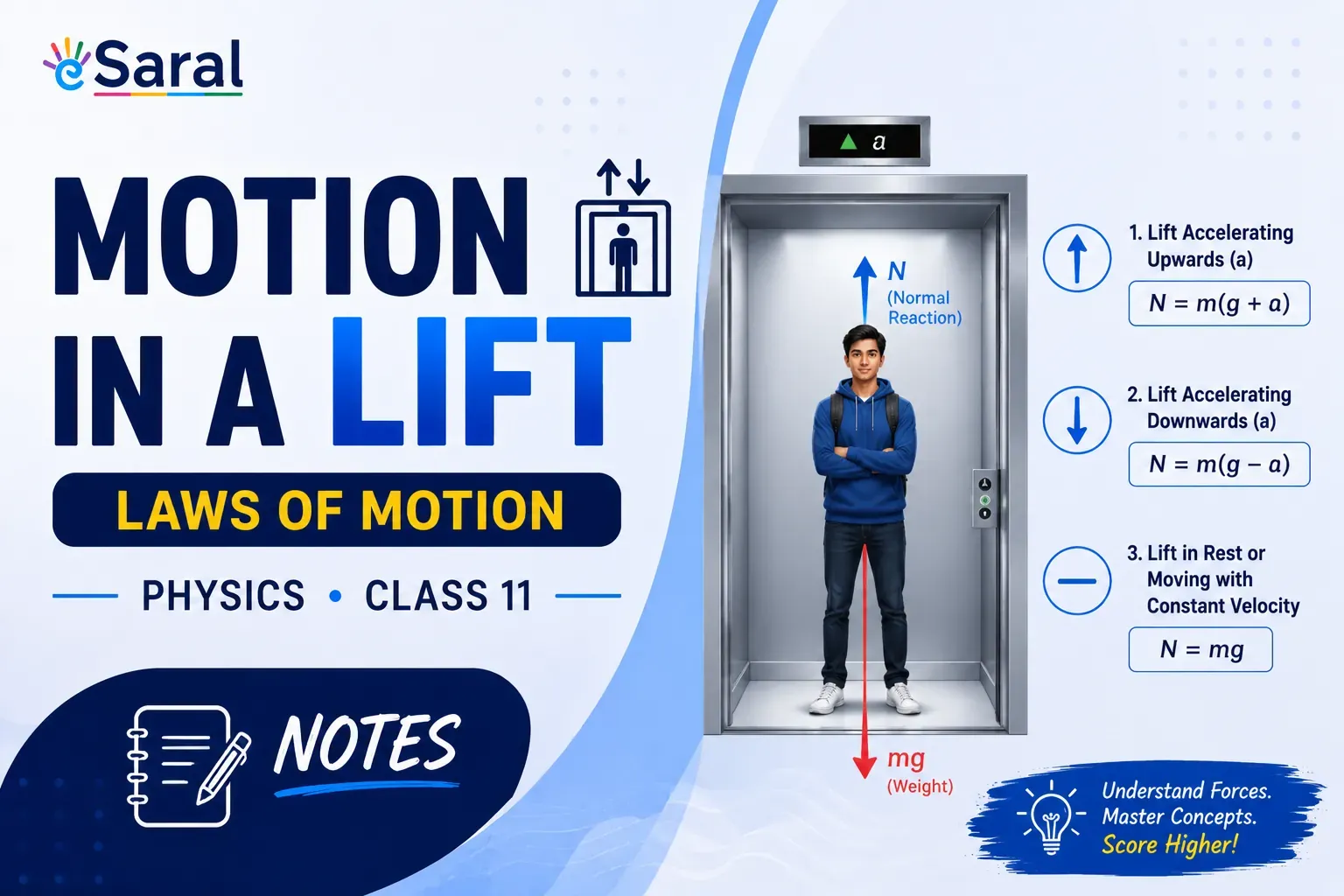
eSaral > Class 11 Physics > Motion in a Lift

What is Apparent Weight and Why Does It Change in a Lift?
Your actual weight is the gravitational force Earth exerts on you:
$W = Mg$
This never changes as long as your mass and $g$ remain constant.
Your apparent weight, however, is the force you feel — the normal reaction $N$ that the floor of the lift pushes back on you. When the lift is stationary or moving at constant velocity, $N = Mg$, so apparent weight equals actual weight.
The moment the lift accelerates, you are in a non-inertial (accelerated) reference frame. To analyse forces from inside the lift, we introduce a pseudo force (also called fictitious force) equal to:
$F_0 = Ma$
directed opposite to the direction of acceleration of the lift. This pseudo force changes the net force on you and therefore changes your apparent weight.
This concept falls under Chapter 5 — Laws of Motion in the Class 11 Physics NCERT syllabus, and it is one of the most frequently tested topics in JEE Main and NEET. For the full NCERT treatment, check the NCERT Solutions for Class 11 Physics on eSaral, where IIT Bombay faculty have solved every problem with detailed explanations.
All 4 Cases of Motion in a Lift — Explained
Case 1: What happens when the lift moves with constant velocity?
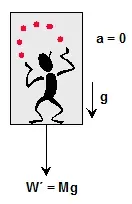
When a lift moves upward or downward at constant velocity, its acceleration is zero:
$a = 0$
There is no pseudo force. The net force equation along the vertical direction gives:
$N - Mg = 0$
Therefore:
$W' = N = Mg = W$
Apparent weight = Actual weight. The weighing scale shows your true mass. This is identical to the situation when the lift is stationary.
Key point for JEE: Constant velocity means zero acceleration — do not confuse speed with acceleration. A lift moving at 5 m/s upward with no change in speed has zero net force on the passenger.
Case 2: What happens when the lift accelerates upward?
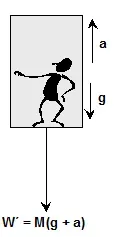
When the lift accelerates upward with acceleration $a$, the passenger is in a non-inertial frame. The pseudo force:
$F_0 = Ma$
acts downward (opposite to the upward acceleration of the lift).
Forces on the passenger (taking downward as positive):
- Weight $W = Mg$ → downward
- Pseudo force $F_0 = Ma$ → downward
- Normal force $N$ → upward
For the passenger to be in equilibrium inside the accelerating lift frame:
$N = Mg + Ma = M(g+a)$
Therefore:
$W' = M(g+a)$
Effective gravitational acceleration:
$g' = g+a$
The passenger feels heavier. A 60 kg person in a lift accelerating upward at 2 m/s² would register an apparent weight of:
$60 \times (10+2) = 720\ N$
instead of 600 N.
This also applies when the lift decelerates while moving downward — the deceleration has an upward component, so the same formula holds.
Case 3: What happens when the lift accelerates downward?
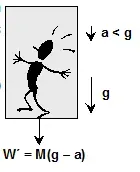
When the lift accelerates downward with acceleration $a$ (where $a < g$), the pseudo force:
$F_0 = Ma$
acts upward (opposite to the downward acceleration).
Forces on the passenger:
- Weight $W = Mg$ → downward
- Pseudo force $F_0 = Ma$ → upward
- Normal force $N$ → upward
Equilibrium inside the lift frame:
$N = Mg - Ma = M(g-a)$
Therefore:
$W' = M(g-a)$
Effective gravitational acceleration:
$g' = g-a$
The passenger feels lighter. This is why you feel a sinking sensation in your stomach when a lift starts moving downward or when a fast lift decelerates at the top floor.
Special Case — Free Fall
$a = g$
$W' = M(g-g) = 0$
This is the condition of weightlessness. In a freely falling lift, the normal force between the passenger and the floor becomes zero. The passenger floats.
Case 4: What happens when the lift accelerates downward faster than free fall?
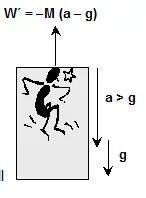
If the lift's downward acceleration exceeds $g$:
$a > g$
then:
$W' = M(g-a)$
Since $a > g$, $(g-a)$ becomes negative.
This means the normal force from the floor is negative. The passenger is pressed against the ceiling of the lift.
The ceiling exerts a downward normal force on the passenger, and the passenger experiences an upward apparent weight of:
$M(a-g)$
In JEE problems, this case is often presented as: "What force does the ceiling exert on the passenger?" The answer is:
$M(a-g)$
directed downward at the passenger.
Quick Reference Table: All Cases at a Glance
Lift Condition | Acceleration | Apparent Weight W′ | Effective g′ | Passenger Feels |
|---|---|---|---|---|
Stationary or constant velocity | $a = 0$ | $Mg$ | $g$ | Normal weight |
Accelerating upward | Upward | $M(g+a)$ | $g+a$ | Heavier |
Decelerating while going down | Upward | $M(g+a)$ | $g+a$ | Heavier |
Accelerating downward | $a < g$ | $M(g-a)$ | $g-a$ | Lighter |
Decelerating while going up | $a < g$ | $M(g-a)$ | $g-a$ | Lighter |
Free fall | $a=g$ downward | $0$ | $0$ | Weightless |
Driven downward | $a>g$ | Negative → pressed to ceiling | Negative | Inverted weightlessness |
How Do You Solve Any Lift Problem Step by Step?
Step 1 — Identify the Direction of Acceleration
Is the lift speeding up or slowing down? Which direction is it moving? A lift moving upward but slowing down has a downward acceleration.
Step 2 — Draw the Free Body Diagram (FBD)
Show weight $Mg$ downward and normal force $N$ upward. If working in the non-inertial frame, also show the pseudo force $Ma$ opposite to the lift's acceleration.
Step 3 — Apply Newton's Second Law
From the ground (inertial) frame:
$\Sigma F = Ma$
For upward acceleration:
$N - Mg = Ma$
$N = M(g+a)$
For downward acceleration:
$Mg - N = Ma$
$N = M(g-a)$
Step 4 — Interpret the Answer
$N$ is what the weighing scale reads (in Newtons). Divide by $g$ to get the scale reading in kg.
Solved Example
Problem: A spring weighing machine inside a stationary lift reads 50 kg when a man stands on it. What would happen to the scale reading if the lift moves upward with (i) constant velocity, and (ii) constant acceleration of 3 m/s²? (Take $g = 10\ m/s^2$)
Solution
Given:
$m = 50\ kg$
$g = 10\ m/s^2$
(i) Constant Velocity ($a = 0$)
There is no net acceleration.
$N - mg = 0$
$N = mg = 50 \times 10 = 500\ N$
Scale reading:
$\frac{500}{10} = 50\ kg$
Answer: 50 kg (unchanged)
(ii) Constant Upward Acceleration ($a = 3\ m/s^2$)
Applying Newton's Second Law:
$N - mg = ma$
$N = m(g+a)$
$N = 50(10+3)$
$N = 50 \times 13$
$N = 650\ N$
Scale reading:
$\frac{650}{10}=65\ kg$
Answer: 65 kg
The scale reads 15 kg more than actual weight because the lift is accelerating upward.
Verification Using Pseudo Force Method
Pseudo force:
$ma = 50 \times 3 = 150\ N$
Total downward force:
$mg + ma = 500 + 150 = 650\ N$
$N = 650\ N$ ✓
Also, read
Frame of reference
To watch Free Learning Videos on physics by Saransh Gupta sir, install the eSaral App.
Frequently Asked Questions
What is the condition for weightlessness in a lift?
Weightlessness occurs in a lift when the lift is in free fall — that is, when the downward acceleration of the lift equals g (≈ 9.8 m/s²). In this condition, apparent weight W′ = M(g − a) = M(g − g) = 0. The normal force between the person and the floor becomes zero, so the person floats. This is the same principle behind weightlessness experienced by astronauts in orbit.
Why do we feel heavier when a lift goes up?
You feel heavier when a lift accelerates upward because the floor must exert an extra force to accelerate you along with the lift. This increases the normal reaction N to M(g + a). The sensation of heaviness comes from this increased contact force between your feet and the floor. Note: you only feel heavier during acceleration, not during constant-speed upward motion.
What is apparent weight in a lift?
Apparent weight in a lift is the normal reaction force N that the lift floor exerts on a person. It equals actual weight (Mg) only when the lift is stationary or moving at constant velocity. When the lift accelerates upward, apparent weight increases to M(g + a); when it accelerates downward, it decreases to M(g − a). A weighing scale inside the lift always reads apparent weight.
Is motion in a lift important for JEE Main and NEET?
Yes. Motion in a lift is a standard application of Newton's second law tested in both JEE Main and NEET almost every year. In JEE Main, 1–2 marks questions directly ask for apparent weight in different lift conditions. In JEE Advanced, lift problems are often embedded in longer multi-concept questions involving spring-mass systems or connected bodies. Mastering all four cases and the FBD method is essential.
Does the formula change if a person is standing on a weighing scale in the lift?
No — the formula remains the same. A weighing scale measures the normal force N acting on it. When a person stands on a scale in an accelerating lift, the scale reading equals M(g + a) for upward acceleration and M(g − a) for downward acceleration, expressed in Newtons. Divide by g (10 m/s² in most JEE problems) to get the reading in kilograms.
What happens if the lift accelerates downward faster than g?
If the lift's downward acceleration a exceeds g, the formula W′ = M(g − a) gives a negative value. Physically, this means the floor cannot provide the required force, and the person is pushed against the ceiling. The ceiling then exerts a downward force of M(a − g) on the person. This situation requires a mechanically driven downward force on the lift beyond gravity alone
Team eSaral
eSaral Academic and Editorial Team
Team eSaral is the collective author profile for educational content created by eSaral’s teachers and academic contributors. The team draws on expertise from IIT graduates, doctors, experienced educators and subject specialists to develop resources for JEE, NEET and school students. Our articles aim to explain concepts clearly and help students study with confidence.
Related Posts

Plant Cell Diagram: Labelled Structure, Parts and Functions
Simple, labelled plant cell diagram with parts and functions. Covers plant cell structure for Class 6, 7, 8, 9, 10 and 11 students, CBSE-aligned.

Saransh Gupta Sir's Visit to IIT Patna: Hostel Life, Placements & Lessons for JEE Aspirants
Inside Saransh Gupta Sir's IIT Patna visit — hostel life, the library, placements, internships, and real advice for JEE aspirants from students living the IIT dream.
Molality Formula: Formula for Molality, Derivation & Solved Examples
Molality formula is $m = \dfrac{n}{W}$. Learn the formula of molality, its SI unit, derivation, relation with molarity, and solved examples for Class 11, JEE and NEET.

BITSAT Previous Year Question Paper PDF
Download BITSAT previous year question papers PDF. Get year-wise BITSAT PYQs, memory-based papers, exam pattern, and preparation tips to improve your BITSAT preparation.

Teachers’ Day 2026 at eSaral Gurukul: Celebrating the Bond Between Students, Teachers & Mentors
See how Teachers’ Day 2026 was celebrated at eSaral Gurukul, reflecting the bond among students, teachers, and mentors, and the role of guidance beyond academics.

JEE Advanced Attempts: Can You Give It a Third Time? Rules Explained
JEE Advanced attempts: current rule is 2 consecutive years only: full eligibility criteria, the 2025 third-attempt controversy, and the latest 2026 petition news.

Best JEE Preparation App
Best JEE preparation app for Main & Advanced: AI mock tests, live doubt-solving, thousands of practice questions. JEE preparation app for droppers & Class 11-12.
Coordinate Geometry Class 10: Formulas, Notes & Solved Examples
Coordinate geometry class 10: complete CBSE formulas — distance, section, midpoint and area of triangle — with derivation, notes and solved examples.
How to make Notes For JEE Smart Notes Strategy of an AIR 41
Learn how to make notes for JEE the way toppers do — indexing, shorthand, and smart short notes for JEE that cut revision time to just 5–7 days.
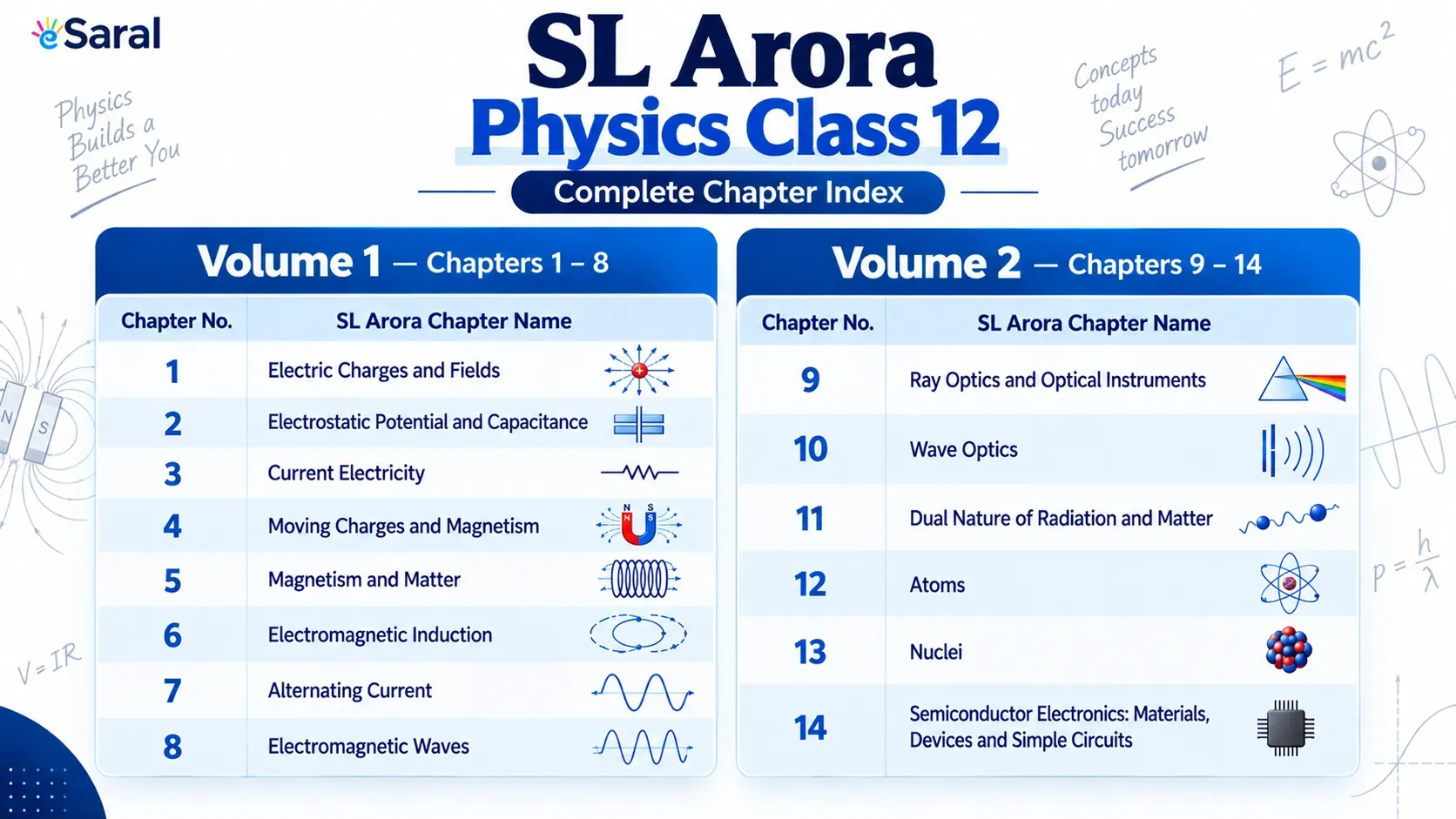
SL Arora Physics Class 12 Index – Chapter List for Volume 1 & 2
SL Arora Physics Class 12 index — complete chapter list for Volume 1 & 2, mapped to NCERT solutions for board, JEE Main, and NEET preparation.