
NCERT Exemplar Class 11 Maths PDF 2026-27 – Chapter-wise Free Download

eSaral Academic and Editorial Team
Summary
The NCERT Exemplar Class 11 Maths PDF 2026–27 is a useful chapter-wise practice resource for strengthening concepts, improving problem-solving skills, and building a strong foundation for school exams and JEE preparation. The current NCERT Class 11 Mathematics textbook follows a 14-chapter structure, from Sets to Probability, while older Exemplar resources were arranged in a 16-chapter sequence; therefore, students should use the updated chapter mapping for 2026–27.
NCERT Exemplar Class 11 Maths PDF 2026-27 – Chapter-wise Free Download
The NCERT Exemplar Class 11 Maths PDF is one of the most useful practice resources for students who want to strengthen their mathematical concepts beyond the standard NCERT textbook exercises. It contains conceptual MCQs, short-answer problems, long-answer questions and higher-level applications that can help students prepare for Class 11 school exams as well as build a stronger foundation for JEE Main and JEE Advanced.
For the 2026–27 session, students should be careful while following older Class 11 Maths Exemplar chapter lists. The current NCERT Class 11 Mathematics textbook contains 14 chapters, beginning with Sets and ending with Probability.
Older NCERT Exemplar material was arranged in a 16-chapter sequence, which also included Principle of Mathematical Induction and Mathematical Reasoning. These two chapters are not listed as separate chapters in the current 2026–27 NCERT Mathematics textbook.
To make preparation easier, the Exemplar PDFs below have been mapped to the current 14-chapter NCERT Class 11 Maths sequence.
NCERT Exemplar Class 11 Maths PDF Chapter-wise Download 2026–27
Current Chapter | Chapter Name | Exemplar PDF |
|---|---|---|
1 | Sets | |
2 | Relations and Functions | |
3 | Trigonometric Functions | |
4 | Complex Numbers and Quadratic Equations | |
5 | Linear Inequalities | |
6 | Permutations and Combinations | |
7 | Binomial Theorem | |
8 | Sequences and Series | |
9 | Straight Lines | |
10 | Conic Sections | |
11 | Introduction to Three Dimensional Geometry | |
12 | Limits and Derivatives | |
13 | Statistics | |
14 | Probability | |
— | Complete Exemplar Answer Key |
These are the same Exemplar PDF resources already linked on the live eSaral page; only the numbering and current-syllabus mapping have been corrected. Payload Website Template
Important 2026–27 Chapter Update
Older NCERT Class 11 Maths books and Exemplar lists contain 16 chapters, but the current 2026–27 textbook contains 14 chapters.
The following two older standalone chapters are not part of the current textbook chapter list:
Older Chapter | Current 2026–27 Status |
|---|---|
Principle of Mathematical Induction | Not listed as a standalone chapter |
Mathematical Reasoning | Not listed as a standalone chapter |
The attached 2026–27 textbook contents show that Complex Numbers and Quadratic Equations is now Chapter 4, followed by Linear Inequalities, Permutations and Combinations, Binomial Theorem and Sequences and Series.
Similarly, after Limits and Derivatives, the current textbook proceeds directly to Statistics as Chapter 13 and Probability as Chapter 14.
This is why old Exemplar chapter numbers do not always match the current textbook numbering.
Current NCERT Class 11 Maths Chapter List 2026–27
According to the current textbook, the chapter sequence is:
Chapter | Chapter Name |
|---|---|
1 | Sets |
2 | Relations and Functions |
3 | Trigonometric Functions |
4 | Complex Numbers and Quadratic Equations |
5 | Linear Inequalities |
6 | Permutations and Combinations |
7 | Binomial Theorem |
8 | Sequences and Series |
9 | Straight Lines |
10 | Conic Sections |
11 | Introduction to Three Dimensional Geometry |
12 | Limits and Derivatives |
13 | Statistics |
14 | Probability |
The textbook additionally contains Answers, Appendix 1: Infinite Series, Appendix 2: Mathematical Modelling and Supplementary Material.
What Is NCERT Exemplar Class 11 Maths?
The NCERT Exemplar Class 11 Maths PDF is a supplementary problem-solving resource designed to test students beyond routine NCERT exercise questions.
It typically includes:
- Multiple-choice questions
- Short-answer questions
- Long-answer questions
- Concept-based problems
- Application-oriented questions
- Problems requiring multiple mathematical steps
The Exemplar should ideally be solved after completing the corresponding NCERT textbook chapter.
For the current textbook PDFs, students can refer to the NCERT Class 11 Maths Book PDF 2026-27.
Why Should You Solve NCERT Exemplar Class 11 Maths?
1. Builds Stronger Concepts
Standard NCERT exercises help establish the basic concepts, while Exemplar problems require students to apply those concepts in less direct situations.
This makes the NCERT Exemplar Class 11 Maths PDF especially useful for identifying whether you have truly understood a topic.
2. Improves Problem-Solving Skills
Mathematics preparation is not only about remembering formulas. Students must learn how to select the right concept and combine multiple steps to solve unfamiliar problems.
Exemplar questions are useful for developing this skill.
3. Helpful for JEE Foundation
Many Class 11 Maths topics form the base for JEE Main and JEE Advanced Mathematics.
Important topics include:
- Trigonometric Functions
- Complex Numbers
- Permutations and Combinations
- Binomial Theorem
- Sequences and Series
- Straight Lines
- Conic Sections
- Limits and Derivatives
Solving the Exemplar after NCERT can help bridge the gap between school-level exercises and entrance-exam problem solving.
4. Useful for Class 11 Exams
Exemplar practice can also help students become comfortable with conceptual and non-routine questions that may appear in school examinations.
Chapter-wise Overview of NCERT Exemplar Class 11 Maths
Chapter 1 – Sets
This chapter covers the representation of sets, empty sets, finite and infinite sets, subsets, universal sets, Venn diagrams, union, intersection and complement.
The current NCERT textbook starts with Sets and includes operations on sets and complement of a set.
Chapter 2 – Relations and Functions
Students study Cartesian products, relations and functions. Exemplar problems help strengthen understanding of mappings and mathematical relationships between sets.
Chapter 3 – Trigonometric Functions
This chapter includes angles, trigonometric functions and formulas involving the sum and difference of two angles.
It is an important foundation chapter for both Class 12 Mathematics and JEE preparation.
Chapter 4 – Complex Numbers and Quadratic Equations
This is Chapter 4 in the current textbook, although it was Chapter 5 in the older Exemplar sequence.
Important areas include:
- Complex numbers
- Algebra of complex numbers
- Modulus and conjugate
- Argand plane
- Polar representation
The current textbook lists this as Chapter 4.
Chapter 5 – Linear Inequalities
Students learn inequalities and algebraic and graphical solutions of linear inequalities in one variable.
Chapter 6 – Permutations and Combinations
This chapter covers:
- Fundamental Principle of Counting
- Permutations
- Combinations
The Exemplar contains non-routine counting problems that are useful for building JEE-level thinking.
Chapter 7 – Binomial Theorem
The current textbook focuses on the Binomial Theorem for positive integral indices.
Exemplar practice can help students handle coefficients, terms and expansions more confidently.
Chapter 8 – Sequences and Series
Important topics include:
- Sequences
- Series
- Geometric Progression
- Relationship between A.M. and G.M.
These topics are confirmed in the current textbook contents.
Chapter 9 – Straight Lines
Students study slope, different forms of equations of a line and distance of a point from a line.
Chapter 10 – Conic Sections
This chapter covers:
- Circle
- Parabola
- Ellipse
- Hyperbola
The current textbook retains all four conic topics.
Chapter 11 – Introduction to Three Dimensional Geometry
Students learn coordinate axes and coordinate planes in 3D, coordinates of points in space and distance between two points.
Chapter 12 – Limits and Derivatives
This chapter forms the foundation of Calculus.
The current textbook covers:
- Intuitive idea of derivatives
- Limits
- Limits of trigonometric functions
- Derivatives
Chapter 13 – Statistics
The current Statistics chapter focuses mainly on measures of dispersion, including:
- Range
- Mean deviation
- Variance
- Standard deviation
Chapter 14 – Probability
Probability is the final chapter of the current NCERT Class 11 Maths textbook.
It includes:
- Events
- Axiomatic approach to probability
NCERT Textbook vs NCERT Exemplar Class 11 Maths
NCERT Maths Textbook | NCERT Maths Exemplar |
|---|---|
Introduces concepts and formulas | Tests deeper application |
Contains standard exercises | Contains more challenging questions |
Best starting point | Best used after NCERT |
Builds the foundation | Strengthens problem solving |
Essential for Class 11 | Useful for advanced practice and JEE foundation |
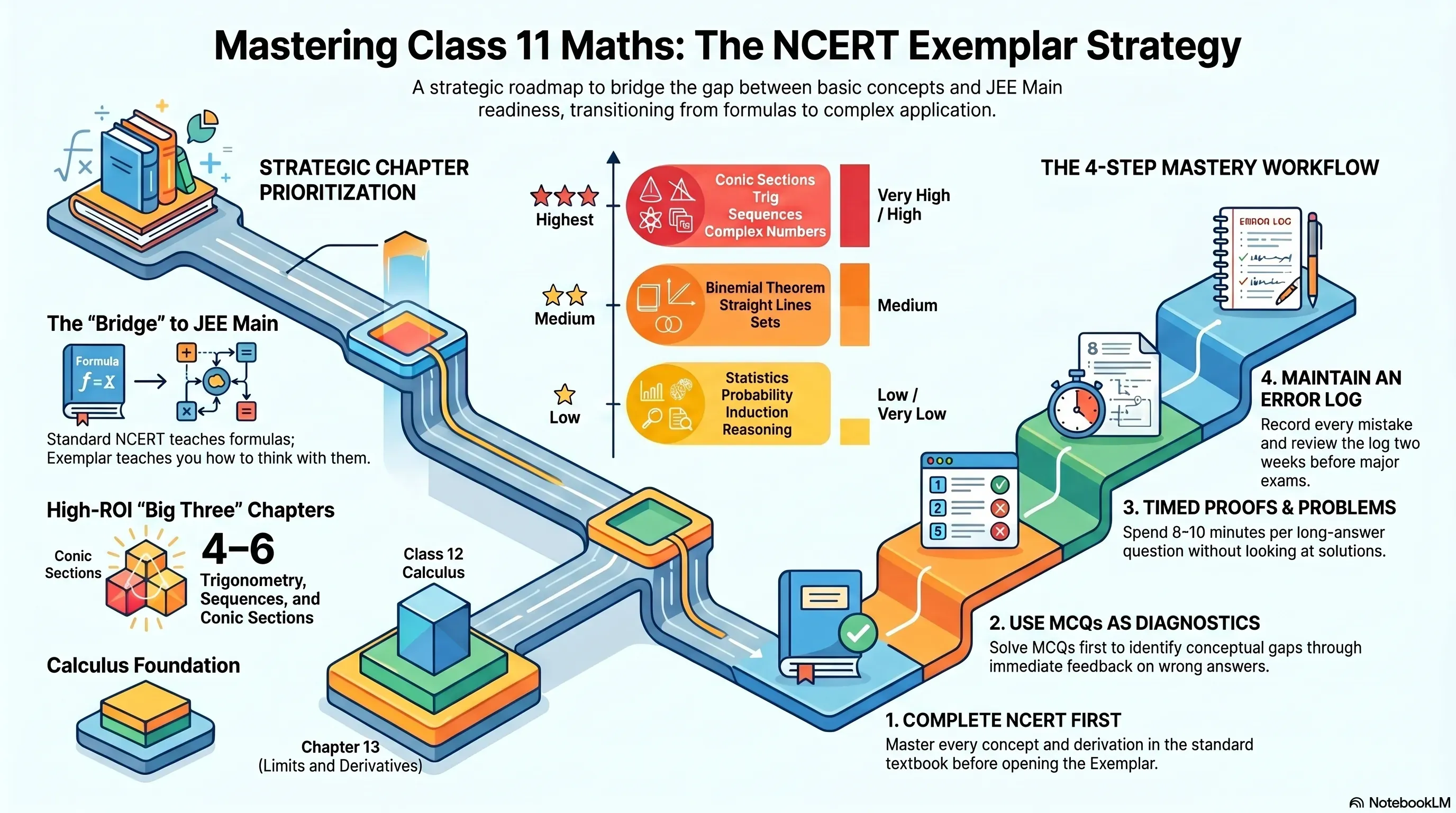
A good preparation sequence is:
NCERT theory → NCERT examples → NCERT exercises → NCERT Exemplar → JEE-level questions
How to Use NCERT Exemplar Class 11 Maths Effectively
Step 1 – Complete the NCERT Chapter First
Understand the theory, solved examples and standard exercises before beginning the Exemplar.
You can use eSaral's NCERT Class 11 Maths Book PDF 2026-27 alongside the Exemplar.
Step 2 – Attempt Questions Without Solutions
Try each question independently before checking the answer.
This helps you identify whether your difficulty is due to:
- A concept gap
- Formula recall
- Calculation error
- Incorrect problem-solving approach
Step 3 – Mark Difficult Problems
Mark questions that take too long or require help.
Return to those questions during revision instead of repeatedly solving only easy problems.
Step 4 – Maintain an Error Notebook
For every incorrect question, write:
Question type → Mistake → Correct method → Key concept
This makes later revision much faster.
Step 5 – Follow the Current 14-Chapter Order
Students should not blindly follow old 16-chapter numbering.
Use the topic name, not only the old Exemplar chapter number, when matching your practice with the current NCERT syllabus.
Removed Chapters from the Current Textbook
The current 2026–27 Class 11 Maths textbook does not list these two older chapters separately:
Principle of Mathematical Induction
Mathematical Reasoning
The present textbook contains 14 main chapters and then moves to Answers and appendices.
Older Exemplar PDFs for these chapters may still exist, but they should not be shown inside the main 2026–27 chapter-wise table because doing so makes the page appear outdated.
Related eSaral Resource
For the latest textbook chapter sequence and textbook PDFs, use:
NCERT Class 11 Maths Book PDF 2026-27
Conclusion
The NCERT Exemplar Class 11 Maths PDF 2026-27 is a valuable supplementary resource for strengthening mathematical concepts and developing better problem-solving skills. However, students should follow the current 14-chapter NCERT Class 11 Maths sequence, rather than the older 16-chapter numbering.
Study each chapter from NCERT first, solve the corresponding Exemplar problems, analyse your mistakes and then move to higher-level JEE practice. This approach keeps your preparation aligned with the current 2026–27 textbook while still making full use of the existing NCERT Exemplar questions.
Frequently Asked Questions
How many chapters are there in NCERT Class 11 Maths for 2026–27?
The current NCERT Class 11 Mathematics textbook contains 14 chapters, from Sets to Probability. The contents page confirms Chapters 1–12 followed by Statistics as Chapter 13 and Probability as Chapter 14.
Why does the older NCERT Exemplar Class 11 Maths PDF show 16 chapters?
Older Exemplar material follows the previous 16-chapter structure. The current 2026–27 textbook no longer lists Principle of Mathematical Induction and Mathematical Reasoning as separate chapters, which reduces the current textbook sequence to 14 chapters.
Which chapters have been removed from Class 11 Maths?
Principle of Mathematical Induction and Mathematical Reasoning are not listed as standalone chapters in the current 2026–27 NCERT Class 11 Mathematics textbook.
Is NCERT Exemplar Class 11 Maths useful for JEE Main?
Yes. NCERT Exemplar can help Class 11 students strengthen conceptual understanding and problem-solving ability before progressing to more advanced JEE Main practice.
Where can I get free video lectures for NCERT Exemplar Class 11 Maths?
Free video lectures covering every Class 11 Maths chapter — with concept explanations and problem-solving at exemplar-difficulty level — are available by installing the eSaral App. Lectures are taught by NK Gupta Sir and the eSaral IIT faculty team, covering boards, JEE Main, and JEE Advanced levels.
Should I solve NCERT or NCERT Exemplar first?
Start with the NCERT textbook. Complete the concepts, solved examples and exercises first, then solve the corresponding NCERT Exemplar Class 11 Maths PDF chapter.
Is NCERT Exemplar enough for JEE Main Maths?
No. Exemplar is useful for conceptual practice, but JEE Main aspirants should also solve JEE-level questions, mock tests and previous-year questions after building their NCERT foundation.
Where can I download the latest Class 11 Maths textbook on eSaral?
Students can access the current 14-chapter textbook structure and chapter-wise resources through eSaral's NCERT Class 11 Maths Book PDF 2026-27. The eSaral page reflects the current 14-chapter arrangement.
Does eSaral provide chapter-wise NCERT Exemplar Class 11 Maths PDFs?
Yes. eSaral provides chapter-wise Exemplar PDFs and an answer-key PDF. This updated page maps those resources to the current 14-chapter 2026–27 textbook sequence so students can practise according to the latest chapter order.
Team eSaral
eSaral Academic and Editorial Team
Team eSaral is the collective author profile for educational content created by eSaral’s teachers and academic contributors. The team draws on expertise from IIT graduates, doctors, experienced educators and subject specialists to develop resources for JEE, NEET and school students. Our articles aim to explain concepts clearly and help students study with confidence.
Related Posts

BITSAT 2027: Registration Date, Exam Date, Syllabus, Eligibility, Pattern & Fees
BITSAT 2027 exam dates, registration timeline, eligibility criteria, exam pattern, marking scheme, syllabus and fees in one page.

BITSAT Previous Year Question Paper PDF (2017-2026)
Download BITSAT previous year question papers PDF from 2017 to 2026,session-wise. Memory-based papers,exam pattern, paper analysis and how to practise

CBSE Class 10 Date Sheet 2027: Expected Exam Dates, Release Date, Admit Card & Result Timeline
CBSE Class 10 date sheet 2027 is awaited. See the expected exam dates, release window, how to download the PDF, admit card and result timelines.

NCERT Physics Class 10 Book PDF in Hindi 2026-27 – भौतिक विज्ञान के 4 अध्याय (Free Download)
NCERT Physics Class 10 book PDF in Hindi 2026-27: download all 4 chapters (अध्याय 9–12) free, with topics and important formulas.

NCERT Biology Class 9 Book Anveshan PDF in Hindi - जीव विज्ञान कक्षा 9 पुस्तक अन्वेषण PDF
Download NCERT Biology Class 9 book PDF in Hindi chapterwise for 2026-27: Cell, Tissues, Reproduction and Diversity. Free PDFs.

Essay On Artificial Intelligence in English (100,150, 200, 250, 300, 500 Words)
This is in contrast to the natural intelligence of humans. With Artificial Intelligence, machines can perform

Essay on 78th India Independence Day in English for Student (100, 150, 200, 250, 300, 500 Words)
Read the best essays on India's Independence Day in English. Short & long essays (100, 150, 200, 250, 300, 500 words) perfect for school exams
NCERT Class 11 English Snapshots book - Free PDF download- Esaral
Download NCERT Class 11 English Snapshots book PDF for free. Get all 8 chapters, chapter-wise. Start your prep today!
NCERT Class 10 biology book pdf - Free PDF Download - eSaral
NCERT Class 10 Biology book PDF 2026-27: all 5 chapters (Life Processes to Our Environment) in English & Hindi, with CBSE syllabus, marks & practical

Essay on Global Warming in English (100,150, 200, 250, 300, 500 Words)
Global warming means the Earth is getting hotter. This happens because of things like pollution from cars and factories.