
NCERT Solutions for Class 9 Maths chapter 14 Exercise 14.2 - Statistics

eSaral Academic and Editorial Team
Hey, are you a class 9 Student and Looking for Ways to Download NCERT Solutions for Class 9 Maths chapter 14 Exercise 14.2? If Yes then you are at the right place.
Here we have listed Class 9 maths chapter 14 exercise 14.2 solutions in PDF that is prepared by Kota’s top IITian’s Faculties by keeping Simplicity in mind.
If you want to score high in your class 9 Maths Exam then it is very important for you to have a good knowledge of all the important topics, so to learn and practice those topics you can use eSaral NCERT Solutions.
In this article, we have listed NCERT Solutions for Class 9 Maths chapter 14 Exercise 14.2 that you can download to start your preparations anytime.
So, without wasting more time Let’s start.
Download The PDF of NCERT Solutions for Class 9 Maths chapter 14 Exercise 14.2 "Statistics"
So, that’s all from this article. I hope you enjoyed this post. If you found this article helpful then please share it with other students.
All Questions of Chapter 14 Exercise 14.2
Once you complete the chapter 14 then you can revise Ex. 14.2 by solving following questions
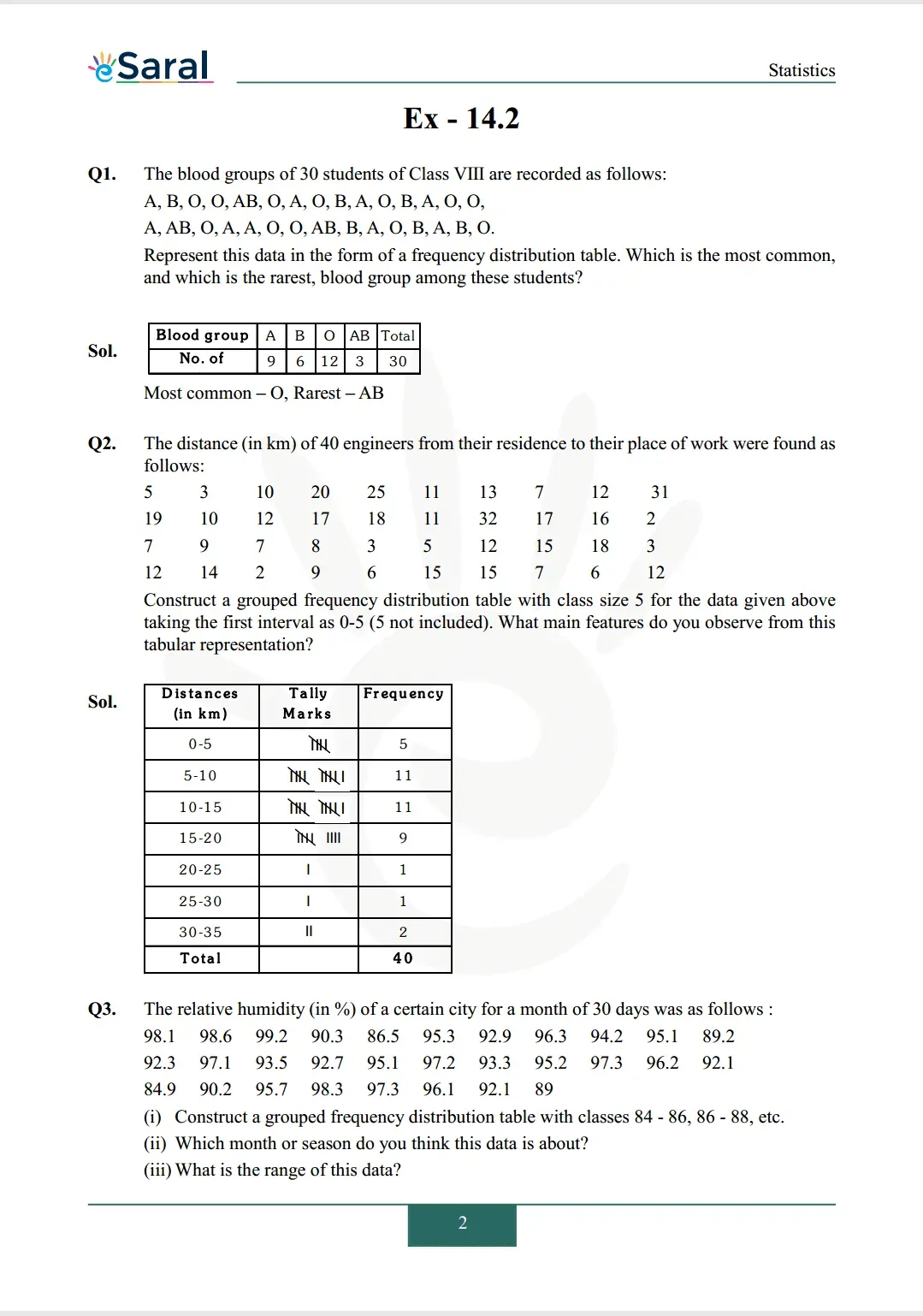
Q1. The blood groups of 30 students of Class VIII are recorded as follows:
$\mathrm{A}, \mathrm{B}, \mathrm{O}, \mathrm{O}, \mathrm{AB}, \mathrm{O}, \mathrm{A}, \mathrm{O}, \mathrm{B}, \mathrm{A}, \mathrm{O}, \mathrm{B}, \mathrm{A}, \mathrm{O}, \mathrm{O}$
$\mathrm{A}, \mathrm{AB}, \mathrm{O}, \mathrm{A}, \mathrm{A}, \mathrm{O}, \mathrm{O}, \mathrm{AB}, \mathrm{B}, \mathrm{A}, \mathrm{O}, \mathrm{B}, \mathrm{A}, \mathrm{B}, \mathrm{O} .$
Represent this data in the form of a frequency distribution table. Which is the most common, and which is the rarest, blood group among these students?
\begin{aligned}
&\text
{Q2. The distance (in} \mathrm{km} \text {) of} 40 \text {engineers from their residence to their place of work were found as} \\
&\begin{array}{llllllllll}
\text {follows:} & & & & & & & & \\ 5 & 3 & 10 & 20 & 25 & 11 & 13 & 7 & 12 & 31 \\ 19 & 10 & 12 & 17 & 18 & 11 & 32 & 17 & 16 & 2 \\ 7 & 9 & 7 & 8 & 3 & 5 & 12 & 15 & 18 & 3 \\ 12 & 14 & 2 & 9 & 6 & 15 & 15 & 7 & 6 & 12
\end{array}
\end{aligned}
Construct a grouped frequency distribution table with class size 5 for the data given above taking the first interval as $0-5$ (5 not included). What main features do you observe from this tabular representation?
Q3. The relative humidity (in %) of a certain city for a month of 30 days was as follows:
$\begin{array}{lllllllllll}98.1 & 98.6 & 99.2 & 90.3 & 86.5 & 95.3 & 92.9 & 96.3 & 94.2 & 95.1 & 89.2 \\ 92.3 & 97.1 & 93.5 & 92.7 & 95.1 & 97.2 & 93.3 & 95.2 & 97.3 & 96.2 & 92.1 \\ 84.9 & 90.2 & 95.7 & 98.3 & 97.3 & 96.1 & 92.1 & 89 & & & \end{array}$
(i) Construct a grouped frequency distribution table with classes $84-86,86-88$, etc.
(ii) Which month or season do you think this data is about?
(iii) What is the range of this data?
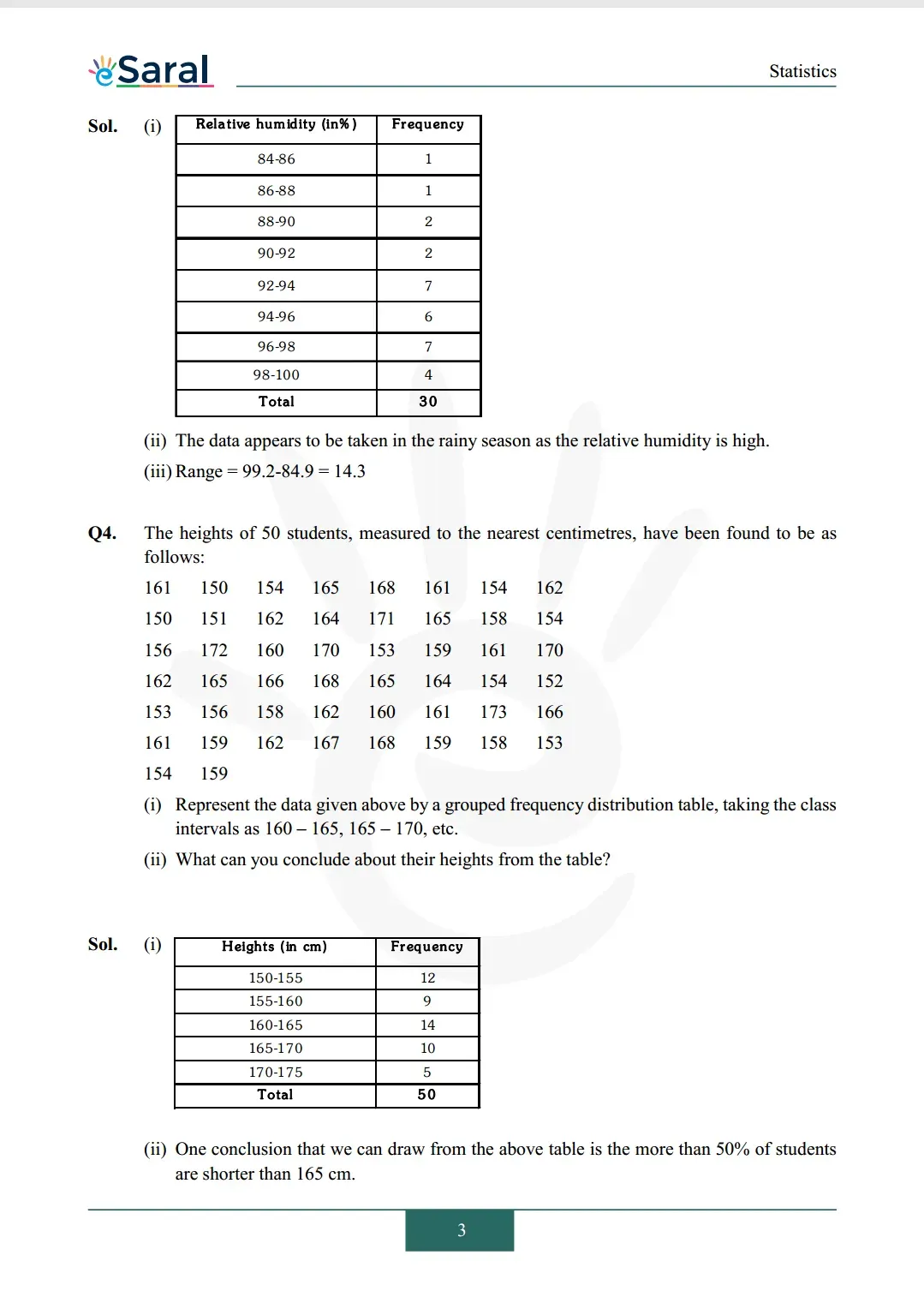
Q4. The heights of 50 students, measured to the nearest centimetres, have been found to be as follows:
$\begin{array}{llllllll}161 & 150 & 154 & 165 & 168 & 161 & 154 & 162 \\ 150 & 151 & 162 & 164 & 171 & 165 & 158 & 154 \\ 156 & 172 & 160 & 170 & 153 & 159 & 161 & 170 \\ 162 & 165 & 166 & 168 & 165 & 164 & 154 & 152 \\ 153 & 156 & 158 & 162 & 160 & 161 & 173 & 166 \\ 161 & 159 & 162 & 167 & 168 & 159 & 158 & 153 \\ 154 & 159 & & & & & & \end{array}$
(i) Represent the data given above by a grouped frequency distribution table, taking the class intervals as $160-165,165-170$, etc.
(ii) What can you conclude about their heights from the table?
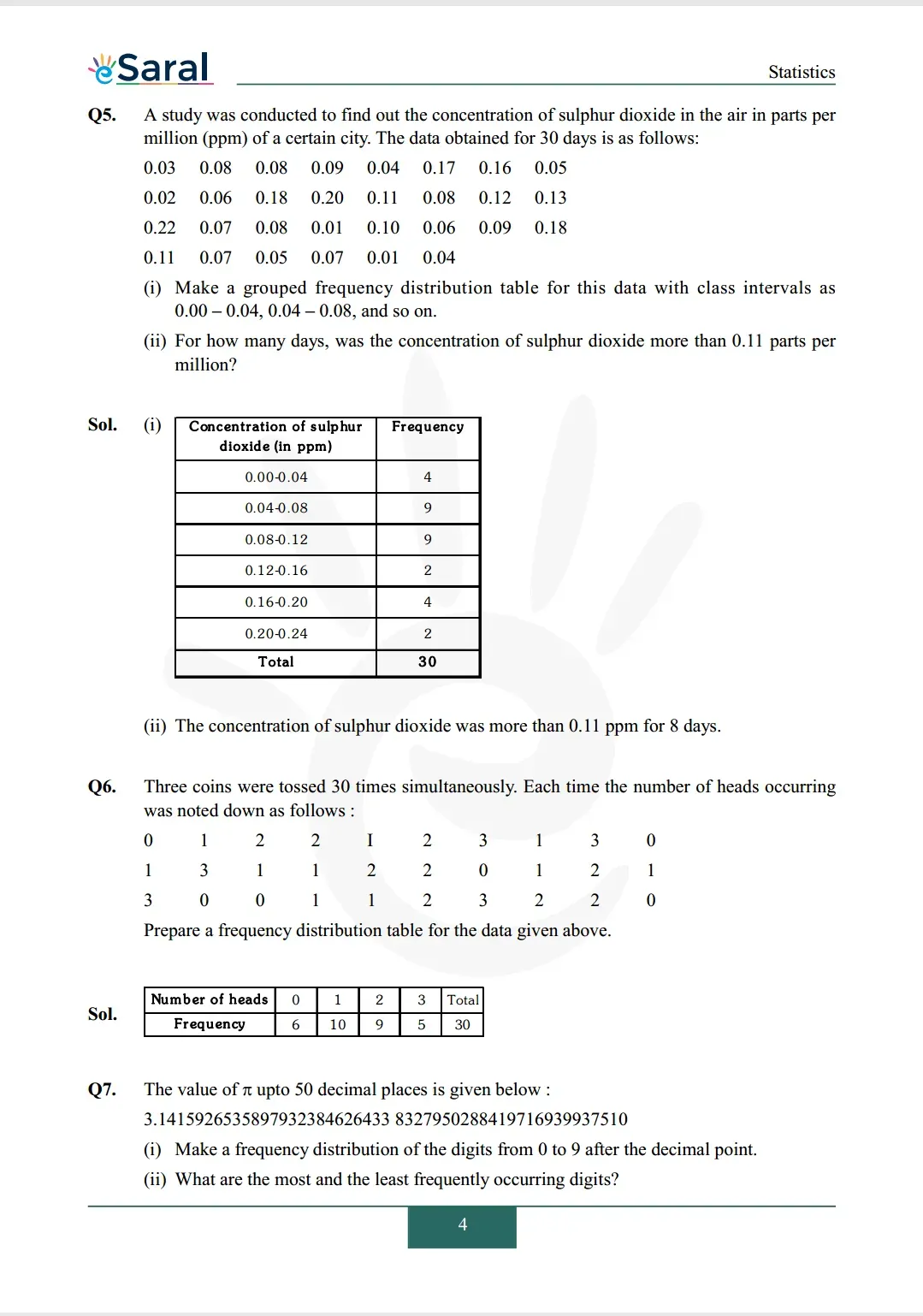
Q5. A study was conducted to find out the concentration of sulphur dioxide in the air in parts per million (ppm) of a certain city. The data obtained for 30 days is as follows:
$\begin{array}{llllllll}0.03 & 0.08 & 0.08 & 0.09 & 0.04 & 0.17 & 0.16 & 0.05 \\ 0.02 & 0.06 & 0.18 & 0.20 & 0.11 & 0.08 & 0.12 & 0.13 \\ 0.22 & 0.07 & 0.08 & 0.01 & 0.10 & 0.06 & 0.09 & 0.18 \\ 0.11 & 0.07 & 0.05 & 0.07 & 0.01 & 0.04 & & \end{array}$
(i) Make a grouped frequency distribution table for this data with class intervals as $0.00-0.04,0.04-0.08$, and so on.
(ii) For how many days, was the concentration of sulphur dioxide more than $0.11$ parts per million?
Q6. Three coins were tossed 30 times simultaneously. Each time the number of heads occurring was noted down as follows:
$\begin{array}{rrrrrrrrrr}0 & 1 & 2 & 2 & \mathrm{I} & 2 & 3 & 1 & 3 & 0 \\ 1 & 3 & 1 & 1 & 2 & 2 & 0 & 1 & 2 & 1 \\ 3 & 0 & 0 & 1 & 1 & 2 & 3 & 2 & 2 & 0\end{array}$ Prepare a frequency distribution table for the data given above.
Q7. The value of $\pi$ upto 50 decimal places is given below:
$3.14159265358979323846264338327950288419716939937510$
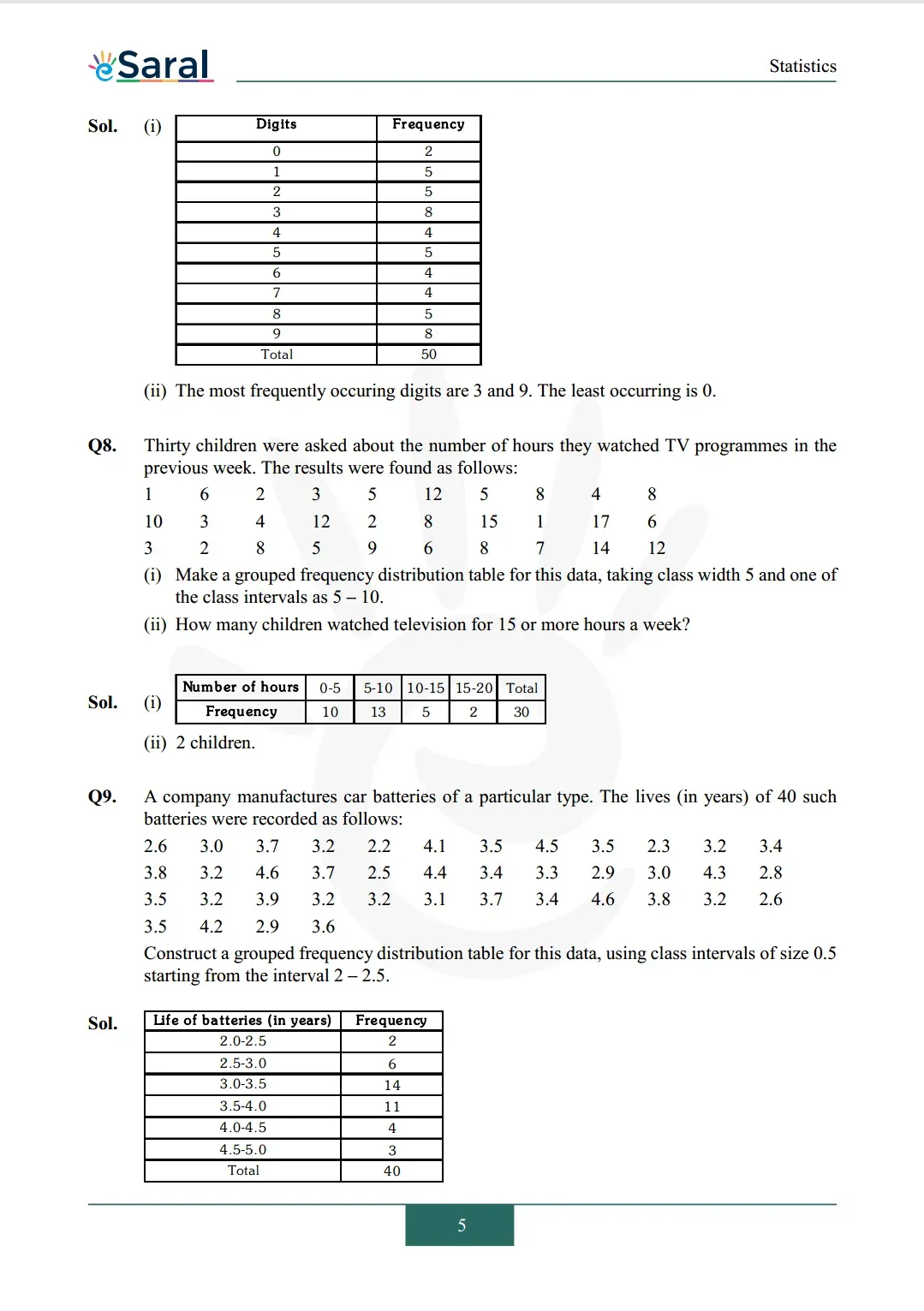
(i) Make a frequency distribution of the digits from 0 to 9 after the decimal point.
(ii) What are the most and the least frequently occurring digits?
Q8. Thirty children were asked about the number of hours they watched TV programmes in the previous week. The results were found as follows:
$\begin{array}{llllllllll}1 & 6 & 2 & 3 & 5 & 12 & 5 & 8 & 4 & 8 \\ 10 & 3 & 4 & 12 & 2 & 8 & 15 & 1 & 17 & 6 \\ 3 & 2 & 8 & 5 & 9 & 6 & 8 & 7 & 14 & 12\end{array}$
(i) Make a grouped frequency distribution table for this data, taking class width 5 and one of the class intervals as $5-10$.
(ii) How many children watched television for 15 or more hours a week?
Q9. A company manufactures car batteries of a particular type. The lives (in years) of 40 such batteries were recorded as follows:
$\begin{array}{llllllllllll}2.6 & 3.0 & 3.7 & 3.2 & 2.2 & 4.1 & 3.5 & 4.5 & 3.5 & 2.3 & 3.2 & 3.4 \\ 3.8 & 3.2 & 4.6 & 3.7 & 2.5 & 4.4 & 3.4 & 3.3 & 2.9 & 3.0 & 4.3 & 2.8 \\ 3.5 & 3.2 & 3.9 & 3.2 & 3.2 & 3.1 & 3.7 & 3.4 & 4.6 & 3.8 & 3.2 & 2.6 \\ 3.5 & 4.2 & 2.9 & 3.6 & & & & & & & & \end{array}$
Construct a grouped frequency distribution table for this data, using class intervals of size $0.5$ starting from the interval $2-2.5$.
Also Read,
Download NCERT Class 9 Maths Book PDF
Download NCERT Class 9 Maths Exemplar PDF
Download Complete Solutions for Class 9 Maths chapter 14 PDF
Download Class 9 Maths Chapter 13 Exercise 13.1 Solutions PDF
Download Class 9 Maths Chapter 13 Exercise 13.2 Solutions PDF
Download Class 9 Maths Chapter 13 Exercise 13.3 Solutions PDF
Download Class 9 Maths Chapter 13 Exercise 13.4 Solutions PDF
If you have any Confusion related to NCERT Solutions for Class 9 Maths chapter 14 Exercise 14.2 then feel free to ask in the comments section down below.
To watch Free Learning Videos on Class 9 by Kota’s top Faculties Install the eSaral App
Team eSaral
eSaral Academic and Editorial Team
Team eSaral is the collective author profile for educational content created by eSaral’s teachers and academic contributors. The team draws on expertise from IIT graduates, doctors, experienced educators and subject specialists to develop resources for JEE, NEET and school students. Our articles aim to explain concepts clearly and help students study with confidence.
Related Posts

BITSAT 2027: Registration Date, Exam Date, Syllabus, Eligibility, Pattern & Fees
BITSAT 2027 exam dates, registration timeline, eligibility criteria, exam pattern, marking scheme, syllabus and fees in one page.

BITSAT Previous Year Question Paper PDF (2017-2026)
Download BITSAT previous year question papers PDF from 2017 to 2026,session-wise. Memory-based papers,exam pattern, paper analysis and how to practise

CBSE Class 10 Date Sheet 2027: Expected Exam Dates, Release Date, Admit Card & Result Timeline
CBSE Class 10 date sheet 2027 is awaited. See the expected exam dates, release window, how to download the PDF, admit card and result timelines.

NCERT Physics Class 10 Book PDF in Hindi 2026-27 – भौतिक विज्ञान के 4 अध्याय (Free Download)
NCERT Physics Class 10 book PDF in Hindi 2026-27: download all 4 chapters (अध्याय 9–12) free, with topics and important formulas.

NCERT Biology Class 9 Book Anveshan PDF in Hindi - जीव विज्ञान कक्षा 9 पुस्तक अन्वेषण PDF
Download NCERT Biology Class 9 book PDF in Hindi chapterwise for 2026-27: Cell, Tissues, Reproduction and Diversity. Free PDFs.

Essay On Artificial Intelligence in English (100,150, 200, 250, 300, 500 Words)
This is in contrast to the natural intelligence of humans. With Artificial Intelligence, machines can perform

Essay on 78th India Independence Day in English for Student (100, 150, 200, 250, 300, 500 Words)
Read the best essays on India's Independence Day in English. Short & long essays (100, 150, 200, 250, 300, 500 words) perfect for school exams
NCERT Class 11 English Snapshots book - Free PDF download- Esaral
Download NCERT Class 11 English Snapshots book PDF for free. Get all 8 chapters, chapter-wise. Start your prep today!
NCERT Class 10 biology book pdf - Free PDF Download - eSaral
NCERT Class 10 Biology book PDF 2026-27: all 5 chapters (Life Processes to Our Environment) in English & Hindi, with CBSE syllabus, marks & practical

Essay on Global Warming in English (100,150, 200, 250, 300, 500 Words)
Global warming means the Earth is getting hotter. This happens because of things like pollution from cars and factories.