
NCERT Solutions for Class 9 Maths chapter 2 Polynomials PDF - eSaral

eSaral Academic and Editorial Team
NCERT Solutions for Class 9 Maths chapter 2 Polynomials PDF
Hey, are you a class 9 student and looking for ways to download NCERT Solutions for Class 9 Maths chapter 2 Polynomials PDF? If yes. Then read this post till the end.
In this article, we have listed NCERT Solutions for Class 9 Maths chapter 2 Polynomials in PDF that is prepared by Kota’s top IITian’s Faculties by keeping Simplicity in mind.
If you want to learn and understand class 9 Maths chapter 2 "Polynomials" in an easy way then you can use these solutions PDF.
NCERT Solutions helps students to Practice important concepts of subjects easily. Class 9 Maths solutions provide detailed explanations of all the NCERT exercise questions that students can use to clear their doubts instantly.
If you want to score high in your class 9 Maths Exam then it is very important for you to have a good knowledge of all the important topics, so to learn and practice those topics you can use eSaral NCERT Solutions.
In this article, we have listed NCERT Solutions for Class 9 Maths chapter 2 Polynomials PDF that you can download to start your preparations anytime.
So, without wasting more time Let’s start.
Download NCERT Solutions for Class 9 Maths chapter 2 Polynomials PDF"

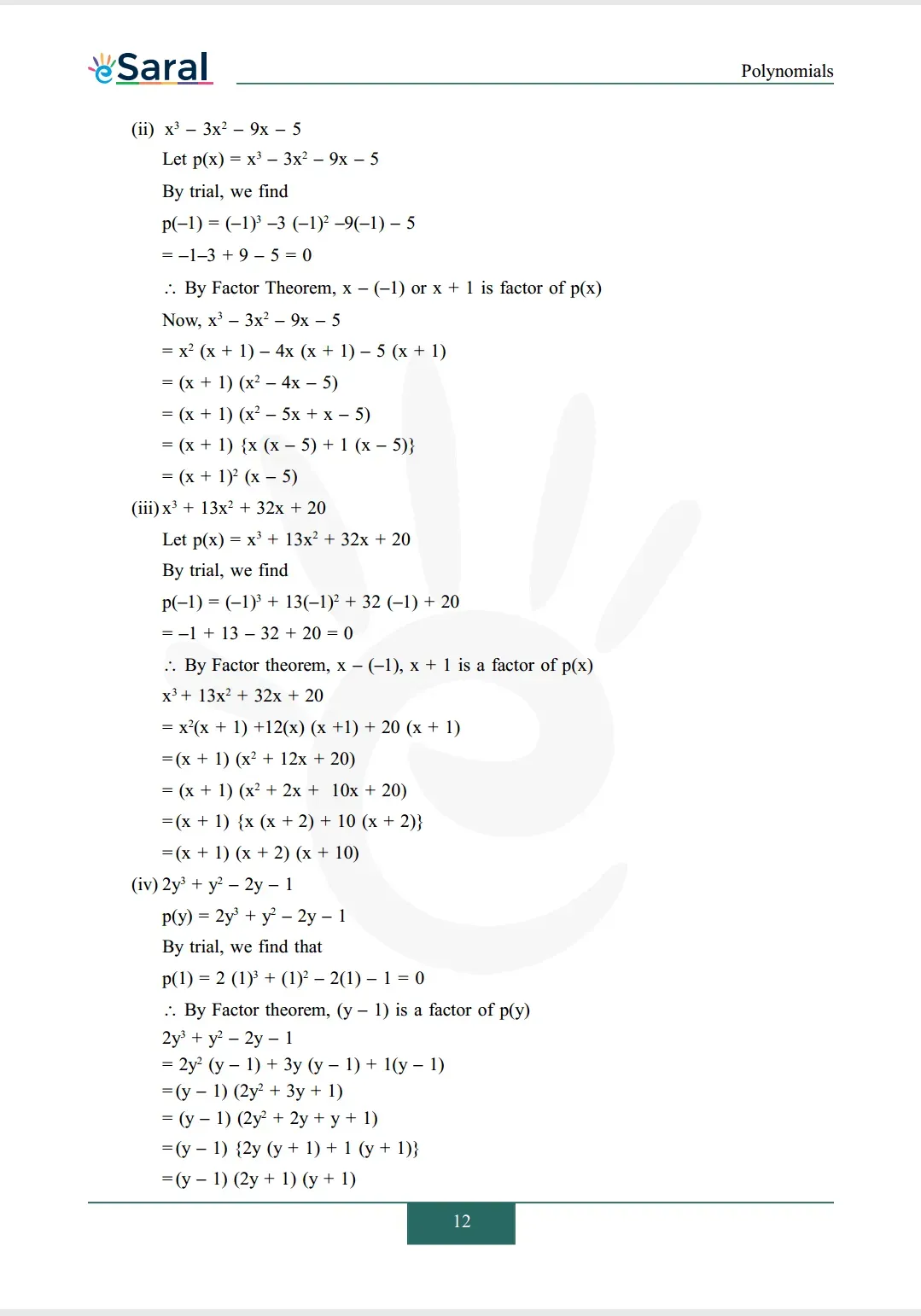
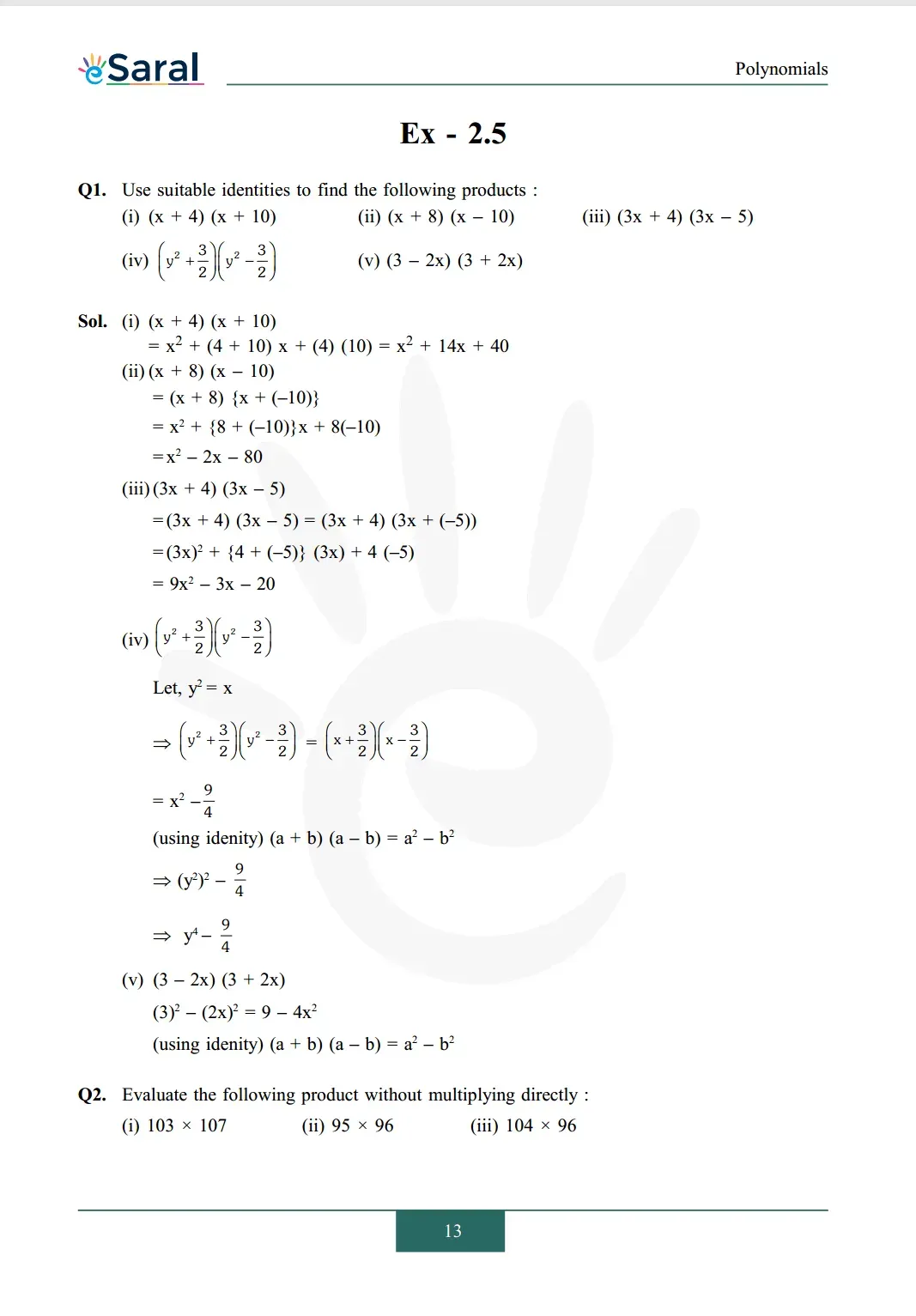
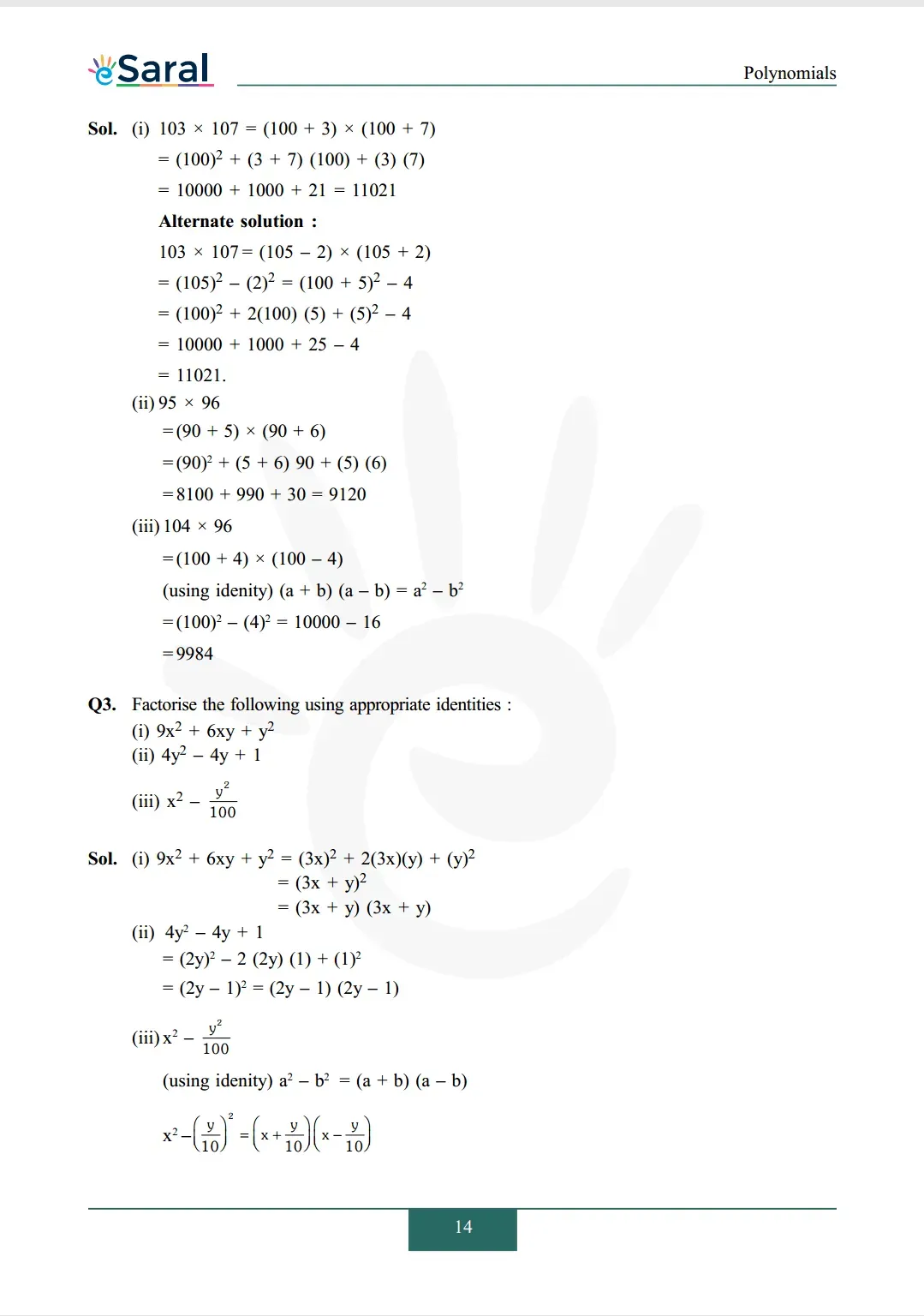
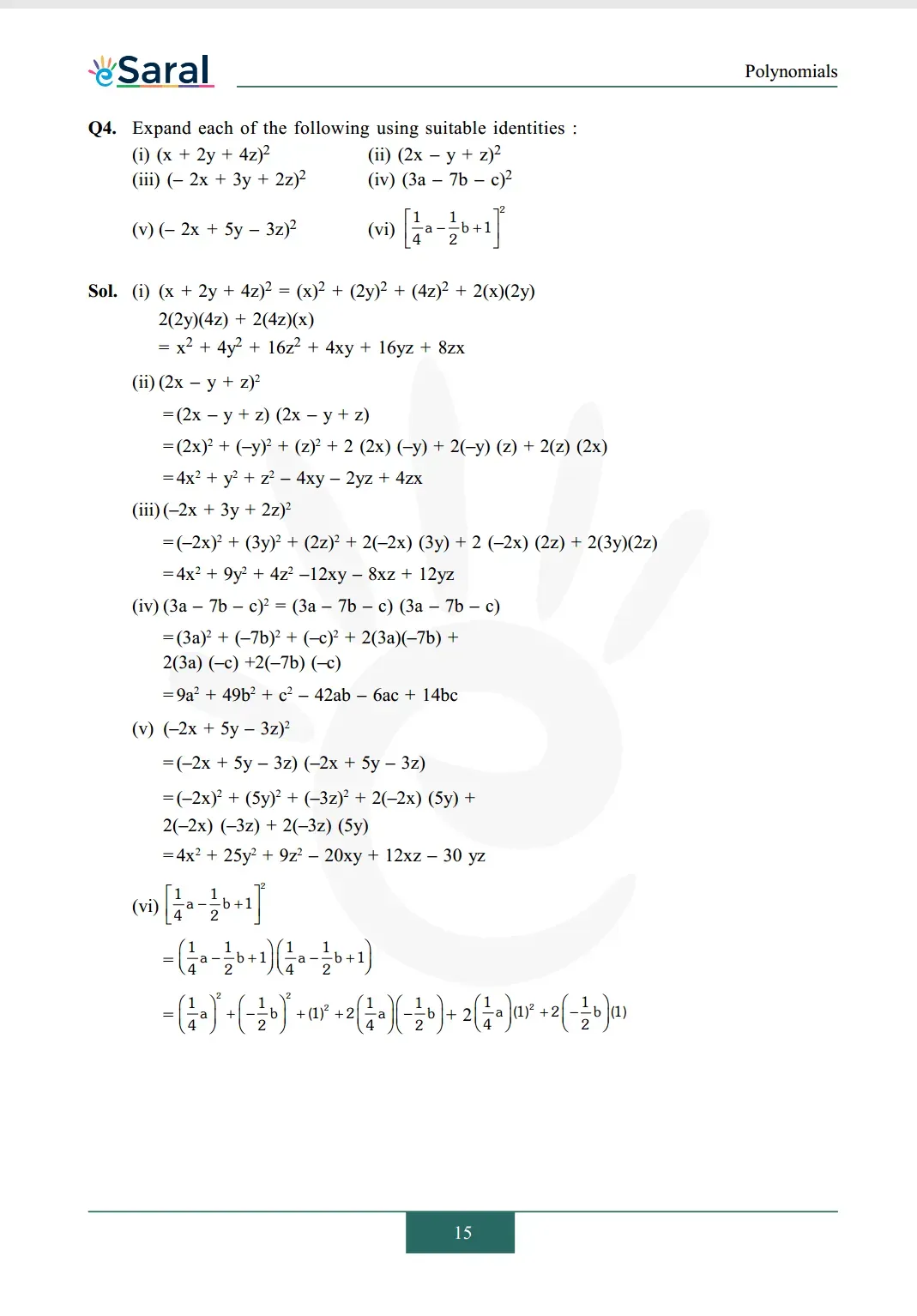
Download The PDF of NCERT Solutions for Class 9 Maths Chapter 2 "Polynomials"
NCERT Solutions for Class 9 Maths chapter 2 Ex - 2.1
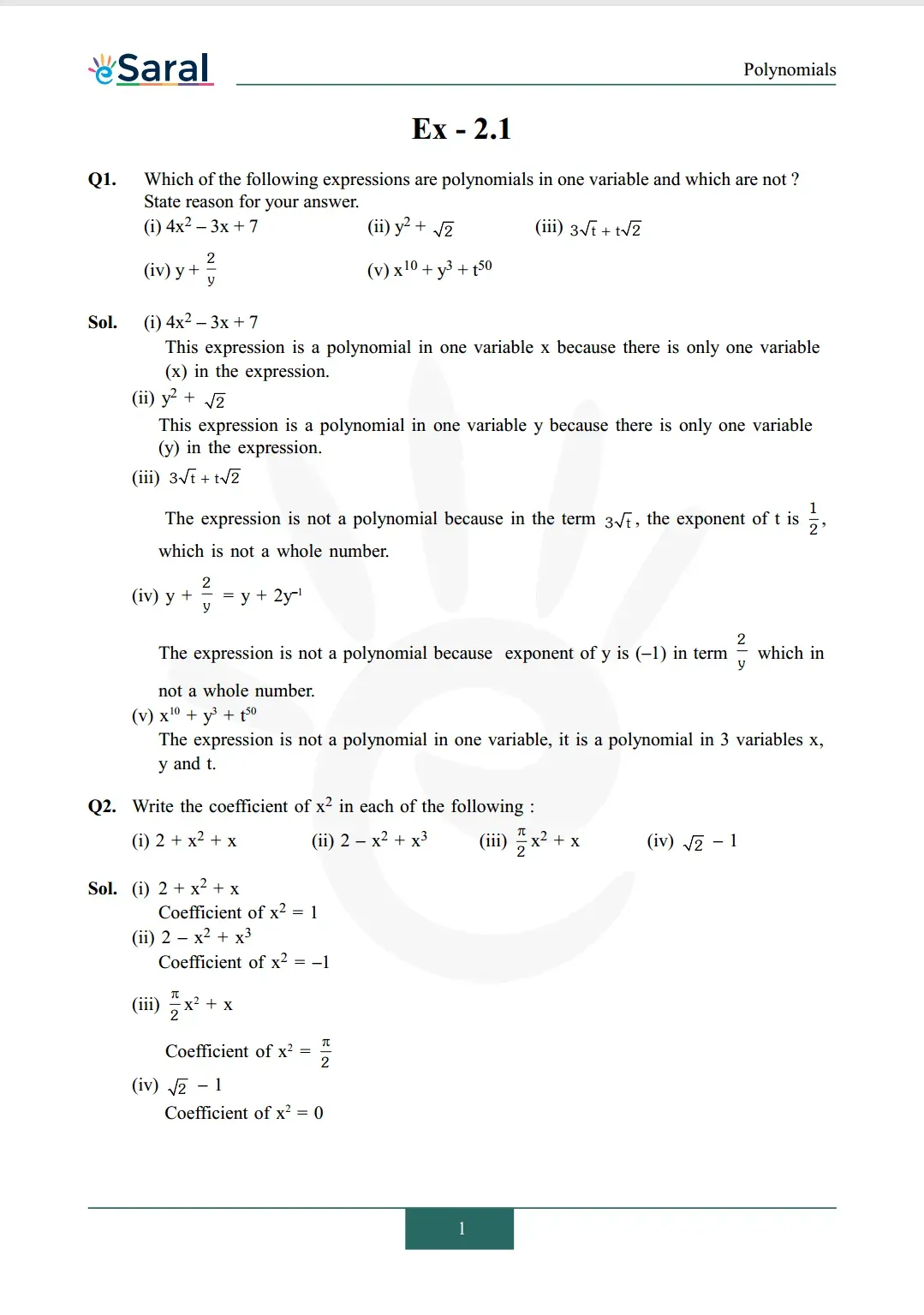
Q1. Which of the following expressions are polynomials in one variable and which are not ? State reason for your answer.
(i) $4 x^{2}-3 x+7$
(ii) $\mathrm{y}^{2}+\sqrt{2}$
(iii) $3 \sqrt{t}+t \sqrt{2}$
(iv) $\mathrm{y}+\frac{2}{\mathrm{y}}$
(v) $x^{10}+y^{3}+t^{50}$
Sol. (i) $4 x^{2}-3 x+7$
This expression is a polynomial in one variable $x$ because there is only one variable (x) in the expression.
(ii) $y^{2}+\sqrt{2}$
This expression is a polynomial in one variable y because there is only one variable (y) in the expression.
(iii) $3 \sqrt{t}+t \sqrt{2}$
The expression is not a polynomial because in the term $3 \sqrt{\mathrm{t}}$, the exponent of $\mathrm{t}$ is $\frac{1}{2}$,which is not a whole number.
(iv) $y+\frac{2}{y}=y+2 y^{-1}$
The expression is not a polynomial because exponent of $y$ is $(-1)$ in term $\frac{2}{y}$ which in
not a whole number.
(v) $x^{10}+y^{3}+t^{50}$
The expression is not a polynomial in one variable, it is a polynomial in 3 variables $\mathrm{x}$, $\mathrm{y}$ and $\mathrm{t}$.
Q2. Write the coefficient of $\mathrm{x}^{2}$ in each of the following :
(i) $2+x^{2}+x$
(ii) $2-x^{2}+x^{3}$
(iii) $\frac{\pi}{2} \mathrm{x}^{2}+\mathrm{x}$
(iv) $\sqrt{2}-1$
Sol. (i) $2+\mathrm{x}^{2}+\mathrm{x}$
Coefficient of $x^{2}=1$
(ii) $2-\mathrm{x}^{2}+\mathrm{x}^{3}$
Coefficient of $x^{2}=-1$
(iii) $\frac{\pi}{2} x^{2}+x$
Coefficient of $\mathrm{x}^{2}=\frac{\pi}{2}$
(iv) $\sqrt{2}-1$
Coefficient of $x^{2}=0$
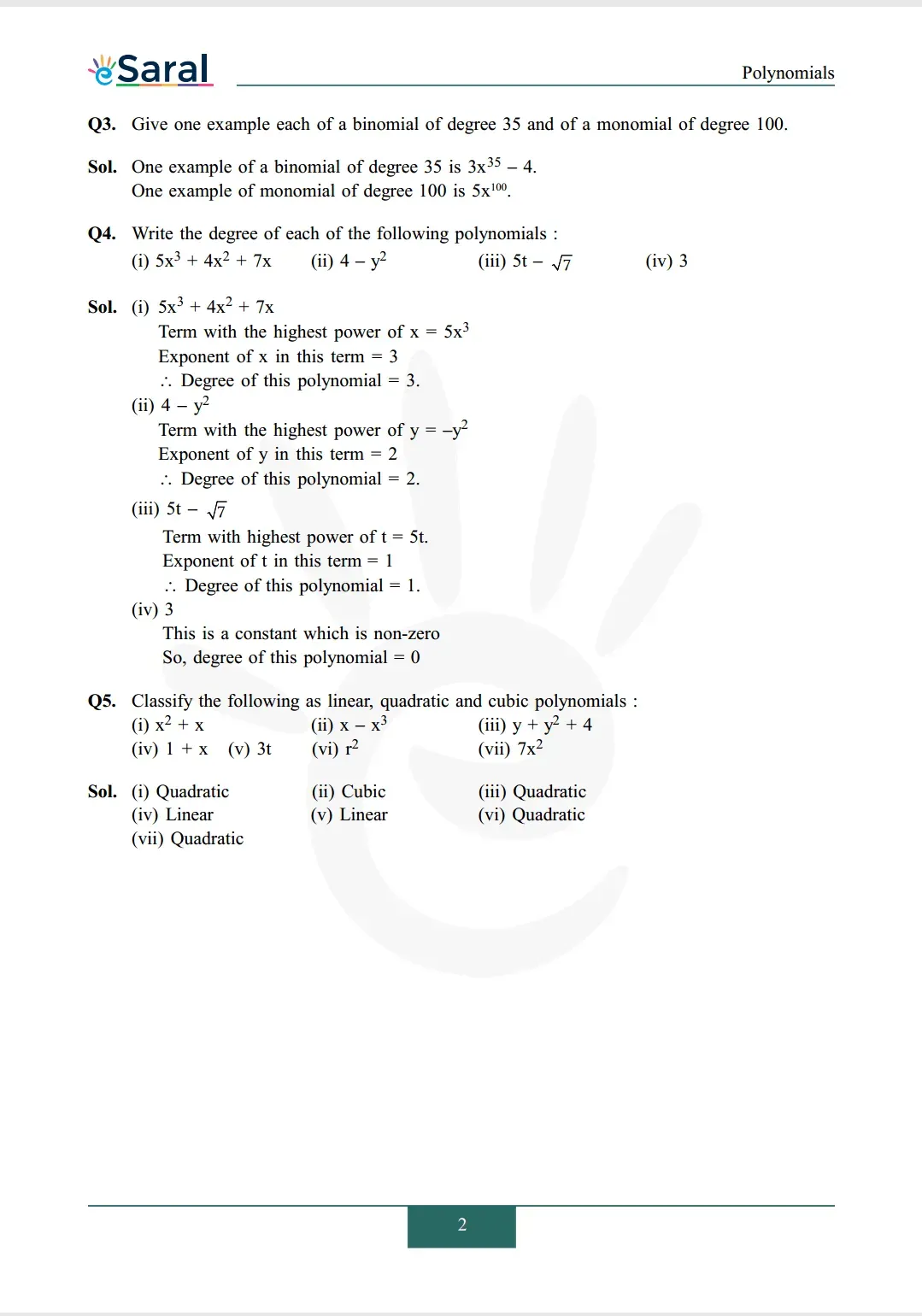
Q3. Give one example each of a binomial of degree 35 and of a monomial of degree 100 .
Sol. One example of a binomial of degree 35 is $3 \mathrm{x}^{35}-4 .$
One example of monomial of degree 100 is $5 \mathrm{x}^{100}$.
Q4. Write the degree of each of the following polynomials:
(i) $5 x^{3}+4 x^{2}+7 x$
(ii) $4-\mathrm{y}^{2}$
(iii) $5 \mathrm{t}-\sqrt{7}$
(iv) 3
Sol. (i) $5 x^{3}+4 x^{2}+7 x$
Term with the highest power of $x=5 x^{3}$
Exponent of $x$ in this term $=3$
$\therefore$ Degree of this polynomial $=3$.
(ii) $4-\mathrm{y}^{2}$
Term with the highest power of $\mathrm{y}=-\mathrm{y}^{2}$
Exponent of $\mathrm{y}$ in this term $=2$
$\therefore$ Degree of this polynomial $=2$
(iii) $5 \mathrm{t}-\sqrt{7}$
Term with highest power of $\mathrm{t}=5 \mathrm{t}$.
Exponent of $t$ in this term $=1$
$\therefore$ Degree of this polynomial $=1$.
(iv) 3
This is a constant which is non-zero
So, degree of this polynomial $=0$
Q5. Classify the following as linear, quadratic and cubic polynomials :
(i) $x^{2}+x$
(ii) $x-x^{3}$
(iii) $\mathrm{y}+\mathrm{y}^{2}+4$
(iv) $1+x \quad$
(v) $3 \mathrm{t}$
(vi) $r^{2}$
(vii) $7 \mathrm{x}^{2}$
Sol. (i) Quadratic
(ii) Cubic
(iii) Quadratic
(iv) Linear
(v) Linear
(vi) Quadratic
(vii) Quadratic
NCERT Solutions for Class 9 Maths chapter 2 Ex - 2.2
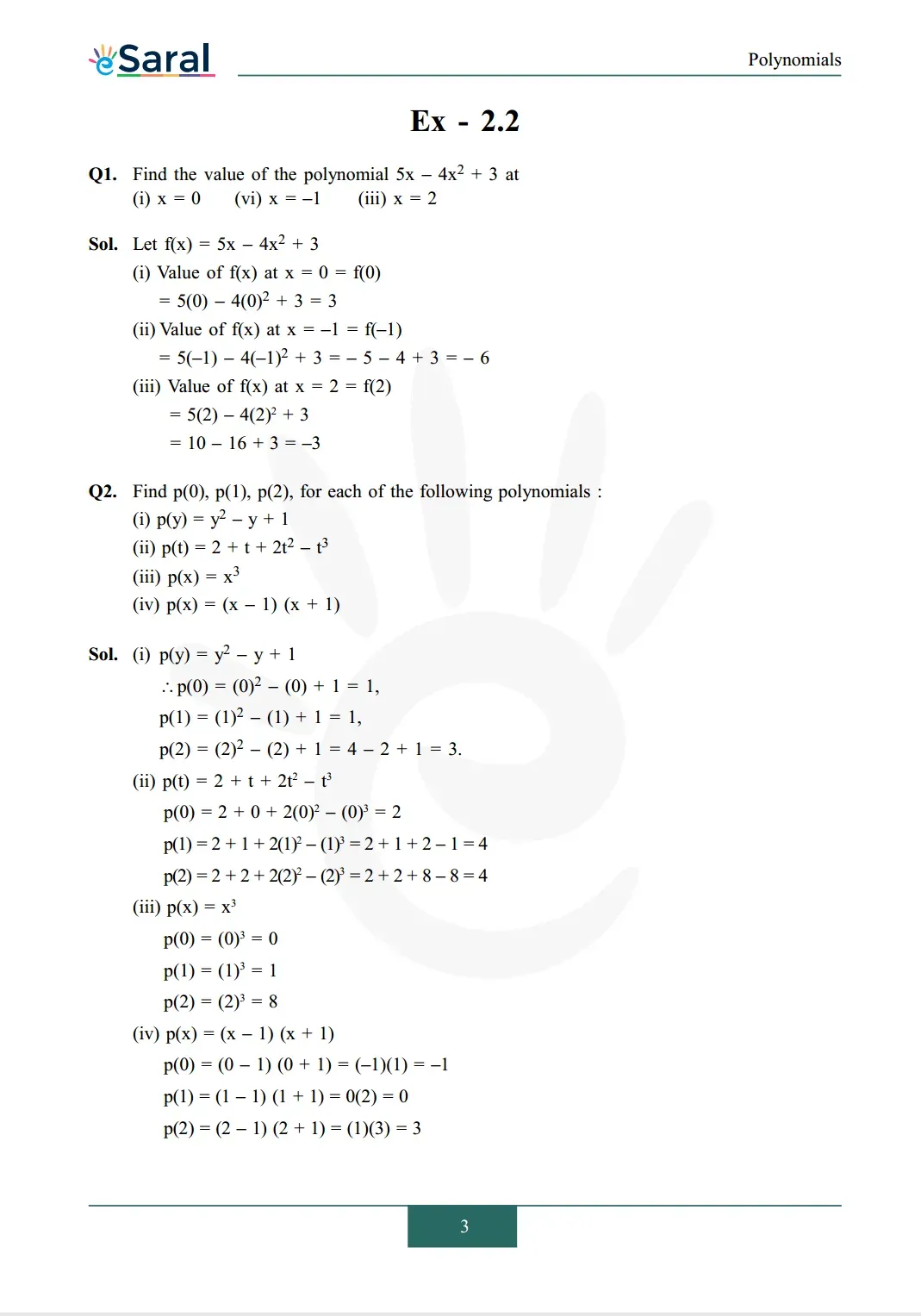
Q1. Find the value of the polynomial $5 x-4 x^{2}+3$ at
(i) $x=0$
(ii) $x=-1$
(iii) $x=2$
Sol. Let $f(x)=5 x-4 x^{2}+3$
(i) Value of $\mathrm{f}(\mathrm{x})$ at $\mathrm{x}=0=\mathrm{f}(0)$
$=5(0)-4(0)^{2}+3=3$
(ii) Value of $\mathrm{f}(\mathrm{x})$ at $\mathrm{x}=-1=\mathrm{f}(-1)$
$=5(-1)-4(-1)^{2}+3=-5-4+3=-6$
(iii) Value of $\mathrm{f}(\mathrm{x})$ at $\mathrm{x}=2=\mathrm{f}(2)$
$=5(2)-4(2)^{2}+3$
$=10-16+3=-3$
Q2. Find $p(0), p(1), p(2)$, for each of the following polynomials :
(i) $p(y)=y^{2}-y+1$
(ii) $p(t)=2+t+2 t^{2}-t^{3}$
(iii) $\mathrm{p}(\mathrm{x})=\mathrm{x}^{3}$
(iv) $\mathrm{p}(\mathrm{x})=(\mathrm{x}-1)(\mathrm{x}+1)$
Sol. (i) $p(y)=y^{2}-y+1$
$\therefore \mathrm{p}(0)=(0)^{2}-(0)+1=1$
$\mathrm{p}(1)=(1)^{2}-(1)+1=1$
$\mathrm{p}(2)=(2)^{2}-(2)+1=4-2+1=3$
(ii) $p(t)=2+t+2 t^{2}-t^{3}$
$\mathrm{p}(0)=2+0+2(0)^{2}-(0)^{3}=2$
$p(1)=2+1+2(1)^{2}-(1)^{3}=2+1+2-1=4$
$\mathrm{p}(2)=2+2+2(2)^{2}-(2)^{3}=2+2+8-8=4$
(iii) $\mathrm{p}(\mathrm{x})=\mathrm{x}^{3}$
$\mathrm{p}(0)=(0)^{3}=0$
$p(1)=(1)^{3}=1$
$p(2)=(2)^{3}=8$
(iv) $p(x)=(x-1)(x+1)$
$p(0)=(0-1)(0+1)=(-1)(1)=-1$
$\mathrm{p}(1)=(1-1)(1+1)=0(2)=0$
$p(2)=(2-1)(2+1)=(1)(3)=3$
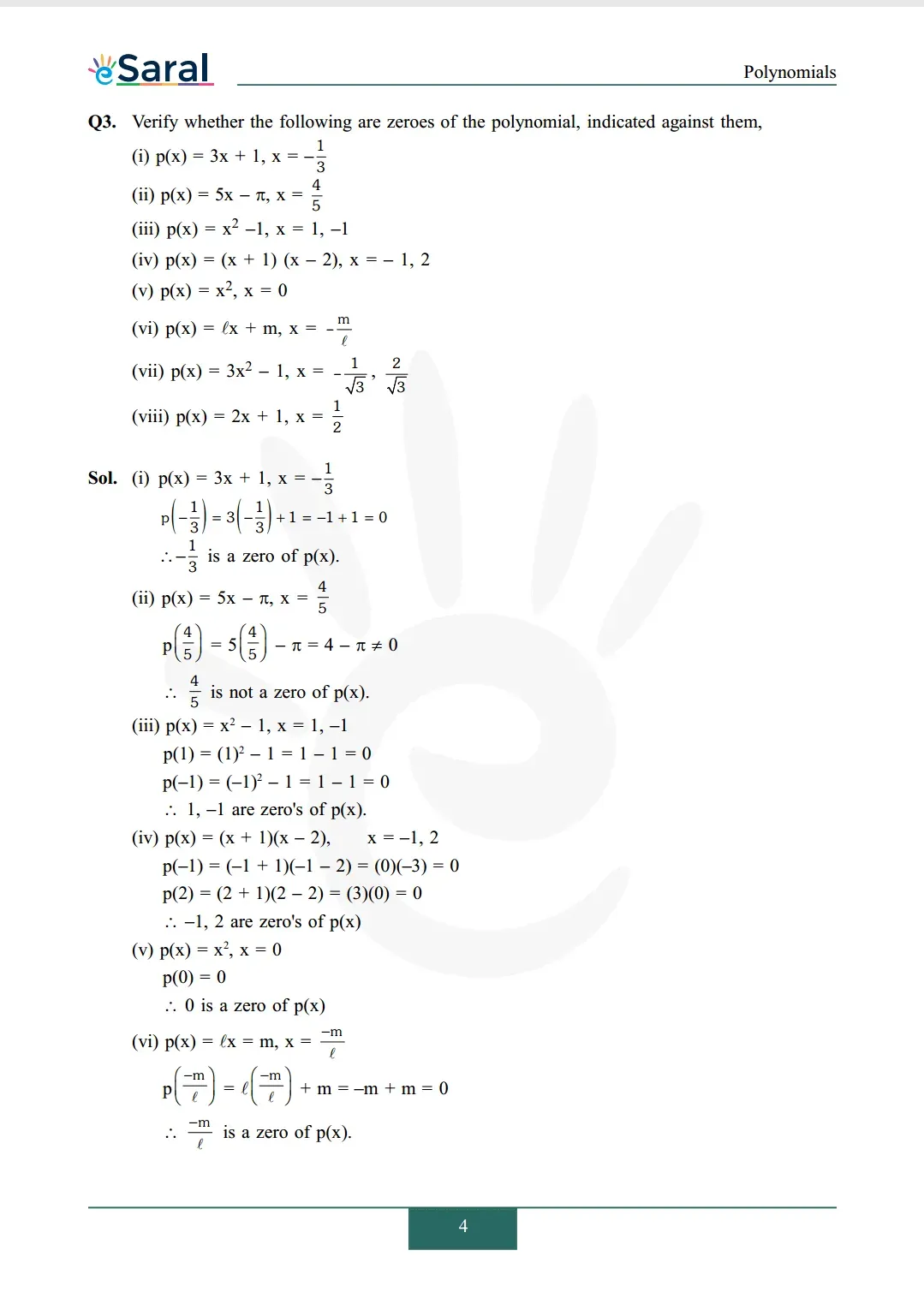
Q3. Verify whether the following are zeroes of the polynomial, indicated against them,
(i) $\mathrm{p}(\mathrm{x})=3 \mathrm{x}+1, \mathrm{x}=-\frac{1}{3}$
(ii) $\mathrm{p}(\mathrm{x})=5 \mathrm{x}-\pi, \mathrm{x}=\frac{4}{5}$
(iii) $\mathrm{p}(\mathrm{x})=\mathrm{x}^{2}-1, \mathrm{x}=1,-1$
(iv) $p(x)=(x+1)(x-2), x=-1,2$
(v) $p(x)=x^{2}, x=0$
(vi) $\mathrm{p}(\mathrm{x})=\ell \mathrm{x}+\mathrm{m}, \mathrm{x}=-\frac{\mathrm{m}}{\ell}$
(vii) $\mathrm{p}(\mathrm{x})=3 \mathrm{x}^{2}-1, \mathrm{x}=-\frac{1}{\sqrt{3}}, \frac{2}{\sqrt{3}}$
(viii) $\mathrm{p}(\mathrm{x})=2 \mathrm{x}+1, \mathrm{x}=\frac{1}{2}$
Sol. (i) $\mathrm{p}(\mathrm{x})=3 \mathrm{x}+1, \mathrm{x}=-\frac{1}{3}$
$p\left(-\frac{1}{3}\right)=3\left(-\frac{1}{3}\right)+1=-1+1=0$
$\therefore-\frac{1}{3}$ is a zero of $\mathrm{p}(\mathrm{x})$.
(ii) $\mathrm{p}(\mathrm{x})=5 \mathrm{x}-\pi, \mathrm{x}=\frac{4}{5}$
$\mathrm{p}\left(\frac{4}{5}\right)=5\left(\frac{4}{5}\right)-\pi=4-\pi \neq 0$
$\therefore \frac{4}{5}$ is not a zero of $\mathrm{p}(\mathrm{x})$
(iii) $\mathrm{p}(\mathrm{x})=\mathrm{x}^{2}-1, \mathrm{x}=1,-1$
$\mathrm{p}(1)=(1)^{2}-1=1-1=0$
$p(-1)=(-1)^{2}-1=1-1=0$
$\therefore 1,-1$ are zero's of $\mathrm{p}(\mathrm{x})$.
(iv) $p(x)=(x+1)(x-2), \quad x=-1,2$
$p(-1)=(-1+1)(-1-2)=(0)(-3)=0$
$\mathrm{p}(2)=(2+1)(2-2)=(3)(0)=0$
$\therefore-1,2$ are zero's of $\mathrm{p}(\mathrm{x})$
(v) $\mathrm{p}(\mathrm{x})=\mathrm{x}^{2}, \mathrm{x}=0$
$\mathrm{p}(0)=0$
$\therefore 0$ is a zero of $\mathrm{p}(\mathrm{x})$
(vi) $\mathrm{p}(\mathrm{x})=\ell \mathrm{x}=\mathrm{m}, \mathrm{x}=\frac{-\mathrm{m}}{\ell}$
$\mathrm{p}\left(\frac{-\mathrm{m}}{\ell}\right)=\ell\left(\frac{-\mathrm{m}}{\ell}\right)+\mathrm{m}=-\mathrm{m}+\mathrm{m}=0$
$\therefore \frac{-\mathrm{m}}{\ell}$ is a zero of $\mathrm{p}(\mathrm{x})$.
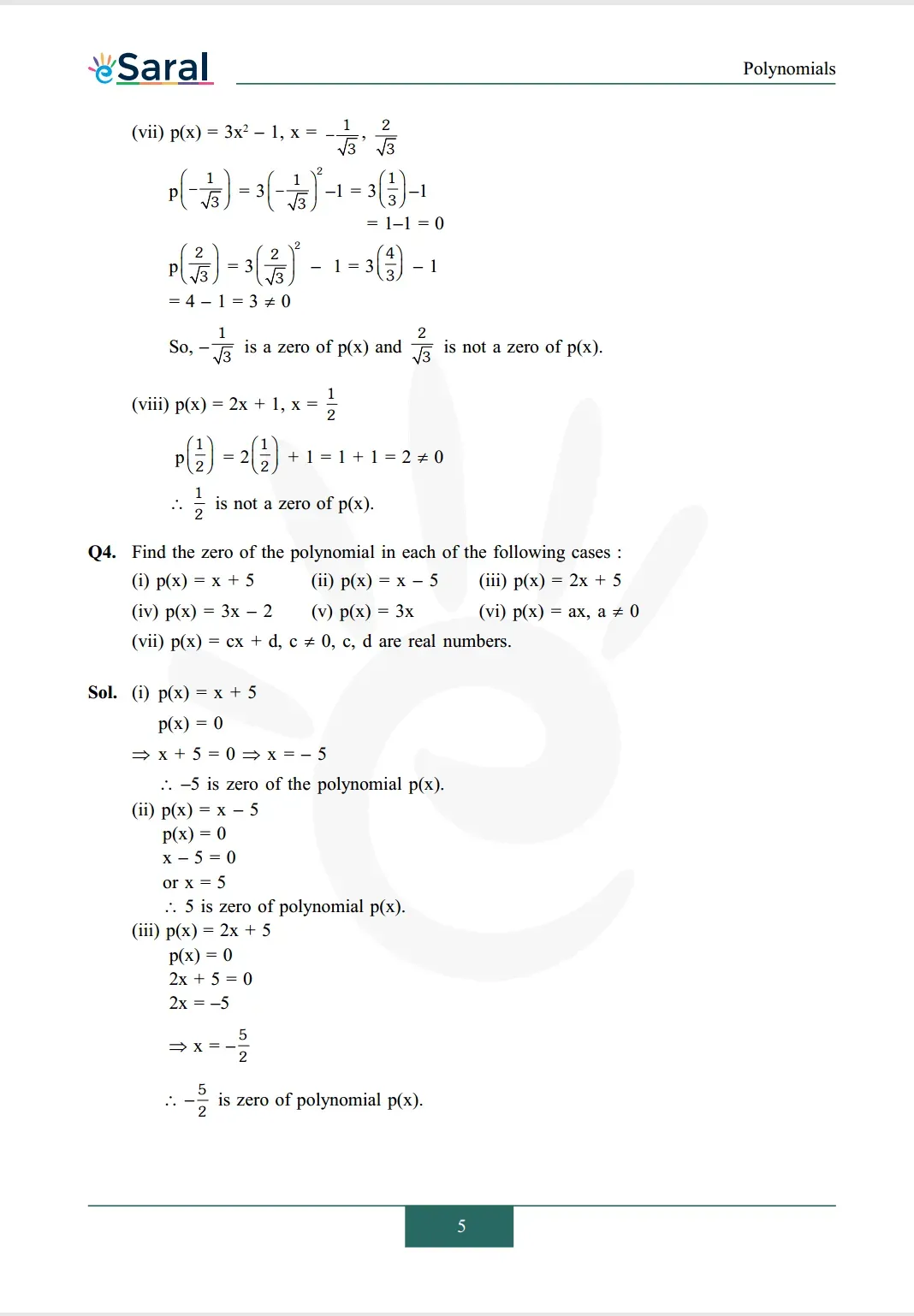
(vii) $\mathrm{p}(\mathrm{x})=3 \mathrm{x}^{2}-1, \mathrm{x}=-\frac{1}{\sqrt{3}}, \frac{2}{\sqrt{3}}$
$\mathrm{p}\left(-\frac{1}{\sqrt{3}}\right)=3\left(-\frac{1}{\sqrt{3}}\right)^{2}-1=3\left(\frac{1}{3}\right)-1$
$=1-1=0$
$\mathrm{p}\left(\frac{2}{\sqrt{3}}\right)=3\left(\frac{2}{\sqrt{3}}\right)^{2}-1=3\left(\frac{4}{3}\right)-1$
$=4-1=3 \neq 0$
So, $-\frac{1}{\sqrt{3}}$ is a zero of $\mathrm{p}(\mathrm{x})$ and $\frac{2}{\sqrt{3}}$ is not a zero of $\mathrm{p}(\mathrm{x})$.
(viii) $\mathrm{p}(\mathrm{x})=2 \mathrm{x}+1, \mathrm{x}=\frac{1}{2}$
$\mathrm{p}\left(\frac{1}{2}\right)=2\left(\frac{1}{2}\right)+1=1+1=2 \neq 0$
$\therefore \frac{1}{2}$ is not a zero of $\mathrm{p}(\mathrm{x})$.
Q4. Find the zero of the polynomial in each of the following cases:
(i) $\mathrm{p}(\mathrm{x})=\mathrm{x}+5$
(ii) $\mathrm{p}(\mathrm{x})=\mathrm{x}-5$
(iii) $\mathrm{p}(\mathrm{x})=2 \mathrm{x}+5$
(iv) $\mathrm{p}(\mathrm{x})=3 \mathrm{x}-2$
(v) $\mathrm{p}(\mathrm{x})=3 \mathrm{x}$
(vi) $\mathrm{p}(\mathrm{x})=\mathrm{ax}, \mathrm{a} \neq 0$
(vii) $\mathrm{p}(\mathrm{x})=\mathrm{cx}+\mathrm{d}, \mathrm{c} \neq 0, \mathrm{c}, \mathrm{d}$ are real numbers.
Sol. (i) $\mathrm{p}(\mathrm{x})=\mathrm{x}+5$
$p(x)=0$
$\Rightarrow x+5=0 \Rightarrow x=-5$
$\therefore-5$ is zero of the polynomial $\mathrm{p}(\mathrm{x})$.
(ii) $\mathrm{p}(\mathrm{x})=\mathrm{x}-5$
$p(x)=0$
$x-5=0$
or $x=5$
$\therefore 5$ is zero of polynomial $\mathrm{p}(\mathrm{x})$.
(iii) $\mathrm{p}(\mathrm{x})=2 \mathrm{x}+5$
$p(x)=0$
$2 x+5=0$
$2 x=-5$
$\Rightarrow \mathrm{x}=-\frac{5}{2}$
$\therefore-\frac{5}{2}$ is zero of polynomial $\mathrm{p}(\mathrm{x})$.
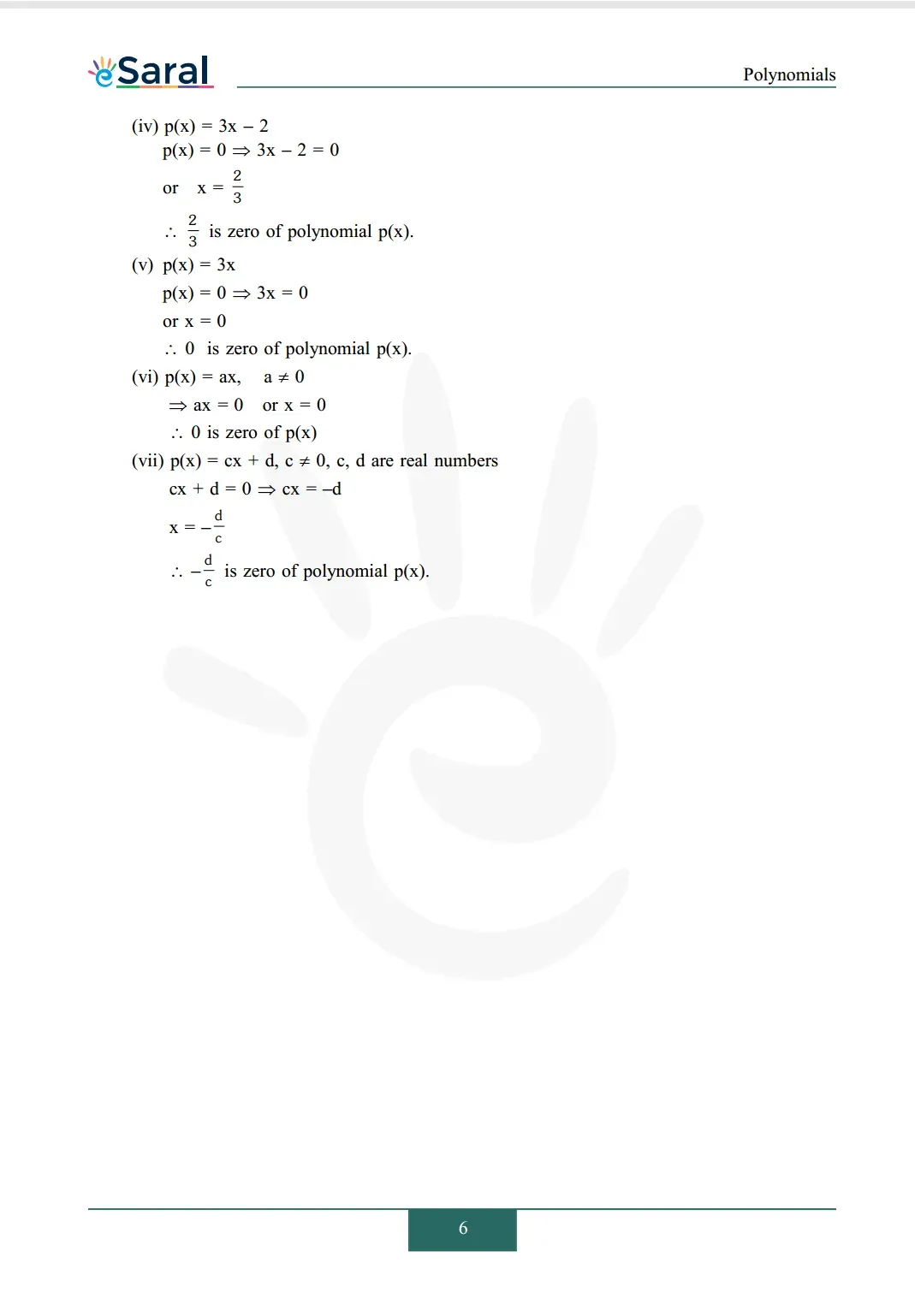
(iv) $p(x)=3 x-2$
$\mathrm{p}(\mathrm{x})=0 \Rightarrow 3 \mathrm{x}-2=0$
or $x=\frac{2}{3}$
$\therefore \frac{2}{3}$ is zero of polynomial $\mathrm{p}(\mathrm{x})$
(v) $\mathrm{p}(\mathrm{x})=3 \mathrm{x}$
$p(x)=0 \Rightarrow 3 x=0$
or $\mathbf{x}=0$
$\therefore 0$ is zero of polynomial $\mathrm{p}(\mathrm{x})$.
(vi) $\mathrm{p}(\mathrm{x})=\mathrm{ax}, \quad \mathrm{a} \neq 0$
$\Rightarrow \mathrm{ax}=0 \quad$ or $\mathrm{x}=0$
$\therefore 0$ is zero of $\mathrm{p}(\mathrm{x})$
(vii) $\mathrm{p}(\mathrm{x})=\mathrm{cx}+\mathrm{d}, \mathrm{c} \neq 0, \mathrm{c}, \mathrm{d}$ are real numbers
$c x+d=0 \Rightarrow c x=-d$
$\mathbf{x}=-\frac{\mathrm{d}}{\mathrm{c}}$’
$\therefore-\frac{d}{c}$ is zero of polynomial $p(x)$.
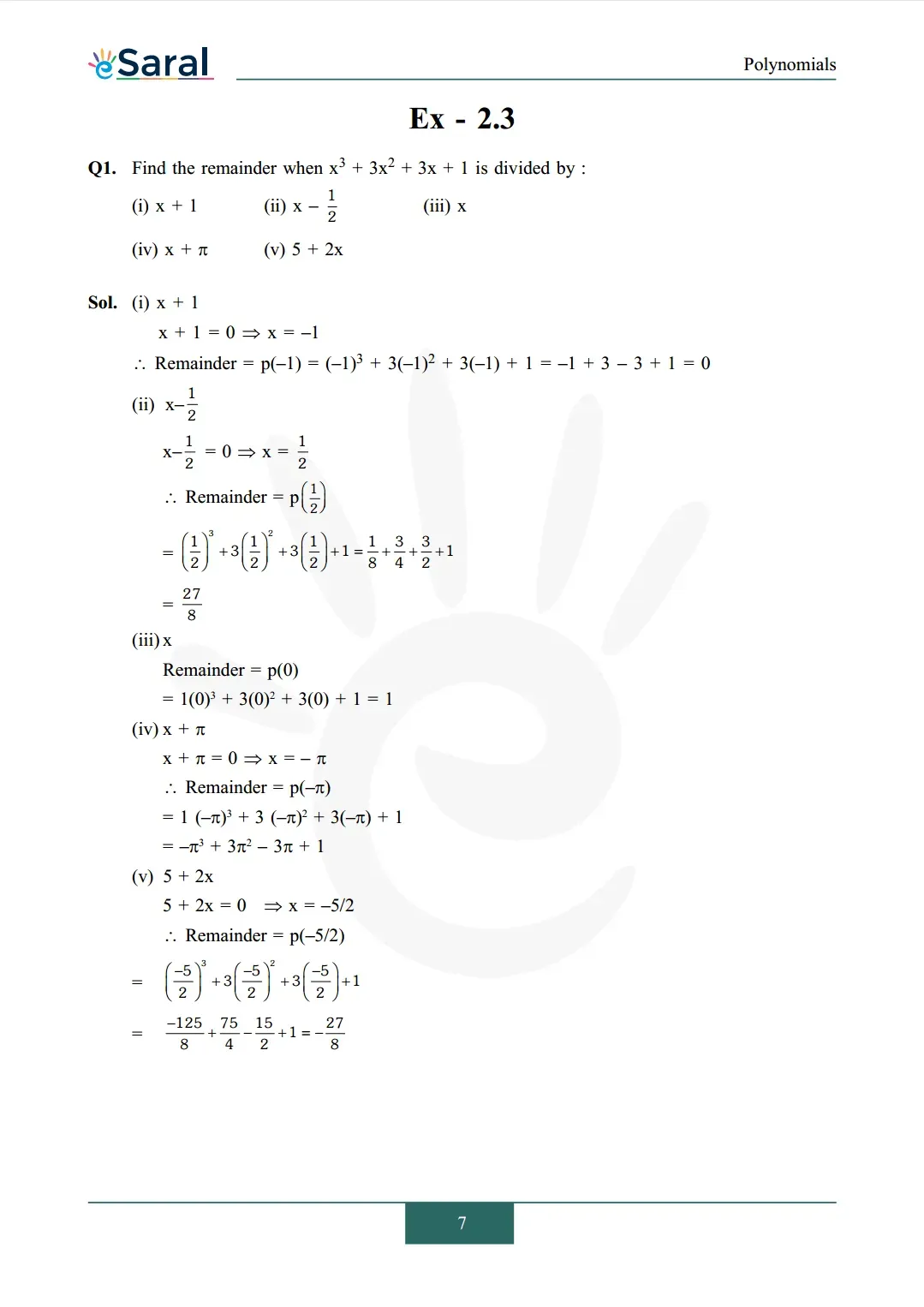
NCERT Solutions for Class 9 Maths chapter 2 Ex - 2.3
Q1. Find the remainder when $\mathrm{x}^{3}+3 \mathrm{x}^{2}+3 \mathrm{x}+1$ is divided by :
(i) $x+1$
(ii) $\mathrm{x}-\frac{1}{2}$
(iii) $\mathrm{X}$
(iv) $x+\pi$
(v) $5+2 \mathrm{x}$
Sol. (i) $x+1$
$x+1=0 \Rightarrow x=-1$
$\therefore$ Remainder $=\mathrm{p}(-1)=(-1)^{3}+3(-1)^{2}+3(-1)+1$
$=-1+3-3+1=0$
(ii) $\mathrm{x}-\frac{1}{2}$
$\mathrm{x}-\frac{1}{2}=0 \Rightarrow \mathrm{x}=\frac{1}{2}$
$\therefore$ Remainder $=\mathrm{p}\left(\frac{1}{2}\right)$
$=\left(\frac{1}{2}\right)^{3}+3\left(\frac{1}{2}\right)^{2}+3\left(\frac{1}{2}\right)$
$+1=\frac{1}{8}+\frac{3}{4}+\frac{3}{2}+1$
$=\frac{27}{8}$
(iii) $\mathrm{X}$
Remainder $=\mathrm{p}(0)$
$=1(0)^{3}+3(0)^{2}+3(0)+1=1$
(iv) $x+\pi$
$\mathrm{x}+\pi=0 \Rightarrow \mathrm{x}=-\pi$
$\therefore$ Remainder $=\mathrm{p}(-\pi)$
$=1(-\pi)^{3}+3(-\pi)^{2}+3(-\pi)+1$
$=-\pi^{3}+3 \pi^{2}-3 \pi+1$
(v) $5+2 \mathrm{x}$
$5+2 \mathrm{x}=0 \Rightarrow \mathrm{x}=-5 / 2$
$\therefore$ Remainder $=\mathrm{p}(-5 / 2)$
$=\left(\frac{-5}{2}\right)^{3}+3\left(\frac{-5}{2}\right)^{2}+3\left(\frac{-5}{2}\right)+1$
$=\frac{-125}{8}+\frac{75}{4}-\frac{15}{2}+1=-\frac{27}{8}$
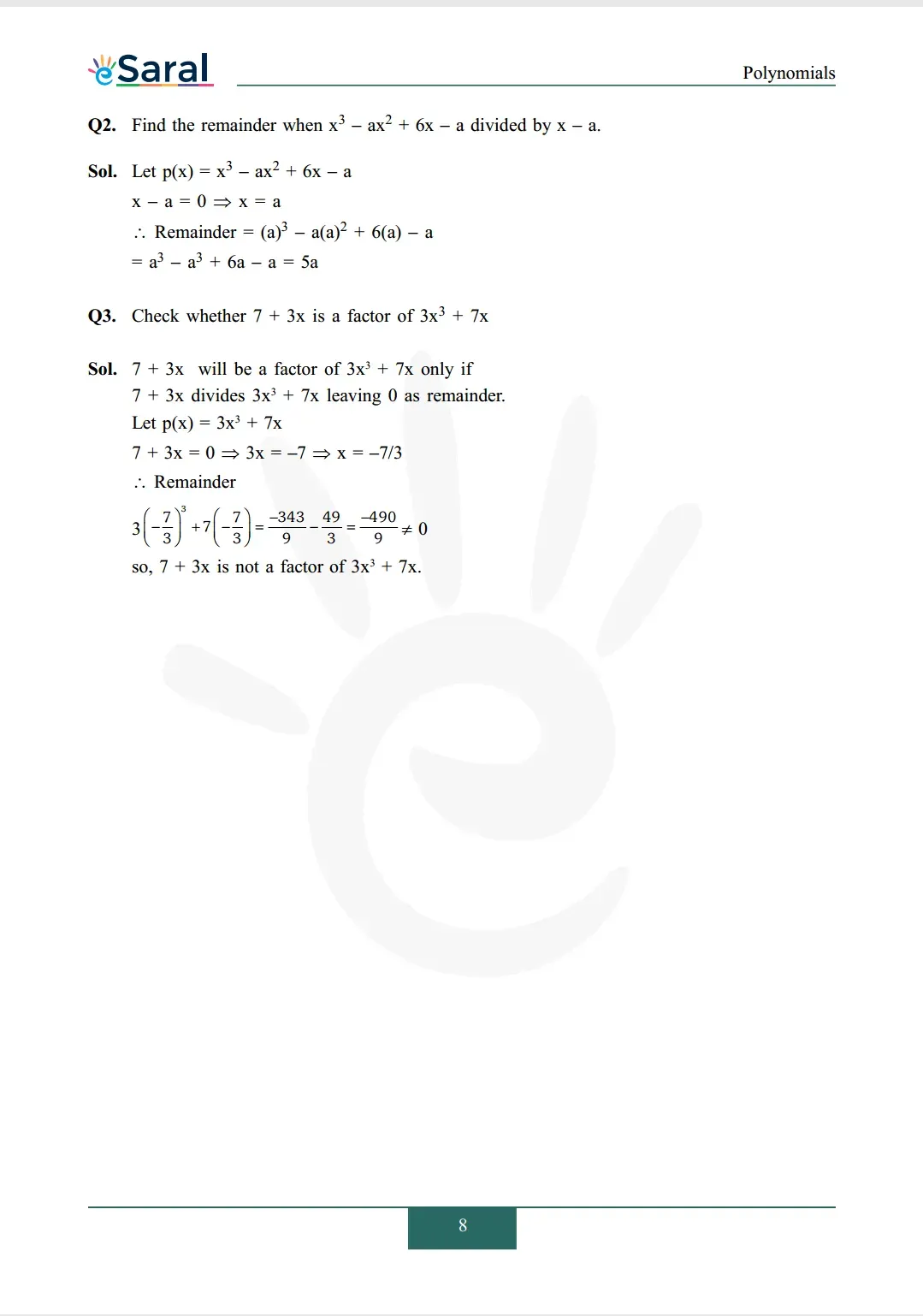
Q2. Find the remainder when $x^{3}-a x^{2}+6 x-$ a divided by $x-a$.
Sol. Let $p(x)=x^{3}-a x^{2}+6 x-a$
$\mathrm{x}-\mathrm{a}=0 \Rightarrow \mathrm{x}=\mathrm{a}$
$\therefore$ Remainder $=(\mathrm{a})^{3}-\mathrm{a}(\mathrm{a})^{2}+6(\mathrm{a})-\mathrm{a}$
$=a^{3}-a^{3}+6 a-a=5 a$
Q3. Check whether $7+3 \mathrm{x}$ is a factor of $3 \mathrm{x}^{3}+7 \mathrm{x}$
Sol. $7+3 x$ will be a factor of $3 x^{3}+7 x$ only if
$7+3 x$ divides $3 x^{3}+7 x$ leaving 0 as remainder.
Let $p(x)=3 x^{3}+7 x$
$7+3 x=0 \Rightarrow 3 x=-7 \Rightarrow x=-7 / 3$
$\therefore$ Remainder
$3\left(-\frac{7}{3}\right)^{3}+7\left(-\frac{7}{3}\right)=\frac{-343}{9}-\frac{49}{3}=\frac{-490}{9} \neq 0$
so, $7+3 \mathrm{x}$ is not a factor of $3 \mathrm{x}^{3}+7 \mathrm{x}$.
NCERT Solutions for Class 9 Maths chapter 2 Ex - 2.4
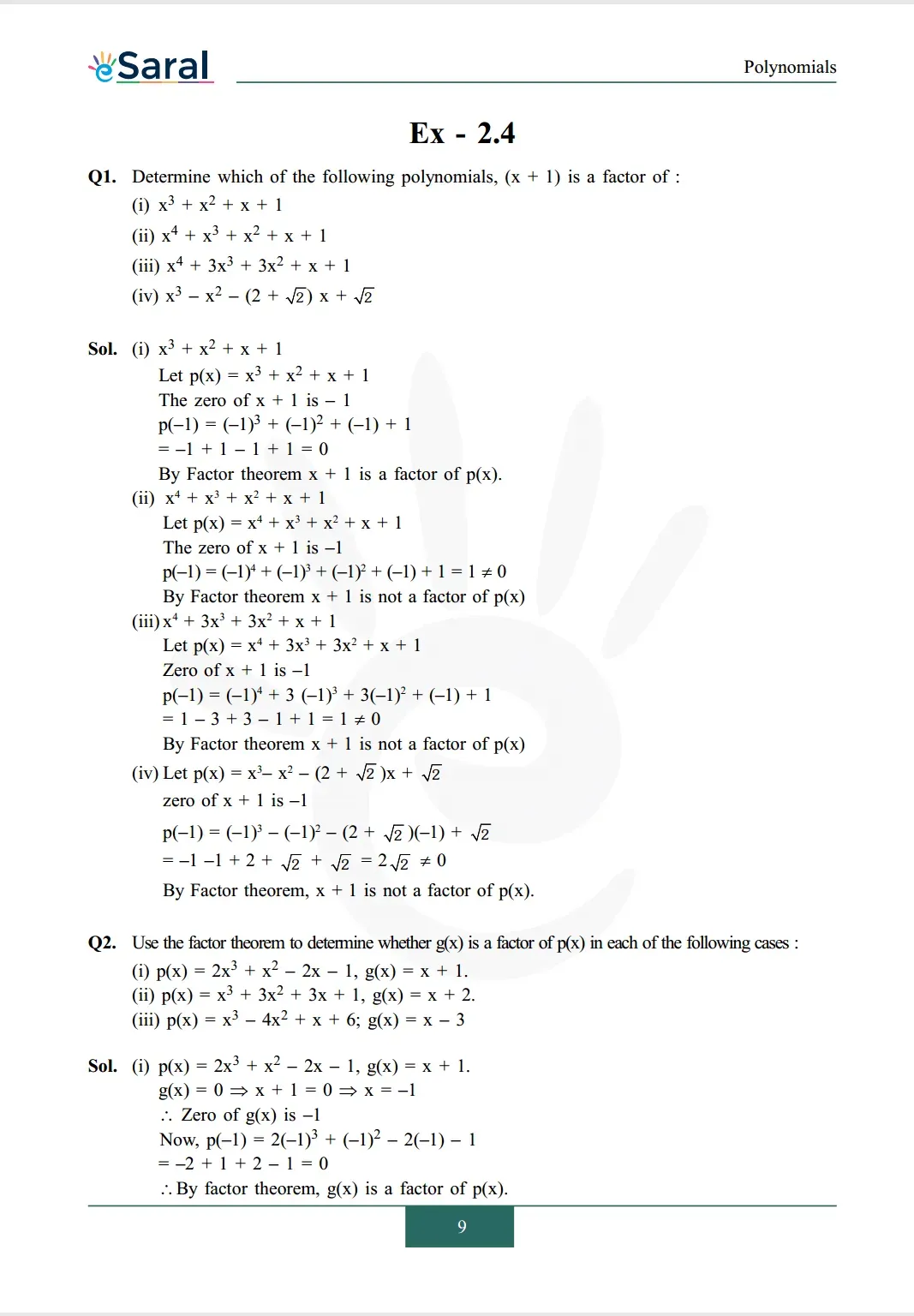
Q1. Determine which of the following polynomials, $(x+1)$ is a factor of :
(i) $x^{3}+x^{2}+x+1$
(ii) $x^{4}+x^{3}+x^{2}+x+1$
(iii) $x^{4}+3 x^{3}+3 x^{2}+x+1$
(iv) $x^{3}-x^{2}-(2+\sqrt{2}) x+\sqrt{2}$
Sol.(i) $x^{3}+x^{2}+x+1$
Let $p(x)=x^{3}+x^{2}+x+1$
The zero of $x+1$ is $-1$
$\mathrm{p}(-1)=(-1)^{3}+(-1)^{2}+(-1)+1$
$=-1+1-1+1=0$
By Factor theorem $x+1$ is a factor of $p(x)$.
(ii) $x^{4}+x^{3}+x^{2}+x+1$
Let $\mathrm{p}(\mathrm{x})=\mathrm{x}^{4}+\mathrm{x}^{3}+\mathrm{x}^{2}+\mathrm{x}+1$
The zero of $x+1$ is $-1$
$p(-1)=(-1)^{4}+(-1)^{3}+(-1)^{2}+(-1)+1=1 \neq 0$
By Factor theorem $x+1$ is not a factor of $p(x)$
(iii) $x^{4}+3 x^{3}+3 x^{2}+x+1$
Let $p(x)=x^{4}+3 x^{3}+3 x^{2}+x+1$
Zero of $x+1$ is $-1$
$p(-1)=(-1)^{4}+3(-1)^{3}+3(-1)^{2}+(-1)+1$
$=1-3+3-1+1=1 \neq 0$
By Factor theorem $\mathrm{x}+1$ is not a factor of $\mathrm{p}(\mathrm{x})$
(iv) Let $\mathrm{p}(\mathrm{x})=\mathrm{x}^{3}-\mathrm{x}^{2}-(2+\sqrt{2}) \mathrm{x}+\sqrt{2}$
zero of $x+1$ is $-1$
$\mathrm{p}(-1)=(-1)^{3}-(-1)^{2}-(2+\sqrt{2})(-1)+\sqrt{2}$
$=-1-1+2+\sqrt{2}+\sqrt{2}=2 \sqrt{2} \neq 0$
By Factor theorem, $x+1$ is not a factor of $p(x)$.
Q2. Use the factor theorem to determine whether $\mathrm{g}(\mathrm{x})$ is a factor of $\mathrm{p}(\mathrm{x})$ in each of the following cases:
(i) $p(x)=2 x^{3}+x^{2}-2 x-1, g(x)=x+1$.
(ii) $\mathrm{p}(\mathrm{x})=\mathrm{x}^{3}+3 \mathrm{x}^{2}+3 \mathrm{x}+1, \mathrm{~g}(\mathrm{x})=\mathrm{x}+2$.
(iii) $\mathrm{p}(\mathrm{x})=\mathrm{x}^{3}-4 \mathrm{x}^{2}+\mathrm{x}+6 ; \mathrm{g}(\mathrm{x})=\mathrm{x}-3$
Sol. (i) $\mathrm{p}(\mathrm{x})=2 \mathrm{x}^{3}+\mathrm{x}^{2}-2 \mathrm{x}-1, \mathrm{~g}(\mathrm{x})=\mathrm{x}+1$.
$\mathrm{g}(\mathrm{x})=0 \Rightarrow \mathrm{x}+1=0 \Rightarrow \mathrm{x}=-1$
$\therefore$ Zero of $g(x)$ is $-1$
Now, $p(-1)=2(-1)^{3}+(-1)^{2}-2(-1)-1$
$=-2+1+2-1=0$
$\therefore$ By factor theorem, $g(x)$ is a factor of $p(x)$.
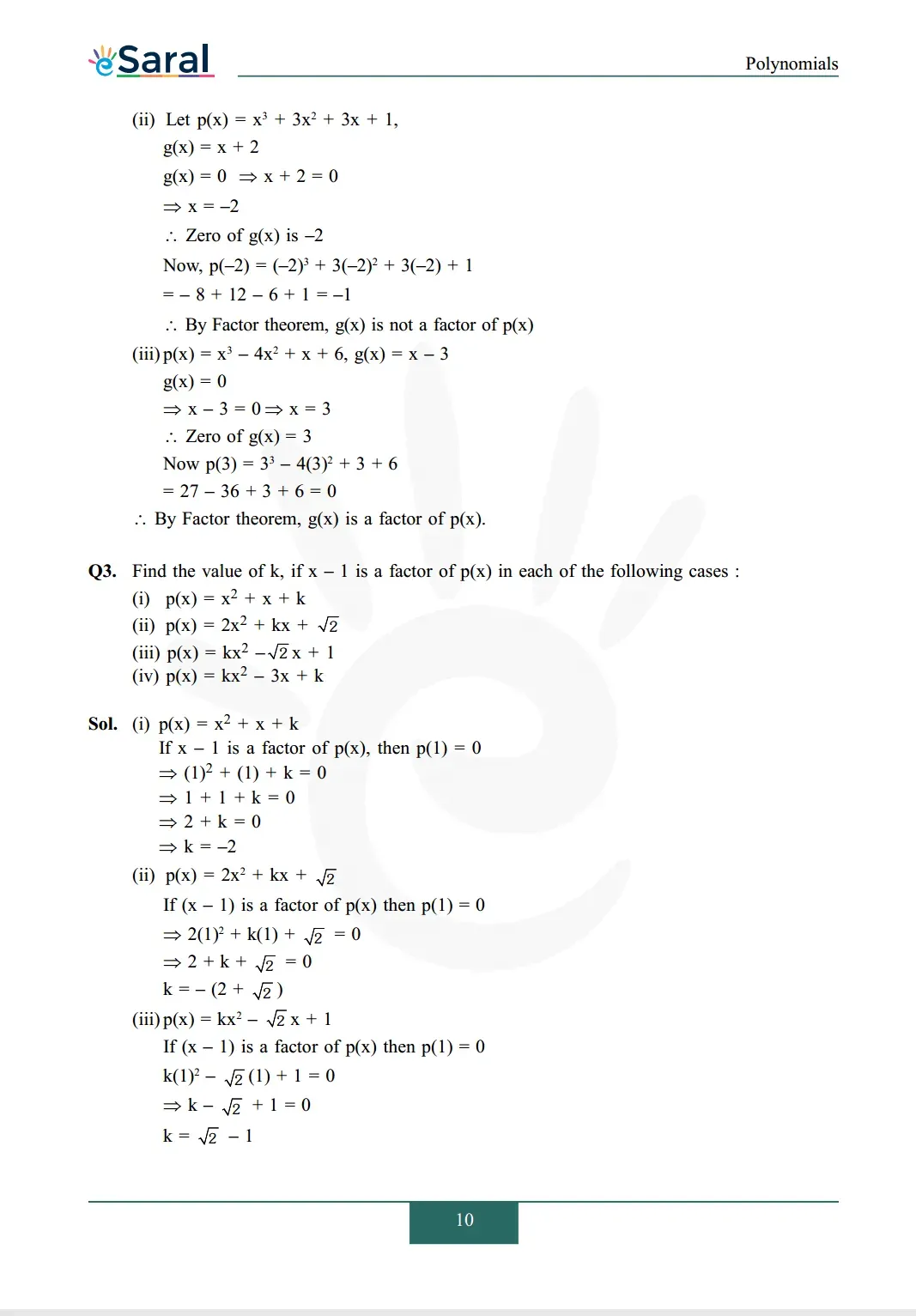
(ii) Let $\mathrm{p}(\mathrm{x})=\mathrm{x}^{3}+3 \mathrm{x}^{2}+3 \mathrm{x}+1$,
$g(x)=x+2$
$g(x)=0 \Rightarrow x+2=0$
$\Rightarrow \mathrm{x}=-2$
$\therefore$ Zero of $g(x)$ is $-2$
Now, $\mathrm{p}(-2)=(-2)^{3}+3(-2)^{2}+3(-2)+1$
$=-8+12-6+1=-1$
$\therefore$ By Factor theorem, $\mathrm{g}(\mathrm{x})$ is not a factor of $\mathrm{p}(\mathrm{x})$
(iii) $p(x)=x^{3}-4 x^{2}+x+6, g(x)=x-3$
$g(x)=0$
$\Rightarrow x-3=0 \Rightarrow x=3$
$\therefore$ Zero of $g(x)=3$
Now $\mathrm{p}(3)=3^{3}-4(3)^{2}+3+6$
$=27-36+3+6=0$
$\therefore$ By Factor theorem, $\mathrm{g}(\mathrm{x})$ is a factor of $\mathrm{p}(\mathrm{x})$.
Q3. Find the value of $\mathrm{k}$, if $\mathrm{x}-1$ is a factor of $\mathrm{p}(\mathrm{x})$ in each of the following cases :
(i) $\mathrm{p}(\mathrm{x})=\mathrm{x}^{2}+\mathrm{x}+\mathrm{k}$
(iii) $\mathrm{p}(\mathrm{x})=\mathrm{kx}^{2}-\sqrt{2} \mathrm{x}+1$
(iv) $p(x)=k x^{2}-3 x+k$
Sol. (i) $\mathrm{p}(\mathrm{x})=\mathrm{x}^{2}+\mathrm{x}+\mathrm{k}$
If $x-1$ is a factor of $p(x)$, then $p(1)=0$
$\Rightarrow(1)^{2}+(1)+\mathrm{k}=0$
$\Rightarrow 1+1+K=0$ $\Rightarrow 2+\mathrm{k}=0$
$\Rightarrow \mathrm{k}=-2$
(ii) $\mathrm{p}(\mathrm{x})=2 \mathrm{x}^{2}+\mathrm{kx}+\sqrt{2}$
If $(x-1)$ is a factor of $p(x)$ then $p(1)=0$
$\Rightarrow 2(1)^{2}+\mathrm{k}(1)+\sqrt{2}=0$
$\Rightarrow 2+\mathrm{k}+\sqrt{2}=0$
$\mathrm{k}=-(2+\sqrt{2})$
(iii) $p(x)=k x^{2}-\sqrt{2} x+1$
If $(x-1)$ is a factor of $p(x)$ then $p(1)=0$
$\mathrm{k}(1)^{2}-\sqrt{2}(1)+1=0$
$\Rightarrow \mathrm{k}-\sqrt{2}+1=0$
$\mathrm{k}=\sqrt{2}-1$
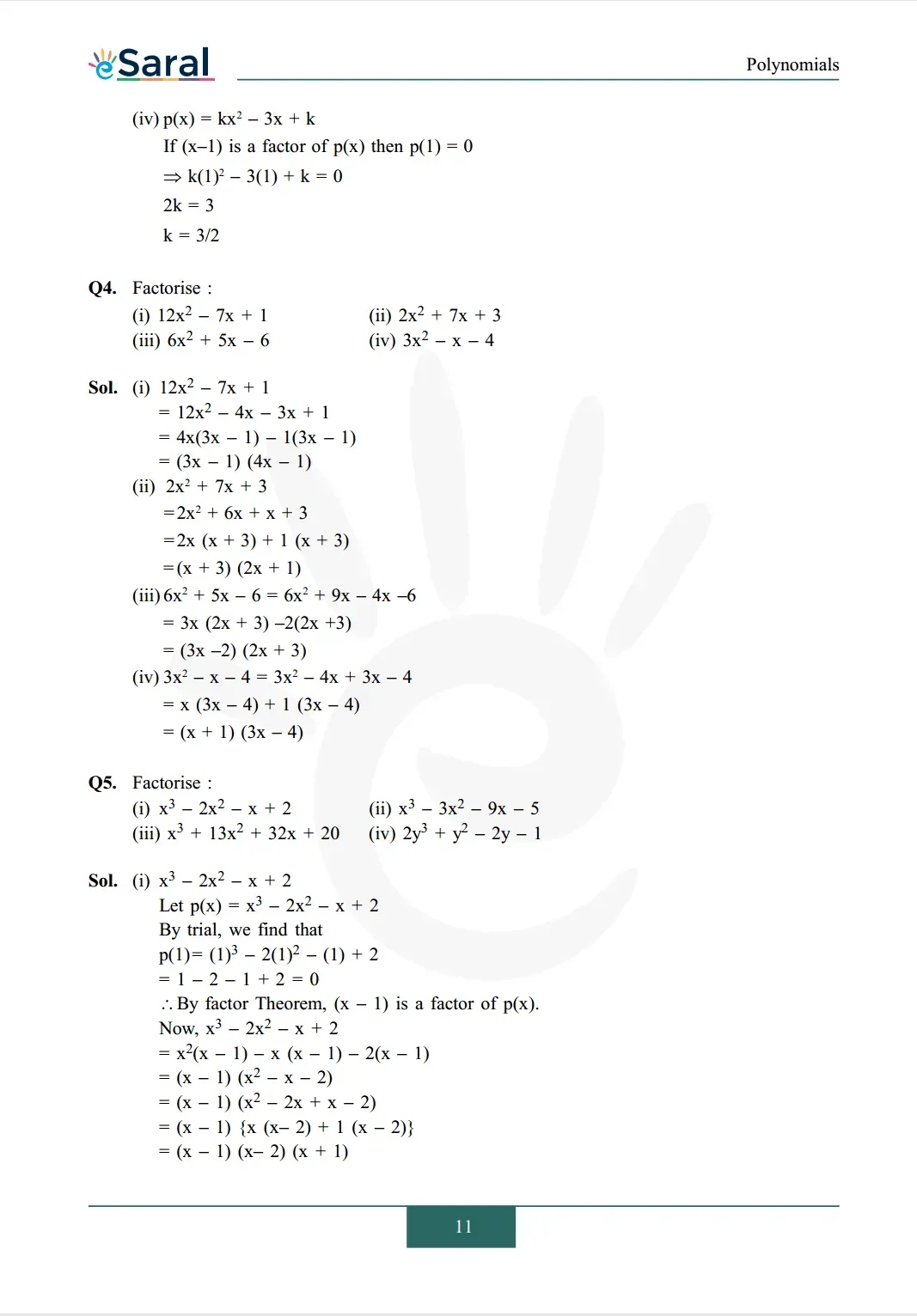
(iv) $\mathrm{p}(\mathrm{x})=\mathrm{kx}^{2}-3 \mathrm{x}+\mathrm{k}$
If $(x-1)$ is a factor of $p(x)$ then $p(1)=0$
$\Rightarrow \mathrm{k}(1)^{2}-3(1)+\mathrm{k}=0$
$2 \mathrm{k}=3$
$\mathrm{k}=3 / 2$
Q4. Factorise :
(i) $12 \mathrm{x}^{2}-7 \mathrm{x}+1$
(ii) $2 \mathrm{x}^{2}+7 \mathrm{x}+3$
(iii) $6 x^{2}+5 x-6$
(iv) $3 x^{2}-x-4$
Sol. (i) $12 \mathrm{x}^{2}-7 \mathrm{x}+1$
$=12 x^{2}-4 x-3 x+1$
$=4 x(3 x-1)-1(3 x-1)$
$=(3 x-1)(4 x-1)$
(ii) $2 x^{2}+7 x+3$
$=2 x^{2}+6 x+x+3$
$=2 \mathrm{x}(\mathrm{x}+3)+1(\mathrm{x}+3)$
$=(\mathrm{x}+3)(2 \mathrm{x}+1)$
(iii) $6 x^{2}+5 x-6=6 x^{2}+9 x-4 x-6$
$=3 x(2 x+3)-2(2 x+3)$
$=(3 x-2)(2 x+3)$
(iv) $3 x^{2}-x-4=3 x^{2}-4 x+3 x-4$
$=x(3 x-4)+1(3 x-4)$
$=(x+1)(3 x-4)$
Q5. Factorise :
(i) $x^{3}-2 x^{2}-x+2$
(ii) $x^{3}-3 x^{2}-9 x-5$
(iii) $x^{3}+13 x^{2}+32 x+20$
(iv) $2 \mathrm{y}^{3}+\mathrm{y}^{2}-2 \mathrm{y}-1$
Sol. (i) $x^{3}-2 x^{2}-x+2$
Let $p(x)=x^{3}-2 x^{2}-x+2$
By trial, we find that
$\mathrm{p}(1)=(1)^{3}-2(1)^{2}-(1)+2$
$=1-2-1+2=0$
$\therefore$ By factor Theorem, $(\mathrm{x}-1)$ is a factor of $\mathrm{p}(\mathrm{x})$.
Now, $x^{3}-2 x^{2}-x+2$
$=x^{2}(x-1)-x(x-1)-2(x-1)$
$=(x-1)\left(x^{2}-x-2\right)$
$=(x-1)\left(x^{2}-2 x+x-2\right)$
$=(x-1)\{x(x-2)+1(x-2)\}$
$=(x-1)(x-2)(x+1)$
(ii) $x^{3}-3 x^{2}-9 x-5$
Let $p(x)=x^{3}-3 x^{2}-9 x-5$
Bv trial. we find
$\mathrm{p}(-1)=(-1)^{3}-3(-1)^{2}-9(-1)-5$
$=-1-3+9-5=0$
$\therefore$ By Factor Theorem, $x-(-1)$ or $x+1$ is factor of $p(x)$
Now, $x^{3}-3 x^{2}-9 x-5$
$=x^{2}(x+1)-4 x(x+1)-5(x+1)$
$=(x+1)\left(x^{2}-4 x-5\right)$
$=(x+1)\left(x^{2}-5 x+x-5\right)$
$=(x+1)\{x(x-5)+1(x-5)\}$
$=(x+1)^{2}(x-5)$
(iii) $x^{3}+13 x^{2}+32 x+20$
Let $p(x)=x^{3}+13 x^{2}+32 x+20$
By trial, we find
$p(-1)=(-1)^{3}+13(-1)^{2}+32(-1)+20$
$=-1+13-32+20=0$
$\therefore$ By Factor theorem, $x-(-1), x+1$ is a factor of $p(x)$
$x^{3}+13 x^{2}+32 x+20$
$=x^{2}(x+1)+12(x)(x+1)+20(x+1)$
$=(x+1)\left(x^{2}+12 x+20\right)$
$=(x+1)\left(x^{2}+2 x+10 x+20\right)$
$=(x+1)\{x(x+2)+10(x+2)\}$
$=(x+1)(x+2)(x+10)$
(iv) $2 \mathrm{y}^{3}+\mathrm{y}^{2}-2 \mathrm{y}-1$
$p(y)=2 y^{3}+y^{2}-2 y-1$’
By trial, we find that
$p(1)=2(1)^{3}+(1)^{2}-2(1)-1=0$
$\therefore$ By Factor theorem, $(\mathrm{y}-1)$ is a factor of $\mathrm{p}(\mathrm{y})$
$2 y^{3}+y^{2}-2 y-1$
$=2 y^{2}(y-1)+3 y(y-1)+1(y-1)$
$=(y-1)\left(2 y^{2}+3 y+1\right)$
$=(y-1)\left(2 y^{2}+2 y+y+1\right)$
$=(\mathrm{y}-1)\{2 \mathrm{y}(\mathrm{y}+1)+1(\mathrm{y}+1)\}$
$=(\mathrm{y}-1)(2 \mathrm{y}+1)(\mathrm{y}+1)$
NCERT Solutions for Class 9 Maths chapter 2 Ex - 2.5
Q1. Use suitable identities to find the following products:
(i) $(x+4)(x+10)$
(ii) $(x+8)(x-10)$
(iii) $(3 x+4)(3 x-5)$
(iv) $\left(y^{2}+\frac{3}{2}\right)\left(y^{2}-\frac{3}{2}\right)$
(v) $(3-2 x)(3+2 x)$
Sol. (i) $(\mathrm{x}+4)(\mathrm{x}+10)$
$=x^{2}+(4+10) x+(4)(10)=x^{2}+14 x+40$
(ii) $(x+8)(x-10)$
$=(\mathrm{x}+8)\{\mathrm{x}+(-10)\}$
$=x^{2}+\{8+(-10)\} x+8(-10)$
$=x^{2}-2 x-80$
(iii) $(3 x+4)(3 x-5)$
$=(3 x+4)(3 x-5)=(3 x+4)(3 x+(-5))$
$=(3 x)^{2}+\{4+(-5)\}(3 x)+4(-5)$
$=9 x^{2}-3 x-20$
(iv) $\left(y^{2}+\frac{3}{2}\right)\left(y^{2}-\frac{3}{2}\right)$
Let, $y^{2}=x$
$\Rightarrow\left(y^{2}+\frac{3}{2}\right)\left(y^{2}-\frac{3}{2}\right)=\left(x+\frac{3}{2}\right)\left(x-\frac{3}{2}\right)$
$=x^{2}-\frac{9}{4}$
(using idenity) $(a+b)(a-b)=a^{2}-b^{2}$
$\Rightarrow\left(\mathrm{y}^{2}\right)^{2}-\frac{9}{4}$
$\Rightarrow \mathrm{y}^{4}-\frac{9}{4}$
(v) $(3-2 \mathrm{x})(3+2 \mathrm{x})$
$(3)^{2}-(2 x)^{2}=9-4 x^{2}$
(using idenity) $(a+b)(a-b)=a^{2}-b^{2}$
Q2. Evaluate the following product without multiplying directly:
(i) $103 \times 107$
(ii) $95 \times 96$
(iii) $104 \times 96$
Sol. (i) $103 \times 107=(100+3) \times(100+7)$
$=(100)^{2}+(3+7)(100)+(3)(7)$
$=10000+1000+21=11021$
Alternate solution :
$103 \times 107=(105-2) \times(105+2)$
$=(105)^{2}-(2)^{2}=(100+5)^{2}-4$
$=(100)^{2}+2(100)(5)+(5)^{2}-4$
$=10000+1000+25-4$
$=11021 .$
(ii) $95 \times 96$
$=(90+5) \times(90+6)$
$=(90)^{2}+(5+6) 90+(5)(6)$
$=8100+990+30=9120$
(iii) $104 \times 96$
$=(100+4) \times(100-4)$
(using idenity) $(a+b)(a-b)=a^{2}-b^{2}$
$=(100)^{2}-(4)^{2}=10000-16$
$=9984$
Q3. Factorise the following using appropriate identities:
(i) $9 x^{2}+6 x y+y^{2}$
(ii) $4 y^{2}-4 y+1$
(iii) $\mathrm{x}^{2}-\frac{\mathrm{y}^{2}}{100}$
Sol. (i) $9 x^{2}+6 x y+y^{2}=(3 x)^{2}+2(3 x)(y)+(y)^{2}$
$=(3 \mathrm{x}+\mathrm{y})^{2}$
$=(3 x+y)(3 x+y)$
(ii) $4 \mathrm{y}^{2}-4 \mathrm{y}+1$
$=(2 y)^{2}-2(2 y)(1)+(1)^{2}$
$=(2 y-1)^{2}=(2 y-1)(2 y-1)$
(iii) $\mathrm{x}^{2}-\frac{\mathrm{y}^{2}}{100}$
(using idenity) $a^{2}-b^{2}=(a+b)(a-b)$
$x^{2}-\left(\frac{y}{10}\right)^{2}=\left(x+\frac{y}{10}\right)\left(x-\frac{y}{10}\right)$
Q4. Expand each of the following using suitable identities:
(i) $(\mathrm{x}+2 \mathrm{y}+4 \mathrm{z})^{2}$
(ii) $(2 \mathrm{x}-\mathrm{y}+\mathrm{z})^{2}$
(iii) $(-2 x+3 y+2 z)^{2}$
(iv) $(3 a-7 b-c)^{2}$
(v) $(-2 x+5 y-3 z)^{2}$
(vi) $\left[\frac{1}{4} \mathrm{a}-\frac{1}{2} \mathrm{~b}+1\right]^{2}$
Sol. (i) $(\mathrm{x}+2 \mathrm{y}+4 \mathrm{z})^{2}=(\mathrm{x})^{2}+(2 \mathrm{y})^{2}$
$+(4 z)^{2}+2(x)(2 y)$
$2(2 y)(4 z)+2(4 z)(x)$
$=x^{2}+4 y^{2}+16 z^{2}+4 x y+16 y z+8 z x$
(ii) $(2 x-y+z)^{2}$
$=(2 x-y+z)(2 x-y+z)$
$=(2 x)^{2}+(-y)^{2}+(z)^{2}+2(2 x)(-y)$
$+2(-y)(z)+2(z)(2 x)$
$=4 \mathrm{x}^{2}+\mathrm{y}^{2}+\mathrm{z}^{2}-4 \mathrm{xy}-2 \mathrm{yz}+4 \mathrm{zx}$
(iii) $(-2 x+3 y+2 z)^{2}$
$=(-2 x)^{2}+(3 y)^{2}+(2 z)^{2}+2(-2 x)(3 y)$
$+2(-2 x)(2 z)+2(3 y)(2 z)$
$=4 x^{2}+9 y^{2}+4 z^{2}-12 x y-8 x z+12 y z$
(iv) $(3 a-7 b-c)^{2}=(3 a-7 b-c)(3 a-7 b-c)$
$=(3 \mathrm{a})^{2}+(-7 \mathrm{~b})^{2}+(-\mathrm{c})^{2}+2(3 \mathrm{a})(-7 \mathrm{~b})+$
$2(3 a)(-c)+2(-7 b)(-c)$
$=9 a^{2}+49 b^{2}+c^{2}-42 a b-6 a c+14 b c$
(v) $(-2 x+5 y-3 z)^{2}$
$=(-2 x+5 y-3 z)(-2 x+5 y-3 z)$
$=(-2 x)^{2}+(5 y)^{2}+(-3 z)^{2}+2(-2 x)(5 y)+$
$2(-2 x)(-3 z)+2(-3 z)(5 y)$
$=4 x^{2}+25 y^{2}+9 z^{2}-20 x y+12 x z-30 y z$
(vi) $\left[\frac{1}{4} \mathrm{a}-\frac{1}{2} \mathrm{~b}+1\right]^{2}$
$=\left(\frac{1}{4} a-\frac{1}{2} b+1\right)\left(\frac{1}{4} a-\frac{1}{2} b+1\right)$
$=\left(\frac{1}{4} a\right)^{2}+\left(-\frac{1}{2} b\right)^{2}+(1)^{2}+2\left(\frac{1}{4} a\right)$
$\left(-\frac{1}{2} b\right)+2\left(\frac{1}{4} a\right)(1)^{2}+2\left(-\frac{1}{2} b\right)(1)$
$=\frac{1}{16} a^{2}+\frac{1}{4} b^{2}+1-\frac{1}{4} a b-b+\frac{1}{2} a$
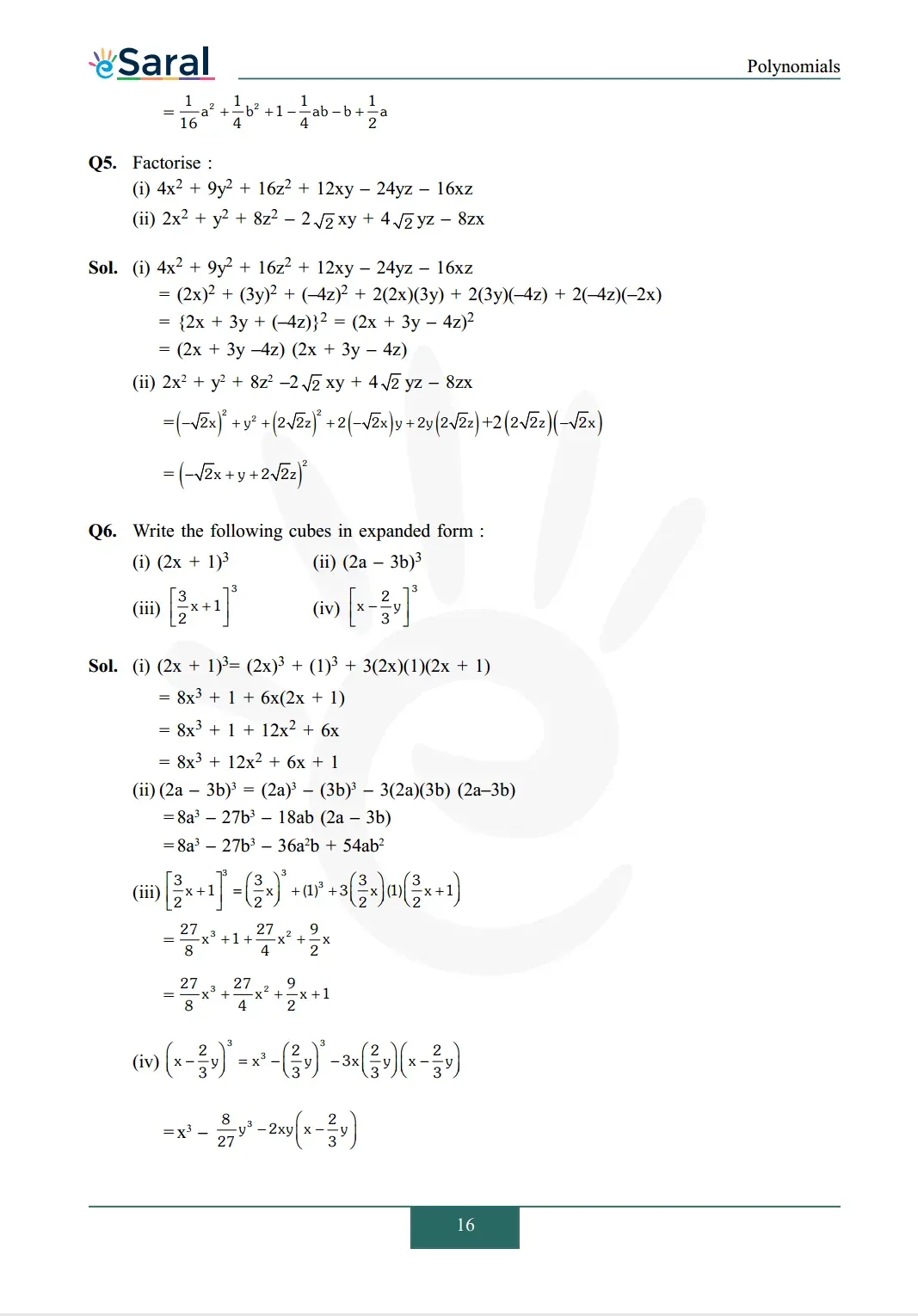
Q5. Factorise:
(i) $4 x^{2}+9 y^{2}+16 z^{2}+12 x y-24 y z-16 x z$
(ii) $2 \mathrm{x}^{2}+\mathrm{y}^{2}+8 \mathrm{z}^{2}-2 \sqrt{2} \mathrm{xy}+4 \sqrt{2} \mathrm{yz}-8 \mathrm{zx}$
Sol. (i) $4 x^{2}+9 y^{2}+16 z^{2}+12 x y-24 y z-16 x z$
$=(2 x)^{2}+(3 y)^{2}+(-4 z)^{2}+2(2 x)(3 y)+2(3 y)(-4 z)+2(-4 z)(-2 x)$
$=\{2 \mathrm{x}+3 \mathrm{y}+(-4 \mathrm{z})\}^{2}=(2 \mathrm{x}+3 \mathrm{y}-4 \mathrm{z})^{2}$
$=(2 x+3 y-4 z)(2 x+3 y-4 z)$
(ii) $2 \mathrm{x}^{2}+\mathrm{y}^{2}+8 \mathrm{z}^{2}-2 \sqrt{2} \mathrm{xy}+4 \sqrt{2} \mathrm{yz}-8 \mathrm{zx}$
$=(-\sqrt{2} \mathrm{x})^{2}+\mathrm{y}^{2}+(2 \sqrt{2} \mathrm{z})^{2}+2(-\sqrt{2} \mathrm{x})$
$y+2 y(2 \sqrt{2} z)+2(2 \sqrt{2} z)(-\sqrt{2} x)$
$=(-\sqrt{2} x+y+2 \sqrt{2} z)^{2}$
Q6. Write the following cubes in expanded form :
(i) $(2 x+1)^{3}$
(ii) $(2 \mathrm{a}-3 \mathrm{~b})^{3}$
(iii) $\left[\frac{3}{2} \mathrm{x}+1\right]^{3}$
(iv) $\left[x-\frac{2}{3} y\right]^{3}$
Sol. (i) $(2 x+1)^{3}=(2 x)^{3}+(1)^{3}+3(2 x)(1)(2 x+1)$
$=8 x^{3}+1+6 x(2 x+1)$
$=8 x^{3}+1+12 x^{2}+6 x$
$=8 x^{3}+12 x^{2}+6 x+1$
(ii) $(2 a-3 b)^{3}=(2 a)^{3}-(3 b)^{3}-3(2 a)(3 b)(2 a-3 b)$
$=8 a^{3}-27 b^{3}-18 a b(2 a-3 b)$
$=8 a^{3}-27 b^{3}-36 a^{2} b+54 a b^{2}$
(iii) $\left[\frac{3}{2} x+1\right]^{3}=\left(\frac{3}{2} x\right)^{3}+(1)^{3}$
$3\left(\frac{3}{2} x\right)(1)\left(\frac{3}{2} x+1\right)$
$=\frac{27}{8} \mathrm{x}^{3}+1+\frac{27}{4} \mathrm{x}^{2}+\frac{9}{2} \mathrm{x}$
$=\frac{27}{8} \mathrm{x}^{3}+\frac{27}{4} \mathrm{x}^{2}+\frac{9}{2} \mathrm{x}+1$
(iv) $\left(x-\frac{2}{3} y\right)^{3}=x^{3}-\left(\frac{2}{3} y\right)^{3}$
$-3 x\left(\frac{2}{3} y\right)\left(x-\frac{2}{3} y\right)$
$=x^{3}-\frac{8}{27} y^{3}-2 x y\left(x-\frac{2}{3} y\right)$
$=x^{3}-\frac{8}{27} y^{3}-2 x^{2} y+\frac{4}{3} x y^{2}$
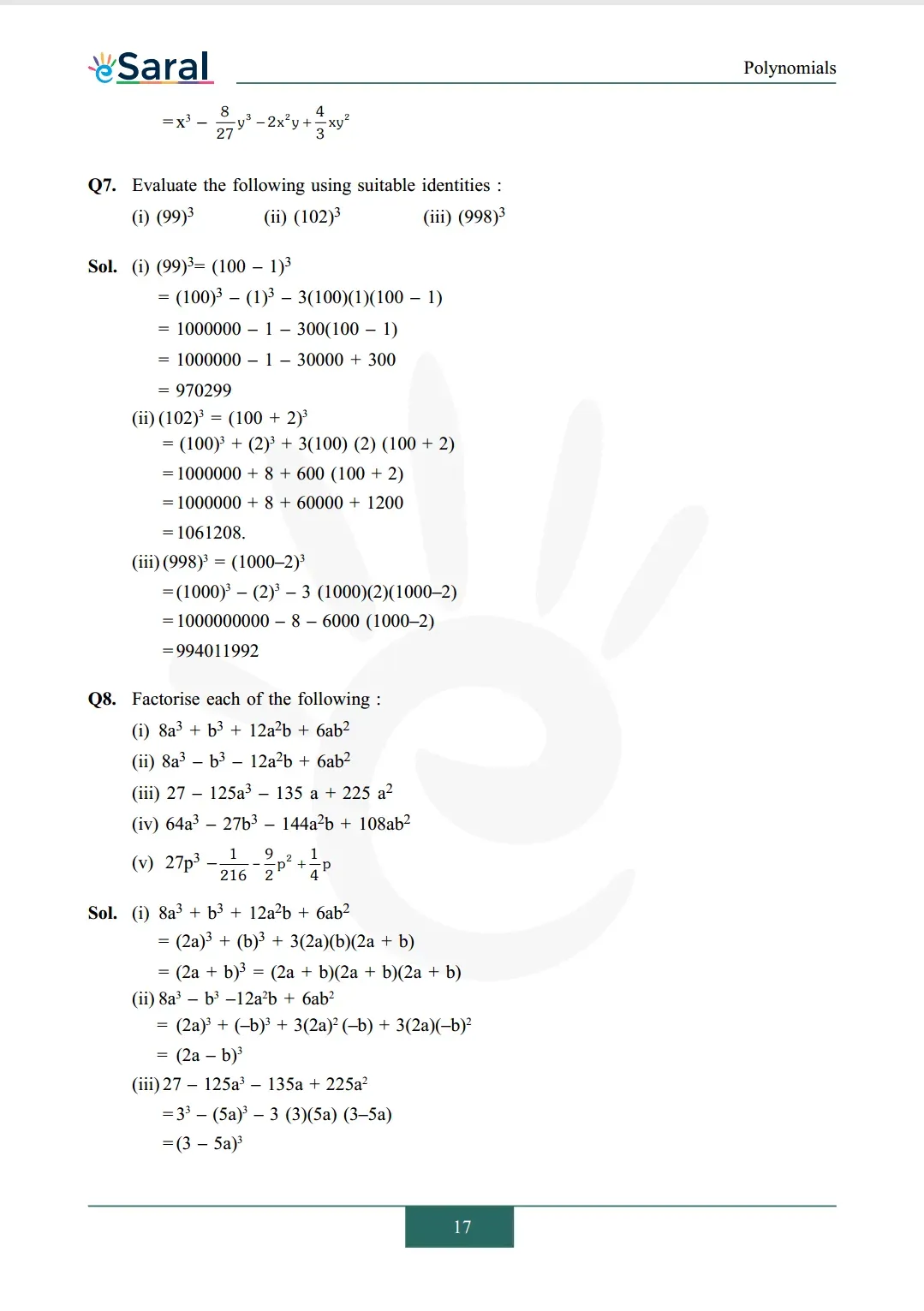
Q7. Evaluate the following using suitable identities:
(i) $(99)^{3}$
(ii) $(102)^{3}$
(iii) $(998)^{3}$
Sol.(i) $(99)^{3}=(100-1)^{3}$
$=(100)^{3}-(1)^{3}-3(100)(1)(100-1)$
$=1000000-1-300(100-1)$
$=1000000-1-30000+300$
$=970299$
(ii) $(102)^{3}=(100+2)^{3}$
$=(100)^{3}+(2)^{3}+3(100)(2)(100+2)$
$=1000000+8+600(100+2)$
v$=1000000+8+60000+1200$
$=1061208$
(iii) $(998)^{3}=(1000-2)^{3}$
$=(1000)^{3}-(2)^{3}-3(1000)(2)(1000-2)$
$=1000000000-8-6000(1000-2)$
$=994011992$
Q8. Factorise each of the following :
(i) $8 a^{3}+b^{3}+12 a^{2} b+6 a b^{2}$
(ii) $8 \mathrm{a}^{3}-\mathrm{b}^{3}-12 \mathrm{a}^{2} \mathrm{~b}+6 \mathrm{ab}^{2}$
(iii) $27-125 \mathrm{a}^{3}-135 \mathrm{a}+225 \mathrm{a}^{2}$
(iv) $64 \mathrm{a}^{3}-27 \mathrm{~b}^{3}-144 \mathrm{a}^{2} \mathrm{~b}+108 \mathrm{ab}^{2}$
(v) $27 \mathrm{p}^{3}-\frac{1}{216}-\frac{9}{2} \mathrm{p}^{2}+\frac{1}{4} \mathrm{p}$
Sol.(i) $8 \mathrm{a}^{3}+\mathrm{b}^{3}+12 \mathrm{a}^{2} \mathrm{~b}+6 \mathrm{ab}^{2}$
$=(2 a)^{3}+(b)^{3}+3(2 a)(b)(2 a+b)$
$=(2 a+b)^{3}=(2 a+b)(2 a+b)(2 a+b)$
(ii) $8 \mathrm{a}^{3}-\mathrm{b}^{3}-12 \mathrm{a}^{2} \mathrm{~b}+6 \mathrm{ab}^{2}$
$=(2 a)^{3}+(-b)^{3}+3(2 a)^{2}(-b)+3(2 a)(-b)^{2}$
$=(2 a-b)^{3}$
(iii) $27-125 \mathrm{a}^{3}-135 \mathrm{a}+225 \mathrm{a}^{2}$
$=3^{3}-(5 a)^{3}-3(3)(5 a)(3-5 a)$
$=(3-5 a)^{3}$
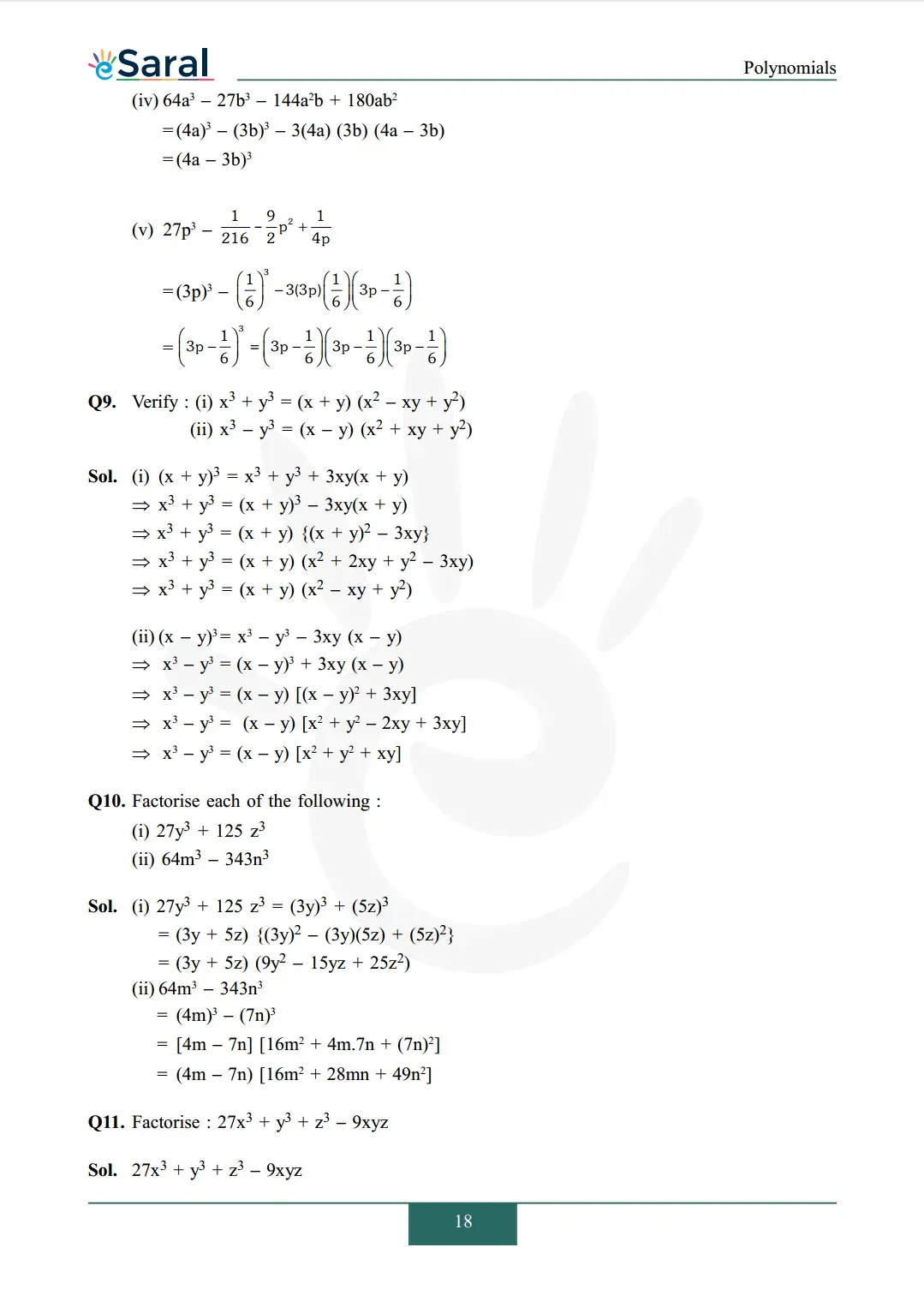
(iv) $64 \mathrm{a}^{3}-27 \mathrm{~b}^{3}-144 \mathrm{a}^{2} \mathrm{~b}+180 \mathrm{ab}^{2}$
$=(4 a)^{3}-(3 b)^{3}-3(4 a)(3 b)(4 a-3 b)$
$=(4 a-3 b)^{3}$
(v) $27 \mathrm{p}^{3}-\frac{1}{216}-\frac{9}{2} \mathrm{p}^{2}+\frac{1}{4 \mathrm{p}}$
$=(3 p)^{3}-\left(\frac{1}{6}\right)^{3}-3(3 p)\left(\frac{1}{6}\right)\left(3 p-\frac{1}{6}\right)$
$=\left(3 p-\frac{1}{6}\right)^{3}=\left(3 p-\frac{1}{6}\right)\left(3 p-\frac{1}{6}\right)\left(3 p-\frac{1}{6}\right)$
Q9. Verify : (i) $x^{3}+y^{3}=(x+y)\left(x^{2}-x y+y^{2}\right)$
(ii) $\mathrm{x}^{3}-\mathrm{y}^{3}=(\mathrm{x}-\mathrm{y})\left(\mathrm{x}^{2}+\mathrm{xy}+\mathrm{y}^{2}\right)$
Sol. (i) $(x+y)^{3}=x^{3}+y^{3}+3 x y(x+y)$
$\Rightarrow x^{3}+y^{3}=(x+y)^{3}-3 x y(x+y)$
$\Rightarrow \mathrm{x}^{3}+\mathrm{y}^{3}=(\mathrm{x}+\mathrm{y})\left\{(\mathrm{x}+\mathrm{y})^{2}-3 \mathrm{xy}\right\}$
$\Rightarrow x^{3}+y^{3}=(x+y)\left(x^{2}+2 x y+y^{2}-3 x y\right)$
$\Rightarrow x^{3}+y^{3}=(x+y)\left(x^{2}-x y+y^{2}\right)$
(ii) $(x-y)^{3}=x^{3}-y^{3}-3 x y(x-y)$
$\Rightarrow x^{3}-y^{3}=(x-y)^{3}+3 x y(x-y)$
$\Rightarrow x^{3}-y^{3}=(x-y)\left[(x-y)^{2}+3 x y\right]$
$\Rightarrow x^{3}-y^{3}=(x-y)\left[x^{2}+y^{2}-2 x y+3 x y\right]$
$\Rightarrow x^{3}-y^{3}=(x-y)\left[x^{2}+y^{2}+x y\right]$
Q10. Factorise each of the following :
(i) $27 \mathrm{y}^{3}+125 \mathrm{z}^{3}$
(ii) $64 \mathrm{~m}^{3}-343 \mathrm{n}^{3}$
Sol.(i) $27 \mathrm{y}^{3}+125 \mathrm{z}^{3}=(3 \mathrm{y})^{3}+(5 \mathrm{z})^{3}$
$=(3 y+5 z)\left\{(3 y)^{2}-(3 y)(5 z)+(5 z)^{2}\right\}$
$=(3 y+5 z)\left(9 y^{2}-15 y z+25 z^{2}\right)$
(ii) $64 \mathrm{~m}^{3}-343 \mathrm{n}^{3}$
$=(4 m)^{3}-(7 n)^{3}$
$=[4 m-7 n]\left[16 m^{2}+4 m .7 n+(7 n)^{2}\right]$
$=(4 m-7 n)\left[16 m^{2}+28 m n+49 n^{2}\right]$
Q11. Factorise : $27 \mathrm{x}^{3}+\mathrm{y}^{3}+\mathrm{z}^{3}-9 \mathrm{xyz}$
Sol. $27 \mathrm{x}^{3}+\mathrm{y}^{3}+\mathrm{z}^{3}-9 \mathrm{xyz}$
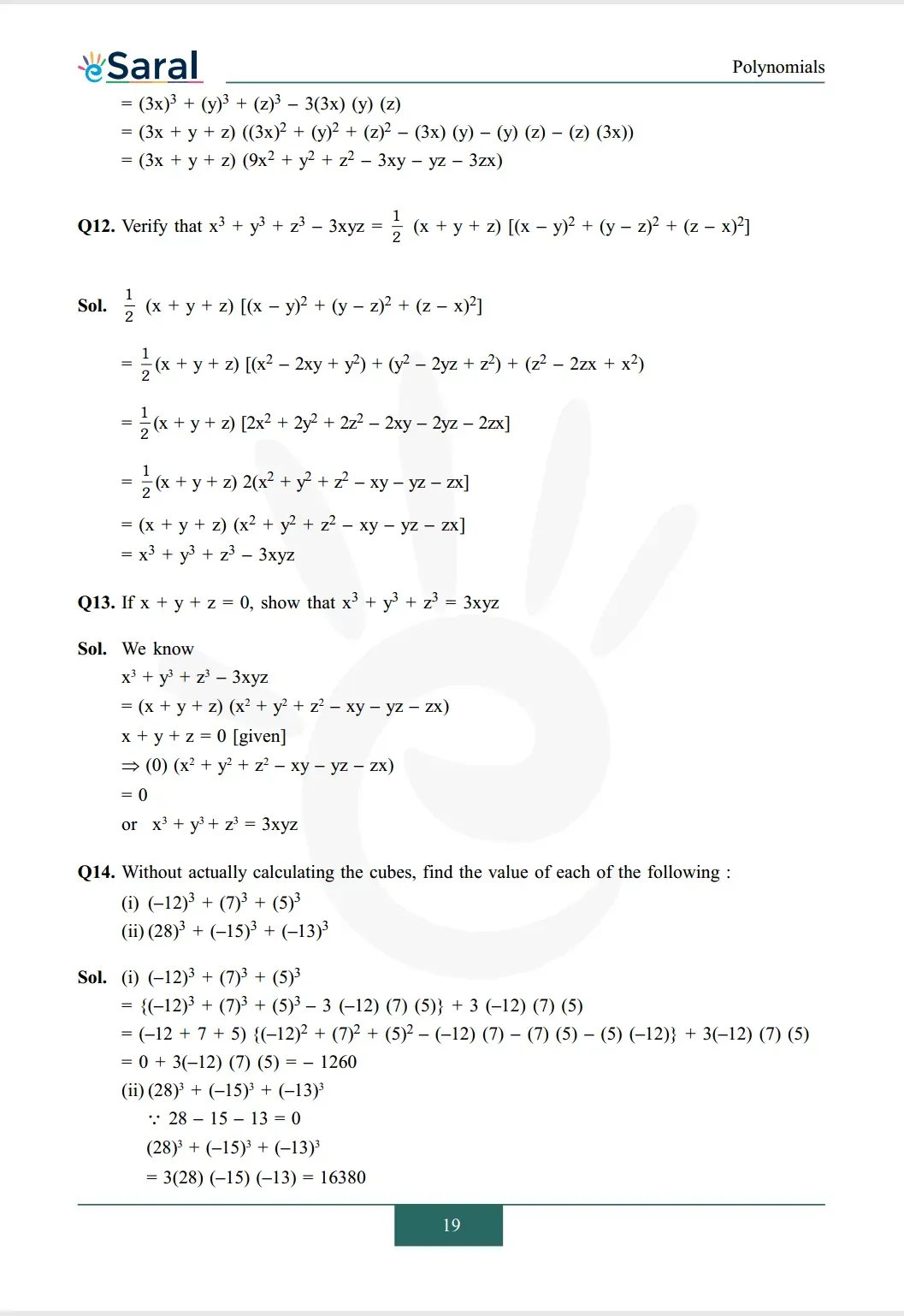
$=(3 x)^{3}+(y)^{3}+(z)^{3}-3(3 x)(y)(z)$
$=(3 x+y+z)\left((3 x)^{2}+(y)^{2}+(z)^{2}\right.$
$-(3 x)(y)-(y)(z)-(z)(3 x))$
$=(3 x+y+z)\left(9 x^{2}+y^{2}+z^{2}-3 x y-y z-3 z x\right)$
Q12. Verify that $\mathrm{x}^{3}+\mathrm{y}^{3}+\mathrm{z}^{3}-3 \mathrm{xyz}$
$=\frac{1}{2}(x+y+z)\left[(x-y)^{2}+(y-z)^{2}+(z-x)^{2}\right]$
Sol. $\frac{1}{2}(x+y+z)\left[(x-y)^{2}+(y-z)^{2}+(z-x)^{2}\right]$
$=\frac{1}{2}(x+y+z)\left[\left(x^{2}-2 x y+y^{2}\right)\right.$
$=-\frac{1}{2}(x+y+z)\left[\left(x^{2}-2 x y+y^{2}\right)\right.$
$+\left(y^{2}-2 y z+z^{2}\right)+\left(z^{2}-2 z x+x^{2}\right)$
$=\frac{1}{2}(x+y+z)\left[2 x^{2}+2 y^{2}+2 z^{2}-2 x y-2 y z-2 z x\right]$
$=\frac{1}{2}(x+y+z) 2\left(x^{2}+y^{2}+z^{2}-x y-y z-z x\right]$
$=(\mathrm{x}+\mathrm{y}+\mathrm{z})\left(\mathrm{x}^{2}+\mathrm{y}^{2}+\mathrm{z}^{2}-\mathrm{xy}-\mathrm{yz}-\mathrm{zx}\right]$
$=x^{3}+y^{3}+z^{3}-3 x y z$
Q13. If $x+y+z=0$, show that $x^{3}+y^{3}+z^{3}=3 x y z$
Sol. We know
$x^{3}+y^{3}+z^{3}-3 x y z$
$=(\mathrm{x}+\mathrm{y}+\mathrm{z})\left(\mathrm{x}^{2}+\mathrm{y}^{2}+\mathrm{z}^{2}-\mathrm{xy}-\mathrm{yz}-\mathrm{zx}\right)$
$x+y+z=0$ [given $]$
$\Rightarrow(0)\left(\mathrm{x}^{2}+\mathrm{y}^{2}+\mathrm{z}^{2}-\mathrm{xy}-\mathrm{yz}-\mathrm{zx}\right)$
$=0$
or $x^{3}+y^{3}+z^{3}=3 x y z$
Q14. Without actually calculating the cubes, find the value of each of the following :
(i) $(-12)^{3}+(7)^{3}+(5)^{3}$
(ii) $(28)^{3}+(-15)^{3}+(-13)^{3}$
Sol.(i) $(-12)^{3}+(7)^{3}+(5)^{3}$
$=\left\{(-12)^{3}+(7)^{3}+(5)^{3}-3(-12)(7)\right.$
$(5)\}+3(-12)(7)(5)$
$=(-12+7+5)\left\{(-12)^{2}+(7)^{2}+(5)^{2}-(-12)(7)\right.$
$-(7)(5)-(5)(-12)\}+3(-12)(7)(5)$
$=0+3(-12)(7)(5)=-1260$
(ii) $(28)^{3}+(-15)^{3}+(-13)^{3}$
$\because 28-15-13=0$
$(28)^{3}+(-15)^{3}+(-13)^{3}$
$=3(28)(-15)(-13)=16380$
(using identity)
if $a+b+c=0$
$\Rightarrow \mathrm{a}^{3}+\mathrm{b}^{3}+\mathrm{c}^{3}=3 \mathrm{abc}$
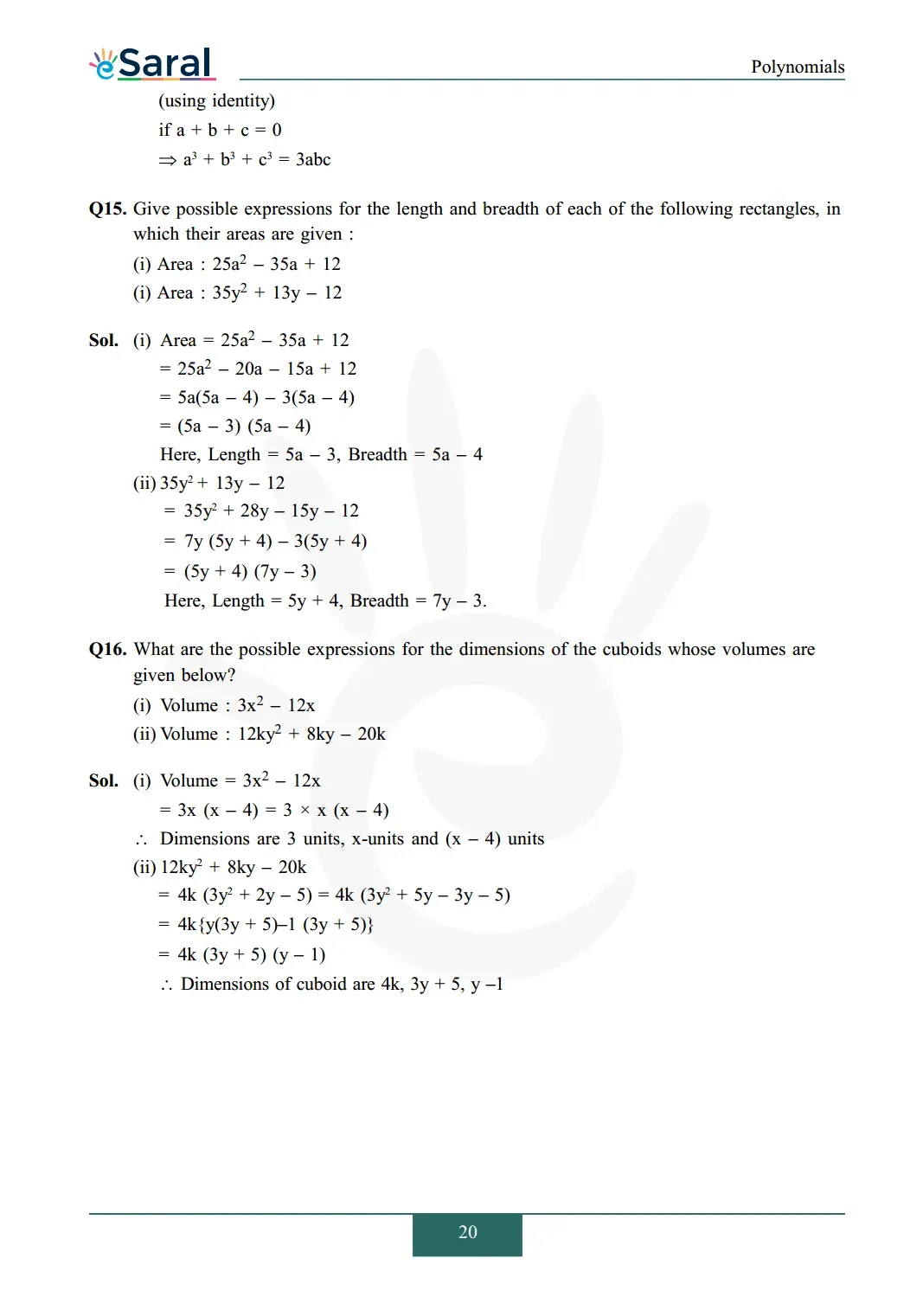
Q15. Give possible expressions for the length and breadth of each of the following rectangles, in which their areas are given :
(i) Area : $25 \mathrm{a}^{2}-35 \mathrm{a}+12$
(ii)Area : $35 \mathrm{y}^{2}+13 \mathrm{y}-12$
Sol. (i) Area $=25 a^{2}-35 a+12$
$=25 a^{2}-20 a-15 a+12$
$=5 \mathrm{a}(5 \mathrm{a}-4)-3(5 \mathrm{a}-4)$
$=(5 a-3)(5 a-4)$
Here, Length $=5 \mathrm{a}-3$, Breadth $=5 \mathrm{a}-4$
Q16. What are the possible expressions for the dimensions of the cuboids whose volumes are given below?
(i) Volume : $3 x^{2}-12 x$
(ii) Volume : $12 \mathrm{ky}^{2}+8 \mathrm{ky}-20 \mathrm{k}$
Sol. (i) Volume $=3 \mathrm{x}^{2}-12 \mathrm{x}$ss
$=3 x(x-4)=3 \times x(x-4)$
$\therefore$ Dimensions are 3 units, $x$ -units and $(x-4)$ units
(ii) $12 \mathrm{ky}^{2}+8 \mathrm{ky}-20 \mathrm{k}$
$=4 \mathrm{k}\left(3 \mathrm{y}^{2}+2 \mathrm{y}-5\right)=4 \mathrm{k}\left(3 \mathrm{y}^{2}+5 \mathrm{y}-3 \mathrm{y}-5\right)$
$=4 \mathrm{k}\{\mathrm{y}(3 \mathrm{y}+5)-1(3 \mathrm{y}+5)\}$
$=4 \mathrm{k}(3 \mathrm{y}+5)(\mathrm{y}-1)$
$\therefore$ Dimensions of cuboid are $4 \mathrm{k}, 3 \mathrm{y}+5, \mathrm{y}-1$
Chapter 2 - Polynomials
In this Chapter you will learn about the Variables and coefficients and there operations of Multiplication, subtraction, and Additions. After completing this chapter you will get the idea about Polynomials, coefficients, Degrees and different terms of Polynomials
NCERT Class 9 Maths Chapter 2 All Exercise Solutions
- Class 9 maths chapter 2 exercise 2.1
- Class 9 maths chapter 2 exercise 2.2
- Class 9 maths chapter 2 exercise 2.3
- Class 9 maths chapter 2 exercise 2.4
- Class 9 maths chapter 2 exercise 2.5
So, that’s all from this article. I hope you enjoyed this post. If you found this article helpful then please share it with other students.
Also Read,
Complete Class 9 Maths Short Revision Notes.
Also See.
- Class 9 Maths all chapter solutions.
- Chapter 1: Number System
- Chapter 2: Polynomials
- Chapter 3: Coordinate Geometry
- Chapter 4: Linear Equations in Two Variables
- Chapter 5: Introduction to Euclid’s Geometry
- Chapter 6: Lines and Angles
- Chapter 7: Triangles
- Chapter 8: Quadrilaterals
- Chapter 9: Areas of Parallelograms and Triangles
- Chapter 10: Circles
- Chapter 11: Constructions
- Chapter 12: Heron’s Formula
- Chapter 13: Surface Areas and Volumes
- Chapter 14: Statistics
- Chapter 15: Probability
If you have any Confusion related to NCERT Solutions for Class 9 Maths chapter 2 Polynomials PDF then feel free to ask in the comments section down below.
To watch Free Learning Videos on Class 9 by Kota’s top Faculties Install the eSaral App
Team eSaral
eSaral Academic and Editorial Team
Team eSaral is the collective author profile for educational content created by eSaral’s teachers and academic contributors. The team draws on expertise from IIT graduates, doctors, experienced educators and subject specialists to develop resources for JEE, NEET and school students. Our articles aim to explain concepts clearly and help students study with confidence.
Related Posts

BITSAT 2027: Registration Date, Exam Date, Syllabus, Eligibility, Pattern & Fees
BITSAT 2027 exam dates, registration timeline, eligibility criteria, exam pattern, marking scheme, syllabus and fees in one page.

BITSAT Previous Year Question Paper PDF (2017-2026)
Download BITSAT previous year question papers PDF from 2017 to 2026,session-wise. Memory-based papers,exam pattern, paper analysis and how to practise

CBSE Class 10 Date Sheet 2027: Expected Exam Dates, Release Date, Admit Card & Result Timeline
CBSE Class 10 date sheet 2027 is awaited. See the expected exam dates, release window, how to download the PDF, admit card and result timelines.

NCERT Physics Class 10 Book PDF in Hindi 2026-27 – भौतिक विज्ञान के 4 अध्याय (Free Download)
NCERT Physics Class 10 book PDF in Hindi 2026-27: download all 4 chapters (अध्याय 9–12) free, with topics and important formulas.

NCERT Biology Class 9 Book Anveshan PDF in Hindi - जीव विज्ञान कक्षा 9 पुस्तक अन्वेषण PDF
Download NCERT Biology Class 9 book PDF in Hindi chapterwise for 2026-27: Cell, Tissues, Reproduction and Diversity. Free PDFs.

Essay On Artificial Intelligence in English (100,150, 200, 250, 300, 500 Words)
This is in contrast to the natural intelligence of humans. With Artificial Intelligence, machines can perform

Essay on 78th India Independence Day in English for Student (100, 150, 200, 250, 300, 500 Words)
Read the best essays on India's Independence Day in English. Short & long essays (100, 150, 200, 250, 300, 500 words) perfect for school exams
NCERT Class 11 English Snapshots book - Free PDF download- Esaral
Download NCERT Class 11 English Snapshots book PDF for free. Get all 8 chapters, chapter-wise. Start your prep today!
NCERT Class 10 biology book pdf - Free PDF Download - eSaral
NCERT Class 10 Biology book PDF 2026-27: all 5 chapters (Life Processes to Our Environment) in English & Hindi, with CBSE syllabus, marks & practical

Essay on Global Warming in English (100,150, 200, 250, 300, 500 Words)
Global warming means the Earth is getting hotter. This happens because of things like pollution from cars and factories.