
NCERT Solutions Class 11 PDF: Maths, Physics, Chemistry, Biology and English (2026-27)

eSaral Academic and Editorial Team
Summary
NCERT Solutions Class 11 by eSaral: chapter-wise links for Maths, Physics, Chemistry and Biology, plus the chapter lists of the NCERT English books Hornbill, Snapshots and Woven Words, with how to use them for CBSE exams, JEE and NEET, and FAQs.
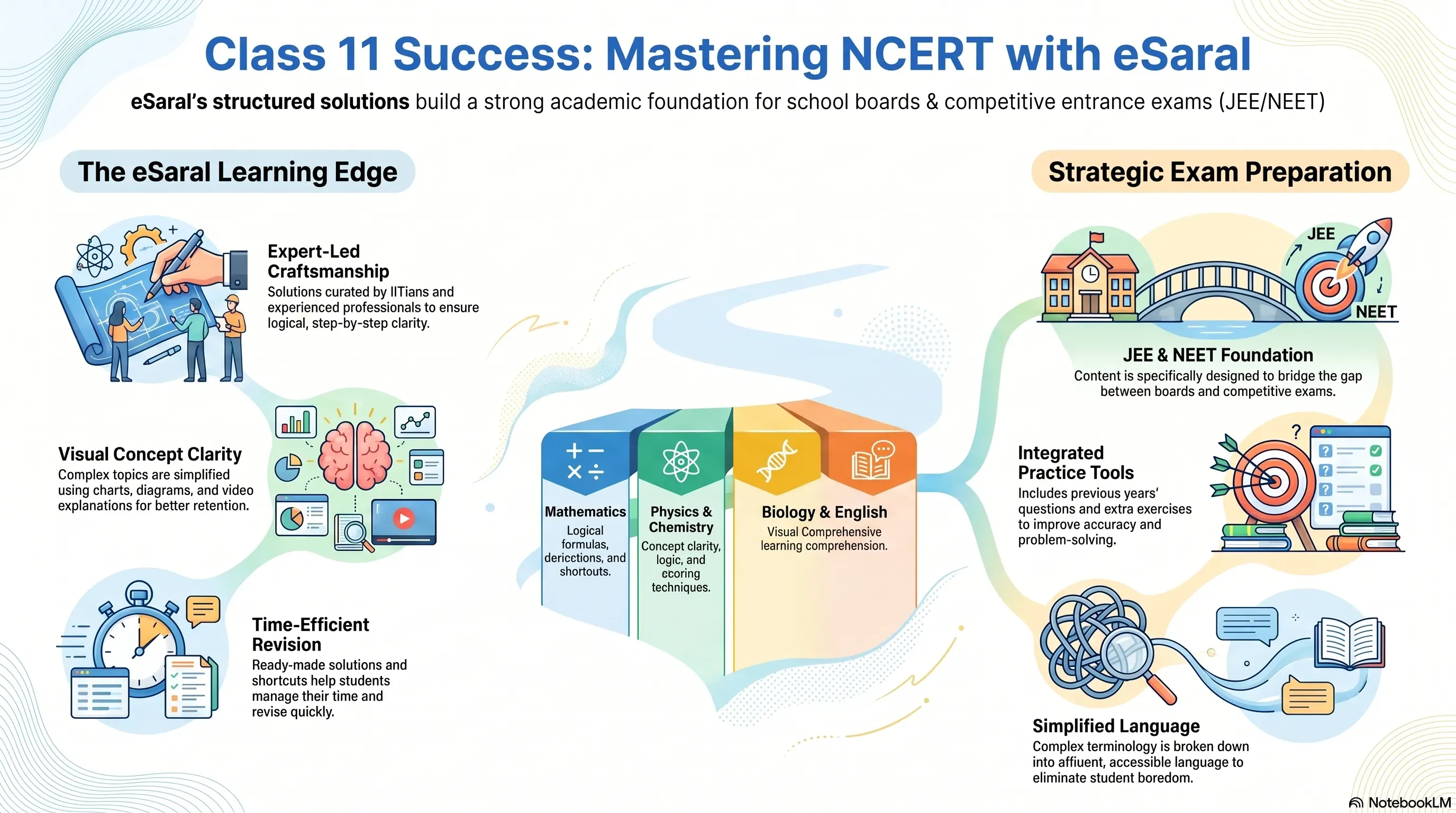
NCERT Solutions Class 11 on eSaral are arranged subject by subject: Maths, Physics, Chemistry and Biology, along with the chapter lists of the NCERT English books. The Maths, Physics, Chemistry and Biology chapters below link to their solutions pages, and the English section lists the chapters of the three NCERT English books. Class 11 is the first step towards the Class 12 boards, JEE and NEET, so solving the NCERT questions yourself, chapter by chapter, is the habit that pays off most.
NCERT Solutions Class 11 at a Glance
Subject | NCERT book | Chapters |
|---|---|---|
Maths | Mathematics | 14 |
Physics | Physics Part 1 and Part 2 | 14 |
Chemistry | Chemistry Part 1 and Part 2 | 9 |
Biology | Biology | 19, in 5 units |
English (core) | Hornbill, with the Snapshots supplementary reader | 6 lessons with poems and writing skills, and 5 stories |
English (elective) | Woven Words | 8 short stories, 12 poems and 7 essays |
NCERT Solutions Class 11 Maths
These NCERT Solutions Class 11 Maths cover the 14 chapters of the NCERT Mathematics book, with the steps shown for every question, so that you can learn the method and then check your own answer. Maths needs regular practice, so solve each exercise yourself first.
- Chapter 1: Sets
- Chapter 2: Relations and Functions
- Chapter 3: Trigonometric Functions
- Chapter 4: Complex Numbers and Quadratic Equations
- Chapter 5: Linear Inequalities
- Chapter 6: Permutations and Combinations
- Chapter 7: Binomial Theorem
- Chapter 8: Sequences and Series
- Chapter 9: Straight Lines
- Chapter 10: Conic Sections
- Chapter 11: Introduction to Three Dimensional Geometry
- Chapter 12: Limits and Derivatives
- Chapter 13: Statistics
- Chapter 14: Probability
NCERT Solutions Class 11 Physics
The Class 11 Physics book is in two parts: Part 1 has Chapters 1 to 7, and Part 2 has Chapters 8 to 14. The chapters on Units and Measurements, Motion and Laws of Motion are the base of mechanics for JEE and NEET, so give them extra time. Use these NCERT Solutions Class 11 Physics after you read each chapter.
- Chapter 1: Units and Measurements
- Chapter 2: Motion in a Straight Line
- Chapter 3: Motion in a Plane
- Chapter 4: Laws of Motion
- Chapter 5: Work, Energy and Power
- Chapter 6: System of Particles and Rotational Motion
- Chapter 7: Gravitation
- Chapter 8: Mechanical Properties of Solids
- Chapter 9: Mechanical Properties of Fluids
- Chapter 10: Thermal Properties of Matter
- Chapter 11: Thermodynamics
- Chapter 12: Kinetic Theory
- Chapter 13: Oscillations
- Chapter 14: Waves
NCERT Solutions Class 11 Chemistry
The Class 11 Chemistry book is also in two parts: Part 1 has Chapters 1 to 6, and Part 2 has Chapters 7 to 9. Chemistry rewards a clear understanding of the basics, especially Structure of Atom, Chemical Bonding and Equilibrium, so read the NCERT text first and then use these NCERT Solutions Class 11 Chemistry to check your answers.
NCERT Solutions Class 11 Chemistry (all chapters)
- Chapter 1: Some Basic Concepts of Chemistry
- Chapter 2: Structure of Atom
- Chapter 3: Classification of Elements and Periodicity in Properties
- Chapter 4: Chemical Bonding and Molecular Structure
- Chapter 5: Thermodynamics
- Chapter 6: Equilibrium
- Chapter 7: Redox Reactions
- Chapter 8: Organic Chemistry: Some Basic Principles and Techniques
- Chapter 9: Hydrocarbons
NCERT Solutions Class 11 Biology
The Class 11 Biology book has 19 chapters in 5 units: Diversity in the Living World (Chapters 1 to 4), Structural Organisation in Plants and Animals (Chapters 5 to 7), Cell: Structure and Functions (Chapters 8 to 10), Plant Physiology (Chapters 11 to 13) and Human Physiology (Chapters 14 to 19). NEET Biology is based on the NCERT text, so read each chapter fully, including the diagrams, and then solve the questions with the NCERT Solutions Class 11 Biology below.
Chapter | Name | NCERT solutions |
|---|---|---|
1 | The Living World | |
2 | Biological Classification | |
3 | Plant Kingdom | |
4 | Animal Kingdom | |
5 | Morphology of Flowering Plants | |
6 | Anatomy of Flowering Plants | |
7 | Structural Organisation in Animals | |
8 | Cell: The Unit of Life | |
9 | Biomolecules | |
10 | Cell Cycle and Cell Division | |
11 | Photosynthesis in Higher Plants | |
12 | Respiration in Plants | |
13 | Plant Growth and Development | |
14 | Breathing and Exchange of Gases | |
15 | Body Fluids and Circulation | |
16 | Excretory Products and Their Elimination | |
17 | Locomotion and Movement | |
18 | Neural Control and Coordination | |
19 | Chemical Coordination and Integration |
NCERT Class 11 English: Hornbill, Snapshots and Woven Words Chapters
In the English section of the NCERT Solutions Class 11 hub, the chapters follow the three NCERT books of Class 11 English: Hornbill (the core textbook), Snapshots (the supplementary reader for the core course) and Woven Words (the elective textbook). Here are the chapters of each book, so that you can follow the NCERT sequence in your English classes.
Hornbill (core textbook)
Chapter | Prose lesson | Poem in the unit |
|---|---|---|
1 | The Portrait of a Lady | A Photograph |
2 | We’re Not Afraid to Die... if We Can All Be Together | None |
3 | Discovering Tut: the Saga Continues | The Laburnum Top, The Voice of the Rain |
4 | The Ailing Planet: the Green Movement’s Role | Childhood |
5 | The Adventure | None |
6 | Silk Road | Father to Son |
The book also has a Reading Skills section, and a Writing Skills section with Note-making, Summarising, Sub-titling, Essay-writing, Letter-writing and Creative Writing.
Snapshots (supplementary reader)
Chapter | Story |
|---|---|
1 | The Summer of the Beautiful White Horse |
2 | The Address |
3 | Mother’s Day |
4 | Birth |
5 | The Tale of Melon City |
Woven Words (elective textbook)
Short stories | Poetry | Essays |
|---|---|---|
1. The Lament | 1. The Peacock | 1. My Watch |
2. A Pair of Mustachios | 2. Let Me Not to the Marriage of True Minds | 2. My Three Passions |
3. The Rocking-horse Winner | 3. Coming | 3. Patterns of Creativity |
4. The Adventure of the Three Garridebs | 4. Telephone Conversation | 4. Tribal Verse |
5. Pappachi’s Moth | 5. The World Is Too Much with Us | 5. What Is a Good Book? |
6. The Third and Final Continent | 6. Mother Tongue | 6. The Story |
7. Glory at Twilight | 7. Hawk Roosting | 7. Bridges |
8. The Luncheon | 8. For Elkana | |
9. Refugee Blues | ||
10. Felling of the Banyan Tree | ||
11. Ode to a Nightingale | ||
12. Ajamil and the Tigers |
How to Use NCERT Solutions Class 11 Well
- Read the NCERT chapter first, and mark the definitions, diagrams and examples.
- Solve each question on your own, and only then open the solution to compare your steps and your answer.
- Note your mistakes in a small notebook, and revise them once a week.
- Finish the chapter before you move on. In Physics and Maths, solve the examples and the exercises. In Biology, solve the questions and revise the diagrams.
💡 Tip from the eSaral Academic Team: In Class 11, finish the NCERT questions of a chapter before you start the JEE or NEET practice questions of the same chapter. The NCERT questions show what the concept looks like in its simplest form, and the harder questions are easier after that.
Why NCERT Solutions Class 11 Matter for CBSE, JEE and NEET
- CBSE exams: school exams in Class 11 follow the NCERT chapters, so the NCERT Solutions Class 11 are the first thing to cover.
- JEE: NCERT builds the base in Maths, Physics and Chemistry, and Chemistry in particular follows the NCERT concepts closely. For Maths and Physics, add JEE-level practice after the NCERT questions.
- NEET: the Biology questions are based on the NCERT text and diagrams, so a full reading of the Biology book matters as much as the answers to the questions.
- Class 12: Class 11 topics such as mechanics, atomic structure, organic basics and the cell come back in Class 12, so a solid base now saves time later.
Frequently Asked Questions
Where can I get NCERT Solutions Class 11 for all subjects?
This page links the NCERT Solutions Class 11 for Maths, Physics, Chemistry and Biology chapter by chapter on eSaral. For English, it lists the chapters of Hornbill, Snapshots and Woven Words. Go to your subject section, and click the chapter you need.
Where can I download the Class 11 NCERT solutions PDF?
Open the chapter link from the subject section. eSaral’s chapter pages have the solutions of that chapter, and the pages with a download button give the PDF as well, so you can save it for offline study.
How many chapters are there in NCERT Solutions Class 11 Maths, Physics and Chemistry?
Class 11 Maths has 14 chapters. Physics has 14 chapters in two parts (Chapters 1 to 7 in Part 1, and Chapters 8 to 14 in Part 2). Chemistry has 9 chapters in two parts (Chapters 1 to 6 in Part 1, and Chapters 7 to 9 in Part 2).
How many chapters are there in NCERT Solutions Class 11 Biology, and what are the units?
The Class 11 Biology book has 19 chapters in 5 units: Diversity in the Living World (Chapters 1 to 4), Structural Organisation in Plants and Animals (Chapters 5 to 7), Cell: Structure and Functions (Chapters 8 to 10), Plant Physiology (Chapters 11 to 13) and Human Physiology (Chapters 14 to 19).
Which English books are used in Class 11: Hornbill, Snapshots or Woven Words?
In the core English course, students use Hornbill as the main textbook with Snapshots as the supplementary reader. Woven Words is the textbook of the elective English course. Check with your school which course you follow.
What are the chapters of Hornbill, Snapshots and Woven Words?
Hornbill has six prose lessons, from The Portrait of a Lady to Silk Road, with five poems and the Reading and Writing Skills sections. Snapshots has 5 stories, from The Summer of the Beautiful White Horse to The Tale of Melon City. Woven Words has 8 short stories, 12 poems and 7 essays, 27 chapters in all, from The Lament to Bridges.
Are NCERT Solutions Class 11 enough for JEE and NEET?
They are the base, and not the whole preparation. For NEET, read the NCERT Biology book line by line, including the diagrams, as the questions are based on it. For JEE, NCERT Chemistry is closely followed, and for Maths and Physics you should add JEE-level practice after the NCERT questions. eSaral’s solutions can help you check your NCERT answers first.
How should I use NCERT Solutions Class 11 for exam preparation?
Read the chapter first, solve each question yourself, and then compare your steps with the eSaral solution. Note your mistakes in a small notebook, and revise them once a week. In Maths and Physics, solve the examples and the exercises, and in Biology, revise the diagrams along with the questions.
Which Class 11 Maths chapters should I give the most time?
Trigonometric Functions, Permutations and Combinations, Binomial Theorem, Sequences and Series, Straight Lines, Conic Sections, and Limits and Derivatives form the base of Class 12 and JEE Maths, so practise them well with the NCERT Solutions Class 11 Maths.
Which Class 11 Physics chapters are the base of mechanics?
Units and Measurements, Motion in a Straight Line, Motion in a Plane, Laws of Motion, Work, Energy and Power, System of Particles and Rotational Motion, and Gravitation (Part 1) are the base of mechanics for JEE and NEET. Part 2 then covers the properties of matter, thermodynamics, kinetic theory, oscillations and waves.
Which Class 11 Chemistry chapters are physical, organic and inorganic?
They are usually grouped like this: physical chemistry has Some Basic Concepts of Chemistry, Structure of Atom, Thermodynamics, Equilibrium and Redox Reactions. Inorganic chemistry has Classification of Elements and Periodicity in Properties and Chemical Bonding and Molecular Structure. Organic chemistry has Organic Chemistry: Some Basic Principles and Techniques, and Hydrocarbons.
Where can I find the NCERT Solutions for each Class 11 Biology chapter?
The Biology table on this page links every chapter, from The Living World to Chemical Coordination and Integration, to its solutions page on eSaral. Open the chapter you need from the list.
Team eSaral
eSaral Academic and Editorial Team
Team eSaral is the collective author profile for educational content created by eSaral’s teachers and academic contributors. The team draws on expertise from IIT graduates, doctors, experienced educators and subject specialists to develop resources for JEE, NEET and school students. Our articles aim to explain concepts clearly and help students study with confidence.
Related Posts

BITSAT 2027: Registration Date, Exam Date, Syllabus, Eligibility, Pattern & Fees
BITSAT 2027 exam dates, registration timeline, eligibility criteria, exam pattern, marking scheme, syllabus and fees in one page.

BITSAT Previous Year Question Paper PDF (2017-2026)
Download BITSAT previous year question papers PDF from 2017 to 2026,session-wise. Memory-based papers,exam pattern, paper analysis and how to practise

CBSE Class 10 Date Sheet 2027: Expected Exam Dates, Release Date, Admit Card & Result Timeline
CBSE Class 10 date sheet 2027 is awaited. See the expected exam dates, release window, how to download the PDF, admit card and result timelines.

NCERT Physics Class 10 Book PDF in Hindi 2026-27 – भौतिक विज्ञान के 4 अध्याय (Free Download)
NCERT Physics Class 10 book PDF in Hindi 2026-27: download all 4 chapters (अध्याय 9–12) free, with topics and important formulas.

NCERT Biology Class 9 Book Anveshan PDF in Hindi - जीव विज्ञान कक्षा 9 पुस्तक अन्वेषण PDF
Download NCERT Biology Class 9 book PDF in Hindi chapterwise for 2026-27: Cell, Tissues, Reproduction and Diversity. Free PDFs.

Essay On Artificial Intelligence in English (100,150, 200, 250, 300, 500 Words)
This is in contrast to the natural intelligence of humans. With Artificial Intelligence, machines can perform

Essay on 78th India Independence Day in English for Student (100, 150, 200, 250, 300, 500 Words)
Read the best essays on India's Independence Day in English. Short & long essays (100, 150, 200, 250, 300, 500 words) perfect for school exams
NCERT Class 11 English Snapshots book - Free PDF download- Esaral
Download NCERT Class 11 English Snapshots book PDF for free. Get all 8 chapters, chapter-wise. Start your prep today!
NCERT Class 10 biology book pdf - Free PDF Download - eSaral
NCERT Class 10 Biology book PDF 2026-27: all 5 chapters (Life Processes to Our Environment) in English & Hindi, with CBSE syllabus, marks & practical

Essay on Global Warming in English (100,150, 200, 250, 300, 500 Words)
Global warming means the Earth is getting hotter. This happens because of things like pollution from cars and factories.