
NEET - Vector Previous Year Questions with Solutions

eSaral › NEET Physics ›Vector Previous Year Questions with Solutions

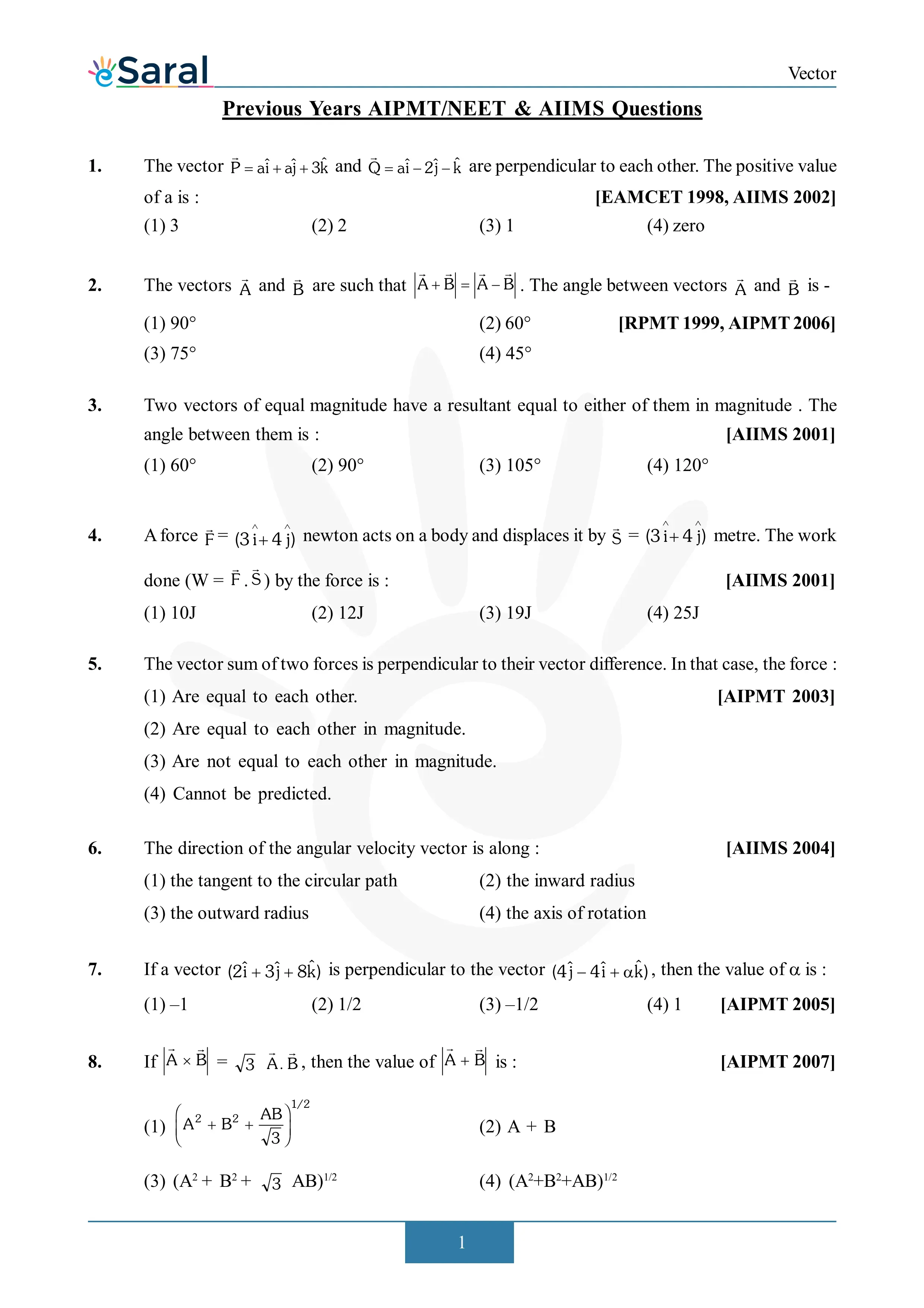
Here you will get Complete Vector NEET Previous Year Questions with complete and detailed solutions.
Get complete NEET previous year questions for Physics, Chemistry and Biology.
You will find all the solutions at the end of this page:
Score 700+ in NEET 2025 – Course for Droppers at ₹2200, Limited Time Offer!
Score 700+ in NEET 2025 – Course for Droppers at ₹2200, Limited Time Offer!

Score 700+ in NEET 2025 – Course for Droppers at ₹2200, Limited Time Offer
Common Mistakes Students Make in Vector Questions
Mistakes That Cost Marks in NEET
Mistake | Why It Happens | How to Avoid It |
|---|---|---|
Using the wrong formula for the resultant | Confusing sum and difference formulas | Memorise both; note that subtraction uses $-2AB\cos\theta$ |
Forgetting to resolve vectors into components before adding | Skipping steps to save time | Always draw a rough diagram |
Confusing dot product with cross product | Similar-looking notation | Dot = scalar = $\cos\theta$; Cross = vector = $\sin\theta$ |
Calculating the angle from horizontal instead of between vectors | Misreading the question | Underline "angle between" in the question |
Treating magnitude of $A - B$ as $A - B$ directly | Algebraic thinking applied to vectors | Magnitudes do not subtract like scalars |
Past eSaral batches have shown that students who drill these five mistake patterns on PYQs before NEET improve their Physics score by 8–12 marks on average — purely by eliminating errors rather than learning new material.
Most Repeated Vector Sub-topics in NEET (By Frequency)
Sub-topic | Approximate Frequency |
|---|---|
Resultant of two vectors (Parallelogram Law) | Very High |
Angle between vectors when resultant equals a given value | High |
Unit vector calculation | High |
Scalar and vector product applications | Medium |
Resolution of vectors into components | Medium |
Null vector and co-planar vectors | Low |
Key Vector Concepts You Must Know Before Solving PYQs
Vector Addition and Subtraction
The Triangle Law and Parallelogram Law of vector addition are tested almost every other year. Know these formulas thoroughly:
- Resultant magnitude (Parallelogram Law):
$R = \sqrt{A^2 + B^2 + 2AB\cos\theta}$ - Direction of resultant:
$\tan \alpha = \frac{B\sin\theta}{A + B\cos\theta}$ - Vector subtraction:
$|A - B| = \sqrt{A^2 + B^2 - 2AB\cos\theta}$
Special Cases Tested in NEET
- $\theta = 0^\circ \rightarrow R = A + B$ (maximum resultant)
- $\theta = 180^\circ \rightarrow R = |A - B|$ (minimum resultant)
- $\theta = 90^\circ \rightarrow R = \sqrt{A^2 + B^2}$
- When $|A + B| = |A - B| \rightarrow \theta = 90^\circ$
Dot Product and Cross Product
Dot Product (Scalar Product)
$\vec{A} \cdot \vec{B} = AB\cos\theta$
- Result is a scalar
- $\vec{A} \cdot \vec{A} = A^2$ (used in work-energy problems)
- If $\vec{A} \perp \vec{B}$, then $\vec{A} \cdot \vec{B} = 0$
Cross Product (Vector Product)
$|\vec{A} \times \vec{B}| = AB\sin\theta$
- Result is a vector, direction by the right-hand rule
- If $\vec{A} \parallel \vec{B}$, then $|\vec{A} \times \vec{B}| = 0$
- Used for torque: $\tau = \vec{r} \times \vec{F}$
- Used for angular momentum: $\vec{L} = \vec{r} \times \vec{p}$
NEET frequently asks:
- “If the dot product of two vectors is zero, what is the angle between them?” → Answer: $90^\circ$
- “If the cross product is zero, what does that imply?” → Answer: vectors are parallel or anti-parallel.
In the eSaral 5-layer doubt-solving system, this is one of the most commonly asked topics at the doubt-clearing stage — students confuse when to use dot product versus cross product. The rule is simple: if the physical quantity involves the cosine of the angle between the vectors (like work), use dot product. If it involves sine (like torque), use the cross product. Practise this distinction with every PYQ you solve.
How to Solve NEET Vector Questions in Exam Conditions
Step-by-Step Approach for Vector PYQs
NEET gives you roughly 75 seconds per Physics question. Vector questions should take 45–60 seconds if you follow this method:
1. Read the question and identify the vector operation — is it addition, subtraction, dot product, or cross product?
2. Write down the given magnitudes and the angle between vectors.
3. Apply the correct formula directly — do not re-derive in the exam.
4. Check the answer options — NEET MCQs often have two options that look similar. Eliminate clearly wrong answers first.
5. Watch units — angles must be in degrees or radians consistently.
Work through every question in the PYQ set above, cross-reference your solutions with the NCERT Solutions for Class 11 Physics, and revisit wrong answers after 48 hours.
If you want Kota-quality teaching for every Physics chapter — delivered by IIT Bombay faculty, including an AIR-41 ranker, with a 5-layer doubt-solving system and affordable pricing — explore eSaral's NEET courses. Bookmark this page for quick PYQ revision as your exam date approaches.
Frequently Asked Questions
Is the Vector chapter difficult for NEET?
Vector questions in NEET are generally of easy to medium difficulty. Most questions are direct formula applications and take under 60 seconds if you know the standard results. The chapter becomes difficult only when students have not practised the special cases. Regular PYQ practice makes this one of the most reliable scoring chapters in NEET Physics.
What are the most important vector topics for NEET?
The highest-priority topics for NEET are: Parallelogram Law of vector addition (resultant magnitude and direction), conditions for maximum and minimum resultant, unit vectors, and the distinction between dot product and cross product. Questions on the angle between vectors when their sum equals their difference (answer: 90°) are asked repeatedly and should be a memorised result.
How many questions come from Vectors in NEET every year?
NTA typically sets 1 to 2 questions from Vectors in NEET, contributing 4 to 8 marks. While the count varies by year, the chapter has appeared in nearly every NEET and AIPMT paper since 2000. Because vector concepts also appear indirectly in topics like Projectile Motion and Rotational Motion, mastering this chapter has a multiplier effect on your overall Physics score.
What is the formula for the resultant of two vectors at angle θ?
The magnitude of the resultant R of two vectors A and B at angle θ is: R = √(A² + B² + 2AB cosθ). The direction α with respect to vector A is: tan α = (B sinθ)/(A + B cosθ). These two formulas cover almost every direct resultant question in NEET.
How do I find the unit vector of a given vector?
A unit vector in the direction of vector A is found by dividing the vector by its own magnitude: Â = A / |A|. If A = aî + bĵ + ck̂, then |A| = √(a² + b² + c²). The unit vector has magnitude 1 and only carries the directional information of the original vector. NEET asks this in both direct and application form.
What is the formula for the resultant of two vectors at angle θ?
The magnitude of the resultant R of two vectors A and B at angle θ is: R = √(A² + B² + 2AB cosθ). The direction α with respect to vector A is: tan α = (B sinθ)/(A + B cosθ). These two formulas cover almost every direct resultant question in NEET.