
NEET Physics Important Questions for Systems of Particles and Rotational Motion - PDF Download

eSaral Academic and Editorial Team
Candidates must download the freely available PDF to begin preparing for the important NEET 2023 questions for the Systems of Particles and Rotational Motion by clicking the links provided below. The chapter is particularly important for the NEET examinations candidate. Important questions and step-by-step solutions are included in the pdf to make it easier for you to comprehend the topics. We highly recommend practising the important question offered by eSaral if you're a student hoping to earn higher marks on the NEET!
NEET Physics Important Questions - Chapters
Name of Unit | Chapter’s name | Average no. of questions |
Physical World and Measurement | Physical World and Units and Measurement | 1 |
Kinematics | Motion in Straight Line Motion in a Plane | 2 |
Laws of Motion | Laws of Motion | 2-3 |
Work, Energy and Power | Work, Energy and Power | 2 |
System of Particles and Rotational Motion | System of Particles and Rotational Motion | 2-3 |
Gravitation | Gravitation | 2 |
Properties of Bulk Matter | Mechanical Properties of Solids Mechanical Properties of Fluids Thermal Properties of Matter | 1 1 1-2 |
Oscillations and Waves | Oscillations Waves | 1-2 1-2 |
Thermodynamics | Thermodynamics | 1-2 |
Behaviour of Perfect Gas and Kinetic Theory | Kinetic Theory | 1 |
Electrostatics | Electric Charges and Fields Electrostatic Potential and Capacitance | 1-2 1-2 |
Current Electricity | Current Electricity | 4 |
Magnetic Effects of Current and Magnetism | Moving Charges and Magnetism Magnetism and Matter | 2 1 |
Electromagnetic Induction and Alternating Currents | Electromagnetic Induction Alternating Currents | 1 1 |
Electromagnetic Waves | Electromagnetic Waves | 1 |
Optics | Ray Optics and Optical Instruments Wave Optics | 2 1 |
Dual Nature of Radiation and Matter | Dual Nature of Radiation and Matter | 2-3 |
Atoms and Nuclei | Atoms Nuclei | 1-2 2 |
Electronic Devices | Semiconductor Electronics | 3 |
Communication Systems | Communication Systems | 0 |
NEET Physics Chapter Wise Weightage 2024
Physics Chapters and Topics | Average No. of Questions | Physics NEET Chapter wise Weightage (In Percentage) |
Centre of Mass (Chapter – System of Particles and Rotational Motion) | 1 | 1% |
Gravitation | 2 | 3% |
Kinematics (Chapters – Motion in a straight line, Motion in a Plane) | 1 | 2% |
Laws of Motion | 3 | 7% |
Mechanical Properties of Solids & Fluids | 2 | 3% |
Oscillations | 1 | 3% |
Rotational Motion (Chapter – System of Particles and Rotational Motion) | 1 | 1% |
Motion of System of Particles and Rigid Body | 3 | 7% |
Units and Measurement | 1 | 2% |
Waves | 2 | 4% |
Work, Energy and Power | 2 | 4% |
Kinetic Theory | 1 | 2% |
Properties of Bulk Matter | 1 | 3% |
Thermal Properties of Matter | 1 | 2% |
Thermodynamics | 3 | 7% |
Magnetic Effects of Current & Magnetism | 3 | 6% |
Electric Charges & Fields | 1 | 2% |
Electromagnetic Waves | 1 | 1% |
Electrostatic Potential & Capacitance | 1 | 2% |
Electrostatics | 1 | 3% |
Alternating Currents | 1 | 3% |
Current Electricity | 3 | 6% |
Electromagnetic Induction | 1 | 2% |
Semiconductor Electronics: Materials, Devices and Simple Circuits | 3 | 6% |
Atoms & Nuclei | 2 | 5% |
Dual Nature of Radiation and Matter | 2 | 4% |
Ray Optics & Optical Instruments | 3 | 5% |
Wave Optics | 2 | 4% |
Exam Pattern Based On NEET 2024 Syllabus
The NEET exam is going to be held in offline mode for all candidates for MBBS/BDS. This exam has three subjects, Biology, Chemistry, and Physics. Recently, the officials have revised the NEET 2024 exam pattern for all three subjects. Aspirants preparing for the examination should go through the exam pattern of NEET. This exam pattern helps them to gain a better understanding of the subject-wise weightage, marking scheme, duration and compulsory attempts in the exam.
NEET Syllabus 2024 Exam Pattern | |
Particulars | Details |
Duration | 3 hours 20 minutes |
Mode | Offline |
Number of questions | 200 out of which candidates have to attempt 180 |
Languages available | 13 |
Type of questions | MCQs |
Marks | 720 |
Negative marking | +4 for every correct response |
Benefits of solving important questions for Systems of Particles and Rotational Motion
Conceptual Clarity: Solving important questions aids in gaining a deeper understanding of fundamental concepts related to Systems of Particles and Rotational Motion. This includes topics like angular momentum, torque, center of mass, and rotational dynamics.
Problem-Solving Skills: By tackling a variety of problems, you develop the ability to apply theoretical knowledge to real-world scenarios. This fosters analytical thinking and problem-solving skills crucial in physics and related fields.
Application of Formulas: Practicing questions reinforces your familiarity with formulas and equations specific to rotational motion. This practical application enhances your ability to choose and apply the right formula in different situations.
Exam Preparation: Questions in exams often mirror or draw inspiration from important problems. Regular practice with such questions prepares you to handle exam scenarios effectively, reducing stress and increasing your chances of success.
Memory Retention: Actively solving problems aids in the retention of theoretical knowledge. The hands-on experience of applying concepts helps reinforce memory, making it easier to recall and apply principles when needed.
Building Confidence: Successfully solving challenging problems boosts your confidence. As you overcome obstacles and master intricate concepts, you develop a sense of accomplishment that positively influences your overall approach to learning.
Real-Life Applications: Many problems in Systems of Particles and Rotational Motion have practical applications in engineering, physics, and everyday situations. Solving these questions provides insight into how these principles are utilized in the real world.
Preparation for Advanced Topics: Systems of Particles and Rotational Motion serve as foundational concepts for more advanced topics in physics. A strong grasp of these fundamentals is crucial for delving into areas like fluid dynamics, celestial mechanics, and advanced quantum mechanics.
NEET 2024 Preparation Tips
Here are some specific preparation tips for the "Systems of Particles and Rotational Motion" section for NEET 2024:
Understand Basic Concepts: Ensure a solid grasp of fundamental concepts like center of mass, torque, angular momentum, and rotational dynamics. Refer to your class notes or standard textbooks for clarity.
Practice Regularly: Solve a variety of problems regularly to strengthen your problem-solving skills. Include a mix of conceptual and numerical questions to cover different aspects of the topic.
Refer to NCERT Textbooks: NCERT textbooks are crucial for NEET preparation. Pay close attention to the theory and examples provided. NEET questions are often based on concepts explained in these textbooks.
Previous Year Question Papers: Practice with previous years' NEET question papers to understand the exam pattern. This will familiarize you with the types of questions asked and help you manage time during the actual exam.
Conceptual Application: Focus on applying theoretical concepts to practical scenarios. Understand how the principles of rotational motion are utilized in solving problems related to real-world situations.
Master Formulas and Units: Memorize essential formulas related to rotational motion. Ensure you are familiar with the units associated with each physical quantity. This will save time during the exam.
Create a Formula Sheet: Prepare a concise formula sheet summarizing key equations for quick revision. Regularly review this sheet to reinforce your memory.
Group Study: Collaborate with classmates for group study sessions. Discussing problems and concepts with others can provide different perspectives and enhance your understanding.
Use Online Resources: Explore online platforms for additional resources, practice questions, and video tutorials. These can supplement your understanding and provide alternative explanations.
Seek Clarification: If you encounter difficulties with specific concepts or problems, don't hesitate to seek clarification from teachers, classmates, or online forums. Understanding any confusion early is essential.
Frequently Asked Questions
Question 1: How Many questions come from the Motion of System of Particles and Rigid Body in NEET?
The three important subjects of NEET examinations one is Physics, chemistry, and biology which includes zoology and botany, each of their subjects is assigned 45 questions. Chapter-wise weightage can be checked according to the pattern of the last few years' question papers. The Motion of System of Particles and Rigid Body chapter has a total 6 % weightage and questions are asked accordingly. You can get sample papers on our platform and solve important questions to practice more with these sample papers, you get an idea about the type of questions asked in the Examination and the pattern of answering them.
Question 2: How should I prepare for a rotational motion for NEET?
Preparation of NEET physics is not an easy task and students should work very hard for every final examination.
- Candidates should start with the basics, do not hurry, and read the whole chapter in one go. Distribute topics to study thoroughly and understand the concept well.
- Study a topic and solve its questions to clear the concept of the topic and practice multiple times.
- NEET exam is all about hard work and practice and you can score a good rank if one does so.
Team eSaral
eSaral Academic and Editorial Team
Team eSaral is the collective author profile for educational content created by eSaral’s teachers and academic contributors. The team draws on expertise from IIT graduates, doctors, experienced educators and subject specialists to develop resources for JEE, NEET and school students. Our articles aim to explain concepts clearly and help students study with confidence.
Related Posts
Plant Cell Diagram: Labelled Structure, Parts and Functions
Simple, labelled plant cell diagram with parts and functions. Covers plant cell structure for Class 6, 7, 8, 9, 10 and 11 students, CBSE-aligned.
Saransh Gupta Sir's Visit to IIT Patna: Hostel Life, Placements & Lessons for JEE Aspirants
Inside Saransh Gupta Sir's IIT Patna visit — hostel life, the library, placements, internships, and real advice for JEE aspirants from students living the IIT dream.
Molality Formula: Formula for Molality, Derivation & Solved Examples
Molality formula is $m = \dfrac{n}{W}$. Learn the formula of molality, its SI unit, derivation, relation with molarity, and solved examples for Class 11, JEE and NEET.
BITSAT Previous Year Question Paper PDF
Download BITSAT previous year question papers PDF. Get year-wise BITSAT PYQs, memory-based papers, exam pattern, and preparation tips to improve your BITSAT preparation.

Teachers’ Day 2026 at eSaral Gurukul: Celebrating the Bond Between Students, Teachers & Mentors
See how Teachers’ Day 2026 was celebrated at eSaral Gurukul, reflecting the bond among students, teachers, and mentors, and the role of guidance beyond academics.
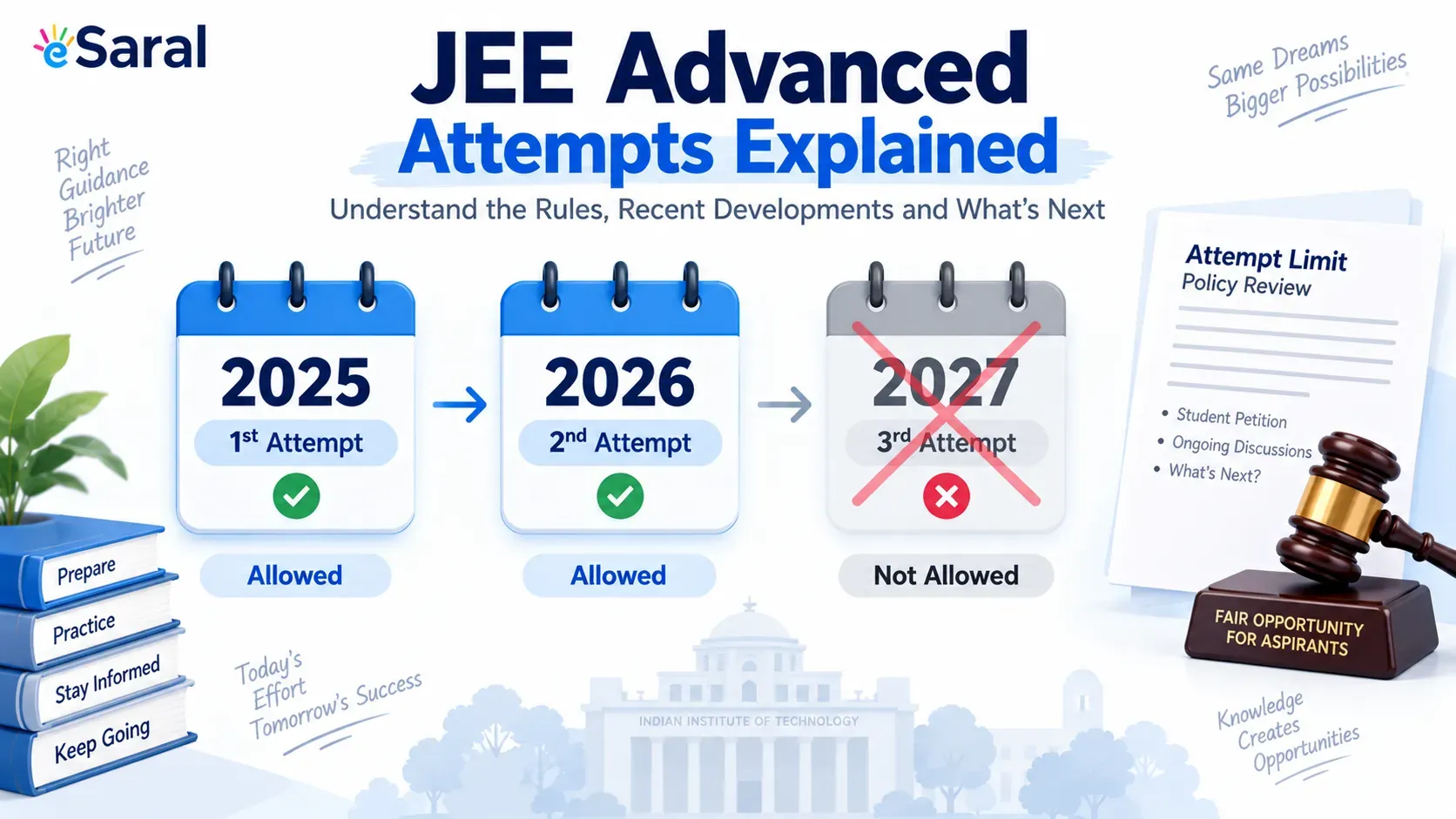
JEE Advanced Attempts: Can You Give It a Third Time? Rules Explained
JEE Advanced attempts: current rule is 2 consecutive years only: full eligibility criteria, the 2025 third-attempt controversy, and the latest 2026 petition news.

Best JEE Preparation App
Best JEE preparation app for Main & Advanced: AI mock tests, live doubt-solving, thousands of practice questions. JEE preparation app for droppers & Class 11-12.
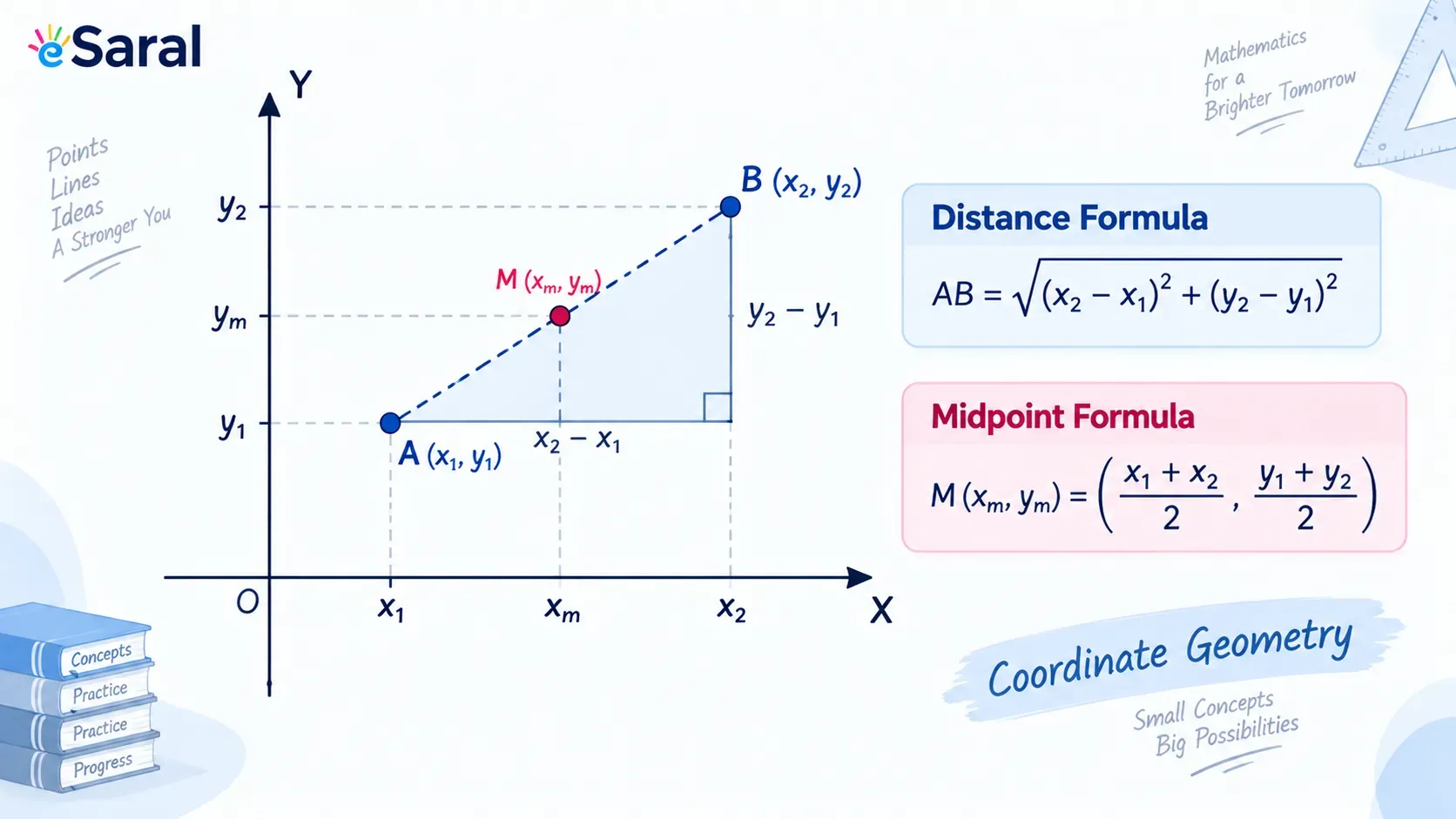
Coordinate Geometry Class 10: Formulas, Notes & Solved Examples
Coordinate geometry class 10: complete CBSE formulas — distance, section, midpoint and area of triangle — with derivation, notes and solved examples.
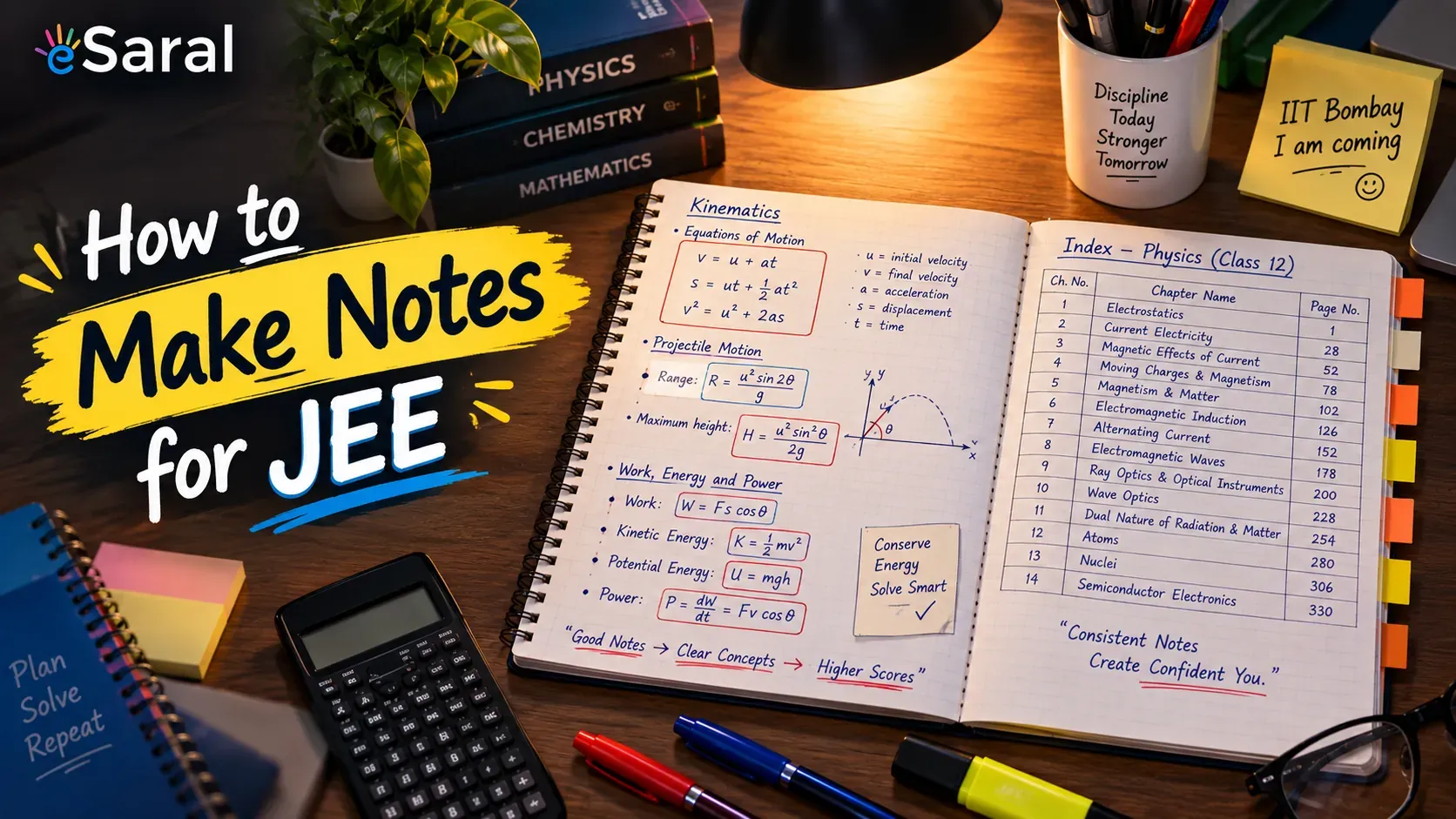
How to make Notes For JEE Smart Notes Strategy of an AIR 41
Learn how to make notes for JEE the way toppers do — indexing, shorthand, and smart short notes for JEE that cut revision time to just 5–7 days.
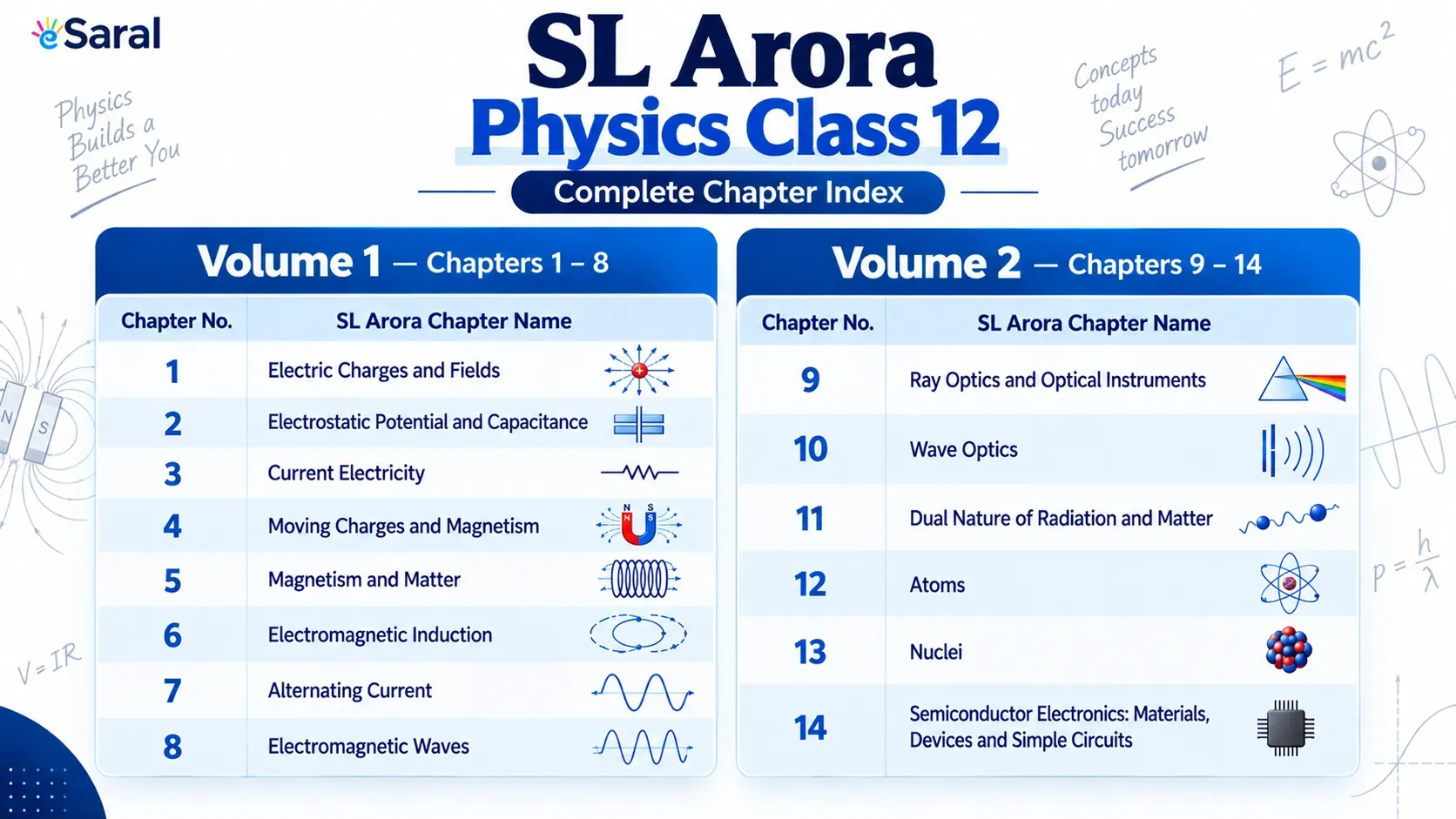
SL Arora Physics Class 12 Index – Chapter List for Volume 1 & 2
SL Arora Physics Class 12 index — complete chapter list for Volume 1 & 2, mapped to NCERT solutions for board, JEE Main, and NEET preparation.