
Nuclear Physics | Atoms and Nuclei Class 12, JEE and NEET

eSaral Academic and Editorial Team
Summary
Atoms and Nuclei Class 12 Notes for IIT JEE and NEET cover the Rutherford and Bohr models of the atom, the energy levels and the spectrum of hydrogen, the composition and size of the nucleus, mass defect and binding energy, the nuclear force, radioactivity and the decay law, and nuclear fission and fusion.
In the current NCERT Class 12 Physics book, the topic is in two chapters: Chapter 12, Atoms, and Chapter 13, Nuclei. Together they make Unit VIII, Atoms and Nuclei, in the CBSE syllabus, and they carry 12 marks with Dual Nature of Radiation and Matter (Chapters 11 to 13) in the 2026-27 scheme. In the JEE Main syllabus, they are one unit, called Atoms and Nuclei. These notes cover both chapters in the order of the NCERT book, with Nuclear Physics from the Nuclei chapter in the second half.
Atoms and Nuclei Class 12 Notes: Chapter Overview and Syllabus
Topic | NCERT and CBSE | IIT JEE and NEET |
|---|---|---|
Alpha-particle scattering, Rutherford’s model | Yes | Yes |
Bohr model, energy levels, hydrogen spectrum | Yes | Yes |
Composition and size of the nucleus, isotopes, isobars, isotones | Yes | Yes |
Mass-energy relation, mass defect, binding energy per nucleon and its variation with mass number | Yes | Yes |
Nuclear force | Yes | Yes |
Radioactivity (alpha, beta and gamma), decay law, half-life and mean life | In the NCERT chapter (check the latest CBSE syllabus) | Yes |
Nuclear fission and fusion | Yes | Yes |
Check the latest CBSE, NTA (JEE Main), JEE Advanced and NMC (NEET) syllabi for the exact lists. The number of questions changes every year, so use previous years’ papers to see the trend.
Tip from the eSaral Physics team: Learn the Bohr formulas as ratios: $r \propto n^2/Z$, $v \propto Z/n$ and $E \propto Z^2/n^2$. Most numerical questions are then a one-line ratio, and not a long calculation.
Atoms and Nuclei Class 12 Notes for IIT JEE and NEET
India's Best Exam Preparation for Class 12th - Download Now
India's Best Exam Preparation for Class 12th - Download Now
India's Best Exam Preparation for Class 12th - Download Now
India's Best Exam Preparation for Class 12th - Download Now
India's Best Exam Preparation for Class 12th - Download Now
eSaral has already come up with an amazing Revision Series of Physics where you can easily revise your chapter within minutes with all the important formulae and key points. This revision series is free for all. Click Here for Complete Physics Revision Series by Saransh Gupta Sir (AIR-41). About Saransh Gupta Sir: Computer Science Graduate from IIT Bombay. Cracked IIT-JEE with AIR-41 and AIEEE (JM) with AIR-71 in 2006. He is the author of the JEE Mentorship Book “StrateJEE”. He taught Physics for 5 years at Allen and was loved immensely by all the students. Many of his students bagged success with flying colours in JEE & NEET Exams.
In the current NCERT Class 12 Physics book, the topic is in two chapters: Chapter 12, Atoms, and Chapter 13, Nuclei. Together they make Unit VIII, Atoms and Nuclei, in the CBSE syllabus, and they carry 12 marks with Dual Nature of Radiation and Matter (Chapters 11 to 13) in the 2026-27 scheme. In the JEE Main syllabus, they are one unit, called Atoms and Nuclei. These notes cover both chapters in the order of the NCERT book, with Nuclear Physics from the Nuclei chapter in the second half.
Atoms and Nuclei Class 12 Notes: Chapter Overview and Syllabus
Topic | NCERT and CBSE | IIT JEE and NEET |
|---|---|---|
Alpha-particle scattering, Rutherford’s model | Yes | Yes |
Bohr model, energy levels, hydrogen spectrum | Yes | Yes |
Composition and size of the nucleus, isotopes, isobars, isotones | Yes | Yes |
Mass-energy relation, mass defect, binding energy per nucleon and its variation with mass number | Yes | Yes |
Nuclear force | Yes | Yes |
Radioactivity (alpha, beta and gamma), decay law, half-life and mean life | In the NCERT chapter (check the latest CBSE syllabus) | Yes |
Nuclear fission and fusion | Yes | Yes |
Check the latest CBSE, NTA (JEE Main), JEE Advanced and NMC (NEET) syllabi for the exact lists. The number of questions changes every year, so use previous years’ papers to see the trend.
Tip from the eSaral Physics team: Learn the Bohr formulas as ratios: $r \propto n^2/Z$, $v \propto Z/n$ and $E \propto Z^2/n^2$. Most numerical questions are then a one-line ratio, and not a long calculation.
Rutherford’s Model and Alpha-Particle Scattering in Atoms and Nuclei Class 12 Notes
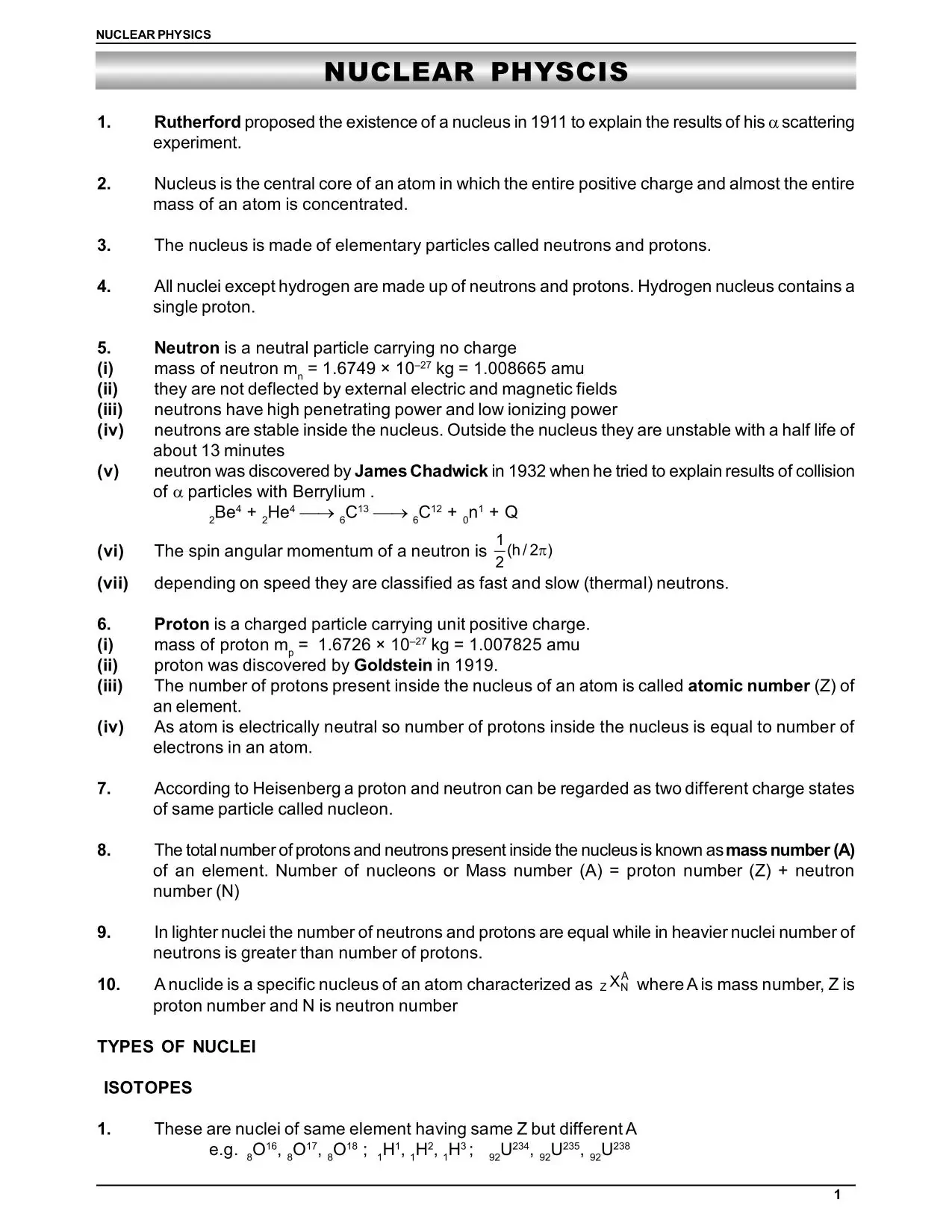
In the experiment of Geiger and Marsden, a beam of alpha particles was directed at a thin gold foil. Most particles went straight through, a few were deflected through large angles, and about one in $8000$ was scattered back. This showed that the positive charge and almost all the mass of an atom are in a very small nucleus (about $10^{-15}$ m, compared with about $10^{-10}$ m for the atom).
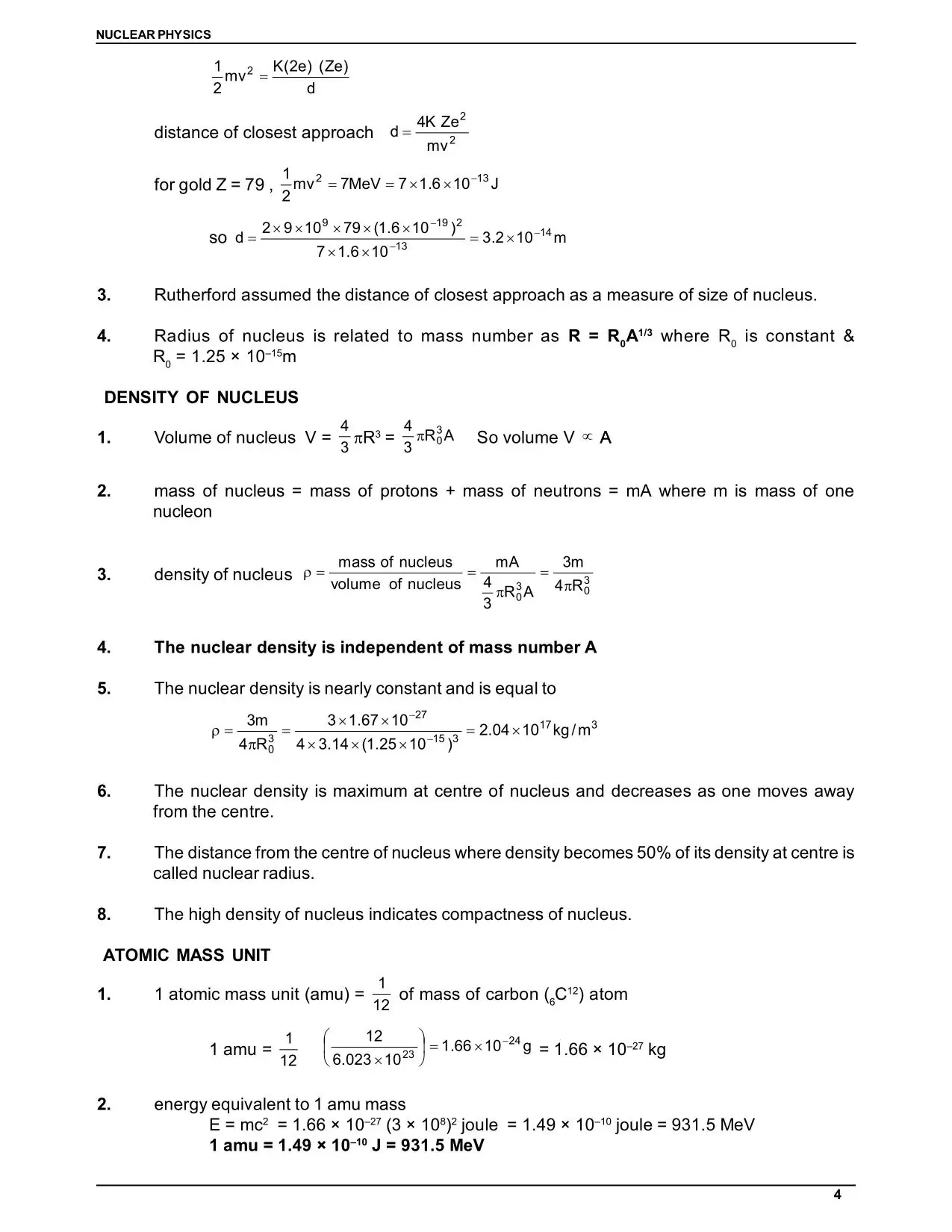
For a head-on collision, the alpha particle of kinetic energy $K$ stops at the distance of closest approach:
$$r_0 = \frac{1}{4\pi\varepsilon_0}\,\frac{2Ze^{2}}{K}$$
The impact parameter $b$ and the scattering angle $\theta$ are related by $b = \dfrac{Ze^{2}\cot(\theta/2)}{4\pi\varepsilon_0 K}$, so a small $b$ gives a large angle of scattering.
Limits of Rutherford’s model: it cannot explain why an electron in an orbit does not radiate and spiral into the nucleus, and it cannot explain the line spectrum of an atom.
Bohr Model of the Hydrogen Atom in Atoms and Nuclei Class 12 Notes
Postulates of Bohr:
- An electron moves in certain stationary orbits without radiating energy.
- The orbits that are allowed have an angular momentum that is an integral multiple of $\dfrac{h}{2\pi}$:
$$m v r = \frac{n h}{2\pi}, \qquad n = 1, 2, 3, \ldots$$
- When an electron jumps from an orbit of energy $E_i$ to an orbit of energy $E_f$, a photon is emitted or absorbed, with $h\nu = \lvert E_i - E_f\rvert$.
For an atom with one electron and the atomic number $Z$ (hydrogen, $\mathrm{He^{+}}$, $\mathrm{Li^{2+}}$):
Quantity | Formula | Value |
|---|---|---|
Radius of the $n$-th orbit | $r_n = \dfrac{n^{2}h^{2}\varepsilon_0}{\pi m e^{2}Z}$ | $r_n = 0.529\,\text{\AA}\;\dfrac{n^{2}}{Z}$ |
Speed of the electron | $v_n = \dfrac{Ze^{2}}{2\varepsilon_0 n h}$ | $v_n = 2.19\times10^{6}\,\dfrac{Z}{n}\ \text{m/s}$ |
Total energy | $E_n = -\dfrac{m e^{4}Z^{2}}{8\varepsilon_0^{2}h^{2}n^{2}}$ | $E_n = -13.6\,\dfrac{Z^{2}}{n^{2}}\ \text{eV}$ |
Kinetic energy | $K_n = -E_n$ | $+13.6\,\dfrac{Z^{2}}{n^{2}}$ eV |
Potential energy | $U_n = 2E_n$ | $-27.2\,\dfrac{Z^{2}}{n^{2}}$ eV |
The de Broglie wave explains the quantisation: $2\pi r_n = n\lambda$, so a stationary orbit holds a whole number of wavelengths.
Limits of the Bohr model: it works for hydrogen-like atoms (one electron) only, it does not explain the relative intensities of the lines or the fine structure, and it cannot explain the splitting of lines in a magnetic field.
Hydrogen Spectrum and Energy Levels in Atoms and Nuclei Class 12 Notes
When an electron falls from the level $n_2$ to the level $n_1$ ($n_2 > n_1$), the wavelength of the photon is given by:
$$\frac{1}{\lambda} = R\,Z^{2}\left(\frac{1}{n_1^{2}} - \frac{1}{n_2^{2}}\right), \qquad R = 1.097\times10^{7}\ \text{m}^{-1}$$
The wavelength in angstrom and the photon energy in eV are related by $\lambda\,(\text{\AA}) = \dfrac{12400}{E\,(\text{eV})}$.
Series | Final level $n_1$ | Region | Series limit ($n_2 \to \infty$) |
|---|---|---|---|
Lyman | 1 | Ultraviolet | The shortest wavelength, $\dfrac{1}{R}$ |
Balmer | 2 | Visible | $\dfrac{4}{R}$ |
Paschen | 3 | Infrared | $\dfrac{9}{R}$ |
Brackett | 4 | Infrared | $\dfrac{16}{R}$ |
Pfund | 5 | Infrared | $\dfrac{25}{R}$ |
- The ionisation energy of hydrogen (from the ground state) is $13.6$ eV, and the energy of the first excited state is $-3.4$ eV.
- The number of different lines that an atom in the level $n$ can emit is $\dfrac{n(n - 1)}{2}$.
- The longest wavelength of a series comes from the transition between two adjacent levels ($n_2 = n_1 + 1$).
Composition, Size and Mass of the Nucleus in Atoms and Nuclei Class 12 Notes
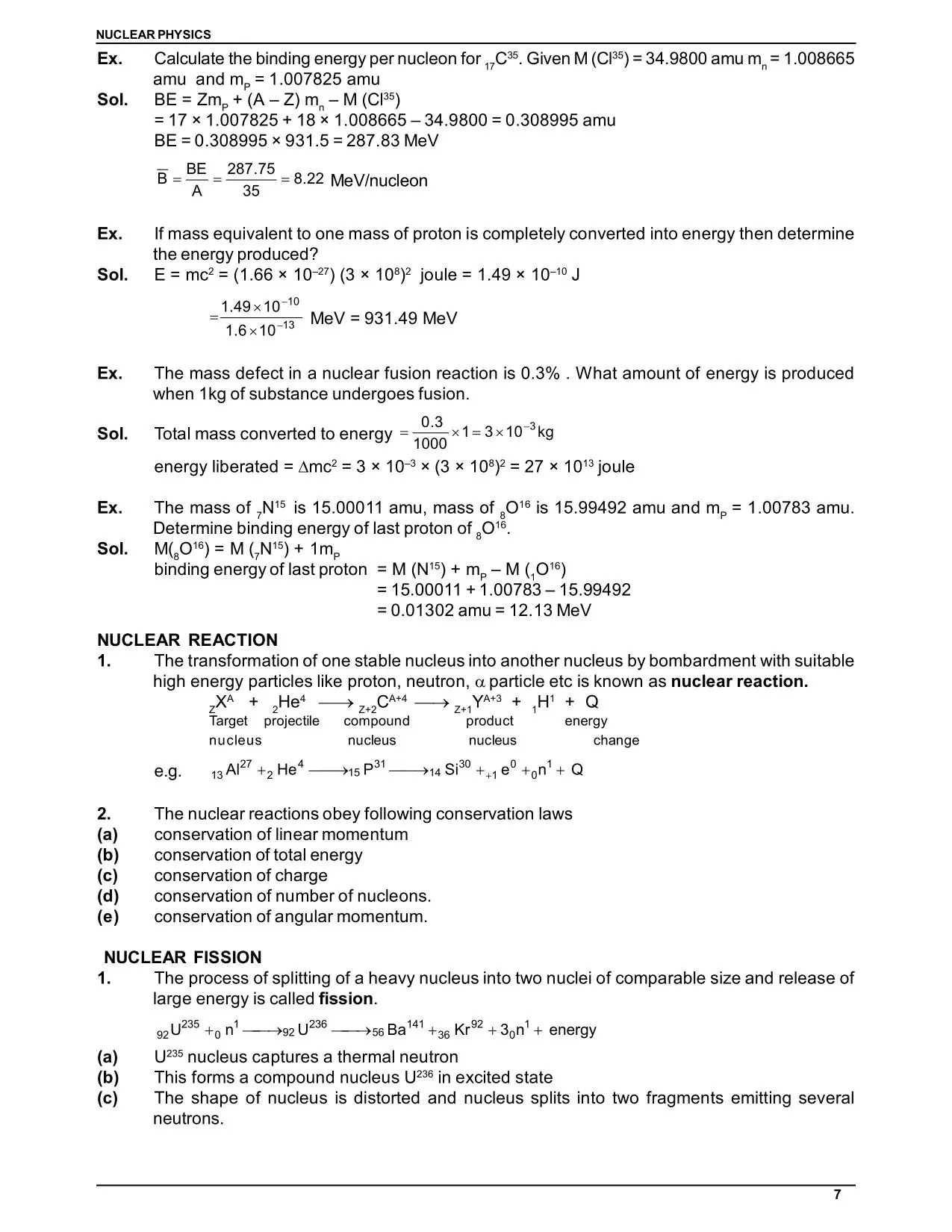
A nucleus of the element X has $Z$ protons and $N = A - Z$ neutrons, and it is written as $^{A}_{Z}\mathrm{X}$, where $A$ is the mass number.
Term | Meaning | Example |
|---|---|---|
Isotopes | Same $Z$, different $A$ | $^{1}\mathrm{H}$, $^{2}\mathrm{H}$, $^{3}\mathrm{H}$ |
Isobars | Same $A$, different $Z$ | $^{14}\mathrm{C}$ and $^{14}\mathrm{N}$ |
Isotones | Same $N$, different $Z$ | $^{13}\mathrm{C}$ and $^{14}\mathrm{N}$ |
$$R = R_0A^{1/3}, \qquad R_0 \approx 1.2\ \text{fm}$$
Since the volume of the nucleus is proportional to $A$, the density of nuclear matter is the same for all nuclei, about $2.3\times10^{17}$ kg m$^{-3}$. The atomic mass unit is $1\,\text{u} = 1.66\times10^{-27}$ kg, which is equivalent to $931.5$ MeV$/c^{2}$.
Mass Defect and Binding Energy in Atoms and Nuclei Class 12 Notes
The mass of a nucleus is less than the sum of the masses of its separate nucleons. The difference is the mass defect, and it appears as the binding energy:
$$\Delta m = \big[Zm_p + (A - Z)m_n\big] - M, \qquad E_b = \Delta m\,c^{2} = \Delta m \times 931.5\ \text{MeV}$$
where $\Delta m$ is in u. If you use the masses of atoms, use the mass of the hydrogen atom for $m_p$, and the electron masses cancel. The binding energy per nucleon is $\dfrac{E_b}{A}$, and it measures the stability of the nucleus.
The binding energy curve:
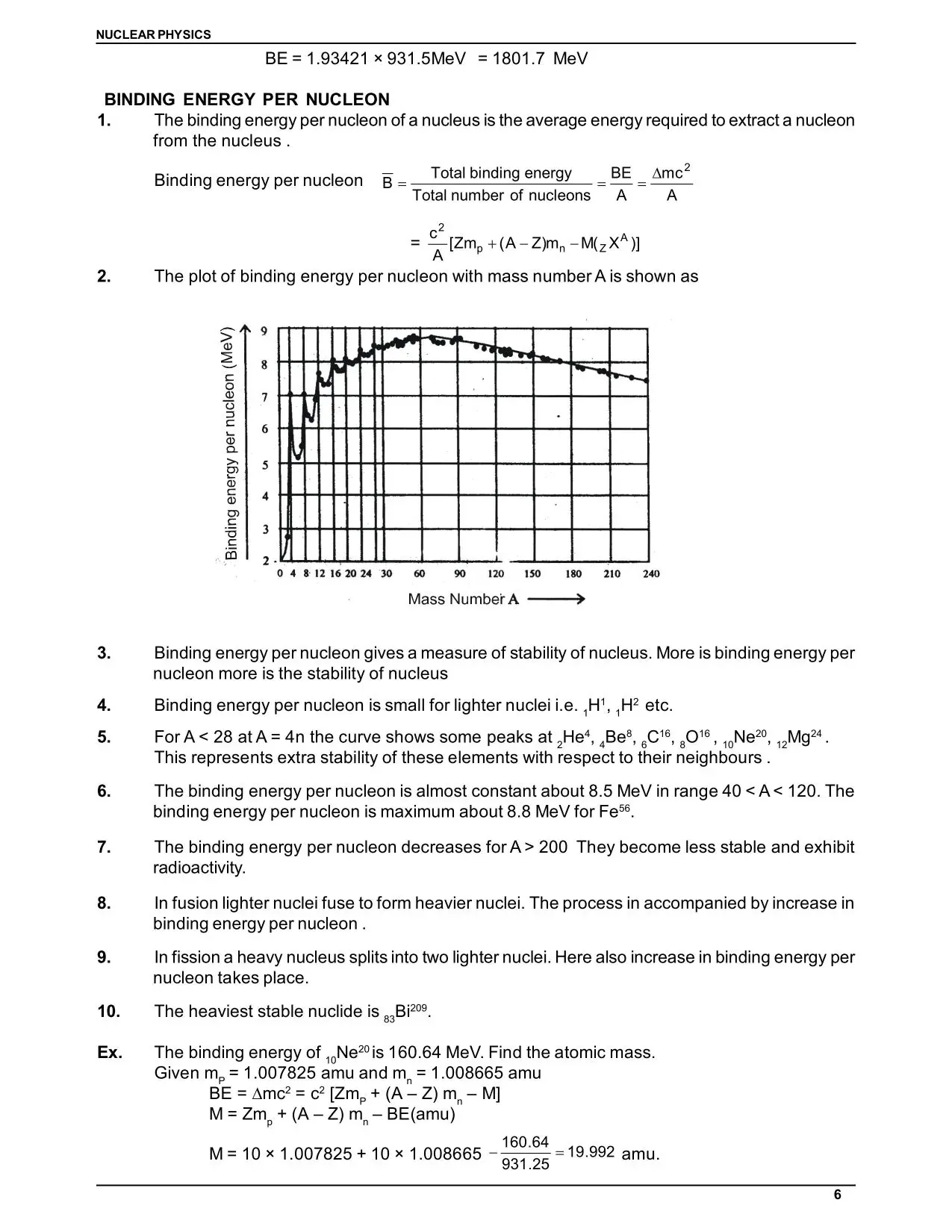
- $E_b/A$ rises quickly for the light nuclei, and it has peaks at $^{4}\mathrm{He}$, $^{12}\mathrm{C}$ and $^{16}\mathrm{O}$.
- It is nearly constant (about $8$ MeV) for $30 < A < 170$, with its maximum of about $8.7$ to $8.8$ MeV in the iron and nickel region ($A \approx 56$ to $62$).
- It falls slowly for the heavy nuclei (about $7.6$ MeV for $^{238}\mathrm{U}$).
So energy is released when heavy nuclei split (fission) and when light nuclei join (fusion), because both change the nucleus into one with a higher binding energy per nucleon.
Nuclear Force in Atoms and Nuclei Class 12 Notes
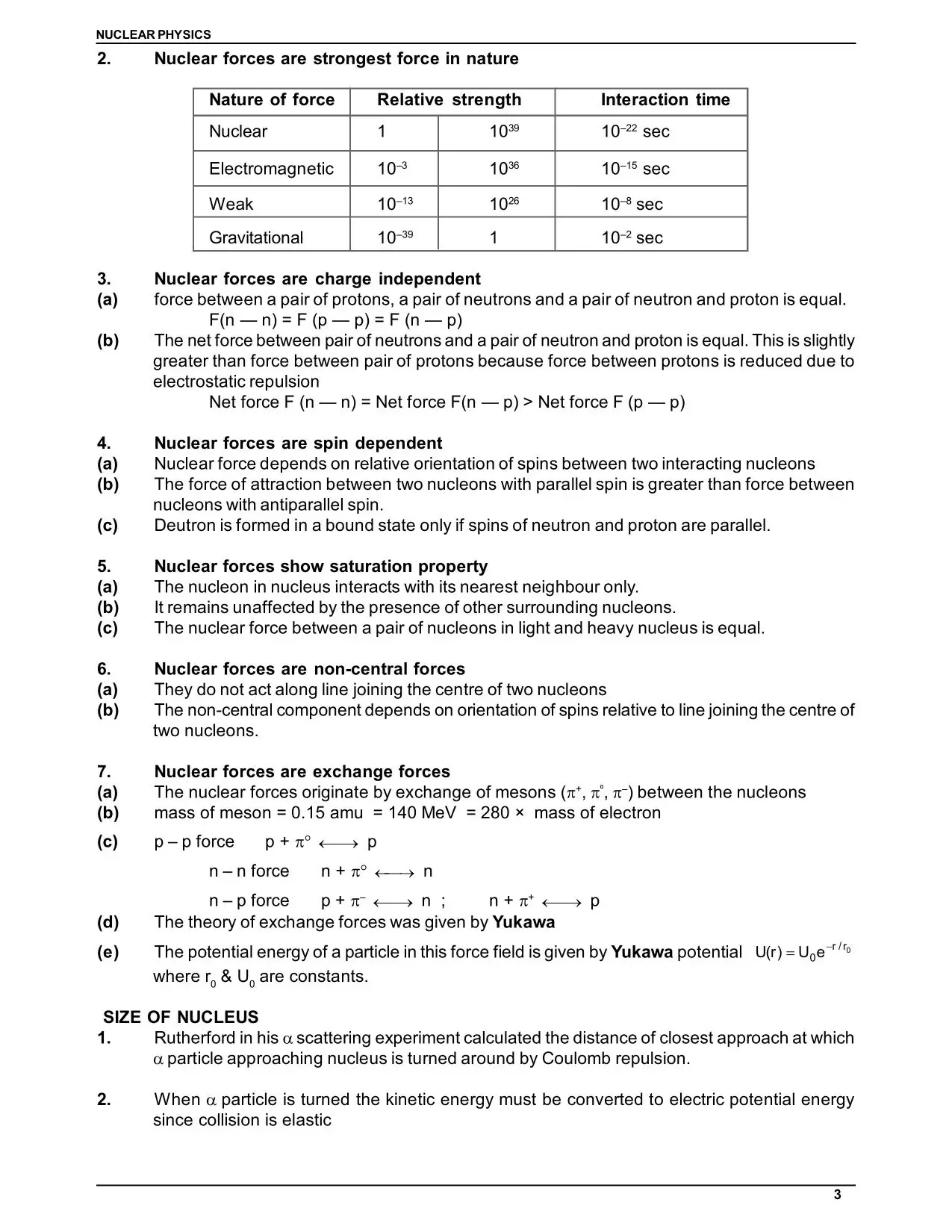
- It is the strongest of the basic forces, much stronger than the electric force at a distance of a few femtometres.
- It is short-range (a few fm), and it is nearly zero beyond about 2.5 to 3 fm.
- It is attractive at a separation of about 0.8 fm to a few fm, and it becomes repulsive below about 0.8 fm.
- It is charge-independent (the force between two protons, two neutrons or a proton and a neutron is about the same) and it does not depend on the charge.
- It shows saturation, which means that a nucleon interacts only with its nearest neighbours.
Radioactivity and the Decay Law in Atoms and Nuclei Class 12 Notes
Radiation | Nature | Change in the nucleus |
|---|---|---|
Alpha ($\alpha$) | Helium nucleus, $^{4}_{2}\mathrm{He}$ | $Z$ falls by 2, $A$ falls by 4 |
Beta minus ($\beta^-$) | An electron, with an antineutrino | $Z$ rises by 1, $A$ is the same |
Beta plus ($\beta^+$) | A positron, with a neutrino | $Z$ falls by 1, $A$ is the same |
Gamma ($\gamma$) | A high-energy photon | No change in $Z$ or $A$ |
Decay law: the rate of decay is proportional to the number of nuclei that are present:
$$\frac{dN}{dt} = -\lambda N, \qquad N = N_0e^{-\lambda t}$$
Quantity | Formula |
|---|---|
Activity | $R = \left\lvert\dfrac{dN}{dt}\right\rvert = \lambda N = R_0e^{-\lambda t}$ |
Half-life | $T_{1/2} = \dfrac{\ln 2}{\lambda} = \dfrac{0.693}{\lambda}$ |
Mean life | $\tau = \dfrac{1}{\lambda} = 1.44\,T_{1/2}$ |
After $n$ half-lives | $N = \dfrac{N_0}{2^{n}}$, with $n = \dfrac{t}{T_{1/2}}$ |
The unit of activity is the becquerel (1 Bq = 1 decay per second), and $1$ curie $= 3.7\times10^{10}$ Bq. The half-life and the decay constant depend only on the nucleus, and not on the amount of the sample or on the temperature.
Nuclear Fission and Fusion in Atoms and Nuclei Class 12 Notes
Nuclear Fission
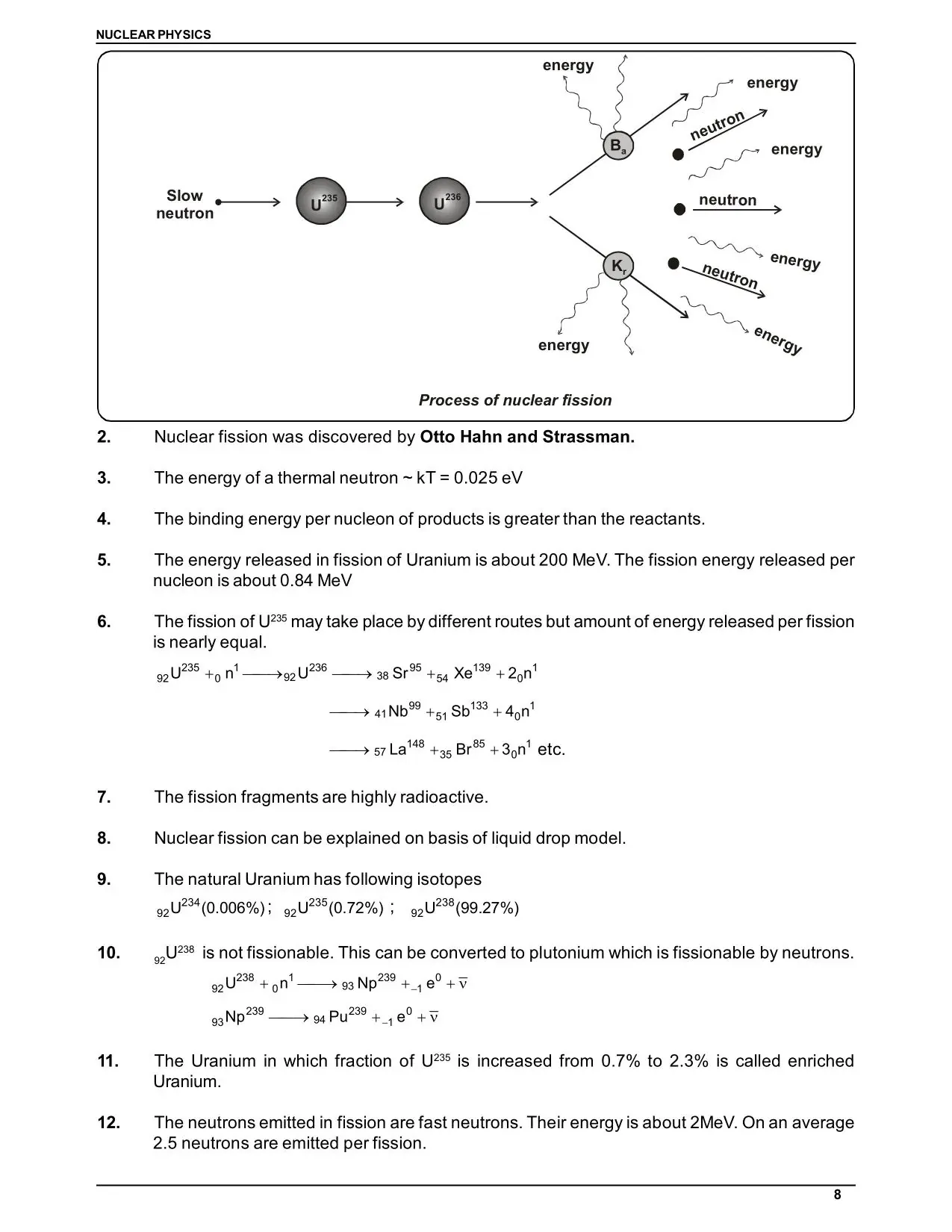
A heavy nucleus splits into two lighter nuclei, with neutrons and a large amount of energy:
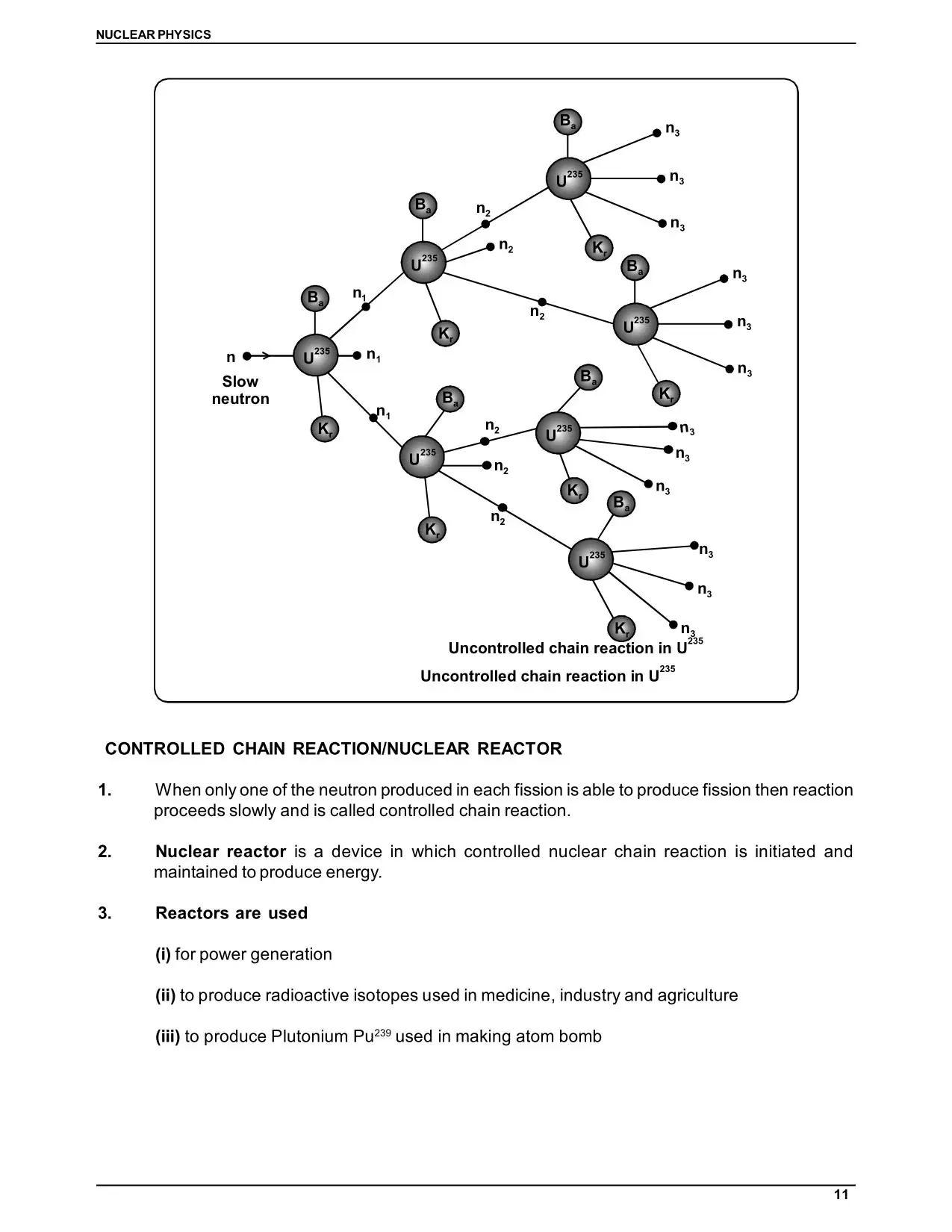
$$^{235}_{92}\mathrm{U} + {}^{1}_{0}n \rightarrow {}^{141}_{56}\mathrm{Ba} + {}^{92}_{36}\mathrm{Kr} + 3\,{}^{1}_{0}n + Q, \qquad Q \approx 200\ \text{MeV}$$
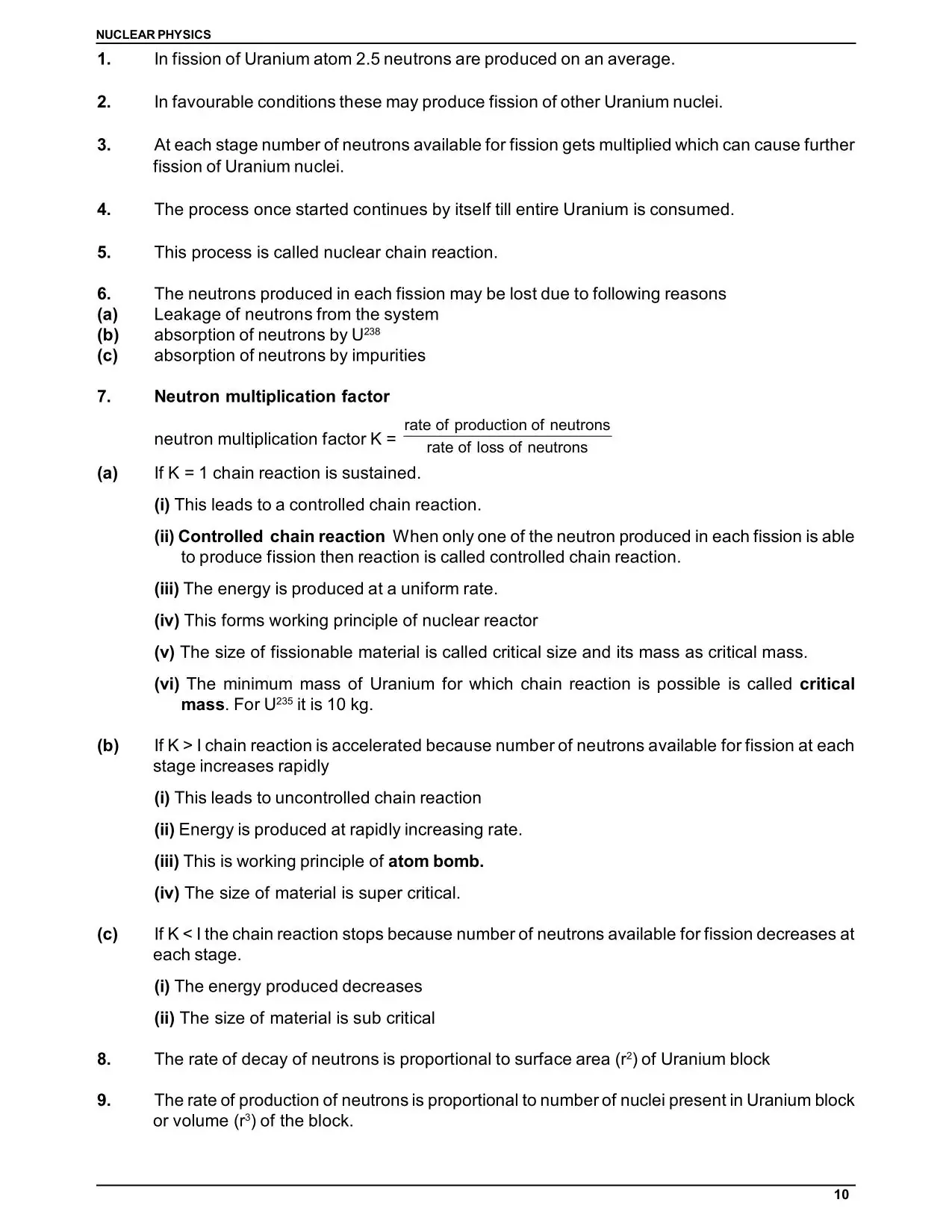
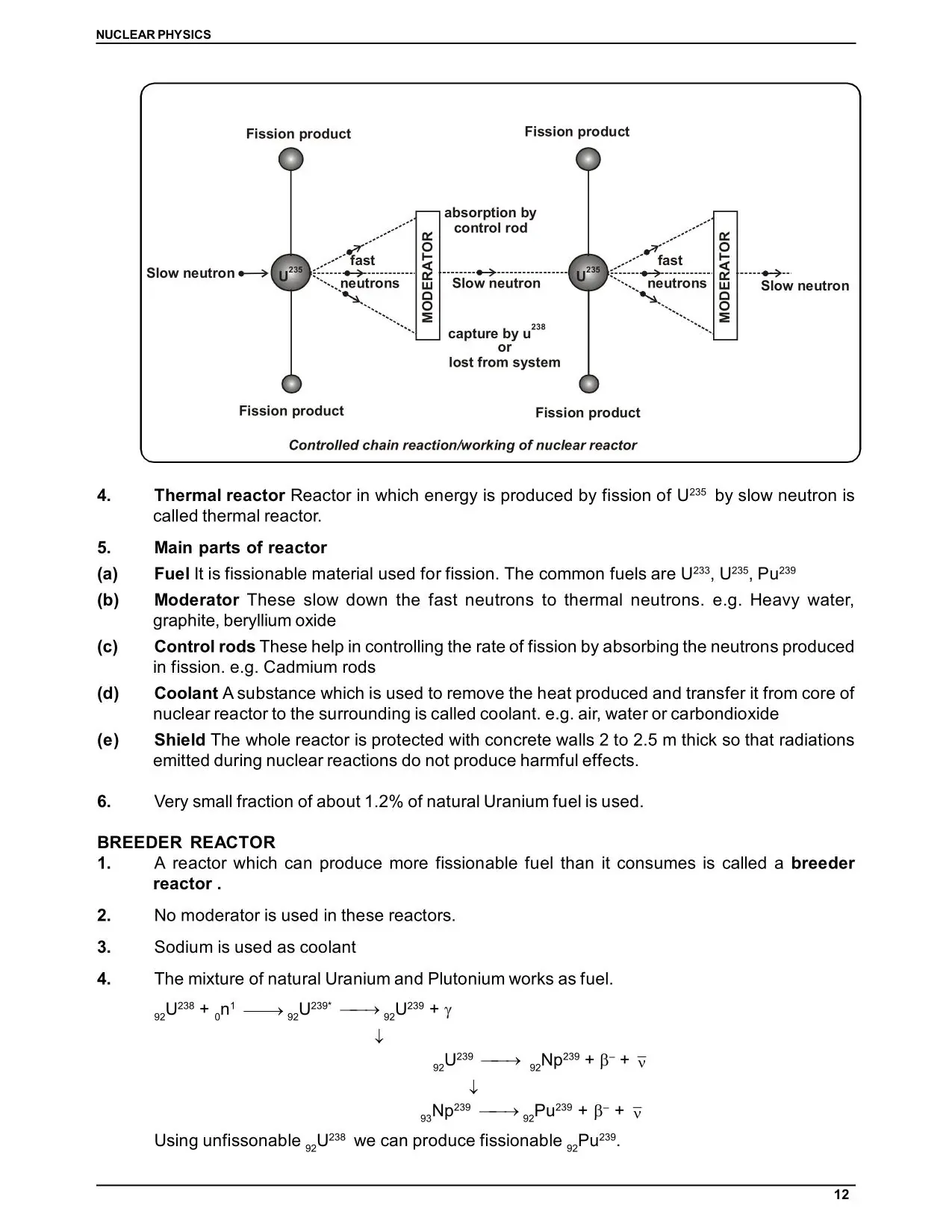
The neutrons that are released can cause more fissions, and this is a chain reaction. In a nuclear reactor, the reaction is controlled: moderators (heavy water or graphite) slow the neutrons down, control rods (cadmium or boron) absorb neutrons, and a coolant removes the heat. An uncontrolled chain reaction is the principle of the atom bomb.
Nuclear Fusion
Light nuclei join to form a heavier nucleus. In the Sun, the proton–proton cycle changes four protons into one helium nucleus:
$$4\,{}^{1}_{1}\mathrm{H} \rightarrow {}^{4}_{2}\mathrm{He} + 2e^{+} + 2\nu + 26.7\ \text{MeV}$$ $$^{2}_{1}\mathrm{H} + {}^{3}_{1}\mathrm{H} \rightarrow {}^{4}_{2}\mathrm{He} + {}^{1}_{0}n + 17.6\ \text{MeV}$$
Fusion needs a temperature of the order of $10^{7}$ to $10^{8}$ K, so that the nuclei have enough kinetic energy to overcome the Coulomb repulsion. For the same mass, fusion releases more energy than fission.
Feature | Fission | Fusion |
|---|---|---|
Process | A heavy nucleus splits | Light nuclei join |
Energy per reaction | About 200 MeV | About 17.6 MeV (D–T) |
Condition | Neutrons, a critical mass | Very high temperature and pressure |
Waste | Radioactive | Much less radioactive waste |
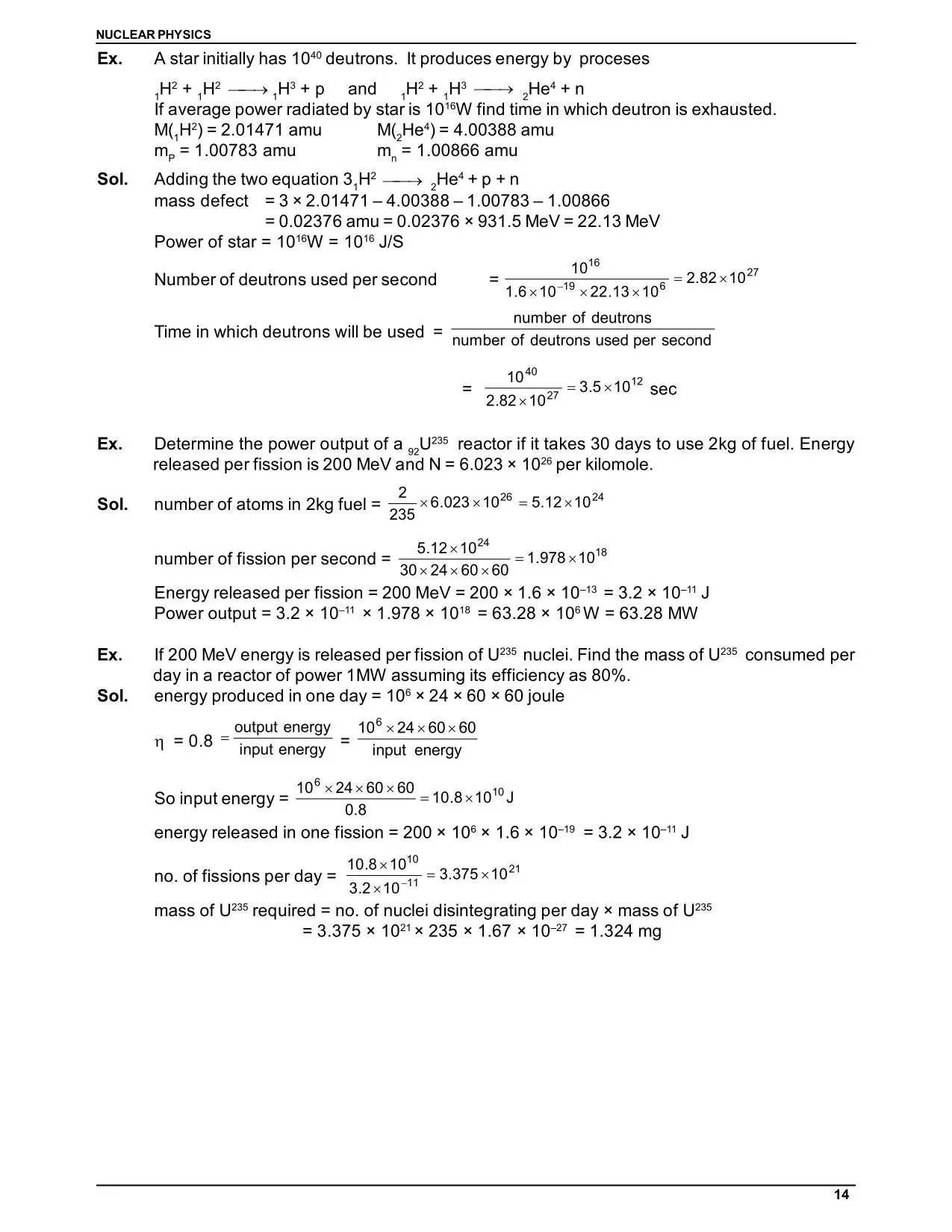
The energy released in a nuclear reaction is the Q value: $Q = \big(\sum m_{\text{reactants}} - \sum m_{\text{products}}\big)c^{2}$.
IIT JEE and NEET Problem Tips in Atoms and Nuclei Class 12 Notes
- Bohr problems: write the ratios $r \propto n^{2}/Z$, $v \propto Z/n$, $E \propto Z^{2}/n^{2}$, and the time period $T \propto n^{3}/Z^{2}$.
- Wavelength of a line: find the energy difference in eV, and use $\lambda\,(\text{\AA}) = 12400/E$.
- Half-life problems: find the number of half-lives $n = t/T_{1/2}$ first, and then use $N = N_0/2^{n}$. After 10 half-lives, about $0.1\%$ is left.
- Counting $\alpha$ and $\beta$ particles: the fall in $A$ is $4\times$ the number of $\alpha$ particles. Then use the change in $Z$ to find the number of $\beta^-$ particles.
- Binding energy: $\Delta m$ in u $\times\,931.5$ gives the energy in MeV. Do not forget to subtract the electron masses if you use the masses of nuclei.
Key Formulas in Atoms and Nuclei Class 12 Notes
Concept | Formula |
|---|---|
Distance of closest approach | $r_0 = \dfrac{1}{4\pi\varepsilon_0}\dfrac{2Ze^2}{K}$ |
Bohr quantisation | $mvr = \dfrac{nh}{2\pi}$ |
Radius and energy (Bohr) | $r_n = 0.529\dfrac{n^2}{Z}$ Å, $E_n = -13.6\dfrac{Z^2}{n^2}$ eV |
Spectral lines | $\dfrac{1}{\lambda} = RZ^2\left(\dfrac{1}{n_1^2} - \dfrac{1}{n_2^2}\right)$ |
Nuclear radius | $R = R_0A^{1/3}$ |
Binding energy | $E_b = \Delta m \times 931.5$ MeV |
Decay law | $N = N_0e^{-\lambda t}$ |
Half-life and mean life | $T_{1/2} = 0.693/\lambda$, $\tau = 1/\lambda$ |
Q value | $Q = (\sum m_{R} - \sum m_{P})c^2$ |
Solved Examples from Atoms and Nuclei Class 12 Notes
Example 1 (Bohr energy): Find the energy of the electron of a hydrogen atom in the level $n = 3$.
$E_3 = -\dfrac{13.6}{3^{2}} \approx -1.51$ eV.
Example 2 (radius): Find the radius of the second orbit of $\mathrm{Li^{2+}}$.
$r_2 = 0.529 \times \dfrac{2^{2}}{3} \approx 0.705$ Å.
Example 3 (Balmer series): Find the wavelength of the first line of the Balmer series ($n_2 = 3 \to n_1 = 2$).
$\dfrac{1}{\lambda} = 1.097\times10^{7}\left(\dfrac{1}{4} - \dfrac{1}{9}\right) = 1.097\times10^{7}\times\dfrac{5}{36} \approx 1.524\times10^{6}$ m$^{-1}$, so $\lambda \approx 656$ nm.
Example 4 (number of lines): How many lines can a hydrogen atom emit from the level $n = 4$?
$\dfrac{n(n - 1)}{2} = \dfrac{4 \times 3}{2} = 6$ lines.
Example 5 (photon energy): Find the energy and the wavelength of the photon emitted when an electron of hydrogen goes from $n = 3$ to $n = 1$.
$E = 13.6\left(1 - \dfrac{1}{9}\right) \approx 12.09$ eV, and $\lambda = \dfrac{12400}{12.09} \approx 1026$ Å (ultraviolet, Lyman series).
Example 6 (distance of closest approach): A 5 MeV alpha particle is fired at a gold nucleus ($Z = 79$). Find the distance of closest approach.
$r_0 = \dfrac{9\times10^{9}\times 2\times 79\times(1.6\times10^{-19})^{2}}{5\times1.6\times10^{-13}} \approx 4.5\times10^{-14}$ m, which is about 45 fm.
Example 7 (nuclear radius): Find the radius of the nucleus of $^{27}\mathrm{Al}$.
$R = 1.2\times 27^{1/3} = 1.2\times 3 = 3.6$ fm.
Example 8 (binding energy): Find the binding energy and the binding energy per nucleon of $^{4}\mathrm{He}$ (use $m_H = 1.007825$ u, $m_n = 1.008665$ u and $M_{He} = 4.002603$ u).
$\Delta m = 2(1.007825) + 2(1.008665) - 4.002603 = 0.030377$ u. $E_b = 0.030377\times931.5 \approx 28.3$ MeV, so $E_b/A \approx 7.07$ MeV.
Example 9 (half-life): 64 g of a radioactive substance has a half-life of 5 days. How much is left after 20 days?
$n = \dfrac{20}{5} = 4$ half-lives, so $N = \dfrac{64}{2^{4}} = 4$ g.
Example 10 (decay constant and mean life): The half-life of a sample is 10 minutes. Find the decay constant and the mean life.
$\lambda = \dfrac{0.693}{600} \approx 1.155\times10^{-3}$ s$^{-1}$, and $\tau = \dfrac{1}{\lambda} \approx 866$ s, which is about 14.4 minutes.
**Example 11 (counting $\alpha$ and $\beta$ particles):** $^{238}_{92}\mathrm{U}$ changes into $^{206}_{82}\mathrm{Pb}$ through a series of decays. Find the number of $\alpha$ and $\beta^-$ particles.
The fall in $A$ is $238 - 206 = 32$, so the number of $\alpha$ particles is $\dfrac{32}{4} = 8$. These reduce $Z$ by $16$, to $76$. To reach $82$, we need $82 - 76 = 6$ $\beta^-$ particles.
Example 12 (Q value of fusion): Find the energy released in $^{2}\mathrm{H} + {}^{3}\mathrm{H} \rightarrow {}^{4}\mathrm{He} + n$ (masses: $2.014102$, $3.016049$, $4.002603$ and $1.008665$ u).
$\Delta m = (2.014102 + 3.016049) - (4.002603 + 1.008665) = 0.018883$ u, so $Q = 0.018883\times931.5 \approx 17.6$ MeV.
eSaral brings you detailed Class 11th Physics study material. eSaral provides a series of detailed chapter-wise notes for all the Subjects of class 11th and 12th. These notes will also help you in your IIT JEE & NEET preparations. We hope these Physics Notes for Class 12 will help you understand the important topics and remember the key points from an exam point of view.
Common Mistakes in Atoms and Nuclei Class 12 Problems
Mistake | Correct approach |
|---|---|
Using $E_n = -13.6/n$ | The energy is $-13.6\,Z^{2}/n^{2}$ eV |
Taking the radius of a Bohr orbit as proportional to $n$ | It is proportional to $n^{2}/Z$ |
Forgetting the factor $Z^{2}$ in the spectral formula for $\mathrm{He^{+}}$ or $\mathrm{Li^{2+}}$ | Use $\dfrac{1}{\lambda} = RZ^{2}(\ldots)$ |
Thinking that the total mass of a nucleus equals the sum of the nucleon masses | It is less by the mass defect |
Saying that half of the sample decays in each half-life of a fixed amount | Half of the remaining nuclei decay in each half-life |
Thinking that the half-life depends on temperature or on the amount | It is a constant of the nucleus |
Mixing up the changes in $Z$ for $\beta^-$ and $\beta^+$ | $\beta^-$ raises $Z$ by 1, and $\beta^+$ lowers it by 1 |
Saying that fission and fusion both need a very high temperature | Fission needs neutrons and a critical mass, and fusion needs a very high temperature |
How to Study Atoms and Nuclei Class 12 Notes
- Read both NCERT chapters first (Atoms and Nuclei), and download the textbook from eSaral’s NCERT Class 12 books page.
- Learn the Bohr formulas as ratios, and the series table of the hydrogen spectrum. Then learn the binding energy curve and the decay law.
- Practise one problem each on the Bohr model, spectral lines, mass defect, half-life, counting of $\alpha$ and $\beta$ particles and the Q value, using the tips on this page.
- Use eSaral’s Complete Class 12 Physics notes for all the chapters, and the free Physics revision series on YouTube for quick formula revision.
- Test yourself with eSaral’s JEE Main chapter-wise PYQs, JEE Advanced chapter-wise PYQs and NEET chapter-wise PYQs.
Frequently Asked Questions
What is nuclear binding energy in simple terms?
Nuclear binding energy is the energy that you would need to supply to break a nucleus completely into its separate protons and neutrons. It equals the mass defect times $c^{2}$, $E_b = \Delta m\,c^{2}$. A higher binding energy per nucleon means a more stable nucleus. The curve peaks at about 8.7 to 8.8 MeV in the iron and nickel region ($A$ about 56 to 62). eSaral’s Atoms and Nuclei Class 12 Notes show the curve and the calculation.
What are the main topics in Atoms and Nuclei for IIT JEE?
In Atoms and Nuclei, the main topics are the Bohr model (radius, energy and speed formulas), the hydrogen spectrum and its series, mass defect and binding energy, radioactive decay and half-life, counting of $\alpha$ and $\beta$ particles, and the Q value of fission and fusion. The number of questions changes every year, so check previous years’ papers.
What is the difference between half-life and mean life?
The half-life $T_{1/2} = \dfrac{0.693}{\lambda}$ is the time in which half of the nuclei decay. The mean life $\tau = \dfrac{1}{\lambda}$ is the average time that a nucleus survives, so $\tau = 1.44\,T_{1/2}$. Both depend only on the nucleus, and not on the size of the sample. In Atoms and Nuclei Class 12 Notes, this is a frequent concept question.
How do you find the number of alpha and beta particles emitted in a decay series?
The fall in the mass number is $4$ times the number of $\alpha$ particles. Each $\alpha$ particle reduces $Z$ by 2, and each $\beta^-$ particle raises it by 1, so the remaining change in $Z$ gives the number of $\beta^-$ particles. For $^{238}\mathrm{U} \to {}^{206}\mathrm{Pb}$, there are 8 $\alpha$ and 6 $\beta^-$ particles.
What is the Bohr model, and what are its limits?
The Bohr model says that an electron moves in stationary orbits with the angular momentum $\dfrac{nh}{2\pi}$, and that a photon is emitted or absorbed when it changes its orbit. It gives $E_n = -13.6\,Z^{2}/n^{2}$ eV and the hydrogen spectrum, but it works only for one-electron atoms and does not explain the fine structure or the relative intensities of the lines. These Atoms and Nuclei Class 12 Notes list the limits.
Why does nuclear fusion need such a high temperature?
The nuclei are positively charged, so they repel each other. They need a very high kinetic energy (a temperature of the order of $10^{7}$ to $10^{8}$ K) to come close enough for the nuclear force to act. For the same mass, fusion releases more energy than fission.
What is the difference between nuclear fission and nuclear fusion?
In fission, a heavy nucleus splits into lighter nuclei, with about 200 MeV per reaction and a chain reaction. In fusion, light nuclei join to form a heavier nucleus, for example D–T fusion with 17.6 MeV. Both change the nuclei into ones with a higher binding energy per nucleon.
Is Atoms and Nuclei in the CBSE Class 12 syllabus for 2026-27?
Yes. Atoms (Chapter 12) and Nuclei (Chapter 13) make Unit VIII, Atoms and Nuclei. In the 2026-27 scheme, Chapters 11 to 13 (Dual Nature, Atoms and Nuclei) carry 12 marks together. Check the latest CBSE syllabus for the radioactivity topics.
Which chapter number is Atoms and Nuclei in Class 12 Physics?
In the current NCERT Class 12 Physics book, Atoms is Chapter 12, and Nuclei is Chapter 13. In the JEE Main syllabus, they are one unit called Atoms and Nuclei. These Atoms and Nuclei Class 12 Notes cover both chapters.
Where can I find more Class 12 Physics notes on eSaral?
eSaral has chapter-wise Class 12 Physics notes, NCERT books, a free Physics revision series on YouTube, JEE Main, JEE Advanced and NEET chapter-wise PYQs and these Atoms and Nuclei Class 12 Notes, all linked on this page.
Team eSaral
eSaral Academic and Editorial Team
Team eSaral is the collective author profile for educational content created by eSaral’s teachers and academic contributors. The team draws on expertise from IIT graduates, doctors, experienced educators and subject specialists to develop resources for JEE, NEET and school students. Our articles aim to explain concepts clearly and help students study with confidence.
Related Posts

BITSAT 2027: Registration Date, Exam Date, Syllabus, Eligibility, Pattern & Fees
BITSAT 2027 exam dates, registration timeline, eligibility criteria, exam pattern, marking scheme, syllabus and fees in one page.

BITSAT Previous Year Question Paper PDF (2017-2026)
Download BITSAT previous year question papers PDF from 2017 to 2026,session-wise. Memory-based papers,exam pattern, paper analysis and how to practise

CBSE Class 10 Date Sheet 2027: Expected Exam Dates, Release Date, Admit Card & Result Timeline
CBSE Class 10 date sheet 2027 is awaited. See the expected exam dates, release window, how to download the PDF, admit card and result timelines.

NCERT Physics Class 10 Book PDF in Hindi 2026-27 – भौतिक विज्ञान के 4 अध्याय (Free Download)
NCERT Physics Class 10 book PDF in Hindi 2026-27: download all 4 chapters (अध्याय 9–12) free, with topics and important formulas.

NCERT Biology Class 9 Book Anveshan PDF in Hindi - जीव विज्ञान कक्षा 9 पुस्तक अन्वेषण PDF
Download NCERT Biology Class 9 book PDF in Hindi chapterwise for 2026-27: Cell, Tissues, Reproduction and Diversity. Free PDFs.

Essay On Artificial Intelligence in English (100,150, 200, 250, 300, 500 Words)
This is in contrast to the natural intelligence of humans. With Artificial Intelligence, machines can perform

Essay on 78th India Independence Day in English for Student (100, 150, 200, 250, 300, 500 Words)
Read the best essays on India's Independence Day in English. Short & long essays (100, 150, 200, 250, 300, 500 words) perfect for school exams
NCERT Class 11 English Snapshots book - Free PDF download- Esaral
Download NCERT Class 11 English Snapshots book PDF for free. Get all 8 chapters, chapter-wise. Start your prep today!
NCERT Class 10 biology book pdf - Free PDF Download - eSaral
NCERT Class 10 Biology book PDF 2026-27: all 5 chapters (Life Processes to Our Environment) in English & Hindi, with CBSE syllabus, marks & practical

Essay on Global Warming in English (100,150, 200, 250, 300, 500 Words)
Global warming means the Earth is getting hotter. This happens because of things like pollution from cars and factories.