
Oblique Projectile motion - Motion in Plane - eSaral

eSaral Academic and Editorial Team
Hey, do you want to learn about the Oblique Projectile motion? If yes. Then keep reading.
Oblique Projectile motion
Consider the motion of a bullet which is fired from a gun so that its initial velocity $\overrightarrow{\mathrm{u}}$ makes an angle $\theta$ with the horizontal direction. Let us take $X$ -axis along ground and Y-axis along vertical.
$\overrightarrow{\mathrm{u}}$ can be resolved as
$\mathrm{u}_{\mathrm{x}}=\mathrm{u} \cos \theta \quad$ (along horizontal)
$\& u_{y}=u \sin \theta$ (along vertical)
motion of bullet can be resolved into horizontal and vertical motion.
(i) In horizontal direction there is no acc. so it moves with constant velocity $v_{x}=u_{x}=u \cos \theta$
So distance traversed in time $t$ is $x=u_{x} t$ or $t=\frac{x}{u \cos \theta}$
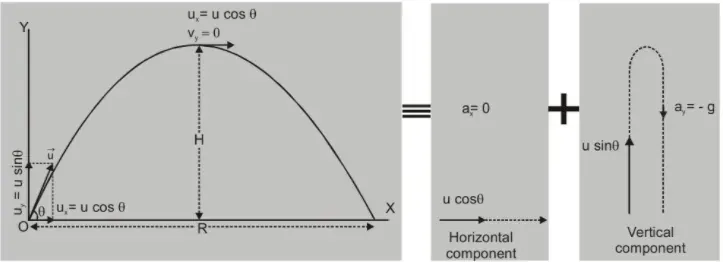
The motion in the vertical direction is the same as that of a ball thrown upward with an initial velocity $\mathrm{u}_{y}=\mathrm{u} \sin \theta$ and $\mathrm{acc}=-\mathrm{g}$ (downward).
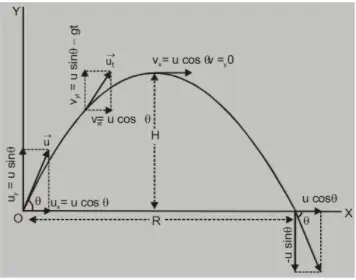
So at time $t$ vertical component of velocity $v_{y}=u_{y}-g t=u \sin \theta-g t$
Displacement along y direction
$y=(u \sin \theta) t-\frac{1}{2} g t^{2}$
Substituting the value of $t$ from eqn. (i) in eqn. (iii)
we get
$\quad y=(u \sin \theta)\left(\frac{x}{u \cos \theta}\right)-\frac{1}{2} g\left(\frac{x}{u \cos \theta}\right)^{2}$
or $\left.y=x \tan \theta-\frac{g}{2 u^{2} \cos ^{2} \theta} \cdot x^{2}\right]$ This is eqn. of parabola.
The trajectory of projectile is parabolic
The projectile will rise to maximum height $\mathrm{H}$ (where $\mathrm{v}_{x}=\mathrm{u} \cos \theta, \mathrm{v}_{y}=0$ ) and then move down again to reach the ground at a distance $\mathrm{R}$ from origin.
Setting $x=R$ and $y=0$ (since projectile reaches ground again)
$\mathrm{O}=\mathrm{R} \tan \theta-\frac{\mathrm{g}}{2 \mathrm{u}^{2} \cos ^{2} \theta} \cdot \mathrm{R}^{2}$
We get $R=\frac{2 u^{2} \cos ^{2} \theta}{g} \times \frac{\sin \theta}{\cos \theta}$
or $\mathrm{R}=\frac{2 \mathrm{u}^{2}}{\mathrm{~g}} \cdot \sin \theta \cos \theta$
or Range $R=\frac{u^{2} \sin 2 \theta}{g}$
If time for upward journey is t
at highest point $\quad v_{y}=0$ so $0=(u \sin \theta)-g t$
$\left(v_{y}=u_{y}-g t\right)$
or $\mathrm{t}=\frac{\mathrm{u} \sin \theta}{\mathrm{g}}$
$\mathrm{T}=2 \mathrm{t} \quad$ (it will take same time for downward journey)
$\therefore$
$T=\frac{2 u \sin \theta}{g}$ Time of flight
At the highest point $y=H$ and $v_{y}=0$ Maximum Height and Time of
Flight Depends on Vertical
Component of Initial Velocity So that $H=\frac{u_{y}^{2}}{2 g} \quad\left[v_{y}^{2}=u_{y}^{2}-2 g y\right]$
or $\mathrm{H}=\frac{\mathrm{u}^{2} \sin ^{2} \theta}{2 \mathrm{~g}}$ Maximum Height
we can also determine $R$ as follows
so $x=u_{x} t$
$R=u_{x} \cdot T$
$=(u \cos \theta)\left(\frac{2 u \sin \theta}{g}\right)$
or $\mathrm{R}=\frac{\mathrm{u}^{2} \sin 2 \theta}{\mathrm{g}}$
velocity at time t $\vec{v}_{t}=v_{x t} \hat{i}+v_{y t} \hat{j}$
$=(u \cos \theta) \hat{i}+(u \sin \theta-g t) \hat{j}$
$v=\sqrt{u^{2} \cos ^{2} \theta+(u \sin \theta-g t)^{2}}$
Note :
(i) Alternative $e q^{n}$, of trajectory $y=x \tan \theta\left(1-\frac{x}{R}\right)$ where $R=\frac{2 u^{2} \sin \theta \cos \theta}{g}$
(ii) Vertical component of velocity $v_{y}=0,$ when particle is at the highest point of trajectory.
(iii) Linear momentum at highest point = mu cos $\theta$ is in horizontal direction.
(iv) Vertical component of velocity is +ive when particle is moving up.
(v) Vertical component of velocity is -ive when particle is moving down.
(vi) Resultant velocity of particle at time $t \vee=\sqrt{v_{x}^{2}+v_{y}^{2}}$ at an angle $\phi=\tan ^{-1}\left(\frac{v_{y}}{v_{x}}\right) .$
(vii) Displacement from origin, $s=\sqrt{x^{2}+y^{2}}$
Special Points :
(1) The three basic equation of motion, i.e.
$v=u+a t$
$\mathrm{s}=\mathrm{ut}+\frac{1}{2} \mathrm{at}^{2} \quad \mathrm{v}^{2}=\mathrm{u}^{2}+2 \mathrm{as}$
For projectile motion give:
$T=\frac{2 u \sin \theta}{g} \quad R=\frac{u^{2} \sin 2 \theta}{g}$
$H=\frac{u^{2} \sin ^{2} \theta}{2 g}$
(2) In case of projectile motion,
The horizontal component of velocity (u $\cos \theta$ ), acceleration (g), and mechanical energy remain constant.
Speed, velocity, vertical component of velocity (u $\sin \theta)$, momentum, kinetic energy and potential energy all change. Velocity and K.E. are maximum at the point of projection, while minimum (but not zero) at the highest point.
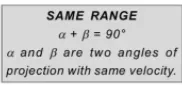
(3) If angle of projection is changed from
then range
$\theta-\theta=(90-\theta)$
$R=\frac{u^{2} \sin 2 \theta^{\prime}}{g}=\frac{u^{2} \sin 2(90-\theta)}{g}=\frac{u^{2} \sin 2 \theta}{g}=R$

So a projectile has same range for angles of projection $\theta$ and $(90-\theta)$
But has different time of flight (T), maximum height (H) \& trajectories
Range is also same for $\theta_{1}=45^{\circ}-\alpha$ and $\quad \theta_{2}=45^{\circ}+\alpha .\left[\right.$ equal $\left.\frac{u^{2} \cos 2 \alpha}{g}\right]$
(4) For maximum Range $\quad R=R_{\max } \Rightarrow 2 \theta=90^{\circ}$
$\text { for } \quad \theta=45^{\circ}$
$R_{\max }=\frac{u^{2}}{g} \quad\left[\right.$ For $\sin 2 \theta=1=\sin 90^{\circ}$ or $\left.\theta=45^{\circ}\right]$
When range is maximum $\Rightarrow$ Then maximum height reached
$\mathrm{H}=\frac{\mathrm{u}^{2} \sin ^{2} 45}{2 \mathrm{~g}}\left(\mathrm{When} \mathrm{R}_{\max }\right)$
or
$\mathrm{H}=\frac{\mathrm{u}^{2}}{4 \mathrm{~g}}$
hence maximum height reached (for $\left.R_{\max }\right) \quad H=\frac{R_{\max }}{4}$

(5) For height H to be maximum
$\mathrm{H}=\frac{\mathrm{u}^{2} \sin ^{2} \theta}{2 \mathrm{~g}}=\max \quad \text { i.e. } \sin ^{2} \theta=1(\max ) \text { or for } \theta=90^{\circ}$
So that $\mathrm{H}_{\max }=\frac{\mathrm{u}^{2}}{2 \mathrm{~g}} \quad$ When projected vertically (i.e. at $\left.\theta=90^{\circ}\right)$
in this case Range $R=\frac{u^{2} \sin \left(2 \times 90^{\circ}\right)}{9}=\frac{u^{2} \sin 180^{\circ}}{9}=0$
$\mathrm{H}_{\max }=\frac{\mathrm{u}^{2}}{2 \mathrm{~g}}$ (For vertical projection) and $\mathrm{R}_{\max }=\frac{\mathrm{u}^{2}}{\mathrm{~g}}$ (For oblique projection with same velocity)
so $\mathrm{H}_{\max }=\frac{R_{\max }}{2}$
If a person can throw a projectile to a maximum distance (with $\theta=45^{\circ}$ ) $R_{\max }=\frac{\mathbf{u}^{2}}{\mathrm{~g}}$.
.
The maximum height to which he can throw the projectile (with $\theta=90^{\circ}$ ) $\mathrm{H}_{\max }=\frac{R_{\text {max }}}{2}$
(6) At highest point
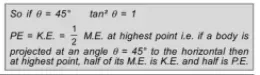
Potential energy will be max and equal to $(\mathrm{PE})_{4}=\mathrm{mgH}=\mathrm{mg} \cdot \frac{\mathrm{U}^{2} \sin ^{2} \theta}{2 \mathrm{~g}}$ or $(\mathrm{PE})_{\mathrm{H}}=\frac{1}{2} \mathrm{mu}^{2} \sin ^{2} \theta$
While K.E. will be minimum (but not zero) and at the highest point as the vertical component of velocity is zero.
$(\mathrm{KE})_{\mathrm{H}}=\frac{1}{2} \mathrm{mv}_{\mathrm{H}}^{2}=\frac{1}{2} \mathrm{~m}(\mathrm{u} \cos \theta)^{2}$
$=\frac{1}{2} \mathrm{mu}^{2} \cos ^{2} \theta$
so $(\mathrm{PE})_{\mathrm{H}}+(\mathrm{KE})_{\mathrm{H}}$
$=\frac{1}{2} m u^{2} \sin ^{2} \theta+\frac{1}{2} m u^{2} \cos ^{2} \theta$
= $\frac{1}{2} \mathrm{mu}^{2}=$ Total M.E.
So in projectile motion mechanical energy is conserved.
$\left(\frac{P E}{K E}\right)_{H}=\frac{\frac{1}{2} m u^{2} \sin ^{2} \theta}{\frac{1}{2} m u^{2} \cos ^{2} \theta}=\tan ^{2} \theta$
(7) In case of projectile motion if range $R$ is $n$ times the maximum height $H,$ l.e. $R=n H$
then $\frac{u^{2} \sin 2 \theta}{g}=n \cdot \frac{u^{2} \sin ^{2} \theta}{2 g}$
or $2 \cos \theta=\frac{n \sin \theta}{2}$
or $\tan \theta=\frac{4}{n} \quad \Rightarrow \quad \theta=\tan ^{-1}\left(\frac{4}{n}\right)$
(8) Weight of a body in projectile motion is zero as it is a freely falling body.
So, that's all from this article. I hope you get the idea about the Oblique projectile motion. If you liked this explanation then please share it with your friends.
Also read
Motion in Two Dimension
To watch Free Learning Videos on physics by Saransh Gupta sir Install the eSaral App.
Team eSaral
eSaral Academic and Editorial Team
Team eSaral is the collective author profile for educational content created by eSaral’s teachers and academic contributors. The team draws on expertise from IIT graduates, doctors, experienced educators and subject specialists to develop resources for JEE, NEET and school students. Our articles aim to explain concepts clearly and help students study with confidence.
Related Posts

BITSAT 2027: Registration Date, Exam Date, Syllabus, Eligibility, Pattern & Fees
BITSAT 2027 exam dates, registration timeline, eligibility criteria, exam pattern, marking scheme, syllabus and fees in one page.

BITSAT Previous Year Question Paper PDF (2017-2026)
Download BITSAT previous year question papers PDF from 2017 to 2026,session-wise. Memory-based papers,exam pattern, paper analysis and how to practise

CBSE Class 10 Date Sheet 2027: Expected Exam Dates, Release Date, Admit Card & Result Timeline
CBSE Class 10 date sheet 2027 is awaited. See the expected exam dates, release window, how to download the PDF, admit card and result timelines.

NCERT Physics Class 10 Book PDF in Hindi 2026-27 – भौतिक विज्ञान के 4 अध्याय (Free Download)
NCERT Physics Class 10 book PDF in Hindi 2026-27: download all 4 chapters (अध्याय 9–12) free, with topics and important formulas.

NCERT Biology Class 9 Book Anveshan PDF in Hindi - जीव विज्ञान कक्षा 9 पुस्तक अन्वेषण PDF
Download NCERT Biology Class 9 book PDF in Hindi chapterwise for 2026-27: Cell, Tissues, Reproduction and Diversity. Free PDFs.

Essay On Artificial Intelligence in English (100,150, 200, 250, 300, 500 Words)
This is in contrast to the natural intelligence of humans. With Artificial Intelligence, machines can perform

Essay on 78th India Independence Day in English for Student (100, 150, 200, 250, 300, 500 Words)
Read the best essays on India's Independence Day in English. Short & long essays (100, 150, 200, 250, 300, 500 words) perfect for school exams
NCERT Class 11 English Snapshots book - Free PDF download- Esaral
Download NCERT Class 11 English Snapshots book PDF for free. Get all 8 chapters, chapter-wise. Start your prep today!
NCERT Class 10 biology book pdf - Free PDF Download - eSaral
NCERT Class 10 Biology book PDF 2026-27: all 5 chapters (Life Processes to Our Environment) in English & Hindi, with CBSE syllabus, marks & practical

Essay on Global Warming in English (100,150, 200, 250, 300, 500 Words)
Global warming means the Earth is getting hotter. This happens because of things like pollution from cars and factories.