
Classification of Elements and Periodicity in Properties Class 11, IIT JEE & NEET

eSaral Academic and Editorial Team
Summary
Classification of Elements and Periodicity in Properties Class 11 is Unit 3 of NCERT Class 11 Chemistry. These notes cover the history of the periodic table, the Modern Periodic Law, IUPAC names for elements with Z > 100, the s-, p-, d- and f-blocks, and the periodic trends in atomic radius, ionisation enthalpy, electron gain enthalpy, electronegativity and valence, including key exceptions like Be–B and N–O.

Chapter Overview and JEE/NEET Importance
Classification of Elements and Periodicity in Properties forms the backbone of inorganic chemistry. Every chapter after it, including Chemical Bonding, the d- and f-Block Elements and Coordination Compounds, builds on the periodic trends introduced here.
- JEE Main and NEET: Classification of Elements and Periodicity in Properties Class 11 is asked regularly in both exams. Questions are usually trend-ordering, exception-based or assertion-reason MCQs.
- Class 11 exams: It is a full NCERT unit (Unit 3), with in-text problems and 32 exercise questions.
- Class 12: Its trends are used again in the d- and f-Block Elements and Coordination Compounds.
If your understanding of classification of elements and periodicity in properties is weak, you will lose marks in several later chapters, so master this one fully instead of skimming it.
Historical Development: From Döbereiner to Mendeleev
The story of classification of elements and periodicity in properties starts in the early 1800s, when chemists first looked for patterns among the known elements.
Döbereiner's Triads (1829)
Johann Döbereiner noticed groups of three elements (triads) with similar properties. In each triad, the atomic weight of the middle element was about the average of the other two.
Triad 1 | Atomic Weight | Triad 2 | Atomic Weight | Triad 3 | Atomic Weight |
|---|---|---|---|---|---|
Li | 7 | Ca | 40 | Cl | 35.5 |
Na | 23 | Sr | 88 | Br | 80 |
K | 39 | Ba | 137 | I | 127 |
Example: for Ca, Sr and Ba, (40 + 137)/2 = 88.5 ≈ 88, the atomic weight of Sr.
Limitation: Only a few elements could be grouped into triads, so the law did not apply to all known elements.
Newlands' Law of Octaves (1865)
John Newlands arranged elements in order of increasing atomic weight and found that every eighth element had properties similar to the first, like the eighth note in a musical octave.
Limitation: The law worked only up to calcium. Beyond that, the pattern broke down.
Mendeleev's Periodic Law (1869)
Dmitri Mendeleev arranged the 63 elements known at the time in order of increasing atomic weight, grouping elements with similar properties together. His key contribution was leaving gaps for undiscovered elements and predicting their properties. These predictions were later confirmed:
Predicted Element | Discovered As | Year of Discovery |
|---|---|---|
Eka-aluminium | Gallium (Ga) | 1875 |
Eka-boron | Scandium (Sc) | 1879 |
Eka-silicon | Germanium (Ge) | 1886 |
Anomalies in Mendeleev's table:
- The position of isotopes was not defined.
- Hydrogen's position was uncertain.
- Some elements were placed out of atomic-weight order to keep similar elements together. For example, iodine (lower atomic weight) was placed after tellurium, and cobalt before nickel.
Modern Periodic Law and the Long-Form Periodic Table
Modern Periodic Law
"The physical and chemical properties of the elements are periodic functions of their atomic numbers."
In 1913, Henry Moseley showed that atomic number, not atomic mass, is the more fundamental property of an element. This led to the Modern Periodic Law and removed the anomalies of Mendeleev's table.
Structure of the Long-Form Periodic Table
The modern periodic table has 118 elements in 18 groups (vertical columns) and 7 periods (horizontal rows). The number of elements in each period is twice the number of orbitals in the energy level being filled.
Period | Number of Elements | Orbitals Being Filled |
|---|---|---|
1 | 2 | 1s |
2 | 8 | 2s, 2p |
3 | 8 | 3s, 3p |
4 | 18 | 4s, 3d, 4p |
5 | 18 | 5s, 4d, 5p |
6 | 32 | 6s, 4f, 5d, 6p |
7 | 32 | 7s, 5f, 6d, 7p |
💡 Expert Tip by Prateek Gupta, IIT Bombay: "Students often lose marks by confusing period number with shell number. Remember — the period number tells you the highest principal quantum number (n) of the valence shell for that row. Period 4 elements have n = 4 as their outermost shell."
Nomenclature of Elements with Atomic Number Above 100
This part of classification of elements and periodicity in properties is short but scoring. A new element first gets a temporary IUPAC name made from numerical roots for its atomic number, ending in "-ium", with a three-letter symbol. Later, IUPAC gives it a permanent name.
Digit | 0 | 1 | 2 | 3 | 4 | 5 | 6 | 7 | 8 | 9 |
|---|---|---|---|---|---|---|---|---|---|---|
Root | nil | un | bi | tri | quad | pent | hex | sept | oct | enn |
Examples: Z = 101 is Unnilunium (Unu), now Mendelevium (Md). Z = 118 is Ununoctium (Uuo), now Oganesson (Og). Z = 120 would be Unbinilium (Ubn).
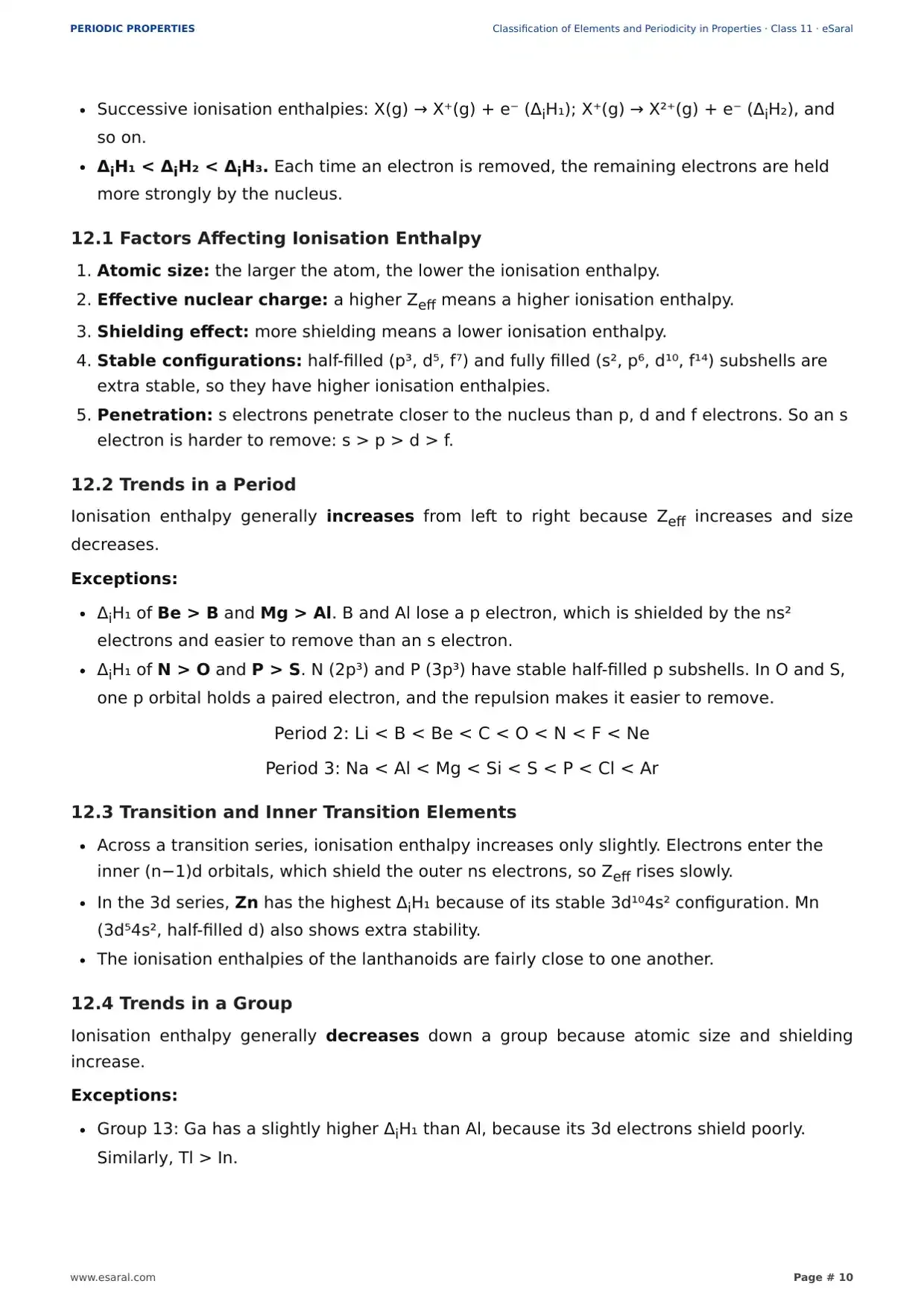
Classification of Elements and Periodicity in Properties Notes

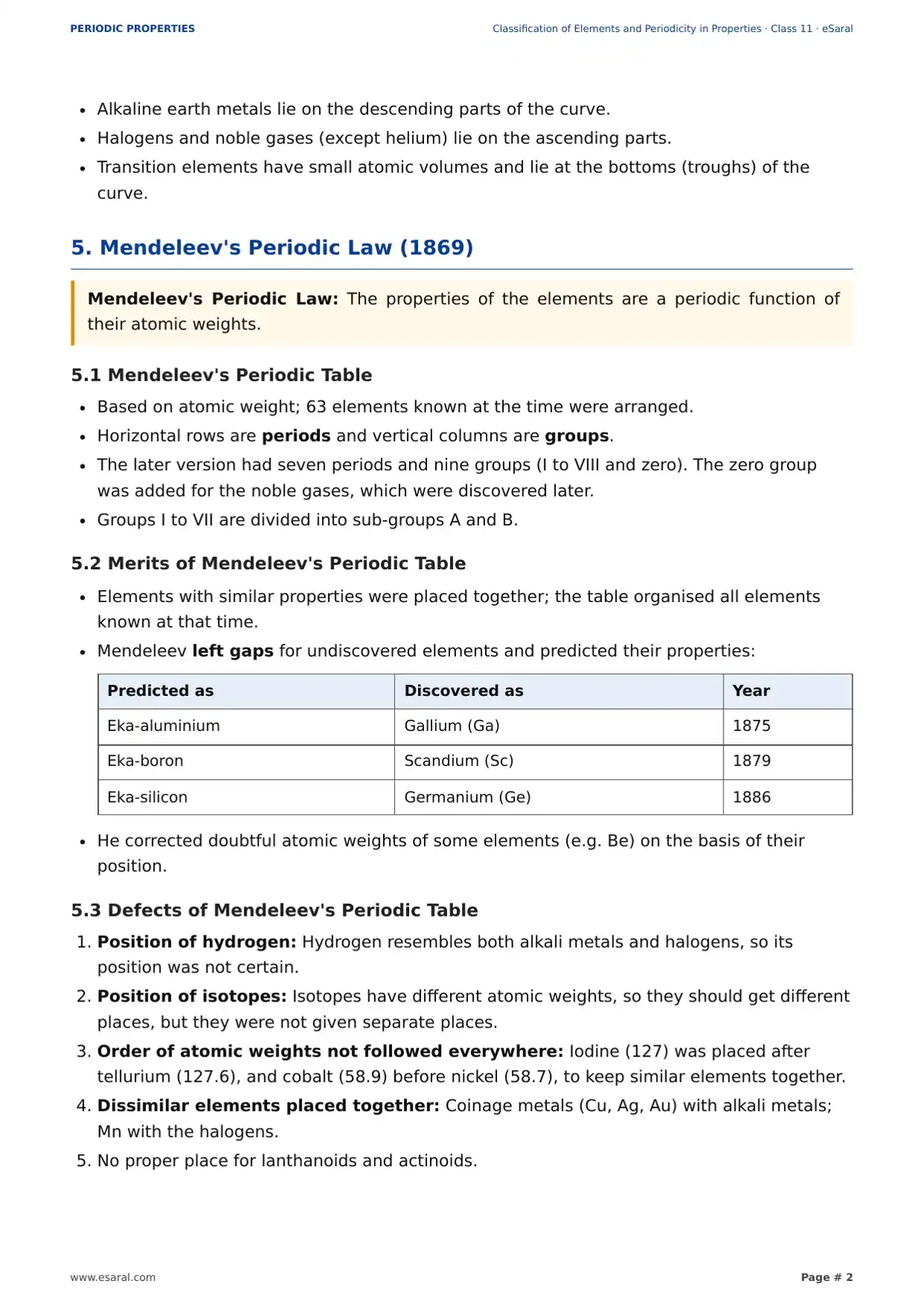
India's Best Exam Preparation for Class 11th - Download Now
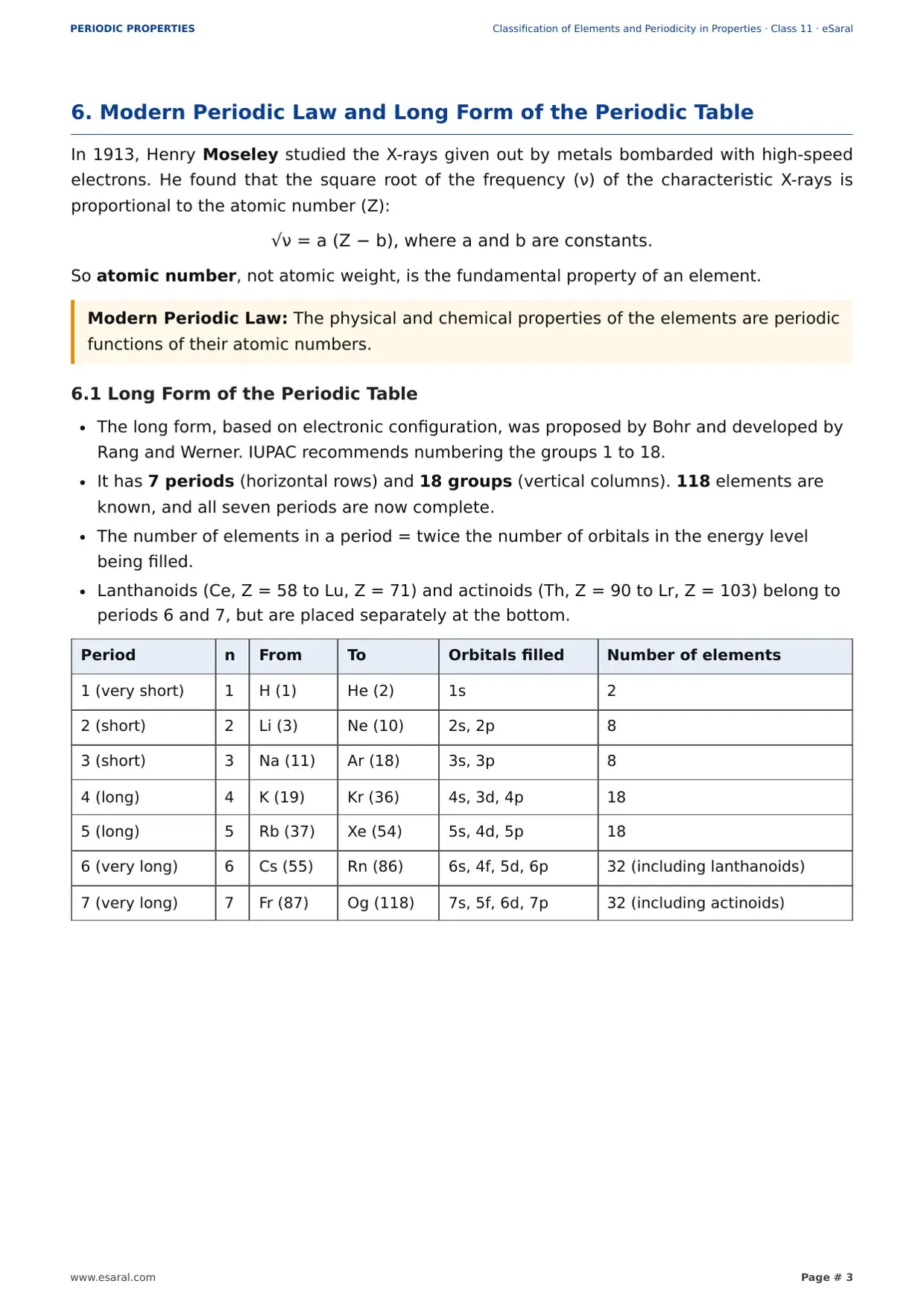
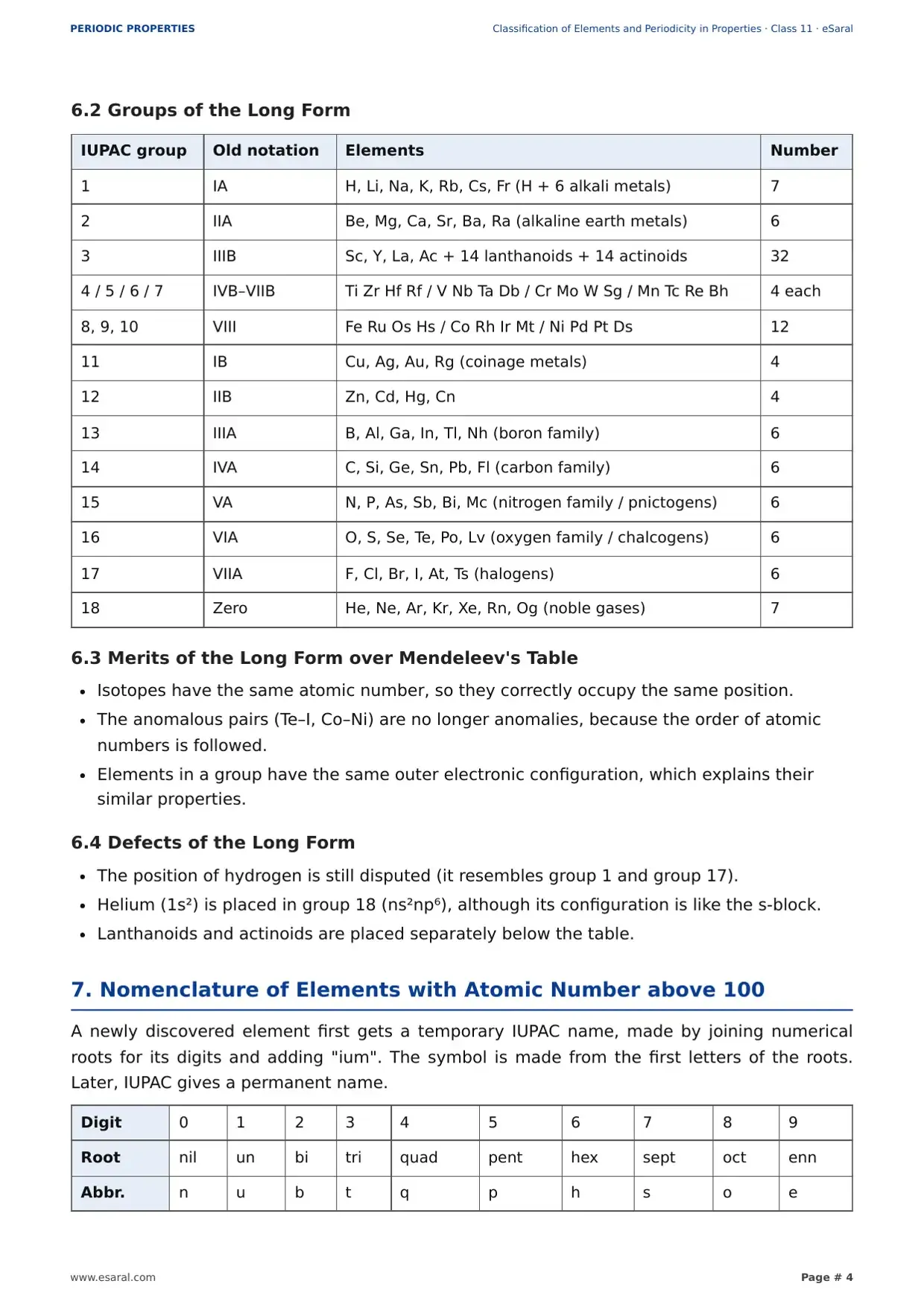
India's Best Exam Preparation for Class 11th - Download Now
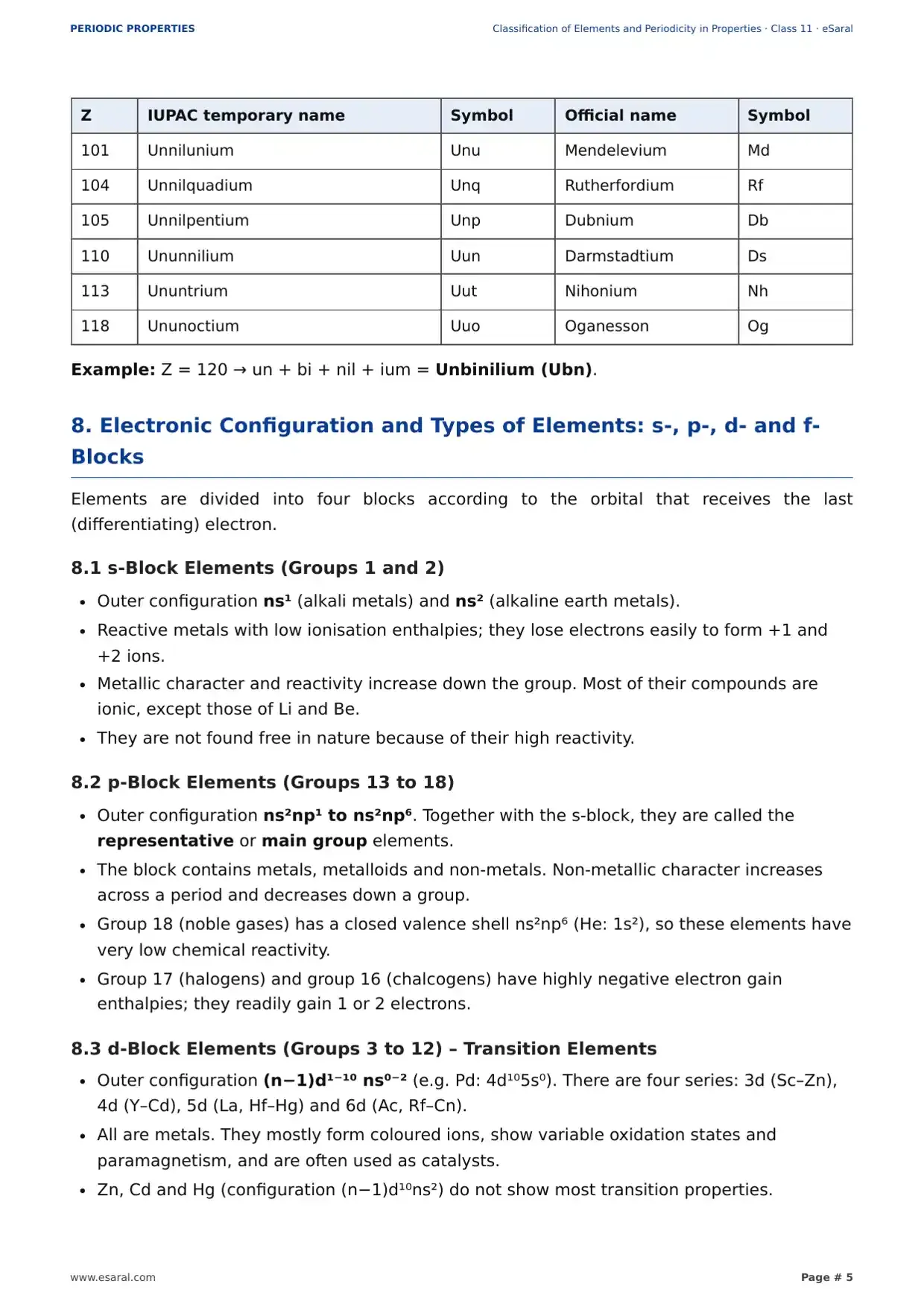
India's Best Exam Preparation for Class 11th - Download Now
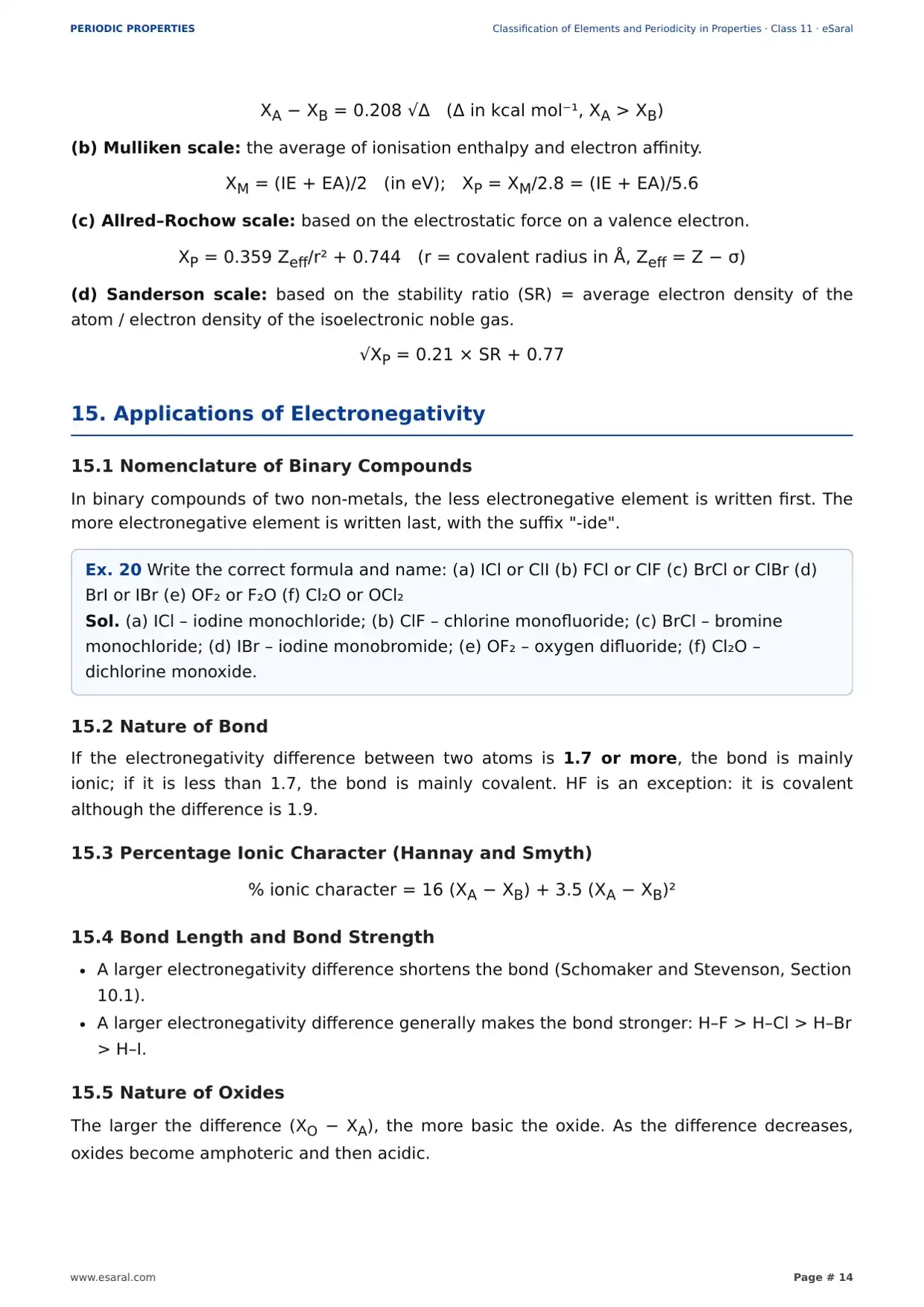
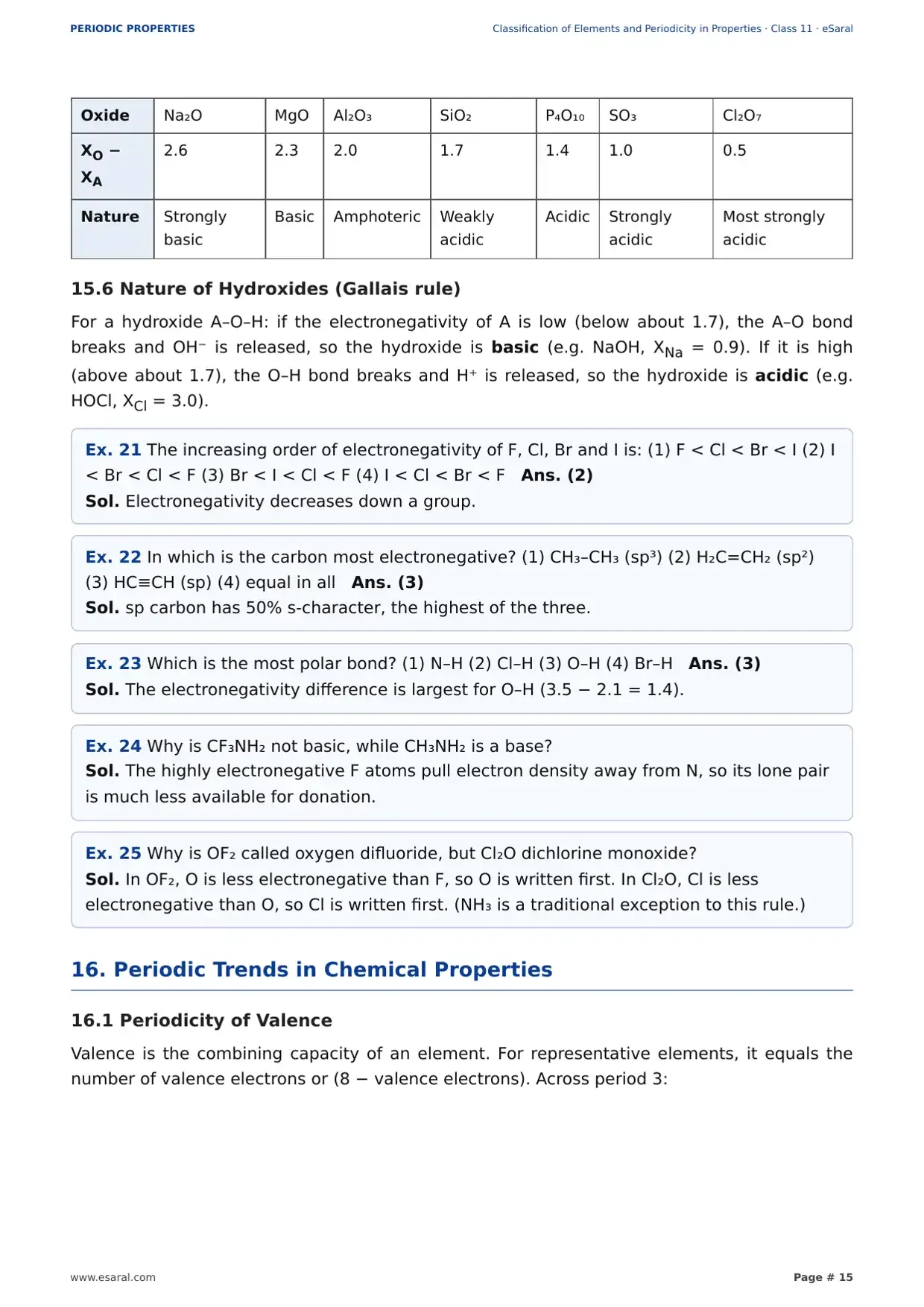
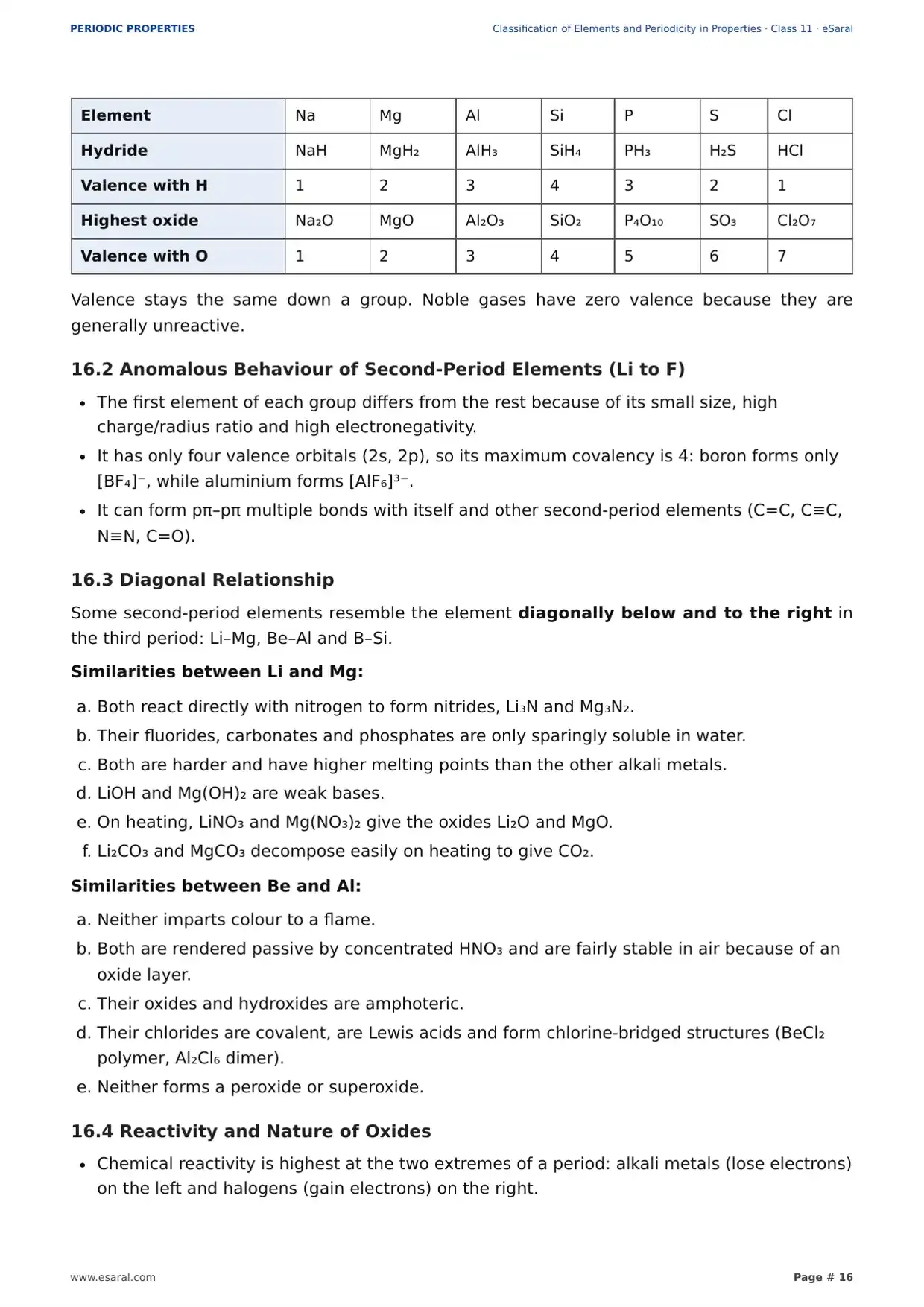
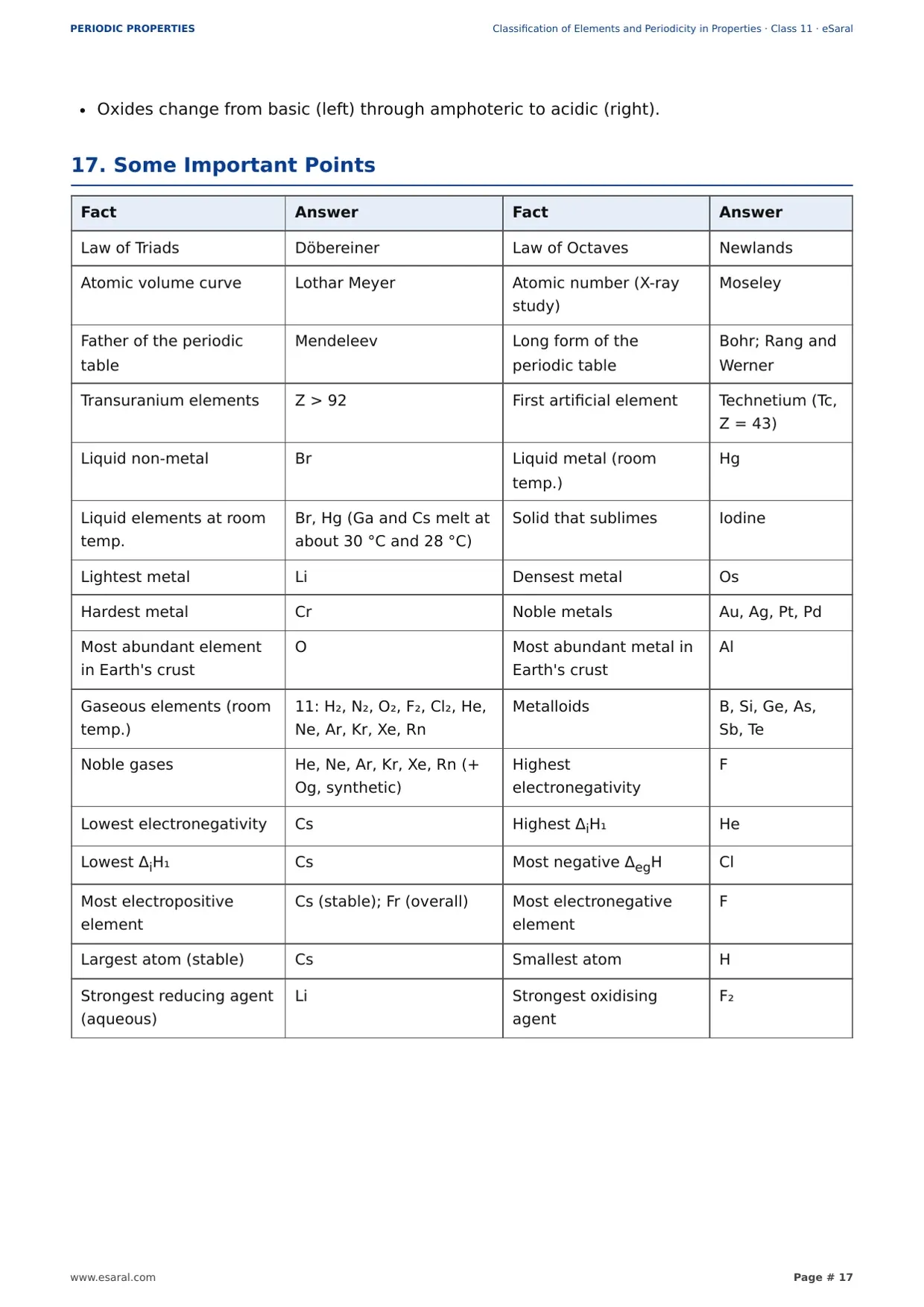
India's Best Exam Preparation for Class 11th - Download Now
Periodic Classification of Elements Class 11: How Are Elements Grouped?
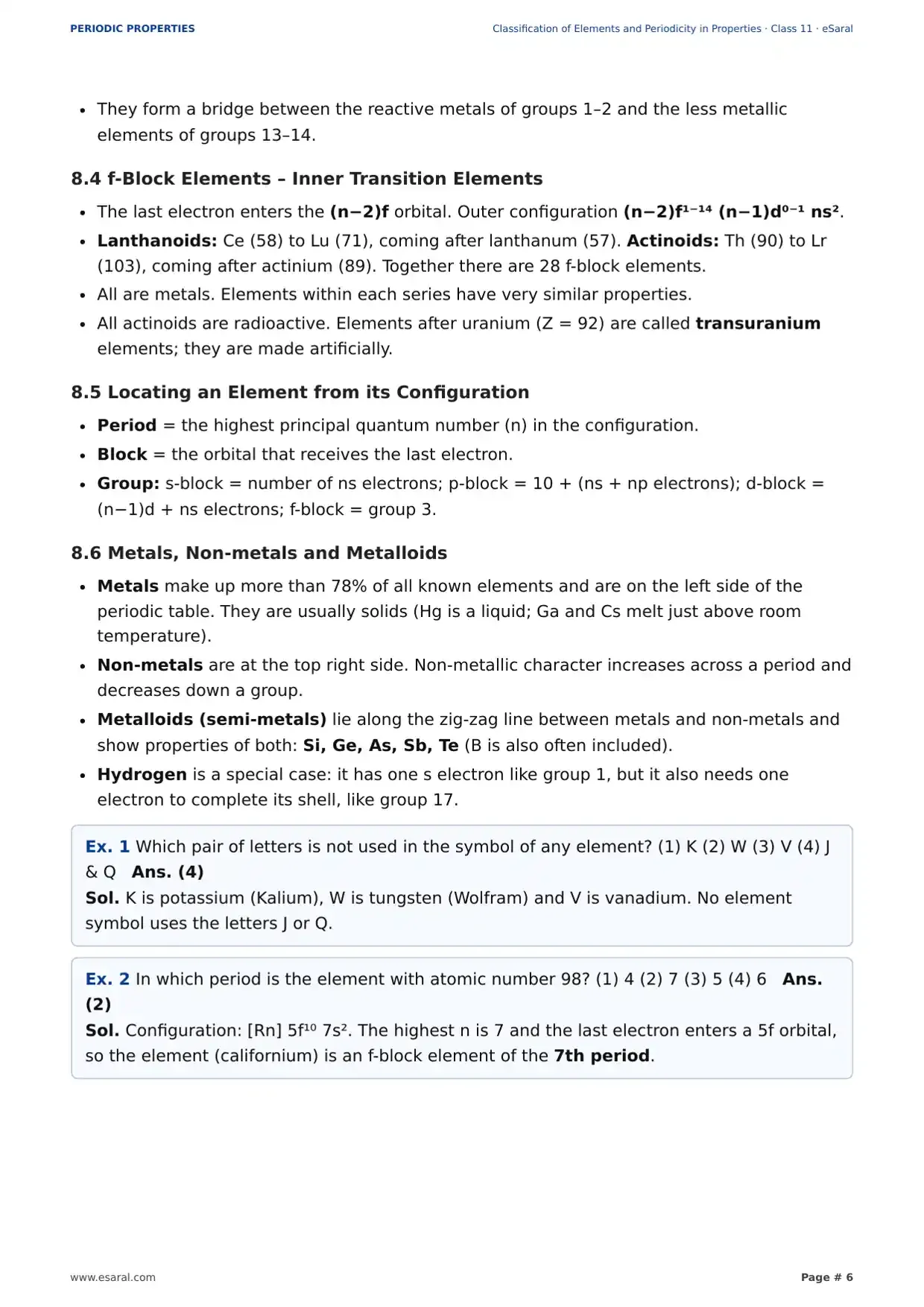
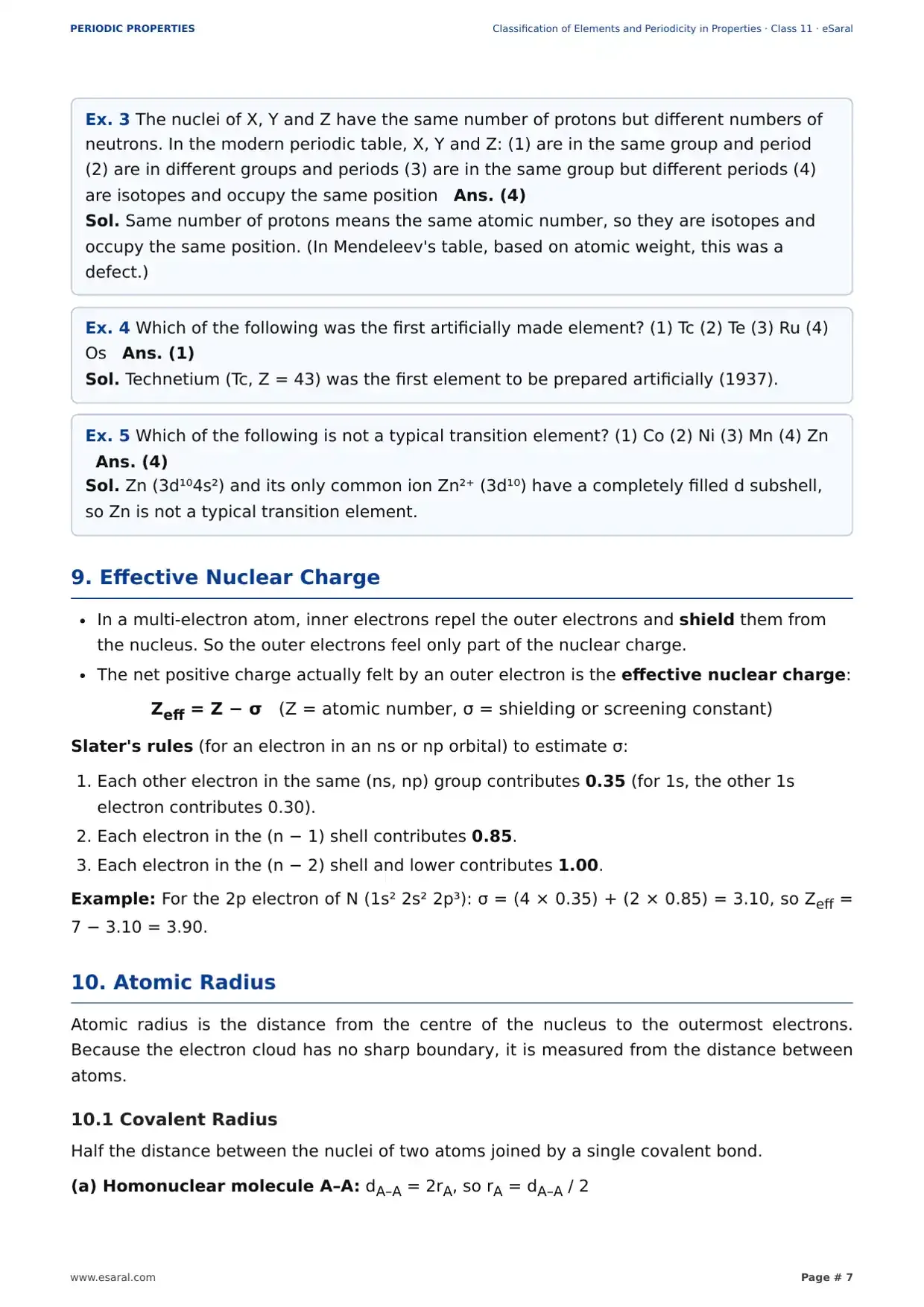
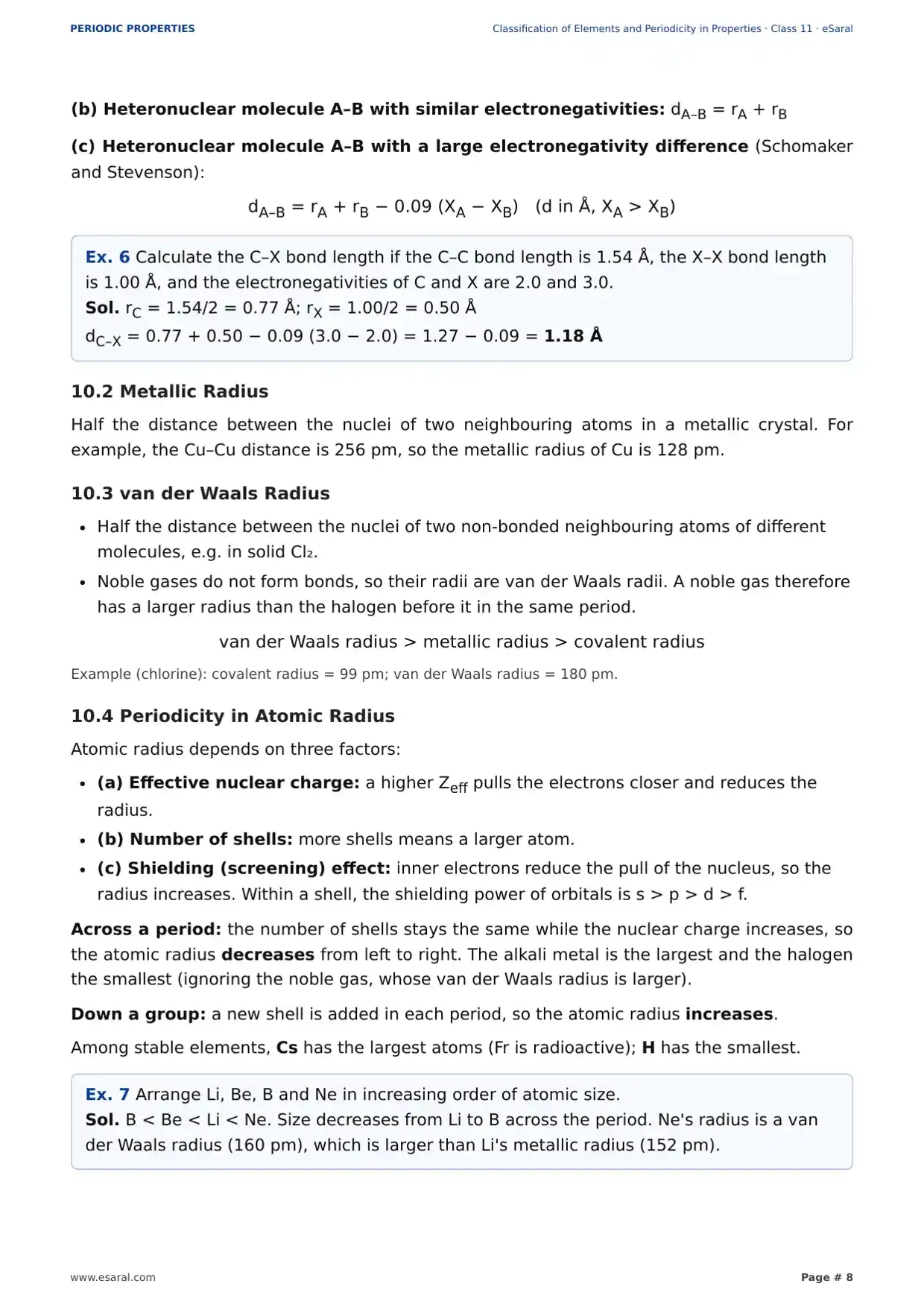
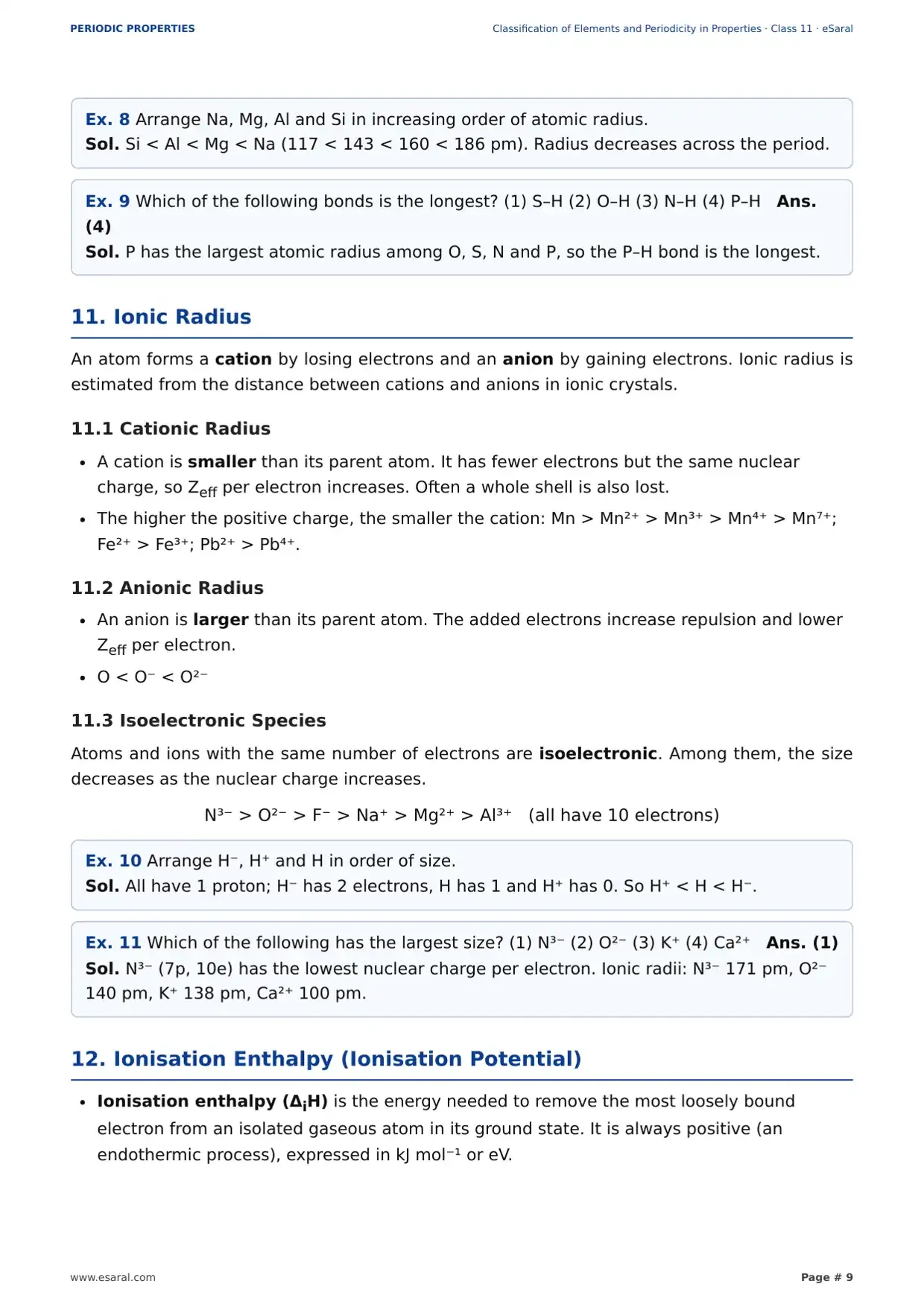
In classification of elements and periodicity in properties, elements are divided into four blocks based on the orbital that receives the last electron:
s-Block Elements (Groups 1 and 2)
- Last electron enters the s orbital (ns¹ or ns²).
- Alkali metals (Group 1) and alkaline earth metals (Group 2).
- Reactive metals with low ionisation enthalpies; mostly form basic oxides.
p-Block Elements (Groups 13 to 18)
- Last electron enters the p orbital (ns²np¹ to ns²np⁶).
- Includes metals, metalloids, non-metals and noble gases.
- The most varied block in properties.
d-Block Elements (Groups 3 to 12)
- Last electron enters the d orbital of the penultimate shell.
- Called transition elements; mostly coloured ions, variable oxidation states and paramagnetism.
f-Block Elements (Lanthanoids and Actinoids)
- Last electron enters the f orbital.
- Placed separately at the bottom of the table.
- Lanthanoids are Ce (58) to Lu (71); actinoids are Th (90) to Lr (103).
Metals, non-metals and metalloids:
- Metals make up more than 78% of all known elements and lie on the left and centre of the table.
- Non-metals are at the top right.
- Metalloids (semi-metals) such as silicon, germanium, arsenic, antimony and tellurium lie along the zig-zag line between them. Boron and polonium are sometimes also included.
- Noble gases in Group 18 have a closed valence shell and are very unreactive.
Periodic Properties Class 11: How Do They Change Across Periods and Groups?
Periodic properties show a regular pattern across periods and down groups. In Classification of Elements and Periodicity in Properties Class 11, these trends are the most frequently tested part of the chapter in both JEE and NEET.
Atomic Radius
Atomic radius is the distance from the nucleus to the outermost electrons, measured as covalent radius for non-metals and metallic radius for metals.
- Across a period: Decreases. The nuclear charge rises while electrons enter the same shell, so they are pulled closer.
- Down a group: Increases. A new shell is added in each period.
- Noble gases: Their radius is a van der Waals radius, which is larger than covalent radii, so they are not compared directly in the trend.
Ionic Radius and Isoelectronic Species
A cation is smaller than its parent atom, and an anion is larger. Isoelectronic species have the same number of electrons, for example O²⁻, F⁻, Na⁺ and Mg²⁺. Among them, the one with the higher nuclear charge is smaller: O²⁻ > F⁻ > Na⁺ > Mg²⁺.
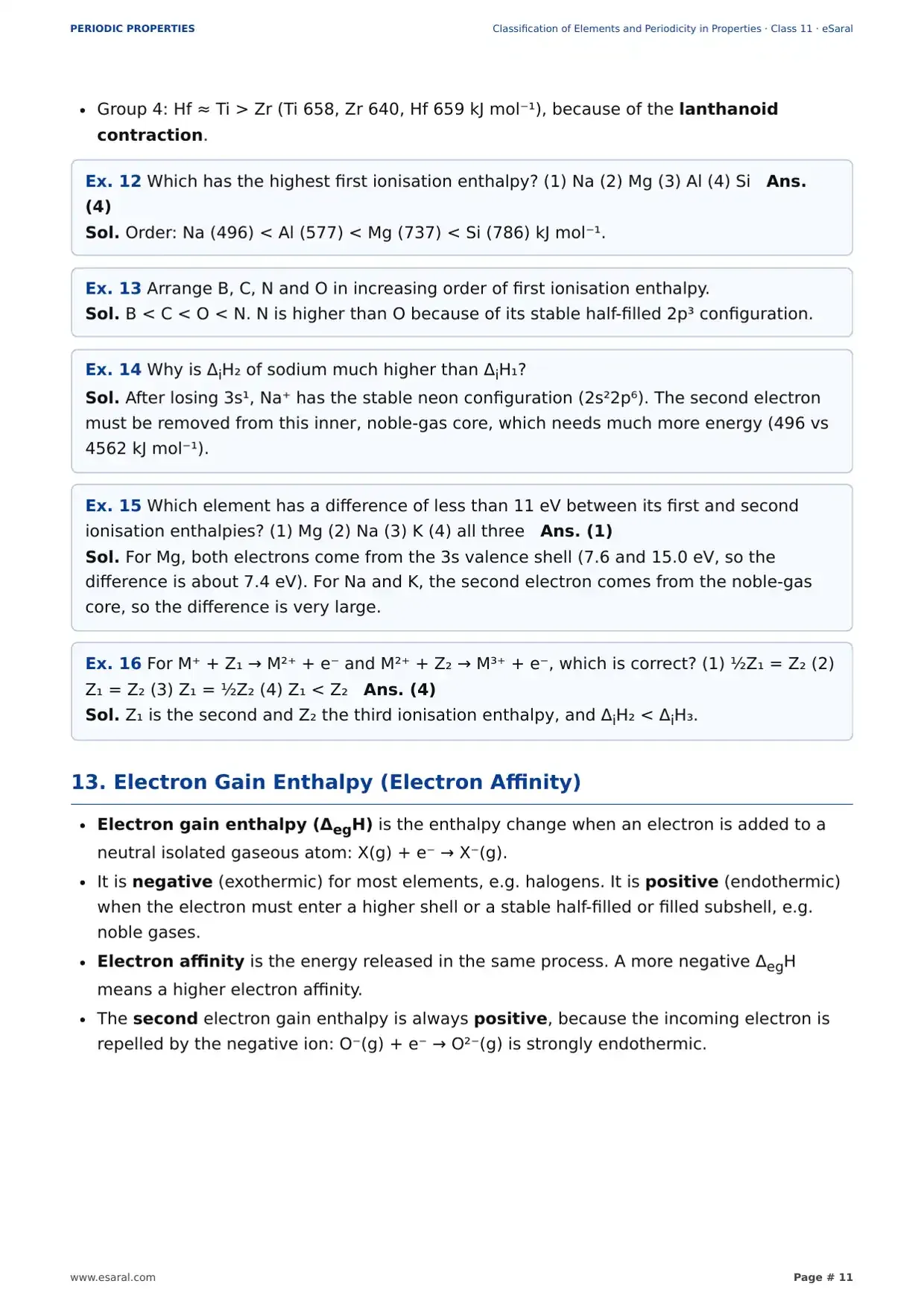
Ionisation Enthalpy (IE)
Ionisation enthalpy is the energy needed to remove an electron from an isolated gaseous atom in its ground state.
- Across a period: Generally increases, because electrons are held more tightly.
- Down a group: Decreases, because the outer electrons are farther away and more shielded.
Important exceptions for JEE:
- IE₁ of B < IE₁ of Be. B loses a 2p electron, which is easier to remove than Be's 2s electron.
- IE₁ of O < IE₁ of N. N has a stable half-filled 2p³ configuration, while O's paired 2p electron is easier to remove.
💡 Expert Tip by Prateek Gupta, IIT Bombay: "The exceptions in ionisation enthalpy — B vs Be and O vs N — appear in JEE Main almost every year. Don't just memorise the exception; understand why. Half-filled and fully filled subshells have extra stability. That one concept explains both exceptions."
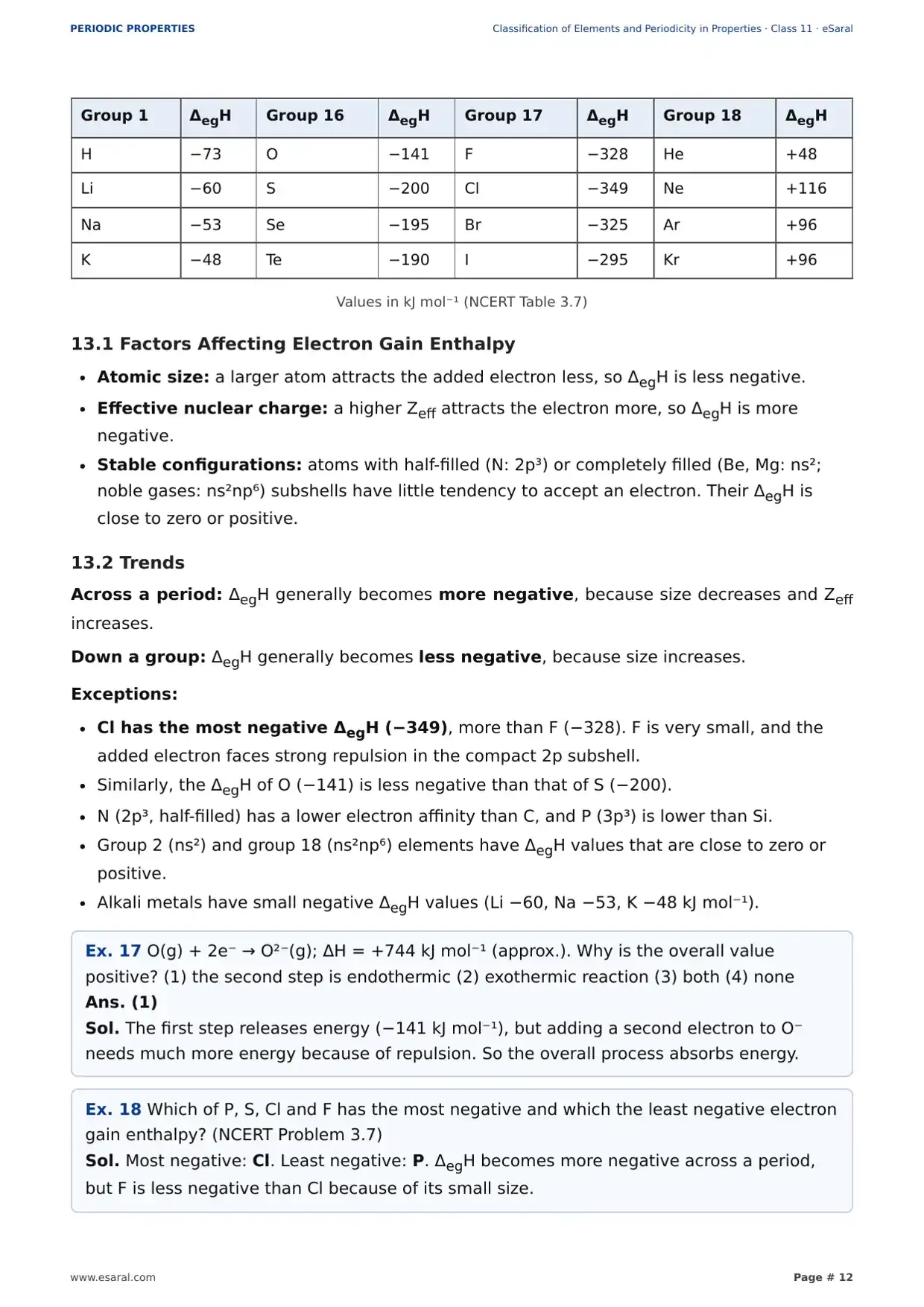
Electron Gain Enthalpy
Electron gain enthalpy (ΔegH) is the enthalpy change when a neutral gaseous atom gains an electron.
- Across a period: Generally becomes more negative.
- Down a group: Generally becomes less negative.
- Exception: Fluorine's electron gain enthalpy is less negative than chlorine's. The added electron enters fluorine's small 2p shell and faces strong electron–electron repulsion.
- Noble gases have large positive values, because the added electron must enter a new shell.
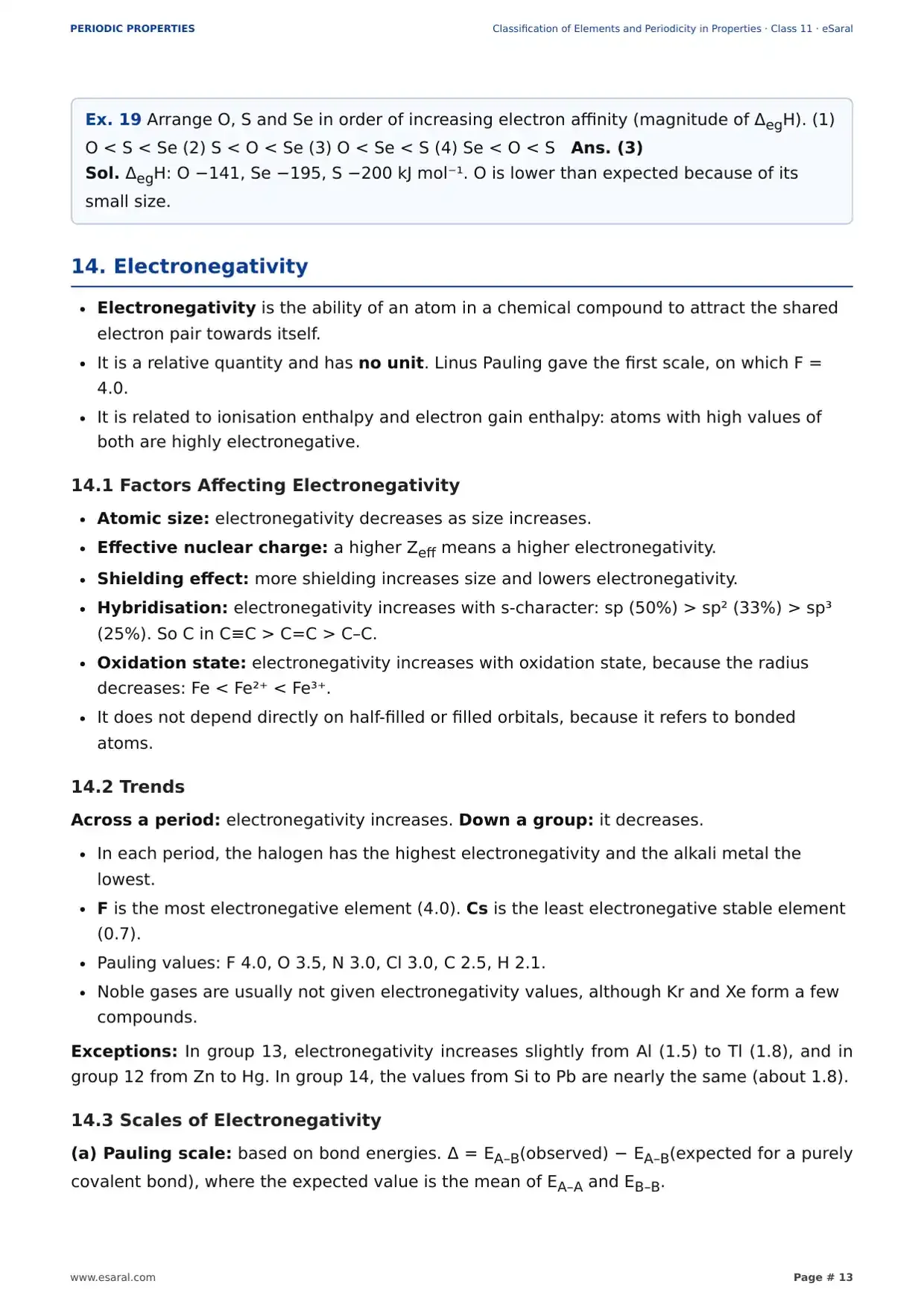
Electronegativity
Electronegativity is the ability of an atom in a compound to attract the shared electron pair towards itself.
- Across a period: Increases.
- Down a group: Decreases.
- Most electronegative element: Fluorine (4.0 on the Pauling scale).
- Least electronegative element: Caesium.
Valence (Combining Capacity)
- Across a period: Valence with respect to hydrogen first increases from 1 to 4 and then decreases to 1 (for example NaH, MgH₂, AlH₃, SiH₄, PH₃, H₂S, HCl). With oxygen, it can rise up to 7 (Cl₂O₇).
- Down a group: Valence stays the same, because elements in a group have the same number of valence electrons.
- Noble gases: Valence is 0, as they are generally unreactive.
Periodic Trends in Chemical Properties
- Anomalous behaviour of second-period elements (Li to F): small size, high electronegativity and no d orbitals. For example, B can form a maximum covalency of 4, while Al can exceed 4.
- Diagonal relationship: Li resembles Mg, and Be resembles Al.
- Reactivity: It is highest at the two extremes of a period, with alkali metals on the left and halogens on the right.
- Oxides: They are basic on the left (Na₂O), amphoteric in the middle (Al₂O₃) and acidic on the right (Cl₂O₇).
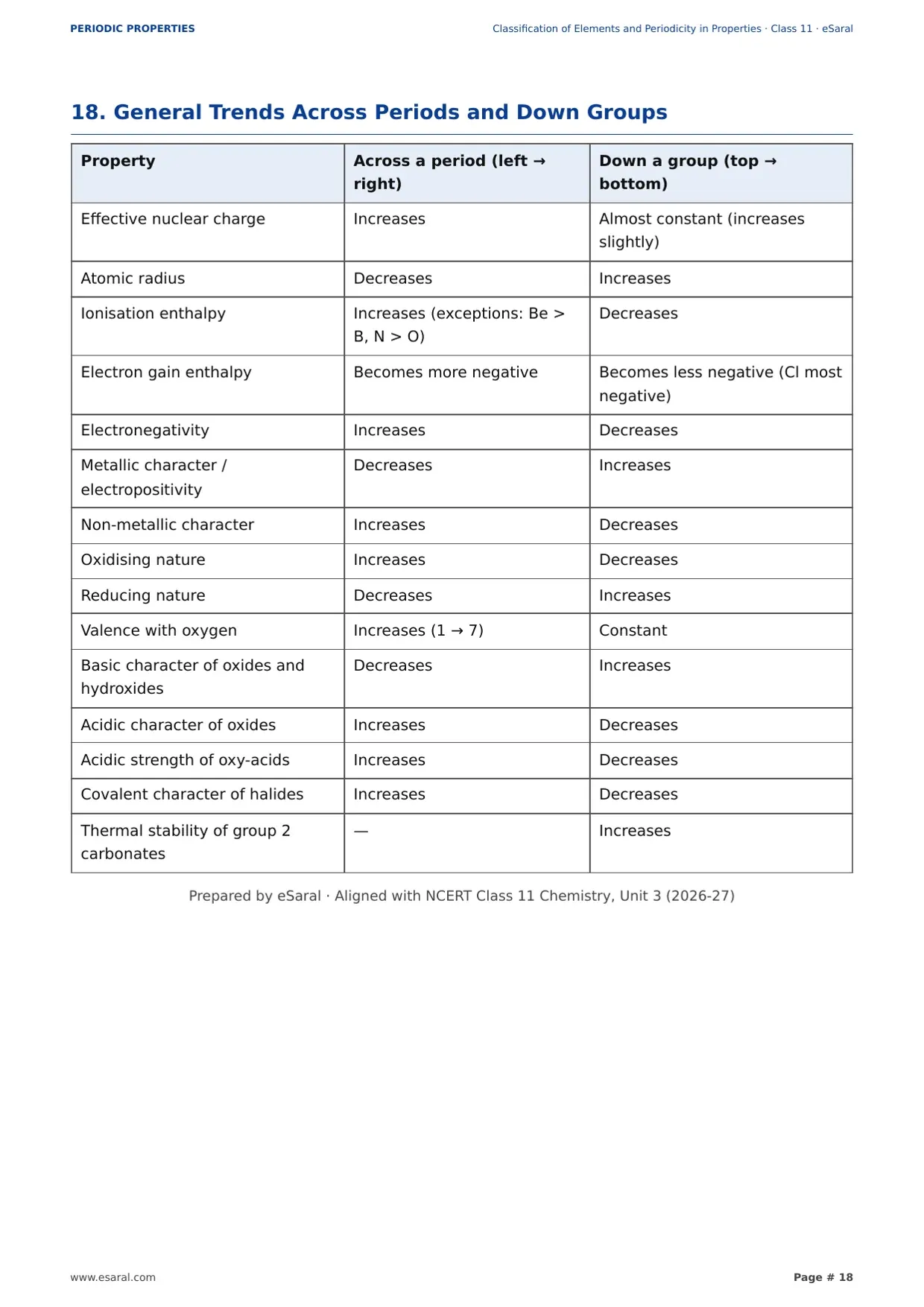
Summary Table — Periodic Trends in Classification of Elements and Periodicity in Properties
Property | Across Period (→) | Down Group (↓) |
|---|---|---|
Atomic radius | Decreases | Increases |
Ionisation enthalpy | Increases (with exceptions) | Decreases |
Electron gain enthalpy | More negative | Less negative |
Electronegativity | Increases | Decreases |
Metallic character | Decreases | Increases |
Non-metallic character | Increases | Decreases |
Most Important Topics for JEE Main and NEET From This Chapter
Based on previous year papers, these are the highest-yield topics in Classification of Elements and Periodicity in Properties Class 11:
- Ionisation enthalpy exceptions, especially N vs O and Be vs B
- Electron gain enthalpy of F vs Cl
- Identifying the s-, p-, d- or f-block, period and group from an electronic configuration
- Ordering isoelectronic species by size
- Atomic radius trends
- Electronegativity order and bond polarity
- IUPAC names and symbols for Z > 100
- Mendeleev's predictions and the number of elements in each period
For JEE Advanced, expect classification of elements and periodicity in properties questions that combine periodic trends with bonding and structure. For NEET, factual and assertion-reason questions dominate.
How to Study Classification of Elements and Periodicity in Properties Class 11 for JEE and NEET
Step 1: Build the Conceptual Framework First (2 days)
Read the NCERT chapter on classification of elements and periodicity in properties once end to end without trying to memorise. Understand why properties change: nuclear charge, shielding and effective nuclear charge. Concepts learned with logic stay with you; memorised facts fade before the exam.
Step 2: Master the Exceptions (1 day)
Write out every exception (the IE exceptions of B and O, F vs Cl, noble gas radii) with the reason next to it. Make a one-page exceptions sheet.
Step 3: Solve the NCERT Exercise, Then Module Problems (3–4 days)
Solve all 32 NCERT exercise questions first, and check them with eSaral's NCERT Solutions for Class 11 Chemistry Chapter 3. Then work through eSaral's chapter module from Exercise 1 (basic) to Exercise 2A (JEE Main level).
Step 4: Attempt Chapter-Wise JEE Main and NEET Tests
After the module, take eSaral's chapter-wise JEE Main and NEET tests for this chapter. Review every wrong answer against your exceptions sheet, and note whether the error was conceptual or careless.
Step 5: Revise With Short Notes Before Exams
Use eSaral's Class 11 Chemistry revision notes and the Classification of Elements and Periodicity in Properties notes above in your final revision. Treat them as a memory trigger before mocks and the actual exam, not as a substitute for steps 1–4.
Frequently Asked Questions
What is the Modern Periodic Law in Classification of Elements and Periodicity in Properties Class 11?
The Modern Periodic Law states that the physical and chemical properties of elements are periodic functions of their atomic numbers. It is based on Henry Moseley's 1913 work, which showed that atomic number, not atomic mass, is the more fundamental property, and it removed anomalies such as Te–I and Co–Ni in Mendeleev's table.
How does atomic radius change across a period and down a group?
Atomic radius decreases across a period, because increasing nuclear charge pulls the electrons closer while no new shell is added. Down a group, atomic radius increases, because each element adds a new electron shell.
Why is the ionisation enthalpy of nitrogen higher than oxygen?
Nitrogen has a half-filled 2p³ configuration, which is extra stable. In oxygen (2p⁴), one 2p orbital holds a paired electron that faces extra repulsion, so it is easier to remove. That is why IE₁ of N is higher than IE₁ of O. eSaral's chemistry faculty point out that this N–O exception, along with Be–B, is one of the most repeated JEE Main questions from this chapter.
Why is the electron gain enthalpy of chlorine more negative than fluorine?
Fluorine is very small, so an electron added to its compact 2p shell faces strong repulsion from the electrons already there. In chlorine, the added electron goes into the larger 3p shell, so less energy is lost to repulsion and more is released.
What is the IUPAC name of the element with atomic number 120?
Using the roots un (1), bi (2) and nil (0), the element with Z = 120 is named Unbinilium, with the symbol Ubn. Elements up to Z = 118 have permanent names, such as Oganesson (Og) for 118.
What is the difference between electron affinity and electron gain enthalpy?
Electron affinity is the energy released when a neutral gaseous atom gains an electron. Electron gain enthalpy is the enthalpy change for the same process, which is negative when energy is released and positive when energy is absorbed. NCERT uses electron gain enthalpy, and both terms appear in JEE papers.
Where can I find NCERT solutions for Classification of Elements and Periodicity in Properties?
eSaral's NCERT Solutions for Class 11 Chemistry Chapter 3 has step-by-step answers to all exercise questions of this unit. For quick revision, use these notes along with eSaral's Class 11 Chemistry revision notes.
Team eSaral
eSaral Academic and Editorial Team
Team eSaral is the collective author profile for educational content created by eSaral’s teachers and academic contributors. The team draws on expertise from IIT graduates, doctors, experienced educators and subject specialists to develop resources for JEE, NEET and school students. Our articles aim to explain concepts clearly and help students study with confidence.
Related Posts

BITSAT 2027: Registration Date, Exam Date, Syllabus, Eligibility, Pattern & Fees
BITSAT 2027 exam dates, registration timeline, eligibility criteria, exam pattern, marking scheme, syllabus and fees in one page.

BITSAT Previous Year Question Paper PDF (2017-2026)
Download BITSAT previous year question papers PDF from 2017 to 2026,session-wise. Memory-based papers,exam pattern, paper analysis and how to practise

CBSE Class 10 Date Sheet 2027: Expected Exam Dates, Release Date, Admit Card & Result Timeline
CBSE Class 10 date sheet 2027 is awaited. See the expected exam dates, release window, how to download the PDF, admit card and result timelines.

NCERT Physics Class 10 Book PDF in Hindi 2026-27 – भौतिक विज्ञान के 4 अध्याय (Free Download)
NCERT Physics Class 10 book PDF in Hindi 2026-27: download all 4 chapters (अध्याय 9–12) free, with topics and important formulas.

NCERT Biology Class 9 Book Anveshan PDF in Hindi - जीव विज्ञान कक्षा 9 पुस्तक अन्वेषण PDF
Download NCERT Biology Class 9 book PDF in Hindi chapterwise for 2026-27: Cell, Tissues, Reproduction and Diversity. Free PDFs.

Essay On Artificial Intelligence in English (100,150, 200, 250, 300, 500 Words)
This is in contrast to the natural intelligence of humans. With Artificial Intelligence, machines can perform

Essay on 78th India Independence Day in English for Student (100, 150, 200, 250, 300, 500 Words)
Read the best essays on India's Independence Day in English. Short & long essays (100, 150, 200, 250, 300, 500 words) perfect for school exams
NCERT Class 11 English Snapshots book - Free PDF download- Esaral
Download NCERT Class 11 English Snapshots book PDF for free. Get all 8 chapters, chapter-wise. Start your prep today!
NCERT Class 10 biology book pdf - Free PDF Download - eSaral
NCERT Class 10 Biology book PDF 2026-27: all 5 chapters (Life Processes to Our Environment) in English & Hindi, with CBSE syllabus, marks & practical

Essay on Global Warming in English (100,150, 200, 250, 300, 500 Words)
Global warming means the Earth is getting hotter. This happens because of things like pollution from cars and factories.