
Permutations and Combinations Class 11 Notes for IIT JEE

eSaral Academic and Editorial Team
Summary
Permutations and Combinations Class 11 Notes cover the fundamental principle of counting, factorials, permutations (with repetition, with identical objects and in a circle), combinations and their properties, restricted arrangements, geometrical counting, division into groups, distribution of objects, the rank of a word and the gaps method. This page gives all the formulas, solved examples and handwritten notes for CBSE boards and JEE.
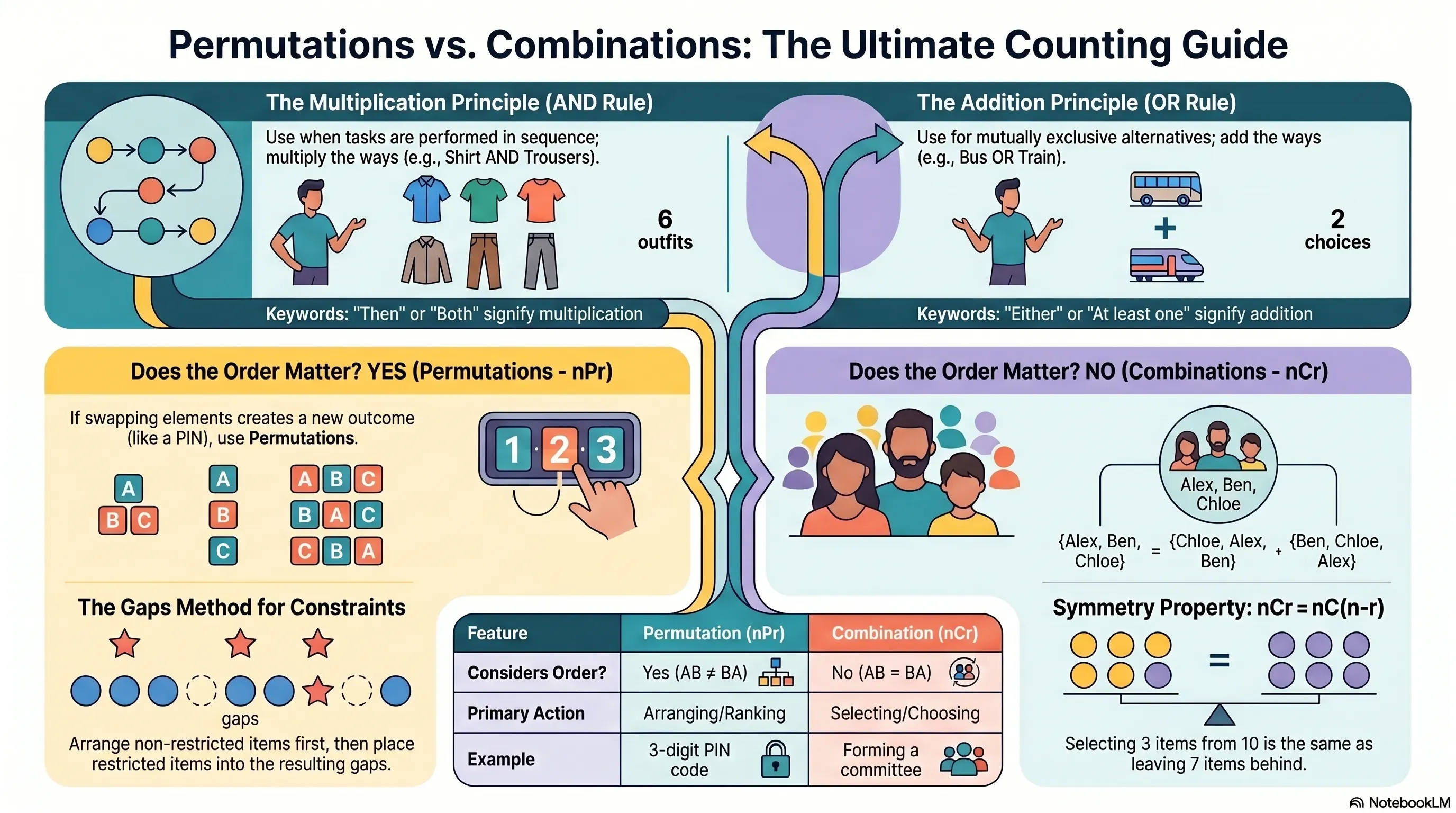
Permutations and Combinations is Chapter 6 of NCERT Class 11 Mathematics (it was Chapter 7 in older books). The NCERT chapter covers the fundamental principle of counting, factorials, and the formulas for ${}^{n}P_{r}$ and ${}^{n}C_{r}$ with simple applications. Circular permutations, restricted arrangements, division into groups and the gaps method are beyond the NCERT text, but JEE problems use them, so these Permutations and Combinations Class 11 Notes explain them too.
Permutations and Combinations Class 11 Notes: Chapter Overview and Syllabus
- NCERT and CBSE: the fundamental principle of counting, factorial notation, permutations, combinations, the derivation of the formulas for ${}^{n}P_{r}$ and ${}^{n}C_{r}$ and the connection between them, and simple applications.
- JEE Main: the fundamental principle of counting, permutation as an arrangement and combination as a selection, the meaning of $P(n, r)$ and $C(n, r)$, and simple applications. Problems on circular arrangements, groups and distributions are built on these ideas.
- Beyond NCERT (useful for JEE): circular permutations, always together and never together arrangements, geometrical counting, division into groups, distribution of objects, the rank of a word and the gaps method.
Check the latest syllabi of CBSE and NTA for the exact lists.
Tip from the eSaral Maths team: Before you write any formula, split the problem into steps, and decide for each step whether the choices are joined by AND (multiply) or by OR (add). Most wrong answers come from using a formula before this structure is clear.
India's Best Exam Preparation for Class 11th - Download Now
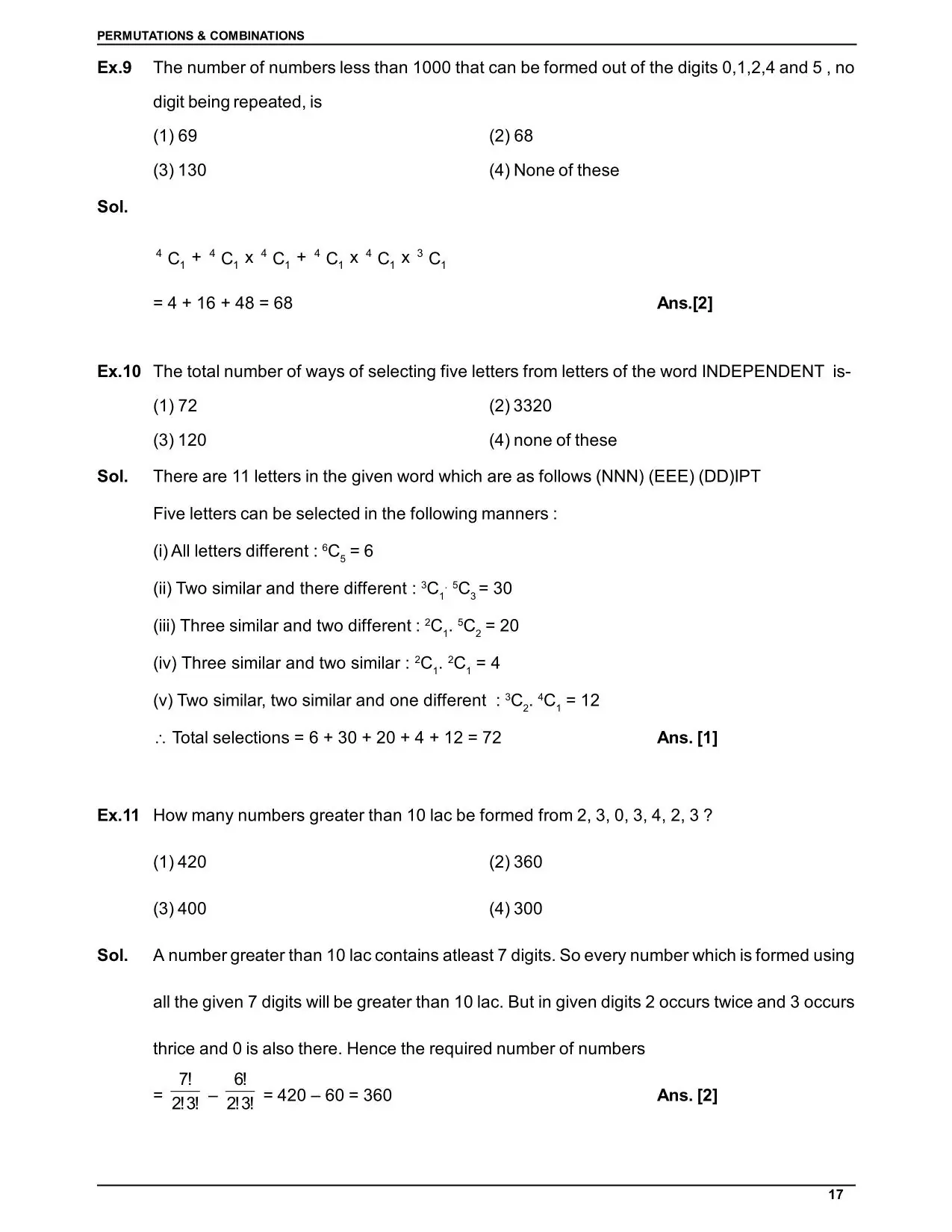
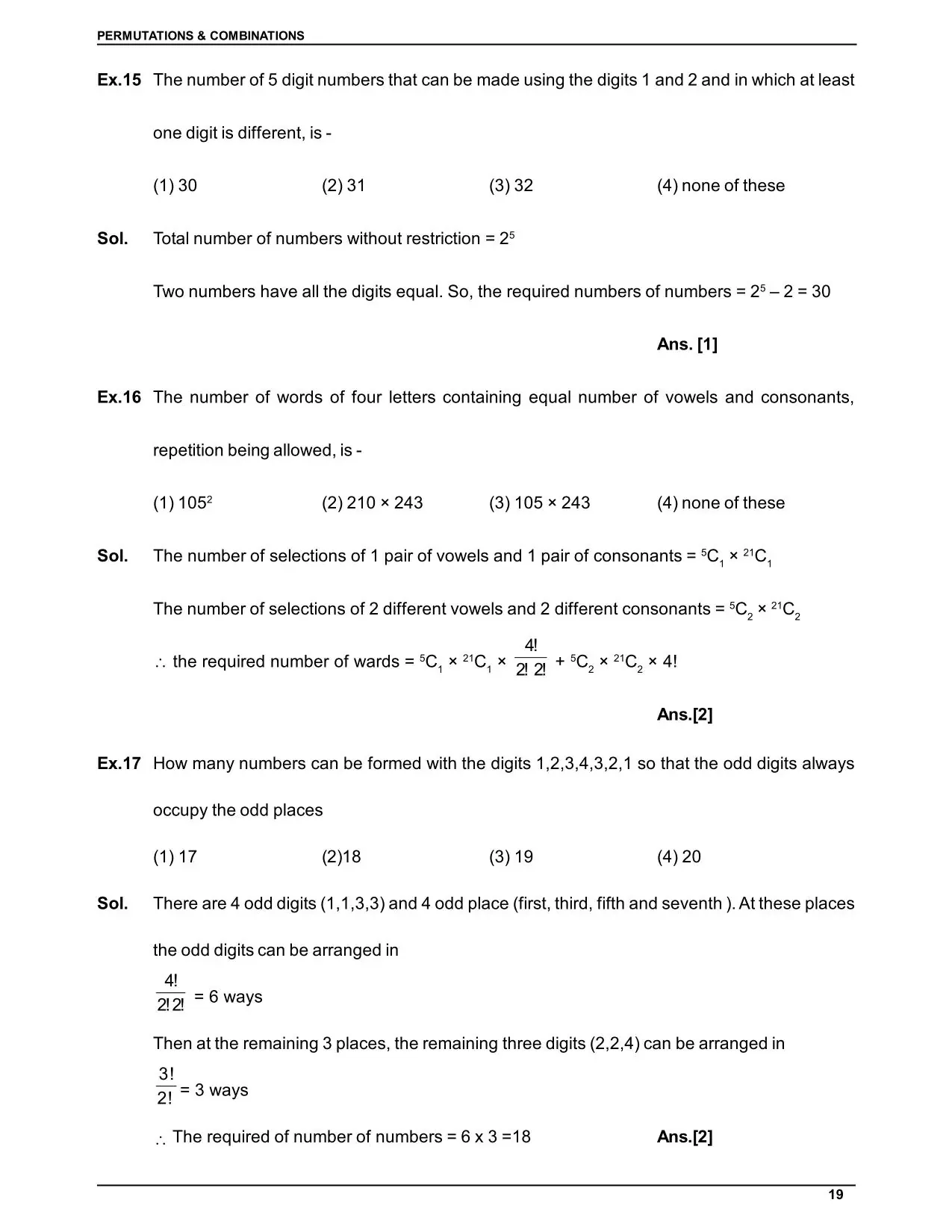
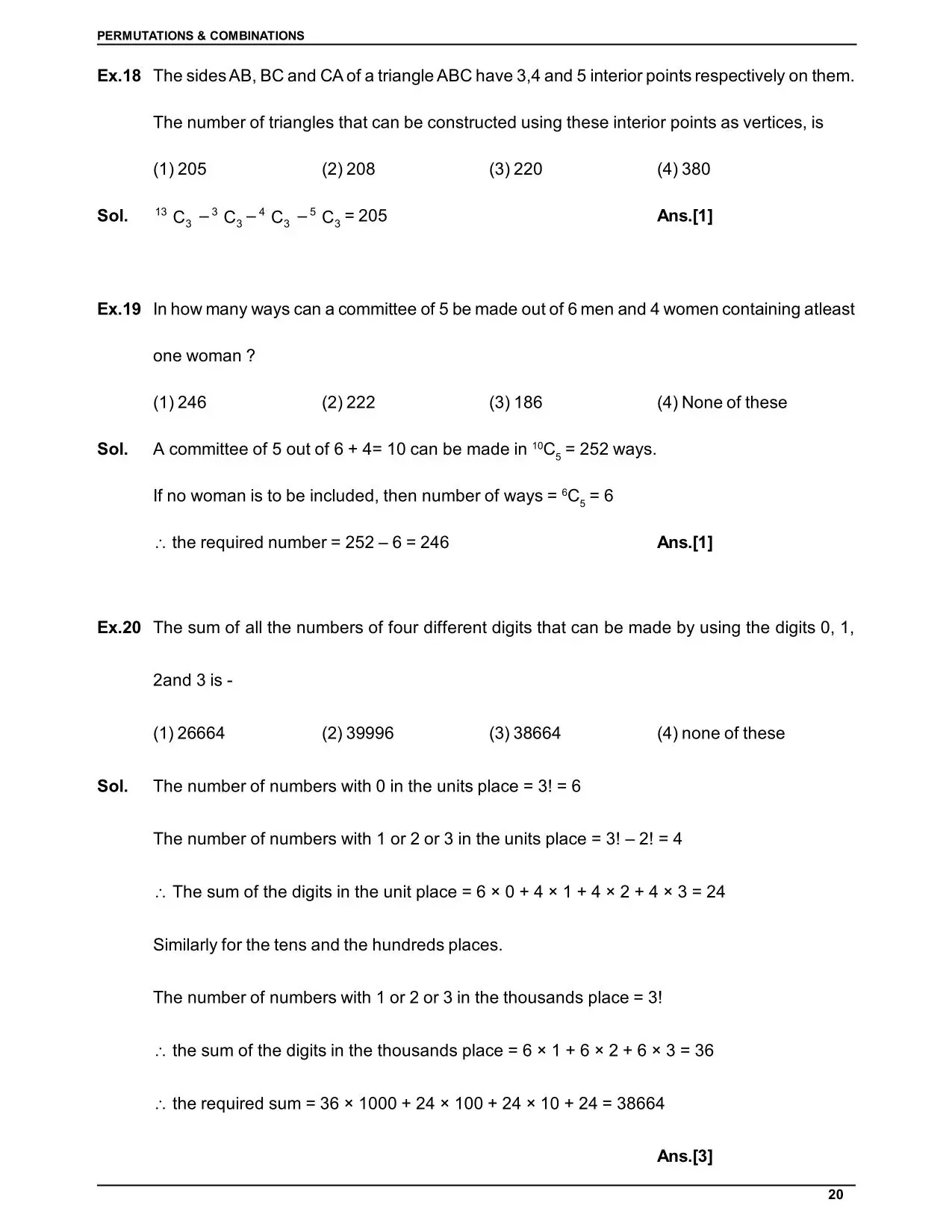
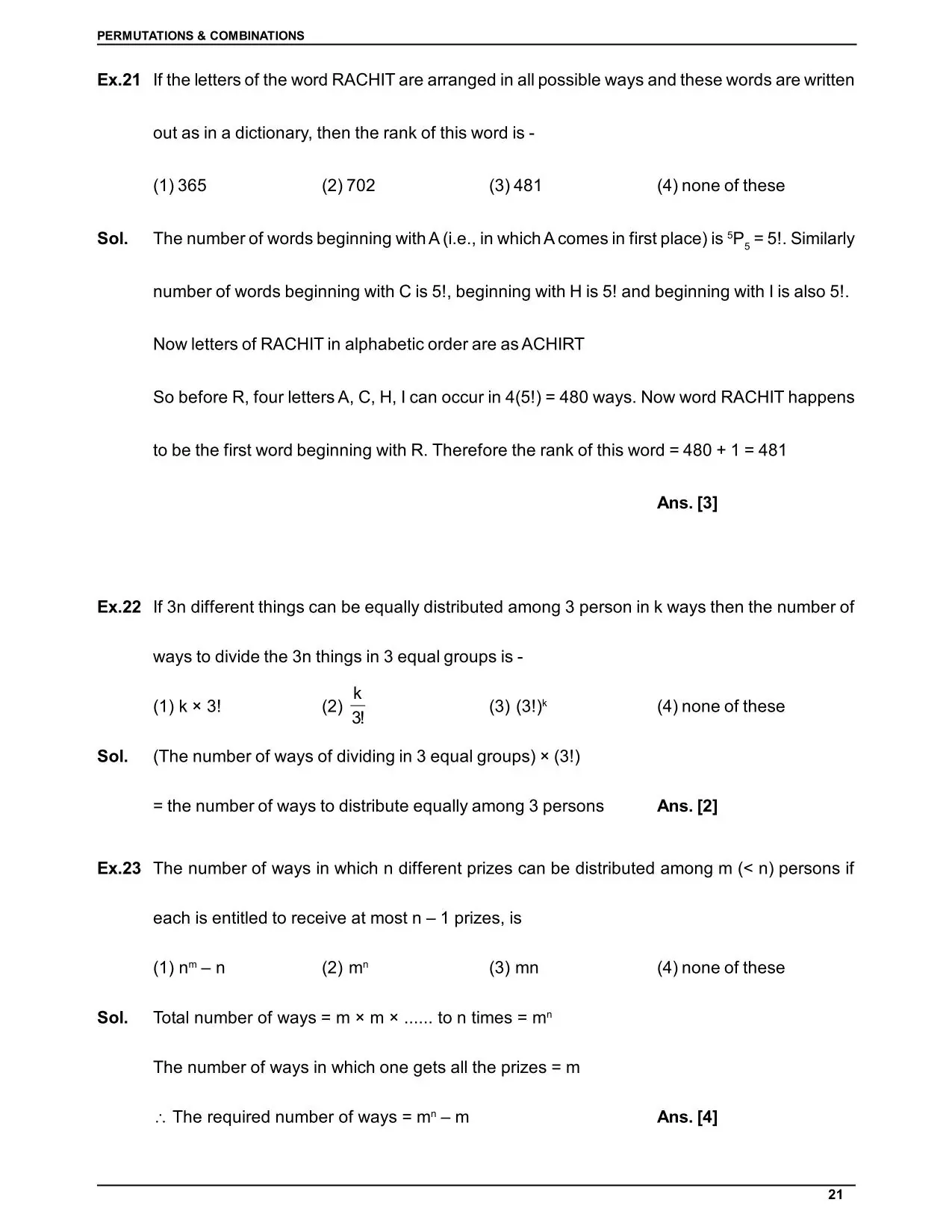
Permutations and Combinations Class 11 Notes
India's Best Exam Preparation for Class 11th - Download Now
India's Best Exam Preparation for Class 11th - Download Now
India's Best Exam Preparation for Class 11th - Download Now
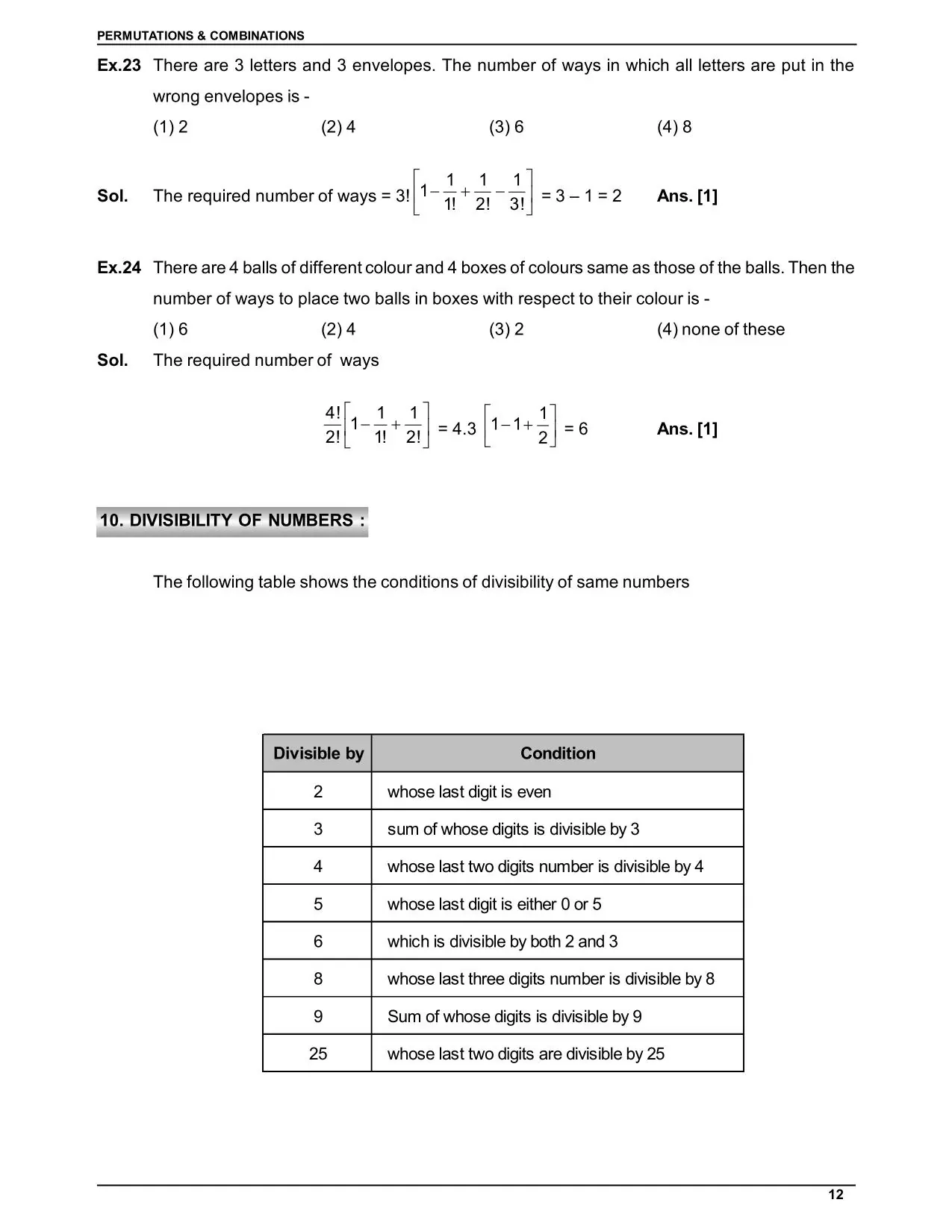
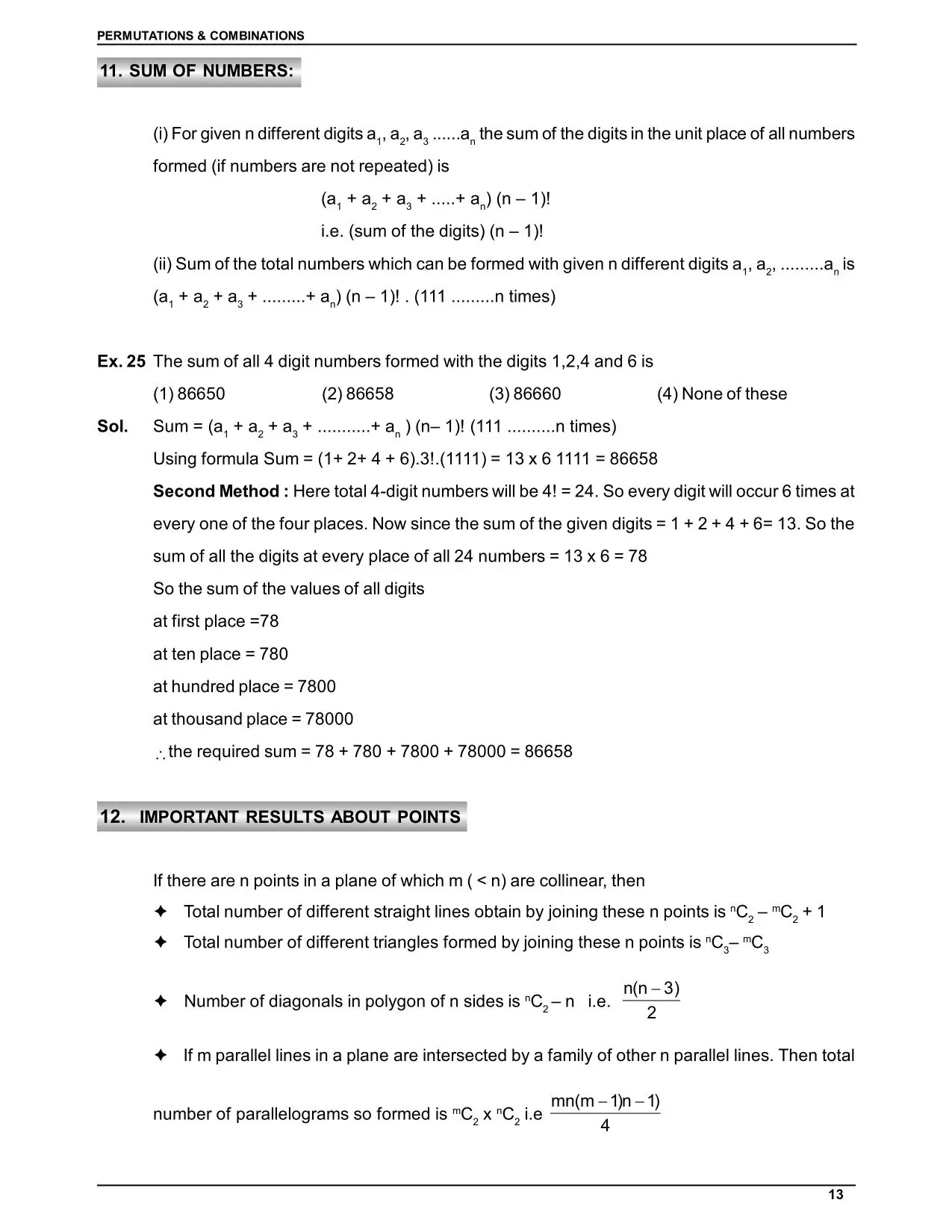
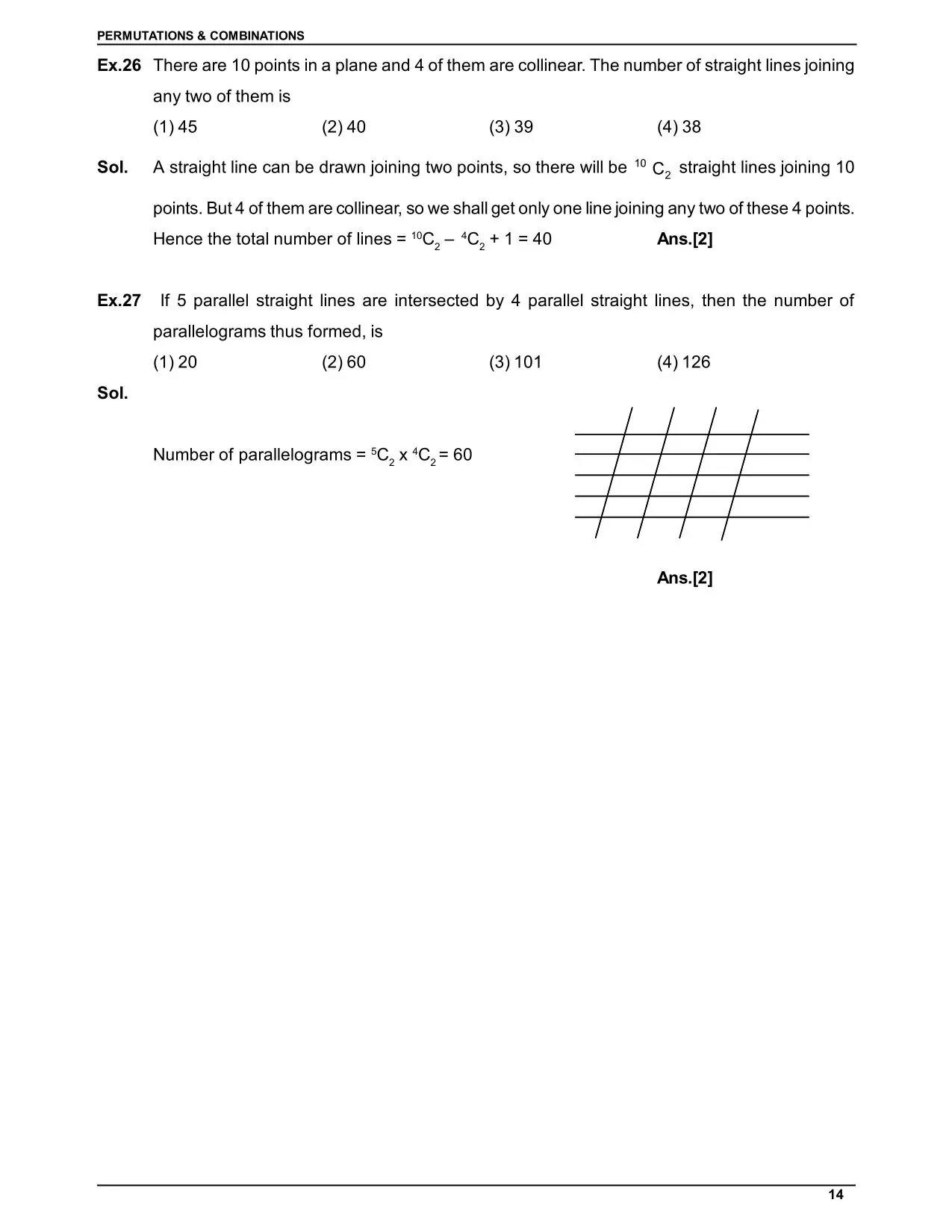
India's Best Exam Preparation for Class 11th - Download Now
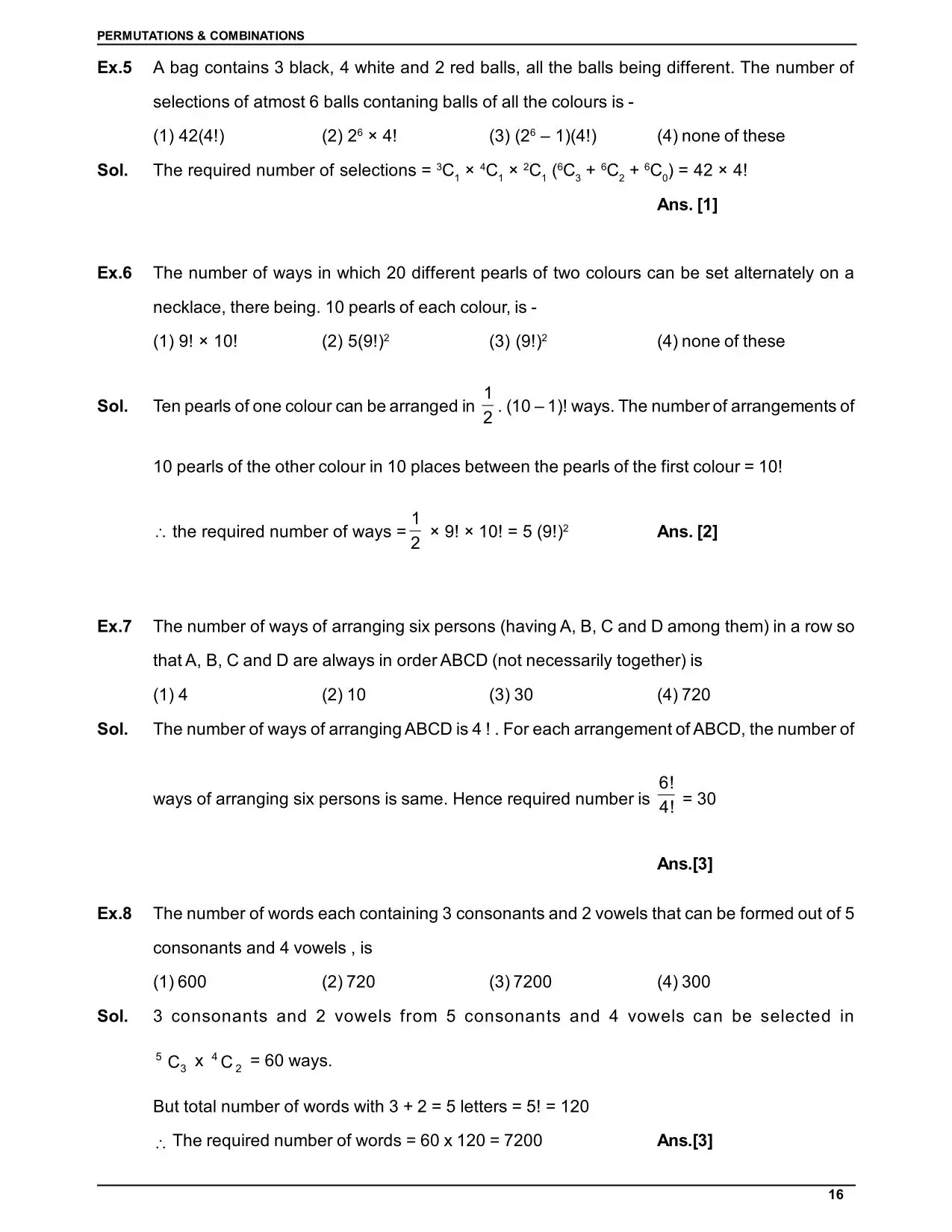
India's Best Exam Preparation for Class 11th - Download Now
India's Best Exam Preparation for Class 11th - Download Now
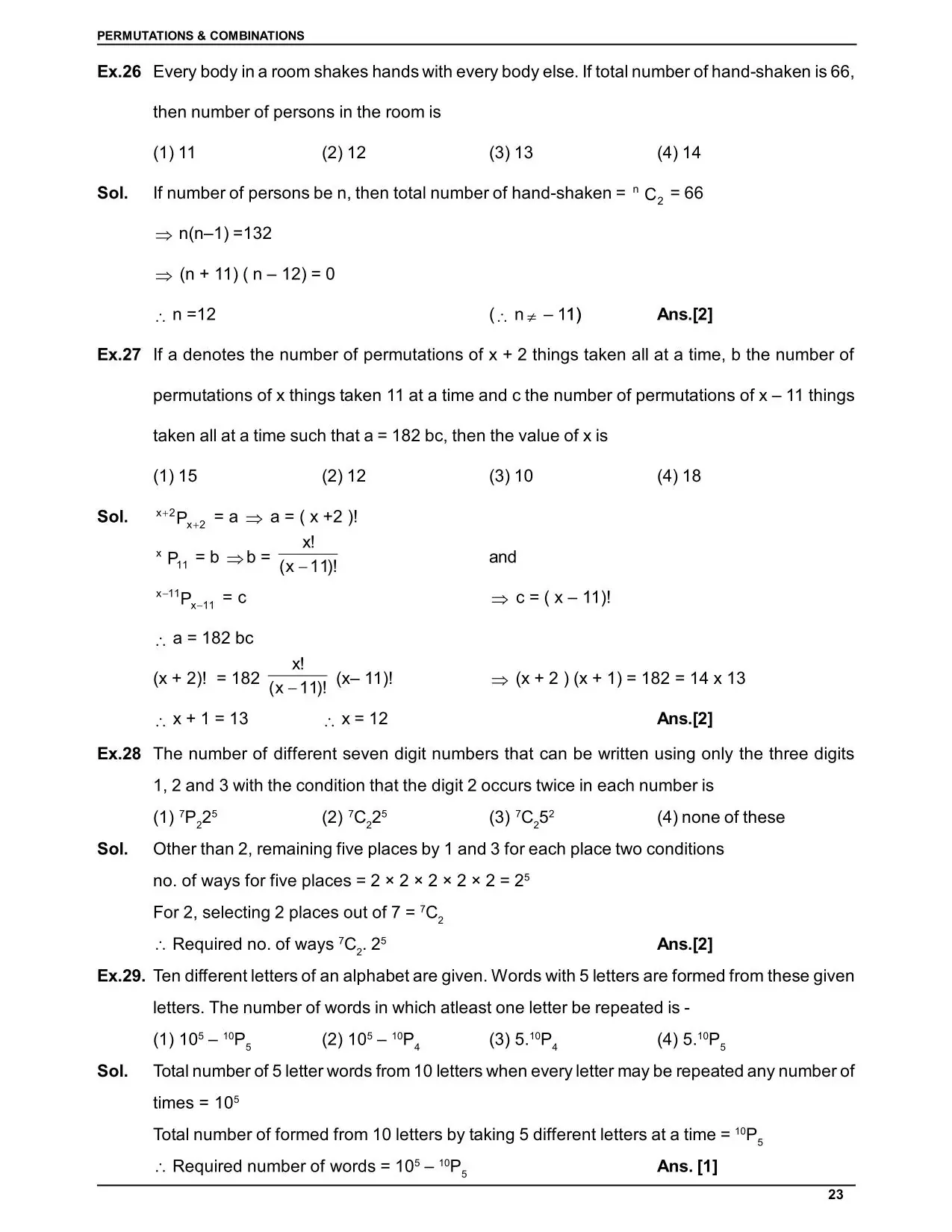
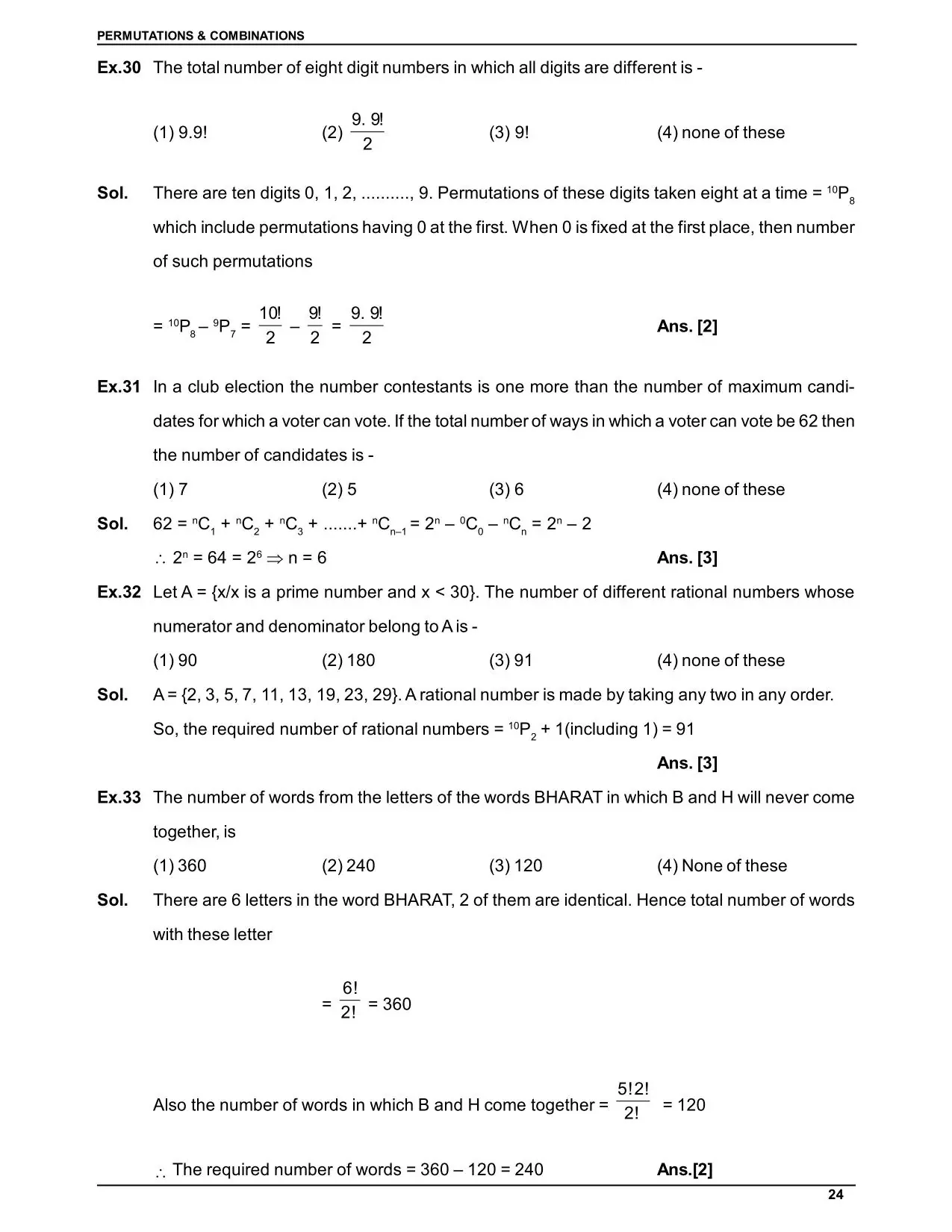
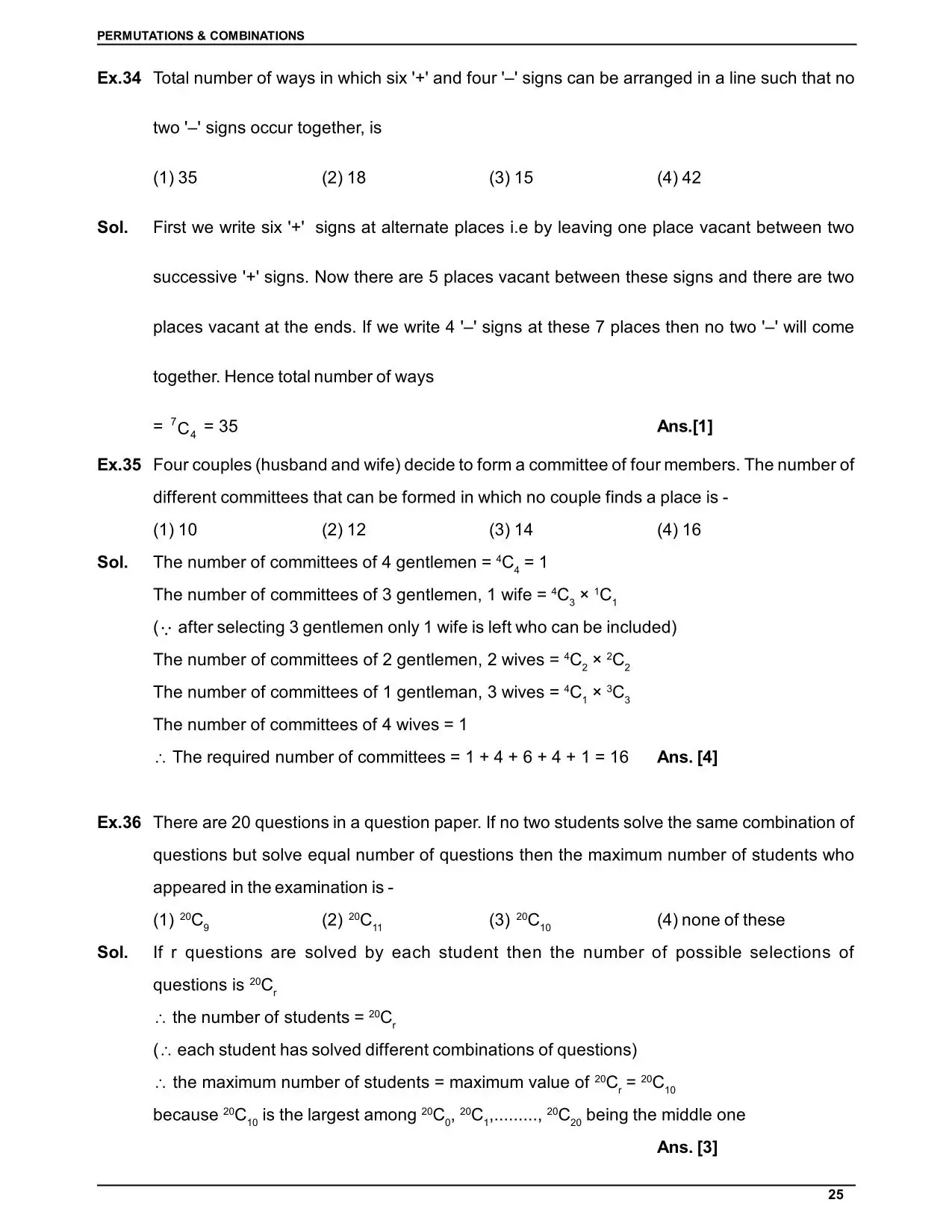
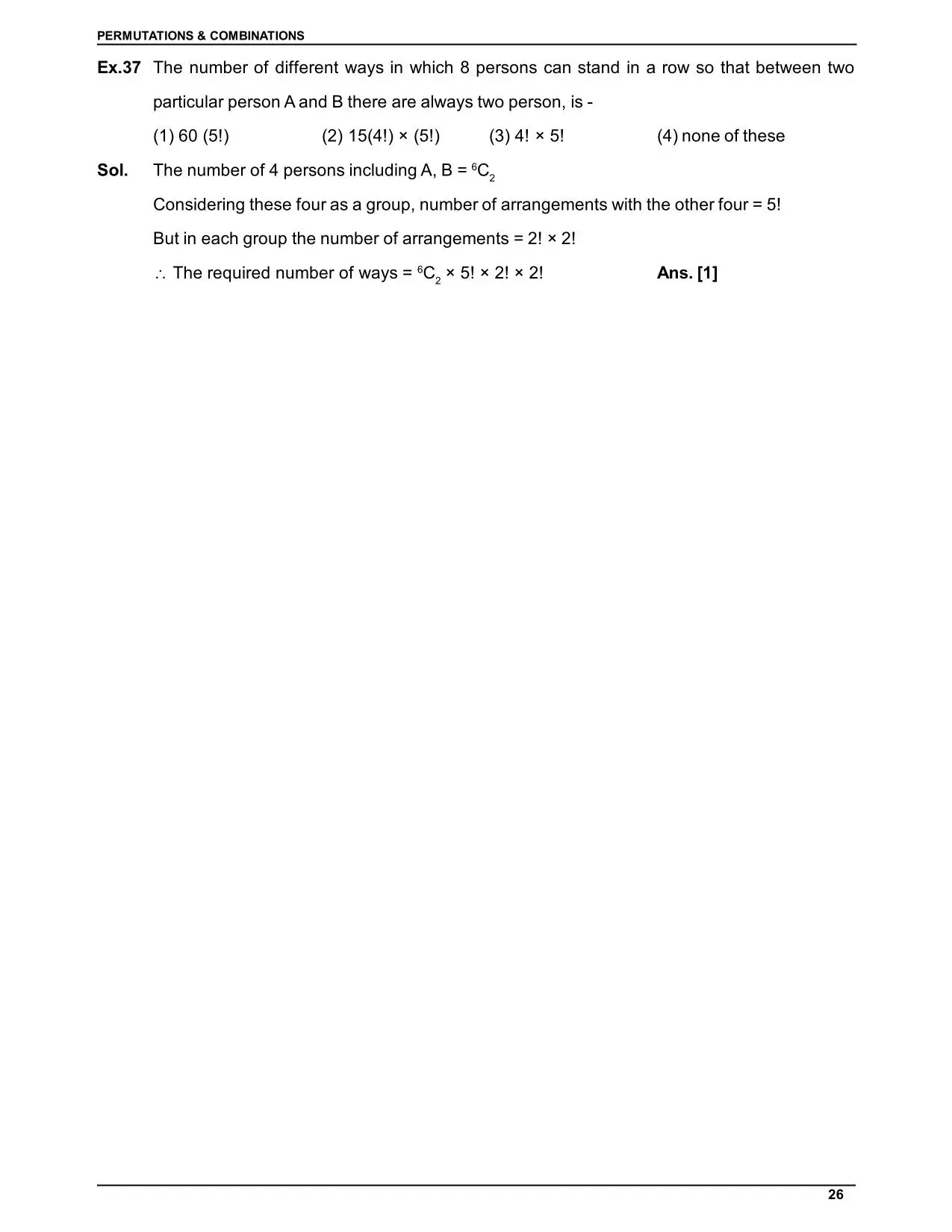
Fundamental Principle of Counting in Permutations and Combinations Class 11 Notes
Multiplication principle (AND): if a task can be done in $m$ ways, and after it a second task can be done in $n$ ways, then both tasks together can be done in $m \times n$ ways.
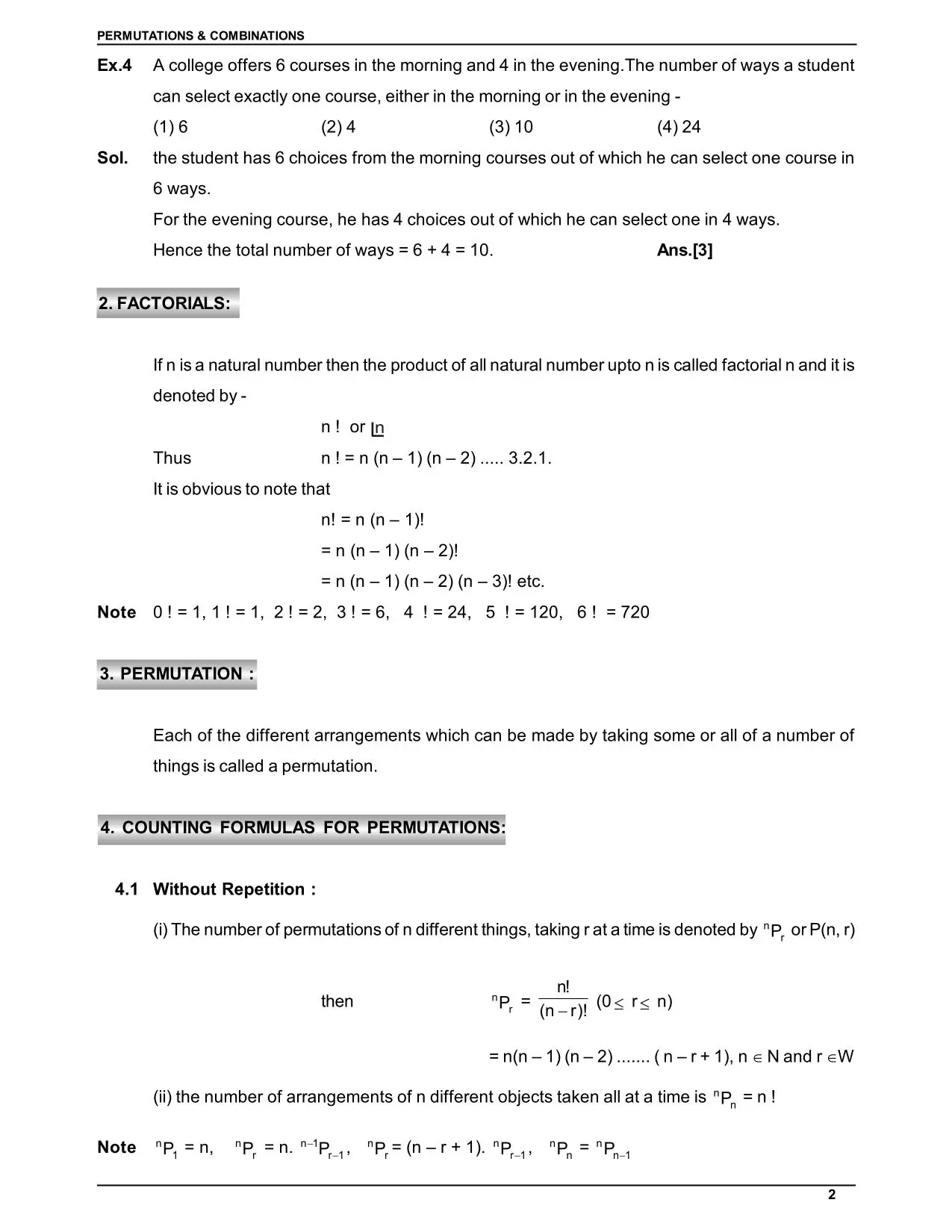
Addition principle (OR): if one of two mutually exclusive tasks can be done in $m$ ways or in $n$ ways, then either task can be done in $m + n$ ways.
Keyword in the problem | Principle |
|---|---|
“and”, “then”, “followed by”, “both” | Multiplication |
“or”, “either” | Addition |
A multi-step problem | Both, applied at each step |
Example: a person has 4 shirts and 3 trousers, so there are $4 \times 3 = 12$ outfits. A student who can travel by 3 bus routes or 2 train routes has $3 + 2 = 5$ ways.
Factorial Notation in Permutations and Combinations Class 11 Notes
For a positive integer $n$:
$$n! = n \times (n-1) \times (n-2) \times \cdots \times 3 \times 2 \times 1, \qquad 0! = 1$$
$n$ | 0 | 1 | 2 | 3 | 4 | 5 | 6 | 7 | 8 | 10 |
|---|---|---|---|---|---|---|---|---|---|---|
$n!$ | 1 | 1 | 2 | 6 | 24 | 120 | 720 | 5040 | 40320 | 3628800 |
Useful relations: $n! = n\,(n-1)!$ and $(n+1)! = (n+1)\,n!$. The number of trailing zeros in $n!$ is $\left\lfloor \dfrac{n}{5} \right\rfloor + \left\lfloor \dfrac{n}{25} \right\rfloor + \cdots$.
Permutations in Permutations and Combinations Class 11 Notes
A permutation is an arrangement in a definite order. The number of arrangements of $r$ objects chosen from $n$ distinct objects is:
$${}^{n}P_{r} = \frac{n!}{(n-r)!}, \qquad 0 \le r \le n$$
Case | Value |
|---|---|
All $n$ objects in a row | ${}^{n}P_{n} = n!$ |
Choosing and arranging 0 objects | ${}^{n}P_{0} = 1$ |
Choosing and arranging 1 object | ${}^{n}P_{1} = n$ |
Derivation: the first place can be filled in $n$ ways, the second in $(n-1)$ ways, and so on until the $r$-th place, which can be filled in $(n - r + 1)$ ways. By the multiplication principle, ${}^{n}P_{r} = n(n-1)\cdots(n-r+1) = \dfrac{n!}{(n-r)!}$.
Permutations with Repetition
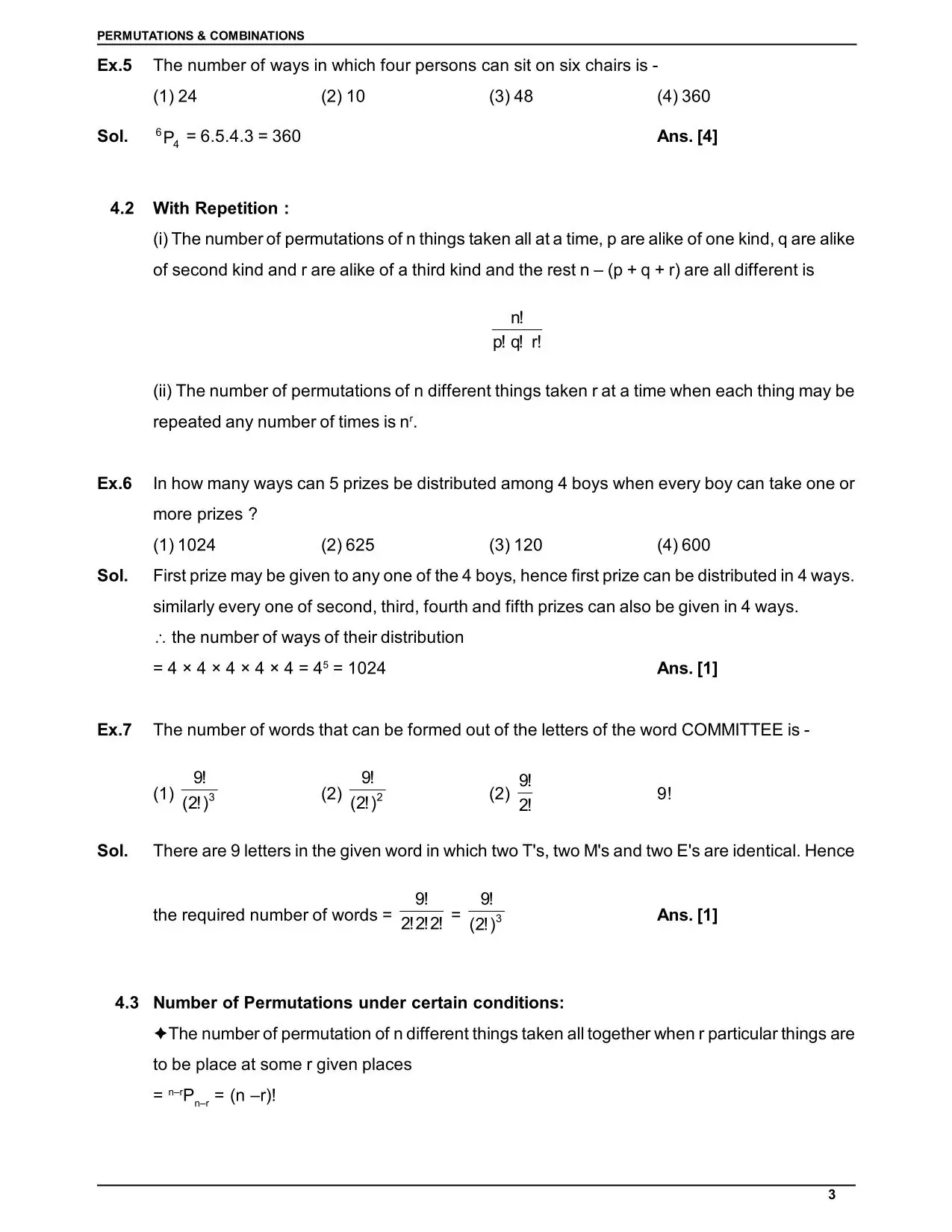
If repetition is allowed, each of the $r$ places can be filled in $n$ ways, so the number of arrangements is $n^{r}$. For example, the 3-digit numbers from the digits $\{1, 2, 3, 4\}$ with repetition number $4^3 = 64$.
Permutations of Objects That Are Not All Distinct
If $n$ objects contain $p$ identical objects of one kind, $q$ of another kind and $r$ of a third kind, the number of arrangements is:
$$\frac{n!}{p!\,q!\,r!}$$
For the word MISSISSIPPI ($n = 11$, with M = 1, I = 4, S = 4, P = 2): $\dfrac{11!}{1!\,4!\,4!\,2!} = 34650$.
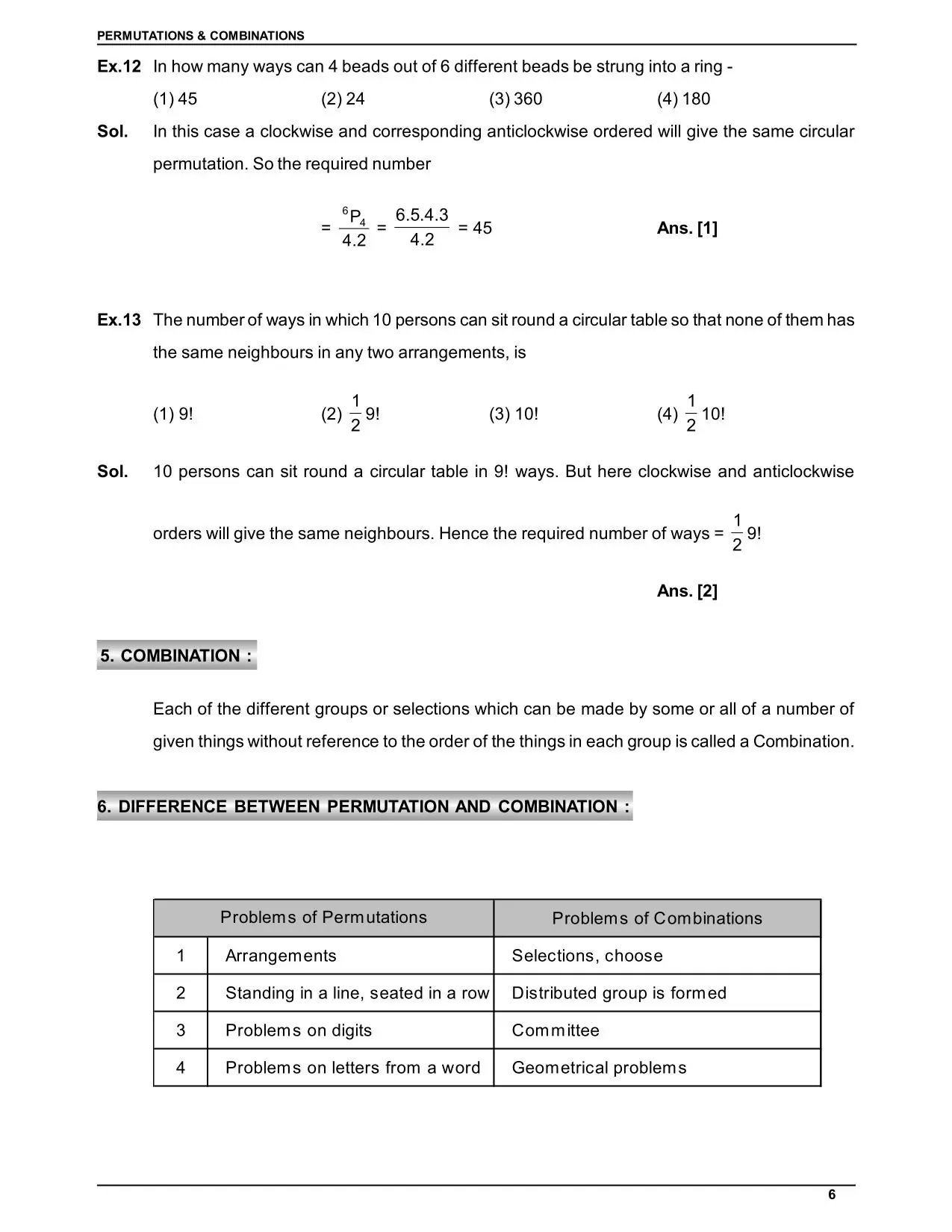
Circular Permutations
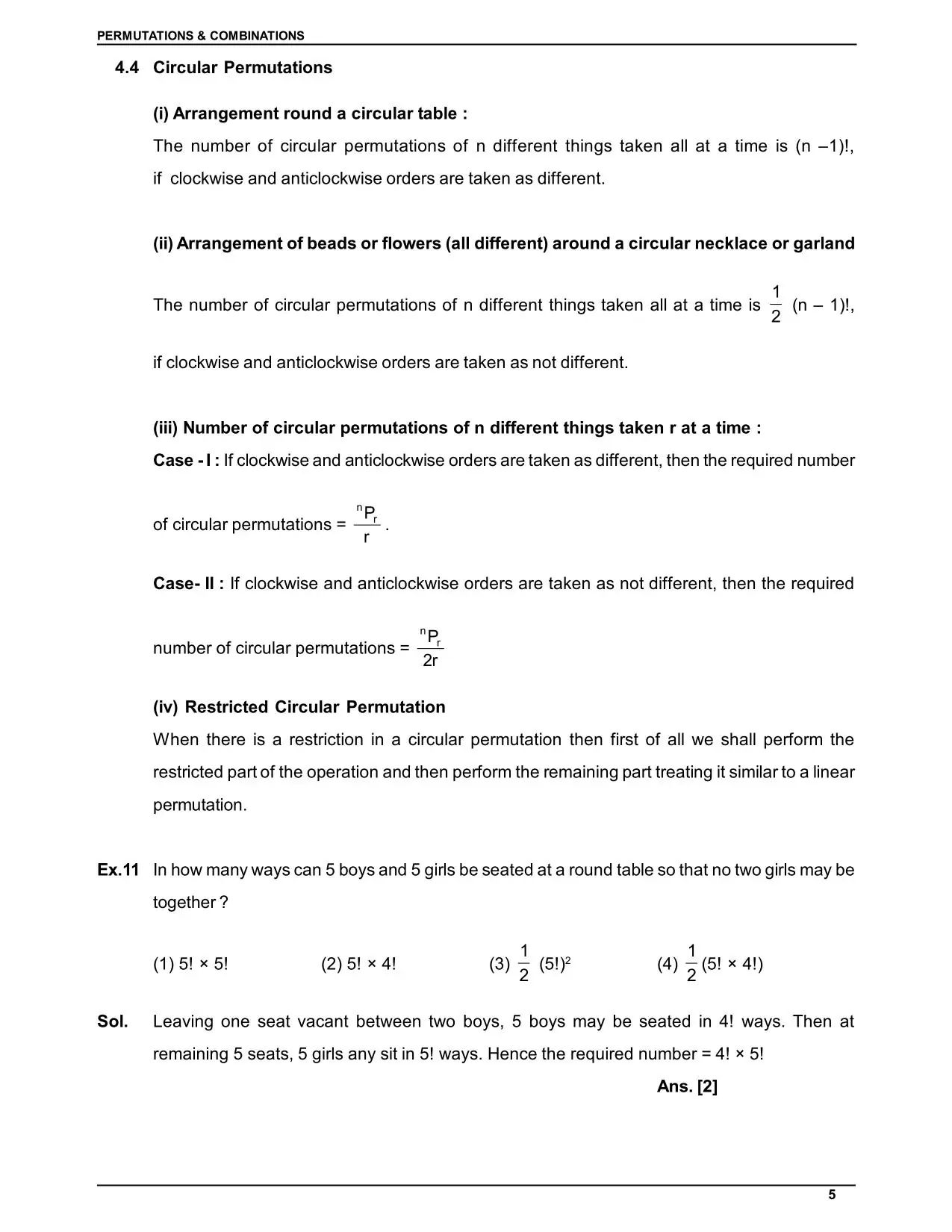
In a circle, only the relative positions matter, so one object is fixed to remove the rotations:
$$\text{Circular arrangements of } n \text{ distinct objects} = (n-1)!$$
When clockwise and anticlockwise arrangements are the same (a necklace or a garland), the number is $\dfrac{(n-1)!}{2}$ (for $n \ge 3$).
Restricted Arrangements: Always Together and Never Together
For $n$ distinct objects in a row, with $r$ specified objects:
Condition | Number of arrangements |
|---|---|
The $r$ objects are always together | $(n - r + 1)!\;\times\; r!$ |
The $r$ objects are never all together | $n! - (n - r + 1)!\;\times\; r!$ |
Combinations in Permutations and Combinations Class 11 Notes
A combination is a selection in which the order does not matter:
$${}^{n}C_{r} = \binom{n}{r} = \frac{n!}{r!\,(n-r)!}, \qquad 0 \le r \le n$$
Property | Statement |
|---|---|
Relation with permutations | ${}^{n}P_{r} = {}^{n}C_{r} \times r!$ |
Symmetry | ${}^{n}C_{r} = {}^{n}C_{n-r}$ |
Special values | ${}^{n}C_{0} = {}^{n}C_{n} = 1$ and ${}^{n}C_{1} = n$ |
Pascal’s identity | ${}^{n}C_{r} + {}^{n}C_{r-1} = {}^{n+1}C_{r}$ |
Sum of all selections | $\displaystyle\sum_{r=0}^{n} {}^{n}C_{r} = 2^{n}$ |
Even and odd selections | $\displaystyle\sum_{r \text{ even}} {}^{n}C_{r} = \sum_{r \text{ odd}} {}^{n}C_{r} = 2^{n-1}$ |
If ${}^{n}C_{x} = {}^{n}C_{y}$ | $x = y$ or $x + y = n$ |
Selections with Conditions
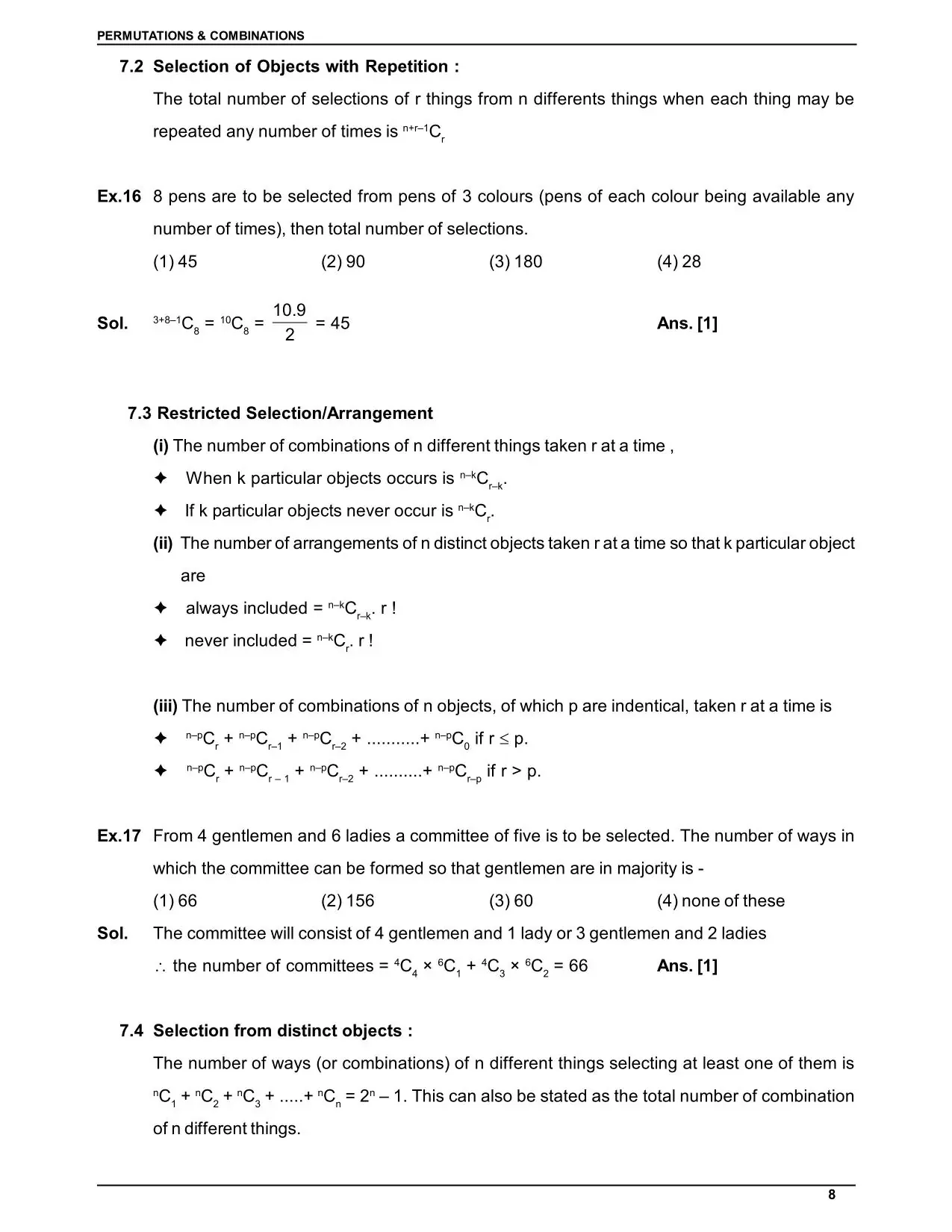
- Particular $k$ objects always included (choosing $r$ from $n$): ${}^{n-k}C_{r-k}$.
- Particular $k$ objects always excluded: ${}^{n-k}C_{r}$.
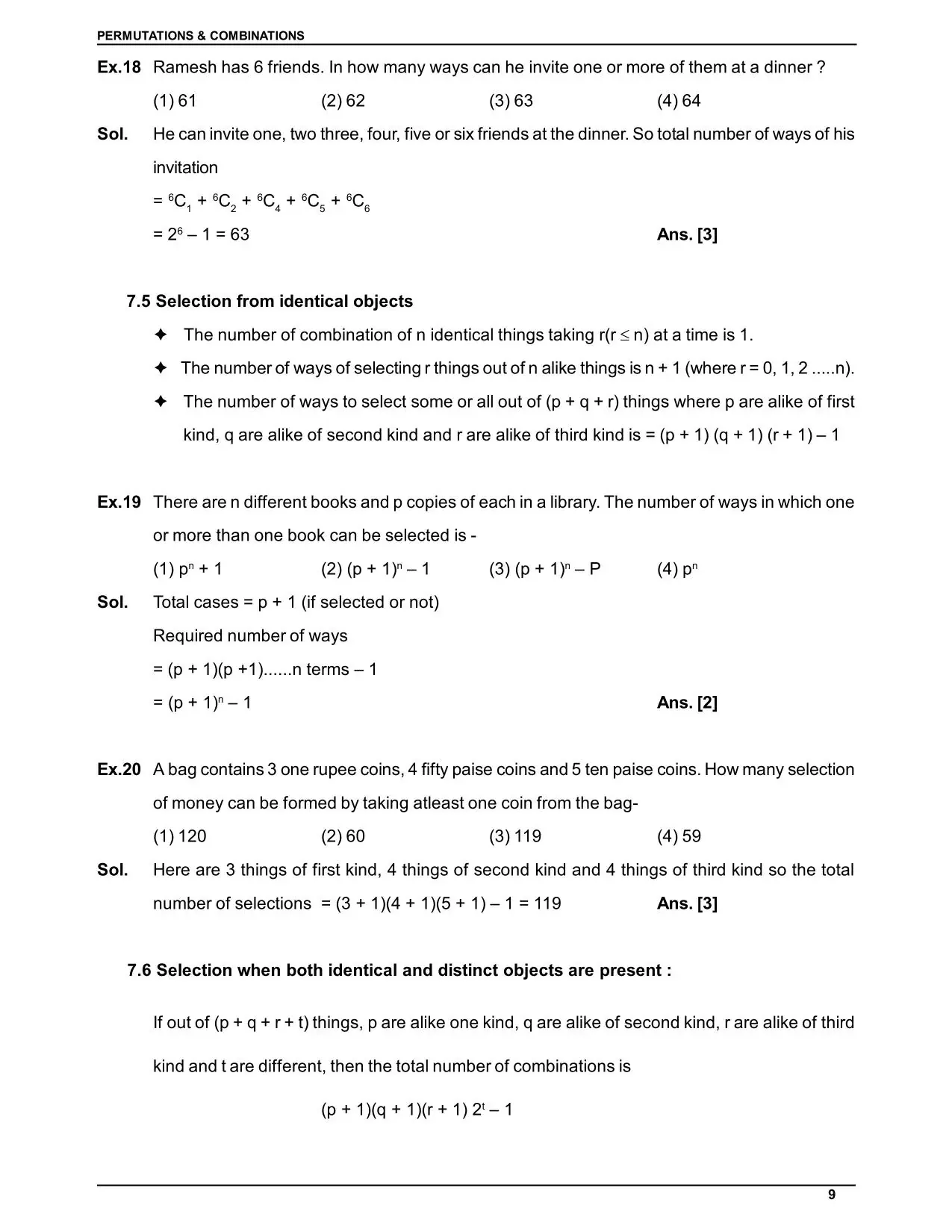
- At least one object from $n$ distinct objects: $2^{n} - 1$.
- From $p$ identical objects of one kind, $q$ of another and $r$ distinct objects, at least one: $(p + 1)(q + 1)\,2^{r} - 1$.
Permutation vs Combination: How to Choose in Permutations and Combinations Class 11 Notes
Feature | Permutation | Combination |
|---|---|---|
Does order matter? | Yes ($AB \ne BA$) | No ($AB = BA$) |
Formula | ${}^{n}P_{r} = \dfrac{n!}{(n-r)!}$ | ${}^{n}C_{r} = \dfrac{n!}{r!(n-r)!}$ |
Keywords | arrange, rank, seat, queue, code | select, choose, form a committee, group |
Example | Arranging 3 books on a shelf | Choosing 3 books from a shelf |
Ask one question: does changing the order give a different outcome? A PIN, 1234 and 4321, is a permutation. A committee of three people is a combination.
Geometrical Counting in Permutations and Combinations Class 11 Notes
For $n$ points in a plane, no three of them collinear:
Quantity | Formula |
|---|---|
Number of straight lines | ${}^{n}C_{2}$ |
Number of triangles | ${}^{n}C_{3}$ |
Number of diagonals of an $n$-sided polygon | ${}^{n}C_{2} - n = \dfrac{n(n-3)}{2}$ |
If $k$ of the $n$ points are collinear, the number of triangles is ${}^{n}C_{3} - {}^{k}C_{3}$, and the number of lines is ${}^{n}C_{2} - {}^{k}C_{2} + 1$.
Division into Groups and Distribution of Objects in Permutations and Combinations Class 11 Notes
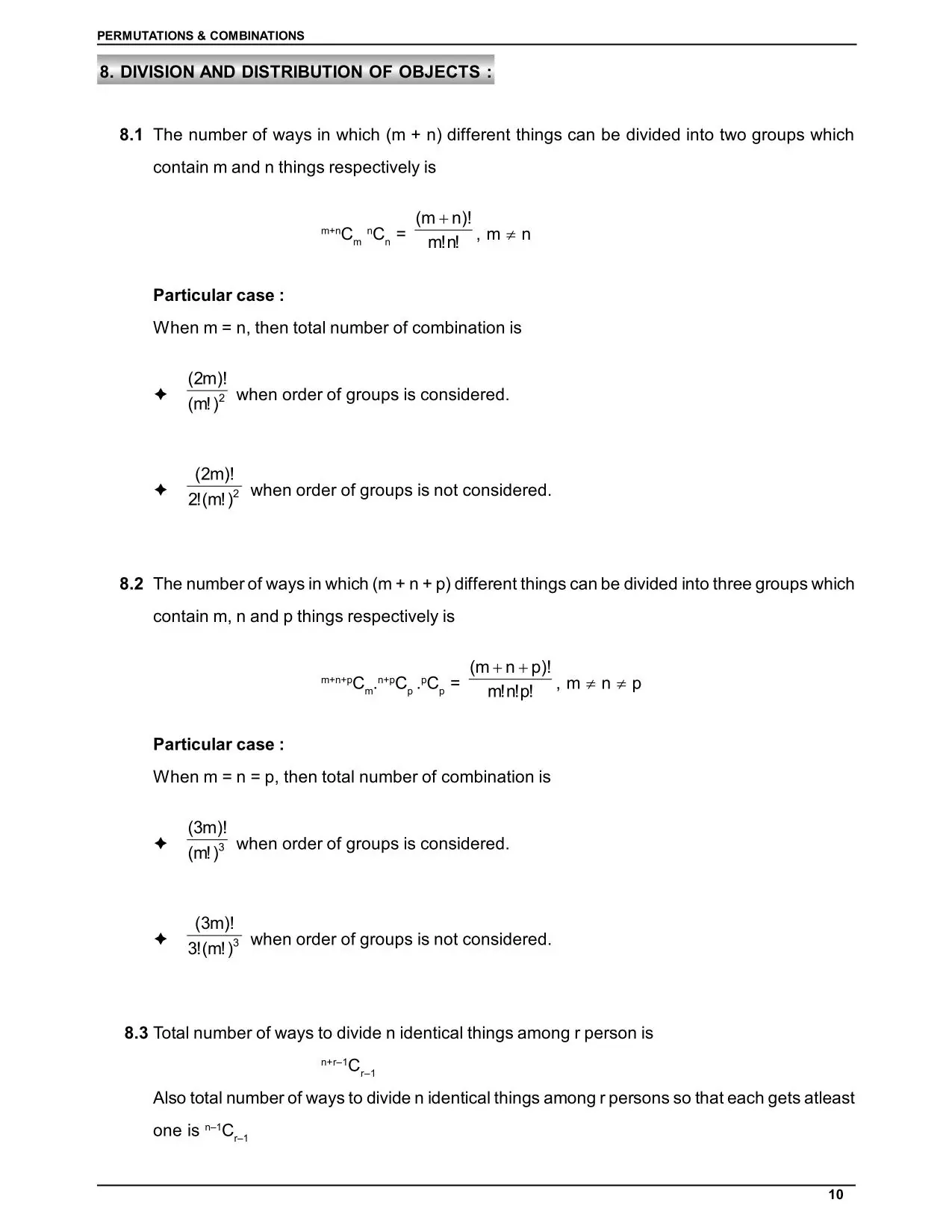
Situation | Number of ways |
|---|---|
$2n$ distinct objects into two labelled groups of $n$ each | $\dfrac{(2n)!}{n!\,n!}$ |
$2n$ distinct objects into two unlabelled groups of $n$ each | $\dfrac{(2n)!}{n!\,n!\,2!}$ |
$mn$ distinct objects into $m$ unlabelled groups of $n$ each | $\dfrac{(mn)!}{(n!)^{m}\,m!}$ |
$n$ distinct objects into $r$ distinct boxes (empty boxes allowed) | $r^{n}$ |
$n$ identical objects into $r$ distinct boxes (empty boxes allowed) | ${}^{n+r-1}C_{r-1}$ |
$n$ identical objects into $r$ distinct boxes (each box has at least one) | ${}^{n-1}C_{r-1}$ |
The number of non-negative integer solutions of $x_1 + x_2 + \cdots + x_r = n$ is ${}^{n+r-1}C_{r-1}$, and the number of positive integer solutions is ${}^{n-1}C_{r-1}$.
Rank of a Word in Dictionary Order in Permutations and Combinations Class 11 Notes
- List the letters in alphabetical order.
- For each position, count the letters that are smaller than the letter in the word, and multiply by the number of arrangements of the remaining places.
- Add all the counts, and add 1.
Example: find the rank of RICE among the arrangements of R, I, C, E. The alphabetical order is C, E, I, R. Words that start with C, E or I: $3 \times 3! = 18$. Words that start with R and then C or E: $2 \times 2! = 4$. Then RICE comes first among the words that start with RI. The rank is $18 + 4 + 1 = 23$.
The Gaps Method in Permutations and Combinations Class 11 Notes
Use the gaps method when some objects must not be adjacent.
- Arrange the other objects first.
- If there are $n$ of them, they create $n + 1$ gaps (including the two ends).
- Place the restricted objects in different gaps. For $r$ restricted objects that are distinct, this gives ${}^{n+1}P_{r}$ ways.
Example: arrange 4 boys and 3 girls in a row so that no two girls are adjacent. The boys can be arranged in $4! = 24$ ways. They create 5 gaps, and the girls can be placed in ${}^{5}P_{3} = 60$ ways. The total is $24 \times 60 = 1440$.
Key Formulas in Permutations and Combinations Class 11 Notes
Concept | Formula |
|---|---|
Permutations | ${}^{n}P_{r} = \dfrac{n!}{(n-r)!}$ |
Combinations | ${}^{n}C_{r} = \dfrac{n!}{r!(n-r)!}$ |
Link | ${}^{n}P_{r} = {}^{n}C_{r}\,r!$ |
Identical objects | $\dfrac{n!}{p!\,q!\,r!}$ |
Circular arrangement | $(n-1)!$ |
Necklace | $\dfrac{(n-1)!}{2}$ |
Symmetry | ${}^{n}C_{r} = {}^{n}C_{n-r}$ |
Pascal’s identity | ${}^{n}C_{r} + {}^{n}C_{r-1} = {}^{n+1}C_{r}$ |
All subsets | $2^{n}$ |
Identical objects into $r$ boxes | ${}^{n+r-1}C_{r-1}$ |
Solved Examples from Permutations and Combinations Class 11 Notes
Example 1 (finding $n$): If ${}^{n}P_{2} = 56$, find $n$.
${}^{n}P_{2} = n(n-1) = 56$, so $n = 8$.
Example 2 (symmetry): If ${}^{n}C_{3} = {}^{n}C_{7}$, find $n$.
Since $3 \ne 7$, we need $3 + 7 = n$, so $n = 10$.
Example 3 (committee): In how many ways can a committee of 3 men and 2 women be formed from 6 men and 5 women? How many committees of 3 from the same group have at least one woman?
${}^{6}C_{3} \times {}^{5}C_{2} = 20 \times 10 = 200$. For at least one woman, take all the committees minus the all-men committees: ${}^{11}C_{3} - {}^{6}C_{3} = 165 - 20 = 145$.
Example 4 (identical letters): Find the number of arrangements of the letters of the word MISSISSIPPI.
$\dfrac{11!}{1!\,4!\,4!\,2!} = 34650$.
Example 5 (circular, together): In how many ways can 6 people sit around a round table if two particular people must sit together?
Treat the two people as one unit, so there are 5 units, which can be arranged in $(5-1)! = 24$ ways. The two people can be arranged in $2!$ ways. The total is $24 \times 2 = 48$.
Example 6 (gaps method): Arrange 4 boys and 3 girls in a row so that no two girls are adjacent.
$4! \times {}^{5}P_{3} = 24 \times 60 = 1440$.
Example 7 (geometry): Find the number of diagonals of a hexagon.
${}^{6}C_{2} - 6 = 15 - 6 = 9$.
Example 8 (distribution): Find the number of non-negative and positive integer solutions of $x + y + z = 10$.
Non-negative: ${}^{10+3-1}C_{3-1} = {}^{12}C_{2} = 66$. Positive: ${}^{10-1}C_{3-1} = {}^{9}C_{2} = 36$.
Common Mistakes in Permutations and Combinations Class 11 Notes Problems
Mistake | Correct approach |
|---|---|
Using ${}^{n}P_{r}$ when the order does not matter | Use ${}^{n}C_{r}$ for a selection |
Forgetting to divide for identical objects | Divide by the factorial of each group of identical objects |
Using $n!$ for a circular arrangement | Fix one object, and use $(n-1)!$ |
Counting a necklace as $(n-1)!$ | Divide by 2, because clockwise and anticlockwise are the same |
Using “at least one” as the sum of cases | Use the complement: all selections minus the unwanted selections |
Treating labelled and unlabelled groups the same | Divide by $m!$ for $m$ unlabelled groups of equal size |
Counting the gaps as $n$ instead of $n + 1$ | $n$ objects create $n + 1$ gaps, including the two ends |
How to Study Permutations and Combinations Class 11 Notes
- Solve 10 counting problems with only the multiplication and addition principles, before you use any formula.
- Read the NCERT chapter, and solve its examples and exercises with eSaral’s NCERT Solutions for Class 11 Maths Chapter 6. Download the textbook from eSaral’s NCERT books for Class 11 page.
- Write a one-page formula card, and for every practice problem, first write its type (arrangement or selection), its condition and the principle that you will use.
- Revise the other Class 11 formula sheets, such as the trigonometry formulas for Class 11, and then solve eSaral’s JEE Main chapter-wise PYQs on this chapter. You can find all the chapters in the Class 11 Maths notes.
Frequently Asked Questions
What is the difference between permutation and combination in Class 11 Maths?
A permutation counts arrangements, so the order matters, and ${}^{n}P_{r} = \dfrac{n!}{(n-r)!}$. A combination counts selections, so the order does not matter, and ${}^{n}C_{r} = \dfrac{n!}{r!(n-r)!}$. The test is whether changing the order gives a different outcome. The two are linked by ${}^{n}P_{r} = {}^{n}C_{r} \times r!$. eSaral’s Permutations and Combinations Class 11 Notes explain this with examples.
What are the formulas for nPr and nCr?
${}^{n}P_{r} = \dfrac{n!}{(n-r)!}$ is the number of arrangements of $r$ objects from $n$ distinct objects, and ${}^{n}C_{r} = \dfrac{n!}{r!(n-r)!}$ is the number of selections. Both need $0 \le r \le n$. Special values are ${}^{n}C_{0} = {}^{n}C_{n} = 1$, ${}^{n}C_{1} = n$ and ${}^{n}C_{r} = {}^{n}C_{n-r}$.
What is circular permutation, and how is it different from linear permutation?
In a linear arrangement, every position is distinct, so $n$ distinct objects give $n!$ arrangements. In a circular arrangement, only the relative order matters, so one object is fixed, and the number is $(n-1)!$. For a necklace or a garland, where clockwise and anticlockwise are the same, the number is $\dfrac{(n-1)!}{2}$. These Permutations and Combinations Class 11 Notes show both.
What is the gaps method in permutations?
The gaps method is used when some objects must not be adjacent. Arrange the other $n$ objects first, which creates $n + 1$ gaps, and then place the restricted objects in different gaps. For $r$ distinct restricted objects, there are ${}^{n+1}P_{r}$ ways to place them.
How many questions come from Permutations and Combinations in JEE Main?
The chapter is a regular part of the JEE Main Mathematics paper, but the number of questions changes from year to year. Typical questions are on committees with conditions, arrangements with identical objects, circular arrangements, the rank of a word and nCr identities. Check previous years’ papers for the trend.
How do you find the number of non-negative integer solutions of an equation?
For $x_1 + x_2 + \cdots + x_r = n$, the number of non-negative integer solutions is ${}^{n+r-1}C_{r-1}$, and the number of positive integer solutions is ${}^{n-1}C_{r-1}$. For example, $x + y + z = 10$ has ${}^{12}C_{2} = 66$ non-negative solutions. This is part of the Permutations and Combinations Class 11 Notes for JEE.
How do you find the rank of a word in dictionary order?
List the letters alphabetically. For each position, count how many letters smaller than the word’s letter are still unused, and multiply by the factorial of the number of remaining places. Add all of these counts, and add 1. For RICE, the rank is 23.
Which chapter number is Permutations and Combinations in Class 11 Maths?
In the current NCERT Class 11 Mathematics book, it is Chapter 6, and in older books it was Chapter 7. These Permutations and Combinations Class 11 Notes follow the chapter name.
Where can I find more Class 11 Maths notes on eSaral?
eSaral has chapter-wise Class 11 Maths notes, NCERT solutions, JEE Main chapter-wise PYQs and these Permutations and Combinations Class 11 Notes, all linked on this page.
Team eSaral
eSaral Academic and Editorial Team
Team eSaral is the collective author profile for educational content created by eSaral’s teachers and academic contributors. The team draws on expertise from IIT graduates, doctors, experienced educators and subject specialists to develop resources for JEE, NEET and school students. Our articles aim to explain concepts clearly and help students study with confidence.
Related Posts

BITSAT 2027: Registration Date, Exam Date, Syllabus, Eligibility, Pattern & Fees
BITSAT 2027 exam dates, registration timeline, eligibility criteria, exam pattern, marking scheme, syllabus and fees in one page.

BITSAT Previous Year Question Paper PDF (2017-2026)
Download BITSAT previous year question papers PDF from 2017 to 2026,session-wise. Memory-based papers,exam pattern, paper analysis and how to practise

CBSE Class 10 Date Sheet 2027: Expected Exam Dates, Release Date, Admit Card & Result Timeline
CBSE Class 10 date sheet 2027 is awaited. See the expected exam dates, release window, how to download the PDF, admit card and result timelines.

NCERT Physics Class 10 Book PDF in Hindi 2026-27 – भौतिक विज्ञान के 4 अध्याय (Free Download)
NCERT Physics Class 10 book PDF in Hindi 2026-27: download all 4 chapters (अध्याय 9–12) free, with topics and important formulas.

NCERT Biology Class 9 Book Anveshan PDF in Hindi - जीव विज्ञान कक्षा 9 पुस्तक अन्वेषण PDF
Download NCERT Biology Class 9 book PDF in Hindi chapterwise for 2026-27: Cell, Tissues, Reproduction and Diversity. Free PDFs.

Essay On Artificial Intelligence in English (100,150, 200, 250, 300, 500 Words)
This is in contrast to the natural intelligence of humans. With Artificial Intelligence, machines can perform

Essay on 78th India Independence Day in English for Student (100, 150, 200, 250, 300, 500 Words)
Read the best essays on India's Independence Day in English. Short & long essays (100, 150, 200, 250, 300, 500 words) perfect for school exams
NCERT Class 11 English Snapshots book - Free PDF download- Esaral
Download NCERT Class 11 English Snapshots book PDF for free. Get all 8 chapters, chapter-wise. Start your prep today!
NCERT Class 10 biology book pdf - Free PDF Download - eSaral
NCERT Class 10 Biology book PDF 2026-27: all 5 chapters (Life Processes to Our Environment) in English & Hindi, with CBSE syllabus, marks & practical

Essay on Global Warming in English (100,150, 200, 250, 300, 500 Words)
Global warming means the Earth is getting hotter. This happens because of things like pollution from cars and factories.