
Physical Significance of Moment of Inertia for Class 11, JEE & NEET

eSaral Academic and Editorial Team
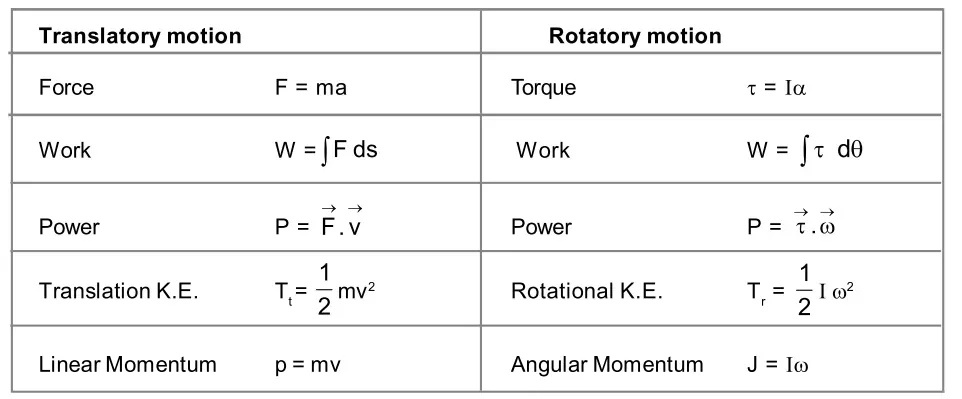
Lets study about Moment of Inertia of a Rigid Body and Physical Significance of Moment of Inertia here. MOMENT OF INERTIA OF RIGID BODY It is the property of a body due to which it opposes any change in its state of rest or uniform rotation. Analytically for a particle of mass m rotating in a circle of radius R, moment of inertia of a particle of mass m about the axis of rotation is given by: $\mathrm{I}=\mathrm{mR}^{2}$ . . . . .(1) So for a body made up of number of particles (discrete distribution) of masses $m_{1}, m_{2}, \ldots \ldots \ldots$. etc. at distance $r_{1}, r_{2}, \ldots$ etc. respectively from the axis of rotation, then moment of inertia of all these particles are $m_{1} r_{1}^{2}, m_{2} r_{2}^{2}, \ldots$ and moment of intertia of body ( $I$ ) is the algebric sum of moment of inertia of all these particles- i.e. $\quad \mathrm{I}=\mathrm{m}_{1} \mathrm{r}_{1}^{2}+\mathrm{m}_{2} \mathrm{r}_{2}^{2}+\ldots \ldots+\mathrm{m}_{\mathrm{r}_{1} \mathrm{i}}^{2}+\mathrm{m}_{\mathrm{n}} \mathrm{r}_{\mathrm{n}}^{2}=\sum_{i=1}^{\mathrm{n}} \mathrm{m}_{\mathrm{r}_{1}} \mathrm{r}_{1}^{2} \ldots \ldots(2)$ $\quad \quad \mathrm{m}_{\mathrm{i}}=\mathrm{mass}$ of ith particle $r_{i}=$ distance of ith particle from axis of rotation While for a continuous distribution of mass, treating the element of mass dm as particle at position r from axis of Rotation. $$ \begin{array}{ll}{\text { dI }=\mathrm{dm} \mathrm{r}^{2},} & {\text { i.e., } \quad \mathrm{I}=\int \mathrm{r}^{2} \mathrm{d} \mathrm{m}}\end{array} $$ . . . . (3) It is a scalar quantity Unit : M.K.S.: $\mathrm{kg}-\mathrm{m}^{2},$ C. G.S. : $\mathrm{gm}-\mathrm{cm}^{2}$ Dimension : $\mathrm{M}^{1} \mathrm{L}^{2} \mathrm{T}^{0}$ Moment of inertia depends on the following factors. i) Mass of body ii) Mass distribution of body or shape, size and density of body. iii) On the position of the axis of rotation. The more is the distribution of mass with respect to axis of rotation the more will be moment of inertia. Moment of Inertia does not depend on the following factors. (i) Angular velocity (ii) Angular Acceleration (iii) Torque (iv) Angular Momentum PHYSICAL SIGNIFICANCE OF MOMENT OF INERTIA:Comparison of the expression for rotational motion with corresponding relations for translatory motion as given in table I, we get moment of inertia plays same role in rotatory motion as mass in translatory motion, i.e., if a body has large moment of inertia, it is difficult to start rotation or to stop it if rotating. Large moment of inertia also helps in keeping the motion uniform. Due to this reason stationary engines are provided with fly-wheels having large moment of inertia. Inertia for rotational motion is moment of inertia. Introduction to Rotational Dynamics Moment of Inertia Moment of Inertia: Perpendicular and Parallel axis theorem Radius of Gyration Law of Conservation of Angular Momentum Conservation of Angular Momentum Examples Kinetic Energy of a Rotating Body Work done in rotatory Motion Rotational Power Combine Translational and Rotational Motion Rolling without slipping Rolling on a plane surface Rolling on a Inclined Plane For Latest updates, Subscribe our Youtube Channel
Team eSaral
eSaral Academic and Editorial Team
Team eSaral is the collective author profile for educational content created by eSaral’s teachers and academic contributors. The team draws on expertise from IIT graduates, doctors, experienced educators and subject specialists to develop resources for JEE, NEET and school students. Our articles aim to explain concepts clearly and help students study with confidence.
Related Posts

Plant Cell Diagram: Labelled Structure, Parts and Functions
Simple, labelled plant cell diagram with parts and functions. Covers plant cell structure for Class 6, 7, 8, 9, 10 and 11 students, CBSE-aligned.

Saransh Gupta Sir's Visit to IIT Patna: Hostel Life, Placements & Lessons for JEE Aspirants
Inside Saransh Gupta Sir's IIT Patna visit — hostel life, the library, placements, internships, and real advice for JEE aspirants from students living the IIT dream.
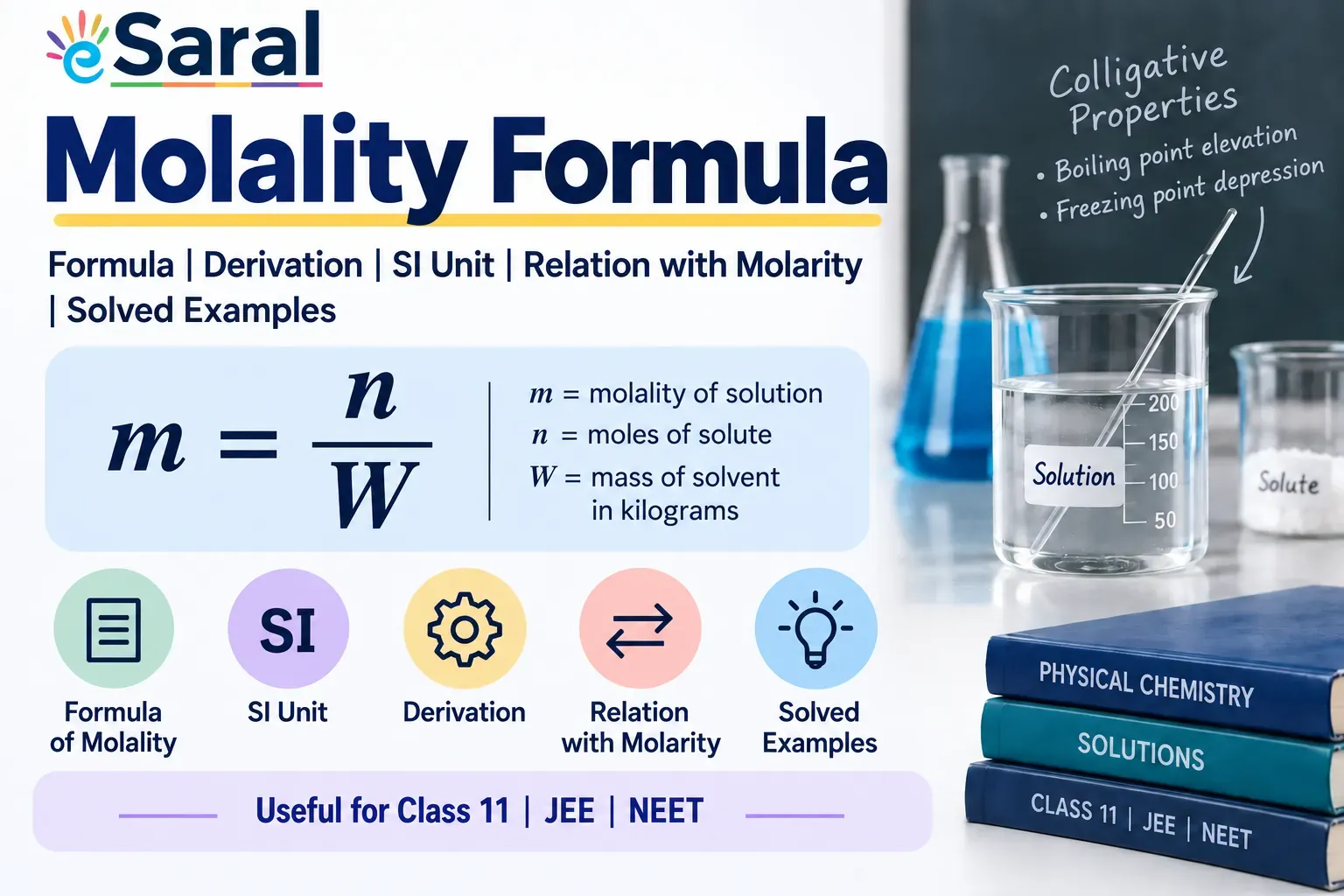
Molality Formula: Formula for Molality, Derivation & Solved Examples
Molality formula is $m = \dfrac{n}{W}$. Learn the formula of molality, its SI unit, derivation, relation with molarity, and solved examples for Class 11, JEE and NEET.

BITSAT Previous Year Question Paper PDF
Download BITSAT previous year question papers PDF. Get year-wise BITSAT PYQs, memory-based papers, exam pattern, and preparation tips to improve your BITSAT preparation.

Teachers’ Day 2026 at eSaral Gurukul: Celebrating the Bond Between Students, Teachers & Mentors
See how Teachers’ Day 2026 was celebrated at eSaral Gurukul, reflecting the bond among students, teachers, and mentors, and the role of guidance beyond academics.

JEE Advanced Attempts: Can You Give It a Third Time? Rules Explained
JEE Advanced attempts: current rule is 2 consecutive years only: full eligibility criteria, the 2025 third-attempt controversy, and the latest 2026 petition news.

Best JEE Preparation App
Best JEE preparation app for Main & Advanced: AI mock tests, live doubt-solving, thousands of practice questions. JEE preparation app for droppers & Class 11-12.
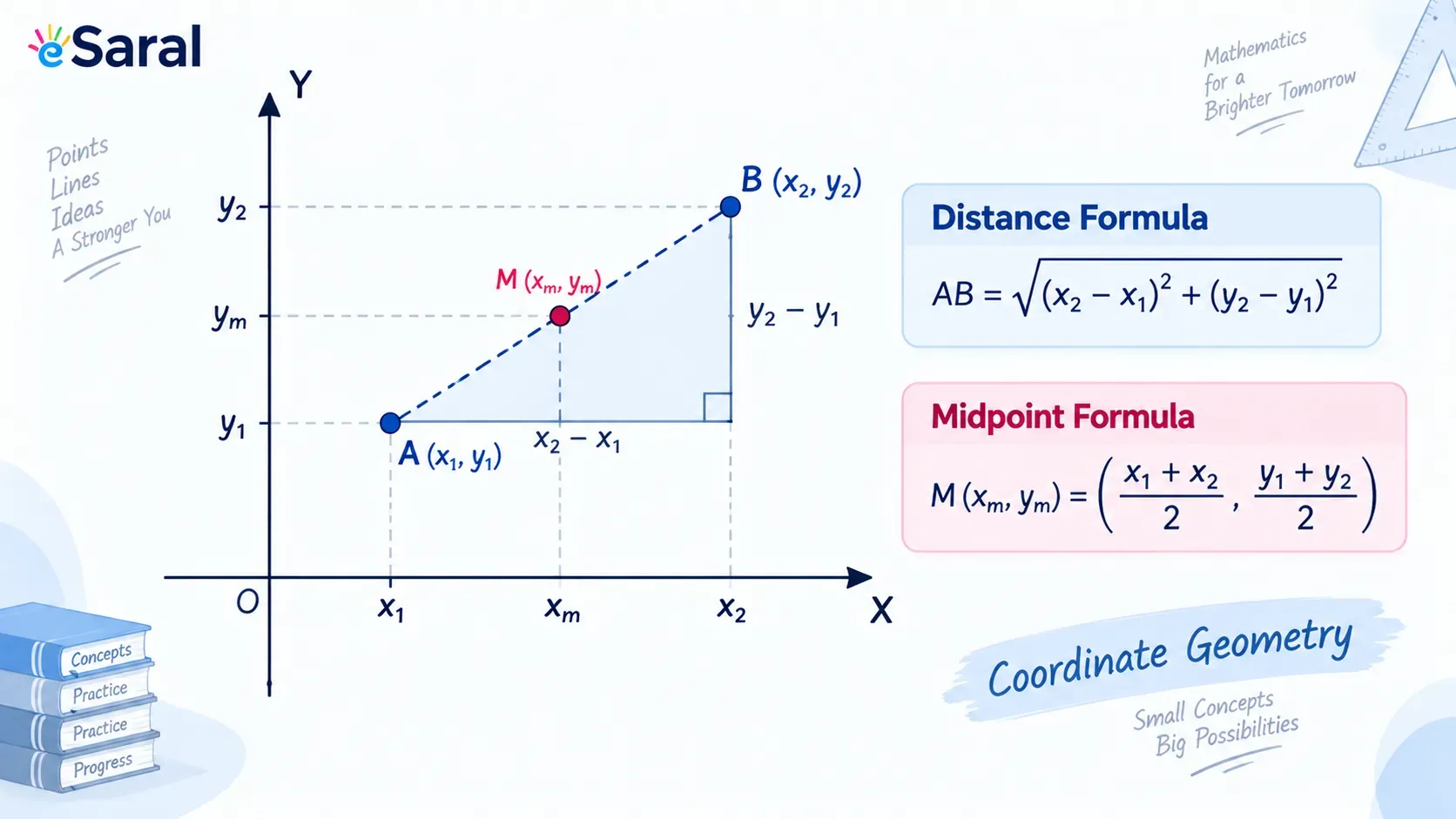
Coordinate Geometry Class 10: Formulas, Notes & Solved Examples
Coordinate geometry class 10: complete CBSE formulas — distance, section, midpoint and area of triangle — with derivation, notes and solved examples.

How to make Notes For JEE Smart Notes Strategy of an AIR 41
Learn how to make notes for JEE the way toppers do — indexing, shorthand, and smart short notes for JEE that cut revision time to just 5–7 days.
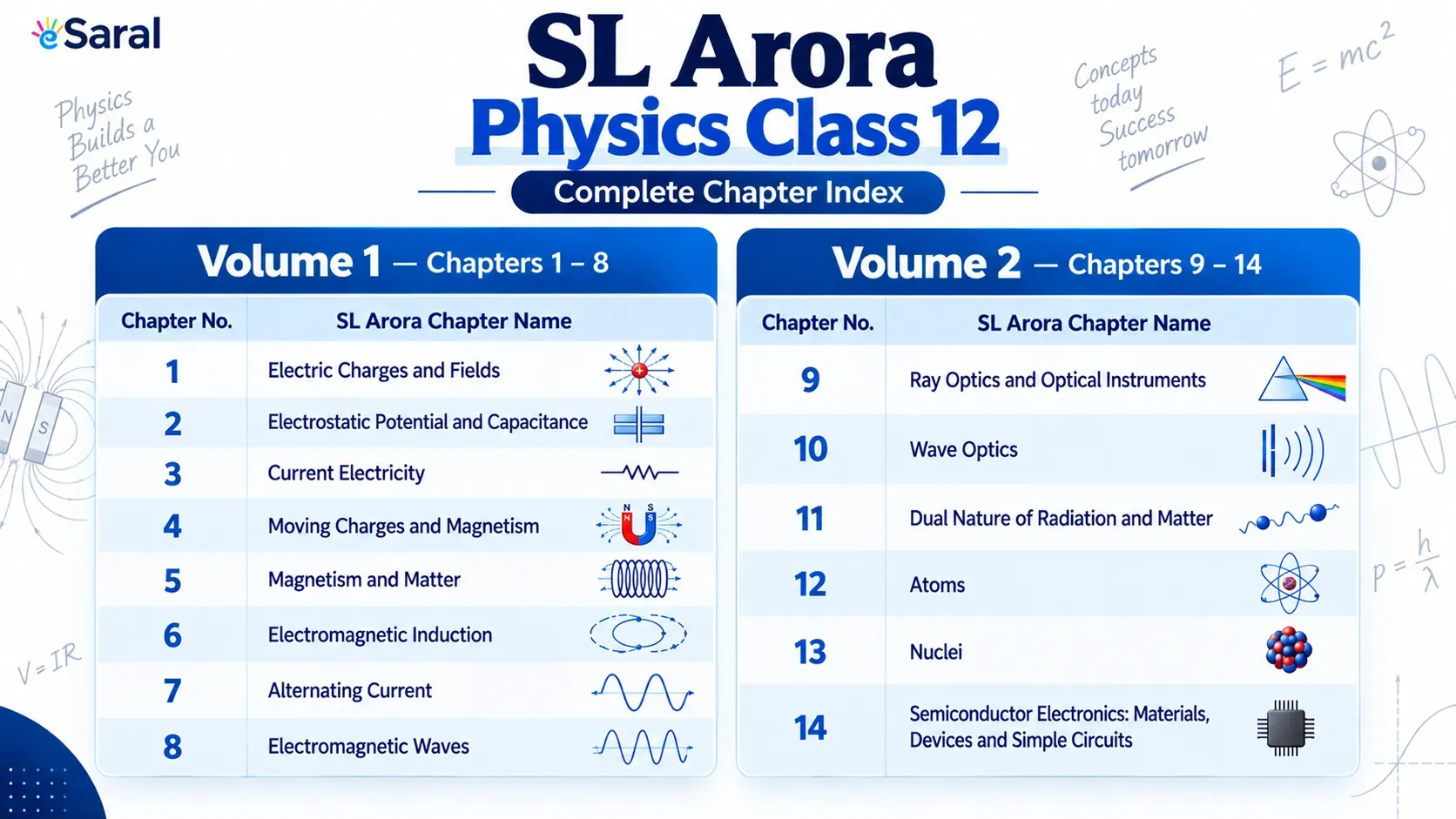
SL Arora Physics Class 12 Index – Chapter List for Volume 1 & 2
SL Arora Physics Class 12 index — complete chapter list for Volume 1 & 2, mapped to NCERT solutions for board, JEE Main, and NEET preparation.