
Motion in a Plane Class 11 Notes | Projectile Motion | IIT JEE | NEET

eSaral Academic and Editorial Team
Summary
These motion in a plane class 11 notes from eSaral cover vectors, resolution of vectors, relative velocity, projectile motion and uniform circular motion, with key formulas and worked examples for CBSE, JEE and NEET.
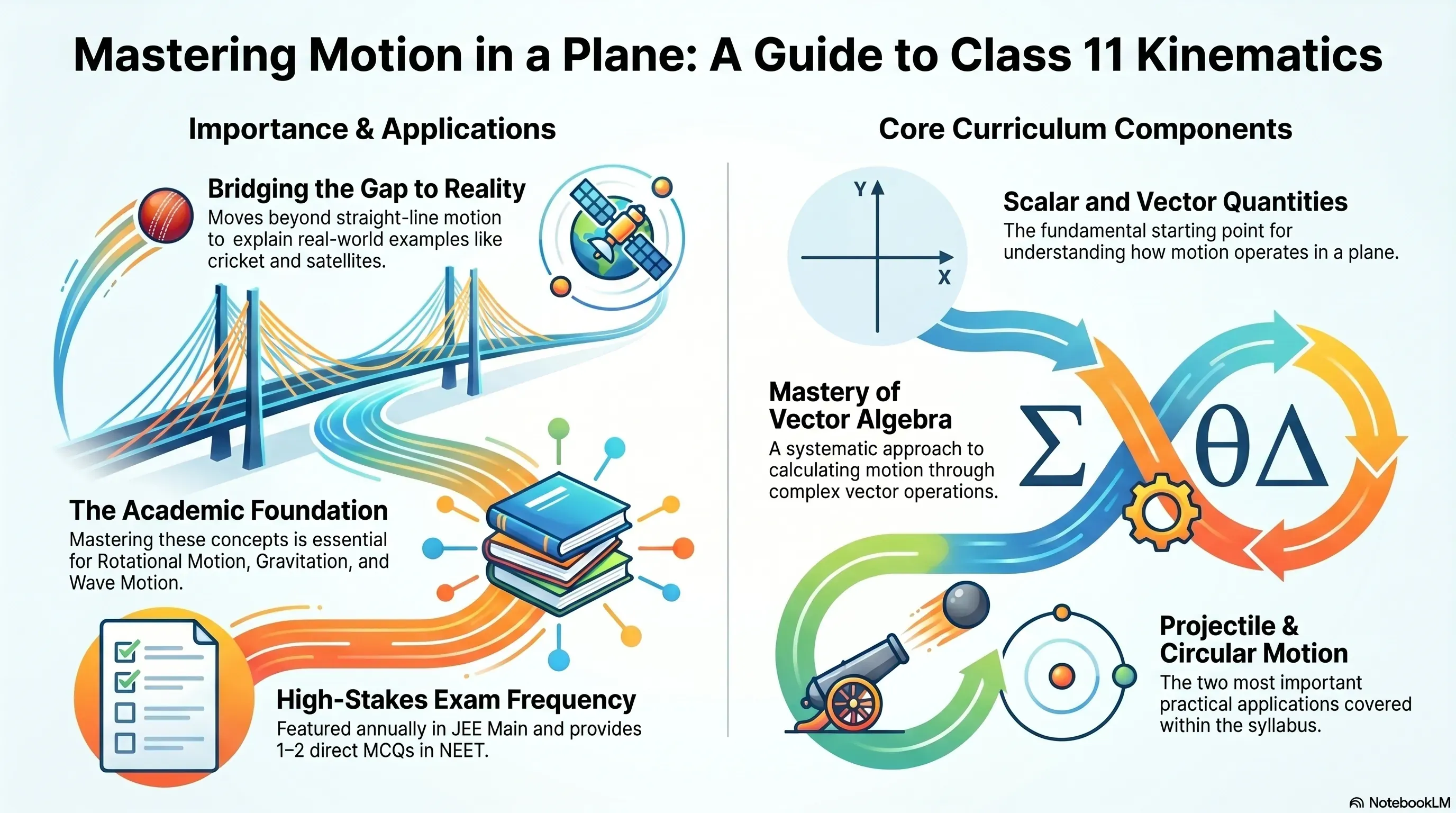
Motion in a plane extends straight-line kinematics to two dimensions, the kind of motion seen when a cricket ball is hit for a six or a satellite orbits the Earth. These motion in a plane class 11 notes explain each concept with its formulas, so you can revise the chapter quickly before tests. For solved exercises, use the NCERT Solutions for Class 11 Physics Motion in a Plane
Motion in a Plane Class 11 Notes: What You Will Learn
- Scalars and vectors, vector addition and resolution
- Equations of motion in a plane with constant acceleration
- Relative velocity in two dimensions
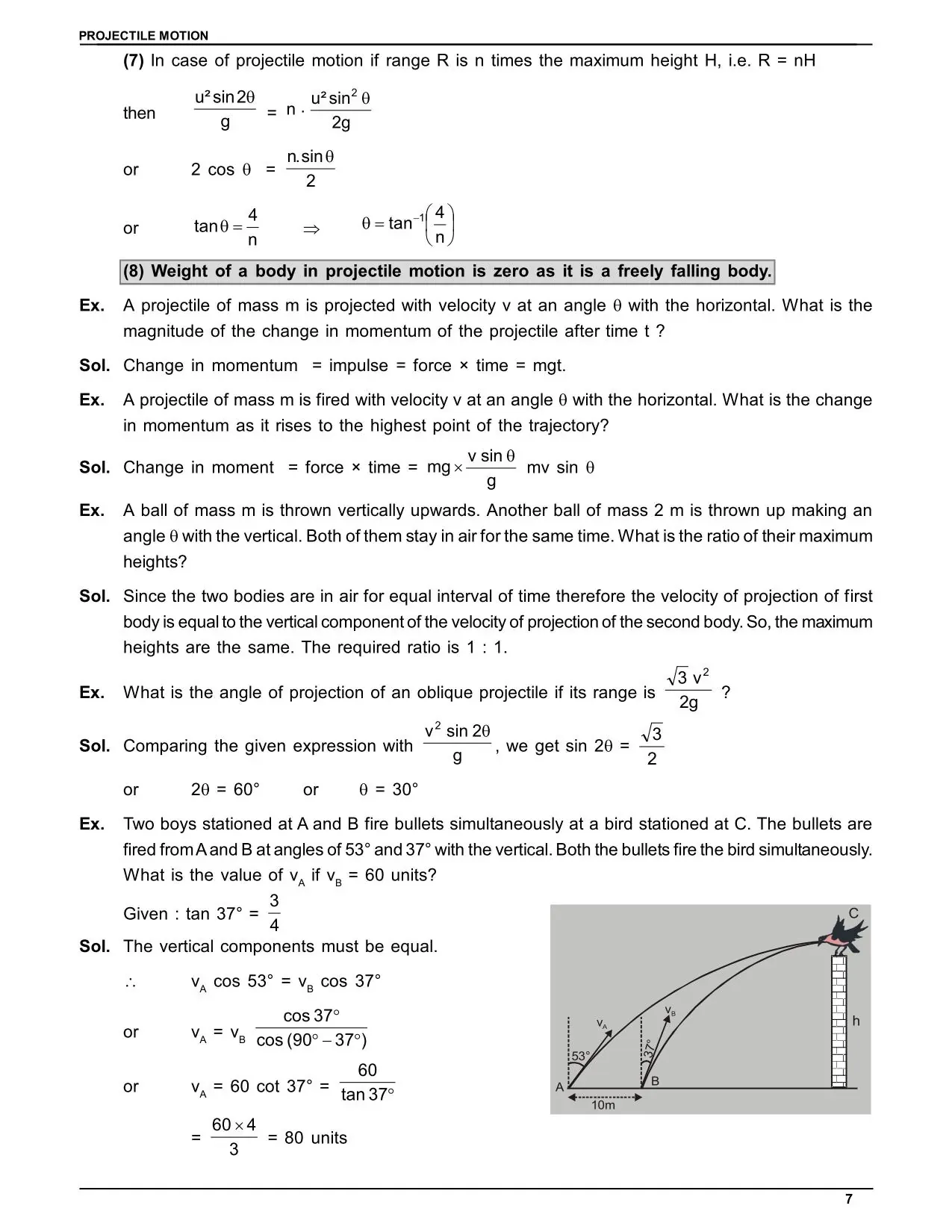
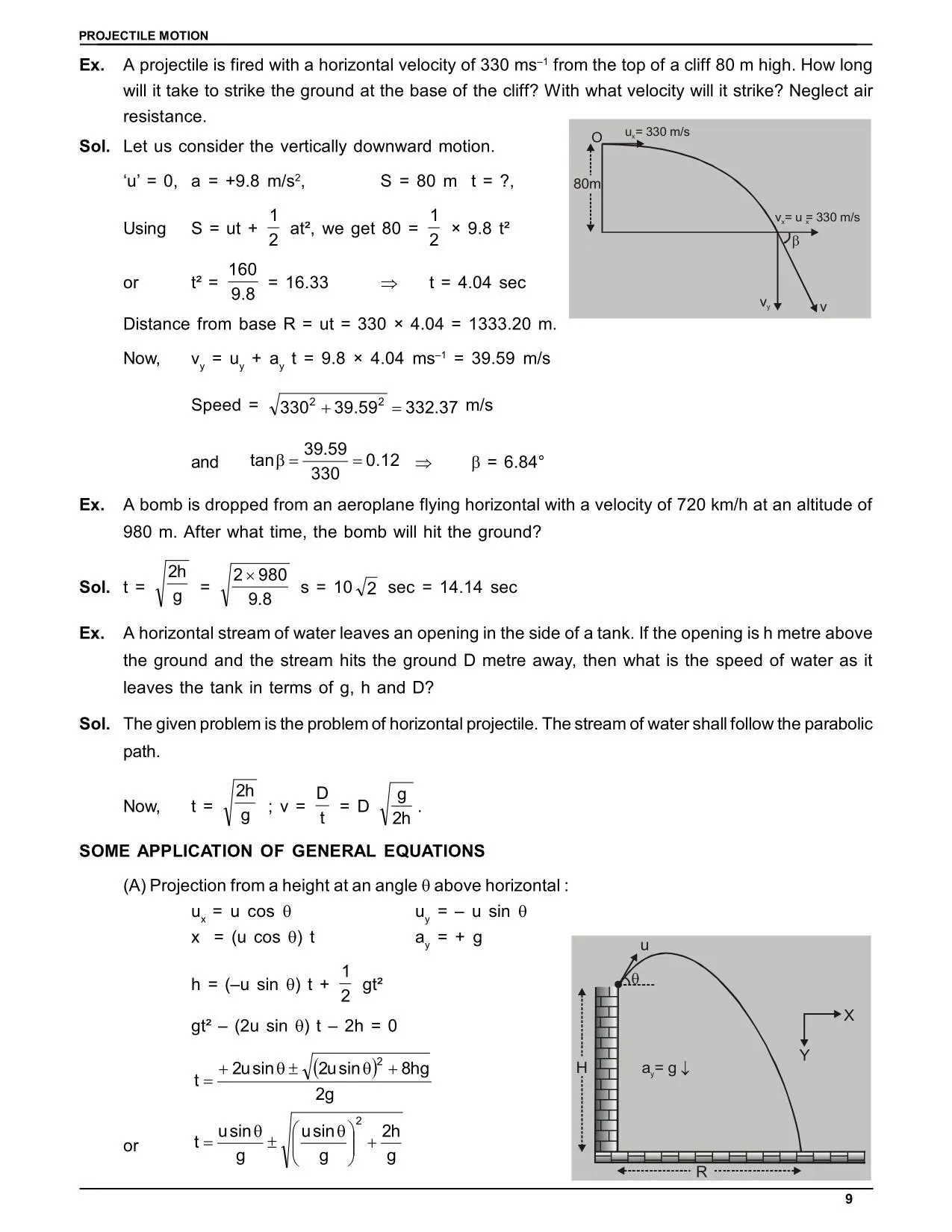
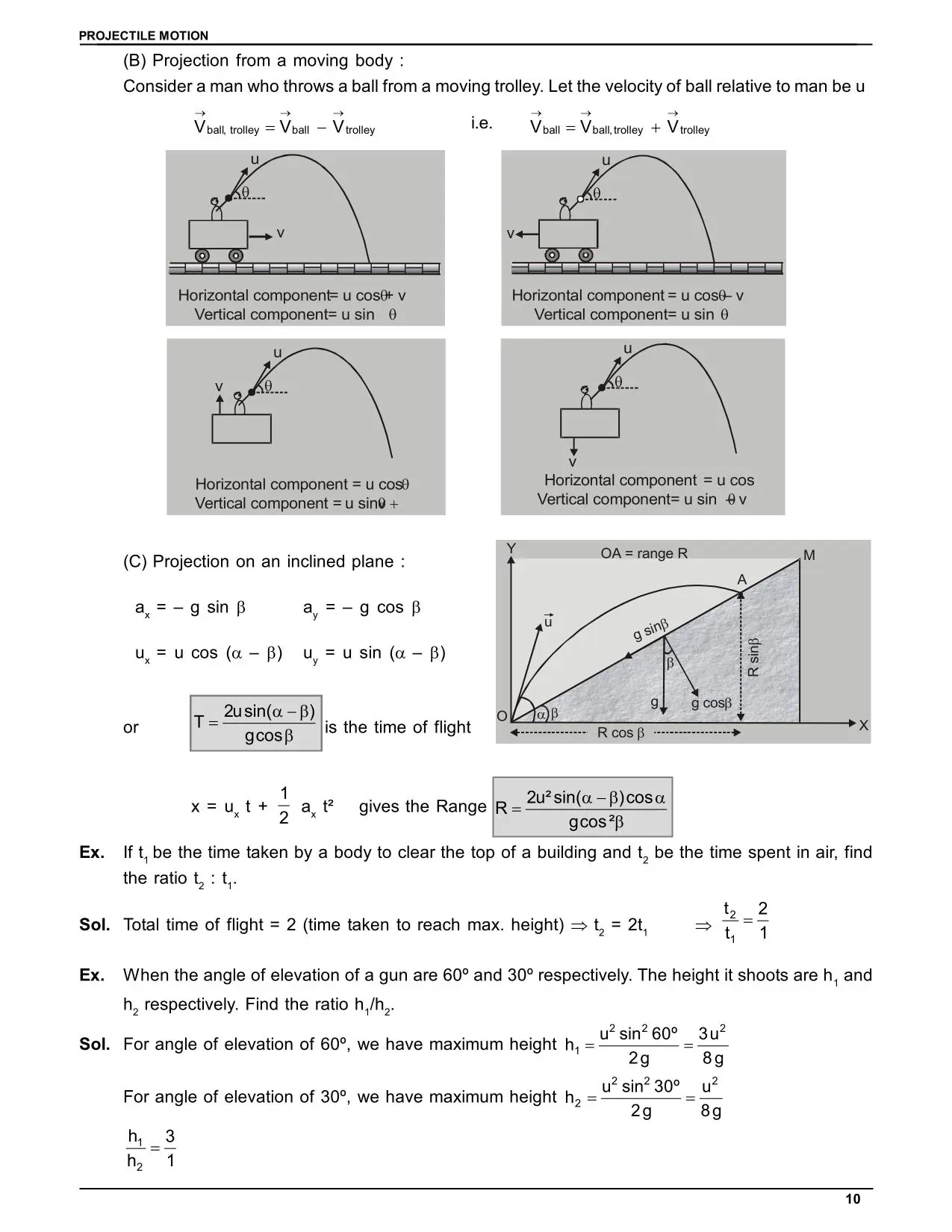
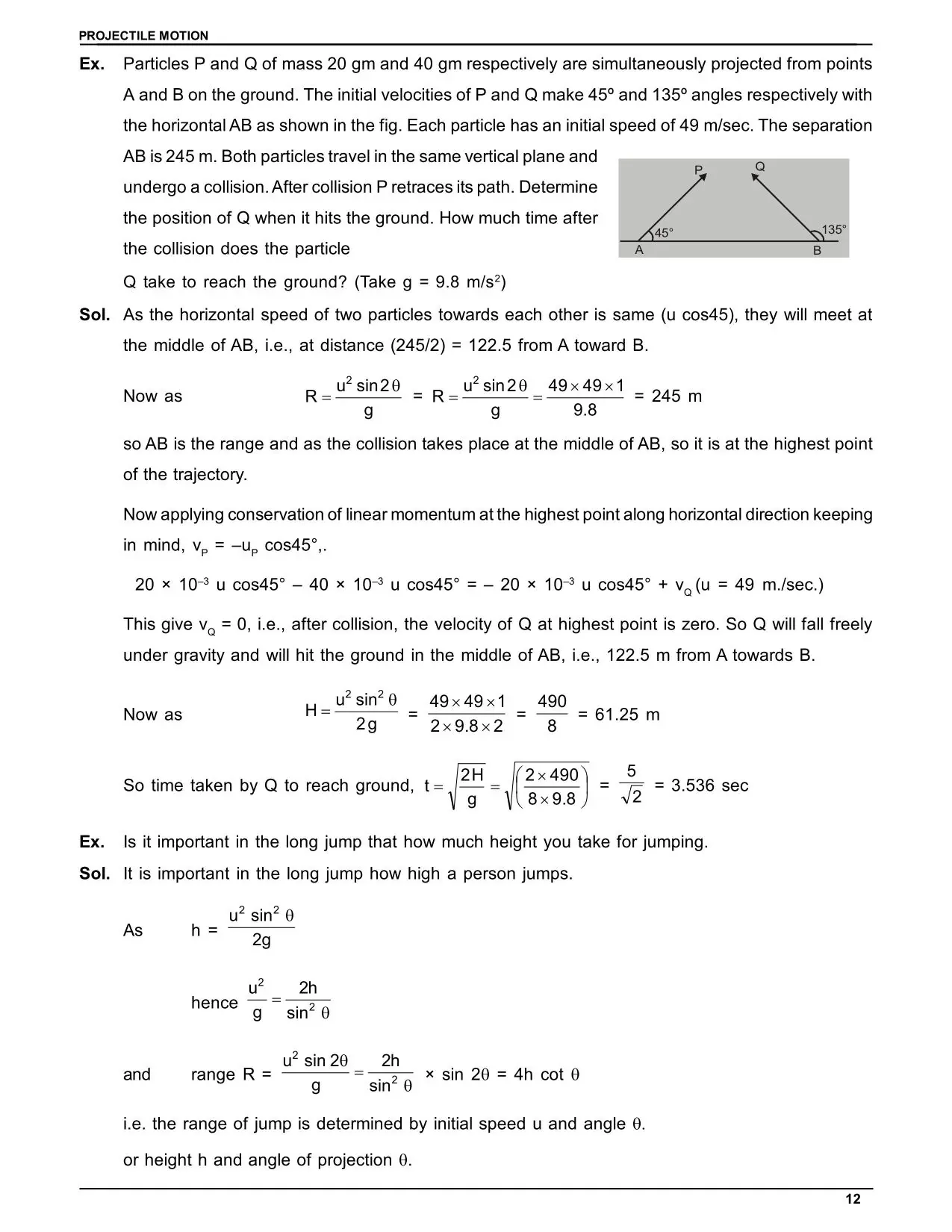
- Projectile motion and its formulas
- Uniform circular motion and centripetal acceleration
India's Best Exam Preparation for Class 11th - Download Now
Motion in a Plane Class 11 Notes
India's Best Exam Preparation for Class 11th - Download Now
India's Best Exam Preparation for Class 11th - Download Now
India's Best Exam Preparation for Class 11th - Download Now
India's Best Exam Preparation for Class 11th - Download Now
India's Best Exam Preparation for Class 11th - Download Now
For a concept-first explanation of how scalar and vector quantities become separate x- and y-component equations, read our guide to vector-based two dimensional motion.
India's Best Exam Preparation for Class 11th - Download Now
Scalars and Vectors in Motion in a Plane
A scalar has only magnitude, such as speed, mass or time. A vector has both magnitude and direction, such as displacement, velocity, acceleration and force. For a concept-first explanation of how vectors become separate x and y component equations, read our guide to vector-based two dimensional motion.
Position Vector and Displacement
The position vector of a point is $\vec{r} = x\hat{i} + y\hat{j}$. The displacement between two points is $\Delta\vec{r} = \vec{r}_2 - \vec{r}_1$. Displacement can be zero even if the path is long, as long as the object returns to its starting point.
Vector Addition: Triangle and Parallelogram Law
By the triangle law, if two vectors are drawn head to tail, the resultant is the third side of the triangle. By the parallelogram law, the resultant is the diagonal from the common point. For vectors $\vec{A}$ and $\vec{B}$ with angle $\theta$ between them:
$$R = \sqrt{A^2 + B^2 + 2AB\cos\theta}$$ $$\tan\alpha = \dfrac{B\sin\theta}{A + B\cos\theta}$$
Here $\alpha$ is the angle the resultant makes with $\vec{A}$.
How to Resolve a Vector into Components
For a vector $\vec{A}$ making angle $\theta$ with the x-axis:
$$A_x = A\cos\theta, \qquad A_y = A\sin\theta$$
Resolving vectors turns a two-dimensional problem into two independent one-dimensional problems, one along each axis.
Equations of Motion in a Plane with Constant Acceleration
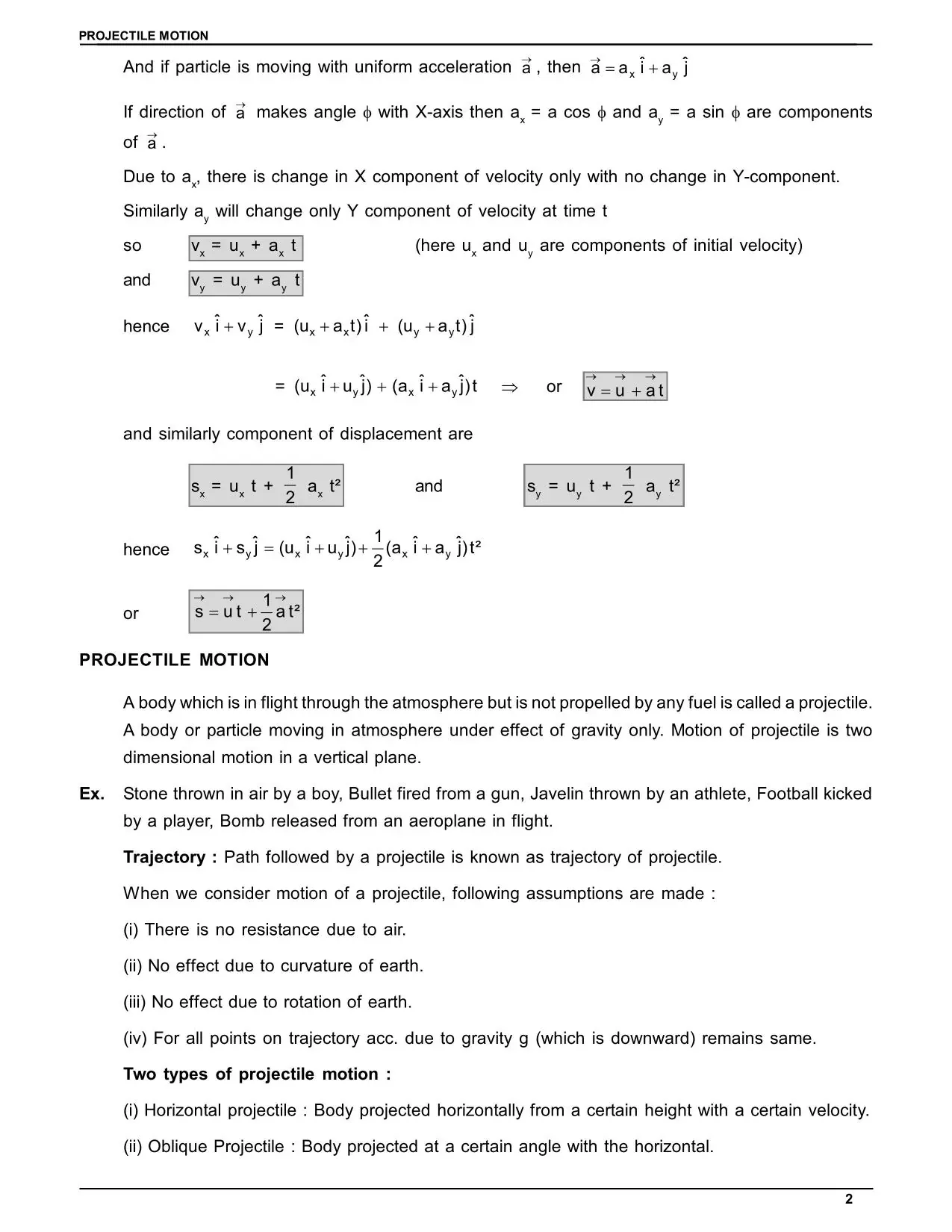
With constant acceleration $\vec{a}$, the one-dimensional equations extend to vector form:
$$\vec{v} = \vec{v}_0 + \vec{a}t$$ $$\vec{r} = \vec{r}_0 + \vec{v}_0 t + \dfrac{1}{2}\vec{a}t^2$$
Each equation splits into an x equation and a y equation, which is exactly how projectile motion is solved.
Relative Velocity in Two Dimensions
The velocity of object A as seen from object B is found by vector subtraction:
$$\vec{v}_{AB} = \vec{v}_A - \vec{v}_B$$
Resolve both velocities into components before subtracting.
River-Boat Problems
Let the boat speed in still water be $v_b$, the river speed be $v_r$ and the river width be $d$. To cross in the shortest time, head perpendicular to the bank, so $t = \dfrac{d}{v_b}$ and the boat drifts downstream by $v_r t$. To reach the point directly opposite (possible only if $v_b > v_r$), head upstream at angle $\theta$ from the perpendicular, where:
$$\sin\theta = \dfrac{v_r}{v_b}, \qquad t = \dfrac{d}{\sqrt{v_b^2 - v_r^2}}$$
Rain and Man Problems
If rain falls vertically at speed $v_r$ and a man walks at speed $v_m$, he must tilt his umbrella forward at angle $\theta$ from the vertical, where $\tan\theta = \dfrac{v_m}{v_r}$.
Projectile Motion: Formulas and Trajectory
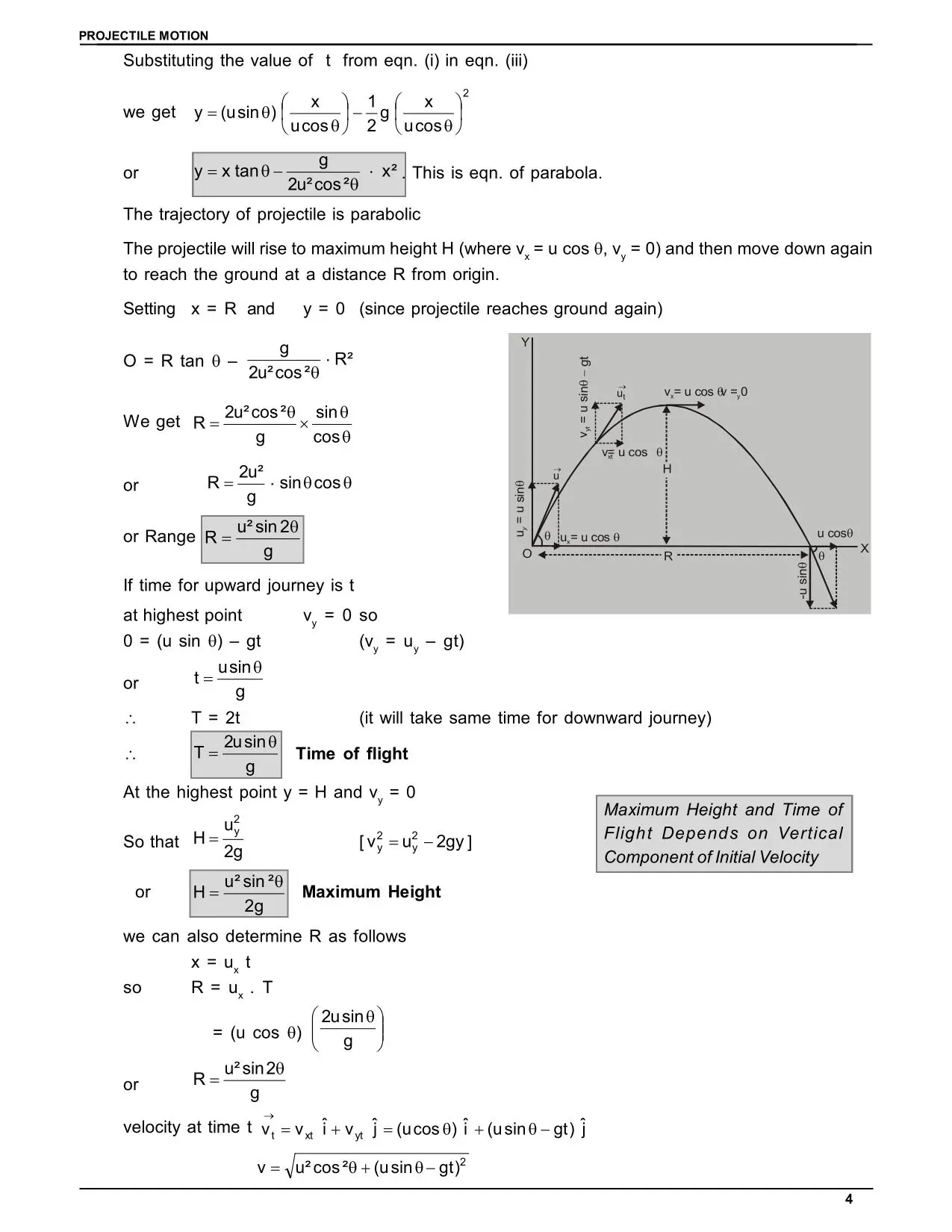
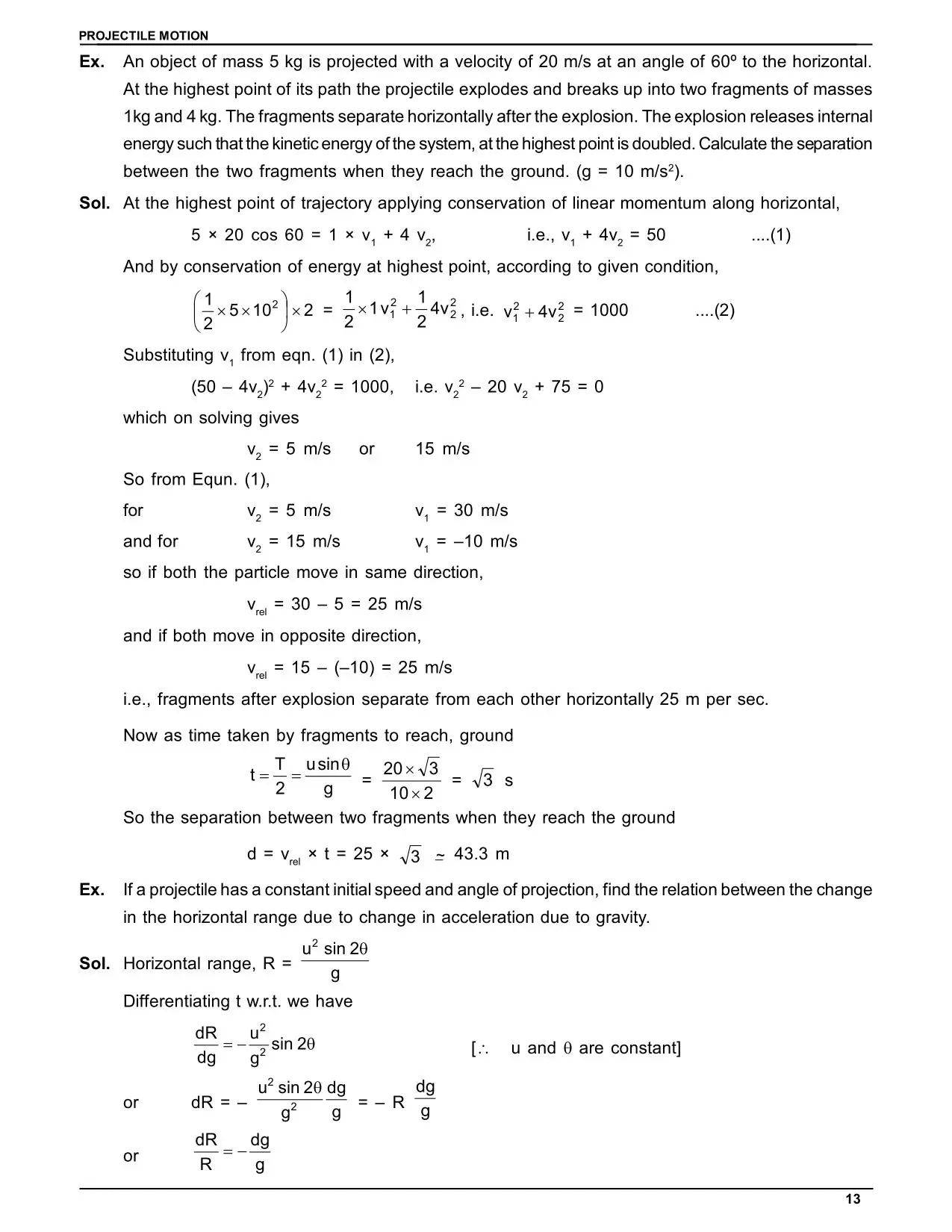
A projectile is launched with speed $u$ at angle $\theta$ to the horizontal. The horizontal velocity $u\cos\theta$ stays constant, and the vertical velocity $u\sin\theta - gt$ changes because of gravity.
Projectile Motion Formulas for Time of Flight, Maximum Height and Range
$$T = \dfrac{2u\sin\theta}{g}$$ $$H = \dfrac{u^2\sin^2\theta}{2g}$$ $$R = \dfrac{u^2\sin 2\theta}{g}$$
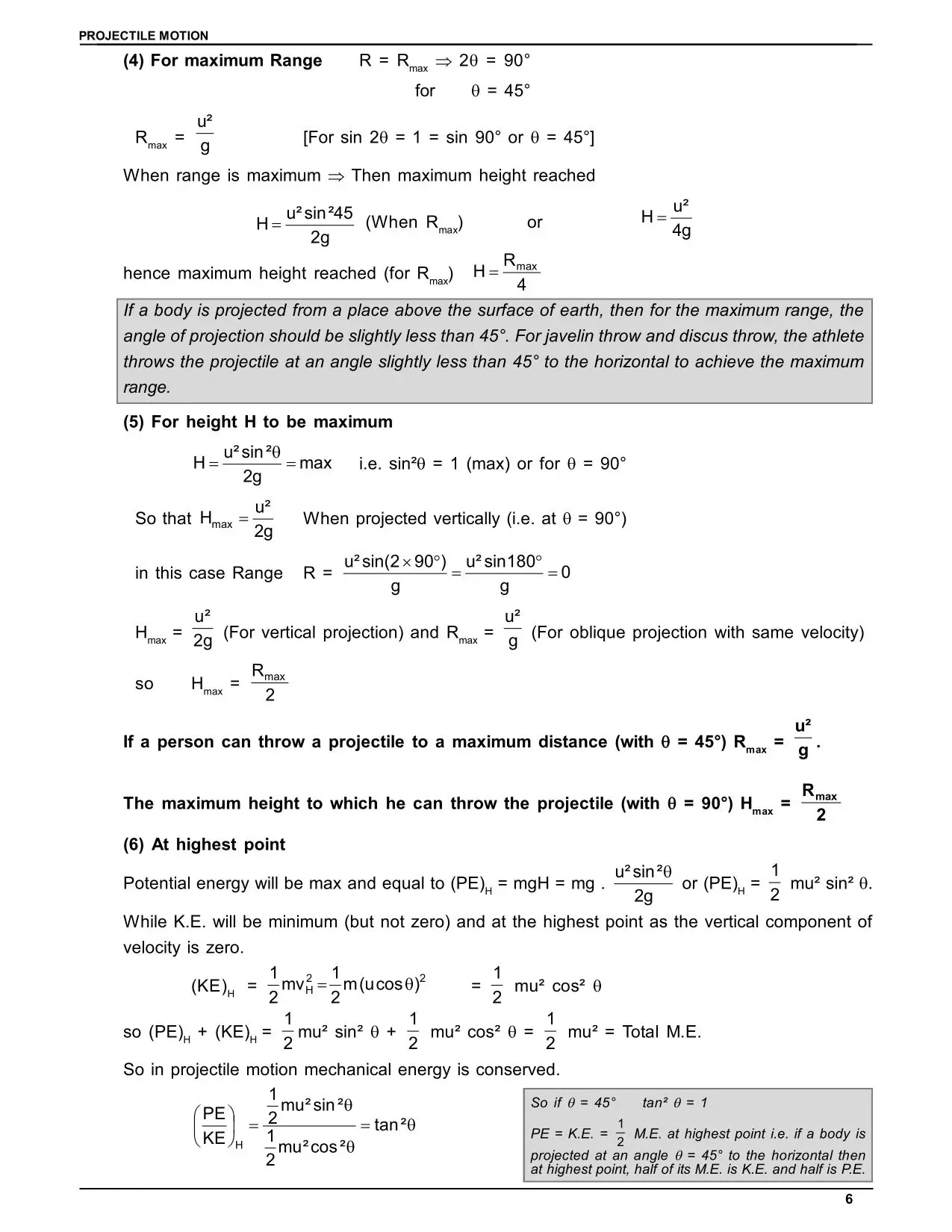
The range is maximum at $\theta = 45^\circ$, where $R_{max} = \dfrac{u^2}{g}$. Angles $\theta$ and $90^\circ - \theta$ give the same range. Also, $H = \dfrac{R\tan\theta}{4}$.
Example: for $u = 20\ \text{m/s}$, $\theta = 30^\circ$ and $g = 10\ \text{m/s}^2$, we get $T = 2\ \text{s}$, $H = 5\ \text{m}$ and $R = 20\sqrt{3} \approx 34.6\ \text{m}$.
Why Is the Path of a Projectile a Parabola?
Horizontal motion is uniform, so $x = u\cos\theta\, t$. Vertical motion is uniformly accelerated, so $y = u\sin\theta\, t - \dfrac{1}{2}gt^2$. Eliminating $t$ gives:
$$y = x\tan\theta - \dfrac{gx^2}{2u^2\cos^2\theta}$$
This is the equation of a parabola.
Horizontal Projection from a Height
For a body thrown horizontally with speed $u$ from height $h$:
$$T = \sqrt{\dfrac{2h}{g}}, \qquad \text{Range} = u\sqrt{\dfrac{2h}{g}}$$
Uniform Circular Motion and Centripetal Acceleration
In uniform circular motion, an object moves on a circle of radius $r$ at constant speed. If the period is $T$ and frequency is $f$:
$$\omega = \dfrac{2\pi}{T} = 2\pi f, \qquad v = \omega r$$ $$a_c = \dfrac{v^2}{r} = \omega^2 r, \qquad F_c = \dfrac{mv^2}{r}$$
Example: a car moving at $10\ \text{m/s}$ on a circular track of radius $50\ \text{m}$ has $a_c = \dfrac{10^2}{50} = 2\ \text{m/s}^2$.
Why Is Uniform Circular Motion Accelerated?
The speed is constant, but the direction of velocity keeps changing. A change in a vector means acceleration, and this centripetal acceleration always points towards the centre.
Common Mistakes in Motion in a Plane Class 11 Notes
- Adding magnitudes directly instead of using the triangle or parallelogram law.
- Mixing horizontal and vertical components in projectile motion.
- Treating displacement as distance on curved paths.
- Forgetting that uniform circular motion is accelerated motion.
How to Revise Motion in a Plane Class 11 Notes
- Learn vector addition and resolution first, since every later topic depends on them.
- Split every problem into x and y components before using any formula.
- Practise projectile problems with different angles to see how $T$, $H$ and $R$ change.
Frequently Asked Questions
What do motion in a plane class 11 notes cover?
Motion in a plane class 11 notes cover scalars and vectors, vector addition and resolution, relative velocity, projectile motion and uniform circular motion. eSaral’s notes give the formulas and worked examples for each topic.
What are the projectile motion formulas for time of flight, maximum height and range?
For launch speed $u$ and angle $\theta$: $T = \dfrac{2u\sin\theta}{g}$, $H = \dfrac{u^2\sin^2\theta}{2g}$ and $R = \dfrac{u^2\sin 2\theta}{g}$. The range is maximum at $45^\circ$, where $R_{max} = \dfrac{u^2}{g}$.
Why is the path of a projectile a parabola?
Horizontal velocity is constant while vertical velocity changes uniformly under gravity. Eliminating time from the two displacement equations gives $y = x\tan\theta - \dfrac{gx^2}{2u^2\cos^2\theta}$, which is a parabola.
What is centripetal acceleration and why does it arise in circular motion?
Even at constant speed, the direction of velocity changes continuously, which needs an acceleration directed towards the centre. Its magnitude is $a_c = \dfrac{v^2}{r}$.
How do you resolve a vector into x and y components?
For a vector $\vec{A}$ at angle $\theta$ to the x-axis, $A_x = A\cos\theta$ and $A_y = A\sin\theta$.
What is the difference between scalar and vector quantities?
A scalar has only magnitude, such as speed or mass. A vector has magnitude and direction, such as velocity or displacement.
How do you solve river-boat relative velocity problems?
Write the boat’s velocity relative to the ground as $\vec{v}_{boat} = \vec{v}_{b} + \vec{v}_{r}$ and resolve it along and across the river. The crossing time depends only on the velocity component perpendicular to the bank.
Is motion in a plane important for JEE Main and NEET?
Yes. Projectile motion, relative velocity and circular motion are regularly tested, and the vector skills are reused in later mechanics chapters. Check recent previous year papers for the current pattern. eSaral’s motion in a plane class 11 notes cover all these topics.
Where can I revise motion in a plane class 11 notes quickly?
Use the formula sections and handwritten pages on this eSaral page, then practise the NCERT exercises. The eSaral app also offers video lectures and study material for Class 11 Physics.
Team eSaral
eSaral Academic and Editorial Team
Team eSaral is the collective author profile for educational content created by eSaral’s teachers and academic contributors. The team draws on expertise from IIT graduates, doctors, experienced educators and subject specialists to develop resources for JEE, NEET and school students. Our articles aim to explain concepts clearly and help students study with confidence.
Related Posts

BITSAT 2027: Registration Date, Exam Date, Syllabus, Eligibility, Pattern & Fees
BITSAT 2027 exam dates, registration timeline, eligibility criteria, exam pattern, marking scheme, syllabus and fees in one page.

BITSAT Previous Year Question Paper PDF (2017-2026)
Download BITSAT previous year question papers PDF from 2017 to 2026,session-wise. Memory-based papers,exam pattern, paper analysis and how to practise

CBSE Class 10 Date Sheet 2027: Expected Exam Dates, Release Date, Admit Card & Result Timeline
CBSE Class 10 date sheet 2027 is awaited. See the expected exam dates, release window, how to download the PDF, admit card and result timelines.

NCERT Physics Class 10 Book PDF in Hindi 2026-27 – भौतिक विज्ञान के 4 अध्याय (Free Download)
NCERT Physics Class 10 book PDF in Hindi 2026-27: download all 4 chapters (अध्याय 9–12) free, with topics and important formulas.

NCERT Biology Class 9 Book Anveshan PDF in Hindi - जीव विज्ञान कक्षा 9 पुस्तक अन्वेषण PDF
Download NCERT Biology Class 9 book PDF in Hindi chapterwise for 2026-27: Cell, Tissues, Reproduction and Diversity. Free PDFs.

Essay On Artificial Intelligence in English (100,150, 200, 250, 300, 500 Words)
This is in contrast to the natural intelligence of humans. With Artificial Intelligence, machines can perform

Essay on 78th India Independence Day in English for Student (100, 150, 200, 250, 300, 500 Words)
Read the best essays on India's Independence Day in English. Short & long essays (100, 150, 200, 250, 300, 500 words) perfect for school exams
NCERT Class 11 English Snapshots book - Free PDF download- Esaral
Download NCERT Class 11 English Snapshots book PDF for free. Get all 8 chapters, chapter-wise. Start your prep today!
NCERT Class 10 biology book pdf - Free PDF Download - eSaral
NCERT Class 10 Biology book PDF 2026-27: all 5 chapters (Life Processes to Our Environment) in English & Hindi, with CBSE syllabus, marks & practical

Essay on Global Warming in English (100,150, 200, 250, 300, 500 Words)
Global warming means the Earth is getting hotter. This happens because of things like pollution from cars and factories.