
Projectile Motion Questions and Answers: Important for Class 11 Physics

eSaral Academic and Editorial Team
Summary
These projectile motion questions and answers for Class 11 Physics cover the proofs, derivations and conceptual questions that come in school exams: the parabolic path, time of flight, maximum height, range, the angle of maximum range and the change in momentum. Each question has a worked answer, and the page also has formulas, numericals, practice questions and FAQs for boards, JEE and NEET.
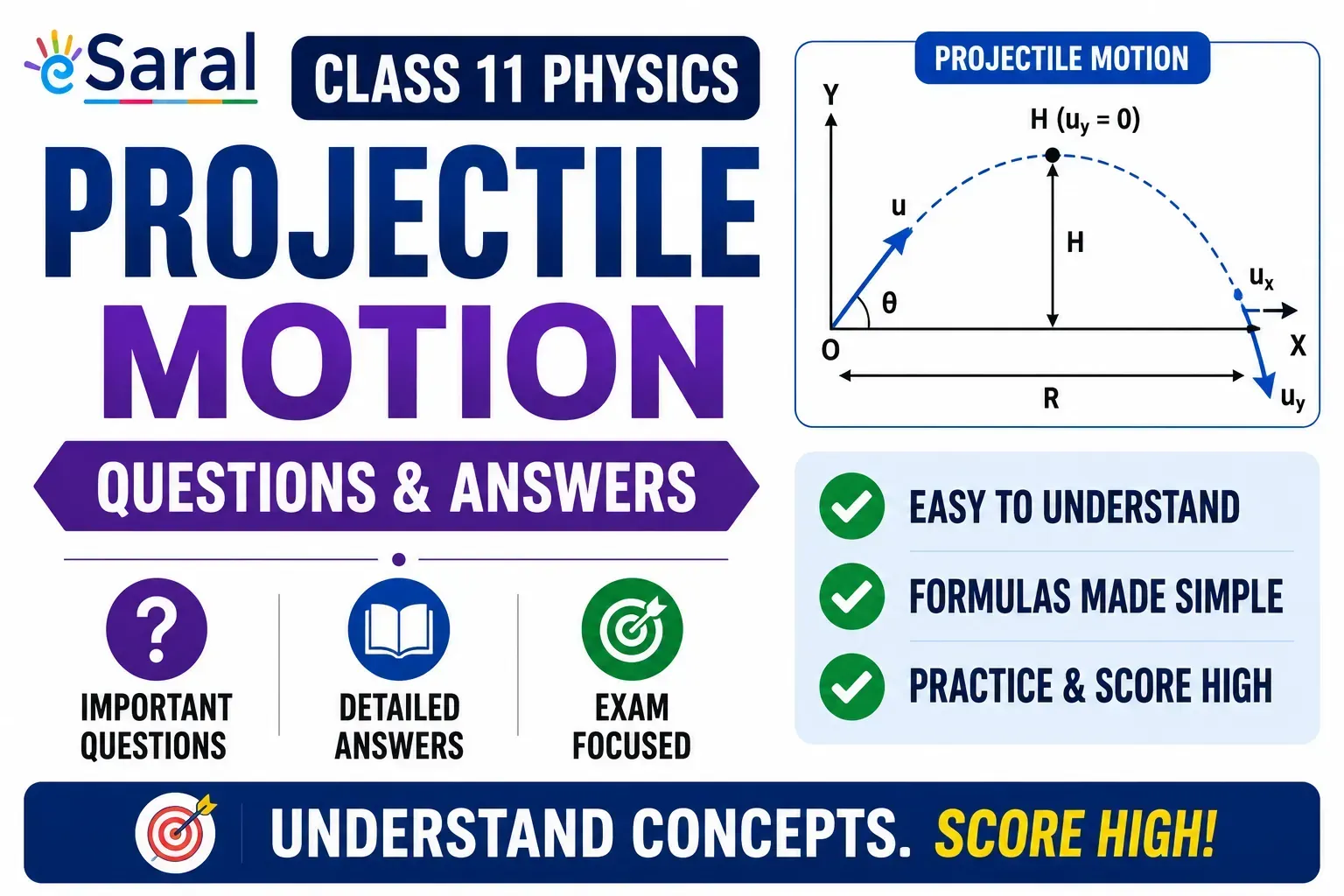
Projectile motion questions in Class 11 are subjective and reasoning-based: you have to prove a result, explain a situation or solve a short numerical. This page gives 21 such projectile motion questions with answers, in the order of the topic, so you can revise the projectile motion questions chapter-wise. If you need the theory first, read eSaral’s Motion in a Plane notes with projectile motion, and revise vector resolution and motion in two dimensions, because every answer below starts by splitting the velocity into horizontal and vertical components.
Projectile Motion Formulas Used in These Questions
Use these formulas for all projectile motion questions. Take a projectile fired with speed $u$ at an angle $\theta$ with the horizontal, from and to the same level, with no air resistance and a constant $g$.
Quantity | Formula |
|---|---|
Components of velocity | $u_x = u\cos\theta, \quad u_y = u\sin\theta$ |
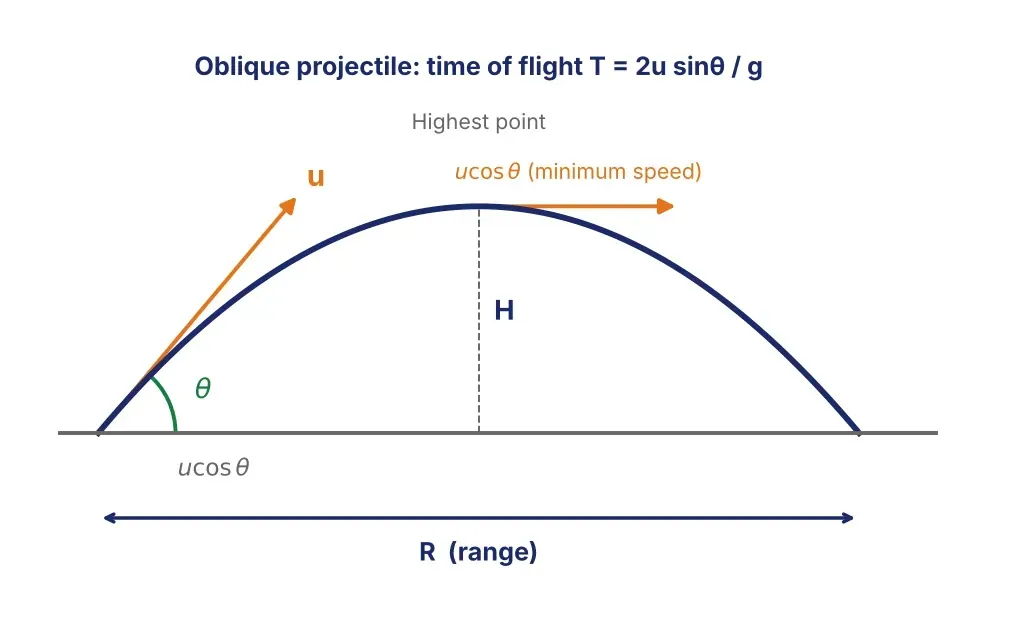
Time of flight | $T = \dfrac{2u\sin\theta}{g}$ |
Maximum height | $H = \dfrac{u^2\sin^2\theta}{2g}$ |
Horizontal range | $R = \dfrac{u^2\sin 2\theta}{g}$ |
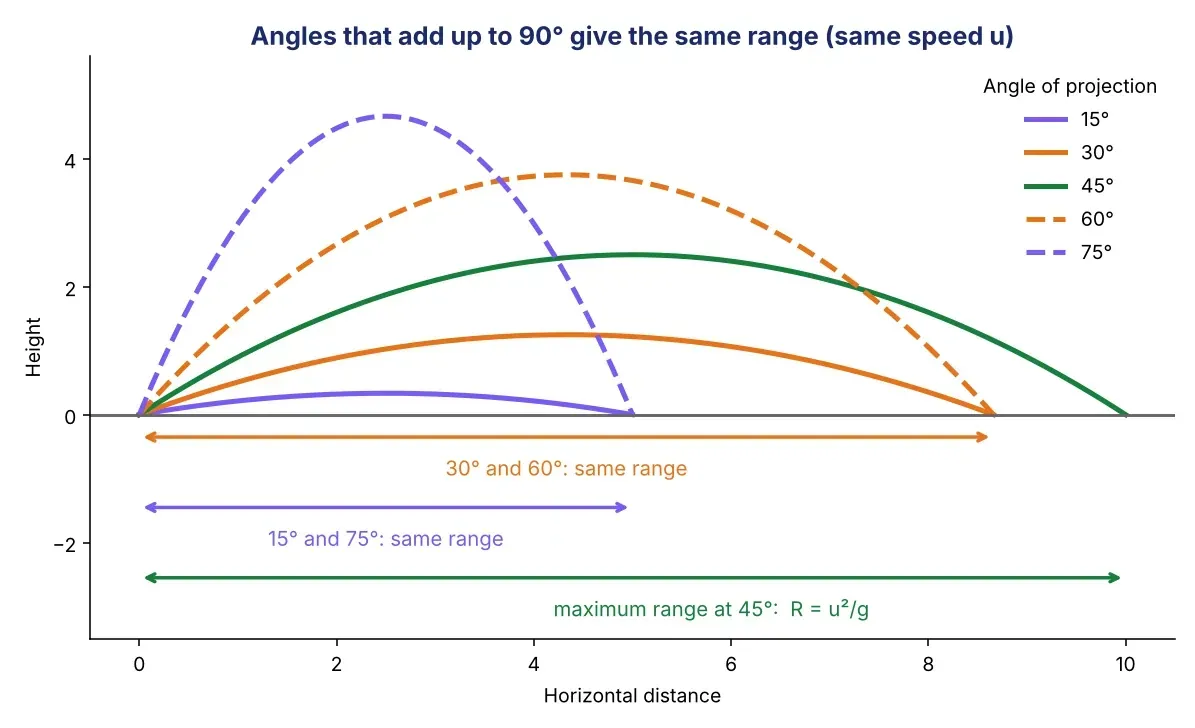
Maximum range (at $\theta = 45^\circ$) | $R_{max} = \dfrac{u^2}{g}$ |
Equation of the path | $y = x\tan\theta - \dfrac{g x^2}{2u^2\cos^2\theta}$ |
Speed at the highest point | $u\cos\theta$ (the minimum speed) |
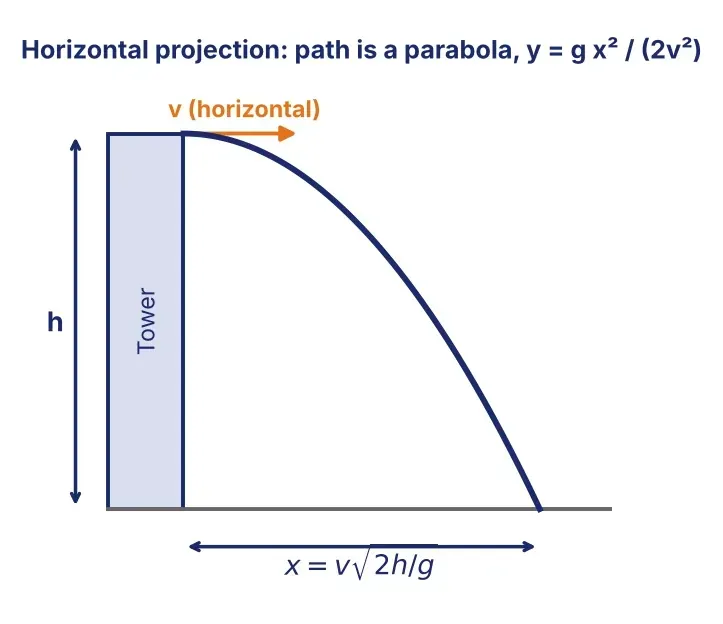
Horizontal projection from height $h$ with speed $v$ | $t = \sqrt{\dfrac{2h}{g}}, \quad x = v\sqrt{\dfrac{2h}{g}}, \quad y = \dfrac{g x^2}{2v^2}$ |
Projectile Motion Questions on Speed, Velocity and Momentum
These projectile motion questions test how the velocity and the momentum change during the flight.
Q1. At which point of the trajectory is the speed minimum?
At the highest point. The vertical velocity is zero there, so the speed is only the horizontal component, $u\cos\theta$, which is the minimum. For a body projected horizontally from a height, the speed only increases after launch, so the minimum is at the start.
Q2. Name a quantity that remains unchanged during the flight of an oblique projectile.
The horizontal component of velocity, $u\cos\theta$, because no force acts in the horizontal direction. The acceleration ($g$, downward) and the total mechanical energy are also constant when air resistance is ignored.
Q3. Name five physical quantities that change during the motion of an oblique projectile.
The speed, the vertical component of velocity, the direction of velocity, the kinetic energy and the potential energy change continuously. The momentum and the height above the ground also change.
Q4. A projectile of mass $m$ is fired with velocity $u$ at an angle $\theta$ with the horizontal. What is the change in momentum as it rises to the highest point?
The vertical momentum changes from $mu\sin\theta$ to zero, and the horizontal momentum $mu\cos\theta$ does not change.
$$\Delta p = 0 - mu\sin\theta = -mu\sin\theta$$
So the change in momentum has magnitude $mu\sin\theta$ and is directed vertically downward.
Q5. A projectile of mass $m$ is projected with velocity $u$ at an angle $\theta$. What is the magnitude of the change in momentum after time $t$?
The only force is gravity, $mg$ downward. The change in momentum equals the impulse of this force.
$$\Delta p = F \times t = mgt$$
The direction is vertically downward, and the result is valid until the projectile lands.
Q6. What is the change in momentum between the initial and final points of the path, if the range is maximum?
The range is maximum at $\theta = 45^\circ$. The horizontal momentum is the same at the start and the end. The vertical momentum changes from $mu\sin 45^\circ$ upward to $mu\sin 45^\circ$ downward.
$$\Delta p = -2mu\sin 45^\circ = -\sqrt{2}\,mu$$
So the magnitude is $\sqrt{2}\,mu$, directed vertically downward.
Projectile Motion Questions on the Path of a Projectile
The two proofs below are the projectile motion questions that appear most often in school exams.
Q7. A body is projected horizontally with a uniform velocity from the top of a tower. Show that the path is a parabola.
Take the origin at the top of the tower, with $x$ horizontal and $y$ downward. The horizontal motion has no acceleration, and the vertical motion starts from rest with acceleration $g$.
$$x = ut, \qquad y = \tfrac{1}{2}gt^2$$
Eliminate $t = x/u$:
$$y = \frac{g}{2u^2}\,x^2$$
This is of the form $y \propto x^2$, so the path is a parabola.
Q8. Prove that the path of a projectile is a parabola.
For a projectile fired with speed $u$ at an angle $\theta$:
$$x = (u\cos\theta)\,t, \qquad y = (u\sin\theta)\,t - \tfrac{1}{2}gt^2$$
From the first equation, $t = \dfrac{x}{u\cos\theta}$. Substituting in the second,
$$y = x\tan\theta - \frac{g}{2u^2\cos^2\theta}\,x^2$$
This is of the form $y = ax - bx^2$ with constants $a$ and $b$, which is the equation of a parabola.
Q9. What is the path followed by a javelin projected horizontally by an athlete?
A parabola. A body projected horizontally follows half of a parabola, because it has a constant horizontal velocity and a vertical motion under gravity (when air resistance is ignored).
Projectile Motion Questions on Range and Angle of Projection
Projectile motion questions on range and angle use the formula $R = \dfrac{u^2\sin 2\theta}{g}$ again and again.
Q10. What are the possible angles of projection with the same velocity to have the same range?
Two angles that add up to $90^\circ$, that is, $\theta$ and $(90^\circ - \theta)$. Since $R = \dfrac{u^2\sin 2\theta}{g}$ and $\sin 2(90^\circ - \theta) = \sin(180^\circ - 2\theta) = \sin 2\theta$, the range is the same. For example, $30^\circ$ and $60^\circ$, or $15^\circ$ and $75^\circ$.
Q11. Galileo stated that “for elevations which exceed or fall short of $45^\circ$ by equal amounts, the ranges are equal.” Prove this statement.
Let the two elevations be $45^\circ + \alpha$ and $45^\circ - \alpha$.
$$R_1 = \frac{u^2\sin(90^\circ + 2\alpha)}{g} = \frac{u^2\cos 2\alpha}{g}, \qquad R_2 = \frac{u^2\sin(90^\circ - 2\alpha)}{g} = \frac{u^2\cos 2\alpha}{g}$$
So $R_1 = R_2$.
Q12. What is the angle of projection at which the maximum height and the horizontal range are equal?
Put $R = H$:
$$\frac{u^2\sin 2\theta}{g} = \frac{u^2\sin^2\theta}{2g} \;\Rightarrow\; 2\sin\theta\cos\theta = \frac{\sin^2\theta}{2} \;\Rightarrow\; \tan\theta = 4$$
So $\theta = \tan^{-1}4 \approx 76^\circ$.
Q13. If the time of flight of a projectile projected with velocity $u$ at an angle $\theta$ is $T$, find the condition for maximum range and its value.
The time of flight is $T = \dfrac{2u\sin\theta}{g}$, and the range is
$$R = (u\cos\theta)\,T = \frac{u^2\sin 2\theta}{g}$$
The range is maximum when $\sin 2\theta = 1$, that is, $\theta = 45^\circ$, and $R_{max} = \dfrac{u^2}{g}$. At this angle $T = \dfrac{\sqrt{2}\,u}{g}$, so in terms of the time of flight, $R_{max} = \dfrac{gT^2}{2}$.
Q14. Prove that a gun will shoot three times as high when its angle of elevation is $60^\circ$ as when it is $30^\circ$, but cover the same horizontal range.
The height is $H = \dfrac{u^2\sin^2\theta}{2g}$, so
$$\frac{H_{60^\circ}}{H_{30^\circ}} = \frac{\sin^2 60^\circ}{\sin^2 30^\circ} = \frac{3/4}{1/4} = 3$$
The range is $R = \dfrac{u^2\sin 2\theta}{g}$. For $30^\circ$ it is proportional to $\sin 60^\circ$, and for $60^\circ$ it is proportional to $\sin 120^\circ = \sin 60^\circ$. So the ranges are equal.
Projectile Motion Questions on Real-Life Situations
These projectile motion questions ask you to explain a situation in words, so state the reason clearly.
Q15. A hunter aims his gun at a monkey sitting on a tree and fires. Will the bullet hit the monkey?
It depends on what the monkey does. Without gravity, the bullet would move along the line of aim. With gravity, the bullet falls below that line by $\tfrac{1}{2}gt^2$ after time $t$.
- If the monkey stays on the tree, the bullet passes below it, so it misses.
- If the monkey lets go at the instant of firing, it also falls by $\tfrac{1}{2}gt^2$ in the same time, so the bullet hits it, provided the bullet reaches the tree before the monkey lands.
Q16. A bomb is released from a horizontally flying bomber when it is vertically above the target. Shall it hit the target?
No. At the instant of release, the bomb has the same horizontal velocity $v$ as the bomber. It keeps this velocity while it falls, so it follows a parabola and lands ahead of the target, at a horizontal distance $v\sqrt{2h/g}$ from the point below the release. To hit the target, the bomb must be released earlier, when the target is that far ahead.
Q17. Why does a tennis ball bounce higher on hills than on plains?
On hills, the acceleration due to gravity is slightly smaller, and the air is thinner. The maximum height $H = \dfrac{u^2\sin^2\theta}{2g}$ increases when $g$ decreases, and thinner air gives less drag.
Q18. Give two applications and two examples of projectile motion.
Applications: planning the angle and speed of a shell fired from artillery, and sports such as javelin throw, shot put and long jump.
Examples: a football kicked at an angle, and a stone thrown from a building.
Q19. When will the relative velocity of two moving objects be zero?
When both objects move with the same velocity, that is, the same speed in the same direction. For example, two projectiles launched together with the same velocity have the same acceleration $g$ at every instant, so their relative velocity stays zero during the whole flight.
Projectile Motion Numerical Questions With Solutions
Numerical projectile motion questions need the same steps every time: resolve the velocity, find the time, and then find the range or the height.
Q20. The height $y$ and the distance $x$ along the horizontal plane of a projectile on a certain planet (with no atmosphere) are $y = (8t - 5t^2)$ m and $x = 6t$ m, where $t$ is in seconds. Find the velocity and the angle of projection.
At $t = 0$: $v_x = 6\ \text{m/s}$ and $v_y = 8\ \text{m/s}$.
$$v = \sqrt{6^2 + 8^2} = 10\ \text{m/s}, \qquad \theta = \tan^{-1}\frac{8}{6} \approx 53^\circ$$
The acceleration is $a_y = -10\ \text{m/s}^2$, so $g = 10\ \text{m/s}^2$ on this planet. The maximum height is $\dfrac{8^2}{2\times 10} = 3.2$ m, the time of flight is $\dfrac{2\times 8}{10} = 1.6$ s, and the range is $6 \times 1.6 = 9.6$ m.
Q21. A mass is projected horizontally with velocity $v$ from a tower of height $h$. Find the horizontal distance it covers from the foot of the tower.
The time to fall is $t = \sqrt{\dfrac{2h}{g}}$. The horizontal distance is
$$x = vt = v\sqrt{\frac{2h}{g}}$$
Extra numerical 1: Time of flight, height and range
A ball is projected at $30^\circ$ with a speed of $20\ \text{m/s}$. Find $T$, $H$ and $R$. Take $g = 10\ \text{m/s}^2$.
$$T = \frac{2\times 20\times 0.5}{10} = 2\ \text{s}, \qquad H = \frac{20^2\times 0.25}{2\times 10} = 5\ \text{m}, \qquad R = \frac{20^2\sin 60^\circ}{10} \approx 34.6\ \text{m}$$
Extra numerical 2: Projection from a tower
A stone is thrown horizontally at $15\ \text{m/s}$ from the top of an $80\ \text{m}$ tower. Find the time to fall, the horizontal distance and the speed on landing. Take $g = 10\ \text{m/s}^2$.
$$t = \sqrt{\frac{2\times 80}{10}} = 4\ \text{s}, \qquad x = 15\times 4 = 60\ \text{m}$$ $$v_y = gt = 40\ \text{m/s}, \qquad v = \sqrt{15^2 + 40^2} \approx 42.7\ \text{m/s}$$
Practice Projectile Motion Questions With Answers
- A projectile is fired at $50\ \text{m/s}$ at an angle of $37^\circ$ ($\sin 37^\circ = 0.6$, $\cos 37^\circ = 0.8$). Find $T$, $H$ and $R$. Take $g = 10\ \text{m/s}^2$.
- The maximum range of a gun is $500\ \text{m}$. Find the speed of the shell. Take $g = 10\ \text{m/s}^2$.
- A projectile fired at $15^\circ$ has a range $R$. At what other angle will the same speed give the same range?
Answers: 1. $T = 6$ s, $H = 45$ m, $R = 240$ m. 2. $u = \sqrt{gR_{max}} = \sqrt{10\times 500} \approx 71\ \text{m/s}$. 3. $75^\circ$.
For exam-style projectile motion questions, solve the Projectile Motion NEET previous year questions and the JEE Main chapter-wise previous year questions.
Common Mistakes in Projectile Motion Questions
These mistakes cost marks in projectile motion questions.
Mistake | Correct approach |
|---|---|
Using $R = \dfrac{u^2\sin 2\theta}{g}$ when the projectile lands at a different level | This formula is only for projection and landing at the same level. Otherwise use the equations of motion for $x$ and $y$ |
Taking the vertical velocity at the top as $u\sin\theta$ | It is zero at the highest point |
Saying that the momentum is constant | Only the horizontal momentum is constant. The vertical momentum changes |
Forgetting the assumptions | These formulas assume no air resistance and a constant $g$ |
Thinking that a heavier body has a different path | The mass does not affect the path when air resistance is ignored |
Related Topics
- Class 11 Physics notes
- Motion in a Plane notes with projectile motion
- Vectors and two-dimensional motion
For more solved projectile motion questions and other chapters, you can also subscribe to the eSaral YouTube channel.
Frequently Asked Questions
Where can I find projectile motion questions and answers for Class 11 with solutions?
This page has 21 subjective projectile motion questions and answers for Class 11 Physics, with derivations, numericals and practice questions. For the theory, use eSaral’s Motion in a Plane notes, and for exam practice use the projectile motion PYQs linked on this page.
Which projectile motion questions are most important for the Class 11 exam?
The most asked projectile motion questions are the proof that the path is a parabola, the formulas for time of flight, maximum height and range, the angle of maximum range, the equal range for complementary angles, and the change in momentum. Conceptual questions such as the hunter and the monkey, and the bomb dropped from a bomber, are also common.
At what angle of projection is the range of a projectile maximum?
The range is maximum at $\theta = 45^\circ$, because $R = \dfrac{u^2 \sin 2\theta}{g}$ is largest when $\sin 2\theta = 1$. The maximum range is $R_{max} = \dfrac{u^2}{g}$, for a projectile that lands at the level of projection.
At what angle of projection are the range and the maximum height equal?
Put $\dfrac{u^2 \sin 2\theta}{g} = \dfrac{u^2 \sin^2\theta}{2g}$. This gives $4\cos\theta = \sin\theta$, so $\tan\theta = 4$ and $\theta = \tan^{-1} 4 \approx 76^\circ$.
Is a stone thrown vertically upward a projectile?
In the strict sense of projectile motion, which is two-dimensional motion along a parabola, it is not. It moves along a straight line under gravity. It can be seen as the limiting case $\theta = 90^\circ$, where the range is zero.
Will the bullet hit the monkey if the hunter aims straight at it?
If the monkey stays on the tree, the bullet falls below the line of aim by $\tfrac{1}{2}gt^2$ and passes below the monkey. If the monkey lets go at the moment of firing, it falls by the same distance in the same time, so the bullet hits it, provided the bullet reaches the tree before the monkey lands.
Which physical quantities remain constant during projectile motion?
The horizontal component of velocity ($u\cos\theta$) stays constant, because no horizontal force acts. The acceleration ($g$, downward) is also constant, and so is the total mechanical energy, when air resistance is ignored. The speed, the vertical velocity, the kinetic energy, the potential energy and the momentum change during the flight.
What is the minimum speed of a projectile during its flight?
For an oblique projectile, the minimum speed is at the highest point, where the vertical velocity is zero and the speed is $u\cos\theta$. For a body projected horizontally from a height, the speed only increases after launch, so the minimum is at the start.
What is the change in momentum of a projectile as it rises to the highest point?
The vertical momentum falls from $mu\sin\theta$ to zero, and the horizontal momentum does not change. So the change in momentum has magnitude $mu\sin\theta$, and it is directed vertically downward.
Why does a tennis ball bounce higher on hills than on plains?
On hills, the acceleration due to gravity is slightly smaller, and the air is thinner. Since $H = \dfrac{u^2\sin^2\theta}{2g}$, a smaller $g$ gives a larger height, and thinner air gives less drag.
How do you solve projectile motion numericals step by step?
Resolve the initial velocity into $u\cos\theta$ and $u\sin\theta$, write the horizontal motion with constant velocity and the vertical motion with acceleration $-g$, find the time of flight, and then use it to find the range and the height. eSaral’s solved examples on this page follow the same steps.
Are projectile motion questions important for JEE and NEET?
Yes. According to eSaral’s chapter analysis, Motion in a Plane gives about one or two questions per JEE Main paper, and projectile motion (range, height, time of flight and angle of projection) is one of the most tested topics in it. NEET also asks projectile motion questions. Practise them with eSaral’s projectile motion PYQs and chapter-wise JEE Main questions.
Team eSaral
eSaral Academic and Editorial Team
Team eSaral is the collective author profile for educational content created by eSaral’s teachers and academic contributors. The team draws on expertise from IIT graduates, doctors, experienced educators and subject specialists to develop resources for JEE, NEET and school students. Our articles aim to explain concepts clearly and help students study with confidence.
Related Posts

BITSAT 2027: Registration Date, Exam Date, Syllabus, Eligibility, Pattern & Fees
BITSAT 2027 exam dates, registration timeline, eligibility criteria, exam pattern, marking scheme, syllabus and fees in one page.

BITSAT Previous Year Question Paper PDF (2017-2026)
Download BITSAT previous year question papers PDF from 2017 to 2026,session-wise. Memory-based papers,exam pattern, paper analysis and how to practise

CBSE Class 10 Date Sheet 2027: Expected Exam Dates, Release Date, Admit Card & Result Timeline
CBSE Class 10 date sheet 2027 is awaited. See the expected exam dates, release window, how to download the PDF, admit card and result timelines.

NCERT Physics Class 10 Book PDF in Hindi 2026-27 – भौतिक विज्ञान के 4 अध्याय (Free Download)
NCERT Physics Class 10 book PDF in Hindi 2026-27: download all 4 chapters (अध्याय 9–12) free, with topics and important formulas.

NCERT Biology Class 9 Book Anveshan PDF in Hindi - जीव विज्ञान कक्षा 9 पुस्तक अन्वेषण PDF
Download NCERT Biology Class 9 book PDF in Hindi chapterwise for 2026-27: Cell, Tissues, Reproduction and Diversity. Free PDFs.

Essay On Artificial Intelligence in English (100,150, 200, 250, 300, 500 Words)
This is in contrast to the natural intelligence of humans. With Artificial Intelligence, machines can perform

Essay on 78th India Independence Day in English for Student (100, 150, 200, 250, 300, 500 Words)
Read the best essays on India's Independence Day in English. Short & long essays (100, 150, 200, 250, 300, 500 words) perfect for school exams
NCERT Class 11 English Snapshots book - Free PDF download- Esaral
Download NCERT Class 11 English Snapshots book PDF for free. Get all 8 chapters, chapter-wise. Start your prep today!
NCERT Class 10 biology book pdf - Free PDF Download - eSaral
NCERT Class 10 Biology book PDF 2026-27: all 5 chapters (Life Processes to Our Environment) in English & Hindi, with CBSE syllabus, marks & practical

Essay on Global Warming in English (100,150, 200, 250, 300, 500 Words)
Global warming means the Earth is getting hotter. This happens because of things like pollution from cars and factories.