
Properties and Solution of Triangle: Formulas, Rules and Notes for JEE

eSaral Academic and Editorial Team
Summary
The properties and solution of triangle connect the sides $a, b, c$ and the angles $A, B, C$ of a triangle through the sine rule, the cosine rule, the projection formulas, Napier's analogy and the half-angle formulas. The same results give the area $\Delta$, the circumradius $R = \dfrac{abc}{4\Delta}$, the inradius $r = \dfrac{\Delta}{s}$ and the ex-radii $r_1 = \dfrac{\Delta}{s - a}$. This page gives every formula, three diagrams, solved examples, common mistakes and FAQs for JEE preparation.
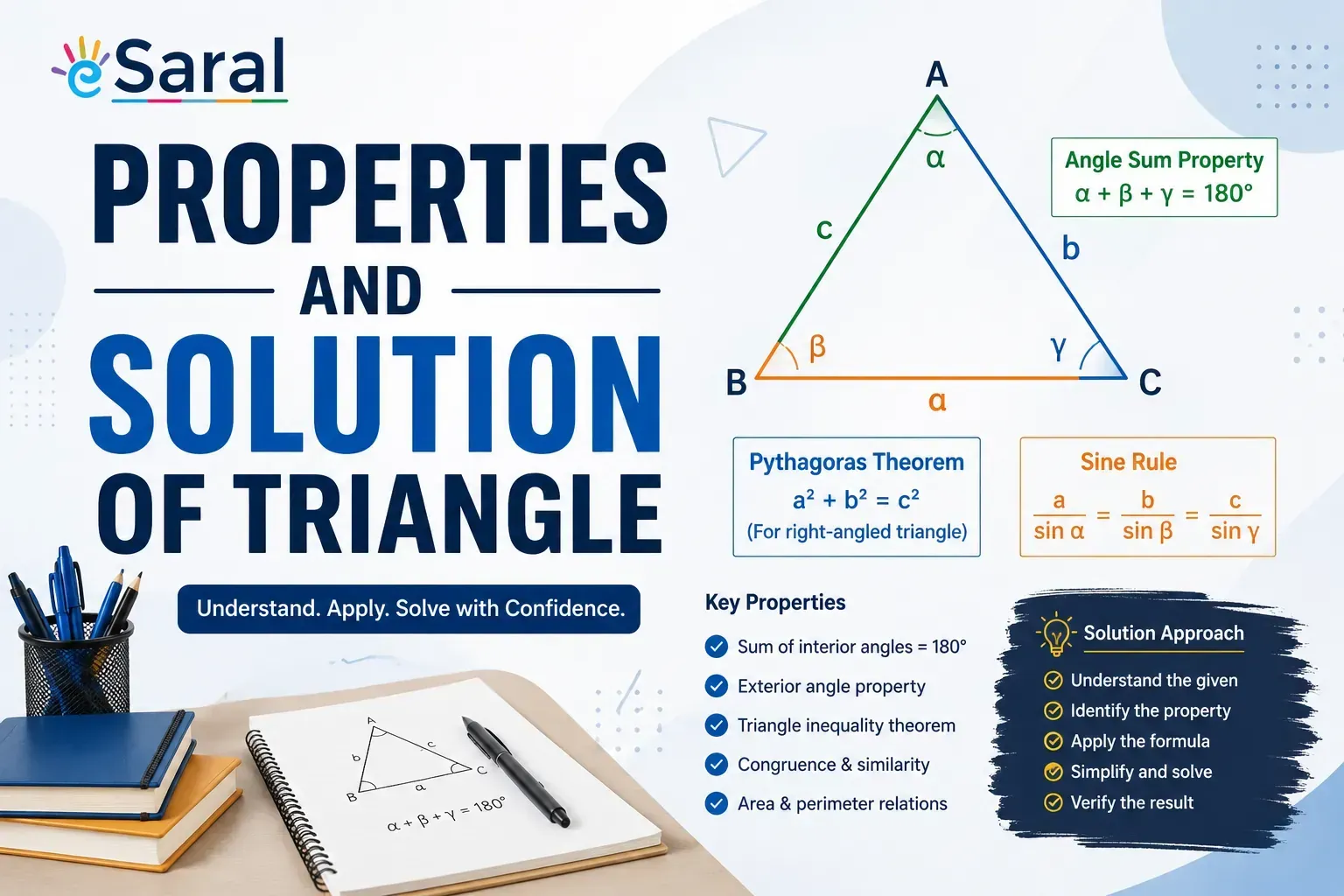
The solution of a triangle means finding its unknown sides and angles from the given ones, and the properties of a triangle give the formulas to do it. This page is a formula-based set of notes on the solution of triangle for JEE preparation, in the order of the topics. If your trigonometry basics are weak, first check the trigonometry formulas page, and read the next topic, heights and distances, after this one. This chapter is part of the JEE Advanced syllabus (relations between the sides and angles of a triangle, the sine rule, the cosine rule, the half-angle formula and the area of a triangle), so check the official syllabus of your exam for the topics that you need.
Notation for the Solution of Triangle
In a triangle ABC, $a$, $b$ and $c$ are the sides opposite to the angles $A$, $B$ and $C$.
Symbol | Meaning |
|---|---|
$s$ | Semi-perimeter, $s = \dfrac{a + b + c}{2}$ |
$\Delta$ | Area of the triangle |
$R$ | Circumradius |
$r$ | Inradius |
$r_1, r_2, r_3$ | Ex-radii (opposite to $A$, $B$, $C$) |
Properties and Solution of Triangle: Sine Rule
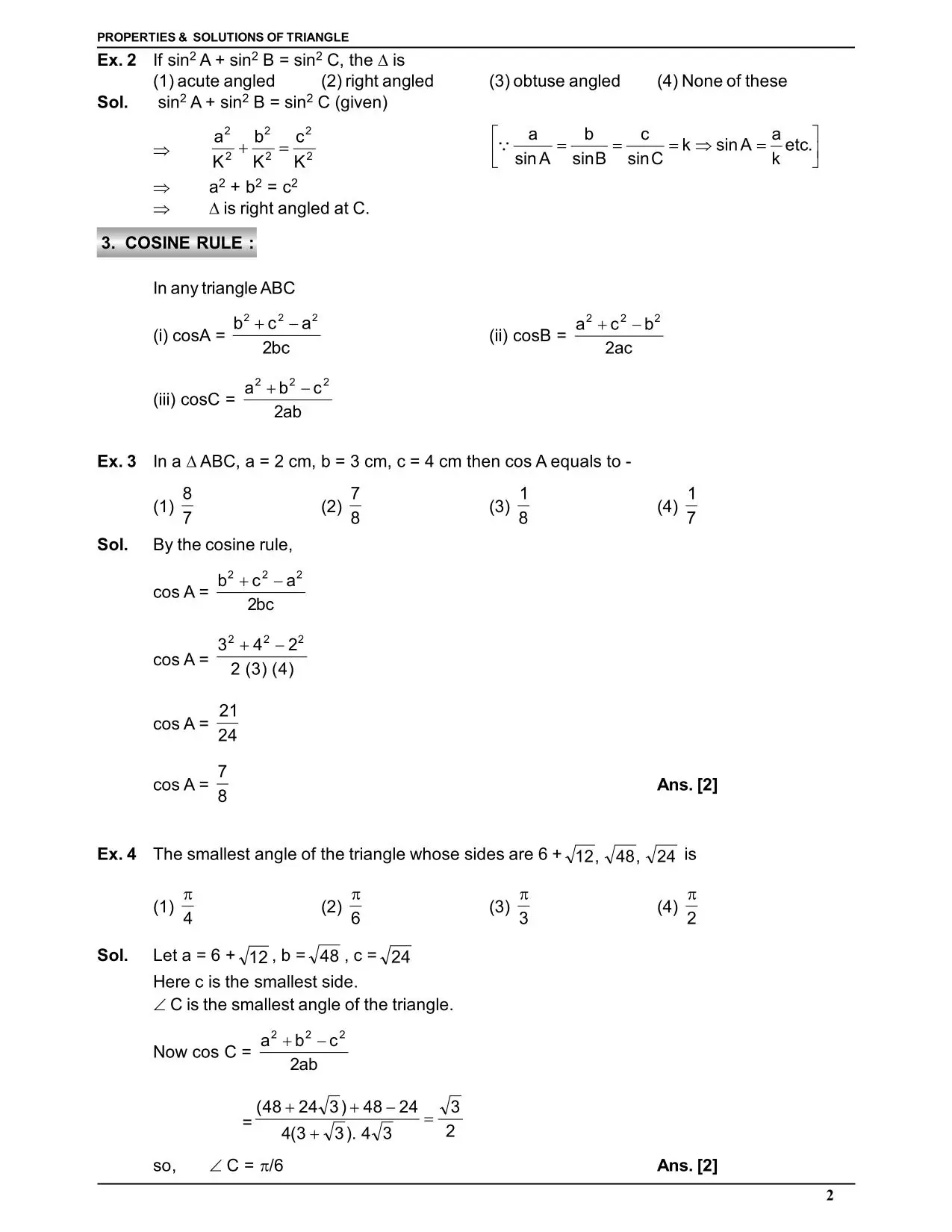
$$\frac{a}{\sin A} = \frac{b}{\sin B} = \frac{c}{\sin C} = 2R$$
So $a = 2R\sin A$, $b = 2R\sin B$ and $c = 2R\sin C$. Use the sine rule when you know a side and its opposite angle, or when $R$ is in the problem.
Properties and Solution of Triangle: Cosine Rule
$$a^2 = b^2 + c^2 - 2bc\cos A, \qquad \cos A = \frac{b^2 + c^2 - a^2}{2bc}$$
with similar results for $b^2$ and $c^2$. Use it for the SAS and SSS cases.
Properties and Solution of Triangle: Projection Formulas
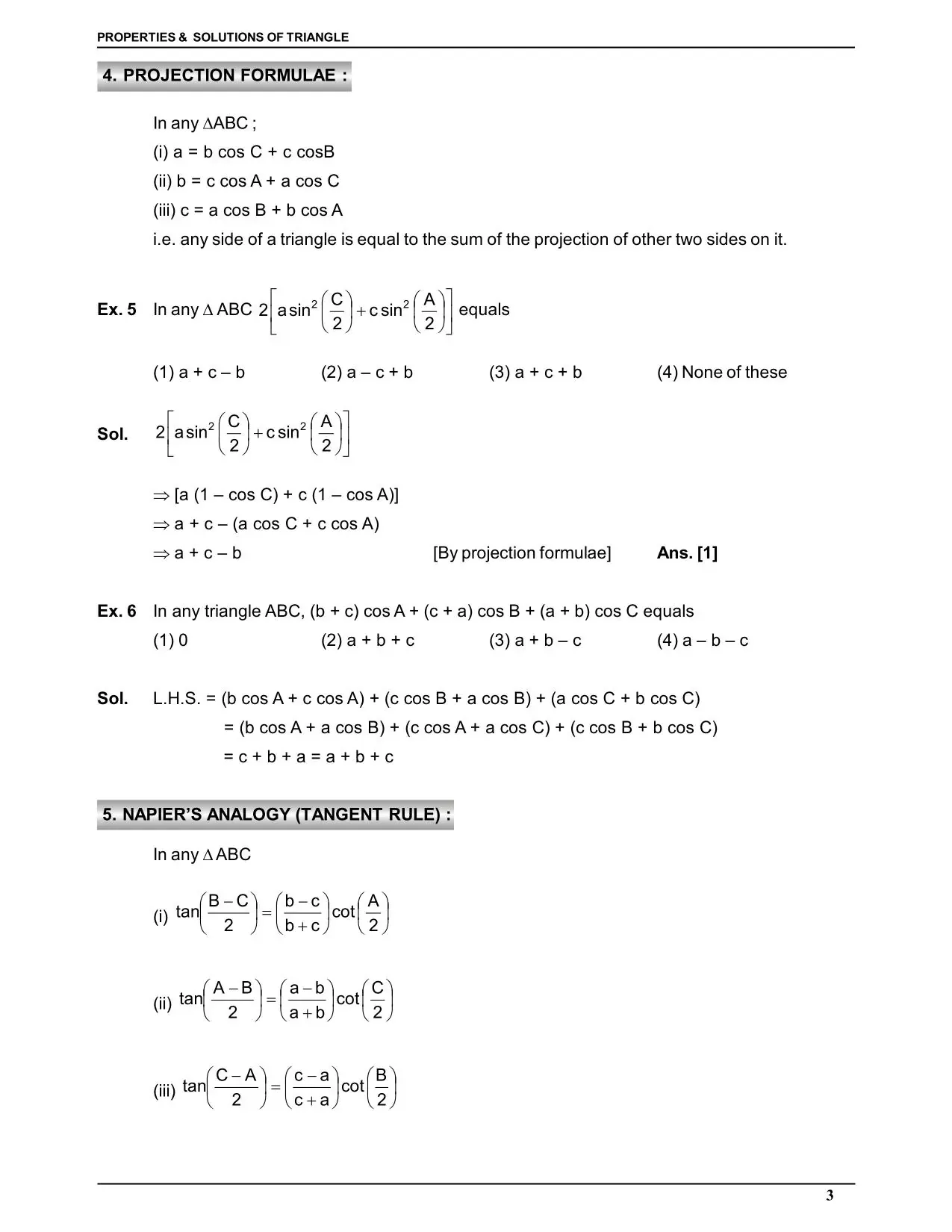
$$a = b\cos C + c\cos B, \qquad b = c\cos A + a\cos C, \qquad c = a\cos B + b\cos A$$
Properties and Solution of Triangle: Napier's Analogy (Tangent Rule)
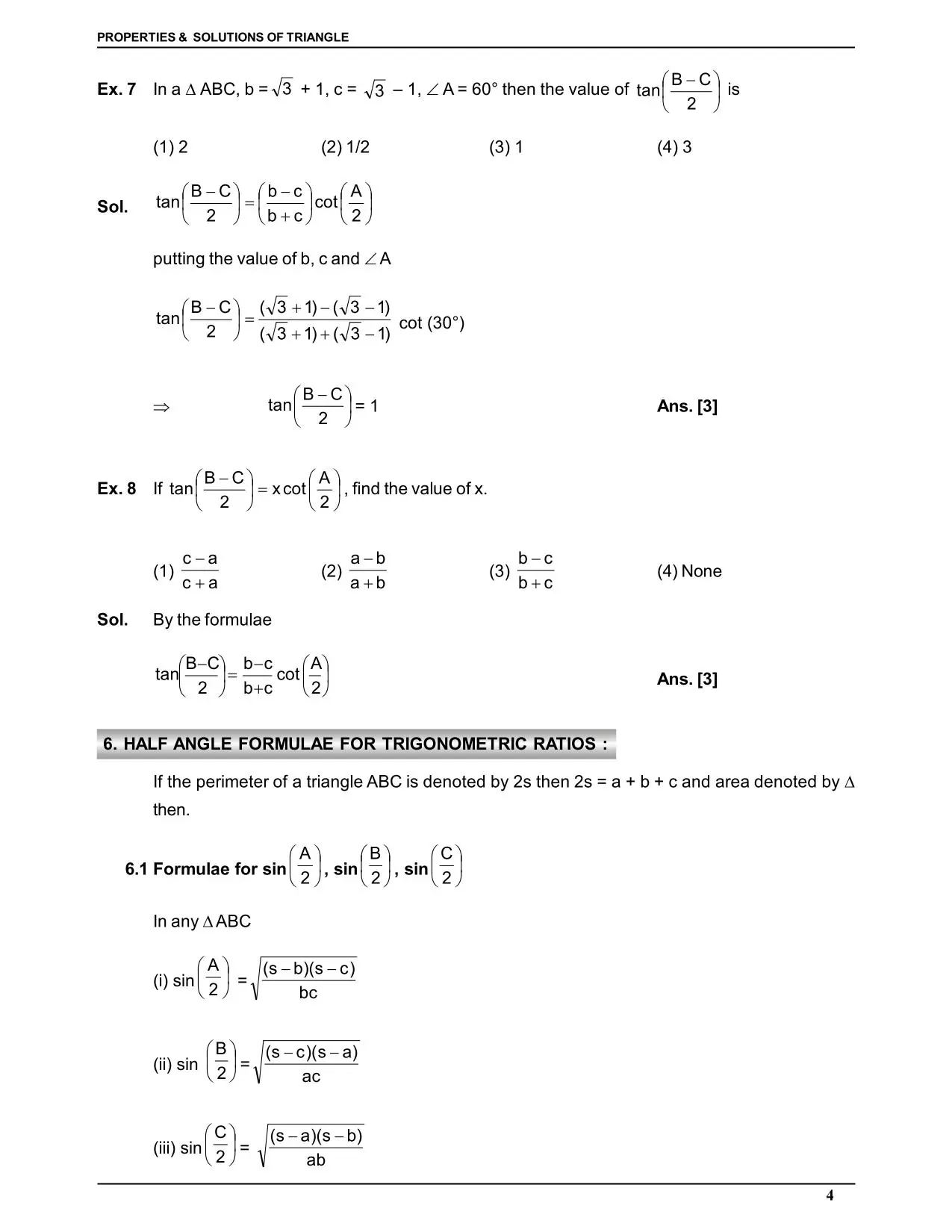
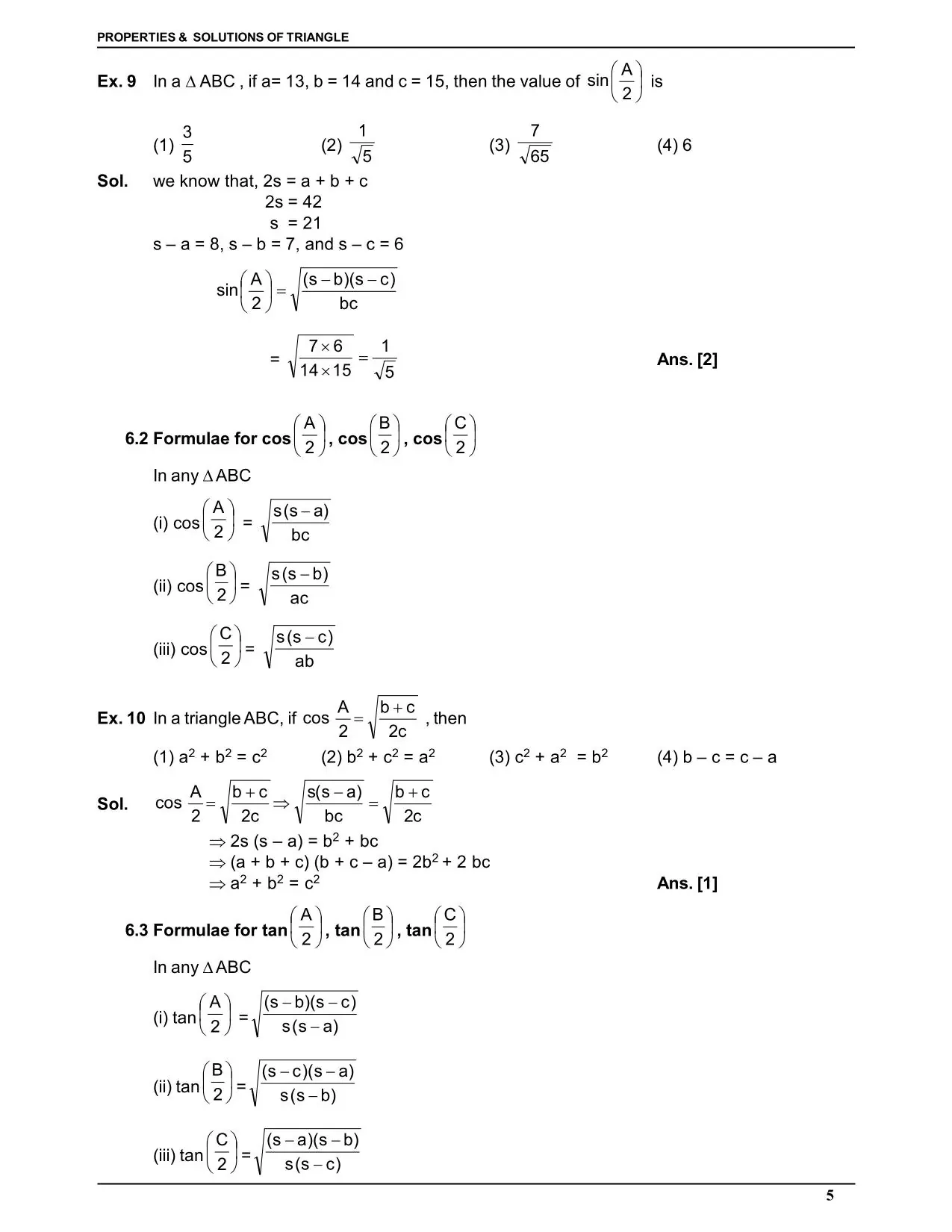
$$\tan\frac{B - C}{2} = \frac{b - c}{b + c}\cot\frac{A}{2}, \quad \tan\frac{C - A}{2} = \frac{c - a}{c + a}\cot\frac{B}{2}, \quad \tan\frac{A - B}{2} = \frac{a - b}{a + b}\cot\frac{C}{2}$$
Properties and Solution of Triangle: Half-Angle Formulas
$$\sin\frac{A}{2} = \sqrt{\frac{(s-b)(s-c)}{bc}}, \qquad \cos\frac{A}{2} = \sqrt{\frac{s(s-a)}{bc}}, \qquad \tan\frac{A}{2} = \sqrt{\frac{(s-b)(s-c)}{s(s-a)}} = \frac{\Delta}{s(s-a)}$$
Properties and Solution of Triangle: Area of a Triangle
Formula | When to use it |
|---|---|
$\Delta = \tfrac{1}{2}ab\sin C = \tfrac{1}{2}bc\sin A = \tfrac{1}{2}ca\sin B$ | Two sides and the included angle |
$\Delta = \sqrt{s(s-a)(s-b)(s-c)}$ (Heron's formula) | Three sides |
$\Delta = \dfrac{abc}{4R}$ | The circumradius is given |
$\Delta = rs$ | The inradius is given |
$\Delta = r_1(s - a) = r_2(s - b) = r_3(s - c)$ | An ex-radius is given |
Circumradius, Inradius and Ex-radii in the Solution of Triangle
Circumradius:
$$R = \frac{a}{2\sin A} = \frac{abc}{4\Delta}$$
Inradius:
$$r = \frac{\Delta}{s} = (s - a)\tan\frac{A}{2} = 4R\sin\frac{A}{2}\sin\frac{B}{2}\sin\frac{C}{2}$$
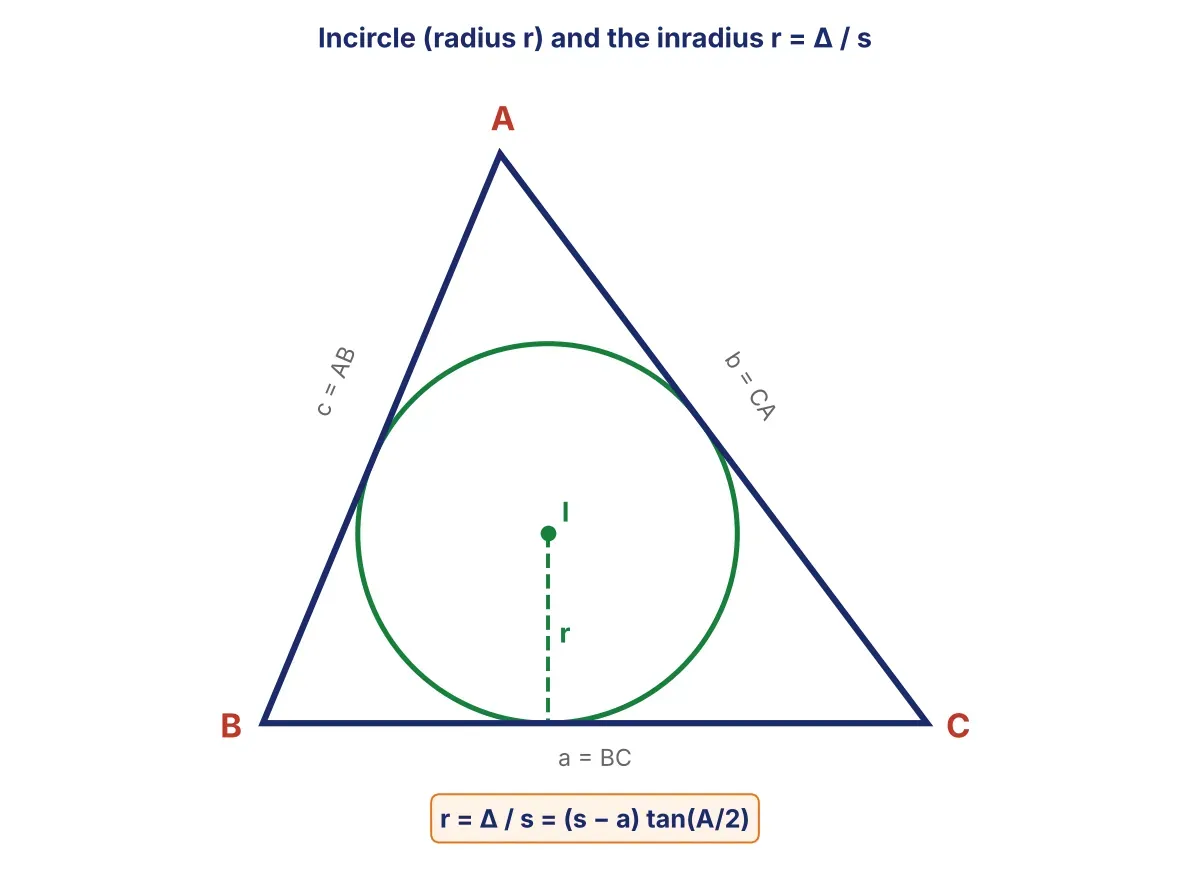
Ex-radii (the radius of the excircle opposite to A):
$$r_1 = \frac{\Delta}{s - a} = s\tan\frac{A}{2} = 4R\sin\frac{A}{2}\cos\frac{B}{2}\cos\frac{C}{2}$$
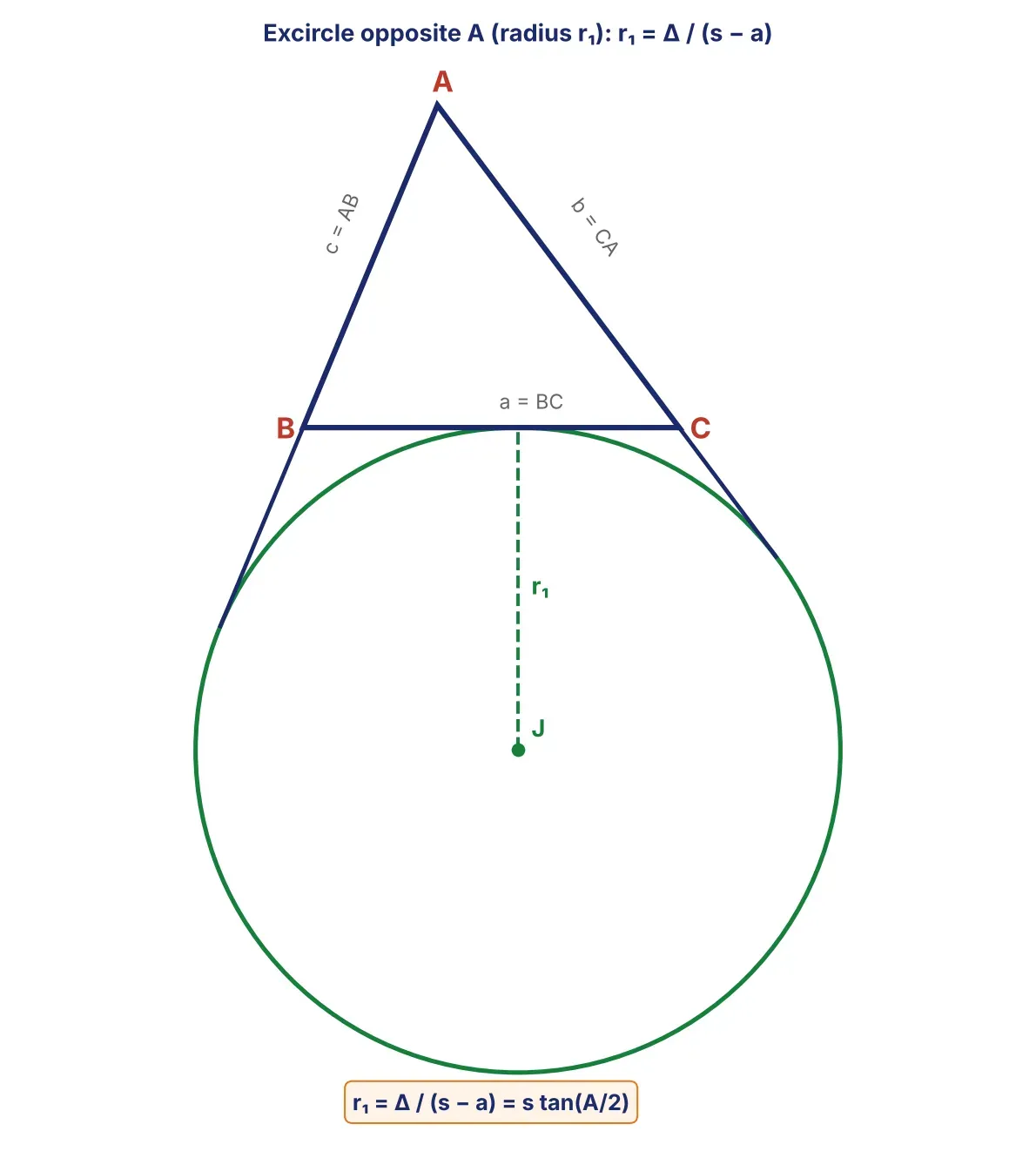
Important identities:
$$r_1 + r_2 + r_3 - r = 4R, \qquad \frac{1}{r} = \frac{1}{r_1} + \frac{1}{r_2} + \frac{1}{r_3}$$ $$r_1r_2 + r_2r_3 + r_3r_1 = s^2, \qquad r\,r_1r_2r_3 = \Delta^2, \qquad R \geq 2r$$
How to Solve a Triangle: The Four Cases
Given | Method |
|---|---|
SSS (three sides) | Find the angles by the cosine rule or the half-angle formulas |
SAS (two sides and the included angle) | Find the third side by the cosine rule, then the angles by the sine rule or Napier's analogy |
ASA or AAS (two angles and a side) | Find the third angle ($180^\circ - A - B$), then the other sides by the sine rule |
SSA (two sides and a non-included angle) | Use the sine rule to find $\sin B$. There can be 0, 1 or 2 triangles |
Solved Examples on the Solution of Triangle
Example 1: All the elements of a 13-14-15 triangle
Find $\Delta$, $R$, $r$ and the ex-radii of a triangle with $a = 14$, $b = 15$, $c = 13$.
$$s = \frac{14 + 15 + 13}{2} = 21, \qquad \Delta = \sqrt{21\times 7\times 6\times 8} = \sqrt{7056} = 84$$ $$R = \frac{abc}{4\Delta} = \frac{14\times 15\times 13}{4\times 84} = 8.125, \qquad r = \frac{\Delta}{s} = \frac{84}{21} = 4$$ $$r_1 = \frac{84}{7} = 12, \qquad r_2 = \frac{84}{6} = 14, \qquad r_3 = \frac{84}{8} = 10.5$$
Check: $r_1 + r_2 + r_3 - r = 12 + 14 + 10.5 - 4 = 32.5 = 4R$.
Example 2: An angle from three sides
In a triangle with $a = 7$, $b = 8$, $c = 9$, find $\cos A$.
$$\cos A = \frac{b^2 + c^2 - a^2}{2bc} = \frac{64 + 81 - 49}{2\times 8\times 9} = \frac{96}{144} = \frac{2}{3}$$
Example 3: A side from two angles and a side
In a triangle, $A = 30^\circ$, $B = 45^\circ$ and $a = 10$. Find $b$.
$$b = \frac{a\sin B}{\sin A} = \frac{10\times\sin 45^\circ}{\sin 30^\circ} = \frac{10\times 0.7071}{0.5} = 10\sqrt{2} \approx 14.14$$
Example 4: A right triangle and an equilateral triangle
For a right triangle with sides 3, 4 and 5, $R = \dfrac{5}{2} = 2.5$ (half the hypotenuse) and $r = \dfrac{3 + 4 - 5}{2} = 1$. For an equilateral triangle of side $a$, $R = \dfrac{a}{\sqrt{3}}$ and $r = \dfrac{a}{2\sqrt{3}}$, so $R = 2r$, which is the case of equality in $R \geq 2r$.
Common Mistakes in the Solution of Triangle
Mistake | Correct approach |
|---|---|
Writing Heron's formula as $\sqrt{s}(s-a)(s-b)(s-c)$ | The root covers all four factors: $\sqrt{s(s-a)(s-b)(s-c)}$ |
Using $R = \dfrac{abc}{4\Delta}$ with the wrong area | First find $\Delta$ (Heron's formula or $\tfrac{1}{2}ab\sin C$), then $R$ |
Mixing up the ex-radius formulas | $r_1$ is opposite to $A$ and equals $\dfrac{\Delta}{s - a}$. The letter in the bracket matches the side |
Ignoring the second triangle in the SSA case | Check whether $180^\circ - B$ also works |
Using the sine rule when the cosine rule is needed | For SSS and SAS (where no side and its opposite angle are known), start with the cosine rule |
Forgetting that $s$ is the semi-perimeter | $s = \dfrac{a + b + c}{2}$, and not $a + b + c$ |
More Notes for JEE Maths
For the full list of formulas, see eSaral's trigonometry formulas for Class 11, and the Class 12 Maths notes for JEE. For free video lectures and study material, download the eSaral app.
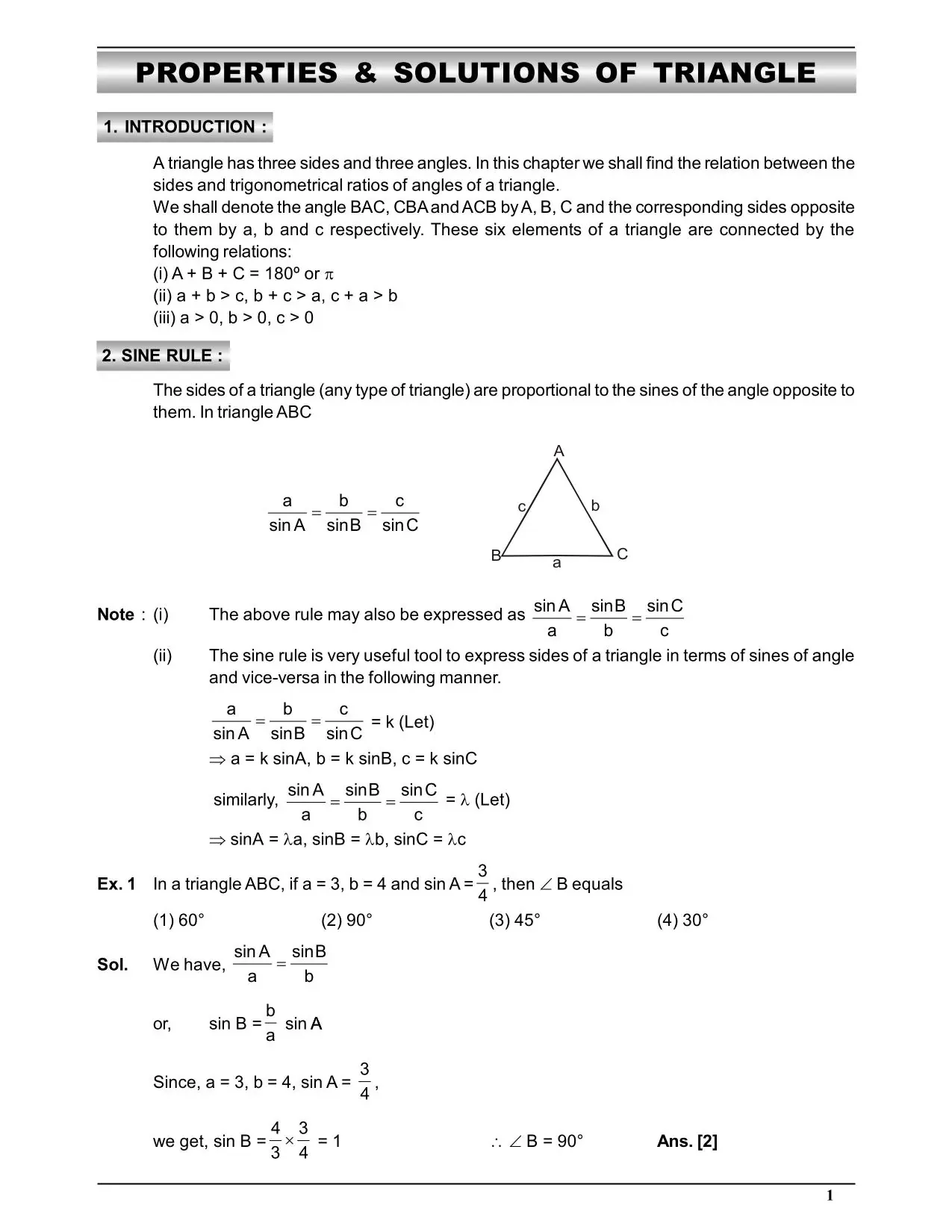
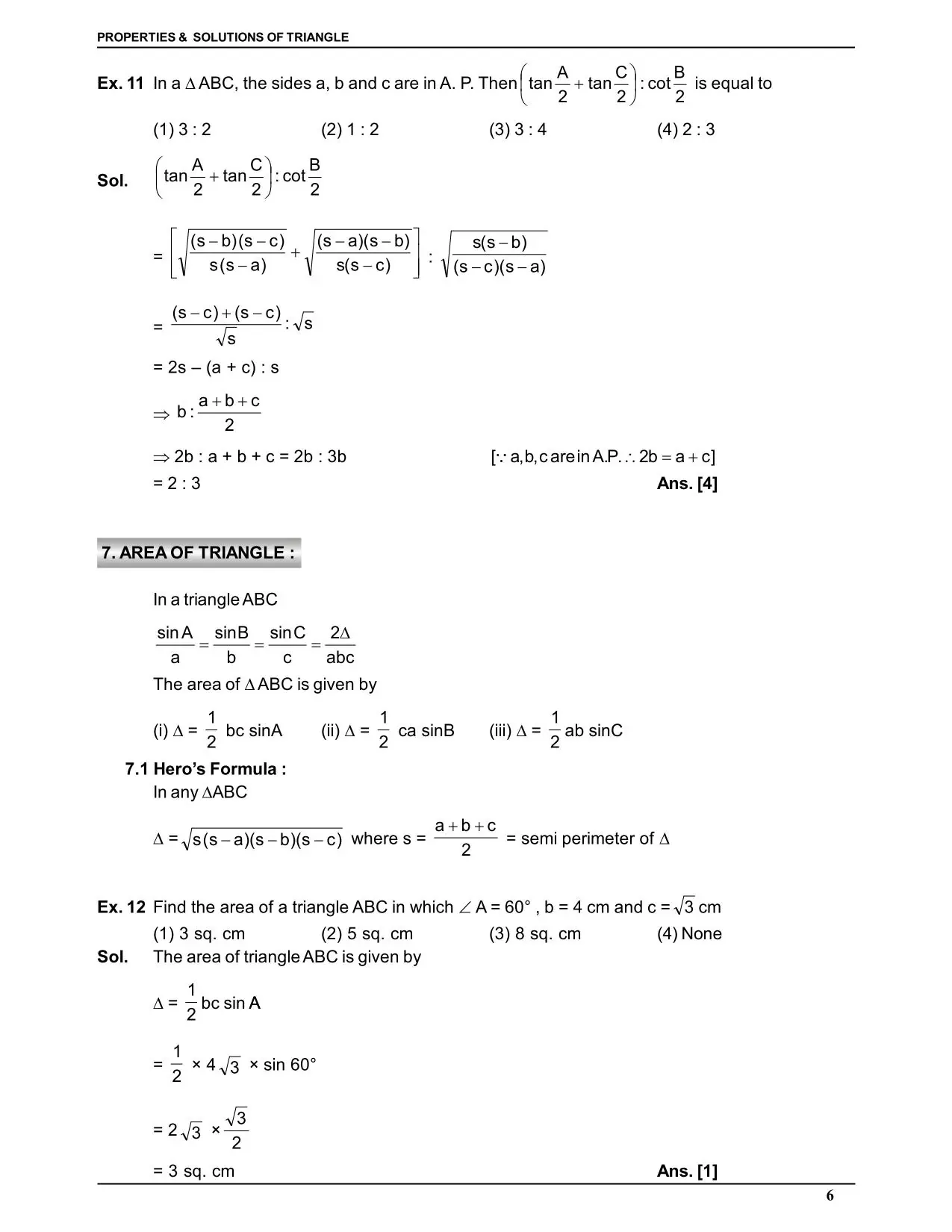
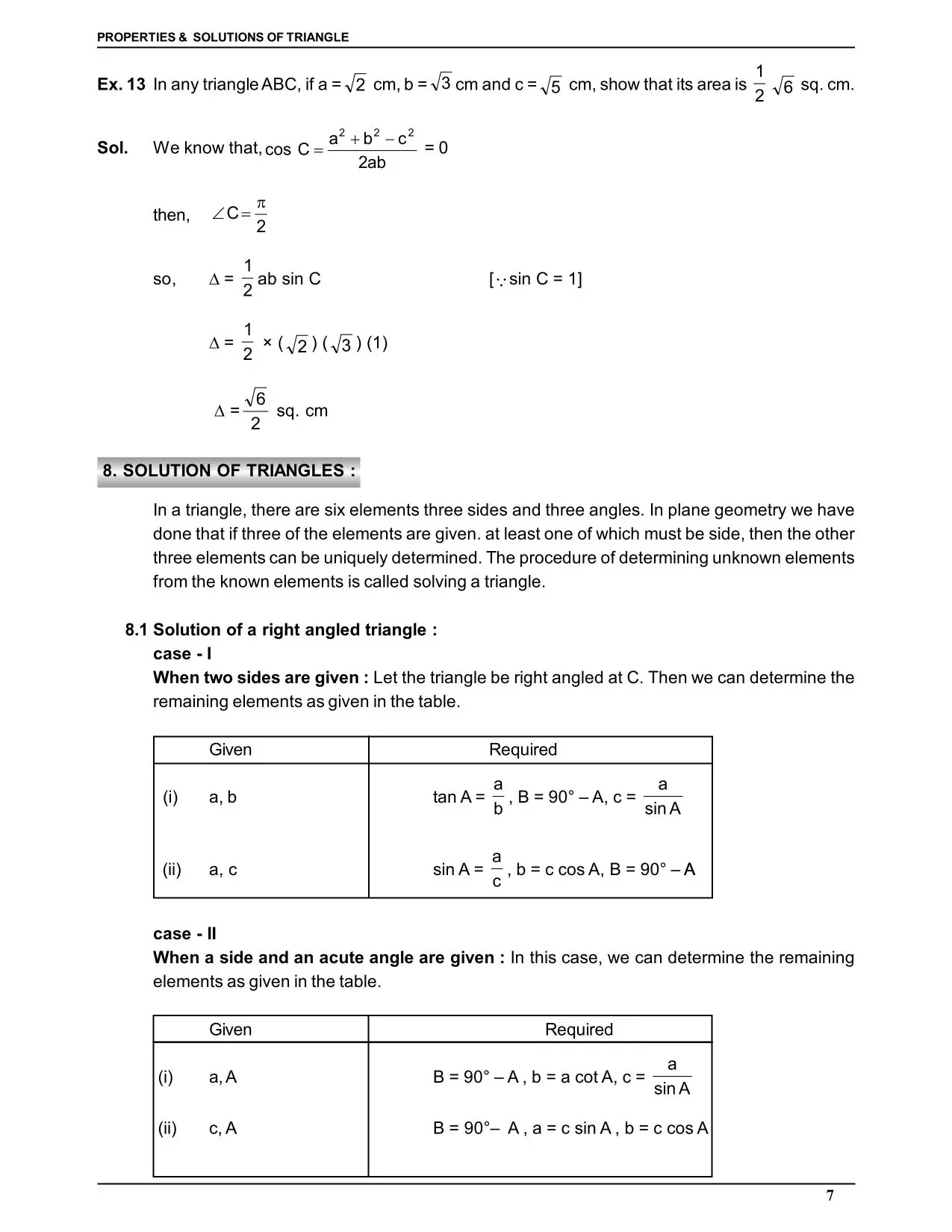
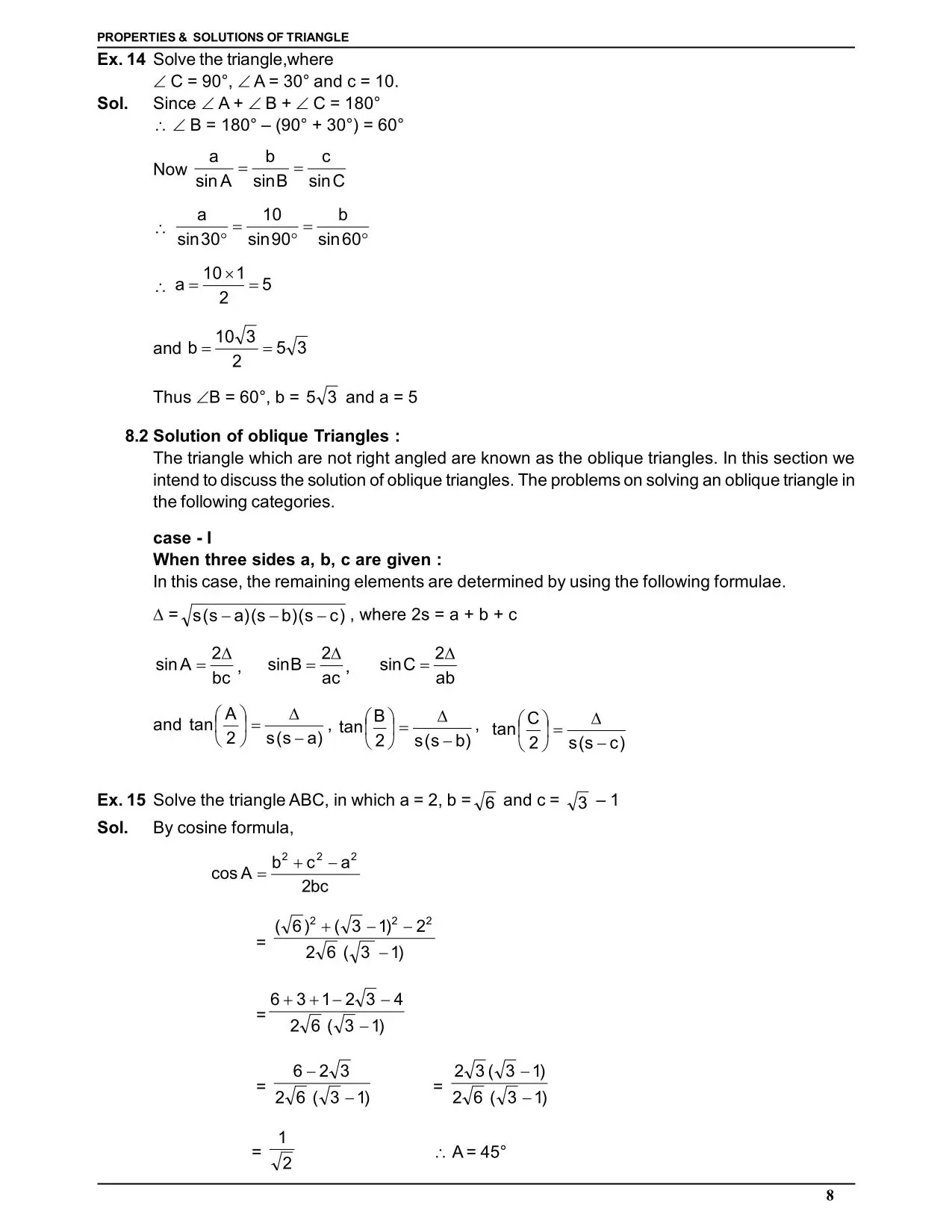
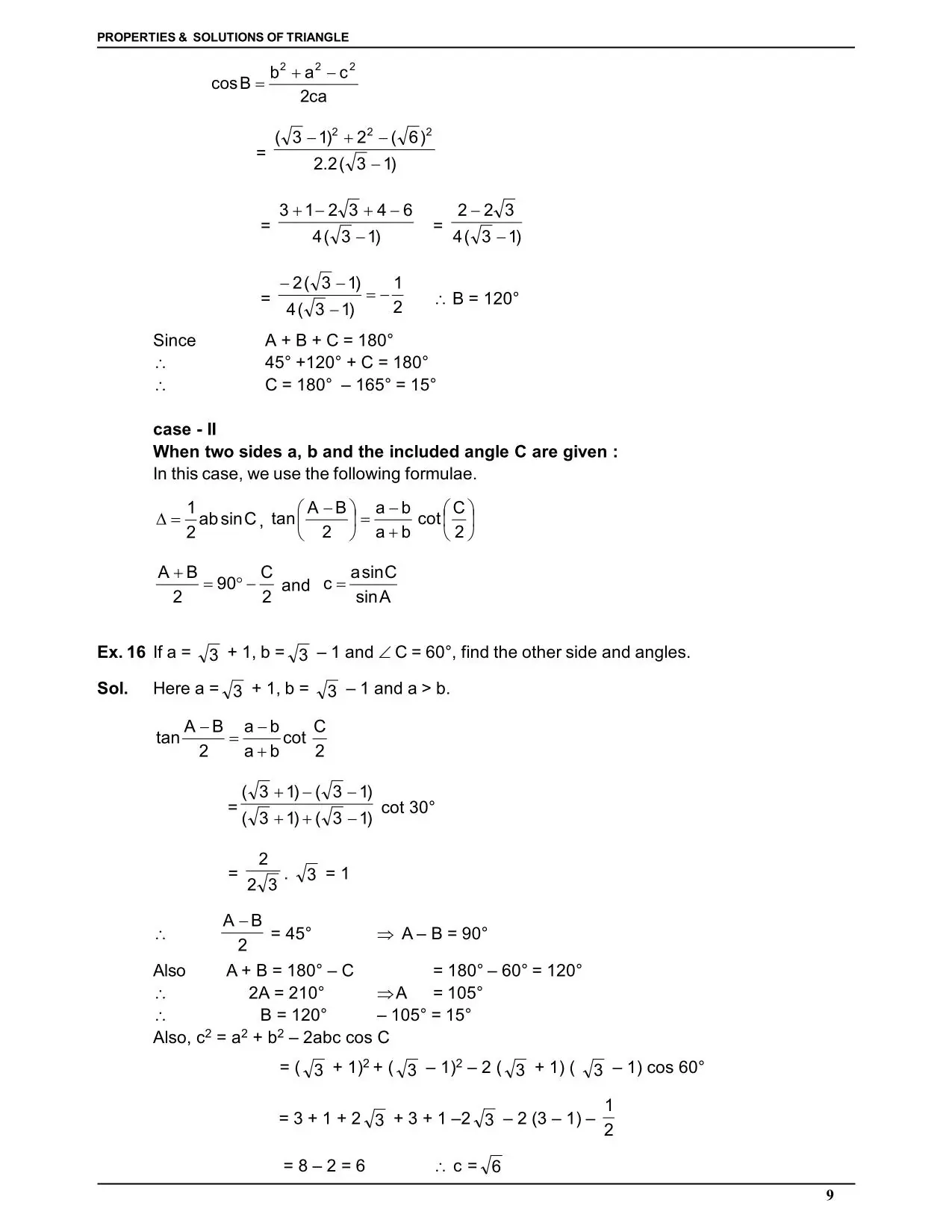
Handwritten Notes on the Properties and Solution of Triangle
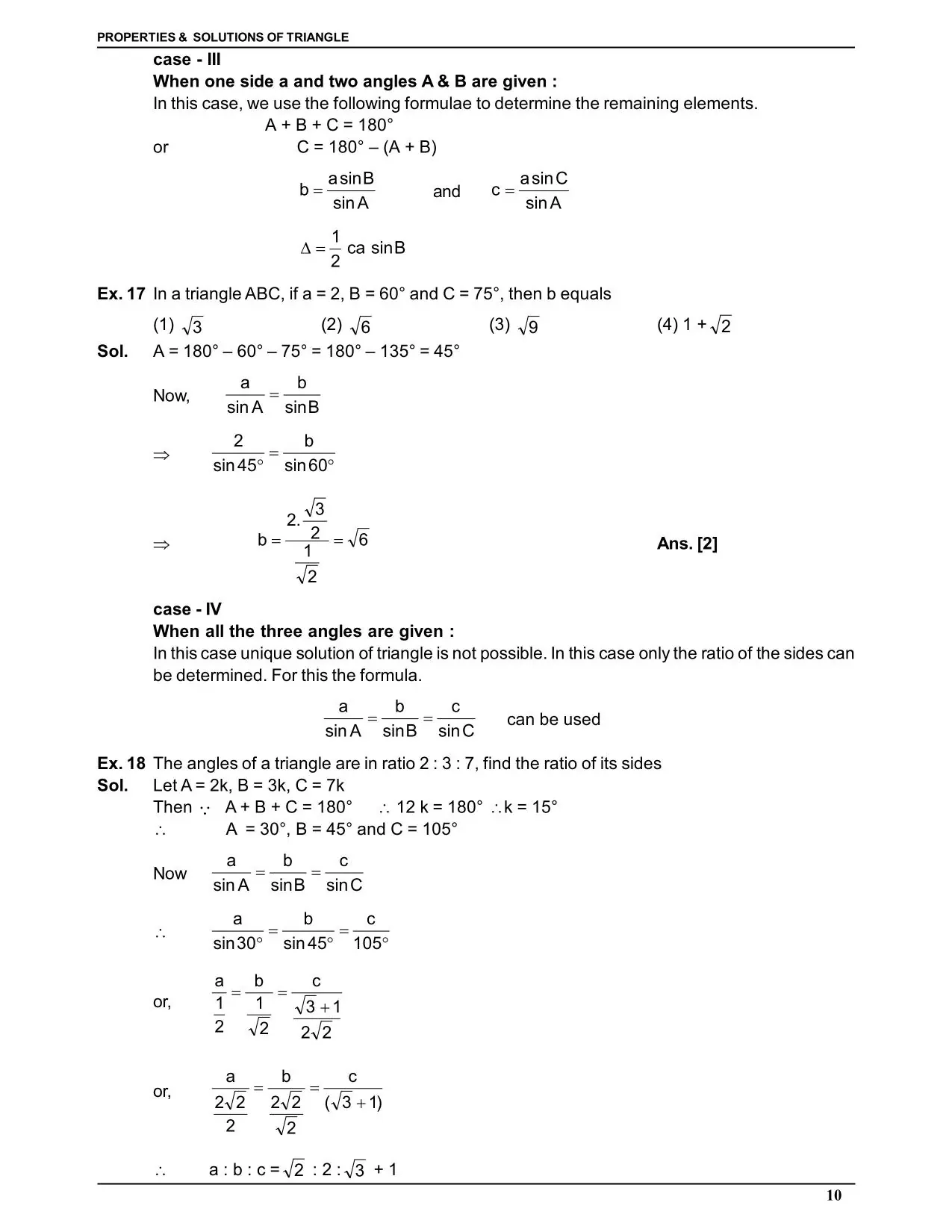
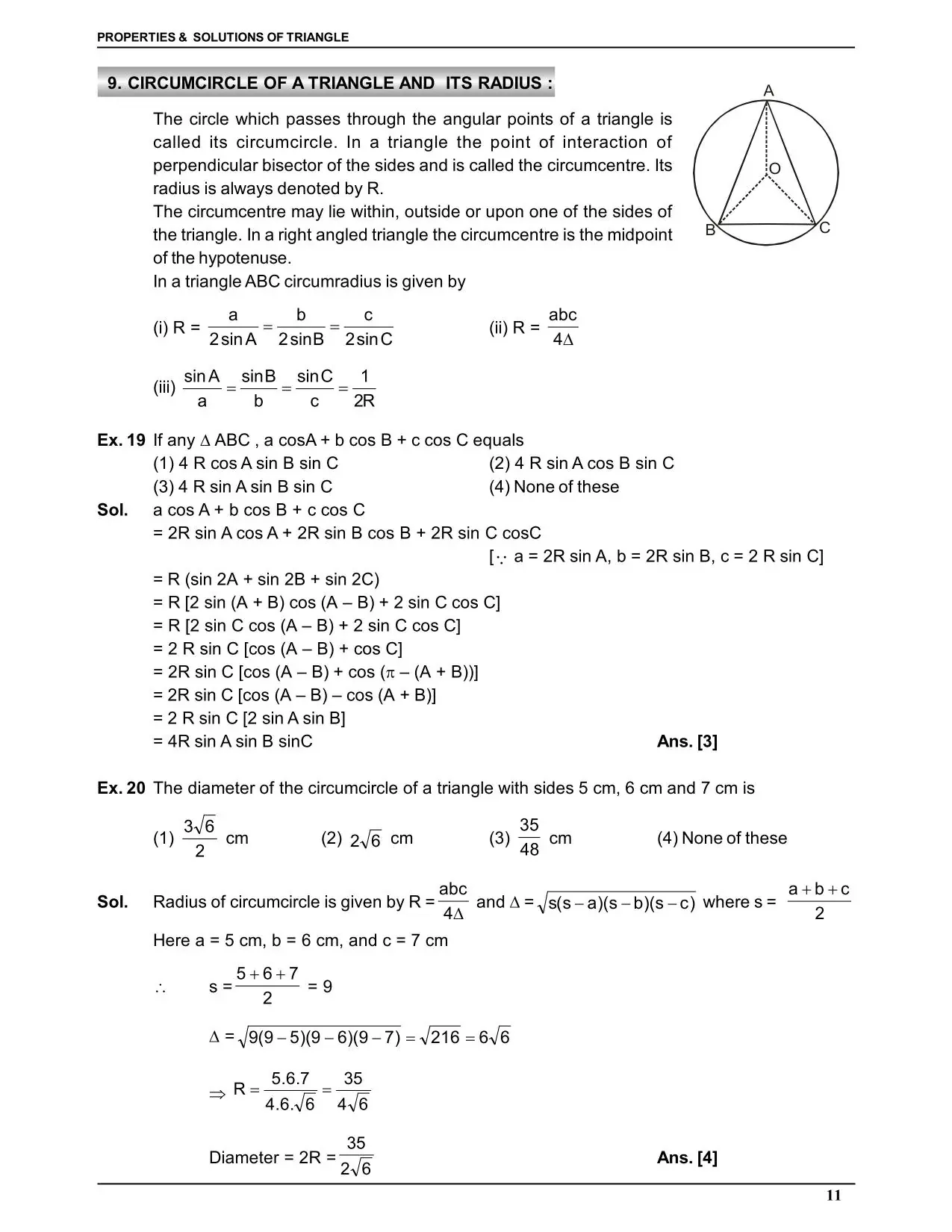
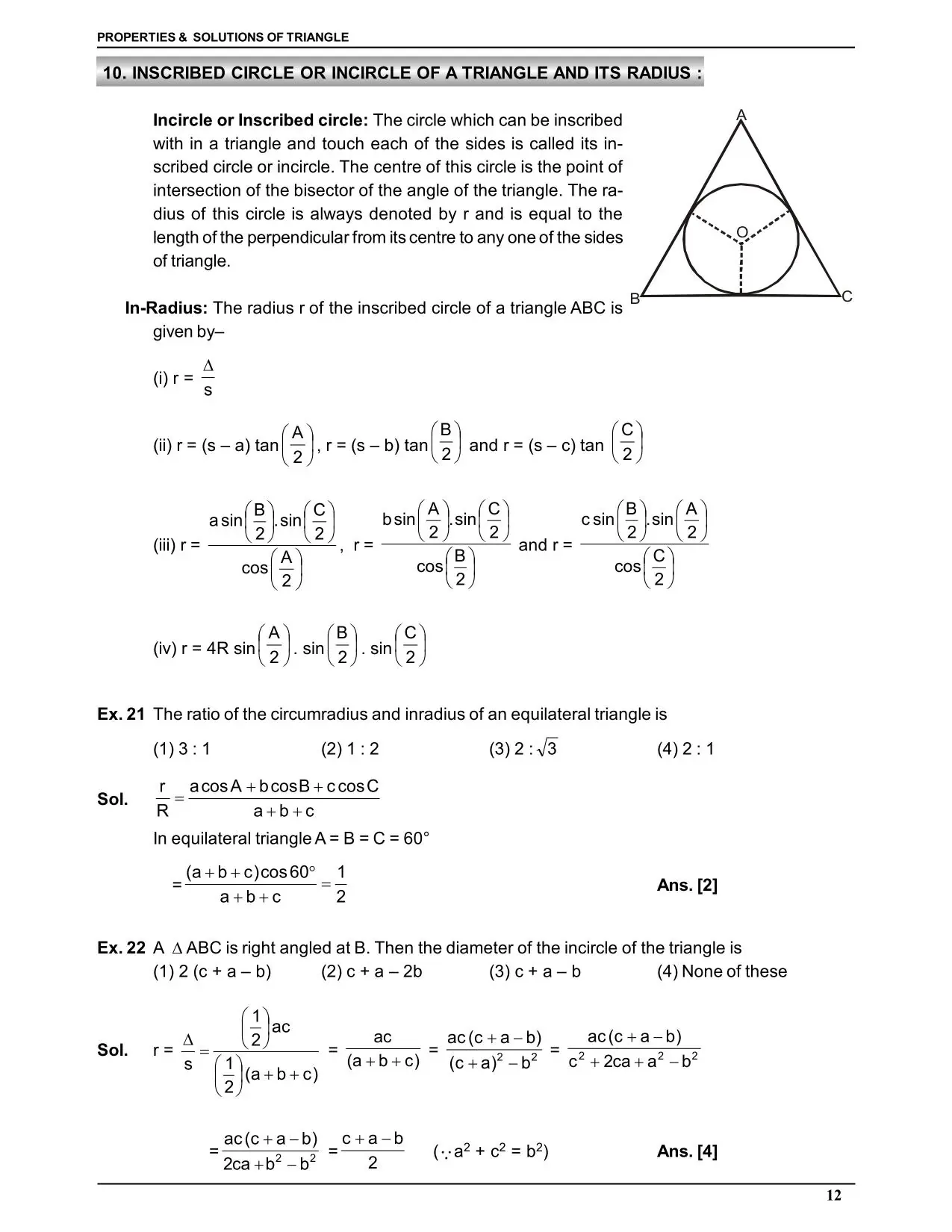
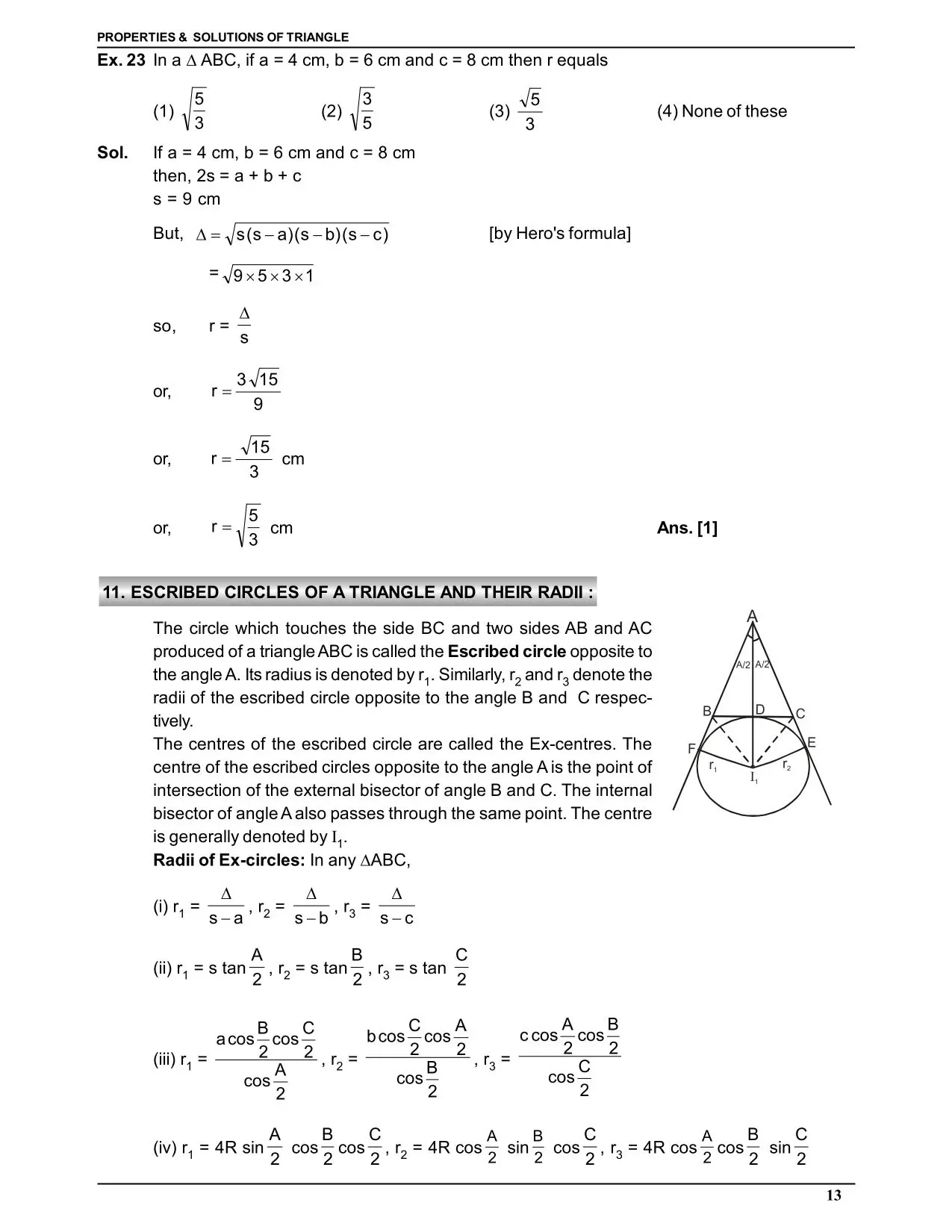
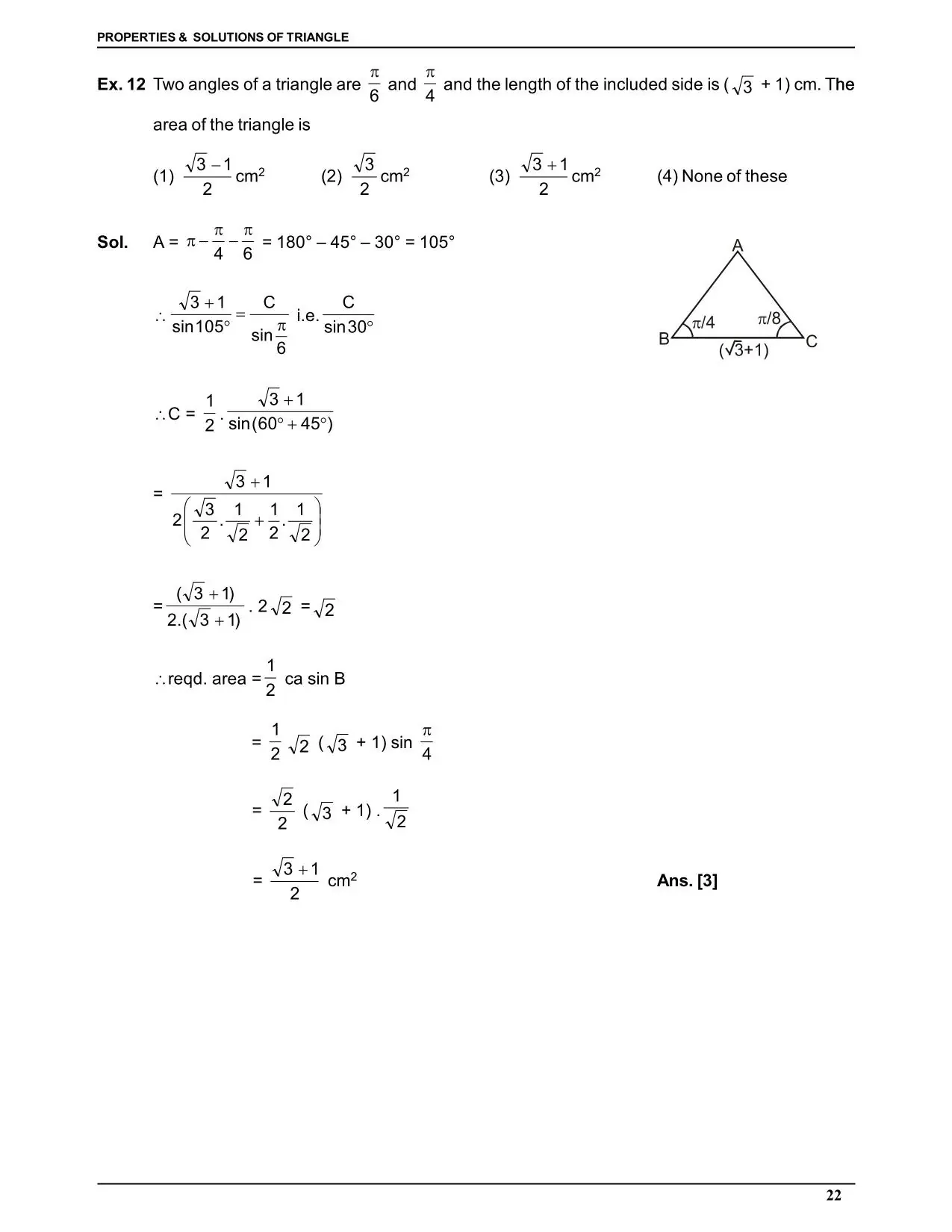
These are eSaral's handwritten notes on the chapter, as images.
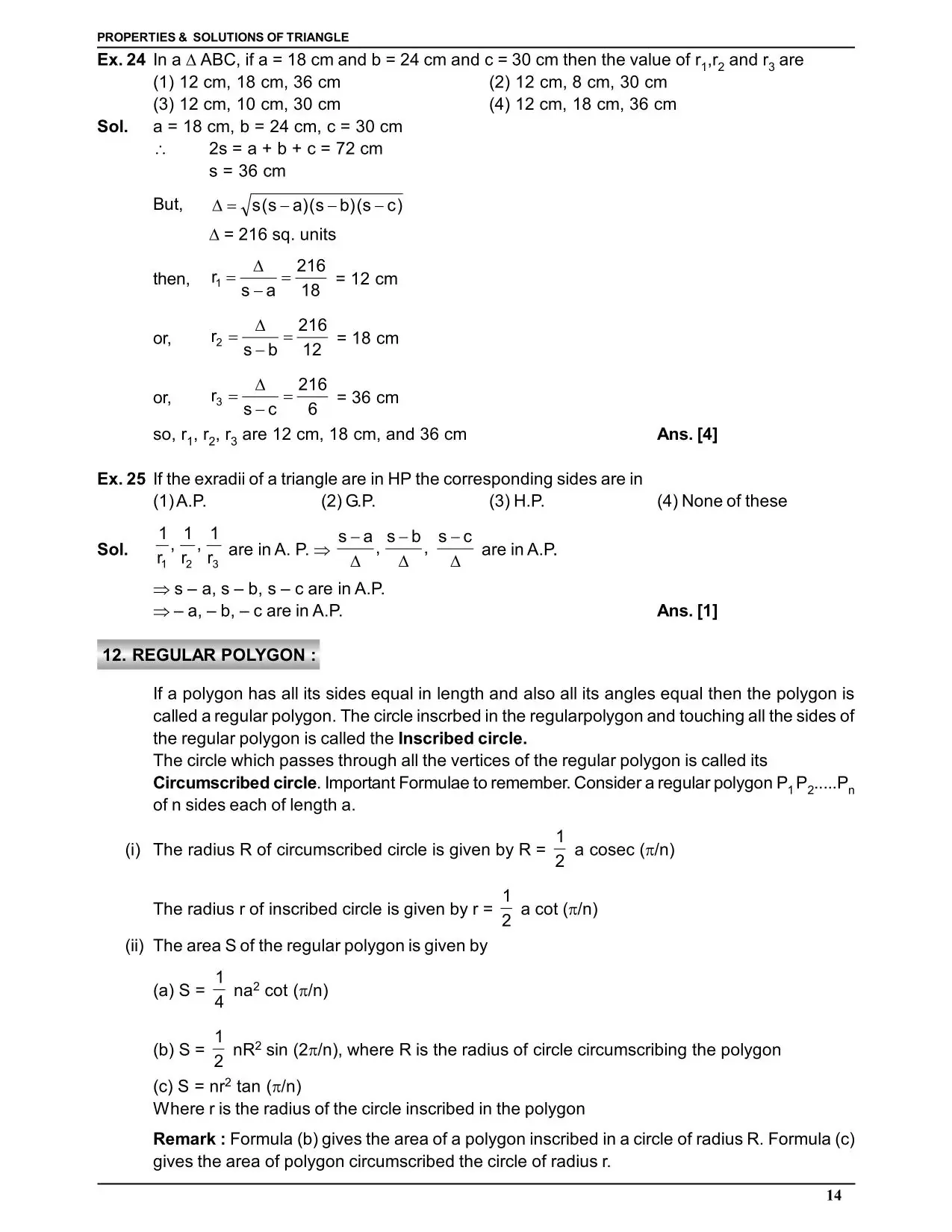
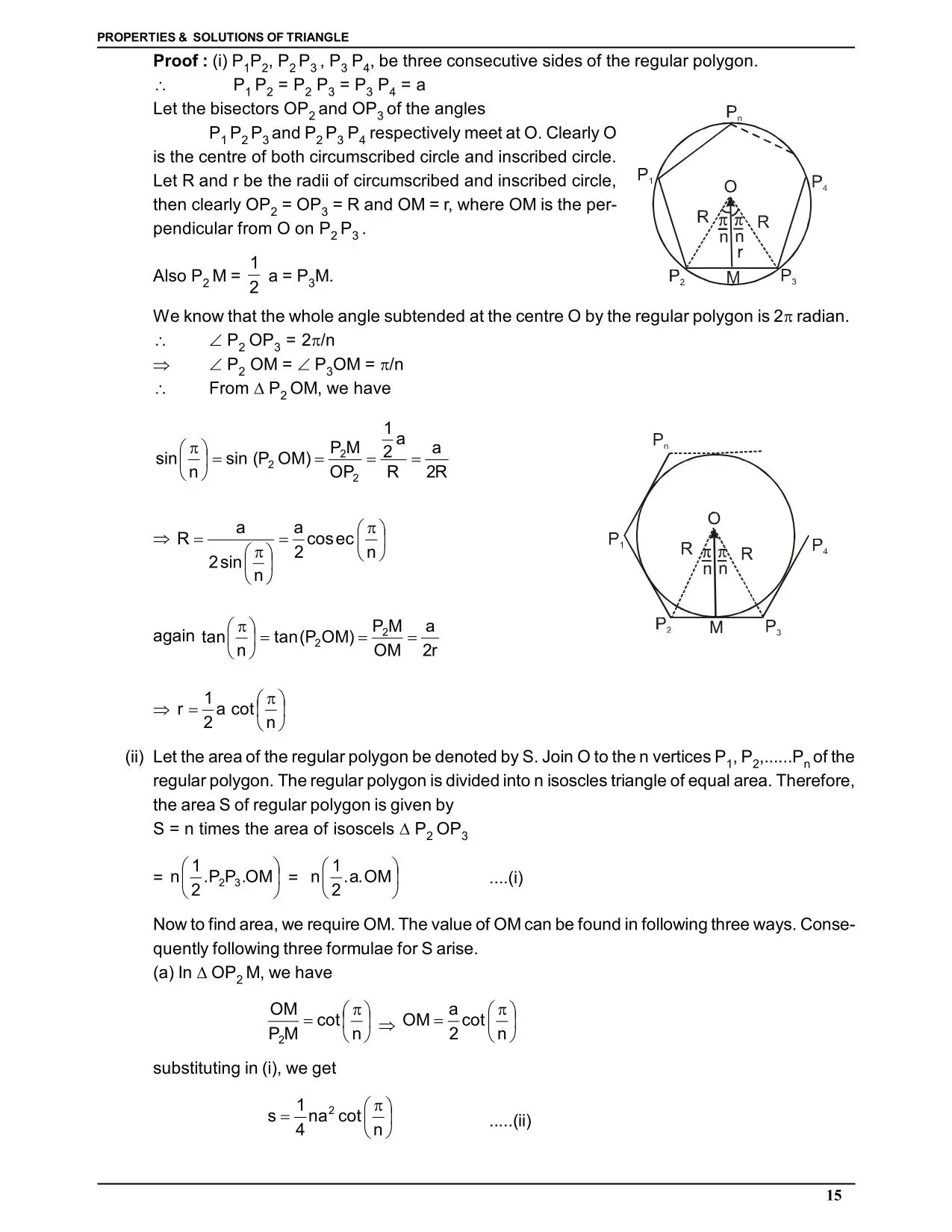
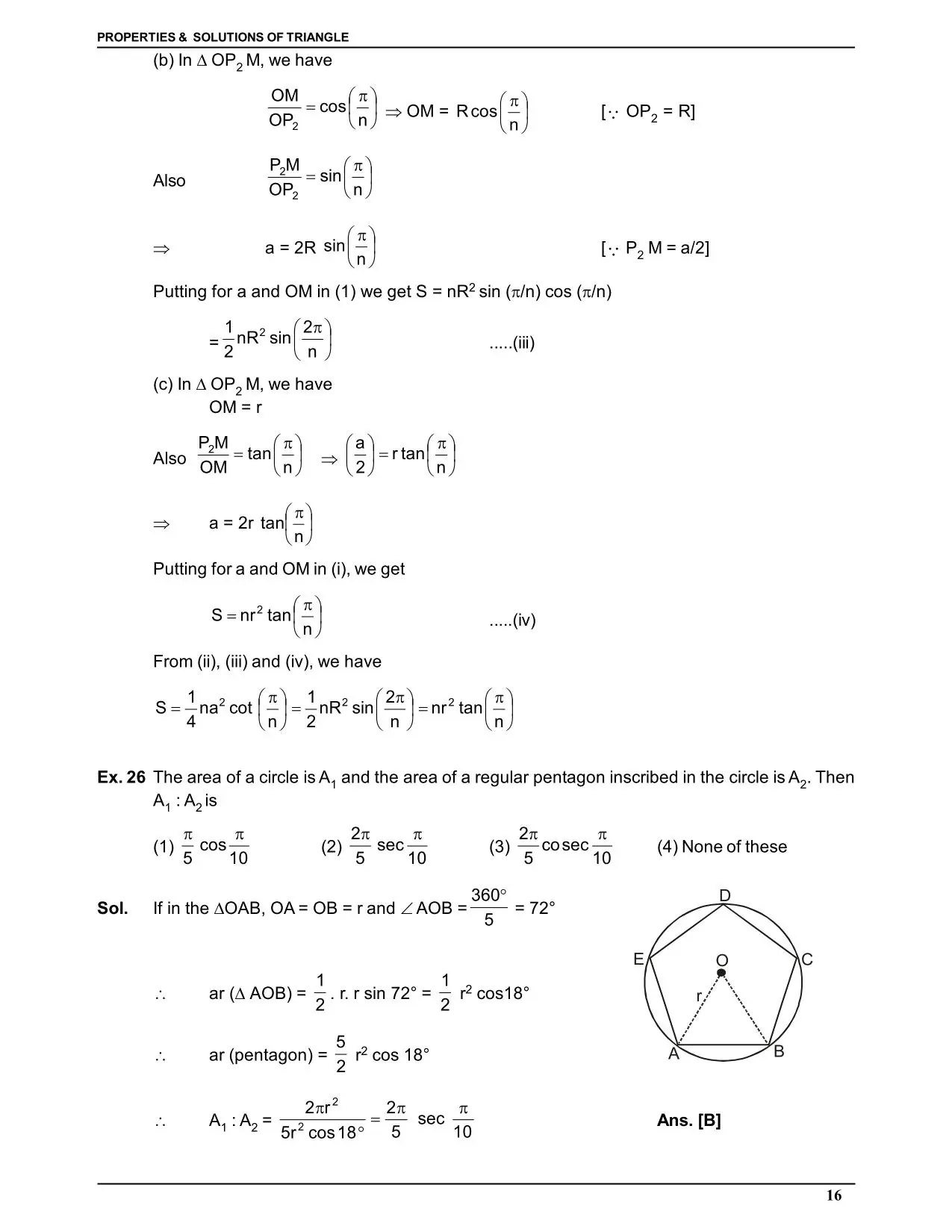
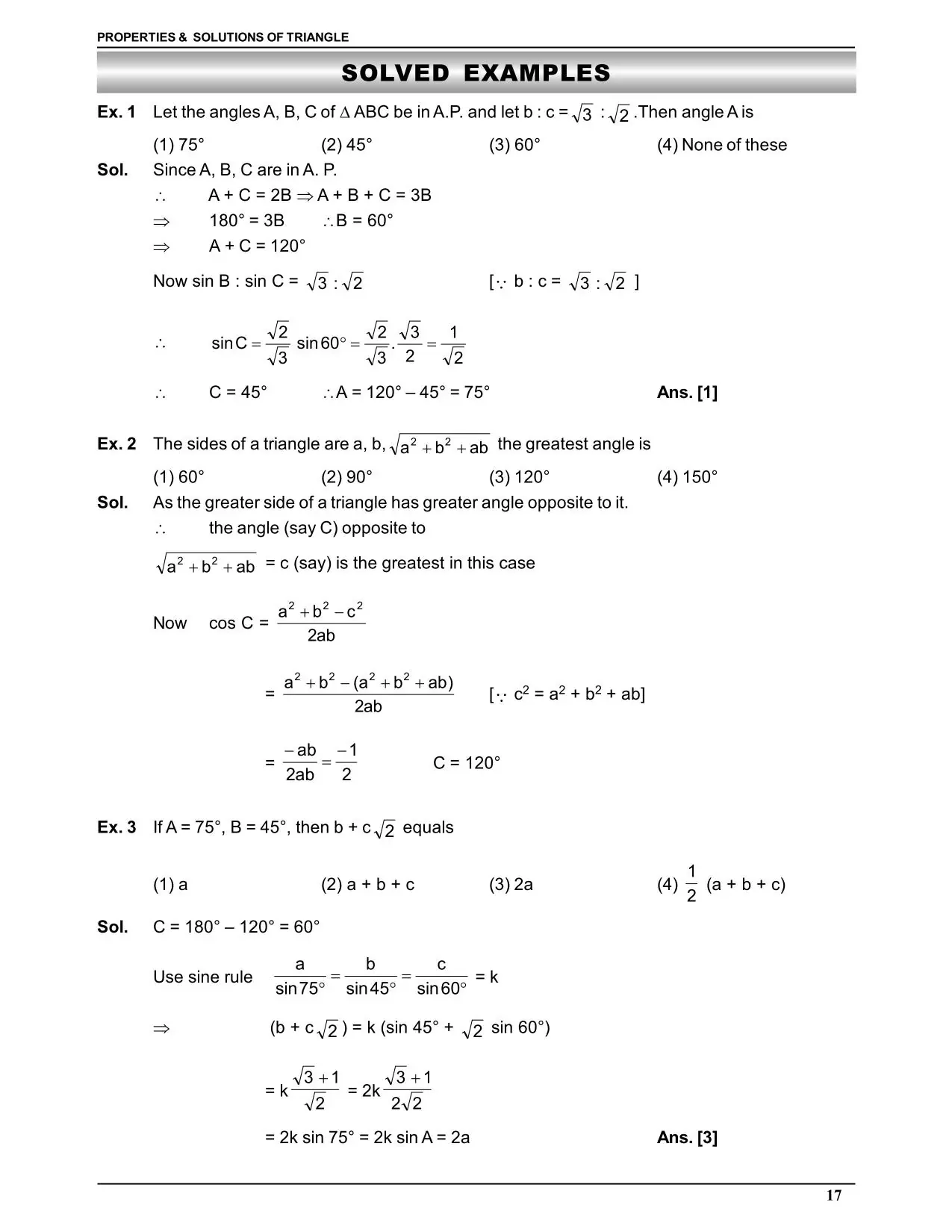
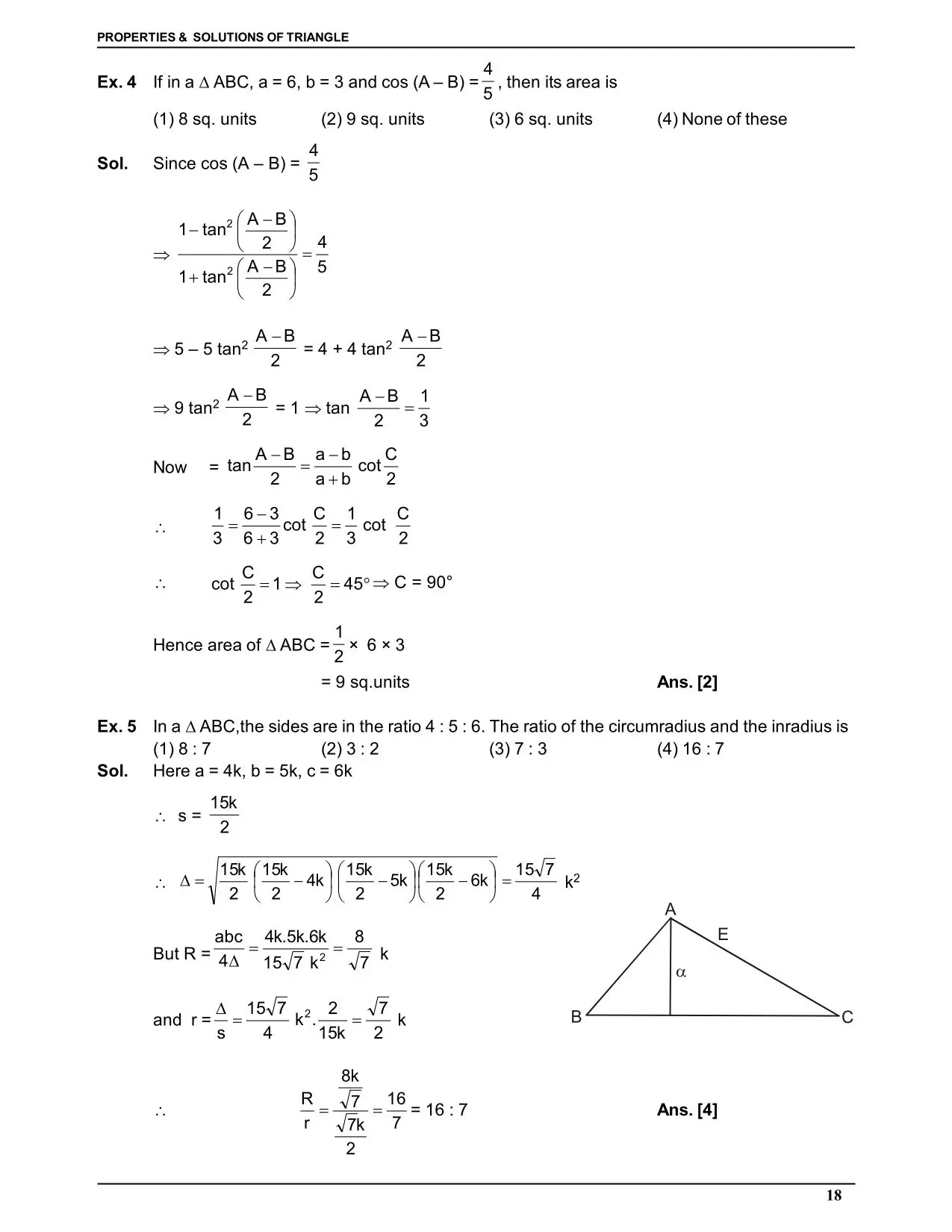
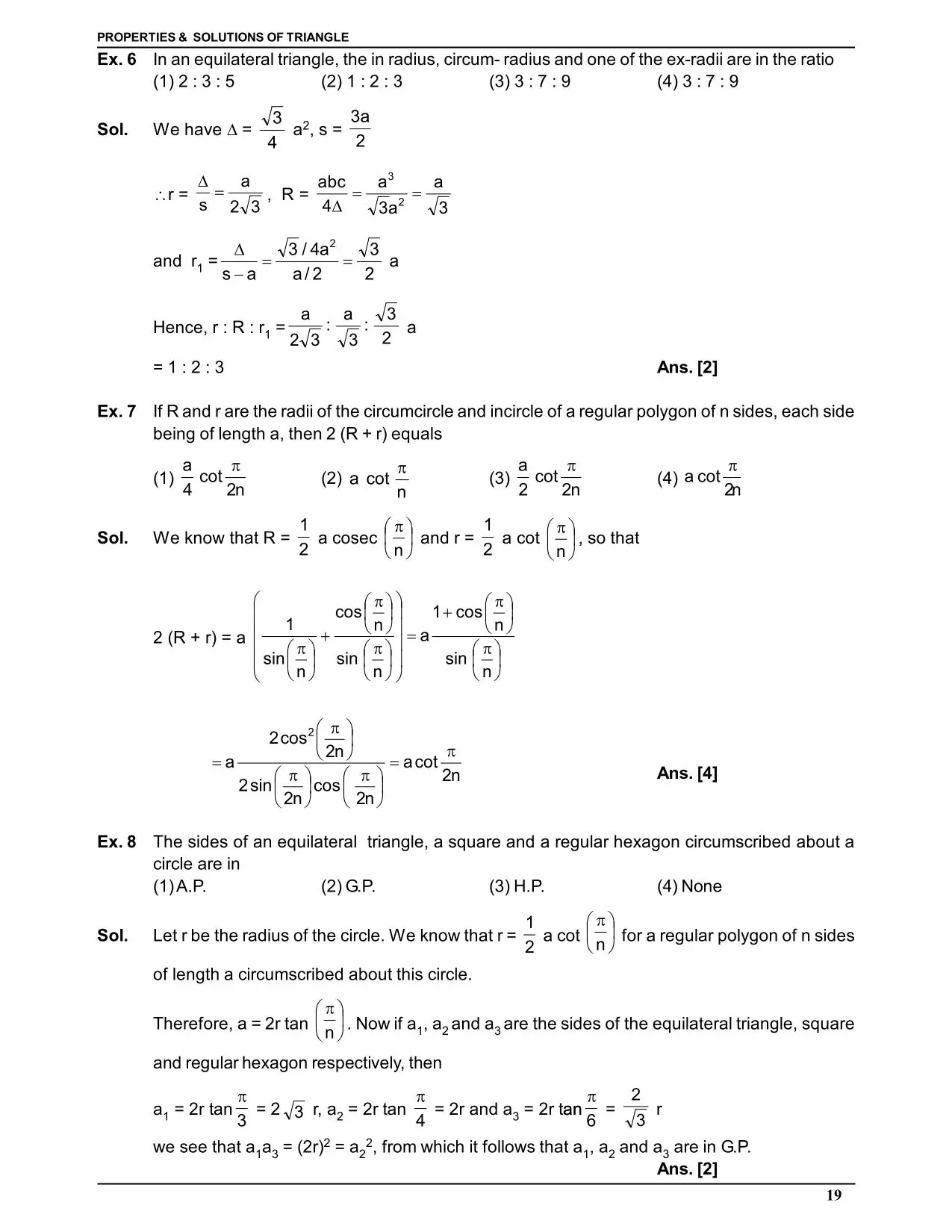
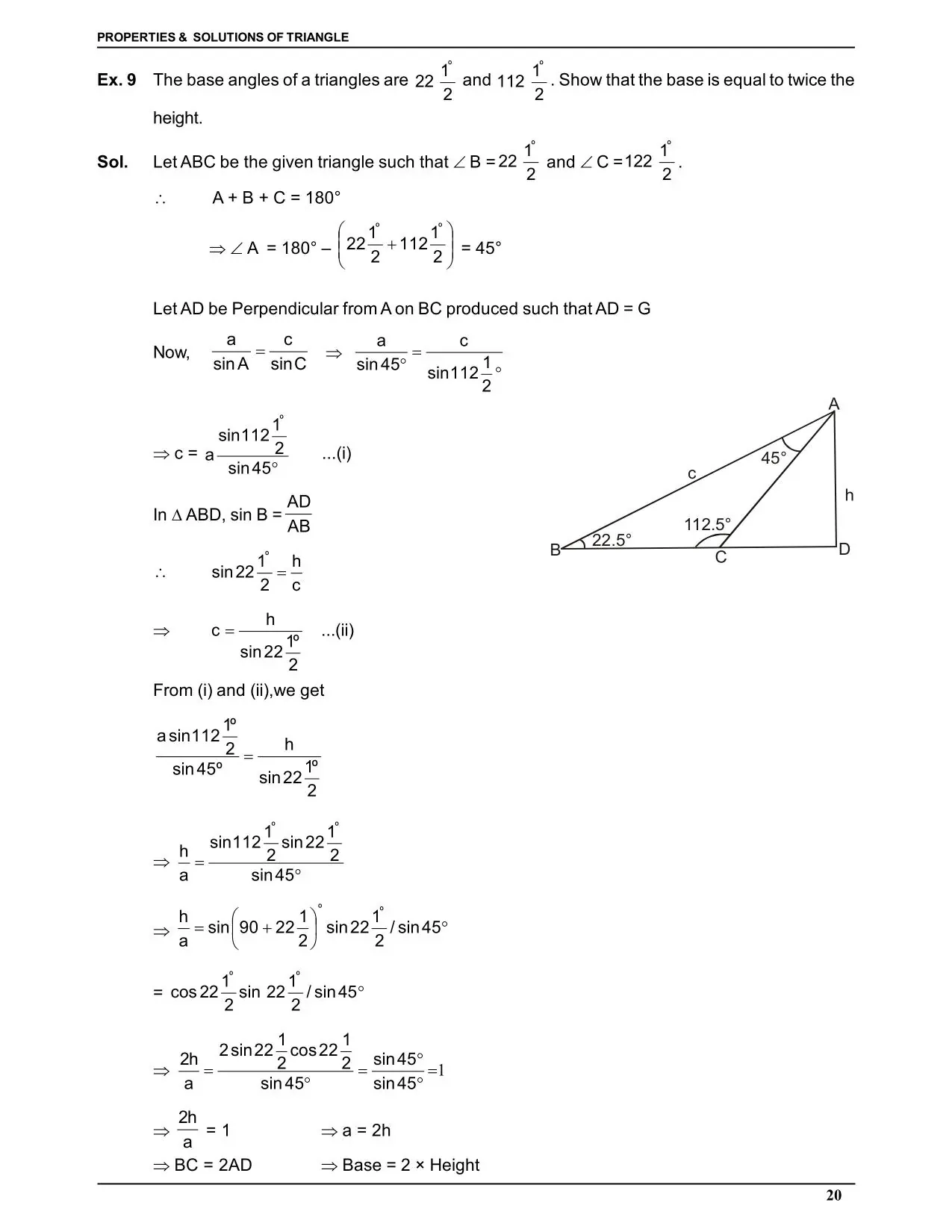
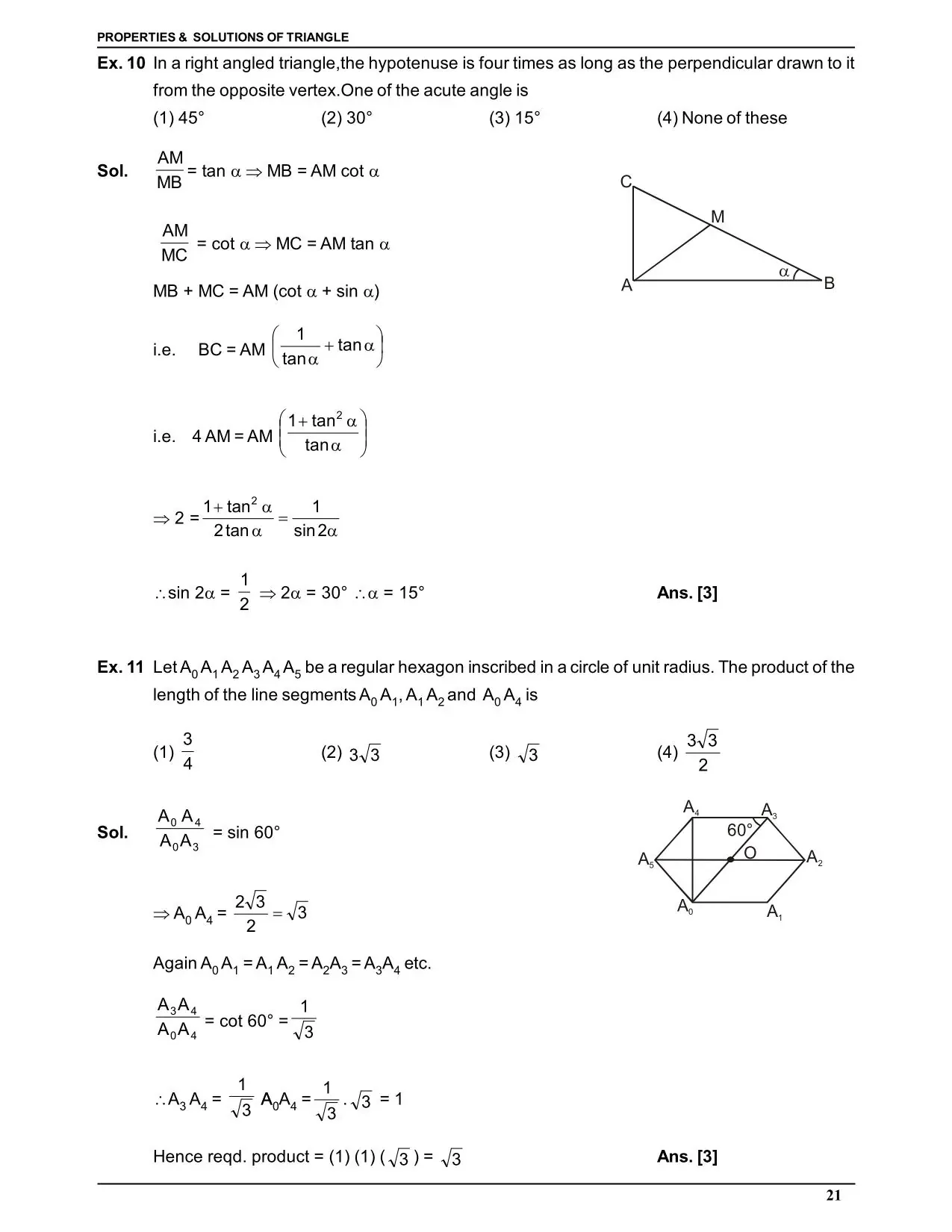
Frequently Asked Questions
What is the solution of a triangle?
The solution of a triangle means finding all its unknown sides and angles when three independent elements are given, at least one of which is a side. The tools are the sine rule, the cosine rule, the projection formulas and the angle sum $A + B + C = 180^\circ$. The same results also give the area, the circumradius $R$, the inradius $r$ and the ex-radii.
What is the sine rule, and when should I use it?
The sine rule says that $\dfrac{a}{\sin A} = \dfrac{b}{\sin B} = \dfrac{c}{\sin C} = 2R$. Use it when you know a side and its opposite angle (the AAS or ASA case), or when the circumradius $R$ is in the problem. Be careful with the SSA case, which can have two solutions.
What is the cosine rule, and when should I use it?
The cosine rule says that $a^2 = b^2 + c^2 - 2bc\cos A$, or $\cos A = \dfrac{b^2 + c^2 - a^2}{2bc}$. Use it when you know two sides and the included angle (SAS), or all three sides (SSS), to find an angle.
What are the formulas for the area of a triangle in the solution of triangle?
$\Delta = \tfrac{1}{2}ab\sin C$ (two sides and the included angle), $\Delta = \sqrt{s(s-a)(s-b)(s-c)}$ (Heron's formula, three sides), $\Delta = \dfrac{abc}{4R}$ (with the circumradius) and $\Delta = rs$ (with the inradius), where $s = \dfrac{a + b + c}{2}$.
What is the difference between inradius, circumradius and ex-radii?
The circumradius $R$ is the radius of the circle through the three vertices, $R = \dfrac{abc}{4\Delta}$. The inradius $r$ is the radius of the circle inside the triangle, $r = \dfrac{\Delta}{s}$. The ex-radii $r_1, r_2, r_3$ are the radii of the three excircles, $r_1 = \dfrac{\Delta}{s - a}$. In any triangle, $R \geq 2r$, with equality only for an equilateral triangle.
What are the important identities with ex-radii?
$r_1 + r_2 + r_3 - r = 4R$, $\ \dfrac{1}{r} = \dfrac{1}{r_1} + \dfrac{1}{r_2} + \dfrac{1}{r_3}$, $\ r_1r_2 + r_2r_3 + r_3r_1 = s^2$ and $r\,r_1r_2r_3 = \Delta^2$. These are used in JEE Advanced-level problems.
What is Napier's analogy (the tangent rule)?
Napier's analogy says that $\tan\dfrac{B - C}{2} = \dfrac{b - c}{b + c}\cot\dfrac{A}{2}$, and similarly for the other two pairs. It is used when two sides and the included angle are known, to find the other two angles.
What are the half-angle formulas of a triangle?
$\sin\dfrac{A}{2} = \sqrt{\dfrac{(s-b)(s-c)}{bc}}$, $\ \cos\dfrac{A}{2} = \sqrt{\dfrac{s(s-a)}{bc}}$ and $\ \tan\dfrac{A}{2} = \sqrt{\dfrac{(s-b)(s-c)}{s(s-a)}} = \dfrac{\Delta}{s(s-a)}$.
Which exams ask the solution of triangle?
The solution of triangle (properties of triangles) is a JEE Advanced topic, with the relations between the sides and angles, the sine rule, the cosine rule, the half-angle formulas and the area. It is mostly taught for JEE preparation and not in the main NCERT chapters, so check the official syllabus of your exam before you decide how much time to give it.
Is the solution of triangle taught in Class 11 or Class 12?
It comes with trigonometry, so most coaching courses teach it in Class 11. eSaral's notes cover it for Class 11 and 12 students who prepare for JEE, and the class label matters less than the exam syllabus.
How do I solve a triangle when two sides and a non-included angle are given?
This is the SSA (ambiguous) case. Use the sine rule to find $\sin B$. If $\sin B > 1$, there is no triangle. If $\sin B = 1$, there is one right-angled triangle. If $\sin B < 1$, check whether the angle $180^\circ - B$ also gives a valid triangle, because there can be two solutions.
Where can I find more notes on trigonometry and heights and distances?
eSaral has the trigonometry formulas page for Class 11, the heights and distances notes, and the Maths notes for Class 11 and 12. The main links are on this page.
Team eSaral
eSaral Academic and Editorial Team
Team eSaral is the collective author profile for educational content created by eSaral’s teachers and academic contributors. The team draws on expertise from IIT graduates, doctors, experienced educators and subject specialists to develop resources for JEE, NEET and school students. Our articles aim to explain concepts clearly and help students study with confidence.
Related Posts

BITSAT 2027: Registration Date, Exam Date, Syllabus, Eligibility, Pattern & Fees
BITSAT 2027 exam dates, registration timeline, eligibility criteria, exam pattern, marking scheme, syllabus and fees in one page.

BITSAT Previous Year Question Paper PDF (2017-2026)
Download BITSAT previous year question papers PDF from 2017 to 2026,session-wise. Memory-based papers,exam pattern, paper analysis and how to practise

CBSE Class 10 Date Sheet 2027: Expected Exam Dates, Release Date, Admit Card & Result Timeline
CBSE Class 10 date sheet 2027 is awaited. See the expected exam dates, release window, how to download the PDF, admit card and result timelines.

NCERT Physics Class 10 Book PDF in Hindi 2026-27 – भौतिक विज्ञान के 4 अध्याय (Free Download)
NCERT Physics Class 10 book PDF in Hindi 2026-27: download all 4 chapters (अध्याय 9–12) free, with topics and important formulas.

NCERT Biology Class 9 Book Anveshan PDF in Hindi - जीव विज्ञान कक्षा 9 पुस्तक अन्वेषण PDF
Download NCERT Biology Class 9 book PDF in Hindi chapterwise for 2026-27: Cell, Tissues, Reproduction and Diversity. Free PDFs.

Essay On Artificial Intelligence in English (100,150, 200, 250, 300, 500 Words)
This is in contrast to the natural intelligence of humans. With Artificial Intelligence, machines can perform

Essay on 78th India Independence Day in English for Student (100, 150, 200, 250, 300, 500 Words)
Read the best essays on India's Independence Day in English. Short & long essays (100, 150, 200, 250, 300, 500 words) perfect for school exams
NCERT Class 11 English Snapshots book - Free PDF download- Esaral
Download NCERT Class 11 English Snapshots book PDF for free. Get all 8 chapters, chapter-wise. Start your prep today!
NCERT Class 10 biology book pdf - Free PDF Download - eSaral
NCERT Class 10 Biology book PDF 2026-27: all 5 chapters (Life Processes to Our Environment) in English & Hindi, with CBSE syllabus, marks & practical

Essay on Global Warming in English (100,150, 200, 250, 300, 500 Words)
Global warming means the Earth is getting hotter. This happens because of things like pollution from cars and factories.