
Properties of Bar Magnet || Magnetism and Matter Class 12, JEE & NEET

eSaral Academic and Editorial Team
Playing with magnets is one of the first moments of science most children discover. That's because magnets are easy to use, safe, and fun. They're also quite surprising. Remember when you first discovered that two magnets could snap together and stick like glue? Remember the force when you held two magnets close and felt them either attract (pull toward one another) or repel (push away)? Here we will study about the Bar Magnet and Properties of Bar Magnet!
A bar magnet is a rectangular piece of the object. It is made up of iron, steel or any other ferromagnetic substance or ferromagnetic composite, having permanent Magnetic Properties. The magnet has two poles: a north and a south pole. When you suspend it freely, the magnet aligns itself so that the north pole points towards the magnetic north pole of the earth.
Properties of Bar Magnet :
- Attractive Property and Poles : When a magnet is dipped into iron fillings it is found that the concentration of iron filings, i.e., attracting power of the magnet is maximum at two points near the ends and minimum at the center. The places in a magnet where its attracting power is maximum are called poles while the place of minimum attracting power is called the neutral region.
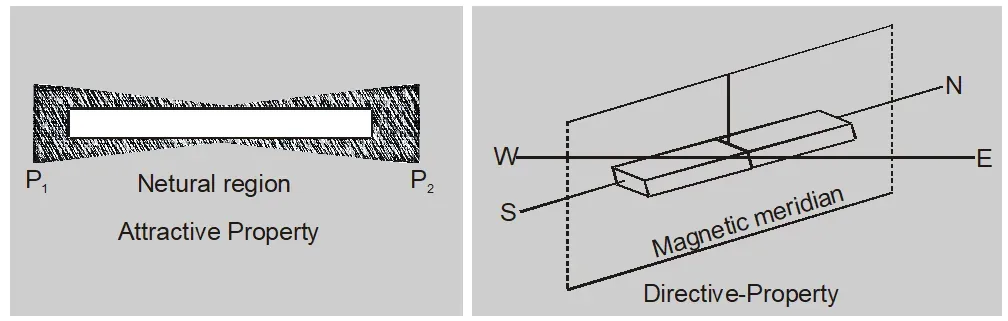
- Directive Property and N-S Poles: When the magnet is suspended its length becomes parallel to the N-S direction. The pole pointing north is called the north pole while the other pointing south is called the south pole.
- Magnetic Axis and Magnetic Meridian: The line joining the two poles of a magnet is called the magnetic axis and the vertical plane passing through the axis of a freely suspended or pivoted magnet is called a magnetic meridian.
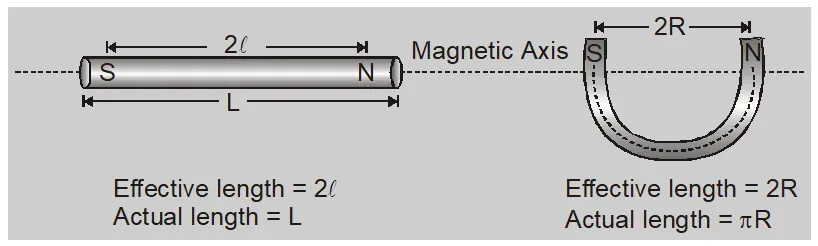
- Magnetic Length: The distance between two poles along the axis of a magnet is called its effective or magnetic length. As poles are not exactly at the ends, the effective length is lesser than the actual length of the magnet.
- Poles Exist in Paris: In a magnet, the two poles are found to be equal in strength and opposite in nature. If a magnet is broken into a number of pieces, each piece becomes a magnet with two equal and opposite poles. This shows that monopoles do not exist.

- Consequent-poles and No-pole: Monopoles do not exist in a magnet but there are two poles of equal strength and opposite nature :
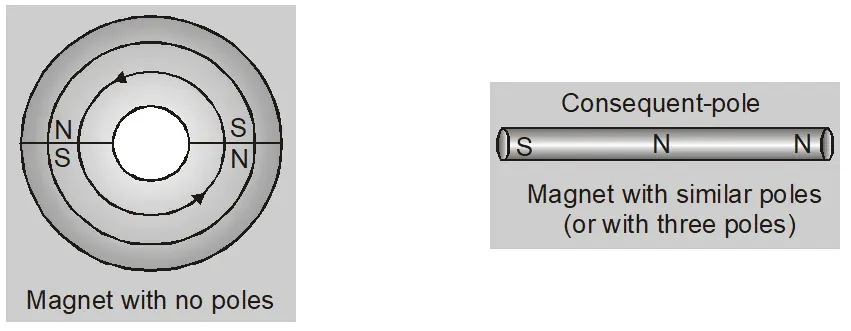 (a) There can be magnets with no poles, e.g., a magnetized ring called toroid or solenoid of infinite length has properties of a magnet but no poles.
(b) There can be magnets with two similar poles (or with three poles), e.g., due to faulty magnetization of a bar, temporarily identical poles at the two ends with an opposite pole of double strength at the center of the bar (called consequent pole) are developed. - Repulsion is a Sure Test of Polarity: A pole of a magnet attracts the opposite pole while repels a similar pole. A sure test of polarity is repulsion and not attraction, as attraction can take place between opposite poles or a pole and a piece of an unmagnetized magnetic material due to the 'induction effect'.
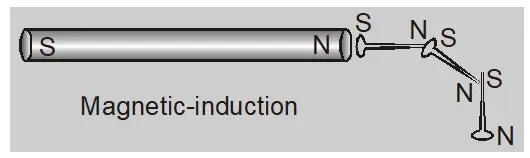
- Magnetic Induction: A magnet attracts certain other substances through the phenomenon of magnetic induction i.e., by inducing the opposite pole in magnetic material on the side facing it as shown in fig.
- Magnetic and Non-magnetic Materials: The substances such as steel, iron, cobalt, and nickel, etc., which are attracted by a magnet are called magnetic while substances such as copper, aluminum stainless steel, wood, glass, and plastic, etc. which are not attracted by the magnet are usually called non-magnetic.
- Permanent and Temporary Magnets: If a magnet retains its attracting power for a long time it is said to be permanent, otherwise temporary. Permanent magnets are made of steel, Alnico, Alcomax, or Ticonal while temporary of soft iron, mumetal, or stalloy.
- Demagnetization: A magnet gets demagnetized, i.e., loses its power of attraction if it is heated, hammered or ac is passed through a wire wound over it.
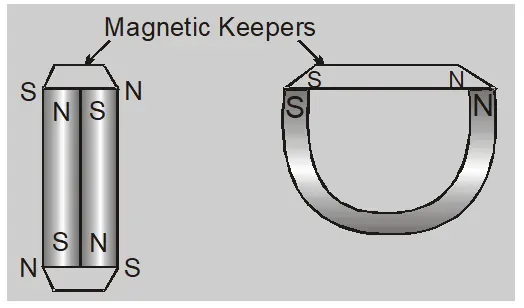
- Magnetic Keepers: A magnet tends to become weaker with age owing to self-demagnetization due to poles at the ends which tend to neutralize each other. However, by using pieces of soft iron called keepers, the poles at the ends are neutralized and consequently, the demagnetizing effect disappears and the magnet can retain its magnetism for a longer period.
For free video lectures and complete study material, Download eSaral APP.
Team eSaral
eSaral Academic and Editorial Team
Team eSaral is the collective author profile for educational content created by eSaral’s teachers and academic contributors. The team draws on expertise from IIT graduates, doctors, experienced educators and subject specialists to develop resources for JEE, NEET and school students. Our articles aim to explain concepts clearly and help students study with confidence.
Related Posts
Plant Cell Diagram: Labelled Structure, Parts and Functions
Simple, labelled plant cell diagram with parts and functions. Covers plant cell structure for Class 6, 7, 8, 9, 10 and 11 students, CBSE-aligned.

Saransh Gupta Sir's Visit to IIT Patna: Hostel Life, Placements & Lessons for JEE Aspirants
Inside Saransh Gupta Sir's IIT Patna visit — hostel life, the library, placements, internships, and real advice for JEE aspirants from students living the IIT dream.
Molality Formula: Formula for Molality, Derivation & Solved Examples
Molality formula is $m = \dfrac{n}{W}$. Learn the formula of molality, its SI unit, derivation, relation with molarity, and solved examples for Class 11, JEE and NEET.
BITSAT Previous Year Question Paper PDF
Download BITSAT previous year question papers PDF. Get year-wise BITSAT PYQs, memory-based papers, exam pattern, and preparation tips to improve your BITSAT preparation.

Teachers’ Day 2026 at eSaral Gurukul: Celebrating the Bond Between Students, Teachers & Mentors
See how Teachers’ Day 2026 was celebrated at eSaral Gurukul, reflecting the bond among students, teachers, and mentors, and the role of guidance beyond academics.
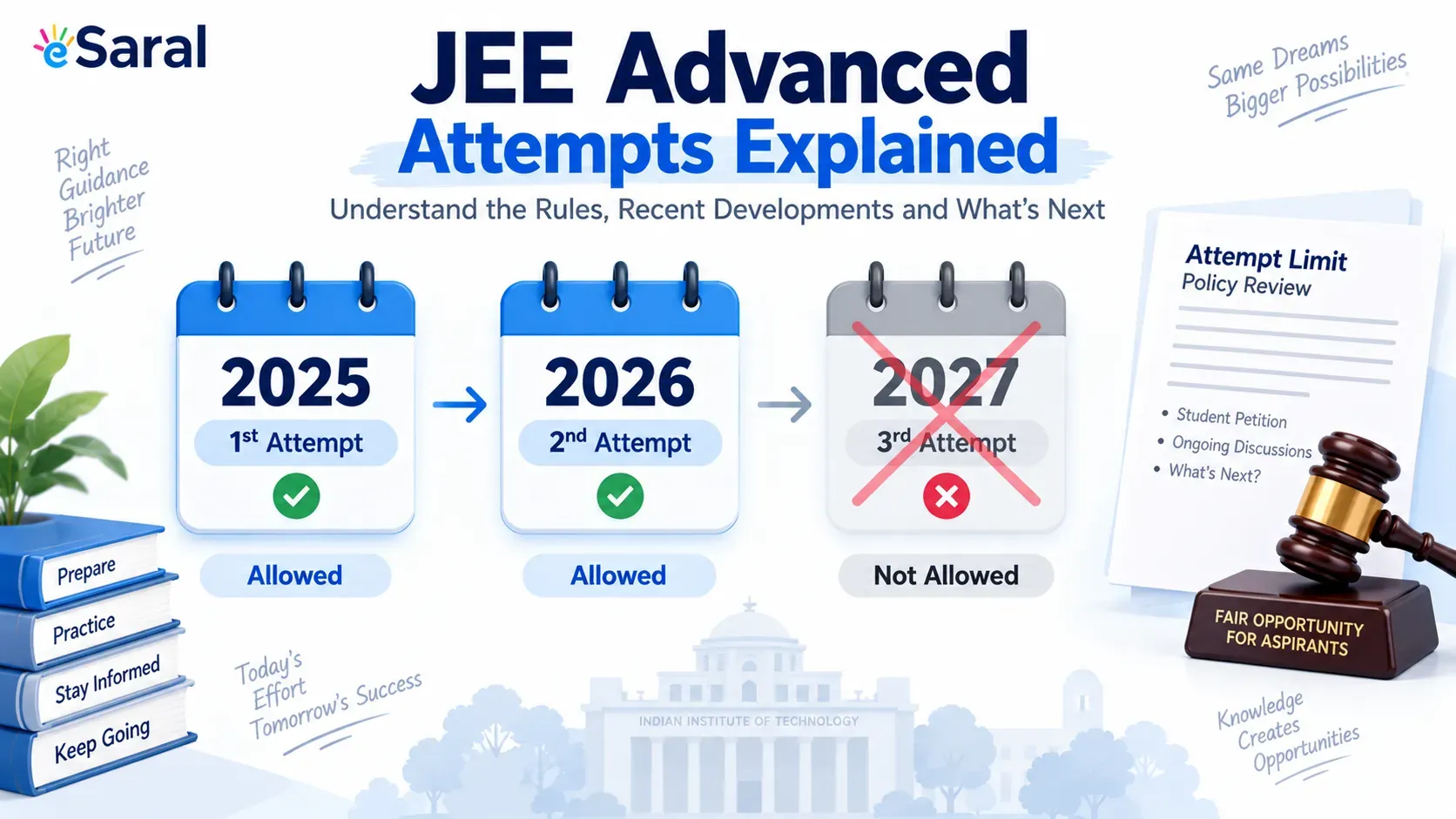
JEE Advanced Attempts: Can You Give It a Third Time? Rules Explained
JEE Advanced attempts: current rule is 2 consecutive years only: full eligibility criteria, the 2025 third-attempt controversy, and the latest 2026 petition news.

Best JEE Preparation App
Best JEE preparation app for Main & Advanced: AI mock tests, live doubt-solving, thousands of practice questions. JEE preparation app for droppers & Class 11-12.
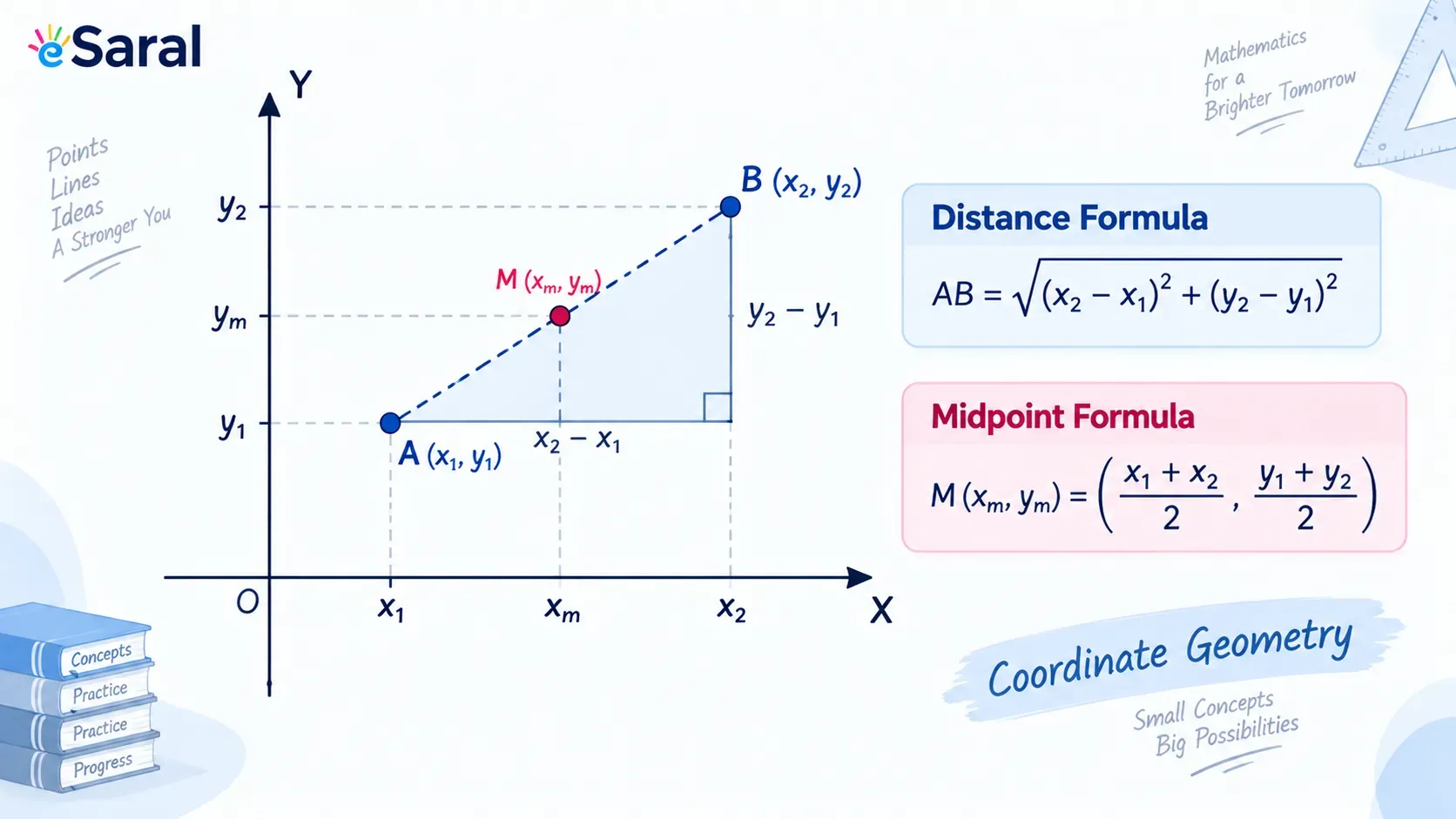
Coordinate Geometry Class 10: Formulas, Notes & Solved Examples
Coordinate geometry class 10: complete CBSE formulas — distance, section, midpoint and area of triangle — with derivation, notes and solved examples.
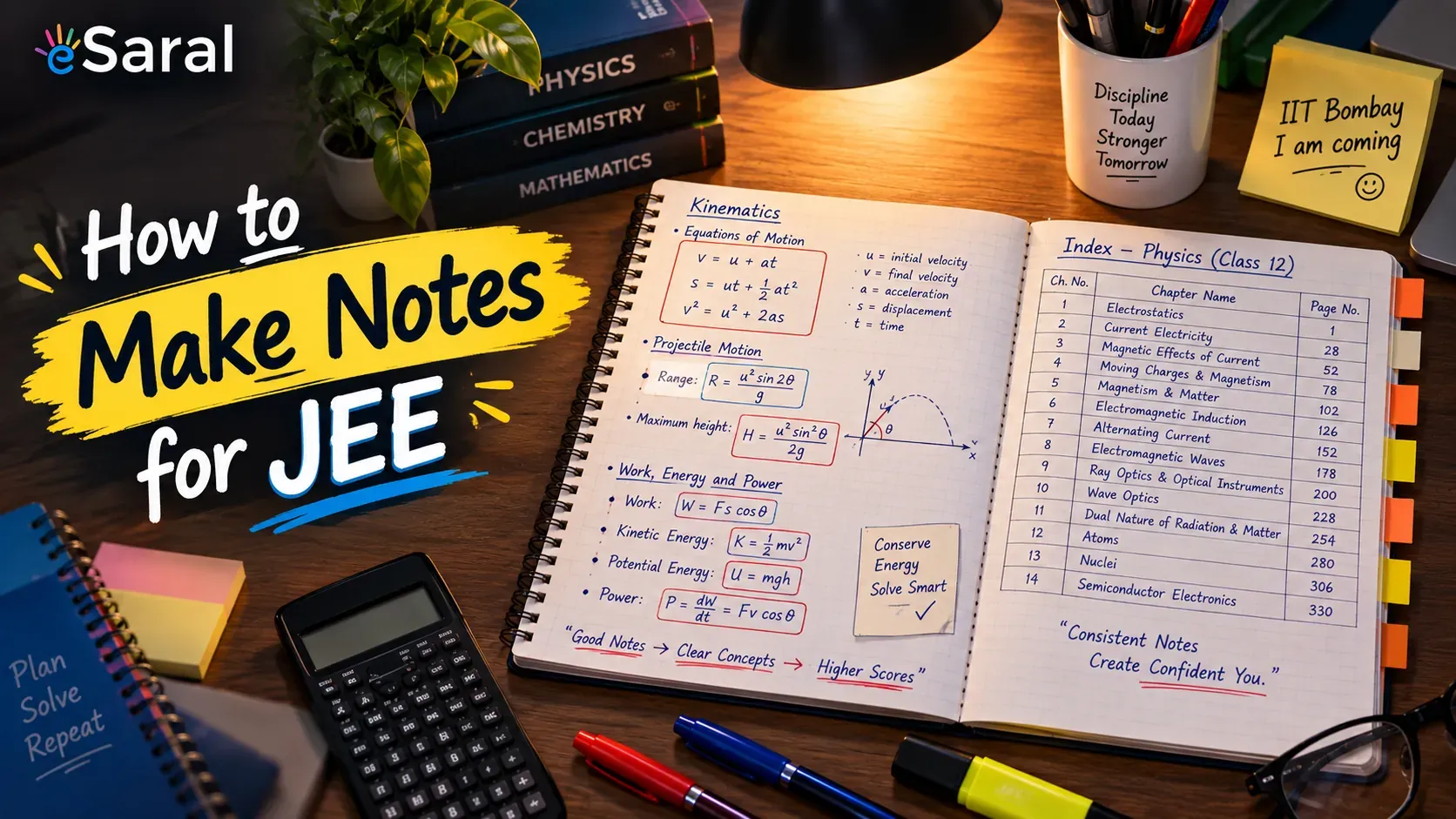
How to make Notes For JEE Smart Notes Strategy of an AIR 41
Learn how to make notes for JEE the way toppers do — indexing, shorthand, and smart short notes for JEE that cut revision time to just 5–7 days.
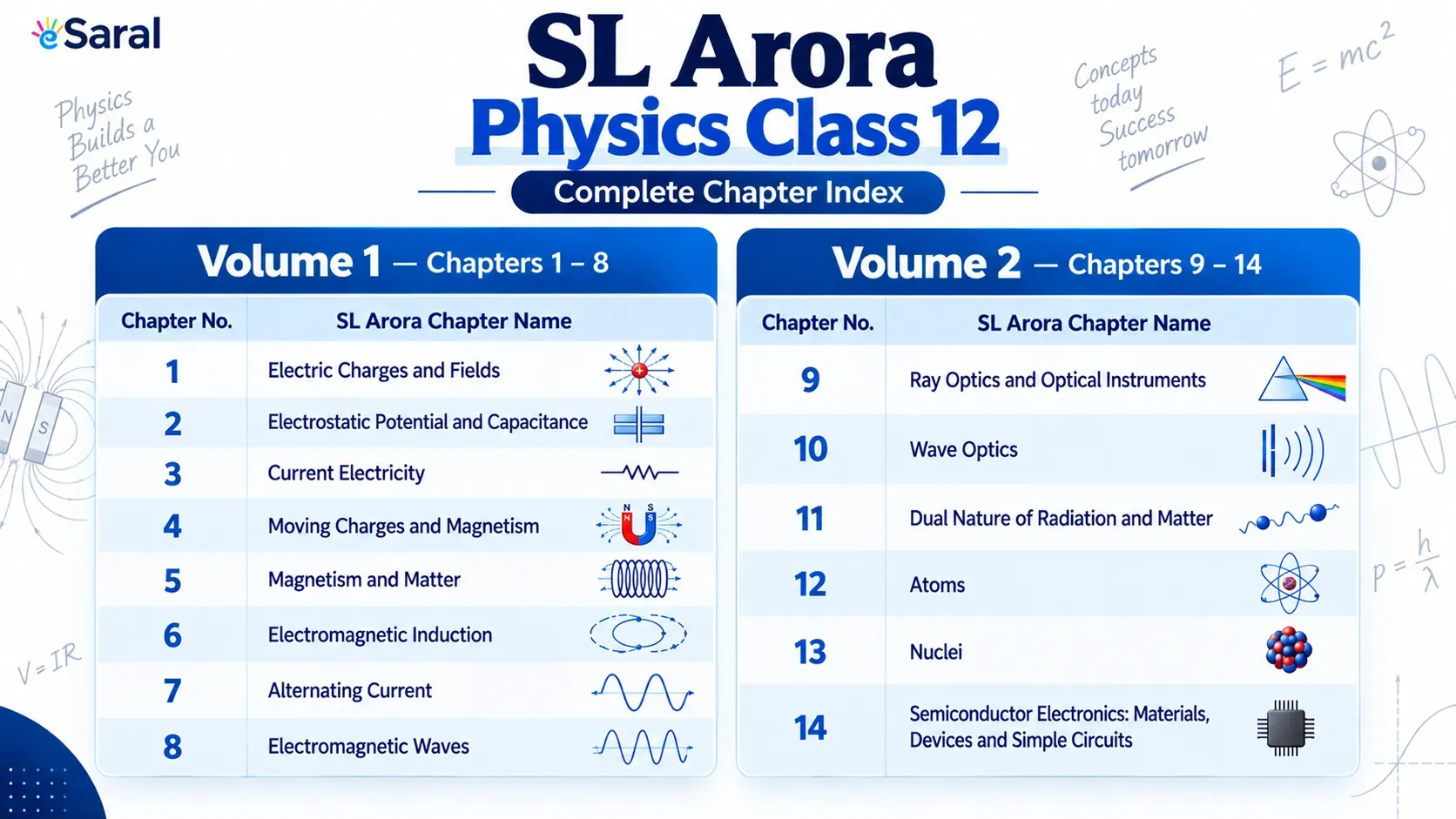
SL Arora Physics Class 12 Index – Chapter List for Volume 1 & 2
SL Arora Physics Class 12 index — complete chapter list for Volume 1 & 2, mapped to NCERT solutions for board, JEE Main, and NEET preparation.