
RD Sharma Solutions for Class 9 Maths Chapter 11 Coordinate Geometry - Free PDF Download

eSaral Academic and Editorial Team
Hey, are you a class 9 student and looking for ways to download RD Sharma Solutions for Class 9 Maths Chapter 11 "Coordinate Geometry"? If yes. Then read this post till the end.
In this article, we have listed RD Sharma Solutions for Class 9 Maths Chapter 11 in PDF that is prepared by Kota’s top IITian’s Faculties by keeping Simplicity in mind.
If you want to learn and understand class 9 Maths Chapter 11 "Coordinate Geometry" in an easy way then you can use these solutions PDF.
Chapter 11 of RD Sharma Class 9 deals with coordinate geometry and concepts such as the cartesian plane, coordinates of a point, names and terms associated with the coordinate plane, notations, plotting points in the plane and more. If you want to improve your basic in Coordinate Geometry, then you can use this.
RD Sharma Solutions helps students to Practice important concepts of subjects easily. RD Sharma class 9 solutions provide detailed explanations of all the exercise questions that students can use to clear their doubts instantly.
If you want to become good at Math then it is very important for you to have a good knowledge of all the important topics of class 9 math, so to learn and practice those topics you can use eSaral RD Sharma Solutions.
India's Best Exam Preparation for Class 9th - Download Now
In this article, we have listed RD Sharma Solutions for Class 9 Maths Chapter 11 that you can download to start your preparations anytime.
So, without wasting more time Let’s start.
RD Sharma Solutions for Class 9 Maths Chapter 11 Coordinate Geometry - Free PDF Download
Question 1: Plot the following points on the graph paper:
(i) $(2,5)$
(ii) $(4,-3)$
(iii) $(-5,-7)$
(iv) $(7,-4)$
(v) $(-3,2)$
(vi) $(7,0)$
(vii) $(-4,0)$
(viii) $(0,7)$
(ix) $(0,-4)$
(x)$(0,0)$
Solution: The following points are given below.
(i) $(2,5)$
(ii) $(4,-3)$
(iii) $(-5,-7)$
(iv) $(7,-4)$
(v) $(-3,2)$
(vi) $(7,0)$
(vii) $(-4,0)$
(viii) $(0,7)$
(ix) $(0,-4)$
(x)$(0,0)$
Let $X^{\prime} O X$ and $Y^{\prime} O Y$ be the coordinate axes,
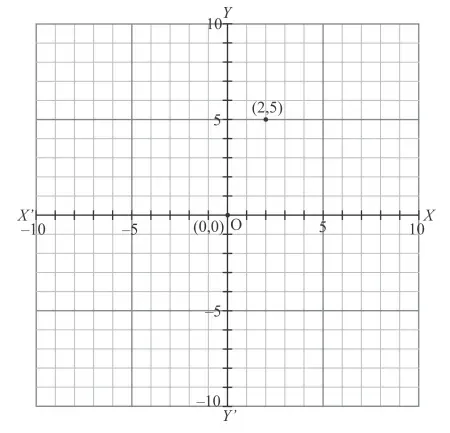
(i) Here for the given point the abscissa is 2 units and ordinate is 5 units.
The point is in the first quadrant. So it will look like as shown in the following figure.
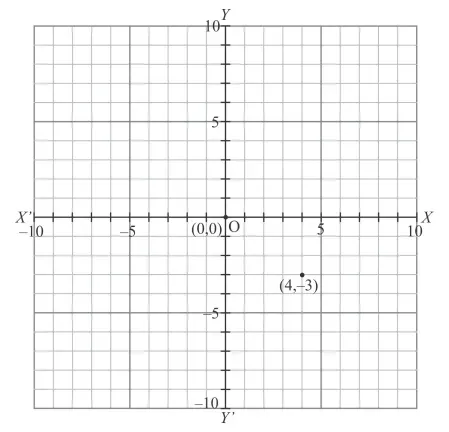
(ii) Here for the given point the abscissa is 4 units and ordinate is $-3$ units.
The point is in the fourth quadrant. So it will look like as shown in the following figure.
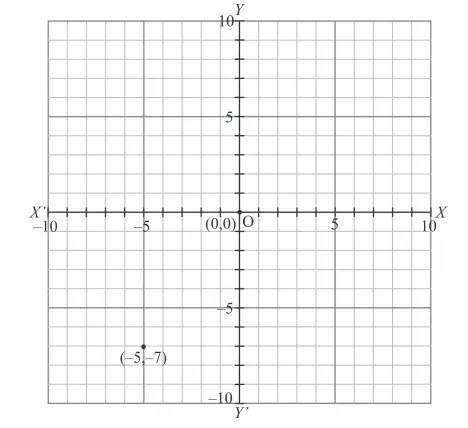
(iii) Here for the given point the abscissa is $-5$ units and ordinate is $-7$ units.
The point is in the third quadrant. So it will look like as shown in the following figure.
(iv) Here for the given point the abscissa is 7 units and ordinate is $-4$ units.
The point is in the fourth quadrant. So it will look like as shown in the following figure.
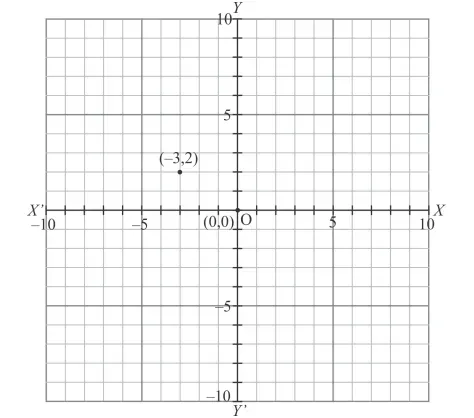
(v) Here for the given point the abscissa is $-3$ units and ordinate is 2 units.
The point is in the second quadrant. So it will look like as shown in the following figure.
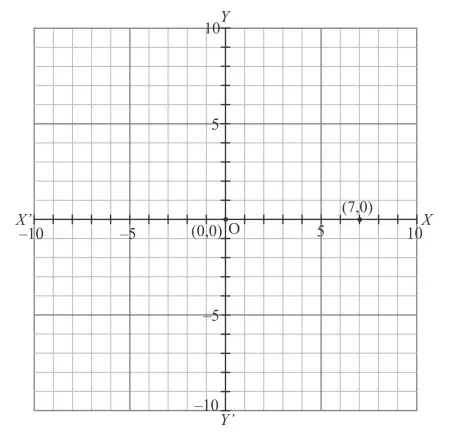
(vi) Here for the given point the abscissa is 7 units and ordinate is 0 units.
The point is on the $x$-axis. So it will look like as shown in the following figure.
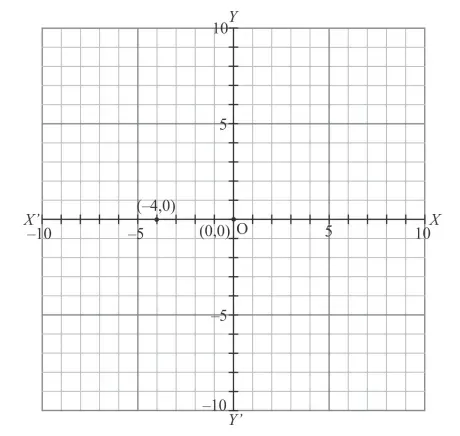
(vii) Here for the given point the abscissa is $-4$ units and ordinate is 0 units.
The point is on the $x$-axis. So it will look like as shown in the following figure.
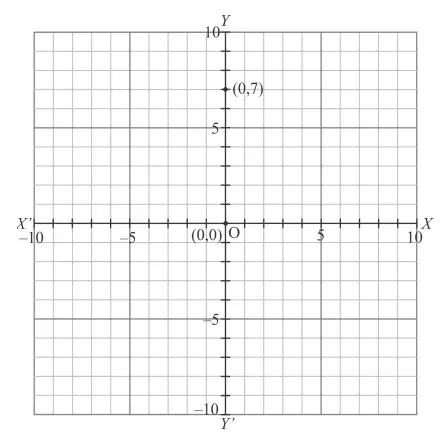
(viii) Here for the given point the abscissa is 0 units and ordinate is 7 units.
The point is on the $y$-axis. So it will look like as shown in the following figure.
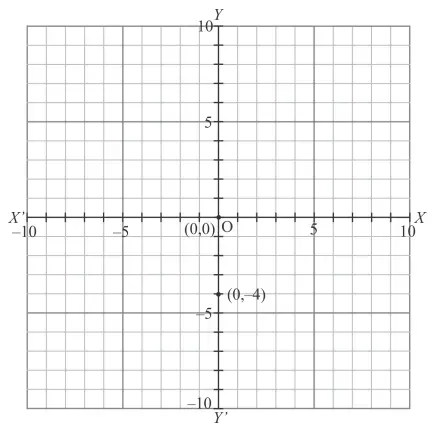
(ix) Here for the given point the abscissa is 0 units and ordinate is $-4$ units.
The point is on the $y$-axis. So it will look like as shown in the following figure.
(x) Here for the given point the abscissa is 0 units and ordinate is 0 units.
The point is basically intersection of the coordinate axes. So it will look like as shown in the following figure.
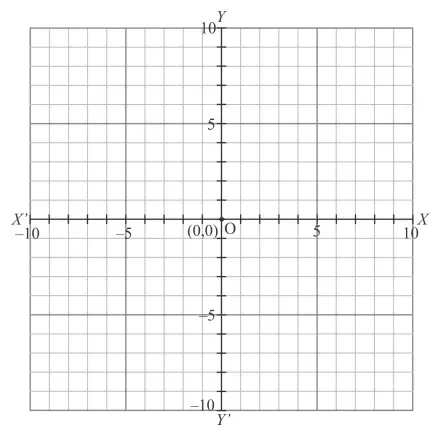
Question 2: Write the coordinates of each of the following points marked in the graph paper:
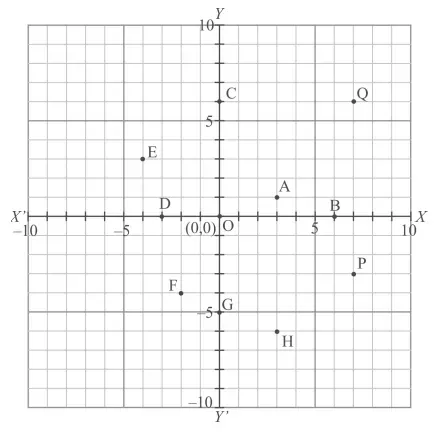
Solution: The following graph is given in the question with the marked points and we are asked to write down their coordinates.
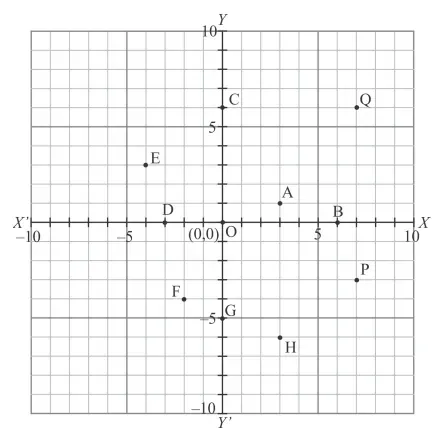
The distance of point A from y-axis is 3 units and that of from x-axis is 1 units. Since A lies in the first quadrant, so its coordinates are .
The distance of point B from y-axis is 6 units and that of from x-axis is 0 units. Since B lies on x-axis, so its coordinates are .
The distance of point C from y-axis is 0 units and that of from x-axis is 6 units. Since C lies on y-axis, so its coordinates are .
The distance of point D from y-axis is -3 units and that of from x-axis is 0 units. Since D lies on x-axis, so its coordinates are .
The distance of point E from y-axis is -4 units and that of from x-axis is 3 units. Since E lies in the second quadrant, so its coordinates are .
The distance of point F from y-axis is -2 units and that of from x-axis is -4 units. Since F lies in the third quadrant, so its coordinates are .
The distance of point G from y-axis is 0 units and that of from x-axis is -5 units. Since G lies on y-axis, so its coordinates are .
The distance of point H from y-axis is 3 units and that of from x-axis is -6 units. Since H lies in the fourth quadrant, so its coordinates are .
The distance of point P from y-axis is 7 units and that of from x-axis is -3 units. Since P lies in the fourth quadrant, so its coordinates are .
The distance of point Q from y-axis is 7 units and that of from x-axis is 6 units. Since Q lies in the first quadrant, so its coordinates are
Question 3: Mark the correct alternative in each of the following:
The point of intersect of the coordinate axes is
(a) ordinate
(b) abscissa
(c) quadrant
(d) origin
Solution: As we know that:
The distance of a point from y−axis is called its x−coordinate or abscissa.
The distance of a point from x−axis is called its y−coordinate or ordinate.
The coordinate axes divide the plane into four equal parts which are known as quadrants.
The point of intersection of the coordinate axes is called the origin and the coordinates of origin are (0,0)
Example is shown in the graph
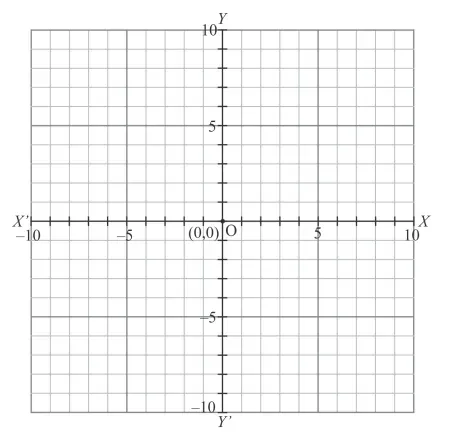
Thus the correct answer is (d).
Question 4: The abscissa and ordinate of the origin are
(a) $(0,0)$
(b) $(1,0)$
(c) $(0,1)$
(d) $(1,1)$
Solution: As we know that:
The distance of a point from y−axis is called its x−coordinate or abscissa.
The distance of a point from x−axis is called its y−coordinate or ordinate.
The coordinate axes divide the plane into four equal parts which are known as quadrants.
The point of intersection of the coordinate axes is called the origin and the coordinates of origin are(0,0)
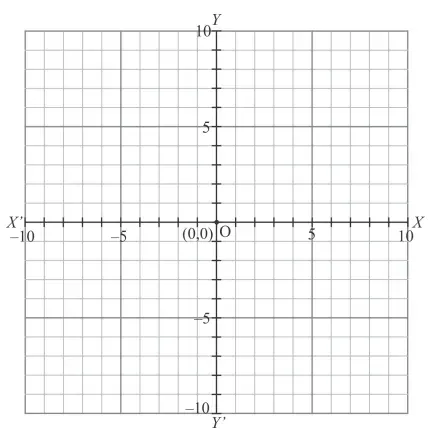
The origin is shown in the graph
Thus the correct answer is (a).
Question 5: The measure of the angle between the coordinate axes is
(a) 0°
(b) 90°
(c) 180°
(d) 360°
Solution: As we know that $x$-axis and $y$-axis intersect to each other at point $\mathrm{O}$ and perpendicular to each other. So, the angle between the coordinate axes is $90^{\circ}$
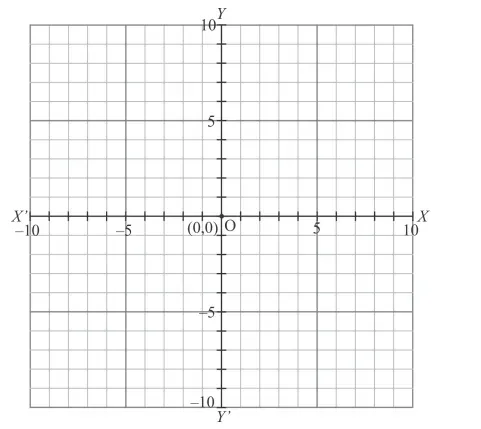
Thus the correct answer is (b).
Question 6: A point whose abscissa and ordinate are 2 and −5 respectively, lies in
(a) First quadrant
(b) Second quadrant
(c) Third quadrant
(d) Fourth quadrant
Solution: As shown in graph that a point whose abscissa and ordinate are 2 and $-5$ respectively lies in the fourth quadrant.
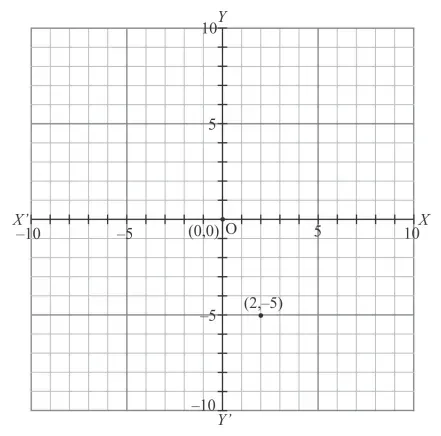
Thus the correct answer is (d).
Question 7: Points (−4, 0) and (7, 0) lie
(a) on x-axis
(b) y-axis
(c) in first quadrant
(d) In second quadrant
Solution: Let the points $P$ and $Q$ whose coordinates are $(-4,0)$ and $(7,0)$ respectively. Locate the points and you will see that they lie on $x$-axis.
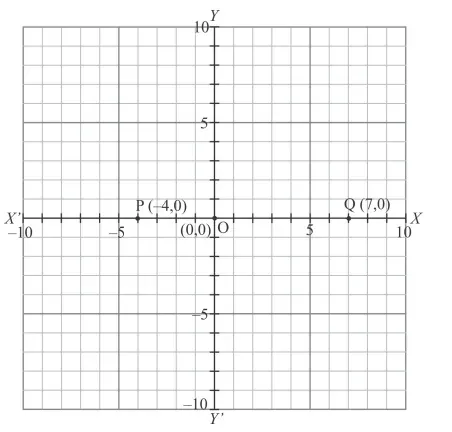
Thus the correct answer is (a).
Question 8: The ordinate of any point on x-axis is
(a) 0
(b) 1
(c) −1
(d) any number
Solution: We know that the $y$-coordinates of every point on $x$-axis are zero. So, the coordinates of any point on the $x$-axis are of the form $(x, 0)$.
Thus the correct answer is (a).
Question 9: The abscissa of any point on y-axis is
(a) 0
(b) 1
(c) −1
(d) any number
Solution: We know that the $x-$ coordinate of every point on $y$-axis is zero. So, the coordinates of any point on the $x-$ axis are of the form $(0, y)$.
Thus the correct answer is (a).
Question 10 : The abscissa of a point is positive in the
(a) First and Second quadrant
(b) Second and Third quadrant
(c) Third and Fourth quadrant
(d) Fourth and First quadrant
Solution: The signs of coordinates $(x, y)$ of a point in various quadrants are shown in the following graph:
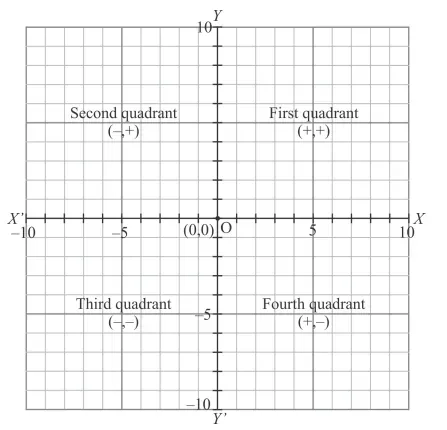
Thus the correct answer is (d).
India's Best Exam Preparation for Class 9th - Download Now
Question 11 : A point whose abscissa is $-3$ and ordinate 2 lies in
(a) First quadrant
(b) Second quadrant
(c) Third quadrant
(d) Fourth quadrant
Solution: As we know that
In the first quadrant : $x>0, y>0$
In the second quadrant $: x<0, y>0$
In the third quadrant : $x<0, y<0$
In the fourth quadrant : $x>0, y<0$
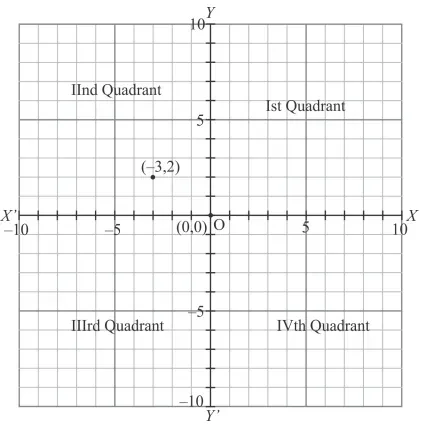
The point whose abscissa is $-3$ which is negative and ordinate 2 is positive, so this point lies in the second quadrant.
Thus the correct answer is (b).
Question 12: Two points having same abscissae but different ordinate lie on
(a) x-axis
(b) y-axis
(c) a line parallel to $y$-axis
(d) a line parallel to $x$-axis
Solution: Let the points $\mathrm{P}(3,5)$ and $\mathrm{Q}(3,2)$ having the same abscissa but different ordinates be shown in the graph given below:
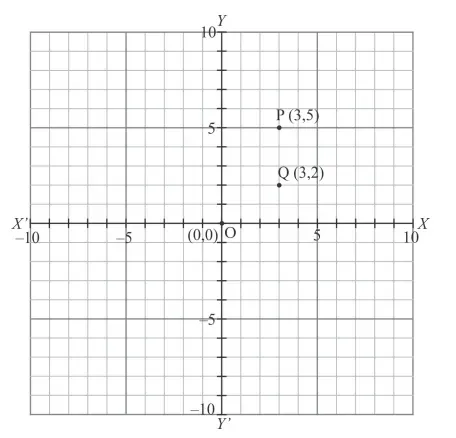
Fig: (location of two considered points)
And these points lie on a line parallel to $y$-axis
Thus the correct answer is (c).
Question 13: The perpendicular distance of the point $P(4,3)$ from $x$-axis is
(a) 4
(b) 3
(c) 5
(d) none of these
Solution: The point $\mathrm{P}(4,3)$ is shown in the graph given below:
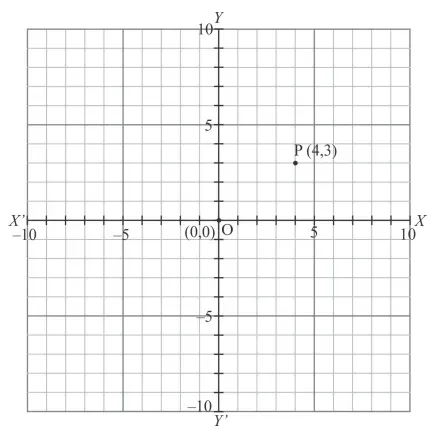
Thus the perpendicular distance of the point $\mathrm{P}(4,3)$ from $x$-axis is 3 units.
Thus the correct answer is (b).
Question 14: The perpendicular distance of the $P(4,3)$ from $y$-axis is
(a) 4
(b) 3
(c) 5
(d) none of these
Solution: The point $\mathrm{P}(4,3)$ is shown in the graph given below:
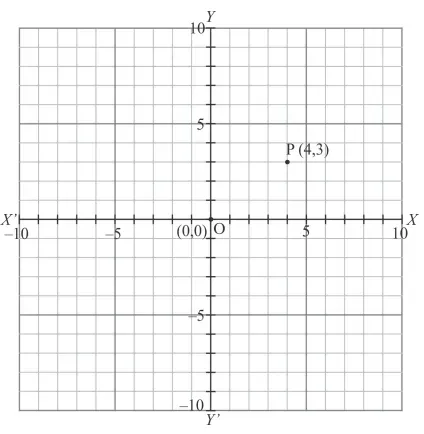
Thus the perpendicular distance of the point $\mathrm{P}(4,3)$ from $y$-axis is 4 .
Thus the correct answer is (a).
Question 15: The distance of the point $P(4,3)$ from the origin is
(a) 4
(b) 3
(c) 5
(d) 7
Solution: The point $\mathrm{P}(4,3)$ is shown in the graph given below:
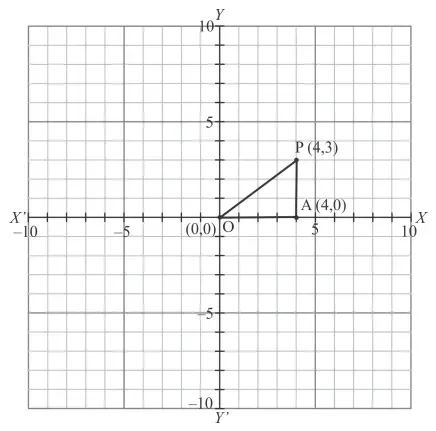
In $\Delta \mathrm{OAP}$ is right angled triangle where
$\mathrm{OA}=4$
and $\mathrm{AP}=3$
By using Pythagoras theorem:
$\mathrm{OP}=\sqrt{\mathrm{OA}^{2}+\mathrm{AP}^{2}}$
$=\sqrt{4^{2}+3^{2}}$
$=\sqrt{16+9}$
$=\sqrt{25}$
$=5$
Thus the distance of the point $\mathrm{P}(4,3)$ from the origin is 5 .
Thus the correct answer is (c)
India's Best Exam Preparation for Class 9th - Download Now
Question 16: The area of the triangle formed by the points $A(2,0) B(6,0)$ and $C(4,6)$ is
(a) 24 sq. units
(b) $12 \mathrm{sq}$. units
(c) 10 sq. units
(d) none of these
Solution: Given that points $\mathrm{A}(2,0), \mathrm{B}(6,0)$ and $\mathrm{C}(4,6)$ form a triangle which is shown in the figure. We are asked to find the area of the triangle $\triangle \mathrm{ABC} .$
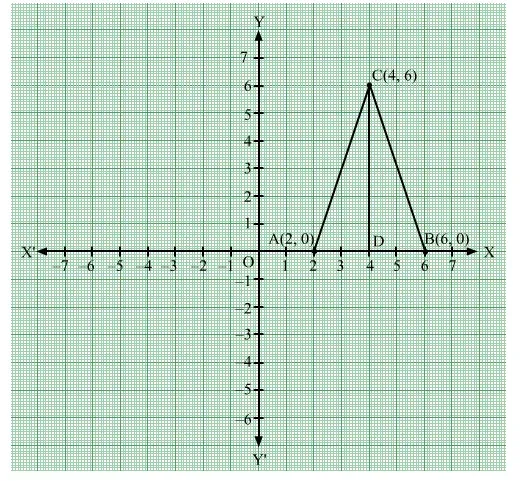
Given that
$\mathrm{OA}=2$
and $\mathrm{OB}=6$
Hence:
$A B=O B-O A$
$=6-2$
$=4$
$C D=6$
By using formula,
$\Delta A B C=\frac{1}{2} \times A B \times C D$
$=\frac{1}{2} \times 4 \times 6$
$=12$ squnits
Thus the correct answer is (b).
Question 17: The area of the triangle formed by the points $P(0,1), Q(0,5)$ and $R(3,4)$ is
(a) $16 \mathrm{sq}$. units
(b) 8 sq. units
(c) 4 sq. units
(d) 6 sq. units
Solution: Given that the points $\mathrm{P}(0,1), \mathrm{Q}(0,5)$ and $\mathrm{R}(3,4)$ form a triangle.
We are asked to find the area of the triangle $\triangle \mathrm{PQR}$ which is shown in the figure.
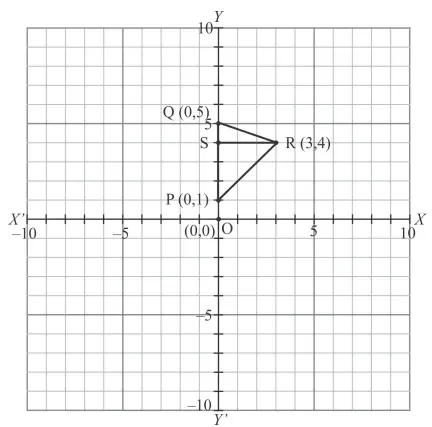
Given that
$\mathrm{OP}=1$
and $\mathrm{OQ}=5$
Hence:
$\mathrm{PQ}=\mathrm{OQ}-\mathrm{OP}$
$=5-1$
$=4$
and $R S=3$
By using formula,
$\mathrm{PQR}=\frac{1}{2} \times \mathrm{PQ} \times \mathrm{RS}$
$=\frac{1}{2} \times 4 \times 3$
$=2 \times 3$
$=6 \mathrm{sq}$. Units
Thus the correct answer is $(\mathrm{d})$.
Also Read,
India's Best Exam Preparation for Class 9th - Download Now
Download NCERT Class 9 Maths Chapterwise Book Free PDF
Download NCERT Class 10 Maths Chapterwise Book Free PDF
Download NCERT Class 9 Maths Chapterwise Exemplar Free PDF
Download NCERT Class 10 Maths Chapterwise Exemplar Free PDF
If you have any Confusion related to RD Sharma Solutions for Class 9 Maths Chapter 11 Coordinate Geometry, then feel free to ask in the comments section down below.
To watch Free Learning Videos on Class 9 by Kota’s top Faculties Install the eSaral App
Team eSaral
eSaral Academic and Editorial Team
Team eSaral is the collective author profile for educational content created by eSaral’s teachers and academic contributors. The team draws on expertise from IIT graduates, doctors, experienced educators and subject specialists to develop resources for JEE, NEET and school students. Our articles aim to explain concepts clearly and help students study with confidence.
Related Posts

BITSAT 2027: Registration Date, Exam Date, Syllabus, Eligibility, Pattern & Fees
BITSAT 2027 exam dates, registration timeline, eligibility criteria, exam pattern, marking scheme, syllabus and fees in one page.

BITSAT Previous Year Question Paper PDF (2017-2026)
Download BITSAT previous year question papers PDF from 2017 to 2026,session-wise. Memory-based papers,exam pattern, paper analysis and how to practise

CBSE Class 10 Date Sheet 2027: Expected Exam Dates, Release Date, Admit Card & Result Timeline
CBSE Class 10 date sheet 2027 is awaited. See the expected exam dates, release window, how to download the PDF, admit card and result timelines.

NCERT Physics Class 10 Book PDF in Hindi 2026-27 – भौतिक विज्ञान के 4 अध्याय (Free Download)
NCERT Physics Class 10 book PDF in Hindi 2026-27: download all 4 chapters (अध्याय 9–12) free, with topics and important formulas.

NCERT Biology Class 9 Book Anveshan PDF in Hindi - जीव विज्ञान कक्षा 9 पुस्तक अन्वेषण PDF
Download NCERT Biology Class 9 book PDF in Hindi chapterwise for 2026-27: Cell, Tissues, Reproduction and Diversity. Free PDFs.

Essay On Artificial Intelligence in English (100,150, 200, 250, 300, 500 Words)
This is in contrast to the natural intelligence of humans. With Artificial Intelligence, machines can perform

Essay on 78th India Independence Day in English for Student (100, 150, 200, 250, 300, 500 Words)
Read the best essays on India's Independence Day in English. Short & long essays (100, 150, 200, 250, 300, 500 words) perfect for school exams
NCERT Class 11 English Snapshots book - Free PDF download- Esaral
Download NCERT Class 11 English Snapshots book PDF for free. Get all 8 chapters, chapter-wise. Start your prep today!
NCERT Class 10 biology book pdf - Free PDF Download - eSaral
NCERT Class 10 Biology book PDF 2026-27: all 5 chapters (Life Processes to Our Environment) in English & Hindi, with CBSE syllabus, marks & practical

Essay on Global Warming in English (100,150, 200, 250, 300, 500 Words)
Global warming means the Earth is getting hotter. This happens because of things like pollution from cars and factories.