
JEE Main Mind Maps: Free Chapter-Wise PDFs for Physics, Chemistry & Maths
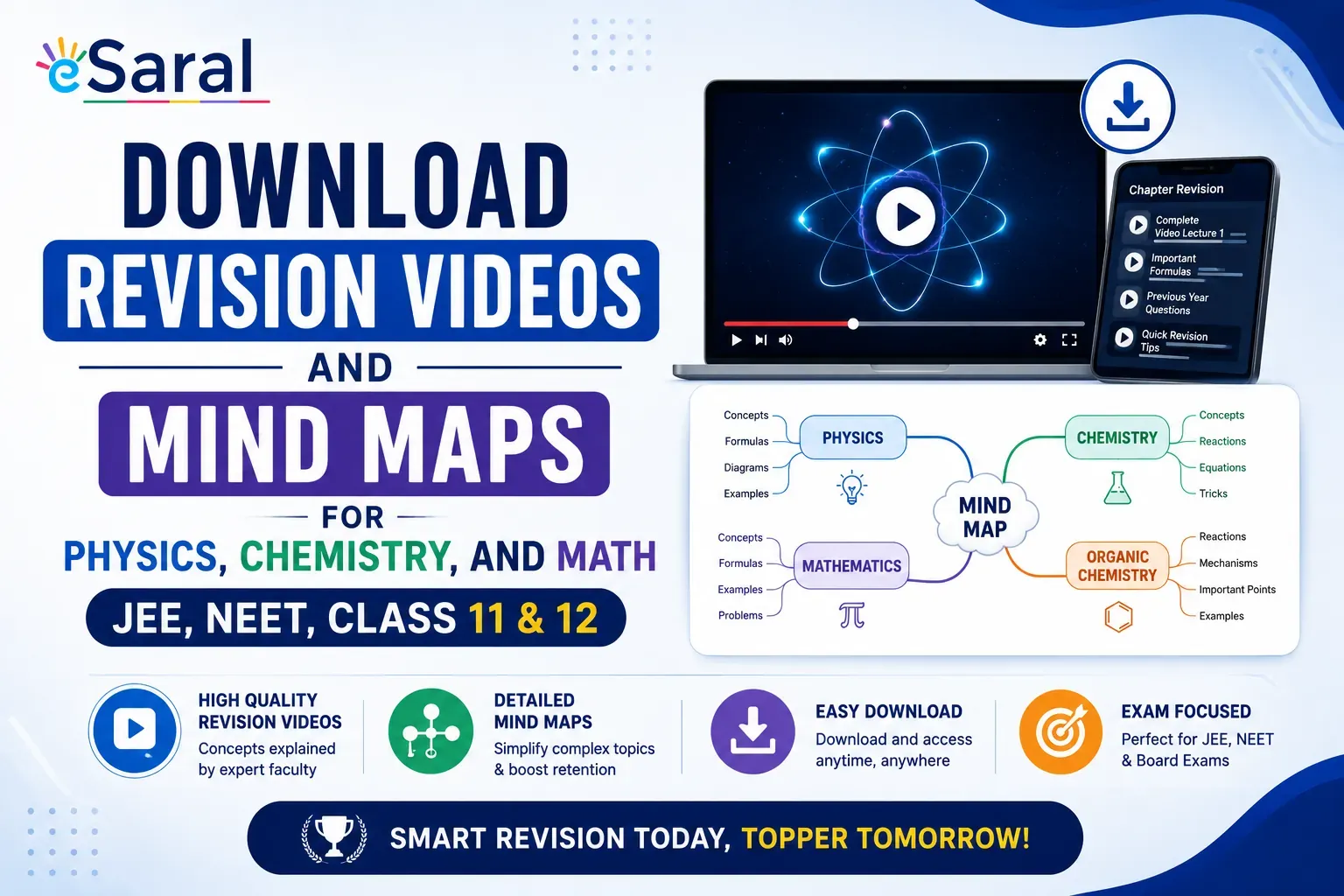
Home »JEE Main Mind Maps: Free Chapter-Wise PDFs for Physics, Chemistry & Maths

🚀 Checkout eSaral Courses
Why Mind Maps Work for JEE Main Revision
JEE Main rewards speed as much as accuracy — 75 questions in 3 hours means you don't have time to derive a formula mid-exam, you need to recall it instantly.
💡 Expert Tip by eSaral Academic Team: During your final 30 days, stop opening full chapter notes. Open the mind map first, self-test what you remember, and only go back to detailed notes for the specific gaps you find. This cuts revision time dramatically while actually improving recall, because you're training retrieval, not re-reading.
Three reasons mind maps matter especially for JEE Main:
- Physics and Chemistry are formula- and reaction-heavy. Chapters like Electrostatics or Coordination Compounds carry dozens of formulas and reactions that blur together without a single reference page.
- Maths depends on remembering the right method, not just the formula. Integral Calculus or Coordinate Geometry questions often hinge on recognising which technique applies — a mind map trains that pattern recognition directly.
- JEE Main draws almost equally from Class 11 and Class 12. Mind maps let you revise a Class 11 chapter like Kinematics with the same speed as a Class 12 chapter like Electromagnetic Induction, without re-reading two years of material.
JEE Main Physics Mind Maps (Chapter-Wise)
Physics carries 25 questions and 100 marks in JEE Main Paper 1, spread across 20 chapters from Mechanics through Modern Physics. Mechanics and Electrodynamics together carry the highest weightage.
JEE Main Physics Mind Maps (Chapter-Wise)
Chapter | Download |
|---|---|
Units and Dimensions | |
Errors and Measurement | |
Vectors | |
Kinematics 1D | |
Kinematics 2D | |
Newton's Laws of Motion (NLM) | |
Friction | |
Circular Motion | |
Work, Power and Energy (WPE) | |
Centre of Mass (COM) | |
Rotational Motion | |
Gravitation | |
Elasticity | |
Fluid Mechanics – Viscosity and Surface Tension | |
Thermal Expansion | |
Calorimetry | |
Kinetic Theory of Gases (KTG) | |
Thermodynamics | |
Heat Transfer | |
Simple Harmonic Motion (SHM) | |
Wave on String | |
Sound Wave (Full Chapter Revision) | |
Electrostatics | |
Capacitor | |
Current Electricity (CE) | |
Magnetic Effects of Current (MEC) | |
Magnetism and Matter | |
Electromagnetic Induction (EMI) | |
Alternating Current (AC) | |
Electromagnetic Waves (EMW) | |
Ray Optics | |
Wave Optics | |
Atomic Structure | |
Dual Nature of Radiation and Matter | |
Radioactivity | |
Semiconductor Devices | |
Nuclear Physics | |
X-Rays |
💡 Expert Tip by eSaral Academic Team: Electrostatics and Current Electricity together feed directly into Magnetic Effects and Electromagnetic Induction. Revise these four chapters back to back using their mind maps — the formula chain across them is one of the highest-yield revision blocks in JEE Main Physics.
JEE Main Chemistry Mind Maps (Chapter-Wise)
Chemistry also carries 25 questions and 100 marks, split roughly equally across Physical, Inorganic, and Organic Chemistry. Inorganic Chemistry is widely considered the most scoring section since it's concept- and memory-based rather than derivation-heavy.
JEE Main Chemistry Mind Maps (Chapter-Wise)
Chapter | Download |
|---|---|
Mole Concept | |
Atomic Structure | |
Chemical Bonding | |
States of Matter | |
Liquid Solution | |
Solid State | |
Thermodynamics | |
Thermochemistry | |
Chemical Equilibrium | |
Ionic Equilibrium | |
Redox Reactions | |
Electrochemistry (Part 1) | |
Electrochemistry (Revision) | |
Chemical Kinetics (CK) | |
Surface Chemistry | |
Periodic Table | |
s-Block Elements | |
P-Block Elements (Group 13–14) | |
P-Block Elements (Group 15–18) | |
Hydrogen | |
D-Block Elements | |
Coordination Compounds | |
Metallurgy | |
Salt Analysis | |
IUPAC Nomenclature | |
General Organic Chemistry (GOC) | |
Isomerism | |
Optical Isomerism | |
Purification of Organic Compounds | |
Hydrocarbons | |
Haloalkanes and Haloarenes | |
Alcohol, Phenol and Ether | |
Carbonyl Compounds | |
Carboxylic Acid | |
Environmental Chemistry | |
Oxidation | |
Biomolecules (BM) |
💡 Expert Tip by eSaral Academic Team: Coordination Compounds and Chemical Kinetics are among the highest-weightage individual chapters in Chemistry. Since both are formula- and rule-heavy rather than conceptually difficult, they're ideal candidates for mind-map-based rapid revision in your last two weeks.
JEE Main Maths Mind Maps (Chapter-Wise)
Maths carries 25 questions and 100 marks, and is widely considered the most time-intensive subject to prepare, since most chapters depend on method recognition rather than direct recall. Algebra and Calculus together carry the highest combined weightage.
Chapter | Download |
|---|---|
Sets | |
Relations | |
Functions | |
Complex Numbers (CN) | |
Quadratic Equations (QE) | |
Matrices | |
Determinants | |
Permutation and Combination | |
Binomial Theorem (BT) | |
Sequence and Series (SS) | |
Logarithm | |
Modulus Function (MOD) | |
Limits | |
Continuity | |
Differentiation | |
Application of Derivatives (AOD) | |
Indefinite Integration | |
Definite Integration (DINT) | |
Area Under the Curve | |
Differential Equations | |
Point | |
Straight Line | |
Circle (CR) | |
Parabola | |
Ellipse | |
Hyperbola | |
Vectors (Chapter 3D/RFS) | |
Compound Angle | |
Trigonometric Equations (TE) | |
Inverse Trigonometric Functions (ITF) | |
Solution of Triangle (SOT) | |
Statistics | |
Probability | |
3D Geometry |
💡 Expert Tip by eSaral Academic :Limit, Continuity and Differentiability feeds directly into Integral Calculus and Differential Equations. Treat these three as one revision block using their mind maps back to back — together they're one of the single largest scoring zones in JEE Main Maths.
Which JEE Main Subject Needs the Most Mind-Map Revision Time?
Chemistry typically needs the most frequent mind-map revision because it spans three distinct styles of learning — Physical Chemistry's formulas, Inorganic Chemistry's memory-based facts, and Organic Chemistry's reaction mechanisms — all within one subject. Physics and Maths, by contrast, reward depth of practice more than repeated recall, so mind maps work best there as a pre-practice warm-up rather than the primary revision method.
How Should You Use These Mind Maps to Revise?
Downloading every PDF across three subjects is the easy part. Using them in the right sequence is what actually moves your score. Follow this method:
- First pass (learning phase): Study the mind map right after finishing the chapter, and use it to confirm you've captured every formula, reaction, or method type taught.
- Second pass (7–10 days later): Recall the entire mind map from memory on a blank page, then compare it against the original to identify weak spots.
- Subject-block revision (monthly): Once a month, revise all mind maps for one subject in a single sitting — Physics one day, Chemistry the next, Maths after that — instead of mixing subjects in one session.
- Final revision (last 15–20 days): Go through every mind map across all three subjects, prioritising high-weightage chapters like Electrostatics, Coordination Compounds, and Calculus first.
Revision Stage | When to Do It | Time Needed per Chapter |
|---|---|---|
First pass | Right after the chapter is taught | 20–25 minutes |
Second pass | 7–10 days later | 10–12 minutes |
Subject-block revision | Once a month | 5–7 minutes per chapter |
Final revision | Last 15–20 days before the exam | 3–5 minutes per chapter |
Droppers and repeaters in particular benefit from this method, since it replaces re-reading two years of notes with a fast, structured recall system across all 60+ JEE Main chapters.
Frequently Asked Questions
Can Class 12 Board students also use these revision videos?
Yes. The revision series is built for Class 11 and 12 students preparing for both Board exams and competitive exams. The content covers the NCERT syllabus as a foundation, so it is directly relevant for Board revision as well. Students can pair these with NCERT Solutions for Class 11 Maths or NCERT Books for Class 12 for complete Board + JEE coverage.
Which subjects are covered in the eSaral revision series?
The revision series covers three subjects: Physics, Chemistry, and Mathematics. Physics is taught by Saransh Gupta Sir (IIT Bombay, AIR-41), Chemistry by Prateek Gupta Sir (IIT Bombay), and Mathematics by N.K. Gupta Sir (IIT Kanpur). All subjects are aligned with the JEE Main, JEE Advanced, and NEET syllabuses
Are the revision videos and mind maps free to access?
Yes. The eSaral revision videos and mind maps for Physics, Chemistry, and Maths are free to access. You can watch the videos directly on the eSaral website or through the eSaral app. Mind maps are available as downloadable visual summaries for each topic without any subscription required
Is the eSaral revision series enough for JEE Advanced preparation?
The revision series covers all important concepts and formulae from the JEE syllabus and includes previous year IIT JEE paper examples. For JEE Advanced, it works best as a rapid recall tool in the final 2–3 weeks rather than a primary study resource. It should be combined with full chapter study, practice problems, and mock tests — all available in the eSaral app
How often are new topics added to the revision series?
New topics are added on an ongoing basis. The eSaral team updates the revision series regularly, and students can also submit suggestions for topics they want added. Check the subject pages (Physics, Chemistry, Maths) periodically for the latest additions.
How are the mind maps different from regular revision notes?
Mind maps present an entire chapter on a single visual page, grouping related formulae, facts, and exceptions spatially. This format activates visual memory and allows you to scan a full topic in 3–5 minutes rather than re-reading pages of notes. They function as flashcards — ideal for the night before an exam or between mock tests.