
Rotational Dynamics for Class 11, JEE & NEET - Introduction

eSaral Academic and Editorial Team
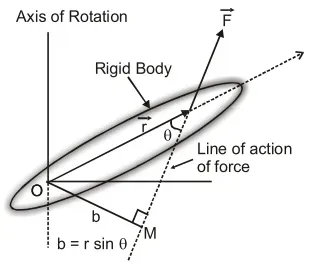
Here, you will learn in detail about Rotational Dynamics and Moment of Inertia. Study about rigid bodies and system of particles in this chapter Rotatory Motion Moment of Force or torque Rotational Equilibrium RIGID BODY System of particle which does not change its shape under the influence of ordinary external force and distance between the particle does not change with respect to time. (i) No body in universe is perfectly rigid. However the bodies in which strain effect is quite negigible under the influence of external force may be said to be rigid bodies e.g. earth, billiard ball etc. (ii) The internal structure of a rigid body and its shape and size do not change in state of motion. Rotatory Motion A body rotating about a fixed axis then every particle of the body moves in a circle and the centres of all these circles lie at axis of rotation. $\overrightarrow{\mathrm{v}}_{\mathrm{i}}=\mathrm{v}$ elocity of $\mathrm{i}^{\text {th }}$ particle of mass $\mathrm{m}_{\mathrm{i}}$ $\overrightarrow{\mathrm{r}_{\mathrm{i}}}=$ position vector of $\mathrm{i}^{\mathrm{th}}$particle $\mathrm{R}_{\mathrm{i}}=$ perpendicular distance of $\mathrm{i}^{\mathrm{ith}}$ particle from axis of rotation. MOMENT OF FORCE OR TORQUE If a hinged or suspended or pivoted body tends to rotate under the action of force, it said to be acted on by a torque: The moment of a force or the torque, about an axis of rotation is equal to the product of the force and perpendicular distance of the line of the action of the force from axis of rotation. The magnitude of torque will be $$ \tau=F . b \quad=F r \sin \theta $$ $b=r \sin \theta$ is known as lever arm or moment arm Unit: $\quad$ M.K.S. : $N-m$ C. G.S. : dyne-cm Dimension: $M L^{2} T^{-2}$ vector form $\vec{\tau}=\vec{r} \times \vec{F}=r F \sin \theta \hat{n},$ where $\theta$ is angle between $\vec{r}$ and $\vec{F}$ and $\hat{n}$ is unit vector perpendicular to the plane of $\vec{r}$ and $\vec{F}$. Torque is an axial vector i.e. its direction is always perpendicular the plane containing vector $\overrightarrow{\mathrm{r}}$ and $\overrightarrow{\mathrm{F}}$ in accordance with right hand rule. If the torque rotates the body in anticlock wise direction, the torque is positive and if the torque rotates the body in clock-wise direction, the torque will be negative. Torque is Minimum When $|\sin \theta|=\min =0$ i.e., $\theta=0^{\circ}$ or $180^{\circ}$ i.e., $\overrightarrow{\mathrm{F}}$ is collinear with $\overrightarrow{\mathrm{r}}$ And $\tau_{\min }=0$ Torque is Maximum When $|\sin \theta|=\max =1$ i.e., $\theta=90^{\circ}$ i.e., $\overrightarrow{\mathrm{F}}$ is orthogonal to $\overrightarrow{\mathrm{r}}$ And $\tau_{\max }=\mathrm{Fr}$ If a body is acted upon by more than one torque, the total torque is the vector sum of each torque. $$ \vec{\tau}=\vec{\tau}_{1}+\vec{\tau}_{2}+\vec{\tau}_{2}+\ldots \ldots \ldots+\vec{\tau}_{n}+\vec{\tau}_{n} \vec{\tau}=\sum_{i=1}^{n} \vec{\tau}_{i} $$ Rotational equilibrium $\sum_{i=1}^{n} \vec{\tau}_{i}=0$ $$ \quad \quad \tau=\mathrm{I} \alpha $$ I- Moment of inertia with respect to axis of rotation. $\alpha$ - Angular acceleration with respect to axis of rotation. $\vec{\tau}=\frac{d \vec{J}}{d t},$ where $\vec{J}$ is angular momentum. The more is the value of b, the more will be torque and easier to rotate the body. (i) The handle of screw driver is taken thick. (ii) In villages the handle of flour-mill is placed near the circumference. (iii) The handle of handpump is kept-long. (iv) The rinch used for opening the tap, is kept-tong. $$ \begin{aligned} \tau=\text { const. } & \text { i.e. } \quad F r \sin \theta=\text { const. } \\ & F=\frac{\text { Const. }}{r \sin \theta} \end{aligned} $$ i.e. longer the arm and greater sin $\theta$, lesser will be the force required for producing desired rotational effect. COUPLE OF FORCES When two forces equal in magnitude but opposite in direction acting at two different points of a body they form couple. This couple tries to rotate body. $$ \begin{array}{l}{\tau=F \cdot b} \\ {b=d \sin \theta}\end{array} $$ Introduction to Rotational Dynamics Moment of Inertia Moment of Inertia: Perpendicular and Parallel axis theorem Radius of Gyration Law of Conservation of Angular Momentum Conservation of Angular Momentum Examples Kinetic Energy of a Rotating Body Work done in rotatory Motion Rotational Power Combine Translational and Rotational Motion Rolling without slipping Rolling on a plane surface Rolling on a Inclined Plane

Team eSaral
eSaral Academic and Editorial Team
Team eSaral is the collective author profile for educational content created by eSaral’s teachers and academic contributors. The team draws on expertise from IIT graduates, doctors, experienced educators and subject specialists to develop resources for JEE, NEET and school students. Our articles aim to explain concepts clearly and help students study with confidence.
Related Posts

Plant Cell Diagram: Labelled Structure, Parts and Functions
Simple, labelled plant cell diagram with parts and functions. Covers plant cell structure for Class 6, 7, 8, 9, 10 and 11 students, CBSE-aligned.

Saransh Gupta Sir's Visit to IIT Patna: Hostel Life, Placements & Lessons for JEE Aspirants
Inside Saransh Gupta Sir's IIT Patna visit — hostel life, the library, placements, internships, and real advice for JEE aspirants from students living the IIT dream.
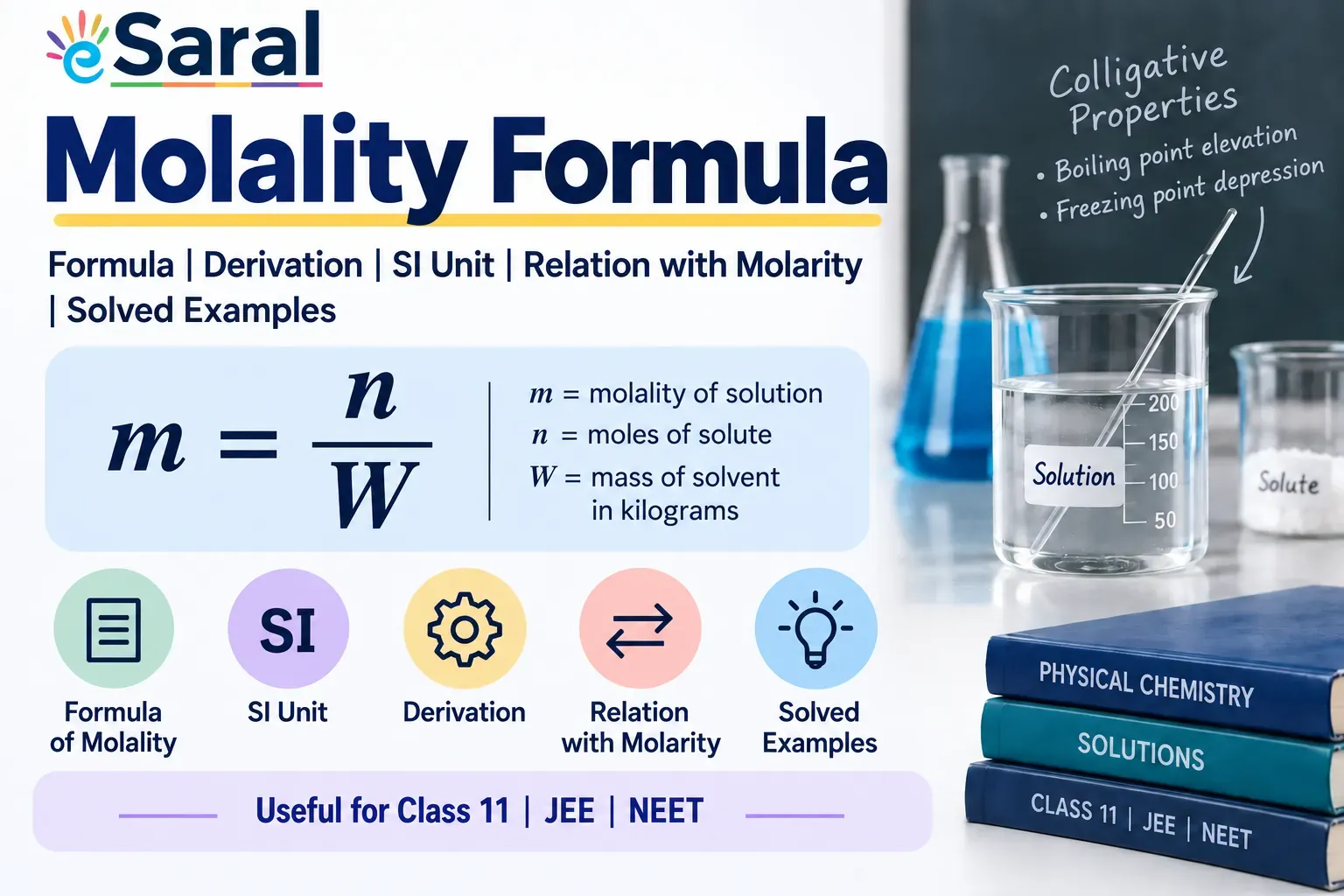
Molality Formula: Formula for Molality, Derivation & Solved Examples
Molality formula is $m = \dfrac{n}{W}$. Learn the formula of molality, its SI unit, derivation, relation with molarity, and solved examples for Class 11, JEE and NEET.
BITSAT Previous Year Question Paper PDF
Download BITSAT previous year question papers PDF. Get year-wise BITSAT PYQs, memory-based papers, exam pattern, and preparation tips to improve your BITSAT preparation.

Teachers’ Day 2026 at eSaral Gurukul: Celebrating the Bond Between Students, Teachers & Mentors
See how Teachers’ Day 2026 was celebrated at eSaral Gurukul, reflecting the bond among students, teachers, and mentors, and the role of guidance beyond academics.
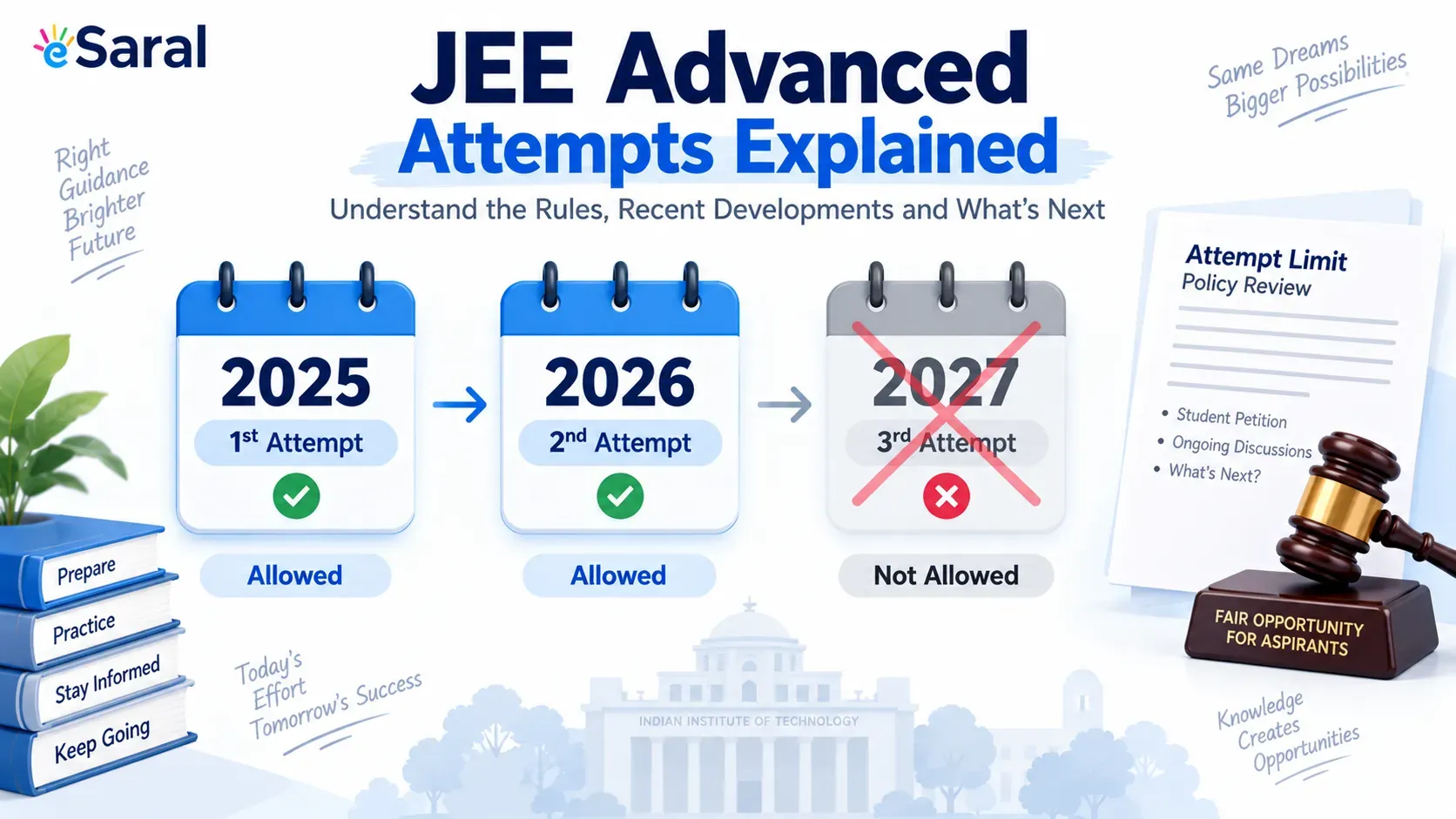
JEE Advanced Attempts: Can You Give It a Third Time? Rules Explained
JEE Advanced attempts: current rule is 2 consecutive years only: full eligibility criteria, the 2025 third-attempt controversy, and the latest 2026 petition news.

Best JEE Preparation App
Best JEE preparation app for Main & Advanced: AI mock tests, live doubt-solving, thousands of practice questions. JEE preparation app for droppers & Class 11-12.
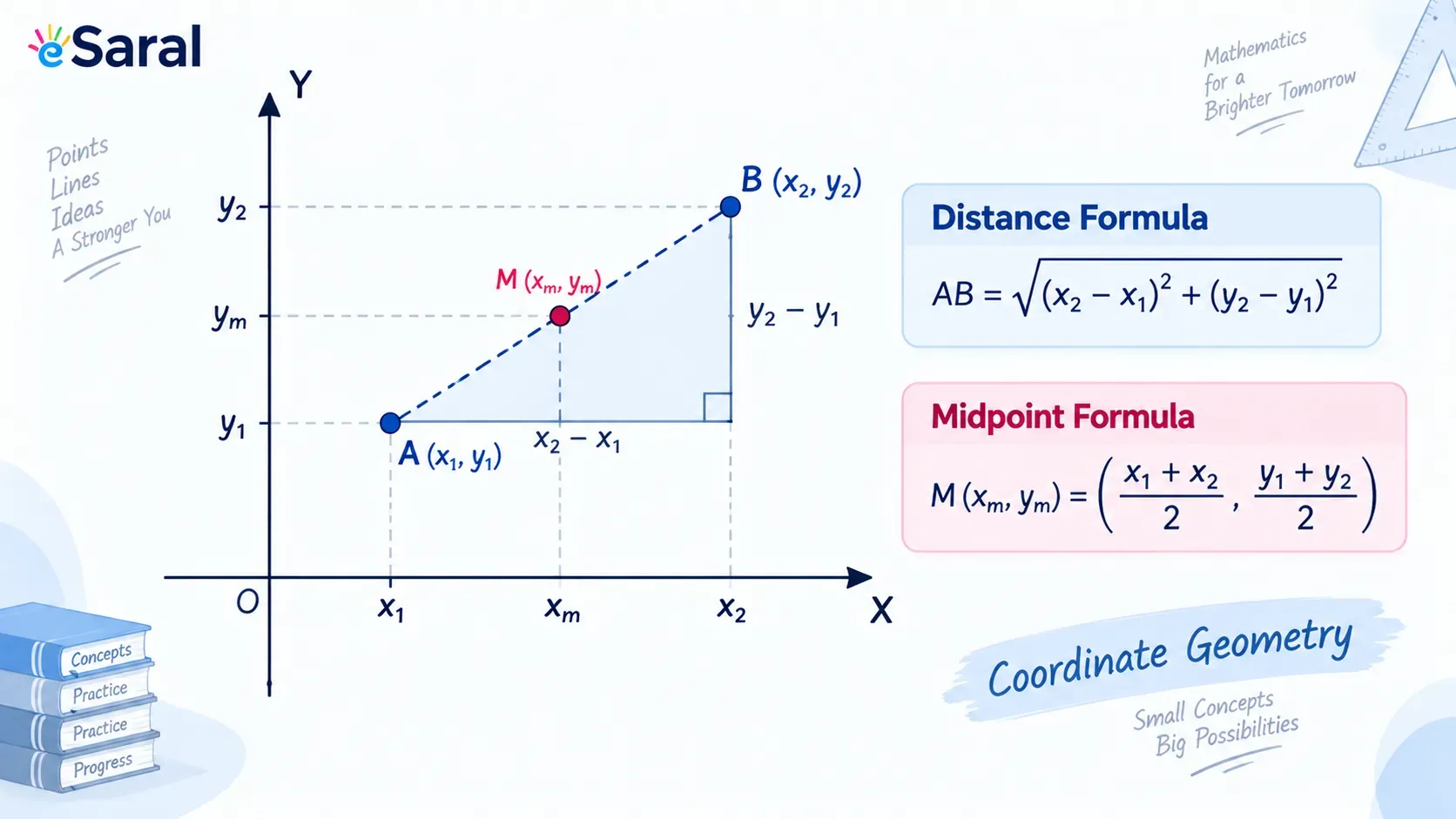
Coordinate Geometry Class 10: Formulas, Notes & Solved Examples
Coordinate geometry class 10: complete CBSE formulas — distance, section, midpoint and area of triangle — with derivation, notes and solved examples.
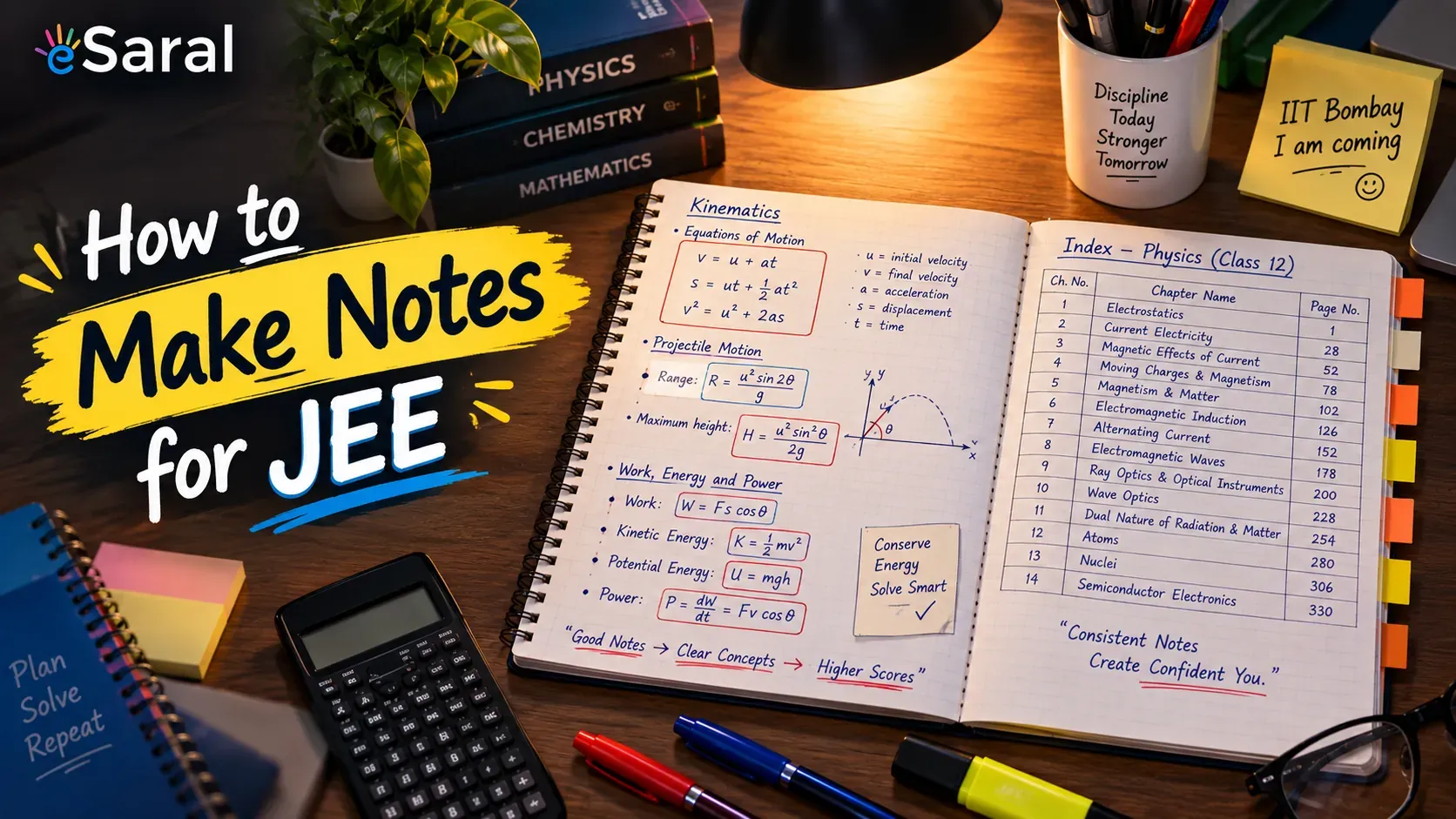
How to make Notes For JEE Smart Notes Strategy of an AIR 41
Learn how to make notes for JEE the way toppers do — indexing, shorthand, and smart short notes for JEE that cut revision time to just 5–7 days.
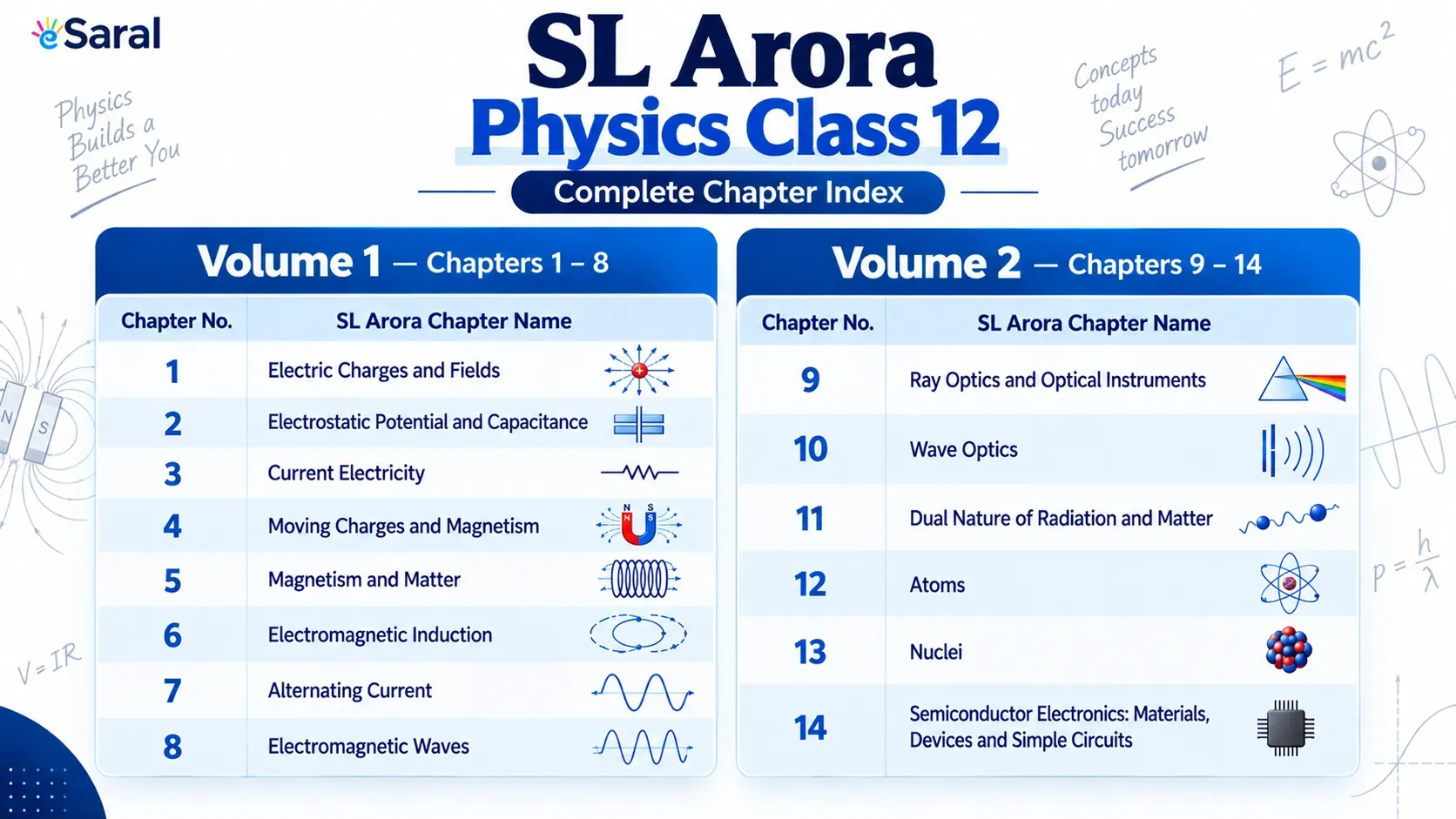
SL Arora Physics Class 12 Index – Chapter List for Volume 1 & 2
SL Arora Physics Class 12 index — complete chapter list for Volume 1 & 2, mapped to NCERT solutions for board, JEE Main, and NEET preparation.