
System of Particles and Rotational Motion Class 11 Notes for IIT JEE & NEET

eSaral Academic and Editorial Team
Summary
Rotational Motion Class 11 Notes cover the chapter System of Particles and Rotational Motion: centre of mass, torque, angular momentum and its conservation, moment of inertia with the parallel and perpendicular axes theorems, rotational kinematics and dynamics, rolling motion and the comparison with linear motion.
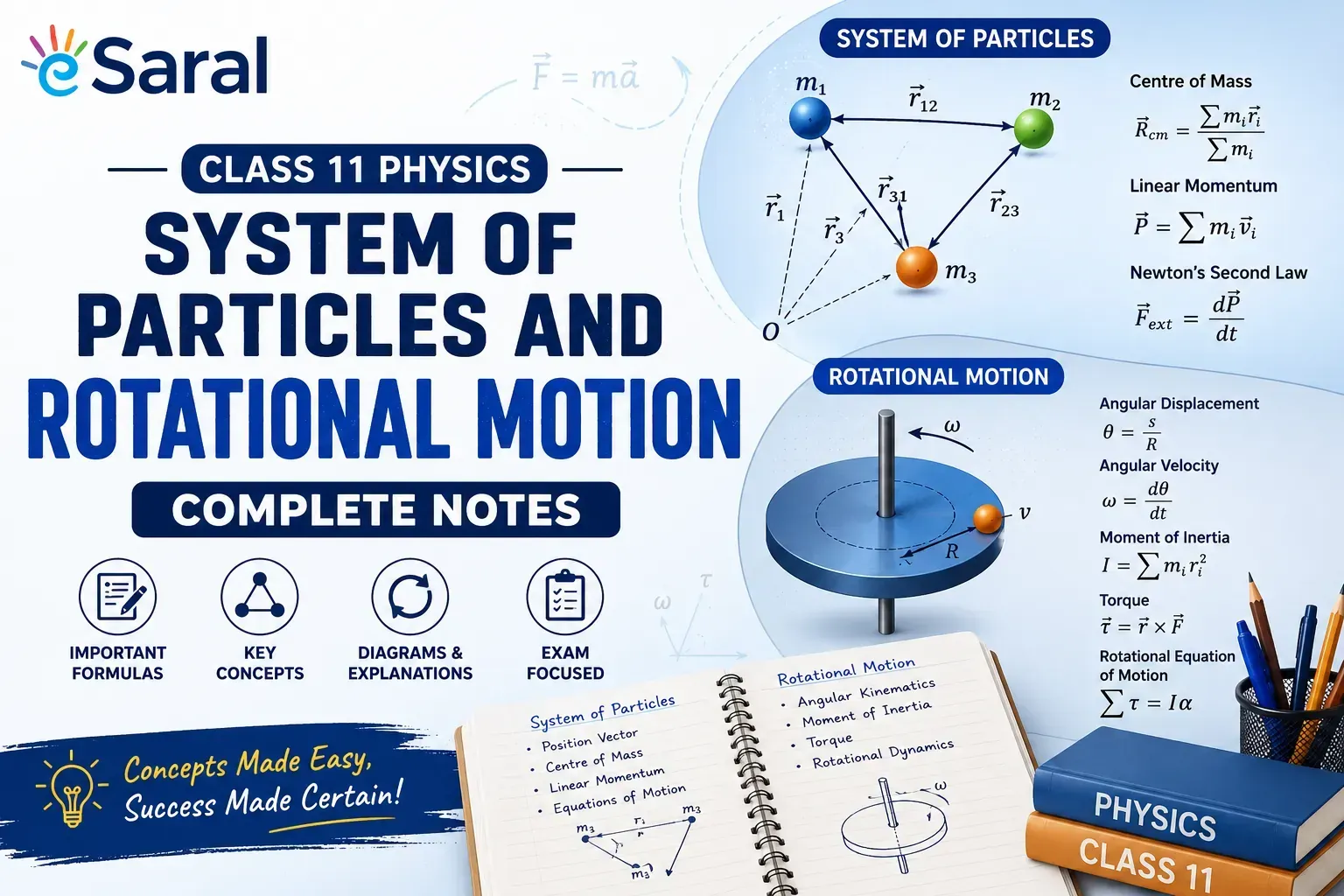
System of Particles and Rotational Motion is Chapter 6 of the current NCERT Class 11 Physics book (it was Chapter 7 in older books). It extends mechanics from a single point mass to a system of particles and a rigid body. In the JEE Main 2026 syllabus, it is Unit 5, Rotational Motion. These Rotational Motion Class 11 Notes follow the chapter in the order of the NCERT book, and they add the problem types that JEE and NEET use.
Rotational Motion Class 11 Notes: Chapter Overview and Syllabus
The JEE Main 2026 syllabus (Unit 5) and the CBSE chapter cover these topics:
- Centre of mass of a two-particle system and of a rigid body
- Moment of a force (torque), angular momentum, conservation of angular momentum and its applications
- Moment of inertia, radius of gyration, values of the moment of inertia of simple geometrical objects, and the parallel and perpendicular axes theorems
- Equilibrium of rigid bodies, rigid body rotation and the equations of rotational motion, and the comparison of linear and rotational motion
Rolling motion is part of the NCERT chapter, and JEE problems use it. Check the latest syllabi of CBSE, NTA (JEE Main) and NMC (NEET) for the exact lists.
Tip from the eSaral Physics team: Learn the chapter as a translation table from linear motion to rotational motion: mass becomes moment of inertia, force becomes torque, and momentum becomes angular momentum. Every formula then follows from one you already know.
Centre of Mass in Rotational Motion Class 11 Notes
For a system of particles with masses $m_i$ at positions $\vec{r}_i$, the centre of mass is:
$$\vec{R}_{cm} = \frac{\sum m_i\,\vec{r}_i}{M}, \qquad M = \sum m_i$$
For two particles on a line: $x_{cm} = \dfrac{m_1x_1 + m_2x_2}{m_1 + m_2}$. The centre of mass of a uniform rod is at its middle. For other common bodies, measured from the centre of the flat face or the circle:
Body | Distance of the centre of mass from the centre |
|---|---|
Semicircular ring | $\dfrac{2R}{\pi}$ |
Semicircular disc | $\dfrac{4R}{3\pi}$ |
Solid hemisphere | $\dfrac{3R}{8}$ |
Hollow hemisphere | $\dfrac{R}{2}$ |
Motion of the centre of mass: only the external forces move it:
$$M\,\vec{a}_{cm} = \vec{F}_{ext}, \qquad \vec{P} = M\,\vec{v}_{cm}$$
If $\vec{F}_{ext} = 0$, the momentum of the system is conserved, and the centre of mass moves with constant velocity.
Angular Velocity, Torque and Angular Momentum in Rotational Motion Class 11 Notes
For rotation about a fixed axis, $v = \omega r$, the tangential acceleration is $a_t = \alpha r$, and the centripetal acceleration is $a_c = \omega^2 r$.
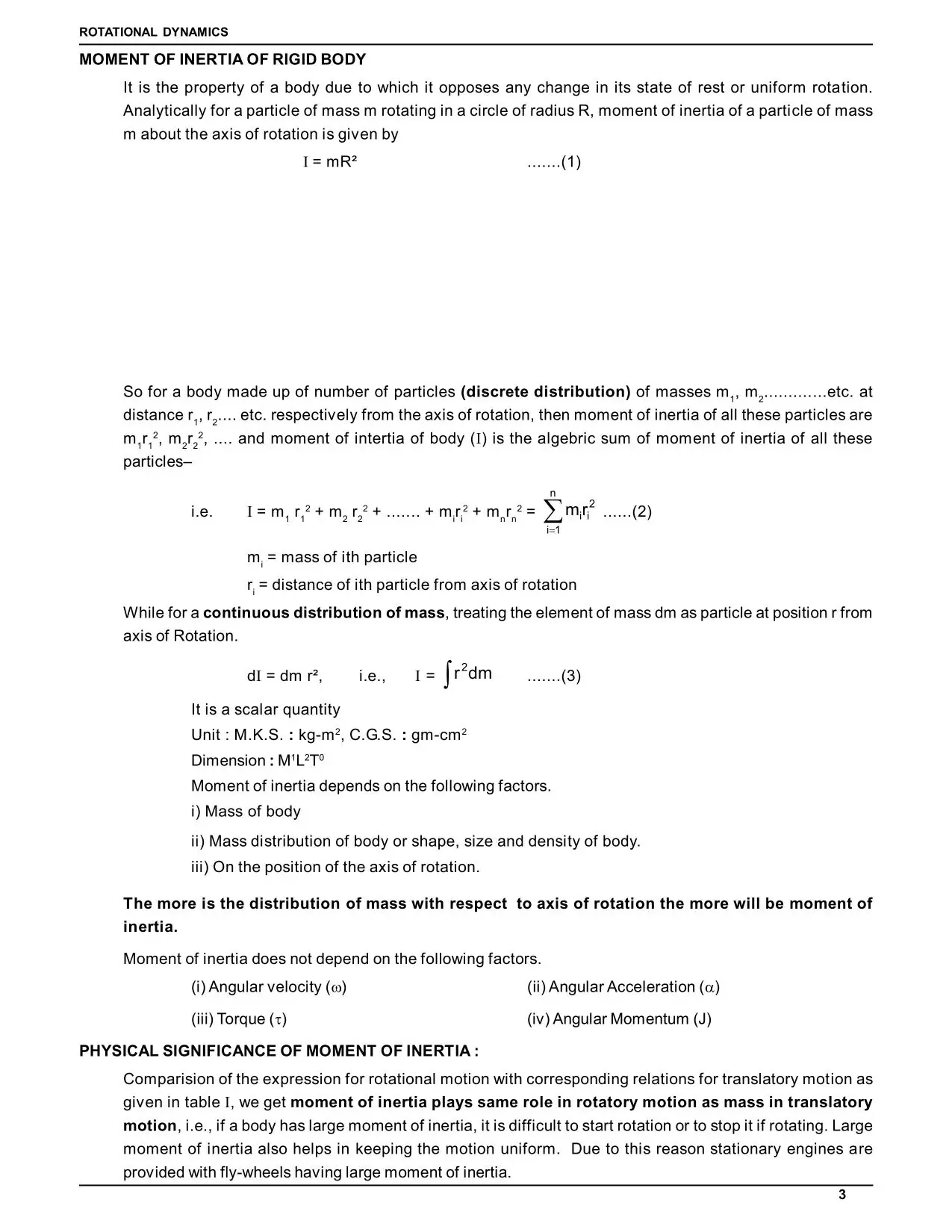
$$\vec{\tau} = \vec{r} \times \vec{F}, \qquad \tau = rF\sin\theta$$ $$\vec{L} = \vec{r} \times \vec{p}, \qquad \vec{\tau}_{net} = \frac{d\vec{L}}{dt}$$
Torque and angular momentum use the vector (cross) product, so revise it with eSaral’s vector physics notes for Class 11. For a rigid body rotating about a fixed axis:
$$L = I\omega, \qquad \tau = I\alpha$$
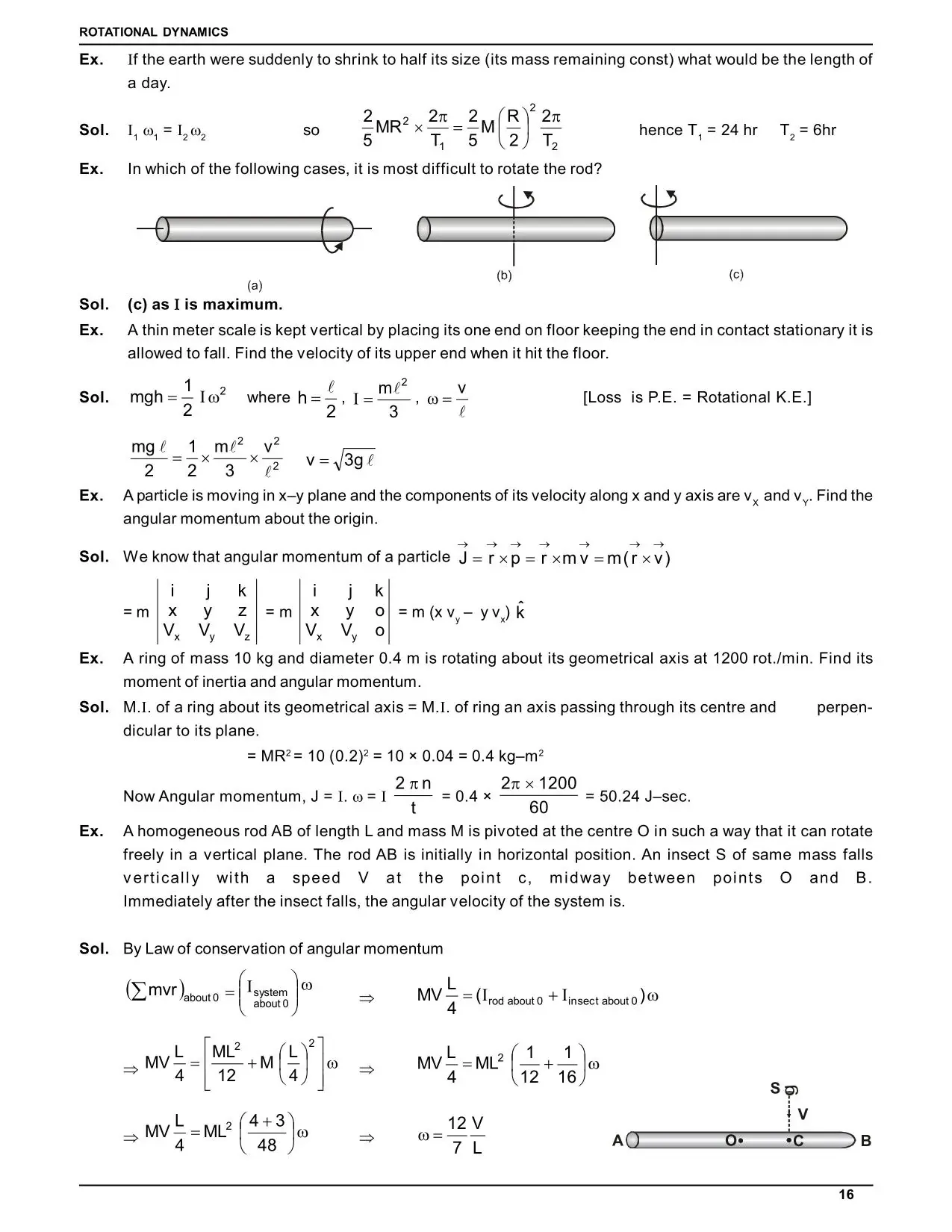
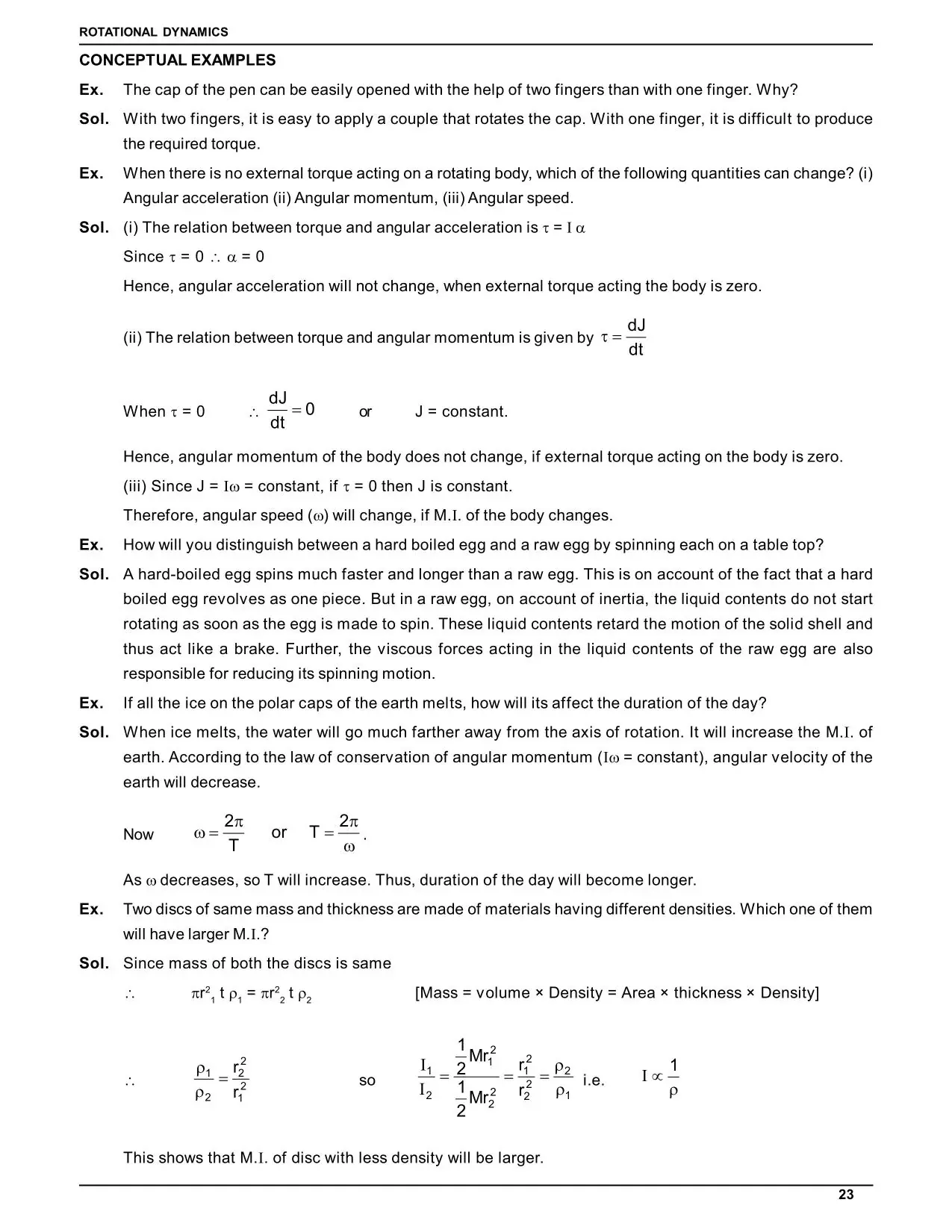
Conservation of angular momentum: if the net external torque is zero, $L$ is constant, so $I_1\omega_1 = I_2\omega_2$. A skater who pulls in the arms reduces $I$, so $\omega$ increases.
Equilibrium of a rigid body: the body is in equilibrium if the net force and the net torque are both zero: $\sum \vec{F} = 0$ and $\sum \vec{\tau} = 0$.
Moment of Inertia in Rotational Motion Class 11 Notes
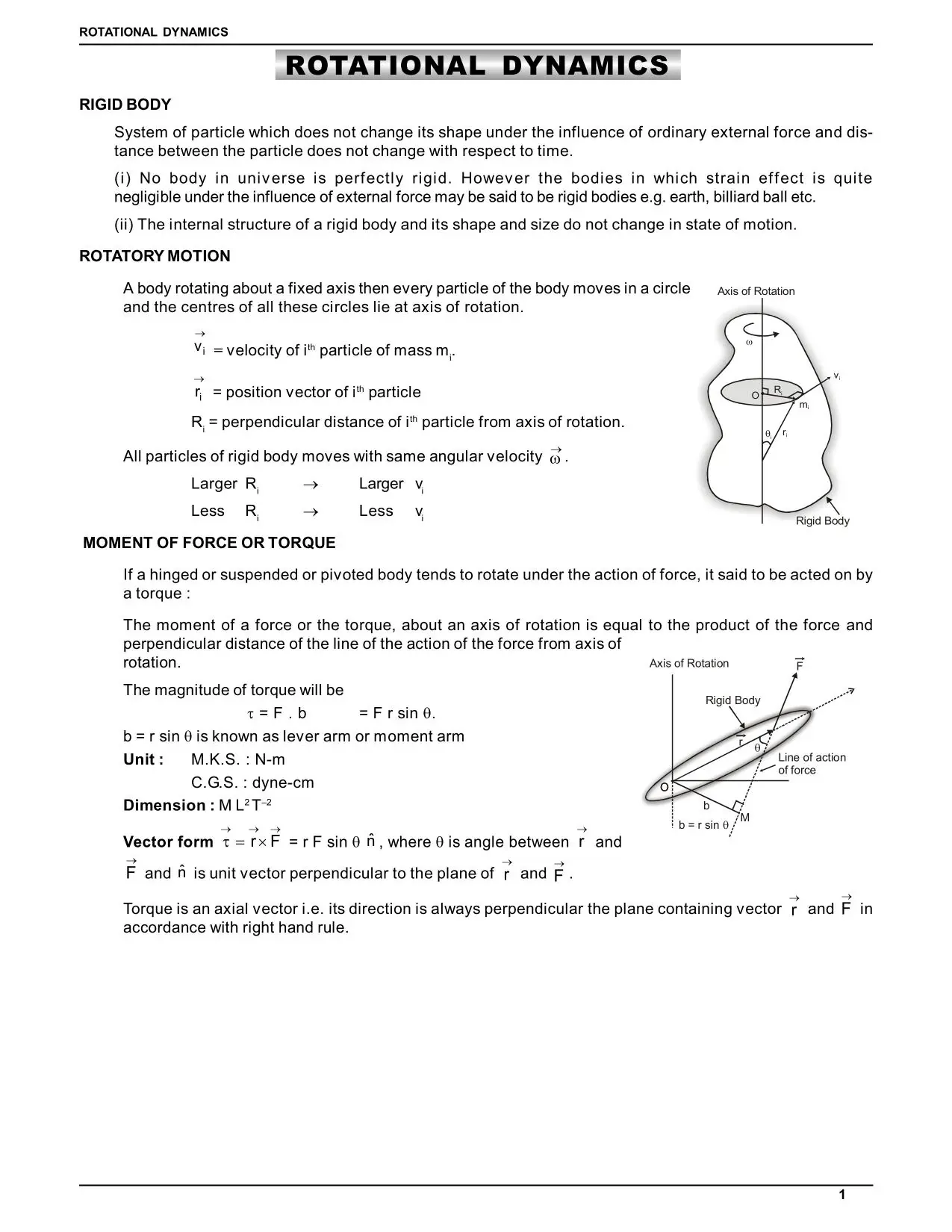
The moment of inertia measures the resistance of a body to a change in its rotation about an axis:
$$I = \sum m_i r_i^{2} \quad \text{(discrete)}, \qquad I = \int r^{2}\,dm \quad \text{(continuous)}$$
The radius of gyration $k$ is defined by $I = Mk^{2}$, so $k = \sqrt{I/M}$. The moment of inertia depends on the mass, on how it is distributed and on the axis.
Standard Values of the Moment of Inertia
Body | Axis | $I$ |
|---|---|---|
Thin ring | Through the centre, perpendicular to the plane | $MR^{2}$ |
Thin ring | A diameter | $\tfrac{1}{2}MR^{2}$ |
Disc | Through the centre, perpendicular to the plane | $\tfrac{1}{2}MR^{2}$ |
Disc | A diameter | $\tfrac{1}{4}MR^{2}$ |
Solid cylinder | Its own axis | $\tfrac{1}{2}MR^{2}$ |
Solid sphere | A diameter | $\tfrac{2}{5}MR^{2}$ |
Hollow sphere (thin shell) | A diameter | $\tfrac{2}{3}MR^{2}$ |
Thin rod | Through the centre, perpendicular to the rod | $\tfrac{1}{12}ML^{2}$ |
Thin rod | Through one end, perpendicular to the rod | $\tfrac{1}{3}ML^{2}$ |
Parallel and Perpendicular Axes Theorems
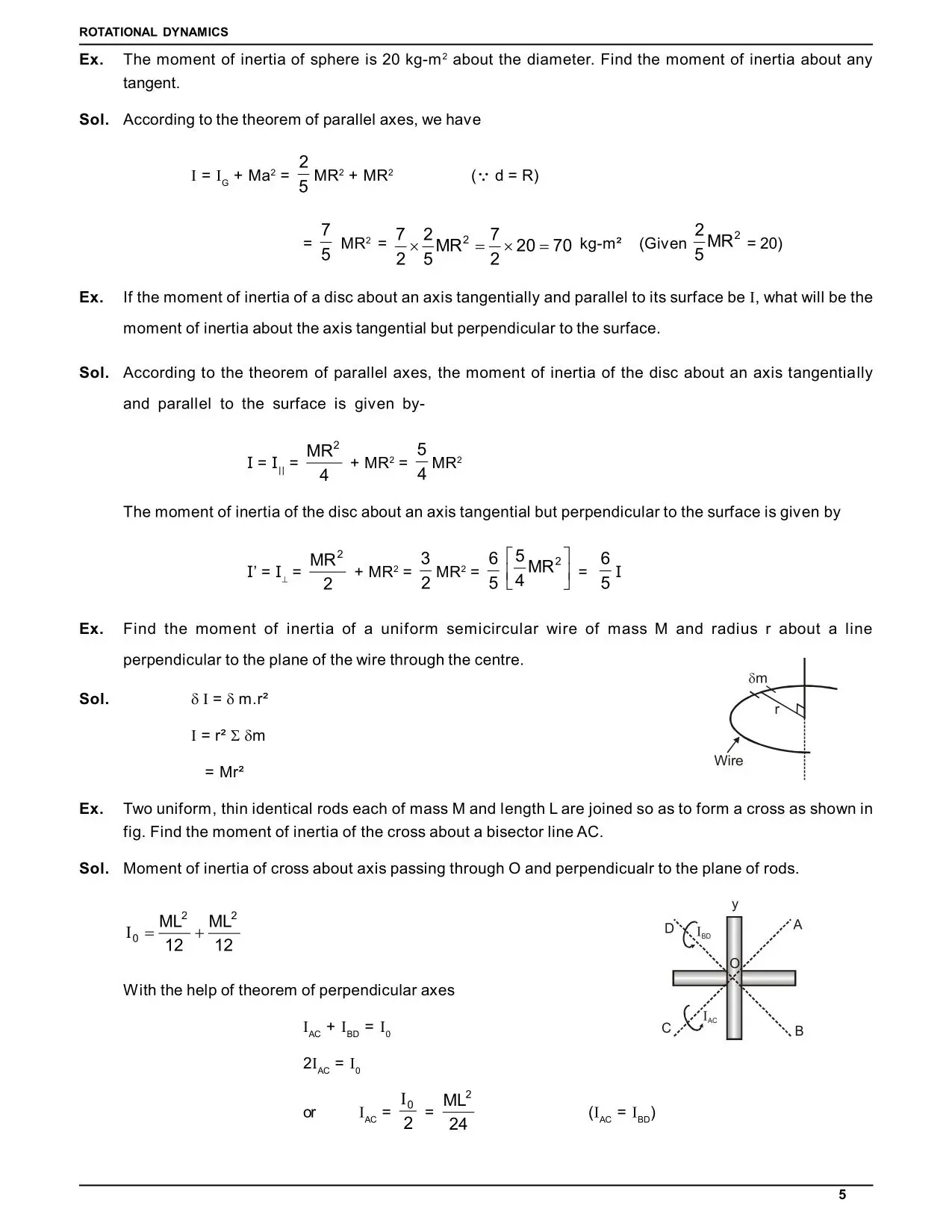
$$I = I_{cm} + Md^{2} \quad \text{(parallel axes theorem)}$$ $$I_z = I_x + I_y \quad \text{(perpendicular axes theorem, for a flat body in the } xy\text{-plane)}$$
For example, for a disc, $I_z = \tfrac{1}{2}MR^2$ and $I_x = I_y = \tfrac{1}{4}MR^2$. About a tangent perpendicular to the plane of the disc, $I = \tfrac{1}{2}MR^2 + MR^2 = \tfrac{3}{2}MR^2$. About a tangent in the plane of the disc (parallel to a diameter), $I = \tfrac{1}{4}MR^2 + MR^2 = \tfrac{5}{4}MR^2$.
Rotational Kinematics and Dynamics in Rotational Motion Class 11 Notes
For constant angular acceleration, the equations are the same as for linear motion:
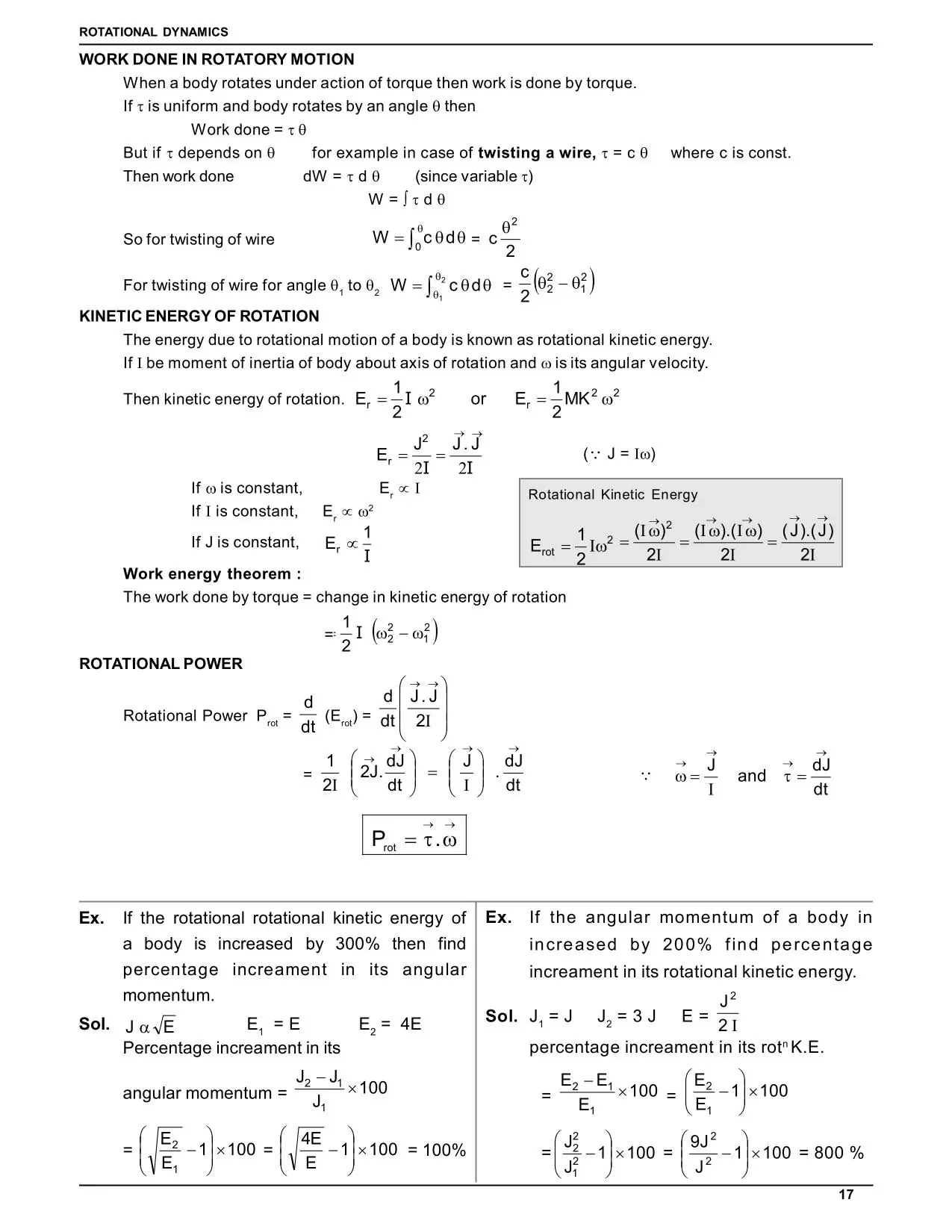
$$\omega = \omega_0 + \alpha t, \qquad \theta = \omega_0 t + \tfrac{1}{2}\alpha t^2, \qquad \omega^2 = \omega_0^2 + 2\alpha\theta$$ $$K_{rot} = \tfrac{1}{2}I\omega^{2}, \qquad W = \tau\theta, \qquad P = \tau\omega$$
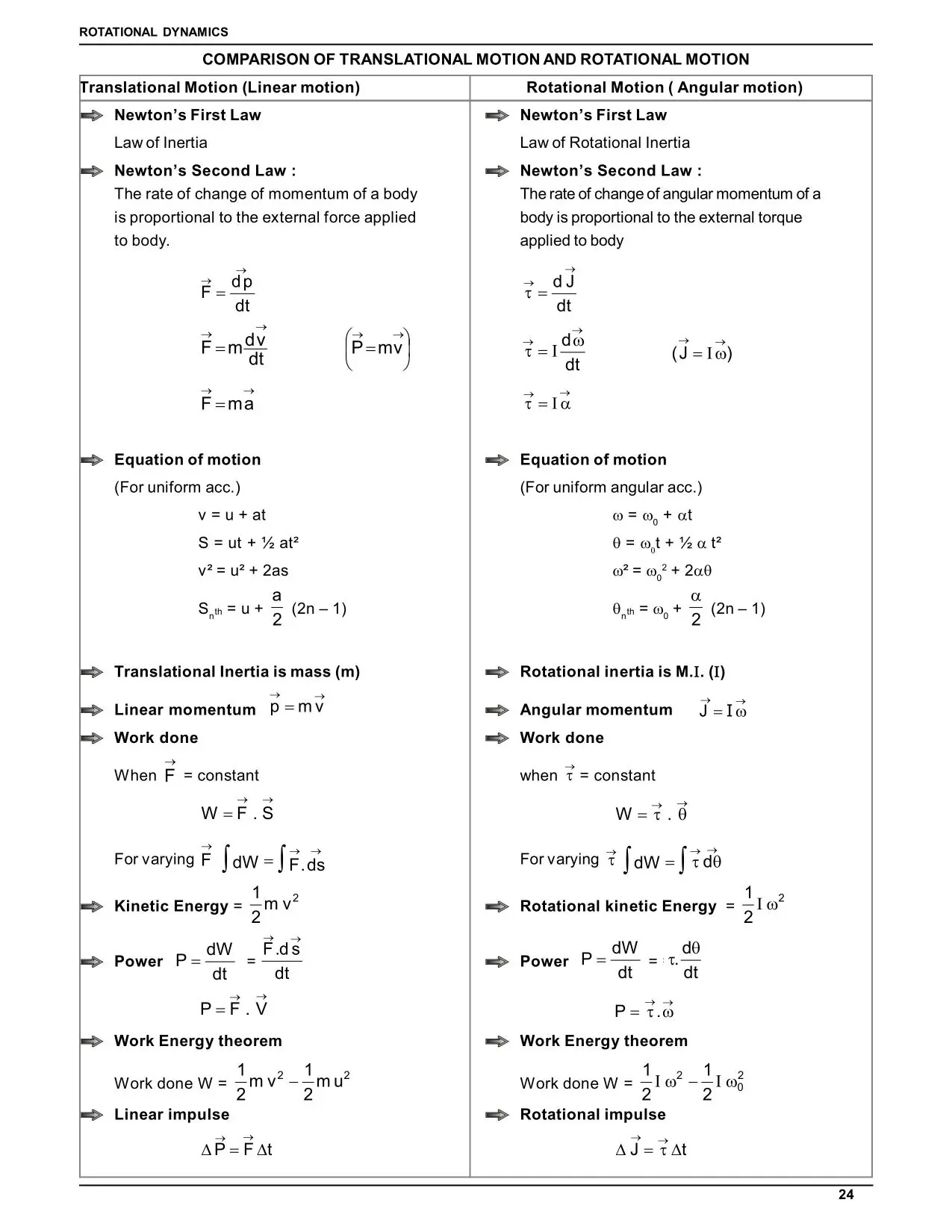
Linear Motion vs Rotational Motion
Linear | Rotational |
|---|---|
Displacement $x$ | Angle $\theta$ |
Velocity $v$ | Angular velocity $\omega$ |
Acceleration $a$ | Angular acceleration $\alpha$ |
Mass $m$ | Moment of inertia $I$ |
Force $F = ma$ | Torque $\tau = I\alpha$ |
Momentum $p = mv$ | Angular momentum $L = I\omega$ |
Kinetic energy $\tfrac{1}{2}mv^2$ | Kinetic energy $\tfrac{1}{2}I\omega^2$ |
Work $W = Fs$ | Work $W = \tau\theta$ |
Power $P = Fv$ | Power $P = \tau\omega$ |
Rolling Motion in Rotational Motion Class 11 Notes
For pure rolling (rolling without slipping), the point of contact is at rest, and:
$$v_{cm} = \omega R$$
The total kinetic energy is the sum of the translational and rotational parts:
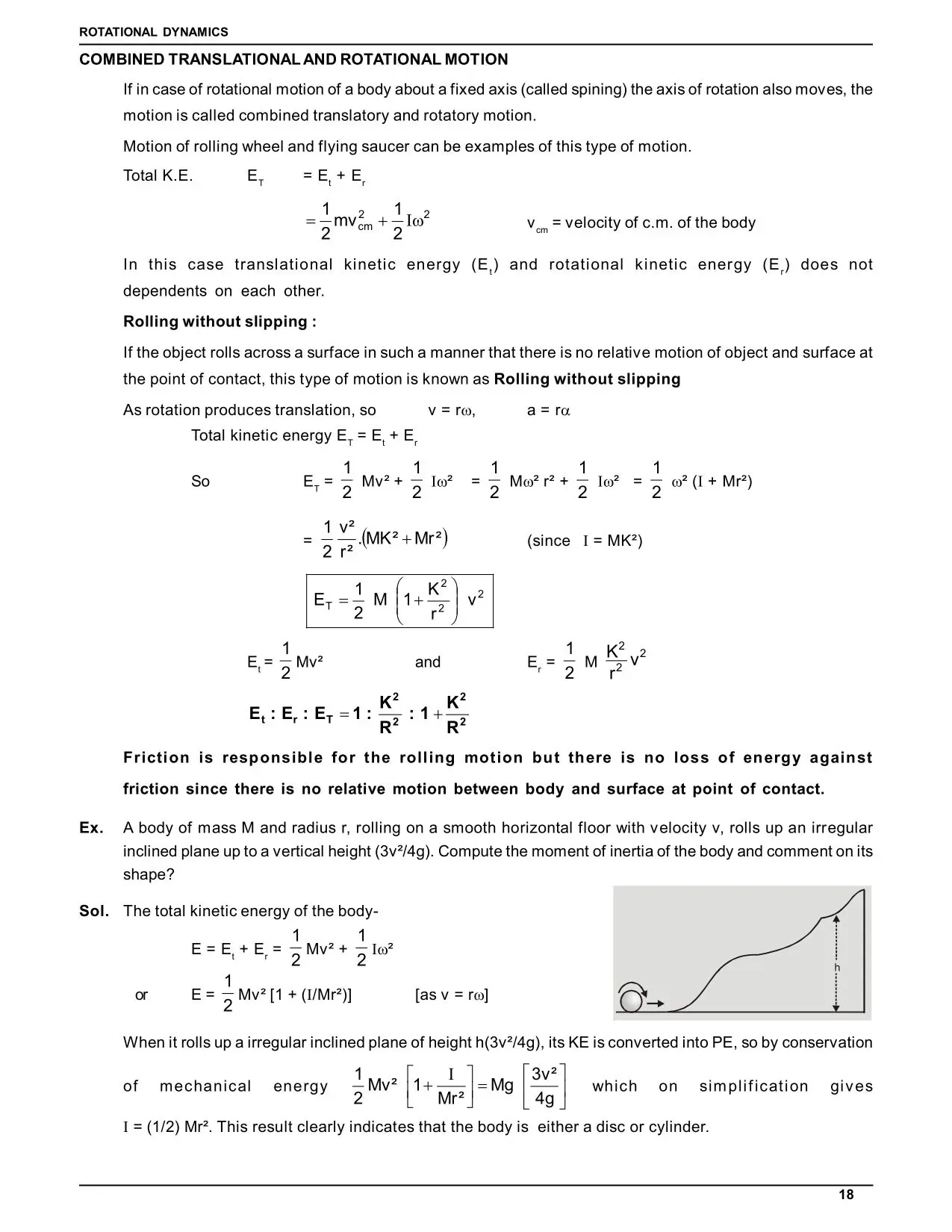
$$K = \tfrac{1}{2}Mv_{cm}^{2} + \tfrac{1}{2}I\omega^{2} = \tfrac{1}{2}Mv_{cm}^{2}\left(1 + \frac{k^{2}}{R^{2}}\right)$$
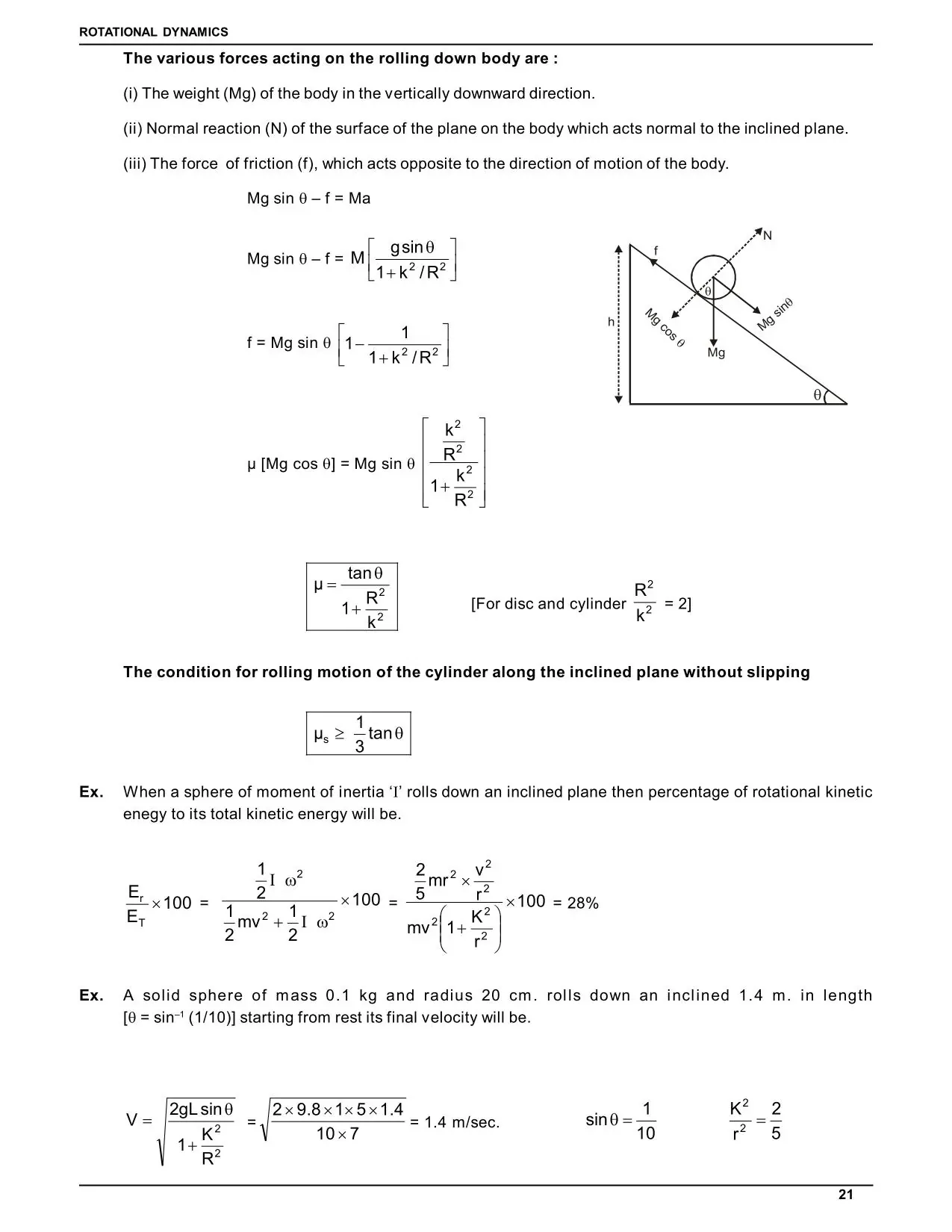
For a body that rolls down an incline of angle $\theta$:
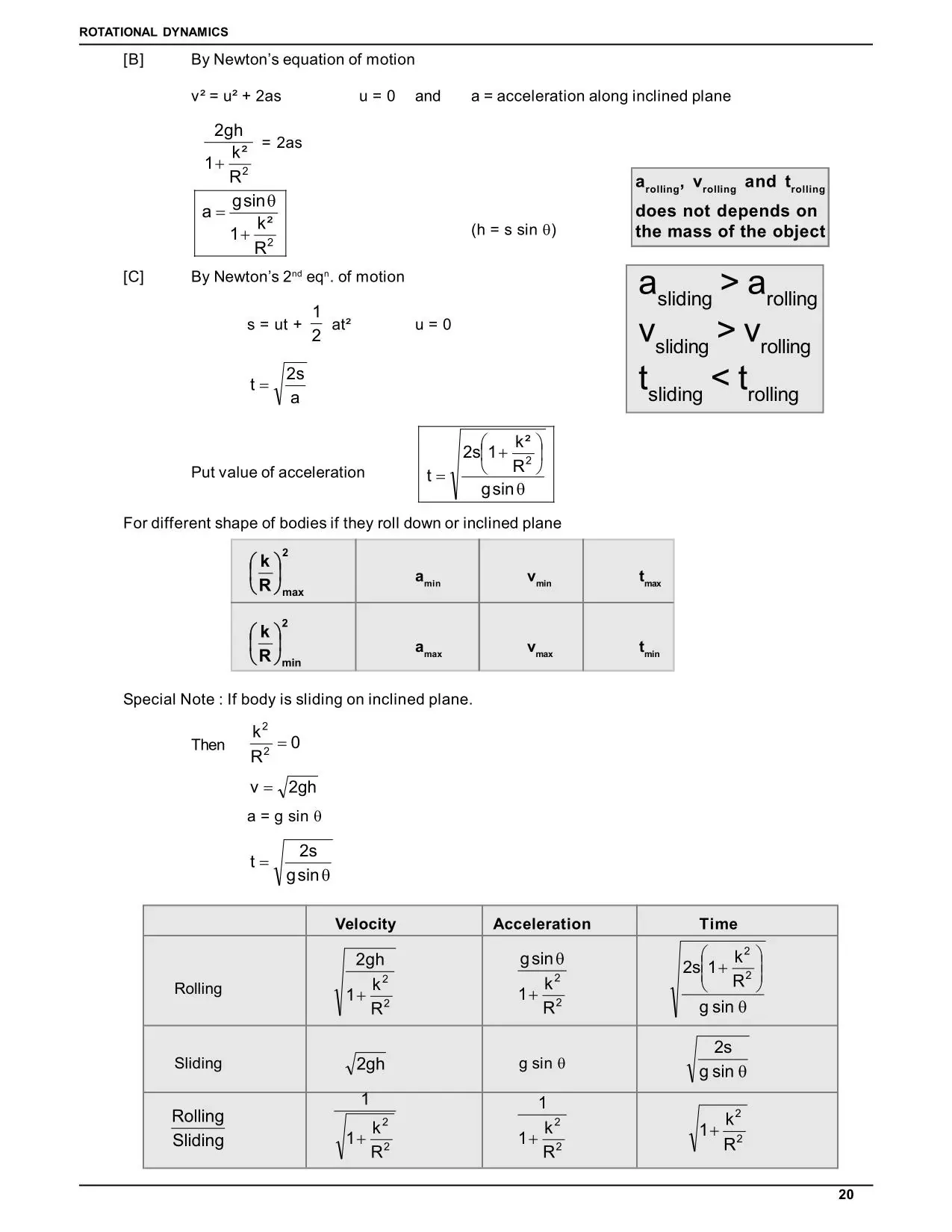
$$a = \frac{g\sin\theta}{1 + \dfrac{k^{2}}{R^{2}}}$$
Body | $\dfrac{k^2}{R^2}$ | Acceleration down the incline |
|---|---|---|
Solid sphere | $\dfrac{2}{5}$ | $\dfrac{5}{7}\,g\sin\theta$ |
Disc or solid cylinder | $\dfrac{1}{2}$ | $\dfrac{2}{3}\,g\sin\theta$ |
Hollow sphere | $\dfrac{2}{3}$ | $\dfrac{3}{5}\,g\sin\theta$ |
Ring or hollow cylinder | $1$ | $\dfrac{1}{2}\,g\sin\theta$ |
The body with the smallest $k^2/R^2$ reaches the bottom first, so the order is solid sphere, disc, hollow sphere, ring. Static friction acts on a rolling body, and it does no work in pure rolling.
Key Formulas in Rotational Motion Class 11 Notes
Concept | Formula |
|---|---|
Centre of mass | $\vec{R}_{cm} = \dfrac{\sum m_i\vec{r}_i}{M}$ |
Torque | $\vec{\tau} = \vec{r}\times\vec{F}$ |
Angular momentum | $\vec{L} = \vec{r}\times\vec{p}$, $L = I\omega$ |
Rotational Newton’s law | $\tau = I\alpha = \dfrac{dL}{dt}$ |
Moment of inertia | $I = \sum m_i r_i^2$ |
Parallel axes theorem | $I = I_{cm} + Md^2$ |
Perpendicular axes theorem | $I_z = I_x + I_y$ |
Rotational kinetic energy | $\tfrac{1}{2}I\omega^2$ |
Pure rolling | $v_{cm} = \omega R$ |
Rolling down an incline | $a = \dfrac{g\sin\theta}{1 + k^2/R^2}$ |
Solved Examples from Rotational Motion Class 11 Notes
Example 1 (centre of mass): A 2 kg mass is at $x = 0$, and a 3 kg mass is at $x = 5$ m. Find the centre of mass.
$x_{cm} = \dfrac{2(0) + 3(5)}{2 + 3} = 3$ m from the 2 kg mass.
Example 2 (torque): A force of 10 N acts at 30° to a spanner of length 0.5 m. Find the torque.
$\tau = rF\sin\theta = 0.5 \times 10 \times \sin 30^\circ = 2.5$ N·m.
Example 3 (parallel axes theorem): A disc of mass 2 kg and radius 0.5 m is given. Find $I$ about (a) an axis through the rim, perpendicular to the plane, and (b) a tangent in the plane of the disc.
(a) $I = \tfrac{3}{2}MR^2 = 1.5 \times 2 \times 0.25 = 0.75$ kg·m². (b) $I = \tfrac{5}{4}MR^2 = 1.25 \times 2 \times 0.25 = 0.625$ kg·m².
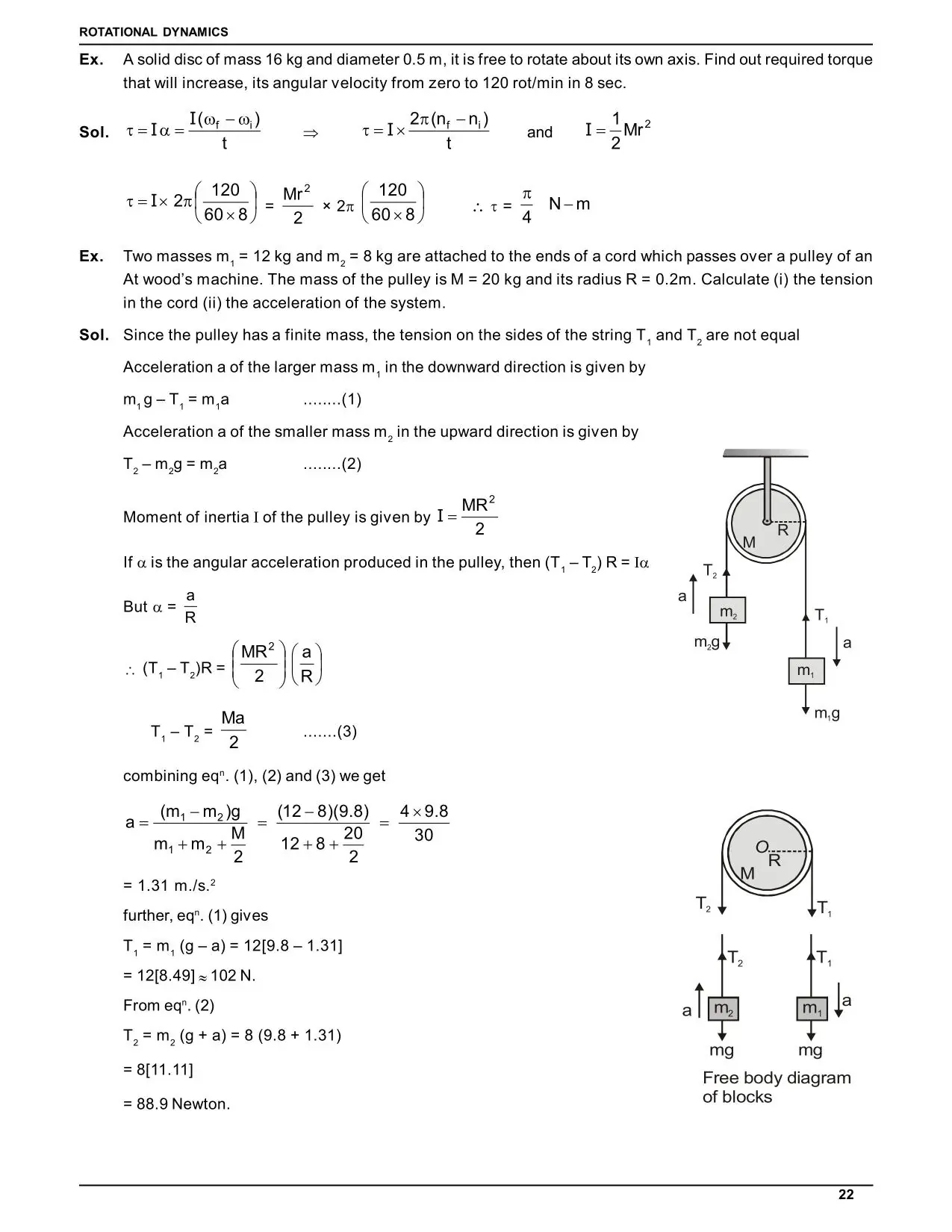
Example 4 (rotational kinematics): A wheel with $I = 0.5$ kg·m² starts from rest with $\alpha = 2$ rad/s². Find $\omega$, $\theta$ and the kinetic energy after 5 s.
$\omega = 2 \times 5 = 10$ rad/s. $\theta = \tfrac{1}{2}(2)(25) = 25$ rad. $K = \tfrac{1}{2}(0.5)(10)^2 = 25$ J.
Example 5 (conservation of angular momentum): A skater spins at 2 rad/s with $I = 4$ kg·m². She pulls in her arms, and $I$ becomes 2 kg·m². Find the new angular velocity and the change in kinetic energy.
$\omega_2 = \dfrac{I_1\omega_1}{I_2} = \dfrac{4 \times 2}{2} = 4$ rad/s. The kinetic energy changes from $\tfrac{1}{2}(4)(2)^2 = 8$ J to $\tfrac{1}{2}(2)(4)^2 = 16$ J. The extra 8 J comes from the work that she does.
Example 6 (rolling down an incline): A solid sphere rolls without slipping down a 30° incline. Find its acceleration ($g = 10$ m/s²).
$a = \dfrac{g\sin\theta}{1 + 2/5} = \dfrac{10 \times 0.5}{1.4} \approx 3.57$ m/s².
Example 7 (kinetic energy in rolling): What fraction of the total kinetic energy of a rolling solid sphere is translational?
$\dfrac{K_{trans}}{K} = \dfrac{1}{1 + 2/5} = \dfrac{5}{7}$, so the rotational part is $\dfrac{2}{7}$.
Example 8 (radius of gyration): Find the radius of gyration of a solid sphere about a diameter.
$I = \tfrac{2}{5}MR^2 = Mk^2$, so $k = R\sqrt{\dfrac{2}{5}}$.
Rotational Motion Class 11 Notes
India's Best Exam Preparation for Class 11th - Download Now
India's Best Exam Preparation for Class 11th - Download Now
India's Best Exam Preparation for Class 11th - Download Now
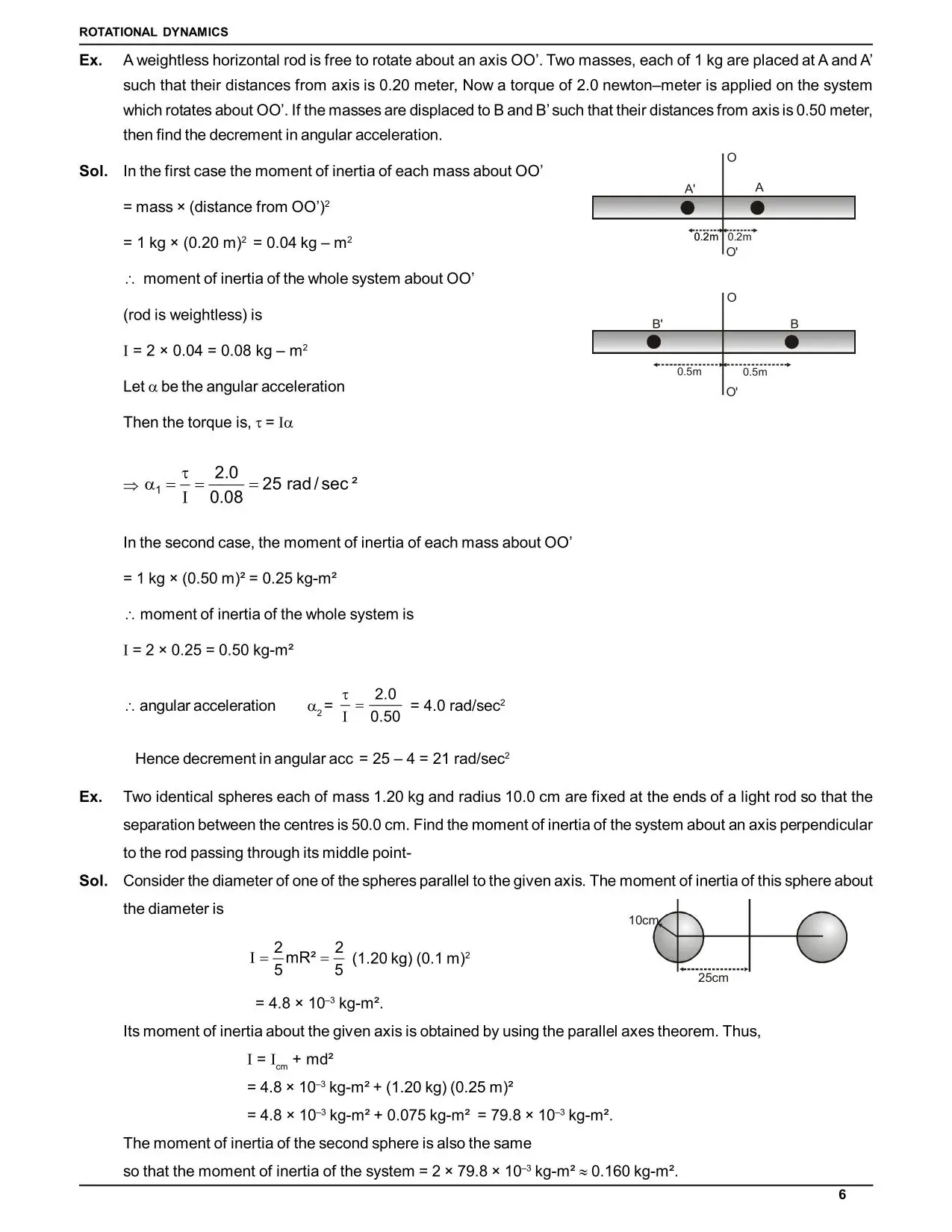
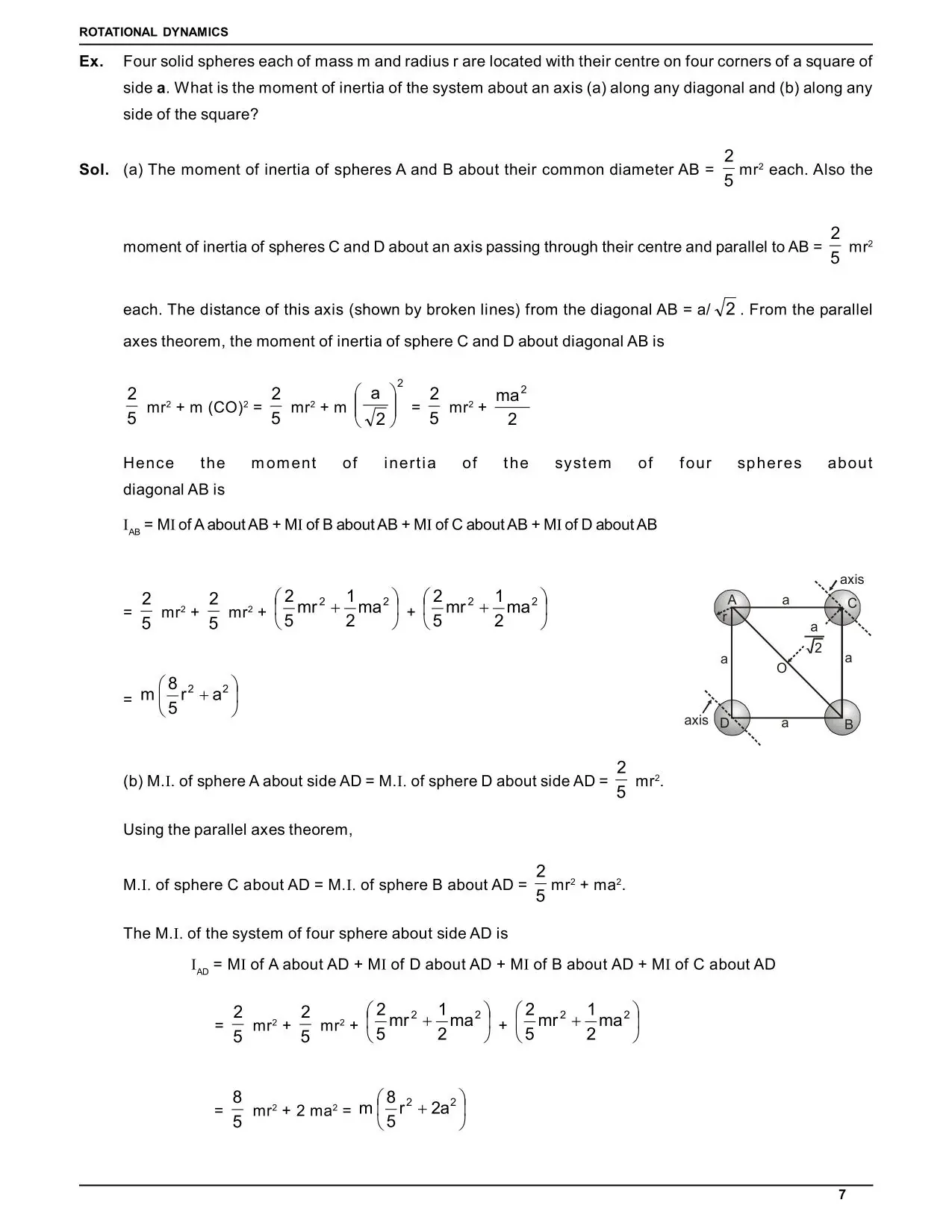
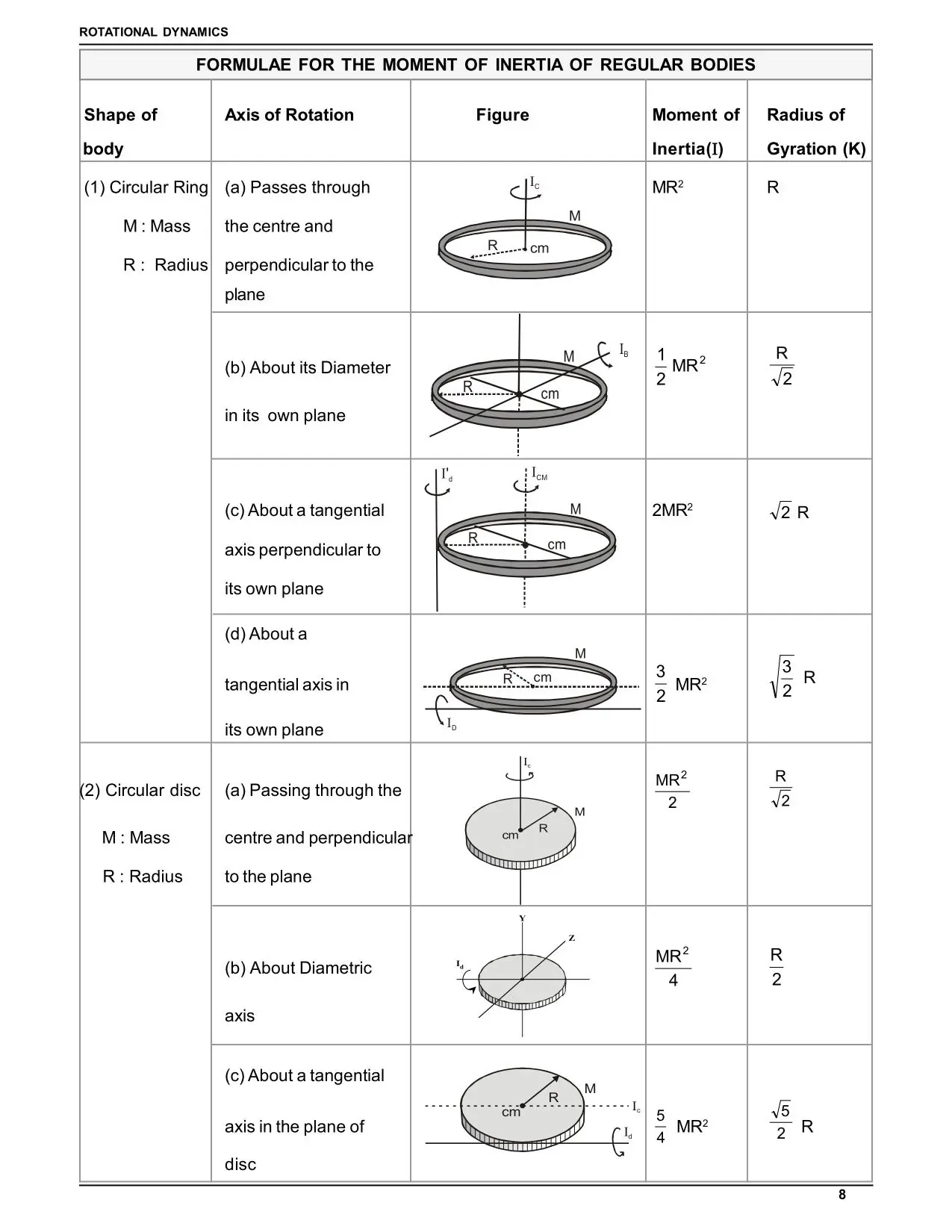
India's Best Exam Preparation for Class 11th - Download Now
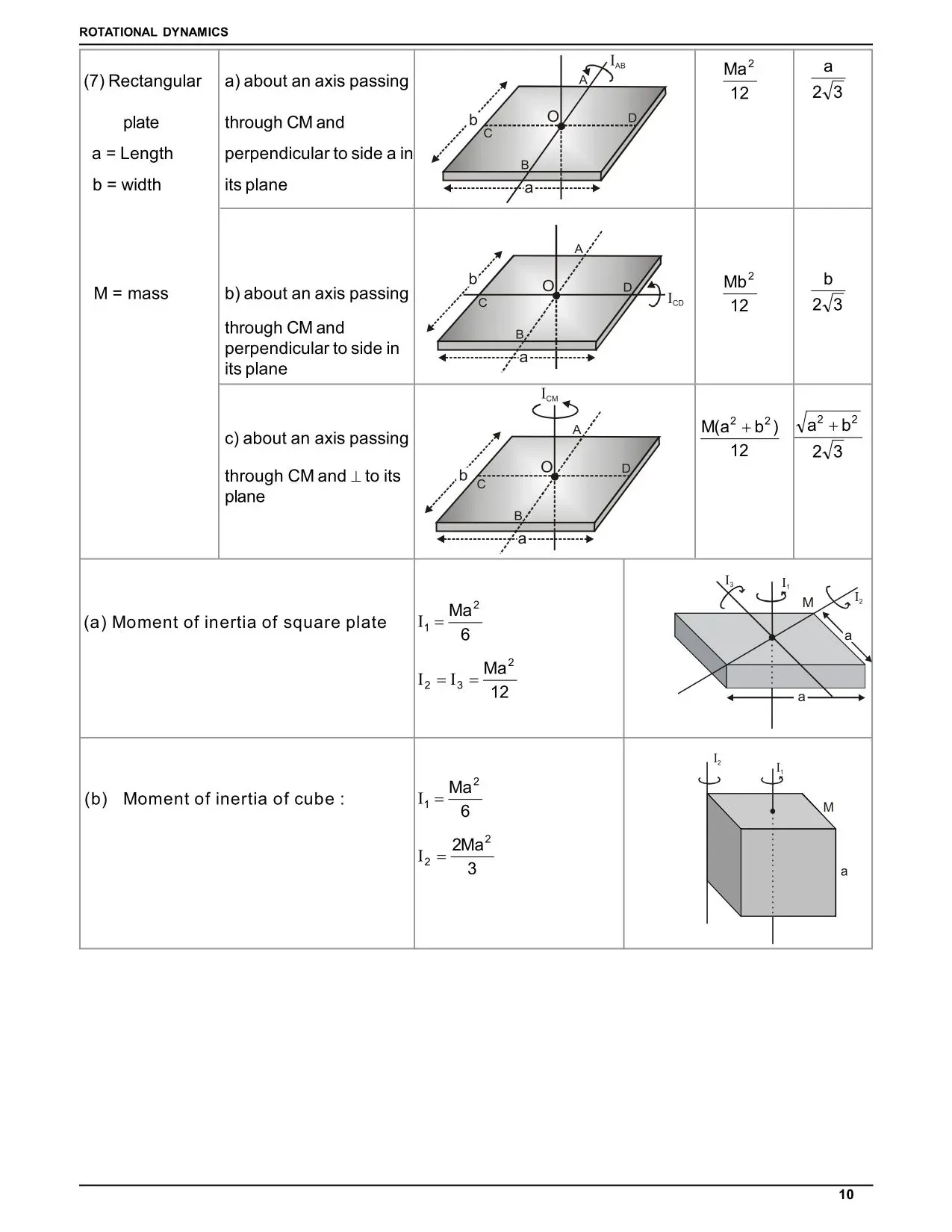
India's Best Exam Preparation for Class 11th - Download Now
India's Best Exam Preparation for Class 11th - Download Now
India's Best Exam Preparation for Class 11th - Download Now
Common Mistakes in Rotational Motion Class 11 Notes Problems
Mistake | Correct approach |
|---|---|
Using $I = I_{cm} + Md^2$ with an axis that is not parallel | The axis must be parallel to the axis through the centre of mass |
Writing $\tfrac{3}{2}MR^2$ for a tangent in the plane of a disc | That value is for a tangent perpendicular to the plane. In the plane, it is $\tfrac{5}{4}MR^2$. |
Using the perpendicular axes theorem for a 3D body | It holds only for a flat (planar) body |
Forgetting that torque is a vector | $\tau = rF\sin\theta$, and its direction follows the right-hand rule |
Using $v = \omega R$ for a body that slips | The condition $v_{cm} = \omega R$ holds only for pure rolling |
Thinking that friction removes energy in pure rolling | Static friction does no work in pure rolling |
Using the same $I$ for different axes | Always state the axis, and use the correct theorem |
How to Study Rotational Motion Class 11 Notes
- Read the NCERT chapter first, and download the textbook from eSaral’s NCERT books for Class 11 page.
- Learn the table of moments of inertia and the linear and rotational comparison table from memory.
- Practise problems in this order: centre of mass, torque and equilibrium, moment of inertia with the theorems, angular momentum conservation, and then rolling motion.
- Before you solve cross product problems, revise how vectors work in two-dimensional motion.
- For quick formula revision, use eSaral’s free Physics revision series on YouTube.
- Revise the unit with eSaral’s Class 11 Physics notes and JEE Main Physics revision notes (Unit 5), and test yourself with eSaral’s JEE Main chapter-wise PYQs and NEET chapter-wise PYQs.
Frequently Asked Questions
What is the parallel axis theorem in simple terms?
If you know the moment of inertia $I_{cm}$ of a body about an axis through its centre of mass, the moment of inertia about any parallel axis at a distance $d$ is $I = I_{cm} + Md^2$. For a disc about a tangent perpendicular to its plane, $I = \tfrac{1}{2}MR^2 + MR^2 = \tfrac{3}{2}MR^2$. For a tangent in the plane of the disc, $I = \tfrac{1}{4}MR^2 + MR^2 = \tfrac{5}{4}MR^2$. eSaral’s Rotational Motion Class 11 Notes show both.
What is the moment of inertia, and why does it matter?
The moment of inertia, $I = \sum m_i r_i^2$, measures the resistance of a body to angular acceleration, just as mass measures the resistance to linear acceleration. For exams, you need the values for a ring, disc, solid sphere, hollow sphere and rod, and the two axes theorems. Most questions use $\tau = I\alpha$ or $L = I\omega$.
What are the most important topics in Rotational Motion Class 11 Notes for JEE?
The moment of inertia of standard bodies and the axes theorems, torque and equilibrium, conservation of angular momentum, rolling motion (conditions and energy) and the comparison of linear and rotational motion. Rolling motion is part of the NCERT chapter and JEE problems use it. The number of questions changes every year, so check previous years’ papers.
What is the difference between torque and force?
Force causes linear acceleration, $F = ma$. Torque causes angular acceleration, $\tau = I\alpha$. Torque depends on the force, on the perpendicular distance from the axis and on the direction of the force: $\vec{\tau} = \vec{r}\times\vec{F}$. A small force at a large distance can give more torque than a large force near the axis.
How is angular momentum conserved?
If the net external torque on a system is zero, $\dfrac{d\vec{L}}{dt} = 0$, so $L = I\omega$ is constant. A skater who pulls in her arms reduces $I$, and so her $\omega$ increases. In Rotational Motion Class 11 Notes, this is the standard example, and the kinetic energy increases because of the work done by the skater.
What is pure rolling, and which body reaches the bottom of an incline first?
In pure rolling, the point of contact is at rest, and $v_{cm} = \omega R$. For a body that rolls down an incline, $a = \dfrac{g\sin\theta}{1 + k^2/R^2}$. A body with a smaller $k^2/R^2$ has a larger acceleration, so the order from first to last is solid sphere, disc, hollow sphere and ring.
Is the System of Particles and Rotational Motion chapter difficult for Class 11 boards?
It is moderately difficult, but most board questions are direct applications: the centre of mass of two particles, the moment of inertia with the theorems, torque and angular momentum conservation. If you use the table of linear and rotational quantities, the chapter becomes structured. Solving the NCERT examples and exercises is the base for board-level performance.
Which chapter number is System of Particles and Rotational Motion in Class 11 Physics?
In the current NCERT Class 11 Physics book, it is Chapter 6 (Chapter 7 in older books). In the JEE Main 2026 syllabus, it is Unit 5, Rotational Motion. These Rotational Motion Class 11 Notes follow the NCERT chapter.
Where can I find more Class 11 Physics notes on eSaral?
eSaral has chapter-wise Class 11 Physics notes, NCERT solutions, a free Physics revision series on YouTube, JEE Main and NEET chapter-wise PYQs, and these Rotational Motion Class 11 Notes, all linked on this page.
Team eSaral
eSaral Academic and Editorial Team
Team eSaral is the collective author profile for educational content created by eSaral’s teachers and academic contributors. The team draws on expertise from IIT graduates, doctors, experienced educators and subject specialists to develop resources for JEE, NEET and school students. Our articles aim to explain concepts clearly and help students study with confidence.
Related Posts

BITSAT 2027: Registration Date, Exam Date, Syllabus, Eligibility, Pattern & Fees
BITSAT 2027 exam dates, registration timeline, eligibility criteria, exam pattern, marking scheme, syllabus and fees in one page.

BITSAT Previous Year Question Paper PDF (2017-2026)
Download BITSAT previous year question papers PDF from 2017 to 2026,session-wise. Memory-based papers,exam pattern, paper analysis and how to practise

CBSE Class 10 Date Sheet 2027: Expected Exam Dates, Release Date, Admit Card & Result Timeline
CBSE Class 10 date sheet 2027 is awaited. See the expected exam dates, release window, how to download the PDF, admit card and result timelines.

NCERT Physics Class 10 Book PDF in Hindi 2026-27 – भौतिक विज्ञान के 4 अध्याय (Free Download)
NCERT Physics Class 10 book PDF in Hindi 2026-27: download all 4 chapters (अध्याय 9–12) free, with topics and important formulas.

NCERT Biology Class 9 Book Anveshan PDF in Hindi - जीव विज्ञान कक्षा 9 पुस्तक अन्वेषण PDF
Download NCERT Biology Class 9 book PDF in Hindi chapterwise for 2026-27: Cell, Tissues, Reproduction and Diversity. Free PDFs.

Essay On Artificial Intelligence in English (100,150, 200, 250, 300, 500 Words)
This is in contrast to the natural intelligence of humans. With Artificial Intelligence, machines can perform

Essay on 78th India Independence Day in English for Student (100, 150, 200, 250, 300, 500 Words)
Read the best essays on India's Independence Day in English. Short & long essays (100, 150, 200, 250, 300, 500 words) perfect for school exams
NCERT Class 11 English Snapshots book - Free PDF download- Esaral
Download NCERT Class 11 English Snapshots book PDF for free. Get all 8 chapters, chapter-wise. Start your prep today!
NCERT Class 10 biology book pdf - Free PDF Download - eSaral
NCERT Class 10 Biology book PDF 2026-27: all 5 chapters (Life Processes to Our Environment) in English & Hindi, with CBSE syllabus, marks & practical

Essay on Global Warming in English (100,150, 200, 250, 300, 500 Words)
Global warming means the Earth is getting hotter. This happens because of things like pollution from cars and factories.