
Straight Lines Class 11 Notes for CBSE and JEE

eSaral Academic and Editorial Team
Summary
Straight Lines Class 11 Notes cover the slope of a line, the angle between two lines, all standard forms of the equation of a line, the distance of a point from a line, the distance between parallel lines, collinearity, and, for JEE, families of lines, angle bisectors and concurrency.

Straight Lines is Chapter 9 of NCERT Class 11 Mathematics, and Conic Sections is Chapter 10. Straight lines are the base of coordinate geometry: the same slope, distance and family-of-lines ideas return in circles, conic sections and three-dimensional geometry. These Straight Lines Class 11 Notes follow the NCERT chapter, and they add the JEE Main topics that the textbook does not cover in depth.
India's Best Exam Preparation for Class 11th - Download Now
Straight Lines Class 11 Notes
India's Best Exam Preparation for Class 11th - Download Now
India's Best Exam Preparation for Class 11th - Download Now
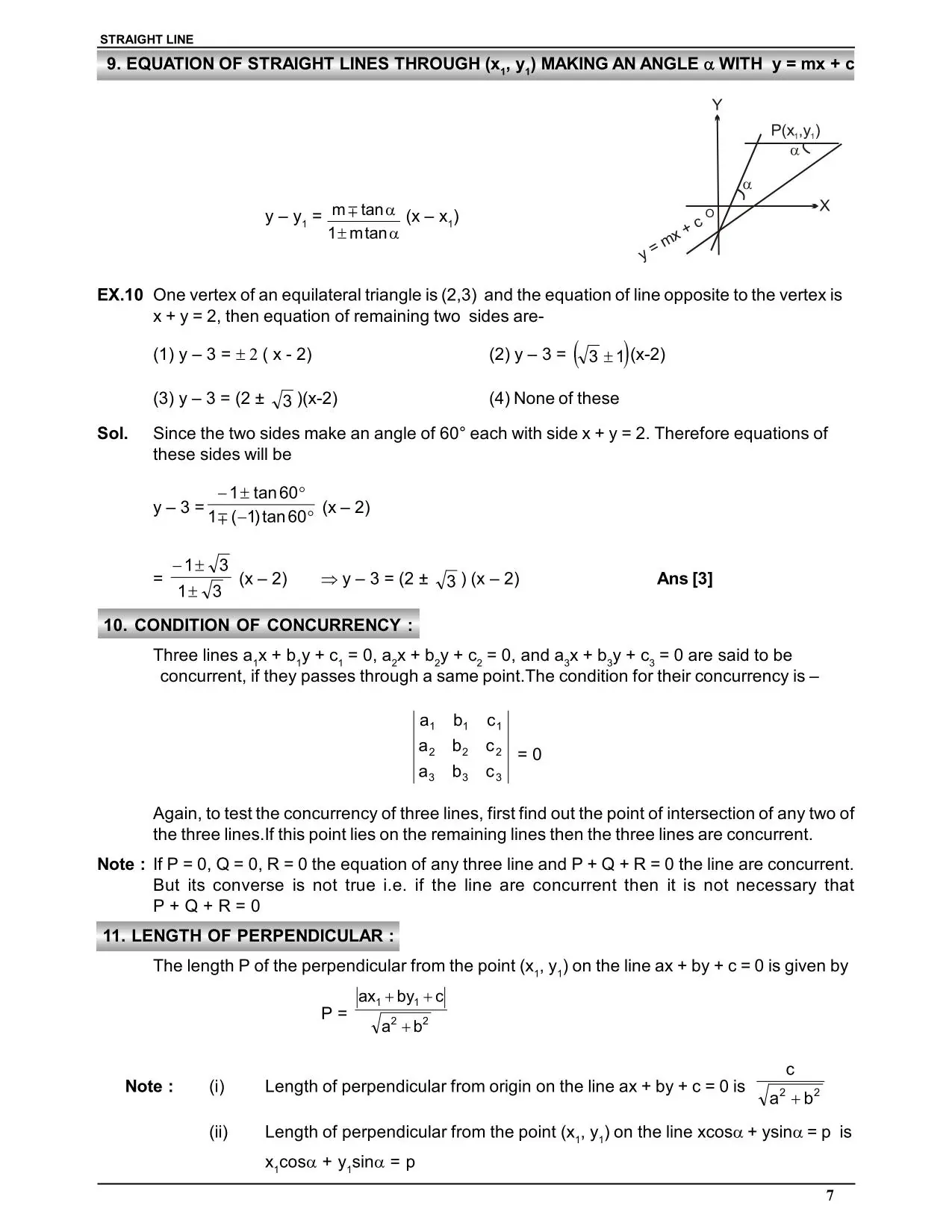
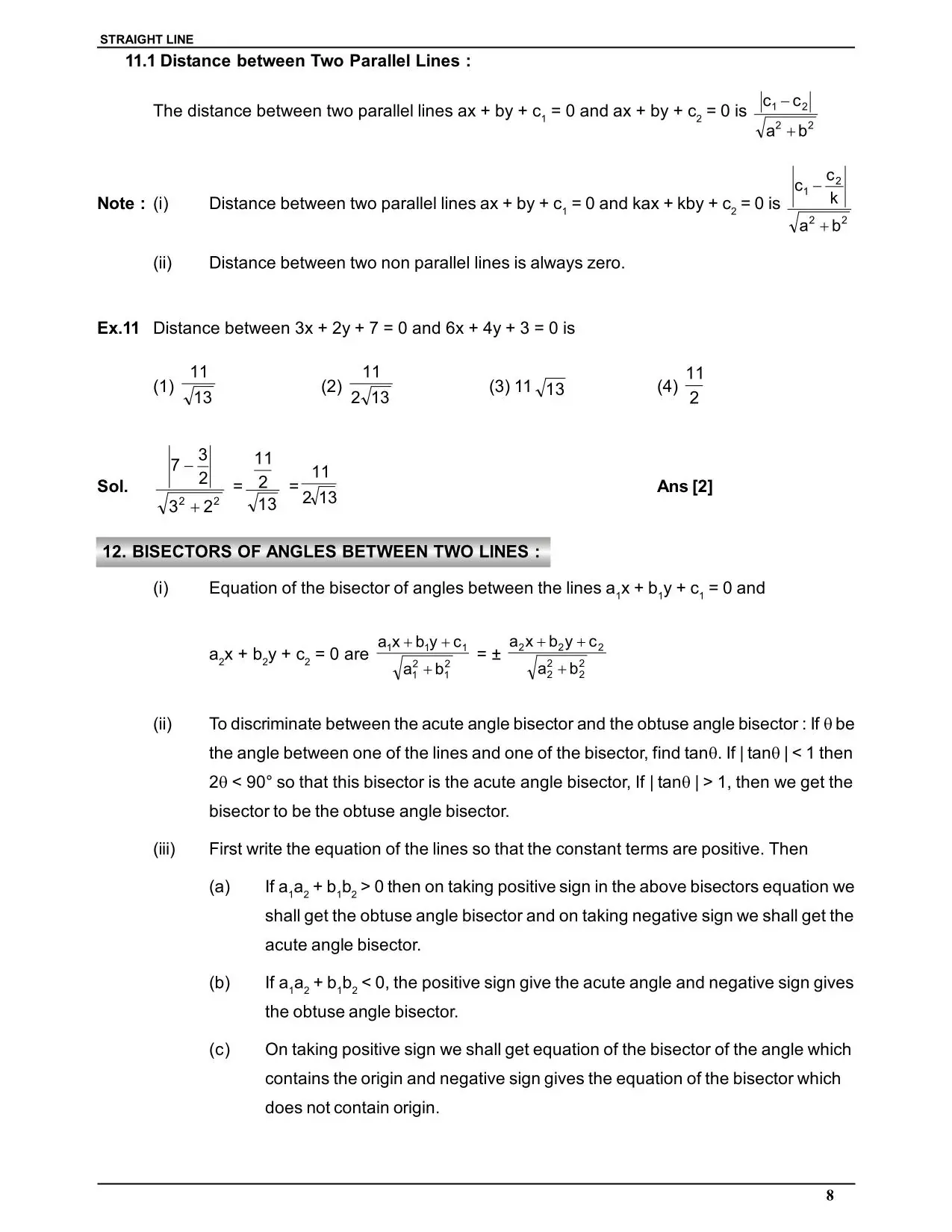
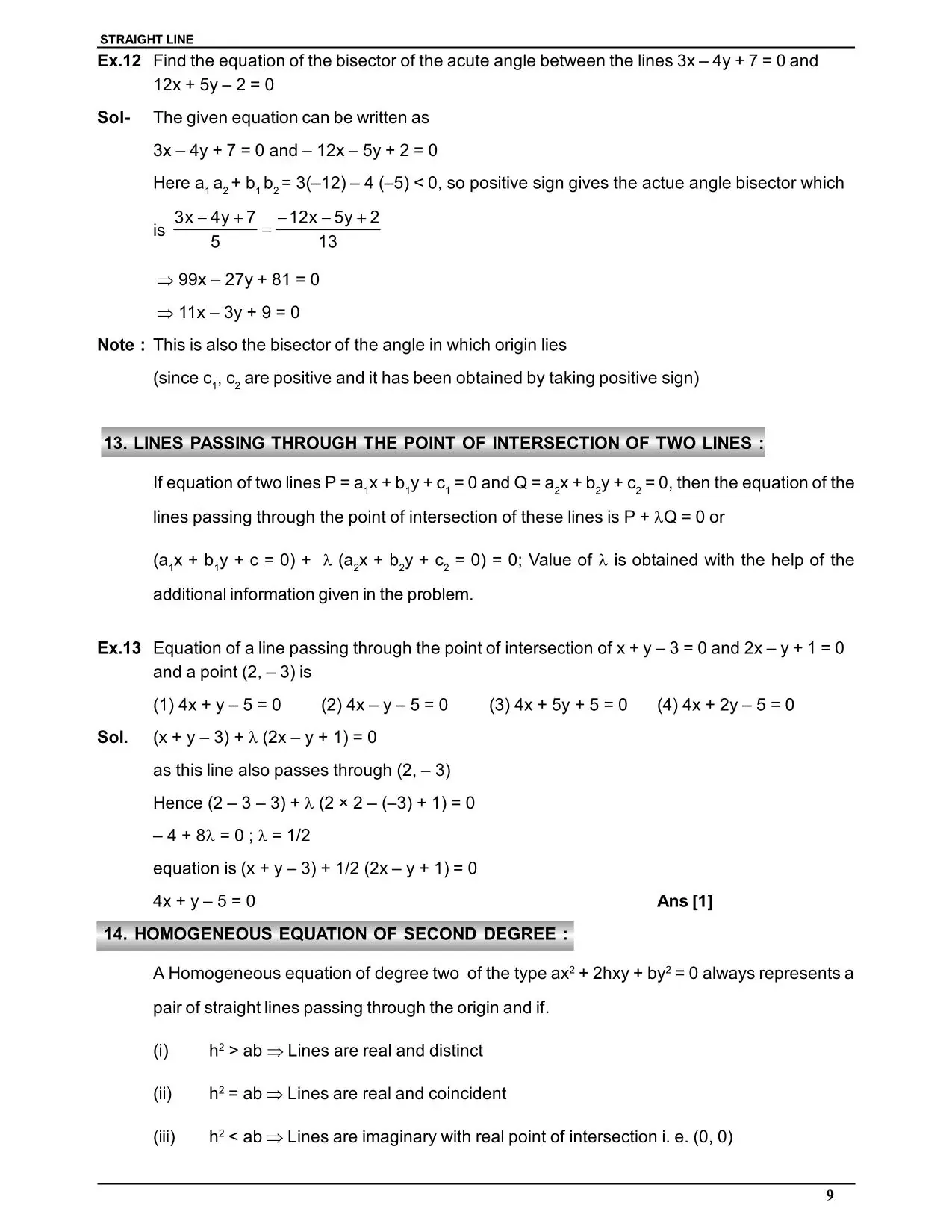
India's Best Exam Preparation for Class 11th - Download Now
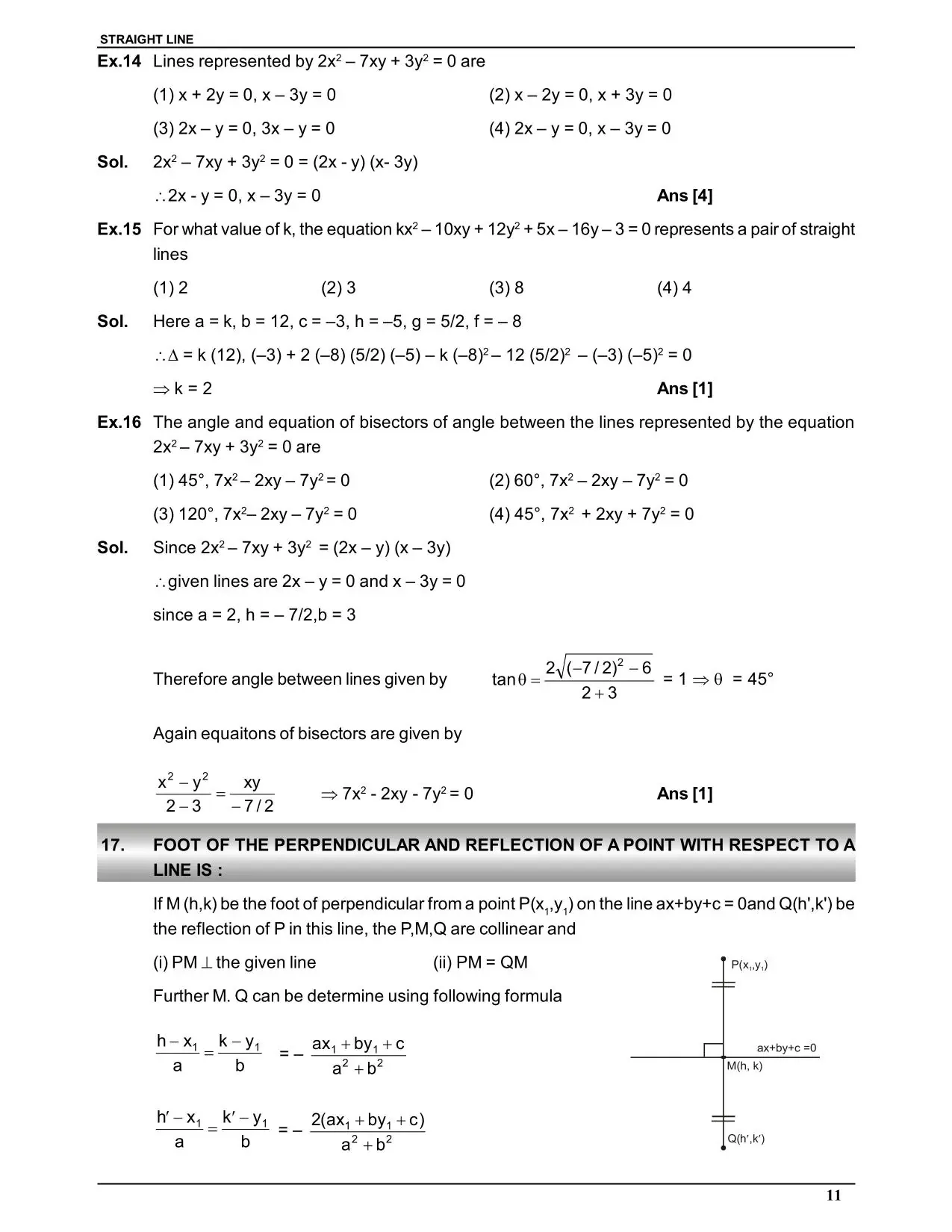
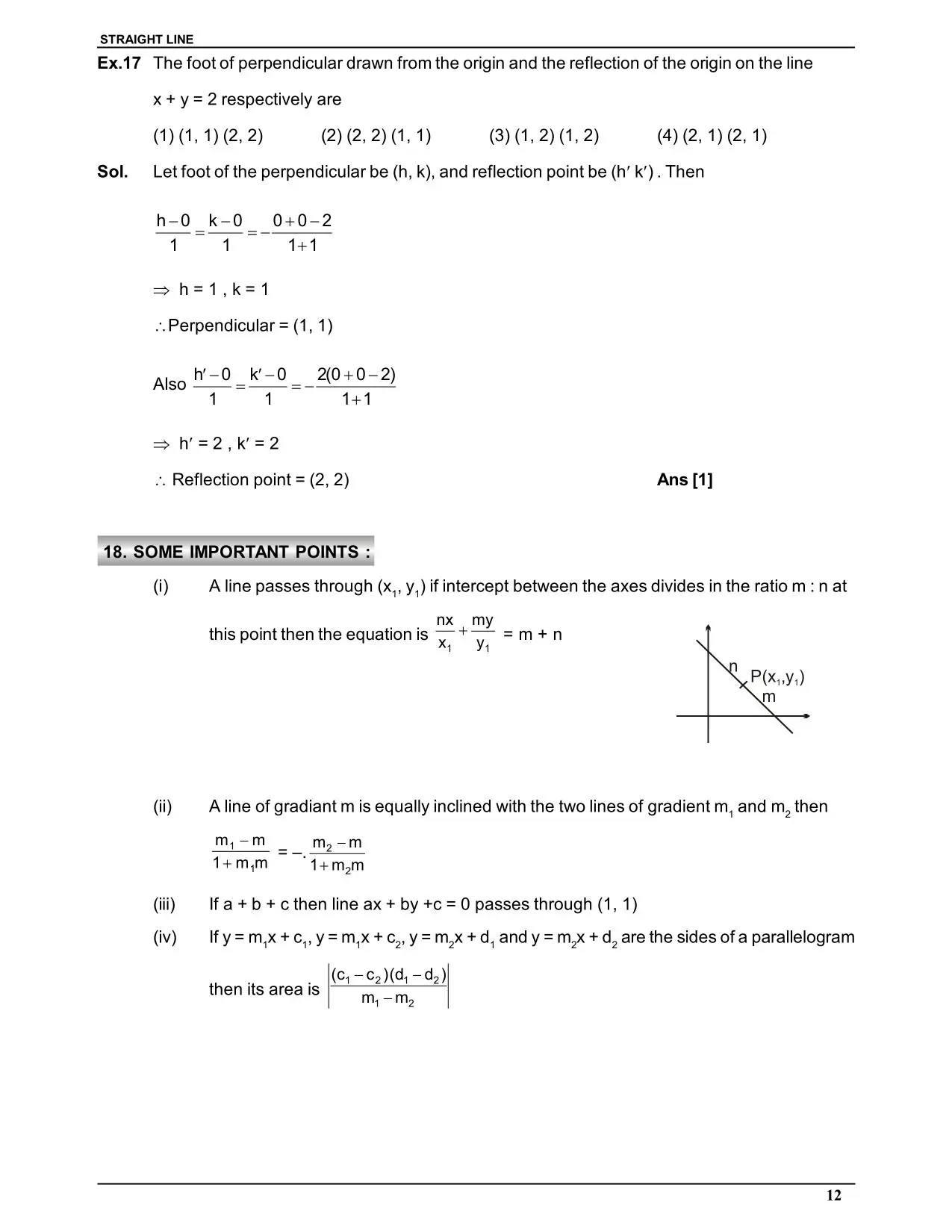
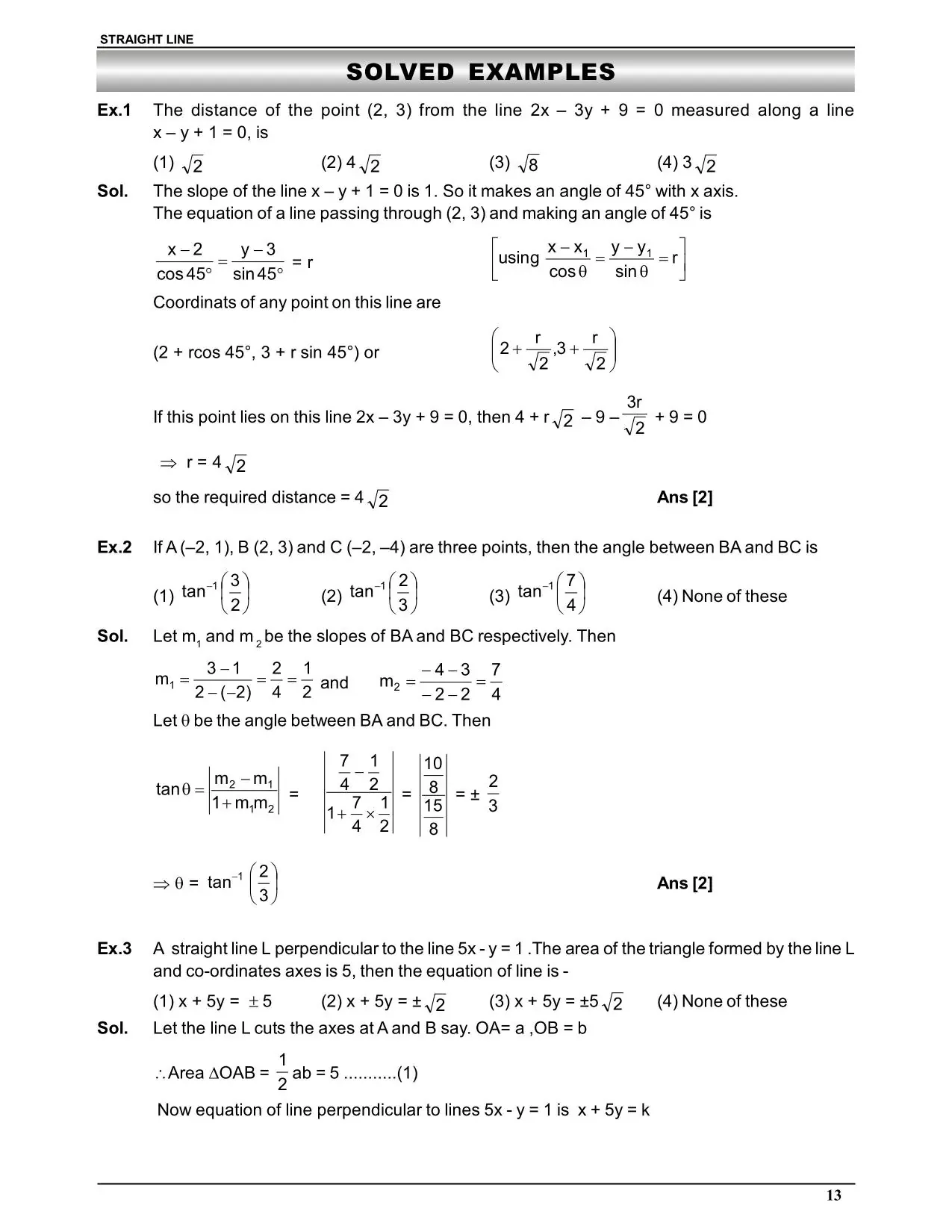
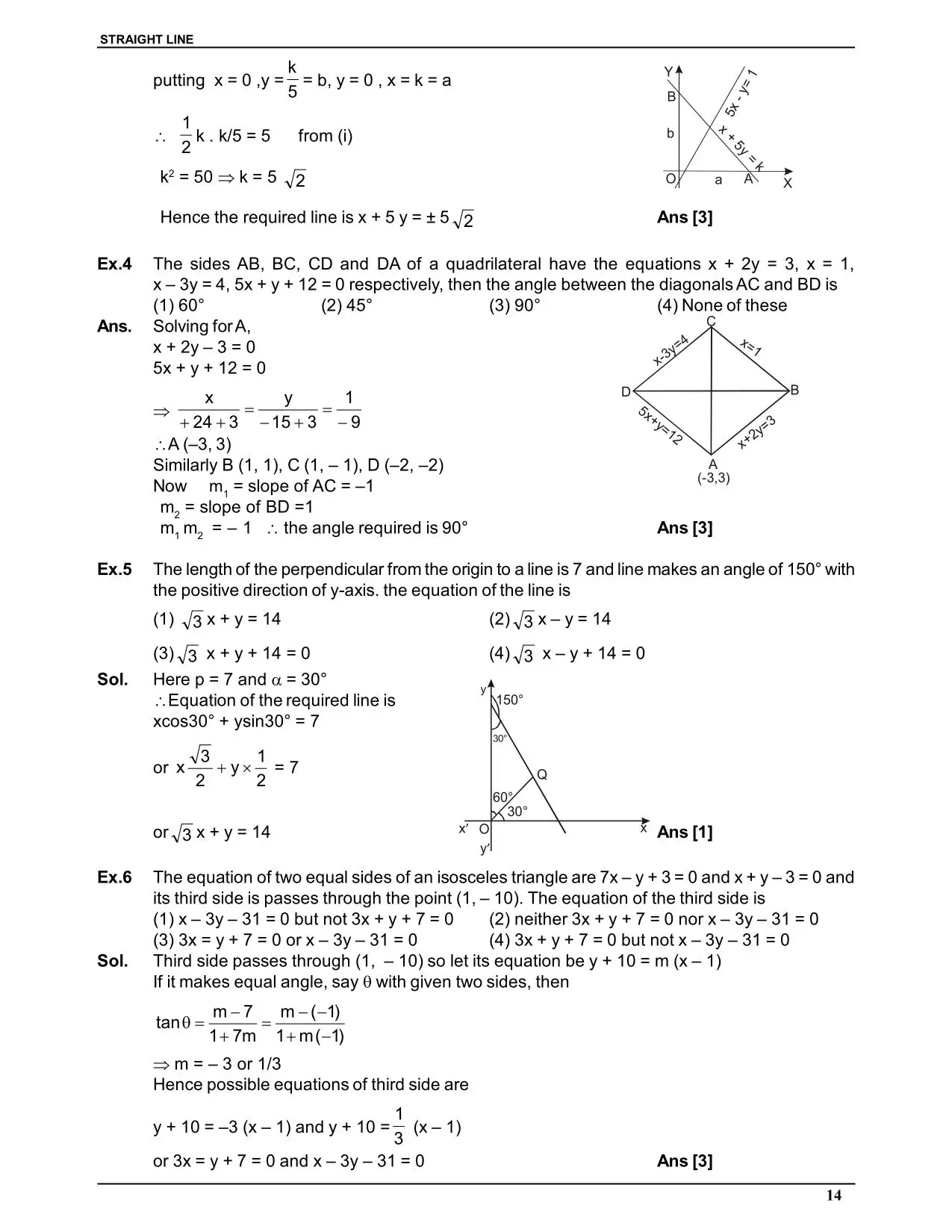
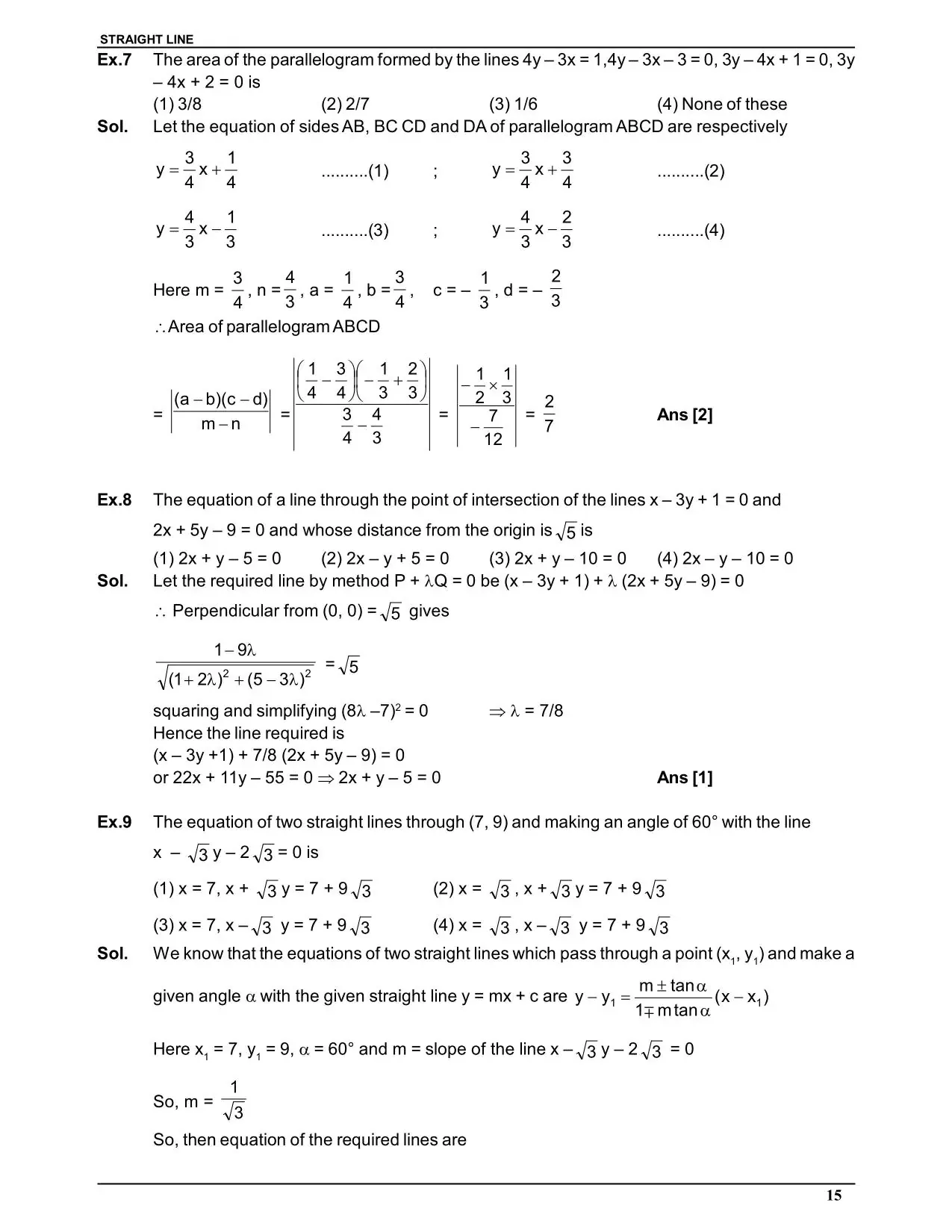
India's Best Exam Preparation for Class 11th - Download Now
India's Best Exam Preparation for Class 11th - Download Now
Straight Lines Class 11 Notes: Chapter Overview and Syllabus
The NCERT chapter covers:
- Slope of a line and the angle between two lines
- Horizontal and vertical lines
- Point-slope form, two-point form, slope-intercept form, intercept form and normal form
- General equation of a line
- Distance of a point from a line, and the distance between parallel lines
- Collinearity of points
The JEE Main syllabus (coordinate geometry) also lists the intersection of lines, conditions for the concurrence of three lines, the bisectors of the angles between two lines, the centroid, orthocentre and circumcentre of a triangle, and the family of lines through the point of intersection of two lines. Check the latest syllabi of CBSE and NTA for the exact lists.
Tip from the eSaral Maths team: Draw a rough figure for every problem, and mark the slope or the intercepts on it. A small diagram catches most sign mistakes before you calculate.
Basic Formulas Before Straight Lines in Straight Lines Class 11 Notes
For points $A(x_1, y_1)$ and $B(x_2, y_2)$:
$$AB = \sqrt{(x_2 - x_1)^2 + (y_2 - y_1)^2}$$
Section formula (internal division in the ratio $m : n$) and midpoint:
$$\left(\frac{m x_2 + n x_1}{m + n},\ \frac{m y_2 + n y_1}{m + n}\right), \qquad \left(\frac{x_1 + x_2}{2},\ \frac{y_1 + y_2}{2}\right)$$
Centroid of a triangle with vertices $(x_1, y_1)$, $(x_2, y_2)$, $(x_3, y_3)$:
$$G = \left(\frac{x_1 + x_2 + x_3}{3},\ \frac{y_1 + y_2 + y_3}{3}\right)$$
Area of a triangle:
$$\text{Area} = \frac{1}{2}\,\Big\lvert\, x_1(y_2 - y_3) + x_2(y_3 - y_1) + x_3(y_1 - y_2)\,\Big\rvert$$
Slope of a Line in Straight Lines Class 11 Notes
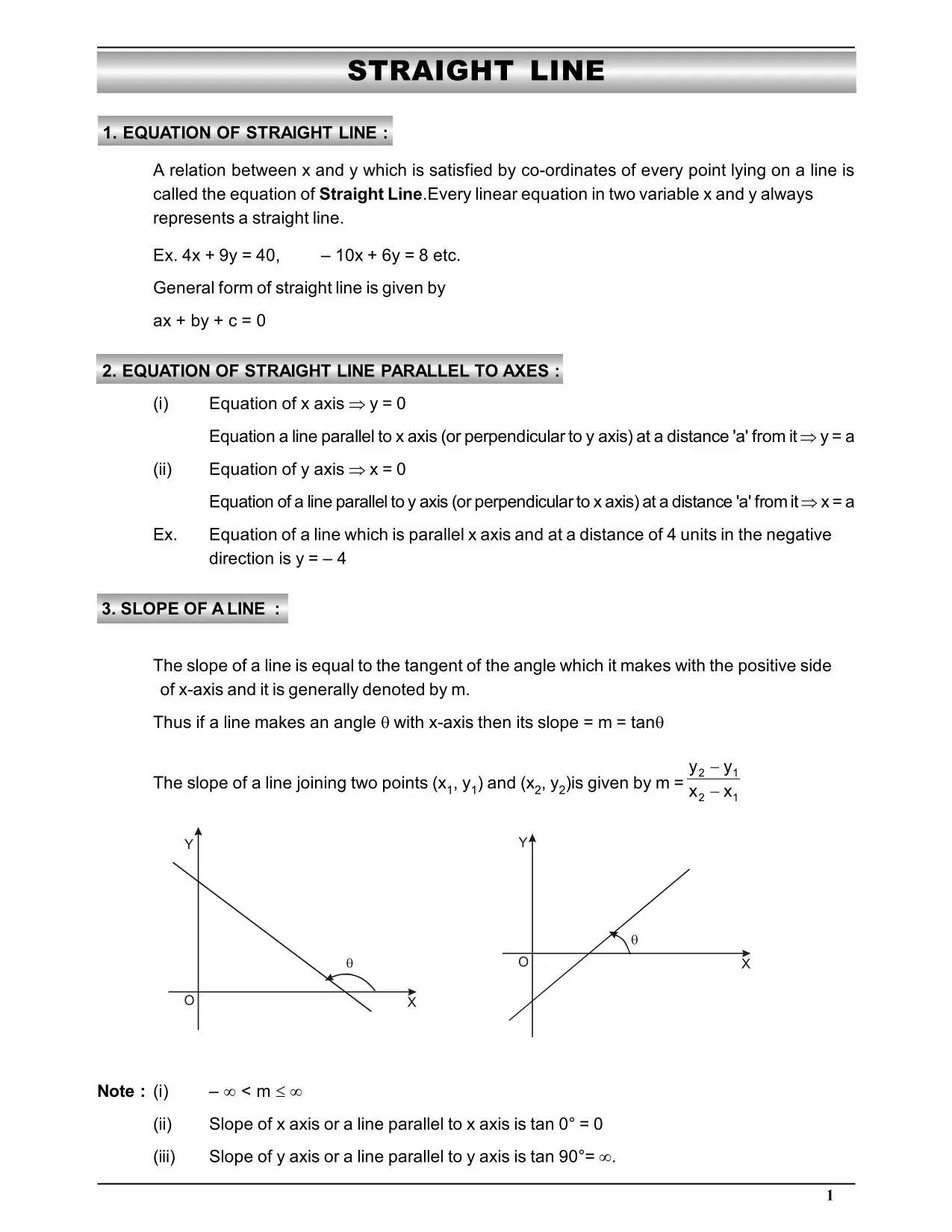
The slope of a line is $m = \tan\theta$, where $\theta$ is the angle that the line makes with the positive $x$-axis, measured anticlockwise ($0^\circ \le \theta < 180^\circ$, $\theta \neq 90^\circ$).
$$m = \frac{y_2 - y_1}{x_2 - x_1}$$
Line | Slope |
|---|---|
Parallel to the $x$-axis | $0$ |
Parallel to the $y$-axis | Not defined |
Making an acute angle with the $x$-axis | Positive |
Making an obtuse angle with the $x$-axis | Negative |
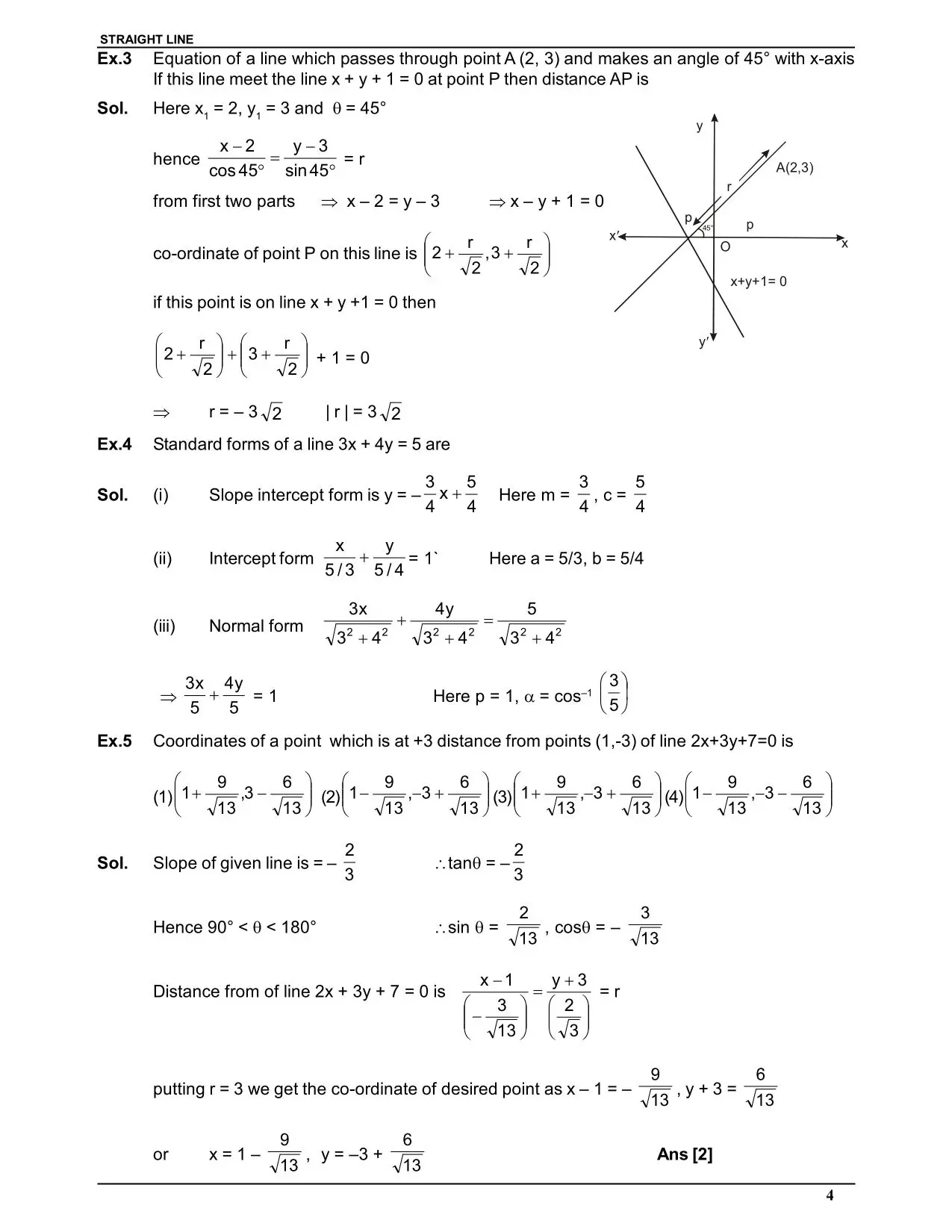
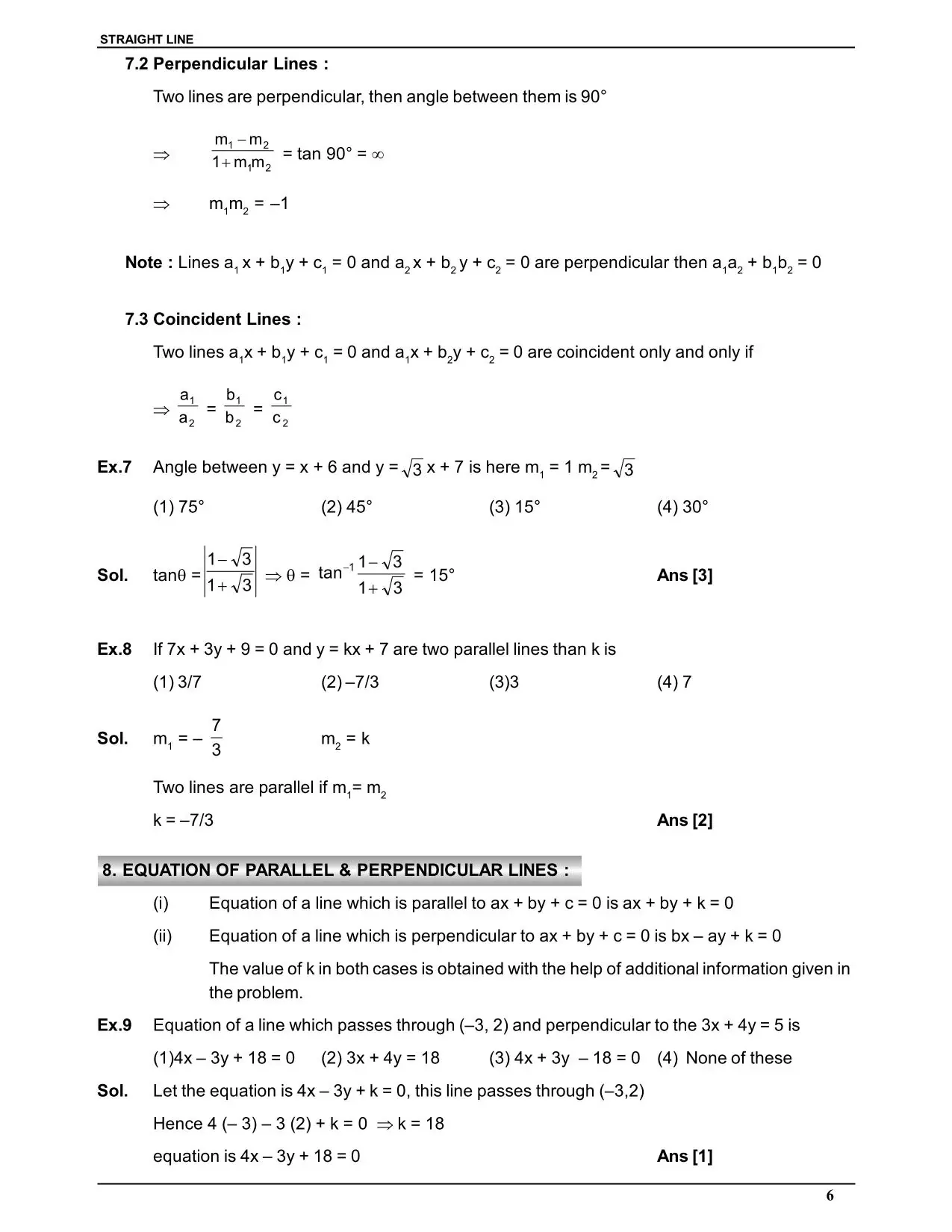
- Parallel lines: $m_1 = m_2$
- Perpendicular lines: $m_1 m_2 = -1$
Angle Between Two Lines in Straight Lines Class 11 Notes
If two lines have slopes $m_1$ and $m_2$, the acute angle $\theta$ between them is given by:
$$\tan\theta = \left\lvert \frac{m_1 - m_2}{1 + m_1 m_2} \right\rvert$$
For the lines $a_1x + b_1y + c_1 = 0$ and $a_2x + b_2y + c_2 = 0$:
Condition | Result |
|---|---|
Parallel | $\dfrac{a_1}{a_2} = \dfrac{b_1}{b_2} \neq \dfrac{c_1}{c_2}$ |
Coincident | $\dfrac{a_1}{a_2} = \dfrac{b_1}{b_2} = \dfrac{c_1}{c_2}$ |
Perpendicular | $a_1 a_2 + b_1 b_2 = 0$ |
Forms of the Equation of a Line in Straight Lines Class 11 Notes
Form | Equation | Use when |
|---|---|---|
Horizontal line | $y = a$ | The line is parallel to the $x$-axis |
Vertical line | $x = b$ | The line is parallel to the $y$-axis |
Point-slope | $y - y_1 = m(x - x_1)$ | A point and the slope are given |
Two-point | $y - y_1 = \dfrac{y_2 - y_1}{x_2 - x_1}(x - x_1)$ | Two points are given |
Slope-intercept | $y = mx + c$ | The slope and the $y$-intercept are given |
Intercept | $\dfrac{x}{a} + \dfrac{y}{b} = 1$ | Both axis intercepts are known |
Normal (perpendicular) | $x\cos\omega + y\sin\omega = p$ | The perpendicular from the origin is given |
General | $Ax + By + C = 0$ | Any straight line |
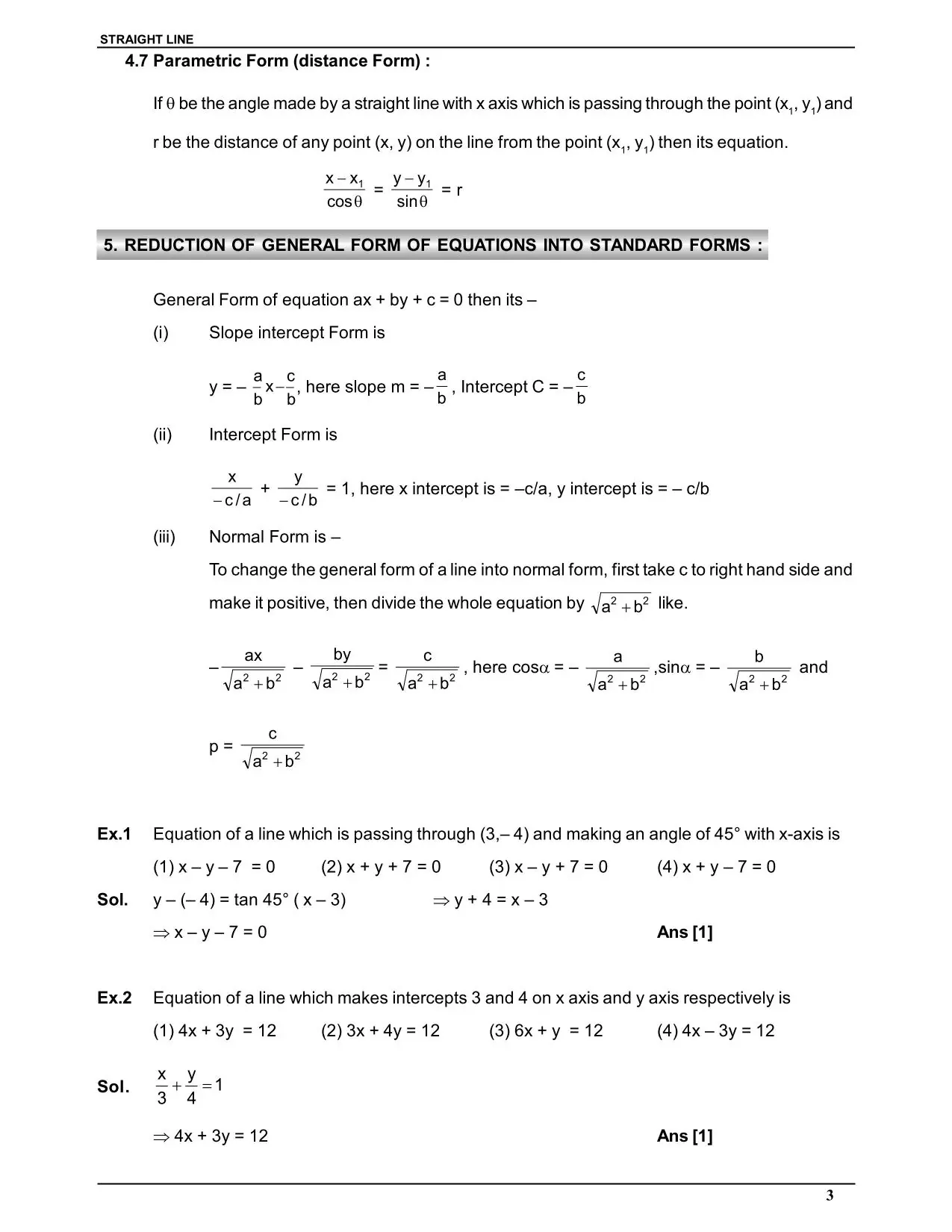
For the general form $Ax + By + C = 0$: the slope is $-\dfrac{A}{B}$, the $x$-intercept is $-\dfrac{C}{A}$ and the $y$-intercept is $-\dfrac{C}{B}$.
In the normal form, $p > 0$ is the length of the perpendicular from the origin, and $\omega$ is the angle that this perpendicular makes with the positive $x$-axis.
Symmetric (distance) form, for JEE: a line through $(x_1, y_1)$ at angle $\theta$ is given by:
$$\frac{x - x_1}{\cos\theta} = \frac{y - y_1}{\sin\theta} = r$$
where $r$ is the distance of the point $(x, y)$ from $(x_1, y_1)$.
Distance Formulas in Straight Lines Class 11 Notes
Distance of a point $(x_1, y_1)$ from the line $Ax + By + C = 0$:
$$d = \frac{\lvert A x_1 + B y_1 + C \rvert}{\sqrt{A^2 + B^2}}$$
Distance between the parallel lines $Ax + By + C_1 = 0$ and $Ax + By + C_2 = 0$:
$$d = \frac{\lvert C_1 - C_2 \rvert}{\sqrt{A^2 + B^2}}$$
To use the second formula, write both equations with the same coefficients of $x$ and $y$ first.
Collinearity and Concurrency in Straight Lines Class 11 Notes
- Three points are collinear if the area of the triangle formed by them is zero, that is, $x_1(y_2 - y_3) + x_2(y_3 - y_1) + x_3(y_1 - y_2) = 0$. You can also check that the slopes of $AB$ and $BC$ are equal.
- Three lines are concurrent if they pass through one point. For the lines $a_ix + b_iy + c_i = 0$ ($i = 1, 2, 3$), the condition is:
$$\begin{vmatrix} a_1 & b_1 & c_1 \\ a_2 & b_2 & c_2 \\ a_3 & b_3 & c_3 \end{vmatrix} = 0$$
Family of Lines and Angle Bisectors for JEE in Straight Lines Class 11 Notes
Family of lines: every line through the point of intersection of $L_1 = 0$ and $L_2 = 0$ is of the form
$$L_1 + \lambda L_2 = 0$$
where $\lambda$ is a parameter. Use it when the intersection point is not easy to find, or when one more condition fixes $\lambda$.
Bisectors of the angles between two lines:
$$\frac{a_1x + b_1y + c_1}{\sqrt{a_1^2 + b_1^2}} = \pm\,\frac{a_2x + b_2y + c_2}{\sqrt{a_2^2 + b_2^2}}$$
The two signs give the two bisectors. To find the bisector of the angle that contains the origin, make $c_1$ and $c_2$ positive first, and use the plus sign.
Triangle centres: the centroid is $G = \left(\dfrac{x_1 + x_2 + x_3}{3}, \dfrac{y_1 + y_2 + y_3}{3}\right)$. The orthocentre, the centroid and the circumcentre lie on one line, and the centroid divides the line from the orthocentre to the circumcentre in the ratio $2 : 1$.
Key Formulas in Straight Lines Class 11 Notes
Concept | Formula |
|---|---|
Slope | $m = \tan\theta = \dfrac{y_2 - y_1}{x_2 - x_1}$ |
Parallel and perpendicular lines | $m_1 = m_2$ and $m_1 m_2 = -1$ |
Angle between two lines | $\tan\theta = \left\lvert \dfrac{m_1 - m_2}{1 + m_1 m_2} \right\rvert$ |
Point-slope form | $y - y_1 = m(x - x_1)$ |
Intercept form | $\dfrac{x}{a} + \dfrac{y}{b} = 1$ |
Normal form | $x\cos\omega + y\sin\omega = p$ |
Distance of a point from a line | $\dfrac{\lvert Ax_1 + By_1 + C\rvert}{\sqrt{A^2 + B^2}}$ |
Distance between parallel lines | $\dfrac{\lvert C_1 - C_2\rvert}{\sqrt{A^2 + B^2}}$ |
Family of lines | $L_1 + \lambda L_2 = 0$ |
Solved Examples from Straight Lines Class 11 Notes
Example 1 (slope and angle): Find the slope of the line through $(1, 2)$ and $(4, 8)$, and the angle it makes with the $x$-axis.
$m = \dfrac{8 - 2}{4 - 1} = 2$, so $\tan\theta = 2$ and $\theta \approx 63.4^\circ$.
Example 2 (point-slope form): Find the equation of the line through $(2, 3)$ with slope $4$.
$y - 3 = 4(x - 2)$, which gives $4x - y - 5 = 0$.
Example 3 (intercept form): Find the equation of the line that cuts off intercepts $3$ on the $x$-axis and $-2$ on the $y$-axis.
$\dfrac{x}{3} + \dfrac{y}{-2} = 1$, which gives $2x - 3y = 6$.
Example 4 (distance of a point from a line): Find the distance of $(1, 2)$ from the line $3x + 4y - 10 = 0$.
$d = \dfrac{\lvert 3(1) + 4(2) - 10 \rvert}{\sqrt{9 + 16}} = \dfrac{1}{5} = 0.2$.
Example 5 (angle between lines): Find the acute angle between $y = 2x + 1$ and $y = 3x - 2$.
$\tan\theta = \left\lvert \dfrac{2 - 3}{1 + 6} \right\rvert = \dfrac{1}{7}$, so $\theta = \tan^{-1}\dfrac{1}{7} \approx 8.1^\circ$.
Example 6 (collinearity): Show that $A(1, 2)$, $B(2, 4)$ and $C(3, 6)$ are collinear.
$\text{Area} = \dfrac{1}{2}\lvert 1(4 - 6) + 2(6 - 2) + 3(2 - 4) \rvert = \dfrac{1}{2}\lvert -2 + 8 - 6 \rvert = 0$, so the points are collinear.
Example 7 (distance between parallel lines): Find the distance between $3x + 4y + 5 = 0$ and $3x + 4y - 10 = 0$.
$d = \dfrac{\lvert 5 - (-10) \rvert}{\sqrt{9 + 16}} = \dfrac{15}{5} = 3$.
Example 8 (concurrent lines): Show that $x + y - 3 = 0$, $2x - y = 0$ and $x - 2y + 3 = 0$ are concurrent.
Solving the first two lines gives $3x = 3$, so $x = 1$ and $y = 2$. Substituting $(1, 2)$ in the third line gives $1 - 4 + 3 = 0$, so all three lines pass through $(1, 2)$.
Common Mistakes in Straight Lines Class 11 Notes Problems
Mistake | Correct approach |
|---|---|
Using $m_1 m_2 = 1$ for perpendicular lines | The condition is $m_1 m_2 = -1$ |
Applying the parallel-lines distance formula without equal coefficients | Make the coefficients of $x$ and $y$ the same in both equations first |
Forgetting the absolute value in the distance formula | The distance is never negative |
Dividing by zero for a vertical line | The slope of a vertical line is not defined. Use $x = b$. |
Taking $\tan\theta$ without the modulus | Use the modulus to get the acute angle |
Mixing up the intercepts with the slope in the general form | Slope is $-A/B$, and the intercepts are $-C/A$ and $-C/B$ |
How to Study Straight Lines Class 11 Notes
- Read the NCERT chapter first, and solve its exercises. eSaral’s NCERT Solutions for Class 11 Maths Chapter 9 give the answers to Exercises 9.1 to 9.3.
- Write a one-page sheet of the forms of a line and the distance formulas, and practise converting between the forms.
- Practise the JEE topics (families of lines, bisectors and concurrency) after the NCERT exercises.
- Revise other formula sheets too, such as the trigonometry formulas for Class 11, and the Class 11 Maths notes for all chapters.
Frequently Asked Questions
How do you check if three points are collinear?
Three points are collinear if the area of the triangle formed by them is zero, that is, $x_1(y_2 - y_3) + x_2(y_3 - y_1) + x_3(y_1 - y_2) = 0$. You can also check that the slope between any two pairs of the points is equal. The area method avoids division, so it works even when a line is vertical.
What is the difference between the slope-intercept form and the intercept form?
The slope-intercept form is $y = mx + c$, where $m$ is the slope and $c$ is the $y$-intercept. The intercept form is $\dfrac{x}{a} + \dfrac{y}{b} = 1$, where $a$ and $b$ are the intercepts on the axes. Use the first when the slope is given, and the second when both intercepts are known.
What is the most important formula in Straight Lines Class 11 notes for JEE?
The distance of a point from a line, $d = \dfrac{\lvert Ax_1 + By_1 + C\rvert}{\sqrt{A^2 + B^2}}$, is used in many problems on distance, angle bisectors and tangents to a circle. Learn it together with the angle formula $\tan\theta = \left\lvert \dfrac{m_1 - m_2}{1 + m_1 m_2} \right\rvert$ in the Straight Lines Class 11 Notes on eSaral.
How many questions come from Straight Lines in JEE Main?
Straight Lines is part of the coordinate geometry unit of the JEE Main syllabus, together with circles and conic sections. The number of questions changes every year, so check previous years’ papers. The ideas of straight lines also help you solve circle and conic questions.
How is the Straight Lines chapter related to other chapters?
Straight Lines is the base for Conic Sections (Chapter 10), which includes the circle, parabola, ellipse and hyperbola, and for Introduction to Three Dimensional Geometry (Chapter 11) in Class 11. The slope, the distance formulas and the family of lines return in all of them. These Straight Lines Class 11 Notes cover the ideas that you need first.
What is the normal form of a line, and when is it used?
The normal form is $x\cos\omega + y\sin\omega = p$, where $p$ is the length of the perpendicular from the origin to the line and $\omega$ is the angle that this perpendicular makes with the positive $x$-axis. It is used when the perpendicular distance from the origin and its direction are given.
How do you find the angle between two lines?
If the slopes are $m_1$ and $m_2$, the acute angle $\theta$ satisfies $\tan\theta = \left\lvert \dfrac{m_1 - m_2}{1 + m_1 m_2} \right\rvert$. The lines are parallel if $m_1 = m_2$ and perpendicular if $m_1 m_2 = -1$. In Straight Lines Class 11 Notes, this formula is used for both lines in slope form and lines in general form.
Which chapter number is Straight Lines in Class 11 Maths?
In the current NCERT Class 11 Mathematics book, Straight Lines is Chapter 9. In older books, it was Chapter 10. These Straight Lines Class 11 Notes follow the chapter name.
Where can I find more Class 11 Maths notes on eSaral?
eSaral has chapter-wise Class 11 Maths notes, NCERT solutions and a formula sheet for trigonometry, linked with these Straight Lines Class 11 Notes on this page, so you can study the chapter and practise it in one place.
Team eSaral
eSaral Academic and Editorial Team
Team eSaral is the collective author profile for educational content created by eSaral’s teachers and academic contributors. The team draws on expertise from IIT graduates, doctors, experienced educators and subject specialists to develop resources for JEE, NEET and school students. Our articles aim to explain concepts clearly and help students study with confidence.
Related Posts

BITSAT 2027: Registration Date, Exam Date, Syllabus, Eligibility, Pattern & Fees
BITSAT 2027 exam dates, registration timeline, eligibility criteria, exam pattern, marking scheme, syllabus and fees in one page.

BITSAT Previous Year Question Paper PDF (2017-2026)
Download BITSAT previous year question papers PDF from 2017 to 2026,session-wise. Memory-based papers,exam pattern, paper analysis and how to practise

CBSE Class 10 Date Sheet 2027: Expected Exam Dates, Release Date, Admit Card & Result Timeline
CBSE Class 10 date sheet 2027 is awaited. See the expected exam dates, release window, how to download the PDF, admit card and result timelines.

NCERT Physics Class 10 Book PDF in Hindi 2026-27 – भौतिक विज्ञान के 4 अध्याय (Free Download)
NCERT Physics Class 10 book PDF in Hindi 2026-27: download all 4 chapters (अध्याय 9–12) free, with topics and important formulas.

NCERT Biology Class 9 Book Anveshan PDF in Hindi - जीव विज्ञान कक्षा 9 पुस्तक अन्वेषण PDF
Download NCERT Biology Class 9 book PDF in Hindi chapterwise for 2026-27: Cell, Tissues, Reproduction and Diversity. Free PDFs.

Essay On Artificial Intelligence in English (100,150, 200, 250, 300, 500 Words)
This is in contrast to the natural intelligence of humans. With Artificial Intelligence, machines can perform

Essay on 78th India Independence Day in English for Student (100, 150, 200, 250, 300, 500 Words)
Read the best essays on India's Independence Day in English. Short & long essays (100, 150, 200, 250, 300, 500 words) perfect for school exams
NCERT Class 11 English Snapshots book - Free PDF download- Esaral
Download NCERT Class 11 English Snapshots book PDF for free. Get all 8 chapters, chapter-wise. Start your prep today!
NCERT Class 10 biology book pdf - Free PDF Download - eSaral
NCERT Class 10 Biology book PDF 2026-27: all 5 chapters (Life Processes to Our Environment) in English & Hindi, with CBSE syllabus, marks & practical

Essay on Global Warming in English (100,150, 200, 250, 300, 500 Words)
Global warming means the Earth is getting hotter. This happens because of things like pollution from cars and factories.