
The Wit That Won the Hearts Summary Class 8: Full Chapter Explanation with Word Meanings

eSaral Academic and Editorial Team
Summary
The Wit That Won the Hearts is the first chapter of Unit 1, Wit and Wisdom, in Poorvi, the NCERT Class 8 English textbook. It tells how the witty poet Tenali Rama ends a quarrel between King Krishnadeva Raya and Queen Thirumalambal by using a joke about paddy seeds and yawning. This page gives a short and a full summary, the background, all the glossary words, a character sketch, the moral, model answers to the textbook questions and MCQs.
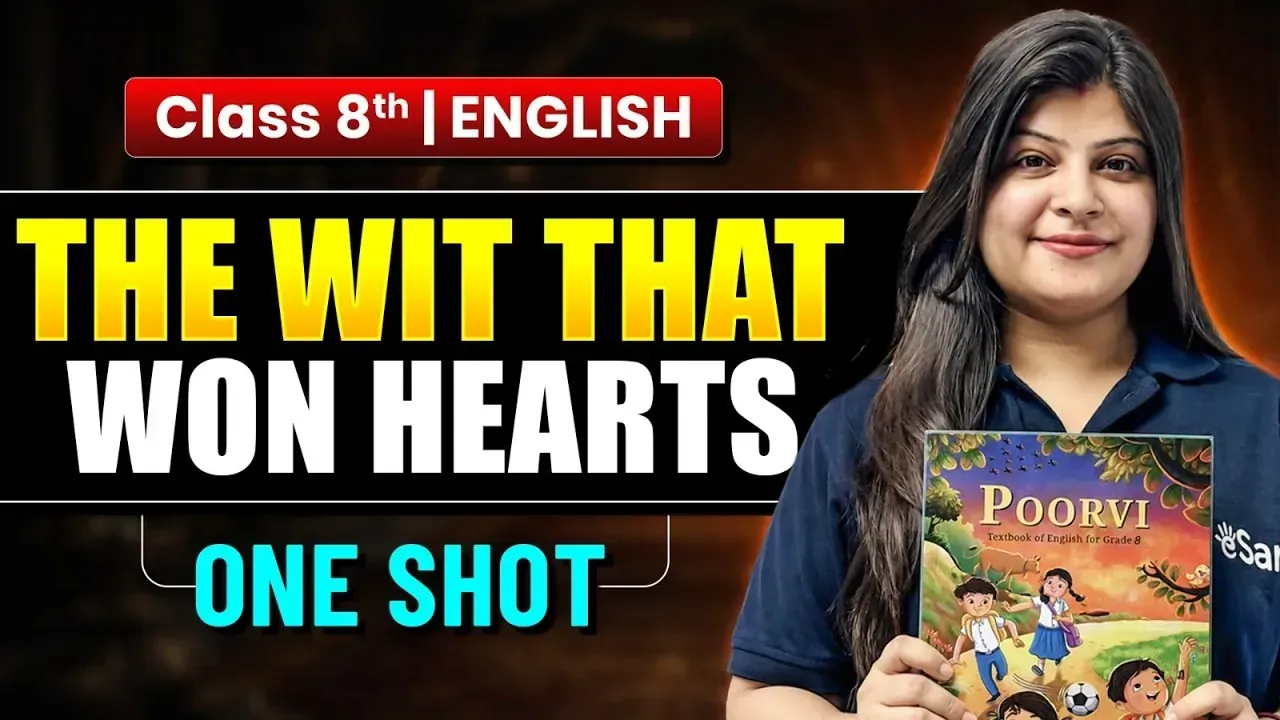
The Wit That Won the Hearts (the textbook title is The Wit that Won Hearts) is the first chapter of Unit 1, Wit and Wisdom, in Poorvi, the NCERT Class 8 English textbook for 2026-27. It is set in the court of King Krishnadeva Raya of the Vijayanagara Empire. The king quarrels with Queen Thirumalambal because she yawned during his poem. The court poet Tenali Rama solves the problem without arguing or giving advice. He uses a joke about paddy seeds and yawning, and the king sees that he was unfair to the queen. The chapter shows that wit, humour and tact can end a quarrel that anger cannot. It also has activities on vocabulary, compound words, if-clauses, listening, speaking and writing. The other two chapters of the unit are A Concrete Example and Wisdom Paves the Way. You can download the book from eSaral’s NCERT Books for Class 8 page.
💡 Expert Tip by eSaral Academic Team: "Wit" is a skill — the ability to quickly answer any question with intelligence and humour so that the other person is left speechless. This chapter teaches wit not just as a vocabulary word, but as a life skill.
The Wit That Won the Hearts Summary: Chapter at a Glance
Point | Details |
|---|---|
Textbook | Poorvi, NCERT Class 8 English |
Unit | Unit 1: Wit and Wisdom |
Type | A short narrative about a historical court |
Setting | The royal court of the Vijayanagara Empire, in the reign of King Krishnadeva Raya (1509–29 CE) |
Main characters | Tenali Ramakrishna (Tenali Rama), King Krishnadeva Raya, Queen Thirumalambal |
Problem | The king stops talking to the queen because she yawned during his poem |
Solution | Tenali Rama uses a joke about paddy seeds and yawning to make the king see his mistake |
Theme | Wit, tact and humour can solve a problem that anger cannot |
Before You Read The Wit That Won the Hearts: Activities from the Chapter
Qualities of a person who uses wit. The book gives a list of qualities: wise, serious, clever, powerful, humorous, stubborn, courageous, observant, charming, creative, punctual, confident and energetic. A witty person is usually clever, humorous, observant, creative and confident. Giving reasons for your choice is part of the activity.
Riddles (answers given on page 16 of the book):
Riddle | Answer |
|---|---|
“I can be a friend or a foe, depending on how you use me. I can bring both joy or pain.” | Words |
“What is always in front of you but can’t be seen?” | The future |
“I can be measured, but I cannot be touched. I can be spent, but I cannot be saved.” | Time |
“What has to be shared before you can keep it?” | A secret |
Background of The Wit That Won the Hearts: Vijayanagara Empire and Krishnadeva Raya
- The Vijayanagara Empire was renowned for its glory, wealth and cultural achievements.
- King Krishnadeva Raya (ruled 1509–29 CE) was a wise and powerful monarch. His reign is often called the Golden Era of the empire, a time when art, literature and architecture flourished.
- He was a great patron of learning, an eminent warrior and a gifted poet. His works, such as the epic Amuktamalyada and the Sanskrit drama Jambavati Parinayam, are acclaimed even today.
- His court was home to eight celebrated poets, known together as the Ashtadiggajas, including Allasani Peddana and Tenali Ramakrishna.
- Tenali Ramakrishna was known for his quick wit and humour. He had a special place in the court as both a poet and a witty advisor, and his clever solutions to seemingly insurmountable problems made him a beloved figure in the empire’s history.
Short Summary of The Wit That Won the Hearts (for Quick Revision)
In The Wit That Won the Hearts, King Krishnadeva Raya quarrels with Queen Thirumalambal because she yawned several times when he recited a poem to her. He stops talking to her, and the palace becomes sad and quiet. The queen asks the witty poet Tenali Rama for help. In the court the next morning, Rama presents “special” paddy seeds and says that the problem is the person who sows them, for example one who yawns while sowing. The court laughs, the king yawns himself, and Rama points out that everyone yawns. The king realises that he was unfair, apologises to the queen, and the couple make peace. They reward Rama.
The Wit That Won the Hearts Full Summary: Step by Step
1. The quarrel. Even the wisest rulers face disharmony. The king had a quarrel with Queen Thirumalambal over a seemingly trivial matter. For weeks, he did not say a word to her and stopped visiting her. His absence cast a shadow over the palace, and the once cheerful corridors became quiet and forlorn. The distraught queen tried her best to settle the matter, but she failed.
2. The queen asks for help. With no other alternative, she went to Tenali Rama, the court’s brilliant and witty poet, and told him the whole incident. The king had written a poem full of vague expressions (sun, moon, stars, beautiful sky) that made no sense. When he recited it to his ministers, they all avoided him and made excuses. Late in the evening, he came to the queen. She was exhausted after a tiring day and yawned several times. The king thought that she was disrespecting his poem, stormed off, and has not spoken to her since. She said, “If I had known this would happen, I would have chosen another day,” and added, “Only you can help the king understand.”
3. Rama plans. Rama agreed to try his best, but he said that it needed a well-planned approach and that he might need time to find the right strategy. The queen, who had placed her last hope in him, thanked him profusely.
4. The court scene. The next morning, the royal court was bustling with activity. Ministers, scholars and courtiers filled the courtroom, with its intricately carved pillars, and sunlight fell on the exquisite rugs. A tension hung in the air, and the king sat on his ornate throne with a stern face. It was clear that the quarrel still gnawed at him. The discussion was about improving paddy cultivation. The ministers suggested bigger irrigation networks and better manure, while Rama stood quietly at the edge with an amused smile.
5. Rama’s “special” seeds. The king called upon Rama. Rama came with a plateful of paddy seeds and said that they were a revolutionary type, and that the yield would be three times greater. A murmur swept through the room. A courtier known for his sarcasm whispered that the seeds were magic and would grow without water, and another said that Rama might have found them on the moon. Snickers rippled through the court. The king frowned and said that it sounded absurd, because such cultivation would need special soil, manure and pest repellents, and the farmers would suffer if something went wrong.
6. The twist. Rama, unfazed, said that the real issue was not the seeds but the person who sows them. The king roared, “Speak clearly, Rama!” Rama said that without proper care no one would reap a good harvest, and asked what would happen if the person had a habit of yawning while sowing: wouldn’t the seeds scatter unevenly? The court burst into laughter, and the sarcasm turned into real amusement. Even the king sighed and instinctively yawned. Rama watched him keenly and said, “Is there anyone in this world who does not yawn? It is as natural as breathing.”
7. The king realises. The king’s mind raced back to the quarrel. He remembered how harshly he had scolded the queen for yawning, and he saw how unfair he had been. He thought that he would not have taken her gesture so personally if he had known that yawning is not a sign of disrespect, and he felt regret.
8. The settlement. That evening, the king went to the queen with a softened expression and said, “I have been foolish. I overreacted. I let my pride blind me. I’m so sorry.” The queen smiled and said that they could leave the quarrel behind, and that she would very much like to listen to his poem. Rama, who had orchestrated the settlement, felt victorious. The king and the queen gave him valuable gifts, and the palace brimmed with joy and laughter once again.
Word Meanings of The Wit That Won the Hearts
These are the glossary words from the textbook. The meanings are given as they are used in the chapter.
Word | Meaning |
|---|---|
renowned | well known |
illustrious | respected and famous |
patron | supporter |
eminent | famous |
insurmountable | too great to be overcome (the book says “undefeatable”) |
trivial | unimportant |
forlorn | lonely |
distraught | extremely sad |
vague | unclear |
strategy | plan |
profusely | in large amounts |
bustling | busy |
intricately | in a detailed manner |
exquisite | fine and attractive |
ornate | decorative |
gnawed (here) | bothered |
yield (here) | harvest |
sarcasm | mockery |
snickers | suppressed laughter |
absurd | illogical |
unfazed | not worried |
furrowed | wrinkled |
sceptical | doubtful |
keenly | intensely |
gesture | a movement of a hand or the head to express an idea or a meaning |
orchestrated | arranged |
brimmed | overflowed |
Other useful words and phrases: wit (quick intelligence with humour), Ashtadiggajas (the eight celebrated poets of Krishnadeva Raya’s court), stormed off (left angrily), cast a shadow (spread sadness), a murmur swept through the room, a hush fell over the court, snickers rippled through the court and mind raced back.
Moral and Theme of The Wit That Won the Hearts
- Wit can solve problems that anger cannot. In The Wit That Won the Hearts, Rama did not use force, money or authority. He used humour and a well-planned idea.
- Do not judge too quickly. In The Wit That Won the Hearts, the king took a natural act (a yawn) as disrespect, and a small misunderstanding grew into a big problem.
- Pride blinds us. The king himself said, “I let my pride blind me.” Saying sorry is a sign of maturity.
- Tact matters. Rama never told the king directly that he was wrong. He let the king discover it, so that the king’s pride was not hurt.
Character Sketch of The Wit That Won the Hearts: Tenali Rama, King Krishnadeva Raya and Queen Thirumalambal
Character | Traits | Evidence from the story |
|---|---|---|
Tenali Rama | Witty, wise, patient, observant and tactful | He told the queen that he needed a well-planned approach, and he made the king see his mistake with a joke about yawning |
King Krishnadeva Raya | Learned and powerful, but sensitive about his poem and proud. He is also honest enough to admit his mistake. | He stormed off over a yawn, but later said, “I have been foolish... I let my pride blind me” |
Queen Thirumalambal | Patient, resourceful and forgiving | She sought Rama’s help, and she was ready to leave the quarrel behind and listen to the poem |
Exam tip: write a character answer in this order: the name, the trait, and the evidence from the story.
NCERT Questions and Answers for The Wit That Won the Hearts
These are model answers to the questions in the textbook. Write them in your own words, and check them with your teacher.
Let Us Discuss The Wit That Won the Hearts: Rectify the False Statements
- The queen insulted the king by speaking against the quality of his poem. False. She did not criticise the poem. She yawned because she was tired, and the king took it as disrespect.
- Tenali Rama immediately went to the king and convinced him to talk to the queen. False. Rama said that he needed a well-planned approach and some time, and he acted the next morning in the court.
- The courtiers admired the king’s poem and praised his literary talent. False. The ministers avoided the king and made excuses when he tried to recite the vague poem.
- The ministers in the court were eager to hear Tenali Rama’s idea about paddy cultivation. False. The courtiers doubted his idea, and they made sarcastic remarks and snickered.
- The king never realised his mistake and continued to stay angry with the queen. False. The king realised his mistake, apologised to the queen that evening and made peace.
Let Us Think and Reflect in The Wit That Won the Hearts: Extract-Based Questions
Extract 1 (“…The king thought I was disrespecting his poem and stormed off…”)
- (i) Why does the queen believe that only Tenali Rama can help? Rama was the court’s brilliant and witty poet who was known for solving difficult problems cleverly. She had already tried her best and failed.
- (ii) B. She regrets the unintended misunderstanding.
- (iii) How does Rama’s response reflect his wisdom? He did not promise an instant solution. He said that the matter needed a well-planned approach and some time to find the right strategy, which shows patience and careful thinking.
- (iv) The king’s reaction shows that he is sensitive and takes great pride in his poetry.
Extract 2 (“That evening, the king approached the queen with a softened expression…”)
- (i) When the king said, “I let my pride blind me”, he means that his pride stopped him from seeing that a yawn is natural and is not disrespect.
- (ii) Why does the queen say, “If you like, we can leave this quarrel behind us”? She has forgiven him, and she wants to restore peace and to hear his poem.
- (iii) The king acknowledges that his pride clouded his judgement, which shows maturity and self-awareness.
- (iv) The queen’s response shows that she is forgiving (or kind and understanding).
Answer the Following Questions on The Wit That Won the Hearts
- Why was the Vijayanagara Empire considered to be in its Golden Era during Krishnadeva Raya’s reign? In his reign (1509–29 CE), art, literature and architecture flourished. The king was a patron of learning, an eminent warrior and a gifted poet, and the empire was renowned for its glory, wealth and culture.
- How did Tenali Ramakrishna gain a special place in the king’s court? He was known for his quick wit and humour. As a poet and a witty advisor, he found clever solutions to seemingly insurmountable problems, and he was one of the Ashtadiggajas.
- How did the quarrel affect the palace? The king did not speak to the queen or visit her for weeks. His absence cast a shadow over the palace, and the cheerful corridors became quiet and forlorn. The queen was distraught.
- What strategy did Tenali Rama use to make the king realise his mistake? He first made a plan. In the court, he brought “special” paddy seeds and said that the problem lay with the person who sows. He asked what would happen if the sower yawned. The court laughed and the king yawned, and then Rama said that everyone yawns, which made the king recall how he had scolded the queen.
- What was the reaction of the courtiers when Rama introduced his “special” paddy seeds? A murmur swept through the room. A courtier mocked that they were magic seeds that would grow without water, another said that Rama had found them on the moon, and snickers rippled through the court.
- How does the story conclude, and what lesson can be learnt from it? The king apologised to the queen, who forgave him and offered to listen to his poem, and they rewarded Rama. The lesson is that wit and tact solve problems better than anger, that we should not take natural actions personally, and that pride blinds us.
Let Us Learn in The Wit That Won the Hearts: Vocabulary and Grammar (Model Answers)
Expressions in the paragraph: 1. hush fell over, 2. rippled through, 3. stormed off, 4. murmur swept through the room, 5. mind raced back, 6. cast a shadow.
Compound words: quick + witted = quick-witted, soft + spoken = soft-spoken, common + sense = common sense, house + hold = household, book + store = bookstore, ill + tempered = ill-tempered, sky + blue = sky-blue, dance + hall = dance hall.
The paragraph about Ravi: (i) soft-spoken, (ii) household, (iii) ill-tempered, (iv) quick-witted, (v) dance hall, (vi) sky-blue, (vii) bookstore, (viii) common sense.
If-clauses (conditional sentences) in the chapter:
Sentence | Pattern | Meaning |
|---|---|---|
If you like, I will try my best to resolve this matter. | Simple present + present modal | A possible future action |
If, by chance, something were to go wrong, our farmers would suffer. | Simple past + past modal | An imaginary situation |
If I had known this would happen, I would have chosen another day. | Past perfect + would have + past participle | A past situation that cannot be changed |
Clauses: in sentence 2, the subordinate clause is “If, by chance, something were to go wrong” and the main clause is “our farmers would suffer”. In sentence 3, the subordinate clause is “If I had known this would happen” and the main clause is “I would have chosen another day”.
Matching: (i) If I had a magic wand, I would give myself wings. (ii) If it rains tomorrow, we will stay indoors and play board games. (iii) If you had listened carefully, you would have solved the puzzle. (iv) If you finish your homework, we will go to the theatre. (v) If I were invisible, I would sneak into the secret room. (vi) If the alarm had rung, the boys would have woken up on time.
MCQs on The Wit That Won the Hearts
Question | Answer |
|---|---|
Who ruled the Vijayanagara Empire in this chapter? | King Krishnadeva Raya |
What is the name of the queen? | Thirumalambal |
Why did the king become angry with the queen? | She yawned several times while he recited his poem |
What was the topic of discussion in the court? | Improving paddy cultivation |
What does “Ashtadiggajas” mean? | The eight celebrated poets of the king’s court |
What did Rama say about his special seeds? | The yield would be three times greater |
What did the king do when Rama spoke about yawning? | He sighed and yawned instinctively |
What does “forlorn” mean? | Lonely |
Jambavati Parinayam is a | Sanskrit drama written by Krishnadeva Raya |
How to Study The Wit That Won the Hearts for Exams
- Read the chapter in the Poorvi book first, and download the textbook from eSaral’s NCERT Books for Class 8 page.
- Learn the sequence of the eight events in the step-by-step summary, because many questions ask for the order of events.
- Learn the glossary words of The Wit That Won the Hearts with their meanings in the chapter, and write one sentence for each.
- Practise the NCERT questions above without looking at the answers first.
Frequently Asked Questions
What is the summary of The Wit That Won the Hearts Class 8?
The Wit That Won the Hearts is about Tenali Rama, the witty poet in King Krishnadeva Raya’s court. The king quarrels with Queen Thirumalambal because she yawned during his poem, and he stops speaking to her. The queen asks Rama for help. Rama brings “special” paddy seeds to the court, says that the problem is the person who sows, and jokes about a sower who yawns. The king yawns himself, realises his mistake and apologises. eSaral’s The Wit That Won the Hearts summary gives both a short and a full version.
Who are the Ashtadiggajas in The Wit That Won the Hearts?
In The Wit That Won the Hearts, the Ashtadiggajas were the eight celebrated poets in King Krishnadeva Raya’s court, such as Allasani Peddana and Tenali Ramakrishna. They enriched the literary tradition with their masterpieces.
What is the moral of The Wit That Won the Hearts?
Wit, which is quick thinking with humour, can solve problems that anger, power or force cannot. The story also teaches us not to judge others too quickly, that pride blinds us, and that apologising is a sign of maturity. The Wit That Won the Hearts shows this through Rama’s indirect way of making the king see his mistake.
What is the meaning of wit in Class 8 English Chapter 1?
In The Wit That Won the Hearts, wit is the ability to think quickly and to answer cleverly, often with humour. In Unit 1, Wit and Wisdom, the chapter shows wit as a skill that solves a problem with tact.
Why did the king become angry with the queen?
In The Wit That Won the Hearts, the king recited his poem to the queen late in the evening. She was exhausted after a tiring day and yawned several times. The king thought that she was disrespecting his poem, stormed off and did not speak to her afterwards.
How did Tenali Rama make the king realise his mistake?
In The Wit That Won the Hearts, Rama presented “special” paddy seeds in the court and said that the problem lay with the person who sows. He asked what would happen if the sower had a habit of yawning. The court laughed, and the king yawned instinctively. Rama then said that everyone yawns, as it is natural as breathing, and the king remembered how he had scolded the queen.
What does “stormed off” mean in The Wit That Won the Hearts?
“Stormed off” means left a place angrily and suddenly. The queen says that the king thought that she was disrespecting his poem and stormed off.
Where can I find more Class 8 English notes on eSaral?
eSaral has the NCERT books for Class 8 (including Poorvi), the NCERT solutions hub for Class 8 and chapter summaries such as this one on The Wit That Won the Hearts, all linked on this page.
Team eSaral
eSaral Academic and Editorial Team
Team eSaral is the collective author profile for educational content created by eSaral’s teachers and academic contributors. The team draws on expertise from IIT graduates, doctors, experienced educators and subject specialists to develop resources for JEE, NEET and school students. Our articles aim to explain concepts clearly and help students study with confidence.
Related Posts

BITSAT 2027: Registration Date, Exam Date, Syllabus, Eligibility, Pattern & Fees
BITSAT 2027 exam dates, registration timeline, eligibility criteria, exam pattern, marking scheme, syllabus and fees in one page.

BITSAT Previous Year Question Paper PDF (2017-2026)
Download BITSAT previous year question papers PDF from 2017 to 2026,session-wise. Memory-based papers,exam pattern, paper analysis and how to practise

CBSE Class 10 Date Sheet 2027: Expected Exam Dates, Release Date, Admit Card & Result Timeline
CBSE Class 10 date sheet 2027 is awaited. See the expected exam dates, release window, how to download the PDF, admit card and result timelines.

NCERT Physics Class 10 Book PDF in Hindi 2026-27 – भौतिक विज्ञान के 4 अध्याय (Free Download)
NCERT Physics Class 10 book PDF in Hindi 2026-27: download all 4 chapters (अध्याय 9–12) free, with topics and important formulas.

NCERT Biology Class 9 Book Anveshan PDF in Hindi - जीव विज्ञान कक्षा 9 पुस्तक अन्वेषण PDF
Download NCERT Biology Class 9 book PDF in Hindi chapterwise for 2026-27: Cell, Tissues, Reproduction and Diversity. Free PDFs.

Essay On Artificial Intelligence in English (100,150, 200, 250, 300, 500 Words)
This is in contrast to the natural intelligence of humans. With Artificial Intelligence, machines can perform

Essay on 78th India Independence Day in English for Student (100, 150, 200, 250, 300, 500 Words)
Read the best essays on India's Independence Day in English. Short & long essays (100, 150, 200, 250, 300, 500 words) perfect for school exams
NCERT Class 11 English Snapshots book - Free PDF download- Esaral
Download NCERT Class 11 English Snapshots book PDF for free. Get all 8 chapters, chapter-wise. Start your prep today!
NCERT Class 10 biology book pdf - Free PDF Download - eSaral
NCERT Class 10 Biology book PDF 2026-27: all 5 chapters (Life Processes to Our Environment) in English & Hindi, with CBSE syllabus, marks & practical

Essay on Global Warming in English (100,150, 200, 250, 300, 500 Words)
Global warming means the Earth is getting hotter. This happens because of things like pollution from cars and factories.