
Waves Physics Class 11 Notes for IIT JEE and NEET

eSaral Academic and Editorial Team
Summary
Waves Physics Class 11 Notes for IIT JEE and NEET cover mechanical waves (transverse and longitudinal), the progressive wave equation, the speed of waves on a string and of sound, intensity, the principle of superposition and interference, reflection of waves, standing waves on strings, organ pipes and the resonance tube, beats and the Doppler effect.
Waves is Chapter 14 of the current NCERT Class 11 Physics book (Chapter 15 in older books), and it follows Oscillations. In the JEE Main 2026 syllabus, waves are part of the unit Oscillations and Waves. The chapter is the base for sound, for the Class 12 chapters on optics and electromagnetic waves, and for many IIT JEE problems. These Waves Physics Class 11 Notes follow the NCERT chapter and add the IIT JEE and NEET topics.
Waves Physics Class 11 Notes: Chapter Overview and Syllabus
Topic | NCERT and CBSE (Class 11) | IIT JEE and NEET |
|---|---|---|
Wave motion, transverse and longitudinal waves, speed of a wave | Yes | Yes |
Displacement relation for a progressive wave | Yes | Yes |
Principle of superposition, reflection of waves | Yes | Yes |
Standing waves in strings and organ pipes, fundamental mode and harmonics | Yes | Yes |
Beats | Yes | Yes |
Doppler effect in sound | Check the latest CBSE syllabus (it was removed in the rationalised syllabus) | Listed in the JEE Main syllabus, and a common topic in problems |
Speed of sound (Newton and Laplace), intensity, resonance tube, end correction | Partly | Common in problems |
Check the latest CBSE, NTA (JEE Main), JEE Advanced and NMC (NEET) syllabi for the exact lists. The number of questions from waves changes every year, so use these Waves Physics Class 11 Notes together with previous years’ papers to see the trend.
Tip from the eSaral Physics team: For waves, write the wave equation and the phase first, and only then substitute numbers. Almost every problem on superposition, standing waves and Doppler effect is a question about phase or about a sign.
India's Best Exam Preparation for Class 11th - Download Now
India's Best Exam Preparation for Class 11th - Download Now
India's Best Exam Preparation for Class 11th - Download Now
India's Best Exam Preparation for Class 11th - Download Now
India's Best Exam Preparation for Class 11th - Download Now
India's Best Exam Preparation for Class 11th - Download Now
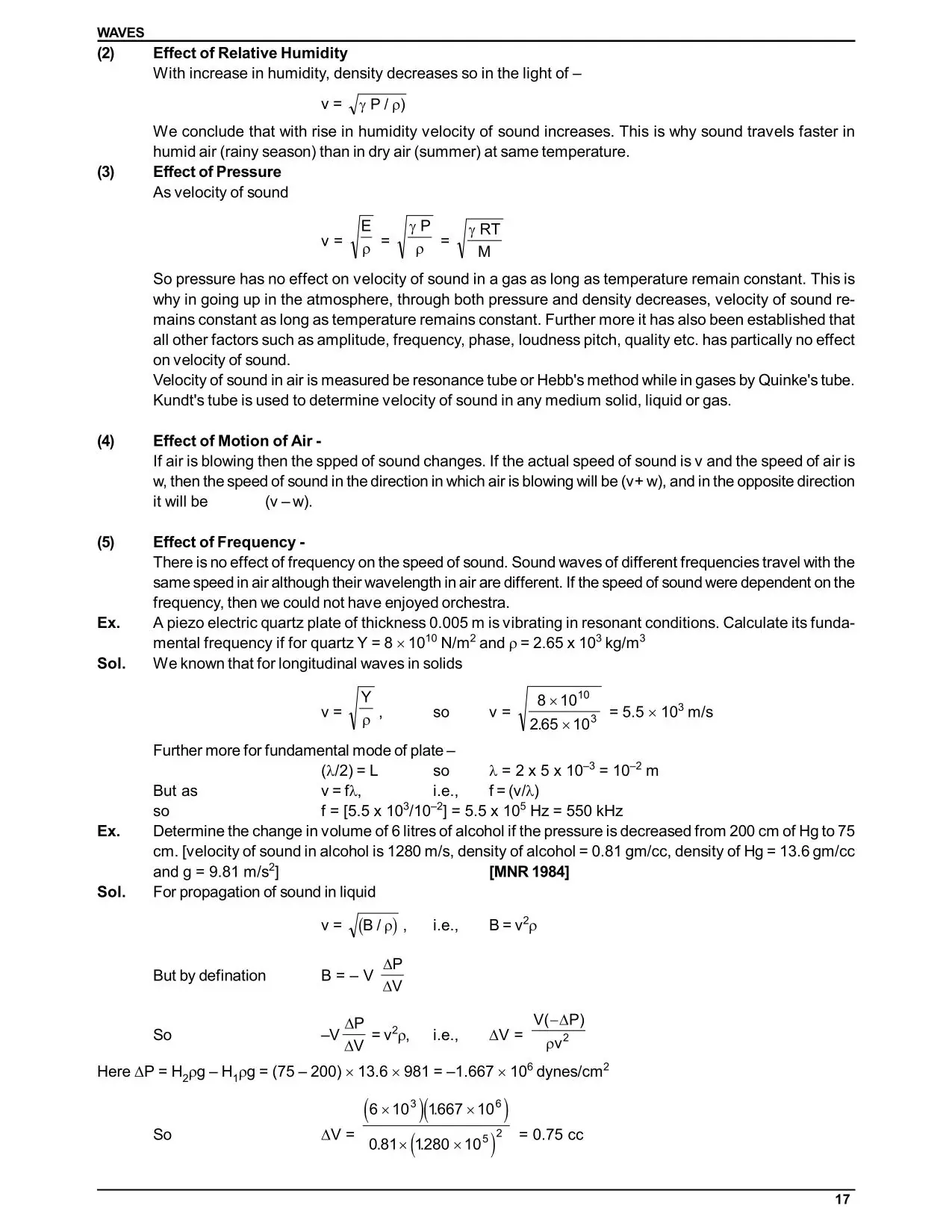
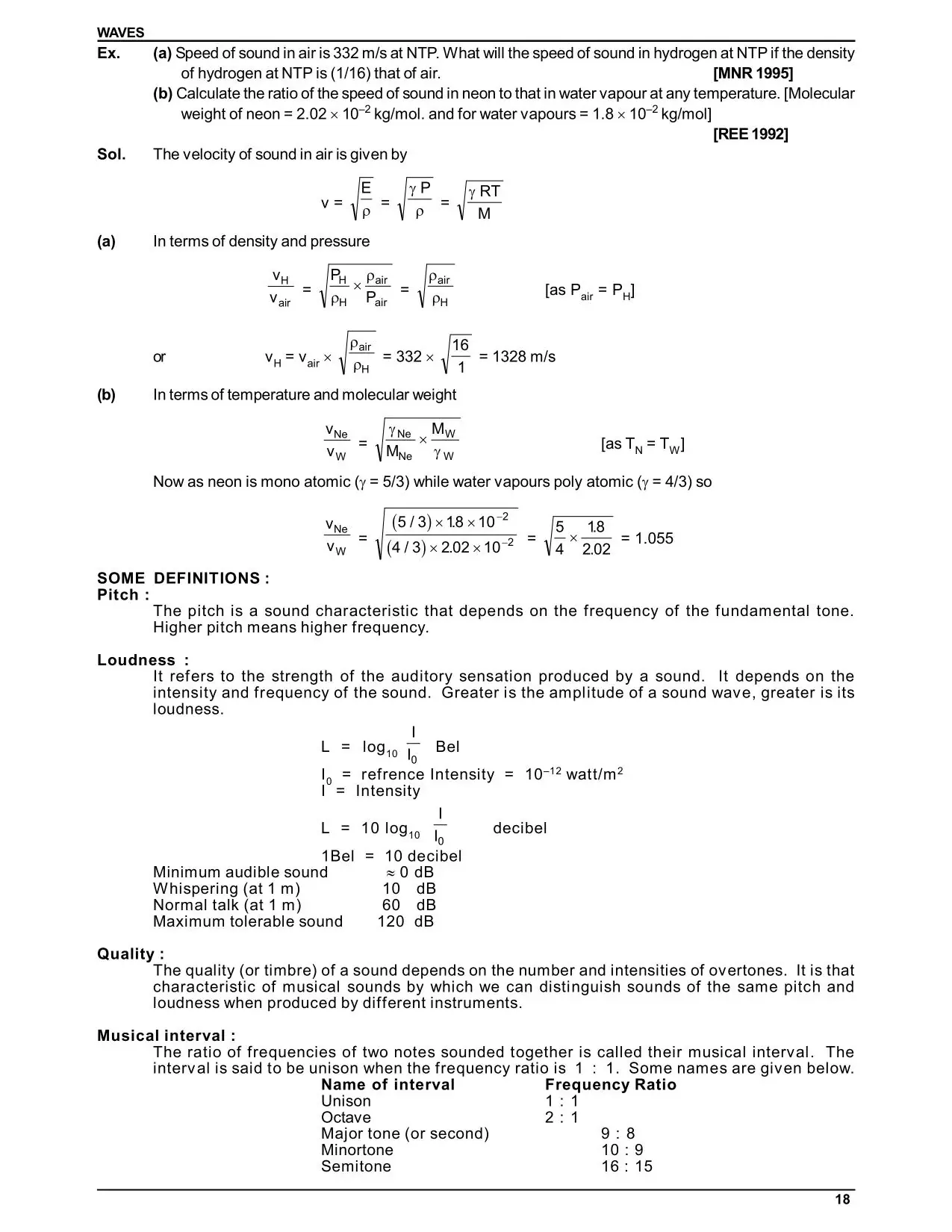
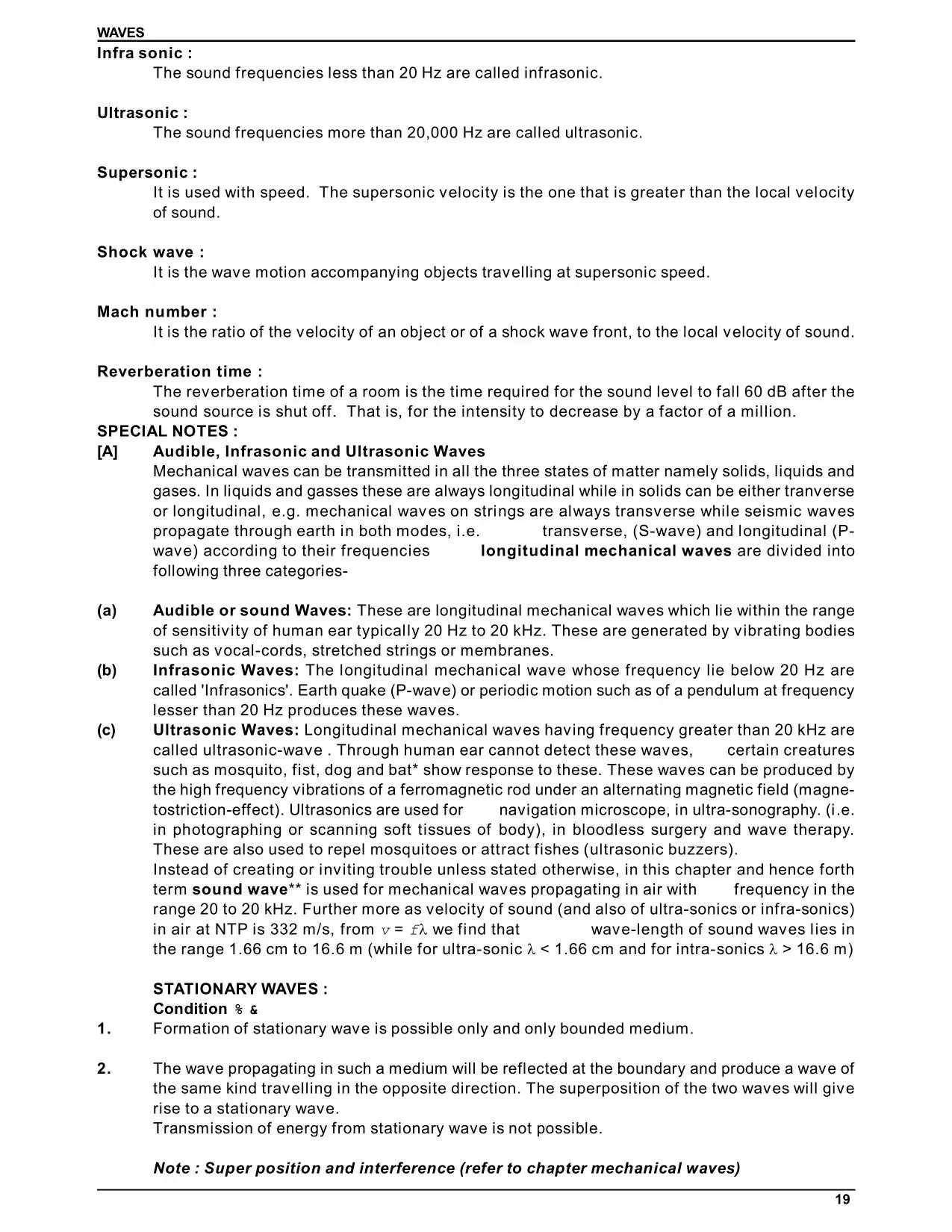
India's Best Exam Preparation for Class 11th - Download Now
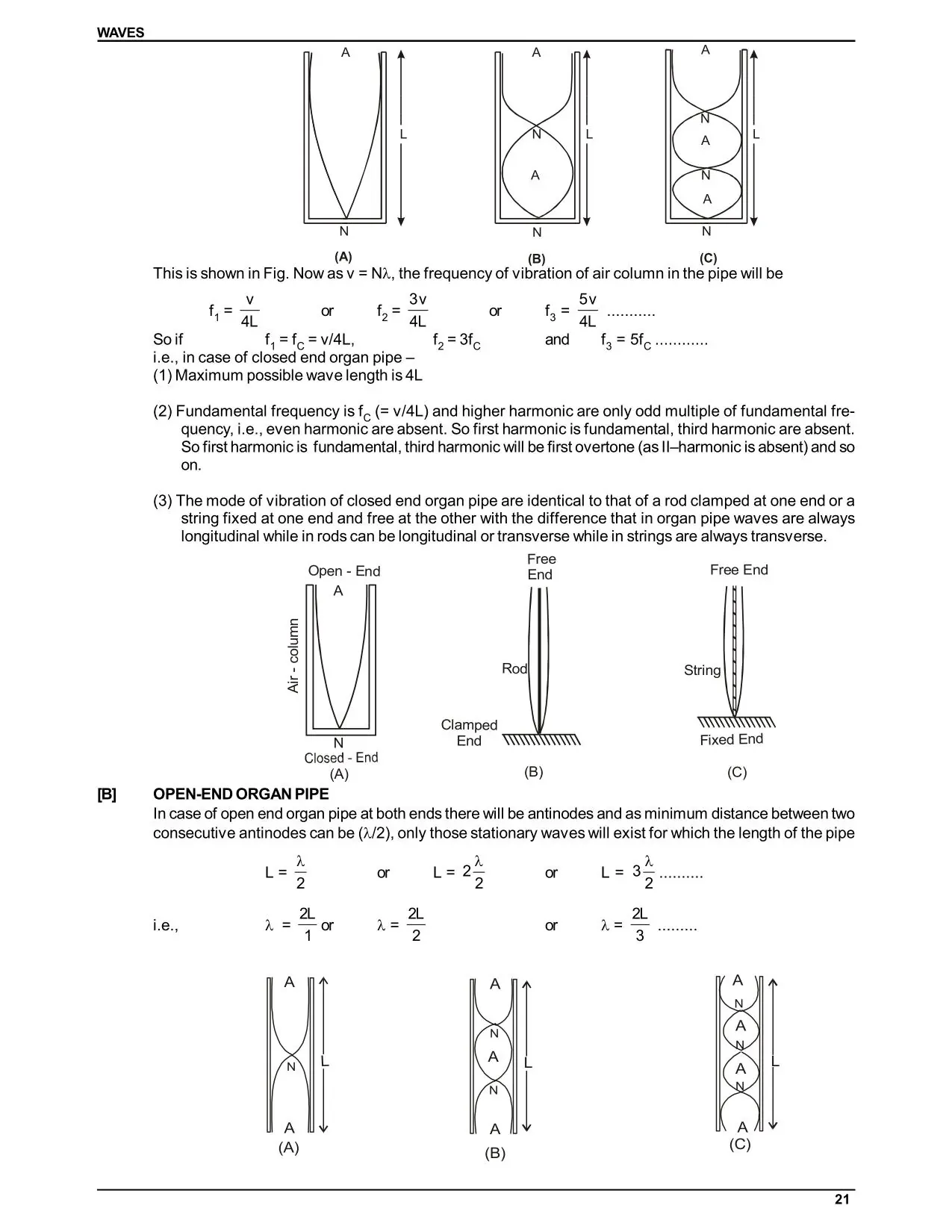
India's Best Exam Preparation for Class 11th - Download Now India's Best Exam Preparation for Class 11th - Download Now
Wave Motion and the Progressive Wave Equation in Waves Physics Class 11 Notes
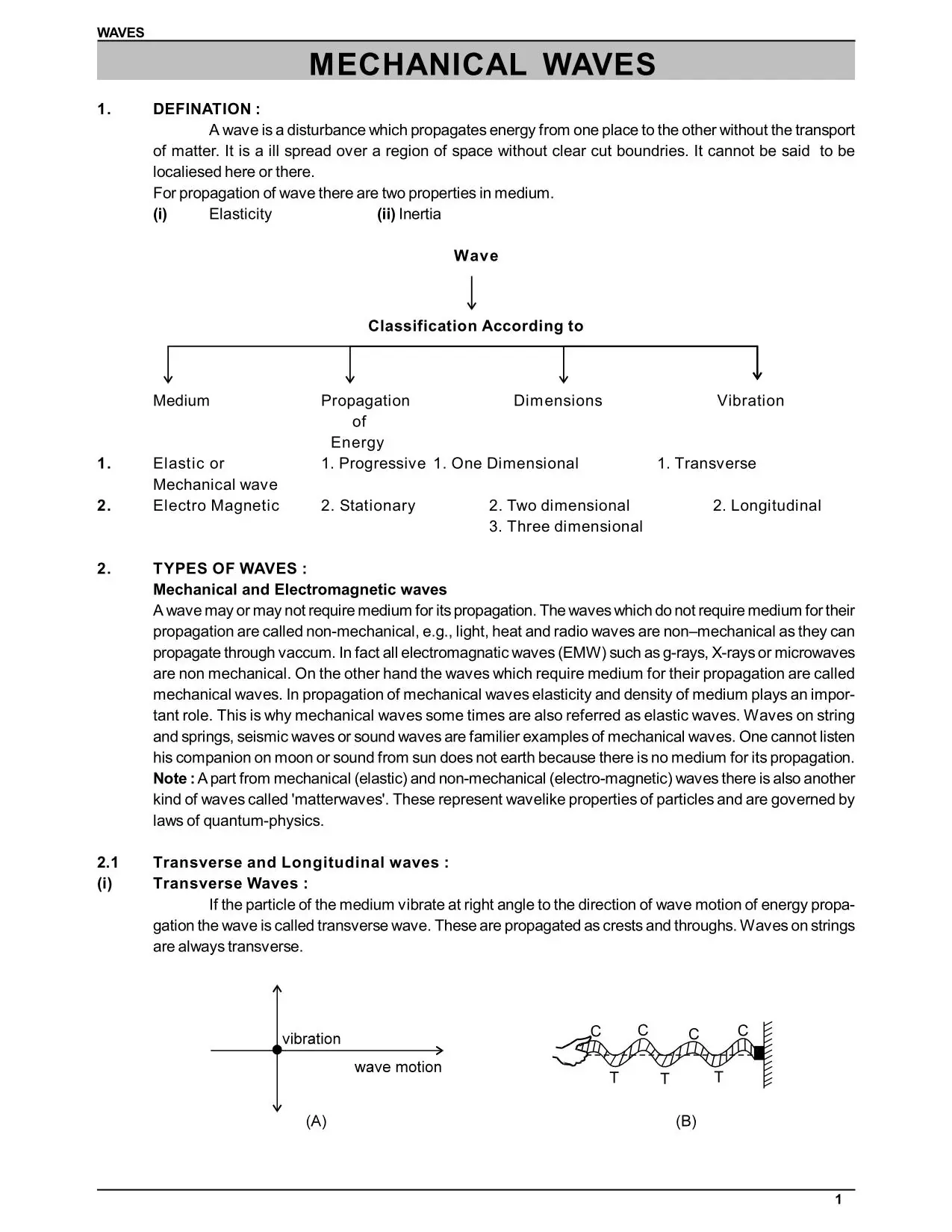
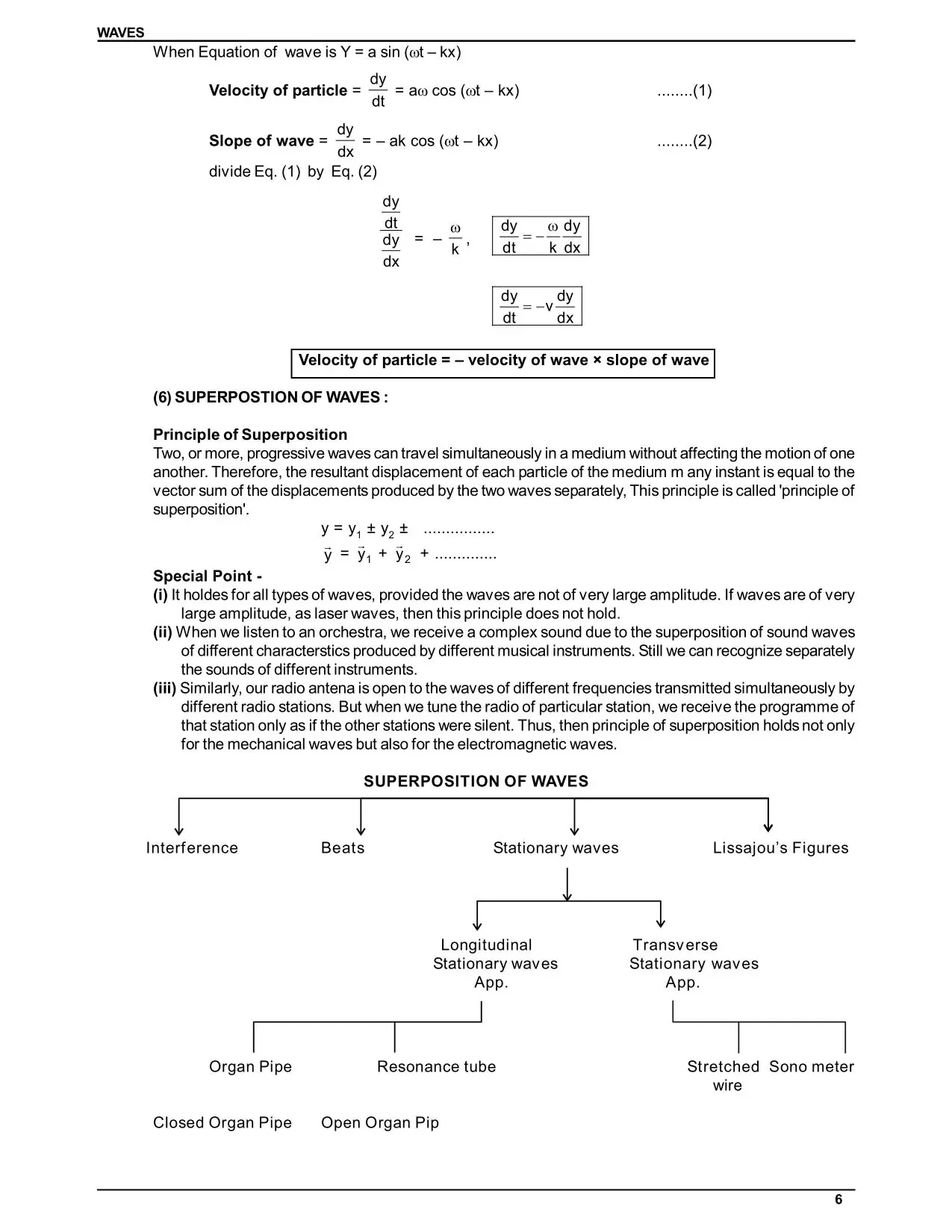
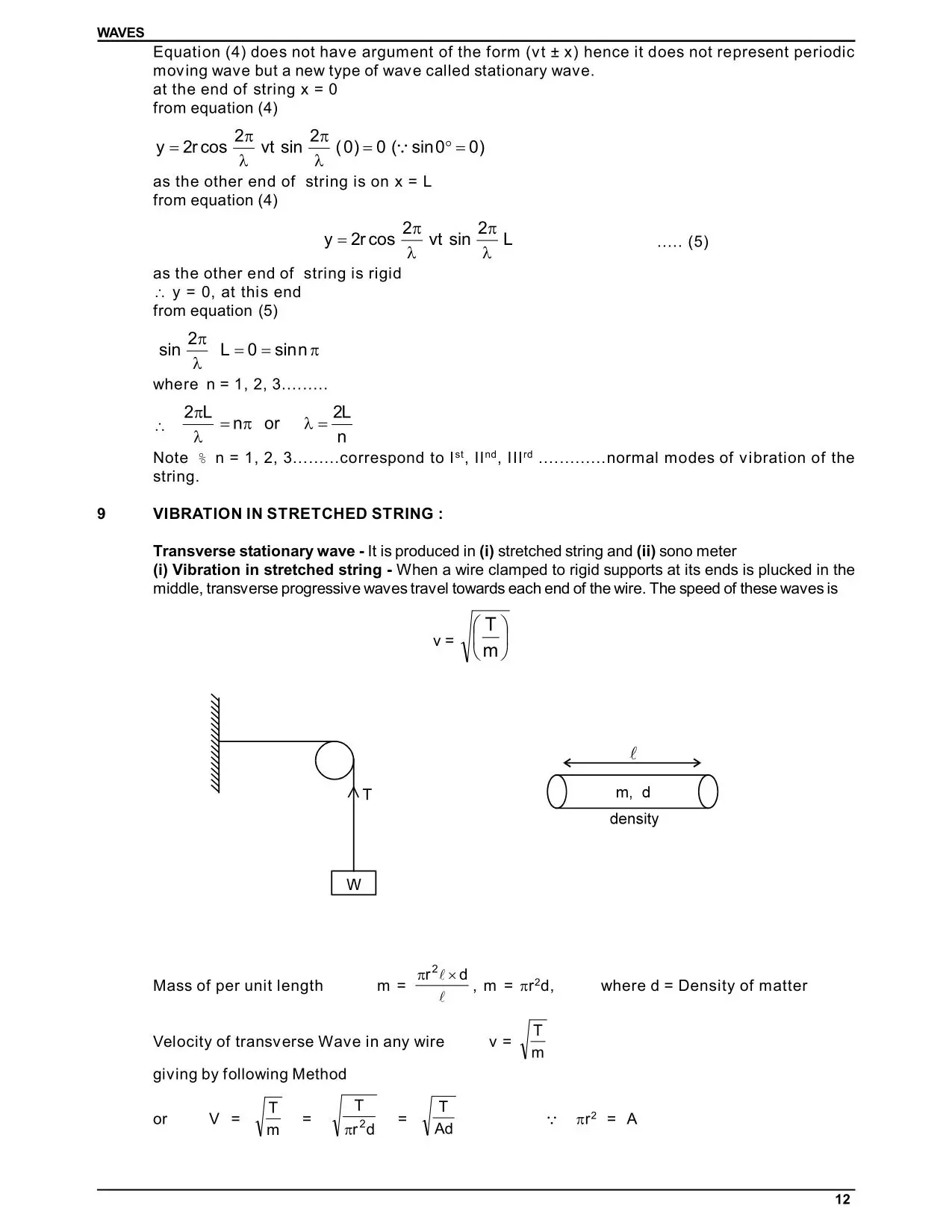
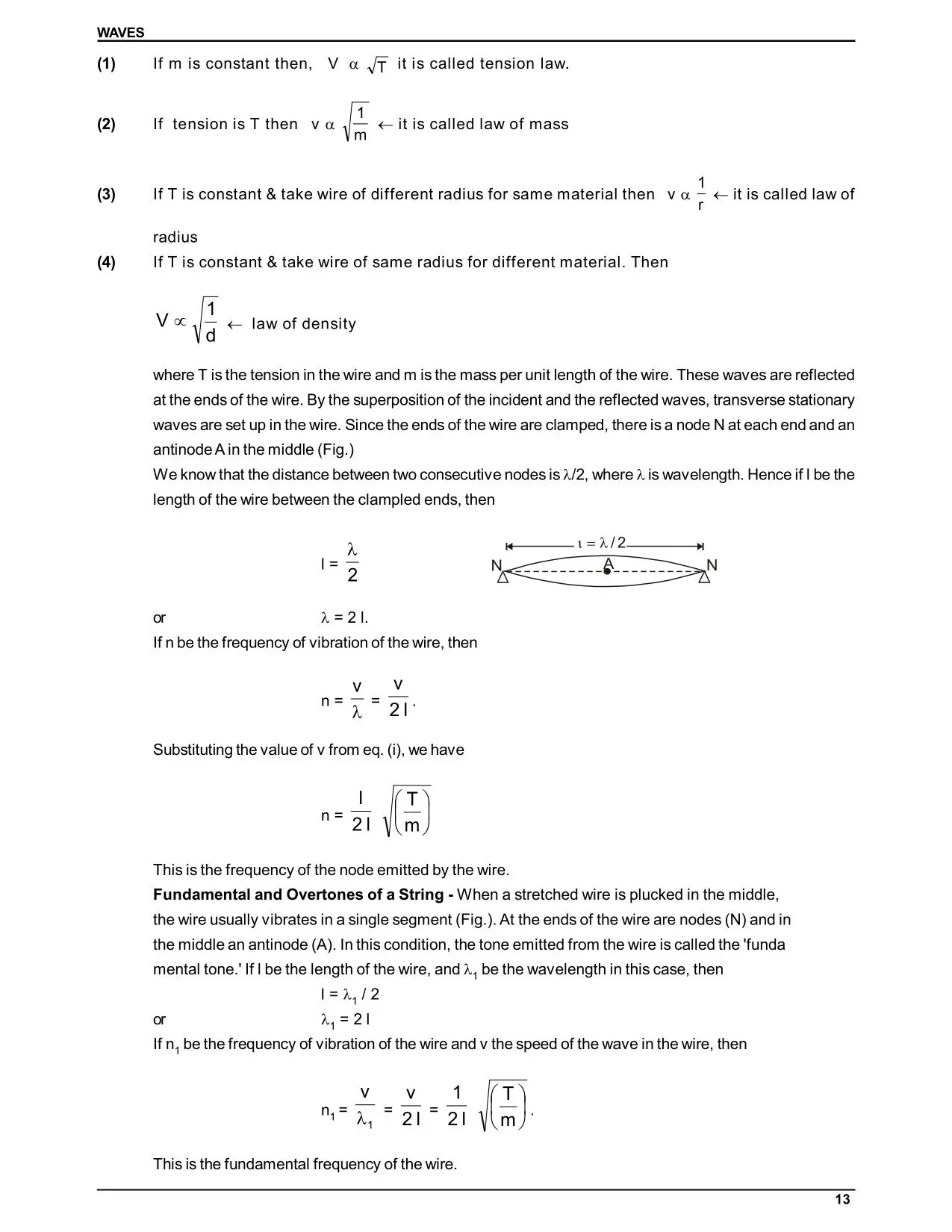
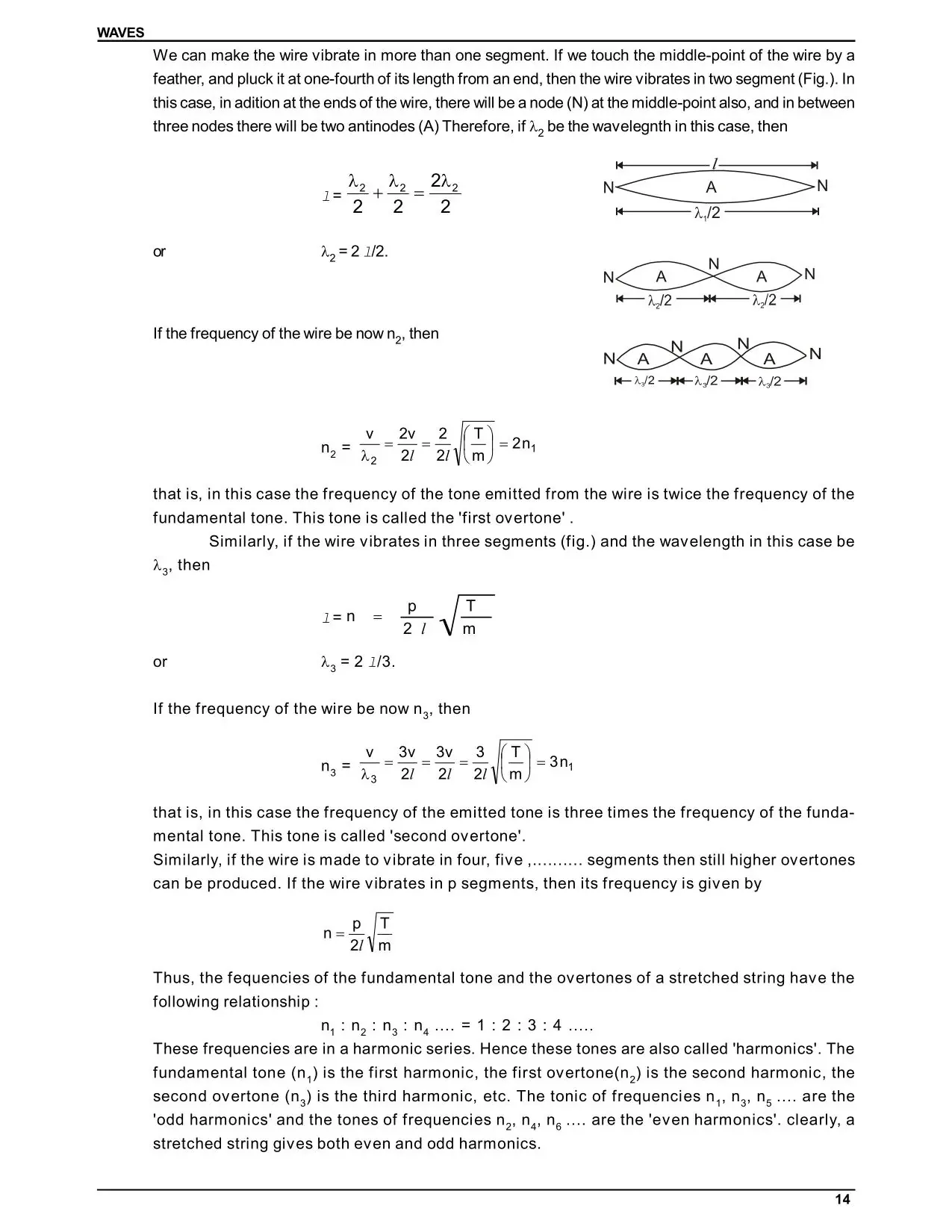
A mechanical wave needs a medium, and it carries energy without carrying matter. In a transverse wave, the particles move perpendicular to the direction of the wave (waves on a string). In a longitudinal wave, they move along it (sound in air). A transverse wave needs a medium that can resist shear (solids, and the surface of a liquid), and a longitudinal wave can travel in solids, liquids and gases.
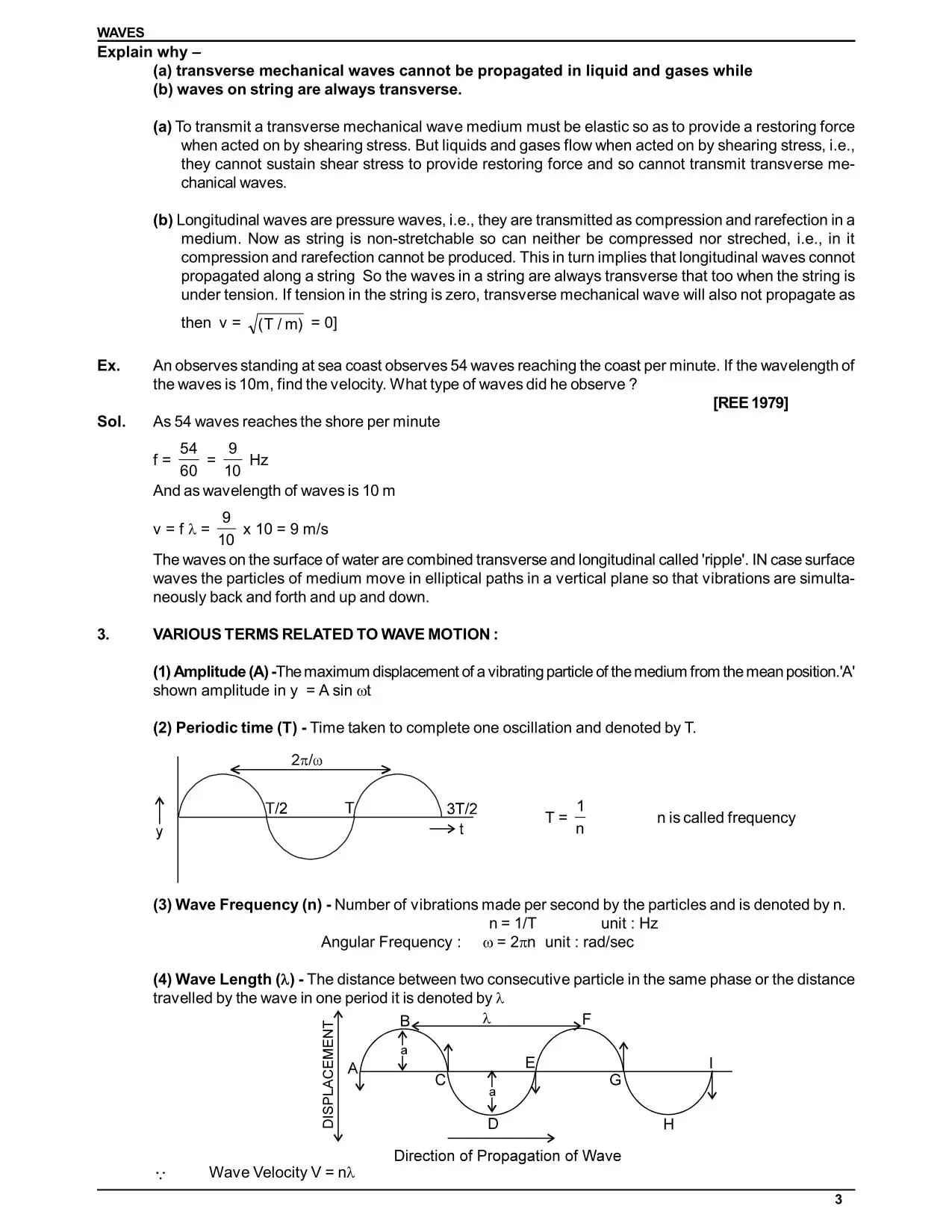
$$v = f\lambda = \frac{\omega}{k}, \qquad \omega = 2\pi f = \frac{2\pi}{T}, \qquad k = \frac{2\pi}{\lambda}$$
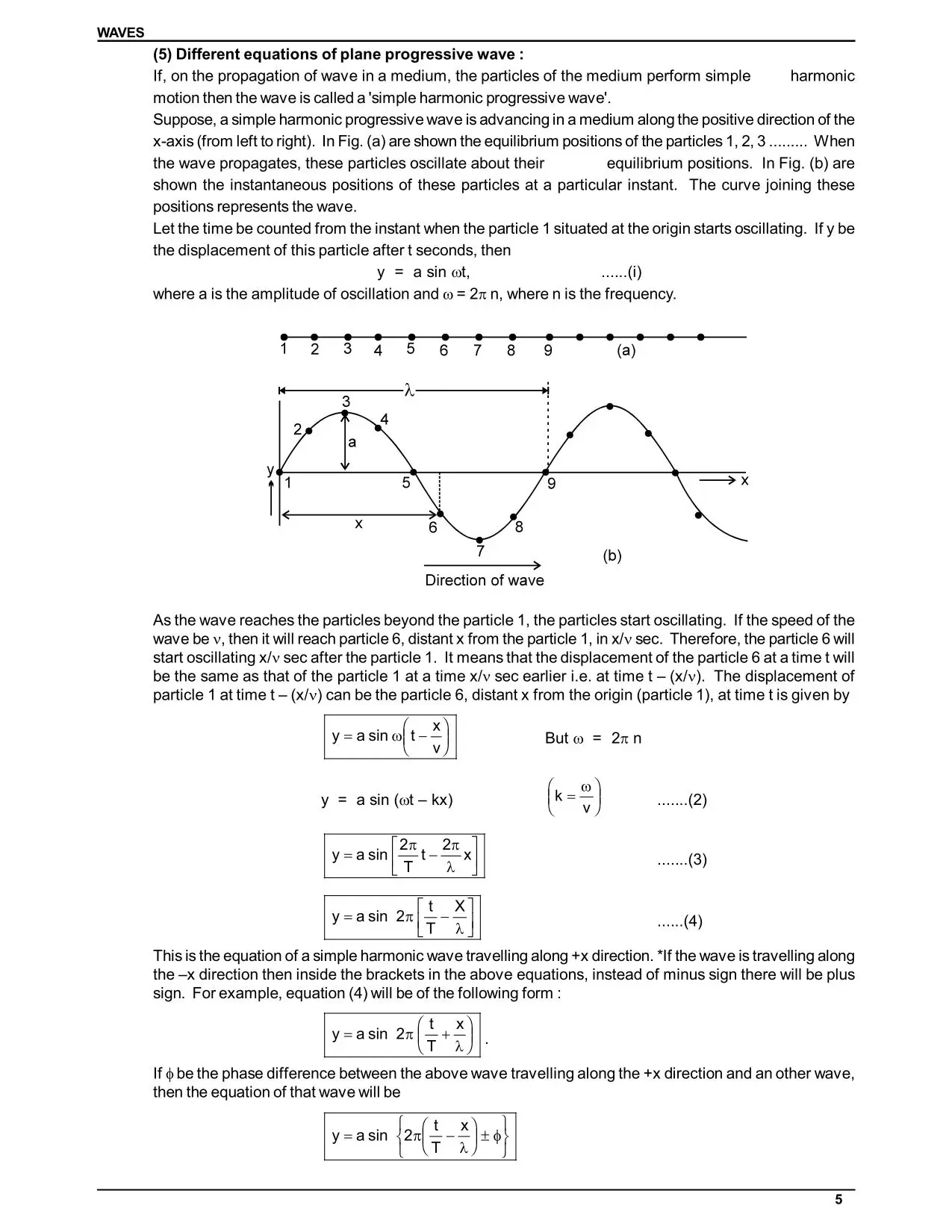
A wave that travels in the positive $x$-direction is described by:
$$y(x, t) = A\sin(kx - \omega t + \phi)$$
A wave that travels in the negative $x$-direction has $kx + \omega t$ in place of $kx - \omega t$.
Quantity | Result |
|---|---|
Particle velocity | $v_p = \dfrac{\partial y}{\partial t} = -A\omega\cos(kx - \omega t + \phi)$, and its maximum is $A\omega$ |
Relation between $v_p$ and the slope | $v_p = -v\,\dfrac{\partial y}{\partial x}$ |
Phase difference for a path difference $\Delta x$ | $\Delta\phi = \dfrac{2\pi}{\lambda}\Delta x$ |
Phase difference for a time difference $\Delta t$ | $\Delta\phi = \dfrac{2\pi}{T}\Delta t$ |
The wave speed $v$ depends only on the medium, and not on the amplitude or the frequency of the wave.
Speed of Waves and Sound in Waves Physics Class 11 Notes
Wave | Speed |
|---|---|
Transverse wave on a string | $v = \sqrt{\dfrac{T}{\mu}}$, where $T$ is the tension and $\mu$ the mass per unit length |
Longitudinal wave in a solid rod | $v = \sqrt{\dfrac{Y}{\rho}}$ |
Longitudinal wave in a liquid or a gas | $v = \sqrt{\dfrac{B}{\rho}}$, where $B$ is the bulk modulus |
Transverse wave in a solid | $v = \sqrt{\dfrac{\eta}{\rho}}$, where $\eta$ is the modulus of rigidity |
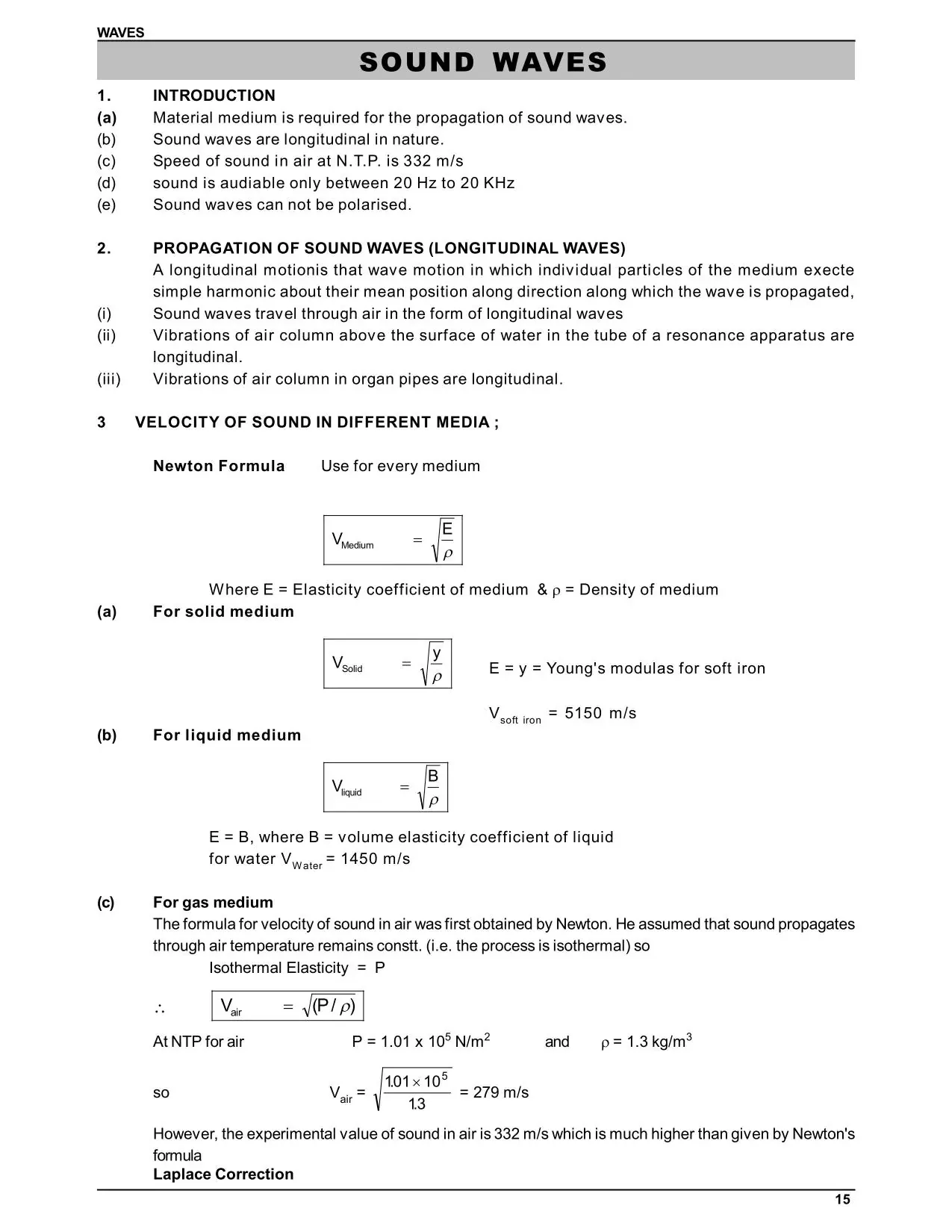
Speed of sound in a gas: Newton assumed an isothermal change and got $v = \sqrt{P/\rho}$, which gives about 280 m/s for air, and this does not match experiment. Laplace said that the compressions are so fast that the change is adiabatic:
$$v = \sqrt{\frac{\gamma P}{\rho}} = \sqrt{\frac{\gamma RT}{M}}$$
This gives about 331 m/s for air at $0,^\circ$C.
Factor | Effect on the speed of sound in a gas |
|---|---|
Temperature | $v \propto \sqrt{T}$, so $v_T = v_0\sqrt{T/T_0}$ (about $331 + 0.61\,t$ m/s, with $t$ in $^\circ$C) |
Pressure (at constant temperature) | No effect, because $P/\rho$ stays constant |
Density of the gas | $v \propto \dfrac{1}{\sqrt{\rho}}$ |
Humidity | Moist air is less dense, so the speed is slightly higher |
Wind | The speed along the wind changes by the speed of the wind |
Intensity and Interference of Waves in Waves Physics Class 11 Notes
The intensity of a wave of amplitude $A$ and angular frequency $\omega$ in a medium of density $\rho$ is:
$$I = \frac{1}{2}\rho\,v\,\omega^{2}A^{2} \quad \Rightarrow \quad I \propto A^{2}$$
The sound level is $\beta = 10\log_{10}\dfrac{I}{I_0}$ decibels, with $I_0 = 10^{-12}$ W m⁻² (an extra topic for IIT JEE).
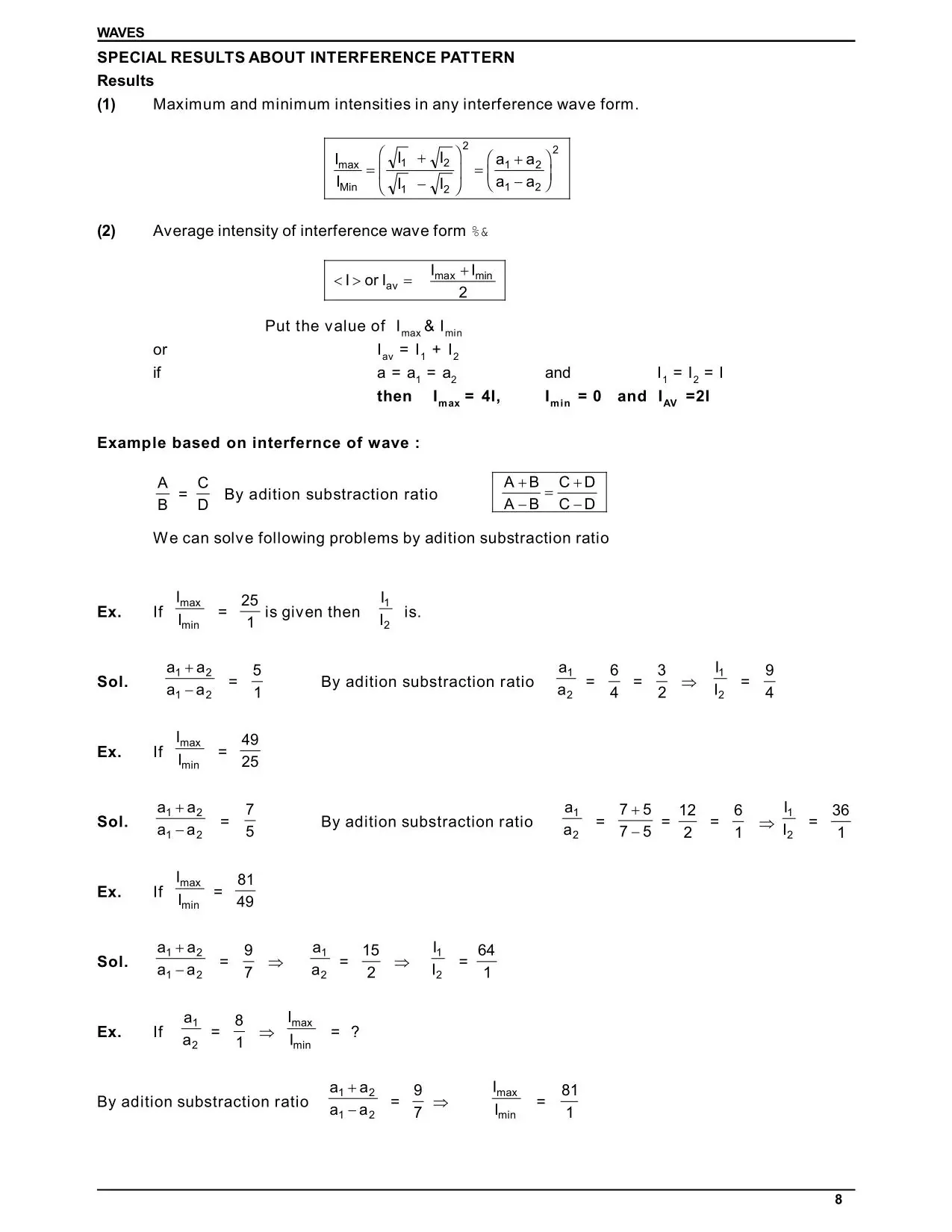
Principle of superposition: when two or more waves meet, the resultant displacement is the sum of the displacements of the individual waves. For two waves of amplitudes $A_1$ and $A_2$ with the phase difference $\phi$:
$$A = \sqrt{A_1^{2} + A_2^{2} + 2A_1A_2\cos\phi}, \qquad I \propto A^{2}$$
Interference | Phase difference | Path difference | Resultant amplitude |
|---|---|---|---|
Constructive | $2n\pi$ | $n\lambda$ | $A_1 + A_2$ |
Destructive | $(2n + 1)\pi$ | $\left(n + \tfrac{1}{2}\right)\lambda$ | $\lvert A_1 - A_2\rvert$ |
Reflection of Waves and Standing Waves in Waves Physics Class 11 Notes
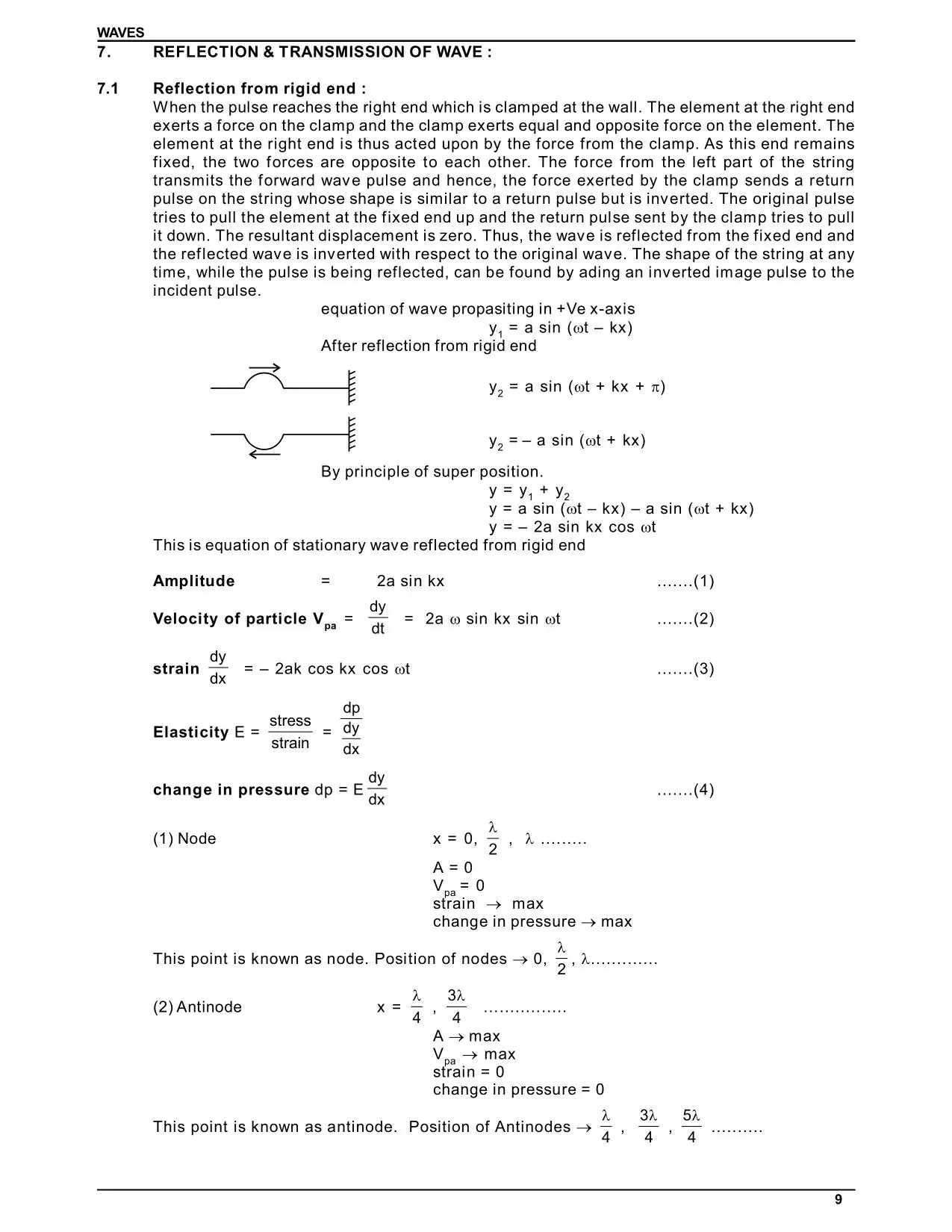
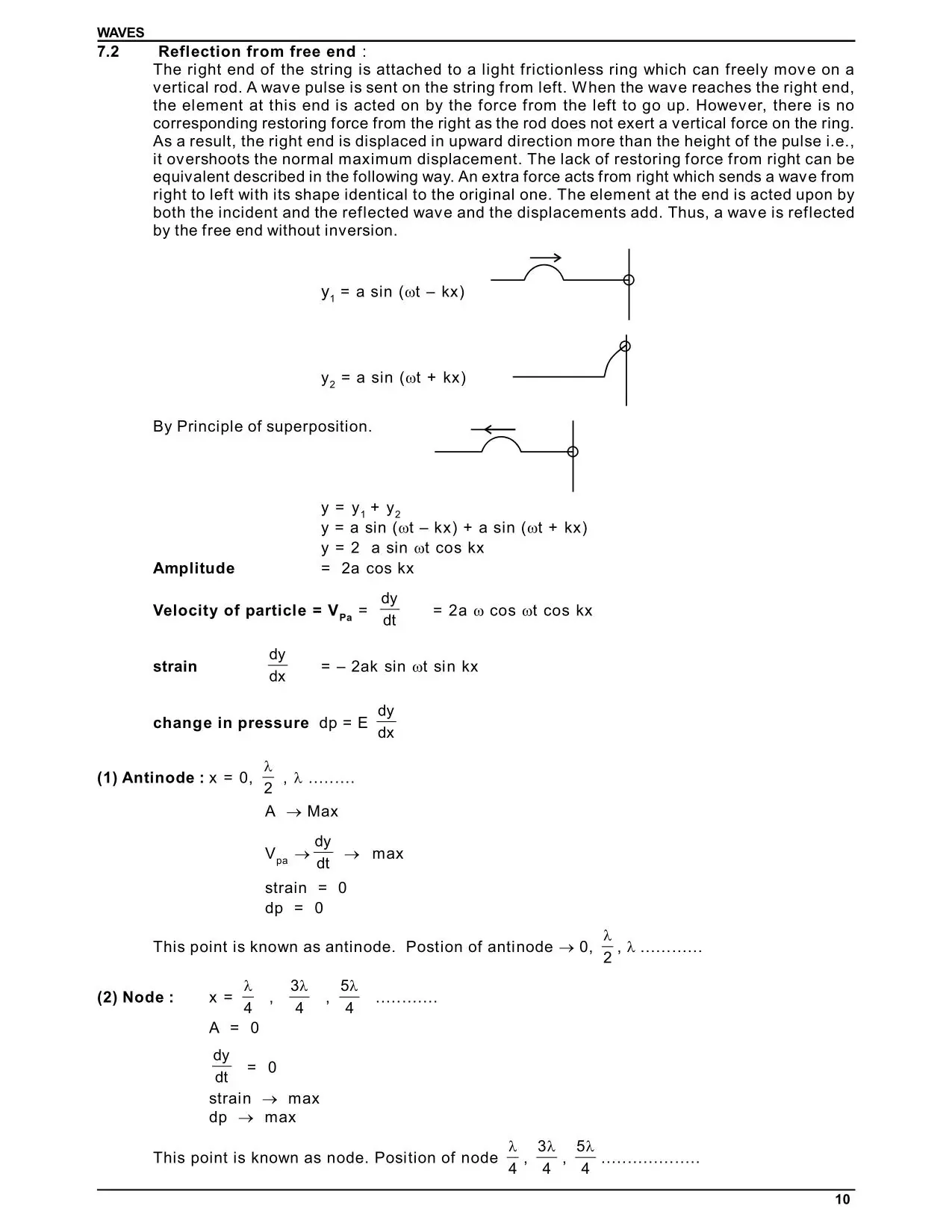
Reflection: at a rigid boundary (a fixed end), the reflected wave has a phase change of $\pi$ (a pulse comes back inverted), and a node forms at the boundary. At a free end, there is no phase change, and an antinode forms.
When two identical waves travel in opposite directions, they form a standing (stationary) wave:
$$y = A\sin(kx - \omega t) + A\sin(kx + \omega t) = 2A\sin kx\,\cos\omega t$$
- Nodes (zero amplitude) are at $x = \dfrac{n\lambda}{2}$, and antinodes (amplitude $2A$) are at $x = \left(n + \tfrac{1}{2}\right)\dfrac{\lambda}{2}$.
- The distance between two consecutive nodes (or antinodes) is $\dfrac{\lambda}{2}$, and between a node and the next antinode it is $\dfrac{\lambda}{4}$.
- All the particles between two nodes oscillate in phase, and the particles on the two sides of a node oscillate in opposite phase.
Feature | Progressive wave | Standing wave |
|---|---|---|
Energy | Transported along the wave | Not transported |
Amplitude | Same for all particles | Varies from zero (node) to maximum (antinode) |
Phase | Changes from particle to particle | Same between two nodes |
Nodes | None | Yes |
Standing Waves on a String in Waves Physics Class 11 Notes
For a string of length $L$ fixed at both ends, $L = \dfrac{n\lambda}{2}$, so the allowed frequencies are:
$$f_n = \frac{n}{2L}\sqrt{\frac{T}{\mu}}, \qquad n = 1, 2, 3, \ldots$$
The mode $n = 1$ is the fundamental (first harmonic), and the higher frequencies are the overtones. Every integer harmonic is present.
Organ Pipes and the Resonance Tube in Waves Physics Class 11 Notes
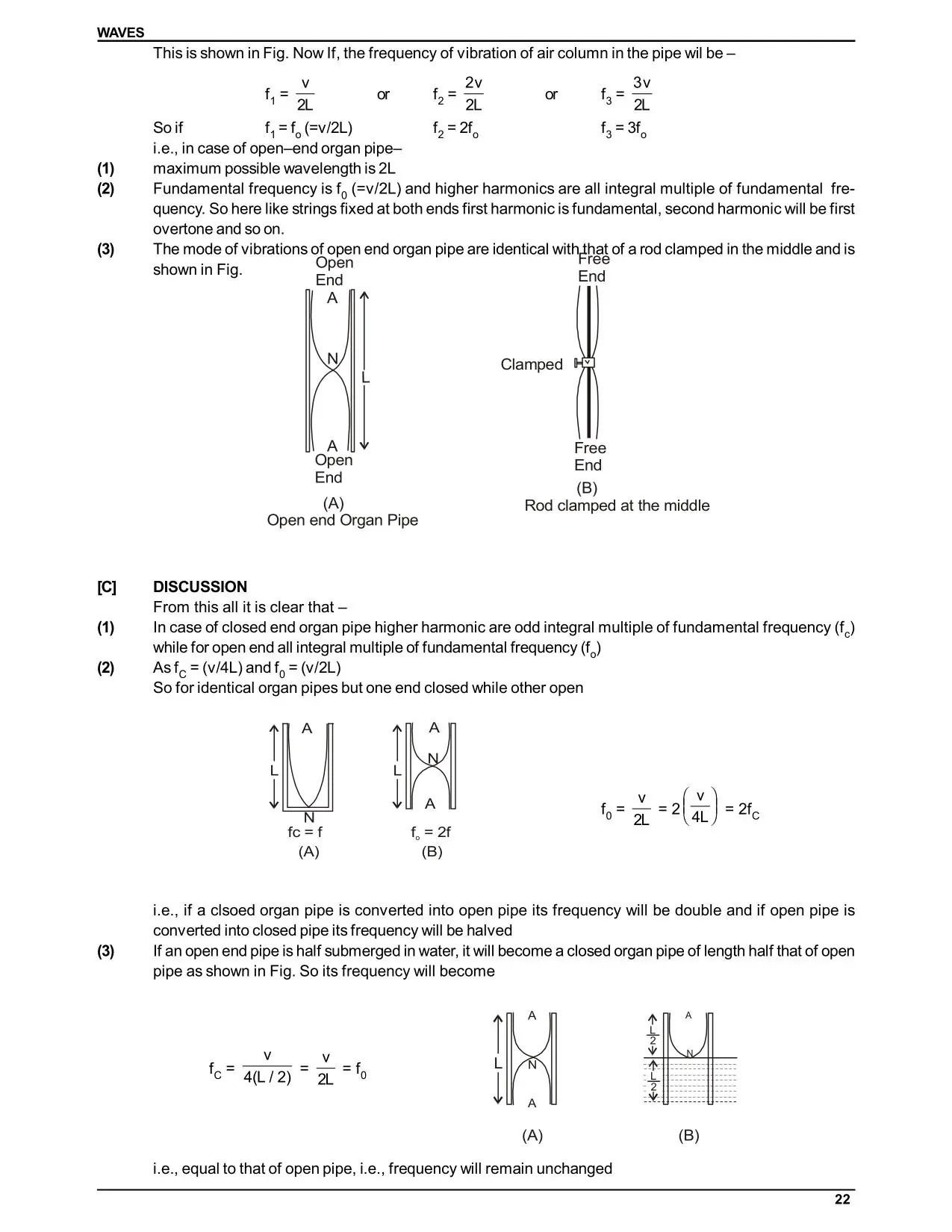
Feature | Closed organ pipe (one end closed) | Open organ pipe (both ends open) |
|---|---|---|
Ends | Node at the closed end, antinode at the open end | Antinodes at both ends |
Allowed frequencies | $f = \dfrac{(2n - 1)v}{4L}$ | $f = \dfrac{nv}{2L}$ |
Fundamental | $\dfrac{v}{4L}$ | $\dfrac{v}{2L}$ |
Harmonics present | Only odd harmonics (1st, 3rd, 5th, …) | All harmonics |
For the same length, the open pipe has a fundamental frequency that is twice that of the closed pipe.
End correction: the antinode forms slightly outside the open end. For a pipe of radius $r$, the end correction is $e \approx 0.6\,r$. The effective length is $L + e$ for a closed pipe, and $L + 2e$ for an open pipe.
Resonance tube experiment: if the first and the second resonance of a closed tube are at the air column lengths $l_1$ and $l_2$, then:
$$l_1 + e = \frac{\lambda}{4}, \quad l_2 + e = \frac{3\lambda}{4} \quad \Rightarrow \quad \lambda = 2(l_2 - l_1), \qquad v = f\lambda = 2f(l_2 - l_1), \qquad e = \frac{l_2 - 3l_1}{2}$$
Beats in Waves Physics Class 11 Notes
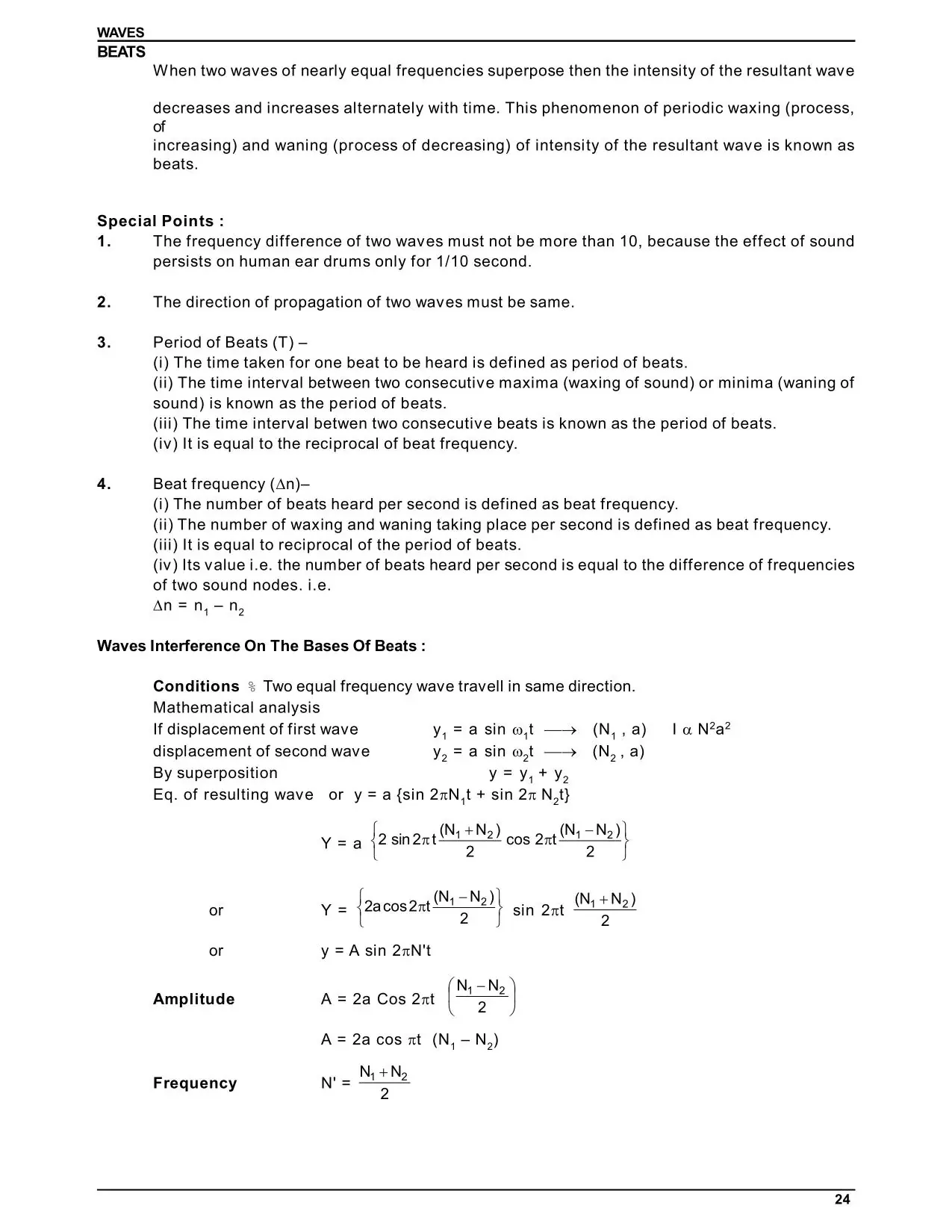
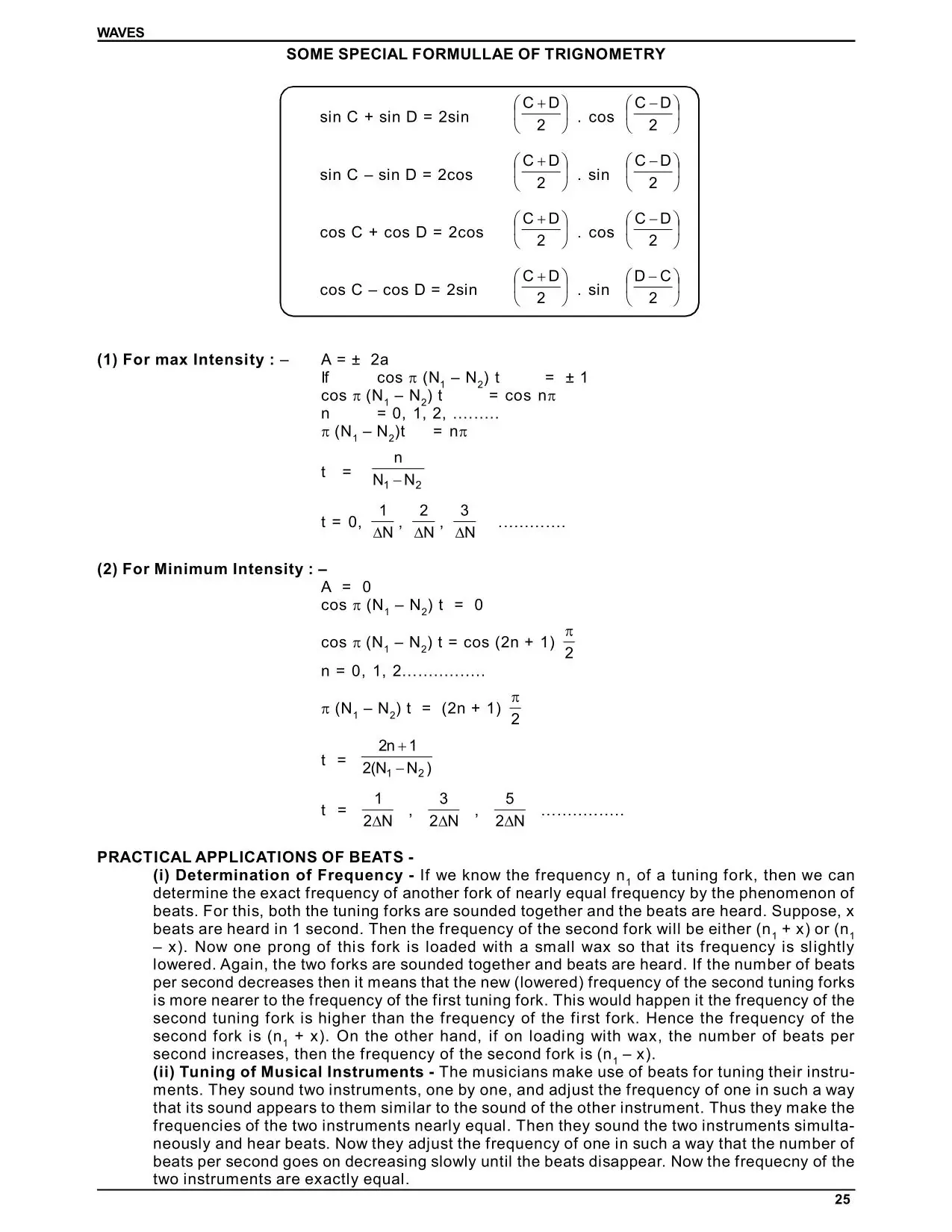
When two waves of nearly equal frequencies $f_1$ and $f_2$ are heard together, the intensity rises and falls periodically. The number of loud sounds per second is the beat frequency:
$$f_{beat} = \lvert f_1 - f_2\rvert$$
The beats are heard clearly when the beat frequency is small (the ear cannot follow a beat frequency above about 10 per second). Loading and filing a tuning fork: adding wax to the prong of a fork lowers its frequency, and filing the prong raises it. This is used to find which of two forks has the higher frequency.
Doppler Effect in Waves Physics Class 11 Notes
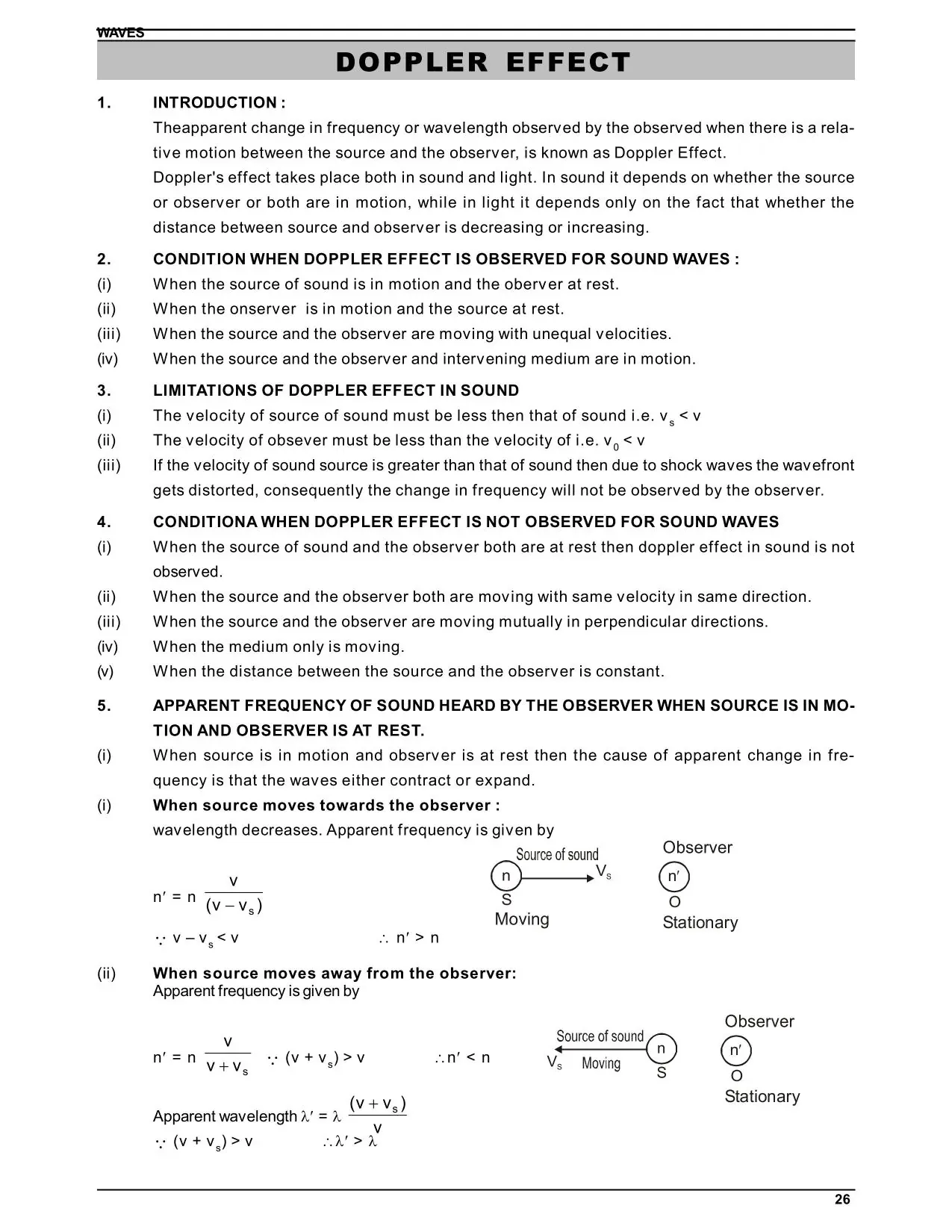
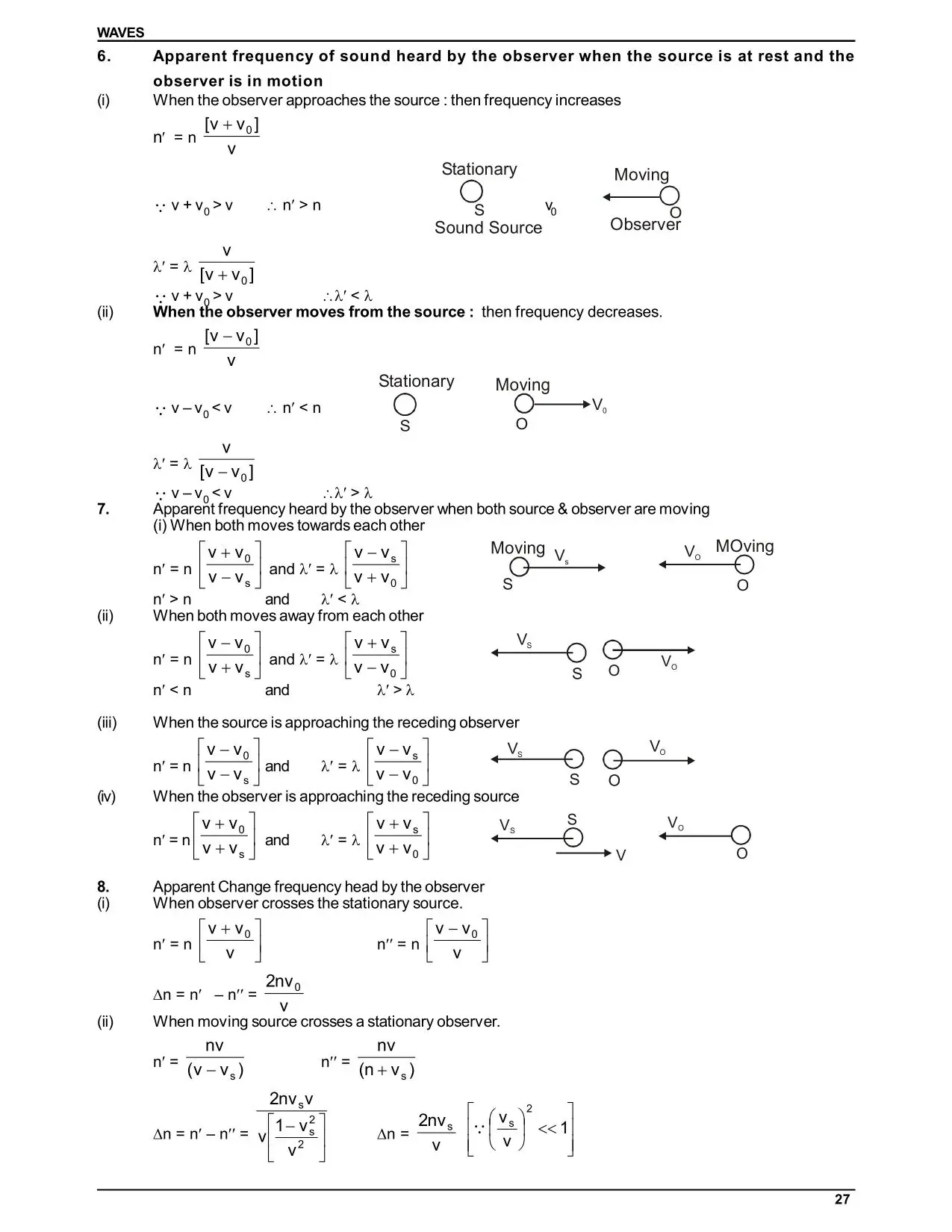
The Doppler effect is the change of the observed frequency when the source and the observer move relative to each other. Take the direction from the source to the observer as positive. If the source moves with the velocity $v_s$ and the observer with $v_o$ in this direction (both measured with respect to the medium), and $v$ is the speed of sound:
$$f' = f\,\frac{v - v_o}{v - v_s}$$
Situation | Observed frequency |
|---|---|
Source moves towards a stationary observer | $f' = f\dfrac{v}{v - v_s}$, which is higher |
Source moves away from a stationary observer | $f' = f\dfrac{v}{v + v_s}$, which is lower |
Observer moves towards a stationary source | $f' = f\dfrac{v + v_o}{v}$, which is higher |
Observer moves away from a stationary source | $f' = f\dfrac{v - v_o}{v}$, which is lower |
Both move towards each other | $f' = f\dfrac{v + v_o}{v - v_s}$ |
- The Doppler effect depends on the velocities relative to the medium. If the wind blows, add the wind velocity to the speed of sound along the wind.
- Reflection from a moving surface: a source of frequency $f$ sends sound to a wall that moves towards it with the speed $u$. The wall acts as an observer first, and then as a source, so the reflected frequency is $f'' = f\dfrac{v + u}{v - u}$.
- The wave speed $v$ and the wavelength do not change when the observer moves. The wavelength changes only when the source moves.
IIT JEE and NEET Problem Tips in Waves Physics Class 11 Notes
- Identify the type of a wave problem first: wave equation (read $A$, $k$ and $\omega$), speed (string or sound), superposition (phase or path difference), standing wave (nodes and antinodes), pipe (open or closed) or Doppler (who moves).
- Compare the coefficients. For $y = A\sin(kx - \omega t)$, find $\lambda = 2\pi/k$, $f = \omega/2\pi$ and $v = \omega/k$.
- Pipes: a closed pipe has only odd harmonics. If a pipe resonates at two consecutive frequencies in the ratio $3 : 5$, it is closed.
- The harmonics of a string are all the integers, and the number of loops is the harmonic number.
- Doppler effect: draw a line from the source to the observer, mark it positive, and put the signs of $v_s$ and $v_o$ from it. Do not memorise four separate formulas.
Key Formulas in Waves Physics Class 11 Notes
Concept | Formula |
|---|---|
Wave speed | $v = f\lambda = \omega/k$ |
Progressive wave | $y = A\sin(kx - \omega t + \phi)$ |
Speed on a string | $v = \sqrt{T/\mu}$ |
Speed of sound in a gas | $v = \sqrt{\gamma P/\rho}$, $v \propto \sqrt{T}$ |
Intensity | $I = \tfrac{1}{2}\rho v\omega^2A^2$ |
Resultant amplitude | $A = \sqrt{A_1^2 + A_2^2 + 2A_1A_2\cos\phi}$ |
Standing wave | $y = 2A\sin kx\cos\omega t$ |
String fixed at both ends | $f_n = \dfrac{nv}{2L}$ |
Closed pipe | $f = \dfrac{(2n-1)v}{4L}$ |
Open pipe | $f = \dfrac{nv}{2L}$ |
Beats | $f_{beat} = \lvert f_1 - f_2\rvert$ |
Doppler effect | $f' = f\dfrac{v - v_o}{v - v_s}$ |
Solved Examples from Waves Physics Class 11 Notes
Example 1 (reading the wave equation): A wave is $y = 0.05\sin(10\pi x - 200\pi t)$ in SI units. Find the amplitude, the wavelength, the frequency and the speed.
$A = 0.05$ m. $k = 10\pi$, so $\lambda = \dfrac{2\pi}{k} = 0.2$ m. $\omega = 200\pi$, so $f = \dfrac{\omega}{2\pi} = 100$ Hz. $v = f\lambda = 20$ m/s, and the wave travels in the $+x$ direction.
Example 2 (speed on a string): A string has a mass of 10 g per metre and a tension of 100 N. Find the speed of a transverse wave.
$v = \sqrt{\dfrac{T}{\mu}} = \sqrt{\dfrac{100}{0.01}} = 100$ m/s.
Example 3 (temperature): The speed of sound at 273 K is 331 m/s. Find it at 27 °C.
$v = 331\sqrt{\dfrac{300}{273}} \approx 331 \times 1.048 \approx 347$ m/s.
Example 4 (string modes): A string of length 1 m is fixed at both ends, and the wave speed on it is 300 m/s. Find the first three frequencies.
$f_n = \dfrac{nv}{2L} = 150n$ Hz, so the frequencies are 150, 300 and 450 Hz.
Example 5 (pipes): For $v = 340$ m/s, find the fundamental frequencies of a closed pipe and an open pipe of length 0.85 m, and the next two frequencies of the closed pipe.
Closed: $\dfrac{v}{4L} = \dfrac{340}{3.4} = 100$ Hz, and the next two are 300 Hz and 500 Hz (odd harmonics). Open: $\dfrac{v}{2L} = \dfrac{340}{1.7} = 200$ Hz.
Example 6 (interference): Two waves of amplitudes 3 and 4 units meet with a phase difference of $90^\circ$. Find the resultant amplitude, and the maximum and the minimum possible values.
$A = \sqrt{9 + 16 + 2(3)(4)\cos 90^\circ} = 5$. The maximum is $3 + 4 = 7$, and the minimum is $4 - 3 = 1$.
Example 7 (beats): Two tuning forks of 256 Hz and 260 Hz are sounded together. How many beats are heard per second?
$f_{beat} = \lvert 260 - 256\rvert = 4$ beats per second.
Example 8 (Doppler effect, source moving): A source of 400 Hz moves towards a stationary observer at 20 m/s. Find the observed frequency before and after it passes ($v = 340$ m/s).
Towards: $f' = 400 \times \dfrac{340}{340 - 20} = 425$ Hz. Away: $f' = 400 \times \dfrac{340}{340 + 20} \approx 377.8$ Hz.
Example 9 (Doppler effect, observer moving): An observer moves at 17 m/s towards a stationary source of 500 Hz. Find the frequency that he hears ($v = 340$ m/s).
$f' = 500 \times \dfrac{340 + 17}{340} = 525$ Hz.
Example 10 (both moving): A source of 1000 Hz moves at 30 m/s towards an observer who moves at 20 m/s towards the source ($v = 340$ m/s). Find the observed frequency.
$f' = 1000 \times \dfrac{340 + 20}{340 - 30} = 1000 \times \dfrac{360}{310} \approx 1161$ Hz.
Example 11 (resonance tube): The first and the second resonance of a closed tube with a 440 Hz fork are at 18 cm and 56 cm. Find the speed of sound and the end correction.
$\lambda = 2(l_2 - l_1) = 2(56 - 18) = 76$ cm, so $v = f\lambda = 440 \times 0.76 \approx 334$ m/s. $e = \dfrac{l_2 - 3l_1}{2} = \dfrac{56 - 54}{2} = 1$ cm.
Example 12 (intensity and sound level): The amplitude of a sound wave is doubled. Find the change in the intensity and in the sound level.
$I \propto A^2$, so the intensity becomes 4 times. The sound level increases by $10\log_{10}4 \approx 6$ dB.
Common Mistakes in Waves Physics Class 11 Notes Problems
Mistake | Correct approach |
|---|---|
Thinking that the wave speed depends on the frequency or the amplitude | It depends only on the medium |
Writing the Doppler formula with the wrong signs | Take the direction from the source to the observer as positive |
Saying that a closed pipe has all the harmonics | It has only the odd harmonics |
Using the length of the pipe without the end correction | Add $e$ for a closed pipe and $2e$ for an open pipe, if the radius is given |
Using $v \propto T$ for sound | $v \propto \sqrt{T}$, with $T$ in kelvin |
Thinking that a standing wave transports energy | It does not |
Adding intensities of two waves directly | Add the displacements, then square: $I \propto A^2$ |
Taking the speed of sound as dependent on the pressure at constant temperature | It is independent of the pressure, because $P/\rho$ is constant |
How to Study Waves Physics Class 11 Notes
- Read the NCERT chapter first, and download the textbook from eSaral’s NCERT books for Class 11 page.
- Learn Waves Physics Class 11 Notes in this order: the wave equation and the phase, then the speed of waves, then superposition and standing waves, and last the pipes, the beats and the Doppler effect.
- Practise one problem each on the wave equation, a string, an open pipe, a closed pipe, beats and Doppler effect, using the tips on this page.
- Revise with eSaral’s Class 11 Physics notes, and use the free Physics revision series on YouTube for quick formula revision.
- Test yourself with eSaral’s JEE Main chapter-wise PYQs and NEET chapter-wise PYQs.
Frequently Asked Questions
What is the difference between a closed and an open organ pipe?
A closed organ pipe (one end closed) has a node at the closed end and an antinode at the open end. It supports only the odd harmonics, and its fundamental frequency is $\dfrac{v}{4L}$. An open organ pipe (both ends open) has antinodes at both ends, supports all the harmonics, and its fundamental frequency is $\dfrac{v}{2L}$. For the same length, the open pipe gives a higher pitch. eSaral’s Waves Physics Class 11 Notes compare the two in a table.
What is the Doppler effect, and how is it asked in IIT JEE?
The Doppler effect is the change in the observed frequency because of the relative motion of the source and the observer, $f' = f\dfrac{v - v_o}{v - v_s}$ with the direction from the source to the observer as positive. IIT JEE problems ask for numerical values with moving sources and observers, reflection from a moving wall, and the effect of wind. In Waves Physics Class 11 Notes, the main trap is a wrong sign, so decide the signs from the direction first.
What are the main topics in the Waves chapter for IIT JEE and NEET?
In Waves Physics Class 11 Notes, the main topics are the progressive wave equation, the speed of a wave on a string and the speed of sound (Newton and Laplace), superposition and interference, standing waves on strings, organ pipes and the resonance tube, beats and the Doppler effect. The number of questions changes every year, so check previous years’ papers.
What is beat frequency, and how is it calculated?
The beat frequency is the number of loud sounds per second when two waves of nearly equal frequencies are heard together. It is the difference of the frequencies, $f_{beat} = \lvert f_1 - f_2\rvert$. A fork of 256 Hz and one of 260 Hz give 4 beats per second. In Waves Physics Class 11 Notes, loading and filing of a fork are used to find which fork has the higher frequency.
Why does sound travel faster in summer than in winter?
In Waves Physics Class 11 Notes, the speed of sound in a gas is $v = \sqrt{\gamma RT/M}$, so $v \propto \sqrt{T}$ with $T$ in kelvin. At a higher temperature, the molecules move faster, so the disturbance is passed on faster. For air, $v \approx 331$ m/s at 273 K and about 347 m/s at 300 K.
How do standing waves form, and what are nodes and antinodes?
In Waves Physics Class 11 Notes, a standing wave forms when two identical waves travel in opposite directions in the same medium (for example, a wave and its reflection). Nodes are the points where the displacement is always zero, and antinodes are the points where the amplitude is maximum. The distance between two consecutive nodes is $\lambda/2$. This decides the allowed frequencies in strings and pipes.
Is the Doppler effect in the CBSE Class 11 syllabus?
It was removed from the rationalised CBSE Class 11 syllabus, so check the latest syllabus for your board. It is listed in the JEE Main syllabus, and it is a common topic in IIT JEE problems, so these Waves Physics Class 11 Notes include it in full.
What is the speed of sound formula given by Newton and Laplace?
Newton took the compression as isothermal and got $v = \sqrt{P/\rho}$, which gives about 280 m/s for air. These Waves Physics Class 11 Notes give both formulas. Laplace corrected it by taking the change as adiabatic, $v = \sqrt{\gamma P/\rho}$, which gives about 331 m/s at $0,^\circ$C, in agreement with experiment.
Which chapter number is Waves in Class 11 Physics?
In the current NCERT Class 11 Physics book, Waves is Chapter 14 (Chapter 15 in older books), after Oscillations. In the JEE Main syllabus, it is part of the unit Oscillations and Waves. These Waves Physics Class 11 Notes follow the NCERT chapter and add the IIT JEE and NEET topics.
Where can I find more Class 11 Physics notes on eSaral?
eSaral has chapter-wise Class 11 Physics notes, NCERT books, a free Physics revision series on YouTube, JEE Main and NEET chapter-wise PYQs and these Waves Physics Class 11 Notes, all linked on this page.
Team eSaral
eSaral Academic and Editorial Team
Team eSaral is the collective author profile for educational content created by eSaral’s teachers and academic contributors. The team draws on expertise from IIT graduates, doctors, experienced educators and subject specialists to develop resources for JEE, NEET and school students. Our articles aim to explain concepts clearly and help students study with confidence.
Related Posts

BITSAT 2027: Registration Date, Exam Date, Syllabus, Eligibility, Pattern & Fees
BITSAT 2027 exam dates, registration timeline, eligibility criteria, exam pattern, marking scheme, syllabus and fees in one page.

BITSAT Previous Year Question Paper PDF (2017-2026)
Download BITSAT previous year question papers PDF from 2017 to 2026,session-wise. Memory-based papers,exam pattern, paper analysis and how to practise

CBSE Class 10 Date Sheet 2027: Expected Exam Dates, Release Date, Admit Card & Result Timeline
CBSE Class 10 date sheet 2027 is awaited. See the expected exam dates, release window, how to download the PDF, admit card and result timelines.

NCERT Physics Class 10 Book PDF in Hindi 2026-27 – भौतिक विज्ञान के 4 अध्याय (Free Download)
NCERT Physics Class 10 book PDF in Hindi 2026-27: download all 4 chapters (अध्याय 9–12) free, with topics and important formulas.

NCERT Biology Class 9 Book Anveshan PDF in Hindi - जीव विज्ञान कक्षा 9 पुस्तक अन्वेषण PDF
Download NCERT Biology Class 9 book PDF in Hindi chapterwise for 2026-27: Cell, Tissues, Reproduction and Diversity. Free PDFs.

Essay On Artificial Intelligence in English (100,150, 200, 250, 300, 500 Words)
This is in contrast to the natural intelligence of humans. With Artificial Intelligence, machines can perform

Essay on 78th India Independence Day in English for Student (100, 150, 200, 250, 300, 500 Words)
Read the best essays on India's Independence Day in English. Short & long essays (100, 150, 200, 250, 300, 500 words) perfect for school exams
NCERT Class 11 English Snapshots book - Free PDF download- Esaral
Download NCERT Class 11 English Snapshots book PDF for free. Get all 8 chapters, chapter-wise. Start your prep today!
NCERT Class 10 biology book pdf - Free PDF Download - eSaral
NCERT Class 10 Biology book PDF 2026-27: all 5 chapters (Life Processes to Our Environment) in English & Hindi, with CBSE syllabus, marks & practical

Essay on Global Warming in English (100,150, 200, 250, 300, 500 Words)
Global warming means the Earth is getting hotter. This happens because of things like pollution from cars and factories.